Classification, expression pattern and comparative analysis of sugarcane expressed
sequences tags (ESTs) encoding glycine-rich proteins (GRPs)
Adriana Fusaro
1, Amanda Mangeon
1, Ricardo Magrani Junqueira
1, Carla Andréa Benício Rocha
1,
Tatiana Cardoso Coutinho
1, Rogério Margis
1,2and Gilberto Sachetto-Martins
1*Abstract
Since the isolation of the first glycine-rich proteins (GRPs) in plants a wealth of new GRPs have been identified. The highly specific but diverse expression pattern ofgrpgenes, taken together with the distinct sub-cellular localization of some GRP groups, clearly indicate that these proteins are involved in several independent physiological processes. Notwithstanding the absence of a clear definition of the role of GRPs in plant cells, studies conducted with these proteins have provided new and interesting insights into the molecular biology and cell biology of plants. Complexly regulated promoters and distinct mechanisms for the regulation of gene expression have been demonstrated and new protein targeting pathways, as well as the exportation of GRPs from different cell types have been discovered. These data show that GRPs can be useful as markers and/or models to understand distinct aspects of plant biology. In this paper, the structural and functional features of these proteins in sugarcane (Saccharum officinarumL.) are summarized. Since this is the first description of GRPs in sugarcane, special emphasis has been given to the expression pattern of these GRP genes by studying their abundance and prevalence in the different cDNA-libraries of the Sugarcane Expressed Sequence Tag (SUCEST) project . The comparison of sugarcane GRPs with GRPs from other species is also discussed.
INTRODUCTION
The occurrence of quasi-repetitive glycine-rich pep-tides has been reported in several different organisms. Glycine-rich regions are thought to be involved in pro-tein-protein interactions in at least three families of mam-malian proteins: keratins, loricrins and a series of single stranded RNA-binding proteins (Steinertet al., 1991).
Glycine-rich proteins (GRPs) are distinguished by their characteristic primary structure, having a glycine con-tent of 20 to 70% which forms glycine-rich domains pre-dominantly arranged in quasi-repetitive (Gly-X)n motifs. In plants, the expression of genes encoding GRPs is devel-opmentally regulated, and also induced by physical, chemi-cal and biologichemi-cal factors such as wounding, virus infection, circadian rhythms, temperature, salinity, drought, flooding, light, salicylic acid, abscisic acid and ethylene. Besides having highly modulated expression, several GRPs also show tissue-specific expression patterns (reviewed in Sachetto-Martinset al., 2000).
The first clue for the existence of GRPs came from the observation that, in certain plant tissues, glycine is the major fraction of total nitrogen. Examples are soybean and the seed-coat of gourds which contain 21% of glycine and the cell wall of milkweed stem (31% glycine) and oat coleoptile cells (27% glycine) (Varner and Cassab, 1986). Glycine-rich proteins have indeed been isolated from pumpkin seed-coat
(47% glycine) by Varner and Cassab (1986) and strawberry fruit (49% glycine) by Reedy and Poovaiah (1987). The first
grpgene was isolated by Condit and Meagher (1986). The protein encoded by this gene contains 67% of glycine resi-dues and has a predicted density very similar to the pumpkin protein isolated by Varner and Cassab (1986). These data, together with the identification of an eukaryotic signal pep-tide at the N-terminus of PtGRP-1, suggest that this protein is indeed a member of the GRP class of cell wall proteins.
Because the GRPs first described were cell wall lo-cated, a structural function has always been attributed to the protein encoded by every newgrpgene described. How-ever, the accumulated data clearly indicate that this concept is an oversimplification and GRPs may have very diverse locations and functions, with the only common feature among all the different GRPs being the presence of glycine-repeat domains (Steinertet al., 1991). As discussed by Steinert et al. (1991) in mammalian keratins, the glycine-repeat domains are highly flexible and may act as a “velcro” zipper in protein-protein interactions. This high flexibility makes GRPs good candidates to work in con-junction with other proteins and other macromolecules. GRPs do not necessarily perform structural functions, but it is possible that their glycine-rich regions allow these pro-teins to assume a structure necessary for their correct con-formation and/or interactions with other proteins (Sachetto-Martins et al., 2000). It is quite possible that
1
Laboratório de Genética Molecular Vegetal, Departamento de Genética, Instituto de Biologia, CCS, Bloco A - sala A2-076, Universidade Federal do Rio de Janeiro, Ilha do Fundão, 21944-970 Rio de Janeiro, RJ, Brazil.
2
GRPs are components of different multi-molecular com-plexes, with the glycine-rich domain being required for the stabilization and flexibility of molecular interactions in such structures. Alberts (1998) introduced the idea of the cell as a collection of protein machines, and because multi-ple molecular systems play distinct roles in cell physiology they need to be differentially regulated, which could ex-plain the highly complex gene expression pattern of GRPs.
The large spectrum of modulation and subcellular lo-cations, together with the broad structural diversity of the GRPs (even in a plant with a compact genome such as
Arabidopsis thaliana),indicates that GRPs do not represent a unique class of proteins. Instead, plant GRPs probably represent a diverse set of proteins which are not necessarily related (Sachetto-Martinset al., 2000).
In this paper we describe the isolation of sugarcane GRPs and summarize the structural and functional features of these proteins. During our research, special emphasis was placed on the expression pattern of these genes by studying their abundance and prevalence in the different cDNA-libraries of the Sugarcane Expressed Sequence Tag (SUCEST) project. The comparison of GRPs from sugar-cane with GRPs from other species will also be discussed.
MATERIAL AND METHODS
Sequence data, alignment and phylogenetic analysis
A basic local alignment sequence tool (BLAST) T-Blast-n search (Altschulet al., 1997) was performed us-ing GRP sequences listed in a recent review (Sachetto-Martins et al., 2000) as baits against the full SUCEST expressed sequence tag (EST) data bank, using
the fragment assembly program Phrap (www.pharap.com) for clustering. The Clustal W program was used to align the different standards with the proteins deduced from the SUCEST clusters (Thompsonet al., 1994).
Phylogenetic analysis was performed using the Mo-lecular Evolutionary Genetics Analysis (MEGA) software (Kumar et al., 2000). The neighbor-joining distance method was used with the pairwise deletion option for the treatment of amino acid gaps during the multiple alignment of sugarcane GRPs. For construction of the phylogenetic tree the confidence levels assigned at various nodes were determined with 5000 replications using the Interior Branch test (Sitnikovaet al., 1995).
SUCEST cDNA libraries
All sugarcane (Saccharum officinarumL.) sequences used during this work were obtained from the SUCEST project and derived from cDNA libraries specific to differ-ent sugarcane tissues, organs or conditions of growth (for detailed information see http://sucest.lad.ic.unicamp.br/ cgi-bin/prod/BD/webobjects/LibraryList.pl).
RESULTS AND DISCUSSION
Distribution of glycine-rich proteins genes on SUCEST data bank
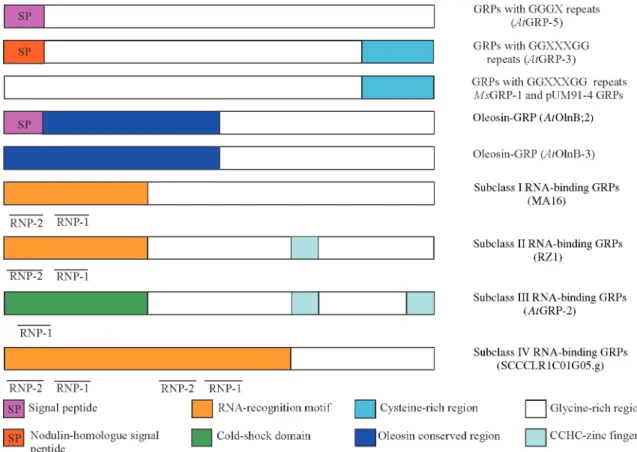
As the name of this collection of proteins suggests, glycine repeats are the major structural feature of GRPs. The glycine-rich domains of plant GRPs consist of se-quence repeats that can be summarized by the formula (Gly)n-X. However, several other distinct motifs can also be identified (Table I and Figure 1). Among these, two
fre-Table I- Glycine-rich proteins genes in the SUCEST databank.
GRP General
characteristics
Representative member
Number of genes publisheda
Number of SUCEST
clusters
SUCEST clus-ters with prefer-ential expression
GGGX repeats Signal peptide, cell wall or membrane located
PvGRP1.8 20 (4) 37 28
GGXXXGG repeats Signal peptide and C-terminal cysteine-rich domains homologues to nodulins
AtGRP-3 11 (2) 8 7
GXGX repeats Proteins with lower glycine content - 19 (3) 20 11
Oleosin-GRP Oleosin conserved
sequenceTapetal-specific expression
AtOlnB-2 and
AtOlnB-3
12 (0) 0 0
RNA-binding GRP (subclass I) RRM and GGYGG repeats MA16CCR1 20 (8) 62 14
RNA-binding GRP (subclass II) RRM, CCHC zinc finger and GGYGG repeats
RZ-1 2 (1) 11 5
RNA-binding GRP (subclass III) Cold-shock domain, CCHC zinc fingers and GGYGG repeats
AtGRP-2 2 (0) 10 6
RNA-binding GRP(subclass IV) Multiple RRM motifs SCCCLR1C01G05.g - 2 0
Total 86 (18) 150 70
a
quently observed consensus sequences split GRPs into two major groups: group 1, the consensus targeting the endo-plasmic reticulum (signal peptide) which is present in most of the GRPs identified up to now, and group 2, the RNA-binding consensus sequences RNP-1 and RNP-2. As discussed by Sachetto-Martinset al.(2000), other motifs also exist, e.g. the RNA-recognition motif (RRM), the oleosin-conserved domain, the cold-shock domain, CCHC zinc-fingers, the C-rich carboxy-terminus, the amphiphilic -helix and H-rich, P-rich and T-rich sequences.
Five different classes of GRPs are shown in Table I, three groups based on the pattern of the glycine-rich repeats (class I, GGGX; class II, GGXXXGG; class III, GXGX) and two other groups based on the type of functional con-served motif (class IV, the oleosin glycine-rich proteins and class V, the RNA-binding GRPs).
In order to search the SUCEST database for genes en-coding glycine-rich proteins, we used the typical GRP pro-teins sequences described for other species as well as the common motifs frequently found in these proteins. Differ-ent types of GRPs were found, a total of 150 differDiffer-ent clus-ters being distributed among the general classes summarized in Table I, representing the first isolation of sugarcane GRP genes. These data show that the SUCEST sequences are equivalent to the large collection of GRPs from monocotyledonous plants already published. Even when compared in absolute terms, the number of GRP
genes listed in this paper surpasses the number of GRPs available before, suggesting that our inventory might con-tain almost all the GRPs expressed in monocotyledonous plants.
Oleosin GRPs are specifically expressed in the anther tapetum layer ofBrassica and Arabidopsis(both dicoty-ledonous plants). The presence of oleosin-conserved se-quences in GRPs is indicative of the involvement of these GRPs in lipid stabilization during tapetal development, as upon tapetal degradation lipid-containing complexes are sorted to the pollen coat to become part of tryphine (Tinget al., 1998). Interestingly no member of the oleosin-GRP class was found in the SUCEST data bank. The absence of oleosin-GRPs in sugarcane and the fact that this kind of GRP has never been isolated from a monocotyledonous plant is evidence of the differences between the anthers and pollen grains of monocotyledonous and dicotyledonous plants.
The distribution of each EST sequence between the different SUCEST libraries was also analyzed. The SUCEST data bank comprises 291,689 EST sequences, ar-ranged in 43,141 clusters, these reads coming from 37 dif-ferent cDNA libraries constructed from difdif-ferent plant tissues under different culture conditions (see http://sucest. lad.ic.unicamp.br/cgi-bin/prod/BD/webobjects/LibraryLis t.pl). Since several GRP genes present tissue-specific ex-pression in other plants, we analyzed the distribution of the
reads from each cluster per library, considering as preferen-tially expressed clusters all those in which the reads came from two different libraries at most. Several clusters pre-sented a putative tissue-specific expression pattern.
Sugarcane ESTs encoding GRPs with GGGX repeats
The typical GGGX array is the most frequently ob-served array, and is generally present in GRPs displaying a signal peptide and high (40% to 70%) glycine content. How-ever, it can also be observed in GRPs without a signal peptide but with RNA-binding sequences, in which case the repeats are usually GGGY (Sachetto-Martinset al., 2000).
The existence of a signal peptide consensus sequence in the N-terminal end of most GRPs suggests that these proteins are located in the cell wall or cell membrane. Studies with
PvGRP-1.8 have shown that this GRP is localized in the cell wall of proto-xylem elements and, surprisingly, is exported to these cells rather than synthesized there (Ryser and Keller, 1992). The same pattern of exportation to a non-producing cell has been observed forPtGRP-1 (Condit, 1993).
By analogy with HRGPs, Sachetto-Martinset al.(2000) have proposed that cell wall GRPs have a structural function, probably acting as a scaffold or agglutinating agent for deposi-tion of cell wall constituents. The detecdeposi-tion ofPvGRP-1.8 in tis-sues undergoing lignification might indicate some interaction between these two cell wall components. The presence of tyro-sine residues in many plant cell wall GRPs, the progressive re-duction in solubility ofPvGRP-1.8 and soybean GRP during development and the detection of a higher molecular weight isoform ofZmGRP-4 in root cap mucilage may indicate that the association of these proteins with themselves or with other components of the extracellular matrix might occur via isodityrosine cross-links, as described for the extensins (Sachetto-Martinset al., 2000).
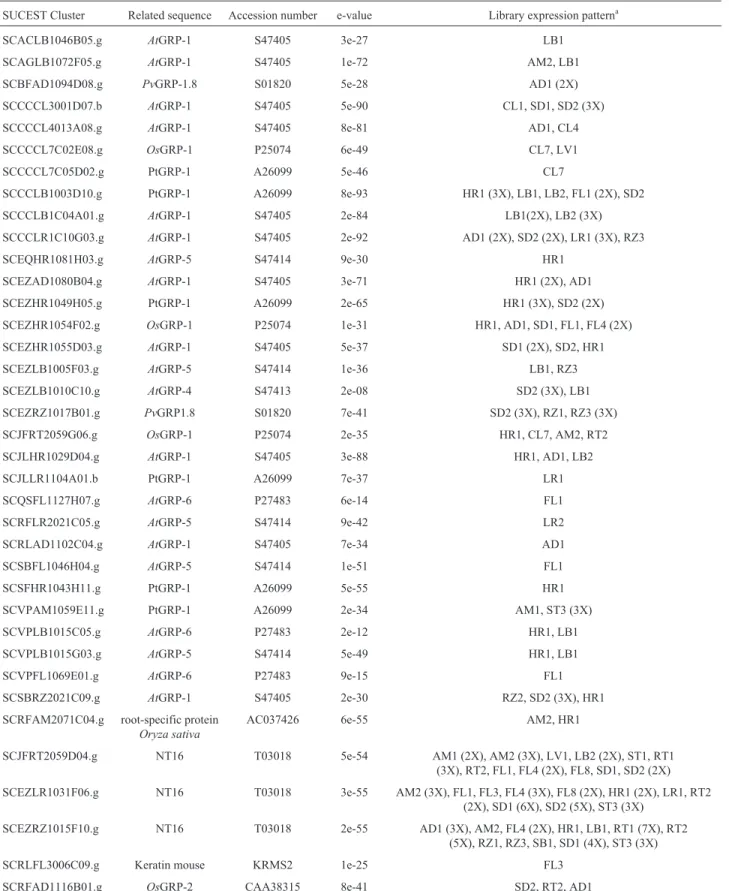
Thirty-seven clusters encoding GRPs with GGGX re-peats were identified in the SUCEST database. These se-quences were different to each other but related to different types of GRPs previously described from monocotyledon-ous and dicotyledonmonocotyledon-ous plants (Table II). Among these 37 clusters, 28 were isolated from only one or two types of li-braries, indicating that these genes could correspond to GRPs with a potential tissue-specific expression pattern. Four of these clusters (SCBFAD1094D08.g, SCEQHR 1081H03.g, SCRLAD1102C04.g and SCSFHR 1043H11.g) were specifically identified in the library pre-pared from sugarcane infected with the nitrogen-fixating endosymbiont bacteria Herbaspirillum rubrisubalbicans
(HR) andGluconacetobacter diazotroficans(AD), suggest-ing a possible role for these genes in the mechanism of plant-microbe interaction. Four leaf-specific clusters (SCA CLB1046B05.g, SCCCLB1C04A01.g, SCJLLR1104 A01.b and SCRFLR2021C05.g) and four flower-specific clusters (SCQSFL1127H07.g, SCSBFL1046H04.g, SCVPFL1069E01.g and SCRLFL3006C09.g) were also observed.
To analyze the similarities between the 37 sugarcane GRPs and the 20 genes previously published by Sachetto-Martinset al.(2000) we aligned these sequences, but, as expected due to the high variation in the structure of this type of GRP, the alignments obtained presented many gaps and regions with no sequence overlapping, which made the construction of a dendrogram impossible.
Sugarcane ESTs encoding GRPs with N- and C-terminal domains homologous to nodulins
The GGXXXGG repeat occurs in a group of GRPs in which some members share similarities with soybean nodulin 24 (Sandalet al., 1992), the tripeptide repetition interspersed between the glycine residues being generally composed of Y, H, R, N or Q. Some of these GRPs have been proposed to be located at the interface between the host plant membrane and the matrix surrounding the endosymbiont (Sandal et al., 1992). Tripeptides with similar composition have been ob-served in non-GRP extracellular matrix proteins. We propose that it may be a ligand attachment region, in analogy to the RGD motif of the extracellular matrix adhesive proteins of mammals. The tripeptide repeats in plant GRPs may also rep-resent interactive sites for association with other proteins or with other cellular structures (Sachetto-Martinset al., 2000).
The binding function of this type of GRP has been re-cently proved by the interaction ofAtGRP-3 with the extra-cellular domain of cell wall associated kinases (WAKs). It was shown that phosphorylation modulates this interaction and that the cysteine-rich C-terminal domain of AtGRP-3 is responsible for this interactionin vitro. AtGRP-3 regulates Wak1 function through binding to its cell wall domain and the interaction of Wak1 with AtGRP-3 occurs in a patho-genesis-related processin planta(Parket al., 2001).
Searching the SUCEST data bank using the previously reported GRPs with N- and C-terminal domains homologous to nodulins, as well as the cysteine-rich domain, allowed us to identify 8 different GRPs (Table III). Although these 8 se-quences are not very similar to each other, they appear to be related to the previously described GRP-1 and GRP-2 from barley. Four of these clusters were preferentially observed in one or two types of libraries. Alignments conducted with the sugarcane ESTs and other similar GRPs resulted in the unrooted tree shown in Figure 2. Two well-separated groups can be seen. All the sugarcane genes group together, being more related to the two barley GRPs and the several
Arabidopsis AtGRP-3-like genes.
Sugarcane ESTs encoding GRPs with lower glycine content
Table II- Sugarcane ESTs encoding GRPs with GGGX repeats.
SUCEST Cluster Related sequence Accession number e-value Library expression patterna
SCACLB1046B05.g AtGRP-1 S47405 3e-27 LB1
SCAGLB1072F05.g AtGRP-1 S47405 1e-72 AM2, LB1
SCBFAD1094D08.g PvGRP-1.8 S01820 5e-28 AD1 (2X)
SCCCCL3001D07.b AtGRP-1 S47405 5e-90 CL1, SD1, SD2 (3X)
SCCCCL4013A08.g AtGRP-1 S47405 8e-81 AD1, CL4
SCCCCL7C02E08.g OsGRP-1 P25074 6e-49 CL7, LV1
SCCCCL7C05D02.g PtGRP-1 A26099 5e-46 CL7
SCCCLB1003D10.g PtGRP-1 A26099 8e-93 HR1 (3X), LB1, LB2, FL1 (2X), SD2
SCCCLB1C04A01.g AtGRP-1 S47405 2e-84 LB1(2X), LB2 (3X)
SCCCLR1C10G03.g AtGRP-1 S47405 2e-92 AD1 (2X), SD2 (2X), LR1 (3X), RZ3
SCEQHR1081H03.g AtGRP-5 S47414 9e-30 HR1
SCEZAD1080B04.g AtGRP-1 S47405 3e-71 HR1 (2X), AD1
SCEZHR1049H05.g PtGRP-1 A26099 2e-65 HR1 (3X), SD2 (2X)
SCEZHR1054F02.g OsGRP-1 P25074 1e-31 HR1, AD1, SD1, FL1, FL4 (2X)
SCEZHR1055D03.g AtGRP-1 S47405 5e-37 SD1 (2X), SD2, HR1
SCEZLB1005F03.g AtGRP-5 S47414 1e-36 LB1, RZ3
SCEZLB1010C10.g AtGRP-4 S47413 2e-08 SD2 (3X), LB1
SCEZRZ1017B01.g PvGRP1.8 S01820 7e-41 SD2 (3X), RZ1, RZ3 (3X)
SCJFRT2059G06.g OsGRP-1 P25074 2e-35 HR1, CL7, AM2, RT2
SCJLHR1029D04.g AtGRP-1 S47405 3e-88 HR1, AD1, LB2
SCJLLR1104A01.b PtGRP-1 A26099 7e-37 LR1
SCQSFL1127H07.g AtGRP-6 P27483 6e-14 FL1
SCRFLR2021C05.g AtGRP-5 S47414 9e-42 LR2
SCRLAD1102C04.g AtGRP-1 S47405 7e-34 AD1
SCSBFL1046H04.g AtGRP-5 S47414 1e-51 FL1
SCSFHR1043H11.g PtGRP-1 A26099 5e-55 HR1
SCVPAM1059E11.g PtGRP-1 A26099 2e-34 AM1, ST3 (3X)
SCVPLB1015C05.g AtGRP-6 P27483 2e-12 HR1, LB1
SCVPLB1015G03.g AtGRP-5 S47414 5e-49 HR1, LB1
SCVPFL1069E01.g AtGRP-6 P27483 9e-15 FL1
SCSBRZ2021C09.g AtGRP-1 S47405 2e-30 RZ2, SD2 (3X), HR1
SCRFAM2071C04.g root-specific protein
Oryza sativa
AC037426 6e-55 AM2, HR1
SCJFRT2059D04.g NT16 T03018 5e-54 AM1 (2X), AM2 (3X), LV1, LB2 (2X), ST1, RT1
(3X), RT2, FL1, FL4 (2X), FL8, SD1, SD2 (2X)
SCEZLR1031F06.g NT16 T03018 3e-55 AM2 (3X), FL1, FL3, FL4 (3X), FL8 (2X), HR1 (2X), LR1, RT2 (2X), SD1 (6X), SD2 (5X), ST3 (3X)
SCEZRZ1015F10.g NT16 T03018 2e-55 AD1 (3X), AM2, FL4 (2X), HR1, LB1, RT1 (7X), RT2
(5X), RZ1, RZ3, SB1, SD1 (4X), ST3 (3X)
SCRLFL3006C09.g Keratin mouse KRMS2 1e-25 FL3
SCRFAD1116B01.g OsGRP-2 CAA38315 8e-41 SD2, RT2, AD1
aSUCEST library codes: AM1 and AM2 (apical meristem from mature and immature plants); FL1,FL3,FL4,FL5 and FL8 (flowers at different stages of
development); LB1 and LB2 (lateral buds); LR1 and LR2 (leaf-root transition zone); LV1 (etiolated leaves), NRn (non-redundant); RTn (root), SB1 (Stem-bark); SDn (seed); STn (stem); CL3, CL4, CL6 and CL7 (callus submitted to different light-dark cycles); AD1 (infected withGluconacetobacter
Table III- Sugarcane ESTs encoding GRPs with N- and C-terminal domains homologous to nodulins.
SUCEST Cluster Related sequencea
e-value Library expres-sion patternb
SCACHR1040D09.g HvGRP-2 8e-20 HR1, SD2 (3X)
SCAGHR1019D04.g HvGRP-2 5e-22 HR1, AM2
SCCCCL4007D09.g HvGRP-2 2e-21 CL4, CL7, SD1, LV1
SCCCCL5002G08.g HvGRP-2 1e-17 CL5
SCCCCL5004A01.g HvGRP-2 2e-21 CL5, CL6, AD1 (2X), HR1,
SCCCHR1001A01.g HvGRP-2 1e-15 HR1, SD2 (2X) SCEPCL6019F08.g HvGRP-1 1e-29 CL6 (2X)
SCUTSD2087F05.g HvGRP-2 3e-18 SD2
a - Accession numbers:HvGRP-1 - X52580;HvGRP-2 - Z48625 b - SUCEST library codes: AM2 (apical meristem from immature plants); LV1 (etiolated leaves); SDn (seed); CL4, CL5, CL6 and CL7 (callus sub-mitted to different light-to-dark cycles); AD1 (infected with
Gluconacetobacter diazotroficans) and HR1 (infected with
Herbaspirillum rubrisubalbicans).
Figure 2- Unrooted dendrogram of glycine-rich proteins with N- and C-terminal sequences homologous to nodulins. The relationships were calcu-lated using MEGA (p distance, neighbor-joining method and bootstrap test with 5000 replications, pairwise deletions). The analysis was based on Clustal W alignment of the sequences. Accession numbers: barley
HvGRP-1 (X52580) and HvGRP-2 (Z48625); Arabidopsis AtGRP-3 (S47409),AtGRP-3s (AAD11798),AtGRP-3L1 (AAD24656),AtGRP-3L2 (AAD24654) andAtGRP-3L3 (AAD24653);Nicotiana tabacumgGRP-8 (M37152); Petunia PtGRP-2 (S11959); Chenopodium rubrum CrGRP (S04069);Medicago sativa MsGRP-1 (X59930), pUM91-4 (AAA32652), pUM90-1 (AAA32653), pUM90-2 (AAA32651) andMsACIA (L03708). The sugarcane sequences use SUCEST nomenclature.
Table IV- Sugarcane ESTs encoding GRPs with lower glycine content.
SUCEST Cluster Related sequence Accession number e-value Library expression patterna
SCACHR1035G08.g Root-specific protein RCc3Oryza sativa S53012 3e-19 HR1 (3X), RT3 (2X)
SCCCCL7002C06.g AtOlnB;3 S19933 6e-14 FL1 (2X), FL3, SD1, CL7, LR1
SCCCHR1001B01.g PtGRP-1 A26099 1e-54 HR1 (6X), RT2 (2X), RT3 (2X)
SCCCLR2002A01.g OsGRP-2 CAA38315 2e-41 FL4 (3X), LR1, LR2, RZ3
SCCCRT3001B10.g Al-induced GRPZea mays AAB86493 e-101 RT3 (5X)
SCCCRT3008C02.g Al-induced GRPZea mays AAB86493 7e-82 RT3 (2X)
SCCCST1004E07.g OsGRP-2 CAA38315 3e-27 ST1, HR1
SCEPRZ1008B12.g PvGRP1.8 S01820 5e-32 LB1 (3X), RZ1, RT2, RT3 (3X), FL1
(2X), CL6, LR2
SCQSFL1125A01.g AtGRP1 S47405 3e-33 FL1 (2X), FL4
SCRURT2014C05.g Al-induced GRPZea mays AAB86493 4e-83 RT2, RT3
SCSGHR1068E12.g OsGRP-2 CAA38315 2e-32 HR1 (2X)
SCVPFL3040G09.g Root-specific proteinOryza sativa AC037426 1e-55 FL3, LV1
SCVPRT2080B02.g Al-induced GRPZea mays AAB86493 1e-79 RT2, RT3 (4X)
SCRULR1020D10.g OsGRP-1 P25074 6e-26 AM1 (2X), FL1 (2X), LR1, SD2
SCBFLR1046B02.g p23 co-chaperoneArabidopsis thaliana AJ297951 2e-69 AM1 (2X)
SCVPRT2083C11.g Putative ubiquitinOryza sativa AC051633 2e-72 AM1, AM2, SB1, RT2, FL1, FL4, SD1
SCACSB1119B05.g FGFR-4 geneHomo sapiens Y13901 2e-15 SB1
SCRLFL4028F09.g Putative ubiquitinOryza sativa AC051633 e-102 SB1, RT3 (2X), FL4 (2X) SCCCLR2003B12.g p23 co-chaperoneArabidopsis thaliana AJ297951 6e-66 LR1, LR2, RT3, FL1 (2X), SD1
SCRULR1020D10.g OsGRP-1 P25074 6e-26 AM1 (2X), FL1 (2X), LR1, SD2
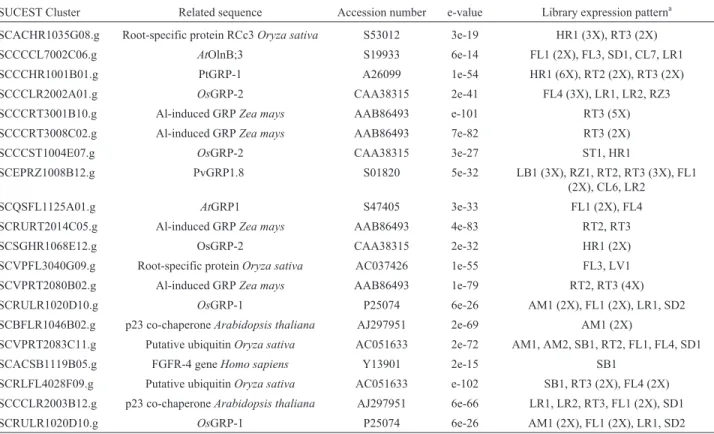
Twenty different clusters were identified, of which eleven were isolated from only one or two library types (Table IV). Interestingly six of these genes show preferential expression in the root system (SCACHR1035G08.g, SCCCHR1001B01.g, SCCCRT3001B10.g, SCCCRT 3008C02.g, SCRURT2014C05.g and SCVPRT2080 B02.g), and are also related to two previously identified root-specific GRPs of maize. As observed for the GGGX GRPs, the high variation in the structures of the GXGX GRPs did not allow the construction of a dendrogram.
Sugarcane ESTs encoding RNA-binding GRPs
Several GRPs with RNA-binding sequences have been identified in different plant species, most of them hav-ing an 80 to 100 amino acid N-terminus conserved region (the RNA-Recognition Motif (RRM) or Consensus Se-quence-type RNA-Binding Domain (CS-RBD)) containing two conserved sequences (RNP-1 and RNP-2). Two plant GRPs (AtGRP-2 andNsGRP-2) have different RNA-bind-ing sequences at their N-terminus. Instead of an RRM do-main they have a cold-shock dodo-main with only the RNP-1 sequence (Sachetto-Martinset al., 2000).
Some of these GRPs are known to havein vitroRNA binding activity (Ludevidet al., 1992; Hiroseet al., 1993; Freireet al., 1995; Hananoet al., 1996; Dunnet al., 1996) and also bind single-stranded DNA (Hiroseet al., 1993; Dunnet al., 1996) and are phosphorylatedin vitro(Dunnet al., 1996) andin vivo(Freireet al., 1995). Deletion assays conducted with the RZ-1 protein have shown that the RNA-binding domain and the C-terminal glycine-rich re-gion are essential for RNA-binding activity (Hananoet al., 1996). Immuno-precipitation studies have shown that the MA16 protein interacts with RNAs through a complex as-sociation with several proteins (Freireet al., 1995). These results, together with the immuno-localization ofSaGRP (Heintzenet al., 1994), MA16 (Albàet al., 1994) and RZ-1 proteins (Hananoet al., 1996) in the nucleus have led to the hypothesis that these GRPs may be involved in RNA pro-cessing, maturation or the control of gene expression. The modulation of some RNA-binding GRPs by factors such as ABA (abscisic acid), salinity, wounding, cold-stress and circadian rhythm may reflect their involvement in the mod-ulation of the pathways activated by these stimuli (Sachet-to-Martinset al., 2000).
In addition to their glycine-rich and RNA-binding motifs, AtGRP-2 (de Oliveira et al., 1990), NsGRP-2 (Obokataet al., 1991) and RZ-1 (Hananoet al., 1996) con-tain one or two CCHC zinc-fingers. Similar domains have been observed in yeast and mammals splicing factors, as well as in several retrovirus GAG proteins and in the human nucleic acid binding protein CNBP (Kingsley and Palis, 1994),and it is possible that these proteins represent com-ponents of the plant cell splicing machinery (Hananoet al., 1996).
Based on their structural features, the RNA-binding GRPs can be classified into three different sub-classes. Pro-teins from the first class show a RRM conserved motif at the N-terminal end followed by a glycine-rich region with GGYGG repeats. GRPs from the second class show similar organization, but present a CCHC zinc-finger inside their glycine-rich region. Proteins from the third subclass are or-ganized with a cold-shock domain at the N-terminus and two copies of the CCHC zinc-finger in their glycine-rich re-gion (Table I and Figure 1). Our analysis of the SUCEST database identified a novel group of RNA-binding GRPs (subclass IV, clusters SCCCCL3005A03.b and SCCCLR1C01G05.g), this new subclass having two copies of the RRM motif followed by a C-terminal glycine-rich re-gion distinct from previous GRPs.
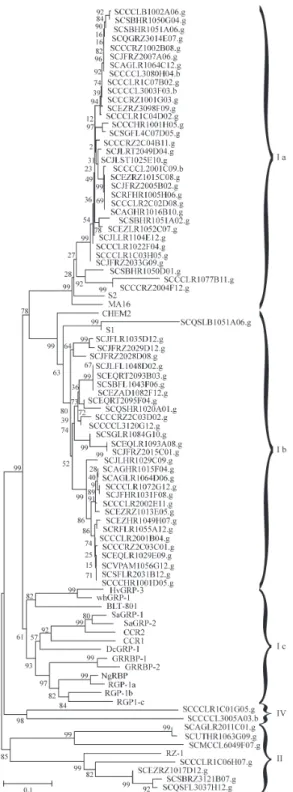
The RNA-binding GRPs from subclasses I and III show a high degree of divergence, and these differences in-troduced a high number of gaps during the alignment of all the RNA-binding sequences and did not allow correlation between the sequences or construction of a dendrogram. To analyze the correlation between the four RNA-binding GRP subclasses, the alignments were constructed mutually excluding GRPs from subclasses I and III (Figures 3 and 4). The observation that class IV RNA-binding GRPs remain as a separated group in both analysis justifies this treatment and shows the existence of a fourth subclass of RNA-binding GRPs.
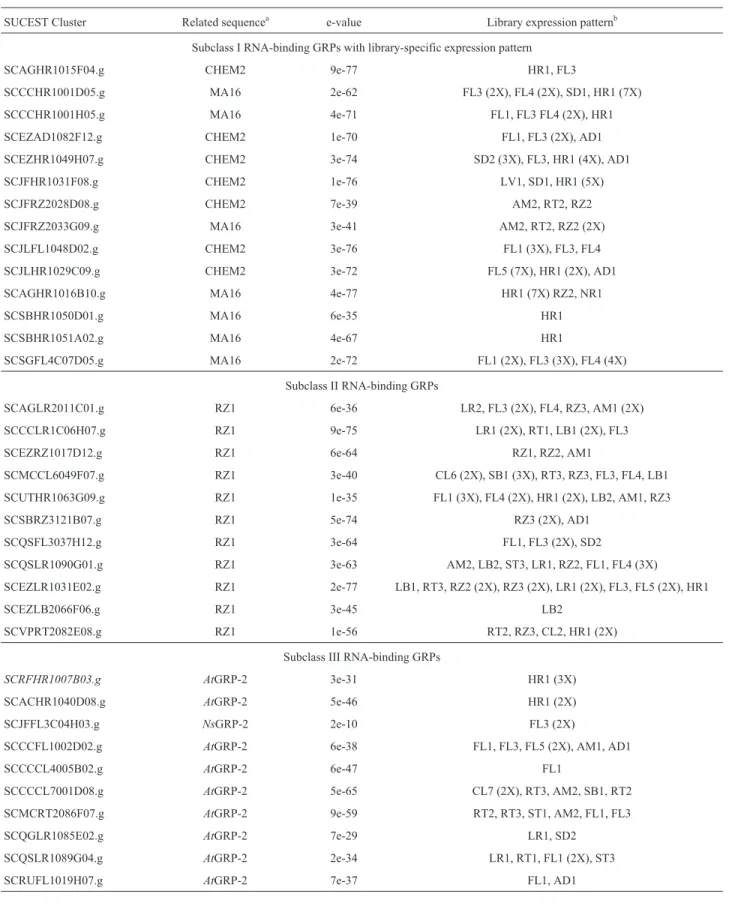
Subclass I RNA-binding GRPs were subdivided into at least three subgroups, subgroups Ia and Ib being com-posed of sequences from monocotyledonous plants and subgroup Ic containing all the sequences from dicotyledonous plants (Figure 3). We found 62 SUCEST clusters encoding subclass I RNA-binding GRPs (Table I). These clusters are preferentially related to the CHEM2, MA16, S1 and S2 GRPs and present e-values ranging from 7e-39 to 9e-81. In general,these clusters were expressed in a large spectrum of libraries, being represented in virtually all the libraries analyzed. These results indicate that the transcripts of these genes accumulated at high levels in most of the organs investigated, suggesting that they may be constitutively synthesized and involved in fundamental cell processes. However, four clusters presented a more re-stricted expression pattern and seven (SCAGHR1015F04.g, SCCCHR1001D05.g, SCCCHR 1001H05.g, SCEZAD1082F12.g, SCJLFL1048D02.g, SCJLHR1029C09.g, and SCSGFL4C07D05.g) were pref-erentially expressed in flower-libraries. Some clusters were expressed during infection with nitrogen-fixating endo-symbionts (Table V).
GRPs from this class may help to elucidate their biological function.
Subclass III GRPs have never before been isolated from monocotyledonous plants, but we identified ten clus-ters in the SUCEST data bank, six of them representing pu-tative tissue-specific genes (Table V). The principal characteristics of these GRPs are the combination of two well-defined nucleic acid-binding motifs, a cold-shock do-main and CCHC zinc-fingers.
The diversity of the glycine-repeats in GRPs suggests that some of these genes may have originated from an an-cestral gene by recombination events. Genes of GRPs orga-nized in tandem on the genome have been isolated in
Arabidopsis thalianaand bean. The high GC content of the
grpgenes makes them hot spots for recombination, and this mechanism is responsible for the genetic diversity of the mammalian keratin gene family in which evolutionary di-vergence is due to recombination at glycine-rich regions (Steinertet al., 1991). Because of its multi-species origin, sugarcane is thought to have one of the most complex plant genomes, with a variable number of chromosomes (gener-ally 2n = 70-120) and a large DNA content. Hot-spot re-combination could explain the high variability in the different classes of sugarcane GRPs.
Several GRPs were expressed in a tissue-specific manner, and the identification of the cell types in which GRPs are expressed opens the possibility of addressing questions on the function of these genes. In other plant spe-cies GRPs have been described that are preferentially ex-pressed in xylem (Keller et al., 1989), phloem (Condit,
1993), epidermis (Sachetto-Martinset al., 1995), tapetum (Ferreira et al., 1997), embryo (Gòmezet al., 1988) and roots (Goddemeieret al., 1998). Tissue-specific genes have
Figure 4- Unrooted dendrogram of RNA-binding glycine-rich protein se-quences. The relationships were calculated using MEGA (p distance, neighbor-joining method and bootstrap test with 5000 replications, pair-wise deletions). The analysis was based on the Clustal W alignment of se-quences. Accession numbers:Nicotiana sylvestris NsGRP-2 (CAA42622) and RZ-1 (D28861);Arabidopsis AtGRP-2 (S47408). The sugarcane se-quences use SUCEST nomenclature. Roman numerals represent the dif-ferent subclasses of RNA-binding GRPs.
Figure 3- Unrooted dendrogram of RNA-binding glycine-rich protein se-quences. The relationships were calculated using MEGA (p distance, neighbor-joining method and bootstrap test with 5000 replications, pair-wise deletions). The analysis was based on the Clustal W alignment of se-quences. Accession numbers: maize MA16 (P10979) and CHEM2 (CAA43431); Sorghum S1 (S12311) and S2 (S12312); barleyHvGRP-3 (Z48624) and BLT-801 (S71453); wheat WhGRP-1 (U32310);Sinapis alba SaGRP-1 (L31374) andSaGRP-2 (L31377); ArabidopsisCCR1 (Q03251) and CCR2 (Z14987); Daucus carota DcGRP-1 (X58146);
Euphorbia esulaGRRBP-1 (AAC61786) and GRRBP-2 (AAC61787);
Table V- Sugarcane ESTs encoding RNA-binding GRPs.
SUCEST Cluster Related sequencea e-value Library expression patternb
Subclass I RNA-binding GRPs with library-specific expression pattern
SCAGHR1015F04.g CHEM2 9e-77 HR1, FL3
SCCCHR1001D05.g MA16 2e-62 FL3 (2X), FL4 (2X), SD1, HR1 (7X)
SCCCHR1001H05.g MA16 4e-71 FL1, FL3 FL4 (2X), HR1
SCEZAD1082F12.g CHEM2 1e-70 FL1, FL3 (2X), AD1
SCEZHR1049H07.g CHEM2 3e-74 SD2 (3X), FL3, HR1 (4X), AD1
SCJFHR1031F08.g CHEM2 1e-76 LV1, SD1, HR1 (5X)
SCJFRZ2028D08.g CHEM2 7e-39 AM2, RT2, RZ2
SCJFRZ2033G09.g MA16 3e-41 AM2, RT2, RZ2 (2X)
SCJLFL1048D02.g CHEM2 3e-76 FL1 (3X), FL3, FL4
SCJLHR1029C09.g CHEM2 3e-72 FL5 (7X), HR1 (2X), AD1
SCAGHR1016B10.g MA16 4e-77 HR1 (7X) RZ2, NR1
SCSBHR1050D01.g MA16 6e-35 HR1
SCSBHR1051A02.g MA16 4e-67 HR1
SCSGFL4C07D05.g MA16 2e-72 FL1 (2X), FL3 (3X), FL4 (4X)
Subclass II RNA-binding GRPs
SCAGLR2011C01.g RZ1 6e-36 LR2, FL3 (2X), FL4, RZ3, AM1 (2X)
SCCCLR1C06H07.g RZ1 9e-75 LR1 (2X), RT1, LB1 (2X), FL3
SCEZRZ1017D12.g RZ1 6e-64 RZ1, RZ2, AM1
SCMCCL6049F07.g RZ1 3e-40 CL6 (2X), SB1 (3X), RT3, RZ3, FL3, FL4, LB1
SCUTHR1063G09.g RZ1 1e-35 FL1 (3X), FL4 (2X), HR1 (2X), LB2, AM1, RZ3
SCSBRZ3121B07.g RZ1 5e-74 RZ3 (2X), AD1
SCQSFL3037H12.g RZ1 3e-64 FL1, FL3 (2X), SD2
SCQSLR1090G01.g RZ1 3e-63 AM2, LB2, ST3, LR1, RZ2, FL1, FL4 (3X)
SCEZLR1031E02.g RZ1 2e-77 LB1, RT3, RZ2 (2X), RZ3 (2X), LR1 (2X), FL3, FL5 (2X), HR1
SCEZLB2066F06.g RZ1 3e-45 LB2
SCVPRT2082E08.g RZ1 1e-56 RT2, RZ3, CL2, HR1 (2X)
Subclass III RNA-binding GRPs
SCRFHR1007B03.g AtGRP-2 3e-31 HR1 (3X)
SCACHR1040D08.g AtGRP-2 5e-46 HR1 (2X)
SCJFFL3C04H03.g NsGRP-2 2e-10 FL3 (2X)
SCCCFL1002D02.g AtGRP-2 6e-38 FL1, FL3, FL5 (2X), AM1, AD1
SCCCCL4005B02.g AtGRP-2 6e-47 FL1
SCCCCL7001D08.g AtGRP-2 5e-65 CL7 (2X), RT3, AM2, SB1, RT2
SCMCRT2086F07.g AtGRP-2 9e-59 RT2, RT3, ST1, AM2, FL1, FL3
SCQGLR1085E02.g AtGRP-2 7e-29 LR1, SD2
SCQSLR1089G04.g AtGRP-2 2e-34 LR1, RT1, FL1 (2X), ST3
SCRUFL1019H07.g AtGRP-2 7e-37 FL1, AD1
a - Accession numbers MA16 - P10979; CHEM2 - CAA43431; RZ1- D28861;AtGRP-2 - S47408;NsGRP-2 - CAA42622.
received a great deal of attention because of their biotech-nological potential. Using the promoter of the tape-tum-specificta29GRP male-sterile tobacco andBrassica
plants were obtained for hybrid production in crop impro-vement programs (Marianeet al., 1990). The identification of sugarcane GRP genes preferentially expressed in spe-cific organs opens up the possibility of isolating tissue-spe-cific promoters that can be used to drive the expression of exogenous genes in sugarcane as well as in other monocot-yledonous plants.
RESUMO
Desde o isolamento da primeira proteína rica em glicina (GRP) em plantas, um grande número de novas GRPs vem sendo identificado. Seu padrão de expressão altamente específico, embora variado, em conjunto com as diferentes localizações sub-celulares de alguns dos tipos de GRPs, claramente indica que estas proteínas encontram-se envolvidas em diversos processos fisiológicos indepen-dentes. Embora ainda sem uma clara definição do papel de GRPs na célula vegetal, estudos realizados com estas pro-teínas têm resultado em novos e interessantes esclareci-mentos da biologia celular e molecular de plantas. Promo-tores com regulação complexa, assim como distintos meca-nismos de regulação da expressão gênica tem sido de-monstrados. Novas vias de endereçamento de proteínas tais como a exportação de GRPs para diferentes tipos celulares, tem sido observados. Estes dados mostram que as GRPs podem constituir marcadores e/ou modelos interessantes para a compreensão de distintos aspectos da biologia vege-tal. Neste trabalho, características estruturais e funcionais deste tipo de proteínas em cana-de-açúcar (Saccharum officinarum L.) foram analisadas. Uma vez que esta é a primeira descrição deste tipo de proteínas em cana-de-açúcar, especial atenção foi dada para o padrão de expressão destes genes, analisando-se a abundância e prevalência de cada um dos genes nas diferentes bibliotecas de cDNA do projeto Sequenciamento de ESTs de cana-de-açúcar (SUCEST). A comparação das GRPs de cana-de-açúcar com as GRPs des-critas em outras espécies também será discutida.
ACKNOWLEDGMENTS
A. Fusaro is recipient of a doctoral fellowship from the Brazilian agency CAPES. A. Mangeon, C.A.B. Rocha, R.M. Junqueira and T.C. Coutinho were supported by fel-lowships from the Brazilian agencies CNPq (CNPq-PIBIC). The Authors thank to Dr Maite F.S. Vaslin for the critical reading of the manuscript and to FAPESP for the support and development of the SUCEST project. This work was supported by a grant from the `young state scien-tist’ (Cientista Jovem do Estado) program from the Rio de Janeiro state agency FAPERJ.
REFERENCES
Albà, M.M., Culiáñez-Macià, F.A., Goday, A., Freire, M.A., Nadal, B.andPagès, M.(1994). The maize RNA-binding protein , MA16, is a nucleolar protein located in the dense fibrillar component.Plant J. 6: 825-834.
Alberts, B.(1998). The cell as a collection of protein machines: preparing the next generation of molecular biologists.Cell 92: 291-294.
Altschul, S.F., Madden, T.L., Schaffer, A.A., Zhang, J., Zhang, Z., Miller, W.andLipman, D.J. (1997). Gapped BLAST and PSI-BLAST: a new generation of protein data-base search programs. Nucleic Acids Research 25: 3389-3402.
Condit, C.M.(1993). Developmental expression and localization of petunia glycine-rich protein 1.Plant Cell 5: 277-288.
Condit, C.M.and Meagher, R,B.(1986). A gene encoding a
novel glycine-rich structural protein of petunia.Nature 323: 178-181.
de Oliveira, D.E., Franco, L.O., Simoens, C., Seurink, J.,
Coppieters, J., Botterman, J. and van Montagu, M.
(1993). Inflorescence-specific genes from Arabidopsis thalianaencoding glycine-rich proteins.Plant J. 3: 495-507.
Dunn, M.A., Brown, K., Lightowlers, R.and Hughes, M.A.
(1996). A low temperature responsive gene from barley en-codes a protein with single stranded nucleic acid binding ac-tivity which is phosphorylated in vitro.Plant Mol. Biol.30: 947-959.
Ferreira, M.A., Almeira-Engler, J., Miguens, F.C., van Mon-tagu, M., Engler, G.andde Oliveira, D.E. (1997). Oleosin gene expression inArabidopsis thalianacoincides with ac-cumulation of lipids in plastids and cytoplasmic bodies. Plant Physiol. Biochem.35: 729-739.
Freire, M.A.andPages, M.(1995). Functional characterization of the maize RNA binding protein MA16.Plant Mol. Biol. 29: 797-807.
Goddemeier ML, Wulff DandFeix G(1998). Root-specific ex-pression of aZea maysgene encoding a novel glycine-rich protein, zmGRP3.Plant Mol Biol 36: 799-802.
Gòmez, J., Sánchez-Martínez, D., Stiefel, V., Rigau, J., Puig-domènech, P. and Pagès, M.(1988). A gene induced by the plant hormone abscisic acid in response to water stress en-codes a glycine-rich protein.Nature 334: 262-264.
Hanano, S., Sugita, M.andSugiura, M.(1996). Isolation of a novel RNA-binding protein and its association with a large ribonucleoprotein particle present in the nucleoplasm of to-bacco cells.Plant Mol. Biol.31: 57-68.
Heintzen, C., Melzer, S., Fischer, R., Kappeler, S., Apel, K.
andStaiger, D.(1994). A light- and temperature-entrained circadian clock controls expression of transcripts encoding nuclear proteins with homology to RNA-binding proteins in meristematic tissue.Plant J. 5: 799-813.
Hirose, T., Sugita, M.andSugiura, M.(1993). cDNA structure, expression and nucleic acid-binding properties of three RNA-binding proteins in tobacco: occurence of tissue-spe-cific alternative splicing.Nucleic Acids Res. 21: 3981-3987.
Keller, B., Schmid, J.andLamb, C.J.(1989). Vascular expres-sion of a bean cell wall glycine-rich protein - β -glucu-ronidase gene fusion in transgenic tobacco. Embo J. 8: 1309-1314.
Kumar, S., Tamura, K., Jacobsen, I. and Nei, M. (2000).
ver-sion 2.0. Pennsylvania and Arizona State Universities, Uni-versity Park, Pennsylvania and Tempe, Arizona.
Ludevid, M.D., Freire, M.A., Gòmez, J., Burd, C.G., Albe-ricio, F., Giralt, E., Dreyfuss, G.andPagès, M.(1992). RNA binding characteristics of a 16kDa glycine-rich protein from maize.Plant J. 2: 999-1003.
Mariane, C., de Beuckeleer, M., Truettner, J., Leemans, J.and
Goldberg, R.B.(1990). Induction of male sterility in plants by a chimeric ribonuclease gene.Nature 347: 737-741.
Ni, Z., Sun, Q., Liu, Z., Wu ,L.andWang, X.(2000). Identifica-tion of a hybrid-specific expressed gene encoding novel RNA-binding protein in wheat seedling leaves using differ-ential display of mRNA.Mol. Gen. Genet. 263: 934-938.
Obokata, J, Ohme, M.andHayashida, N.(1991). Nucleotide sequence of a cDNA clone encoding a putative glycine-rich protein of 19.7 kDa inNicotiana sylvestris.Plant Mol. Biol. 17: 953-955.
Park, A.R., Cho, S.K., Yun, U.J., Jin, M.Y., Lee, S.H., Sachet-to-Martins G. andPark, O.K.(2001). Interaction of the ArabidopsisReceptor Protein Kinase Wak1 with a Glyci-ne-rich Protein, AtGRP-3J. Biol. Chem.276: 26688-26693.
Reddy, A.S.N.andPoovaiah, B.W.(1987). Accumulation of a glycine rich protein in auxin- deprived strawberry fruits. Biochem. Biophys. Res. Commun. 147: 885-891.
Ryser, U. and Keller, B.(1992). Ultrastructural localization of bean glycine-rich protein in unlignified primary walls of protoxylem cells.Plant Cell 4: 773-783.
Sachetto-Martins, G., Fernandes, L.D., Felix, D.andde Oli-veira, D.E.(1995). Preferential Transcripcional activity of a glycine-rich protein genefrom Arabidopsis thalianain pro-toderm derived cells.Int. J. Plant Science. 156(4): 460-470.
Sachetto-Martins, G., Franco, L.O. and de Oliveira, D.E.
(2000). Plant glycine-rich proteins: a family or just proteins with a common motif?BBA 1492: 1-14.
Sandal, N.N., Bojsen, K., Richter, H., Sengupta-Gopalan, C
andMarcker, K.A.(1992). The nodulin 24 protein family shows similarity to a family of glycine-rich plant proteins. Plant Mol. Biol. 18: 607-610.
Sitnikova, T., A. RzhetskyandM. Nei.(1995). Interior-branch and bootstrap tests of phylogenetic trees.Molecular Biology and Evolution 12: 319-333.
Steinert, P.M., Mack, J.W., Korge, B.P., Gan, S-Q., Haynes, S.R.and Steven, A.C.(1991). Glycine loops in proteins: their occurrence in certain intermediate filament chains, loricrins and single-stranded RNA-binding proteins.Int. J. Biol. Macromol. 13: 130-139.
Ting, J.T.L., Wu, S.S.H., Ratnayake, C.and Huang, AH.C.
(1998). Constituents of the tapetosomes and elaioplastids in Brassica campestristapetum and their degradation and re-tention during microsporogenesis.Plant J. 16: 541-551.
Thompson, J.D., Higgins, D.G. and Gibson, T.J. (1994).
CLUSTAL W: improving the sensitivity of progressive mul-tiple sequence alignment through sequence weighting, posi-tions-specific gap penalties and weight matrix choice. Nucleic Acids Research,22: 4673-4680.