VIROLOGY l Lennette l CLASSIC SLOW VIRUS DISEASES 157
CLASSIC SLOW VIRUS DLSEASES1
E. H. Lennette *
Current knowledge of slow virus diseases provides a foundation for examining the possible viral etiology of a number of
chronic degenerative diseases, including multifile sclerosis, Parkinson’s disease, and diabetes mellitus.
General Comments
The designation slow virus disease refers not to the causal agent but to the fact that the diseases induced have a slow, relentless- ly progressive course and a fatal termina- tion. These diseases can be divided into two categories according to whether the causal agent is a typical, conventional virus (propagable in vitro; cytopathogenic; anti- genie; associated with inflammatory le- sions, for example of the central nervous system, etc.) or a transmissible agent whose properties and behavior suggest an uncon- ventional or atypical virus.
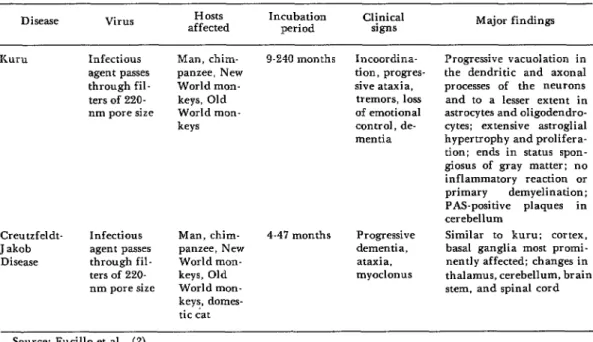
In the latter category are four of the classic slow virus diseases, namely kuru and Creutzfeldt-Jakob disease of man (Table 1) and scrapie and mink encephalopathy of animals (Table 2). The transmissible agents involved are regarded as atypical viruses because of their nature, properties, and characteristics; and, because of the similar pathologic picture they induce, they are regarded as prototypic viruses of this group, collectively referred to as the subacute spongifoorm encephalopathies. The label encephalopathy rather than encephalitis is used because the widespread destructive cerebral changes present a pic-
*Working paper, WHO Scientific Group on Virus Diseases (Geneva, 1-5 September 1975).
2Chief, Biomedical Laboratories, State of Califor- nia Department of Public Health. Berkeley, Califor- nia, U.S.A.
ture of degeneration without inflamma- tion, and the label spongzyoorm arises from the striking cellular alteration character- ized by swelling of the neurons and glia; the glia proliferation and the neuronal vacuolation and subsequent neuronal loss lead to the characteristic spongiform ap- pearance. There is no primary demyelina- tion, and secondary degeneration is of minor degree. In the cerebrospinal fluid there is no pleocytosis and no elevation of protein content. Patients characteristically show no fever.
Both kuru and Creutzfeldt-J akob disease have been transmitted to nonhuman pri- mates, so that it has become possible to study the physical, chemical and biological properties of all four viruses. They are considered here because they serve as models in studying the possible role of viruses in the causation of other encepha- lopathies.
The Human Diseases
KUTU
This is the first subacute progressive degenerative disease of the brain of man for which a viral etiology has been demonstrated. The virus has been trans- mitted from man to chimpanzees, to rhesus monkeys, and to five species of New World monkeys.
158 PAHO BULLETIN l Vol. XI, No. 2, 1977
as a new disease by these people in the early 1920’s. it was first reported and described in 1957, at which time the prevalence was some 200 cases in a population of approxi- mately 35,000 people distributed among 170 villages.
Some 3,500 cases of the disease in all are known to have occurred, and transmission, which appeared to follow a heredofamilial pattern, is now known to be associated with ingestion of infectious tissue attendant upon ritual cannibalism of the dead as a mourning ceremony. This practice has been interdicted, and the disease as a con- sequence has been declining in prevalence and should soon disappear. Approximately one-third of the cases previously were seen in children under 15 years of age, but none are any longer found in this age group. At present, the current total prevalence is about 50 cases, the decline being attributed to disappearance of the disease in children. In addition to the transmissible agent,
genetic factors also are believed to play a role in the pathogenesis of kuru.
Creutxfeldt-Jakob Disease (C-J Disease) Unlike kuru, which is restricted geo- graphically, Creutzfeldt-J akob disease, a rare presenile dementia first described by Creutzfeldt and Jakob in the early 1920’s, has a worldwide distribution. There is no obvious sex difference, and onset is gener- ally late in life-between the ages of 35 and 65. The disease generally occurs sporadical- ly, although there are recorded instances of familial clustering in which it has ap- peared in close relatives over several generations. A transmissible agent has been demonstrated in both the sporadic and the familial type of occurrence. Successful transmission has been made to chimpan- zees, to an Old World monkey, to several species of New World monkeys, and to the domestic cat.
Table 1. Chronic infections of the human central nervous system with unconventional agents.
Disease Virus affected Hosts Incubation
period Clinical signs Major findings Ktlrtl Infectious
agent passes through fil- ters of 220- nm pore size
Creutzfeldt- J akob
Disease
Infectious agent passes through fil- ters of 22.0. nm pore size
Man, chim- panzee, New World mon- keys, Old World mon- keys
Man, chim- panzee, New World mon- keys, Old World mon- keys, domes- tic cat
9-240 months Incoordina- tion, progres- sive ataxia, tremors, loss of emotional control, de- mentia
4-47 months Progressive dementia, ataxia, myoclonus
Progressive vacuolation in the dendritic and axonal processes of the neurons and to a lesser extent in astrocytes and oligodendro- cytes; extensive astroglial hypertrophy and prolifera- tion; ends in status spon- giosus of gray matter: no inflammatory reaction or primary demyelination; PAS-positive plaques in cerebellum
Similar to kuru; cortex, basal ganglia most promi- nently affected: changes in thalamus, cerebellum, brain stem, and spinal cord
VIROLOGY l Lennette e CLASSIC SLOW VIRUS DISEASES 159
Table 2. Chronic infections of the animal central nervous system with unconventional agents.
Disease Virus affected Hosts Incubation period Clinical signs Major findings
Scrapie Infectious Sheep, goat, agent passes mouse, rat, through fil- gerbil,mink, I ters of 30-nm cynomolgus pore size and squirrel
monkey, skunk, hamster
SO-60 months Ataxia, Similar to kuru, with some tremors, PAS-positive doubly re- hyperexcita- fractile birefringent amy- bility, inco- loid plaques: involvement ordination of subcortical regions, par-
ticulariy medulla; out- ’ standing vacuolation of
nerve cells Transmissible Infectious
mink agent passes encephalopa- through fil- thy ters of 50.nm
pore size
Mink, skunk, 4-48 months Slowly pro- Similar to scrapie; involve-
raccoon, gressive ment most prominently of
ferret (in- locomotor cerebrum, especmlly its eluding al- incoordination, more rostra1 parts; marked bino ferret), excitability, astrogliosis and spongy de- hamster, goat, convulsions generation of gray matter sheep, Old
World mon- keys, New World monkeys Source: Fucillo et al. (2).
The Animal Diseases missible mink encephalopathy may actual-
Scrapie
So named because the diseased animal tends to scrape against fixed objects, scrapie was first recognized in Scotland nearly 200 years ago, and since then it has spread to other countries and continents. Certain sheep lines are highly susceptible, while others are highly resistant; it would appear that natural transmission of the disease is determined by an autosomal recessive gene. Because scrapie can be transmitted to mice, and since the disease itself closely resembles kuru and Creutzfeldt-J akob disease, much current knowledge of this group of diseases is derived from scrapie as a model agent.
The interrelationship of these diseases and agents is suggested by the hypothesis that kuru may have arisen among the For6 people through ritual cannibalism of an individual succumbing to C-J disease. Similarly, since scrapie has been trans- mitted to several species of monkeys, it may also be potentially pathogenic for man. The possibility has been raised that trans-
ly represent a fatal scrapie virus infection in this species.
Transmissible Mink EncePhaZoPathy TME is a relatively new disease, having first been seen onmink farms in the United States of America about 25 years ago. The natural history of the disease is still unknown, but the suggestion has been made that it may have arisen from the feeding of mink on sheep meat contami- nated with scrapie virus. It is possible that a natural reservoir of the virus exists in nature-perhaps, for example, in skunks and raccoons, which are susceptible to experimental inoculation.
Nature and Properties of the Transmissible Agents
160 PAHO BULLETIN . Vol. XI, No. 2, 1977
on the scrapie agent, comparisons and analogies would seem valid.
In sum, the scrapie agent is small (filter- able through membranes of 43-nm but not 27-nm pore size ), and it has a remarkable resistance to thermal inactivation, to for- malin, to many proteolytic enzymes, to many organic reagents, and to ultraviolet irradiation. These are all properties quite different in most major respects from those of conventional viruses in general.
Ultrastructural studies of tissues infected with all four agents have failed to show the presence of any recognizable virions. Like- wise, highly infective tissue suspensions do not contain identifiable viral particles. Furthermore, when examined by the elec- tron microscope, purified material -or gradient band material containing the highly infective moiety-contains only fragmented membranes.
Indeed, some of the properties of these agents, and especially their marked resist- ance to inactivation by UV irradiation, have led to the suggestion that they contain little or no nucleic acid and thus represent a new category of viruses. Or they may represent pathogenic animal counterparts of several plant pathogens which are trans- missible and ostensibly consist of very small (50,000 daltons) naked RNA genomes.
Future Areas of Research
What is currently known about the clas- sic slow virus diseases and their agents,
‘This applies to scrapie and TME; the agents of kuru and C-J disease fail to pass through membranes of 100.nm pore size.
together with what has been learned within the past decade or so about slow virus diseases induced by conventional agents, provides the technical and philosophical basis for considering the possible viral etiology of chronic degenerative diseases whose etiology is still unknown-e.g., multiple sclerosis, amyotrophic lateral scle- rosis, Parkinson’s disease, and presenile dementias, to mention only a few affecting the central nervous system. In addition, there are such chronic disease problems as glomerulonephritis and other nephropa- thies; myocarditis, valvulitis, endocarditis and other cardiopathies; and diabetes mellitus and other endocrinopathies. In some of these diseases, as in kuru and Creutzfeldt-J akob disease, genetic factors are suspected of playing some role, and in others (such as Aleutian disease of mink) genetic factors predisposing to infection are known to be important disease determi- nants. Besides looking for viral involve- ment in these various diseases, workers might well investigate the role of immu- nologic factors, both humoral and cell- mediated.
No recommendation is made with respect to expanding research on these particular slow virus diseases. It is suggested, however, that the methods and technics which have been applied to the study of these diseases and other slow diseases or latent infections be carried into the chronic disease field. This should yield information on the possible viral etiology of certain cardio- pathies, nephropathies, and endocrinopa- thies, as well as of selected neoropathies such as multiple sclerosis.
SUMMARY
Two human diseases, kuru and Creutzfeldt- concepts, and new technology that provide a Jakob disease, and two animal diseases, scrapie basis for the study of chronic diseases and latent
VIROLOGY ’ Norrby l CHRONIC VIRAL DISEASE IMMUNOPATHOLOGY 161
REFERENCES (I) Diener, T. 0. Viroids: The smallest known agents of infectious disease. Ann Rev Microbial 28: 23-40, 1974.
(2) Fucillo, D. A., J. E. Kurent, and J. L. Sever. Slow virus diseases. Ann Rev Microbial 28: 231-264, 1974.
(3) Gibbs, C. J. Jr., and C. Gajdusek. Cell-virus interactions in slow infections of the nervous system. In: F. 0. Schmidt and F. G. Worden, eds., The Neurosciences: Third Study
Program. Cambridge (Mass.) MIT Press, 1974. (4) Maugh, T. H., Diabetes: Epidemiology suggests a viral connection. Science 188: 347- 351, 1975.
(5) Maugh, T. H. Model systems indicate viruses a cause. Science 188: 436-438, 1975.
(6) Zeman, W., and E. H. Lennette, eds. Slow Virus Diseases. Baltimore, Williams and Wil- kins, 1974.
IMMUNOPATHOLOGIC
PROCESSES IN CHRONIC
VIRAL
DISEASES 1
E.C. J. Norrby 2
Immune com$Eex disease is often associated with chronic virus infections. Several human and animal diseases are known to involve deposition of immune com@lexes; ones affecting man include hefiatitis B, subacute sclerosing panence$halitis, and Burkitt’s lym$homa.
Optimum conditions for the formation of immune-pathological complications occur in infections that involve ongoing viral rep- lication and a continuous host immune response. Two different mechanisms lead- ing to the appearance of tissue injury can be distinguished: damage to virus-infected cells by immunologic reactions, and injury of certain tissues by deposition of antigen- antibody complexes. The possible patho- genic significance of the former type of re- action has not been clarified, but there are several human and animal diseases in which deposition of immune complexes has been shown to occur (1). The primary sites for deposition of immune complexes are the
‘Working paper, WHO Scientific Group on Virus Diseases (Geneva, l-5 September 1975)
ZProfessor, Department of Virology, Karolinska Institute School of Medicine, Stockholm, Sweden.
renal glomeruli, the choroid plexus of the brain, and blood vessels (mainly arteries). Injury may also occur, however, in heart, lung, joint, and skin tissue.