ANALYSIS OF PHILOSOPHY OF ART FROM ISLAMIC
PHILOSOPHERS’ PERSPECTIVE
RAHBARIPOUR, Kasra1
Abstract
The western philosophers’ perspective of art is quite different from the Islamic philosophers’ philosophy of art because western philosophers repeatedly employed their western criteria and norms in evaluation of Islamic art. Consequently, this research analyzes art philosophy from Islamic philosophers’ perspective so as to have a deep understanding of art, its forms and values. The main objectives were o analyze the philosophy of art based on Islamic philosophers’ perspective, to determine what influences Islamic philosophers’ perspective of art and to understand the important role of art in Islamic culture. Methodology used was a cross sectional survey that was descriptive with qualitative research and quantitative research being employed. Specifically, research participants only included Islamic philosophers derived from different regions. Findings reveal that Islamic philosophers exteriorize and visualize what hidden inwardly in metaphysics and revelation art is. Moreover, it was revealed that majority of the Islamic philosophers believed that western philosophers misunderstand their perspective of art. In addition, the Islamic philosophers strongly agreed that Art should mainly express submission to God and that artwork that is nonconforming to Islamic worldview is unsuccessful artistically. Another philosophy of artwork is that it should reflect Divine Unity and consideration of beauty was of great importance in art according to Islamic philosophers. It was concluded that art and what constitutes art significantly depend on the culture and believes of individual groups or religious affiliations. Islamic philosophers have a radical different perspective of art philosophy where man is considered as divinity instrument created by Supreme Allah.
Key words: Art, Philosophy, Islam, Philosophers
Data de submissão: September 2013 | Data de publicação: December 2013.
1 This article was derived from master's thesis in architectural engineering titled “Design of Museum of history of philosophy of art: approaching ideas of islamic thinkers”, presented by Kasra Rahbaripour with the supervision of Dr. Hasan Sattari Sarebangholi (PhD) in Faculty of Art and Architecture, Islamic Azad University of Tabriz. Department of Architecture, Tabriz Branch, Islamic Azad University. Author Email: [email protected]
INTRODUCTION
Philosophy of art refers to what art constitutes and what it is. This implies that the meaning and art constituents may significantly vary depending on the perspective and viewpoints of individuals or different philosophers (AHMED, 2009). Art philosophy and art have been impacted on by religion through religious beliefs which affect art constituents and accepted art. The art philosophy amongst Islamic philosophers is primarily inclined to manifest Islamic spirituality. In the perspective of the Islamic philosophers, traditional art and sacred art should concern formation of contemplative and peaceful environment where Divine Realty can be well exhibited and conform to spiritualization realization. In addition, Islamic philosophers opine that art means more than spatial or aesthetic experience since it represents the symbolic visualization of higher reality (BAKAR, 2009). This could well indicate that sacred art is tantamount to Islamic art thus transmit deific message and it transcends place and time. Art therefore, emanates from Spiritual world to manifest expression of God’s relationship with men and its function includes expressing only primordial truth and metamorphosing invisible forms into visible.
The western philosophers’ perspective of art is quite different from the Islamic philosophers’ philosophy of art because western philosophers repeatedly employed their western criteria and norms in evaluation of Islamic art. According to the western philosophers’ perspective, besides contributing to its society’s art, Islamic philosophers undervalued, diminished and restricted creativity in art. Western philosophers hence consider Islamic philosophers to be limiting and obstructing dramatic scenes and artistic talent. Such perspectives are serious misunderstanding of perspective of Islamic philosophers to art and Islamic philosophy of art. Consequently, this research analyzes art philosophy from Islamic philosophers’ perspective so as to have a deep understanding of art, its forms and values. Therefore, it was important to conduct this research and the findings will be a great contribution to the limited literature on Islamic philosophers’ perspective of art.
Focus issues and Research objectives
The main focus and objective of conducting this study include:
1. To analyze the philosophy of art based on Islamic philosophers’ perspective 2. To determine what influences Islamic philosophers’ perspective of art 3. To understand the important role of art in Islamic culture
Research Questions
1. What is philosophy of art based on Islamic philosophers’ perspective? 2. What influences Islamic philosophers’ perspective of art?
3. Does art play an important role in Islamic culture?
Research Hypothesis
Ho: Respondents who strongly believe that “western philosophers misunderstand the
Islamic philosophers’ perspective of art” are likely to ‘strongly agree’ or ‘agree’ that “Art should mainly express submission to God”
Table 1
Type of relationship
Variable
Negative relationship Positive
relationship Lack of relationship Islamic philosophers belief that western philosophers misunderstand them verses philosophy of art to mainly express submission to God - positive -
LITERATURE REVIEW
Western scholars posit that Islamic philosophers lack literary or adequate knowledge about many artistic works since they don’t adopt figurative art. On the other hand, Islamic philosophers argue that they don’t consider imagery because of the man’s position in Islamic religion (FEATHERSTONE, 2012). Moreover, Islamic religious rule discourages depiction of animal or human form since people would hark back figures and idol worshiping which is a practice condemned strongly by Islam. Moreover, Islamic philosophers report about the features of artistic creativity and beauty thru explanations about God’s attributes on the subject of creation. In addition, the Islamic philosophers are reported to have modified the views of Plato on imitation and literature reported in poetics and rhetoric of Aristotle. Generally speaking, Islamic philosophers perceive literary and artistic creativity not to end in the artists (LEWIS, 2008).
Contrasting western art which is alleged to be predominantly personal expressions by Islamic philosophers, art is understood to play a significant role in societies of believers. Accordingly, artists don’t express their personal perceptions or whims but somewhat that of unseen existence. At centre of art according to Islamic philosophers is metaphysical faith in the enter truth that is connected directly to Allah (RAPPORT, 2000). After establishing eternal basis of truth, Islamic philosophers avers that arts are attempts in due course to represent philosophical truth in physical form through sacred geometry, biomorphic forms and calligraphy in mediums of tile, brass, wood and gypsum (NASR, 2012). For that reason, Islamic philosophers expects the artists to act as the mediators of truth and expression into physical form via specific artistic technics that are enhanced potentially by personal virtues of artists like belief in Allah, patience and peace. The technique skill level, in conjunction with personal virtue’s spiritual level determined the extent to which clarity in ability of the artifact to communicate the eternal truth. Art as Islamic philosophers harangue stem from the artists’ community and it encourage, remind and edify broader society of Allah’s truth.
Metaphysics embed the perspective of Islamic philosophers about philosophy of art. As consideration of the Islamic philosophy which is quite distinct from western or modernist views, individuals are expected to realize that a subterranean sense exists
beyond their physical world (NASR, 2006). Connection between geometry and metaphysical cosmology in art are also explained by the Islamic philosophers. They corroborate that in art, everything needs to be related to Allah including artistic beauty. Hence, Islamic philosophy of art requires metaphysical realism of existence of Allah and communicating this existence through geometry so as to be revealed in universe. Hence they imply that there is sacred geometry in design of the natural objects like coral, the sun, fish, flowers and clouds which were created by Allah are evidence of Allah’s existence.
The Islamic philosophers also believe that truth comes from God which is communicated in geometric portions and that Allah is connected to artwork in sacred geometry (MOOSA, 2006; & MAHMOUD, 2007). This is the main concept guiding artwork as believed by Islamic philosophers making art to be timeless since the truth evident in art is also timeless. Consequently, art like colours, painting and using gold in the perspective of Islamic philosophers, portray fear and reflect nature of Allah and sense of his beauty which is not present in contemporary western art.
Role of community observing and interpreting artwork to comprehend the purpose of the art is also considered by Islamic philosophers to be of great importance (BOER, 2005). This is because the community’s sense influences the production of art since the artists depend on direction and inspiration in what to develop from them. Moreover, Islamic philosophers state that artists should not sign artwork since this would symbolize ownership which is inappropriate as it ignores many other artists who developed the foundation where the new artwork emerged (MUHAMMAD, 2010). And since art is considered by Islamic philosophers to reveal everlasting truth, validity in building and respecting artwork of others. Art is also expected to impact directly on the society they are exhibited. What is also interesting in the Islamic philosophers’ perspective of art is that an art can bless people observing it and that building designed using Islamic geometry brings beauty and peace to cities.
Consequently, Muslim art has been different from other cultures as regards material, form, meaning and subject (MERRIAM, 2011; & MILLS, 2009). For instance, it focuses on pure forms which take different patterns and shapes rather than
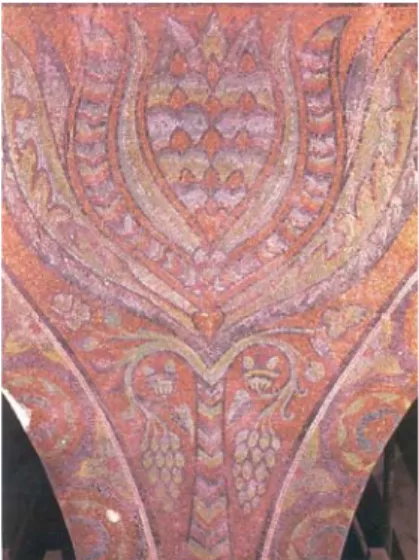
representing natural objects. These can be generally classified into calligraphic, geometrical and floral which may appear together or alone in media like pottery, textile, stucco or ceramics. See figure 1.
Figure 1: Flora decoration seen in a Mosque "Dome of Rock". Source: Nashabi (2009). Floral and Vegetal art. Even though, art according to Islamic philosophers, of course, independently
developed from influences from environment and nature, its representation is abstract and not realistic like other art. For instance, vegetal forms in which flowers and branches are interlaced or woven often not and into distinguished geometrical lines as illustrated in arabesque. See figure 2.
Figure 2: tree landscape in Umayyad Mosque: Damascus. Source: Hodgson (2003).
Geometrical Art. Islamic philosophers note that art in Islam involves the geometric patterns to
provide substitute to prohibited live creatures’ depiction. In addition, geometrical art encourage spiritual meditation. See figure 3.
Figure 3: Floral Arabesque in Masjid-I-Shah Mosque interior, Isfahan. Source: Cahnmann (2003).
Calligraphy. Another decorative art form accepted by Islamic philosophers is calligraphy which involves
employing artistic lettering. See figure 4.
Figure 4: Kufic calligraphy in Cordoba Mosque.Source: Coffman (2010).
Table 1: Surveying previous conducted studies on research subject
Time Writer(s) Title of the research work
Resource (APA)
Research model Results
2012 Nasr Islam and the plight of modern man
Book Descriptive study 2010 Muhammad Toward Islamization
of disciplines
Cross sectional study
Difference between Islamic philosophy art and western philosophy of art
Method
This study was a cross sectional survey that was descriptive with qualitative research and quantitative research being employed to achieve its objectives and provide answers to the research questions. Hence, a research mixed method was desired because it allows for triangulation hence ensuring validity as well as reliability of the research findings (COOPER & SCHINDLER, 2010). Specifically, research participants only included Islamic philosophers derived from different regions. The main reason for involving only Islamic philosophers was because the subject under study was seeking to analyse the perspective of the Islamic philosophers about the philosophy of artwork. Consequently, the study respondents were sampled using the purposive technique of sampling. One particular advantage of employing purposive technique of sampling respondents was because it increases balanced selection of participants based on different groups. Nevertheless, it is noted to have the limitation of sample representativeness of the whole population. This study hence targeted 50 respondents to participate in the study about philosophy of art based on Islamic philosophers’ perspective.
Research tools
Data was collected using two different approached mainly to obtain primary and secondary data (Corbin and Strauss, 2008). Consequently, primary data was collected using the closed ended questionnaire as the main instrument employed. The procedure included sending the questionnaires to participants through established contacts to complete within two weeks at their own convenient time. On the other hand, secondary data was obtained through review of existing literature on Islamic philosophers views about art philosophy. The collected data was then edited, verified and checked for errors and consistency before transcribing into SPSS for generation of descriptive statistics and testing of the developed hypothesis. In particular, hypothesis was tested using Independent-Sample T Test (Corner, 2009).
Limitations and limits
The main limitation was in the instrument of collecting data. That is, closed ended questionnaire may have limited the collection of a wide range of information from the Islamic philosophers concerning art.
Findings and results
A total of 50 respondents participated in this study with males 52.0% and females 48.0%. See table 2 and graphic 1.
Table 2: Gender of respondents
Graphic 1: Gender of respondents
40 50 60 Male Female Gender Male Female
Table 3: State your highest education level
Frequency Percent Valid Percent Cumulative Percent
Valid Diploma 14 28.0 28.0 28.0
Bachelor Degree 21 42.0 42.0 70.0
Masters 9 18.0 18.0 88.0
Doctor of Philosophy 6 12.0 12.0 100,0
Total 50 100,0 100,0
Frequency Percent Valid Percent
Cumulative Percent Valid Male 26 52.0 52.0 52.0 Female 24 48.0 48.0 100.0 Total 50 100.0 100.0
A total of 50 respondents participated in this study with males 52.0% and females 48.0%.
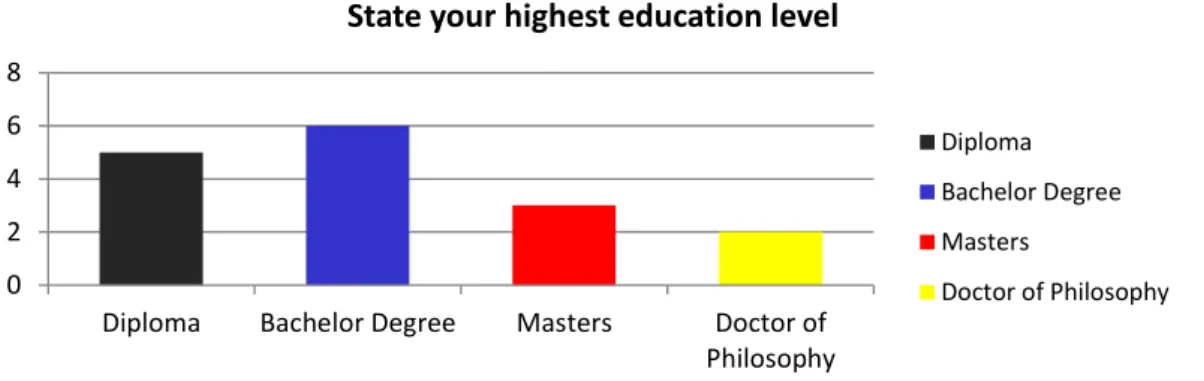
Graphic 2: State your highest education level 0 2 4 6 8
Diploma Bachelor Degree Masters Doctor of Philosophy State your highest education level Diploma Bachelor Degree Masters Doctor of Philosophy
Majority of the Islamic philosophers who participated in this study were holders of bachelor degree 42.0%. See table 3 and Graphic 2.
Table 4: Do you speak Arabic?
Graphic 3: Do you speak Arabic?
0 5 10 yes No Are you speak Arabic? yes No
Table 5: Are you an artist?
Frequency Percent Valid Percent Cumulative Percent
Valid Yes 31 62.0 62.0 62.0
No 19 38.0 38.0 100.0
Total 50 100,0 100,0
Frequency Percent Valid Percent
Cumulative Percent Valid Yes 30 60.0 60.0 60.0 No 20 40.0 40.0 100.0 Total 50 100.0 100.0
It was established that over half of the respondents speak Arabic 60.0%. See table 4 and graphic 3.
Graphic 4: Are you an artist? 0 2 4 6 8 10 yes No Are you an artist? yes No
Table 6: Do you believe western philosophers misunderstand the Islamic philosophers' perspective of art?
Frequency Percent Valid Percent
Cumulative Percent
Valid Strongly agree 17 34.0 34.0 34.0
Agree 16 32.0 32.0 66.0 Undecided 9 18.0 18.0 84.0 Disagree 7 14.0 14.0 98.0 Strongly disagree 1 2.0 2.0 100.0 Total 50 100.0 100.0 Strongly disagree Disagree Undecided Agree Strongly agree Percent 40 30 20 10 0
Do you believe western philosophers misunderstand the Islamic philosophers' perspective of art?
Graphic 5: Do you believe western philosophers misunderstand the Islamic philosophers' perspective of art?
When the Islamic philosophers were asked if they consider themselves to be artists, quite a considerable number 62.0% agreed. See table 5 and graphic 4.
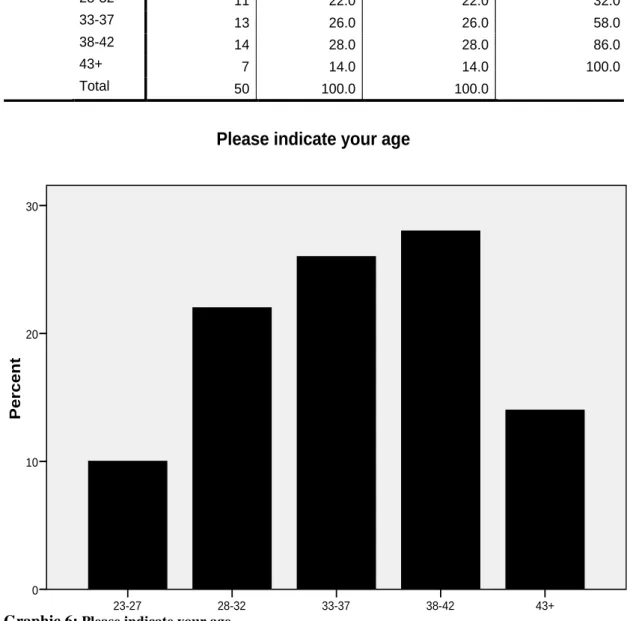
In terms of age, majority 28.0% said that they belong to the age group 38-42 years. See table 7 and graphic 6.
Table 7: Please indicate your age
Frequency Percent Valid Percent
Cumulative Percent Valid 23-27 5 10.0 10.0 10.0 28-32 11 22.0 22.0 32.0 33-37 13 26.0 26.0 58.0 38-42 14 28.0 28.0 86.0 43+ 7 14.0 14.0 100.0 Total 50 100.0 100.0 43+ 38-42 33-37 28-32 23-27 Percent 30 20 10 0
Please indicate your age
Graphic 6: Please indicate your age
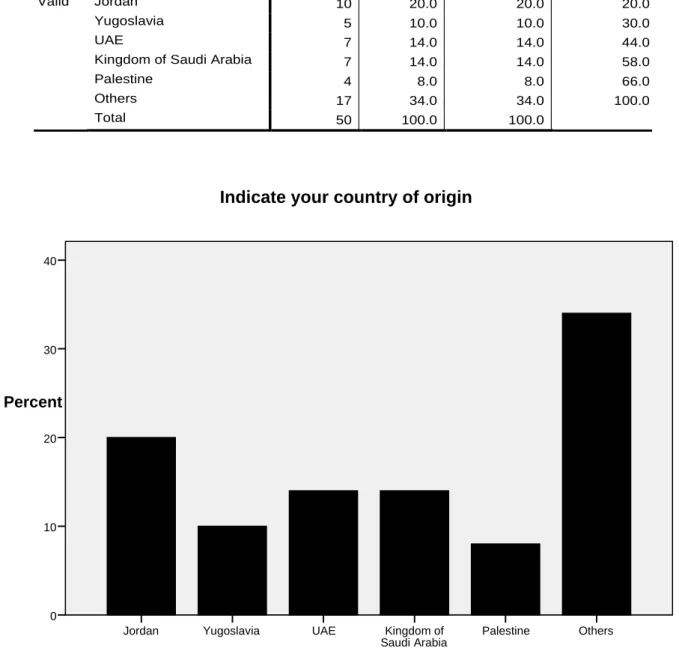
It was interesting that the country of origin of the respondents were quite different with majority 34.0% from ‘other’ country followed by Jordan 20.0%. See table 8 and graphic 7.
Table 8: Indicate your country of origin
Frequency Percent Valid Percent
Cumulative Percent
Valid Jordan 10 20.0 20.0 20.0
Yugoslavia 5 10.0 10.0 30.0
UAE 7 14.0 14.0 44.0
Kingdom of Saudi Arabia 7 14.0 14.0 58.0
Palestine 4 8.0 8.0 66.0
Others 17 34.0 34.0 100.0
Total 50 100.0 100.0
Graphic 7: Indicate your country of origin
Most of the Islamic philosophers 24.0% who participated in this study agreed that they are best described as conservative Muslim. See table 9 and graphic 8.
Others Palestine Kingdom of Saudi Arabia UAE Yugoslavia Jordan Percent 40 30 20 10 0
Table 9: Are you best described as conservative Muslim?
Frequency Percent Valid Percent
Cumulative Percent
Valid Strongly agree 11 22.0 22.0 22.0
Agree 12 24.0 24.0 46.0 Undecided 7 14.0 14.0 60.0 Disagree 11 22.0 22.0 82.0 Strongly disagree 9 18.0 18.0 100.0 Total 50 100.0 100.0 Strongly disagree Disagree Undecided Agree Strongly agree Percent 25 20 15 10 5 0
Are you best described as conservative Muslim?
Graphic 8: Are you best described as conservative Muslim?
Islamic philosophers’ perspective of art philosophy
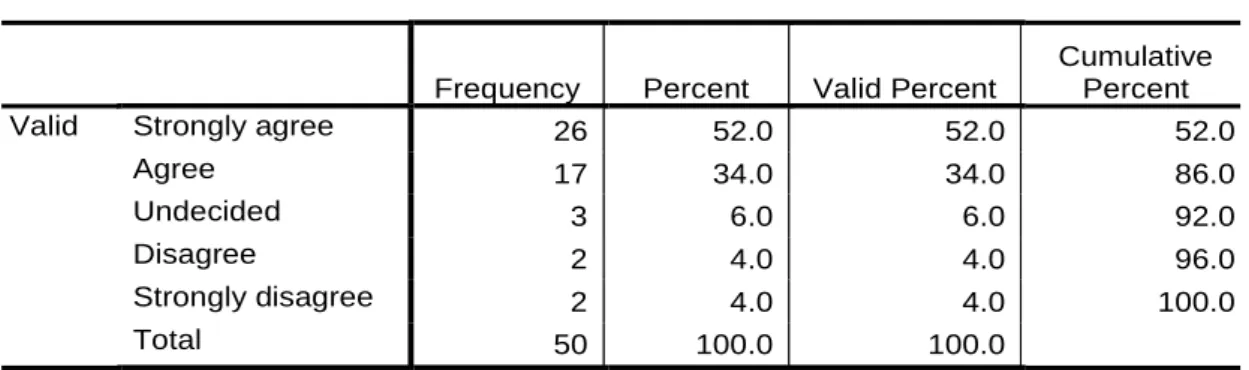
A considerable majority of the Islamic philosophers 52.0% strongly agree that Art should mainly express submission to God. See table 10 and graphic 9..
Table 10: Do you agree that Art should mainly express submission to God
Frequency Percent Valid Percent
Cumulative Percent
Valid Strongly agree 26 52.0 52.0 52.0
Agree 17 34.0 34.0 86.0 Undecided 3 6.0 6.0 92.0 Disagree 2 4.0 4.0 96.0 Strongly disagree 2 4.0 4.0 100.0 Total 50 100.0 100.0 Strongly disagree Disagree Undecided Agree Strongly agree Percent 60 50 40 30 20 10 0
Do you agree that Art should mainly express submission to God
Graphic 9: Do you agree that Art should mainly express submission to God
It was also found out that over half of the Islamic philosophers 50.0% strongly agree that artwork that is nonconforming to Islamic worldview as unsuccessful artistically. See table 11 and graphic 10.
Table 11: If an artwork is nonconforming to Islamic worldview, do you see it as unsuccessful artistically?
Frequency Percent Valid Percent
Cumulative Percent
Valid Strongly agree 25 50.0 50.0 50.0
Agree 11 22.0 22.0 72.0 Undecided 2 4.0 4.0 76.0 Disagree 4 8.0 8.0 84.0 Strongly disagree 8 16.0 16.0 100.0 Total 50 100.0 100.0 Strongly disagree Disagree Undecided Agree Strongly agree Pe rc en t 50 40 30 20 10 0
If an artwork is nonconforming to Islamic worldview, do you see it as unsuccessful artistically?
Graphic 10: If an artwork is nonconforming to Islamic worldview, do you see it as unsuccessful artistically?
Most of the Islamic philosophers strongly agree 36.0% that they consider themselves to better reflect philosophy of art. See table 12 and graphic 11.
Table 121: Do you consider Islamic philosophers to better reflect philosophy of art?
Frequency Percent Valid Percent
Cumulative Percent
Valid Strongly agree 18 36.0 36.0 36.0
Agree 16 32.0 32.0 68.0
Undecided 4 8.0 8.0 76.0
Disagree 5 10.0 10.0 86.0
Strongly disagree 7 14.0 14.0 100.0
Total 50 100.0 100.0
Graphic 11:Do you consider Islamic philosophers to better reflect philosophy of art?
The study found that the idea about absolute truth and reality dominate over the Islamic philosophy of art according to majority of the respondents who strongly agreed 44.0%. See table 13 and graphic 12.
Strongly disagree Disagree Undecided Agree Strongly agree Percent 40 30 20 10 0
Table 13: Does the idea about absolute truth and reality dominate over the Islamic philosophy of art?
Frequency Percent Valid Percent
Cumulative Percent
Valid Strongly agree 22 44.0 44.0 44.0
Agree 11 22.0 22.0 66.0 Undecided 8 16.0 16.0 82.0 Disagree 6 12.0 12.0 94.0 Strongly disagree 3 6.0 6.0 100.0 Total 50 100.0 100.0 Strongly disagree Disagree Undecided Agree Strongly agree Percent 50 40 30 20 10 0
Does the idea about absolute truth and reality dominate over the Islamic philosophy of art?
Graphic 12: Does the idea about absolute truth and reality dominate over the Islamic philosophy of art? Islamic philosophy of art was found to mostly emphasize on reflection of Divine Unity as indicated by most respondents 48.0% who strongly agree. See table 14 and graphic 13.
Table 24: Does Islamic philosophy of art mostly emphasize on reflection of Divine Unity?
Frequency Percent Valid Percent
Cumulative Percent
Valid Strongly agree 24 48.0 48.0 48.0
Agree 16 32.0 32.0 80.0 Undecided 8 16.0 16.0 96.0 Disagree 1 2.0 2.0 98.0 Strongly disagree 1 2.0 2.0 100.0 Total 50 100.0 100.0 Strongly disagree Disagree Undecided Agree Strongly agree Percent 50 40 30 20 10 0
Does Islamic philosophy of art mostly emphasize on reflection of Divine Unity?
Graphic 13: Does Islamic philosophy of art mostly emphasize on reflection of Divine Unity?
Majority of the respondents 38.0% strongly agreed that Islamic philosophy of art regard beauty to be of great importance in art. See table 15 and graphic 14.
Table 35: Does Islamic philosophy of art regard beauty to be of great importance in art?
Frequency Percent Valid Percent
Cumulative Percent
Valid Strongly agree 19 38.0 38.0 38.0
Agree 12 24.0 24.0 62.0 Undecided 12 24.0 24.0 86.0 Disagree 4 8.0 8.0 94.0 Strongly disagree 3 6.0 6.0 100.0 Total 50 100.0 100.0 Strongly disagree Disagree Undecided Agree Strongly agree Perc ent 40 30 20 10 0
Does Islamic philosophy of art regard beauty to be of great importance in art?
Graphic 14: Does Islamic philosophy of art regard beauty to be of great importance in art?
A considerable number of the Islamic philosophers 26.0% stated that they consider themselves to be highly influenced by Islamic virtues and culture. See table 16 and
Table 4: Do you consider yourself to be highly influenced by Islamic virtues and culture?
Frequency Percent Valid Percent Cumulative Percent
Valid 13 26.0 26.0 26.0 12 24.0 24.0 50.0 9 18.0 18.0 68.0 9 18.0 18.0 68.0 Strongly disagree 7 14.0 14.0 100,0 Total 50 100,0 100,0 Strongly disagree Disagree Undecided Agree Strongly agree Percent 30 20 10 0
Do you consider yourself to be highly influenced by Islamic virtues and culture?
Graphic 15: Do you consider yourself to be highly influenced by Islamic virtues and culture?
Strongly agree Agree Undecided Disagree
Hypothesis testing
Independent sample test revealed that t=-.510 and .613 significance level which is higher than .05 level of significance hence Ho was accepted. See table 17.
Table 57: Independent Samples Test
Levene's Test for Equality of
Variances t-test for Equality of Means
F Sig. t df 95% Confidence Interval of the Difference Sig. (2-taile d) Mean Differe nce Std. Error Differ
ence Upper Lower Do you believe western philosophers misundersta nd the Islamic philosophers ' perspective of art? Equal variances assumed .740 .395 -.510 41 .613 -.17647 .346 06 -.8753 5 .52241 Equal variances not assumed -.525 37.61 7 .602 -.17647 .335 95 -.8567 9 .50385
Discussion
The study was conducted to analyze art philosophy from Islamic philosophers’ perspective. Interestingly, Islamic philosophers were found to consider themselves to better reflect philosophy of art. This implies that Islamic philosophers exteriorizes and visualizes what hidden inwardly in metaphysics and revelation is art. Moreover, it was revealed that majority of the Islamic philosophers believed that western philosophers misunderstand their perspective of art. In addition, the Islamic philosophers strongly agreed that Art should mainly express submission to God and that artwork that is nonconforming to Islamic worldview is unsuccessful artistically. This finding conforms to work of Leaman (2009) and Mohammadi (2002) that Islamic philosophers posits that God creates perfect art while the works of mankind are flawed hence art must have hidden meaning and reverence to God.
Another philosophy of artwork is that it should reflect Divine Unity and consideration of beauty was of great importance in art according to Islamic philosophers. However, this finding differs with the findings of Halimeh (2011) and Ramadan (2009) that art there is beauty and ugly art. Some of the predisposing factors influencing their perspective of art include their Islamic and Arabic culture and being conservative Muslims. This is because Islamic philosophers are highly influenced by Islamic virtues and culture. Furthermore, the idea about absolute truth and reality dominate over the Islamic philosophy of art.
CONCLUSION
The implications of the findings of this study are that future studies should also include the western philosophers as respondents in order that their perspectives on art can be compared to those of Islamic philosophers. Hence, one major weakness in this study was the inclusion of only Islamic philosophers as the study respondents. In summary, it can be concluded that art and what constitutes art significantly depend on the culture and believes of individual groups or religious affiliations. Islamic philosophers have a radical different perspective of art philosophy where man is considered as divinity instrument created by Supreme Allah. Nevertheless, Islamic philosophers regard art to be very important in delivering the divine truth from Allah hence must be created with consideration of the community viewing the art.
REFERENCES
AHMED, S. (2009). Postmodernist perceptions of Islam: observing the observer. Asian Survey, 31(3), 213-231.
BAKAR, O. (2009). The history and philosophy of science. Cambridge, UK: The Islamic Texts Society.
BOER, J. (2005). Muslims: Why we reject secularism. Lagos, Nigeria: More Books.
CAHNMANN, M. (2003). The craft, practice, and possibility of poetry in educational research. Journal of the American Educational Research Association, 1(5), pp.23-34.
COFFMAN, J. (2010). Arabization and Islamization in the Algerian university. Chicago: The University of Chicago Press.
COOPER, D.R., & SCHINDLER, P.S. (2010). Business Research Methods. 8th Edition. New York: Mc GrawHill
CORBIN, J., & STRAUSS, A. (2008). Basics of Qualitative Research Techniques and Procedures for Developing Grounded, Theory. 3rd Edition. Los Angeles: SAGE Publications.
CORNER, J. (2009). ‘In Search of More Complete Answers to Research Questions. Quantitative versus Qualitative Research Methods: Is there away forward?’, Journal of Advanced Nursing, 16:718-727.
FEATHERSTONE, M. (2012). Islam encountering globalization.n London, UK: Routledge Curzon
HALIMEH, D. (2011). The influence of Islam, gender roles, and social class on educational attainment of Pakistanis in Los Angeles County and Lahore, Pakistan. New York, NY: Harcourt.
HODGSON, M. (2003). Rethinking world history. New York, NY: Cambridge
LEAMAN, O. (2009). A brief introduction to Islamic philosophy. Maldan, MA: Blackwell Publishers Inc.
LEWIS, B. (2008). The multiple identities of the Middle East. New York: Schocken Books.
MAHMOUD, Z. (2007). Arab and American cultures. Washington DC: American Enterprise Institute for Public Policy Research.
MERRIAM, S. (2011). Power and positionality: Negotiating insider/outsider status within and across cultures. International Journal of Lifelong Education, 20 (5), 405-416.
MILLS, C. (2009). The sociological imagination. New York: Oxford Press.
MOHAMMADI, A. (2002). Islam encountering globalization. London: Routledge and Curzon.
MOOSA, E. (2006). Contrapuntal readings in Muslim thought: Translations and transitions. Journal of the American Academy of Religion, 74 (1), 107-118.
MUHAMMAD, M. (2010). Toward Islamization of disciplines. Herndon, VA: International Institute of Islamic Thought.
NASHABI, H. (2009). The liberal arts and the future of higher education in the Middle East Beirut, Lebanon: American University of Beirut.
NASR, S. (2012). Islam and the plight of modern man. Cambridge, UK: The Islamic Texts Society.
NASR, S. (2006). Islamic philosophy from its origin to its present. Albany, NY: State University of New York Press.
RAMADAN, T. (2009). Radical reform: Islamic ethics and liberation. Oxford: Oxford University Press.
RAPPORT, N. (2000). Social and cultural anthropology: The key concepts. New York: Routledge Publishing.
Appendix
Research Questionnaire
1. Please state your gender a. Male
b. Female 2. Please indicate your age
a. 18-22 b. 23-27 c. 28-32 d. 33-37 e. 38-42 f. 43+
3. Indicate your country of origin a. Jordan
b. Yugoslavia c. UAE
d. Kingdom of Saudi Arabia e. Iraq
f. Palestine g. Others
4. State your highest education level a. Diploma
b. Bachelor Degree c. Masters
d. Doctor of Philosophy 5. Do you speak Arabic?
a. Yes b. No
6. Do you believe western philosophers misunderstand the Islamic philosophers’ perspective of art? a. Strongly agree b. Agree c. Undecided d. Disagree e. Strongly disagree 7. Are you an artist?
b. No
8. Are you best described as conservative Muslim? a. Strongly agree
b. Agree c. Undecided d. Disagree
e. Strongly disagree
9. Do you agree that Art should mainly express submission to God? a. Strongly agree
b. Agree c. Undecided d. Disagree
e. Strongly disagree
10. If an artwork is nonconforming to Islamic worldview, do you see it as unsuccessful artistically? a. Strongly agree
b. Agree c. Undecided d. Disagree
e. Strongly disagree
11. Do you consider Islamic philosophers to better reflect philosophy of art? a. Strongly agree
b. Agree c. Undecided d. Disagree
e. Strongly disagree
12. Does the idea about absolute truth and reality dominate over the Islamic philosophy of art? a. Strongly agree
b. Agree c. Undecided d. Disagree
e. Strongly disagree
13. Does Islamic philosophy of art mostly emphasize on reflection of Divine Unity? a. Strongly agree
b. Agree c. Undecided d. Disagree
14. Does Islamic philosophy of art regard beauty to be of great importance in art? a. Strongly agree b. Agree c. Undecided d. Disagree e. Strongly disagree
15. Do you consider yourself to be highly influenced by Islamic virtues and culture? a. Strongly agree
b. Agree c. Undecided d. Disagree