National ETD initiatives in global platform:
participative analysis and current status in NDLTD
Sukanta Kumar Patra
Jadavpur University, India
Mousumi Das
Govt. College of Nursing, ID & BG Hospital, India
Abstract
Global ETD search platform is a joint effort of 34 regions/ countries throughout of the world under supervision of NDLTD. The study attempts to view the status of repositories, contributions, initiatives and adaptation of open ETDs in different countries of the world in NDLTD’s repository for global uses. It also includes the analysis to the top ten national ETD repositories based on their collection and it also tries to draw a map in relation with United Nation Human Development Index and ETD repositories. There are about 55,72,749 ETDs have been deposited in the NDLTD’s global open repository for global access and utilities. Among the contributed countries, the top ten repository countries are UK, Taiwan, France, Germany, India, Portugal, Japan, Finland, P. R. China and Brasil in regards of the uploaded resources. The rank correlation coefficient have been calculated with respected to ETD rank and global HDI rank among them. The paper also tries to present a continental ETD analysis for present global ETD scenario. The quantitative analysis of the national ETD repositories were all landmark achievement of individual ETD participating countries, as these provided the opportunity for researchers, faculty and students for furthering their existing knowledge and sustainable world.
Keywords: ETD, NDLTD (Networked Digital library of Theses and Dissertations), Global ETD, UN2030 Agenda for SDG, UN HDI ranking, Open Access.
Introduction
An increasing number of universities and colleges throughout the world are adopting ETDs as either an option or a requirement of fulfilment of degrees. So, ETDs have long been a primary scholarly product of all worldwide universities. Researchers are carrying out activities to generate new knowledge. As per UN 2030 agenda for sustainable development – “Quality, accessible, timely and reliable disaggregated data will be needed to help with the measurement of progress and to ensure that no one is left behind. Such data is key to decision-making. Data and information from existing reporting mechanisms should be used where possible.”
In historically, ETD movement begins in 1987 with a meeting convened by Nick Altair of UMI in Ann Arbor, Michigan, involving participants from Virginia Tech, the University of Michigan, and two fledgling software companies (ArborText and SoftQuad).
The NDLTD (Networked Digital library of Theses and Dissertations), an international organization dedicated to promoting the creation, adoption, use, dissemination, and preservation of ETDs. It also supports e-publishing and open access to scholarship in order to enhance the sharing of knowledge globally. All the existing national ETD repositories are not exhaustive itself individually, so there are necessities to globalize their resources through NDLTD repository. Global ETD is a joint effort of 34 regions/countries throughout of the world under the NDLTDs supervision.
When all universities support ETD activities, they will be key participants in institutional repositories and open access and will have engaged in discussion and infrastructure development supportive of further open access activities (Fox, 2006).
Literature review
Numbers of studies have been published on electronic theses and dissertations and its present status and initiatives worldwide. Some related studies are –
Yiotis explained to explores the topic of ETD repositories. It provides information relevant to academic and digital librarians interested in including an ETD repository in their institution's digital library. His paper discusses interoperability among repositories and the Open Archives Initiative Protocol for Metadata Harvesting. The paper also discusses issues related to ETD repositories including intellectual property rights, publishers' views of ETDs as prior publications, plagiarism issues, development costs, and long-term preservation issues. It was found that library administrators who implemented ETD repositories at various universities adapted their models to the needs of their institutions and their graduate students. ETD administrators made decisions about implementation models and software and hardware infrastructure in terms of human and technical resource allocation (Yiotis, 2008; 101-115).
Suber argues for mandating open access (OA) to electronic theses and dissertations (ETDs). ETDs are the most invisible form of useful literature and the most useful form of invisible literature. ETDs should be considered low-hanging fruit for the OA movement, along with journal articles. Their authors are not paid to write them, and can consent to OA without losing revenue. Fears that OA for ETDs will prevent future publication are understandable but groundless. There are easy workarounds for ETDs describing patentable discoveries or containing chapters for which copyright has already been transferred to publishers. An OA requirement will even elicit better work (Suber, 2008: 25).
Coates tried to find out the answer of his two questions: first, how do users in different locations find Auburn University Electronic Theses and Dissertations (ETDs)? Second, do users in different locations interact differently with the collection and, if so, how?
Coates mentioned that most local users came to the repository via Auburn University web pages. This group usually landed on the collection home page and used internal navigation pages to find what they needed. Submission page views showed that most ETD depositors were local. Most out-of-state users came to the repository via web search engines. This group usually landed directly on bibliographic information pages for individual ETDs. They used internal navigation pages less frequently than local users. Users located within the state but outside of the local area interacted with the collection in a way that was intermediate between these two groups (Coates, 2014: 285-299).
Ahmed, Alreyaee and Rahman says that institutional repositories constitute an integral part of present-day digital libraries allowing global access to scholarly publications and provides an opportunity for future research enhancement and long term preservation of information. Electronic theses and dissertations (ETDs) represent a growing segment of available content in institutional repositories where they contribute to the impact and ranking of their institutions. Their study traces the growth and development of online e-theses repositories in Asia within the broader framework of open access. Their study tries to discover the composition of ETD repositories in Asia based on the seven key parameters, i.e. country, types, language, disciplines, software, content types and repository policies. To achieve the stated objectives, the ETD repositories developed by Asian countries were identified by selecting the database of OpenDOAR (Directory of Open Access Repositories) and the retrieved data were thoroughly analyzed for the necessary information. The authors found that ETD repositories are addressing this problem by making institutional knowledge available online and thereby not only increasing its visibility and use, but also making them contribute to the impact and ranking of their institutions. Asian countries are beginning to embrace the idea of digitizing, archiving and making their theses and dissertations available online. The study found that more than half of all IRs listed in the directory of OpenDOAR contain ETDs. ETD system is growing fast in some Asian countries. However, the number of universities having e-theses repositories is meager considering the large number of quality academic and
research institutions across Asian countries (Ahmed, Alreyaee and Rahman, 2014: 438-451). Ghosh examines the developments in ETD repositories, in particular PhD thesis repositories, in India. The purpose is to perform a preliminary study and explore the possibilities for creating a national repository for the deposit, discovery, use and Long-term care of research theses in an open access environment. The author looks at the current state of deployment of ETD repositories in the academic sector and discusses the subject coverage, number of items, access policy, browse/search option, and value-added services. This study raises questions about policies and strategies that national higher education, research funding and policy-making bodies, as well as individual institutional communities within the higher education sector will want to consider. In spite of the great interest in e-theses development and the fact that the majority of doctoral theses in India are being produced electronically, no wide scale activity has been initiated by the government in terms of the storage and dissemination of these materials. Adoption of national level policies on institutional repository development is also lacking in India. To date, very few institutes request students to electronically submit their theses and dissertations. This article proposes the construction of a reservoir of extensive doctoral research and an Indian portal to enable preserving of scientific and technological research materials in the country and a global view of Indian institutional research assets. She also found that few national Level institutes such as the Indian Institute of Science and the Indian Institute of Technologies have established ETD repositories and a few are currently in the planning stage (Ghosh, 2009: 21-33).
Sheeja aims to describe recent developments in the services provided by Indian electronic thesis and dissertation (ETD) repositories. It seeks to explore the prospect of knowledge formation and diffusion in India and to discuss the potential of open access e-theses repositories for knowledge management. The study is based on literature review and content analysis of Indian ETD repository websites. Institutional repositories and electronic thesis and dissertation projects in India were identified through a literature survey as well as internet searching and browsing. The study examines the tools, type of contents, coverage and aims of Indian ETD repositories. It highlights the significance of an integrated platform for preserving, searching and retrieving Indian theses. It describes the features and functions of Indian ETD repositories (Sheeja, 2012: 418-427).
Troman, Jacobs and Copelend explain to describe recent development of EThOS (UK ETD repository) with its service. The existing arrangements for access to UK doctoral theses are not seen as ideal or sustainable. A range of stakeholders have come together in recent years to invest in an alternative. They also told that the EThOS service model is a partnership between the British Library as the service provider and UK universities, and includes technical, legal, business and operational aspects. The EThOS service model includes a range of partnership options to suit the varied requirements of UK higher education institutions. The main ambition of the model is to make electronic theses available open access via a financially
viable and sustainable model. The core of the model is a "central hub", offering discovery, digitization and preservation functions, working with institutions, in part via their institutional repositories (Troman, Jacobs and Copeland, 2007: 157-163).
Objective of study
It is important to know the national ETD repository initiatives globally and how it fares compared to NDLTD’s Global ETD. Since scholarly visibility is the main aim of an established ETD repository, it is hoped that the top ranking universities of the world are pioneering the institutional repositories initiatives for doctoral theses and dissertations as well as contribution to their respective national ETD repositories and paving the path for the new universities, especially in the developing countries. This study attempts to view the status of repositories, contribution, initiative and adaptation of open ETDs in different countries of the world in NDLTD’s repository for global uses. It also includes to analysis the top ten National ETDs based on their numbers of ETD collections. The major objectives of the study are –
To analysis the importance of ETD in global context.
To find out top ten open National ETD repositories of the world, who are participated in NDLTD’s Global ETD initiatives.
To analysis the open access national ETD repositories with various parameters.
To present a comparative study of the global ETDs and UN Human development indicators.
Research method
Global ETD search platform is a joint effort of 34 regions/countries throughout of the world under the NDLTDs supervision. The data for the study were collected from NDLTD’s website (http://www.ndltd.org/) through webometric method. Collected data should be process by MS- Excel and statistical applications.
Analysis and findings
While many universities have been moving forward with their efforts to support the submission of ETDs, a smaller number have been made attempts to mine the huge store of traditional print T&D by covering them to electronic format for improved access.
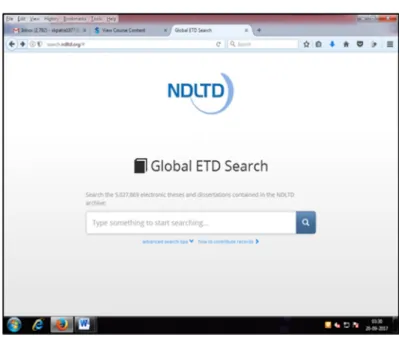
Figure 1: Global ETD Search Platform
There are about 55,72,749 ETDs have been deposited in the global open repository by 34 countries/region. Among the contributed countries of NDLTD repository, the following country’s repositories are top ten ETD repositories based on their respective uploaded ETDs.
Sl
No. Country Resource Name/URL
ETD
Collections Rank
1 Brasil Biblioteca Digital Brasileira de Teses e Dissertacoes (http://bdtd.ibict.br/ )
1,36,817 10
2 Finland Theseus: theses and publications of the Universities of Applied Sciences
(http://www.theseus.fi/?locale=len )
1,55,353 8
3 France Theses France (http://www.theses.fr/ )
4,55,796 3
4 Germany Deutsche Nationalbibliothek
(http://www.dnb.de/EN/Netzpublikationen/netzpublikationen _node.html ) 2,46,050 4 5 India Shodhganga (http://shodhganga.inflibnet.ac.in/ ) 2,25,028 5
6 Japan Japanese Institutional Repositories Online (JAIRO) (http://jairo.nii.ac.jp/en/ )
1,96,953 7
7 Portugal RCAAP - Repositório Científico de Acesso Aberto de Portugal
(http://www.rcaap.pt/ )
2,06,244 6
8 P. R. China
China Doctoral Dissertations Full-Text Database (http://oversea.cnki.net/kns55/brief/result.aspx?dbPrefix=CD
FD )
1,44,000 9
9 Taiwan National Digital Library of Theses & Dissertations in Taiwan
(
http://ndltd.ncl.edu.tw/cgi-bin/gs32/gsweb.cgi/ccd=2o.dzF/webmge?switchlang=en )
10 United Kingdom
EThOS (http://ethos.bl.uk/ )
5,00,000+ 1
Table 1:Top ten National ETD repositories in the world
It is found from Table 1 that EThOS (The ETD repository of UK) has contributed more than 5,00,000 ETDs and placed first rank among them. National Digital Library of Theses & Dissertations in Taiwan contributed 4,78,591 ETDs and occupied second rank. It is also indicated that Theses France of France contributed 4,55,796 ETDs place third rank. The other top ten repository countries are Germany (Deutsche Nationalbibliothek; 2,46,050 ETDs), India(Shodhganga; 2,25,028 ETDs), Portugal (RCAAP - Repositório Científico de Acesso Aberto de Portugal; 2,06,244 ETDs ), Japan (Japanese Institutional Repositories Online; 1,96,953 ETDs), Finland (Theseus: theses and publications of the Universities of Applied Sciences; 1,55,353 ETDs), P. R. China (China Doctoral Dissertations Full-Text Database; 1,44,000 ETDs) and Brasil (Biblioteca Digital Brasileira de Teses e Dissertacoes; 1,36,817 ETDs) respectively based on their uploaded ETDs in NDLTD’s platform.
United Nation HDI Index and ETDs
As per UN Human Development Indices and Indicator: 2018 Statistical Update
(http://hdr.undp.org/sites/default/files/2018_human_development_statistical_update.pdf)
we see that six countries among the top ten repository countries fall in Very High HDI countries list, three fall in High HDI countries list and one fall in Medium HDI countries list.
UN HDI Category Country/Countries No of total ETDs
Very High HDI UK, France, Germany, Japan,
Finland, Portugal 17,60,396
High HDI China, Brazil 7,59,408
Medium HDI India 2,25,028
Table 2: United Nation HDI Index and ETDs
Sl No. Country ETD Collections ETD Rank (X) Global HDI Rank Comparative
HDI Rank (Y) d=X-Y d
2
1 Brasil 1,36,817 10 79 7 3 9
2 Finland 1,55,353 8 15 3 5 25
4 Germany 2,46,050 4 5 1 3 9 5 India 2,25,028 5 130 10 -5 25 6 Japan 1,96,953 7 19 4 3 9 7 Portugal 2,06,244 6 41 6 0 0 8 P. R. China 1,44,000 9 88 8.5 0.5 0.25 9 Taiwan 4,78,591 2 88 8.5 -6.5 42.25 10 United Kingdom 5,00,000+ 1 14 2 -1 1 Total 0 124.5
Table 3: The Spearman’s Rank Correlation Coefficient analysis
In the Y-series (Comparative HDI Rank) we see that the value 88 occurs 2 times, because UN country HDI list consider Taiwan as in part of China. The common comparative rank given to these values is 8.5 which is average of 8 and 9.
The Spearman’s Rank Correlation Coefficient: = 1 − ∑
( )
= 0.2454
The Development Policy and Analysis Division of the Department of Economics and Social Affairs of the United Nations Secretariat (UN/DESA) was prepared a country classification based on their economic situation & prospects. They classify all countries of the world into one of three broad categories, such as developed economics, economics in transition and developing economics countries.
UN Country
Classification Sl No. ETD Repository Countries in NDLTD
Name of the ETD Repository
Major Developed Economics
1 Canada Theses Canada 2 France Theses France
3 Germany Deutsche Nationalbibliothek 4 Italy TesiOnline
5 Japan
Japanese Institutional Repositories Online (JAIRO)
CiNii Dissertations
7 United States American Doctoral Dissertations
Developed Economics
1 Australia Trove
2 Belgium
BicTel/e (Theses in French)
DOKS (Theses in Flemish)
3 Finland Theseus: theses and publications of the Universities of Applied Sciences
4 Ireland University College Dublin theses 5 Lithuania eLABa ETD
6 Netherlands NARCIS
7 New Zealand NZResearch.org.nz
8 Portugal RCAAP - Repositório Científico de Acesso Aberto de Portugal
9 Spain
TESEO
Tesis Doctorales en Red 10 Switzerland Helveticat
11 Wales Theses Collection Wales
Economics in transition
1 Armenia
Open Access Repository of the Armenian Electronic Theses and Dissertations
2 Serbia NaRDuS - National Repository of Dissertations in Serbia
Developing Economics
1 Bangladesh Digital Archive on Agricultural Theses and Journals
2 Brasil Biblioteca Digital Brasileira de Teses e Dissertações
3 China
China Doctoral Dissertations Full-Text Database
National Digital Library of Theses & Dissertations in Taiwan
4 Hong Kong HKU Theses Online (HKUTO) 5 India Shodhganga
6 Pakistan Pakistan Research Repository 7 Peru RENATI
8 South Africa ETD Portal
From the above table, we see that six economics developed countries (France, Germany, Japan, United Kingdom, Finland and Portugal) have good ETD repository and they fall under the top ten ETD repository of the world.
We also seen that the top ranked contributed ETD countries of NDLTD are from developed countries (UN Countries of developed economics) and also their positions in UN HDI index are very high, such as UK (14), France (24), Germany (5), Japan (19), Finland (15) and Portugal (41), etc.
Continental ETD Analysis
Sl. No. Continent ETDs Percentage (%)
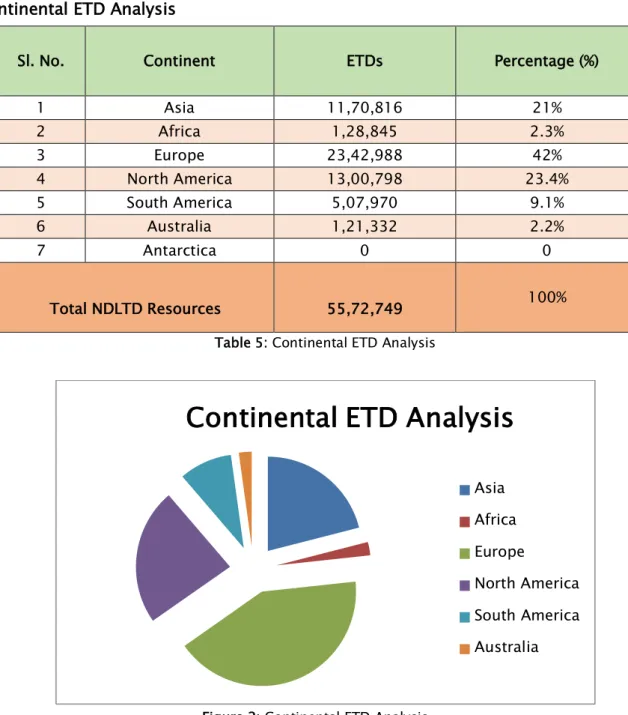
1 Asia 11,70,816 21% 2 Africa 1,28,845 2.3% 3 Europe 23,42,988 42% 4 North America 13,00,798 23.4% 5 South America 5,07,970 9.1% 6 Australia 1,21,332 2.2% 7 Antarctica 0 0 Total NDLTD Resources 55,72,749 100%
Table 5: Continental ETD Analysis
Figure 2: Continental ETD Analysis
By analysis of present scenario of the Global ETD repository, we see that from the Table 4, six continents have been contributed in NDLTD repository. European countries contributed maximum portions (42%) of ETDs in NDLTD repository. North American countries contributed
Continental ETD Analysis
Asia Africa Europe North America South America Australia
23.4% ETDs and Asian countries contributed 21% of ETDs in NDLTD repository for global access.
Conclusions
Global ETD platform is a joint effort of 34 regions/countries throughout of the world under the NDLTDs supervision. When the research output is available in open access platform, it would be widely used for research and teaching and sometimes it may use for decision and policy make. Most importantly, it helps to avoid duplication of research in many disciplines or avoiding plagiarism. Universities must come forward voluntarily to deposit their research content of theses in their respective ETD repository platform. EThOS of United Kingdom, National Digital Library of Theses & Dissertations in Taiwan and Theses France are contributed near about 25.74% of total ETDs of NDLTD platform. The global scenario of NDLTD repository platform indicate that European countries contributed near about 42% of total contributed ETDs in NDLTD repository. It is the best time to encourage ETD movement to the developing and under developing countries for sustainable development. If the developed countries come forward and take many initiatives, then the picture will be change of sustainable world. A new scholarly communication paradigm needs to be developed for linking ETDs and integrating universities and faculty with these national ETD repositories. The quantitative analysis of the national ETD repositories were all landmark achievement of individual ETD participating countries, as these provided the opportunity for researchers, faculty and students for furthering their existing knowledge.
References
Ahmed, A., Alreyaee, S., & Rahman, A. (2014). Theses and dissertations in institutional repositories: An asian perspective. New Library World, 115(9), 438-451.
Coates, M. (2014). Electronic theses and dissertations. Library Hi Tech, 32(2), 285-299. doi:http://dx.doi.org/10.1108/LHT-08-2013-0102
Ferreras-Fernández, T., García-Peñalvo, F., Merlo-Vega, J., & Martín-Rodero, H. (2016). Providing open access to PhD theses: Visibility and citation benefits. Program, 50(4), 399-416. doi:http://dx.doi.org/10.1108/PROG-04-2016-0039
Ghosh, M. (2009). E-theses and indian academia: A case study of nine ETD digital libraries and formulation of policies for a national service. The International Information & Library Review, 41(1), 21-33.
Han, Y. (2014). ETD: Total cost of ownership - collecting, archiving and providing access. Library Management, 35(4), 250-258. doi:http://dx.doi.org/10.1108/LM-08-2013-0084
Lowry, C. B. (2006). ETDs and digital repositories-a disciplinary challenge to open access? Portal : Libraries and the Academy, 6(4), 387-393.
Sawant, S. (2013). Past and present scenario of open access movement in india. The Journal of Academic Librarianship, 39(1), 108-109.
Sheeja, N. K. (2012). Knowledge management and open access e-theses: Indian initiatives. Library Review, 61(6), 418-427. doi:http://dx.doi.org/10.1108/00242531211284339 Suber, P. (2008). Open access to electronic theses and dissertations. DESIDOC Journal of Library & Information Technology, 28(1), 25. doi:http://dx.doi.org/10.14429/djlit.28.1.149
Swain, D. K. (2010). Global adoption of electronic theses and dissertations. Library Philosophy and Practice, , 1-7.
Troman, A., Jacobs, N., & Copeland, S. (2007). A new electronic service for UK theses: Access transformed by EThOS. Interlending & Document Supply, 35(3), 157-163. doi:http://dx.doi.org/10.1108/02641610710780836
Yiotis, K. (2008). Electronic theses and dissertation (ETD) repositories. OCLC Systems & Services, 24(2), 101-115. doi:http://dx.doi.org/10.1108/10650750810875458
Appendices
Photo 2: Taiwan ETD Repository
Photo 4: Portugal ETD Platform