Maria Francisca Amaral Gomes Marques Mano
LICENCIADA EM BIOQUÍMICA
F
IBER
F
UNCTIONALIZATION
F
OR
B
IOMEDICAL
A
PPLICATIONS
DISSERTAÇÃO PARA OBTENÇÃO DO GRAU DE MESTRE EM BIOTECNOLOGIA
ORIENTADOR: Doutor Alexandre Paiva, Investigador Pós-Doc, FCT-UNL
COORIENTADOR: Prof. Doutor João Paulo Borges, Professor Auxiliar, FCT-UNL
JÚRI:
PRESIDENTE: Prof. Doutor Carlos Alberto Gomes Salgueiro
ARGUENTE(S): Doutora Ana Rita Cruz Duarte
VOGAL(AIS): Doutor Alexandre Babo de Almeida Paiva
FIBER FUNCTIONALIZATION FOR BIOMEDICAL APPLICATIONS
Copyright @ 2014
–
Maria Francisca Amaral Gomes Marques Mano, da Faculdade de
Ciências e Tecnologia da Universidade Nova de Lisboa e da Universidade Nova de
Lisboa.
Aos meus pais.
The limits of the possible can only be defined by going beyond them
into the impossible.
AGRADECIMENTOS
“Ser humilde não é ser mais que alguém, é saber que não somos mais do que ninguém.” (Unknown)
Todo o conhecimento, trabalho e dedicação encontrado nesta tese, é produto de variadíssimas contribuições, de vários tipos, sem as quais não teria sido possível chegar onde cheguei. Por isso faço um agradecimento inicial, e geral, a todas as pessoas que contribuíram para a concretização deste projeto, e me deram a força necessária para enfrentar os desafios.
Tornando-me agora mais pessoal, queria começar por agradecer à Professora Susana Barreiros, por me ter aceite como nova aprendiz no laboratório, ter acreditado e apoiado todos os pequenos projetos que foram surgindo e desenvolvendo ao longo do ano. Porém, tenho que lhe agradecer verdadeiramente, por ter cedido ao meu pedido de alteração de projeto, pondo de parte as “suas” enzimas e deixando-me enveredar numa área totalmente diferente. Muito obrigada.
Ao Professor João Paulo Borges por, também me ter aceite, porém, no laboratório de Biomateriais, cedendo-me todo o material necessário para a realização de todo o projeto. Agradeço--lhe todo o tempo e paciência que dispôs para as nossas reuniões de “nad a-disto-está-a-resultar-por--favor-ajuda”. A verdade é que se não fossem essas reuniões salva-vidas, esta tese não teria metade dos resultados que apresenta, nem imagens tão magníficas. Muito obrigada.
Aos meus pais. Não chegam as palavras para vos agradecer tudo. Se sou o que sou hoje, a vós vos devo. Obrigada por me aturarem horas a fio, pelo apoio constante e incondicional, e por nunca me deixarem desistir. Obrigada por me indicarem sempre o caminho mais correto. Dedico-vos esta tese, com todo o amor e orgulho que uma filha pode ter pelos seus pais.
À Rita Craveiro. Iniciaste-me e inseriste-me dentro do ambiente laboratorial. Obrigada por me teres guiado e ajudado, nos primeiros tempos. Sem ti os DES/NADES/THEDES não teriam o mesmo sentido. Ambas partilhámos a mesma dor para com estes solventes (mal ditos sejam! Mais ou menos ;) ) Obrigada pela preocupação e pela “mania” das limpezas. Não fosses tu e aquele laboratório estava “de pantanas”, literalmente.
Ao Ângelo, mais conhecido como Gimma. “Xô Doutor” tanta paciência e ajuda que tenho em dívida para contigo. Tantos e-mails de socorro, socorridos. Mas a culpa também é tua. Ninguém te manda debitar ideias (saíste-me um belo idiota ;) ) como se não houvesse amanhã. Trinta mil ideias novas e diferentes para fazer em tão pouco tempo. Alguém tinha que arcar com as consequências disto tudo, não podia cair tudo sobre mim, coitadinha. Mas agora falando sério, um imenso obrigada pelo tempo e paciência que dispuseste. O FTIR não seria a mesma coisa, e nunca mais será!
À Ana Baptista. Aninhas muitas foram as “confissões” que ocorreram naquele laboratório. O apoio, a preocupação e as palmadinhas no ombro quando as coisas estavam num elevado nível de stress, foram determinantes para o sucesso deste trabalho. Obrigada por estares sempre disponível quando a ajuda era necessária.
do teu trabalho. Obrigada por teres partilhado esse conhecimento comigo. Toda a sorte para o teu futuro.
À Rita R. Pinto. Mãezinha, foste das que mais acompanhou todo o meu processo de “sofrimento”, durante esta caminhada. A ciência consegue levar qualquer pessoa sã, ao limite da loucura. Obrigada pelos abraços e pelas palavras reconfortantes, que vieram sempre no momento certo. Espero que agora esta nova aventura, na tua vida, te traga tudo de bom. Estamos todos mortinhos para conhecer esse rebento rechonchudo, que nos acompanhou durante todo este projeto. Coitadinho, ainda passou uns momentos de quanta loucura, naquele laboratório.
À Mariana Gameiro. Se fosse a escrever todos os nomes pelos quais és conhecida, não terminava isto hoje. Macaca sénior, tornaste-te uma parte imprescindível na minha vida. Acho que não teria saído com metade do coração cheio deste ano, se as coisas tivessem sido diferentes. Obrigada por me teres ensinado a ser mais humilde, mais simpática, mais risonha e mais palhaça (ainda). Acho que o Chefe foi o que sofreu mais no meio de tudo isto, pobre coitado.
À Telma Cordeiro. Macaca júnior, quem diria que os caminhos se cruzavam assim. Uma bolsa de investigação, um pouco fora do teu ambiente, levou a que integrasses nesta pequena família. Mas é como dizem, é aí que a vida acontece, fora da nossa zona de conforto. Hoje o DQ já não é a mesma coisa sem ti. Obrigada por me teres acompanhado, apoiado e levantado, tanto profissional como pessoalmente. E obrigada por me teres feito também mais risonha e mais palhaça. Mais uma vez, quem saiu mal nisto tudo foi o Chefe.
À Tânia Carvalho. Tanusca, passaste de uma estranha a ser tratada como mãe, por nós as três. Toda a tua boa disposição, humildade e amizade ajudaram a suportar os maus momentos que, por vezes, a investigação trás. Obrigada por tudo, pelos mimos e por nos levares a comer choco frito. Espero que Londres te traga aquilo que realmente desejas, e eu desejo-te tudo de bom.
À Sílvia, à Carmen, ao Zé, à Kat, à Luiza, ao Michael, à Sandra e aos estagiários brasileiros (Verónica, Kevin e Mariana), obrigada por tornarem o laboratório num ambiente mais familiar e alegre. Sempre facilita o trabalho, já por si, complicado.
And at last, but not least… Never least. O grande Chefe, Alexandre. Nem sei por onde começar. Foste um apoio incondicional, um grande mentor, e no fim acabaste por ficar um amigo. O trabalho nunca se revelou fácil, mas tu nunca me deixaste desistir. Sempre que o futuro se apresentava negro, conseguias arranjar maneira de mudar o ponto de vista. A ti te devo muito. Apesar de para ti ser sempre uma criança, com 12 anos de mentalidade, mas com férias de pessoa de 65, a verdade é que cresci pessoalmente, e profissionalmente, ao longo deste ano. Obrigada por, juntamente com a Professora, me terem aceite como aluna, bem como a minha proposta. Obrigada por criares um ambiente tranquilo e informal no laboratório. Torna-se mais fácil, e mais suportável trabalhar. A ciência, por si, já torna tudo mais difícil ;) (não, não me estou a queixar! Gosto imenso de investigação, principalmente de andar a bater com a cabeça nas paredes, e desvendar os grandes mistérios científicos). Obrigada Alexandre, obrigada por tudo! Este trabalho não teria sido nem metade do que é.
ABSTRACT
Deep-eutectic solvents (DES) are considered novel renewable and biodegradable solvents, with a cheap and easy synthesis, without waste production. Later it was discovered a new subclass of DES that even can be biocompatible, since their synthesis uses primary metabolites such as amino acids, organic acids and sugars, from organisms. This subclass was named natural deep-eutectic solvents (NADES).
Due to their properties it was tried to study the interaction between these solvents and biopolymers, in order to produce functionalized fibers for biomedical applications. In this way, fibers were produced by using the electrospinning technique. However, it was first necessary to study some physical properties of NADES, as well as the influence of water in their properties.
It has been concluded that the water has a high influence on NADES properties, which can be seen on the results obtained from the rheology and viscosity studies. The fluid dynamics had changed, as well as the viscosity.
Afterwards, it was tested the viability of using a starch blend. First it was tested the dissolution of these biopolymers into NADES, in order to study the viability of their application in electrospinning. However the results obtained were not satisfactory, since the starch polymers studied did not presented any dissolution in any NADES, or even in organic solvents. In this way it was changed the approach, and it was used other biocompatible polymers.
Poly(ethylene oxide), poly(vinyl alcohol) and gelatin were the others biopolymers tested for the electrospinning, with NADES. All polymers show good results, since it was possible to obtain fibers. However for gelatin it was used only eutectic mixtures, containing active pharmaceutical ingredients (API’s), instead of NADES. For this case it was used mandelic acid (antimicrobial properties), choline chloride, ibuprofen (anti-inflammatory properties) and menthol (analgesic properties).
The polymers and the produced fibers were characterized by scanning electron microscope (SEM), Transmission electron microscopy (TEM) and Fourier transform infrared spectroscopy (FTIR). With the help of these techniques it was possible to conclude that it was possible to encapsulate NADES within the fibers.
Rheology it was also study for poly(ethylene oxide) and poly(vinyl alcohol), in a way to understand the influence of polymer concentration, on the electrospinning technique.
For the gelatin, among the characterization techniques, it was also performed cytotoxicity and drug release studies. The gelatin membranes did not show any toxicity for the cells, since their viability was maintained. Regarding the controlled release profile experiment no conclusion could be drawn from the experiments, due to the rapid and complete dissolution of the gelatin in the buffer solution. However it was possible to quantify the mixture of choline chloride with mandelic acid, allowing thus to complete, and confirm, the information already obtained for the others characterization technique.
RESUMO
Deep-eutectic solvents apresentam-se como solventes renováveis e biodegradáveis, sendo a sua síntese barata, simples e sem produção de resíduos. Posteriormente foi descoberta uma subclasse destes solventes que, para além de ter todas estas vantagens, consegue ainda ser biocompatível, uma vez que usa na sua síntese metabolitos primários de organismos, como aminoácidos, ácidos orgânicos e açúcares. Esta subclasse designou-se por natural deep-eutectic solvents (NADES).
Devido às suas propriedades, tentou-se estudar a sua interação com biopolímeros, de modo a produzir fibras funcionalizadas para aplicações biomédicas, através do uso de eletrofiação. Começou-se então por estudar as propriedades físicas destes solventes, bem como a influência da água nas propriedades dos mesmos. Conseguiu-se concluir que a água tem uma grande influência sobre as propriedades dos NADES, através da realização de estudos da reologia.
Posteriormente utilizaram-se misturas de biopolímeros, contendo amido, tendo-se procedido a estudos de dissolução nos solventes eutécticos, de modo a testar a sua aplicabilidade na eletrofiação. Porém nenhum dos biopolímeros teve sucesso na dissolução em NADES, nem em solventes orgânicos. Tentou-se então alterar a abordagem e recorreu-se a outros polímeros também de carácter biocompatível.
Poli(óxido de etileno), poli(vinil álcool) e gelatina foram os biopolímeros testados para a técnica de eletrofiação, juntamente com NADES. O poli(óxido de etileno) e o poli(vinil álcool) produziram as primeiras fibras com NADES, através da eletrofiação. Contudo a gelatina apenas produziu fibras para misturas eutécticas, os THEDES, que continham ingredientes farmacêuticos ativos (API’s). Estes THEDES foram sintetizados misturando ácido mandélico (propriedades antibacterianas) com cloreto de colina, e ibuprofeno (propriedades anti-inflamatórias) com mentol (propriedades anestésicas).
Recorreram-se a várias técnicas de caracterização como microscopia eletrónica de varrimento (SEM), microscopia eletrónica de transmissão (TEM) e espetroscopia de infravermelho (FTIR), de modo a caracterizar as fibras obtidas, para os três polímeros. A informação obtida, e conjugada, permitiu então averiguar que o NADES e o THEDES conseguiam ser impregnados no interior das fibras, ou então encapsulados em casulos.
A reologia foi também uma propriedade estudada para o poli(óxido de etileno) e poli(vinil álcool), de modo a compreender a influência da concentração do polímero no processo de eletrofiação.
No caso da gelatina estudou-se citotoxicidade e tentou-se realizar um perfil de libertação controlada dos fármacos. As membranas de gelatina testadas não demonstraram qualquer toxicidade para as células, tendo mantido a viabilidade celular. Porém os testes de libertação não foram bem-sucedidos, devido à rápida desintegração das membranas quando colocadas em tampão. Para este último teste, porém, conseguiu-se quantificar o ácido mandélico com cloreto de colina, corroborando os resultados obtidos anteriormente, para as técnicas de caracterização.
CONTENT
AGRADECIMENTOS ... xi
ABSTRACT ... xiii
RESUMO ... xv
LIST OF TABLES ... xxi
LIST OF FIGURES ... xxiii
NOMENCLATURE ... xxv
OVERVIEW ... 1
PART 1:GREEN CHEMISTRY - THE NEED FOR SELF-SUSTAINABLE PROCESSES ... 3
PART 2:IONIC LIQUIDS – A NEW GREEN SOLVENT ... 5
PART 3:THE NEED OF NEW GREEN SOLVENTS ... 7
STATE OF THE ART ... 9
PART 1:DEEP-EUTECTIC SOLVENTS: THE “NEWS IONIC LIQUIDS” ... 11
1.1. DEEP EUTECTIC SOLVENTS PRODUCTION ... 11
1.2. EUTECTIC MIXTURE ... 11
PART 2:FROM DEEP-EUTECTIC SOLVENTS TO NATURAL DEEP-EUTECTIC SOLVENTS ... 12
2.1. AN ALTERNATIVE MEDIUM... 12
2.2. THE IMPORTANCE OF NADES IN RESEARCH ... 15
PART 3:ELECTROSPINNING – A FIBER MAKING TECHNIQUE ... 16
3.1. ELECTROSPINNING SETUP ... 16
3.2. ELECTROSPINNIG PARAMETERS ... 17
PART 4:POLYMERS – FROM PLASTIC BAGS TO BIOMEDICAL APPLICATIONS ... 18
MATERIALS AND METHODS ... 21
PART 1:PREPARATION AND CHARACTERIZATION OF NADES AND THEDES ... 23
1.1. CHEMICALS ... 23
1.2. PREPARATION OF NADES ... 23
1.3. PREPARATION OF THEDES... 24
1.4. WATER QUANTIFICATION ... 24
PART 2:STARCH BLENDS PROCESSING ... 25
2.1. CHEMICALS ... 25
2.2. DISSOLVING THE POLYMERS IN VARIOUS SOLVENTS ... 25
2.3. CHEMICAL MODIFICATIONS OF SPCL ... 25
3.2. SAMPLES PREPARATION ... 26
3.3. ELECTROSPINNING EXPERIMENTAL SET-UP ... 27
3.4. ELECTROSPINNING CONDITIONS ... 27
PART 4:POLYMERS CHARACTERIZATION ... 28
4.1. FOURIER TRANSFORM INFRARED SPECTROSCOPY ... 28
4.2. SCANNING ELECTRON MICROSCOPY ... 28
4.3. TRANSMISSION ELECTRON MICROSCOPY ... 28
PART 5: BIOLOGICAL AND DRUG DELIVERY STUDIES ... 29
5.1. BIOLOGICAL STUDIES ... 29
5.2. DRUG DELIVERY PROFILE ... 29
RESULTS AND DISCUSSION ... 31
PART 1:PHYSICAL PROPERTIES OF NADES AND THEDES ... 33
1.1. WATER CONTENT ... 33
1.2. VISCOSITY ... 33
PART 2:STARCH BLENDS PROCESSING ... 34
2.1. DISSOLVING THE POLYMERS IN NADES ... 34
2.2. TESTING ORGANIC COMPOUNDS AS SOLVENTS ... 35
2.3. MISCIBILITY OF NADES IN ORGANIC SOLVENTS ... 36
2.4. DISSOLVING POLYMERS WITH CO-SOLVENTS ... 36
PART 3:CHEMICAL MODIFICATION OF SPCL ... 37
PART 4:ELECTROSPINNING OF BIOCOMPATIBLE POLYMERS ... 39
4.1. POLY (ETHYLENE OXIDE) ... 39
4.1.1. DISSOLVING NADES IN PEO SOLUTION ... 39
4.1.2. FIBERS OPTIMIZATION ... 39
4.1.3. FIBERS CHARACTERIZATION ... 42
4.2. POLY (VINYL ALCOHOL) ... 43
4.2.1. FIBERS OPTIMIZATION ... 43
4.3. GELATIN ... 46
4.3.1. FIBERS OPTIMIZATION ... 46
4.3.2. FIBERS CHARACTERIZATION... 47
4.3.3. IN VITRO BIOLOGICAL STUDIES ... 51
FUTURE WORK ... 57
BIBLIOGRAPHY ... 59
APPENDIX ... 63
APPENDIX I– IBUPROFEN PREPARATION ... 65
APPENDIX II– SPCL ACETYLATION ... 65
LIST OF TABLES
CHAPTER 2:
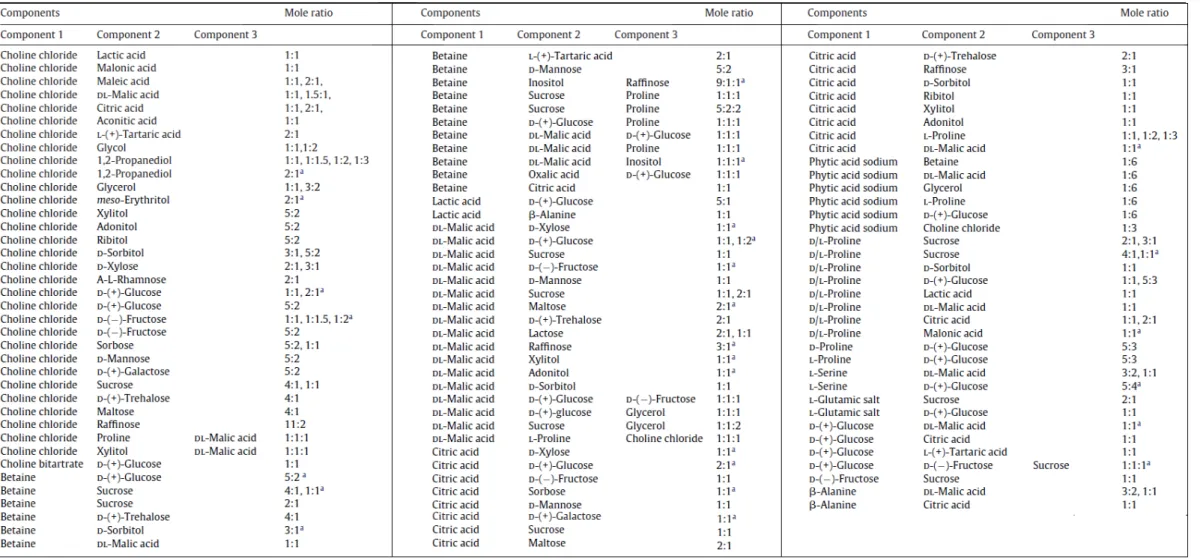
TABLE 2.1. LIST OF THE VARIOUS COMPOUNDS THAT CAN BE USED TO FORMED NATURAL DEEP-EUTECTIC SOLVENTS AND THEIR MOLAR RATIOS19. ... 14
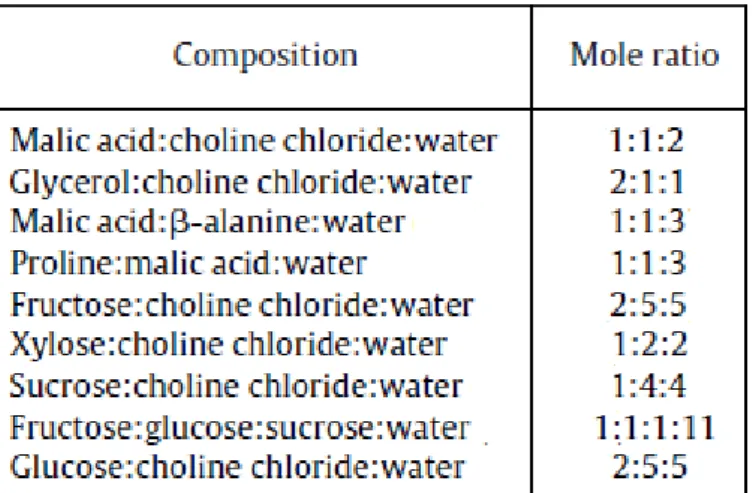
TABLE 2.2.NATURAL DEEP-EUTECTIC SOLVENTS WITH KNOWN RATIOS OF WATER IN THEIR COMPOSITION.ADAPTED FROM Y.DAI ET AL.(2013)19. ... 15
CHAPTER 3
:
TABLE 3.1. LIST OF NATURAL DEEP-EUTECTIC SOLVENTS USED FOR THIS STUDY. ... 23
TABLE 3.2.THERAPEUTIC DEEP-EUTECTIC SOLVENTS USED FOR THIS STUDY, WITH THE MOLAR RATIO AND THE TEMPERATURE USED FOR THEIR PREPARATION. ... 24
TABLE 3.3. POLYMERS TESTED FOR THE DISSOLUTION INTO NADES, WITH THE WEIGHT FRACTION USED AND THE RANGE OF
TEMPERATURE TESTED, IN ORDER TO IMPROVE SOLUBILIZATION. ... 25
TABLE 3.4. BIOPOLYMERS USED FOR THE ELECTROSPINNING TECHNIQUE.IT SHOWS THE VOLUME OF NADES ADDED, AS WELL AS THE POLYMER WEIGHT FRACTION ADDED TO EACH SAMPLE.THE TEMPERATURE IS RELATED TO THE DISSOLUTION OF THE POLYMER. ... 26
TABLE 3.5.CONDITIONS USED TO PREPARE GELATIN SAMPLES, FOR THE ELECTROSPINNING.IT INDICATES THE VOLUME OF NADES AND THE POLYMER WEIGHT USED FOR EACH SAMPLE. ... 27
TABLE 3.6. ELECTROSPINNING RANGE PARAMETERS TESTED FOR EACH POLYMER SAMPLE. ... 27
CHAPTER 4:
TABLE 4.1. PERCENTAGE OF WATER CONTENT PRESENT IN EACH NADES.THE VALUES WERE OBTAINED THROUGH THE KARL-FISCHER METHOD... 33
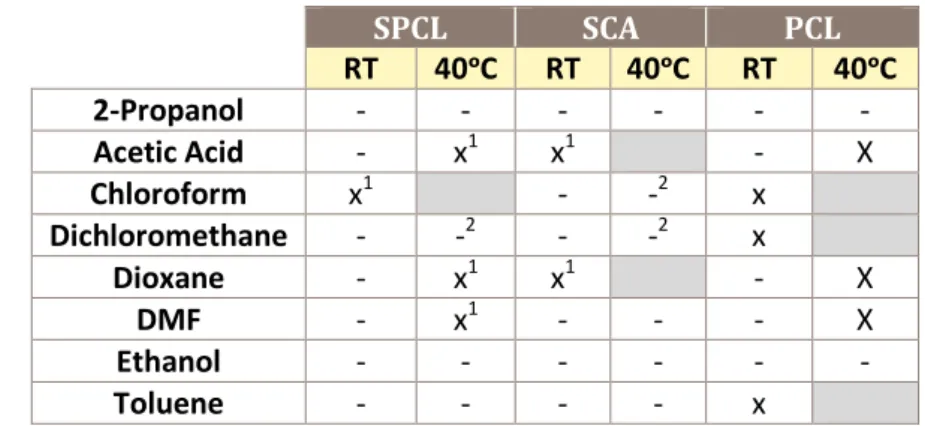
TABLE 4.2. RESULTS OBTAINED FOR THE DISSOLUTION TEST MADE FOR SPCL AND SCA POLYMER, IN NADES, AT VARIOUS
TEMPERATURES (X SYMBOL – OCCURRED DISSOLUTION;- SYMBOL – PRESENCE OF POWDER IN NADES, AFTER STIRRED 16H). ... 35
TABLE 4.3.ORGANIC SOLVENTS TESTED FOR DISSOLVING SPCL,SCA AND PCL POLYMERS, AT VARIOUS TEMPERATURES (X SYMBOL – OCCURRED DISSOLUTION;- SYMBOL – PRESENCE OF POWDER IN SOLVENTS, AFTER STIRRED 16H). ... 35
TABLE 4.4. LIST OF ORGANIC SOLVENTS TESTED IN ORDER TO ACHIEVING THE COMPATIBILITY BETWEEN THEM AND NADES, IN A 1:2
VOLUME RATION.THE ORGANIC SOLVENTS ARE ORGANIZED FROM THE LESS POLAR TO THE MORE POLAR. ... 36
TABLE 4.5. ELECTROSPINNING OPTIMIZED PARAMETERS, OBTAINED FOR PEO SAMPLES, WITH CA:SUC AND CHCL:CANADES. ... 41
LIST OF FIGURES
CHAPTER 1:
FIGURE 1.1.THE TWELVE PRINCIPLES OF GREEN CHEMISTRY ... 4
FIGURE 1.2.POSSIBLE IONIC LIQUIDS APPLICATIONS.(ADAPTED FROM PHARM ET AL4). ... 5
FIGURE 1.3. EVOLUTION OF THE NUMBER OF PUBLICATIONS ON IONIC LIQUIDS, ACCORDING TO THE WEB OF KNOWLEDGE DATABASE. 6 FIGURE 1.4.SEM IMAGE OF ION JELLY FIBERS.ADAPTED FROM PIMENTA ET AL5. ... 6
CHAPTER 2: FIGURE 2.1. A TYPICAL DIAGRAM OF A EUTECTIC MIXTURE MADE WITH TWO COMPOUNDS.IN THIS FIGURE IT IS POSSIBLE TO SEE THE MOLAR RATION AS WELL AS THE TEMPERATURE NEEDED TO ACHIEVE THE EUTECTIC POINT (EP). ... 12
FIGURE 2.2. CHEMICAL STRUCTURE OF THE CITRIC ACID (A) AND THE SUCCINIC ACID (B) PERMITTING THE COMPARISON BETWEEN THESE TWO ORGANIC ACIDS. ... 16
FIGURE 2.3. A)SEM IMAGES THAT DEMONSTRATE THE ELECTROSPRAY PROCESS DUE TO LOW CONCENTRATION OF POLYMER;B)SEM IMAGE FROM A MICROSCALE FIBER DUE TO A HIGHER CONCENTRATION OF POLYMER.ADAPTED FROM LI AND WANG (2013)29 ... 17
CHAPTER 4: FIGURE 4.1.THE VISCOSITY OBTAINED FOR CHCL:CA, DRIED WITH NITROGEN (CLOSED SYMBOLS), AND CHCL:CA, DRIED ONLY WITH VACCUM (OPEN SYMBOLS) AT 25ᵒC.FOR CHCL:CA(CLOSE SYMBOLS) SOLUTION THE VISCOSITY WAS 4,801PA.S, AND FOR CHCL:CA (OPEN SYMBOLS) WAS 0,558PA.S.DATA IN THE GREY AREA ARE CONSIDERED OUTLIERS. ... 34
FIGURE 4.2. EXAMPLE OF AN ACETYLATION REACTION.THE ACETYL GROUP IS REPRESENTED GREEN. ... 37
FIGURE 4.3. FTIR SPECTRUM OF SPCL. ... 37
FIGURE 4.4. FTIR SPECTRUM OF THE REACTION BETWEEN IBUPROFEN ANHYDRIDE WITH SPCL, IN CHLOROFORM. ... 38
FIGURE 4.5. FTIR SPECTRUM OF THE REACTION BETWEEN IBUPROFEN ANHYDRIDE WITH SPCL, BUT AFTER WASHING THE PRODUCT REACTION WITH ETHANOL. ... 38
FIGURE 4.6. FTIR SPECTRUM OF THE REACTION BETWEEN SPCL AND PROPIONIC ANHYDRIDE, IN CHLOROFORM. ... 39
FIGURE 4.7.ELECTRON MICROSCOPE IMAGES FOR THE ELECTROSPINNING OPTIMIZATION PARAMETERS.LEFT IMAGE -PEO2%(W/V) WITH CA:SUC 2%(W/V) FIBERS (CONDITIONS:24CM,10KV,0,2ML/H,45%,23ᵒC); RIGHT IMAGE -PEO3%(W/V) WITH CA:SUC 2%(W/V) FIBERS (CONDITIONS:24CM,15KV,0,2ML/H,35-40% AND 28-30ᵒC).(AMPLIFICATION OF BOTH IMAGES:100X) .... 40
FIGURE 4.8. THE VISCOSITY PARAMETER OBTAINED FOR CA:SUC (OPEN SYMBOLS) AND CHCL:CA(CLOSED SYMBOLS), AT 25ᵒC.FOR CA:SUC SOLUTION THE VISCOSITY WAS 1,743PA.S AND FOR CHCL:CA WAS 0,558PA.S.DATA IN THE GREY AREA ARE CONSIDERED OUTLIERS. ... 40
FIGURE 4.9.EFFECT OF POLYMER CONCENTRATION ON THE VISCOSITY OF THE DIFFERENT POE SOLUTIONS WITH 2%(V/V)CHCL:CA. PEO CONCENTRATION OF (2%(W/V): GREY SYMBOLS;PEO CONCENTRATION OF 3%(W/V): BLACK SYMBOLS;PEO CONCENTRATION OF 4%(W/V): OPEN SYMBOLS.THESE EXPERIMENTS WERE REALIZED AT 25ᵒC.DATA IN THE GREY AREA ARE CONSIDERED OUTLIERS. 41 FIGURE 4.10. SEM IMAGES OBTAINED FOR NADES FIBERS.UPPER LEFT AND RIGHT -PEO3%(W/V) WITH CA:SUC 2%(V/V) FIBERS (ELECTROSPINNING PARAMETERS:24CM,15KV,0,2ML/H,35-40% AND 28-30ᵒC); BOTTOM LEFT AND RIGHT -PEO3%(W/V) WITH CHCL:CA2%(V/V) FIBERS (ELECTROSPINNING PARAMETERS:28CM,20KV,0,2ML/H,35-40% AND 28-30ᵒC). ... 43
FIGURE 4.11.EFFECT OF POLYMER CONCENTRATION ON THE VISCOSITY OF THE DIFFERENT PVA CONCENTRATION WITH 2%(V/V) CHCL:CA(GREY SYMBOLS:7,8%(W/V); BLACK SYMBOLS:9.8%(W/V)).BOTH EXPERIMENTS WERE REALIZED AT 25ᵒC.DATA IN THE GREY AREA ARE CONSIDERED OUTLIERS. ... 44
FIGURE 4.12. VISCOSIMETRY OF THE SAMPLE PVA9.8% WITH CHCL:CA(OPEN SYMBOLS: VISCOSITY; CLOSED SYMBOLS: SHEAR STRESS).THIS EXPERIMENT WAS REALIZED AT 25ᵒC.DATA IN THE GREY AREA ARE CONSIDERED OUTLIERS. ... 45
FIGURE 4.14. SEM IMAGE OF THE FIBERS OBTAINED FOR 30% GELATIN WITH CHCL:MANDAC AT 2%.IMAGE AMPLIFICATION:300X.
(ELECTROSPINNING PARAMETERS:18CM,20KV,0,2ML/H,35-40% AND 30-32ᵒC). ... 47
FIGURE 4.15. SEM IMAGE OF FIBERS OBTAINED FOR 30% GELATIN WITH IBU:MEN AT 1,5%.IMAGE AMPLIFICATION:300X. ... 47
FIGURE 4.16. SEM IMAGE OF FIBERS OBTAINED FOR 30% GELATIN WITH IBU:MEN AT 1,5%, WITH A HIGHER AMPLIFICATION
(AMPLIFICATION:1000X).THE ARROWS INDICATE THE HELICAL FORM.(ELECTROSPINNING PARAMETERS:18CM,20KV,0,2ML/H, 35-40% AND 30-32ᵒC). ... 48
FIGURE 4.17.POSSIBLE SHAPES THAT FIBERS CAN HAVE, ACCORDING TO KOOMBHONGSE ET AL61. THE FIGURE DEMONSTRATES THE COLLAPSE OF THE FIBER (4.17 A-C), WITH THE FORMATION OF FLAT RIBBONS (4.17 D) AND ALSO THE FORMATION OF RIBBONS WITH TWO TUBES (4.17 E). ... 48
FIGURE 4.18. SEM IMAGE OF FIBERS OBTAINED FOR 30% GELATIN WITH CHCL:MANDAC AT 2%, WITH A HIGHER AMPLIFICATION
(AMPLIFICATION:1000X).IT IS POSSIBLE TO SEE THE FORMATION OF FLAT RIBBONS (1) AND ALSO RIBBONS WITH TWO TUBES (2).
(ELECTROSPINNING PARAMETERS:18CM,20KV,0,2ML/H,35-40% AND 30-32ᵒC). ... 49
FIGURE 4.19. TEM IMAGES OF GELATIN FIBERS WITH THEDES, IN OPTIMIZED CONDITIONS.LEFT - GELATIN 30%(W/V) WITH
CHCL:MANDAC 2%(W/V); RIGHT - GELATIN 30%(W/V) WITH IBU:MEN 1,5%(W/V)(THE ARROW POINTING THE CHANGE OF DENSITY).(ELECTROSPINNING PARAMETERS:18CM,20KV,0,2ML/H,35-40% AND 30-32ᵒC). ... 49
FIGURE 4.20.FTIRSPECTRUM OF GELATIN,CHCL:MANDAC (THEDES) AND THE ELECTROSPUN FIBERS OBTAINED... 50
FIGURE 4.21. FTIRSPECTRUM OF GELATIN,IBU:MEN (THEDES) AND THE ELECTROSPUN FIBERS OBTAINED. ... 50
FIGURE 4.22.MTS ASSAY FOR BOTH GELATIN MEMBRANES WITH THEDES TESTED (IBU:MEN AND CHCL:MANDAC) ... 51
APPENDIX
FIGURE A.1.FTIRSPECTRUM OF CHOLINE CHLORIDE (CHCL), MANDELIC ACID (MANDAC) AND THE MIXTURE OF BOTH,
CHCL:MANDAC (THEDES). ... 66
NOMENCLATURE
API’s Active Pharmaceutical Ingredients
CA Citric Acid ChCl Choline Chloride CA:Suc Citric Acid : Sucrose
ChCl:CA Choline Chloride : Citric Acid ChCl:MandAc Choline Chloride : Mandelic Acid DES Deep-eutectic Solvents
DMF Dimethylformamide
FTIR Fourier transform infrared spectroscopy
Glu Glucose
Ibu Ibuprofen
Ibu:Men Ibuprofen : Menthol ILs Ionic liquids
MandAc Mandelic Acid
Men Menthol
NADES Natural Deep-eutectic Solvents PCL Polycaprolactone
POE Poly(ethylene oxide) PVA Poly(vinyl alcohol)
SEM Scanning electron microscopy
SPCL Starch-Polycaprolactone SCA Starch-Cellulose Acetate
Suc Sucrose
TEM Transmission electron microscopy THEDES Therapeutic Deep-eutectic Solvents
Xyl Xylose
RT Room Temperature
FIBER FUNCTIONALIZATION FOR BIOMEDICAL APPLICATIONS
Chapter 1
FIBER FUNCTIONALIZATION FOR BIOMEDICAL APPLICATIONS
OVERVIEW
P
ART1:
G
REENC
HEMISTRY-
THE NEED FOR SELF-
SUSTAINABLE PROCESSESSince the beginning of times that renewable processes allowed the replacement of various compounds, preventing the exhaustion of needed natural resources and the accumulation of possible toxic mixtures.
The passage of time led to a growth in various areas and men started to comprehend the mechanisms behind the processes. In this way the need of knowledge became to grow and the production of new compounds led to an increase of hazard materials. Thus the accumulation of non-biodegradable mixtures increased and natural resources also started to be used without control. As a consequence problems emerged associated with the abuse of renewable and natural resources. It became impossible to replace them with the same rate at which they were used. But with the fast development of the chemical industry, so did the awareness of society for environmental and health hazards that these processes could cause so they started to require all the benefits that these industries would provide but without the negative problems and with more sustainable processes.
It was following this line that the concept of Green Chemistry arose in the 90’s1 where can also be known as sustainable chemistry and it is defined as the process of eliminating, or reducing, the use of hazardous substances or their generation1. It involves twelve principles that help the user to adapt and adjust his practices for achieving the goal of sustainability.
The Twelve Principles of Green Chemistry1 (see figure 1.1) embrace important points such as
prevention, atom economy, less hazardous chemical synthesis, designing safer chemicals, safer solvents and auxiliaries, design for energy efficiency, use of renewable feedstock, reduce derivatives, catalysis, design for degradation, real-time analysis for pollution prevention and inherently safer chemistry for accident prevention. Through a careful plan that goes from chemical synthesis to molecular design1, these principles serve as a guideline for the design of new chemical processes and
compounds by applying the life-cycle from raw materials, the safety of the transformations and the toxicity and biodegradability of the materials used1. It also allows to demonstrate that it is possible to design products and processes that are profitable with all the benefits for human and environment health1.
Although the success that the green chemistry is having in all research sectors, it is important to notice that these principles must be applied as a consistent system and not as independent goals1
since it is only possible to achieve a sustainable process if they were applied as an integrated guideline1.
The use of safer solvents can be the more active principle in the Green Chemistry since they are the main reason for the large production of waste due to their process and their applications, without counting with the properties such as flammable, corrosive and toxic profile that the most conventional solvents have1. In this way chemist started to work on a way to overcome these
FIBER FUNCTIONALIZATION FOR BIOMEDICAL APPLICATIONS
P
ART2:
I
ONICL
IQUIDS–
A NEW GREEN SOLVENTIonic liquids arose as the substitutes for VOCs (volatile organic compounds) due to various reasons such as the high use of these solvents and their volatility2. Although the existence of governmental policies that control the emission and the abusive use of VOCs it is important to develop more efficient and environmental friendly process in order to decrease these pollution2.
So the ionic liquids have been seeing as the green solvents that could help to minimize the risks of using VOCs. They are made of organic salts composed by cations and anions, which present a liquid state at temperatures below 100ᵒC3, where some of them are liquid at room temperature2 and thus called room temperature ionic liquids (RTILs).
Usually called as “designer solvents”, their properties can be managed according to the needs of the scientist. The green character is conferred by unique properties typical of these solvents that go from the negligible of vapor pressure to the thermal stability and polarity2,3. These properties
make it possible to use them under high temperature conditions, since they do not decompose over a large range of temperature2, preventing the production of atmospheric VOCs even at low pressures2. The miscibility of the ionic liquids is another property that can be modified since they can go from immiscible to fully miscible2 depending on the nature of the cation or the anion used.
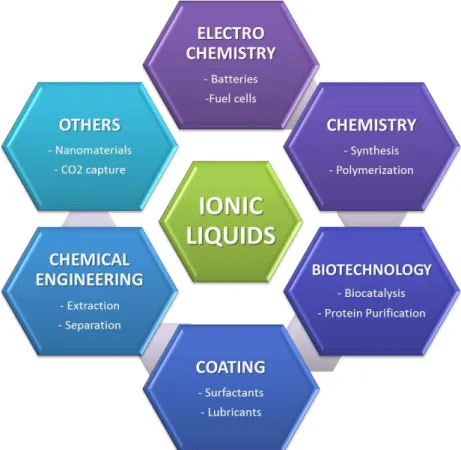
It is due to all these properties, and the possibility to adapt the properties of ionic liquids, that make them interesting solvents to be used in all industries sectors and scientific areas, such as chemical engineering, energy, electrochemistry, catalysis, extraction, separation and organic reactions, among others2 (see figure 1.2).
CHAPTER 1:OVERVIEW
Due to their vast applications the attention among these solvents had a suddenly increase that led to a rapid growth in publication rate5. Literature search shows that from the end of the 20th
century the number of publication on ionic liquids increased over a 70 growth factor, according to web of knowledge database on the search for ionic liquids results (see figure 1.3).
Figure 1.3. Evolution of the number of publications on ionic liquids, according to the Web of Knowledge database.
As said before, the applications of these solvents depend on the imagination of the user, leading to more than one hundred applications in all areas. But for the interest of this thesis theme spoken here, the use of these green solvents will be directed to a more specific area, electrospinning technique.
An example of an application of this technique is the production of ion jelly® fibers6 (see figure 1.4). These fibers combine the properties of one polymer, gelatin, with ionic liquid, allowing the creation of membranes with a high area/volume ratio and high porosity6. This process enabled
the increase the applications with ionic liquids.
FIBER FUNCTIONALIZATION FOR BIOMEDICAL APPLICATIONS
The advantage of using ionic liquids is the fact that it is possible to design their properties according to the application wanted by combining different cation/anion modifying thus their properties. However it is important to notice that ionic liquids are widely applied into the electrospinning technique along with others polymers as cellulose7 and others8,9.
P
ART3:
T
HE NEED OF NEW GREEN SOLVENTSDesigner property is the main characteristic that makes ionic liquids so appealing, since it enables to adjust the physicochemical properties of the solution. However the evolution of the science led to an advance on the information about ILs allowing grouping these solvents into various generations. The first generation comprehends physical properties that are often unique in ILs, such as decreased vapor pressure and high thermal stability. This generation did not attract much interest due to the oxygen-sensitive that did not allowed an easy handling.
Thus the research was directed to new synthesis of others ILs that led to the second generation, which have a more stable behavior in presence of water or oxygen. These solvents present interesting properties (lower melting points, viscosity, different solubility, etc.) enabling their use as reaction mediums. This generation is still target of study providing interest and novel applications in different areas.
Although the vast applications and interest on these green solvents, the green character of ionic liquids have been challenged due to the lack of information about their biodegradability and toxicity10. Moreover the sustainability of the production process is still challenging, since the synthesis of ionic liquids includes the production of by-products that can be harmful, leading to an increase of waste thus influencing the E-factor11. The E-factor highlights the waste produced in one process and it can be determined by dividing the total waste produced by the total amount of the desired product12. The smaller the E-factor the more sustainable will be the reaction.
The literature shows that the most common ionic liquids used are indeed toxic to nature4
distancing them from the green image typically found. The question now relies on the possibility of designing environmentally acceptable ILs that will maintain their excellent application capability among with the capacity to fulfill the environmentally safety criteria.
In this way it has been proven that the addition of polar groups to the structure enables a decrease in toxicity and an increase in biodegradability4. But being ionic liquids known as designer
solvents maybe the true solution passes through the creation of novel ionic liquids based on more environmentally friendly compounds, thus fulfilling all the criteria needed to guarantee the green character of these solvents.
Recently a new generation of ILs was created based on active pharmaceutical ingredients in order to produce ILs with biological activity. The development of antimicrobial Ion Jelly fibers13 is one example of this application. Through the use of a biocompatible polymer and the combination of choline chloride and antimicrobial acids, it was possible to obtain electrospun fibers that demonstrated antimicrobial properties against E. coli and B. subtilis13. This discovering altered the non-green character that ILs had obtain previously since the cholinium cation presents a low toxicity and good biodegradability11.
FIBER FUNCTIONALIZATION FOR BIOMEDICAL APPLICATIONS
Chapter 2
FIBER FUNCTIONALIZATION FOR BIOMEDICAL APPLICATIONS
STATE OF THE ART
P
ART1:
D
EEP-
EUTECTIC SOLVENTS:
THE“
NEWS IONIC LIQUIDS”
Deep eutectic solvents can be considered as the new ionic liquids in nowadays research evidencing close properties and applications to ionic liquids. They both share some physical properties that go from their non-flammability, due to the lack of measurable vapor pressure14, and a
non-reactive behavior with water14. They can also provide reaction conditions, like ILs, in areas such
as liquid-liquid extraction15, removal of glycerol from biodiesel fuel15, dissolution and separation of
components16, catalysis16, organic synthesis16, and electrochemistry16 among others. However deep-eutectic solvents result from the mixture of two safe compounds that in known proportions are able to form an eutectic mixture, being this the main reason why deep-eutectic solvents offer certain advantages over ionic liquids14.
The components used for the DES preparation are cheap, renewable and biodegradable, overcoming the high price and sometimes the toxicity that some ionic liquids exhibit16. Beyond that
these solvents do not need a post-synthesis purification since the purity that they have depends only on the purity of its individual components14. Finally they also present a low cost to the users making DES more desirable than ILs for a large-scale synthesis applications14.
1.1.DEEP EUTECTIC SOLVENTS PRODUCTION
DES are a result of an eutectic mixture that occurs between a quaternary ammonium salt and a hydrogen-bond donor14. Choline chloride is an example of a quaternary salt and is also the most
common reagent used for the formation of DES since it is a cheap, biodegradable and non-toxic compound having the advantage of being extracted from biomass or synthesized from fossil reserves16. The combination of this salt with hydrogen-bond donors such as urea, renewable carboxylic acids and polyols, results in an easy synthesis of deep-eutectic solvents16. This final
solution presents a melting point that is far lower than the melting point of the individual components of the mixture. These phenomenon can be explained by the charge delocalization that occurs through the hydrogen bond that exists between the halide anion and the hydrogen-donor14.
In general DES are characterized by the formation of a liquid phase with a very large depression of freezing point usually higher than 150ᵒC16. However it is important to note that DES are liquid in a range of temperatures that goes from room temperature to 70ᵒC16.
Since they have close properties to ionic liquids it is possible to include DES in this class of solvents17. Still DES cannot be considered ILs since they haven’t in their composition ionic species and
can be formed with non-ionic compounds16.
1.2.EUTECTIC MIXTURE
Deep eutectic solvents are compared to an eutectic mixture since the latter has in his composition two or more compounds18 that result in a final solution with different properties than
the initial compounds, being the melting point the property that suffers a stronger modification14,19.
These type of mixtures present a lower melting point when compared to the initial components18,
CHAPTER 2:STATE OF ART
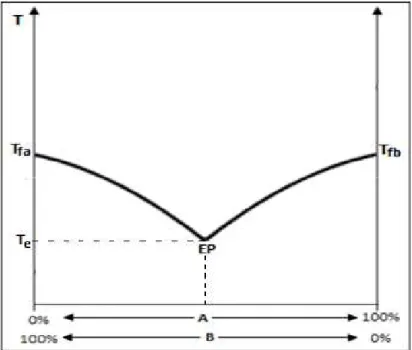
creation of this eutectic mixture. This phenomenon is then called the eutectic point and can be observed in Figure 2.1.
In case of changing the ratio of the compounds or if the temperature is modified, the eutectic mixture does no longer exist20. It is this temperature – ratio process that allows the formation of alloys in areas such as metallurgy and biomedicine being able to make them stronger and when needed, biocompatible.
Figure 2.1. A typical diagram of a eutectic mixture made with two compounds. In this figure it is possible to see the molar ration as well as the temperature needed to achieve the eutectic point (EP).
P
ART2:
F
ROMD
EEP-E
UTECTICS
OLVENTS TON
ATURALD
EEP-E
UTECTICS
OLVENTSThe green character of deep-eutectic solvents is the principal quality that makes these solvents so interesting in the research area by means of replacing the harsh organic solvents. However the applications of DES and ILs in the real chemistry industry have some limitations due the toxicity of these solvents against humans and the environment, the high cost of ILs and the solid state of some DES at room temperature19. In this way it is important to overcome these disadvantages and turn these solvents more friendly for the various areas of application.
2.1.AN ALTERNATIVE MEDIUM
According to Dai et al. hypothesis19, there are is alternative medium to water and lipids since there are various biological processes that occur in living organisms that are difficult to explain19. The survival of organisms in extreme environmental conditions, or the biosynthesis of poorly water soluble metabolites19, are some of the biological processes that can confirm the existence of an
FIBER FUNCTIONALIZATION FOR BIOMEDICAL APPLICATIONS
The application of NMR technique allowed a clear view of the major molecules present in these organisms that go from sugars to amino acids, choline and some organic acids21. In this way it is
believed that these compounds can form a third new type of liquid separated from water and lipids21.
For proving this hypothesis some experiments were made through mixture several of these molecules in known molar ratios that proved, in the end, to be liquid19. Table 2.1 shows various combinations of the most common metabolites that provide more than a hundred of possible combinations19.
CHAPTER 2:STATE OF THE ART
FIBER FUNCTIONALIZATION FOR BIOMEDICAL APPLICATIONS
2.2.THE IMPORTANCE OF NADES IN RESEARCH
NADES became an important issue as they present a pharmaceutically acceptable toxicity profile19. Moreover, they brought an improved knowledge in the area of biosynthesis in organisms
and also lead to an increase in the number of applications19.
The molecular interactions responsible for the formation of NADES are exactly the same as in DES. It is the hydrogen bond, confirmed by NMR technique19, that it the responsible for the molecular interactions. Table 2.2 demonstrates that in some NADES solutions, they have in their composition, known molar ratios of water. It is believed that water has an important role in the structure of NADES, influencing the stability of the structure and even their physical properties19.
Table 2.2. Natural Deep-Eutectic Solvents with known ratios of water in their composition. Adapted from Y. Dai et al. (2013)19.
Although the presence of water can influence the physical properties of NADES it also modifies their solubility capacity (as well as in DES and ILs). However in some cases the addition of water is a needed step since most of DES are not liquid at room temperature. In order to overcome this problem and achieve liquid NADES at room temperature the addition of water is the main solution19. But beyond the decrease of viscosity the addition of water also leads to the loss of hydrogen bonds between the compounds and thus destroying the structure responsible for the formation of NADES19. In order to control all this conditions the addition of water must be controlled and in known amounts since the hydrogen bonds play key role in structure stabilization.
Dai et al. showed that the number of hydrogen bond donor or acceptor groups, the spatial structure of the groups and the position of the bonds are critical to the stability of NADES structure19.
CHAPTER 2:STATE OF ART
Figure 2.2. Chemical structure of the citric acid (A) and the succinic acid (B) permitting the comparison between these two organic acids.
Due to their different physical characteristics it is possible to use these solvents as an alternative medium in various applications such as extraction 22, organic23 and enzymatic24 reactions and it can also be used for increasing the solubility of compounds such as DNA, gluten and starch with values higher than in water19.
The application of these green solvents in this work relies on the fabrication of new polymers and extends their applications for various research fields.
P
ART3:
E
LECTROSPINNING–
A FIBER MAKING TECHNIQUEThe advance in the areas such as nanotechnology forced the creation of new and improved techniques in order to promote the fabrication of nanostructures with unique properties and applications25. It is in this way that electrospinning arises as a new and improved method capable of
producing fibers with a higher contact area in a nanoscale production. Beyond that this process makes it even possible to control the fiber characteristics such as the diameter, composition and length25.
The fiber technology appears in the 30’s when Formhals discovered an apparatus capable of performing polymer filaments with the use of electrostatic repulsion between surfaces26 that was
called back then electrical spinning26. However, due to the technology limitations, this process was
not capable of accomplish nanofibers, neither having significant applications27.
The application of this technology into nanoscale only occurred in the 90’s when the electrospinning process was re-introduced, in order to characterized it and to find out what were the parameters behind it28. Therefore Doshi and Renenker were responsible for renaming it and so the
electrospinning name28 appears. Among that they were capable of conjugate the electrospinning
process with SEM, allowing then to demonstrate the significance of nanofibers and their applications.
3.1.ELECTROSPINNING SETUP
FIBER FUNCTIONALIZATION FOR BIOMEDICAL APPLICATIONS
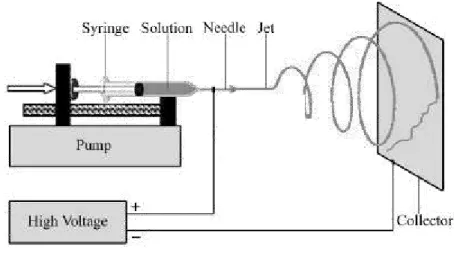
formation of a liquid jet is important that the strength of the electric field overcomes the surface tension of the liquid. Only these conditions enable the formation of a long and thin fiber that will be pushed out from the Taylor cone and then attracted to the grounded collector25.
Figure 2.3. Representation of the electrospinning setup (adapted).
3.2.ELECTROSPINNIG PARAMETERS
In order to achieve good results from this process it is important to pay attention to various parameters that influence the fiber formation. These parameters can be separated into three groups which are related with the solution, the process itself and environmental conditions29.
In the solutions parameters, the concentration of the polymer has an important role in the electrospinning process since for lower concentrations there are not conditions for the elongation of the polymer and so a electrospray process is obtained (see figure 2.4-A)29. But an higher concentration of polymer is also not good to produce nanofibers since the final result is a microscale fiber (see figure 2.4-B)29.
Figure 2.4. A) SEM images that demonstrate the electrospray process due to low concentration of polymer; B) SEM image from a microscale fiber due to a higher concentration of polymer. (Amplification: a) non-defined; b) 100x ) Adapted from Li
and Wang (2013)29
CHAPTER 2:STATE OF ART
molecular weight since this parameter also influences the process. The presence of beads can be a result of a low molecular weight polymer. In order to obtain smooth fiber for the same concentration it is necessary to increase the molecular weight of the polymer29. However for higher values of molecular weight microfibers can be obtained with the possibility of existence of beads29.
Furthermore, it is also important to consider the surface tension of the solution in the electrospinning process29. This parameter plays an important role in the existence or not of beads in the final product and according to literature it is possible to convert fibers with beads to smooth fibers with the decrease of the surface tension29. This process can be achieved by changing the mass
ratio of the solvents mix or the solvent used, since it also contributes to the surface tension30.
The process parameters to take into account include voltage, flow rate, collector and the distance between the collector and the needle25,29. It is known that the electric field applied has indeed a role on the fiber diameter. However it is not a linear parameter since various studies demonstrate that in some polymers exist alterations of the diameter whereas for other polymers the change of the electric field does not have any effect29. Other parameter that also influences the
diameter is the flow rate since is related to the time needed for solution polarization25,29. Thus
normally is recommended the use of a low flow rate in order to give enough time for the polarization of the polymer solution occur.
The distance between the collector and the tip of the needle has also an influence on the diameter and morphology of the fiber25,29. Here the distance is an important parameter since it
influences solvent evaporation time, enabling the formation of the fiber. So if a short distance is used there will not be enough time for the solidification of the fiber. Although long distances does not help either since it can disrupt the polymer elongation thus leading to the formation of beads29. Distance also influences the electric field. However, as stated above, its effect on fiber diameter is not clear. The collector is also an important feature since it acts as the conductive substrate allowing the collection of the fibers25.
At last the environmental conditions, which include the humidity and temperature used for this process25,29. The conjugation of these two properties influence others such as the evaporation rate of the solvent that will increase at low humidity conditions29. Some workers have already demonstrated that in some cases these parameters can also influence the diameter and the morphology of electrospinning fibers29.
P
ART4:
P
OLYMERS–
FROM PLASTIC BAGS TO BIOMEDICAL APPLICATIONSPolymers can be grouped into two groups depending on their source, which may be natural or synthetic. This latter arose during the world wars two due to the lack of natural polymers, which have led to the development of polymers such as nylon, acrylic, polyester and Teflon, among others31. These manufacture process increasing the popularity of these kind of polymers since there
are unlimited and economic possibilities for fabricate them with specific properties31.
Synthetic polymers derive from petroleum resources which leads to an exhaustive use of these fossils fuels and also the accumulation of plastics in the environment, since the chemical stability of these polymers does not allow an easy decomposition of the material31.
FIBER FUNCTIONALIZATION FOR BIOMEDICAL APPLICATIONS
Nonetheless there is a non-win situation on using some biodegradable polymers obtained from natural derived polymers. They present predominant hydrophilic nature, which results on a fast degradation rate, and poor mechanical performances. In this way it very common to improve these characteristics by blending these natural polymers with other biopolymers with synthetic origin32.
By definition a biomaterial is any natural or synthetic material that can interact with biological systems as like supplementation or substitution of functions of living tissues33,34.Over time various natural polymers were tested as replacement for tissues from living forms but the response from the host were variable since the material was not always tolerated by the human body33. In this
way it was tested the interactions between tissues and the natural materials for a better understanding.
In order to be a biomaterial with an appropriate host response, it should also be biocompatible for performing its function33. By being biocompatible, the biomaterial can be broken down and excreted, or reabsorbed by the human body, without any need of surgical revision or removal34.
However it is important to notice that the host response depends on the chemical, physical and biological properties of the biomaterial33,34. This is an important question to address for the design of biodegradable biomaterial since they must not induce an inflammatory response, presenting a degradation time according to their function, possessing adequate mechanical properties according to their use34. Beyond that the products of the degradation cannot be toxic and
have to be readily reabsorbed or excreted by the organism and should include appropriate permeability and processability for designed application34.
The best known resources capable of making biodegradable plastics are starch and cellulose31, that by blending with other polymers are very used for biomedical applications35,36. But according to clinical experience it is possible to ensure that not all the engineered materials can be used for biomedical applications33.
FIBER FUNCTIONALIZATION FOR BIOMEDICAL APPLICATIONS
Chapter 3
FIBER FUNCTIONALIZATION FOR BIOMEDICAL APPLICATIONS
MATERIALS AND METHODS
P
ART1:
P
REPARATION AND CHARACTERIZATION OF NADES AND THEDESBeing known as the substitutes for ionic liquids, NADES (subclass of DES) should share similar properties with ILs. There is, however, very limited data available on the properties of these solvents. Thus it became important to study some physical properties of these solvents, in order to acquire more information about them.
1.1. CHEMICALS
The preparation of NADES results from the use of individual compound without any additional step of purification after their preparation. It was used choline chloride (Sigma-Aldrich, ≥98%), citric acid (Merck, >99%), sucrose (Cmd Chemicals), glucose (Cmd Chemicals), D-(+)-xylose (Merck, >99%), R-(-)-mandelic acid (Alfa Aesar, 98%), (±) - menthol (Aldrich, ≥98%) and ibuprofen sodium salt (Fluka, ≥98%). The synthesis of ibuprofen was prepared by following the protocol, in appendix I,and store at -20ᵒC37, according with Stott
et al.
1.2. PREPARATION OF NADES
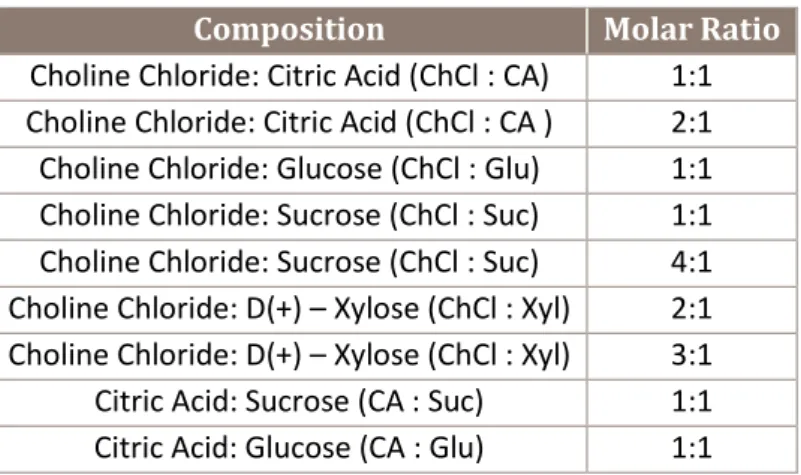
In this study NADES were prepared in different molar ratios as shown in Table 3.1. Concentrated solutions of glucose (Glu) 1M, sucrose (Suc) 1M, xylose (Xyl) 1M and citric acid 1M (CA) were previous prepared. For solutions contained these compounds it was added the volumes needed to achieve the molar ratios.
For NADES containing chloride choline (ChCl), it was weight and the needed volume of the second compound was added for the molar ratio wanted. After achieving clear solutions they were dried through the vacuum evaporating method, at 40 ᵒC and 75-65 mbar. This process occurred until a viscous solution was obtained.
Table 3.1. List of Natural Deep-Eutectic Solvents used for this study.
Composition Molar Ratio
CHAPTER 3:MATERIALS AND METHODS
1.3. PREPARATION OF THEDES
Two THEDES solutions were prepared, mandelic acid with choline chloride (ChCl:MandAc) and ibuprofen with menthol (Ibu:Men). It is possible to see in Table 3.2 the molar ratios and the temperatures used for their preparation.
Table 3.2. Therapeutic Deep-eutectic solvents (THEDES) used for this study, with the molar ratio and the temperature used for their preparation.
Molar Ratio Temperature
ChCl:MandAc 1:2 40 ᵒC
Ibu:Men 1:3 40 ᵒC
The solutions were stirred until obtaining a clear solution. For ChCl:MandAc mixture it was added a small amount of water, to ensure the completely dissolution. In the end the water was remove with the help of a vacuum evaporator.
1.4. WATER QUANTIFICATION
The water was quantified through the Karl Fischer method using an 831 KF Coulometer (Metrohm). This coulometer titration is based on the classical method developed by Karl Fischer, which allows determining the water content in solutions. It is based on a reaction between iodine and water. This reaction occurs at a 1:1 molar ratio38, which will allows to quantify the total amount
of water present in the solution tested. This process was carried out at room temperature where the final value was the mid value of three measures.
1.5. VISCOSITY
FIBER FUNCTIONALIZATION FOR BIOMEDICAL APPLICATIONS
P
ART2:
S
TARCH BLENDS PROCESSINGStarch blends are biocompatible polymers with various applications. However their interaction with these new solvents is new, being thus necessary to perform different experiments such as: dissolving the polymers into organic solvents and NADES, testing the possibility of applying them into electrospinning, and even the possibility of modifying their structure.
2.1.CHEMICALS
The chemical used were acetic acid glacial (Scharlab, >99%), chloroform (Carlo Erba, >99%), dimethylformamide (Scharlab, >99%), dioxane (Merck, >99%), toluene (Sigma-Aldrich, >99%), starch-polycaprolactone (SPCL; Novamont, Italy), starch-cellulose acetate (SCA; Novamont, Italy), polycaprolactone (PCL; Sigma-Aldrich, Mn 70000-90000), propionic anhydride (Sigma-Aldrich, >99%) and ibuprofen anhydride, which was synthesized according to Bartoli et al. All chemicals were used without any purification.
2.2.DISSOLVING THE POLYMERS IN VARIOUS SOLVENTS
Predetermined amounts of polymer were added to various NADES and stirred, in order to test their dissolution. The influence of temperature it was also tested. Table 3.3 demonstrates the weight fraction and the temperature tested for each polymer.
Table 3.3. Polymers tested for the dissolution into NADES, with the weight fraction used and the range of temperature tested, in order to improve dissolution.
Polymers Weight fraction (% w/v)
Temperature Range
SPCL 5 RT to 60ᵒC
SCA 5 RT to 60ᵒC
PCL 7 RT to 60ᵒC
2.3.
CHEMICAL MODIFICATIONS OF SPCLBeyond testing the dissolution of starch blends, chemical modifications to starch were also performed. Two protocols were followed for chemical modifications on SPCL, known as acetylation. The first one involved ibuprofen anhydride. For this process it was added a 10% (w/v) of SPCL for 1ml of chloroform. For the reaction it was used a weight ratio of 1 starch for 3 anhydride. The solution was left to stir during 48h at room temperature. The steps followed for both these modifications can be seen of appendix II.
CHAPTER 3:MATERIALS AND METHODS
P
ART3:
E
LECTROSPINNING OF BIOCOMPATIBLE POLYMERIC SOLUTIONSBeyond starch polymers it was also tested the viability of conjugate others biocompatible polymers with NADES. Here it will be also study their applicability into electrospinning and also their viability as functionalized polymers.
3.1.CHEMICALS
The polymers used were poly (ethylene oxide) (POE; Sigma-Aldrich, Mv 5000000), poly (vinyl alcohol) (PVA; Acros Organics, 95% hydrolyzed, Mv 95000) and gelatin (Gel; Panreac, CULTIMED.403902). The NADES used were choline chloride with citric acid (ChCl:CA) and citric acid with sucrose (CA:Suc).
3.2.SAMPLES PREPARATION
A known amount of polymer was dissolve into water, then NADES was added and the mixture was left to stir, until complete dissolution. Table 3.4 shows the conditions used for PEO and PVA.
Table 3.4. Biopolymers used for the electrospinning technique. It shows the volume of NADES added, as well as the polymer weight fraction added to each sample. The temperature is related to the dissolution of the polymer, in water.
NADES
Volume fraction %(v/v)
Polymer
Weight fraction %(w/v) Temperature
PEO
ChCl:CA (1:1) 2
2
Room temperature 3
4
CA:Suc (1:1) 2 2
3 PV
A ChCl:CA (1:1) 2
7,8 Preheated water 80ᵒC 9,8
FIBER FUNCTIONALIZATION FOR BIOMEDICAL APPLICATIONS
Table 3.5. Conditions used to prepare gelatin samples, for the electrospinning. It indicates the volume of NADES and the polymer weight used for each sample.
THEDES Volume fraction (v/v)
Polymer Weight fraction (w/v)
GEL
Aqueous Solutions
- 30
- 35
- 40
ChCl:MandAc (1:2) 2 30 35 Ibu:Menthol (1:3) 0,5 30 1 1,5 2
3.3.ELECTROSPINNING EXPERIMENTAL SET-UP
The high voltage supply used, for the electrospinning voltage, was a Glassman EL 30kV, that was linked to the metallic needle. The solution, in the syringe, was pumped with a KDS100 from KD Scientific. The metallic needles had various diameters and they were from ITEC. For collecting the fibers a fixed collector was used. All these equipments were located into an acrylic box, in order to help to control the ambient parameters.
Among that it was used an electric heater, for cases where the temperature needed to be higher. For controlling humidity, the air conditioning of the room was used.
3.4.ELECTROSPINNING CONDITIONS
For producing fiber it was necessary to test various parameters in order to achieve the best electrospinning conditions. Table 3.6 shows the parameters range tested for each polymer, the temperature and the humidity inside the box, the flow rate of the polymeric solution, the distance between the tip of the needle and the collector and the voltage applied to the solution. Later, on chapter 4, it will be discussed the parameters chosen and how they influence the process.
Table 3.6. Electrospinning range parameters tested for each polymer sample.
RANGE OF PARAMETERS TESTED
Temperature Humidity Flow rate Distance Voltage
PEO CA:Suc (1:1) RT-30ᵒC 30-45% 0,05-0,3 ml/h 15-30 cm 5-15 kV
ChCl:CA (1:1) RT-30ᵒC 30-50% 0,1-0,7 ml/h 15-35 cm 5-25 kV PVA ChCl:CA (1:1) RT-30ᵒC 40-50% 0,1-0,2ml/h 11-18cm 15-25kV GEL ChCl:MandAc (1:2) 28-42ᵒC 15-40% 0,1-0,5 ml/h 15-20 cm 15-25 kV
CHAPTER 3:MATERIALS AND METHODS
PART
4:
P
OLYMERS CHARACTERIZATION4.1.FOURIER TRANSFORM INFRARED SPECTROSCOPY
Being an absorption technique, FTIR is commonly used to identify chemical compounds or substituents groups, in samples. Infrared spectra results from transitions of vibrational states, due to molecular vibrations39.
This process happens due to interactions that occur between the infrared light and the molecule analyzed. The sample absorbs the energy from the light, and the molecule starts to vibrate39.
Capable of analyze gas, liquid or even solid samples, FTIR became an important technique on the identification of compounds, since every molecule has vibrational modes that differs slightly from other molecules (with exception of enantiomers)39. It is commonly used the region between 4000
and 400 cm-1, since most of the organic compounds or inorganic ions absorbs the radiation within this region39. The term Fourier transform comes from the use of a mathematical process, the fourier transform, that is responsible for converting the raw data, into the known spectra.
For the study it was used a Tensor 27 FTIR spectrometer, from Bruker Optic GmbH, with the help of the OPUS 6.0 software, for data analysis.
4.2.SCANNING ELECTRON MICROSCOPY
This technique is a type of microscopy that can image and analyze bulk specimens. It uses an electron beam that is created by the acceleration of electrons, and is responsible for tracing over the object, and creating an exact replica of the original object40. Once the electron beam hits and
interacts with the sample, it is created a complete 3D image. Beyond image signal, others signals are produced (like secondary electrons), that will be responsible for the registration of different levels of brightness40.
This microscope operates in vacuum and it relies on electric field to work. In this way it became important that the sample has conductivity, or otherwise they must be coated with a conductive material, such as gold or platinum40.
For sample coat it was used a Polaron SC502 sputter coater. The microscope used was a Zeiss DSM 962. For fixing the samples it was used a carbon conductive tape purchased from Agar Scientific.
4.3.TRANSMISSION ELECTRON MICROSCOPY
This other type of microscopy also uses the electron beam to analyze the sample. However in here the electrons interact strongly with the atoms of the sample, passing through it, which implies the use of a thin thickness sample41. It is then by this interaction that it is possible to form an image,
that will be a two-dimensional projection of the sample.
The most common image obtained is through a contrast formation, where the image is formed directly by occlusion and absorption of the electrons41, by the sample. Regions where the electrons cannot pass through the sample, appears in dark41. However for regions where the
electrons are unscattered, the image appears brighter41. Among it may also be a grey scale between
FIBER FUNCTIONALIZATION FOR BIOMEDICAL APPLICATIONS
PART
5:
BIOLOGICAL AND DRUG DELIVERY STUDIES5.1. BIOLOGICAL STUDIES
Extracts from membrane formed by gelatin fibers with THEDES were prepared according to the ISO/EN 10993 norm. L929 cells from mouse fibroblast, with a 1,5x10⁴ cell/mL concentration were grown during 24h at 37ᵒC. After that period the medium was substituted by gelatin membranes, and the cellular viability was evaluated through the MTS assay, after 72h.
5.2. DRUG DELIVERY PROFILE
The gelatin membranes, obtained by electrospinning, were weighed and suspended in 10mL of phosphate buffer solution. Then it was stirred at 60 rpm at 37 ᵒC.
Aliquots of 500 µL were withdrawn in predetermined time intervals and the same volume of fresh medium was added to the suspension.
FIBER FUNCTIONALIZATION FOR BIOMEDICAL APPLICATIONS