The Structural Approach to Social Representations: Bridges between Theory and Methods
Rafael Wolter 1, 2
1Universidade Salgado de Oliveira, Rio de Janeiro, RJ
2Universidade do Estado do Rio de Janeiro, Rio de Janeiro, RJ
Abstract
Since the publication of the works of Jean-Claude Abric and Celso Sá, the structural approach to social representation has become widely diffused. There is often a lack of congruency between theoretical aspects of the structural approach and technical character-istics of the different methods used. This paper aims at making explicit the structural charactercharacter-istics that are studied by the different structural approach techniques. These characteristics are: associative power of the elements, consensual aspects of thought and
object essence. With these characteristics it is possible to elaborate a classification of the different techniques of the structural
approach to social representations. The conclusion focuses on the absence of the social representation dynamics on a technical level despite being a central theoretical point for a better understanding of the socio representational phenomenon.
Keywords: Structural approach, social representations, methods, theory
A Abordagem Estrutural das Representações Sociais: Pontes entre Teoria e Método
Resumo
A abordagem estrutural das representações sociais é extremamente difundida no campo das representações sociais, notada-mente após os livros de Abric em 1994 e de Celso Sá em 1996. Há frequentenotada-mente nas pesquisas empíricas uma falta de congruência entre os aspectos teóricos da abordagem estrutural e as características técnicas dos diferentes métodos usados. Neste artigo explicitamos as características da estrutura estudadas pelas diferentes técnicas, mais precisamente: o poder
asso-ciativo dos elementos, a consensualidade do que é pensado e por fim a essência do objeto. Após essas reflexões é apresentada uma classificação das grandes técnicas da abordagem estrutural a partir dessas três características. Na conclusão, é levantada a questão da dinâmica representacional que fica deixada de lado pelas diferentes técnicas e deveria ser mais estudada para uma melhor apreensão do fenômeno representacional.
Palavras-chave: abordagem estrutural, representações sociais, método, teoria
El Abordaje Estructural de las Representaciones Sociales: Puentes entre Teoría y Método
Resumen
El abordaje estructural de las representaciones sociales ha sido ampliamente difundido, especialmente a partir de la publicación de los libros de Abric en 1994 y de Celso Sá en 1996. Existe con frecuencia en las investigaciones empíricas una incongruencia entre los aspectos teóricos del abordaje estructural y las características técnicas de los diferentes métodos utilizados. En este artí-culo quedan explícitas las características de estructura estudiadas por las diferentes técnicas, especialmente: poder de asociación
de los elementos, consenso de lo que se piensa y finalmente esencia del objeto. Después de estas reflexiones se presenta una clasificación de las grandes técnicas de abordaje estructural a partir de estas tres características. Como conclusión se plantea el
tema de la dinámica representativa que es dejada de lado por las diferentes técnicas y debería ser más estudiada para una mejor aprehensión del fenómeno representativo.
Palabras-clave: Abordaje estructural, representaciones sociales, método, teoría Introduction
Two decades ago Celso Sá (1996) published “the central nucleus of social representations,” which covers the fundamental concepts of the theory of social representations in general and of the structural approach in particular. Since then, several studies have been based on this book (Tura, 1998; Campos & Rouquette, 2003; Pecora & Sá, 2008; Wachelke, 2013; Wolter, 2008, 2016; Wolter & Wachelke, 2013). Regarding the relation between method and theory,
Bourdieu (1992, p. 7) reminds us that “reflection on
the method of analyzing empirical data [...] is not
separate from the reflection between objects and
objectives of research.” He adds that the established
boundary between methodology and theory is
bale-ful. In the specific case of the structural approach
to social representations there are a number of
specific techniques that are inseparable from theo -retical issues. In this article we seek to explain these
relations based on a reflection upon the theoretical
characteristics studied by the most usual techniques. All techniques have theoretical assumptions, often
1. Some preliminary elements on the concept of structure and the central nucleus theory
Frequently used in human and social sciences, the notion of social representation has become banal, implying a certain conceptual imprecision. As Fla-ment and Rouquette (2003) have often pointed out, the notion is vaguely a synonym for a more or less shared “conception” or for a simple general idea about anything.
The preceding paragraph refers to a simple and repeatedly expressed idea: each human group, at a
given time, codifies and decodes its experience of the world in a specific way that carries the mark of social positions and relations (Clemence, Doise &
Lorenzi-Cioldi, 1994). Moscovici (1976) developed the theory
of social representations to fill a theoretical gap left by
sociologists and psychologists. On the one hand, Émile
Durkheim (1898), in his sociology of knowledge, while
formulating the concept of collective representations, covered the myths, language, and beliefs that sustain society. On the other hand, the concept of attitudes took a more individualizing course, notably in the works of Gordon Allport (1954). This view of attitudes
can be illustrated in the definition by Eagly and Chai -ken (1998) as a psychological tendency that shows itself in the evaluation, with some degree of favorability or
unfavorability, of specific objects.
In his doctoral thesis, Moscovici (1976) studied how Communists and Catholics of the 1950s thought psychoanalysis, occupying the theoretical gap between
Durkheimian sociology and the field of attitudes. On
the one hand, he studied the inner dynamics of society
with a group approach, such that Durkheim’s sociology
of knowledge and the theory of collective representa-tions with its societal approach did not fully apprehend, because they focused on society as a whole. On the
other hand, the concept of attitudes proved insuffi -cient to understand the differences between Catholics and Communists in relation to the object (psychoanaly-sis) because they neglected extra-individual reasons for rejecting the object. More precisely, both groups rejected psychoanalysis, but conceived it quite distinctly, that is, they had different social representations (SR).
Before characterizing SRs, it should be pointed out, according to Flament and Rouquette (2003 p. 13) that they
“are cognitive formations, socially constructed and conse-quently differentiated. Two general and distinct principles preside over the investigation of the notion: the need for a sociological reference (and not strictly psychological) to the
genesis and functioning of SRs; (...); and the need for com-parisons (synchronic and diachronic) between populations”.
The authors add that this view of the world shared by groups cannot be satisfactorily grasped in individual-izing studies, because it is a social fact.
1.1 Structure, thinking structure
Studying the myths of indigenous populations,
Lévi-Strauss came to contradictory conclusions, some -times describing myths as stable, some-times as unstable, sometimes as a construct that follows a rationale, and sometimes as something unruly. He stated that
“anything is likely to happen in myth; it seems that the sequence of events follows no logical or continuity rule. Any characteristic can be attributed to any subject; every con-ceivable relationship can be met. But despite this apparent arbitrariness, myths reproduce themselves with the same char-acteristics, and often with the same details, in different regions of the world” (1955, p. 432).
He concluded that the meaning of the myths is not in the isolated elements, but in the way the different isolated elements relate. Myths vary in content, but they share the same structure.
Jean Piaget described the general and necessary characteristics to distinguish one structure from any other system:
“A structure is a system of transformations which, in its system quality, implies the existence of laws (opposed to the properties of each element), and which preserves itself or develops by means of its own transformations, without tak-ing them outside their boundaries or ustak-ing external elements. In a word, a structure has three characteristics; wholeness, transformation and self-adjustability” (Piaget, 1968, p.7).
Every structure is by definition, an artifice, a theo -retical construction, and is not provided by any research subject. Wolter et al. (2015) illustrate this point, remind-ing us that no child in the experiments of Piaget and
no indigenous in the work of Lévi-Strauss was able to
provide the structures that governed, respectively, the development and family relationships. Piaget (1968)
and Lévi-Strauss (1958) where the authors who, from a theoretical and empirical work, developed and defined
the structure of the phenomena they studied.
specifically, for the author, “the elements that constitute
a representation are hierarchized, weighted, and main-tain, between themselves, relations that determine the meaning, and the place they occupy in the representa-tional system.” The social representation can, therefore, be conceived as a set of ideas, which are related to one another, thought by a group about an object.
From the moment that, when studying a social representation, the researcher seeks to apprehend not only the content of representation, but also the relations between the contents and the dynamics of the whole, it can be said that the research follows a structural perspective. Within this logic, Flament and
Rouquette (2003, p.13) gave an operational definition
of representation: “a SR can be characterized as a set of cognitive elements linked by relations. These elements and these relations are attested in certain groups.” That is, not only the elements vary from group to group but also the relationships between the elements. Within a structural approach, both the relations between dif-ferent cognemes and the elements (thought contents) themselves are highly important. This emphasis on the connections between the elements underlies a set of techniques that focus on the associative power that we will describe next.
1.2 The structure of social representation: central core and periphery
In more technical terms, the social representation is composed of cognemes that are related to each other and form a set that is transformed based on rules that pre-serve the totality. According to Codol (1969), a cogneme is the most basic cognitive element, that is, the smallest unit of cognition at this level of analysis. A representation is then composed of ideas (or cognemes or elements) that are activated when a group thinks of an object. When thinking about the object many ideas are activated but not all are equivalent, as Abric (1994) says, some are more valuable than others. He also states that sharing a representation with other people then means sharing the core values relative to the object in question.
It was Abric (1987, 1994) who introduced the central core theory (CC) in the study of social represen-tations. According to Sá (1996) the central core theory is a complementary approach to the “great theory” elaborated by Moscovici (1976). Also according to Sá (1996), the CC theory is not intended to replace the
great theory and is more specific and heuristic.
For Abric the central core is “the fundamental ele-ment of the representation, since it determines both
the signification and the organization of the represen -tation (1994, p.21). According to him (1994, p. 22):
“the central core provides two essential functions: A genera-tive function: it is through the central core that other elements
in the representational field acquire meaning and specific
value. An organizational function: it is the central core that determines the nature of the relationships that these elements maintain with each other. It is, in this sense, the unifying and stabilizing element of the representation”.
2. The characteristics of the central core and the periphery
The elements of the CC have a number of characteristics that distinguish it from the peripheral system. These are essential for the empirical study within the structural approach because the different techniques aim to study these attributes to differenti-ate the status of representational elements: central or peripheral (Sá, 1996).
2.1 The associative power
The first great characteristic of central elements
is their associative power. Elements that are associated with fewer ones can hardly be considered central. Since the meaning of the peripheral elements derives from the CC, it is natural for the central elements to connect to a large number of other cognemes. The central element
is not an isolated element and it lies at the confluence
of a wide range of ideas that arise about the object. It should be noted that the central elements often relate to other central elements. As these central cognemes con-nect they form a system, the central core, around which another system, the peripheral, circulates. These strong connections between the different central elements of a SR make the central system cohesive and hardly a central
element opposes another central one. More specifically,
a central element does not contradict another central element; oppositions, contradictions and incongruities are situated in the peripheral system. This peripheral system is not secondary in the representation and acts as a bumper (Flament, 1987), by allowing an adaptation
2.2 Consensuality
Another great feature of the CC elements is con-sensuality within a group. These central elements are commonly thought and evoked within a given popu-lation for a given object. For example, in the case of
AIDS, the elements of illness and death are thought of
in a recurrent way by young people. In other words, the central elements are not thought of by a dissident minor-ity within the group but by a good part of the group. This consensuality allows the cohesion of group thinking, something necessary for intragroup communication and for sociability to remain in social relations. According to Abric (1994, p.28) the CC corresponds to a
“common social and collective basis that defines the homo -geneity of a group (...). It plays a key role in the stability and cohesion of representation (...). Moreover, it is relatively independent from the immediate context in which the indi-vidual uses or verbalizes his representations; its origin is elsewhere: in the historical, social, ideological global context –
which defines the norms and values of individuals and groups
within a given social system.”
It should be noted that the notion of consensuality
in no way means that the group will fully share the cen-tral ideas because unanimity is a rare and special case of
consensuality. In most cases, central elements are shared by a large part of the group in most situations, which is not equivalent to being activated every time by all members of the group in all situations.
2.3 stability
Another characteristic of the central core is its stabil-ity (Wolter et al., 2015). The stability of the SR can be seen in two aspects, synchronic and diachronic. Synchronic stability
corresponds to the fact that at a given moment, regard-less of context, the central element will be activated by members of the group when thinking about the object in question. In other words, at some point, no matter the context, some elements remain extremely activated.
The peripheral elements of the SR, as opposed to central ones, are extremely contextual. When cir-cumstances change, the activation of the peripheral elements may also be affected. The contingencies of the moment - such as a more salient issue in the media, purpose of the situation, personal interest of the moment - can cause peripheral cognemes to arise or disappear.
Diachronic stability, in turn, corresponds to the persistence of the central elements to remain as such over time (Wolter et al., 2015). According to Rouquette
(1994), every SR has an earlier state, a current state, and a later state; we could add that in the transition from one state to another, the peripheral elements are more sus-ceptible to changes compared to the central ones. This lower susceptibility to change over time corresponds to the diachronic dimension of stability. Because of the
diachronic stability it is possible to foresee the group’s
thinking about an object, because we will know that some elements will be thought and they are the ones that give the meaning of the SR. For example, stud-ies on the social representation of young people about the Military Regime (Sá et. al. 2008; Wolter et. al. 2015) indicated that censorship, dictatorship and repression were central in three data collections (2005, 2010 and
2011) with different techniques. It is possible to affirm
that a possible collection next year will also indicate, after due analysis and if no external factor generates a strong contextual change, that these elements are cen-tral. Peripheral elements, on the other hand, are not necessarily stable and can quickly disappear from the
group’s thought.
2.4 Conditionality
Superficially, it would be possible to state that the
central and peripheral elements are quantitatively dis-tinguished: number of ideas with which the element connects, number of people sharing the cogneme, number of situations to which the element resists, or even amount of time the element remains in the group. However, the differences are not limited in any way to
quantifications and a great distinction between cen -tral and peripheral elements is, according to Sá (1996), of a qualitative nature. According to Moliner (1994), the central core entertains “a privileged bond with the object of representation. This bond is symbolic and results from the historical and social conditions that presided over the birth of the representation” (p. 202).
As described by Flament (1994), the central elements of the SR are absolute while the peripheral elements are conditional. The studies on this question
have their origin in the findings of Abric et al. (1967),
and are perfectly illustrated in the studies of Moliner
(1989), Rateau (1995) or more recently Lheureux,
common opinions, where there is no hierarchy and who get together. That is, subjects cannot think of the ideal group without the cognemes friendship and equality, which are absolute, in turn, they can discard the cognemes having a common opinion and hanging out together, which are conditional.
3. Normative, practical and descriptive dimensions: evaluative, functional and denotative elements
Social representations have been described as linked to practices and judgments since the princeps
work by Serge Moscovici (1976). Social groups often judge when thinking of an object. For example, the studies on the Gypsy SRs in several countries bring
ideas that reflect the judgment of this social group. The works of Guimelli and Deschamps (2000) show
that when thinking of gypsies, young French people quickly have in mind the idea of theft. In Brazil a recent work (Bonomo, Faria, Souza & Brazil, 2013) showed that non-gypsies activate the deception cogneme when thinking of gypsies. Both elements, theft and decep-tion, translate that when thinking about gypsies the normative dimension is activated.
3.1 The Normative Dimension
The normative dimension corresponds to a part of the SR that forms a set of affective and evaluat-ing ideas, which are related to each other, thought by a group about a particular social object. This norma-tive dimension composed of evaluanorma-tive elements is, according to Guimelli (2003, p.136), “linked to values, norms or strongly salient stereotypes in the group; it allows the group to make judgments about the object. This dimension is probably marked by ideological and historical factors.” It corresponds to the normative reg-ister of cognitions.
The normative dimension contains the represen-tational elements that express affection in relation to the object, the fact of liking, disliking, detesting, reject-ing, and accepting. Naturally, in situations of social pressure, this dimension, when opposed to the norms prevailing in the situation, is partially masked in what has been called the silent zone of social representations (Abric 2003).
Objects linked to ideologies, governed by many social norms, tend to be thought of with many evalu-ative elements. Abortion, for example, is an extremely ideological object and, depending on the ideology in question, it will be thought with positive or negative judgments, however, in both cases, it will be thought
of through judgments, therefore it will have evaluative elements.
When the evaluative elements are central to the SR, it is acceptable to assume that social norms strongly
influence the thinking of the group in question. Natu
-rally, the activation of these elements is influenced by
the social context (Abric & Guimelli, 1998) as well as the contingencies of the moment, and in situations of
conflict over the object, the evaluative elements tend
to over-activate. For example, in the full debate about the legalization of hunting in a given municipality, it is natural that the evaluation elements have a strong acti-vation compared to situations without debate.
3.2 The functional dimension
Social groups often judge and evaluate when think-ing about an object, but this is not the only way of
thinking. Several findings have shown that thought can be
practical, or in other words, functional. Many studies of the structural approach focused on the question of the relations between practices and representations (Abric, 1994; Flament, 1994; Rouquette, 2000; Guimelli, 1994; Wolter & Sá, 2013). To understand this relation it is nec-essary to know which representational elements are the interface with the action and have a prescriptive character. Flament explains that prescriber has the meaning of
“all the modalities in which an action is susceptible of being affected: ‘one must do...; ‘one can do...’; ‘it is desirable to...’; ‘one cannot...’; ‘one should not...’ etc. The prescriptive aspect of a cognition is the fundamental bond between cognition and the behaviors that are supposed to correspond to it” (Fla-ment, 1994, p.38).
Therefore, the functional elements of social rep-resentations have this prescriptive feature. For this reason, in contexts where new practices emerge, these elements are affected and may, in some cases, disappear from the representation and/or give way to another functional element that best adapts to the new practice (Flament, 1994). The set of functional elements, in case they are interconnected, forms the practical dimensions of the SR.
3.3 The descriptive dimension
group, not necessarily serve to judge or to guide prac-tices, but to say what it is. The three dimensions are not mutually exclusive and can be studied from the tech-niques derived from the basic cognitive schemes model (Guimelli & Rouquette, 1992).
4. The techniques of study of the central core
In the last decades five techniques have been
extremely used in the structural approach studies: pro-totypical analysis (Vergès, 1992); mise-en-cause (Moliner, 1989) and a more recent and less spread adaption of this
technique, the context independence test (Lo Monaco
et al., 2008); similarity analysis (Bouriche, 2003); induc-tion by ambiguous scenario (Moliner, 1993); and basic cognitive schemes (Guimelli & Rouquette, 1992).
4.1 The prototypical analysis
The prototypical analysis is a survey of what the different research participants (usually more than a hun-dred) evoke in relation to the representational object, to then classify the elements into two coordinates (Wach-elke & Wolter, 2001; Wolter & Wach(Wach-elke, 2013). The
first coordinate is taken from the average order of recall, where the terms readily evoked are at the first
extreme, and at the other, the terms later evoked. The second coordinate opposes the extremely quoted and frequent terms to the least evoked terms. As a result, the evoked elements are located, based on these two coordinates, in one of the four possible places (very often and readily evoked; very often and late evoked; rarely and readily evoked; and rarely and late evoked).
4.2 The questioning technique
The questioning technique, or mise-en-cause, analyses centrality under another aspect: that of the negotiability of the cogneme for the recognition of the representational object. In this case the researcher must present the object of study (e.g. Family) without the ele-ment tested (e.g. love). If most participants agree that without love it is not a family, then the love element will be central. Now, if most participants accept that there may be a family without love, then the love element will be seen as peripheral because the group can think of the object without this element.
4.3 The similarity analysis
The similarity analysis (Flament, 1981), in turn, studies the distances between the different represen-tational elements (cognemes). These distances are typically presented in tree shapes where the edges trans-late the distances and the poles are the representational
elements. The elements that are close to many other elements tend to be considered central. In turn, the elements close to few other elements tend to be con-sidered peripheral.
4.4 The basic cognitive schemes
The basic cognitive schemes (Guimelli e Rou-quette, 1992; Wolter et al., 2016) study the types of connectors activated by the elements that are candi-dates to the central core. The data collection consists of presenting the candidates to the subjects, with 28 con-nectors connecting them to the other representational elements. We can understand these relationships as cognitive paths that lead from one element to another. If, for example, a group, when thinking about soccer,
thinks of the ‘Manchester United’ cogneme, which in turn brings the ‘club’ cogneme, several paths may have
been traversed to relate these two cognemes:
- Manchester United is a type of a club, which translates a relation of class included;
- Manchester United can be defined as a club, which translates as a defining relation;
- Manchester United uses its club status (for example, to raise funds for the club), which translates into a relation of use;
- Manchester United is always characterized by being a club, which translates a relationship of characterization.
These 28 connectors are composed of three fami-lies, or rather, meta-schemes of connectors: 7 evaluative connectors (which translate the normative dimension), 12 functional/prescriptive connectors (which translate the practical dimension) and 9 descriptive connec-tors (which are related to the descriptive dimension of the object). Participants must say which of the 28 connectors can connect the candidate to the other rep-resentational elements. If the element is central, it will mass activate the functional and evaluative connectors to relate to the other representational elements. This activation is studied from an algorithm that studies both the connectivity of the element and the balance in the activation of practical and evaluative elements.
4.5 Induction by ambiguous scenario
5. Discussion: the types of relationship studied by structural
approach techniques and their general and specific characteristics It is important to emphasize that all the tech-niques presented above have as a characteristic the possibility of studying the SR based on the central core theory and distinguishing the central elements from the peripherals. Naturally, some techniques are more restrictive than others: prototypical analysis, for example, is less restrictive in distinguishing elements compared to basic cognitive schemes. However, we can separate these techniques into two groups: those that study the relations between the object and the elements; and those that study the relations between elements of the representation.
5.1 The relation between the object and the representational element
An object of representation activates a set of ele-ments or cognemes within certain social groups. If the elements are activated within the population it is because there is a relation between them that we will call it object-element relation. It can be illustrated by a simple task of free evocation, where an object, for
example AIDS, can activate several elements, such as
death, illness, suffering and sadness (Costa, Oliveira and Fomozo, 2012).
This relationship has several characteristics that
are studied by the techniques. The first characteristic
studied is the degree of cogneme sharing when the group thinks about it as it comes across the object. For
exam-ple, in the case of the object AIDS, several studies show
that illness and death are extremely shared by young people (Camargo, Barbará & Bertoldo, 2007; Costa, Oliveira & Fomozo, 2012). That is, in thinking about the object, many members of the group have in mind the same cogneme. The degree of sharing is directly or indirectly taken into account in all structural approach techniques.
The second characteristic studied is related to the readiness to access to the cogneme when the object is thought. When thinking about an object, some ele-ments emerge more quickly than others. In this same
example of AIDS, some studies (e.g. Camargo, Barbará
& Bertoldo, 2007; Costa, Oliveira & Fomozo, 2012)
show that death and disease are among the first terms
that come in mind, soon they are accessible. Accessibil-ity is studied with the prototypical analysis developed by Vergès (1992).
The third feature of the object-element relation-ship studied is conditionality, that is, the fact that, without the presence of the element the members of the group
are not able to recognize the object. The studies on the ideal group (Moliner, 1993) illustrate well this point, when presenting a group without the cogneme friend-ship, most participants were not able to recognize the group presented as being an ideal group (object). For example, several studies have shown that the SR of the Military Regime for university students is structured around the dictatorship element (cf. Wolter et al. 2015 for the presentation of the several studies). Hardly would this same group accept the idea that the Mili-tary Regime does not have this characteristic of having been dictatorial. That is, the idea of a dictatorship, for these young people, is absolute in thinking the Military Regime, just as friendship is unconditional and neces-sary for young people to think of the ideal group. In opposition to the absolute elements, other elements are conditional, and the group is able to think the object
without them. Moliner’s study demonstrated that young
people were able to recognize a group where members hold different opinions. In other words, the fact of having a common opinion is not absolute but rather conditional to think the object ideal group. Condition-ality is present in the mise-en-cause technique (Moliner, 1989).
The fourth characteristic of the techniques that focus on the object-element relationship is the degree of exclusiveness of the cogneme in relation to nearby objects. Abric (2003, p.71) summarized the quest for exclusiveness by stating that “it rests on the idea that representation is an active process of construction of reality. We, therefore, seek the elements that the sub-ject needs to recognize the obsub-ject of representation and differentiate it from other objects nearby.” This fea-ture is present in the induction by ambiguous scenario (Moliner, 1993), where the researcher seeks to know which elements are essential and exclusive to the object, that is, they are not activated by nearby objects. The
example of the profit element illustrates well this idea
of exclusiveness, since many elements are common to
both ‘business’ and ‘association’, and very activated by both. However, the profit element is exclusive of the ‘business’ object and according to Moliner (1994), it is central. In turn, ‘workplace’ is common to both objects,
but because it does not differentiate these two close objects it would not be central.
These four characteristics, degree of sharing, readiness of access, conditionality and exclusiveness serve to distinguish the central elements from peripherals by studying the relation between the object and what it activates. In
the first case the central cogneme is activated within
many people. In the second case, the cogneme is very
available to many people in the group studied. Marbe’s law lists the first two characteristics in stating that the
terms frequently evoked by a population tend to be more readily evoked than the infrequent terms (Vergès, 1992, Osgood, 1953). That is, degree of sharing and readi-ness of access are characteristics that are correlated and empirically are often studied together. In fact, both study two aspects of the accessibility of the element in the population when thinking the object. Conditionality
and exclusiveness, in turn, translate the existence of more qualitative characteristics of the central core and both translate characteristics of essence of the object.
5.2 The relation between representational elements
Another way of studying the social representa-tion within the structural approach is to focus on the relationship between the different elements activated by the object. This form is perhaps the one that best
corresponds to the different definitions of structure presented by Lévi-Strauss and Piaget, cited at the
beginning of this article. The fundamental idea for the study of the relation between elements is that the central element has a privileged relationship with the
other representational elements. Abric (1994) defined
the central core as the part of the social representa-tion that gives meaning to the whole. The great majority
of representational elements take their meaning from the few elements of the central core. Claude Flament, in 1981, emphasized the importance of studying the relations between elements, and adapted the analysis of similarity to the study of social representations. This analysis focuses on the distance from the represen-tational elements. When an element is close to many other elements (i.e., in the population, both terms often “go together”) it can be considered a good candidate for the CC; on the other hand, elements that are only close to one other can be considered peripheral. The basic cognitive schemes developed by Guimelli and Rouquette (1992) study the amount of connectors activated that connect one representational element to another. The idea behind this method is that the elements of CC activate many connectors, primarily evaluative and functional, to relate to other elements. If the element has few evaluative and functional connections, it is hardly central. In turn, the peripheral elements have comparatively fewer connections. Both the techniques of similarity and basic cognitive schemes focus on the
fifth and final characteristic, associative power.
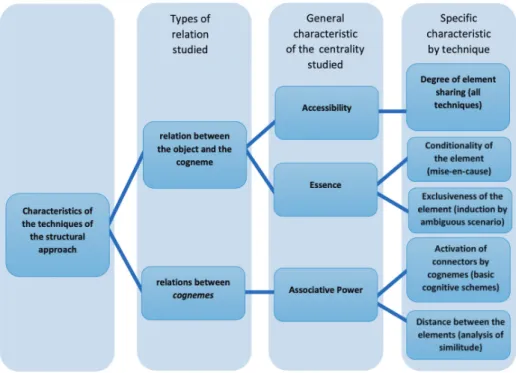
In short, the bridge between the different techniques and their theoretical aspects studied is sum-marized in Figure 1. There, it is possible to see that the techniques of the structural approach are divided according to: the type of relation studied; the general
characteristic of centrality in question; and the specific
characteristic in question.
Conclusion
The structural approach to social thought in recent decades presented a number of
theoreti-cal innovations (Wachelke, 2013) and five major
techniques (presented above). The advantages and disadvantages of each technique are varied and there is a wide literature on the subject (e.g., Abric, 2003); however, it should be emphasized that all techniques are, to a lesser or greater extent, approximations of the phenomenon. As we explained before, each tech-nique studies particular characteristics of the CC and
periphery and the approaches have specificities, some
focus on the associative power, others on accessibility or even on the essence. None of them studies all of the characteristics and, for this reason, methodological triangulation is necessary. We may also inquire into the lack of interest in representational stability and dynam-ics, which are, however, key theoretical points in the study of representational structure. We begin the
text with Bourdieu’s (1992) statement on the relation
between method and theory, and, following this logic, we currently have no theoretical argument to assert that one characteristic is more important than another to study the structure, so we do not have theoretical elements to indicate one technique over another. But it is important to keep in mind what each technique studies for a better understanding of the research results and for a better interpretation of the social fact
at stake.
References
Abric, J.-C. (1987). Coopération, competition et representations sociales. Cousset: Del Val.
Abric, J.-C.(1994). Représentations sociales: aspects théoriques. In J.-C. Abric (Org.). Pratiques sociales et representations (pp. 11-36). Paris: PUF.
Abric, J.-C. (2003). La recherche du noyau central et la
zone muette des representations sociales. In J. C. Abric (Org.) Méthodes d’études des representations socia-les (pp. 60-80). Ramonville Saint-Agne: Érès.
Abric, J.-C., Faucheux, C., Moscovici, S., & Plon, M.
(1967). Rôle de l’image du partenaire sur la coo -pération en situation de jeu. Psychologie Française, 12, 267-275.
Abric, J.C. & Guimelli, C. (1998). Représentations so-ciales et effets de contexte. Connexions. N° spécial: Logiques sociales de la connaissance, 72 (2), 23-38.
Allport, G. (1954). The nature of prejudice. Reading, MA: Addison-Wesley
Bonomo, M., Faria, M. G. & Souza, L. d., Brasil, J. A. (2012). Temor e fascínio: dimensão afetiva e repre
-sentações sociais de cigano entre população não
cigana. Psicologia e Saber Social, 1 (2), 245-264.
Bourdieu, P. (1992). Um progrès de la réflexivité. In W. Doise, A. Clemence, F. Lorenzi-Cioldi (Orgs.). Représentations sociales et analyses des données (pp. 7-8). Grenoble: PUG.
Bourriche, B. (2003). L’analyse de similitude. In J.-C.
Abric (Org.). Méthodes d’étude des représentations so-ciales (pp. 221-252). Ramonville Saint-Agne: Érès.
Camargo, B. V., Barbará, A., & Bertoldo, R. B. (2007).
Concepção pragmática e científica dos adolescen -tes sobre a aids. Psicologia em Estudo, 12 (2), 277-284. Recuperado de: http://www.scielo.br/pdf/pe/ v12n2/v12n2a08
Campos, P., & Rouquette, M. (2003). Abordagem es-trutural e componente afetivo das representações sociais. Psicologia: Reflexão e Crítica, 16 (3), 435-445.
Clémence, A., Doise, W. & Lorenzi-Cioldi, F. (1994).
Prises de position et principes organisateurs des représentations sociales, In: C. Guimelli (Ed.),
Structures et transformations des représentations sociales
(pp. 119-152). Neuchâtel: Delachaux et Niestlé.
Codol, J.-P. (1969). Note terminologique sur l’emploi de quelques expressions concernant lês activités et processus cognitifs em psychologie social. Bulletin de Psychologie, 23, 63-71.
Durkheim, E. (1898). Représentations individuelles et
représentations collectives. Revue de métaphysique et de morale, VI, 273-302. Recuperado de: http://
classiques.uqac.ca/classiques/Durkheim_emile/ Socio_et_philo/ch_1_representations/represen -tations.html
Eagly, A. H. & Chaiken.S. (1998). Attitude, Structure
and Function. In. D.T. Gilbert, Susan T. Fisk, & G. Lindsey (Orgs.). Handbook of Social Psychology
(pp.269–322). New York: McGowan-Hill.
Flament, C. (1987). Pratiques et representations
socia-les. In J.-L. Beauvois, R. V. Joule et J. M. Monteil (Orgs.). Perspectives cognitive et conduits sociales. 1.
Théo-rie simplicites et conflits cognitifs (pp.143-150). Cousset:
Del Val.
Flament, C. (1994). Structure, dynamique et transfor-mation des representations sociales. In J. C. Abric (Org.): Pratiques sociales et representations (pp. 37-57). Paris: PUF.
Flament, C. & Rouquette, M.-L. (2003). Anatomie des idées ordinaires. Comment étudier les représenta-tions sociales. Paris: Armand Colin.
Guimelli, C. (1994). Transformations et représentations sociales, pratiques nouvelles et schèmes cognitifs de base. In: C. Guimelli (Org.). Structures et trans-formations des représentations sociales (pp. 171- 198).
Lausanne: Delachaux et Niestlé.
Guimelli, C. (2003). Le modèle des schèmes cognitifs
de base: méthodes et applications. In J.-C. Abric (Org.). Méthodes d’étude des représentations sociales (pp. 119-143). Ramonville Saint-Agne: Érès.
Guimelli, C. & Rouquette, M.-L. (1992). Contributions du modèle associatif des schemes cognitifs de base
à l’analyse structurale des representations sociales. Bulletin de psychologie, XLV, 405, 196-202.
Guimelli, C. & Deschamps, J.C. (2000). Effets de
con-texte sur la production d’associations verbales. Le
cas des représentations sociales des Gitans. Cahiers Internationaux de Psychologie Sociale, 47 (4), 44-54.
Jodelet, D. (1989). Représentations sociales: un
domai-ne en expansion. In D. Jodelet (Org.) (pp, 31-61). Les representations sociales. Paris: P.U.F.
Lévi-Strauss, C. (1955). The Structural Study of Myth.
Journal of American Folklore, 78 (270), 428-444.
Lheureux, F., Rateau, P., & Guimelli, C. (2008).
Hiérarchie structurale, condionnalité et nor-mativité des représentations sociales. Cahiers Internationaux de Psychologie Sociale, 77, 41-55. doi: 10.3917/cips.077.0041
Lo Monaco, G., Lheureux, F. & Halimi-Falkowicz, S. (2008). Test d’Indépendance au Contexte (TIC) et
structure des représentations sociales. Swiss Journal of Psychology, 67(2), 119-123.
Moliner, P. (1989). Validation expérimentale de l’hypo -thèse du noyau central des représentations sociales.
Bulletin de Psychologie, 41 (387), 759-762.
Moliner, P. (1993). Cinq questions à propos des re-présentations sociales. Cahiers Internationaux de Psychologie Sociale, 20, 5-52.
Moliner, P. (1994). Les méthodes de répérage et d’iden
-tification du noyau des representations sociales.
In C. Guimelli (Org.). Structures et transformations des representations sociales (pp. 199-232). Lausanne: Delachaux et Niestlé.
Moscovici, S. (1976). La psychanalyse, son image et son pub-lic. Paris: PUF.
Piaget, J. (1968). Le structuralisme. Paris: PUF.
Osgood, C. E. (1953). Method and theory in experi-mental psychology. New-York: Oxford University Press.
Pecora, A. R. & Sá, C. P. (2008). Memórias e represen-tações sociais da cidade de Cuiabá, ao longo de
três gerações. Psicologia: Reflexão e Crítica, 21(2),
319-325.
Rateau, P. (1995). Le noyau central des representations socials comme système hiérarchisé. Une etudes sur la représentation du groupe. Les Cahiers Internatio-naux de Psychologie Sociale, 26(2), 29-52.
Rouquette, M-L. (1994). Sur La connaissance des masses.
Grenoble: Presses Universitaires de Grenoble.
Rouquette, M. L. (2000). Representações e práticas so -ciais: alguns elementos teóricos. In: A.S.P. Moreira
e D.C. Oliveira (Orgs.). Estudos interdisciplinares de
representação social (pp. 39-46). Goiânia: AB.
Sá, C. P. (1996). Núcleo central das representações sociais. Pe-trópolis: Vozes.
Sá, C. P. (1998). A construção do objeto de pesquisa em repre -sentações sociais. Rio de Janeiro: EdUERJ.
Sá. C. P., Castro, R. V., Möller, R. C., Perez, J. A., & Bezerra, F. C. C. (2008). A memória histórica do Regime Militar em três gerações: conteúdos factuais e juízos críticos. Psicologia: Teoria e Práti-ca, 10(1), 36-51. Recuperado de: http://pepsic.
bvsalud.org/scielo.php?script=sci_arttext&pi -d=S1516-36872008000100004
Tura, L. F. R. (1998). Aids e estudantes: A estrutura das representações sociais. In D. Jodelet & M. Madeira
(Orgs.), Aids e representações sociais: A busca de sentidos
(pp. 121-154). Natal: Ed. UFRN.
Vergès, P. (1992). L’évocation de l’argent: une mé
représentation. Bulletin de psychologie, XLV (405), 203-209.
Wachelke, J. (2013). Beyond social representations: A review of the structural approach on social think-ing. Revista Interamericana de Psicologia/Interamerican Journal of Psychology, 47(1).
Wachelke, J., & Wolter, R. (2011). Critérios de construção
e relato da análise prototípica para representações sociais. Psicologia: Teoria e Pesquisa, 27(4),521-526.
Doi: 1590/S0102-37722011000400017
Wolter, R. P. (2008). Pensée sociale et situations de crise: le rôle des nexus dans l’implication personnelle et les modes de raisonnement. Tese de Doutorado, Université Paris Descartes, Paris.
Wolter, R. P., & Sá. C. P. (2013). As rela-ções entre representarela-ções e práticas: o caminho esquecido. Revista Internacional de Ciencias Sociales y Humanidades, 33 (2), 87-105. Recupera-do de: https://www.researchgate.net/profile/
Rafael_Wolter/publication/275889356_AS_RE
-LAES_ENTRE_REPRESENTAES_E_PR
-T I C A S _ O _ C A M I N H O _ E S QU E C I D O /
links/5549308a0cf25a87816ab2aa.pdf
Wolter, R. P. & Wachelke, J. (2013). Índices complementares para o estudo de uma
representação social a partir de evocações livres:
raridade, diversidade e comunidade. Psicologia: Teo-ria e Prática, 15(2), 119-129.
Wolter, R. P., Wachelke, J., Sá, C., Passeri, C. & Naiff, D.
(2015). Temporalidade e representações sociais:
es-tabilidade e dinâmica dos elementos ativados pelo
Regime Militar brasileiro. Psychologica (Coimbra), 28,
(1), 107-125. doi: 10.14195/1647-8606_58-1_6. Wolter, R. P., Wachelke, J., & Naiff, D. (2016). A abor
-dagem estrutural das representações sociais e o modelo dos esquemas cognitivos de base:
pers-pectivas teóricas e utilização empírica. Temas em Psicologia, 24(3), 1139-1152. doi: 10.9788/ TP2016.3-18
Recebido em: 04-07-2016 Reformulado em: 06-06-2017 Aprovado em: 03-05-2018
Sobre o autor:
Rafael Wolter – Salgado de Oliveira University / Rio de Janeiro State University. Member of Salgado de Oliveira
Uni-versity and Universidade do Estado do Rio de Janeiro doctoral programs and Editor of the journal Psychology and
Social Knowledge. Has works within the theoretical field of social thought (Social memory, Social Representations, Ideologies) and issues related to conflicts and intergroup relations, both current and past.
E-mail: [email protected]
Contato com o autor:
Universidade Estadual do Rio de Janeiro
Rua São Francisco Xavier, 524, sala 10027, bloco “b”, Maracanã