VERBAL COMMUNICATION: AN ESSENTIAL FACTOR IN INTERNATIONAL TRADE
Sandra Ribeiro
[email protected] OBSERVARE, Observatory for External Relations, Universidade Autónoma de Lisboa (Portugal)
Maria João Ferro
[email protected] Linguistics Centre of Universidade Nova de Lisboa (CLUNL) Instituto Superior de Contabilidade e Administração de Lisboa (ISCAL, Portugal)
Abstract
Establishing a business relationship is a complex action influenced by different variables. When we approach the international context, the complexity becomes even greater, with communication between commercial actors playing a crucial role. In this sense, the promotion of effective and unimpeded verbal communication between international partners is crucial for the success of any transaction.
It is in this context that economics of language gains relevance, allowing the inclusion of the language spoken by the commercial partners as one of the explanatory factors of international trade, assuming in the explanatory gravitational models of trade flows between countries the role of facilitator of trade exchanges or, on the contrary, of an obstacle to the commercial relationship.
Studies in the area of economics of language reveal that economic relations are strongly influenced by language, but language choices can also be influenced by economic factors, which is why this is a bilateral relationship. The study we present here focuses on how verbal communication (measured according to linguistic proximity, that is, a greater or lesser degree of similarity between the language spoken by two business partners) influences the commercial relations established in an international context. In this study, we conclude that, based on data on the volume of Portuguese exports in 2015, the ease of verbal communication with the trading partner has a positive influence on the increase in trade - in empirical terms, this conclusion is corroborated by the fact that Spain is Portugal's main trading partner. We conclude that the language factor is not being well used by the Portuguese State, as the linguistic proximity could be used to increase Portuguese exports, namely with the countries that compose the Community of Portuguese Speaking Countries (CPLP) and with those that integrate the Southern Common Market (Mercosur).
Keywords
International Trade, Verbal Communication, International Economics, Gravitational Model, Multilingualism
How to cite this article
Ribeiro, Sandra; Ferro, Maria João (2020). "Verbal communication: an essential factor in imternational trade". JANUS.NET e-journal of International Relations, Vol. 11, N.º 1, May-October 2020. Consulted [online] on the date of the last visit, https://doi.org/10.26619/1647-7251.11.1.3
VERBAL COMMUNICATION: AN ESSENTIAL FACTOR IN INTERNATIONAL TRADE
Sandra Ribeiro
Maria João Ferro
1. Introduction
People cannot go about in society unlsess there is system that allows communicating with others. Although communication is not exclusive to humans, as there are animals that also have structured systems that allow communication among members of species, human language stands out due to its huge creative potential - with a limited number of linguistic signs, human beings are capable of producing an unlimited number of expressions. However, communication does not depend only on verbal language, as non-verbal communication plays a fundamental role in the success of human interaction - gestures, facial expressions, silence, all these elements contribute to the establishment of interpersonal relationships.
It is in this line that the development of bilateral commercial relations lies: without the existence of a structured and shared system, interpersonal, group and inter-organization relationships are not possible; therefore, trade is, if not impossible, at least extremely difficult when there is no linguistic basis for understanding.
In this article, our aim is to demonstrate the importance of verbal communication in international trade, embodied in the “language” factor, the structured and shared communication system that guarantees understanding between business partners. We will start by examining the topic of economics of language, and then move on to the analysis of the role of verbal communication in international trade. In point 4, we will address communication as a determining factor in gravitational models, followed by the presentation of the methodology and results. Finally, we conclude with some observations and recommendations.
2. The Economics of Language
The relationship between language and economic science was formally described in the 1960s by Jacob Marschak (1965), who coined the expression “economics of language”. In his analysis, the author examined economic concepts, such as cost and benefit, applied to the language.
Studies in the area of economics of language have shown that economic relations are strongly influenced by language, but language choices can also be influenced by economic factors, for which reason this is a bilateral relationship. The three major areas of research in this field revolve around the following axes:
-
migration: by studying, for example, the influence of mastery of the language spoken in the host country on the personal income of immigrants;-
foreign direct investment: by analyzing how the choices that investors make can bemotivated by the language spoken in the country where they decide to invest; and
-
international trade: by examining the determining role of language in bilateralrelations in the context of international trade
In all these areas of study, language stands out as a factor that can be an asset or, conversely, a barrier in each sector of social life, both for individuals and organizations. Considering immigration, for example, the choice of the country where the immigrant intends to go to is often limited or, at least, influenced by, the command of the language spoken in that country or by the ease of learning that language (Adserà and Pytliková, 2015). Thus, learning the language spoken in a country (or one of the languages spoken in the country, in case of multilingual societies) results in a real increase in the personal income of an immigrant. Analyzing the endogeneity between language and income, Chiswick and Miller (1995) consider that “linguistic adjustment”, that is, the development of fluency in the language of the host country, influences the results of the labour market, specifically the wages that immigrants earn.
The study presented here is based on the same principle that language is a valuable asset, but falls within the last aspect presented above, insofar as we examine how communication (measured according to linguistic proximity, that is, a greater or lesser degree of similarity between the language spoken by two business partners) influences international business relationships.
3. Verbal communication and international trade
The globalization process, essentially based on economic and cultural integration, of the last decades has been causing profound transformations, both culturally and economically. This movement has been intensified exponentially by the creation and popularization of several technologies that have played a fundamental role not only for the development of the world economy, but also at cultural level. The communication networks in this globalized world, increasingly faster and more efficient, allowed communication and quick access to any part of the globe instantly, thus contributing to the intensification of international exchanges. International trade represents the unlimited expansion of the markets for the countries’ economies. This process has accelerated exponentially thanks to fast communications.
Rahman (2014) argues that companies that try to “conspire” are able to obtain substantial benefits in terms of communication, especially with the help of a commercial association. Verbal language is essential for communication in a trade context, influencing several aspects in the economic area, such as effective communication in business and international trade, employment opportunities and tourism, among others. From the point of view of organizations, language can also become a barrier or an incentive. For Ginsburgh and Weber (2018, p. 6), “Learning (or not learning) foreign languages results from several economic incentives. The main one is obviously trade”.
Among other relevant aspects, the choice of a business partner must consider the communication possibilities between both partners. Ferro and Ribeiro (2016) present five language strategies that business partners can use in the specific case of communication when establishing a business relationship, as follows:
-
both partners can master the same language and, therefore, use it to communicate,as, for example, the case of communication between a Brazilian company and a Portuguese one, since Portuguese is the official language of both countries;
-
partners can resort to intercomprehension, that is, each partner can use its ownlanguage and be understood by the other - to a certain extent, this is a viable possibility when establishing a commercial relationship between Portugal and Spain, given that communication is close between Portuguese and Spanish speakers, with the caveat, as defended by Ferro and Costa (2016), that Portuguese speakers find it easier to understand Spanish speakers, not only for cultural reasons that influence the attitude of Spanish speakers, but also, very concretely, for phonetic reasons, which have to do, among other aspects, with the characteristic of Portuguese vowels;
-
both partners can choose one of their languages, as long as the other masters it - formany years French was the main foreign language spoken in Portugal; despite being gradually replaced by English, it still remains one of the foreign languages most spoken by the Portuguese (European Commission, 2012). Thus, and in the case of a Portuguese company wishing to establish a business relationship with a French company, there will be the possibility of communicating in French;
-
in the absence of a common language, partners may choose to use a foreign languagethat they both master and which may possibly be a lingua franca in their sector of activity or in the geographical region where they are - for a Portuguese company, that language may be English, the most widely spoken and learned foreign language in Portugal today (European Commission, 2012; Eurostat, 2015);
-
if none of the possibilities for direct communication listed above is feasible, it will bepossible to establish communication through a mediator, who may be a language professional (a translator or an interpreter) or someone who acts in the market in question specifically as an intermediary.
Following a study on the role of language in international trade, Melitz (2008, p. 672) argues:
The underlying hypotheses about the signs of the influences of the language variables in the study are fairly intuitive, but their full importance comes out best when we focus on the possible substitution between domestic and foreign trade. Different languages are impediments to communication, therefore trade.
To overcome communication barriers to the establishment of bilateral trade, it is not only the sharing of a common language that can improve communication between business partners and act as a facilitator of these relationships. Linguistic proximity, that is, the fact that two languages share many features (such as Portuguese, Spanish, French, Catalan, and Italian, which are all Romance languages with great affinity) makes it easier
for speakers of one of the languages to learn another, which will also have positive repercussions on international trade.
4. Communication as a determining factor in gravitational models
Tinbergen (1962) pioneered the application of the law of gravity equation to analyze international trade flows, making the international trade gravitational model based on Newton's theory of gravity. Since then, the gravitational model has become a popular instrument in the empirical analysis of international trade. Meltiz (2008) argues that the use of the gravitational model implies the existence of two basic advantages: first, the model has been the exclusive tool in similar research conducted so far and, secondly, and more significantly, he considers that the model is particularly suitable as it focuses on barriers to trade.
According to the basic gravitational model, exports from country i to country j are explained, at first, by their economic dimension (GDP or GNP), and by their direct geographical distances. Thus, it concludes that exports between two countries are positively related to the size of their economies and negatively related to factors that indicate the existence of barriers to trade, of which the most important is the distance between the two countries. The initial model is represented by the models (1) and (2) presented below:
Tij = f [(GDPD𝑖 GDP𝑗)
𝑖𝑗 ] (1)
Tij = β0 (GDPi . GDPj)β1 . Dij β2. eε (2)
Subsequently, the model underwent some changes and new variables were added. In this sense, many considered only the characteristic of some variable, constituting a dummy variable (a binary variable that assumes the value of 1 when the characteristic to be analyzed is present, and 0 otherwise).
Over time, the initial model has been improved and expanded with several variables that intend to explain trade flows between two countries. Thus, besides the basic variables considered by the model (GDP and distance), other variables were added, such as population, GDP per capita (Bergstrand, 1990), country size, and communicatio affinity. In this sense, Melitz and Toubal (2014) refer that the gravitational models used to explain international trade generally include some linguistic variable, which may correspond to the country’s official language and/or to foreign languages mastered by a large part of the country’s population. Several studies like those by Helliwell (1998), Melitz (2008), Egger and Lassmann (2012) have already established the relationship between the sharing of a common language and the volume of commercial transactions between two countries. Meltiz (2008) states that, without controlling other barriers and capital gains for trade besides language – distance, political association, relations between former colonies and others – it would be difficult, if not impossible, to make inferences about linguistic effects as such.
The equation of the gravitational model implies the logarithmization of its variables, originating a log-log model. Thus, an example of an augmented model of other variables can be presented as in model (3), in the following form:
Ln(Tij) = β0 + β1 Ln (GDPi GDPj) + β2 LnDij + β3 Langij + β4 Contij + β5 RTAij + εij (3)
Where i and j represent countries and the variables are defined as:
T– volume of trade (considering just exports or just imports, or both) between two countries; GDP – Real GDP;
D – Distance;
Lang – dummy variable that takes the value 1 when i and j share a common language and 0 otherwise;
Cont – dummy variable that takes the value 1 when i and j share a common border and 0 otherwise; RTA – dummy variable that takes the value 1 when i and j belong to a free trade area and 0 otherwise.
The “linguistic proximity” “variable” is often used in order to quantify the proximity between two languages. This has been used in the past by several authors: Chiswick and Miller (2005) used the results of assessment tests in the context of learning a foreign language; Melitz (2008) made the division between open-circuit languages and direct- communication languages; Lohman (2011) created the Language Barrier Index. Ferro and Ribeiro (2016) created a method of classifying linguistic proximity based on linguistic criteria, specifically etymological criteria, from which they organized languages according to the linguistic family to which they belong.
5. Methodology and results
In order to analyze the relationship between Portuguese exports and the linguistic proximity between Portugal and the countries considered to be its main trading partners, we have prepared several studies. In all of them, we used the gravitational model, which is the most commonly used econometric instrument for the study of international trade, and its theoretical foundations were explored, for example, in the works of Anderson (1979), Helpman and Krugman (1985) and Kalirajan (1999). The increase in the use of this model is mainly due to its ease of implementation, as well as the success it has had in the analysis of trade flows from several countries, and even economic blocs.
Although our focus is on verbal communication, it should be noted that gravitational models include other variables whose authors consider to be capable of explaining international trade. Many studies have been carried out relating these variables.
Egger and Lassmann (2012) analyzed the effect of 701 coefficients captured by linguistic distances in 81 articles published between 1970 and 2011 in 24 journals. They conclude that, for a distance of less than 10% between the two countries, their trade increases by about 5%. Melitz and Toubal (2014), on the other hand, used the bilateral trade model (for 200,000 observations on transactions carried out from 1998 to 2007) in order to unravel the many effects that languages can have on trade. Accordingly, they built four
types of bilateral distances between countries: common official language, common mother tongue, common spoken language and linguistic distances, as they consider that each of them has a specific role in facilitating communication between the citizens of both countries involved in trade. Krisztin and Fischer (2014) also use the dummy variable “common language” in the gravitational model in the study of 21,170 observations that translate bilateral flows between 146x145 country pairs. They conclude that the impact on trade flows may be close to 90% greater if countries share the same language. In this context, we have also carried out several studies relating trade flows between countries with linguistic proximity. In Ferro and Ribeiro (2016), 56 main Portuguese trading partner countries (in 2013) were grouped according to their language families. The criteria underlying the classification were: (i) linguistic criteria: languages were classified according to an etymological principle, based on their linguistic family; (ii) similarity between languages: given that Portuguese is a Romance language, languages belonging to that family were included in this group to explain the similarity between them; (iii) foreign languages: including four languages: English (the foreign language most commonly studied in Portugal), which is a Germanic language, followed by two Romance languages (French and Spanish) and then by another Germanic language, German. The objective was to analyze whether the fact that the language of the commercial partner belongs to each of these language families has a direct relationship with Portuguese exports to that country. In the study, one finds support for one of its basic hypotheses - specifically the fact that Portuguese exports are greater to countries that share a similar language. We thus concluded that there is a direct relationship between the volume of Portuguese exports and the fact that the destination country has an official Romance language. Since this is also the linguistic family of Portuguese, this result was expected, given that when countries share the same language, the linguistic barrier is removed, facilitating communication between them and enabling closer communication; therefore, costs tend to be lower - the same is true, although to a much lesser extent, when there is linguistic proximity between the languages spoken in both countries.
Thus, we introduced a new variable called “ProxLing”, which aims to capture the linguistic proximity between two countries. We defined this variable taking into account the official language of the destination country, which should be Portuguese, Spanish or English. Our objective was to capture a triple effect: with this variable, we identified the countries that share a common language with Portugal, but we also included those that have Spanish as an official language to reflect linguistic proximity, and those that have English as the official language to capture the effect of the most studied and spoken foreign language in Portugal.
Ribeiro and Ferro (2017) presented the relationship between the volume of exports from Portugal to its 98 main trading partners around the world in 2013, considering the countries' membership of the European Union (EU) or Mercosur, and the linguistic proximity between the official languages of those countries and Portuguese. Taking into account only the countries belonging to the EU economic bloc, we have organized them according to the linguistic family to which their official language belongs. In line with a study that we had previously conducted (Ferro and Ribeiro, 2016), we proposed a triple approach to the influence of language on Portuguese foreign trade, after grouping the 28 EU member states according to their language families. Given that, at this stage in our study, we were interested in isolating the two language families most relevant to
Portugal's foreign trade - taking into account the classification of Portuguese and also the country's linguistic policies with regard to the teaching and learning of foreign languages - we classified all other languages as belonging to the Others group, thus eliminating the need for a more detailed classification. We concluded that there is a direct relationship between the volume of Portuguese exports and the fact that the destination country has an official Romance language. When two countries share the same or a very similar language, the communication barrier is blurred or even eliminated and, consequently, transaction costs tend to be lower. We also conclude that taking into account all EU Member States, the volume of Portuguese exports is higher for countries whose official language is similar to Portuguese.
Although in these studies the impact of communication on international trade is obvious, in order to consider more recent data, we carried out the analysis of the volume of Portuguese exports in 2015, considering Portugal’s main 61 trading partners and studying the following equation (model 4):
Ln(Tij) = β0 + β1 Ln GDP + β2 EU + β3 LnDij + β4 ProxLingj + εij (4)
Where the variables represent the following:
T – volume of exports between two countries (in this case: Portugal and its commercial partner); GDP – real GDP;
EU - dummy variable that takes the value 1 if the country belongs to the EU and 0 otherwise; D – Distance;
ProxLingi – dummy variable that takes the value 1 if i and j have linguistic proximity to Portugal (spoken language: Portuguese, Spanish or English) and 0 otherwise
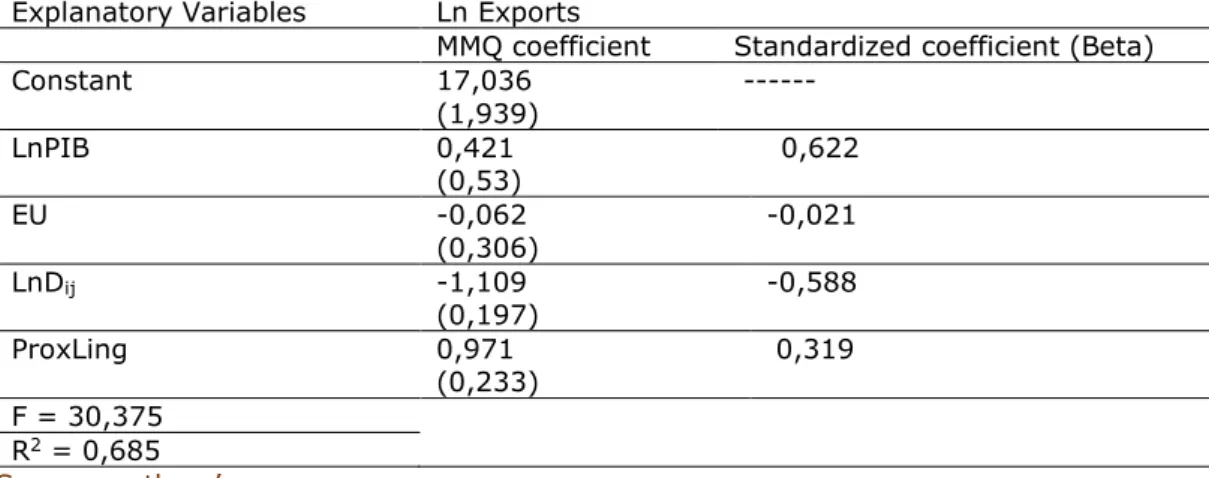
Table 1 - Model estimation results (4) Explanatory Variables Ln Exports
MMQ coefficient Standardized coefficient (Beta)
Constant 17,036 (1,939) --- LnPIB 0,421 (0,53) 0,622 EU -0,062 (0,306) -0,021 LnDij -1,109 (0,197) -0,588 ProxLing 0,971 (0,233) 0,319 F = 30,375 R2 = 0,685
Source: authors’ own Remarks:
Numbers in parentheses are standard deviations. Significance level of 5%.
After conducting the regression study using the SPSS software, the impact of all the explanatory variables in the model was analyzed taking into account the following indicators: (i) global significance test (test F); (ii) individual significance test (test t),
According to all the variables presented in the table, the results obtained reveal that the one that has the greatest explanatory capacity at the level of exports is linguistic proximity.
Thus, as expected, the fact that a country belongs to the EU has a positive impact on the volume of Portuguese exports to that destination, not only due to the importance of belonging to the same economic bloc, but also because of the relative physical proximity between all EU member states. In fact, we could also see that the increase in distance has a negative effect on the volume of exports, causing it to decrease by 1.109% for each 1% increase in the number of kilometers that separate both countries (accounting for the distance between capitals).
In previous studies (cf. Ribeiro and Ferro, 2017), we also found a direct relationship between the volume of exports from Portugal to a given country and the official language of that same country – if a country’s official language is a Romance one, there is a positive relationship with great explanatory capacity between the volume of exports and the linguistic proximity of the official languages of the two countries involved in the bilateral relationship. This linguistic proximity was measured using the ProxLing variable, which includes Portuguese, Spanish and English. The latter was included in the variable not because of its effective proximity to Portuguese, as it is a language of another linguistic family (Germanic, not Romance), but, because, due to the linguistic policies implemented in Portugal, English is a language spoken by a large part of the population.
By blurring or eliminating the communication barrier, linguistic proximity allows transaction costs to fall. These conclusions are consistent with the gravitational model, as presented.
Conclusion
The increasing internationalization of economies has been implying an increasing importance and appreciation of the language factor. Especially in a global context that strongly propels the Portuguese economy towards internationalization, the language factor as a facilitator of communication in international trade has proved to be an extremely relevant axis.
In this sense, the choice of a commercial partner should take into account, among other factors, the language factor. Since communication between economic partners is an essential factor for the success of the relationship, it is in the interest of these partners to eliminate, or blur, language barriers, so that they can reduce the costs of commercial transactions.
In this study, we conclude that, with data on the volume of Portuguese exports for 2015, the ease of verbal communication with the trading partner has a positive influence on the increase in trade - in empirical terms, this conclusion is corroborated by the fact that Spain is Portugal's main trading partner, highlighting the fact that, as shown, other variables also explain it, such as geographical proximity.
In our opinion, the language issue is not being used well by the Portuguese State, as it could take more advantage of linguistic proximity to promote bilateral commercial relations with the countries that make up the Community of Portuguese Speaking Countries (CPLP) and with those that make up the Southern Common Market (Mercosur).
On the other hand, the importance of language policies and the influence they will have on the training of future generations of entrepreneurs is also not widespread among the population, despite the current focus on learning English, which is undoubtedly an asset for generations to come.
We therefore consider that, given the relevance of linguistic proximity for the ease of communication between business partners and, consequently, for the increase in the volume of exports, the Portuguese State should make a set of linguistic policies aimed precisely at promoting trade relations based on linguistic proximity.
In fact, although the course is not yet clear, the possibility of English losing some ground as the most widely used language within the European Union is on the table. It is true that English is unlikely, in the near future, to cease being the lingua franca in many sectors of society, specifically in the world of business, but other languages may gain preponderance. In a new geopolitical organization, it will be up to the languages to reorganize themselves and concretely the Portuguese official entities will have to take advantage of any leeway that may come, taking advantage of the economic potential that the Portuguese language already has today.
References
Adler, R. B. & Rodman, G. (2006). Understanding human communication. 9th ed. New
York: Oxford University Press.
Adserà, A. & Pytliková, M. (2015). The role of language in shaping internacional migration. The Economic Journal, 125:586 F49-F81.
Anderson, J. (1979). A theoretical foundation for the gravity equation. The American Economic Review, 69:1; 106-116.
Bergstrans, H. (1990). The Heckscher-Ohlin-Samuelson model, the Linder hypothesis and the determinants of bilateral intra-industry trade. The Economic Journal, 100:403 1216-1229.
Chiswick, B. R. e P. W. Miller (1995). “The Endogeneity between Language and Earnings: International Analyses.” Journal of Labor Economics, 3:2, 246-288.
Chiswick, R. e Miller, W. (2005). Linguistic distance: A quantitative measure of the distance between English and other languages. Journal of Multilingual and Multicultural Development, 26:1 1-11.
European Comission (2012). Europeans and their languages [online]. Special Eurobarometer 386. Directorate-General for Communication. [29-03-2016]. Available at WWW: < URL: http://ec.europa.eu/public_opinion/archives/ebs/ebs_ 386_en.pdf > Egger, P. e Lassmann, A. (2012). The language effect in international trade: A meta-analysis, Economic Letters 116, 221-224.
Eurostat (2015). News release, 164/2015 [online]. Eurostat Press Office. [25/03/2016].
Available at \WWW: < URL:
Ferro, M.J. and Costa, R. (2016). The economic value of language (Ch. 10). In O. Gomes & H. F. Martins (Eds.). Advances in applied business research: The L.A.B.S. Initiative. New York: Nova Publishers. ISBN: 978-1-63484-957-9.
Ferro, M. J. and Ribeiro, S. (2016). The role of language in international trade: How does language affect the choice of foreign trading partners? In. S. N. de Jesus & P. Pinto (Eds.). Proceedings of the International Congress on Interdisciplinarity in Social and Human Sciences (pp. 608-621). Universidade do Algarve, Faro, 5-6 May 2016.
Ginsburgh, V. and Weber, S. (2018) The Economics of Language, ECARES working paper 2018-18
Helpman, E. and Krugman, R. (1985). Market structure and foreign trade: Increasing returns, imperfect competition, and the international economy. Cambridge, MA & London: The MIT Press. ISBN: 9780262081504.
Helliwell, F. (2000). How much do national borders matter? Washington: Brookings Institution. ISBN 0-8157-3554-5.
Kalirajan, K. (1999). Stochastic varying coefficients gravity model: An application in trade analysis. Journal of Applied Statistics, 26:2 185-193.
Krisztin, T. and Fisher, M. (2014). The gravity model for international trade: Specification and estimation issues in the prevalence of zero flows. Working Papers in Regional Science, 2014/01. WU Vienna University of Economics and Business, Vienna
Lohmann, J. (2011). Do language barriers affect trade? Economics Letters, 110:2; 159-162.
Marschak, J. (1965). The Economics of Language. Behavioral Science, 10:2; 135-140. Melitz, J. (2008). Language and foreign trade. European Economic Review 52, 667-99. Melitz, J. and Toubal, F. (2014). Native language, spoken language, translation and trade. Journal of International Economics 93, 351-363.
Rahman, D (2014) The power of communication, American Economic Review 104(11): 3737–3751
Ribeiro, S. and Ferro, M. J. (2017). Em que medida a proximidade linguística influencia as exportações portuguesas? Um estudo aplicado à União Europeia e ao Mercosul. Debater a Europa, 16, 189-208. ISSN: 1647-6336.
Tinbergen, J. (1962). Shaping the world economy: Suggestions for an international economic policy. New York: The Twentieth Century Fund.
Victor G. and Shlomo W. (2018). The Economics of Language. Working Papers ECARES 2018-18, ULB; Universite Libre de Bruxelles.