Pesq. agropec. bras., Brasília, v.49, n.5, p.349-355, maio 2014 DOI: 10.1590/S0100-204X2014000500004
Fábio Luiz Partelli(1), André Monzoli Covre(1), Marcos Goes Oliveira(1), Rodrigo Sobreira Alexandre(1), Edney Leandro da Vitória(1) and Marcelo Barreto da Silva(1)
(1)Universidade Federal do Espírito Santo, Rodovia BR‑101 Norte, Km 60, Bairro Litorâneo, CEP 29932‑540 São Mateus, ES, Brazil.
E‑mail: [email protected], [email protected], [email protected], [email protected], [email protected], [email protected]
Abstract – The objective of this work was to evaluate the root system distribution and the yield of 'Conilon' coffee(Coffea canephora) propagated by seeds or cuttings. The experiment was carried out with 2x1 m spacing, in an Oxisol with sandy clay loam texture. A randomized complete block design was used, following a 2x9x6 factorial arrangement, with two propagation methods (seeds and cuttings), nine sampling spacings (0.15, 0.30, 0.45, 0.60, 0.75, and 0.90 m between rows, and 0.15, 0.30, and 0.45 between plants within rows), six soil depths (0.10–0.20, 0.20–0.30, 0.30–0.40, 0.40–0.50, and 0.50–0.60 m), and six replicates. Soil cores (27 cm3)
with roots were taken from 12 experimental units, 146 months after planting. The surface area of the root system and root diameter, length, and volume were assessed for 13 years and, then, correlated with grain yield.
The highest fine root concentration occurred at the superficial soil layers. The variables used to characterize
the root system did not differ between propagation methods. Moreover, no differences were observed for net photosynthetic CO2 assimilation rate, stomatal conductance, internal CO2 concentrations, and instantaneous water‑use efficiency in the leaves. Cutting‑propagated plants were more productive than seed‑propagated ones.
Index terms: Coffea canephora, root diameter, root length, root volume, vegetative propagation.
Distribuição do sistema radicular e produtividade do café 'Conilon'
propagado por sementes ou estaquia
Resumo – O objetivo deste trabalho foi avaliar a produtividade e a distribuição do sistema radicular do café 'Conilon' (Coffea canephora) propagado por sementes ou estaquia. O experimento foi realizado no espaçamento 2x1 m, em Latossolo com textura franco‑argilo‑arenosa. Utilizou‑se o delineamento experimental de blocos ao acaso, em arranjo fatorial 2x9x6, com dois métodos de propagação (semente e estaca), nove espaçamentos (0,15, 0,30, 0,45, 0,60, 0,75 e 0,90 m, nas entrelinhas, e 0,15, 0,30 e 0,45 entre plantas), seis profundidades (0,10–0,20, 0,20–0,30, 0,30–0,40, 0,40–0,50 e 0,50–0,60 m) e seis repetições. Foram retirados monólitos (27 cm3) de solo com raízes de 12 unidades experimentais, 146 meses após o plantio. A área superficial do
sistema radicular bem como o diâmetro, o comprimento e o volume das raízes foram avaliados por 13 anos
e correlacionados à produtividade de grãos. A maior concentração de raízes mais finas ocorreu nas camadas superficiais do solo. As variáveis utilizadas para caracterizar o sistema radicular não diferiram entre os métodos
de propagação. Além disso, não se observaram diferenças quanto à taxa de assimilação fotossintética líquida de CO2, nem quanto à condutância estomática, às concentrações internas de CO2 e à eficiência do uso da água nas
folhas. Plantas propagadas por estaquia foram mais produtivas do que as propagadas por sementes.
Termos para indexação: Coffea canephora, diâmetro de raízes, comprimento de raízes, volume de raízes, propagação vegetativa.
Introduction
Seed‑derived plants from Coffea canephora Pierre ex A. Froehnerare both genetically and morphologically heterogeneous, which results in substantial variations in plant architecture, disease resistance, maturation time, seed size and shape, and yield (Conagin &
(Weigel & Jurgens, 2002; Paiva et al., 2012). Moreover, this technique has allowed the establishment of coffee crops in areas with biotic or abiotic limitations (Miranda et al., 2011; Paiva et al., 2012).
Commercial 'Conilon' coffee fields use seedlings
from cuttings. However, there are important questions related to the development of plants derived from cuttings, as for their ability to grow in depth and to anchor and support adult plants.
Root system characteristics are known to differ according to species, genotype, plant age, season, climate, plant density, root diameter, biotic stresses, and soil texture and structure (Lynch, 1995). Current studies addressing the characteristics of root system of coffee plants are still inconclusive as to its distribution
in the soil profile, as well as to root physiology, size,
and volume (Rena & Guimarães, 2000; Carvalho et al., 2008; Andrade Júnior, 2013). Therefore, additional knowledge on coffee root system can improve crop management, since a well‑developed root system can enhance water and nutrient uptake and, also,
increase the efficiency of soil‑applied fungicides and
insecticides, which can directly affect plant yield and tolerance to drought and other stresses (Franco & Inforzato, 1946; Rena & Guimarães, 2000; Carvalho et al., 2008).
The objective of this work was to evaluate the root system distribution and the yield of 'Conilon' coffee (Coffea canephora) propagated by seeds or cuttings.
Materials and Methods
This experiment was carried out in Vila Valério (18°57'S; 40°18"W, at approximately 150 m altitude), in the north‑western portion of the state of Espírito Santo, Brazil. The climate type in the region is tropical, with hot and humid summers and dry winters. The annual rainfall is 1,200 mm, and precipitation volume concentrates between November and January. Annual average temperature is 23°C, with 29°C maximum
mean and 18°C minimum mean (Comitê de Bacia Hidrográfica do Rio Doce, 2013). The soil in the area was classified as Typic Hapludox (Latossolo Vermelho
Amarelo, Santos et al., 2013), with sandy clay loam texture, whose physical and chemical attributes (Silva, 2009) are described in Table 1.
The crop was established on November 22, 1999, in a 2x1 m spacing, following east‑west orientation. The
experiment was carried out in a randomized complete block design in a 2x9x6 factorial arrangement, with two forms of propagation (seed and cuttings), nine soil sampling spacing distances (15, 30, 45, 60, 75, and 90 cm between rows, and 15, 30, and 45 cm between plants in the rows) – which represented six samples in the career direction, and three between plants –, six soil depths (10–20, 20–30, 30–40, 40–50, and 50–
60 cm), and six replicates. Each plot consisted of five
plants with 12 replicates, until the 2006 harvest, and six replicates until the last harvest (2013). The number of replicates was reduced because some plants were cut off for visual assessment of the root system. In the place of cut plants, cacao plants were grown. In order to avoid interference of cacao plants on the results, only 50% of the plants that remained in the undisturbed areas were evaluated.
Conventional fertilizers were used from 2002 to 2006, when they were changed to organic fertilizers. After 2006, chemical fertilizers were applied only when
soil analyses indicated possible nutrient deficiency.
Crop management included irrigation.
Seed‑ and cutting‑propagated plants were harvested 13 times during the growing seasons from 2001 (17‑month‑old plants) to 2013 (161‑month‑old plants). Total yield was estimated (kg ha‑1) according to individual yields. Harvested coffee at 5.33 L was considered to provide 1 kg of processed coffee,
according to observations in the field.
Net CO2 assimilation rate (A), stomatal conductance to water vapor (gs), internal CO2 concentration (Ci), and transpiration rates (E) were measured in two leaves, on 12 plants per treatment, using a portable Irga open system Ciras 2, (PP Systems, England). Measurements were taken between 8:00 and 10:00 h.
During this interval, plants were subjected to field
variations, ranging approximately between: 1,200
and 1,400 μmol m‑2s‑1 irradiance; 65 and 70% relative
humidity; and 22 and 24ºC; with 380 μL L‑1 air CO2
concentration. In general, maximum ranges occur by
mid‑morning (Silva et al., 2004). Determinations were
performed in recently matured leaves, from the upper parts of plants.
Chlorophyll (Chl) fluorescence and gas exchange
were evaluated on the same leaves, at the same times, using a Ciras 2, PP Systems. The photochemical quenching (qP) (Kooten & Snell, 1990) and the
Pesq. agropec. bras., Brasília, v.49, n.5, p.349‑355, maio 2014
DOI: 10.1590/S0100‑204X2014000500004
(Fv’/Fm’) (Krüpa et al., 1993) were obtained under
steady‑state photosynthetic conditions (irradiance
of 650 μmol m‑2 s‑1 and saturating flashes of 6,000
μmol m‑2 s‑1).
In order to evaluate the root system, soil cores were taken from 12 experimental units, 146 months after planting, as follows: six plots with plants derived from seed, and six from cuttings (six replicates). The large number of treatments (2x9x6) and replicates (six plots per treatment) were able to provide a broad knowledge of the root system distribution of 'Conilon' coffee, and made it possible to build maps based on reliable results. Sampled monoliths had 27 cm3 volume (3x3x3 cm). Samples were stored in plastic bags and refrigerated at approximately ‑10°C until analysis. The monoliths were washed to separate roots from the soil with running water and 30‑mesh sieve. Roots retained in the sieve were transferred to another sieve (60 mesh) and were washed in water again.
The washed roots were photographed with a digital camera and, subsequently, they were analyzed using the
Safira software, which is an analysis system for fibres
and roots (Embrapa Instrumentação Agropecuária, São Carlos, SP, Brazil) (Jorge & Rodrigues, 2008), in order to quantify length, volume, surface area, and diameter of roots. Fine root content per volume (cm3) of soil was estimated with roots with less than 1 mm diameter.
Nonnormally distributed data associated with root diameter, surface area, length, and volume were transformed [y = Log (x + 1)] prior to the analysis of variance and comparison of means; notwithstanding, the original data were shown.
Statistical analysis was performed using Assistat 7.6
(Silva, 2012). Data were subjected to the analysis of
variance, following a Box‑Cox transformation. Means were compared by Tukey’s test, at 5% probability.
Isoline diagrams were drawn using the GS+ version
7 software (Gamma Design Software, Plainwell,
Michigan, USA), in order to illustrate the spatial
distribution of the root system in the soil profile, in two
dimensions.
Results and Discussion
The yield of cutting‑propagated plants was
significantly higher in the 1st, 2nd, 4th, 8th, 10th and 13th
harvests (Table 2), whereas seed‑propagated plants
did not show significantly higher yields in none of the
studied years. The highest yield difference between
the two groups of plants was found after the first two
harvests. The overall production along the experimental period was 43,788 kg ha‑1 for cutting‑ propagated plants, and 35,644 kg ha‑1 for seed‑propagated ones. Additionally, the average annual yields for the 13‑year period were respectively 3,368 and 2,742 kg ha‑1.
Therefore, cutting‑propagated plants had a significantly
higher yield during the trial, showing a clear advantage over the seed‑propagated ones.
Plants derived from cuttings had earlier production capability, which might be caused by the greater physiological maturity of these individuals. In that respect, these plants were able to develop a higher number of productive (plagiotropic) branches sooner than seed‑derived ones. This might be related to the fact that 'Conilon' clones are produced from cuttings of physiologically differentiated tissue (Bragança et al., 2001). In contrast, seed‑derived plants are able
Table 1. Soil chemical and textural properties, at six depths, after 146 months of 'Conilon' crop establishment.
Variable Soil depth (cm)
0–10 10–20 20–30 30–40 40–50 50–60
pH 5.7 5.4 5.4 5.4 5.2 5.1
P (mg dm‑3) 28 5 3 2 1 1
K (mg dm‑3) 101 60 43 34 28 24
S (mg dm‑3) 7 6 7 13 22 26
Ca (cmolc dm‑3) 2.0 1.4 1.2 1.0 0.9 0.7 Mg (cmolc dm‑3) 0.5 0.3 0.2 0.2 0.2 0.1 Al (cmolc dm‑3) 0.0 0.3 0.3 0.3 0.4 0.4 H+Al (cmolc dm‑3) 2.6 2.1 2.0 2.0 1.8 2.1
Na (mg dm‑3) 49 34 27 26 25 22
SB (cmolc dm‑3) 2.8 1.9 1.5 1.3 1.2 0.9 E (cmolc dm‑3) 5.4 4.0 3.5 3.3 3.0 3.0 CEC (cmolc dm‑3) 2.8 2.2 1.8 1.6 1.6 1.3 OM (dag kg‑1) 1.9 1.1 0.9 0.8 0.7 0.5
m (%) 0 14 17 19 25 32
V (%) 51.5 46.9 43.0 39.2 39.4 29.1
Fe (mg dm‑3) 74 108 125 121 125 110 Cu (mg dm‑3) 0.5 0.3 0.3 0.2 0.2 0.2 Zn (mg dm‑3) 6.7 2.4 0.6 0.2 0.2 0.2
Mn (mg dm‑3) 42 35 33 20 9 7
B (mg dm‑3) 0.82 0.77 0.47 0.30 0.27 0.23 Total sand (g kg‑1) 610 586 582 520 524 500 Silt (g kg‑1) 150 154 138 160 156 140 Clay (g kg‑1) 240 260 280 320 320 360 Soil density (g cm‑3) 1.06 1.25 1.51 1.51 1.65 1.65
to develop plagiotropic (i.e., productive) branches only by the ninth or tenth leaf axil. This difference delays fruiting stage and the full production potential of plants,
which was clearly observed in the first four years of this experiment. These findings agree with Carvalho
et al. (2011), who observed that C. arabica 'Catuaí' plants had a better initial development when derived from vegetative propagation (somatic embryogenesis). However, the higher yields observed for plants derived from cuttings may also have been caused by the better genetic material used for the propagation of these plants.
Net photosynthetic CO2 assimilation, stomatal conductance to water vapor, internal CO2 concentrations,
and instantaneous water‑use efficiency did no differ
between propagation methods (Table 3). Moreover,
the energy harvesting efficiency and photochemical
quenching were also statistically similar.
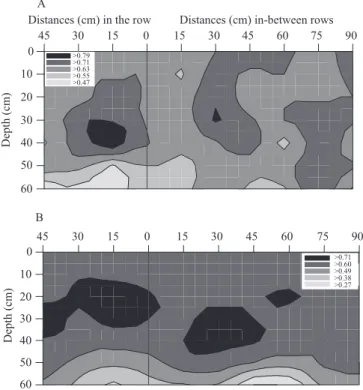
Regarding the root system, the average diameter
of lateral roots was significantly higher in plants
derived from seed (Table 4 and Figure 1), mostly due to data variation in depth, since no differences were observed in the horizontal position (distance from the coffee tree trunk). Seed‑grown plants
had a significantly greater diameter in the
50–60 cm layer, which was similar to that reported for C. arabica plants (Rena & Guimarães, 2000).
When comparing root concentrations according
to the horizontal distance from the trees, the first
centimetres of the top‑soil layer had greater values of root length and volume between rows than the ones observed within rows (Figure 2). The area between plants in the rows did not receive topdressing fertilization. Therefore, this result most likely occurred because of the higher fertility in the space between rows (Sousa et al., 2002).
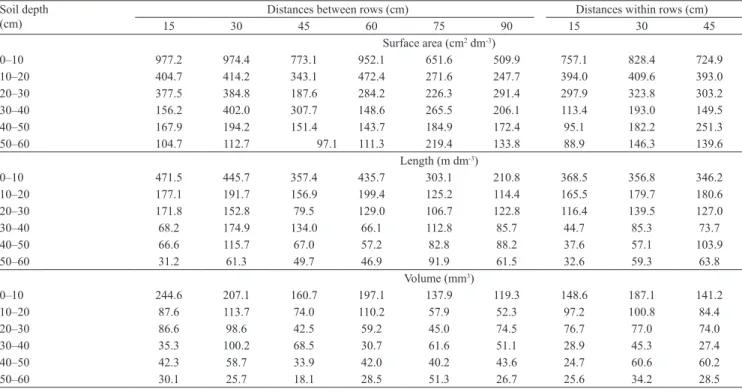
Root surface area, length, and volume did not differ between the propagation methods in none of the evaluated distances or depths (Table 5 and Figure 2). Therefore, under the particular conditions of this study, the root system of 'Conilon' coffee was not affected by
the propagation method. This finding contrasts with
the results reported for C. arabica, in which total root length and dry weight of cutting‑propagated plants were greater than those of seed‑propagated ones (Jesus et al., 2006).
No interaction was observed between the evaluated distances and depths, for data related to root surface area, length, and volume. Roots had a higher concentration in the top soil layer (0–10 cm), which decreased with depth (Table 6). Roots had lower concentrations in the layers below 40 cm, showing a parallel with nutrient concentrations (P, K, and Ca) (Table 1). The spatial
distribution of roots in the soil profile confirmed
these trends (Figures 2). Mota et al. (2006) reported the highest concentration of coffee roots up to 0.20 m depth, and Rodrigues et al. (2001) observed lower root concentrations at deeper soil layers. This behavior of
Table 2. Yield of Coffea canephora 'Conilon' propagated by seed or cuttings, from 2001 (17 months) to 2013 (161 months)(1).
Propagation 2001 2002 2003 2004 2005 2006 2007 2008 2009 2010 2011 2012 2013 Cutting 421a 5,795a 1,629a 3,135a 1,562a 4,325a 2,330a 4,349a 2,861a 4,410a 3,812a 4,051a 5,107a Seed 73b 3,220b 1,269a 2,355b 1,549a 3,745a 2,513a 3,446b 2,977a 3,099b 4,051a 4,170a 3,178b CV (%) 50.2 16.9 35.3 26.2 34.9 27.4 22.2 26.1 45.6 17.66 33.23 26.26 30.04
(1)Means followed by equal letters, in the columns, do not differ, by Tukey’s test, at 5% probability.
Table 3. Net photosynthesis (A), stomatal conductance to water vapor (gs), internal CO2 concentration (Ci), transpiration (E), and two parameters for chlorophyll fluorescence (Fv'/Fm', qP) of Coffea canephora 'Conilon' plants propagated by seed or cuttings.
Propagation A Gs Ci E Fv’/Fm’ qP’
(μmol m‑2 s‑1 CO
2) (mmol m‑2 s‑1 H2O) (μmol mol‑1) (mmol m‑2 s‑1 H2O)
Cutting 13.88a 85.12a 230.58a 1.76a 0.60a 0.49a
Seed 13.01a 98.02a 227.17a 1.59a 0.62a 0.49a
CV (%) 13.88 39.04 27.51 15.02 6.45 28.99
Pesq. agropec. bras., Brasília, v.49, n.5, p.349‑355, maio 2014
DOI: 10.1590/S0100‑204X2014000500004
root systems can also be observed for other species, such as passion fruit (Sousa et al., 2002; Lucas et al., 2012) and orange rootstocks (Zaccheo et al., 2012).
Although root development in coffee is mainly related to the genetic characteristics of the plant (Martins et al., 2013), other factors may also interfere in the spatial distribution, such as the propagation form, seedling stage, and amount of water in the soil (Franco & Inforzato, 1946). The availability of soil nutrients
to plants can also influence the deep root density
and distribution (Bakker et al., 2006). According to
Witschoreck et al. (2003), the concentration of fine
roots in the soil surface layer is related to the higher concentrations of organic matter and nutrients, and to favorable physical conditions. Nutrient availability can be a limiting factor for coffee root development, particularly for Brazilian soils (Rena & Guimarães, 2000).
Table 4. Root diameter (mm) of Coffea canephora 'Conilon' propagated by seed or cuttings at different soil depths(1).
Soil depth (m) Cuttings Seed
0–10 0.659Aa 0.687Aa
10–20 0.704Aa 0.700Aa
20–30 0.770Aa 0.741Aa
30–40 0.679Aa 0.703Aa
40–50 0.636Aa 0.673Aa
50–60 0.415Bb 0.592Ba
CV (%) 37.89 32.45
(1)Means followed by equal letters, lowercase in the rows and uppercase in the columns, do not differ by Tukey’s test, at 5% probability.
Figure 1. Spatial distribution of the root diameters (mm) of Coffea canephora 'Conilon', propagated by seed (A) or cuttings (B), at different horizontal distances and depths. The zero point refers to the plant location.
Figure 2. Spatial distribution of: A, root surface area (cm2 dm‑3); B, root length (m dm‑3); and C, root volume
(mm3) for Coffea canephora 'Conilon' propagated by seed
Conclusions
1. Cutting‑propagated plants of Coffea canephora 'Conilon' are more productive than seed‑propagated ones.
2. Surface area, length, and volume of 'Conilon' roots are not affected by the propagation method, and show higher values in the soil surface, in‑between the rows.
Acknowledgements
To Coordenação de Aperfeiçoamento de Pessoal de Nível Superior (Capes) and to the Universidade Federal do Espírito Santo (Ufes), for partial support of this work; and to Mr. Valnei Marcos Partelli, for permitting the use of the experimental area.
References
ANDRADE JÚNIOR, S. de; ALEXANDRE, R.S.; SCHMILDT,
E.R.; PARTELLI, F.L.; FERRÃO, M.A.G.; MAURI, A.L. Comparison between grafting and cutting as vegetative propagation methods for 'Conilon' coffee plants. Acta Scientiarum. Agronomy,
v.35, p.461‑469, 2013. DOI: 10.4025/actasciagron.v35i4.16917. BAKKER, M.R.; AUGUSTO, L.; ACHAT, D.L. Fine root
distribution of trees and understory in mature stands of maritime pine (Pinus pinaster) on dry and humid sites. Plant Soil, v.286,
p.37‑51, 2006. DOI: 10.1007/s11104‑006‑9024‑4.
BRAGANÇA, S.M.; CARVALHO, C.H.S. de; FONSECA, A.F.A. da; FERRÃO, R.G. Variedades clonais de café Conilon lançadas para
Table 6. Surface area, length, and volume of roots of Coffea canephora 'Conilon' propagated by seed or cuttings at different soil depths.
Depth (cm) Surface area (cm2 dm‑3) Length (m dm‑3) Volume (mm3) Absolute values
0–10 794.3a 366.2a 171.5a
10–20 372.3b 165.6b 86.4b
20–30 297.4bc 127.3bc 70.5bc
30–40 215.8cd 93.9cd 49.9cd
40–50 174.4cd 75.1cd 45.1cd
50–60 128.2d 55.4d 29.9d
CV (%) 37.71 37.89 39.28
Percentual values
0–10 40.13 41.45 37.83
10–20 18.81 18.75 19.06
20–30 15.03 14.41 15.55
30–40 10.90 10.63 11.00
40–50 8.66 8.50 9.94
50–60 6.84 6.27 6.59
(1)Means followed by equal letters, in the columns, do not differ, by Tukey’s test, at 5% probability.
Table 5. Surface area, length, and volume of Coffea canephora 'Conilon' roots propagated by seed or cuttings, at different spacing distances and depths.
Soil depth (cm)
Distances between rows (cm) Distances within rows (cm)
15 30 45 60 75 90 15 30 45
Surface area (cm2 dm‑3)
0–10 977.2 974.4 773.1 952.1 651.6 509.9 757.1 828.4 724.9
10–20 404.7 414.2 343.1 472.4 271.6 247.7 394.0 409.6 393.0
20–30 377.5 384.8 187.6 284.2 226.3 291.4 297.9 323.8 303.2
30–40 156.2 402.0 307.7 148.6 265.5 206.1 113.4 193.0 149.5
40–50 167.9 194.2 151.4 143.7 184.9 172.4 95.1 182.2 251.3
50–60 104.7 112.7 97.1 111.3 219.4 133.8 88.9 146.3 139.6
Length (m dm‑3)
0–10 471.5 445.7 357.4 435.7 303.1 210.8 368.5 356.8 346.2
10–20 177.1 191.7 156.9 199.4 125.2 114.4 165.5 179.7 180.6
20–30 171.8 152.8 79.5 129.0 106.7 122.8 116.4 139.5 127.0
30–40 68.2 174.9 134.0 66.1 112.8 85.7 44.7 85.3 73.7
40–50 66.6 115.7 67.0 57.2 82.8 88.2 37.6 57.1 103.9
50–60 31.2 61.3 49.7 46.9 91.9 61.5 32.6 59.3 63.8
Volume (mm3)
0–10 244.6 207.1 160.7 197.1 137.9 119.3 148.6 187.1 141.2
10–20 87.6 113.7 74.0 110.2 57.9 52.3 97.2 100.8 84.4
20–30 86.6 98.6 42.5 59.2 45.0 74.5 76.7 77.0 74.0
30–40 35.3 100.2 68.5 30.7 61.6 51.1 28.9 45.3 27.4
40–50 42.3 58.7 33.9 42.0 40.2 43.6 24.7 60.6 60.2
Pesq. agropec. bras., Brasília, v.49, n.5, p.349‑355, maio 2014
DOI: 10.1590/S0100‑204X2014000500004
o Estado do Espírito Santo. Pesquisa Agropecuária Brasileira,
v.36, p.765‑770, 2001. DOI: 10.1590/S0100‑204X2001000500006. CARVALHO, C.H.S. de; REZENDE, J.C. de; ALMEIDA, G.R.R.; TEIXEIRA, J.B.; PADILHA, L. Características agronômicas
e morfológicas de cafeeiro ‘Catuaí Vermelho’ propagado por
embriogênese somática. Pesquisa Agropecuária Brasileira, v.46,
p.378‑383, 2011. DOI: 10.1590/S0100‑204X2011000400006.
CARVALHO, M.; JESUS, A.M.S.; CARVALHO, S.P.; GOMES, C.N.; SOARES, A.M. Comportamento em condições de campo de cafeeiros (Coffea arabica L.) propagados vegetativamente e por semeadura. Coffee Science, v.3, p.108‑114, 2008.
COMITÊ DE BACIA HIDROGRÁFICA DO RIO DOCE. A bacia do Rio Doce: característica da bacia. Disponível em: <http://www.riodoce.
cbh.gov.br/bacia_caracterizacao.asp>. Acesso em: 2 mar. 2013. CONAGIN, C.H.T.M.; MENDES, A.J.T. Pesquisas citológicas e genéticas em três espécies de Coffea. Auto‑incompatibilidade em
Coffea canéfora pierre ex froehner. Bragantia, v.20, p.787‑804,
1961. DOI: 10.1590/S0006‑87051961000100034.
FRANCO, C.M.; INFORZATO, R. O sistema radicular do cafeeiro nos principais tipos de solo do Estado de São Paulo. Bragantia,
v.6, p.443‑458, 1946. DOI: 10.1590/S0006‑87051946000900001.
JESUS, A.M.S.; CARVALHO, S.P.; SOARES, A.M. Comparação entre sistemas radiculares de mudas de Coffea arabica L. obtida por estaquia e por sementes. Coffea Science, v.1, p.14‑20, 2006.
JORGE, L.A. de C.; RODRIGUES, A.F. de O. Safira: sistema de
análise de fibras e raízes. São Carlos: Embrapa Instrumentação
Agropecuária, 2008. 21p. (Embrapa Instrumentação Agropecuária. Boletim de pesquisa e desenvolvimento, 24).
KOOTEN, O. van; SNELL, J.F.H. The use of chlorophyll fluorescence
nomenclature in plant stress physiology. Photosynthesis Research,
v.25, p.147‑150, 1990. DOI: 10.1007/BF00033156.
KRÜPA, Z.; ÖQUIST, G.; HUNER, N.P. The effects of cadmium on photosynthesis of Phaseolus vulgaris: a fluorescence analysis. Physiologia Plantarum, v.88, p.626‑630, 1993. DOI: 10.1111/
j.1399‑3054.1993.tb01381.x.
LUCAS, A.A.T.; FRIZZONE, J.A.; COELHO FILHO, M.A. Características da distribuição radicular de maracujazeiro sob fertirrigação. Irriga, v.17, p.245‑250, 2012.
LYNCH, L. Root architecture and plant productivity. Plant Physiology, v.109, p.7‑13, 1995.
MARTINS, L.D.; TOMAZ, M.A.; AMARAL, J.F.T. do; BRAGANÇA, S.M.; RODRIGUES, W.N.; REIS, E.F. dos. Nutritional efficiency in clones of Conilon coffee for phosphorus.
Journal of Agricultural Science, v.5, p.130‑140, 2013.
MIRANDA, W.L.; GUIMARÃES, R.J.; MAGALHÃES, P.B.; COLOMBO, A.; OLIVEIRA, P.M. de O. Desenvolvimento
vegetativo de plantas de café arábica enxertadas sobre café robusta e submetidas à reposição hídrica. Pesquisa Agropecuária
Brasileira, v.46, p.1618‑1624, 2011. DOI: 10.1590/
S0100‑204X2011001200006.
MOTA, A.C.V.; NICK, J.A.; YORINORI, G.T.; SERRAT, B.M.
Distribuição horizontal e vertical da fertilidade do solo e das raízes
de cafeeiro (Coffea arabica L.) cultivar Catuaí. Acta Scientiarum. Agronomy, v.28, p.455‑463, 2006. DOI: 10.4025/actasciagron.
v28i4.758.
PAIVA, R.F. de; MENDES, A.N.G.; CARVALHO, G.R.; REZENDE, J.C. de; FERREIRA, A.D.; CARVALHO, A.M.
de. Comportamento de cultivares de cafeeiros C. arabica L. enxertados sobre cultivar ‘Apoatã IAC 2258’ (Coffea canephora).
Ciência Rural, v.42, p.1155‑1160, 2012. DOI: 10.1590/
S0103‑84782012000700003.
RENA, A.B.; GUIMARÃES, P.T.G. Sistema radicular do cafeeiro:
estrutura, distribuição, atividade e fatores que o influenciam. Belo Horizonte: Epamig, 2000. 80p. (EPAMIG. Documentos, 37). RODRIGUES, L.A.; MARTINEZ, H.E.P.; NEVES, J.C.L.; NOVAIS, R.F.; MENDONÇA, S.M. Growth response of coffee
tree shoots and roots to subsurface liming. Plant and Soil, v.234,
p.207‑214, 2001. DOI: 10.1023/A:1017999318532.
SANTOS, H.G. dos; JACOMINE, P.K.T.; ANJOS, L.H.C. dos; OLIVEIRA, V.A. de; LUMBRERAS, J.F.; COELHO, M.R.;
ALMEIDA, J.A. de; CUNHA, T.J.F.; OLIVEIRA, J.B. de. Sistema
brasileiro de classificação de solos. 3.ed. rev. e ampl. Brasília:
Embrapa, 2013. 353p.
SILVA, E.A.; DAMATTA, F.M.; DUCATTI, C.; REGAZZI,
A.J.; BARROS, R.S. Seasonal changes in vegetative growth and photosynthesis of Arabica coffee trees. Field Crops Research,
v.89, p.349‑357, 2004. DOI: 10.1016/j.fcr.2004.02.010.
SILVA, F.A.S. Assistat ‑ statistical assistance. Versão 7.6 beta.
2012. Disponível em: <http://www.assistat.com/indexi.html>.
Acesso em: 15 mar. 2012.
SILVA, F.C. da. Manual de análises químicas de solos, plantas
e fertilizantes. 2.ed. rev. ampl. Brasília: Embrapa Informação
Tecnológica; Rio de Janeiro: Embrapa Solos, 2009. 627p.
SOUSA, V.F.; FOLEGATTI, M.V.; COELHO FILHO, M.A.;
FRIZZONE, J.A. Distribuição radicular do maracujazeiro sob
diferentes doses de potássio aplicadas por fertirrigação. Revista
Brasileira de Engenharia Agrícola e Ambiental, v.6, p.51‑56,
2002. DOI: 10.1590/S1415‑43662002000100010.
WEIGEL, D.; JURGENS, G. Stem cells that make stems. Nature,
v.415, p.751‑754, 2002. DOI: 10.1038/415751a.
WITSCHORECK, R.; SCHUMACHER, M.V.; CALDEIRA,
M.V.W. Estimativa da biomassa e do comprimento de raízes
finas em Eucalyptus urophylla S.T. Blake no Município de Santa Maria‑RS. Revista Árvore, v.27, p.177‑183, 2003. DOI: 10.1590/
S0100‑67622003000200008.
ZACCHEO, P.V.C.; NEVES, C.S.V.J.; STENZEL, N.M.C.;
OKUMURA, R.S. Distribuição do sistema radicular de
porta‑enxertos sob laranjeira ‘Folha Murcha’ em clima subtropical.
Semina: Ciências Agrárias, v.33, p.921‑930, 2012. DOI:
10.5433/1679‑0359.2012v33n3p921.