Phosphorus analysis in soil under herbaceous perennial leguminous
cover by nuclear magnetic spectroscopy
Luciano Pasqualoto Canellas(1), José Antônio Azevedo Espíndola(2), José Guilherme Marinho Guerra(2), Marcelo Grandi Teixeira(2), Ary Carlos Xavier Velloso(1) and Victor Marcos Rumjanek(3)
(1)Universidade Estadual do Norte Fluminense, Laboratório de Solos, Av. Alberto Lamego, 2000, Parque Califórnia, CEP 28013-602 Campos dos Goytacazes, RJ, Brazil. E-mail [email protected] (2)Embrapa Agrobiologia, km 7, BR 467, CEP 23851-970 Seropédica, Brazil. E-mail: [email protected], [email protected], [email protected] (3)Universidade Federal Rural do Rio de Janeiro, Dep. de Química, CEP 23851-970 Seropédica, RJ, Brazil. E-mail: [email protected]
Abstract – The availability and the reserves of organic phosphorus are controlled by its mineralization rate and are also influenced by changes in soil management. The objective of this study was to evaluate the influence of soil covering with different leguminous plant on soil organic P by 31P-NMR spectroscopy. Alkaline soil extracts
were obtained from two depths (0–5 and 5–10 cm) of an Ultisol cultivated with herbaceous perennial leguminous plants (Arachis pintoi, Pueraria phaseoloides, Macroptilium atropurpureum). In an adjacent area, samples of
the same soil cover with a secondary tropical forest and grass (Panicum maximum) were also collected. The
leguminous management was divided into with removal and without removal of shoot parts after cut on soil surface. Phosphate monoesters are the dominant P species in all soil samples and P diesters accumulated on the superficial layer of secondary forest soil. The P amount of this fraction is higher for the legume covered soil when compared with the grass covered soil. The permanence of leguminous plants on the topsoil after the cut promoted an increase in P diester/P monoester ratios. These findings can be accounted for an enhancement of P availability to plants in soils cultivated with leguminous plants.
Index terms: cultivation, deforestation, cover crops.
Análise de fósforo em solo com leguminosas herbáceas perenes
por meio de ressonância magnética nuclear
Resumo – A disponibilidade e as reservas de fósforo orgânico são controladas pela taxa de mineralização e influenciadas pelas alterações no manejo do solo. O objetivo deste trabalho foi avaliar o fósforo orgânico mediante espectroscopia de ressonância magnética nuclear de 31P (RMN 31P) em solo sob cobertura de plantas
leguminosas. Extratos alcalinos foram obtidos em duas profundidades (0–5 e 5–10 cm) de um Argissolo numa área cultivada com leguminosas herbáceas perenes (Arachis pintoi, Pueraria phaseoloides e Macroptilium atropurpureum). Em áreas adjacentes ao experimento foram coletadas amostras do mesmo solo sob cobertura de
floresta tropical secundária (capoeira) e capim-colonião (Panicum maximum). O manejo das leguminosas foi
dividido em com e sem a remoção da parte aérea da superfície após o corte das plantas. Os fosfatos em ligações monoésteres foram predominantes em todas as amostras de solo e os fosfatos em ligações diésteres foram acumulados na camada superficial do solo sob floresta secundária. A quantidade de fósforo em ligações diésteres foi maior nas amostras de solo sob cobertura de leguminosas do que sob gramíneas. A permanência da parte aérea na superfície do solo promoveu aumento na razão P diéster/P monoéster. Esses resultados podem ser usados para justificar o aumento da disponibilidade de fósforo para as plantas em solos cultivados com leguminosas.
Termos para indexação: cultivo, desmatamento, culturas de cobertura do solo.
Introduction
The productivity of most crops is limited by phosphorus (P) availability, especially in strongly weathering soils. In most of the agricultural systems, the maintenance of P availability to plants growing in these soils is one of
released from decomposing organic matter (Fardeu, 1996). An important part of P in soil is organically bound and plays a key role in the P cycle (Dalal, 1977). Stabilization of organic phosphorus (OP) in soil is frequently explained by the incorporation of microbial, vegetation and animal phosphate units into the humified soil organic matter (Stevenson, 1994). Beck & Sanchez (1994) found that the NaOH-extractable Po fraction is an important source of plant available P in a non-fertilized Ultisol. Guerra et al. (1996) showed that, despite the lower amounts, OP was intimately related to available P, indicating the potential contribution of this fraction to the availability of P in strongly weathering soils. Neufeldt et al. (2000) confirmed this observation showing that, in an Oxisol, more than 60% of labile P is organic. However, the analysis of P fractionation allows only indirect structural characterization of OP compounds. 31P NMR
allows a more detailed determination of structural features of organic P in soils.
Newman & Tate (1980) quantified the relative amounts of P in different compounds such as orthophosphates, mono and diester phosphates, phosphonates, and polyphosphates. A series of works has been reported following this approach mainly with temperate soils. Results dealing with tropical soils are more scarce. Forster & Zech (1993) found that, in tro-pical rain forest soils, persistent orthophosphate P monoester makes up an even greater percentage of soil phosphorus. Similar results were observed for Brazilian savannah soils, cultivated or not, and could be explained by the stabilization on Al and Fe hydroxides and other clays (Chapuis-Lardy et al., 2001). In a primary tropical forest, Möller et al. (2000) verified that soil organic phosphorus (SOP) is constituted mainly of orthophosphate diesters on the organic layer, whereas on the mineral horizons orthophosphate monoesters dominated the chemical composition of extractable SOP. Through 31P NMR spectroscopy, Solomons et al. (2002)
observed that in tropical sub-humid soils the proportion of the more stable organic orthophosphate monoesters increased following changes in land use compared to that of natural forests.
Characterization of the SOP pool is essential for understanding the P cycle in tropical agroecosystems where Po contributes significantly to the nutrition of crops. The objective of this study was to evaluate the influence of soil covering with different leguminous plant on soil organic P by 31P NMR spectroscopy.
Material and Methods
The trial was carried out at an Ultisol located at Embrapa Agrobiologia experimental field, in Seropédica, Rio de Janeiro State, Brazil (43o 41' W, 22o 45' S; 33 m
above sea level). Soil chemical properties of the 20 cm surface were analysed, showing pH (H2O), 5.6; Al,
0.0 mmolc dm-3 (titration against NaOH); Ca, 30.0 mmolc dm-3
and Mg, 14.0 mmolc dm-3 (titration against EDTA); P,
2.0 mg dm-3 (Mehlich 1 extraction and colorimetric
determination); K, 72.0 mg dm-3 (Mehlich 1). The mean
annual temperature and rainfall are, respectively 24.1oC
and 1,620 mm. The dry season occurs from April to August.
A completely randomized block design, in a factorial scheme 3x4 with three replications, was used. Three legumes were evaluated: groundnut (Arachis pintoi
Krap. & Greg.), tropical kudzu (Pueraria phaseoloides
(Roxb) Benth.), and siratro (Macroptilium
atropurpureum (OC.) Urb). After the first cut, each
plot was divided into two subplots: plants were either cut and left on the soil surface or they were cut and removed. Plot size was 3.0x7.0 m and subplot size was 3.0x3.5 m. After 30 months of trial installation soil samples were collected at the depths of 0–5 and 5–10 cm with or without plant residues on the soil surface. Soil samples were also collected at the same depths in a closed area covered with secondary vegetation, i.e., mainly formed by C3 plants or by Panicum maximum
cv. KK-16.
One hundred grams of air-dried soil were mixed with 1 L of 0.5 mol L-1 NaOH with pH adjusted to 7.0 and
this was left standing overnight under N2 atmosphere at
room temperature. Then all samples were filtered through Whatman 41 filter paper. Subsamples of each filtered extract were digested in H2SO4/HClO4 mixture
and the total P analysed (Olsen & Sommers, 1982). The remainder of each filtrate had the volume reduced under vacuum and at low temperature (40oC), the ions removed
by cation resin column (Amberlit IR-120 H+) and finally
freeze-dried. All field samples were collected in triplicate and P analysis carried out in duplicate.
To prepare the samples for NMR analysis, approximately 1 g of the freeze-dried extracts was weighed into a 50 mL plastic centrifuge tube with 2.5 mL of D2O. Samples were vortexed for two min. 31P NMR
spectra were obtained at 101.27 MHz on a Bruker WM 250 high resolution using a 45o pulse with a 1.5-s
acid as an external reference. The 31P spectra were
proton decoupled using an inverse-gated pulse sequence to eliminate the nuclear Overhauser enhancement in order to achieve quantitative results. The assignment of peaks was based on Newman & Tate (1980), Adams & Byrne (1989) and Cade-Menun & Preston (1996). Chemical shifts were measured relative to external 85% H3PO4. Peak areas were determined by integration.
Results and Discussion
No significant differences were observed in total P contents in the studied samples covered with perennial leguminous. From 40% to 63% of total soil P were extracted with 0.5 mol L-1 NaOH. In the soil extracts
obtained from P. phaseoloides the P contents were
lower (119.2 mg kg-1) than those obtained from A.pintoi
(157 mg kg-1) and M. atropurpureum (128.2 mg kg-1).
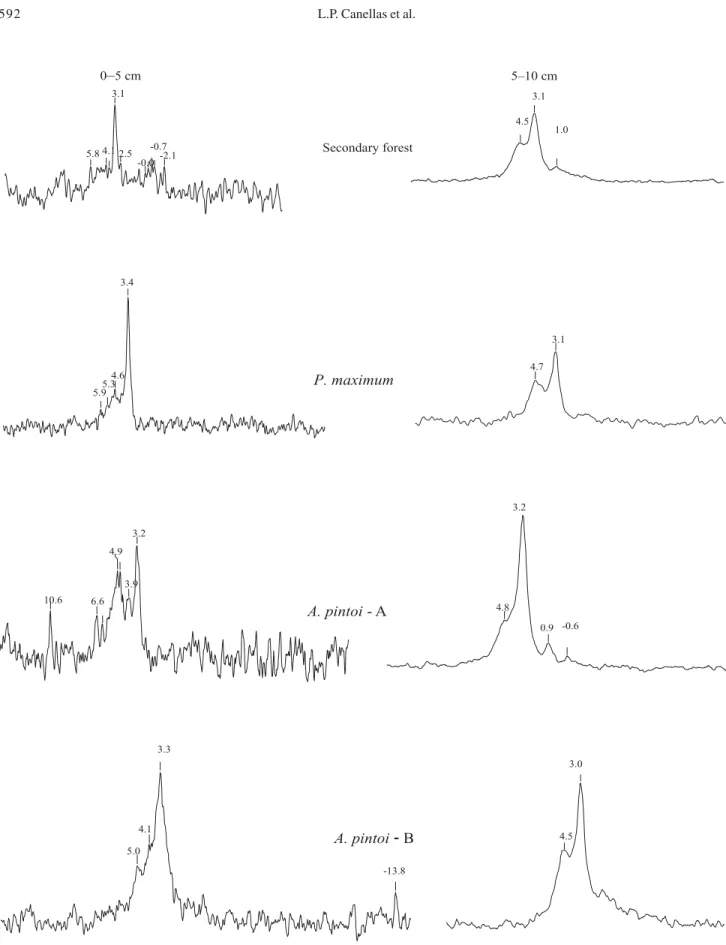
No relevant differences in P contents were observed with litter being present or not on the soil plots. Nevertheless, it was possible to observe major differences in the distribution of various P forms for the different vegetable soil covering (Table 1 and Figures 1 and 2). In all soil samples, P monoesters were the predominant OP form, representing between 66% to 95% of NaOH extractable phosphorus. Alkali-extractable orthophosphate monoester originates mainly from hydrolysed plant derived phospholipids, including glycerophosphate, inositol phosphate, choline phosphate and others, which are associated with cuticle and middle lamella tissue and cellular membranes and have resonance signals at 3.0 to 5.0 ppm (Newman & Tate, 1980). The high charge density of monoesters allows rapid adsorption to oxihydroxides, which protect them from degradation (Condron et al., 1990). Turrión et al. (2001) found a direct relationship between the P-monoesters and the amount of clay showing a possible path for monoesters stabilization in soils.
Phosphates in diester linkages (1 to -1 ppm) comprise <1% to 34% of total spectra area and consist mainly of glycerol and sugar molecules linked by phosphate groups (Condron et al., 1990) and phospholipids (Newman & Tate, 1980). Nucleic acids and phosphoric acids residues which serve as a link between adjacent pentoses units could be significant stores of P in microbial cells. They are readily mineralized in soils, unless stabilized by clay minerals or humic acids (Crecchio & Stotzky, 1998) and are among the most soluble fractions of Po in soils (Adams, 1990). Amelung et al. (1998) reported that the Table 1.
V
alues of total soil P
, P
in NaOH soil extract, chemical shift (ppm) and corresponding designation
(1).
(1)V
alues in parentheses are for alkaline soil extract obtained in subplants where the shoot part of leguminous were cut and remov
ed.
(2)
Samples digestion with H
2 SO 4 + HClO 4 and colorimetric P determination. (3) Not detected. Total P (1)
Chemical shift (ppm)
266 394 (294) 312 (289) 258 (270) 280 208 301 (382) 310 (301) 278 (288) 234
ND
(3)
9 (ND) ND ND ND ND ND ND ND ND
Superficial layer (0
–
5 cm)
Subsuperficial layer (5
–
10 cm)
Covering plant Secondary forest A. Pintoi M. atropurpureum P. phaseoloides Grass Secondary forest A. Pintoi M. atropurpureum P. phaseoloides Grass
P in NaOH extract 138 158 (138) 137 (122) 121 (124) 147 91 136 (196) 130 (126) 116 (131) 120 9 to 10 (Mineral
orthophosphate)
---(mg
kg
1
)---(% of total extract soil
P)---6.8 to 9 (P-Aryl diesters) 5 to 5.9 (Sugars)
4 to 5
(Mononucleotides)
3 to 3.5 (Inosytol)
1 to -1
(P-Diesters)
1
2
13 (ND) 10 (ND) N
D N D N D N D N D N D N D
24 42 (23) 16 (34) 8 (7) 17 ND ND ND ND ND ND 12 (17) 11 (<1) 19 (35) 12 32 18 (31) 10 (74) 46 (43) 44 42 24 (56) 59 (47) 47 (42) 66 58 70 (63) 73 (25) 38 (56) 55
11 to -20
(Polyphosphates)
Di-monoesters
ratio
Figure 1. 31P NMR spectra of 0.5 mol L-1 NaOH soil extracts from 0¯5 and 5¯10 cm soil samples under secondary tropical forest, grass (Panicum maximum), and Arachis pintoi. A: without removal of shoot part from leguminous soils plot; B: with removal of
Figure 2. 31P NMR spectra of 0.5 mol L-1 NaOH soil extracts from 0
¯5 and 5¯10 cm soil samples under Macroptilium atropurpureum and Pueraria phaseoloides. A: without removal of shoot part from leguminous soils plot; B: with removal of shoot part from
small amount of orthophosphate diesters produced by plants is very labile, whereas the diester P produced by microbes is more likely to be stabilized on mineral surfaces, possibly due to the closer proximity of microbes to those surfaces. The percentage of diester P is normally <10% in well-drained soils (Condron et al., 1985). Accumulation of diester P has been shown only to occur in soils where microbial activity is restrained due to acidity, waterlogging or low temperature (Makarov et al., 1995).
In secondary tropical forest soils, diester P fractions comprise around 34% of total phosphorus. The apparent vitality and absence of P deficiency symptoms of forest trees suggest the existence of an efficient, however delicate, natural P cycle. In soil extracts obtained from leguminous plants covering, the enhancement of microbial activity due to organic residues with low lignin/N ratio can promote an enhancement in diester P amount, which could be stabilized on oxihydroxide fractions, thus being protected from mineralization or accumulated during the dry season. The P distribution in the areas with
P. phaseoloides showed the presence of additional
signals between 1.0 and 1.4 ppm and at 1.86 ppm due to P diesters. In addition, with M. atropurpureum, an
increase in the integration of signals of diesters at 0.57, 2.57 and 1.46 ppm has been found. This result suggests that the quality of the organic residues has an influence on OP distribution. Regarding soil samples cultivated with
A. pintoi at 0–5 cm of depth, the signals due to P diesters
comprise 12% but have been attributed solely to aryl phosphate diesters with a resonance at 6.8 ppm according to Bedrock et al. (1994) and Amelung et al. (2001). Furthermore, an increase in monoesters at 3.4 ppm has been observed for A. pintoi covering at 5–10 cm of
depth. An increase has also been observed in P diesters represented by a signal at 1 to -1 ppm together with the absence of signals due to aryl phosphate diesters. The low content of lignin and higher N content compared with other leguminous plants could explain, at least partially, the increase in soil biomass activity with stabilization of aryl phosphate diesters on the superficial layer and the increase of P monoesters in the subsuperficial layer. Signals for diester P are only at tra-ce levels for the grass alkaline soil extract.
Main differences between 31P spectra due to
vegetable cover can be easily observed through analysis of the diester P/monoester P ratio. This value for secondary forest samples is 0.51 indicating the presence
of orthophosphate diesters at high concentration. Simi-lar results were obtained by Solomons et al. (2002). As for the grass soils, this ratio is much lower than the values reported by Hawkes et al. (1984) and Sumann et al. (1998) for temperate grass soil. The use of
M. atropurpureum and P. phaseoloides as covering
crops enhances the diester P/monoester P ratio to 0.11 and 0.34, respectively, and the ratio is more closely related to that observed for secondary tropical forest than to the grass soil extract.
Further relevant signals were observed at 9 to 10 ppm which can be assigned to mineral orthophosphates, suggesting that some orthophosphate (PO43-) ions are
associated with inorganic colloids through Fe and Al brid-ges. The presence of inorganic phosphates species in soluble humic substances can be attributed to a slow hydrolysis of organic P or, more probably, by the release of orthophosphate associated with humic substances (Makarov et al., 1997). Other signals present in 31P
spectra were assigned to polyphosphates (-20.0 to -18.0 ppm) derived from ATP in A. pintoi and grass soil
extracts and unknown SOP structures resonating at -2.1 to -0.8 ppm (Solomons et al., 2002) only in grass soil extracts.
The main effects of crop residues management on SOP distribution in 0.5 mol L-1 NaOH extracts is the
increase in the diester P/monoester P ratio with the permanence of plant residues on the soil surface. With
A. Pintoi, this ratio was increased from 0.11 to 0.17 and
from 0.18 to 0.34 for P. phaseoloides and
M. atropurpureum soil, respectively. Solomons et al.
(2002) observed that with better crop residue management the surface litter accumulation reflected a more conservative cycling of organic P in ecosystems and lead to the increase of orthophosphate diesters compounds, teichoic acids and phosphonates which may apparently represent more labile organic P species. Guggenberger et al. (1996) also observed an increase of about 10% in P diesters for the A horizon (0–10 cm) following a change from continuous growth of grass
(Brachiaria decumbens) to a grass/legume
(B. decumbens + P. phaseoloides) pasture. In
agreement with previous reports (Alvey et al., 2001; Daroub et al., 2001; Phiri et al., 2001) P availability increases under soil rotation with leguminous plants.
main changes in molecular composition in this fraction. Since P is a non-renewable resource, there is a need to develop agricultural systems based on maximum efficiency of P use with minimal adverse environmental impacts.
Conclusion
Herbaceous perennial leguminous plants can help restore soils to their native P fertility levels by enhancing the amount of P diesters, which is a labile organic P fraction.
References
ADAMS, M.A. 31P NMR identification of phosphorus compounds
in neutral extracts of mountain ash (Eucalyptus regnans F. Muell.) soils. Soil Biology & Biochemistry, v.22, p.419-421, 1990. ADAMS, M.A.; BYRNE, L.T. 31P-NMR analysis of phosphorus
compounds in extracts of surface soils from selected karri (
Eucalyp-tus diversicolor F. Meull.) forests. Soil Biology & Biochemistry,
v.21, p.523-528, 1989.
ALVEY, S.; BAGAYOKO, M.; NEUMANN, G.; BUERKERT, A. Cereal/legume rotations affect chemical properties and biological activities in two West African soils. Plant and Soil, v.231, p.45-54, 2001.
AMELUNG, W.; RODIONOV, A.; URUSEVSKAJA, I.S.; HAUMAIER, L.; ZECH, W. Forms of organic phosphorus in zonal steppe soils of Russia assessed by 31P NMR. Geoderma, v.103,
p.335-350, 2001.
AMELUNG, W.; ZECH, W.; ZHANG, X.; FOLLETT, R.F.; TIESSEN, H.; KNOX, E.; FLACH, K.W. Carbon, nitrogen and sul-fur pools in particle-size fractions as influenced by climate. Soil
Science Society of America Journal, v.62, p.172-181, 1998.
BECK, M A.; SANCHEZ, P.A. Soil-phosphorus fraction dynamics during 18 years of cultivation on a typic Paleudult. Soil Science
Society of America Journal, v.58, p.1424-1431, 1994.
BEDROCK, C.N.; CHESHIRE, M.V.; CHUDEK, J.A.; GOODMAN, B.A.; SHAND, C.A. 31P-NMR studies of humic acid
from a blanket peat. In: SENESI, N.; MIANO, T.M. (Ed.). Humic substances in the global environment and implications on
hu-man health. Amsterdam: Elsevier, 1994. p.227-234.
CADE-MENUN, B.J.; PRESTON, C.M. A comparison of soil ex-traction procedures for 31P NMR spectroscopy. Soil Science,v.161,
p.770-785, 1996.
CHAPUIS-LARDY, L.; BROSSARD, M.; HERVÉ, Q. Assessing organic phosphorus status of cerrado Oxisols (Brazil) using 31
P-NMR spectroscopy and phosphomonoesterase activity measure-ment. Canadian Journal of Soil Science, v.81, p.591-601, 2001. CONDRON, L.M.; FROSSARD, E.; TIESSEN, H.; NEWMAN, R.H.; STEWART, J.W.B. Chemical nature of organic phosphorus in cultivated and uncultivated soils under different environmental con-ditions. Journal of Soil Science,v.41, p.41¯50, 1990.
CONDRON, L.M.; GOH, K.M.; NEWMAN, R.H. Nature and distribution of soil phosphorus as revealed by a sequential extrac-tion method followed by 31P-NMR analysis. Journal of Soil
Sci-ence,v.36, p.199-207, 1985.
CRECCHIO, C.; STOTZKY, G. Binding of DNA on humic acids: effect on transformation of Bacillus subtilis and resistance to Dnase.
Soil Biology & Biochemistry, v.30, p.1061-1067, 1998.
DALAL, R.C. Soil organic phosphorus. Advances in Agronomy, v.29, p.83-117, 1977.
DAROUB, S.H.; ELLIS, B.G.; ROBERTSON, G.P. Effect of crop-ping and low-chemical input systems on soil phosphorus fractions.
Soil Science, v.166, p.281-291, 2001.
FARDEU, J.C. Dynamics of phosphates in soils: an isotopic out-look. Fertility Research, v.45, p.91-100, 1996.
FORSTER, J.C.; ZECH, W. Phosphorus status of a soil catena under liberian evergreen rain-forest - results of P-31 NMR-spec-troscopy and phosphorus adsorption experiments. Zeitschrift fur
Pflanzenernahrung und Bodenkunde,v.156, p.61-66, 1993.
GUERRA J.G.M.; ALMEIDA, D.L. de; SANTOS, G. de A.; FERNANDES, M.S. Organic phosphorus content in soil samples.
Pesquisa Agropecuária Brasileira, v.31, 291-299, 1996.
GUGGENBERGER, G.; HAUMAIER, L.; THOMAS, R.J.; ZECH, W. Assessing the organic phosphorus status of an Oxisol under tropical pastures following native savannah using 31P NMR
spec-troscopy. Biology and Fertility of Soils, v.23, p.332-339, 1996. HAWKES, G.E.; POWLSON, D.S.; RANDALL, E.W.; TATE, K.R. A 31P nuclear magnetic resonance study of the phosphorus species
in alkali extracts of soils from long-term field experiments. Journal
of Soil Science, v.35, p.35¯45, 1984.
MAKAROV, M.I.; GUGGENBERGER, G.; ALT, H.G.; ZECH, W. Phosphorus status of Eutric Cambisols polluted by P-containing emissions: results of 31P-NMR spectroscopy and chemical analysis
results of P-31 NMR-spectroscopy and phosphorus adsorption experiments. Zeitschrift fur Pflanzenernahrung und
Bodenkunde,v.158, p.293-298, 1995.
MAKAROV, M.I.; MALYSHEVA, T.I.; HAUMAIER, L.; ALT, H.G.; ZECH, W. The forms of phosphorus in humic and fulvic acids of a toposequence of alpine soils in the northen Caucasus. Geoderma, v.80, p.61-73, 1997.
MÖLLER, A.; KAISER, K.; AMELUNG, W.; NIAMSKUL, C.; UDOMSRI, S.; PUTHAWONG, M.; HAUMAIER, L.; ZECH, W. Relationships between C and P forms in tropical soils Thailand as assessed by liquid-state 13C- and 31P-NMR spectroscopy.
Austra-lian Journal of Soil Research, v.38, p.1017-1035, 2000.
NEUFELDT, H.; SILVA, J.E. da; AYARZA, M.A.; ZECH, W. Land-use effects on phosphorus fractions in Cerrado Oxisols. Biology
and Fertility of Soils, v.31, p.30-37, 2000.
NEWMAN, R.H.; TATE, K.R. Soil phosphorous characterization by 31P nuclear magnetic resonance. Communications in Soil
Sci-ence and Plant Analysis, v.11, p.835-842, 1980.
OLSEN, S.R.; SOMMERS, L.E. Phosphorus. In: PAGE, A.L. (Ed.).
Methods of soil analysis: chemical and microbiological properties.
PHIRI, S.; BARRIOS, E.; RAO, I.M.; SINGH, B.R. Changes in soil organic matter and phosphorus fractions under planted fallows and a crop rotation system on a Colombian volcanic-ash soil. Plant and Soil,v.23, p.211-223, 2001.
SOLOMONS, D.; LEHMAMN, J.; MAMO, T.; FRITZSCHE, F.; ZECH, W. Phosphorus compounds and dynamics as influenced by land use changes in the sub-humid Ethiopian highlands. Geoderma, v.105, p.21-48, 2002.
STEVENSON, F.J. Humus chemistry: genesis, composition, reac-tions. New York: J. Wiley, 1994. 496p.
SUMANN, M.; AMELUNG, W.; HAUMAIER, L.; ZECH, W. Climatic effects on soil organic phosphorus in the North American Great Plains identified by phosphorus-31 nuclear magnetic
reso-nance. Soil Science Society of America Journal,v.62, p.1580-1586, 1998.
TIESSEN, H.; MOIR, J.O. Characterization of available P by se-quential extraction. In: CARTER, M.R. (Ed.). Soil sampling and
methods of analysis. Boca Raton: Lewis, 1993. p.75-86.
TURRIÓN, M.B.; GALLARDO, J.F.; HAUMAIER, L.; GONZÁLEZ, M.I.; ZECH, W. 31P-NMR characterization of
phos-phorus fractions in natural and fertilized forest soils. Annals of
Forest Science, v.58, p.89-98, 2001.
VELLOSO, A.C.X.; SANTOS, G. de A.; RAMOS, D.P. Capacidade de troca de cátions e adsorção de fosfato de solos sob vegetação do Cerrado do Amapá. Pesquisa Agropecuária Brasileira, v.17, p.27-32, 1982.