Revista Caatinga
VIGOR TESTS ASSOCIATION AS AN ALTERNATIVE FOR PRECISE AND
EFFICIENT ASSESSMENT OF MAIZE SEED QUALITY
1MARCOS ALTOMANI NEVES DIAS2, VITOR HENRIQUE VAZ MONDO*3, SILVIO MOURE CICERO2, NAYARA
ROBERTO GONÇALVES2, CIBELE APARECIDA TEIXEIRA DA SILVA2
ABSTRACT – This study aimed to associate two concepts of seed vigor testing, the aging and seedling growth using image analysis, providing a feasible and time-saving way to evaluate maize seed vigor in large scale. For
this purpose, five seed lots with different vigor levels from two single hybrids were used. The seeds were char-acterized by moisture content, germination, seedling emergence, seedling emergence speed index, accelerated aging and cold tests. The treatments were composed by varying the accelerated aging periods (0, 24, 48, 72 and 96h) and seedling growth periods (48 and 72h), before submitting the seedlings to image analysis for seedling root length measurement. Considering the results obtained, the adaptation of accelerated aging test by reducing the aging duration from 96h to 48h, and the replacement of the germination test by seedling root length meas-urement using image analysis could be considered a potential tool for maize seed vigor assessment. The treat-ments composed of 48h of seed aging followed by seedlings root length measuretreat-ments using image analysis provided reliable data, compared to traditional vigor tests and it could be considered an efficient and time
-saving approach, associating two different concepts of seed vigor analysis.
Keywords: Zea mays L. Seed analysis. Physiological potential. Image analysis.
ASSOCIAÇÃO DE TESTES DE VIGOR PARA AVALIAÇÃO PRECISA E EFICIENTE DA QUALIDADE DE SEMENTES DE MILHO
RESUMO- O experimento teve como objetivo associar conceitos para avaliação do vigor de sementes, o
en-velhecimento acelerado e crescimento de plântulas medido por meio da análise de imagens. Para tanto, cinco lotes de sementes com diferentes níveis de vigor de dois híbridos simples foram utilizados. As sementes foram caracterizadas pelo teor de água, germinação, porcentagem e índice de velocidade de emergência de plântulas, envelhecimento acelerado e teste de frio. Os tratamentos foram constituídos por diferentes períodos de envelhe-cimento acelerado (0, 24, 48, 72 e 96h) e de cresenvelhe-cimento de plântulas (48 e 72h) e, em seguida, as plântulas, submetidas à análise de imagens para mensuração do comprimento de raízes. A adaptação do teste de envelhe-cimento acelerado, reduzindo a duração do envelheenvelhe-cimento de 96h para 48h e a substituição do teste de germi-nação pela mensuração do comprimento de raízes das plântulas por meio da análise de imagens, comprovou-se
um método potencial para avaliação da qualidade de sementes de milho. Assim, os tratamentos compostos por
48h de envelhecimento, seguido pela mensuração do comprimento de raízes utilizando a análise de imagens,
forneceram dados confiáveis em comparação aos testes de vigor tradicionais e podem ser considerados uma nova abordagem para a análise de vigor de sementes.
Palavras-chave: Zea mays L. Análise de sementes. Potencial fisiológico. Análise de imagens.
________________
*Corresponding author
1Received for publication in 29/08/2014; accepted in 23/02/2015.
2University of São Paulo, Escola Superior de Agricultura ‘Luiz de Queiroz’ (USP/ESALQ) - Crop Science Department, PO Box 09,
13418-900, Piracicaba-SP, Brazil; [email protected].
Revista Caatinga
INTRODUCTION
The maize seed industries are recognized for dealing with cutting-edge technologies, on a global
scale. In Brazil, the presence of multinationals com-panies brought large investments in research and development to this sector, which has changed the scenario by improving the quality of maize seeds available to growers. In these companies, many seg-ments work jointly, in order to produce the best qual-ity seeds, in terms of genetics and physiological po-tential. The last phase, previous to seed release in the market, is the quality assurance, which is crucial to guarantee the seed quality standards.
Several years of research were dedicated to develop vigor tests, which are successfully used ei-ther by seed companies on seed quality control pro-grams or to research purposes, providing information about the planting value of a wide range of environ-mental conditions and evaluate storage potential of seed lots (HAMPTON; TEKRONY, 1995), as well as additional information to differentiate seed lots of acceptable standard germination (TEKRONY, 2003; VIEIRA et al, 2004).
The deterioration during storage of commer-cial seeds could be defined as one of the main causes of seed quality losses. According to this fact, the accelerated aging test (MCDONALD; PHANNEN-DRANATH, 1978) was developed based on the con-cept of tolerance to stresses as high temperature and relative humidity, and could be well correlated with storage potential for seeds of many species. The test is conducted in eight days for maize (MARCOS
-FILHO, 1999; DUTRA; VIEIRA, 2004) and it could be considered longstanding to be included in seed quality control programs, where the ability to obtain quick results has many advantages, mainly, allowing quick decision-making.
As the seed quality control is time and cost spending, improvements towards reducing both pa-rameters are highly desirable. Moreover, with in-creases of seeds produced and the competitiveness in the maize seed market, there is a need for more effi-ciency in all process related to seed production.
There is considerable interest in developing methods and equipment that enable a rapid and auto-mated evaluation of seed quality (VAN DER BURG, 2009) and, despite the reliability of available seed vigor tests, there are still opportunities to improve or develop new methods (MARCOS-FILHO et al.,
2009). Considering this, the seedling image analysis is a relatively new approach for seed vigor testing purposes, bringing many advantages, as the avoid-ance of human error, precise data and greater flexi-bility in the evaluations, and it had been well de-scribed for maize seed evaluations (HOFFMASTER et al., 2005; OTONI; MCDONALD, 2005; GOMES
-JUNIOR et al., 2009; MONDO et al., 2011).
In addition to that, the inclusion of seedling growth analysis after seed accelerated aging may enable a
more detailed evaluation of a given seed lot, which could enrich the data obtained when compared to the traditional, accelerated aging test. Thus, this study aimed to associate two concepts of seed vigor test-ing, aging and seedling growth, providing a feasible and time-saving way to evaluate maize seed vigor in
large scale.
MATERIAL AND METHODS
Maize seeds from single hybrids ‘Dow 2A120’ and ‘BR206’, provided by the seed compa-nies Dow AgroSciences and Riber KWS, respective-ly, were used for this study. Each hybrid was repre-sented by five seed lots, uniform in seed size and different in terms of physiological potential. The following tests were carried out for seed lot charac-terization.
Moisture content (MC): determined by oven drying two seed samples of 20 g from each seed lot at 105°C±3°C for 24 hours, followed by weighing (BRASIL, 2009). The results were expressed as per-centage.
Germination (G): carried out with four repli-cates of 50 seeds per lot in rolled paper towels. Seeds were uniformly distributed on two germination paper towels moistened with water to 2.5 times the dry paper weight and covered with another paper towel. The rolls were vertically placed in a dark germina-tion chamber at 25±1 oC. The percentage of normal
seedlings was recorded on the seventh day after sow-ing (BRASIL, 2009).
Seedling emergence (SE) and seedling emer-gence speed index (SESI):conducted with four repli-cates of 50 seeds per lot, uniformly distributed in plastic boxes (47 x 30 x 11 cm) filled with sand, moistened with 60% of the water holding capacity and maintained at room temperature (25oC). The
emerged seedlings were counted daily, considering only seedlings with coleoptiles at least 1 cm above the substrate surface, for calculating the SESI (MAGUIRE, 1962). The final counting occurred at the seventh day, and the results were expressed as a percentage of emerged seedlings.
Cold test (CT): conducted with four replicates of 50 seeds per lot, uniformly distributed in plastic boxes (47 x 30 x 11 cm) filled with a soil-sand
mix-ture (25-75%), moistened with 60% of water holding
capacity. After sowing, the boxes were maintained in a chamber at 10oC for seven days and then placed at
room temperature (25oC). Afterward, the total
emerged seedlings, considering only seedlings with coleoptiles at least 1 cm above the substrate surface, were counted on the fifth day, and the results were expressed as a percentage of emerged seedlings.
Revista Caatinga
The boxes were placed in a germination chamber and maintained at 41±1oC for 96 h (MONDO; CICERO,
2005). After the aging period, seeds were submitted to the germination test, as described previously, and the normal seedlings were counted on the 4th day
after sowing. The results were expressed as a per-centage of normal seedlings.
The treatments were composed by varying the accelerated aging (AA) and seedling growth periods, followed by seedling root length evaluation through image analysis. For determining the efficiency of AA combined with Seedling Root Length analysis (SRL), the treatments proposed were based on five aging periods (0, 24, 48, 72 and 96 h) and two seed-ling growth periods (48 and 72 h, two and three-day
-old seedlings, respectively). The AA tests were con-ducted using the same methodology described previ-ously, with variations in aging and seedling growth periods.
The seedling growth tests were carried out under the same conditions of germination test previ-ously described, with three replicates of 25 seeds, in order to avoid contact with seedlings, and the seeds were positioned with radicle end pointed downwards, in order to standardize root growth conditions for all samples. For seedling root length evaluation, at the second and third days after germination test installa-tion, the seedlings images from each treatment were obtained from an inverted scanner (Scanjet HP) with 100 dpi resolution, and the images processed by the software Seed Vigor Imaging System (SVISTM) by
measuring the length of the primary root, in millime-ters.
The data was submitted to analysis of vari-ance in a completely randomized design and in case of significance according to the F values, means were compared using Tukey’s test (p ≤ 0,05).
RESULTS AND DISCUSSION
Initial moisture content varied from 7.5 to 7.6% for hybrid Dow 2A120 and from 9.4 to 10.7% for hybrid BR206, which were considered acceptable values, indicating that this parameter have not influ-enced seed lot performance on potential physiologi-cal tests. Also, it is important to highlight that the seed moisture content after aging, independent of aging duration, varied less than two percent points among samples, emphasizing a proper conduction of the seed aging test.
The physiological potential characterization (Table 1) showed similar germination among seed lots, for both hybrids. This result is a premise for this kind of study, where seed lots must differ only in
terms of seed vigor, and be similar to germination percentages. The results also pointed to similarity among seed lots for seedling emergence, which was expected, considering the stable conditions of tem-perature and moisture used for this test. According to Egli and Rucker (2012), seed lots with the same standard germination but a range in vigor levels will often produce equal emergence in ideal field condi-tions, but the high vigor lots will have an advantage when conditions are less than ideal. Considering this statement, the cold test, seedling emergence speed index and accelerated aging test, which are consid-ered well standardized assessments, segregated lots1 and 2 as high vigor, lot 3 as intermediate vigor and lots 4 and 5 as low vigor for hybrid 2A120. Those tests could also segregate the seed lots from hybrid BR206, being lots 1, 2 and 3 segregated as high vig-or and lots 4 and 5 as low vigvig-or.
The planting quality is normally characterized by the germination test, which measures the ability of a seed lot to produce normal seedlings under opti-mal conditions for the considered specie (AOSA, 2005). On the other hand, predicting the seed lot performance under suboptimal field conditions is the main goal of seed vigor tests (TEKRONY et al., 1987). In this scenario, the accelerated aging test is considered one of the most sensitive and efficient vigor test for various species (MARCOS-FILHO,
2005).
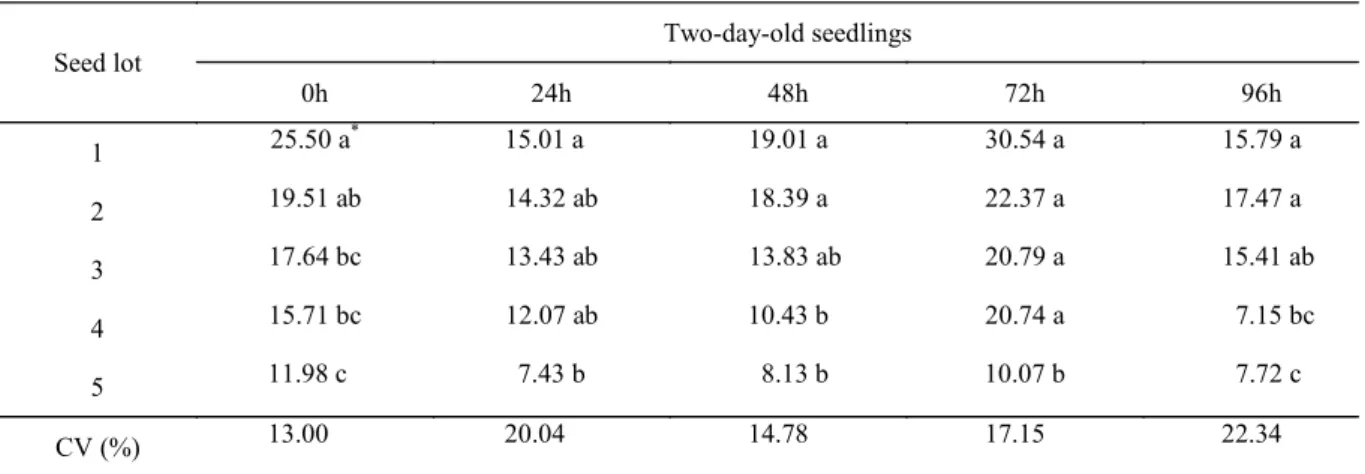
In Tables 2, 3, 4 and 5, the results were pro-vided by the association of two vigor tests, accelerat-ed aging and seaccelerat-edling root length, measuraccelerat-ed by im-age analysis with the software SVISTM. This soft-ware enabled a rapid assessment of seedling devel-opment.
For hybrid 2A120, with seedling root length measured after two days (Table 2), it is possible to observe that the 48h AA treatment segregated the seed lots equally to the 96h AA treatment, which can be considered a good result, by reducing the time spent on seed aging and, consequently, the whole test from eight to four days. Those tests could segre-gate lots one to five very close to the other standard-ized vigor tests. For the procedure using three-day
-old seedlings (Table 3), the treatments with 24 and 96h AA resulted in the same segregation found for two-day-old seedlings. It is expected that a reduction
in seed aging duration can be compensated by the seedling growth analysis, which is also used for seed vigor assessment. On the other hand, the germination test is not able to provide data related to seed vigor. As an example of this compensatory effect, the 48h AA with two-day-old seedlings and 24h AA with
three-day-old seedlings similarly segregated seed
Revista Caatinga
Table 1. Maize seed lots physiological potential characterization. G – Germination; CT – Cold test; SE – Seed-ling emergence; SESI – SeedSeed-ling emergence speed index; AA – Accelerated aging.
Hybrid Seed lot G (%) CT (%) SE (%) SESI AA (%)
2A120
1 97 a* 92 a 98 a 23.0 a 86 a
2 95 a 86 a 97 a 22.7 ab 74 a
3 95 a 72 b 95 a 22.2 ab 56 b
4 90 a 58 c 95 a 21.1 ab 35 c
5 90 a 54 c 95 a 19.8 b 18 d
CV (%) 3.90 5.70 4.70 6.40 13.30
BR206
1 92 a 71 a 88 a 18.6 a 78 a
2 88 a 63 ab 84 a 17.2 ab 76 a
3 86 a 63 ab 77 a 14.9 ab 71 ab
4 84 a 61 ab 76 a 14.7 b 68 b
5 81 a 53 b 72 a 14.4 b 54.5 b
CV (%) 6.50 12.50 9.20 11.30 11.70
*Means followed by same letter in the column do not significantly differ according to Turkey’s test (p < 0.05). CV: coeffi-cient of variance.
Table 2. Maize Hybrid 2A120 two-day-old seedlings root length, in millimeters, evaluated with seed vigor imaging system.
Seed lot
Two-day-old seedlings
0h 24h 48h 72h 96h
1 26.05 a* 15.87 a 17.22 a 7.39 b 11.74 a
2 21.80 b 13.76 a 11.53 ab 15.73 a 7.45 ab
3 21.39 b 9.14 b 5.65 bc 5.74 bc 3.65 bc
4 15.10 c 6.57 b 4.50 c 4.29 bc 0.99 c
5 10.88 d 4.67 b 1.24 c 0.47 c 0,00 c
CV (%) 7.43 16.06 27.93 33.64 35.33
*Means followed by same letter in the column do not significantly differ according to Turkey’s test (p < 0.05). CV: coeffi-cient of variance.
For hybrid BR206, data is presented in Tables 4 and 5. It was possible to observe in this case that the 24h AA treatment associated with two-day-old
seedlings (Table 4) could segregate seed lots as well as the cold test, and the 48h AA treatment similarly to accelerated aging test (Table 1). On the other hand, for the three-day-old seedlings analysis (Table
Revista Caatinga
Table 3. Maize Hybrid 2A120 three-day-old seedlings root length (mm), evaluated with seed vigor imaging system.
*Means followed by same letter in the column do not significantly differ according to Turkey’s test (p < 0.05). CV: coeffi-cient of variance.
Table 4. Maize Hybrid BR206 two-day-old seedlings root length (mm), evaluated with seed vigor imaging system.
*Means followed by same letter in the column do not significantly differ according to Turkey’s test (p < 0.05). CV: coeffi-cient of variance.
The primary root emergence and, consequent-ly, root growth, usually is delayed from deteriorated seeds; evidence suggests that the extent of deteriora-tion determines the length of the delay, during which metabolic repair of damage caused by deterioration takes place before further germination processes can
continue (MATTHEW et al., 2012). Also, Hoch-holdinger et al. (2004) affirmed that on grass spe-cies, the SRL is a good way to estimate seed vigor. Those facts confirm SRL as a potential method to be used, with the aim of reducing time and costs of seed lot quality assessment.
Table 5. Maize Hybrid BR206 three-day-old seedlings root length (mm), evaluated with seed vigor imaging system.
Seed lot
Three-day-old seedlings
0h 24h 48h 72h 96h
1 57.41 ns 41.14 ns 59.70 a* 52.97 ab 50.39 a
2 53,29 40,37 52.86 ab 60.29 a 48.81 a
3 48,12 40,55 47.25 ab 47.47 b 46.93 a
4 48,66 34,14 39.00 ab 40.34 bc 34.77 ab
5 45,67 26,74 35.57 b 31.89 c 28.65 b
CV (%) 8.58 17.87 18.64 9.66 13.51
*Means followed by same letter in the column do not significantly differ according to Tukey’s test (p < 0.05). ns Non
-significant by F test (P<0.05). CV: coefficient of variance.
Seed lot
Three-day-old seedlings
0h 24h 48h 72h 96h
1 80.44 a
*
55.31 a 58.31 a 43.23 a 33.08 a
2 77.39 a 48.82 ab 43.46 ab 51.79 a 20.83 ab
3 63.66 b 31.53 bc 34.63 b 18.54 b 9.31 bc
4 54.91 bc 27.54 c 27.85 bc 17.68 b 5.45 c
5 46.09 c 23.32 c 10.44 c 6.73 b 0.55 c
CV (%) 6.83 16.64 18.35 19.96 37.59
Seed lot
Two-day-old seedlings
0h 24h 48h 72h 96h
1 25.50 a
*
15.01 a 19.01 a 30.54 a 15.79 a
2 19.51 ab 14.32 ab 18.39 a 22.37 a 17.47 a
3 17.64 bc 13.43 ab 13.83 ab 20.79 a 15.41 ab
4 15.71 bc 12.07 ab 10.43 b 20.74 a 7.15 bc
5 11.98 c 7.43 b 8.13 b 10.07 b 7.72 c
Revista Caatinga
Seed vigor tests are based on different con-cepts, such as the resistance to stress, as CT and AA, speed of germination, as SESI, membrane integrity, as electrical conductivity (EC) and seedling develop-ment, as SRL (MATTHEWS et al., 2012) and its association with the pursuit of efficiency, fastness and cost reduction on seed analysis has been tried in few opportunities in literature. One example is the application of AA test associated with tetrazolium test (TT), which was studied by Bittencourt et al. (2012) on maize seeds. The authors found that the combination of both vigor tests resulted in similar results compared to the traditional method of AA test, which could lead to time-saving during a seed
analysis routine in laboratories.
Considering the results obtained in the psent research work, the adaptation of AA test by re-ducing the aging duration from 96h to 48h, and the replacement of the germination test by seedling root length measurement using image analysis could be considered a potential method for maize seed vigor analysis. In general, it reduces the test total duration from eight days, or 192h, to four days, or 96h, which represents approximately 50% of time reduction. Additionally it brings to test the benefits of image analysis, with reproducible results, practical proce-dures and does not involving human error in count evaluations, estimates and measurements (SAKO et al., 2001; HOFFMASTER et al., 2003; HOFFAM-STER et al., 2005 ).According to Barros and Marcos
-Filho (1997), Pinto et al. (2007) and Santorum et al.
(2013), there is an increasing need for efficient meth-ods to assess the physiological quality of seeds, which enable decision making regarding the collec-tion, processing, storage and marketing of the crop, and the association of AA and SRL tests could be a great alternative to meet those demands.
CONCLUSION
The treatments composed of 48h of seed ag-ing followed by seedlag-ings root length measurement using image analysis provide reliable data, compared to traditional vigor tests and it could be considered an efficient and time-saving approach for maize seed
vigor assessment. Moreover, by associating two dif-ferent concepts of seed quality analysis, accelerated aging and seedling root length, the test can provide more consistent data referring to seed vigor.
REFERENCES
ASSOCIATION OF OFFICIAL SEED ANALYSTS – AOSA. Rules for testing seeds. AOSA, Las Cru-ces, NM. 2005.
BRASIL. Ministério da Agricultura, Pecuária e
Abastecimento. Regras para análise de sementes.
Brasília: MAPA/ACS, 2009. 399 p.
BARROS, A. S. R.; MARCOS-FILHO, J. Testes
para avaliação rápida do vigor de sementes de soja.
Journal of Seed Science, Pelotas, v. 19, n. 2, p. 288
-294, 1997.
BITTENCOURT, S. R. M. et al. Alternative method-ology for the accelerated aging test for corn seeds.
Ciência Rural, Santa Maria, v. 42, n. 8, p. 1360
-1365, 2012.
DUTRA, A. S.; VIEIRA, R. D. Accelerated aging as test of vigor for corn and soybean seeds. Ciência Rural, Santa Maria, v. 34, n. 3, p. 715-721, 2004.
EGLI, D.B.; RUCKER, M. Seed vigor and the uni-formity of emergence of corn seedlings. Crop Sci-ence, Madison, v. 52, n. 6, p. 2774-2782, 2012.
GOMES-JUNIOR, F. G. et al. Evaluation of priming
effects on sweet corn seeds by SVIS. Seed Technol-ogy Journal, Washington, v. 33, n. 1, p. 95-100,
2009.
HAMPTON, J. G.; TEKRONY, D. M. Handbook of vigour test methods, 3rd ed. International Seed
Test-ing Association, Zurick, Switzerland. 1995. 117 p.
HOCHHOLDINGER, F. et al. From weeds to crops: genetic analysis of root development in cereals.
Trends in Plant Science, Cambridge, v. 9, n. 1, p. 42-48, 2004.
HOOFMASTER, A. L. et al. An automated system for vigor testing three-day-old soybean seedlings. Seed Science and Technology, Bassersdorf, v. 31, n. 3, p. 701-713, 2003.
HOFFMASTER, A. L. et al. Seed Vigor Imaging System (SVIS) for soybean and corn seedlings. Seed Technology Journal, Washington, v. 27, n. 1, p. 7
-23, 2005.
MAGUIRE, J. D. Speed of germination aid in selec-tion and evaluaselec-tion for seedling emergence and vig-or. Crop Science, Madison, v. 2, n. 2, p. 176-177,
1962.
MARCOS-FILHO, J. Testes de vigor: importância e
utilização. In: KRZYZANOWSKI, F. C.; VIEIRA, R. D.; FRANÇA NETO, J. B. (Ed.). Vigor de se-mentes: conceitos e testes. Londrina: Abrates, 1999.
p. 1-21.
MARCOS-FILHO, J.; KIKUTI, A. L. P.; LIMA, L.
B. Procedures for evaluation of soybean seed vigour, including an automated computer imaging system.
Revista Caatinga 102-112, 2009.
MARCOS-FILHO, J. Fisiologia de sementes de plantas cultivadas. Piracicaba: Fealq, 2005. 495 p. MATTHEWS, S. et al. Evaluation of seed quality: from physiology to international standardization.
Seed Science Research, Cambridge, v. 22, Supple-ment S1, p. 69–73, 2012.
MCDONALD, M. B.; PHANNENDRANATH, B. R. A modified accelerated aging vigor test procedure.
Seed Technology Journal, Washington, v. 3, n. 1, p. 27-37, 1978.
MONDO, V. H. V.; CICERO, S. M. Using image analysis to evaluate the quality of maize seeds locat-ed in different positions on the ear. Journal of Seed Science, Pelotas, v. 27, n. 1, p. 9-18, 2005.
MONDO, V. H. V.; DIAS, M. A. N.; CICERO, S. M. Seed vigor imaging system for two-day-old corn
seedling evaluation. Seed Technology Journal, Washington, v. 33, n. 2, p. 191-196, 2011.
OTONI, R. R.; MCDONALD, M. B. Moisture and temperature effects on maize and soybean seedlings using the seed vigor imaging system. Seed Technol-ogy Journal, Washington, v. 27, n. 2, p. 243-247,
2005.
PINTO, T. L. F.; CICERO, S. M.; FORTI, V. A. Image analysis technique to evaluate weathering damage in soybean seeds. Journal of Seed Science, Londrina, v. 29, n. 3, p. 31-38, 2007.
SAKO, Y. et al. A system for automated seed vigour assessment. Seed Science and Technology, Bassers-dorf, v. 29, n. 3, p. 625-636, 2001.
SANTORUM, M. et al. Comparison of test for the analysis of vigor and viability in soybean seeds and their relationship to field emergence. Acta Scien-tiarum, Maringá, v. 35, n. 1, p. 83-92, 2013.
TEKRONY, D. M.; EGLI, D. B.; WHITE, G. M. Seed production and Technology. In: WILCOX, J. R. (ed.). Soybeans: Improvement, production and uses. 2nd ed. Agron. Monogr.16. ASA, CSSA, and
SSSA. Madison, WI. p. 295–353, 1987.
TEKRONY, D. M. Precision is an essential compo-nent in seed vigor testing. Seed Science and Tech-nology, Bassersdorf, v. 31, n. 2, p. 435-447, 2003.
VAN DER BURG, J. Raising seed quality: what is in the pipeline? Proceedings of the 2nd World Seed
Conference. FAO, Rome, v. 1, n. 1, p. 177–185, 2009.
VIEIRA, R. D. et al. Electrical conductivity of seed soaking solution and soybean seedling emergence.
Scientia Agricola, Piracicaba, v. 61, n. 2, p. 164