E-mail: [email protected]
An overview of the Ambiente & Agua journal nine years after its
inception
doi:10.4136/ambi-agua.1541
Getulio Teixeira Batista
Universidade de Taubaté (UNITAU), Taubaté, SP, Brazil Programa de Pós-graduação em Ciências Ambientais
Editor-in-Chief of Ambi-Agua Journal e-mail: [email protected]
ABSTRACT
After nine years of continuous on-time publication, we thought it appropriate in this editorial to review some of the journal’s accomplishments. To date, we have published 27 issues, on schedule, totaling 440 articles selected out of 1093 submissions. All of the articles have been peer-reviewed by at least two reviewers. Our average overall rejection rate is 60%, and this trend is steadily increasing due to the more stringent standards applied as the journal interfaces with various databases and indices, and also due to the increasing number of submissions we receive as the journal achieves greater prominence and recognition. The
journal’s system currently includes 1,904 registered users, 682 of which are members of our
ad hoc peer reviewers’ panel. Our Editorial Committee was recently augmented with the addition of outstanding scientists from the European Community, Asia, the Middle East and Latin America, and it continues to grow. In recent years we have been publishing about 60 articles per year. All of the articles have doi™ registration with CrossRef, which enhances their accessibility and visibility through interaction with many indices and publication search engines. We promote the visibility of the articles in many venues throughout the world and more recently in academic and social networks. Another major accomplishment was the recent inclusion of the journal in distinguished collections such as SciELO and SCOPUS.
Keywords: Ambi-agua, Impact Factor, SciELO, SCOPUS.
Uma visão geral da Revista Ambiente & Água nove anos após a sua
criação
RESUMO
Rev. Ambient. Águavol. 9 n. 4 Taubaté – Oct. / Dec. 2014
de renomados cientistas da Comunidade Europeia, Ásia, Oriente Médio e América Latina e está em contínuo crescimento. A revista tem publicado cerca de 60 artigos por ano. Todos os
artigos têm registro doi™ na CrossRef, o que aumenta a acessibilidade e a visibilidade deles, devido à interação com vários indexadores e mecanismos de busca de publicações. A visibilidade dos artigos é continuamente promovida em muitas bases mundiais e, recentemente, nas redes acadêmicas e sociais. Outra grande conquista foi a inclusão da revista em coleções de prestígio tais como SciELO e SCOPUS.
Palavras-chave: Ambi-agua, Fator de Impacto, SciELO, SCOPUS.
1. DISCUSSION
The publication is available at http://www.ambi-agua.net. Additionally, since the end of 2013 the most recent issues are hosted in the SciELO server at http://www.scielo.br/ambiagua. The complete collection of articles is also hosted by Redalyc, accessible at: http://www.redalyc.org/revista.oa?id=928. All articles are forwarded to Mendeley, and more recently to Academia.edu. EBSCO started publishing our full texts in their collection “Environment Complete” on December 18, 2008. We also promote the visibility of articles in many collections and search engines by making their metadata available, as can be seen in: http://www.ambi-agua.net/seer/files/indexadores_AA_ Outubro_2013.pdf.
There are many ways to assess the impact of a scientific journal (Moed, 2010). However, the most commonly used and accepted index, the Impact Factor (IF), is proprietary and operated on a commercial basis. We therefore monitor our journal by examining indicators that are free of charge, such as Google Analytics and also the SciELO metrics since August 2013, when Ambiente & Agua was first included in that collection. For the period of August 01, 2013 to October 10, 2014, Google Analytics found that the journal’s site
(http://www.ambi-agua.net) had 26,669 visitor sessions, from 15,470 users that viewed 162,613 pages (6.10 pages / session). In the equivalent period, at SciELO’s site
(http://www.scielo.br/ambiagua) the journal had a total of 20,449 article requests (7,900 of vol. 8, n. 3, Sep. – Dec. 2013; 5,846 of vol. 8, n. 1, Jan. – Mar. 2013; and, 5,429 of vol. 8, n. 2, Apr. – Aug. 2013). This is quite remarkable, since SciELO has only the most recent issues, and demonstrates the great visibility of SciELO.
SciELO publishes several metrics of its journals, and some of those relating to Revista Ambiente & Agua have already begun to appear (Table 1).
Table 1. Number of citations granted and received by Revista Ambient. Agua from 2012 to 2014.
Rev. Ambient.
Água issues n. of n. of articles n. of granted citations n. of received citations
2014 3 47 1248 35
2013 3 61 1596 36
2012 3 63 1717 37
Source: adapted from SciELO metrics at:
http://statbiblio.scielo.org//stat_biblio/index.php?no=03.xml&state=03&lang=en&issn=1980-993X
-993X&CITED%5B%5D=1980-993X&YNG%5B%5D=2014 shows that in 2014 the journal received 35 citations (all years, Table 1). Ten of these citations related to articles published in 2013, and nine to articles from 2012, totaling 19 citations received in 2014 for articles published in the two previous years (2013 and 2012). Since 124 articles were published in 2013 and 2012, the journal Impact Factor is 0.1532 on a two-year basis. This is the first published IF of the journal.
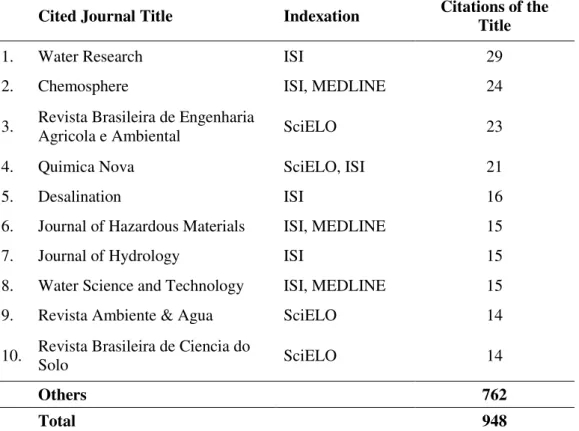
The citations granted by Revista Ambient. Agua are mostly to journals indexed by ISI WoS and SciELO (Table 2).
Table 2. Report of SciELO on granted citations by Revista Ambient. Agua for articles published in 2013 to journals published in all previous years.
Cited Journal Title Indexation Citations of the Title
1. Water Research ISI 29
2. Chemosphere ISI, MEDLINE 24
3. Revista Brasileira de Engenharia
Agricola e Ambiental SciELO 23
4. Quimica Nova SciELO, ISI 21
5. Desalination ISI 16
6. Journal of Hazardous Materials ISI, MEDLINE 15
7. Journal of Hydrology ISI 15
8. Water Science and Technology ISI, MEDLINE 15
9. Revista Ambiente & Agua SciELO 14
10. Revista Brasileira de Ciencia do Solo SciELO 14
Others 762
Total 948
Source: adapted from SciELO metrics at:
http://statbiblio.scielo.org//stat_biblio/index.php?state=12&lang=en&country=scl&ng=b&issn=
1980-993X&CITING%5B%5D=1980-993X&YNG%5B%5D=2013&YED%5B%5D=all&COUNT_SCI%5B%5D=10
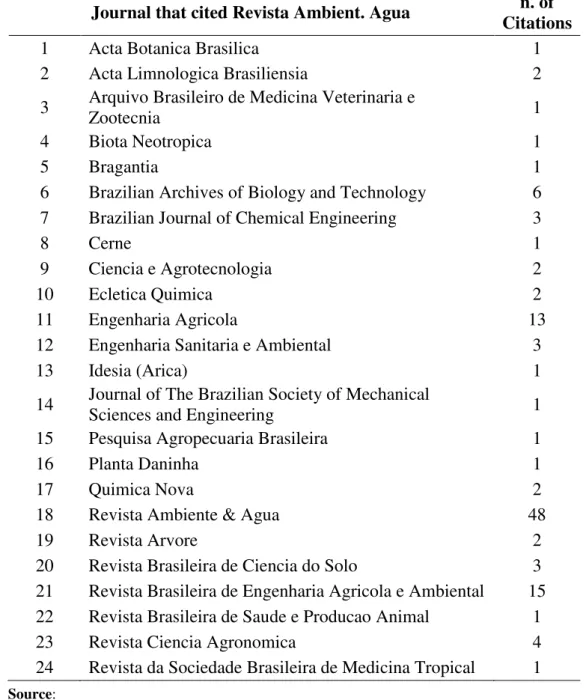
Table 3 shows the journals that cited articles published by Revista Ambient. Agua. The
“Revista Brasileira de Engenharia Agricola e Ambiental” and the “Engenharia Agricola”
journals were the journals most frequently citing our journal, excluding self-citations, followed by the Brazilian Archives of Biology and Technology. This fact to some extent indicates the journal’s focus towards Environment, Engineering and Biology.
Rev. Ambient. Águavol. 9 n. 4 Taubaté – Oct. / Dec. 2014
Table 3. Citations received by articles published in Revista Ambient. Agua from 2007 to 2013 from all journals.
Journal that cited Revista Ambient. Agua Citations n. of
1 Acta Botanica Brasilica 1
2 Acta Limnologica Brasiliensia 2
3 Arquivo Brasileiro de Medicina Veterinaria e Zootecnia 1
4 Biota Neotropica 1
5 Bragantia 1
6 Brazilian Archives of Biology and Technology 6 7 Brazilian Journal of Chemical Engineering 3
8 Cerne 1
9 Ciencia e Agrotecnologia 2
10 Ecletica Quimica 2
11 Engenharia Agricola 13
12 Engenharia Sanitaria e Ambiental 3
13 Idesia (Arica) 1
14 Journal of The Brazilian Society of Mechanical
Sciences and Engineering 1
15 Pesquisa Agropecuaria Brasileira 1
16 Planta Daninha 1
17 Quimica Nova 2
18 Revista Ambiente & Agua 48
19 Revista Arvore 2
20 Revista Brasileira de Ciencia do Solo 3
21 Revista Brasileira de Engenharia Agricola e Ambiental 15 22 Revista Brasileira de Saude e Producao Animal 1
23 Revista Ciencia Agronomica 4
24 Revista da Sociedade Brasileira de Medicina Tropical 1 Source:
http://statbiblio.scielo.org//stat_biblio/index.php?no=09.xml&state=09&lang=en&issn=1980-993X.
For 2015, SciELO Brasil has established new criteria for indexations, emphasizing actions of professionalization, internationalization and funding sustainability of journals. These actions will certainly improve the performance of the journals in the collection (Parker, 2014). A detailed description of the new SciELO criteria can be found in SciELO (2014).
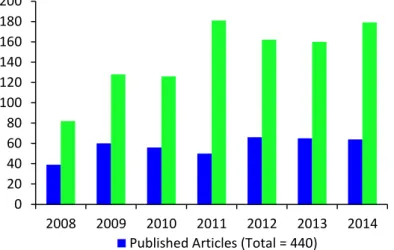
Statistics of the journal from the OJS system used to manage the editorial process indicate that the number of submissions is increasing (Figure 1) and that the number of articles published each year has stabilized at 60. The rejection rate is therefore increasing (Figure 2), allowing a better selection of manuscripts to be published.
http://www.redalyc.org/revista.oa?id=928. However, we do not currently have access to the metrics of these sites.
One interesting feature of Ambiente & Agua journal is the short time required to process a submission while still maintaining the quality of peer review. As shown in Figure 3, this time is short compared with most other Brazilian journals of similar thematic scope. These times are averages; and can be found on the first page of all published articles, the date of submission and the date of acceptance. This can sometimes be as short as one month. This figure shows that publication time follows closely the evaluation time. In fact, the correlation between the time of evaluation and the time to publication is very high, with R2 = 0.91 (Figure 4). Therefore, it is clear that the peer reviewers are doing a thorough and prompt analysis. As in every final yearly issue, we include a list of the peer reviewers that evaluated manuscripts for that particular year. In 2014, as of the time of this writing, a total of 200 reviewers had evaluated at least one manuscript. Some had evaluated several submissions. Of these 200 reviewers, 142 have joined the journal this year, demonstrating the journal’s
increasing momentum and acceptance. We are greatly indebted to them for their voluntary service and for their excellent, insightful and professional product.
Figure 2. Rejection rate of submissions from 2008 to September 2014.
0 20 40 60 80 100 120 140 160 180 200
2008 2009 2010 2011 2012 2013 2014 Published Articles (Total = 440)
0 10 20 30 40 50 60 70 80
2008 2009 2010 2011 2012 2013 2014
Rejection Rate
Average = 60% Figure 1. Number of submitted manuscripts and published
Rev. Ambient. Águavol. 9 n. 4 Taubaté – Oct. / Dec. 2014
Figure 3. Average times for manuscript evaluation and for submission to
publication of articles processed from 2008 to September 2014.
Figure 4. Relationship between evaluation time and time to publication for
submissions from 2008 to September 2014.
Another interesting aspect of our journal is the low rate of endogeny, as shown in Figure 5. With an overall endogeny lower than 6%, we opened the journal to the worldwide scientific community in the interdisciplinary area of environment and water resources. In fact,
0 50 100 150 200 250
2008 2009 2010 2011 2012 2013 2014
Evaluation Time (in days) Time to Publication (in days)
R² = 0,91
100 120 140 160 180 200 220 240
40 60 80 100 120 140
Ti
m
e
u
p
t
o
Pu
b
li
cation
(
d
ay
)
the journal draws authors from a large geographical area and a diverse institutional background both nationally and internationally.
Figure 5. Endogeny analysis of Ambiente & Agua journal considering the number of articles with first author from the University of Taubaté (in blue) and the total number of published articles (in red). Overall endogeny is 5.6% (372 published articles analyzed).
2. CONCLUSIONS
Ambiente & Agua journal has come a long way in just eight years of continued publication, as the number of collections in which the journal is indexed clearly establishes, especially the SCOPUS and SciELO. It is also significant that the MCTI / CNPq / MEC / CAPES call for bid proposals N. 44/2013 selected the journal in the top one third among the proposals it granted. This was quite rewarding, considering the call’s objective of encouraging the publication of Brazilian scientific journals of high specialization in all areas of knowledge in order to contribute significantly to scientific and technological development and innovation in the country. Our Editorial Committee has recently welcomed new members from several different countries, further increasing the internationalization of the journal. However, several challenges lie ahead as we work to implement the new SciELO Brasil criteria, and to further professionalize and internationalize the journal and to ensure its financial sustainability. The first Impact Factor of the journal is 0.1532 on a two-year basis. While this is a point to be improved upon, we remain confident that we will not only meet, but exceed our goals, thanks largely to the quality and impact of individual articles.
3. REFERENCES
PARKER, A. L. SciELO Citation Index no Web of Science. SciELO em Perspectiva, 28 Feb. 2014a. Available from: http://blog.scielo.org/blog/2014/02/28/scielo-citation-index-no-web-of-science/. Access in: 13 Oct. 2014.
PARKER, A. L. Reunião anual do SciELO sinaliza nova etapa do programa. SciELO em Perspectiva, 03 Oct. 2014b. Available from: http://blog.scielo.org/blog/2014/10/03/ reuniao-anual-do-scielo-sinaliza-nova-etapa-do-programa/. Access in: 13 Oct. 2014.
0 5 10 15 20 25
Rev. Ambient. Águavol. 9 n. 4 Taubaté – Oct. / Dec. 2014