ISSN 0101-2061 Food Science and Technology
DI:
D http://dx.doi.org/10.1590/1678-457X.35516
1 Introduction
Nowadays, it is common that consumers choose healthy food products, which will benefit their diet by meeting nutritional demands, because a healthy diet is based on fulfilling the nutritional body´s needs in a balanced way (Grunert, 2002).
The demand for diet and light food products has been increasing; consequently, the use of fruits as ingredients has also improved, because they allow getting products with sensory qualities similar to the standard ones. Therefore, canned fruits in low-sucrose or no sucrose seem to be arising in food market (Campos & Cândido, 1995; Rorato et al., 2006).
Fruits in syrup have become an important alternative in fruit production and consumption by providing flavour, colour and good texture; avoiding waste; and fulfilling a current niche market (Caetano et al., 2015). This product is prepared by adding concentrated solution of sucrose syrup on fruit at high temperature, or simultaneously heat and mass transfer during cooking (Sato et al., 2005).
Traditional canned fruits are widely found in food markets; being characterized by high concentration of sucrose. However, in diet products, sucrose is replaced by low-calorie sweeteners, which attracts more consumers’ interest (Abreu et al, 2008; Lottenberg, 2008).
However, processing standard and diet canned fruits carry some challenges, such as preserving its original integrity; promoting longer shelf-life; and making them more attractive to palates.
Moreover, some positive and negative changes can occur during the process, such as destruction of the inhibitors; desirable complexes formation between food components and metal ions; nutrient losses; and changes in sensory properties, i.e. colour, flavour, aroma and texture (Barbosa et al, 2016; Correia et al., 2008).
With regards to food production, quality assurance procedures aimed to detect and solve any faults arising in manufacturing process, ensuring microbiological safety and quality food (Evangelista, 2008).
Thus, the current study aimed to evaluate the physicochemical, microbiological and sensory quality of standard and diet canned fig in syrup, as well as verify their storage stability.
2 Materials and methods
Green figs were used for canning, which is ideal for cooking, and purchased from producers of Valinhos Agricultural Association, Sao Paulo State. Lowçucar® Food company provided all the following sweeteners: sodium cyclamate, sucralose and sodium saccharin. Sucrose was purchased from local shops in Botucatu, São Paulo, Brazil. Two treatments were performed, being one with standard sucrose syrup (T1) and the other with a blend of sweeteners (T2).
Green figs were transported to the Nutrition and Dietetics’ Laboratory of Botucatu Biosciences Institute, UNESP. Then, discarded all the branches, leaves, stems, damaged and not developed fruit,
Storage stability of standard and diet figs canned in syrup
Priscilla Kárim CAETAND1*, Flávia Maria Vasques FARINAZZI-MACHADD2,Flávia Aparecida de Carvalho Mariano NASSER1, Karina Aparecida FURLANETD1, Rogério Lopes VIEITES1
Received 16 Dec., 2016 Accepted 06 June, 2017
1 Horticulture Department, Faculty of Agronomic Sciences of Botucatu, Universidade Estadual Paulista “Júlio de Mesquita Filho” – UNESP, Botucatu, SP, Brazil 2 Food Technology, Faculdade de Tecnologia – FATEC, Marília, SP, Brazil
*Corresponding author: [email protected] Abstract
The current study aimed to evaluate the physicochemical, microbiological and sensory quality of traditional and diet figs canned in syrup, as well as verify their storage stability. Therefore, it was used green figs from the cultivar Roxo de Valinhos. Two treatments were held: standard sucrose syrup and sweetener blends: sodium cyclamate, sucralose and sodium saccharin. The syrups were previously prepared; being 25 °Brix for sucrose syrup; and by dividing the quantity of sucrose potency (100) to the blend of sweeteners potency (125) for sweetener blends. The products were stored at room temperature for 180 days and evaluated once a month through pH, soluble solids, titratable acidity, texture, vacuum and sensory evaluation (i.e. affective test); except for the commercial sterility test that was conducted at 0 to 180 days. Both canned figs in syrup showed no significant difference for pH, titratable acidity, soluble solids, vacuum and texture; therefore, both were considered commercially sterile and kept their sensory characteristics throughout storage.
Keywords:Ficus carica L; sweeteners; compote; sensory analysis; shelf life.
visibly attacked by pests and unwanted ripe fruits. Afterwards, a water immersion occurred in stainless steel tanks for twelve hours at room temperature (25 °C).
All the water was drained out after 24 hours. Then, figs were cleaned with sodium hypochlorite solution at 200 mg L-1 (Andrade, 2008). Afterwards, figs were rinsed in tap water to remove both chlorine residues and fig latex; and air dried. With regards to the cutting process, it consisted of removing the stalk at the top and cut crosswise at the bottom.
Regarding to the pre-processing, fruits were placed into stainless steel pot with 10 Litres capacity and cooked until softened (about 20 minutes). Subsequently, they were placed in stainless steel sieves and cooled with running water for 10 minutes, causing a thermal shock. Then, figs were drained in stainless steel sieves for 20 minutes and stored in glass jars (600 ml). Beforehand, syrup was prepared for T1 (25 °Brix) and T2 (sucrose sweetness 100%, thus dividing the amount of sucrose used in T1 by the blend sweeteners potency, which is 125%). In glass jars, figs were fully covered with syrup at 40 °C; sealed with metal lid and placed in water bath for 15 minutes at 90 °C. Cooling was immediately carried out after heating.
All products were stored for the 180-day period at room temperature (25 °C), the following analysis were conducted: physicochemical, microbiological, texture, vacuum and sensory.
Commercial sterility test was performed at 0 and after 180 days of storage, in triplicate. Analyses were performed according to Normative Instruction No. 62 of August 26, 2003; therefore, samples were incubated at 36 ± 1 °C for 10 days and 55 ± 1 °C for 7 days, discrepancies about gas production has been observed in ‘blown pack” spoilage, which causes product deterioration (Stumbo, 1973).
Figs in syrup were evaluated for their physicochemical characteristics at 0, 30, 60, 90, 120, 150 and 180 days of storage. Besides that, soluble solids (°Brix) were determined by using a refractometer; pH by using a potentiometer; and titratable acidity by titration (g of citric acid 100 g-1), according to Brasil (2005).
For measuring the firmness of canned fruits was carried out by penetration tests on the whole fruit using STEVENS (LFRA texture analyzer) with cylindrical probe of stainless steel and pointer TA 9/1000. The fig was placed under the probe and three penetrations were made in the central part of the fig, randomly. The depth of each penetration was 10 mm with a velocity of 2.0 mm sec-1. The firmness was evaluated periodically, every 30 days, and the analyzes were done in triplicate and the result expressed in Newton.
Vacuum levels were determined in inches of mercury (in.-Hg). Prior to the measurement, lids of the glass jars were slightly moistened. Afterwards, vacuum gauge was pressed firmly on the lid by puncturing. Then, reading was done by puncturing needle. Vacuum was measured every 30 days, in triplicate.
Sensory analysis was only performed after approval by the Research Ethics Committee of the Botucatu Medical School (protocol nº 4324-2012), being conducted at Science Center and Food Quality Laboratory (Lafise), Institute of Food Technology (ITAL). Consumer acceptance test was performed with 60 untrained
consumers, whose recruitment was based on their habits and interest in canned fruits in syrup. Analyses were made at 0 and every 30 days until the final period of storage (180 days). A 9-point hedonic scale, i.e.1=dislike extremely, 5=neither liked/or dislike, 9=like extremely (Associação Brasileira de Normas Técnicas, 1998), was used to evaluate flavour, aroma, sweetness, texture and global acceptance.
Samples were coded with three-digit random numbers. Tests were carried out in individual air-conditioned and controlled lighting booths. In randomized order, samples were served monadically (100ml disposable transparent plastic), but consumers could have required more if necessary. Between samples water was offered in order to dissipate any residual flavour.
The results were expressed as means and standard deviation, and subjected to Analysis of Variance, followed by Tukey test. Furthermore, regression testing was performed during storage period.
3 Results and discussions
With regards to the commercial sterility and shelf life, the results of T1 and T2 showed to be suitable for consumption according to the current legislation (Agência Nacional de Vigilância Sanitária, 2001). Both treatments did not show any particular changes; microorganisms’ growth; and physical changes, even when incubated at 36 °C and 55 °C; consequently, the consumption of these canned figs in syrup showed to be suitable during storage.
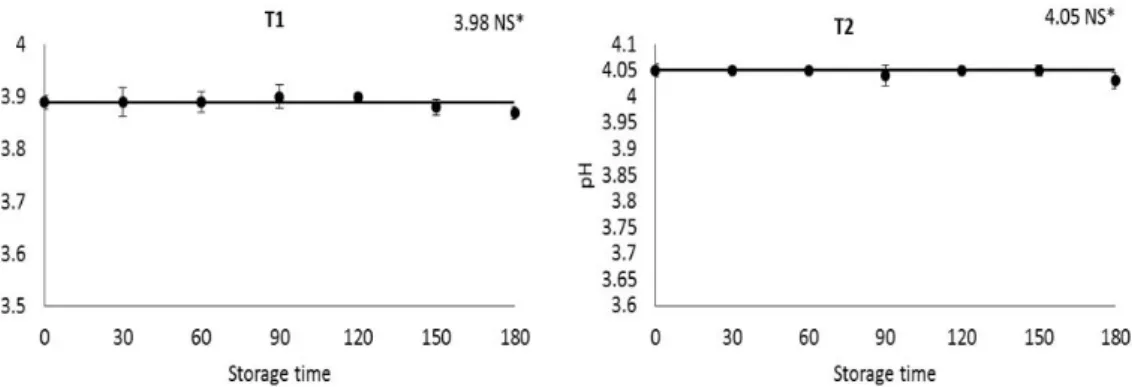
Regarding to the physicochemical traits, there was no significant difference between standard and diet samples during storage (Figure 1). In T1, pH averaged from 3.89 (at time 0) to 3.87 (after the 5th and 6th months). Additionally, pH values in diet canned figs did not differ over the 180 days of storage at room temperature, showing its stablity.
During storage, pH values did not differ statistically in diet creamy fig desserts by adding different blends of sweeteners, according to Martini (2008).
According to RDC/ANVISA Resolution 272, September 22, 2005, the pH of canned fruits in syrup should be below 4.5. Therefore, the current study samples were appropriate for consumption during storage (Agência Nacional de Vigilância Sanitária, 2005).
With regards to the titratable acidity, T1 presented 0.12 g 100 g-1 citric acid at time 0 and at 180 days after (Figure 2). T2 showed some numerical variations at 30 and 180 days after, with no significant difference during storage. The antimicrobial effect of pH prevents either contamination of industrial products or extended shelf life. Additionally, Clostridium botulinum and pathogenic bacteria do not develop at pH ≤ 4.5 (Hoffmann, 2001).
in soluble solids may be due to the syrup transfer or absorption by the fruit.
In diet formulation made with sweeteners, soluble solids values were significantly lower due to the absence of sucrose, i.e. a soluble constituent in these products.
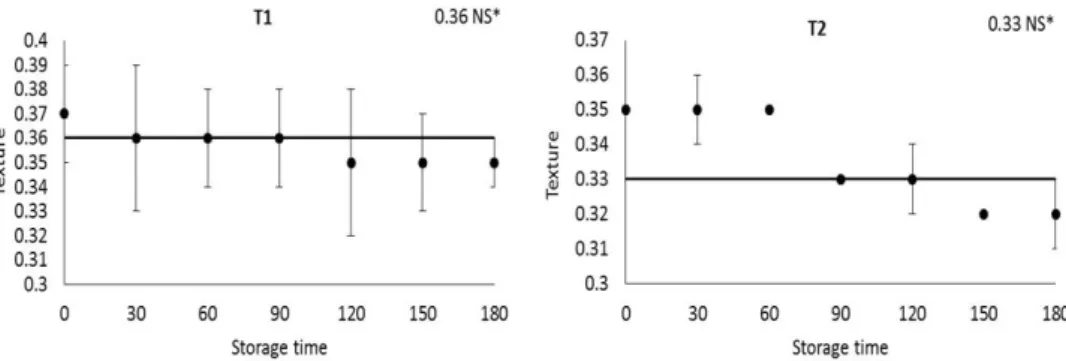
For the figs texture analysis, the results showed no significant change in the forces required to penetrate the pulp tissues in both samples during storage (Figure 4).
During storage, the concentrations of soluble solids between fruit and syrup increased the fruit osmotic pressure and water loss by the highest soluble solids content in the syrup. Additionally, sucrose absorption may occur, but always depending on the structure and permeability of cell membrane, besides the effects caused by fruits processing (Cardoso et al, 2010; Sato et al., 2004). Thus, the exchange of water and sucrose affects fruit texture during storage; however it was not observed in the current study, since soluble solids were not affected by storage.
Figure 1. pH values and standard deviation of compotes due to the storage time, 2016. *NS not significant by F test (T1 – sucrose and T2 - Sodium cyclamate, sucralose and saccharin Sodium).
Figure 2. Values and standard deviation of titratable acidity (g citric acid 100 g-1) of the compotes as a function of storage time, 2016. *NS not significant by F test (T1 – sucrose and T2 - Sodium cyclamate, sucralose and saccharin Sodium).
When observing the vacuum values, both treatments did not show any statistical difference for average during evaluations (Figure 5).
Vendruscolo & Treptow (2000) found lower vacuum levels than those in the current study, while evaluated canned peaches in syrup from Greece (3.0-7.0 in.Hg-1). Moreover, Folegatti et al. (2003) obtained higher values (17.7-19.1 in.Hg-1) for canned umbu in syrup, whose had different soluble solids content.
At the beginning, the influence of filling conditions on product could alter the vacuum value, according to Dantas (1996); consequently, oxidized pigments and microbial growth could occur during storage.
Therefore, the vacuum values (T1 and T2) are within the food safety parameters, according to RDC/ANVISA Resolution 17, November 19, 1999 (Agência Nacional de Vigilância Sanitária, 1999); with vacuum values greater than 10 in.Hg-1. Soler et al. (1995) highlighted that the vacuum values should be from 7 to 15 in.Hg-1, but a value above 10 is considered to be very good.
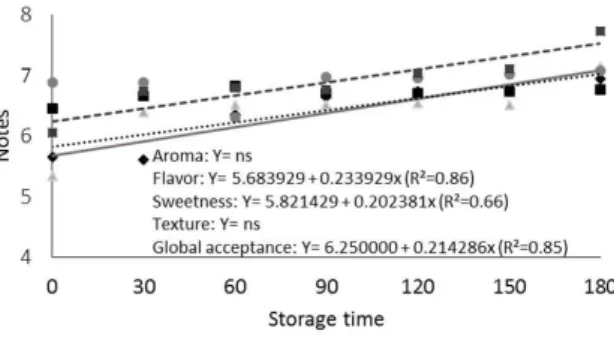
In the sensorial evaluation of conventional fig compote (T1), the results for the aroma score did not present significant difference in the averages showing their stability over the shelf life (Figure 6). Dn the other hand, the diet compotes scores increased from 6.28 (at time 0) to 6.85 (at the end of storage), with an average between “like slightly” and “enjoyed regularly”, as
Figure 4. Values of standard deviation and texture of compotes storage time function (N), 2016. *NS not significant by F test (T1 – sucrose and T2 and - Sodium cyclamate, sucralose and saccharin Sodium).
Figure 5. Values vacuum and standard deviation of compotes due to the storage time, 2016. *NS not significant by F test (T1 – sucrose and T2 - Sodium cyclamate, sucralose and saccharin Sodium).
can be seen in Figure 7. The aroma of food products is one of the major causes of new products acceptance (Paravisini et al., 2014).
Regarding to the taste, T1 showed some differences at different times, being lower at 0 and 30 days, but higher in the other times, with an average of 6.95 at the end of storage. However, the diet version increased throughout storage, i.e. 5.93 (at time 0) and 6.76 (at 180 days), being among “like slightly” and “liked regularly”. The results are consistent with Prati et al. (2002), who found an increase in the scores of flavour for starfruit in syrup of different concentrations of sucrose over 180 days of storage, with an average ranging from 4.53 to 6.82.
Unlike the current research, Silva et al. (2012) evaluated the sensory properties of guava and orange compotes (standard and diet versions), presenting no significant difference in the samples flavour. Altisent et al. (2013) reported that taste is a key element when purchasing a product.
With regards to the sweetness, the scores were 5.61 for T2 at time 0, but 7.20 on the 180th day; therefore, showing a significant difference during storage that reached the highest scores in this analysis. Additionally, the scores were 5.35 for T2 at time 0, but 7.15 on the 180th day, also presenting the highest score given by the untrained consumers.
sweetness over 90 days of storage, according to Miranda et al. (2012); however, most untrained judges enjoyed the samples from the end of the experiment, probably due to the increase in the sweetness by the absorption of sucrose syrup and sweeteners during shelf life.
Whereas the firmness, it was observed that the average values assigned by the untrained consumers varied from 6.88 to 7.08N (T1 sample); and from 6.76 to 7.18N (T2 sample), thus it stood near ‘I liked regularly it’. Although, there were significant differences between the scores given to this attribute by considering the storage period; therefore, the figs firmness was not affected during packaging thereof in the syrups in both samples.
Dn the other hand, Prospero et al. (2015) obtained a statistically significant difference in the firmness of jaracatiá in syrup over 90 storage days, with an average score of 7.26 and 7.85.
Assuming that texture evaluation is also the primary way by which consumers judge the quality of many food products (Pereira et al., 2005). The fact that there were uniformity scores for both treatments has indicated their quality maintenance over storage.
Regarding the global acceptance, scores awarded by the untrained consumers revealed that both canned figs were influenced by storage. Moreover, the sucrose syrup sample (T1)
received the highest scores at 180 days after (7.73), i.e. “enjoyed” on sensory scale. But the diet samples rose from 6.70 (at time 0) to 7.55 (at the end of the evaluation), i.e. “like slightly” and “liked” on sensory scale.
According to the results obtained during shelf-life, canned figs in sucrose syrup (T1) or sweeteners (T2) kept their sensory characteristics over the study period; therefore, preserving quality and acceptability of the judges. Mendonça et al. (2005) evaluated the sensory stability of light canned peaches and then found that four formulations remained stable over 90 days of storage. Chitarra & Chitarra (2005) consider that shelf-life is the period that the product is expected to retain a predetermined quality level under specified conditions of storage, which occurred in the current study.
4 Conclusions
Canned figs in sucrose syrup or sweeteners showed no growth of microorganisms, therefore, ensuring its commercial sterility.
Both canned figs prepared with sucrose syrup (T1) and sweeteners (T2) kept their sensory characteristics during the study period.
In both treatments, canned figs were stable over six months of storage, as shown by the physicochemical, microbiological and sensory results.
Acknowledgements
To Fundação de Amparo à Pesquisa do Estado do São Paulo (FAPESP, Process n. 2012/15206-0), the scholarship award.
References
Abreu, L. M., Cardoso, S. T., Kajishima, S., & Verruma-Bernardi, M. R. (2008). Comparação sensorial de doce de goiaba com sacarose e
adoçantes com baixa caloria. Revista Higiene Alimentar, 22(159), 93-98.
Agência Nacional de Vigilância Sanitária– ANVISA. (1999, November
20). D Regulamento Técnico que fixa o Padrão de Identidade do
palmito em conserva, e dá outras providências (Resolução RDC
nº 17, de 19 de novembro de 1999). Diário Oficial [da] República
Federativa do Brasil.
Agência Nacional de Vigilância Sanitária– ANVISA. (2001, January
10). Aprova o Regulamento Técnico sobre padrões microbiológicos
para alimentos (Resolução RDC nº 12, de 2 de janeiro de 2001).
Diário Oficial [da] República Federativa do Brasil.
Agência Nacional de Vigilância Sanitária– ANVISA. (2005, September
23). Dispõe sobre o “Regulamento Técnico para produtos de vegetais,
produtos de frutas e cogumelos comestíveis” (Resolução da Diretoria
Colegiada - RDC nº 272, de 22 de setembro de 2005). Diário Oficial
[da] República Federativa do Brasil.
Altisent, R., Jaeger, S. R., Johnston, J. W., & Harker, F. R. (2013). Injection of flavor essences into fruit pieces: a new approach for exploring
consumer preferences for novel flavors of apple fruit. Journal of
Sensory Studies, 28(5), 405-413. http://dx.doi.org/10.1111/joss.12066.
Andrade, N. J. (2008). Higiene na indústria de alimentos: avaliação e
controle da adesão e formação de biofilmes bacterianos. São Paulo:
Varela.
Figure 6. Sensory evaluation of conventional fig compote (T1) of the attributes aroma, flavor, sweetness, texture and global acceptance as the storage period. Botucatu-SP, 2015.
acesulfame-K. Food Science and Technology, 25(3), 401-407. http:// dx.doi.org/10.1590/S0101-20612005000300002.
Miranda, T. G., Lafetá, B. D., Dessimoni-Pinto, N. A. V., & Vieira, G. (2012). Evaluation of strawberry in syrup under diferente
concentrations of sugar and packaging. Alim. Nutr., 23(2), 307-315.
Morita, A. S., Gois, V. A., Praça, E. F., Tavares, J. C., Andrade, J. C., Costa, F. B., Barros-Júnior, A. P., & Sousa, A. H. (2005). Crystallization
of melon fruit through slow sugary process. Ciência Rural, 35(3),
705-708. http://dx.doi.org/10.1590/S0103-84782005000300035. Paravisini, L., Septier, C., Moretton, C., Nigay, H., Arvisenet, G., Guichard,
E., & Dacremont, C. (2014). Caramel odor: Contribution of volatile compounds according to their odor qualities to caramel typicality.
Food Research International, 57, 79-88. http://dx.doi.org/10.1016/j.
foodres.2014.01.009.
Pereira, R. B., Bennett, R. J., & Luckman, M. S. (2005). Instrumental and sensory evaluation of textural attributes in cheese analogs: a
correlation study. Journal of Sensory Studies, 20(5), 434-453. http://
dx.doi.org/10.1111/j.1745-459X.2005.00038.x.
Prati, P., Nogueira, J. N., & Dias, C. T. S. (2002). Evaluation of star fruit (averrhoa carambola l.) sweet and sour for the canned processing.
Boletim Centro de Pesquisa de Processamento de Alimentos, 20(2),
221-246. Retrieved from http://revistas.ufpr.br/alimentos/article/ viewFile/1249/1049
Prospero, E. T. P., Silva, P. P. M., Martin, J. G. P., & Spoto, M. H. F. (2015). Processamento tecnológico do “doce de jaracatiá em calda” de frutos de três regiões do estado de São Paulo: avaliação de suas
qualidades físico-químicas e sensoriais. Bioenergia em Revista, 5(2),
18-35. Retrieved from http://www.fatecpiracicaba.edu.br/revista/ index.php/bioenergiaemrevista/article/view/175/pdf_1
Rorato, F., Degáspari, C. H., & Mottin, F. (2006). Evaluation of the knowledg e level on diet and light products of consumers and
customers on a Curitiba supermaket. Revista Visão Acadêmica,
7(1). http://dx.doi.org/10.5380/acd.v7i1.9011.
Sato, A. C. K., Cunha, R. L., & Sanjinez-Argandona, E. J. (2005). Evaluation of colour, texture and mass transfer during guava in
syrup processing. Brazilian Journal of Food Technology, 8(2),
149-156. Retrieved from http://bj.ital.sp.gov.br/artigos/brazilianjournal/ free/p05199.pdf
Sato, A. C. K., Sanjinez-Argandoña, E. J., & Cunha, R. L. (2004). Physical, chemical and sensorial analyses of industrialized guava in
syrup. Food Science and Technology, 24(4), 550-555. http://dx.doi.
org/10.1590/S0101-20612004000400012.
Silva, M. B. L., Macedo, D. C., Pereira, L. P., & Silva, J. C. (2012). Comparison between the sensory acceptance of dietary and conventional jams.
Global Science and Technology, 5(3), 156-161. http://rv.ifgoiano.edu.
br/periodicos/index.php/gst/article/view/315/328
Soler, M. P., Fadini, M. A. S. H., & Dkada, C. E. (1995). Frutas: compotas,
doce em massa, geleias e frutas cristalizadas para micro e pequenas
empresas. Campinas: ITAL.
Stumbo, C. R. (1973). Thermobacteriology in food processing (2nd ed.).
New York: Academic Press.
Vendruscolo, J. L., & Treptow, R. D. (2000). Comparative quality of
canned peaches from greece and from Brazil. Revista Brasileira de
Agrociência, 6(2), 126-130.
Associação Brasileira de Normas Técnicas – ABNT. (1998). NBR 14141:
escalas utilizadas em análise sensorial de alimentos e bebidas. Rio
de Janeiro: ABNT.
Barbosa, C., Alves, M. R., Rocha, S., & Dliveira, M. B. (2016). Modified atmosphere packaging of precooked vegetables: effect on physicochemical
properties and sensory quality. Food Chemistry, 194, 391-398.
PMid:26471571. http://dx.doi.org/10.1016/j.foodchem.2015.07.147. Brasil, Ministério da Saúde, Agência Nacional de Vigilância Sanitária.
(2005). Métodos físico-químicos para análises de alimentos (4th ed.)
Brasília: Ministério da Saúde.
Caetano, P. K., Mendonça, V. Z., Daiuto, E. R., & Vieites, R. L. (2015). Sensory preference of compote and sweet in fig syrup as a function
of the preparation mode. Nativa, 3(3), 191-195. http://dx.doi.
org/10.14583/2318-7670.v03n03a07.
Campos, A. M., & Cândido, L. M. B. (1995). Formulação e avaliação físico-química e reológica de geleias de baixo teor de sólidos solúveis
com diferentes adoçantes e edulcorantes. Ciência e Tecnologia de
Alimentos, 15(3), 268-278.
Cardoso, W. S., Pinheiro, F. A., Perez, R., Patelli, T., & Faria, E. R. (2010). Fruit salad development: from market research to food
technology. Food Science and Technology, 30(2), 454-462. http://
dx.doi.org/10.1590/S0101-20612010000200024.
Chitarra, M. I., & Chitarra, A. B. (2005). Pós-colheita de frutos e hortaliças:
fisiologia e manuseio (2nd ed.). Lavras: UFLA.
Correia, L. F. M., Faraoni, A. S., & Pinheiro-Sant’Ana, H. M. (2008).
Effects of industrial food processing on vitamin stability. Alimentos
e Nutrição, 19(1), 83-95. Retrieved from http://serv-bib.fcfar.unesp.
br/seer/index.php/alimentos/article/viewFile/204/209
Dantas, S. T., Anjos, V. D. A., Segantini, E., & Gatti, J. A. B. (1996).
Avaliação da qualidade de embalagens metálicas: aço e alumínio.
Campinas: ITAL/CETEA.
Evangelista, L. (2008). Tecnologia de alimentos. São Paulo: Atheneu.
Folegatti, M. I. S., Matsuura, F. C. A. U., Cardoso, R. L., Machado, S. S., Rocha, A. S., & Lima, R. (2003). Industrial use of umbu: jelly and
fruit-in-syrup processing. Ciência e Agrotecnologia, 27(6), 1308-1314.
http://dx.doi.org/10.1590/S1413-70542003000600015.
Grunert, K. G. (2002). Current issues in the understanding of consumer
food choise. Denmark: The MAPP Centre. Retrieved from http://
www.farmfoundation.us/news/articlefiles/832-klausgrunerthvp-paper3-13-03_000.pdf
Hoffmann, F. L. (2001). Fatores limitantes à proliferação de microrganismos
em alimentos. Brasil Alimentos, 9(1), 23-30. Retrieved from http://
www.signuseditora.com.br/ba/pdf/09/09%20-%20Higiene.pdf Lottenberg, A. M. P. (2008). Diet composition along the evolution of
type 1 Diabetes Mellitus. Arquivos Brasileiros de Endocrinologia
e Metabologia, 52(2), 250-259. PMid:18438535. http://dx.doi.
org/10.1590/S0004-27302008000200012.
Martini, R. (2008). Formulação de doces cremosos à base de frutas
com baixo teor de sólidos solúveis e diferentes edulcorantes (Master’s
dissertation). Escola Superior de Agricultura “Luiz de Queiroz”, Piracicaba.