Quorum sensing in Enterococcus faecium, Enterococcus faecalis and Bacillus cereus
strains isolated from ricotta processing
Quorum sensing em cepas de Enterococcus faecium, Enterococcus faecalis e Bacillus cereus isoladas do processamento de ricota
Meg da Silva Fernandes1* Luciana Maria Ramires Esper2 Dirce Yorika Kabuki3
Arnaldo Yoshiteru Kuaye1
ISSNe 1678-4596
1Departamento de Tecnologia de Alimentos, Universidade Estadual de Campinas (UNICAMP), Rua Monteiro Lobato, 80, 13083-862, Cidade
Universitária Zeferino Vaz, Campinas, SP, Brasil. E-mail: [email protected]. *Corresponding author. 2Departamento de Bromatologia, Universidade Federal Fluminense (UFF), Santa Rosa, Niteroi, RJ, Brasil. 3Departamento de Ciência de Alimentos, Universidade Estadual de Campinas (UNICAMP), Campinas, SP, Brasil.
ABSTRACT: The quorum sensing phenomenon is a process of intra- and inter-species microbial communication involving the production
and detection of extracellular signaling molecules. The autoinducer AI-2 has been proposed to serve as a ‘universal signal’ for interspecies communication. This study aimed to evaluate the capability of Enterococcus faecium, Enterococcus faecalis, and Bacillus cereus strains isolated from ricotta processing to produce quorum sensing signalling molecules (AI-2). The strains were evaluated for the presence of the luxS gene using the polymerase chain reaction. AI-2 quorum sensing signalling molecules were measured in relative light units (RLUs) using a luminometer. A total of 74% of E. faecium, 91% of E. faecalis, and 95% of B. cereus isolates were positive for luxS gene. In addition, the induced bioluminescence in Vibrio harveyi BB170 was observed in all strains, indicating the presence of the AI-2 autoinducer.
Key words: luxS, AI-2, Vibrio harveyi, bioluminescence, Enterococcus spp., Bacillus cereus.
RESUMO: O fenômeno quorum sensing corresponde a um processo de comunicação intra e interespécies microbianas e é mediado por
sinais químicos extracelulares, denominados moléculas sinalizadoras ou auto indutoras (AI). A molécula AI2 está envolvida na comunicação interespécies, denominada sistema “universal” de comunicação. Este estudo teve como objetivo avaliar a capacidade de Enterococcus faecium, Enterococcus faecalis e Bacillus cereus isolados do processamento de ricota em produzir moléculas sinalizadoras de Quorum sensing (AI-2). Os isolados foram avaliados quanto à presença do gene luxS utilizando a reação em cadeia da polimerase (PCR). As moléculas sinalizadoras (AI-2) foram medidas em unidades relativas de luz (RLU) através de um luminômetro. Um total de 74% dos isolados de E. faecium, 91% de E. faecalis e 95% de B. cereus foram positivos para o gene luxS. Além disso, todos os isolados apresentaram capacidade de induzir o fenômeno de bioluminescência em Vibrio harveyi BB170, indicando a presença de auto indutores AI-2.
Palavras-chave: luxS, AI-2, Vibrio harveyi, bioluminescência, Enterococcus spp., Bacillus cereus.
FOOD TECHNOLOGY
Quorum sensing phenomenon is a process of intra- and inter-species microbial communication and it is measured by extracellular chemical signals known as signal molecules or autoinducers (AI) (READING & SPERANDIO, 2006). These molecules are produced by bacteria during their growth and are released into the environment. The extracellular accumulation of these signals indicates the presence of a relatively dense population, leading the bacteria to initiate a coordinated behavior (GRIFFITHS, 2005). This mechanism allows cells to control many of their functions, including virulence gene expression, plasmid transfer, toxin production, exopolysaccharide production and sporulation, and
biofilm formation. Many bacteria, including various
clinically important pathogens can use a molecule denominated as the autoinducer AI-2 for intercellular communication (BASSLER, 2002).
This study aimed to evaluate the capability
of E. faecium, E. faecalis, and B. cereus strains
isolated from ricotta processing to produce quorum sensing signalling molecules (AI-2). In total, 53
E. faecium isolates (43 from ricotta and 10 from
to the luxS gene. All strains were characterized in our previous studies as pathogenic, because they have virulence genes and are resistant to different antimicrobials. For more details, see FERNANDES et al. (2014) and FERNANDES et al. (2015a).
Table 1 shows the primers (Invitrogen,
Life Technologies, Carlsbad, USA) used for
amplification of the luxS gene. Primers were designed
for luxS gene identification based on the sequences
of E. faecalis ATCC 29212, E. faecium ATCC 51299
and B. cereus ATCC 14579, which are deposited in
GenBank at the National Center for Biotechnology Information (NCBI) in Fasta format (GenBank access number 004722). Genomic DNA from pure cultures was extracted according to the methods described
by FURRER et al. (1991). The PCR mixture (25 μl final volume) contained 0.2μl of Taq polymerase
(Invitrogen, Life Technologies, Carlsbad, USA)
(1 U/μl), 2.5μl of 10X buffer (Invitrogen, Life
Technologies, Carlsbad, USA) (200mM Tris HCl pH
8.0, 500mM KCl), 1.5μl of 50mM MgCl2 (Invitrogen, Life Technologies, Carlsbad, USA), 0.5μl of 10mM
dNTPs (Invitrogen, Life Technologies, Carlsbad,
USA), 1μl (12.5mM) of each primer, 1μl of extracted
DNA and sterile Milli-Q water. Thermocycler parameters were as follows: an initial cycle of 94°C for 3min, 35 cycles of 94°C for 30 sec, 60°C for 1min
and 72°C for 1.5min, a final extension step of 72°C
for 7min and then holding at 4°C. Electrophoresis of the PCR products was performed on 1.5% agarose gels (Invitrogen, Life Technologies, EUA), which were stained with ethidium bromide. Visualization of the PCR products was performed using a UV transilluminator. The E. faecalis ATCC 29212, E.
faecalis ATCC 51299, and B. cereus ATCC 14579
were utilized as positive control. As negative control, sterile Milli-Q water was used.
Biofilms are composed of aggregated cells
and, consequently, they become a suitable environment for the quorum sensing phenomenon (BASSLER,
2002). Therefore, we selected 4 E. faecium strains,
4 E. faecalis strains, and 4 B. cereus strains from the
previously mentioned strains for detection of the AI-2 signalling molecules. These strains are known to be
able of forming biofilm on stainless steel surfaces
in our previous studies (FERNANDES et al., 2014; FERNANDES et al., 2015b).
All assays were performed in triplicate,
according to TAGA & XAVIER (2011). The strains
were activated in Luria-Bertani (LB) broth (Difco, Becton, Dickinson and Company) supplemented with 0.5% glucose with continuous stirring at 175 rpm and 30°C for 24h. Cultures were then diluted 1:100 in LB broth (supplemented with 0.5% glucose) and incubated again for 6 hours (to mid-exponential phase) under the same conditions. Aliquots (1mL) of bacterial culture were transferred to Eppendorf®
tubes and centrifuged (Eppendorf® Centrifuge 5415D, Hamburg, Germany) at 15000 x g for 5min.
The supernatants were filtered through a 0.22-μm
membrane (Millex® GV, Merck Millipore Ltd.,
Co. Cork, Ireland), and the filtered samples were
immediately subjected to the assay. The V. harveyi
BB170 biosensor was activated in Autoinducer Bioassay (AB) medium (SURETTE & BASSLER, 1998) and incubated at 30°C for 16h with continuous stirring at 175 rpm. The culture was then diluted 1:5000 in AB medium. The strains Salmonella
Typhimurium ATCC 14028 and Escherichia coli
O157:H7 were used as positive controls. As negative controls, sterile AB and LB culture media were used
(TAGA & XAVIER, 2011). For detection of AI-2, 10μl of filtered culture supernatant and 90μl of the V.
harveyi BB170 dilution were combined in microwell
plates (Greiner Bio One GmbH, Frickenhausen, Germany). Plates were incubated at 30°C with continuous stirring at 300 rpm, and bioluminescent activity was measured in relative light units (RLU) using a luminometer (FLUOstar Omega Microplate Reader, BMG Labtech, Offenburg, Germany) at
Table 1 - Primer sequences used to detect the luxS gene.
Microorganism Sequence of oligonucleotides (5’ to 3’) Product size (pb) Reference
E. faecalis CACCATATGTTCGCCTTGCT
ATAAAAACCAGTGCGGCAAC 203 Present study
*
E. faecium GAGCACTTGACTGCCGAACT
GCCACATTGTGTTTCATTGC 198 Present study
*
B. cereus CCCTTTCACAGGCAGTTTTC
GATCATACGATTGTAAAGGCACC 450 Present study
*
15min intervals for at least 5 hours. All assays were performed in triplicate, and the results correspond to the induction of bioluminescence as determined by the following equation.
Eq. 1:
Induction of bioluminescence = RLU of the sample/ RLU of negative control.
Possible cell-to-cell communication between the E. faecium, E. faecalis, and B. cereus
was evidenced by the presence of the luxS gene and by a positive bioluminescence reaction. Of the 53
E. faecium isolates, 74% (39) were positive for the
luxS gene. Among them, 68% (29/43) of the ricotta isolates were positive for the luxS gene, while 100% (10/10) of the isolates from the environment were positive for this gene. For E. faecalis, 91% (42/46) of the isolates were positive for the luxS gene. All raw milk (12/12) and cheese whey (1/1) samples contained the luxS gene, and 90% (10/11) of samples from the environment and 86% (19/22) of ricotta samples were positive for this gene. Additionally, 95% (36/38) of the B. cereus isolates were positive for the luxS, while all isolates from ricotta (18/18) and raw (1/1) and pasteurised milk (2/2) were positive
for this gene. Furthermore, 94% (14/15) of isolates from the environment and 50% (1/2) of isolates from cheese whey were also positive for the luxS gene. Therefore, this study proves the existence of the luxS
gene in E. faecium, E. faecalis and B. cereus strains isolated from various locations, ranging from the
raw material to the final product. The majority of B.
cereus, E. faecalis, and E. faecium strains presented
the luxS, demonstrating the possibility of producing
the Al-2 autoinducer (XAVIER & BASSLER,
2003). The autoinducer AI-2 is synthesized by the enzyme luxS, which is involved in the metabolism of S-adenosylmethionine (SAM), converting it into ribosylhomocysteine S-homocysteine (SRH) and 4,5-dihydroxy-2,3-pentanedione (DPD). The DPD is a very unstable compound that reacts with water and cyclizes to form several furanones, one of which is thought to be the precursor of AI-2 (SCHAUDER et al., 2001). Results indicating the presence of the Al-2 quorum sensing signaling molecules by detecting the presence of the luxS gene were corroborated by
confirmation of the capacity to induce the phenomenon
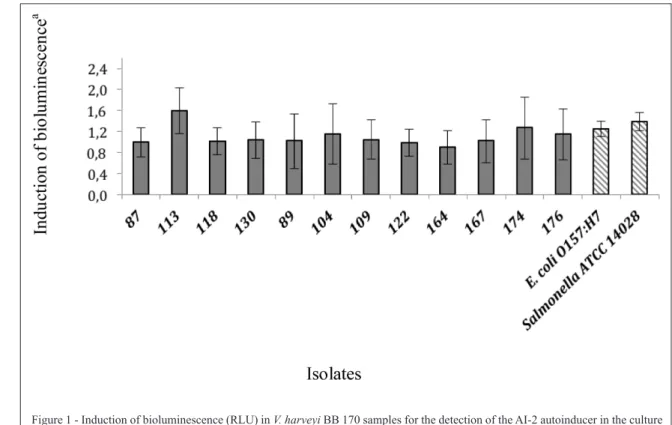
of bioluminescence in V. harveyi BB170. Normalized relative light unit (RLU) levels ranging from 0.89 to 1.59, were obtained. According to figure 1, E.
Figure 1 - Induction of bioluminescence (RLU) in V. harveyi BB 170 samples for the detection of the AI-2 autoinducer in the culture supernatants of E. faecalis (isolates 87, 113, 118, 130), E. faecium (isolates 89, 104, 109, 122) and B. cereus (isolates 164, 167, 174, 176).
faecalis isolate 113 and B. cereus isolate 174 stood out for showing the highest induction activity as compared to the other samples tested. These results
are in accordance with TAGA & XAVIER (2011),
whose reported a bioluminescence induction index of 1.8 after a 6-h culture of S. Typhimurium. When calculating AI-2 activity, the possible presences of AI-2 exogenous molecules (produced by the test strains) and of AI-2 endogenous molecules (produced
by V. harveyi) have been taken into consideration.
Endogenous AI-2 was not a target of this study but could cause an error in interpretation, since after a few hours, an accumulation of endogenous AI-2 can occur due to the increase in the population of
V. harveyi BB 170, inducing bioluminescence once
again. Thus, when calculating AI-2 activity, the light was measured the instant immediately prior to the start of light production by V. harveyi (TAGA
& XAVIER, 2011). In this study, the 5-h time point
was selected to monitor the effects of exogenous
AI-2 (SHAO et al., 2012). Confirmation of the
presence of the luxS gene associated with a positive response for the phenomenon of bioluminescence with V. harveyi BB170 for most isolates tested in this study, corroborates with the hypothesis of the presence of the AI-2 autoinducer and the existence of the phenomenon of quorum sensing. This phenomenon may favor the adaptation and survival
of microorganisms in both food and biofilms. The E.
faecium, E. faecalis and B. cereus strains analyzed
in this study are able of forming biofilm. According
to SHAO et al. (2012) and AUGER et al. (2006),
AI-2 has an important role in biofilm formation by
E. faecalis and B. cereus, respectively. AUGER et
al. (2006) showed that an increase in the level of AI-2 in the medium resulted in a decrease in the
density of the biofilm formed by B. cereus. This result indicated that the presence of AI-2 can also cause the detachment of a large proportion of the
cells in the biofilm. Cells detachment or parts of biofilms may lead to the contamination of the food
or to the colonization of other regions, resulting in
new biofilms (SIMÕES et al., 2010). These facts
indicated that AI-2 may be related to the regulation of important phenotypes in food contamination. Further research should be conducted to promote understanding of the way bacteria communicate. The knowledge of the mechanisms of survival and
interaction of microorganisms in a biofilm and its
relation with the quorum sensing system can help in the development of measures of control and
elimination of these biofilms in the food processing
environment, providing food safety.
ACKNOWLEDGMENTS
This research was supported by the Fundação de Amparo à Pesquisa do Estado de São Paulo (FAPESP) – Process n.2010/10507-7. The authors are grateful to prof. Dr. Geraldo Renato de Paula (UFF) for his aid in designing the primers and to prof. Dr. Maristela da Silva Nascimento (UNICAMP) for donating the culture of B. cereus ATCC 14579.
REFERENCES
AUGER, S.; et al. Autoinducer 2 affects biofilm formation by Bacillus cereus. Applied and Environmental Microbiology, v.72, p.937-941, 2006. Available from: <https://www.ncbi.nlm. nih.gov/pmc/articles/PMC1352198/>. Accessed: dez. 18, 2017. doi: 10.1128/AEM.72.1.937-941.2006.
BASSLER, B.L. Small talk. Cell–to-cell communication in bacteria. Cell, v.109, p.421-424, 2002. Available from: <http:// www.sciencedirect.com/science/article/pii/S0092867402007493>. Accessed: dez. 18, 2017. doi: 10.1016/S0092-8674(02)00749-3.
FERNANDES, M.S.; et al. Enterotoxigenic profile, antimicrobial susceptibility, and biofilm formation of Bacillus cereus isolated from ricotta processing. International Dairy Journal, v.38, p.16-23, 2014. Available from: <https://www.sciencedirect.com/ science/journal/09586946/38/1>. Accessed: dez. 18, 2017. doi: 10.1016/j.idairyj.2014.03.009.
FERNANDES, M.S.; et al. Dissemination of Enterococcus faecalis and Enterococcus faecium in a Ricotta Processing Plant and Evaluation of Pathogenic and Antibiotic Resistance Profiles. Journal of Food
Science, v.80, p.M765-M775, 2015a. Available from: <https://www.
ncbi.nlm.nih.gov/pubmed/25874819>. Accessed: dez. 18, 2017. doi: 10.1111/1750-3841.12824.
FERNANDES, M.S., et al. Biofilms of Enterococcus faecalis and Enterococcus faecium isolated from the processing of ricotta and the control of these pathogens through cleaning and sanitization procedures. International Journal of Food Microbiology, v.200, p.97-103, 2015b. Available from: <https://www.ncbi.nlm.nih.gov/ pubmed/25702883>. Accessed: dez. 18, 2017. doi: 10.1016/j. ijfoodmicro.2015.02.004.
FURRER, B; et al. Detection and identification of Listeria monocytogenes in cooked sausage products and in milk by in vitro amplification of hemolysis gene fragments. Journal of Applied Bacteriology, v.70, p.372-379, 1991. Available from: <http://onlinelibrary.wiley.com/ doi/10.1111/j.1365-2672.1991.tb02951.x/epdf>. Accessed: dez. 19, 2017. doi:10.1111/j.1365-2672.1991.tb02951.x/epdf.
GRIFFITHS, M. Quorum sensing. In: GRIFFITHS, M.
Understanding pathogen behavior: virulence, stress response
and resistance. England: CRC Press, 2005, p.580-640.
READING, N.C.; et al. Quorum sensing: the many languages of bacteria. FEMS Microbiology Letters, v.254, p.1-11, 2006. Available from: <https://academic.oup.com/femsle/ article/254/1/1/640226>. Accessed: dez. 18, 2017. doi: 10.1111/j.1574-6968.2005.00001.x.
SCHAUDER, S.; et al. The LuxS family of bacterial autoinducers: biosynthesis of a novel quorum sensing signal molecule. Molecular
Microbiology, v.41, p.463−476, 2001. Available from: <http://
full>. Accessed: dez. 18, 2017. doi: 10.1046/j.1365-2958.2001.02532.x.
SHAO, C., et al. LuxS-Dependent AI2 Regulates Versatile Functions in Enterococcus faecalis V583. Journal of Proteome
Research, v.11, p.4465−4475, 2012. Available from: <http://pubs.
acs.org/doi/ipdf/10.1021/pr3002244>. Accessed: dez. 18, 2017 doi: 10.1021/pr3002244.
SIMÕES, M.; et al. A review of current and emergent biofilm control strategies. LWT - Food Science and Technology, v.43, p.573-583, 2010. Available from: <https://www.sciencedirect. com/science/journal/00236438/43/4>. Accessed: dez.19, 2017. doi: 10.1016/j.lwt.2009.12.008.
SURETTE, M.G., BASSLER, B.L. Quorum sensing in Escherichia coli and Salmonella Typhimurium. Proceedings
of the National Academy of Sciences of the United States of
America, v.995, p.7046-50, 1998. Available from: <http://www.
pnas.org/content/95/12/7046.full.pdf?sid=9af5ac7f-55b4-4251-8d65-228893d95f92>. Accessed: dez. 19, 2017.
TAGA, M.E.; XAVIER, K.B. Methods for analysis of bacterial autoinducer-2 production. Current Protocols in Microbiology, v.23, p.1-15, 2011. Available from: <http://onlinelibrary.wiley. com/doi/10.1002/9780471729259.mc01c01s23/pdf>. Accessed: dez. 19, 2017. doi: 10.1002/9780471729259.
XAVIER, K.B.; BASSLER, B.L. LuxS quorum sensing: more than just a numbers game. Current Opinion in
Microbiology, v.6, p.191-197, 2003. Available from: