Introduction
People are increasingly concerned about their bodies, whether for reasons related to health, well-being or aesthetics, among others 1,2. Thus, the search for a means to reach the desired body is increasingly evident, with physical exercise being one of the healthiest means to achieve a better perception of body image (BI)3. The reasons for practicing physical exercise are clear 4,5, however little has been shown on to what degree a set of factors may influence a person to be either dissatisfied or not with their own body 6.
Whereas body satisfaction may be termed as a general component of multidimensional body perception, BI address-es a more raddress-estricted view of the body; that is, between actual physical form and desired physical form, which, in turn, is part of body satisfaction 7. Both body satisfaction and dissatisfaction address several elements, such as contentment with the body parts, satisfaction with weight, and the BI perception itself, which is the view and judgment that the person has over his/her own body based on the cultural standards stipulated by society 8. Brazilian researches showed that the biggest problem for BI dissatisfaction is related to weight 1,9. These studies indicated that men desire to be stronger and large, and women desire to be thin. In this perspective, the relationship of BI with the standards imposed by society has increasingly been identified in different countries by the sociocultural theory 10.
This theory shows the media power as a strong influence on people’s way of thinking when referring to the perception of their own body, in addition to parental influence and peer comparison 11,12. Therefore, BI perception is influenced on a daily basis by the constant comparisons and internalizations of these local sociocultural influences 10. Thus, the practice of physical exercise may work as a facilitating agent for greater
body satisfaction 7,13. However, even the BI of those who already practice some physical exercise routinely, such as weight training, which is very common because of its practicality and fast results, tends to be influenced by several other factors existing in the sociocultural context, as well as by the physical and behavioral profile of the person 14.
Therefore, studies have shown that BI dissatisfaction may be related to several variables, such as sex 15, according to which women report being more dissatisfied 16, which leads to unhealthy eating behaviors 17. The BI may also be a determinant for the practice of physical exercise. Considering young people, BI dissatisfaction may lead to insufficient levels of physical exercise 18, and it is related with low socioeconomic conditions, as well as to long periods spent in front of the television 19.
In addition, the practice of physical exercise is related to a lower BI dissatisfaction for both men and women 3. This shows the positive role that physical exercise has over BI perception. However, this practice does not guarantee satisfaction, as Parmer and Desai 14 showed that weight-training practitioners had more BI dissatisfaction than non-practitioners did. Therefore, it is either necessary to investigate how socio-demographic variables (such as sex, marital status, income, occupation, and others), and personal perceptions related to health and physical activity, may or may not influence BI dissatisfaction. This is the gap this research intends to explore.
Therefore, the present study aims to investigate the associ-ation of socio-demographic and health-related variables on the prediction of body dissatisfaction of weight training practitioners. This study also seeks to verify the association of body image with socio-demographic, health and physical activity profiles. Thus, we hypothesized that subjects with better socioeconomic levels and good health conditions would have a better perception of body image.
Original Article (short paper)
Factors associated with body image dissatisfaction
of weight training practitioners
Daniel Vicentini de Oliveira1, José Roberto Andrade do Nascimento Júnior2, Paolo Marcello da Cunha3, Jéssica Fernanda Siqueira4, Érica Cristina Félix da Silva4, Cláudia Regina Cavaglieri1
1Universidade Estadual de Campinas, UNICAMP, Campinas, SP, Brazil; 2Universidade Federal
do Vale do São Francisco, UNIVASF, Petrolina, PE, Brazil; 3Universidade Estadual de Londrina,
UEL, Londrina, PR, Brazil; 4Centro Universitário Metropolitano de Maringá, Maringá, PR, Brazil;
Abstract — Aims: This study aimed at investigating the socio-demographic and health-related variables associated with body image dissatisfaction.Methods: This is a cross-sectional study. 894 (34.04±13.62 years old) weight training practitioners from a medium-large city in the south of Brazil participated in this study. A socio-demographic questionnaire was used along with the Body Shape Questionnaire. The Chi-squared Test and the Binary Logistic Regression (p<0.05) were used to analyze the data. Results: Female subjects who have been practicing weight training for two to five years are more likely to be dissatisfied with their bodies (OR=4.305 [95% CI=2.984-6.213; OR=1.773 [95% CI=1.086-2.895], p<0,05, respectively). Conclusion: There is one group of individuals who are less likely to experience body weight satisfaction. This group of people has three characteristics: 1, 2, and 3.
Methods
Participants
894 individuals (34.04 ± 13.62 years old) of both sexes, who practice weight training in the city of Maringá, Paraná, Brazil, were intentionally selected to participate in this descriptive study. Thus, 15 fitness centers accredited by the Regional Council of Physical Education of Paraná were selected after a regional distribution of the city (four zones), with approximately four fitness centers per region.
Therefore, over-18-year-old subjects of both sexes who were enrolled in the weight training modality with a minimum attendance of two times a week were included in the research. Only the subjects who signed the Free Informed Consent Form (FICF) participated in the study. Inappropriately completed questionnaires were excluded, that is, those with one or more unanswered items.
Instruments
A semi-structured questionnaire was used to characterize the socio-demographic, health, and weight training profiles of the sample. This questionnaire consisted of different questions related to sex (female, male); marital status (with a partner, without a partner); monthly income in minimum wage (MW) related to the year 2016 (up to 1 MW; 1.1 to 2 MW; over 2 MW); education (incomplete elementary education, com-plete elementary education, comcom-plete high school, comcom-plete higher education); smoking (has never smoked, has already smoked, currently smokes); race (Caucasian, black, Asian); occupational situation (active, non-active); student status (yes, no); self-perception of health (bad, regular, good, very good, excellent), self-perception of body (slim; normal; fat); weight training time (less than 6 months, 6 months to 2 years, more than 2 years); weekly frequency of weight training (2, 3, 4, 5 or more times); reason for practicing weight training (medical recommendation, leisure, aesthetic, others); level of physical activity; practicing other exercises (yes, no); body image dissatisfaction.
The body dissatisfaction was assessed by using the Body Shape Questionnaire (BSQ) validated for the Brazilian population by Di Pietro and Silveira20 and which consists of 34 questions in a 6-point Likert scale (from 1 = never to 6 = always). After summing the points of each question, the classification of body dissatisfaction levels was carried out according to: less than 80 points = absence of dissatisfaction; from 80 to 110 points = a slight dissatisfaction; from 110 to 140 points = a moderate dissatisfaction; score above 140 points = severe body dissatisfac -tion. The evaluation was performed by considering the physical fitness and concern expressed during the last four weeks of the data collection. Cronbach’s alpha for the instrument was α = 0.73, indicating strong reliability.
Procedures
Initially, contact with the Regional Council of Physical Education (CREF/PR) was made in order to acquire the list of fitness centers that offered a weight training modality in the city of Maringá, Paraná. Subsequently, 15 fitness centers were drawn. The data collection was carried out in the fitness centers in a private room, either before or after the weight training practice. The individuals who agreed to participate in the study signed the Free Informed Consent Form. Data collection was performed from May to July 2016.
Statistical analysis
The analyses were carried out by using a descriptive and inferential statistics approach. In the descriptive approach, the absolute and relative frequencies were distributed for the categorical variables (sociodemographic, health and physical activity). The numerical variables were expressed through the mean and standard deviation. In the inferential statistics, the Chi-squared test, and, when necessary, Fisher’s exact test, were used to investigate the proportional differences in the prevalence of body dissatisfaction based on the sociodemographic, health, and physical activity variables.
The Binary Logistic Regression (gross and adjusted anal-ysis) was used to evaluate the associations of the sociodemo-graphic, health and physical activity variables (independent variables) with the presence of body dissatisfaction (dependent variable) of the subjects. For both Chi-squared and Logistic Regression, the BSQ was reorganized into two categories: absence of dissatisfaction - those classified as free from body dissatisfaction; and presence of dissatisfaction - those who were classified as having some level of body dissatisfaction (slight, moderate or severe). For modeling the regression anal-ysis, only those variables that showed a level of significance equal to or less than 0.20, considering the association with the presence of body dissatisfaction in the Chi-squared test, were considered. The model fit was verified through the Hosmer-Lemeshow test. The analyses were performed by using SPSS software version 20.0 (p <0.05)
Ethical Considerations
The permanent committee on ethics in research approved this research with human beings under the article number nº 1.694.517 / 2016.
Results
Regarding the health and physical activity profiles of the weight training practitioners (Table 2), it was verified that the majority considered their health as being good/very good (52.7%); in relation to body self-perception the subjects per -ceived themselves as slim (68. 9%); they have been practicing weight training for six months to two years (37.5%) and at a frequency of three to four times a week (54.6%). The majority of them practice weight training due to medical recommendation (45.4%); and they have a very active level of physical activity (55.3%). Absence of body image dissatisfaction was found in 71.1% of the participants, and presence of body image dissat -isfaction was found in 28.9%.
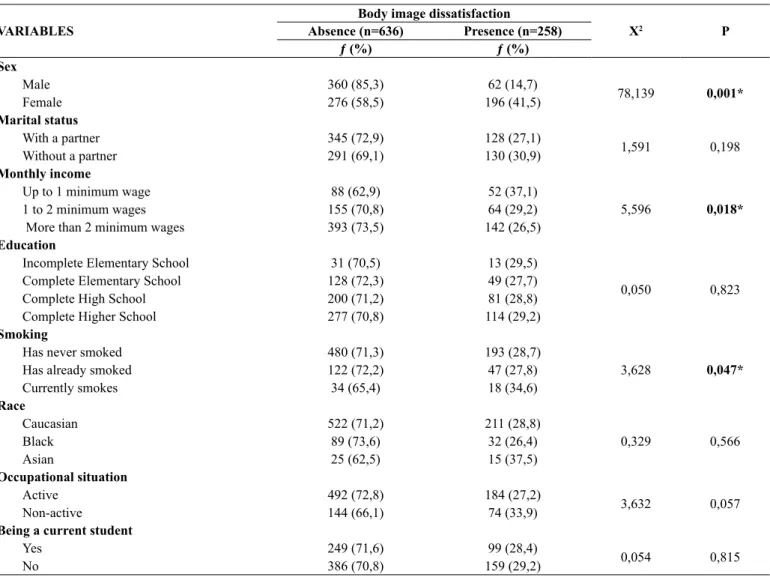
When analyzing the association between body image dis-satisfaction and the socio-demographic variables (Table 3), a significant association with sex (p = 0.001), monthly income (p = 0.018) and smoking (p = 0.047) was verified. It should be highlighted that there is a higher proportion of individuals with absence of body dissatisfaction who are males (85.3%); they have a monthly income of more than two minimum wages (73.5%) and have never smoked (71.3% %).
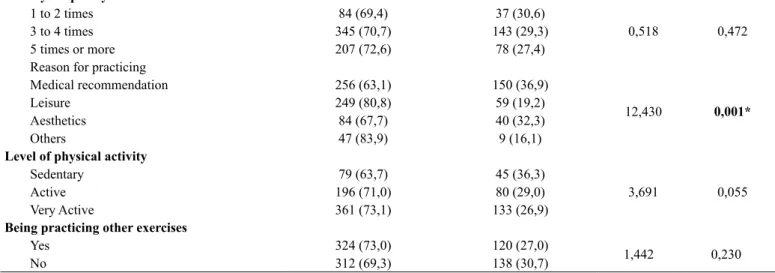
When analyzing the association between body image dissat-isfaction with health and physical activity variables (Table 4), a significant association was found among health self-perception (p = 0.001), body self-perception (p = 0.001), and reason for practicing (p = 0.001). It is noteworthy that there is a higher proportion of individuals with absence of body dissatisfaction who: 1) have very good/excellent health perception (74.3%); 2) perceive themselves as having a normal body (77.9%), and; 3) practice weight training for leisure (80.8%).
For modeling the regression analysis, only the variables that showed a level of significance equal to or less than 0.20 in the as -sociation were considered. Table 5 shows the socio-demographic factors associated with the presence of body image dissatisfaction in weight training practitioners. In the gross analysis, there was a significant association (p <0.05) between the presence of body image dissatisfaction and age, sex, monthly income, occupational situation, health self-perception, body self-perception, reason for practicing and the level of physical activity.
Table 1. Socio-demographic profile of the weight training practi -tioners in Maringá, Paraná, Brasil.
VARIABLES ƒ %
Sex
Male 422 47,2
Female 472 52,8
Marital status
With a partner 473 52,9
Without a partner 421 47,1
Monthly income
Up to 1 minimum wage 140 15,7
1 to 2 minimum wages 219 24,5
More than 2 minimum wages 535 59,8
Education
Incomplete Elementary Education 44 4,8 Complete Elementary Education 177 19,8
Complete High School 281 31,4
Complete Higher Education 392 44,0
Smoking
Has never smoked 673 75,3
Has already smoked 169 18,9
Currently smokes 52 5,8
Race
Caucasian 733 82,0
Black 121 13,5
Asian 40 4,5
Occupational situation
Active 676 75,6
Non-active 218 24,4
Being a current student
Yes 349 39,1
No 545 60,9
Table 2. Profile of health and physical activity of weight training practitioners in Maringá, Paraná, Brasil.
VARIABLES ƒ %
Health self-perception
Bad/Regular 81 9,1
Good 342 38,3
Very good/Excellent 471 52,7
Body self-perception
Slim 193 21,6
Normal 589 65,9
Fat 112 12,5
Weight training time
Less than 6 months 279 31,2
6 months to 2 years 335 37,5
2.1 to 5 years 174 19,5
More than 5 years 106 11,9
Weekly frequency
1 to 2 times 121 13,5
3 to 4 times 488 54,6
5 times or more 285 31,9
Reason for practicing
Medical recommendation 406 45,4
Leisure 308 34,5
Aesthetics 124 13,9
Others 56 6,3
Level of physical activity
Irregularly active 124 13,9
Active 276 30,9
Very Active 494 55,3
Being practicing other exercises
Yes 444 49,7
No 450 50,3
Body image dissatisfaction
Absence 636 71,1
Table 3. Association between body image dissatisfaction and the socio-demographic variables of weight training practitioners in Maringá, Paraná, Brasil.
VARIABLES
Body image dissatisfaction
X2 P
Absence (n=636) Presence (n=258)
ƒ (%) ƒ (%)
Sex
Male 360 (85,3) 62 (14,7)
78,139 0,001*
Female 276 (58,5) 196 (41,5)
Marital status
With a partner 345 (72,9) 128 (27,1)
1,591 0,198
Without a partner 291 (69,1) 130 (30,9)
Monthly income
Up to 1 minimum wage 88 (62,9) 52 (37,1)
5,596 0,018*
1 to 2 minimum wages 155 (70,8) 64 (29,2)
More than 2 minimum wages 393 (73,5) 142 (26,5)
Education
Incomplete Elementary School 31 (70,5) 13 (29,5)
0,050 0,823
Complete Elementary School 128 (72,3) 49 (27,7)
Complete High School 200 (71,2) 81 (28,8)
Complete Higher School 277 (70,8) 114 (29,2)
Smoking
Has never smoked 480 (71,3) 193 (28,7)
3,628 0,047*
Has already smoked 122 (72,2) 47 (27,8)
Currently smokes 34 (65,4) 18 (34,6)
Race
Caucasian 522 (71,2) 211 (28,8)
0,329 0,566
Black 89 (73,6) 32 (26,4)
Asian 25 (62,5) 15 (37,5)
Occupational situation
Active 492 (72,8) 184 (27,2)
3,632 0,057
Non-active 144 (66,1) 74 (33,9)
Being a current student
Yes 249 (71,6) 99 (28,4)
0,054 0,815
No 386 (70,8) 159 (29,2)
*Significant association – p < 0.05: Qui-scared Test.
Table 4. Association between body image dissatisfaction and the variables related to health and physical activity of weight training practitioners in Maringá, Paraná, Brasil.
VARIABLES
Body image dissatisfaction
X2 P
Absence (n=636) Presence (n=258)
ƒ (%) ƒ (%)
Health self-perception
Bad/Regular 42 (51,9) 39 (48,1)
16,990 0,001*
Good 244 (71,3) 98 (28,7)
Very good/Excellent 350 (74,3) 121 (25,7)
Body self-perception
Slim 82 (42,4) 111 (57,5)
100,611 0,001*
Normal 459 (77,9) 130 (22,1)
Fat 95 (84,8) 17 (15,2)
Weight training time
Less than 6 months 191 (68,5) 88 (31,5)
1,420 0,203
6 months to 2 years 244 (72,8) 91 (27,2)
2.1 to 5 years 119 (68,4) 55 (31,6)
Weekly frequency
1 to 2 times 84 (69,4) 37 (30,6)
0,518 0,472
3 to 4 times 345 (70,7) 143 (29,3)
5 times or more 207 (72,6) 78 (27,4)
Reason for practicing
Medical recommendation 256 (63,1) 150 (36,9)
12,430 0,001*
Leisure 249 (80,8) 59 (19,2)
Aesthetics 84 (67,7) 40 (32,3)
Others 47 (83,9) 9 (16,1)
Level of physical activity
Sedentary 79 (63,7) 45 (36,3)
3,691 0,055
Active 196 (71,0) 80 (29,0)
Very Active 361 (73,1) 133 (26,9)
Being practicing other exercises
Yes 324 (73,0) 120 (27,0)
1,442 0,230
No 312 (69,3) 138 (30,7)
*Significant association – p < 0,05: Qui-squared Test.
Table 5. Factors associated with the presence of body image dissatisfaction of weight training practitioners in Maringá, Paraná, Brasil.
Variables OR gross OR adjusted [C.I. 95%]
Age 0,987 [0,976-0,998]* 0,980 [0,966-0,994]*
Sex
Male 1,00 1,00
Female 4,123 [2,977-5,712]* 4,305 [2,984-6,213]*
Marital status
Active 1,00 1,00
Non-active 1,204 [0,901-1,609] 1,129 [0,807-1,580]
Smoking
Has never smoked 1,00 1,00
Has already smoked 0,958 [0,658-1,395] 1,254 [0,804-1,956]
Currently smokes 1,317 [0,726-2,388] 1,281 [0,612-2,681]
Monthly income
Up to 1 minimum wage 1,00 1,00
1 to 2 minimum wages 0,699 [0,446-1,096] 0,766 [0,441-1,330]
More than 2 minimum wages 0,611 [0,413-0,906]* 0,799 [0,491-1,300]
Occupational situation
Active 1,00 1,00
Non-active 1,374 [1,008-1,907]* 1,180 [0,783-1,777]
Health self-perception
Bad/Regular 1,00 1,00
Good 1,162 [0,850-1,588] 0,893 [0,617-1,292]
Very good/Excellent 2,686 [1,658-4,351]* 1,717 [0,945-3,119]
Body self-perception
Slim 1,00 1,00
Normal 0,209 [0,148-0,296] 0,219 [0,145-0,330]*
Fat 0,132 [0,073-0,238]* 0,113 [0,059-0,217]*
Weight training time
Less than 6 months 1,00 1,00
6 months to 2 years 0,809 [0,571-1,147] 1,355 [0,893-2,056]
2.1 to 5 years 1,003 [0,668-1,507] 1,773 [1,086-2,895]*
More than 5 years 0,635 [0,378-1,069] 1,091 [0,590-2,015]
Reason for practicing
Medical recommendation 1,00 1,00
Leisure 0,404 [0,286-0,573]* 0,576 [0,384-0,862]*
Aesthetics 0,813 [0,530-1,246] 1,052 [0,642-1,726]
It should be highlighted that the female subjects and those who have been practicing weight training for 2 to 5 years showed to be, respectively, 4.305 [95% CI = 2.984-6.213] and 1.773 [95% CI = 1.086-2.895] times more likely to be dissatisfied with their body image when compared to the male subjects and those who have been practicing for less than 2 years and for more than 5 years. In addition, it should be emphasized that the individuals who have a normal body self-perception; those who perceive themselves as being fat in relation to slim subjects; the ones who have either an active or very active level of physical activity, and those who practice weight training due to leisure or other reasons (except for aesthetics and medical recommendation) are less likely to have body image dissatisfaction.
Discussion
This study aimed to investigate the association of different factors related to the body dissatisfaction prediction of weight training practitioners. Although strongly discussed, there is lack evidence about this subject in different contexts 16, especially regarding the profile of the practitioners who go to fitness centers and may be pre-disposed to this behavior. The main findings point out those who are practitioners of physical exercise for leisure, physically active or that perceived normal or fat body self-perception had lower chances of being dissatisfied with their body image. These results were opposite to those of fe-male practitioners and of participants who have been practicing exercises for two or five years: these participantswere more likely to be dissatisfied with their body image. In this sense, the findings of this investigation contribute to the indication of peculiarities considering the subjects who go to fitness centers and are dissatisfied with their own bodies, which may both interfere in the practice of exercise in the long term and should therefore differentiate the work to be carried out with certain profiles of people. In general, female and male subjects with at least two years of practice are more likely to be dissatisfied with their BI. On the other hand, those who perceive themselves as having normal or fat bodies, those who are active, and those who practice physical exercise for leisure are less likely to be dissatisfied with their BI.
The present study found that even the female subjects who go to fitness centers are more likely to be dissatisfied with their BI than male practitioners (Table 5), which is in accordance with the great majority of studies, as reported in the meta-analysis by Weinberger, Kersting, Riedel-Heller, Luck-Sikorsk16, who verified that BI dissatisfaction is more evident in women and in other studies 1, 13. This shows that female individuals tend to be dissatisfied with their own body even if assiduously attending a fitness center. This may be evidence of the need for a more
specific type work to be done with women, since these results showed that female subjects are more likely to be dissatisfied with their BI, and it is the role of the health professionals to instruct them to seek a healthy body, but not an ‘ideal’ one.
In addition, it should be highlighted that people who have been practicing exercise for two to five years are also more likely to be dissatisfied with their BI (Table 5). Parmer and Desai 14 found that the subjects who go to fitness centers are more dissatisfied with their BI when compared to those who do not practice exer-cise, which partially meets the result of the present research and indicates that physical exercise may be a factor that leads to the constant search for body perfection. However, this may be new evidence for to improve instruction and/or attendance of these individual, since this is the period when the body stabilizes and does not have as many aesthetic effects at first, but improvement and physiological evolution. Thus, it is extremely relevant that such practitioners are aware of this body evolution process, and intensely face this period, taking into account other types of gains, such as psychological ones, with the decrease of stress, the sensation of well-being, and the pleasure that the practice of physical exercise provides to the organism 21. Therefore, usually the practitioners of weight training always aim to get an even better body, so they are rarely satisfied with their bodies. This explains the results found in this study.
In this perspective, the factors that were significant for the practitioner to have lower chances of being dissatisfied with their bodies are also important. The way people perceive themselves, the reasons for practicing, and even the level of physical activity may be elements that favor the contentment of their BI (Table 5). Therefore, people who have a perception of a normal body, who perform physical exercise for leisure, and who are active or very active are more likely to have a lower chance of being dissatisfied. These results corroborate a large number of studies that evaluated people of different levels of physical activity 13,15, indicating a greater dissatis-faction in people with low levels of physical activity and a sedentary lifestyle.
It is worth mentioning that the present research showed that more than half of the people, regardless their level of physical activity, were satisfied with their BI (Table 4), and leisure is the reason for exercising that may lead to less chances of BI dissat-isfaction. The practice of physical exercises for leisure, pleasure, and well-being are typical reasons that are intrinsic to the person, who perceives a greater importance for himself/herself, and that this practice is a benefit and it is integrated into the person’s life 22. Therefore, some research has shown the benefits of practicing
physical exercise due to intrinsic reasons are that it may ensure better results 23; contribute to the fact that the subjects continue practicing for longer regardless the results 24 ; and result in higher personal satisfaction 25.
Level of physical activity
Sedentary 1,00 1,00
Active 0,717 [0,457-1,123] 0,581 [0,343-0,986]*
Non-active 0,647 [0,426-0,981]* 0,559 [0,344-0,909]*
A relatively new result found in the present study was that people who perceive themselves as being fat seem to be more satisfied with their BI than those who recognize themselves as slim people (Table 4). Similarly, those who perceive themselves as being fat have a lower chance of having BI dissatisfaction when compared to subjects who think they are slim (Table 5). This should be further discussed, since the vast majority of studies point to overweight people as dissatisfied with their bodies 13,14,16, but few studies evaluate people who already per-ceive themselves as being slim. The present study verified that people belonging to this type of profile are more dissatisfied and more likely to show dissatisfaction with their BI. This type of behavior is more evident in subjects who desire greater gains in muscle mass 26, which was not investigated in the present study. It is worth emphasizing that regardless of people’sperceptions of being either fat or slim, they believe themselves to be out of the ‘standard’ and are dissatisfied. Thus, the professionals should work the same way with them.
The research also showed that people who have never smoked had a higher absence of dissatisfaction with their BI (Table 3). This indicates the relevance of having healthy habits in daily practice. In addition to the health benefits the practice of physical exercise provides people, attitudes outside this environment also strongly influence the BI perception. Not smoking is of extreme importance to the person’s own acceptance of his/her body 27, and this is one of the predictive factors of BI dissatisfaction. Therefore, the person who has never smoked or has quit smok-ing becomes more attractive and more satisfied with their BI.
In addition, despite the contributions of these findings, some limitations should be discussed. First, the sample refers to a single city in the southern region of Brazil, which does not allow for generalization of the results to the Brazilian population. However, it is worth emphasizing the large number of participants in this research, whose results may lead to a further discussion on so important a topic. Second, the research only evaluated the perception that the participant had on his/her own body, but not the physical dimensions, such as height, weight, BMI and waist circumference. Therefore, the real physical status of the people is lost, and many of them have a distorted view of reality. Regarding the factors associated to BI, the results are based on cross-sectional data, not allowing causal inferences. Thus, it is suggested that these measures be included for a real comparison between the perception and the physical status of the people. This could be achieved by having more resources and a more robust research design and data analysis, such as the use of longitudinal approaches and structural equation modeling to detect the impact of different factors for BI dissatisfaction. However, this study brings important contributions related to the association among the body perception, physical activity level and reason for practice with the less chance to experience BI dissatisfaction.
Conclusion
It is concluded that, for this sample, a risk profile could be noticed for those who may experience BI dissatisfaction.
Individuals who practice physical exercise for leisure, are active, or perceived themselves as normal or fat have lower chances of being dissatisfied with their body image. This is directly contrary to the profile of female practitioners and of those who have been practicing exercise for two or five years: these groups are more likely to be dissatisfied body image. It is highlighted that healthy life habits favor a greater acceptance of the body itself. As a practical implication of these results, it is possible to consider the differentiated care provided by health professionals and psychologists to people who have an at-risk profile. The professionals can use these results to better understand how exercise practitioners perceive their bodies and thus can give psychological support and thus may prevent those practitioners from doing something that could be harmful to their health. Such studies should be carried out in order to further understanding of the reasons for body dissatisfaction, which may be related to different factors in people’s lives.
References
1. Almeida LLB, Baptista TJR. Análise da imagem corporal de pra-ticantes de atividades físicas em um centro de práticas corporais. Pensar a Prática, 2016;19(3):601-611.
2. Kenny U, Sullivan L, Callaghan M, Molcho M, Kelly C. The relationship between cyberbullying and friendship dynamics on adolescent body dissatisfaction: A cross-sectional study. J Health Psycho, 2017;1:1-11.
3. Melching K, Green M, O’Neal E, Renfroe L. Body Image Dissatisfaction: Responses between Male and Female Exercisers and Non-Exercisers. Int J Exerc Sci. 2016;9(3):248-257. 4. Aaltonen S, Rottensteiner M, Kaprio J, Kujala UM. Motives
for physical activity among active and inactive persons in their mid30s. Scand J Med Sci Sports. 2014;24(4):727-735. 5. Ingledew DK, Markland D, Strömmer ST. Elucidating the roles of
motives and gains in exercise participation. Sport Exerc Perform Psychol. 2014;3(2):116-131.
6. Castro EMRT, Fonsec SCF, Pinto GSM, Mourão-Carvalhal MIM. Factors associated with body image dissatisfaction in Portuguese adolescents: obesity, sports activity and TV watching. Motricidade. 2016;12(2):18-26.
7. Cardoso FL, Zequinão MA, Felizola FLV, Ceola EA., Matos PH. Percepção e satisfação corporal em relação ao exercício físico. Rev. bras. ativ. fís. Saúde. 2011;16(2):95-99.
8. Casquinho J, Cheira J, Roseiro J, Neves L, Martins J, Marques A. Relação entre a perceção de imagem corporal e a prática de atividade física formal e informal. Revista da Sociedade Científica de Pedagogia do Desporto. 2013;1(2):304-311.
9. Fortes LDS, Meireles JFF, Neves CM, Almeida SS, Ferreira MEC. Autoestima, insatisfação corporal e internalização do ideal de magreza influenciam os comportamentos de risco para transtornos alimentares? Rev. Nutri. 2015;28(3):253-264.
11. Dohnt H, Tiggemann M. The contribution of peer and media influ -ences to the development of body satisfaction and self-esteem in young girls: A prospective study. Dev Psychol. 2006;42(5):929-936. 12. Rodgers R, Chabrol H, Paxton SJ. An exploration of the tripartite
influence model of body dissatisfaction and disordered eating among Australian and French college women. Body Image. 2011;8(3):208-215.
13. Bibiloni MM, Coll JL, Pich J, Pons A, Tur JA. Body image satisfaction and weight concerns among a Mediterranean adult population. BMC Public Health. 2017;17(1):39-50.
14. Parmar SD, Desai MD. Body Weight Effect on Body Image among Gym Users and Non-Gym Users. IJIP. 2015;3(1):88-94. 15. Zaccagni L, Masotti S, Donati R, Mazzoni G, Gualdi-Russo E.
Body image and weight perceptions in relation to actual measure-ments by means of a new index and level of physical activity in Italian university students. J Transl Med. 2014;12(1):1-8. 16. Weinberger NA, Kersting A, Riedel-Heller SG, Luck-Sikorsk
C. Body Dissatisfaction in Individuals with Obesity Compared to Normal-Weight Individuals: A Systematic Review and Meta-Analysis. Obesity Facts. 2016;9(6):424-441.
17. Batista A, Neves CM, Filgueiras JF, Ferreira MEC. Dimensão atitudinal da imagem corporal e comportamento alimentar em graduandos de educação física, nutrição e estética da cidade de Juiz De Fora–MG. Revista da Educação Física. 2015;26(1):69-77. 18. Kopcakov J, Veselska ZD, Geckova AM, van Dijk JP, Reijneveld
SA. Is being a boy and feeling fat a barrier for physical activ-ity? The association between body image, gender and physical activity among adolescents. Int J Environ Res Public Health. 2014;11(11):11167-11176.
19. Schneider S, Weiß M, Thiel A, Werner A, Mayer J, Hoffmann H, Diehl K. Body dissatisfaction in female adolescents: extent and correlates. Eur J Pediatr. 2013;172(3):373-384.
20. Di Pietro M, Silveira DXD. Internal validity, dimensionality and performance of the Body Shape Questionnaire in a group of Brazilian college students. Rev. Bras. Psiquiatr. 2009;31(1):21-24. 21. Barroso CS, Peters RJ, Johnson RJ, Kelder SH, Jefferson T. Beliefs and perceived norms concerning body image among African-American and Latino teenagers. J Health Psychol. 2010;15(6):858-870.
22. Deci EL, Ryan RM. Self- Determination Theory. In:Lange PAMVan, Kruglanski AW, Higgins ET editores. Handbook of theories of social psychology. Thousand Oaks:Sage. p.416-437. 23. Thøgersen-Ntoumani C, Shepherd SO, Ntoumanis N,
Wagenmakers AJ, Shaw CS. Intrinsic motivation in two exercise interventions: Associations with fitness and body composition. Health Psychol. 2016;35(2):195-198.
24. Jõesaar, H, Hein V, Hagger MS. Peer influence on young ath -letes’ need satisfaction, intrinsic motivation and persistence in sport: A 12-month prospective study. Psychol Sport Exerc. 2011;12(5):500-508.
25. Jaakkola T, Ntoumanis N, Liukkonen J. Motivational climate, goal orientation, perceived sport ability, and enjoyment within Finnish junior ice hockey players. Scand J Med Sci Sports. 2016;26(1):109-115.
26. Mendonça RMSC, Fernandes HM. Influence of different programs of physical exercise in body composition and psychological di-mensions in women. Motricidade. 2012;8(2):1023-1031. 27. Blow J, Cooper TV. Predictors of body dissatisfaction in a Hispanic
college student sample. Eating behaviors. 2014;15(1):1-4.
Corresponding author
Daniel Vicentini de Oliveira
Universidade Estadual de Campinas, Campinas, São Paulo, Brasil Endereço: Rua Tessália Vieira de Camargo, 126.
Cidade Universitária Zeferino Vaz. CEP: 13083-887. Campinas, SP. Email: [email protected]
Manuscript received on March 27, 2018
Manuscript accepted on May 28, 2018