Original Article (short paper)
Time-course of health-related adaptations in response to combined training
in hypertensive elderly: immune and autonomic modulation interactions
Amanda V. Sardeli
1,2, Arthur F. Gáspari
1, Wellington M. dos Santos
1,
Daisa Fabiele G. Moraes
1, Victor B. Gadelha
1, Lucas do C. Santos
1,
Marina Lívia V. Ferreira
1, Simara Maria de J.Prudêncio
1, Ivan Luiz P. Bonfante
1, Bruno Rodrigues
1,
Cláudia Regina Cavaglieri
1,2, Bo Fernhall
3, Mara Patrícia T. Chacon-Mikahil
1,21
Universidade Estadual de Campinas, UNICAMP, Laboratory of Exercise Physiology, Faculty of Physical
Education, Campinas, SP, Brazil;
2Universidade Estadual de Campinas, UNICAMP, Gerontology
Program, Faculty of Medical Sciences, Campinas, SP, Brazil;
3University of Illinois at Chicago,
Department of Kinesiology and Nutrition, College of Applied Health Sciences, Chicago,USA.
Abstract
––
Aims:
This article is a methodological description of a randomized clinical trial (ClinicalTrials.gov
U1111-1181-4455) aiming to evaluate the time-course (monthly) and associations between blood pressure changes
and other health-related adaptations in response to exercise training in hypertensive elderly.
Methods:
The patients
will be randomized to a control or combined training group interventions (aerobic and resistance exercise), with
monthly assessments in four months. Although, the changes in baseline blood pressure is the primary clinical outcome,
the secondary outcomes include: body composition, cardiorespiratory fitness, muscle strength, arterial stiffness,
baroreceptor sensitivity, cardiovascular autonomic modulation, inflammatory markers, oxidative stress, growth factors,
tissue remodeling markers, metabolic profile, renal function, cognitive function and quality of life.
Results:
To support
the understanding of the blood pressure changes in hypertensive elderly, a time-course of exercise-induced adaptations
including cardiovascular and immunological adaptations are fundamental for research in this field.
Conclusion:
To investigate the time-course of combined training-induced adaptations including all the diverse aspects of health
in hypertensive elderly a well-controlled protocol design is necessary, mainly to clarify the relationship between
cardiovascular and immunological exercise-induced adaptations.
Keywords:
aging; hypertension; exercise; immune system; cardiovascular system.
Introduction
Cardiovascular diseases lead to nearly 17 million deaths per
year worldwide, and 9.4 million of these deaths are attributed
to hypertension
1, 2. The incidence of hypertension increases with
age
3, reaching 63.2% of the elderly population in Brazil
4. The
pathogenesis of hypertension is still unclear, with heterogeneous
and multifactorial etiology, but it is influenced by the kidney
function, cardiovascular autonomic modulation, endothelial
function and the immune system (IS)
5, 6.
Recently, the IS and autonomic nervous systems have
received attention regarding their influence in the genesis of
hypertension. Both the IS and the autonomic nervous system
control and interact with the other physiological systems and
undergo remarkable changes during the aging process, including
developing conditions such as low-grade chronic inflammation
7, 8and cardiac autonomic modulation imbalance
9, 10. Low-grade
chronic inflammation contributes to many chronic diseases
common to the elderly, such as hypertension, atherosclerosis,
diabetes, rheumatoid arthritis and frailty syndrome
11, 12.
Likewise, autonomic modulation imbalance, as a result of
elevated sympathetic modulation
10and reduced parasympathetic
modulation
9, also increases the risk of chronic diseases and
mortality
13, 14. It is noteworthy, the evidence for the interaction
between these systems is the presence of β-adrenergic receptors
in immune system cells, such as T cells, B cells, natural killer
cells, macrophages, and neutrophils, providing the molecular
basis to catecholaminergic signaling
15. In addition, Tracey
16showed that vagal stimulation is a potential inductor of
anti-inflammatory markers increase and/or anti-inflammatory markers
reduction. Moreover, recent evidence has shown the influence of
IS cells and inflammatory cytokines on cardiovascular autonomic
modulation nucleus in the central nervous system contributing
to the development of hypertension
17-19.
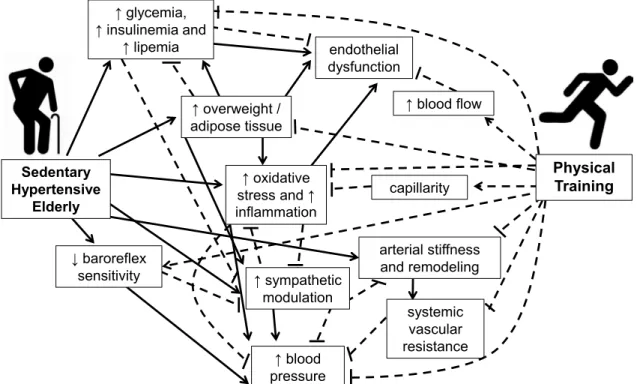
Figure 1 illustrates some factors related to the development
and maintenance of hypertension adding the influence of
physical training on the attenuation on these factors. Both aerobic
training and resistance training promote immune adaptations and
lower BP
20, 21. Regarding immune adaptations, some
exercise-induced anti-inflammatory mechanisms have been proposed and
the most known is the reduction of adipose tissue which in turns
reduces adipose pro-inflammatory cytokines
20. Another mechanism
proposed in the literature is coordinated by the induction of an
anti-inflammatory environment after each exercise session,
associated to the regulation of energy expenditure
20, 22. Furthermore,
both aerobic and resistance training, as well as the combination
of these exercises types, produce significant cardiovascular
benefits, especially in sedentary and populations at increased
cardiovascular risk. These benefits comprise improvements in
the parasympathetic and sympathetic modulation of heart and
vessels
23-25, baroreflex sensitivity
26, central and peripheral arterial
compliance
27-29, endothelial function
30, as well as the specific
reduction in blood pressure
31-33. Moreover, some studies have
shown the effects of physical training on autonomic modulation
in parallel with the reduction of inflammatory markers in healthy
adults and elderly
34, 35.
A significant study investigated the association of immune
and autonomic systems in spontaneously hypertensive rats
18.
They found that aerobic training reduced inflammation in
hypothalamic nuclei of cardiovascular control and increased
baroreflex sensitivity after two weeks, increased parasympathetic
modulation to the heart after 4 weeks, and reduced sympathetic
modulation to the vessels and blood pressure after 8 weeks.
However, hypertensive elderly develop hypertension with the
association of multiple health conditions that might differ in some
aspects from spontaneously hypertensive rats
36. Furthermore,
the time-course of these adaptations in humans is unknown.
This is the first randomized control trial able to describe the
time-course of exercise-induced blood pressure changes in parallel
to IS, autonomic modulation and a comprehensive assessment
of health-related adaptations in elderly humans. Importantly, this
study will investigate the effect of combined training, which shows
promise for blood pressure reduction and it is recommended due
to its essential and complementary benefits for elderly health
6, 37, 38.
endothelial dysfunction
↑ blood flow
↑ blood pressure Sedentary
Hypertensive Elderly
↓ baroreflex sensitivity
↑ overweight / adipose tissue
capillarity ↑ glycemia,
↑ insulinemia and ↑ lipemia
arterial stiffness and remodeling
systemic vascular resistance
Physical
Training
↑ oxidative stress and ↑ inflammation
↑ sympathetic modulation
Figure 1. Interactions between alterations in sedentary hypertensive elderly individuals and the influence of physical training. The arrows represent the stimulus of the hypertensive condition (full line) and exercise (dashed line) on the changes indicated inside the rectangles, while the dashed lines ending with transverse lines represent inhibition for a given change.
Methods
Subjects
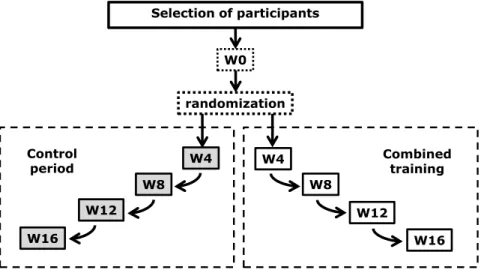
The elderly hypertensives (over 60 years old) will be
randomized to a control group (without intervention) or 4 months
of combined exercise training, according to figure 2. The inclusion
criteria are individuals from both sexes, non-physically active
(frequency of regular physical activity less than two sessions
per week), no participation in any regular training program over
the last 6 months preceding the beginning of the interventions;
stage 1 or 2 hypertension (Stage 1 = systolic blood pressure:
Selection of participants
W0
W8 W4
W16
W12
W8 W4
W16 W12
Combined training Control
period
randomization
Figure 2. Experimental design. W: weeks of assessments; 0, 4, 8, 12 and 16 weeks along control and combined training period.
Figure 3. Flowchart of the participant`s selection.
by The Ethics Committee at University of Campinas (CAEE
54943216.7.0000.5404). The flow chart of the participant’s
selection is detailed in figure 3.
The sample size was calculated using G*Power 3.2.1 software,
based on mean blood pressure (MBP) of a study with adults of
middle age, before and after combined training
31. Using a study
design of an F test (ANOVA two way for repeated measurements),
this analysis provided an
f
effect size of 0.29, with p < 0.05 and
95% power, yielding an n of 14 in each group. The effect size of
combined training observed in a previous study of our group
40of the secondary biomarker endpoints (glycemia, insulinemia,
fat percentage, the interval between R waves, TNF-α, PCR,
leptin, and adiponectin) were also calculated, resulting in less
than the 28 individuals.
Experimental design
The participants of the present randomized clinical trial
will be evaluated at baseline (W0), after 4 weeks (W4), after 8
weeks (W8), after 12 weeks (W12) and after 16 weeks (W16)
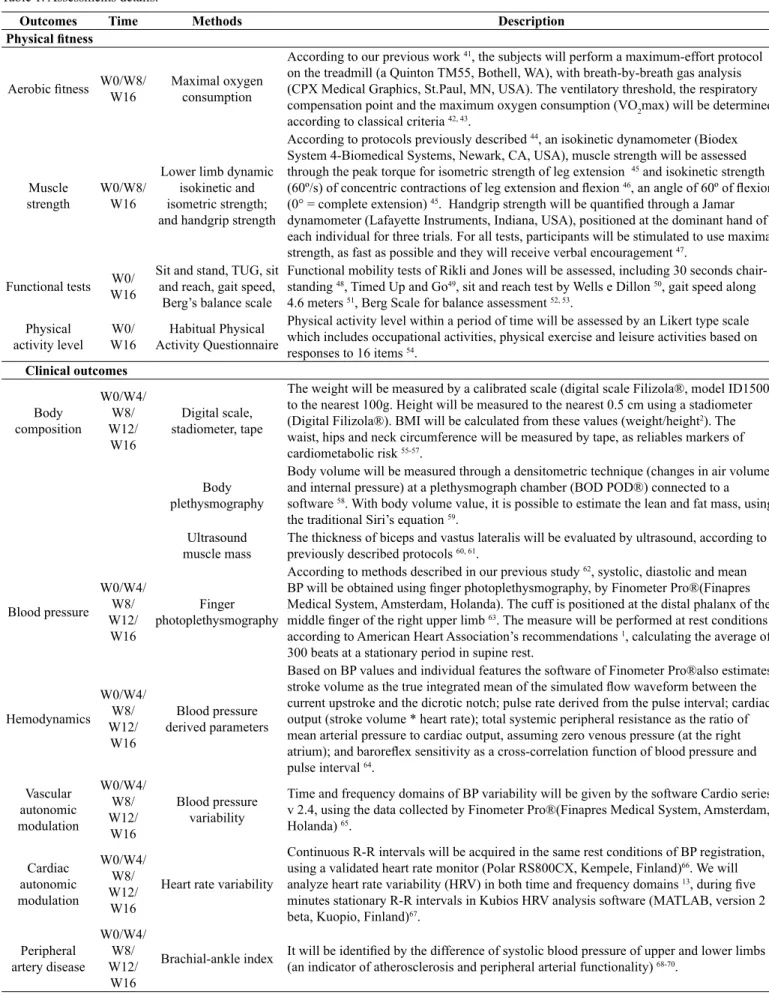
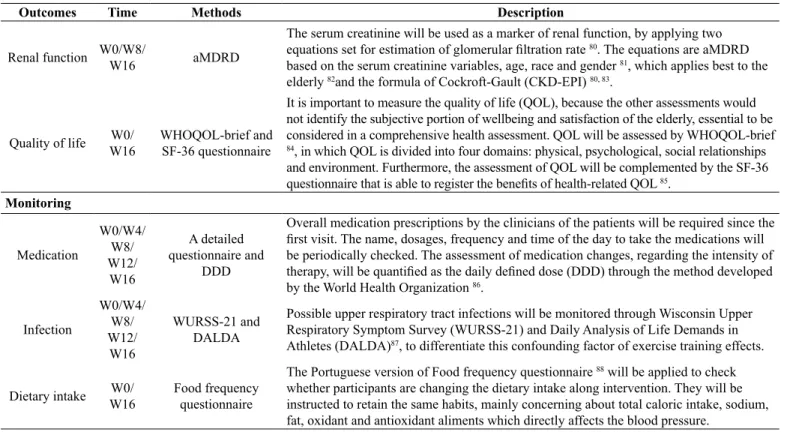
of control or training intervention as described in Table 1.
Table 1. Assessments details.
Outcomes Time Methods Description
Physical fitness
Aerobic fitness W0/W8/W16 Maximal oxygen consumption
According to our previous work 41, the subjects will perform a maximum-effort protocol
on the treadmill (a Quinton TM55, Bothell, WA), with breath-by-breath gas analysis (CPX Medical Graphics, St.Paul, MN, USA). The ventilatory threshold, the respiratory compensation point and the maximum oxygen consumption (VO2max) will be determined according to classical criteria 42, 43.
Muscle strength
W0/W8/ W16
Lower limb dynamic isokinetic and isometric strength; and handgrip strength
According to protocols previously described 44, an isokinetic dynamometer (Biodex
System 4-Biomedical Systems, Newark, CA, USA), muscle strength will be assessed through the peak torque for isometric strength of leg extension 45 and isokinetic strength
(60º/s) of concentric contractions of leg extension and flexion 46, an angle of 60º of flexion
(0° = complete extension) 45. Handgrip strength will be quantified through a Jamar
dynamometer (Lafayette Instruments, Indiana, USA), positioned at the dominant hand of each individual for three trials. For all tests, participants will be stimulated to use maximal strength, as fast as possible and they will receive verbal encouragement 47.
Functional tests W0/ W16
Sit and stand, TUG, sit and reach, gait speed,
Berg’s balance scale
Functional mobility tests of Rikli and Jones will be assessed, including 30 seconds chair-standing 48, Timed Up and Go49, sit and reach test by Wells e Dillon 50, gait speed along
4.6 meters 51, Berg Scale for balance assessment 52, 53.
Physical activity level
W0/ W16
Habitual Physical Activity Questionnaire
Physical activity level within a period of time will be assessed by an Likert type scale which includes occupational activities, physical exercise and leisure activities based on responses to 16 items 54.
Clinical outcomes
Body composition
W0/W4/ W8/ W12/
W16
Digital scale, stadiometer, tape
The weight will be measured by a calibrated scale (digital scale Filizola®, model ID1500) to the nearest 100g. Height will be measured to the nearest 0.5 cm using a stadiometer (Digital Filizola®). BMI will be calculated from these values (weight/height2). The
waist, hips and neck circumference will be measured by tape, as reliables markers of cardiometabolic risk 55-57.
Body plethysmography
Body volume will be measured through a densitometric technique (changes in air volumes and internal pressure) at a plethysmograph chamber (BOD POD®) connected to a software 58. With body volume value, it is possible to estimate the lean and fat mass, using
the traditional Siri’s equation 59.
Ultrasound muscle mass
The thickness of biceps and vastus lateralis will be evaluated by ultrasound, according to previously described protocols 60, 61.
Blood pressure
W0/W4/ W8/ W12/
W16
Finger photoplethysmography
According to methods described in our previous study 62, systolic, diastolic and mean
BP will be obtained using finger photoplethysmography, by Finometer Pro®(Finapres Medical System, Amsterdam, Holanda). The cuff is positioned at the distal phalanx of the middle finger of the right upper limb 63. The measure will be performed at rest conditions
according to American Heart Association’s recommendations 1, calculating the average of
300 beats at a stationary period in supine rest.
Hemodynamics
W0/W4/ W8/ W12/
W16
Blood pressure derived parameters
Based on BP values and individual features the software of Finometer Pro®also estimates: stroke volume as the true integrated mean of the simulated flow waveform between the current upstroke and the dicrotic notch; pulse rate derived from the pulse interval; cardiac output (stroke volume * heart rate); total systemic peripheral resistance as the ratio of mean arterial pressure to cardiac output, assuming zero venous pressure (at the right atrium); and baroreflex sensitivity as a cross-correlation function of blood pressure and pulse interval 64.
Vascular autonomic modulation
W0/W4/ W8/ W12/
W16
Blood pressure variability
Time and frequency domains of BP variability will be given by the software Cardio series v 2.4, using the data collected by Finometer Pro®(Finapres Medical System, Amsterdam, Holanda) 65.
Cardiac autonomic modulation
W0/W4/ W8/ W12/
W16
Heart rate variability
Continuous R-R intervals will be acquired in the same rest conditions of BP registration, using a validated heart rate monitor (Polar RS800CX, Kempele, Finland)66. We will
analyze heart rate variability (HRV) in both time and frequency domains 13, during five
minutes stationary R-R intervals in Kubios HRV analysis software (MATLAB, version 2 beta, Kuopio, Finland)67.
Peripheral artery disease
W0/W4/ W8/ W12/
W16
Brachial-ankle index It will be identified by the difference of systolic blood pressure of upper and lower limbs (an indicator of atherosclerosis and peripheral arterial functionality) 68-70.
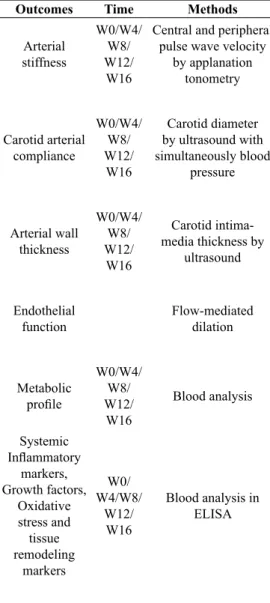
Outcomes Time Methods Description
Arterial stiffness
W0/W4/ W8/ W12/
W16
Central and peripheral pulse wave velocity
by applanation tonometry
Pulse wave velocity is obtained by SphygmoCor® (AtCor Medical) according to guidelines for clinical application of central and peripheral stiffness 71.
Carotid arterial compliance
W0/W4/ W8/ W12/
W16
Carotid diameter by ultrasound with simultaneously blood
pressure
Images of the left carotid common artery diameter 2cm under the carotid bifurcation will be collected by ultrasound (Nanomaxxtm, SonoSite, EUA), acquired with the linear transducer of 10-5MHz, at M mode, where a sequence of pictures for 5 seconds is registered 62. CC is calculated considering the difference between maximal and minimum
diameters along the 5 seconds pulse, associated with systolic and diastolic BP at the same moment, gauged by a digital sphygmomanometer (Omron HEM-7113, Omron Corp, Kyoto, Japan) 62, according to the equation CC = ([Sd - Dd]/Dd)/(SBP - DBP)62, 72.
Arterial wall thickness
W0/W4/ W8/ W12/
W16
Carotid intima-media thickness by
ultrasound
It will be registered by ultrasound image (Nanomaxxtm, SonoSite, EUA) acquired with the linear transducer of 10-5MHz, from left carotid common artery 2 cm under the carotid bifurcation and analyzed through the software image J (U.S. National Institutes of Health, Bethesda, Maryland, USA) as described elsewhere 73.
Endothelial function
Flow-mediated dilation
The diameter of brachial artery will be measured through ultrasound (Nanomaxxtm, SonoSite, EUA), acquired with the linear transducer of 10-5MHz, before and after 5 minutes of occlusion in the forearm (250mmHg) 74. The diameter will be recorded for 30
seconds in the baseline condition (supine rest) and after 30, 60 and 90 minutes of vascular occlusion.
Metabolic profile
W0/W4/ W8/ W12/
W16
Blood analysis
The blood samples will be obtained from the antecubital vein and collected into serum, heparin- and EDTA-plasma Vacuette® tubes, after a minimum of 12h fasting. Blood sample will be centrifugated at 3000rpm for 10min, separated in aliquots and stored at -80°C. Glucose, total cholesterol, HDL, LDL, VLDL and triglycerides will be analyzed. Systemic
Inflammatory markers, Growth factors,
Oxidative stress and tissue remodeling
markers
W0/ W4/W8/
W12/ W16
Blood analysis in ELISA
The same samples mentioned above will be used to analysis of IL-6, IL-10, TNF-α, CRP, VEGF, BDNF, Antioxidant assay kit,TBARS, MMP-9, and TIMP-1 will be analysed in duplicate by immunoenzymatic method ELISA (enzyme-linked immunosorbent assay, ELISA, ELX 800 Biotek, USA model) by means of ultrasensitive kits (R & D Systems) using a specific kit for each of the markers.
Cognitive functions
W0 / W16
Stroop test, MMSE, ISLT, and GMLT.
We will apply the computerized version of the Stroop test: TESTINPACS®75. The
participants use the forefingers of both hands to press one of the two options of the keyboard key ([←] or [→]). In step 1, the participants have to choose the right name for the color displayed on the screen. In step 2, participants have to choose the right name for the color writing displayed on the screen, with the letters colored always in white. In step 3, participants have to choose the right name for the color of the word letters instead the name of the color written. After receiving the instructions for the test, they will perform one familiarization trial. The software registers the number of hits and the time to answer in milliseconds. We will also apply the MMSE for sample characterization 76
which evaluates the temporal orientation, spatial orientation, immediate memory, memory recall, attention, calculation, and language 77. It consists of a questionnaire, in which
the evaluator questions and proposes the tasks evaluated, adding points to successes. Learning, executive function and memory will be evaluated by ISLT and GMLT and later recall using the software Costate (Melbourn, VIC, Australia)78. ISLT consists in a list of
12 words (e.g. Eggs, Orange, Toothpaste, etc.) verbally presented. The evaluator counts the cumulative number of items recorded by the participant, along three trials. GMLT evaluates the ability of the participant to learning the pathway along the 10x10 grid through the total time needed to discover the way, the movements per second, number of legal and illegal trials, according to the rules previous provided to the participant. After the GMLT, the ISLT will be solicited again (later recall) to evaluate memory.
Depression W0/
W16 GDS-15
The GDS-15 is a short version of the original scale which is one of the most frequently used tools for tracking depression in the elderly 79. It is composed by 15 questions easy
to understand that avoid somatic complaints, detecting mood disorders and can be administered by a trained interviewer.
Table 1. Continued
Outcomes Time Methods Description
Renal function W0/W8/
W16 aMDRD
The serum creatinine will be used as a marker of renal function, by applying two equations set for estimation of glomerular filtration rate 80. The equations are aMDRD
based on the serum creatinine variables, age, race and gender 81, which applies best to the
elderly 82and the formula of Cockroft-Gault (CKD-EPI) 80, 83.
Quality of life W0/ W16
WHOQOL-brief and SF-36 questionnaire
It is important to measure the quality of life (QOL), because the other assessments would not identify the subjective portion of wellbeing and satisfaction of the elderly, essential to be considered in a comprehensive health assessment. QOL will be assessed by WHOQOL-brief
84, in which QOL is divided into four domains: physical, psychological, social relationships
and environment. Furthermore, the assessment of QOL will be complemented by the SF-36 questionnaire that is able to register the benefits of health-related QOL 85.
Monitoring
Medication
W0/W4/ W8/ W12/
W16
A detailed questionnaire and
DDD
Overall medication prescriptions by the clinicians of the patients will be required since the first visit. The name, dosages, frequency and time of the day to take the medications will be periodically checked. The assessment of medication changes, regarding the intensity of therapy, will be quantified as the daily defined dose (DDD) through the method developed by the World Health Organization 86.
Infection
W0/W4/ W8/ W12/
W16
WURSS-21 and DALDA
Possible upper respiratory tract infections will be monitored through Wisconsin Upper Respiratory Symptom Survey (WURSS-21) and Daily Analysis of Life Demands in Athletes (DALDA)87, to differentiate this confounding factor of exercise training effects.
Dietary intake W0/ W16
Food frequency questionnaire
The Portuguese version of Food frequency questionnaire 88 will be applied to check
whether participants are changing the dietary intake along intervention. They will be instructed to retain the same habits, mainly concerning about total caloric intake, sodium, fat, oxidant and antioxidant aliments which directly affects the blood pressure.
Note: TUG: Time up and go; MLTPAQ: Minnesota Leisure Time Physical Activity Questionnaire; BMI: Body mass index; BP: Blood pressure; CC: Carotid compliance; SBP: Systolic blood pressure; DBP: Diastolic blood pressure; SD: Systolic diameter of the carotid artery; DD: Diastolic diameter of the carotid artery; HDL: High density lipoprotein; LDL: Low density lipoprotein; VLDL: very low density lipoprotein; IL-6: Interleukin 6; IL-10: Interleukin 10, TNF-α: Tumor necrosis factor alpha; CRP: C-reactive protein; VEGF: Vascular endothelial growth factor; BDNF: Brain-derived neurotrophic factor; TBARS: Thiobarbituric acid reactive substances; MMP-9: Matrix
metalloproteinases 9; TIMP-1: Tissue inhibitor of metalloproteinase 1; ELISA: Enzyme-linked immunosorbent assay; MMSE: Mini mental exam test; ISLT: International Shopping List task; GMLT: Groton Maze Learning Test; GDS-15: Geriatric depression scale; aMDRD: abbreviated modification in diet in renal disease; WHOQOL brief: World health organization quality of life brief questionnaire; SF-36: Short Form Health Survey ; QOL: Quality of life; DDD: daily defined dose; WURSS-21:Wisconsin Upper Respiratory Symptom Survey; DALDA: Daily Analysis of Life Demands in Athletes.
Table 1. Continued
Training Protocol
Participants will be advised to maintain their normal diet and all
their prescribed medications during the 16 weeks of intervention. The
protocol of 16 weeks of combined training was based on exercise
guidelines for hypertensive and elderly
38, 89. It is noteworthy the
purpose of the minimum amount of resistance exercise recommended
in these guidelines and a larger amount of aerobic exercise, due to
the higher effectiveness from aerobic exercise on cardiovascular
adaptations described in the literature
21, 27. The exercise sessions
will be individually supervised. It will consist of seven resistance
exercises for the major muscle groups followed by continuous
walking and/or running twice per week and one additional session
of only aerobic training, according to the prescription described in
table 2. All training sessions will be held in the Integrated Laboratory
of the Faculty of Physical Education, UNICAMP (LabFEF).
Participants in the control group will not receive any treatment;
however, they will monthly visit the research laboratory to make the
same assessments which will be carried out for the training group.
Statistical analysis
Discussion
Combined training by itself is able to reduce systolic and
diastolic blood pressure of hypertensive subjects
90, but due to
the higher effectiveness of aerobic vs. resistance training
91we
proposed a larger amount of aerobic exercise in the present
program. The blood pressure reductions might arise, as a
consequence of improvement in a variety of factors including
sympathovagal balance, arterial function and structure, baroreflex
sensitivity, systemic inflammation and weight control. Thus,
in the next paragraphs, we are going to discuss how each of
these adaptations is expected to develop along exercise training
time-course.
The reduction in circulating blood glucose, advanced
glycation end products (AGEs) and increase in insulin sensitivity
could occur as a result of increased energy substrate utilization
during exercise
92-94and the up-regulation of auxiliary glucose
uptake intracellular mechanisms, independent of insulin, by
active muscles in every training session
95. These changes might
attenuate oxidative stress, vascular tissue damage, and an increase
in nitric oxide biodisponibility
96, 97which added to increase in
endothelial vascular shear stress (increased blood flow during
exercise) would improve endothelial function and vasodilation,
leading in turns to arterial compliance and baroreflex sensitivity
improvements
18, 29, 98. These changes may precede the increase in
parasympathetic modulation and the reduction of sympathetic
modulation to the heart and vessels, respectively
18, 34, 57, 99, 100.
Improvements in cardiovascular autonomic modulation could
also be induced by neuronal protection against potential glucose
neurotoxicity
101.
Body fat reduction is progressive during the training
program due to the increase in energy expenditure during
and after each training session. That is associated with an
increased mitochondrial biogenesis which occurs in skeletal
muscle and other tissues
55, 98, increased metabolic rate
94, 102and fat oxidation
103, 104. The fat reduction, together with the
improvement in glucose uptake, reduced the concentration of
the final advanced glycation end products and proinflammatory
markers, in turns improving insulin sensitivity. Nevertheless, the
training protocol proposed herein may not induce substantial fat
reduction, enough to influence beneficial adaptations through
this pathway.
The overload on muscle fibers induces muscle damage
following each exercise session and may increase the
concentration of inflammation and reactive oxygen species at
the beginning of the training period
105, 106. After several weeks of
exercise training there is an expected reduction of reactive oxygen
species (initially high) and increase in the antioxidant capacity
106, 107, which might also culminate in blood pressure reduction by the
mediation of reduced T cell activation response to angiotensin II,
and vascular endothelial function improvement
108, 109.
The cardiovascular autonomic modulation adaptations
contribute directly to the reduction of heart rate and blood
pressure at rest
18. Cardiovascular autonomic modulation
adaptations may reduce systemic inflammation in different
ways: by increasing parasympathetic modulation and thereby
inhibit TNF-α production by splenic macrophages primarily
16, 110; reducing the secretion of free fatty acids (lipolysis reduction)
by decreasing sympathetic hyperactivity for the adipocytes,
and by stimulating the hypothalamic-pituitary-adrenal axis to
increase the production of glucocorticoids, thereby inhibiting
the production of proinflammatory cytokines
106. A reduction in
body fat would further reduce the amount of macrophages M1
and increase macrophages M2 to adipose tissue, which enhances
the regulatory T cell activity and reduces the expression of
toll-like receptors, stimulating reduction of TNF-α production, IL -6
and increasing IL-10 and adiponectin production
20, 40,111. Other
mechanisms that stimulate the pro-inflammatory reduction,
are the signaling cascades triggered by muscular IL-6 every
exercise session, which in turn stimulates monocytes and
macrophages to reduce TNF-α production and increase
IL-10 production, respectively
20. The reduction of body fat with
exercise training and reduced pro-inflammatory markers may
also reduce C-reactive protein production by the liver. Possibly,
these inflammatory changes accentuate or contribute to the
maintenance of the expected blood pressure reduction and reduce
cardiovascular risk by several other means after the training
period
20, 35, 109.
There are also two other important adaptations induced by
aerobic and resistance training for the elderly. First, the increase
in maximum oxygen consumption which is an independent
predictor of mortality
112, may be obtained after at least 8 weeks
training by the increase in arteriovenous oxygen difference and
especially by the increase in cardiac output (by myocardial
Table 2. Combined training program.Type of exercise Intensity Volume Frequency
Resistance exercise leg extension and flexion, leg press, heel lift, bench press, pulley, and abdominal
RPE between 5-6
(in a 10 point scale) 1 set of 10-15 repetitions twice per week Endurance exercise walking/running on treadmill and field 46-63% VO2max. (speed) 50 minutes continuous three times per week Note: RPE: ratio of perceived exertion; VO2max: maximum oxygen consumption.
Results
The results of this study will provide a detailed description
of the chronological sequence, every 4 weeks, of organic
contraction force increase, end-diastolic volume increase and
improvements in autonomic control efficiency)
113. Second, an
increase in muscle mass is important for good health, functional
independence and falls avoidance in age
38, 114, 115. These changes
may occur even at the beginning of the intervention
61, 103, 116.
Furthermore, we expect improvements in cognitive function,
functional performance, and quality of life
117-119. These
complementary benefits might be related to the cardiovascular
functions improvements, metabolism, strength, aerobic fitness
and also psychological and social effects that emerge from
exercise training intervention
104, 120-123.
In summary, this study will open the way towards the
chased understanding of the relationship between autonomic
and immune system exercise-induced adaptations, especially
regarding their effects on blood pressure. Furthermore, the
follow up of diverse organic adaptations along exercise training
stimulus will contribute to the understanding of the complex
relationship among organic structures and functions, describing
a comprehensive time-course analysis of elderly healthy and
quality of life.
References
1. Perloff D, Grim C, Flack J, Frohlich ED, Hill M, McDonald M, et al. Human blood pressure determination by sphygmomanometry. Circulation. 1993;88(5 Pt 1):2460-70.
2. WHO. Global Brief on Hypertension: Silent killer, global public health crisis. Switzerland: 2013.
3. Writing Group M, Mozaffarian D, Benjamin EJ, Go AS, Arnett DK, Blaha MJ, et al. Heart Disease and Stroke Statistics-2016 Update: A Report From the American Heart Association. Circulation. 2016;133(4):e38-360.
4. Secretaria de Vigilância em Saúde (SVS): Vigilância de fatores de risco e proteção para doenças crônicas por inquérito telefônico (VIGITEL) [Internet]. 2010. Available from: http://tabnet.datasus. gov.br/cgi/tabnet.exe?idb2010/g02.def.
5. McCarthy CG, Goulopoulou S, Wenceslau CF, Spitler K, Matsumoto T, Webb RC. Toll-like receptors and damage-asso-ciated molecular patterns: novel links between inflammation and hypertension. American journal of physiology Heart and circulatory physiology. 2014;306(2):H184-96.
6. Brook RD, Appel LJ, Rubenfire M, Ogedegbe G, Bisognano JD, Elliott WJ, et al. Beyond medications and diet: alterna-tive approaches to lowering blood pressure: a scientific state -ment from the american heart association. Hypertension. 2013;61(6):1360-83.
7. Bruunsgaard H, Pedersen BK. Age-related inflammatory cytokines and disease. Immunol Allergy Clin North Am. 2003;23(1):15-39. 8. Franceschi C, Capri M, Monti D, Giunta S, Olivieri F, Sevini F, et al. Inflammaging and anti-inflammaging: a systemic perspective on aging and longevity emerged from studies in humans. Mech Ageing Dev. 2007;128(1):92-105.
9. Migliaro ER, Contreras P, Bech S, Etxagibel A, Castro M, Ricca R, et al. Relative influence of age, resting heart rate and sedentary life style in short-term analysis of heart rate variability. Braz J Med Biol Res. 2001;34(4):493-500.
10. Wichi RB, De Angelis K, Jones L, Irigoyen MC. A brief review of chronic exercise intervention to prevent autonomic nervous system changes during the aging process. Clinics (Sao Paulo). 2009;64(3):253-8.
11. Ferrucci L, Penninx BW, Volpato S, Harris TB, Bandeen-Roche K, Balfour J, et al. Change in muscle strength explains accelerated decline of physical function in older women with high interleukin-6 serum levels. J Am Geriatr Soc. 2002;50(12):1947-54.
12. Bruunsgaard H, Andersen-Ranberg K, Hjelmborg J, Pedersen BK, Jeune B. Elevated levels of tumor necrosis factor alpha and mortality in centenarians. Am J Med. 2003;115(4):278-83. 13. TFotESo. Heart rate variability. Standards of measurement,
physio-logical interpretation, and clinical use. Task Force of the European Society of Cardiology and the North American Society of Pacing and Electrophysiology. Eur Heart J. 1996;17(3):354-81. 14. Schwartz PJ. The autonomic Nervous System and Sudden death.
Eur Heart J. 1998;19:72-80.
15. Madden KS, Felten DL. Experimental basis for neural-immune interactions. Physiol Rev. 1995;75(1):77-106.
16. Tracey KJ. The inflammatory reflex. Nature. 2002;420(6917):853-9. 17. Masson GS, Nair AR, Silva Soares PP, Michelini LC, Francis J.
Aerobic training normalizes autonomic dysfunction, HMGB1 content, microglia activation and inflammation in hypothalamic paraventricular nucleus of SHR. American journal of physiology Heart and circulatory physiology. 2015;309(7):H1115-22. 18. Masson GS, Costa TS, Yshii L, Fernandes DC, Soares PP,
Laurindo FR, et al. Time-dependent effects of training on cardio-vascular control in spontaneously hypertensive rats: role for brain oxidative stress and inflammation and baroreflex sensitivity. PLoS One. 2014;9(5):e94927.
19. Cardinale JP, Sriramula S, Mariappan N, Agarwal D, Francis J. Angiotensin II-induced hypertension is modulated by nucle-ar factor-kappaBin the pnucle-araventriculnucle-ar nucleus. Hypertension. 2012;59(1):113-21.
20. Gleeson M, Bishop NC, Stensel DJ, Lindley MR, Mastana SS, Nimmo MA. The anti-inflammatory effects of exercise: mecha -nisms and implications for the prevention and treatment of disease. Nat Rev Immunol. 2011;11(9):607-15.
21. Cornelissen VA, Smart NA. Exercise training for blood pres-sure: a systematic review and meta-analysis. J Am Heart Assoc. 2013;2(1):e004473.
22. Donges CE, Duffield R, Drinkwater EJ. Effects of resistance or aerobic exercise training on interleukin-6, C-reactive protein, and body composition. Medicine and science in sports and exercise. 2010;42(2):304-13.
23. Martins-Pinge MC. Cardiovascular and autonomic modulation by the central nervous system after aerobic exercise training. Braz J Med Biol Res. 2011;44(9):848-54.
24. Carter JB, Banister EW, Blaber AP. Effect of endurance exercise on autonomic control of heart rate. Sports Med. 2003;33(1):33-46. 25. Taylor AC, McCartney N, Kamath MV, Wiley RL. Isometric
training lowers resting blood pressure and modulates auto-nomic control. Medicine and science in sports and exercise. 2003;35(2):251-6.
27. Sardeli AV, Gáspari AF, Chacon-Mikahil MPT. Acute, short and long-term effects of different types of exercise in central arterial stiffness: a systematic review and meta-analysis. Journal of sports medicine and physical fitness. 2018;58(6).
28. Collier SR, Frechette V, Sandberg K, Schafer P, Ji H, Smulyan H, et al. Sex differences in resting hemodynamics and arterial stiffness following 4 weeks of resistance versus aerobic exercise training in individuals with pre-hypertension to stage 1 hypertension. Biol Sex Differ. 2011;2(1):9.
29. Collier SR, Kanaley JA, Carhart R, Jr., Frechette V, Tobin MM, Hall AK, et al. Effect of 4 weeks of aerobic or resistance exercise training on arterial stiffness, blood flow and blood pressure in pre- and stage-1 hypertensives. J Hum Hypertens. 2008;22(10):678-86. 30. Newcomer SC, Thijssen DH, Green DJ. Effects of exercise on
endothelium and endothelium/smooth muscle cross talk: role of exercise-induced hemodynamics. Journal of applied physiology. 2011;111(1):311-20.
31. Laterza MC, de Matos LD, Trombetta IC, Braga AM, Roveda F, Alves MJ, et al. Exercise training restores baroreflex sensi -tivity in never-treated hypertensive patients. Hypertension. 2007;49(6):1298-306.
32. Guimaraes GV, Ciolac EG, Carvalho VO, D’Avila VM, Bortolotto LA, Bocchi EA. Effects of continuous vs. interval exercise training on blood pressure and arterial stiffness in treated hypertension. Hypertens Res. 2010;33(6):627-32.
33. Figueroa A, Park SY, Seo DY, Sanchez-Gonzalez MA, Baek YH. Combined resistance and endurance exercise training improves arterial stiffness, blood pressure, and muscle strength in postmeno-pausal women. Menopause. 2011;18(9):980-4.
34. Soares-Miranda L, Sandercock G, Vale S, Santos R, Abreu S, Moreira C, et al. Metabolic syndrome, physical activity and cardiac autonomic function. Diabetes Metab Res Rev. 2012;28(4):363-9. 35. Wanderley FA, Moreira A, Sokhatska O, Palmares C, Moreira P, Sandercock G, et al. Differential responses of adiposity, inflamma -tion and autonomic func-tion to aerobic versus resistance training in older adults. Experimental gerontology. 2013;48(3):326-33. 36. Page IH. Theories concerning causes of hypertension. Hypertension
Research: a memoi 1920-1960. 1.ed.: Pergamon Press; 1989. p. 56-61.
37. Freitas EV, Py L, Cançado FAX, Doll J, Gorzoni ML. Tratado de geriatria e gerontologia. 3 ed ed. Rio de Janeiro: Guanabara Kogan; 2011.
38. Chodzko-Zajko WJ, Proctor DN, Fiatarone Singh MA, Minson CT, Nigg CR, Salem GJ, et al. American College of Sports Medicine position stand. Exercise and physical activity for older adults. Medicine and science in sports and exercise. 2009;41(7):1510-30. 39. Chobanian AV, Bakris GL, Black HR, Cushman WC, Green LA, Izzo JL, Jr., et al. The Seventh Report of the Joint National Committee on Prevention, Detection, Evaluation, and Treatment of High Blood Pressure: the JNC 7 report. JAMA. 2003;289(19):2560-72. 40. Brunelli DT, Caram K, Nogueira FR, Libardi CA, Prestes J,
Cavaglieri CR. Immune responses to an upper body tri-set resistance training session. Clin Physiol Funct Imaging. 2014;34(1):64-71. 41. Libardi CA, De Souza GV, Cavaglieri CR, Madruga VA, Chacon-Mikahil MP. Effect of resistance, endurance, and concurrent training on TNF-alpha, IL-6, and CRP. Medicine and science in sports and exercise. 2012;44(1):50-6.
42. Heubert RA, Billat VL, Chassaing P, Bocquet V, Morton RH, Koralsztein JP, et al. Effect of a previous sprint on the parameters of the work-time to exhaustion relationship in high intensity cy-cling. International journal of sports medicine. 2005;26(7):583-92. 43. Howley ET, Bassett DR, Jr., Welch HG. Criteria for maximal
oxygen uptake: review and commentary. Medicine and science in sports and exercise. 1995;27(9):1292-301.
44. Libardi CA, Souza TM, Conceicao MS, Bonganha V, Chacon-Mikahil MP, Cavaglieri CR, et al. Electromechanical delay of the knee extensor muscles: comparison among young, middle-age and older individuals. Clin Physiol Funct Imaging. 2015;35(4):245-9. 45. Wallerstein LF, Barroso R, Tricoli V, Mello MT, Ugrinowitsch C.
The influence of familiarization sessions on the stability of ramp and ballistic isometric torque in older adults. J Aging Phys Act. 2010;18(4):390-400.
46. Hartmann A, Knols R, Murer K, de Bruin ED. Reproducibility of an isokinetic strength-testing protocol of the knee and ankle in older adults. Gerontology. 2009;55(3):259-68.
47. Symons TB, Vandervoort AA, Rice CL, Overend TJ, Marsh GD. Reliability of a single-session isokinetic and isometric strength measurement protocol in older men. J Gerontol A Biol Sci Med Sci. 2005;60(1):114-9.
48. Jones CJ, Rikli RE, Beam WC. A 30-s chair-stand test as a measure of lower body strength in community-residing older adults. Res Q Exerc Sport. 1999;70(2):113-9.
49. Podsiadlo D, Richardson S. The timed “Up & Go”: a test of basic functional mobility for frail elderly persons. J Am Geriatr Soc. 1991;39(2):142-8.
50. Wells KF, Dillon EK. The sit and reach: a test of back and leg flex -ibility. Research Quarterly for Exercise and Sport. 1952;23:115-8. 51. Guralnik JM, Simonsick EM, Ferrucci L, Glynn RJ, Berkman LF, Blazer DG, et al. A short physical performance battery assessing lower extremity function: association with self-reported disability and prediction of mortality and nursing home admission. J Gerontol. 1994;49(2):M85-94.
52. Miyamoto ST, Lombardi Junior I, Berg KO, Ramos LR, Natour J. Brazilian version of the Berg balance scale. Braz J Med Biol Res. 2004;37(9):1411-21.
53. Berg K, Norman KE. Functional assessment of balance and gait. Clin Geriatr Med. 1996;12(4):705-23.
54. Florindo AA, Latorre Mdo R, Jaime PC, Tanaka T, Zerbini CA. [Methodology to evaluation the habitual physical activity in men aged 50 years or more]. Rev Saude Publica. 2004;38(2):307-14. 55. Sutherland LN, Bomhof MR, Capozzi LC, Basaraba SA, Wright
DC. Exercise and adrenaline increase PGC-1{alpha} mRNA ex-pression in rat adipose tissue. J Physiol. 2009;587(Pt 7):1607-17. 56. Shoelson SE, Lee J, Goldfine AB. Inflammation and insulin re
-sistance. J Clin Invest. 2006;116(7):1793-801.
57. Singh JP, Larson MG, O’Donnell CJ, Wilson PF, Tsuji H, Lloyd-Jones DM, et al. Association of hyperglycemia with reduced heart rate variability (The Framingham Heart Study). Am J Cardiol. 2000;86(3):309-12.
58. Guedes DP, Guedes JERP. Manual Prático para Avaliação em Educação Física: Manole; 2006.
60. Abe T, Kondo M, Kawakami Y, Fukunaga T. Prediction Equations for Body Composition of Japanese Adults by B-mode Ultrasound. American Journal of Human Biology. 1994;6:161-70.
61. Abe T, DeHoyos DV, Pollock ML, Garzarella L. Time course for strength and muscle thickness changes following upper and lower body resistance training in men and women. European journal of applied physiology. 2000;81(3):174-80.
62. Sardeli AV, Santos LC, Ferreira MLV, Gáspari AF, Rodrigues B, Cavaglieri CR, et al. Cardiovascular responses to different resis-tance exercise protocols in elderly. International journal of sports medicine. 2017;38:928-36.
63. Guelen I, Westerhof BE, van der Sar GL, van Montfrans GA, Kiemeneij F, Wesseling KH, et al. Validation of brachial artery pressure reconstruction from finger arterial pressure. J Hypertens. 2008;26(7):1321-7.
64. FMS. Finometer User’s Guide. Amsterdam: Finapres Medical Systems BV. Amsterdam2005. p. 221.
65. Parati G, Frattola A, Di Rienzo M, Mancia G. Blood pressure variability. Importance in research and in clinical hypertension. Arq Bras Cardiol. 1996;67(2):131-3.
66. Hernando D, Garatachea N, Almeida R, Casajus JA, Bailon R. Validation of heart rate monitor Polar RS800 for heart rate variabil-ity analysis during exercise. Journal of strength and conditioning research. 2016:ahead of print.
67. Niskanen JP, Tarvainen MP, Ranta-Aho PO, Karjalainen PA. Software for advanced HRV analysis. Comput Methods Programs Biomed. 2004;76(1):73-81.
68. Ankle Brachial Index C, Fowkes FG, Murray GD, Butcher I, Heald CL, Lee RJ, et al. Ankle brachial index combined with Framingham Risk Score to predict cardiovascular events and mortality: a meta-analysis. JAMA. 2008;300(2):197-208. 69. Rooke TW, Hirsch AT, Misra S, Sidawy AN, Beckman JA, Findeiss
LK, et al. 2011 ACCF/AHA Focused Update of the Guideline for the Management of Patients With Peripheral Artery Disease (updating the 2005 guideline): a report of the American College of Cardiology Foundation/American Heart Association Task Force on Practice Guidelines. J Am Coll Cardiol. 2011;58(19):2020-45. 70. Aboyans V, Criqui MH, Abraham P, Allison MA, Creager MA,
Diehm C, et al. Measurement and interpretation of the ankle-bra-chial index: a scientific statement from the American Heart Association. Circulation. 2012;126(24):2890-909.
71. Van Bortel LM, Duprez D, Starmans-Kool MJ, Safar ME, Giannattasio C, Cockcroft J, et al. Clinical applications of arterial stiffness, Task Force III: recommendations for user procedures. Am J Hypertens. 2002;15(5):445-52.
72. Juonala M, Järvisalo MJ, Mäki-Torkko N, Kähönen M, Viikari JSA, Raitakari OT. Risk Factors Identified in Childhood and Decreased Carotid Artery Elasticity in Adulthood The Cardiovascular Risk in Young Finns Study. Circulation. 2005;112:1486-93.
73. Ferreira-Sae MC, Cipolli JA, Cornelio ME, Matos-Souza JR, Fernandes MN, Schreiber R, et al. Sodium intake is associat-ed with carotid artery structure alterations and plasma matrix metalloproteinase-9 upregulation in hypertensive adults. J Nutr. 2011;141(5):877-82.
74. Rodriguez-Miguelez P, Seigler N, Harris RA. Ultrasound Assessment of Endothelial Function: A Technical Guideline of the Flow-mediated Dilation Test. J Vis Exp. 2016(110).
75. Stroop JR. Studies of interference in serial verbal reaction. Journal of Experimental Psychology. 1935;18(6):643-62.
76. Folstein MF, Folstein SE, McHugh PR. “Mini-mental state”. A practical method for grading the cognitive state of patients for the clinician. J Psychiatr Res. 1975;12(3):189-98.
77. Bertolucci PH, Brucki SM, Campacci SR, Juliano Y. [The Mini-Mental State Examination in a general population: impact of educational status]. Arq Neuropsiquiatr. 1994;52(1):1-7. 78. Shah T, Verdile G, Sohrabi H, Campbell A, Putland E, Cheetham
C, et al. A combination of physical activity and computer-ized brain training improves verbal memory and increases cerebral glucose metabolism in the elderly. Transl Psychiatry. 2014;4:e487.
79. Paradela EM, Lourenco RA, Veras RP. [Validation of geriatric depression scale in a general outpatient clinic]. Rev Saude Publica. 2005;39(6):918-23.
80. Fliser D. Assessment of renal function in elderly patients. Curr Opin Nephrol Hypertens. 2008;17(6):604-8.
81. Levey AS, Coresh J, Balk E, Kausz AT, Levin A, Steffes MW, et al. National Kidney Foundation practice guidelines for chronic kidney disease: evaluation, classification, and stratification. Ann Intern Med. 2003;139(2):137-47.
82. Verhave JC, Fesler P, Ribstein J, du Cailar G, Mimran A. Estimation of renal function in subjects with normal serum creatinine lev-els: influence of age and body mass index. Am J Kidney Dis. 2005;46(2):233-41.
83. Earley A, Miskulin D, Lamb EJ, Levey AS, Uhlig K. Estimating equations for glomerular filtration rate in the era of creati -nine standardization: a systematic review. Ann Intern Med. 2012;156(11):785-95, W-270, W-1, W-2, W-3, W-4, W-5, W-6, W-7, W-8.
84. Silva PAB, Soares SM, Santos JFG, Silva LB. Cut-off point for WHOQOL-bref as a measure of quality of life of older adults. Revista de Saúde Publica. 2014;48(3):390-7.
85. Ciconelli RM, Ferraz MB, Santos W, Meinão I, Quaresma MR. Translation into Portuguese and validation of the generic ques -tionnaire for assessing quality of life SF- 36. Rev Bras Reumatol. 1999;39:143-50.
86. WHO. ATC classification index with DDDs 2017. In: Methodology CCfDS, editor.; Oslo, Norway2016.
87. Moreira A, Cavazzoni PB. Monitorando o treinamento através do Wisconsin Upper Respiratory Symptom Survey-21 e Daily Analysis of Life Demands in Athletes nas versões em língua portuguesa. R da Educação Física/UEM. 2009;20(1):109-19.
88. Pedraza DF, Menezes TN. Questionários de Frequência de Consumo Alimentar desenvolvidos e validados para população do Brasil: revisão da literatura. Revista Ciência & Saúde Coletiva. 2015;20(9):2697-720.
89. Pescatello LS, Franklin BA, Fagard R, Farquhar WB, Kelley GA, Ray CA, et al. American College of Sports Medicine position stand. Exercise and hypertension. Medicine and science in sports and exercise. 2004;36(3):533-53.
91. Cornelissen VA, Buys R, Smart NA. Endurance exercise benefi -cially affects ambulatory blood pressure: a systematic review and meta-analysis. J Hypertens. 2013;31(4):639-48.
92. Campbell PT, Campbell KL, Wener MH, Wood BL, Potter JD, McTiernan A, et al. A yearlong exercise intervention decreases CRP among obese postmenopausal women. Medicine and science in sports and exercise. 2009;41(8):1533-9.
93. Mikus CR, Oberlin DJ, Libla J, Boyle LJ, Thyfault JP. Glycaemic control is improved by 7 days of aerobic exercise training in patients with type 2 diabetes. Diabetologia. 2012;55(5):1417-23. 94. Campbell WW, Crim MC, Young VR, Evans WJ. Increased energy requirements and changes in body composition with resistance training in older adults. Am J Clin Nutr. 1994;60(2):167-75. 95. Goodyear LJ, Kahn BB. Exercise, glucose transport, and insulin
sensitivity. Annu Rev Med. 1998;49:235-61.
96. Singleton JR, Smith AG, Russell JW, Feldman EL. Microvascular complications of impaired glucose tolerance. Diabetes. 2003;52(12):2867-73.
97. Panzer C, Lauer MS, Brieke A, Blackstone E, Hoogwerf B. Association of fasting plasma glucose with heart rate re-covery in healthy adults: a population-based study. Diabetes. 2002;51(3):803-7.
98. Monahan KD, Tanaka H, Dinenno FA, Seals DR. Central arterial compliance is associated with age- and habitual exercise-relat-ed differences in cardiovagal baroreflex sensitivity. Circulation. 2001;104(14):1627-32.
99. Collier SR, Kanaley JA, Carhart R, Jr., Frechette V, Tobin MM, Bennett N, et al. Cardiac autonomic function and baroreflex changes following 4 weeks of resistance versus aerobic train-ing in individuals with pre-hypertension. Acta Physiol (Oxf). 2009;195(3):339-48.
100. Catai AM, Chacon-Mikahil MP, Martinelli FS, Forti VA, Silva E, Golfetti R, et al. Effects of aerobic exercise training on heart rate variability during wakefulness and sleep and cardiorespiratory responses of young and middle-aged healthy men. Braz J Med Biol Res. 2002;35(6):741-52.
101. Dimova R, Tankova T, Guergueltcheva V, Tournev I, Chakarova N, Grozeva G, et al. Risk factors for autonomic and somatic nerve dysfunction in different stages of glucose tolerance. J Diabetes Complications. 2016.
102. Mole PA. Impact of energy intake and exercise on resting metabolic rate. Sports Med. 1990;10(2):72-87.
103. Cadore EL, Izquierdo M, Pinto SS, Alberton CL, Pinto RS, Baroni BM, et al. Neuromuscular adaptations to concurrent training in the elderly: effects of intrasession exercise sequence. Age (Dordr). 2013;35(3):891-903.
104. Hawley JA, Hargreaves M, Joyner MJ, Zierath JR. Integrative biology of exercise. Cell. 2014;159(4):738-49.
105. Allen DG, Whitehead NP, Yeung EW. Mechanisms of stretch-in-duced muscle damage in normal and dystrophic muscle: role of ionic changes. J Physiol. 2005;567(Pt 3):723-35.
106. Sallam N, Laher I. Exercise Modulates Oxidative Stress and Inflammation in Aging and Cardiovascular Diseases. Oxid Med Cell Longev. 2016;2016:7239639.
107. Walsh NP, Gleeson M, Shephard RJ, Gleeson M, Woods JA, Bishop NC, et al. Position statement. Part one: Immune function and exercise. Exerc Immunol Rev. 2011;17:6-63.
108. Guzik TJ, Hoch NE, Brown KA, McCann LA, Rahman A, Dikalov S, et al. Role of the T cell in the genesis of angiotensin II induced hypertension and vascular dysfunction. J Exp Med. 2007;204(10):2449-60.
109. Harrison DG. The immune system in hypertension. Trans Am Clin Climatol Assoc. 2014;125:130-38; discussion 8-40.
110. Tentolouris N, Argyrakopoulou G, Katsilambros N. Perturbed autonomic nervous system function in metabolic syndrome. Neuromolecular Med. 2008;10(3):169-78.
111. Ploeger HE, Takken T, de Greef MH, Timmons BW. The effects of acute and chronic exercise on inflammatory markers in children and adults with a chronic inflammatory disease: a systematic review. Exerc Immunol Rev. 2009;15:6-41.
112. Kodama S, Saito K, Tanaka S, Maki M, Yachi Y, Asumi M, et al. Cardiorespiratory fitness as a quantitative predictor of all-cause mortality and cardiovascular events in healthy men and women: a meta-analysis. JAMA. 2009;301(19):2024-35.
113. Jones AM, Carter H. The effect of endurance training on parameters of aerobic fitness. Sports Med. 2000;29(6):373-86.
114. Ishigaki EY, Ramos LG, Carvalho ES, Lunardi AC. Effectiveness of muscle strengthening and description of protocols for prevent-ing falls in the elderly: a systematic review. Braz J Phys Ther. 2014;18(2):111-8.
115. Reid KF, Naumova EN, Carabello RJ, Phillips EM, Fielding RA. Lower extremity muscle mass predicts functional performance in mobility-limited elders. J Nutr Health Aging. 2008;12(7):493-8. 116. Scanlon TC, Fragala MS, Stout JR, Emerson NS, Beyer KS,
Oliveira LP, et al. Muscle architecture and strength: adaptations to short-term resistance training in older adults. Muscle Nerve. 2014;49(4):584-92.
117. Colcombe S, Kramer AF. Fitness effects on the cognitive function of older adults: a meta-analytic study. Psychol Sci. 2003;14(2):125-30. 118. Stiggelbout M, Popkema DY, Hopman-Rock M, de Greef M,
van Mechelen W. Once a week is not enough: effects of a widely implemented group based exercise programme for older adults; a randomised controlled trial. J Epidemiol Community Health. 2004;58(2):83-8.
119. Cakar E, Dincer U, Kiralp MZ, Cakar DB, Durmus O, Kilac H, et al. Jumping combined exercise programs reduce fall risk and improve balance and life quality of elderly people who live in a long-term care facility. Eur J Phys Rehabil Med. 2010;46(1):59-67. 120. Chapman SB, Aslan S, Spence JS, Defina LF, Keebler MW,
Didehbani N, et al. Shorter term aerobic exercise improves brain, cognition, and cardiovascular fitness in aging. Front Aging Neurosci. 2013;5:75.
121. Hollmann W, Struder HK, Tagarakis CV, King G. Physical activity and the elderly. European journal of cardiovascular prevention and rehabilitation : official journal of the European Society of Cardiology, Working Groups on Epidemiology & Prevention and Cardiac Rehabilitation and Exercise Physiology. 2007;14(6):730-9. 122. Booth FW, Roberts CK, Laye MJ. Lack of exercise is a
major cause of chronic diseases. Comprehensive Physiology. 2012;2(2):1143-211.
Corresponding author
Amanda Veiga Sardeli
Laboratory of Exercise Physiology, FISEX, Faculty of Physical Education, University of Campinas, Av Érico Veríssimo, 701 CEP 13083-851, PO Box 6134, Campinas, Brazil.
E-mail: [email protected]
Manuscript received on April 11, 2018 Manscript accepted on July 31, 2018