i THE EFFECTS OF DIFFERENT CLUB AFFILIATION ON BTV SUBSCRIPTION
David José Pereira Roque
Dissertation submitted as partial requirement for the conferral of Master in Marketing
Supervisor:
Professor Carlos Fernandes
Professor de Mestrados Executivos do INDEG-ISCTE Business School-IUL CEO – Laborimóveis e Geral Lazarim
Board Member – Centro Português de Design Consultor de Gestão em Estratégia, Finanças e Marketing
i Abstract
Sports marketing has unique characteristics that may lead their audience in behave in completely different ways compared with all the others consumer’s profiles. BTV challenged the sports viewing industry not only by spoiling their own TV rights but also by including on their target people who support others teams beyond Benfica.
In spite of this strategy has been considered at an initial stage as risky, BTV only in the first year accounted 30 Million Euros of revenues.
The current study aims to study the impact that all the different sports contents powered by BTV have on BTV subscription, the influence of different club affiliation on BTV subscription and, the influence of price on BTV subscription.
On the first part of the study a literature review was performed in order to understand different insights that were revealed as important to justify the results achieved. This was followed by an analyze of the current situation of televised sports industry in Portugal and BTV in particular.
Regarding the contents, English Premier League and Benfica games played at home are by far, the contents that arouse more interest. The results reveal that there is a huge influence of different club affiliation on BTV subscription, particularly by Sporting and Porto supporters. The price perception of BTV is also influenced by different club affiliation, where Benfica supporters have different opinion regarding BTV price, when compared in particular with Sporting and Porto supporters. Other conclusions are highlighted on the last part of the dissertation.
Keywords: Club affiliation, sports marketing, emotions, TV Broadcast industry JEL: M310 - Marketing
ii Resumo
O marketing desportivo tem características únicas que podem influenciar o público-alvo a comportar-se de forma diferente quando comparado com outros perfis de consumidores. A BTV desafiou a indústria televisiva, não só por deter os direitos do próprio clube, mas também por incluir no seu target pessoas que apoiam outros clubes.
Considerada inicialmente uma estratégia de risco, a BTV atingiu, no seu primeiro ano, 30 milhões de euros em receitas.
O presente estudo tem como objetivo analisar o impacto dos conteúdos televisivos na subscrição da BTV, a influência do clubismo na subscrição da BTV, e a influência do preço na subscrição da BTV.
Na primeira parte do estudo foi feita uma revisão literária com o intuito de compreender as diferentes perceções de forma a poder fundamentar e legitimar os resultados obtidos. Posteriormente foi feita uma análise à indústria das transmissões desportivas em Portugal e à BTV especificamente.
Relativamente aos conteúdos desportivos, a Liga Inglesa e os jogos do Benfica em casa representam, com grande destaque, os conteúdos de maior interesse. Os resultados revelaram a existência de uma grande influência do clubismo na subscrição da BTV, particularmente no caso dos apoiantes do Sporting e Porto. A perceção de preço da BTV é também influenciada pelo fator anterior, onde se observa que os apoiantes do Benfica apresentam uma opinião muito diferente daquilo que são os resultados da análise aos apoiantes de Sporting e Porto. Outras conclusões estão presentes no final da dissertação.
Palavras-chave: Clubismo, marketing desportivo, emoções, indústria das transmissões televisivas.
JEL: M310 - Marketing JEL: M390 - Other
iii Acknowledgements
Working on this dissertation has been an incredible and rewarding experience. I would like to acknowledge everyone somehow involved for their incredible contribute.
First, I would like to deeply acknowledge my dissertation supervisor Professor Carlos Fernandes, for his guidance, mentoring and support. His expertise brought me important insights only reachable with his counseling. Was really a privilege working under his direction and guidance.
I also would like to express my gratitude to my manager and my colleagues who have been comprehensive and helpful since I joined my work.
I am grateful to my family and friends for their never ending support and patience. They always believed in me and that it was a key-factor in this process.
Finally, a special thanks to Marta Cabral and my mother who has, during this time, always been a source of inspiration, encouragement and motivation. Their unconditional support kept me going during the hard times and helped me get the focus needed to accomplish my goals.
iv Table of Contents Abstract ... i Resumo ... ii Acknowledgements ... iii Table of Contents ... iv
List of Tables ... vii
List of Figures ... viii
Executive Summary ... x
Chapter 1 ... 1
1.1 Introduction ... 1
1.2 Objectives ... 3
1.3 Thesis Structure ... 4
Chapter 2: Literature Review ... 5
2.1 Televised Sports ... 5
2.1.1 Importance of televised sports ... 5
2.1.2 Motives for viewing televised sports ... 6
2.1.2.1 Emotional Motivations in viewing televised sports ... 7
2.1.2.2 Cognitive motivations in viewing televised sports ... 10
2.1.2.3 Behavioral and social motivations in viewing televised sports ... 11
2.2 Motives for viewing televised sports and fandom ... 14
2.3 Emotions ... 16
2.3.1 Classification of Emotion ... 16
2.3.2 Emotions and Sports consumers ... 17
2.3.3 Dualistic model of passion ... 19
2.3.4 Obsessive passion ... 20
2.3.5 Harmonious passion ... 20
v
2.4 Broadcast Industry ... 22
2.4.1 Introduction ... 22
2.4.2 The distribution process of broadcasting rights ... 23
2.4.3 Sports rights holders ... 23
2.4.4 Licensed broadcasters ... 24
2.4.5 Integration of the broadcast industry ... 24
2.4.6 The influence of technology on broadcasting ... 25
Chapter 3: Contextualization ... 27
Chapter 4: Methodology ... 33
4.1 Research hypothesis ... 33
4.2 Data collection ... 34
4.3 Description of the questionnaire ... 34
4.4. Sample design ... 36
4.5 Measurement scales ... 37
Chapter 5: Results ... 38
5.1 Sample characterization ... 38
5.2. Reliability of summed items – Cronbach`s Alpha ... 41
5.3 Analysis ... 42
5.3.1 From the motives to watch Televised Sports to the motives to watch BTV ... 42
5.3.2. The influence of different range of contents on BTV subscription ... 45
5.3.3 Effect of different club affiliation on the subscription of BTV ... 48
5.3.4 The Influence of Price on BTV Subscription ... 55
Chapter 6: Conclusion, Limitations and Future Research ... 58
6.1. Summary and major conclusions ... 58
6.2. Limitations of the study ... 63
6.3. Recommendations for future research ... 64
vi Appendixes ... 77
vii List of Tables
Table 1: Motives for viewing televised sports summed-up ... 13
Table 2: Hierarchy of consumer emotions ... 17
Table 3: Global audience in 2010/2011. ... 29
Table 4: Value of TV revenues in 2012/2013. ... 29
Table 5: Audiences of BTV and Sport TV. ... 32
Table 6: Research hypothesis ... 33
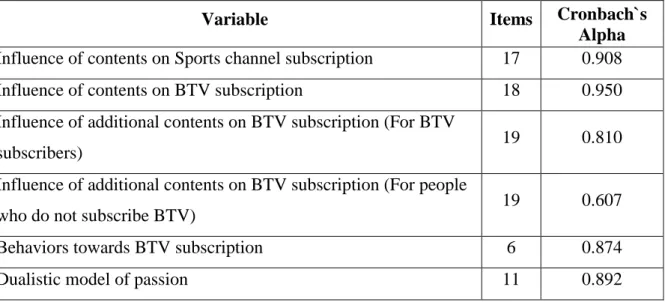
Table 7: Cronbach`s Alpha of the scales present in the study. ... 42
Table 8: Pearson correlation between behaviors regarding BTV subscription by non Benfica fans and level of fandom. ... 54
viii List of Figures
Figure 1: The role of passion in fan behavior. ... 22
Figure 2: Parties involved in broadcasting rights ... 23
Figure 3: SPORT TV Prices. ... 30
Figure 4: Number of subscriptions of BTV (in thousands). ... 31
Figure 5: Conceptual framework ... 34
Figure 6: Gender of the responses ... 39
Figure 7: Education background of the respondents. ... 40
Figure 8: Group ages of the respondents. ... 40
Figure 9: Club preferences of the respondents. ... 41
Figure 10: BTV subscriptions. ... 41
Figure 11: Motives for watching televised sports. ... 43
Figure 12: Motives for subscribing BTV. ... 43
Figure 13: Motives for not subscribing BTV. ... 44
Figure 14: Frequency of using different sports broadcasters. ... 44
Figure 15: Frequency of use different sports broadcasters by different club affiliation. ... 45
Figure 16: Influence of different sports contents on the subscription of a sports channel. ... 46
Figure 17: Influence of BTV sports contents on their subscription. ... 46
Figure 18: The influence of additional sports contents on the range of contents of BTV in BTV subscribers. ... 47
Figure 19: The influence of additional sports contents on the BTV subscription. ... 47
Figure 20: BTV subscriptions according different club preferences. ... 48
Figure 21: BTV subscriptions according to different football leagues preferences by non Benfica supporters. ... 49
Figure 22: Comparison of English Premier League accompaniment between previous seasons and the current one by non Benfica supporters. ... 50
ix Figure 24: Behaviors regarding BTV subscription by non Benfica fans according to
respondent’s gender. ... 52 Figure 25: Behaviors regarding BTV subscription by non Benfica fans according to
educational background. ... 53 Figure 26: Behaviors regarding BTV subscription by non Benfica fans according different club affiliation. ... 54 Figure 27: Respondents opinion regarding BTV subscription price. ... 55 Figure 28: Respondents opinion regarding BTV subscription price according to different club affiliation. ... 56 Figure 29: Respondents opinion regarding BTV subscription price according to different club affiliation by non BTV subscribers. ... 57 Figure 30: Respondents opinion regarding BTV’s subscription price according to different deliberations regarding BTV subscription intentions by non Benfica fans. ... 57
x Executive Summary
A presente tese é uma investigação que tem como finalidade, analisar o impacto dos diferentes conteúdos televisivos na subscrição da BTV, o impacto do clubismo na subscrição da BTV, e a influência do preço na subscrição da BTV. A dissertação em questão também analisa os motivos que levam as pessoas a ver canais desportivos em geral, partindo posteriormente para a BTV em particular.
A BTV foi lançada em 2008, mas apenas a 1 de Julho de 2013 passou a ser um canal subscrito. Este facto deve-se essencialmente à aquisição dos direitos televisivos da English Premier League assim como à transmissão dos seus próprios jogos na BTV. Com estas medidas o Benfica assumiu claramente um risco, para além de prescindir do habitual montante respetivo à transmissão dos seus próprios jogos, estima-se que pagou um valor entre 7,5 e 9 milhões de Euros para adquirir aquela que é considerada por muitos, a melhor liga de futebol do mundo. O target do seu canal passou assim a incluir adeptos de outros clubes. Com a aquisição dos direitos televisivos da English Premier League, a BTV ficou na sua posse com um dos ativos mais poderosos que um canal desportivo pode ter. Durante a temporada 2010-2011, a English Premier League foi de longe o campeonato de futebol mais assistido no mundo, as audiências contabilizadas neste período foram na ordem dos 4,7 bilhões (SPORT + MARKT). A audiência média por jogo foi de 12,3 milhões. Basicamente, tem mais telespectadores do que as ligas espanholas, italianas e alemãs juntas.
Desde que a BTV passou a ser um canal premium, tem tido um enorme sucesso. Passados apenas 18 dias do seu lançamento, este canal alcançou 80 mil subscritores. 150 Mil subscritores foram alcançados em apenas 44 dias. E de acordo com o último número oficial, anunciado em Fevereiro de 2014, a BTV já contabilizava 307.872 mil subscrições. Este sucesso, não tem sido refletido apenas em número de subscrições mas também ao nível de audiências. Tendo a BTV ganho por diversas vezes não só à Sport TV como também a diversos canais por cabo. Todos estes fatores acabam por influenciar assim as contas da BTV, que já contabilizou receitas na ordem dos 30 Milhões de Euros.
Considerando que o consumidor de desporto, apresenta características muito específicas e diferentes de outros tipos de consumidores, foi imprescindível desenvolver uma revisão literária sobre as emoções e paixões presentes neste tipo de consumidores. No entanto, em
xi primeira instância tentou-se perceber as motivações das pessoas assistirem a conteúdos televisivos.
De acordo com estudos desenvolvidos por Arthur A. Raney, as pessoas vêm desportos na televisão devido a necessidades emocionais, cognitivas e comportamentais. Estudos desenvolvidos por Gantz e Wann, definem o entretenimento, como a razão chave para as pessoas verem desportos na televisão.
Para uma melhor compreensão do comportamento do consumidor de desporto, a revisão de literatura foi também desenvolvida sob este prisma. De acordo com diferentes estudos, é possível concluir que o processo de decisão é diretamente influenciado por emoções, onde o envolvimento emocional influencia positivamente a decisão (Leone, Perugini & Bagozzi, 2005). Consumidores de desporto tendem a estar afastados de equipas que não as deles, devido ao facto de estas produzirem sentimentos negativos (Damasio, 1994).
O modelo de paixão dualista (Vallerand et al. 2003) aplicado ao desporto é também muito importante para este estudo. De acordo com este modelo, existem dois tipos de paixões que um individuo pode experienciar: paixão harmoniosa e paixão obsessiva. Estes dois tipos de paixão podem levar as pessoas, sob a mesma situação, a terem comportamentos diferentes. Indivíduos com paixão obsessiva tendem a detestar os adeptos de outras equipas. Neste tipo de paixão, há uma vontade incontrolável de realizar a atividade, resultante de fatores contingenciais e a não realização da mesma pode levar os indivíduos a consequências negativas. Ao passo que a paixão harmoniosa acontece quando a pessoa define a atividade como relevante, sem qualquer tipo de dependência de fatores contingenciais. A vontade incontrolável de realizar a atividade não ocorre mesmo em atividades prazerosas.
Os resultados obtidos confirmam os pressupostos gerais dos estudos presentes na revisão literária. Relativamente aos conteúdos desportivos, estes não se revelam como um motivo para não subscrever, nomeadamente nos inquiridos que não são do Benfica. Mesmo que a amplitude de programas fosse maior, estes não considerariam a subscrição. Para os subscritores da BTV, os jogos do Benfica jogados em casa assim como os jogos da English Premier League, assumem-se como os conteúdos mais relevantes na decisão de subscrever. A principal razão que leva a amostra a subscrever e a não subscrever BTV é a afiliação com o seu respetivo clube, onde os inquiridos que apoiam o Benfica subscrevem porque são do Benfica e os inquiridos que não são do Benfica, não subscrevem este serviço porque este
xii serviço é do Benfica. Confirmando assim os estudos desenvolvidos por Leone, Perugini e Bagozzi, que afirmam que o envolvimento emocional influencia positivamente a escolha. Relativamente ao modelo dualista, a paixão obsessiva está positivamente correlacionada com diferentes comportamentos “radicais” que foram apresentados junto da amostra, como “não subscrevia a BTV, mesmo que fosse 1 euro”, o que confirma que indivíduos com paixão obsessiva tendem a detestar as equipas rivais. A perceção do preço da BTV está também relacionada com o clubismo. Parte da amostra que simpatiza com o Benfica considera o preço da BTV aceitável, e por outro lado, os inquiridos que não são do Benfica, consideram o preço deste serviço não aceitável.
Como se verificou, o clubismo está intrinsecamente relacionado com a subscrição da BTV. Apesar de todas as dificuldades que a BTV tem em chegar aos adeptos de outros clubes, esta tem apresentado resultados muito positivos. Esta realidade deve-se ao facto do Benfica possuir por todo o mundo um elevado número de adeptos, tendo assim um grande número de potenciais clientes que correspondem ao seu target e que de certa forma contribuem positivamente para os resultados que se tem verificado.
1 Chapter 1
1.1 Introduction
"Innovation is a permanent value of Benfica and the fact that we can offer during the next three years, the English league games to all the Portuguese fans, and not just to Benfica, is something that fills me with pride and points the way we want to go with BTV."
Luís Filipe Vieira, President of Benfica.
Benfica has been characterized by being an innovative organization within the sports market. In 2008, Benfica launched the first sports club TV channel in Portugal. Currently, Benfica is broadcasting its own contents to Cape Verde, Canada, Mozambique, Angola, United States, France, Luxemburg and Switzerland. The number of potential clients are available on the following operators: MEO, Vodafone, Cabovisão and NOS. While the international coverage is provided by Orange, Premium Sports , Zap TV, Post Telecom, El Trona, CV Multimédia and BOOM TV. After five years, BTV is booming the sector of televised sports.
On the 28th of February of 2013, the same day that Benfica was celebrating 109 years of age, Luís Filipe Vieira, the current President of Benfica, boomed the world of televised sports completely, not only in Portugal but worldwide. He had just announced the acquisition of English Premier League for the following three seasons, which so far has been transmitted for a long time by Sport TV. This practice is completely innovative in this sector. So far, any TV channel owned by a club had acquired the TV rights of a foreign league and also had transmitted their own games played at Luz stadium on his TV channel. In addition to this fact, BTV at the beginning of the season 2013-2014 required, for the first time, monthly subscription by those who want to have this channel.
BTV hadn’t acquired a normal football league. The Premier league constitutes a powerful asset by any TV channel that has it in his own contents. During the 2010-2011 season, Premier League was by far the most watched football league in the world, where the TV audiences were 4.7 billion (SPORT+MARKT data). The average audience per match was 12.3 million. Ultimately, the English premier league has more TV viewers than the Spanish, Italian and German leagues combined.
2 In addition to English Premier League and Benfica games played at home, BTV also broadcasts the Major soccer league (US league), Greece Super League, all the games of Farense played on their stadium and also other contents which are intrinsic to Benfica.
However, the program offer of BTV is not so broad when compared with its main competitors. With all of these innovative strategies, never practiced before by any sports organization, Benfica is clearly positioning itself not only for Benfica fans but also for sports fans in general. Benfica, by positioning itself to others sports fans is clearly taking a risk never taken before.
The risk mentioned above occurs due to the uniqueness of Sports Marketing. According to the literature review sports marketing is defined as “the process of designing and implementing activities for the production, pricing, promotion, and distribution of a sport or sport business product to satisfy the needs or desires of consumers and to achieve the company’s objectives” (Pitts and Stotlar, 2007, p. 69). This definition was completed by Beech and Chadwick, that define sports marketing as ”an outgoing process in which contests with an uncertain outcome are staged, creating opportunities for the fulfillment of direct and indirect objectives among sport customers, sport businesses and other related organizations or individuals”.
According to Beech and Chadwick, it is dubious that fans acquire products from its rival – Sports are usually connected with emotions and beliefs, this is what makes fans supports some clubs instead of others and consequently make them using products powered by these clubs. Thus, sports organizations have a well defined geographical marketplace and a well known category of customers who buy the team’s products. According to Tudor Niciporucr some sport marketers consider it “as grave restriction for further development, others try to expand the brands by creating a completely different image of that of the parent” – these examples set out to illustrate once again the uniqueness of this industry.
Concerning this, it is improbable that fans will acquire products from rival sports organizations. BTV constitutes one of the products of Benfica. With the acquirement of English premier league TV rights, BTV is including as their target non-Benfica fans, sports fans that obviously support others clubs (some of them with high levels of rivalry). These sports fans will feel a mix of emotions, on one hand they want to watch their favorite team/player/coach in English premier league or in other league broadcasted by Benfica. On the other hand, they do not want subscribe or even watch the channel of their biggest rival. In addition to this, Portuguese sports fans (Benfica fans included) are also wondering if they
3 should subscribe to BTV, a service never paid until now, taking into account the services provided by BTV. Essentially, this is a huge question that most sports fans, both from Benfica and others, are facing now and will be analyzed throughout my research.
1.2 Objectives
The exploitation of its TV rights as well as the acquisition of foreign football leagues is a booming trend on televised sports all over the world. Inclusively, there are some sports organizations, in other countries, considering the acquisition of TV rights of relevant European and foreign leagues exactly as Benfica did. However, the success of this practice is not yet proven. Sports marketing have unique characteristics that can lead the customer to behave in a specific way. Hence, at this moment there is no academic research and any case of success about the consequences that these practices can have on the audiences of televised sports powered by a sports club. Concerning the given facts, there is a need for sports organizations to understand if this innovation is really successful and if the identification level of sports fans within a particular club will influence the subscription of BTV. The results of this research can lead sports organizations to concrete conclusions concerning televised sports sponsored by a sports club and in addition to this, if their strategies can be positioned to sports fans in general, beyond its own fans.
The overall objective of this dissertation is to achieve concrete conclusions concerning the different motives of Portuguese sports fans in viewing televised sports sponsored by BTV. Through this objective, sports organizations will reach important insights regarding televised sports provided by a sports organization TV channel. In order to achieve this, it is crucial to study different variables that may eventually influence the subscription of BTV, since this TV channel is completely innovating this sector.
However, first of all, the development of an intense analysis of different research papers to develop the literature review becomes crucial. Regarding this, a deeper research on televised sports, emotions, fanaticism, sports marketing and televised sports will be extremely important. All the topics mentioned previously and consequent conclusions resulting from them represent another objective of this dissertation.
In order to achieve the overall objective defined initially, first it is relevant to reveal the motives behind viewing televised sports and the reasons to watch BTV particularly. Regarding the latter, three different variables will be analyzed on this paper (1) the impact
4 that the amplitude of program offer provided by BTV will have on the subscription of this channel, (2) the effect that different club affiliations will have on the subscription of BTV and finally (3) understanding if the price of monthly subscription asked by Benfica will influence the subscription of this channel when compared with its main competitors.
1.3 Thesis Structure
The dissertation is structured in six different chapters explained bellow:
Chapter 1: The first chapter introduces the topic of this dissertation. In this section, the background of the topic in hand is presented and the reasoning behind why this dissertation will be conducted. Furthermore, it contains an explanation of why the Benfica’s strategy may be considered risky and the uniqueness of sports marketing is also mentioned. The objectives of this dissertation are also referred. Chapter one ends with the structure of the thesis.
Chapter 2: The literature review is separated in three different parts in order to achieve different conclusions regarding the core of this dissertation. Thus, the first part of the dissertation regards to televised sports, where the importance of televised sports, the motives in watching mediated sports and the influence of fandom in televised sports are covered. The second part of the literature review is concerns Emotions and their influence in sports consumption. At the end, the literature finishes with the sports broadcast industry and their respective TV rights.
Chapter 3: This section includes the contextualization. Throughout this chapter it is possible thoroughly understand the way the variables under study, such as price and contents available not only in BTV but also in Sport TV may influence the subscription of BTV. Sports channels in Portugal, number of subscribers, audiences and the power of English Premier League are also covered.
Chapter 4: This chapter highlights the conceptual framework and also the research hypothesis that will be studied in this research as well as the sample design. The methodology of this dissertation is explained. All the strategies to collect the data and their respective techniques are outlined, as well as the description of the questionnaire and also the measurement scales.
5 Chapter 5: In data analyses, all the results derived from the data are analyzed and discussed. The studies of reliability of the items used during the study are also covered under this chapter.
Chapter 6: As a final point, the overall conclusions of the research are presented along with the limitations verified during the development of this research and also recommendations for future investigations.
Chapter 2: Literature Review 2.1 Televised Sports
2.1.1 Importance of televised sports
Television has gained a great importance in mediated sports, having established itself as the leading means to broadcast sports contests. Through this medium, the sports audience is composed not only of people that are at the stadium but also by everyone around the world. Television allows their audience to watch sports competitions with a variety of aspects that for example is not possible at the site. Through television, sports fans can watch sports events with added value, such as: close ups, repetitions, slow motion or watch the action in different angles, where the emotions involved in the game can be easily perceived by the audience. All of these add ups contribute to increasing the intensity within the game where fans are exposed to comments made by the announcer. Dramatic occurrences can happen every time. Watching on TV can be even more exciting that watching live on the stadium since not all the seats on the venue allows their audience to watch these events on the best possible way. Some seats are far away from the field, where the emotions are decreasingly felt. In addition to this, television spreads sports events all over the world with few seconds of delay, enabling sports fans to watch their favorite team/competitions live, even if they are on the other side of the world. “The phenomenon of mass consumerism of televised sport has created a much different feel for sport than in the past.” (Rinehart, 1994, p. 25).
Certain sports are only recognized all over the world due to the television exposure. Television in this way is contributing for the development of sports globalizations through the global transmission of popular traditional sports (Beck and Bosshart, 2003) – for example NBA in United States, cycling in France or even English premier league in England. Few sports are only recognized in the way they are, due to the worldwide broadcasting through television. At the same time, television has been recognized as a treat to the sports traditions, where the opportunity to watch sports competition on television through numerous
6 advantages can avoid sports fan to watch these events at the local. Considering the facts mentioned previously, according to Rowe (1996, P.565) “TV has conferred its favors on only a few sports, leaving the majority with insufficient resources and exposure”. Televised sports have also contributed to changes in the game schedules. For instance, some important football leagues have changed their timetable in order to be broadcasted in different areas of the world at a reasonable time to be watched.
Televised sports have become important for companies (where sports organizations are included). Companies have been fighting to assure the TV rights of different sports or even important European leagues, where this acquisition can improve their brand image. This acquisition can also stand for company’s ideology or company goals and objectives. However, it does not have to be a great sports event. A certain football league or sports, like boxing or golf that only reach a certain niche can also define a TV brand. In addition to this, by broadcasting important sports events, the companies can increase their advertising revenue.
In summary, televised sports allows the audience to experience a different set of experiences that are not possible at the stadium and watch some sports events that are only possible through television. Televised sports contribute to the globalization of some sports and are increasingly defining the TV brands image of companies.
2.1.2 Motives for viewing televised sports
Through the studies of balance theory (Heider, 1958) and cognitive dissonance (Festinger, 1957) it was possible to conclude that gradually, people tend to watch and find information that is somehow consistent with their values, beliefs and thoughts. On the other hand, inconsistent information under personal values, beliefs and thoughts tend to be avoided by the audience. In summary, people search for information that is coherent with their identity, hence seeking out for balance (Heider 1958) and avoiding such dissonance (Festinger, 1957). This behavior can be characterized by selective exposure (Zilmann & Bryant, 1985). This phenomenon is obviously extended to the viewer’s pleasure, where the audience is looking for contents that bring pleasure and not only consistent content among their values. Therefore, the interest in viewing certain contents is conditioned by cognitive and affective variables. Several studies have identified different reasons that lead viewers to watch television, although just a few researchers have identified consistent motives in viewing sports on
7 television. Through the television viewing motives scales (TVMS; Rubin, 1983), that highlighted 36 different reasons, some of them were considered as being highly connected with sports viewing motives. This is the case of “entertaining”, “Self-esteem”, “companionship”, “social interaction”, “escape” and “apathetic motivations”.
Entertaining is considered the key reason why people watch televised sports. This reason is consistent among different studies (Gantz, 1981; Wann, 1995) that also defend entertainment as a primary motive for watching sports on television. According to Gantz (1981), people usually watch sports as a way “to let loose” or just to relax.
Moreover, Self-esteem, achievement and companionship were consistently considered motivations that lead the viewer to seek sports on television through preceding studies; all of these motives were added to the TVMS (Milne & McDonald, 1999; Trail & James, 2001; Wann, 1995).
According to previous researches, all of the previously mentioned motives can be divided into three different categories of needs, namely emotional, cognitive and behavioral or social needs (Arthur A. Raney, 2006).
2.1.2.1 Emotional Motivations in viewing televised sports
The audience of televised sports is guided by expected emotional rewards that arise by viewing their favorite team/player or even their favorite sport on television. The variation of emotions that the audience feels during a specific game/program is part of this essence, where the winner could eventually change during the course of the match. However, negative emotions can also be a possible outcome, despite the fact that positive emotions is what the audience is looking for when they view mediated sports (Arthur A. Raney, 2006).
Rubin (2002) stated that motivation is the main explanation in the study of media effects. Uses and gratification studies have defined several reasons that try to explain the motivation that leads the audience in viewing televised sports. Entertainment, eustress, self-esteem and escape corresponds to the motivations mentioned previously.
Entertainment Motivation
Being part of an affiliation and consequently being emotionally affected by the performance of a specific team/player is the first reason that leads viewers in watching televised sports: entertainment (Gantz, 1981; Gantz & Wenner, 1991, 1995; Krohn, Clarke, Preston, McDonald, & Preston, 1998, Smith, 1998; Wann 1995; Wann, Scrader, & Wilson, 1999,
8 Wann et al., 2001; Wenner & Gantz, 1998). However, Gantz and Wenner (1995) reported that the involvement level toward a specific player or team influence the reasons why the viewer watches televised sports, where highly involved fans tend to watch sports in a deeper way and pursue a different set of experiences than the lower involved fans.
Gantz (1981) considered “the thrill of victory” as the principal motivation. By supporting their favorite teams or players, the audience will feel better with themselves when the supported team wins. The enjoyment and an expected emotional reward that come across when the individuals are supporting their favorite team are considered the most important motivational factors that lead the audience in viewing mediated sports (Arthur A. Raney). The disposition theory of sports spectatorship (Bryant & Raney, 2000; Zillmann, Bryant, & Sapolsky, 1989; Zillmann & Paulus, 1993) states that level of affiliation with a specific team/player varies from high levels of affiliation through indifference to low levels of affiliation. This range of affiliation levels directly influences the enjoyment in viewing televised sports. The enjoyment in viewing televised sports is influenced by the strength and the level of rivalry that the competitors represent to the audience. So, the enjoyment tends to increase as the level of affiliation of the winning team is higher. Furthermore, the enjoyment also increases along with the level of rivalry. The maximum enjoyment is achieved by the viewer when the winning team represents the highest level of affiliation and consequently defeats the losing team with the highest value of rivalry. The maximum disappointment or negative enjoyment is achieved when the most esteemed team is beaten by the unloved team (Zillmann & Paulus, 1993).
Eustress motivation
According to Bernhardt, Dabbs, Fielden, & Lutter (1998) televised sports can lead the viewer to increase the arousal and the excitement. Viewing sports is frequently defined as exciting ( e.g., Krohn, et all ., 1998) or “pumped up” ( e.g. Wann, 1995). The major source of the excitement and arousal that is around the sports event is the uncertainty and the suspense that usually characterize and define a simple game or a big competition (Zillmann 1991). In order to study a relationship among uncertainty and enjoyment, a group of researchers (Gan, Tuggle, Mitrook, Coussement, & Zillmann) rated the enjoyment of a group of participants (male and female) in one of the eight collegial basketball matches. The researchers assumed that the uncertainty increases as the score difference decrease; this means that one game with a difference of only one point in the final score was considered as the most uncertain game and being in this way extremely suspenseful. If the difference in the final score was 5-9 points
9 the game was considered “substantially” suspenseful and “extremely” suspenseful with less than 5 points of difference. In the case of male participants the level of arousal increases when the final score was smaller. The same was verified in the females but only up to “substantially” category. In the “extremely” suspenseful games, the female respondents experienced distress, associated with irritation that may lead to decrease the enjoyment. Many sport viewers are looking for arousal and excitement, and by doing this, they are exposed to eventual displeasure situations. Extremely suspenseful games, where the final score among the two teams is close and in this way is considered as uncertainty game up to last minute, may lead the viewer, mainly the female audience, to stress situations.
Thus, as we could verify through the researches, eustress is a motivation to view televised sports, specially for men (Gantz & Wenner, 1991; Wann, 1995; Wann, et al., 1999).
Self-Esteem Motivation
Another emotional motivation that leads the viewer to watch televised sports is the self esteem that by doing so can be achieved. This means that by viewing televised sports the audience may feel better with themselves (Wann, 1995; Wann, et al., 1999; Wenner & Gantz, 1998). Self-esteem and the levels of confidence increase naturally by supporting a specific team that wins. On the other hand, if the team loses the self-esteem may decrease. Hirt, Zillmann, Erickson & Kennedy (1992) demonstrated when the viewers experience a winner of their favored basketball team, they consequently expect that team to perform well in the future, and also the expectation to overcome specific tasks is higher when compared to viewers that experienced a defeat by their favored team.
The fact that the viewer is a fan of a successful team may function as an emotional utility. A group of researchers stated that one of the positive of outcomes of being associated with a success team is to “bask in the reflected glory” (BIRG) experienced by these successful teams (Cialdini, et al., 1976). Overall, sport fans that support a successful team may eventually be perceived as a successful person on their personal lives. Aiming to demonstrate the BIRG phenomenon, Cialdini and his respective team verified that fans tend to use clothing or accessories that identify themselves as a fan after the victory of their favorite team and the opposite was also verified. In addition to this, fans tend to use more the pronoun “we” in case of victory than in case of defeat. Consequently, the self-esteem and the confidence that come from supporting a successful team are associated with personal success, representing an emotional motivation that leads the sports fans in viewing televised sports.
10 So far, the three emotional motivations mentioned previously are connected and influenced by the level of emotional affiliation with a specific team/player and the consequent outcome that is involved in a sport event, where that team/player is obviously included. This last emotional motivation is less dependent on the fanship or the eventual outcomes that arise with the competition. Various viewers defined the sports events as escape from the stress of their personal live (Gantz, 1981; Gantz &Wenner, 1991, 1995; Krohn, et al., 1998; Smith, 1998; Wann, et al., 1999, 2001; Wenner & Gantz, 1998). According to Smith (1998), as long as the viewer is watching a sport event, even if the mood varies to low levels “any pain is temporary and minor compared to the relief of gaining a respite from a wearisome existence” (P.58). The escape motivations in viewing televised sports tend to be higher on the most stressful situations or problems (Wann, 1997). Escaping boredom is another motivation in viewing mediated sports, according to Wann and Rochelle (1999), “two in five sports fans tune in to sports to escape boredom”, viewers have a tendency to view sports content in bored activities, namely in breaks from a respective job agenda (Krohn et al. 1998).
2.1.2.2 Cognitive motivations in viewing televised sports Learning Motivation
Concerning the cognitive motivations that lead sports fans in watching mediated sports, one of the most important is learning about players or teams, where the favorite player or team are the core of this cognitive process ( Gantz, 1981; Gantz & Wenner, 1995; Wenner & Gantz, 1998). Researchers have verified that sports fans pride in knowing such statistics or historical facts about a specific player or team, and this information can be easily assessed in televised sports. These incomes about sports facts play an important social role for fans. By knowing such statistical information or curious history about a certain player/team the conversation between friends, strangers or even in the family becomes easier. The sociability between two persons that never met before tend to occur when both of them have curious and interesting facts to share with each other (Melnick, 1993). Another aspect that makes this socialization easier is the sports universality that transcends genders, social status, education and even ages (Lever, 1983). Sports conversation is always an opportunity to discuss friendly different disagreements between sports fan with different clubs affiliations, the opposite of religion and politics for example (Karp & Yoels, 1990). These conversations usually occur during a sports event, where trivial facts, statistics, curiosities and opinions are endlessly communicated.
11 Viewers report that learning more about the sports themselves is also another reason to view televised sports. Those people are namely females and non sports fans that look forward to have a better understanding towards a certain sport/team/player in order to watch in a near future with the ones who really enjoy that experience and somehow are important for them, such as boyfriend, friends or family (Arthur A. Raney).
Aesthetic Motivation
Another reason that leads the viewer in watching televised sports are the “aesthetic qualities of the competition” (Krohn, et al., 1998; Smith, 1998; Wann, et al., 1999, 2001; Wann & Wilson, 1999). According to Smith, a great team/player performance can be considered art. Others compare the improvisational aspects of different sports with jazz performances.
2.1.2.3 Behavioral and social motivations in viewing televised sports Release
Viewing televised sports can be assumed as a way to release emotions that come from the daily live. It is assumed that the audience somehow brings to the sports televised experienced appalling emotions that tend to be enhanced by viewing sports on television. The drama that arises from sports and the consequent expectations can release negative emotions that lead the viewer to mediated sports consumption (Gantz, 1981; Gantz & Wenner, 1991, 1995; Krohn, et al., 1998; Wenner & Gantz, 1998).
The experience of releasing the emotions during a specific game or sports events do not appear by simply watching it, but mostly by performing diverse behaviors during the sports event. According to a study, fans that reported high levels of release motivations in viewing televised sports assume that the reasons why they are sports viewers comes by the following: “to let loose”, “to have a few beers or drinks”, “to let off steam” and “to get psyched up” (Gantz, 1981; Gantz & Wenner, 1991). While others respondents, assume that applauding and shouting against the coach decisions or just to express dissatisfaction with a specific player are part of a pleasant sports experience (Gantz, 1981) that somehow are way to release emotions.
Companionship
Other reason that guides the audience to watch televised sports is companionship (Dietz-Uhler, Harrick, End, & Jacquemotte, 2000; Gantz, 1981; Gantz & Wenner, 1991, 1995; Krohn, et al., 1998; Melnick, 1993; Smith, 1988; Wann, 1995; Wann, et al., 1999; Wann., 2001; Wenner & Gantz, 1998). Compared to normal televised content, sports events are
12 considered to enable an easy form of communication among friends or even strangers during the mediation of a sports event (Wenner & Gantz, 1998). As mentioned previously, the universal language of sports and the possibility of talking about it without social status or education level boundaries, bring everyone to the same level where all the opinions can be valid.
Melinck (1993) defined “sports encounter” as the unique communicative practice among strangers. The author suggests that sports allow and facilitate the integration and the communication between unfamiliar people. Though this interaction should be mediated through various assumptions; “an assumed level of knowledge”, “an assumed set of shared behaviors and motivations”, “an assumed commitment to and enthusiast about the game” and “an assumed understanding of time boundaries during which a conversation can take place”. All of these assumptions constitute the conversation conductive set. Sports conversation may be one of few times that public discussion can be guided by friendly disagreements. The enjoyable moments between friends with different points of views, or different club affiliation can be met through sports viewing.
Group Affiliation
Many sports fans reported that one of the reasons why they view televised sports is the sense of belonging to a specific group affiliation that is shared among the participants on that group. (Krohn, et al., 1998; Smith, 1998; Wann, 1995; Wann, et al., 1999, 2001). According to Smith (1988), sports can drive people with different points of views, education, religions and so on, into the same level. Fundamentally, sports can unify communities, schools and even nations. Worldwide competitions, as the world cup or the Olympic Games, where different nations compete against each other, can bring happiness to these nations and even increase the levels of pride even if only for a brief moment. However, according to Wann (1995) this motivation in viewing televised sports is verified namely in younger sports fans and also among people with high income levels.
An overview is presented on the following table (Table 1) in order to clarify and sum up all the motives of viewing televised sports.
13 Table 1: Motives for viewing televised sports summed-up
Motivations Motives Characteristics Source
Emotional
Entertainment
The enjoyment and an expected emotional reward that come across when the individuals are supporting their favorite team are considered the most important motivational factors.
Arthur A. Raney
Eustress
Viewing sports is frequently defined as exciting or “pumped up”. The major source of the excitement and arousal that is around the sports event is the uncertainty and the suspense that usually characterize and define a simple game or a big competition. Krohn, et all ., 1998; . Wann, 1995; Zillmann 1991
Self-esteem By supporting a specific team and if this team wins, the self esteem and the levels of confidence increases naturally. Wann, 1995; Wann, et al., 1999; Wenner & Gantz, 1998 Escape
As long as the viewer is watching a sport event, even if the mood varies to low levels “any pain is temporary and minor compared to the relief of gaining a respite from a wearisome existence”.
Smith (1998)
Cognitive
Learning
Concerning the cognitive motivations that lead sports fans in watching mediated sports, one of the most important is learning about players or teams, where the favorite player or team are the core of this cognitive process. Gantz, 1981; Gantz & Wenner, 1995; Wenner & Gantz, 1998 Aesthetic A great team/player performance can be considered
a form of art. Smith, 1998
Behavioral and social
Release
The drama that arise from sports and the consequent expectation in release the negative emotions leads the viewer to mediated sports consumption.
Gantz, 1981; Gantz & Wenner, 1991, 1995; Krohn, et al., 1998; Wenner & Gantz, 1998 Companionship
Comparing to normal televised content, sports events are considered to enable in an easier way the communication among friends or even strangers during the mediation of a sports event.
Wenner & Gantz, 1998
Group affiliation
Many sports fans reported that one of the reasons why they view televised sports is the sense of belonging to a specific group affiliation that is shared among the participants on that group.
Krohn, et al., 1998; Smith, 1998; Wann, 1995; Wann, et al., 1999, 2001 Source: Own elaboration
14 2.2 Motives for viewing televised sports and fandom
The audience of televised sports cannot be considered homogeneous. Therefore, by experiencing televised experience, the audience can perform different behaviors according their level of fanship (Gantz, 1995).
The term fan is usually connected with sports. This term comes from “fanatic” that is usually applied in people who have a strong interest toward a program, personality and of course, sports teams or players (Gantz; Wang; Paul; F.Potter ). This kind of audience is characterized by being active and interested. This represents a wide range of complex processes, where affective involvements make the distinction between fans and non fans. Those fans tend to watch and follow their favorites frequently and consequently they have more knowledge than non fans. In addition to these facts, by being emotionally involved, the information processing about what they are watching tends to be more efficient than non fans (Gantz; Wang; Paul; F.Potter ).
Gantz and Wenner (1995) defined sport fans according to the level of knowledge reported and interest. Those with higher levels of knowledge were considered more fans than those with lower levels.
According to Cohen (2001) there are various indicators that serve as a fandom indicator, such as “liking”, “being similar to”, and “having affinity with a mediated personality”. The level of fandom can be characterized according to these three indicators. On the other hand, different authors, such Gantz and Wenner (1995) have identified several problems in different researches that approach the effects of sports. In these researches, fandom or just spectator are similarly used. Therefore, these authors identified three different levels of fandom: (1) Fans or “truly believers”, which involve those who are intensely connected with a specific team. (2) Spectators, or just observers of the sports and finally (3) non-fans, those who are not interested in sports itself, but watch it in order to stay with their friends or family. Fans usually support a specific athlete, while non-fans do not have an affiliation with any athlete. Different levels of fandom helped to explain why viewers watch televised sports differently. According to uses and gratification studies, background characteristics influence directly the motives for mediated sports consumption. Fandom constitutes one of these characteristics. Few researchers have identified that highly committed fans have different reasons, mainly stronger, to watch sports on television than fans with lower involvement (Gantz & Wenner,
15 1991; Traill & James, 2001; Wann, 1995). Thus, it is important to understand the influence that different levels of fandom toward television sports motives.
In order to study the relationship among fanship and televised sports motives, Gantz and Wenner concluded that among 15 different motivations, 12 were positively correlated (P.64). The level of fandom is more correlated with motives that in fact are connected with more interest in sports and also the involvement on it. Therefore, the highest values of correlation were verified when the sports fans watch sports in order to verify how their favorite teams performs and also due to the drama and tension involved on the game. On the other hand, negative values of correlations were verified when the viewers watch sports as a way to do something with friends or family or just because they are watching.
Fans usually invest more on television sports experience, they are more committed and that is the reason why they experience a different range of emotions. On the contrary, non-fans watch sports without any involvement and emotions. Pre and post behaviors are rarely experienced by non fans. Whilst for fans the sports experience is much more than a simple game, they usually prepare the game by knowing about the game and all the incidents that came after the game are also observed by fans (Gantz and Wenner, 1995). Non fans usually watch sports as an unplanned and less emotionally experience compared with fans, having therefore a lower involvement.
Another study, to clarify the relationship among fandom and sports viewing motives, of Adam C. Earnheardt and Paul M. Haridakis was conducted. According to these studies, there is a positive correlation among fandom and self-esteem and achievement motivation and also among entertainment motivations. As long the level of involvement with sports increases, the motives in watching sports in the parameters mentioned previously are stronger. Positive correlations were also identified in companionship and escape motivations. However, the study identified a negative correlation between fandom and apathetic motivations. In summary, the viewers with higher values of fandom tend to watch televised sports for the following motives: entertainment, escape, self-esteem, achievement, companionship, learning about sports and passing time. On the other hand, viewers with high fandom levels usually don’t watch televised sports due to apathy motivations compared with non fans.
16 2.3 Emotions
2.3.1 Classification of Emotion
According to Morris (1992), emotions concern appraisals of external circumstances. Clore et al. (1994) define the word affect as a term that reaches the positive or negative valence of something; regarding this they say that all emotions are affective but not all affective things are emotions. Emotions arise from experiences with events that are appraised as having positive or negative consequences for the individual’s concerns (Frijda ,1993). To complete the definition, Lazarus (1994) defined emotions as the representation of a transient reaction to specific kinds of adaptation experiences. Alike, Ortony et al. (1987) distinguished emotions from non-emotions and reached the conclusion that emotion refers to internal mental states that are focused primarily on affect where affect simply refers to the perceived goodness or badness of something. Most theories of emotion defined that positive emotions come along with the attachment of some goals or the development to reach that goal. Opposite to this, negative emotions arise from the failure to reach the goals defined or from the lack of development to achieve that goal. These theories are basically the explanation of how motivation and cognition can produce emotions in different situations (Lazarus, 1991). Several authors and researches found a correlation between cognition and emotions, where cognition comes previously from emotion. There are mainly, eight primary emotions that can arise from negative or positive affect: anger, feat, sadness, shame, contentment, happiness, love and pride (see table 2). The emotional stimuli may be an event, a scene, a face, a poster or an advertising campaign. These events, work as a first reaction that have direct impact on the organism, it is usually experienced by sudden changes such as the incensement of heart rate or the acceleration of respiratory rhythm or even the rise of muscle tension. These stimuli are sent from the thalamus to the cortex, where afterwards they are processed (Aharonson, 2007). After this and according to the interpretation that varies from individual to individual, the type of response comes up.
17 Table 2: Hierarchy of consumer emotions
Positive affect
Contentment Contented. Fulfilled. Peaceful
Happiness Optimistic. Encouraged. Hopeful. Happy. Pleased. Joyful. Relieved. Thrilled.
Enthusiastic.
Love Sexy. Romantic. Passionate. Loving. Sentimental. Warm-Hearted.
Pride Love.
Negative affect
Anger Angry. Frustrated. Irritated. Unfulfilled. Disconnected. Envious. Jealous.
Fear Scared. Afraid. Panicky. Nervous. Worried. Tense.
Sadness Depressed. Sad. Miserable. Helpless. Nostalgia. Guilty
Shame Embarrassed. Ashamed. Humiliated.
Source: Laros & Steenkamp (2005) 2.3.2 Emotions and Sports consumers
In sports marketing, the main fact that influences the feelings and the sense of belonging for certain sports organization is the emotion. Emotions play the principal role in this field of marketing. If somehow a club does not transmit any emotion to their audience, they will likely be unhappy and consequently will not buy tickets for the matches as well as their products. Sports organizations are adapting their strategies in order to reach those emotions. The main goal is establishing with the customer an emotional channel of trust and mutual collaboration (Consoli, 2010).
According to Izzard (2009), emotions play an important and crucial factor in consumer’s behavior. This element influences strongly the way we think and consequently the decisions we make. Considering this, sports consumers give an exclusive chance to study how emotions influence the human being (Knobloch-Westerwick et al., 2009).
If we have a look at consumer consumption, sports followers are distinctive from the others. Sports supporters tend to give the impression in showing loyalty among their favorite sports club (Tapp 2003). Sport consumers have unique characteristics comparing with normal consumers, sports organizations are giving importance in studying their behavior, guided by emotions, in order to understand this uniqueness. Thus, emotions are a psychological factor that must be linked with sports consumption.
18 Sport researches have been guided with the idea that sport consumers are rational and their decisions are logically made. Nonetheless, fans standpoint their behaviors as a consumers who are not considered logical (Kwak, 2011). These findings are essential to understand sport consumers behaviors.
Raney (2006) stated that consumers watch sports due to all emotional rewards that arise when watching it. Sport consumers, by experiencing different outcomes of favorite team’s performance will consequently experience different emotional outcomes. This is to say, they will experience positive emotions in the event of winning and negative in case of losing (Hirt et al., 1992).
The decision making stages, evaluation, intention and consequently choice, are influenced by emotions, where the emotional involvement positively influences the choice (Leone, Perugini, & Bagozzi, 2005). Consumer’s choices and preferences are directly induced by emotions. This explains the reasons why fans supports specific teams while hate others. (Peters, Lipkus, & Diefenbach, 2006). Damasio (1994) acknowledged that emotion operates as information. Thus, when our stimuli identify negative feelings regarding certain possible choices, it operates as information that posts that choice away. Consequently, all the stimuli can generate positive or negative feelings that are influenced by affective outcomes and such outcomes operates as information when the consumers are making their choices. Sports consumers tend to stay away from unaffiliated teams, as their information produces negative feelings (Damasio, 1994). Bagozzi et at., also studied the influence of emotions in information processing. The emotional state influences the way the information is processed, specifically on judgments and evaluation stages. In other words, positive stimuli tend to be approached while negative ones bring out avoidance behaviors (Chen & Bargh, 1999).
According to a study performed by Kwak et al., the positive or negative valence of the message produced by sports, stimulate different emotional states and consequently the emotions induced on the messages produce different behaviors. This conclusion supports others sport researches, which stated that emotions are used by sports fans as an information sources and all the feelings implicit on the emotions are considered the most relevant factor when the consumer is making the decision (Pham, 1998; Schwarz & Clore, 1983). Thus, these findings also supports that emotions play an important role in approach/avoidance behaviors as mentioned above. All of these behaviors are influenced not only by the level of team
19 identification but also due to other variables in sports fans, such as “involvement, commitment, trust and loyalty” (Kwak, Kim & R.Hirt, 2011).
Another point that must be pointed out in sports researches is the dynamics of the relationships among sports organizations and its fans, and this is what makes sports consumption a distinctive experience. In contrast to other businesses, the performance of the brand is not regular over time. Team performance can diverge from year to year, week to week or even in a simple game (Knobloch-Westerwick et al, 2009). As such, this dissimilarity of performance causes a fluctuation on the emotional stages on its fans (Kerr et al., 2005; Knobloch-Westerwick et al., 2009).
Affective theories have another overview regarding the approach/avoidance behaviors. These theories propose that the present emotional state influence the way they make decisions in different situations (Andrade, 2005). People with positive emotions tend to have approving considerations of the situation, which leads the consumer into an approach behavior. Alternatively, people with negative emotions tend to have less approving considerations over the situation, leading the consumer into an avoidance behavior (Kwak, Kim & R.Hirt, 2011). 2.3.3 Dualistic model of passion
Sport fans spend their time watching, speaking and investing money in sustaining a passion for their favorite team. Different behaviors are performed by these fans. On one hand, they share positive occurrences with other fans. On the other, fans with different preferences tend to discuss around a certain sport topic. What are the main motives that lead these fans in performing such behaviors? Passion is the answer. By being passionate with a specific team, fans tend to perform different behaviors in order to support their team and even their personal life schedule can be organized around their team. Vallerand et al. (2003) presented two different passions, related with adaptive and maladaptive outcomes. According to the dualistic model of passion (Vallerand et al., 2003) these outcomes varies according the activities. Enjoyable activities performed are turned into a passion. According to the same author, passion can be defined as a strong connection that individuals feel about certain activity that is done with pleasure and love, and for this reason they invest their personal time and discuss about it. A person`s identity can be defined according to the different enjoyable activities preferred by different people. Fans who are passionate in supporting their favorite team do not just watch football, they are truly fans, they are “Benfica” fans, for instance. In consequence, by cheering for their favorite team, fans are also cheering for themselves (Vass, 2003).
20 2.3.4 Obsessive passion
The dualistic model of passion affirms that two different types of passion are performed according the type of internalization that occur on individuals. Obsessive passion results in an uncontrollable will to perform the activity. However, it takes place when a controlled internalization occur in a person`s identity (Deci &Ryan, 2000; Sheldon, 2002; Vallerand, 1997). Controlled internalization, derived from different contingences (for example, the urge of being accepted or self-esteem), occur when intra/interpersonal pressure to perform a specific activity is implied or just because of the uncontrolled level of excitement in engaging some activities. Thus, obsessive passions are experienced by people who are forced to perform activities due to contingency factors; there is pressure to engage in such activities. Therefore, these contingencies factors may not lead the person to positive emotions and negative emotions may also be achieved. The person may feel obligated to engage in activities even when they should not. Obsessive passion creates an inflexible way of persistence that may guide the person into problems. The activities can cause divergence among other personal activities, such as relationships or problems at work.
2.3.5 Harmonious passion
The other type of passion defined in the dualistic model of passion is the harmonious passion. This is consequence of an autonomous internalization in a person`s identity (Deci & Ryan, 2000). In contrast of the passion mentioned previously, this passion happens when the person defines the activity as relevant, without any type of dependence on contingency factors. The uncontrolled will to perform the activity does not occur in pleasant activities. Even when the activity is pleasant for the individuals, they do not overlap it over others personal life`s activities, it remains in synchronization. This direction leads the individuals in performing the activities in a more flexible way, with a better balance and allowing to get the most of each activity. The positive emotions may eventually be facilitated while individuals are performing other activities, since they avoid them from thinking in loving activities (Mageau et al., 2005; Ratelle et al., 2004; Vallerand et al., 2003, Study 1). The control over the activity provides different outcomes when comparing with obsessive passion. The permanency on the activities is fully influenced on the positives emotions that can arise from it. If the individuals experience negative outcomes, the activity should be stopped. Despite of being important, with harmonious passion, activities do not play the principal role on