53
Marta Pinto holds a PhD in Multimedia in Education
and is a Research Assistant (LIBE project) at Faculty of Psychology and Education Science of University of Porto, Portugal. Email: [email protected] João Caramelo is Assistant Professor in Sciences of
Education at the University of Porto, Portugal. His research interests are Adult Education and Educational Assessment Processes and Policies.
Email: [email protected]
Susana Coimbra is Assistant Professor and researcher
in Psychology at the University of Porto, Portugal. Her research interests include SES and gender differences on self-efficacy, resilience, and intergene-rational solidarity during adolescence and transition to adulthood. Email: [email protected]
Manuela Terrasêca lectured as Associate Professor in
the Psychology and Sciences of Education
Department at the University of Porto. Her research interests are Education Systems, Policies and Institutions Evaluation. Currently is the IR of a Brazil-Portugal cooperation project on School Evaluation and Public Policies and the Portuguese national coordinator of LIBE project.
Email: [email protected]
Gabriella Agrusti is Professor of Research Methods in
Education at LUMSA University – Department of Humanities. She works on key competences assess-ment and developassess-ment, on civic and citizenship educa-tion (IEA-ICCS 2009 and 2016 study) and on e-learning (LIBE project). LUMSA University, via di Porta
Castello, 44 – 00193 Roma (Italy) Email: [email protected]
Marta Pinto, João Caramelo, Susana Coimbra, Manuela Terrasêca, Gabriella Agrusti
Defining the Key Competences and Skills for Young Low Achievers’ in Lifelong Learning by the
Voices of Students, Trainers and Teachers
Europe has stressed the importance of lifelong learning as a way for its citizens to enrol and to engage fully in day-to-day demands of work and citizenship life events. Support is more urgent for those who are at risk of social and educational exclusion. This paper presents an overview on the goals of the European project LIBE “Supporting Lifelong learning with Inquiry-Based Education”, that aims at designing, developing and trying out an innovative e-learning management system devoted to develop key information processing skills for ICT with an inquiry-based approach to learning, focused on the young adult population (16-24) that have low levels of competences regarding literacy, numeracy and ICT skills. Additionally, it presents the results of a content analysis of focus groups sessions, carried out with Portuguese teachers, trainers and students, aiming to identify the key competences and skills most needed by young low achievers. The Portuguese results integrate the alignment of the proposal of the LIBE framework for the learning outcomes, instructional objectives and ICT key information processing competencies. Results highlight literacy skills and social competence as the most relevant for the target audience, adding ICT competences as very important in developing literacy skills and self-efficacy. Pedagogical support is considered a significant part of the students’ successful learning, both in face-to-face or e-learning environments.
Keywords:
Low achiever, competences, skills, lifelong learning, e-learning, information and communication technology 1 Introduction
In the Renewed Lisbon Strategy (COM 2005/24) it is considered that the growth of productivity in the European space has markedly slowed, stressing the
importance of stronger investments and use of Information and Communication Technologies (ICT) across the economy in order to regain better levels of productivity (Commission of the European Communities, 2005). Simultaneously, the document points towards ICT as the backbone for the knowledge economy, although European investment in these technologies has been “lower and later” than in the United States. Therefore, the Renewed Lisbon Strategy stimulates the use of ICT both in public and in private sectors to continue the eEurope agenda (Commission of the European Communities, 2005).
Technology has been integrated into most aspects of work and life in the 21st century. To engage fully in day-to-day demands of work and life events, many of which already integrate ICT, citizens need specific set of competences and skills such as information processing, literacy, numeracy and problem solving in technology-rich environments. These concerns are stressed by European discourses, when reporting the need of Life-long Learning (LLL) of citizens, particularly those considered to be low achievers, typically 16 to 24 year olds (and to a lesser extent 25-30 year olds) who face higher unemployment rates (OECD, 2013a). Additionally, it is stressed the need to promote and to master “gene-ric” skills such as communication, self-management, critical thinking and the ability to learn, assisting citizens in a better integration into all areas of information and into a rapidly changing labour market (Berger & Croll, 2012; OECD, 2013a).
Therefore, in the perspective of promoting a digital democracy or digital inclusion, it is important to consider the specific barriers of access and the quality experiences with ICT that may affect the educational and lifelong learning paths and employment opportunities of all citizens of all ages. In particular of those who are econo-mically, socially and culturally most vulnerable.
54
1.1 Demand for skills in lifelong learning for youngadults
At all levels of life, changes regarding technological advances are demanding to all citizens and organizations, requiring the development of a set of cognitive skills that potentiate an adaptation to a guaranteed continuous evolution of technology. Those skills are required for rapidly changing activities that demand higher-levels of understanding, interpretation, analysis and communi-cation of information, overcoming the skills needed for routine cognitive and manual tasks (OECD, 2012). This demand is most strongly made by the international labour market in order to prepare for the current and future needs of the workforce, and thus, it is acknowledged in the Europe 2020 by Europe and its Member States, towards the implementation of policies that improve employability, social inclusion and personal fulfilment of its citizens. Europe is giving special focus to citizens from a disadvantaged background, young and young adults with low basic skills or that constitute early leavers from education and training (Urban, 2012). It is in fact a political commitment of the European Union member states, to reduce the proportion of low
achievers, defined by OECD as the pupils who scored
below level two on the combined mathematics, reading and science literacy scale of the Programme for International Student Assessment (PISA test) (LIBE, 2014a). In this paper, we add to this definition, young adults who are in regular schooling paths but have low success rates in school or have dropped-out from regular schooling paths due to low success rates and social exclusion. These pupils generally have greater difficulty in completing more complex tasks and understanding more complex concepts, and most can be expected to continue facing those difficulties throughout their lives, because they are not expected to continue with education beyond compulsory schooling (European Commission, 2005; OECD, 2013a).
Therefore, they maintain poor levels of literacy and numeracy, the essential skills that allow for a full participation in modern societies. These poor levels also affect the mastery of ICT in the workplace and daily activities (e.g. online banking, e-government, electronic shopping according to OECD, 2012). Furthermore, in order to successfully participate and integrate work and society, they need to master literacy and numeracy skills (highest levels) that appear to be a pre-condition for key information-processing skills (average levels) and for undertaking more complex problem-solving tasks. The key skills adopted in this paper are those of defined by OECD for the Adult Literacy and Life Skills Survey (PIAAC) as follow (OECD, 2013a, p. 59):
“Literacy is defined as the ability to understand, evaluate, use and engage with written texts to participate in society, to achieve one’s goals, and to develop one’s knowledge and potential. Literacy encompasses a range of skills from the decoding of written words and sentences to the comprehension,
interpretation, and evaluation of complex texts. It does not, however, involve the production of text;”
“Numeracy is defined as the ability to access, use, interpret and communicate mathematical information and ideas in order to engage in and manage the mathematical demands of a range of situations in adult life. To this end, numeracy involves managing a situation or solving a problem in a real context, by responding to mathematical content/information/ideas represented in multiple ways;”
“Problem solving in technology rich environments is defined as the ability to use digital technology, communication tools and networks to acquire and evaluate information, communicate with others and perform practical tasks. The assessment focuses on the abilities to solve problems for personal, work and civic purposes by setting up appropriate goals and plans, and accessing and making use of information through computers and computer networks.”
Given that written information is present in all areas of life in which people participate in society—as citizen, consumers, parents or employees—it is crucial for individuals to master literacy skills, to understand and respond to textual information and communicate in written. Literacy skills intersect with numeracy and ICT, enabling performance on tasks that, in part, depend on the ability to read and understand text (OECD, 2013a, 2013b). In text it is distinguished between digital text and print-based text, and the domain to master reading these two different types of texts that differ in: reading of printed texts; reading digital texts in simulated websites, search engines results pages and blog posts (OECD, 2013a).
Data collected in 2013 with the PIAAC survey indicates that in OECD countries, young adults (age 16-24) regar-ding literacy proficiency levels are on average at level tree (scores from 276 points to less than 326 points) broadly meaning they can: understand and respond appropriately to longer texts and of several types; to make appropriate inferences of text structures and of one or more pieces of information; identify and formu-late responses. Regarding the proficiency in nume-racy, they are on average at level two (scores from 226 points to less than 276 points), meaning they have the ability to: navigate within digital texts, access and identify information from different sections of a document; to integrate two or more pieces of informa-tion, compare and contrast about information; make inferences (low-level). Regarding proficiency of problem solving in technology-rich environments, in all countries 16-24 year-olds reach higher average levels of proficiency than the older adults, having lower chances of having no prior computer experience, or failing the ICT core test (OECD, 2013a). It is important to support those affected by the lowest levels of skills and highest levels of unem-ployment, in a process of lifelong learning.
LLL is benefiting from e-learning being integrated into all levels of education and training, and benefiting the diversity of attendees of learning activities. Online
55
learning initiatives such as online courses or MassiveOpen Online Courses (MOOC) have emerged as attractive solutions for free access to LLL. MOOCs can be defined as “(…) online learning environments that feature course like experiences - for example, lectures, labs, discussions, and assessments - for little to no cost” (DeBoer, Ho, Stump, & Breslow, 2014).
These online courses are instructor-guided and design-ned to scale up to support large numbers of learners and combine the offer of various topics and depth of learning. MOOCs also assist in answering the need of students engaged in LLL to learn anytime/ anywhere by using course content asynchronously and unconstrained (DeBoer et al., 2014), to which is added the possibility to obtain a certification of course completion to prove their acquisition of new skills, for employment purposes or other. MOOCs in their nature have unrestricted regis-tration and no differentiation according to participants level of education (e.g., degree desired, age cohorts, or prerequisite knowledge), leading to a diversity of participants backgrounds, age, schooling, country of origin and ultimately of intent for registration.
Online learning is also supported by Virtual Learning Environments (VLE), Learning Management Systems (LMS) or Course Management Systems (CMS), frequently used in conventional face-to-face learning restricted to classrooms and with differentiating instruction (DeBoer et al., 2014; Everett, 2002). VLE, LMS and CMS support interactions between registered users allowing the tea-cher to guide and monitor learners’ progress, granting a controlled access to elements of the curriculum, that can be separately assessed by tracking student activity and achievement (Blin & Munro, 2008; Everett, 2002).
Online courses, whatever the learning systems, have created the opportunity to collect unprecedented volumes of data on students’ interactions with the systems, and to gain insight and create a potential for personalized human learning through machine learning to gain insight and create a potential for personalize human learning (Cooper & Sahami, 2013).
The need to master these sets of skills and therefore become better prepared to fully participate in life and work events are concerns central for the European project LIBE “Supporting Lifelong learning with Inquiry-Based Education”. The project aims to design, develop and try out an innovative e-learning management system devoted to develop key information processing skills for ICT, with an inquiry-based approach to learning with a high level of personalization in learning, targeted at low educational achievers age 16-24. The e-learning system will support six online courses offered in four languages: Italian, Norwegian, Portuguese and English languages. The courses were developed by three partner countries: Italy, Norway and Portugal.
In order to plan the pedagogical approach and framework of the learning objectives of the LIBE courses, it was necessary to align this with the actual needs of the low achievers in the three countries. Being this an unfamiliar social context, the methodological approach proposed was to promote focus group discussions with
teachers of low achievers and students low achievers. The topics that served as a support to create the discussion guidelines were (LIBE, 2014a):
a) “Supporting the identification of the prominent target group learning needs, in terms of transversal skills […];
b) Collecting possible areas of interest for young people age 16-24 and most suitable activities for e-learning; c) Identify teachers’ and learners’ expectations in the
use of ICT for educational and occupational purposes (i.e. job search);
d) Learning from teachers’ and educators’ successful experiences with low achievers or with blended / e-learning;
e) Allowing a better understanding of the teaching/training needs in different educational settings (school education, professional/vocational education, and initial/continuing education).” Guidelines were created within LIBE project and applied by all countries in the focus group sessions. This paper presents the content analysis of the focus group sessions developed in Portugal.
2 Methodological approach
This section offers on overview of the research goals, methodological approaches and data collection method.
The first step was to design the focus group guide,
define and clarify the concepts that would lay out the set
of topics for the group to discuss. As listed previously, the topics focused on the need to establish and under-stand the skills, competencies and learning needs of low achievers, concerning literacy, numeracy and ICT skills.
The second step was to define the expected sample of participants for the focus group sessions. In the year one of the project, it was agreed that participants should be teachers and students, representatives of high school and professional/vocational education.
A focus group discussion is a group interview, where a small number of participants are invited to share their opinions and experiences on specific topics. This approach was chosen because it can be used to grasp a better understanding of a social context, to identify nuances of research setting that could impact upon the research, and to serve as a source for grounded theory application. The researchers invited a small number of participants to share their opinions and experiences on specific topics, and acting as moderators led the discussion ensuring that all participants were included in regular turn taking. Generally, focus group takes place in a formal, prearranged setting, having between five to seven people sitting around a conference table, and lasts between one and two hours (LIBE, 2014b).
In Portugal, researchers performed three focus groups sessions: one with school teachers of four urban secondary schools, working with students that have below average grades in national standardized exams in different curriculum subjects such as Mathematics and Portuguese language; one session with trainers in
56
vocational training centres, with experience in workingwith students considered to be low achievers, notably migrants and students that drop out from regular schooling paths; one session with low achiever students with ages between 16-24, all attending training voca-tional courses (VET) at one training centre (part of the European Association for Cities, Institutions and Second Chance Schools).
2.1 Focus group topics and questions
The guidelines were developed around five well-developed topics, described in the previous section, through multiple questions and follow-up questions that can be used if the topic is more complex to answer (LIBE, 2014b). The focus group had a semi-structured question format for exploratory purposes. Questions were kept as open as possible, in order to stimulate useful “trains of thoughts” among the participants. The guidelines for the focus group with teachers/trainers were defined by all the partners of the LIBE, and in a co-related set of topics the Portuguese research team developed the focus group guideline for students.
The guidelines for the focus group discussion with teachers and trainers (LIBE, 2014b) presented a set of topics and questions centred on the experience teachers and trainers had with low achievers: topic 1 is about low achievers knowledge and skills; topic 2 reads, activities and topics in learning; topic 3 explores successful teaching and learning experiences with low achievers. Introductory questions help to set the stage, allowing participants to reflect on their experiences and followed by the probes were launched by the moderator, aiming for more specific and critical areas that are central to the purpose of the study.
The participants, teachers and trainers, were asked to share their personal experience, rather than to state expert opinions, in designing, constructing or developing any type of solution. Questions determined for teachers and trainers, within the three topics were:
a) Topic 1 questions: Which knowledge and skills low
achiever students achieve with more difficulty? What do you feel are the most important skills low achiever students should learn?
b) Topic 2 questions: On the basis of the table that we
handed you (table 1 “Which are the most important skills low achievers should achieve?”), do you think that contents envisaged are relevant for low achievers? Which topics, other than those already included, could be added? For each domain, which activities are more suitable for an e-learning course? Please fill in table (table 2 “Summary of OECD PIAAC and IEA ICILS domains included in LIBE learning outcome framework”). […] Could you briefly indicate them?
c) Topic 3 questions: At your school, are there specific
courses/programs devoted to foster computer and information literacy, i.e. the ability to retrieve information in internet and to use them for study and personal development? If yes, which pedagogical approaches are implemented and on which specific
contents? Do you have successful teaching/learning classroom experiences related to the use of internet for retrieving and communicating information? If yes, which methodologies did you use and which contents did you deal with? When students (broadly speaking) make researches on the Internet, which skills are involved and which of these are prerequisites for a good search?
Questions determined for students, within the three topics derived from the guidelines of the teachers and trainers set of questions, and centred on the personal experience of students in formal learning context (school) (LIBE, 2014b): learning experiences, general knowledge and skills, ICT skills and competences and expectations for the future. Questions determined for students, within the four topics were:
a) Topic 1 questions: What is most important to learn in
school?; Which were the most important learning experiences you made in school?; Indicate three of those learning experiences and explain why you consider them the most important; At the school you are in today, which learning experiences did you like the most?; Which learning experiences do you consider most important for your future (school, professional, personal)?; How do you achieve good results in these learning experiences?; What have been the greatest difficulties in achieving good results?
b) Topic 2 question: When you search or browse the
Internet, what knowledge and skills do you use (give examples); Those knowledge and skills are learned in school or out of school?; Do you consider the content in Table 2 relevant for you?; Which other topics could be added?
c) Topic 3 questions: At your school, are there
courses/programs where you can learn how to search the Internet, use a computer or present a school work based on ICT (if so, how does it work, and do you consider it is necessary or effective?); In the other classes, have you had learning experiences related to searching on the Internet, using the computer or present a school work based on ICT?; For you future (school, vocational, personal) how useful is it to know how to make a good use of ICT? d) Topic 4 questions: What are your expectations / plans
for the future?; Thinking about the contents in Table 2, which are most important for your future (personal and professional)?
2.2 Participants
The three focus group sessions involved a total of 18 participants from Portuguese education system. The sessions summed six hours of records. A detailed report is presented here.
The sessions with teachers involved six participants (three women and three men) from 4 Secondary schools. Participants were reached following two contact strate-gies: invitation made to the director of the school who
57
reached out to the teachers; invitation made directly byLIBE researchers who had personal contact with tea-chers. All teachers taught different curriculum subjects, (Biology; Project of product Design; Geometry; Graphic Arts; Physics and Chemistry; Information and Commu-nication Technology; English) guaranteeing a diversity of experience and teaching and learning approaches.
The focus group session with trainers involved six professionals (three women and three men) of three Vocational training Centres. Participants were reached following the two contact strategies described previously for the teachers FG session. All trainers taught different curriculum subjects (Wood, Textile, Portuguese Language, ICT, Mathematics, Psychology and Parental training and social support) guaranteeing a diversity of experience and teaching and learning approaches.
The focus group session with students involved six participants (five young men and one young woman) with ages between 17 and 25. These students were low achievers at risk of social exclusion, all previous dropouts of the regular education system, before integrating the Vocational Training School. Participants were invited to participate in the study, through the mediation of the school director and a teacher. All the students were attendees in the first year of a vocational course (“Wood and carpentry” course: three students; “Textiles” course: three students; “Kitchen” course: one student).
2.3 Procedure
2.3.1 Procedures for data collection and analysis The sessions with teachers and trainers were carried out at the facilities of the university. The session with students was implemented in the school they attended. The sessions were scheduled after a contact with the institutions where these professionals and students worked/studied, and agreed upon the schedule and place more convenient for each group of participants. Each session lasted about 1-2 hours, in a room with a video projector to show power point slides to stimulate the discussion, and with light refreshments (e.g. coffee, mineral water and cookies) in order to create a comfortable environment, while the participants sat around a conference table.
The focus group approach followed was starting with a welcome presentation of the moderators and project LIBE aims, followed by information about the guidelines of the session and the expected outcomes of this participation for the LIBE courses design. The participants were informed about, and agreed with, the audio and video recording of the sessions for posterior transcription and analysis. After the sessions, the full transcripts were made and sent to the participants for validation. All transcriptions were validated and constitute the empirical data for analysis.
2.3.2 Thematic content analysis (deductive and inductive)
The content analysis of the focus group sessions transcripts were supported by categories of analysis that emerged both from deductive and inductive process.
Deductive categories were obtained from project LIBEs’ framework used to create the focus group guidelines, and concerned the basic skill domains (LIBE, 2014a): •Literacy (see section 1.1 of this paper for the
definition);
•Numeracy (see section 1.1 of this paper for the definition);
•ICT competences: “ability to access, use, interpret and communicate mathematical information and ideas in order to engage in and manage the mathematical demands of a range of situations in adult life (OECD, 2012).” and “the ability to use computers to inves-tigate, create, and communicate in order to participate effectively at home, at school, in the workplace, and in society (Fraillon, Schulz, & Ainley, 2013).”
An inductive approach of the empirical data analysis, and that emerged from reading the transcripts, added three new categories:
•Social competence: “the ability to manage thoughts, feelings and behaviours in order to cope efficiently with the demands of the context and of interpersonal situations, taking in consideration one’s and reference group’s values and goals” (Dodge, 1985; Trower, 1995) •Pedagogical support: “individual or peer support during
the learning process, given to students by a teacher or colleague” (OECD, 2007; Vaux, 1992).
•Self-efficacy: “the perception of personal competence to succeed in a specific activity or domain in a pros-pective situation. Previous experiences in specific domains, and in particular the interpretation of previous success or failure, are the most important sources of self-efficacy beliefs Self-efficacy is one of the most important motivation theories. Motivation is the dynamic and energizing dimension of the action: it determines the initiation, sustainability and perse-verance of an action or set of actions to reach a specific goal” (Bandura, 1995, 2006; Maddux, 1995).
The results of the analysis are greatly useful for the team of researchers of LIBE project, because they will serve as guides of topics and approaches to activities to design the e-learning courses targeted for young people (16-24) low achievers. The results of the content analysis are discussed in the next section.
3 Key Competences and skills of low achievers
The participants in the FG sessions were inquired following the guidelines described in section 2.1, concerning the skills considered the most important for low achiever students to achieve. In total there were 6 categories of analysis: the predefined categories defined by the LIBE framework (LIBE, 2014a) - Literacy, Numeracy and ICT competences (composed by ‘Computer and information literacy’, and ‘Problem solving in technology-rich-environments’); and three categories that emerged from the first analysis made to the transcripts of the FG sessions - social competences, pedagogical support and self-efficacy.
58
The next sections are structured by categories or groupof categories most noted to the less noted in the analysis. The names of the participants were coded to guarantee anonymity.
3.1 Literacy and social competences
Two main categories emerged as the most significant skills and competences that student low achievers should learn: literacy and social competences.
Literacy was considered as the most important skill for
low achievers to learn by a total of 12 participants (n=18) – three teachers, three trainers and six (total) of students. Teachers, trainers and students were consis-tent in identifying reading and interpretation of written texts as fundamental activities that require these skills. The development of literacy skills was highlighted as having influence in the successful development of other skills, such as numeracy, ICT and also social skills.
The majority of participants’ voices echoed the perception that literacy skills are the most relevant for students’ lives, and therefore revealed concerns related to deepening students motivation to develop their literacy skills and to become aware of how relevant they are in their lives:
“Teacher C1: How can I reach them (students) in a way that they see, understand, interpret, think about written information? Because this is very difficult to get through.”
In fact both groups recognized the importance of literacy. Students were very much aware that literacy skills are very important in their everyday life: in nication activities, both written and spoken commu-nication, in school, and in work situations. Students were able to identify several real life situations that either could benefit or had already benefited from the development in school of their literacy skills:
“Student F: Portuguese (language) for me is the most important: reading, writing and talking correctly. (…) we are not going to go to an interview and say ‘Hey dude’!”
When teachers and trainers were required to describe the most adequate activities performed with students low achievers in order to develop their literacy skills, six main activities emerged:
•Read; •Write;
•Integrate and interpret related parts of text to one another;
•Access and identify written information; •Evaluate and reflect about written information; •Make semantic and lexical inferences.
A strong and effective strategy, described by teachers/ trainers, was to adopt a learner-centred approach and choose topics connected to daily issues of students’ lives:
•Create a Curriculum Vitae; •Fill out an application; •Read and interpret receipts;
•Evaluate and reflect about information in the news; •Write an email to communicate with others in school of
work.
The analysis yet revealed that many of the activities performed by students or planned by teachers for students for the development of literacy skills, correlated with the category of “ICT competences”: nine parti-cipants (n=18) described “literacy” activities that involve-ed the use of ICT and web environments, because to develop this last set of competences, students were required to access, use and interpret written text: •Web search for information with the goal to develop
reading and interpretation;
•Web search for various texts with the goal to identify and extract the most relevant information;
•Write an email;
•Write a Curriculum Vitae using an online tool (Europass tool was frequently mentioned);
•Use software (desktop and in the cloud) to make writing exercises appealing.
These detailed activities and topics would be explored by the researchers in the determination of the activities for LIBE online courses. The category of “ICT competences” will be explored in further detail in section 3.2.
This analysis revealed that all the participants have a great awareness about literacy as a central skill for low achievers, and that their knowledge and how they apply those skills has a major impact on their opportunities in life. According to the results of the PIAAC, in all OECD countries, the impact on those with low literacy proficiency are linked to a higher unemployment rates - twice more likely to be unemployed -, being more likely to report poor health, and to have a no or little participation as active citizens—believing that they have little impact on political processes and not participating in associative or volunteer activities (OECD, 2013a). The activities described both by teachers/trainers and students revealed this awareness that literacy proficiency is crucial for an engaged citizenship.
The second category that emerged as core for students was “social competences”, where a total of 4 participants (trainers) considered social competences as the most important to be achieved by low achievers: managing thoughts, feelings and behaviours in the school and training contexts, as well as in interpersonal situations, taking in consideration group’s values and goals. Although the number of participants was less than half the total number of participants, it becomes relevant to notice it was because it was exclusively mentioned together with literacy. The participants grounded their choice stressing that, according to their experience, the lack of these skills and competences influence students successful development of other basic skills such as
59
literacy and numeracy, and may jeopardise theirprofessional future opportunities.
“Trainer M: Yes, those are the skills that will allow them (students) to approach any area, profession, interest areas, any tool, much more than content”.
“Trainer A: These young people, from the group that are unsuccessful in school, we highlight: how to be in a classroom, know how to listen, respect rules and limits. These are very basic competences that come from basic socialization.”
The group of teachers agreed that social competences are important, despite recognizing that students had more difficulty in achieving them (3 teachers), they also pondered about the frequent difficulty to verify in a school and classroom context if low achiever students have effectively achieved the basic social competences. On the other side, teachers also shared their frequent surprise when the same group of students who reveal a lack of achieving social competences, are frequently the students who in a traineeship context, apply the social competences needed to have success in that work experience. The basic social competence mostly referred by teachers and trainers was having and showing respect between peers and towards student/teacher, and com-pliance with the basic rules of attendance and punctu-ality.
“Teacher A1: Because social competences in a classroom will be the same that will be demanded from them (students) in the world outside. (…) I think that in school we assess competences in a very different way from the assessment where he (the student) is working in an institution with elders or with children.”
“Teacher A3: (…) we had several students who arrived late to class, had some misbehaviour problems towards teachers, mainly teachers from social and cultural learning units such as Portuguese (language), English (language), which are units to which they relate less. We though this will be a calamity (when they go into to traineeship). The companies we have had protocols with for years, we knew that when something went wrong it would go wrong for them (students) and for all the other students to come! But in truth it didn’t happen.”
It is relevant to highlight that in FG discussions with students there was no mention of social competences, although all students talked about the importance of having a relationship of trust with teachers, revealing an effort to apply the values and goals within the context of a school and classroom. In contrast, the teachers/trainers strongly grounded their choice stating how crucial are social competences for students’ successful development of other basic skills such as literacy and numeracy. In most OECD countries, there was a correlation between the lower literacy proficiency and negative social outcomes such as less likely to trust others and to other indicators of social well-being: low levels of political
efficacy, non-participation in volunteer activities, lower levels of health (OECD, 2013a). This meets the emphasis given to this category.
3.2 ICT competences, pedagogical support and self-efficacy
Participants were directly questioned about ICT
competences, focusing on the most relevant for students
to learn and learned by students, and about the type of teaching and learning activities developed. The aim was to obtain inputs through a set of examples further useful for project LIBE courses. There were 32 activities des-cribed, of which were listed the main activities perform-ed with/by students that focus on computer and infor-mation literacy:
•Using search engines (mainly Google, and others) •Using video and image sharing sites (YouTube) •Using web tools to communicate, mainly email
•Using computer software in the desktop (e.g. Microsoft Word, Excel, Power Point) and in the cloud (Google Drive).
The activities described by the participants were orga-nized in 6 main types (Table1, next page), of which are highlighted:
•Accessing, using and evaluating information (e.g. text, video and image format): correlated to literacy, and computer and information literacy domains.
•Searching for information using search engines (e.g.: text, video, images): correlated to literacy, and computer and information literacy domains.
•Using software to process text, creating graphs and making presentations (desktop and in the cloud): correlated to literacy, numeracy, and computer and information literacy domains.
From the total of 32 activities related to ICT competences described by the participants, 10 correlated with the category of literacy skills and two with numeracy skills. Some of the topics of the activities described comprise the list below, to which were added some comments of the participants:
•Culture - literature, cinema: “Student V: In Portuguese (language class) when we see a movie, in order to make a summary of it the internet is useful. The teacher tells us to use the internet and search for a summary, or to see the movie again.”
•Curriculum vitae: “Trainer M: Send an e-mail, write an e-mail, because it’s related to writing. But thinking about competences more adequate for their need to enter the labour force, it’s the cover letter, sending a curriculum (…).”
•Construction industry and carpentry (specific training courses): “Student F: We want to build a table or a chair. We go to the internet, see what we want and take some images to try and make our project better”;
60
“Student A: (…) Yes, in YouTube. There, the videosshow better what you want to do (tutorials), step by step. It’s much better. If it’s in an image, you just see the image, but if it’s in a video it shows step by step and it’s much easier to understand.”
Table 1: Number of participants that described activities for the category ICT competences.
ICT competences: type of activities Nº of participants Teach ers Traine rs Stude nts Access, use and evaluate
information (e.g. text, video and image format).
3 3 3
Search for information using search engines (e.g. text, video, images).
3 2 4
Communicate using email for
class work purposes. 0 2 0 Communicate using social
network groups for class work purposes.
1 0 0
Use software to process text, create graphs and make presentations (desktop and in the cloud).
0 4 4
Use web tools (e.g. Google
translator, Europass). 0 1 2 Use information safely and
securely (e.g.: copyrights restrictions; manage personal information on social networks).
0 1 3
ICT competences were described to be widespread in students learning activities, some of which foreseeing the need to use ICTs in looking future for employment. Indeed ICTs are changing the way services are provided and consumed and therefore it has become almost a prerequisite for accessing basic services (for e.g.: public services, taxation, health, online shopping) via the Internet (OECD, 2013a).
The content analysis revealed two additional unex-pected but relevant categories: “Pedagogical Support” and “Self-efficacy”.
Trainers and students gave extensive examples of
pedagogical support during the learning process that,
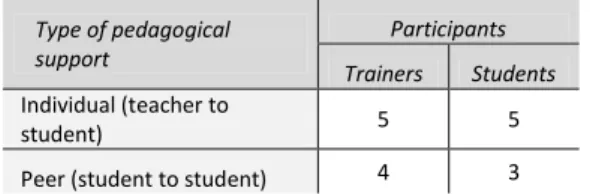
according to their experience, could benefit learning. Trainers revealed that pedagogical support is very important for low achievers, both when given individually by the teacher to a student and also when given between students in activities that involve pair or group work (Table4).
“Trainer T: Work in pairs is essential in this type of training. They (students) work much better and feel more at ease when working with someone.”
“Trainer A: It depends on the learning unit. They need care (...) they want caring attention, which sometimes is a way for them to feel supported, to believe that they can do it. (…) they need presence. Presence (of a teacher) is fundamental for them.”
The same experience was shared in the statements of the students:
“Student F: (…) I work in the carpentry workshop, and
like it mainly because of the teacher, who is very cool. Whatever I need he is there for me…I’ve never seen a teacher like him, I was really amazed. I like him and like this school because it’s different.”
“Student V: (…) the teacher motivates me, motivates all of us and never gives up on us. It’s something I think is good.”
“Student R: For me was gym class, because we are more close to each other, more united.”
Table 4: Number of participants who considered peda-gogical support important.
Type of pedagogical support Participants Trainers Students Individual (teacher to student) 5 5
Peer (student to student) 4 3
The analysis revealed a correlation between pedagogical support and individual social competences, highlighting that when students have mostly individual pedagogical support, they are able to compromise with their own learning experiences. In the discussion with teachers, they did not emphasize examples of pedagogical support, but reported to prefer students to be involved in group work activities and benefiting from peer support.
During the discussion sessions, the researcher questioned about the need of pedagogical support of these students both in a face-to-face learning and in at a distance e-learning environment. This generated refec-tion but not clear answers. The participants had some difficulty focusing on the idea of students doing only online study. Nevertheless two of the participant teachers, clearly stressed the idea that, according to their experience, they did not consider low achievers able to develop an e-learning course without face-to-face pedagogical support.
Pedagogical Support was very linked to face-to-face settings: a teacher/trainer who provides support to stu-dents in their instructional program, or a teacher/trainer who nurtures the right conditions for students peer support. An effective pedagogical support regarding an online/distance learning environment was more difficult for teachers/trainers to foresee. This may be a result of the lack of personal experience in online/distance teaching and learning. Only one of the teachers/trainers had participated in an online course. A first perspective meets the international research community concern about the difficulty in identifying the positive influence that learning in online/distance environments, more recently MOOCs, may have on students. The second perspective relates to the overlapped vision teachers/ trainers revealed about pedagogical support in face-to-face and online settings. It was consensual that pedagogical support in a face-to-face setting has a positive impact on low achievers learning. In contrast,
61
teachers and trainers did not envision, what someresearchers state as, the existing and powerful disruptive change in the roles of teachers and students when working and interacting in an online environment (Garrison & Anderson, 2003; Bielaczyc & Blake,2006; Siemens & Tittenberger, 2006). Additionally, there is a growing recognition that technology alone cannot change education, but technology and pedagogy will form a pair for success: “the technology sets the beat and creates the music, while the pedagogy defines the moves” (Bielaczyc & Blake, 2011; Garrison, 2011, p. 81).
Self-efficacy was the final category that emerged from
the content analysis. This category relates to the per-ception of personal competence to succeed in a specific activity or domain, and the motivation to initiate, sustain and persevere in an action or set of actions to reach a specific goal (Bandura, 1995, 2006; Maddux, 1995). The content analysis revealed that the category of self-efficacy correlated with the category of pedagogical support by five participants (4 trainers, 1 student), describing the enrichment of proposing activities with a learner-centred approach, in order to foster students motivation, sense of worth and success. This fosters the perception of personal competence to succeed in a specific activity.
“Student R: (…) Carpentry marked me because I had no idea I could do it (the work), and I can do it!”
When participants (total 6) discussed the type of activities and topics more relevant to work with students, there was a clear relation with their day-to-day needs, previous experiences in specific domains and their need to enter the labour market. Activities described by 6 of the participants (4 students):
•Fill out an application;
•Communication in a work situation; •Knowledge for a work situation;
•Write a cover letter and a CV to apply for a job.
“Student D: In this (school) it’s kitchen because it can be an opportunity for my life. I can work in other countries and make money doing this.”
The analysis also reveals that self-efficacy correlates with social competence, focusing on the role teachers and trainers have in helping students build their self-efficacy, enhancing the development of individual and social com-petence. By proposing to students activities in which they recognize their interests and experiences and relate more significantly to them and to others, it may help students gain confidence in their work and become better integrated in school and society.
“Student V: I liked this school because it gave me the will to study again. In other schools, I didn’t do anything, I was always leaving (class). In this school I gained the will to study again, to learn again.”
Low achievers have, by definition, a past experience of academic failure and discouragement feedback by rele-vant figures such as teachers. Previous experiences and social persuasion are two fundamental sources of self-efficacy. In order to construct self-efficacy, teachers and trainers rather than simply verbally transmitting the message that low achievers are able to do something, they should concentrate their efforts to structure learn-ing situations in which to experience success is probable (Bandura, 1995).To have the opportunity of experiencing mastery and to be reinforced by it is decisive to build efficacy believes, personal trust, and resilience. Therefore, in particular during the transition to adult-hood, it may represent a turning point, shifting from at risk trajectory to a recovery trajectory (Rutter, 1990; Werner & Smith, 2001).
4 Conclusions
The qualitative and exploratory information collected through the focus groups sessions, was undoubtedly relevant for the proposal of activities and topics to explore in LIBE online courses. Teachers, trainers and students conveyed with strong voices, their view about the key skills and competences for low achievers, the target audience of LIBE courses.
The content analysis revealed literacy skills as the most important for low achievers. Developing literacy skills enhance their ability to communicate effectively with others, to read better and interpret what they read in all activities of life, both in a face-to-face setting and an online environment setting. This is an output for LIBE courses, have a stronger series of activities for this domain.
In the ICT domain, which also integrates literacy skills, the needs of low achievers were specifically focused on the ability to access, retrieve and evaluate the infor-mation on the Internet. A common lack in distinguishing trustworthy from unreliable information was pointed by participants as difficulties observed in low achievers. The need to develop ICT competences was very much related to the need to read and interpret information online related to various tasks of work and day-to-day life events, but also to gain awareness and learn about how to communicate and manage information online.
From the discussions also emerged the need students low achievers have of pedagogical support from teachers and trainers and between peers. This support was conveyed as relevant and determinant of students’ self-efficacy. The more students feel confident, motivated and supported, the more enhanced is their participation in school and learning. This is unquestionably relevant for the proposal of LIBE courses that will need to ponder the type of support given, although it is foreseen, in the project, to produce courses a high level of personali-zation in learning.
Many examples of successful learning experiences with low achievers were approved. Nevertheless, the learner-centred approach where commitment to learning is mainly due to the motivation towards the activity is based on different topics related to students’ day-to-day
62
lives. The use of specific software and social networkingapplications was also recurrently suggested.
The above-mentioned, together with the results of analysis of the focus groups from other partner countries (Italy, Norway) will have implications in the developed learning activities for LIBE courses.
Acknowledgments
We thank all the team members of project LIBE “REF. NO. 543058-LLP-1-2013-1-IT-KA3-KA3MP – LIBE” for the contributions, and the European Commission the funder of this project. This project has been funded with support from the European Commission. This publication reflects the views only of the author, and the Commission cannot be held responsible for any use which may be made of the information contained therein.
REFERENCES
Bandura, A. (1995). Self-efficacy in changing societies: Cambridge University Press.
Bandura, A. (2006). Toward a Psychology of Human Agency. Perspectives on Psychological Science, 1(2), 164-180. doi: 10.1111/j.1745-6916.2006.00011.x
Berger, A., & Croll, J. (2012). Training in basic internet skills for special target groups in non-formal educational settings – conclusions from three pilot projects. Research
in Learning Technology, 20, 377-398.
Bielaczyc, K., & Blake, P. (2011). Shifting epistemologies:
Examining student understanding of new models of knowledge and learning. . Paper presented at the 7th
International Conference on Learning Sciences (ICLS ‘06). Blin, F., & Munro, M. (2008). Why hasn’t technology disrupted academics’ teaching practices? Understanding resistance to change through the lens of activity theory.
Computers & Education, 50(2), 475-490.
Commission of the European Communities (2005). Communication to the Spring European Council - Working together for growth and jobs, a new start for the Lisbon Strategy - Communication from President Barroso in agreement with Vice-President Verheugen. Brussels, Commission of the European Communities. Cooper, S., & Sahami, M. (2013). Reflections on Stanford's MOOCs. Communications of the ACM, 56(2), 28-30.
DeBoer, J., Ho, A. D., Stump, G. S., & Breslow, L. (2014). Changing “Course” Reconceptualizing Educational Variables for Massive Open Online Courses. Educational
Researcher, 0013189X14523038.
Dodge, K. (1985). Facets of Social Interaction and the Assessment of Social Competence in Children. In B. Schneider, K. Rubin, & J. Ledingham (Eds.), Children’s
Peer Relations: Issues in Assessment and Intervention
(pp. 3-22): Springer US.
European Commission. (2005). Working together for growth and jobs - A new start for the Lisbon Strategy. Brussels: European Commission.
Everett, R. (2002). MLEs and VLEs explained. JISC MLE
Information Pack, 1.
Fraillon, J., Schulz, W., & Ainley, J. (2013) International Computer and Information Literacy Study: Assessment Framework. Amsterdam: International Association for the Evaluation of Educational Achievement.
Garrison, D. R. (2011). E-learning in the 21st century: A
framework for research and practice: Taylor & Francis.
LIBE. (2014a). Deliverable 3.1 LIBE Framework of ICT key information processing competencies.
LIBE. (2014b). Deliverable 3.3 LIBE Focus groups with target groups.
Maddux (Ed.). (1995). Self-efficacy, adaptation, and
adjustment. Theory, research, and application. New York:
Plenum Press.
OECD. (2007). Glossary of Statistical Terms.
OECD. (2012). Literacy, Numeracy and Problem Solving in Technology-Rich Environments: Framework for the OECD Survey of Adult Skills (pp. 57).
OECD (Cartographer). (2013a). OECD Skills Outlook 2013: First Results from the Survey of Adult Skills. Retrieved from http://skills.oecd.org/skillsoutlook.html
OECD. (2013b). Technical Report of the Survey of Adult Skills (PIAAC). In O. Publishing (Ed.).
Rutter, M. (1990). Psychosocial resilience and protective mechanisms. In J. Rolf, A. Masten, D. Cicchetti, K. Nuechterlein, & S. Weintraub (Eds.), Risk and protective
factors in the development of psychopathology (pp.
181-214): Cambridge University Press.
Trower, P. (1995). Adult social skills: State of the art and future directions. In W. O’Donohue & L. Krasner (Eds.),
Handbook of psychological skills training: Clinical techniques and applications (pp. 54-80). New York: Allyn
and Bacon.
Urban, M. (2012). Editorial. European Journal of
Education, 47(4), 477-481. doi: 10.1111/ejed.12011
Vaux, A. (1992). Assessment of social support. In H. Veiel & U. Baumann (Eds.), The meaning and measurement of
social support. New York: Hemisphere.
Werner, E., & Smith, R. (2001). Journeys from childhood
to the Journeys from childhood to the midlife: Risk, resilience, and recovery, resilience, and recovery. New