I A Work Project, presented as part of the requirements for the Award of a Master Degree in
Management from the NOVA – School of Business and Economics.
SOCCER CLUBS AND SUPPORTERS: CHANGES IN THE LAST TWENTY YEARS
Martim Cruz da Costa Álvares, 3551
A Project carried out on the Master in Management Program, under the supervision of: Professor José Tavares
II I. Abstract
This Work Project focuses on the connection between football clubs and supporters and its main purpose is to analyze how such relationship has changed in the last twenty years. The starting point was to conduct a secondary data investigation, which allowed generating eight hypotheses. Thereupon, these hypotheses were evaluated through face-to-face interviews and survey observations. After such field work, it was possible to demonstrate the growing diversification of the audience spectrum and the intensified degree of involvement in the relationship between clubs and supporters, as well as the expected complexity of the said connection. Additionally, we were able to obtain some clarity on the reasoning behind the traditional-consumer element, the transition from passive to active and the financial requirement clubs have with supporters. However, issues related with loyalty and transparency remain arguable. The changes previously referred were estimated according to demographic characteristics and also elucidated by former field experts.
III III. Acknowledgements
First of all, a word of gratitude to Deloitte, namely Associate Partner Bruno Marques and Partner Sérgio Monte Lee for their approval on changing the admission date, which allowed me to fully commit with the Work Project and excluded the chances of underperformance in the professional and/or academic field.
Secondly, I wish to thank my Work Project advisor Professor José Tavares for being a skilled tutor, a source of stimulating discussion and for delivering relevant help regarding all sorts of matters. Professor José helped devise and supported my idea on the topic selection. If one is allowed a more informal and emotional acknowledgement, then Professor José definitely gave me the ‘wings’ and guidance to develop a project I was keenly immersed from the first day to the last.
Also, I want to thank my family, in particular my parents, two brothers and aunts, who are my utmost source of inspiration and, without them, this adventure would not be the same. I have been fortunate to be a part of this family and I appreciate their effort, namely to spread the survey that allowed me to collect data for this Work Project.
In that respect, I am also indebted to all the respondents of the survey. Additionally, I would like to recognize all the interviewed professionals, who were kind enough to share their time, knowledge and experience, providing tremendous help to this Work Project.
Finally, a grandiose thank you to my friends and colleagues for being cheek by jowl with me and providing assistance whenever needed.
“The ultimate measure of a man is not where he stands in moments of comfort and convenience, but where he stands at times of challenge and controversy.” – Martin Luther King, Jr.
IV IV. Table of Contents
1.Introduction………...…1
2. Literature Review………...…..2
2.1. Definition of soccer supporter………...…2
2.2. How much has the relationship changed? Evolution in the last decades……..…3
2.3. How and by how much have the financial interests and requirements shifted the relationship?...6
2.4. Marketization of soccer, a real issue?...8
3. Hypotheses………...…9 4. Methodology………..….10 5. Results……….…10 5.1. Online Survey……….……..10 5.1.1. Structure……….………10 5.1.1.1 Demographic Information……….………...11 5.1.2. Data Analysis……….……11
5.1.3. Relation between hypotheses according to characteristics……….…...17
5.2. Face-to-face Interviews………19
5.2.1. Structure……….19
5.2.2. Main Insights from face-to-face interviews………...20
6. Discussion………....22
7. Work Project Limitations………...24
8. Conclusion………...….25
9. Further Research………...…26
1 1. Introduction
In the fall semester of 2017, I attended the course Global Business Challenges at Nova SBE where I studied the non-market factors that affect economies, particularly the impact they have in companies. Together with my academic and personal background, I spotted a research topic that would apply those concepts to soccer clubs. This led me to set up the following research question for my Master Thesis: “How has the relationship between clubs and supporters changed in the last twenty years?”.
The phenomenon of marketization has had an impact in the different spheres of soccer. The relationship between club and supporters is no longer the same, and the typical traditional supporter has evolved into several different personas. Throughout time, financial, social and cultural factors have shaped the way clubs and supporters interact. Changes can be pinpointed according to specific criteria and a logic behind those shifts was clarified.
Having in mind the literature review, the Work Project’s (WP) main purpose is: (i) to provide a definition of the concept of “soccer supporter”, understand the transformation of the relationship between soccer clubs and supporters in the last decades, and confirm the marketization of the sport; (ii) apply a methodology to formulate and study the research hypotheses through survey results and face-to-face interviews; (iii) deliver valid conclusions regarding the changing relationship and define further research.
Due to confidentiality reasons, the names of the interviewees will not be disclosed, unless otherwise authorized. Such anonymity is required not only given the public profile of some, but also to ensure the candid and unrestrained sharing of their experience/information.
2 2. Literature Review
2.1. Definition of soccer supporter
For the sake of this project, one must start by defining the concept of soccer supporter. Soccer has been through a tremendous “marketization” – from a sport to an industry – and for that reason we are able to tackle this transition by identifying different (modern) spectators’ personas (Giulianotti, 2002). There are four model-type categories (see Appendix 1), which are described below, and are established by two essential paired distinctions: traditional-consumer and hot-cool.
According to Critcher and Taylor (1979), the traditional-consumer horizontal axis assesses the basis of the individual’s investment in a specific club. For instance, traditional spectators are characterized by a long-established, community-based and family relationship with the club. In contrast, the consumer enthusiasts have a market-centered connection to the club (represented by the consumption of club products).
The hot-cool vertical opposition represents the divergent degrees to which the institution is crucial to the individual’s project of self-development. The hot faction highlights profound sorts of identification and solidarity with the club (Baudrillard and McLuhan, 1990).
Supporters: located in the traditional/hot quadrant, this group of people have a long-lasting and affinity investment with the club. Taylor (1971) claimed they are most of the times part of associations (supporters’ groups) and generate unique atmospheres on match days (Bale, 1994) with voices and bodies that act in unison as part of the chants. This level of affiliation cannot be conquered by acquiring the latest club merchandising, it is about being present in club’s less fortunate times (Thornton, 1995), participate in rituals surrounding match days and enjoy lively and active rivalries with other clubs (Armstrong & Giulianotti, 2001).
Followers: placed in the traditional/cool four-square, these are followers of the players, coaches and other soccer celebrities besides being followers of the clubs. Research by Cohen (1978)
3 illustrated that the followers are not part of a permanent journey side by side with the club, instead they have historical connections to a club due to its hiring of certain players or managers (e.g. Galácticos at Real Madrid). Also, this group differs from Supporters by the fact they do not exhibit the sort of inextricable relation with the club and the neighboring communities. In fact, they might have a rapport with traditional hot supporters, but they lack the sense of belonging to a club.
Fans: situated in the consumer/hot dimension, they are contemporary fans of a soccer club or its players (specially its superstars). According to Conn (1997), their connection with the club is more fragile than the one of the Supporters, meaning they are less loyal (in case of the inability to fulfill season objectives). The power of connection with the club and its players is usually represented by the impulsive buying of related products and they believe triumph relies on larger financial investment from all forms. Normally, fans are politically passive, but able to discuss their idols’ private life and even stalk them sometimes (Thompson, 1997).
Flaneurs: based in the consumer/cool interlacement. Benjamin (1999) argued this group is defined as the postmodern spectator, the offbeat urban social type and less gender specific. Although they went through a considerable amount of experiences (television and internet), they are disconnected from those events and soccer clubs in general (Featherstone, 1995). The social practices are to a greater extent approaching consumption and appreciation of popular figures rather than acknowledgment of a club’s identity.
2.2. How much has the relationship changed? Evolution in the last decades
After the hooliganism movements of the 1970’s and the stereotyped masculine working-class audience, in the late 1990’s the social distribution of the spectators evolved into something more diverse and heterogeneous (Taylor, 1979). Nevertheless, family and local traditions remained, memorizing the clubs’ history was still a must and imaginative way to complain
4 against the referee continued (Gorman, 2011). The growing importance of the pop culture gave birth to entertaining chants (Sked, 2017).
In the meantime, technical and sales departments were created at the clubs to produce a whole experience to the spectator, rather than just another Sunday league match. From passive to active supporter, one must recognize the conditions that forged a dynamic relationship between the club and its supporters (Cleland, 2010).
In the past, clubs faced financial obstacles and thus exclusively through public and private financial participations from their supporters and the local institutions were able to stay in business (Kuper, 2010). Besides the match-day tickets, donations were indispensable. However, Cleland (2010) explained that the connection between clubs and supporters was still characterized to some extent as being exclusive.
Giulianotti (1999) argues that the sport has suffered a huge transformation in the early 1990’s, the so called hyper commodification of soccer, as a consequence of the new and great sources of capital appearance. In addition, social and cultural changes took place with the higher migration of elite labor, a progressive expansion of intracontinental and worldwide competitions, colossal increases in top players’ wages, brand-new media platforms and advanced forms of cultural terminology.
In fact, these modifications encourage attempts to create a more inclusive relationship between clubs and supporters in general. According to Abercrombie and Longhurst (1998), the media was one of the channels of a two-way talk, as well as fanzines. Also, the creation of supporter groups and associations was the attempt to move from a ‘passive’ involvement to an ‘active’ collaboration (Crawford, 2004). In these forums of discussion, supporters claimed the game to be theirs, not the private property of the owners and unknown executives (Jary, 1991).
5 Throughout time, the voice of supporters increased in level of importance and their participation was considered to be successful. Clubs realized they could progressively involve more and more the crowd in the game and actually take advantage from their interest and desire to be involved. The fear that soccer clubs mutate from conventional community clubs into corporate business organizations becomes a real issue (Kennedy and Kennedy, 2012). Therefore, Arnaut (2006) claimed managers must focus on achieving the perfect equilibrium between the marketization of their club (and its advantages), and respecting and satisfying the needs and wants of the fans. Although clubs’ directors try to find the right balance, these transformations led to discontent of many supporters and the growing cost of watching a soccer match. In other words, we witnessed a softening on the number of traditional supporters and an escalation of the contemporary consumer fans (Krabbenbos, 2013).
After all, the massive funds that soccer clubs generate were solely possible because of the growing supporter demand for the sport. People are the market for match-day, broadcasting, commercial and merchandising gains. Additionally, supporters are the audience of the stadia and for that reason belong to the product itself (i.e. the crowd), the one that is traded to “at home” customers. In sum, the great rise of financial capital in the sport is the result of the merchant exploitation of soccer fans and their fidelity to the club (Hamil and Chadwick, 2010). As a matter of fact, loyalty diverges along the different personas. To be more precise, the social, cultural and economic shifts have been producing less loyal fans. According to Giulianotti (1999), the middle and higher classes – target of the modernized channels – regularly follow the more triumphant football clubs and they change their preferences often. On the contrary, the lower class – present in the victorious and disastrous moments of the club – are normally more connected to local distinctiveness and stay devoted.
Moreover, the understanding of the ‘savoir-faire’ of a supporter as a human being, determines the chances of success for a club in the relationship. In a changing and highly competitive
6 environment where advertisement, attraction and retention became a lifework effort, Rein, Kotler & Shields (2006) developed a model for the ‘puzzling’ fan according to seven characteristics of the market in which the same is a stakeholder: pressurized competitive environment, higher fan expectations, the paradox of commercialization, new technology, individualism, changes in family structure and behavior, and time pressure.
Other scholars highlighted different aspects of the connection. They refer to the challenge (of soccer clubs) to build a stronger and more loyal relation with the new consumer fans and to understand the reservations of the traditional supporters. Even though some assimilate the need of the club to stand financially competitive, others will require the club not to lose the one-of-a-kind identity (Melin, 2006).
2.3. How and by how much have the financial interests and requirements shifted the relationship?
The reader must be wondering how soccer has arrived at its current situation. More specifically, one might have questioned, how does a sport become an industry at such an exponential rate? The answer is quite simple. Andrews and Harrington (2016) argue that the sector is controlled by a minority elite of clubs, players, agents and owners concentrated in Europe’s top leagues. The countless clubs apart from this exclusive group, have limited resources and together they form the base ground of the financial pyramid.
The gap between the richer and the poorer clubs has increased throughout the years due to brand-new revenue mix (e.g. sponsorships, broadcasting, etc) and complex & enormous transactions (of players, club ownership and funding). Thus, this particular environment gives origin to illegal operations and schemes such as money laundering, match-fixing and other sorts of illegal activities (Salvo, 2011).
Thereupon, the financial interests and requirements have an impact on the relationship between supporters and the club. As a consequence of the commercial exploitation of the fans, nowadays
7 the clubs are more and more committed to provide the best match experience possible. They seek to build a distinctive relationship by showing that supporters’ opinions matter. For this purpose, paying attention to supporters’ desires and the resourceful use of data collected from fans have become worthwhile assets (Halicka, 2017). To illustrate, Sporting Clube de Portugal has inserted a man-of-the-match voting (refer to Appendix 2) into the fans’ match experience, exposing them to a club’s app with other sorts of advertisement (Sporting, 2014).
Clubs’ departments are progressively concerned in terms of involving and take into consideration supporters’ point of view. Zimmermann (2017) argues the fan itself is more demanding and the same requests to be part of a wholly mesmerizing experience. As an example, benefiting from the fact that athletes are evolving more into celebrities, Tottenham’s new stadium will institute a superior initiative called the ‘The Tunnel Club’. This concept arranges fans seats next to the dugout and a space inside the stadium where fans can take a look inside the player tunnel.
The match-day experience has not only explored the followers dream to witness players’ mood inside the tunnel, but it also reached a level of personalization that has not been seen before. Clubs profit from the revolution in the digital world by creating smart and user-friendly services to give answer to fans’ wishes during the game. Futebol Clube do Porto has took this idea to a whole new level (confront Appendix 3) by displaying a new app (Seat Delivery) where “fans can order food, drinks and merchandising products directly from their seats at any time during the match” (FC Porto, 2018).
Last but not least, there are supplementary reasons why clubs frame on the principals and morals of the fans and supporters. Clubs must cultivate its connection with individual fans as carefully as they tie-up with sponsors. Without those steadfast relations, the brand will be less valued by the sponsor (Johnson, 2015). The significance of the sponsorship deals can be seen in the recent
8 corporate partnership between Chelsea FC and Yokohama Rubber: a US$57 million-per-year deal for the next 15 years, representing almost 20% of the club’s total revenue (Smith, 2016). 2.4. Marketization of football, a real issue?
There will always be a discussion over the event or period in which soccer became hyper commodified, meaning from a sport to an international business. Some argue it started in the late 80’s with the economic, social and cultural changes, which were previously mentioned. Others believe it began with the first partnerships between clubs and enterprises. One thing is absolutely clear - it happened and it is not likely to go away.
Regarding the professionalization of soccer, the last records delivered by FIFA declared an increase from 242 million players in 2000 to 265 million in 2006 (FIFA, 2007). Similarly, the number of players in Portugal registered in 1996 was about 95,746, and last year there were 177,021 certified players (FPF, 2017).
Besides, the European professional football market recorded €24.6 billion of revenues in the season 2015/16 (refer to Appendix 4) compared to €13.6 billion in 2006/07. Within the said market, the Premier League revenue growth shines apart from the other competitions, with revenues of €685 million in 96/97. By comparison, revenues in 17/18 are estimated to reach a stratospheric value of €5.08 billion (Statista, 2018).
Figure 1 – Premier League clubs’ revenue by stream from 2012/2013 to 2017/2018 in million U.S. dollars (Statista, 2018): key contribution from the increasing broadcasting revenues
9 Another way to confirm this phenomenon is by looking at the number of viewers in the major international competitions. To be more precise, 3.2 billion individuals watched the 2014 FIFA World Cup (almost 46% of the world population). In fact, more than one billion people watched at least one minute of the final match of this massive event (FIFA, 2015).
In addition, there are trends in today’s soccer that characterize this contemporary era. First of all, the increasing presence of outside investors with huge participations in European football clubs – coming mainly from Middle East, but also Asia. Secondly, the growing interest of Chinese clubs in players from European top leagues – breaking transfer records and seducing players with unimaginable salaries. As a consequence, the market is continuously overpriced, with 9 out of 10 biggest transfers above €80 million happening in the space of 4 years (Transfermarkt, 2018).
In conclusion, we stand before a sport - the most popular in the world - that has grown remarkably in the last decades and where soccer clubs seek the utmost to exploit its business potential. As to the popularity of the sport itself, we can thank the efforts of organizations like FIFA and national federations. On the economic side of the ‘business’, one may say partnerships with corporations, diversified revenue sources (TV deals, transfers, sponsorships, etc) and new types of (foreign) ownership justify the tremendous evolution.
3. Hypotheses
Having in mind the ideas explored in the previous literature review, the subsequent hypotheses (H) were outlined (the comparison refers to the current situation versus twenty years ago):
Hypothesis Description
H1. Nowadays, supporters are consumer fans with a market-centered relationship with the club (reflected in the centrality of consuming club products) rather than a traditional posture (with local and popular cultural identification with the club).
H2. The audience in football is more heterogeneous.
H3. Nowadays, supporters are more active and more participative than before.
H4. "The game is ours". The supporters' opinion matters more and more to the club, meaning the relationship is more inclusive.
H5. Clubs demand economically more from a supporter. H6. Supporters are less loyal to their club than before. H7. The relationship is more complex.
10 H8. The relationship is more transparent.
Table 2 – Hypotheses inferred from secondary data analysis
4. Methodology
To address the WP research question: “How has the relationship between club and supporters changed in the last twenty years?” a methodology combining three assorted techniques was followed: 1) a secondary data available in online sources, books and academic articles; 2) a qualitative data collection from face-to-face interviews with two former Presidents of Sporting Clube de Portugal (A and B), one former Chairman of the Board of the General Meeting at Sport Lisboa e Benfica (C) and one former Vice-President of Sport Lisboa e Benfica (D); and 3) a quantitative data collection from online survey with a sample of 260 respondents.
These methods were employed sequentially. In the first place, a secondary data analysis was carried out in order to formulate hypotheses. The hypotheses were then confirmed, or not, through the survey outcome and with the face-to-face interviews.
This research procedure, called ‘Triangulation’, has emerged on the principles that (i) diversified methods and data sources are needed since every technique/data source has its limitations (Denzin, 1978); (ii) the triangulation of evidence unleashed by various sources of proof raise the validity of the findings (Eisenhardt, 1989; Patton, 2002; Denzin, 1978)
5. Results
5.1. Online Survey 5.1.1. Structure
The survey was divided into 3 main parts: welcome or introduction note, demographic information and close-ended type question or body of the survey. More specifically, the welcome note gave a little context to the surveyor by explaining the purpose of the research. Then, the demographic information* was followed by the starting question “Do you consider yourself a football fan?”. Finally, the multiple-choice questionnaire with the chance to rate on
11 a scale from 1 (strongly disagree) to 5 (strongly agree) the eight research hypotheses. The section below featuresthe results and supplies valid material for discussion (see Appendix 5). 5.1.1.1. Demographic information*
The demographic information included age, gender, nationality and level of education of the respondents as it could meaningful differentiate views of an older segment versus a younger group, make the distinction in terms of gender opinion, determine the geographic boundaries and understand the impact of schooling on the topic.
5.1.2. Data Analysis
This section displays the 305 respondents from which, 260 fully filled the survey. As such, the sample of 260 answers was the one taken into consideration for the discussion. Regarding age, 65 of the respondents are between 20 and 29 years old and 195 with 30 years or more.
The vast majority (95%) is Portuguese. In terms of gender, the survey was answered by 195 men and 65 women. Fifthly, around 82% of the sample has a Bachelor or higher Degree. At last, 190 of the respondents are fans of football and the rest not.
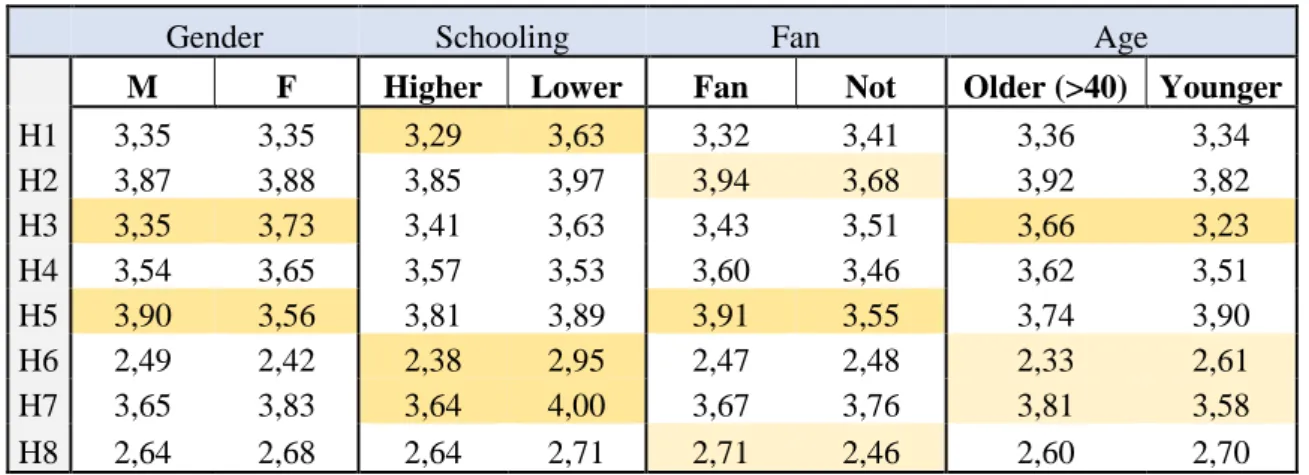
In this data analysis segment, an average analysis of the scores was also conducted and possible conclusions were drawn. The idea was to understand which characteristics influence each hypothesis.
Gender Schooling Fan Age
M F Higher Lower Fan Not Older (>40) Younger
H1 3,35 3,35 3,29 3,63 3,32 3,41 3,36 3,34 H2 3,87 3,88 3,85 3,97 3,94 3,68 3,92 3,82 H3 3,35 3,73 3,41 3,63 3,43 3,51 3,66 3,23 H4 3,54 3,65 3,57 3,53 3,60 3,46 3,62 3,51 H5 3,90 3,56 3,81 3,89 3,91 3,55 3,74 3,90 H6 2,49 2,42 2,38 2,95 2,47 2,48 2,33 2,61 H7 3,65 3,83 3,64 4,00 3,67 3,76 3,81 3,58 H8 2,64 2,68 2,64 2,71 2,71 2,46 2,60 2,70
12 H1. Nowadays, supporters are consumer fans with a market-centered relationship with the club (reflected in the centrality of consuming club products) rather than a traditional posture (with local and popular cultural identification with the club).
Graph 4 – Survey results in absolute value for the first hypothesis (WP’s author based on survey observations)
With respect to the traditional-consumer orientation, more than half - approximately 55% - of the surveyors partly or fully agreed that nowadays, the relationship between supporter and club is more market-centered. However, around 26% of the survey participants still consider the relationship to be a traditional one. The remaining opinions lie in the middle of this concept. Regarding this first hypothesis, there is a significative difference on the average between higher educational level (people holding a bachelor, masters and/or other) and lower (elementary school and/or secondary school). In a question where answers are spread across the rating scale, the evidence shows that inferior schooling people are surer in a market-centered relationship than the other division.
H2. The audience in football is more heterogeneous. 0
50 100 150 200
Disagree Neither Agree
Strongly disagree Somewhat disagree Neither disagree or agree Somewhat agree Strongly agree
13 Graph 5 – Survey results for the second hypothesis (WP’s author based on survey observations)
From this statement, we concluded that more than 75% of the people surveyed somewhat or entirely recognize a more diverse group observing a football event compared with twenty years ago. Also, almost 12% is not sure about this fact and the remaining does not concur with an increasing heterogeneous audience.
With respect to this second assumption, there is a slight disparity on the average between people considering themselves a fan and the ones that are not. In a topic where the answers are concentrated in the agree and strongly agree dimensions, the fans are more confident about a diverse spectator group than the not fan respondents.
H3. Nowadays, supporters are more active and participate more than before. 0
50 100 150 200
Disagree Neither Agree
Strongly disagree Somewhat disagree Neither disagree or agree Somewhat agree Strongly agree 0 50 100 150 200
Disagree Neither Agree
Strongly disagree Somewhat disagree Neither disagree or agree Somewhat agree Strongly agree
14 Graph 6 – Survey results for the third hypothesis (WP’s author based on survey observations)
Regarding the dimension active-passive, close to 38% fairly agree fans have become more participative and almost 16% are free from doubt. Nonetheless, approx. 23% believes followers and flaneurs characterize the football public. The other 61 respondents, acknowledge the same extent of involvement.
Having in mind the active-passive binomial, there are two average contrasts we can possibly highlight. For instance, we are in the presence of a hypothesis where half of the measurer group concur with the statement. To be more specific, the female segment shows support to an increasing participation of supporters throughout time, when compared with the male assembly. Furthermore, the senior age (>40) group argues in line with the female opinion.
H4. "The game is ours". The supporters' opinion matters more and more to the club, meaning the relationship is more inclusive.
Graph 7 – Survey results for the fourth hypothesis (WP’s author based on survey observations)
If we consider the number of surveyors that moderately confirm plus those which strongly agree with the hypothesis, we can appraise more than 62% of the whole sample. On the other hand, around 19% are convinced that supporters still do not have a say. The remaining participants – 19% - think the relationship is as inclusive as it was before.
H5. Clubs economically demand more from a supporter. 0
50 100 150 200
Disagree Neither Agree
Strongly disagree Somewhat disagree Neither disagree or agree Somewhat agree Strongly agree
15 Graph 8 – Survey results for the fifth hypothesis (WP’s author based on survey observations)
The debate on whether clubs economically demand more or not from a supporter has revealed solid results. 61 respondents thoroughly agree the financial claim is higher than before. The larger majority – 119 surveyees – somewhat corroborate with this circumstance. Additionally, 54 of the participants present a neutral judge by considering the requirement has kept constant. Exactly 10% does not comply with the view of the previous ones.
The debate on whether clubs economically demand more or not from a supporter has revealed solid results. Before pointing up two aspects, it is relevant to refer that the majority of the sample confirms the assumption. On the one hand, men are more certain on this circumstance than women. On the other hand, fans are the ones strongly supporting that clubs are requiring more financially, when compared with the not fan respondents.
H6. Supporters are less loyal to their club than before. 0
50 100 150 200
Disagree Neither Agree
Strongly disagree Somewhat disagree Neither disagree or agree Somewhat agree Strongly agree 0 50 100 150 200
Disagree Neither Agree
Strongly disagree Somewhat disagree Neither disagree or agree Somewhat agree Strongly agree
16 Graph 9 – Survey results for the sixth hypothesis (WP’s author based on survey observations)
Talking of loyalty, the degree of discord with the hypothesis is considerable. Almost 30% of the sample fully rejects this possibility and 27.7% somewhat disagrees. Furthermore, 17.7% believes loyalty has remain equal and the 65 left respondents consider loyalty to be a scarce component in supporters nowadays.
With regard to the loyalty topic, there is one major discord we can focus our attention and one minor change on the average. Taking in consideration, we are in the presence of an assumption where the majority disagrees, the higher schooled party is opposing the most to the statement. Also, the elder crowd shares the opinion of the previous group by claiming loyalty to a club has not negatively changed.
H7. The relationship is more complex.
Graph 10 – Survey results for the seventh hypothesis (WP’s author based on survey observations)
With regard to evaluating the complexity of the relation, the great majority claimed this variable has widen when compared with twenty years ago. More specifically, 54 of the surveyors are completely sure about the enlargement of the complexity and 113 of the same sample, somewhat agree with the case. 59 of them have the exact opinion they had twenty years before and the remaining 32 have a different impression.
0 50 100 150 200
Disagree Neither Agree
Strongly disagree Somewhat disagree Neither disagree or agree Somewhat agree Strongly agree
17 When we address the complexity of the relationship, we must underline two average differences. In a pool of respondents that acknowledges favorably to this growing complexity, we can firstly refer that the lower apprenticeship band is giving more validation to the hypothesis than any other group. Similarly, the older class emphasizes the complexity of the relationship.
H8. The relationship is more transparent.
Graph 11 – Survey results for the eighth hypothesis (WP’s author based on survey observations)
Lastly, the transparency of the connection follows a similar pattern of the previous hypothesis. Close to 15% of the individuals consider the relationship not to be transparent at all, almost 33% partly disagree with the rising transparency throughout time and 29.6% neither agree or disagree with the statement. The other 60 respondents think transparency has expanded. Lastly, the transparency issue has a specific and interesting discordance we can look at. In a question where the vast plurality disagrees with the statement, the ‘not a fan’ mass is even more convinced on the less transparent relationship between club and supporters, than the fan side. 5.1.3. Relation between hypotheses according to characteristics
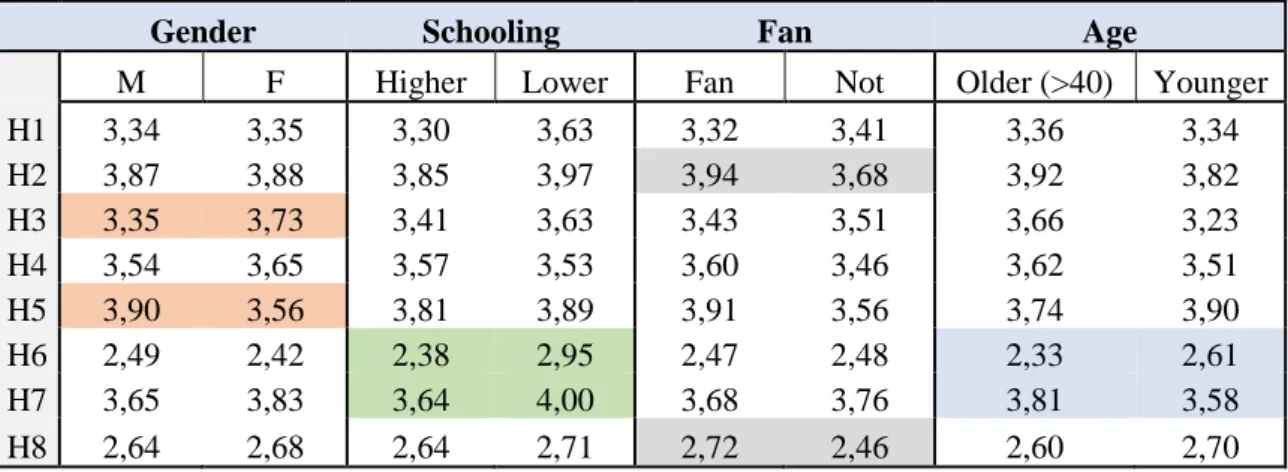
Following the average analysis, there is one aspect the reader must be also aware: the relationship between hypotheses according to a specific characteristic. For that reason, in this division we will identify and interpret potential links.
0 50 100 150 200
Disagree Neither Agree
Strongly disagree Somewhat disagree Neither disagree or agree Somewhat agree Strongly agree
18
Gender Schooling Fan Age
M F Higher Lower Fan Not Older (>40) Younger
H1 3,34 3,35 3,30 3,63 3,32 3,41 3,36 3,34 H2 3,87 3,88 3,85 3,97 3,94 3,68 3,92 3,82 H3 3,35 3,73 3,41 3,63 3,43 3,51 3,66 3,23 H4 3,54 3,65 3,57 3,53 3,60 3,46 3,62 3,51 H5 3,90 3,56 3,81 3,89 3,91 3,56 3,74 3,90 H6 2,49 2,42 2,38 2,95 2,47 2,48 2,33 2,61 H7 3,65 3,83 3,64 4,00 3,68 3,76 3,81 3,58 H8 2,64 2,68 2,64 2,71 2,72 2,46 2,60 2,70
Table 12 – Average analysis according to characteristics (WP’s author based on survey observations)
Gender
To begin with, the variable gender displays a likely connection between the third and the fifth assumptions. Not only the rating pool are particularly identical, but there is also a reasoning behind the different gender opinion. Tendentially less passionate about the sport, women believe their partners and men in general, are progressively active in the club’s life. Correspondently, men are usually the ones responsible for ‘financing’ the club through member quotas and merchandising. For women, this occurrence is not as obvious. In brief, we are in the presence of a social peculiarity.
Schooling
Looking to a miscellaneous characteristic, we can address the clear link between the sixth and seventh statements. On the one hand, it is understandable that people with lower qualifications perceive the relationship to be more and more complex. On the other hand, the fact that people with inferior educational level consider lack of loyalty to be recurrent might not be so intuitive. We can only say that the great disagreement to the hypothesis reflects the increasing appearance of followers and flaneurs – people willing to follow celebrities – and the expanded number of other recreational activities that currently deviate the attention of a demanding and hardly retained supporter.
19 Fan
Thirdly, we devote effort to understand the results shown in the fan world. The relation among hypothesis two and hypothesis eight is almost self-explanatory. Fans are the ones attending stadiums, more involved in sports environment and constantly notified regarding the current state of every single detail about the club or football itself. For that reason, their opinion on the diversity of the audience might be more legitimate and since they are more willingly informed they perceive transparency to be higher than a ‘not a fun’ individual. However, the great opposition to the statement in the survey results are a clear reference to the hostile status and controversy around Portuguese football in the recent year(s).
Age
In this last parameter, we reclaim the connection between the sixth and seventh assumptions. We assume that an older person, is normally the traditional supporter. As for, this group does not even consider changing their club (even when success is far) and complexity is tremendous since they have assisted to a longer period of evolution and transformation in football. The other side of the coin tells us that the younger generation might not be as loyal as the elder (similarly to what happens in the workplace). Also, for them complexity is a thing, but being born after the 70’s gives them a lessen perspective, when compared with the traditionalist generation. 5.2. Face-to-face interviews
Face-to-face interview allow the researcher to “perform accurate screening, capture emotions and behaviors (verbal and non-verbal) and maintain focus under participants’ own terms and context”(DeFranzo, 2014)in this manner making it one of the chosen data collection methods. 5.2.1. Structure
Contrary to the survey, the interviewees had the opportunity to answer open-ended questions, by sharing their knowledge, field experience and opinion. The conversations lasted between 45
20 minutes to 1 hour and the idea was to collect views from the professional perspective. For a description of interviewees’ former role, confront to the methodology section.
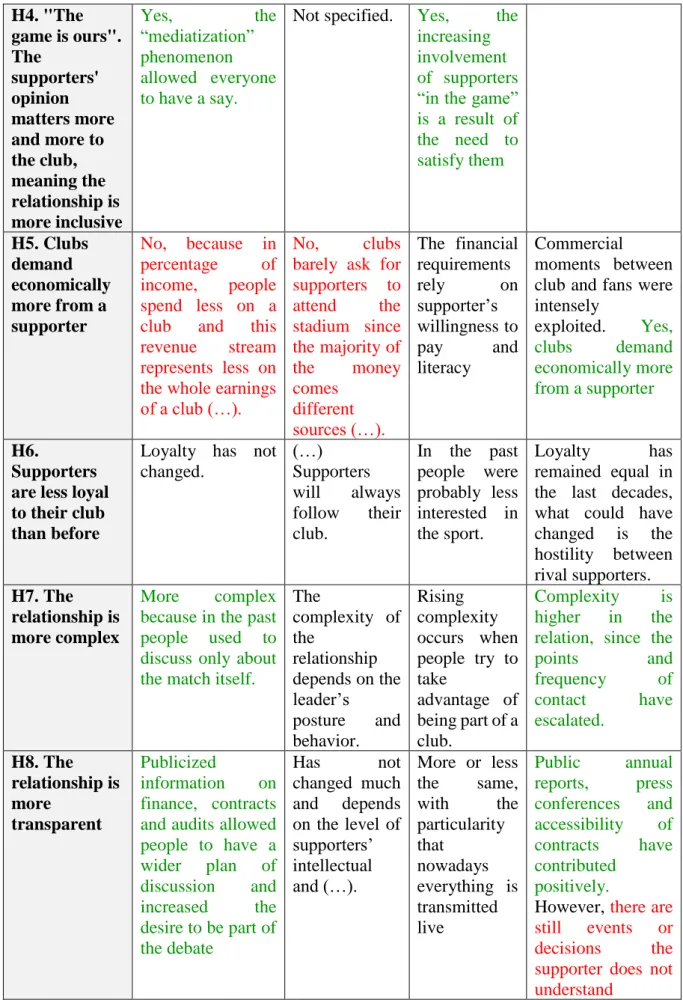
5.2.2. Main insights from the face-to-face interviews Interviewees/
Hypotheses
Interviewee A Interviewee B Interviewee C Interviewee D H1. Nowadays, supporters are more consumer fans that have a market-centered relationship to the club rather than a traditional posture No major change in the consumption pattern (difficult to translate it into an increase on the revenue mix) Depends on the dimension of clubs and on the distinction supporter/fan Depends on the educational and wealth level of the supporter
Not fully true.
Through the
traditional affinity, clubs are then able
to exploit the commercial side. H2. The audience in football is more heterogeneous the audience, is more heterogeneous, especially in terms of gender, but it occurs in the normal development of society The audience is nowadays probably more heterogeneous, but in Portugal (contrary to what has been done abroad) we have not been able yet to diversify even more With respect to the spectrum of the audience, there is the growing presence of (young) women as a natural consequence of women emancipation.
There is one major
change in the crowd: the appearance of corporate/business bodies in the stadium. H3. Nowadays, supporters are more active and participate more than before
Although there are more products and conditions that increase the level of
loyalty/attendance, (…), probably the amount spent in football is less than
fifty years ago
(…). Although there were attempts to create better conditions to attract people to stadiums, supporters have not become necessarily more active. Although social media expanded rapidly knowledge and generated an image of massive social participation, the rising participation of the supporters is not certain (…) Supporters have become more
active and involved with the club, as a
result of the growing number of opportunities of interaction and participation that were created (different activities/sports, comfort conditions, fan
zones, social media and marketing)
21 H4. "The game is ours". The supporters' opinion matters more and more to the club, meaning the relationship is more inclusive Yes, the “mediatization” phenomenon allowed everyone to have a say.
Not specified. Yes, the increasing involvement of supporters “in the game” is a result of the need to satisfy them H5. Clubs demand economically more from a supporter No, because in percentage of income, people spend less on a
club and this
revenue stream
represents less on the whole earnings of a club (…).
No, clubs
barely ask for supporters to attend the stadium since the majority of the money comes different sources (…). The financial requirements rely on supporter’s willingness to pay and literacy Commercial moments between club and fans were intensely exploited. Yes, clubs demand economically more from a supporter H6. Supporters are less loyal to their club than before
Loyalty has not changed. (…) Supporters will always follow their club. In the past people were probably less interested in the sport. Loyalty has remained equal in the last decades, what could have changed is the hostility between rival supporters. H7. The relationship is more complex More complex
because in the past
people used to
discuss only about the match itself.
The complexity of the relationship depends on the leader’s posture and behavior. Rising complexity occurs when people try to take advantage of being part of a club. Complexity is higher in the
relation, since the
points and frequency of contact have escalated. H8. The relationship is more transparent Publicized information on finance, contracts and audits allowed people to have a wider plan of discussion and increased the desire to be part of the debate Has not changed much and depends on the level of supporters’ intellectual and (…). More or less the same, with the particularity that nowadays everything is transmitted live Public annual reports, press conferences and accessibility of contracts have contributed positively.
However, there are
still events or
decisions the
supporter does not understand
22 6. Discussion
From this WP research, the opportunity to link survey results with interview reactions arises as imperative. In this chapter, the following procedure gives the reader a rundown of the major changes in the relationship and the testimonials bring added value.
Although half of the survey respondents agree with the first hypothesis, the four former professionals are not sure about this situation. The majority refer this phenomenon was dependent on supporter level of education, wealth and engagement. One of them even explains an interesting aspect.
“The market centered relationship is a consequence of the traditional posture. The emotional connection is the first touchpoint. Then, through the development of areas like marketing the
clubs will take advantage of the emotional bond to explore the commercial side of the relation”.
The second hypothesis is the one that gathers the highest level of concurrence. Not only the three quarters of the survey sample, but also the opinion of the interviewees confers agreement. The increasing presence of women and corporate audiences are the two highlighted features. However, one of the dialogists left a reflection:
” Due to traditionalism and lack of initiatives similar to what they did in the Premier League, in my opinion, we have not been able to diversify the audience even more. If we change the time
schedule of matches and sell the broadcasting rights for higher amounts to Middle East, India
and China, we could have a more heterogenous audience internally and externally”.
The debate increases when we reach the third hypothesis. Closer to half of the survey pool support the passive to active transition. On the other hand, the erstwhile members of directorship in Portuguese clubs are not so convinced. Even though, they agree that the number of opportunities of interaction and participation expanded, one spotted a slacken point.
“Before, people solely had money to attend the stadium once, pay the Benfica membership quota and that was it. Nowadays, you can go to a concert, to the cinema, to the theatre, etc. I
23
believe that in proportion with growth, the supporter participation is probably not larger than
twenty years ago.”
The fourth hypothesis yields back a reconciliation between the two methods. Firstly, around sixty percent of the people surveyed defend the supporters’ opinion is increasingly important to the club. Secondly, the former professionals outline the “mediatization” aspect and the need to satisfy supporters to have them following the club.
“With the creation of the SAD (Sociedade Anónima Desportiva), supporters have the opportunity to participate in the Meetings, as well as becoming stockholders (…). The comfort
conditions created in stadiums and arenas increased the quality of the involvement”.
Survey respondents greatly support the fifth hypothesis. Likewise, the interviewees recognized the rising exploitation of commercial opportunities. However, some consider these moments do not represent a command, in other words, are dependent on supporter’s will. One of them illustrated a typical miscalculation:
“There is an illusion that the requirement is bigger than before. Even with a marginal increase of the membership quota, not only they represent less for the growing income of an individual,
also they fill a smaller portion of a club’s budget. In the past, there were no television rights or sponsorships and so, membership quotas were a big slice of the funding plan for a club”.
Contrary to the second hypothesis, the issue related with loyalty raises enormous discord in the survey’s respondents. The past organization’s managers of Sporting and Benfica reveal neutral opinion on the topic. Anyhow, one disclosed a curious aspect:
“I believe loyalty has remained equal. What might have changed is the aversion for rivals that above all, has been artificially triggered by people who get paid to do that”.
According to our research, the majority of the people surveyed agree with the raising complexity of the relationship. Some of the former professionals referred the number of points and frequency of contact expansion have contributed to this intricacy.
24
“In days gone by, people discussed about the match itself: offside, bad performance of the referee, great goal, etc. Nowadays, because you have information about everything, everyone
thinks they have a say. Throughout time, that complexity augmented.”
Finally, the eighth hypothesis has produced surprising results on both sides. The survey respondents disagreement is a reflection of the current state of Portuguese football. Nevertheless, some interviewees mentioned the existence of publicized information on finance, contracts and audits to support the transparency of the relation. Yet, there was a voice that manifested in line with the survey results:
“There are still some aspects that are not transparent. Specially in Portugal, we have the so-called grey areas. Object of discussion. For instance (…), the referees nomination or the fact
that a club transfers money to an adversary on the eve of the match”.
7. WP Limitations
Even though limitations were lessened as much as possible, there were some considered inescapable regarding this WP research. These constraints related several aspects: sample size, time constraints, geographical restrictions and access to data.
Firstly, the sample size of the face-to-face interviews was small. Despite the fact that interviewees have worked at high level in management of a club, their opinion might not be representative of the total Portuguese population. In order to obtain more wide-ranging insights in the field, it would have been interesting to interview professionals that have worked for the so-called, smaller clubs of Portugal (or at an international scale).
Another limitation is the geographic extent of the survey respondents. Due to easiness of access and survey disclosure the vast majority (95%) is Portuguese. In future research studies, these restraints can be worked out through divulgation in international platforms and across a longer period of time Also, the response rate was about 85%.
25 Moreover, the focus of the relationship lays on the so-called, ‘king of sports’, football. The existence of other sports and possible supporter synergies were not deeply explored. Furthermore, the relationship with the national team is out of scope although it was topic of an interesting discussion with one of the interviewees.
8. Conclusion
As we have seen previously, the relationship between clubs and supporters is determined by the context, the spectator persona and the characteristics of the human being. By conducting a survey and face-to-face interviews, we had the opportunity to quantitatively and qualitatively answer the research question.
From these WP findings, we can make a distinction between straightforward changes, demystified facts and topics that, at this point, are still debatable. First, one cannot deny the rising heterogenicity of the audience, the involvement of the spectator in the ‘game’ and the complexity of the relationship. Secondly, we clarified that the market centered relation arises from the emotional tie, that the path from passive to active has been nurtured but not always embraced and that the financial requirement has to be evaluated according to growth and clubs’ budget proportion.
Furthermore, the issue of loyalty to a club will always be a subject of discussion. In fact, the former club managers did not identify a modifying pattern. On the contrary, it is clear that conditions to improve the transparency of the relation between fan and club were created. However, there are still grey areas that require explanation to the supporters.
The key to understand this matchless relationship relies on an interconnected comprehension of the changing elements and thus one cannot analyze this matter strictly from just one, that is to say, the sum of the paper is worth more than its parts. As Lou Holtz said “Life is ten percent
what happens to you and ninety percent how you respond to it”. This brings the question, what
26 9. Further research
Finally, I would like to mention areas for further research based on my WP results and conclusions. One thing that could be particularly appealing to study is the effect that winning or losing a match has on the relation (between clubs, fans and sponsors) and how have clubs been dealing with those events. Secondly, the impact of geographic regions in a person’s club choice and the capacity of big clubs to challenge those physical obstacles. At last, a detailed analysis of the mentioned grey areas of the relation and other aspects that could be clarified. 10. References
Abercrombie, N. and Longhurst, B. 1998. Audiences: A Sociological Theory of Performance
and Imagination. London: Sage.
Andrews, M. and Harrington, P. 2016. Off Pitch: Football’s financial integrity weaknesses,
and how to strengthen them. Bsc.cid.harvard.edu. Available at:
https://bsc.cid.harvard.edu/files/bsc/files/cid_wp_311.pdf
Armstrong, G., & Giulianotti, R. (Eds.). 2001. Fear and loathing in world football. Oxford, UK: Berg
Arnaut J.L. 2006. Independent European Sport Review, p. 67-68.
Bale, J. 1994. “Landscapes of modern sport”. Leicester, UK: Leicester University Press. Baudrillard, J. 1990. Seduction. London: Macmillan
Benjamin, W. 1973. Charles Baudelaire: A lyric poet in the era of high capitalism. London: NLB.
Cohen, R. 1978. “Ethnicity: Problem and focus in anthropology”. Annual Review of
Anthropology, 7, 379-403.
Conn, D. 1997. The football business. Edinburgh, Scotland: Mainstream.
27 Critcher, C. 1979. “Football since the war”. In J. Clarke, C. Critcher, & R. Johnson (Eds.),
Working class culture: Studies in history and theory (pp. 161-184). London: Hutchinson.
Featherstone, M. 1995. Undoing culture. London: Sage.
Giulianotti, R. 1999. “Football: A sociology of the global game”. Cambridge, UK: Polity. Giulianotti, R., & Gerrard, M. 2001a. “Cruel Britannia? Glasgow Rangers, Scotland and “hot” football rivalries”. In G. Armstrong & R. Giulianotti (Eds.), Fear and loathing in world
football (pp. 23-42). Oxford, UK: Berg.
Giulianotti, R., & Gerrard, M. 2001b. “Evil genie or pure genius? The (im)moral football and public career of Paul “Gazza” Gascoigne”. In D. L. Andrews & S. Jackson (Eds.), Sport stars:
The politics of sport celebrity (pp. 124-137). London: Routledge.
Gordman, G. 2011. “21st Century Football Fan: A Guide”. Back Page Football. Available at: http://backpagefootball.com/21st-century-football-fan-a-guide/15776/
Halicka, M. 2017. “5 Ideas & Tactics for Using Data to Increase Fan Engagement.”
Eventbrite UK Blog. Available at: https://www.eventbrite.co.uk/blog/using-data-to-increase-fan-engagement-ds00/
Hamil, S. & Chadwick, S., eds. 2010. Managing Football: An International Perspective, Butterworth Heinemann, Oxford.
Jary, D., Horne, J. and Bucke, T. 1991. ‘Football ‘Fanzines’ and Football Culture: A Case of
Successful ‘Contestation’’. Sociological Review 39, no. 3: 581-598.
Johnson, S. 2015. “Finance in football: will the fans stand by the brands?”. The Guardian. Available at: https://www.theguardian.com/media-network/2015/jun/25/finance-football-fans-commerce-brands-fifa
Kennedy, P. & Kennedy, D. 2012. Football supporters and the commercialisation of football:
28 Kuper, S. 2010. “Football is not about corporations. It's about clubs and communities.”
[online] the Guardian. Available at:
https://www.theguardian.com/commentisfree/2010/feb/28/football-money-portsmouth-simon-kuper
McLuhan, M. 1964. “Understanding media”. London: Routledge.
Melin, F. 2006. “Varumärkestrategi: Om konsten att utveckla starka varumärken.” Liber AB. Malmö
Rein, I., Kotler, P. and Shields, B. 2006. The Elusive Fan: Reinventing Sports in a Crowded
Marketplace. 1st ed. New York: McGraw-Hill.
Sked, J. 2017. “The evolution of the football fan - and what it says about the game”. [online] iNews. Available at: https://inews.co.uk/sport/football/football-indepth/evolution-football-fan-paul-brown/
Taylor, I. 1971a. “Football mad: A speculative sociology of football hooliganism”. In E. Dunning (Ed.), The sociology of sport: A selection of readings (pp. 352-377). London: Frank Cass.
Taylor, I. 1971b. “Soccer consciousness and soccer hooliganism”. In S. Cohen (Ed.), Images
of deviance (pp. 134-163). Harmondsworth, UK: Pelican.
Thompson, J. B. 1997. “The media and modernity: A social theory of the media”. Cambridge,
UK: Polity.
Thornton, S. 1995. “Club cultures: Music, media and subcultural capital”. Cambridge, UK: Polity
Zimmermann, N. 2017. “The Future of Football”. Kantarmedia.com. Available at: https://www.kantarmedia.com/uk/thinking-resources/blog/the-future-of-football