LEADING WITH PURPOSE: HOW LEADERS PERCEIVE AND CHANNEL PURPOSE IN MANAGEMENT
ALEXY DA SILVA MIGUEL #2134
A Project carried out on the Directed Research course, under the supervision of: Professor Miguel Pina Cunha
question of what management methods would be better to be applied by leaders. Recently academics and psychologists have found strong positive results from the appliance of purpose inside organizations. These studies have proven that there is a lack of purpose inside organizations and more precisely inside the leader’s visions. This paper aims at outlining what purpose is to academics and how leaders perceive it. Then the goal is to understand how leaders try to channel their view of purpose to employees’ and what are the difficulties facing this process. Results obtained from a group of international leaders in different organizations and industries are compared to the theoretical perspective of academics extracted from a review of the existing literature. The findings suggest that leaders often do not understand the terminology of purpose and do not apply it in their day-to-day activities. It is further highlighted that they use different methods to motivate and direct employees in their teams and organizations.
1. Introduction………..1-2-3 2. Purpose at work: definition and specificities……….3-4-5 3. Theoretical perspective on purpose at work……….5-6
3.1. Purpose inside organizations and society……….6-7 3.2. Employee engagement………..8-9-10 3.3. Leading with a purpose………10-11-12 3.4. The extremes of purpose on leadership………12-13 3.5. Conclusion………13
4. Methodology……….14-15
4.1. Sample and procedures……….15 4.2. Defining the sample size………15 4.3. Data sorting and analysis………...15-16-17
5. Findings………17-18-19
5.1. Insignificance: purpose interpretation by leaders………..19-20-21-22 5.2. Channel purpose: practices often used in relation to purpose………...22-23-24 5.3. Common identity: integrating purpose in leadership………...24-25 5.4. Constructing an emergent model………...25-26
6. Validity issues………26 7. Discussion………26-27-28 8. Conclusion……….29-30 9. Bibliography………...30-31-32-33 10. Appendixes……….33-34-35-36
1. Introduction
A great American philosopher once said “It is not enough to be industrious; so are the ants. What are you industrious about?” (Henry David Thoreau, 1857). It is clear that for ages, the greatest part of humanity has been part of a vicious cycle where they would go to work and come back home with no self-thinking about the purpose of their lives. Business was made to produce profits and the work force was just a tool that would be squeezed until the last drop to provide that same profit.
Organizations have then evolved since the beginnings of industrialization and the expansion of capitalism. More precisely, our millennial employees are searching for fulfillment in their jobs and the tendency is growing on new generation of workers. We see in this 21st century that business is shifting from a global profit machine to a more carrying form, which believes in sustainability and social responsibility. It was John Mackey, co-founder and co-CEO of Whole Foods Market who said during a conference held by the Great Place to Work Institute that “Businesses in the 21st century need to shift focus from profit maximization to purpose maximization“ (John Mackey, 2012). He came to the conclusion that if organizations would align their strategies, systems and structures around a higher purpose, the result would be “making more money than you thought possible“. The great challenge facing the organizations today is exactly to find that alignment (Craig & Snook, 2014). Research shows that when we see the purpose of our job, not just the task, we are more engaged, more productive and more committed (John, 2012). A recent study found that associates that see their job as a “calling“ rather than a “job“ worked longer hours and were even far less likely to call in sick (Gallup, 2012). Jeff Immelt, president executive of General Electric, explained why: “they want to be part of something bigger than themselves. They want to work well, they want to
be promoted and they want action. But they also want to work for an organization that makes a difference, that does things which are important for the world” (Immelt, 2004). So it is obvious through research that purpose driven organizations would be the best place to work and in the long term they would achieve the more success in business. But the big issue that persists to these new necessary implementations is the famous alignment of the organizational structure with their purpose. The channel linking leaders and followers. We have identified that those who are mostly responsible to develop that alignment are the leaders in organizations. The communication of a vision, which includes an appellative purpose and a core of clear values, constitutes the key task of leaders (Saïd Business School & Heidrick & Struggles, 2015). Craig and Snook defend that this is the most important task. Still today that encounter where leadership takes on purpose remains a major difficulty that only a very small number of leaders (about 20% worldwide in 2015) is able to achieve during their careers (Craig & Snook, 2014). The result is a workforce that feels disconnected, with low levels of engagement and a high likelihood to leave their organization. This thesis aims at understanding correctly what is the theoretical approach on the subject of purpose by delineating the studies and research made on organizations, and the most recent discoveries related to organizational leadership and purpose. The focus will be on the power of purpose related to leadership, and the effects that a purpose-driven leadership will have on one organization. We imply that leadership is the helm that will direct the entire organizational purpose, mostly because of the hierarchical position created by management. This is the reason leadership is further scrutinized in the framework of this thesis.
Yet, while we have detailed the intended objective of the thesis, it is important to delimitate its scope and mention what will not be covered. The author does not intend to create any new personal definition of purpose. Besides we will not try to identify what are the best leadership characteristics for management taking in account the presence or absence of purpose, nor describe how should an organization be managed.
The thesis is structured as follows. First the ideology of purpose at work is defined to ensure a clear comprehension of this topic. Then, the literature and theoretical studies used as a theoretical framework for the research is outlined. This also defines a method of study for our research. Then follows the research that aims at providing a net overview with concrete experiences taken firsthand from leaders in different types of industries, to the more experimental studies made on leadership with a purpose. The goal is to understand how they perceive and channel purpose into their respective organizations and delineate the vision on this subject. We engaged with leaders from “two sides of purpose”. One side that we find easier to engage with purpose such as organizations in pharmaceutical and technology development, and another side, which we find more difficult to pass on purpose such as the Financial industry where employees may feel less motivated. The leaders were chosen in order to obtain a process that would find the intermediate ground on leadership with purpose. The result is a more complete research that finds the differences in leadership with purpose and identifies the real difficulties and possibilities to channel purpose into modern organizations.
2. Purpose at work: definition and specificities
Purpose is a word that has been strongly appearing in the business world for the past few years. Nevertheless the theme is not relatively new and it has been around
management for some time. In the 1960’s Donnelley referred the advantages of family businesses against other organizational businesses, referring the facility to create a profound organizational purpose. Years before that, Mary Parker Follet (1868-1933), one of the “prophets of management” (Ducker, 1995), underlined the relevance of the theme. She pointed the importance of a necessity of leaders to canalize the efforts of the ones led for a prosecution of a common purpose, and for organizations to put themselves in service of the community. But before entering the analysis on purpose at work, let us take a step back to understand what is purpose defined by Indra Noovi and found in the latest book written by M. Pina Cunha, A. Rego and F. Castanheira. It is common during discussions to compare the idea of having a purpose with having objectives, and this is not necessarily correct. Having a purpose means having found an ultimate objective, i.e. the reason for doing what we do. It is possible to have many objectives and no purpose. It is a simple cycle of objectives that will succeed for a period of time with no morals what so ever. In a different case, when we see the objectives being aligned with a purpose, it is probable that the achievement of those objectives will bring significance and well-being to an employees’ life (Cunha, Rego and Castanheira, 2015). The idea of purpose at work, involving organizations all over the world, affects the way employees feel about their work and the way stakeholders view the companies. As Indra Noovi once said: “Purpose is not social responsibility” talking about the way companies make profits and use that money, instead purpose is related “to the way we earn the money”. In resume, purpose is an element that provides sense to the actions of an organization, also including social responsibility. Purpose is what transforms the work. People that work with no purpose have a simple “job”. There is a difference between someone who works from 9 till 5 in exchange of a salary,
focusing on a career that will only bring a greater status and more responsibility. Compared to someone whose work has a purpose that guides that person through a vocation answering a “calling”. The “calling” allows the person to get aligned with what she/he is. In consequence this alignment will provide a life full of significance. It is demonstrated today that a growing part of employees seek often for the answer of “Who am I” and “Why am I doing what I’m doing” (Cunha, Rego & Castanheira, 2015). This demonstrates first a growing level of reasoning and consciousness about their effect on the organization and the effect that the organization can have on their private lives. It also shows that organizations can no longer focus only on remuneration ideas and cold profits, because the employees will no longer only react to those individualistic and cold incentives. The answers will be found through a work with purpose. They want to work well, they want to be promoted, and they want action. But they also want to work for a company that makes a difference and do important things in the world” (Immelt, 2014).
3. Theoretical perspective on purpose at work
The first two sections of this thesis outlined the scope of the research conducted and the specificities of purpose at work. It is essential to review the existing literature to set the basis for this work’s research. First we will introduce the impact of purpose on both society and organizations, which represents the way purpose is seen and defined, and thus we will identify what would mean working with purpose in an organization. This analysis will allow us to move to a more specific matter regarding employee engagement that relates to purpose. In reality what we expect to take from this section is an analysis of the effects of a strong leadership with purpose on the workers. From this structural analysis we will pass on to the more detailed theories regarding purpose
inside leadership, to provide a clear view of the challenges that leaders need to face to promote organizational and personal purpose. Finally we will shortly identify the negative effects that can appear on leadership with purpose to transmit a sense of balance that will allow the reader to move on to our research with a neutral state of mind.
3.1. Purpose inside organizations and society:
Organizations strive more and more to have a positive effect on society. That effect is sometimes referred as their vision and usually leaders link that vision with the organizational purpose but it cannot be considered a true purpose (Craig & Snook, 2015). The ideology is appearing with the creation of organizations with conscience of their economical dimension but also genuine and rich in their human dimension, and this requires an organizational purpose with a consideration for the common good and personal development (Cappelli, Singh, Singh and Useem, 2015). The “common good” which is in fact the purpose as some studies show, is in fact growing inside the mentality for management, but it is not something new. In the 60’s Donnelley was already referring the advantages of family businesses against other organizational businesses, providing evidence that there was a stronger facility to create a profound organizational purpose that would affect positively the financial results (Donnelley, 1964). Years before, Mary Parker Follett, considered one of the “prophets of management” (Ducker, 1995), developed a research pointing the importance of a necessity of leaders who would canalize the efforts of the followers (employees) for a prosecution of a common purpose, and also for organizations to put themselves in service of the community (Follett, 1924). So as discussed before we see this tendency growing in leadership and recently Rosabeth Moss Kanter was able to illustrate that
argument with a study made in combination with a great number of organizations. This study was resumed by Chris Bryant in the Financial Times in 2014. The important outcome was as he said: “What is the purpose of an organization? Many executives will say that their function is to maximize the shareholders’ return, serving the necessities of the customers, and eventually having social benefits from social actions. Nevertheless, a growing number of organizations believes that their purpose is to serve the common good (…)” (Bryant, 2014, p. 10). The study found in the book Common Interest, Common Good: Creating Value Through Business and Social Sector Partnerships reveals examples coming from organizations and leaders who declare that common good could be considered as a balance to be proposed to shareholders the same way the balance sheet is presented. They enhance the importance of common good without nevertheless having conscience that financial results are crucial for the growth of organizations. To continue this idea, Christian Felber, considered the founder of “the economy of good” defends that one day the “balance of good” will be more important than the balance sheet or any other financial declaration (Felber, 2010). But we will not enter in discussion about the perfect balance between financial ideologies and purpose related ideologies in this paper. Having described the effects that can appear in a global organizational perspective we will now focus on a more detailed theme on purpose regarding the two main factors of our research. These two main factors that were identified in an organization that provides a positive sense of purpose were the efficiency of work and engagement from the employees, and, a leadership that would guide positively the workers in an “out of the ordinary state of work” (Craig, 2014).
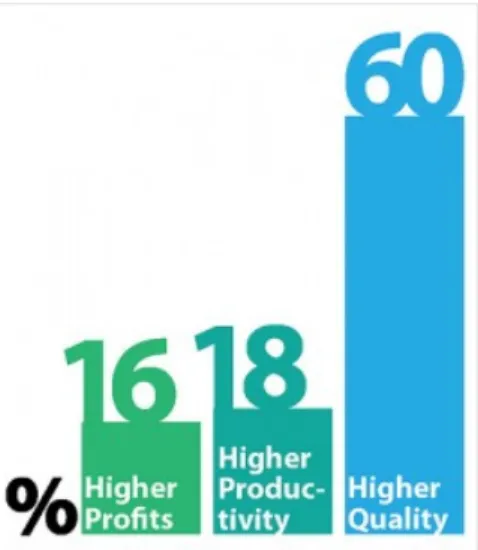
In the Encyclopedia of Management Theory we identified two authors who focused on employee engagement related to purpose at work. The authors in questions are W. Kahn and S. Fellows, and we analyzed one important paper they wrote entitled “Employee Engagement and Meaningful Work”. Their theory is based on the fact that employees cannot be divided between engaged and unengaged, and the main reason is the fact that conditions may shift during an employee’s life (Kahn and Fellows, 2013). The momentary state of engagement is called “flow” by the authors, and it occurs “when people are able to use their strengths to meet a challenge in a self-directed way” (J. McCarthy, 2013). The interesting fact in this study is that they found that leaders usually focus on answering the question: “who is engaged and who isn’t?” instead of trying to find what are the conditions that will help increase employee engagement. As it is proven in this study, the most important condition for employee engagement is the moment where the worker can experience meaningfulness at work (Kahn and Fellows, 2013). This meaningfulness can be translated as purpose. Comparing this research with N. Craig and S. Snook’s study on purpose, we clearly identify the similarities and found that the highest level of purpose would lead to a stronger level of commitment resulting in more profits, productivity and quality of work (Figure 1).
Figure 1: Gallup data on top engaged employees
As the data proves, purpose and engagement are correlated, and the factor defining the results is the condition in which employees are putted during their work. Leaders should focus on providing the best conditions to empower their people and give a meaning to their employee’s work life (Craig & Snook, 2014). Another very important factor coming from leadership in study of engagement and purpose is the capacity to create common interest between workers. Recently Paul Gustavson and Steward Liff found that teams with the best results were those sharing a common vision and purpose. This was confirmed during a recent project at Google called Project Oxygen where it was identified that the skill of creating a vision for a team was part of a good leader (Garvin, 2013). It is not only required to take in account the organizations’ purpose, it is necessary to translate it to a more specific level and guided with a unified team vision. Taking this real factor in account, we cannot forget that some positions inside organizations require less teamwork than others, but nevertheless a purpose-driven leadership must orient them. Let us clarify this explanation with a simple example proving that engagement and purpose must appear everywhere and in everyone in the
organization. In 1962, when visiting NASA, the president at the time Mr. Kennedy, questioned a guard: “What are you doing?” to what he answered: “Well Mr. President, I’m helping the organization to put a man on the moon” (In Murray, 2014, p100). What we take from this is that the guard was clearly focused on the purpose of his job reflecting the entire purpose of the organization. He woke up every morning not only to secure the area but also to be sure that a man would one day be placed on the moon. This different mentality created by purpose increases drastically the focus and productivity of the entire operational system of the organization (Cunha, Rego & Castanheira, 2015). We also take from this that it is easier to influence/lead efficiently with a purpose rather than using the strict chain of command (hierarchy). This takes us to the analysis of leadership and the specificities necessary to achieve a positive channel of purpose into the organization.
3.3. Leading with a purpose:
Over the past five years, there’s been an explosion of interest in purpose-driven leadership. Academics argue persuasively that an executive’s most important role is to be a steward of the organization’s purpose (Craig, 2014). Business experts make the case that purpose is a key to exceptional performance, while psychologists describe it as the pathway to greater well-being (Craig & Snook, 2014). This discussion appears mainly in a time where we come to find successful business people asking very often the same questions and coming to the same answers. In a HBR interview reverend Peter Gomes analyzed this correctly. He said: “I often cross paths with successful people in business at just the point where they are asking such questions. What’s it all worth? What am I getting out of this? What have I done? I’m successful by every standard this world can imagine, and yet I’m unhappy. Or I can’t produce happiness in others. How
do I reconcile my success with my sense of emptiness? And the short answer I give is that you have put your ultimate confidence in penultimate enterprises. Business has to be a means, not the end. If you treat success in business as life’s ultimate goal, then it becomes a great, glowering, impressive, but ultimately empty and futile, tin god.” (Gomes, 2001, p.64). The lack of purpose develops a certain Midas effect where leaders find the productivity in the short-term to be positive in profit but after a while they find no value or sense of purpose in it. The result is that in the long-term profit is affected negatively and more importantly, the entire organization feels lost in the sense that the leadership is no longer effective. The literature provides an interesting result concerning these questions and the lack of presence of purpose in leadership. The problem found is that most leaders do not engage in their activities, with a clear understanding of purpose (Craig and Snook, 2014). As E. E. Cummings once said: “To be nobody but yourself in a world which is doing its best, night and day, to make you everybody else, means to fight the hardest battle which any human being can fight; and never stop fighting.” — E.E. Cummings
They cannot find their purpose on leadership because, as suggested by E.E Cummings, they are constantly bombarded by messages from bosses, advertisers, consulting gurus, etc. And these messages interfere with the clear understanding of whom they really are and their true authenticity. The result is that leaders cannot formulate a purpose statement correctly, and without that clear statement the leader is not able to put in action a purpose-driven leadership (Craig & Snook, 2014). Other adversities such as the financial crisis and the recession, also affect purpose as explained by D. Ulrich and W. Ulrich. During these periods leaders have the tendency to regress to old management mentalities that tend to control more the employees. The meaningfulness of work tends
to disappear leaving place to worries related to more financial matters that are necessary to please shareholders (D. & W. Ulrich, 2010).
What we take from the literature is that purpose does not come without a challenge but the reward is very appellative not only for the organization growth but also individually for each worker in the organization. Leaders cannot forget that ultimately, what strengthens them as a leader is helping others grow and develop. “That’s because they, in turn, will make your company more productive and make you a more successful leader. That becomes a virtuous cycle, which is what I think we want to see in organizations.” (D. Ulrich, 2015). As Dave Ulrich said during an interview: “I would put it very simply: improving your talent will increase productivity, and that will improve your ability to meet your strategic goals. Reaching those goals will help you better serve your customers so they will buy more from you. That will also increase investors’ confidence so your stock price will go up. And your company will have a better reputation in the community, so it will be more sustainable.” – D. Ulrich
3.4. The extremes of purpose on leadership:
As the reader might have identified by now, the term purpose is in this research used generally in a positive way as it defines the ultimate objective of a fulfilled life (Craig & Snook, 2014). Nevertheless it is important to balance this idea by analyzing the negative effects caused by purpose on management of organizations. The author provides here a different view on purpose that will not be an important part of the research but requires some attention. We take here a Kafkaesque approach to the professional who devotes his/her life to purpose and loses critical distance. We take here the analysis in his book The Metamorphosis, where the father was wearing at all times his uniform, in a demonstration of devotion for his organization. The Kafkaesque father is the
professional who transforms purpose in absurdity, taking purpose to an extremist level and providing a negative effect on work. In real life we found leaders who affirm being ready to “die” for their organization and have no personal life such as Maria das Graças Foster, CEO of Petrobras (Pearson, 2015, p.7). This can result is disastrous organizational events such as the one that recently happened with Enron. This huge organization was able to pass a dangerous purpose into their employees’ mind, and when it was discovered that their success was not genuine it created great damage into their employees and customers’ lives. What we expect the reader to understand from this part is that, as Andrew Hill referred it in the Financial Times, purpose is now dangerously used in excess inside organizations (Hill, 2015a, p.10). And purpose was used in the past to achieve tragedies for Mankind; so a mobilizing and evil purpose mixed with the domain of powerful institutional players, can be a tragic combination (Chan et al., 2015).
3.5. Conclusion:
To sum up, purpose is an important factor not only inside individuals’ lives but also in managing sustainable growing organizations. It is proven that purpose-driven organizations will not only attract the best talents in the market and provide the best environment for productivity and creativity, but also demonstrate a stronger profit growth in the long-term. The best teams are motivated by the purpose of the organization and on that direction leaders are required to articulate their purpose into them. Nowadays the technical difficulties experienced by organizations still remains the way of spreading that purpose correctly into organizations and be sure that the leaders will influence their teams into focusing on the correct purpose.
4. Methodology
In order to answer the research question, an inductive analysis of the topic was conducted. The main data collection technique used was retrospective interviewing (Langley, 2009), where leaders of organizations were asked to reflect upon their encounters with what was identified as Purpose of Organizational Leadership (Craig and Snook, 2015). The total of the interviews was divided between a significant amount of in vivo interviewing of 1 to 2 hours, and through the intermediary of calls or e-mail response. It followed the general precepts advanced by the Gioia methodology following a systematic inductive approach to concept development (Gioia et al. 2012: 16). As a qualitative study, it was oriented towards discovery and understanding (Mayring, 2002), not verification, as it intended to explore the essence of the direct, firsthand purpose efficiency in leadership rather than examining if it corresponded to some previously formed hypothesis. Afterwards some general documentation about the organizations’ practices related to management were analyzed (some documentation was confidential and shared by the leaders interviewed and the other was found available online). The main goal of the study was thus to explore the effect of purpose on organizational leadership when facing day-today activities so as to understand the process and the reality better by studying it from an external perspective. Focusing on this outcome, the interviewees were given the time necessary to reflect and describe their experience, as well as to share their point of view regarding the whole process through open-ended questions and a space/moment to share anything they would want to bring to prove their ideas about the subject in study. Data collection followed two procedures. The snowball sampling procedure (Goodman, 1961), meaning that at the end of each interview, the respondent was asked to help identify one or several new
informants who might be in a leadership position following our criteria. The second procedure was target identification through curriculum analysis.
4.1. Sample and procedures
The data was gathered from 16 interviews. A first e-mail or personal contact explaining the request for an interview preceded data collection. The interviewees were leaders in high management positions who had a direct experience with purpose and who understood what role the subject had inside the organizations. They were divided between the two main organizational areas: private and governmental. Interviews were conducted from three different ways: face-to-face in a location selected by the interviewees, with audio-record; through a call, which was also audio recorded; and by fulfilling a questionnaire. For the first two, the audio was then transcribed verbatim. Interview protocols (see example in appendix 1) were designed based on the literature review.
4.2. Defining the sample size
The decision about the number of interviews was based on grounded theorizing (Chamaz, 2006), which meant for the researcher to progressively analyze the outcome of the interviews and understand if a pattern was appearing. It is indeed hard to prove that saturation has actually been achieved (Bowen, 2008;Morse, 1995). It is on the fact that major themes became apparent and data was confirming hypothesis that it was decided to withdraw from the field and concentrate on a deeper analysis of the data collected.
4.3. Data sorting and analysis
After a close reading of the book Strategies for Interpreting Qualitative Data (Martha S. Feldman, 1995) it was decided that the more appropriate technique to organize and
build conceptual meaning of the data would be the semiotic approach. More precisely, we took the technique of semiotic clustering (Manning, 1987), which is defined as simple but very efficient. The concern would be then to identify signs and understand the processes by which they come to have meaning. For this we set up a table with three columns. The first column is labeled “Denotative Meanings”. In this column we placed the various ways we observed or heard the interviewees use the concept of purpose on their own experience of leadership. We used the semiotic analysis to deepen our understanding of the purpose reality in organization’s leadership, which we became aware of through a previous ethnomethodological analysis. This first step allowed us to have a first view of the concept of purpose explained by real leaders inside organizations. The Appendix 3, titled “Semiotic Cluster Analysis”, lists 11 common ways interviewees talked about their view on purpose. These are not listed in order of importance but instead regarding their relations to the other columns. The process of research moved from the subjects’ first order data to second order constructs, guided by conceptual meaning. We labeled this second column: “Connotative Meanings”. Here we use the notations of metonymy, metaphor and opposition. We asked ourselves: “What does it mean when someone in this organization talks about, for example, purpose as a guider?” This step relied mostly on our intrinsic understanding provided mostly by the literature review and the analysis made on the organizations where the interviewees pursued their leadership position. It does not provide the understanding. Rather it helps to draw many pieces together into a pattern that can increase the significance of the data both to the researcher and to the audience (Feldman, 1995). This step made us use mostly metonymy, and the goal was to propose an understanding that would clarify how would purpose influence leadership decisions from our interviewees. The third column
labeled “Leadership Concerns” involves a leap similar to the one necessary for moving from the first to the second column. It identifies the issues that are of concern within the organization that relate to the denotative and connotative meanings. This part becomes clearer as we describe the specific concerns in the analysis. There is not much obscurity in the leadership concerns discussed here. Any individual with more than a casual relationship with organizations or an understanding of organizational management would recognize these issues as leadership concerns. The table helps us not in discovering the concerns per say, but in making clear the connections between them and other features of the organizational leadership.
5. Findings
The original data obtained during the interviews was resumed in 11 categories, which were provided directly from the interview data. These categories, represented in the left side of Appendix 2, referred to a diversity of topics related to the concepts previously mentioned. The first group of categories analyzes the factor of interest, which explicitly identifies how leaders perceive purpose in their work. It included the following aspects: a notion that leaders describe the organizational purpose differently; that purpose may increase their leadership relation; that all see their own purpose in different ways; that they agree that personal purpose may not interfere with good leadership; and the importance of vision and values as a guider to their leadership. A second group of categories explained processes of integration and monitoring of purpose. This part relates to the way leaders managed their employees. We analyze the influential process that can be complex and inefficient; the hierarchical latter that can create barriers; and the monitoring process of decisions and employees. Finally, we identified a third group covering a discussion focused on principles of productivity in comparison with our
initial idea of purpose. The author wanted to have a discussion that would allow finding the best managing methods fro employees and the perception of purpose from the interviewees. We here take a the discussion on profitability and purpose; on what we call pure alignment of purpose, which reveals the point of maximum efficiency between leaders and followers; the methods of monitoring that efficiency; and a final analysis of management mistakes and their relation to a lack of purpose. The interviewees explicitly mentioned all these points reflected in our categories, and it is from these points that we developed our concepts. At this first stage, the interpretive effort was limited, but we were performing a strong and constant revision of data and applying it to the concepts to find the arrangement that would provide an outcome in a conceptually elegant way, making sure to maintain rigor and meaning theoretically speaking. First order concepts are present in Appendix 2, together with illustrative quotes extracted from the interviews. The data was then subsequently arranged into broader categories disposed to represent thematic consistency. We have now generated second order themes. The second step involved a factor of analytic interpretation, since these more encompassing labels reflected a conceptual order that was not directly offered by the interviewees but that reorganized their existential concerns in a more reflexive set of categories, leading to the column of the Connotative Meanings in Appendix 3. The major message interpreted from respondents was the difficulty for a leader to have one specific definition for purpose and that it wasn’t clear what it meant for them. The fact that purpose was not so much real in their minds, is explained by the fact that many were motivated more strongly by the vision and values of their organizations and they often described that as the ultimate purpose to achieve success. This reflects the theory discussed by literature about the outside messages affecting the discovery of purpose
(Ulrich, 2014). The fact that the definition was not identified clearly and that the respondents were often diverging, led us to rationalize the idea. The consequence is that leaders will not take in consideration long-term meaning for workers; instead they will look for short-term motivational techniques that will better involve the worker inside the organization. The result often takes out any value proposition of purpose that might have been developed in the long-term.
Analyzing the intermediate categories of Appendix 3 led to the development of final four order themes that relate with the objective of this thesis. The four order components identify that leaders have recognized the organization requires unification around an ultimate goal to obtain efficient results over long periods of time. Hence, our information found that most do not recognize purpose as a tool of leadership, providing more importance to vision and values in order to create cohesion; and they identify that employee motivation through purpose would be a greater challenge. We now firstly discuss, the interviews’ observations, vis-à-vis the leaders’ perspective on purpose. The analysis engages then the discussion on channeling purpose inside the organization and the necessity to create a common identity that motivates employees. Finally the interpretations allow us to develop an emergent model simplifying the analysis made from the interviews.
5.1. Insignificance: purpose interpretation by leaders
Mentioning purpose to a leader in an organization is cognitively challenging. Huge organizations nowadays have developed specific methods to manage their collaborators, and very often other processes amend the research of purpose. Even though we find many psychological studies proving that efficient leaders take the role of stewards of the organization’s purpose (Craig and Snook, 2014), it is not often clear that they actually
know how to even define the term. Our informants mentioned two cognitive difficulties raised by the experience and interactions they described: (1) unclearness and (2) complexity of ideals. Unclearness represents the non-understanding of the term “purpose”, either on a personal level or at an organizational level. It was felt that leaders were often confused by the term and would not describe it correctly. This meant they could not define an organizational purpose or a personal one because they were not directed into thinking that way. Complexity of ideals refers to the fact that they were from the beginning used to take reference to the vision and values, when asked about the ultimate goals. This idea is very well implemented in their minds and they make use of it to inspire employees, declaring the strong efficiency of good vision and values over any other mentality.
Unclearness
Unclearness, understood as the confusion about the meaning of purpose resulted from respondents questions before answering and providing relatively different definitions from leader to leader (some even being in the same industry). Entering the process of applying purpose to their leadership became relatively confusing because most of them saw vision and values as the guidance for their ultimate goals. Informants found purpose as something unclear and obligatory present in most organizations, “Any organization as purpose because it is the only way to survive.” Even if they acknowledged that a certain sense of psychological goal was necessary they would usually turn to the vision of the organization, “The actors of the organization from the smallest position to the highest must have the knowledge of the visions (…)”, mentioning the tradition of applying these methods and referencing to the positive results brought by this process without referencing the term purpose.
Complexity of ideals
The real perception of the cognitive challenge appeared when we entered the discussion of their own purpose and the processes of management that would require it. Many informants described their purpose explicitly defining their job description, “As COO, my purpose within WIP is to manage all the daily operations – fund raising, finances and event organization.” Informants felt uncomfortable with these questions and were not prepared to answer, when asked about purpose. We identified tough, that some type of purpose usually motivated their personal careers, even if not explicitly described in their answers. We were able to take such conclusions when the informants were asked about their motivations during their careers and their influential processes. Many established ex-leaders as their role model, which made us think about the theory developed recently by Steward Friedman about leaders being made and not born. We find a case of purpose in this quest for leadership but our respondents were effectively not aware of it, so we won’t go any further on this matter. This part of complexity of ideals was resumed by our discussions that led us to clearly understand the effectiveness of proposed directives involving vision, confused in our terms with the sense of purpose. As proposed by Nick Craig in one of his studies we entered a small game with some of our respondents to find purpose. We left some time for them to talk about their childhood and their passions, and then we applied it to leadership. The result was astonishing as some discovered some attitudes they usually had in work with some daily activities they enjoyed outside of work. They found a relation between them as a person and their position in the organization, which for some came as a discovery. One example was a director who answered at first that his purpose was to “guarantee the
development of new drugs” and then modified it to a real purpose saying “my purpose is to bring life to the entire world”.
We find here that some leaders developed a closed mindset along their careers full of organizational messages regarding leadership, but that could change if some work was to be done regarding something more meaningful than simply “financial results”.
5.2. Channel purpose: practices often used in relation to purpose
When looking at the processes used in management of organizations we discovered that very often the theory of an ultimate purpose would be difficult to expand due to the complexity of the communication systems. Our respondents were asked to talk extensively on the communication of messages in their organizations because we constantly found new barriers to the passage of purpose internally. Taking in account that the majority of the informants were unfamiliar with the definition of purpose, it would be difficult to care about the message. Leadership unfamiliar with purpose faces two important perceptions of barrier: (1) hierarchy and (2) offering purpose and more. Hierarchy
Many respondents mentioned the use of “intermediaries” to pass their leadership decisions, “We only talked with the intermediary employees” and “So the first step was to meet with the intermediate (…) and make sure they understood and agreed with the decisions taken by the organization.” If the process lacks of purpose from the top leaders, it is imaginable that the purpose will not pass trough the rest of the hierarchical organization. Organizations with large amount of employees, find themselves sometimes involved with hierarchical systems that are too complex in terms of identifying if there is an understanding of the organizational purpose. A respondent said, “We would organize a social event for all employees at the end of the year to pass
the message of our goals.” But with this idea we can assume that purpose is not monitored during the year and the process to monitor would probably be very complicated in large organizations. The outcome we take from the interviews is that leaders focalize more on goals than meaningful work, because they do not care much about the mentality during work but in the engagement and results provided by the workers. So even if they identify their organization as having a purpose, those words were interpreted as vague and with lack of correspondence.
Offering purpose or not
We then entered more deeply on how the incentive of purpose was made and how they could guarantee purpose in their organization. The first interesting response that we often got was related to financial aid. When asked how they would motivate people to work with more purpose and a majority said: “Purpose is passed by using bonuses.” This was found very common as many leaders usually related the increase of engagement to salary increase or bonuses that would motivate the employee to work more and more efficiently. Now focusing more on purpose we entered a discussion about the Theory of Human Motivation described by Maslow and more precisely the study of self-actualization. It is defined as the desire for self-fulfillment and the tendency for a human to become actualized in what he/she is potentially (Maslow, 1943). So we deepened the development of this subject by asking our respondents if they care about the personal side of an employee’s work. Our discovery was made in two points: organizational purpose and personal purpose. Organizational purpose is offered in many ways such as described by one leader: “We tell them the successful stories and the less successful stories. So they feel proud of that.” The leader will often use the results to pass on the purpose of the organization. Another informant discussed a
second important factor common in the research: “Pass the purpose being transparent.” It also requires transparency and honesty when the message needs to motivate the employee to care about the organization. And finally there was another type of message to pass organizational purpose, which goes back to a previous discussion about money. “The best you are in your purpose, in your quality the more profit you do. Believing in good drives results and results drive money.” And in this point of view we rediscover the message of purpose with not much purpose. Unless we believe that the purpose of an employee is to make money, which was described by some informants as being a valid purpose inside the organization. On the personal purpose we find one very constant reaction that can be traduced by this quote: “Personal purpose cannot be strongly considered because then all collaborators would have to be singularly satisfied. They are the ones who need to align their personal purpose with the organization or leave.” The leaders do not care about personal purpose because it is a “dream” as many said during the interviews. They try to lead their employees into understanding the organization for which they work and to be motivated about their tasks. This is fundamentally based on vision and values provided by the organization and it involves processes that track a great number of people into following their needs. One will be motivated to pass more time with his/her family if it will personally motivate their productivity, and another might be given more responsibilities and leadership if it will also increase their purpose at work.
5.3. Common identity: integrating purpose in leadership
After observing that most leaders had different point of views on the idea of purpose, they nevertheless all ended in a same conclusion. The organization is based on cohesion and on passing the right meaning to the functions and decisions order by top positions
in management. They based their affirmations on the value of their outcome per example: “The only way for society to accept us is because we add value. Companies who don’t add value will die.” They mentioned very often the need to find employee happiness by saying things such as: “I asked now and then if they were happy and if there was something that the organization could do better to increase personal happiness and motivation.” So even if they would not promote the term “purpose” into their leadership aptitudes, it was clear that the informants would all agree on one thing, which was the effect of motivational work in productivity. The personal environment should be attractive to those who make the organization exist in the day-to-day activities. Carlos Ghosn said: “Employees are your most valuable assets. They are the heart and guts of a company.” Many leaders identified this idea as entirely valid. Hence the problem to this mentality was described by the pressures they often have from boards and higher leaders who disable in some way their ideas to promote a more meaningful work.
5.4. Constructing an emergent model
Building on the observations resulting from the interviews, we will now transform these middle level interpretations of our respondents into a theoretical model integrating the findings (see Appendix 4). This will provide a comparative analysis of both academics –based on the literature – and the leaders. In general, the findings suggest that a perception of purpose differs from leader to leader. This doesn’t mean that they find their leadership empty of purpose. It is simply that they find sense in the simple activity of working. There is not ultimate objective, because their leadership is turned to a multitude of objectives bringing value to the organization and society. One good example is the fact that an informant mentioned the purpose in Tobacco companies. It is
clear that Tobacco companies have a purpose, and the leaders can manage to create purpose at work because they are providing value to society. Maybe it is a discussable value for some, but for others it is clearly a value added to a lifestyle.
The discovery that leaders would not look for purpose nor try to look for it in employees made us understand that they follow a pattern relied on their job description and their utility for the organization. This takes out the deep understanding of ones purpose and leads the leaders into a meaningless career without “understanding of actions” (Craig, 2014).
6. Validity issues
In order to test if our conceptual interpretations respected our informants’ perspectives,
we undertook a validity procedure. About 60% of the informants were called to validate the findings. We expressed our conclusions to them and we found a general agreement. Respondents mentioned that after rethinking about the subject while working, they found it very complex to find a purpose and to share it to the employees. They never really thought about purpose in their leadership, and they were surrounded by an environment that wouldn’t empower that inner search that would allow them to share with the employees. They believed in common identity and motivational work but not through the integration of purpose as described by literature.
7. Discussion
We have read much about purpose and the appliances to leadership with literature. The search of purpose is definitely important not only for leaders but for regular people. George Bernard Shaw said: “This is the true joy in life, the being used for a purpose recognized by yourself as a mighty one.” It is of our agreement with the interviews’ data, that despite this growing understanding of purpose, many big challenges remain.
The relation with purpose is not very well understood, but at the same time it is recognized as a power to lead. One conversation with a CEO of a pharmaceutical company during an interview made the author realize that there was a presence of purpose but the leader was just not aware. The leader has a passion for boats and he owns a beautiful catamaran where ha travels the world with a team. After some discussion about this passion we came to realize that the leadership while sailing was passed to his enterprises. He was a leader used to face “big waves” and always ready to provide the necessary orientation to those guiding the “boat” (organization). That was his passion and it was the reason he started his business.
This realization of purpose was a big challenge for the small number of leaders interviewed, and we found out that during a training made by Nick Craig and Scott A. Snook to thousands of leaders from different organizations, only 20% had a strong sense of their own individual purpose. The process of integration in organizations and the development in careers nowadays leaves not much space for self-purpose. Leaders can usually articulate their organization’s mission, and state the important values and their vision, but the challenge begins when we focus on their personal purpose. Usually leaders will answer with something from their job description or provide nebulous answers such as: “I’m here to help other excel” or “My purpose is to empower people”. Even though we do not criticize these responses because they reflect very often an excellent leadership with astonishing results (in our respondents case), it becomes too demanding to propose a clear plan that would translate purpose into action. The result is very often that they limit their aspirations and fail to achieve their most ambitious personal and professional objectives. As one respondent mentioned: “I know leaders who lead big organizations in health care who have no personal life and one day they
will seek treatment.” As we analyzed our data we discovered that even if there was a blur in the interpretation of purpose, our respondents were strongly aware of their motivational effect and on the necessity to improve as humans and share their knowledge with the entire organization. It was a typical demonstration of self-actualization (Maslow, 1943). Most of our respondents understood the necessity of becoming a better self and take profit of their potential. The barriers for that self-development are often built by the organization itself. Leaders take most of their time worrying about issues to be solved, and they have a constant pressure to perform at the highest level. The purpose of leadership becomes complicated to understand as they grown into the ideals of the organization. Leadership takes base in the mission, vision and values proposed by the organization, and those are taken as guiders for decisions. More modern leaders actualize themselves to the market needs and provide strong messages to the collaborators in order to create good environments for people to work. Nevertheless that doesn’t take in account the research for purpose nor motivates such discovery. In a globalized world with an increasing number of consumers, people lose their track of purpose and don’t stop to think about their own existence. Purpose translates in bonuses and offers that will facilitate one’s life. And it loses it’s meaning of personal research along the career of an employee, because organizations define patterns of idea and tend to create leaders for their own growth and profit. The structure of modern organization is made so leaders focus on cohesion, trust, empowerment and good outside image, but this doesn’t develop their own purpose inside the organization. It provides a direction, that mixed with their own skills and character will provide a positive outcome in terms of leadership and sustainable growth.
8. Conclusion
In order to conclude this research, the intended relation between purpose-driven leadership and organizational management is restated. Leaders do not perceive purpose directly as a management finding that would allow the organization to sustainably grow, like academics do, but rather as an ideology that is reserved for academic research. The economical focus and the top executive organizational pressure points the leader into a structure type of leadership that follows rules and neglect personal thinking about the task. Even if academic research of modern organizations identifies personal purpose as an important part of leadership, most leaders do not seek for that purpose along their careers. Our conclusions are based on the ideal of purpose and the current reflection of leadership stated by the data acquired during the interviews and the research found on literature. We find difficult to implement such self-purpose into our modern organizations, mainly because people do not feel the extreme need to look for a deep purpose. Nevertheless the author strongly believes in the benefits that purpose-driven exercises would provide to leaders and consequently, to the management of growth inside organizations. Even if it was clear that leaders found their regular activities efficient. The lack of purpose was for them insignificant because they grew their careers following rules of management given by consultants, other leaders and the organization itself. The results were more important than the meaning of life. This was probably because most leaders interviewed were from a higher range of ages and they did not belong to the more recent meaningful seekers age. Even though life seems to lose meaning after a long career, they find the experience positive and rewarding. One positive outcome noticed is that many leaders took more time to think about their purpose in life, similar to the outcome found by D. & W. Ulrich. The growth of
self-thinking is reflected in the appearance of modern lifestyles inside organizations and creative environments that promote freedom while increasing efficiency. Nevertheless the role of a leader is to guide and provide the right tools for growth and we cannot state from our conclusions that purpose would come as a solution to such growth inside organizations. This said we have identified that a certain organizational purpose continues to exist and leaders are able to take that purpose and promote a purpose driven leadership, creating strong and sustainable organizations. While these research findings are expected to make a contribution to purpose at work, it must be acknowledge that the scope of the research is limited to the number of leaders interviewed. Besides, more studies should be addressed regarding cultural and geographical factors due to the management applied in different types of organizations around the world and the necessity for different styles of leadership.
9. Bibliography
Carroll, A. B. (2009). True Leadership Bears Four Main Responsibilities. In Business
ethics: Brief readings on vital topics (pp. 100,101). New York: Routledge.
Sorenson, R. D., & Goldsmith, L. M. (2009). Leadership Concepts and Theories.
In The principal's guide to managing school personnel. Thousand Oaks, CA: Corwin Press.
Dik, B. J., Byrne, Z. S., Steger, M. F., & American Psychological Association.
(2013). Transformational Leadership and Meaningful Work. In Purpose and meaning in the workplace.
Sagawa, S., & Segal, E. (2000). Chapter one. In Common interest, common good:
Creating value through business and social sector partnerships. Boston, MA: Harvard Business School Press.
Ulrich, D., & Ulrich, W. (2010). The why of work: How great leaders build abundant
organizations that win. New York: McGraw-Hill.
Feldman, M. S. (1995). Semiotic Analysis. In Strategies for interpreting qualitative
data. Thousand Oaks: Sage Publications.
Dik, B. J., Byrne, Z. S., Steger, M. F., & American Psychological Association.
(2013). Doing Well, Doing Good, and Doing With: Organizational Practices for Effectively Cultivating Meaningful Work. In Purpose and meaning in the workplace.
Punch, K. (2005). Semiotics. In Introduction to social research: Quantitative and
qualitative approaches. London: SAGE.
Colli, A. (2003). Family Business. In The history of family business,
1850-2000 (pp. 194-215).
Kessler, E. (2013). Managing People, Personality and Perception. In Encyclopedia of
management theory. Thousand Oaks, Calif.: SAGE.
Denzin, N. K., & Lincoln, Y. S. (1994). Qualitative Research. In Handbook of
qualitative research (pp. 273-284). Thousand Oaks: Sage Publications.
Kessler, E. (2013). Managing Organizations. In Encyclopedia of management theory.
Thousand Oaks, Calif.: SAGE.
Kahn, W. A. & Fellows, S. (2013). “Employee Engagement and Meaningful Work” in
B. J. Dik, Z. S. Byrne & M. F. Steger’s (Eds.) Purpose and Meaning in the Workplace, 105-126. American Psychological Association.
Pina Cunha, M., Rego, A., & Castanheira, F. (2016). Proposito: Ideias para
Dik, B. J., Byrne, Z. S., Steger, M. F., & American Psychological Association. (2013). Connecting the Dots: Coaching Leaders to Turn Values Into Meaningful Work.
In Purpose and meaning in the workplace.
Craig, N., & Snook, S. A. (2014, May 1). From Purpose to Impact. Retrieved from
https://hbr.org/2014/05/from-purpose-to-impact
Loehr, A. (2015, August 1). Creating Purpose-Driven Organizations. Retrieved from
http://www.anneloehr.com/2015/01/08/future-work-creating-purpose-driven-organizations/
Skoll World Forum. (2013, November 4). Game Changers: The World’s Top Purpose
Driven Organizations. Retrieved from
http://www.forbes.com/sites/skollworldforum/2013/11/04/gamechangers-the-worlds-top-purpose-driven-organizations/
Hakimi, S. (2015, July 21). Why Purpose-Driven Companies Are Often More
Successful. Retrieved from http://www.fastcompany.com/3048197/hit-the-ground-running/why-purpose-driven-companies-are-often-more-successful
Light, D. A. (2001, September 1). Is Success a Sin? Retrieved from
https://hbr.org/2001/09/is-success-a-sin
Resources, R. (n.d.). Concepts of Leadership [PDF]. Retrieved from
http://www.ramergroup.com/pdfs/Concepts-of-Leadership.pdf
Heylighen, F. (1992). A COGNITIVE-SYSTEMIC RECONSTRUCTION OF
MASLOW'S THEORY OF SELF-ACTUALIZATION [PDF]. Retrieved from http://cleamc11.vub.ac.be/Papers/Maslow.pdf
Yakowicz, W. (2015). Why Great Leaders Are Made, Not Born | Inc.com. Retrieved
Kalrgaard, R. (2009, July 23). Purpose-Driven Leadership. Retrieved from
http://www.forbes.com/2009/07/23/bmw-hy-vee-karlgaard-intelligent-technology-leadership.html
Bersin, J. (2015, November 15). Purpose At Work: It Comes From Within. Retrieved
from http://joshbersin.com/2015/11/purpose-at-work-it-comes-from-within/
Schwartz, T., & Porath, C. (2014, May 30). Why You Hate Work - The New York
Times. Retrieved from http://www.nytimes.com/2014/06/01/opinion/sunday/why-you-hate-work.html?_r=1
Birks, M., & Mills, J. (2011). Grounded theory: A practical guide. Retrieved from
http://uk.sagepub.com/sites/default/files/upm-binaries/36848_birks.pdf
Howell, B. (2014, August 25). Finding your purpose at work: An interview with
Imperative CEO Aaron Hurst | Monster.com. Retrieved from http://www.monster.com/blog/b/imperative-ceo-aaron-hurst-0825
Lindsey Pollak. (2015). How to Create a Sense of Purpose at Work. Retrieved from
http://www.levo.com/articles/career-advice/how-to-create-a-sense-of-purpose-at-work#!
10. Appendixes
Appendix 1
The open-ended interview protocol
The interviews followed an open-ended interview protocol. Half of the interviews were performed via e-mail. To achieve the best outcome, the interviewees were asked to be in a quite room and take their time to answer the questions. The other half was made via call or personal presence. These interviews were more flexible, and we focalized our questions taking in consideration the goal of our study and the profile of the interviewee.
Framework
Explanation of the interview objectives
Personal Information
Age - Experience - History of career - Actual Position - Name of the organization
“Please define shortly what is a purpose driven organization for you”
In depth analysis of the leadership purpose
“What is your purpose in this organization?”
“What is the greatest purpose of your organization? And how do you guarantee that your employees understand and follow it?”
“What do people typically ask you for help in?”
“What is your strongest tool to pass on purpose in your organization? Is it very effective or would you modify it? If yes how?”
“Have you created or do you have any tool of measurement in your organization to identify if your employees understand and follow the correct purpose?”
“Do you engage the organization in meeting and understanding the customer’s identity? Do you feel that customers play a strong part in the employees purpose of work?”
“What were the challenges, difficulties and hardships you’ve overcome or are in the process of overcoming related to your purpose? How did you overcome them?”
Personal analysis of the leader’s goals and perspectives
“What kind of causes do you strongly believe in? Connect with?”
“Who inspires you the most? (Anyone you know or do not know. Family, friends, authors, artists, leaders, etc.) Why?”
“What are your deepest values? (3-6)”
“When you started your career did you see yourself being in this position of leadership? Was it the domain you always wanted, or would there be another field more in line with your personal goals?”
Appendix 2
Representative data
Concept Representative evidence from interviews Organizational purpose by
leaders:
Organizational purpose is not interpreted the same way by all leaders
• “Any organization as purpose because it is the only way to survive.”
• “The actors of the organization from the smallest position to the highest, must have the knowledge of the visions, and what is the objective of the organization.” • “For me, a purpose driven organization is one that is very clear as to what
objective it is geared to, ensures that its staff is also fully aware of its purpose, projects that purpose to those outside the organization and renews its commitment to that purpose at regular intervals.”
• “Our purpose is to sell industrial instrumentation in markets such as Industry, potable and waste water.”
• “An organization that has been constituted by one person or some people that strong believes in something and think that their product/service is beneficial for the society.”
The leaders purpose: We found out what leaders believed their purpose were inside the organization
• “My purpose was basically, to involve the people in the direction of achieving the objective proposed by the organization. Which meant achieving the maximum efficiency.”
• “It’s not by doing what was done yesterday, it required creativity and innovation.”
• “As COO, my purpose within WIP is to manage all the daily operations – fund raising, finances and event organization.”