UNIVERSIDADE CATÓLICA PORTUGUESA
SOUND BASED SOCIAL NETWORKS
Dissertation submitted to the Portuguese Catholic University in partial fulfillment of requirements of the Doctoral Degree in Science and
Technologies of the Arts – Computer Music
by
João Miguel Magalhães Marcelino Fernandes Cordeiro
ESCOLA DAS ARTES September 2013
UNIVERSIDADE CATÓLICA PORTUGUESA
SOUND BASED SOCIAL NETWORKS
Dissertation submitted to the Portuguese Catholic University in partial fulfillment of requirements of the Doctoral Degree in Science and
Technologies of the Arts – Computer Music.
By João Miguel Magalhães Marcelino Fernandes Cordeiro
Dissertation supervised by Professor Álvaro Mendes Barbosa and co-supervised by Professor Luis Gustavo Pereira Marques Martins.
ESCOLA DAS ARTES September 2013
This Doctorate Research was partially supported by the Portuguese Science and Technology Foundation (FCT), trough the award of the
Doctorate Grant reference SFRH / BD / 47844 / 2008.
Abstract
The sound environment is an eco of the activity and character of each place, often carrying additional information to that made available to the eyes (both new and redundant). It is, therefore, an intangible and volatile acoustic fingerprint of the place, or simply an acoustic snapshot of a single event. Such rich resource, full of meaning and subtleness, Schaeffer called Soundscape. The exploratory research project presented here addresses the Soundscape in the context of Mobile Online Social Networking, aiming at determining the extent of its applicability regarding the establishment and/or strengthening of new and existing social links. Such research goal demanded an interdiscipli-nary approach, which we have anchored in three main stems: Soundscapes, Mobile Sound and Social Networking. These three areas pave the scientific ground for this study and are introduced during the first part of the thesis. An extensive survey of the state-of-the-arte projects related with this research is also presented, gathering examples from different but adjacent areas such as mobile sensing, wearable computing, sonification, social media and context-aware computing. This survey validates that our approach is scientifically op-portune and unique, at the same time.
Furthermore, in order to assess the role of Soundscapes in the context of Social Networking, an experimental procedure has been implemented based on an Online Social Networking mobile application, enriched with envi-ronmental sensing mechanisms, able to capture and analyze the surrounding Soundscape and users' movements. Two main goals guided this prototypal research tool: collecting data regarding users' activity (both sonic and kinetic) and providing users with a real experience using a Sound-Based Social Net-work, in order to collect informed opinions about this unique type of Social Networking. The application – Hurly-Burly – senses the surrounding Sound-scape and analyzes it using machine audition techniques, classifying it ac-cording to four categories: speech, music, environmental sounds and silence.
Additionally, it determines the sound pressure level of the sensed Sound-scape in dB(A)eq. This information is then broadcasted to the entire online so-cial network of the user, allowing each element to visualize and audition a rep-resentation of the collected data. An individual record for each user is kept available in a webserver and can be accessed through an online application, displaying the continuous acoustic profile of each user along a timeline graph. The experimental procedure included three different test groups, forming each one a social network with a cluster coefficient equal to one.
After the implementation and result analysis stages we concluded that Soundscapes can have a role in the Online Social Networking paradigm, spe-cially when concerning mobile applications. Has been proven that current off-the-shelf mobile technology is a promising opportunity for accomplishing this kind of tasks (such as continuous monitoring, life logging and environment sensing) but battery limitations and multitasking's constraints are still the bot-tleneck, hindering the massification of successful applications. Additionally, online privacy is something that users are not enthusiastic in letting go: using captured sound instead of representations of the sound would abstain users from utilizing such applications. We also demonstrated that users who are more aware of the Soundscape concept are also more inclined to assume it as playing an important role in OSN. This means that more pedagogy towards the acoustic phenomenon is needed and this type of research gives a step further in that direction.
Resumo
O ambiente sonoro de um lugar é um eco da sua atividade e carácter, transportando, na maior parte da vezes, informação adicional àquela que é proporcionada à visão (quer seja redundante ou complementar). É, portanto, uma impressão digital acústica - tangível e volátil - do lugar a que pertence, ou simplesmente uma fotografia acústica de um evento pontual. A este opu-lento recurso, carregado de significados e subtilezas, Schafer chamou de Paisagem-Sonora. O projeto de investigação de carácter exploratório que aqui apresentamos visa o estudo da Paisagem-Sonora no contexto das Re-des Sociais Móveis Em-Linha, procurando entender os molRe-des e limites da sua aplicação, tendo em vista o estabelecimento e/ou reforço de novos ou existente laços sociais, respectivamente. Para satisfazer este objectivo foi necessária uma abordagem multidisciplinar, ancorada em três pilares princi-pais: a Paisagem-Sonora, o Som Móvel e as Redes Sociais. Estas três áreas determinaram a moldura científica de referência em que se enquadrou esta investigação, sendo explanadas na primeira parte da tese. Um extenso levan-tamento do estado-da-arte referente a projetos relacionados com este estudo é também apresentado, compilando exemplos de áreas distintas mas adja-centes, tais como: Computação Sensorial Móvel, Computação Vestível,
Soni-ficação, Média Social e Computação Contexto-Dependente. Este
levanta-mento veio confirmar quer a originalidade quer a pertinência científica do pro-jeto apresentado.
Posteriormente, a fim de avaliar o papel da Paisagem-Sonora no con-texto das Redes Sociais, foi posto em prática um procedimento experimental baseado numa Rede Social Sonora Em-Linha, desenvolvida de raiz para dis-positivos móveis e acrescida de mecanismos sensoriais para estímulos am-bientais, capazes de analisar a Paisagem-Sonora envolvente e os movimen-tos do utilizador. Dois objectivos principais guiaram a produção desta ferra-menta de investigação: recolher dados relativos à atividade cinética e sonora
dos utilizadores e proporcionar a estes uma experiência real de utilização uma Rede Social Sonora, de modo a recolher opiniões fundamentadas sobre esta tipologia específica de socialização. A aplicação – Hurly-Burly – analisa a Paisagem-Sonora através de algoritmos de Audição Computacional, classi-ficando-a de acordo com quatro categorias: diálogo (voz), música, sons am-bientais (“ruídos”) e silêncio. Adicionalmente, determina o seu nível de pres-são sonora em dB(A)eq. Esta informação é então distribuída pela rede social dos utilizadores, permitindo a cada elemento visualizar e ouvir uma represen-tação do som analisado. É mantido num servidor Web um registo individual da informação sonora e cinética captada, o qual pode ser acedido através de uma aplicação Web que mostra o perfil sonoro de cada utilizador ao longo do tempo, numa visualização ao estilo linha-temporal. O procedimento experi-mental incluiu três grupos de teste distintos, formando cada um a sua própria rede social com coeficiente de aglomeração igual a um. Após a implementa-ção da experiência e análise de resultados, concluímos que a Paisagem-Sonora pode desempenhar um papel no paradigma das Redes Sociais Em-Linha, em particular no que diz respeito à sua presença nos dispositivos mó-veis. Ficou provado que os dispositivos móveis comerciais da atualidade apresentam-se com uma oportunidade promissora para desempenhar este tipo de tarefas (tais como: monitorização contínua, registo quotidiano e
análi-se análi-sensorial ambiental), mas as limitações relacionadas com a autonomia
energética e funcionamento em multitarefa representam ainda um constran-gimento que impede a sua massificação. Além disso, a privacidade no mundo virtual é algo que os utilizadores atuais não estão dispostos a abdicar: parti-lhar continuamente a Paisagem-Sonora real em detrimento de uma represen-tação de alto nível é algo que refrearia os utilizadores de usar a aplicação. Também demonstrámos que os utilizadores que mais conhecedores do fe-nómeno da Paisagem-Sonora são também os que consideram esta como im-portante no contexto das Redes Sociais Em-Linha. Isso significa que uma ati-tude pedagógica em relação ao fenómeno sonoro é essencial para obter dele o maior ganho possível. Esta investigação propõe-se a dar um passo em frente nessa direção.
Acknowledgments
The process of completing a PhD thesis leaves a mark in most peo-ple's life. The same applies to me! The time I started the program coincided with a huge challenge in my professional life: the beginning of my teaching carrier at UCP, which lasted approximately until the moment I finished writing the thesis and decided to move to Macau, to continue teaching in that region. Indeed, this period of time left a mark on me, consequence of the interaction with great people and wonderful places I was lucky to meet and visit. These acknowledgments are dedicated to those people I've met during this period and somehow contributed to the completion of this text. For all of you, my warm gratitude!
I start by acknowledging my adviser Professor Álvaro Barbosa for his enviable “look-aheadness” and thank him for the many doors he has opened along my path, and Professor Luís Gustavo Martins, my co-adviser, for being a beacon both in scientific and ethical fields. Carrying on within UCP’s staff, my recognition goes to all senior researchers and Professors, which have transmitted me and my colleagues, during the curricular year, valuable knowledge in the field of Computer Music, in particular Professor Paulo Fer-reira-Lopes, the PhD Program Coordinator. To my class year colleagues (An-dré Rangel, José Luís Ferreira, João Carrilho, Miguel Cardoso, Pedro Patrício, Ricardo Guerreiro, Telmo Marques and Vitor Joaquim) I address my profound admiration (I will always remember our Saturday’s lunches!). The other PhD students enrolled in the Doctoral Program of Science and Technol-ogy of The Arts I would like to thank the fruitful exchange of information re-garding their individual projects, I have learnt a lot from different and very in-teresting areas thanks to them. In particular, I would like to show my deepest gratitude to those more “physically” close, sharing (or visiting often) the 0.8 room in UCP, André Baltazar, André Perrotta, Bruno Afonso, Diana Cardoso, Francisco Bernardo, Joana Gomes, José Alberto Gomes, Nicolas
Makel-berge, Samuel Van Ransbeeck, Vasco Carvalho, Vitor Joaquim and Mailis Rodrigues. I couldn’t think of a better team to work with. A special thanks goes to “Perrota” for his help with OpenFrameworks, Vasco for printing the thesis and teaming up during the last 5 years, Baltazar for participating in the Murky Shooting project, Bruno for his help with the classification algorithm, Andrian Santos for participating in the MMucS project, Luís Sarmento for setting up the MySQL database, Jorge Cardoso for his help with the web application and “Nics” for the long chats regarding the slippery combination of art and science. Still within UCP people, I address a word of recognition to Professor Sofia Lourenço for her motivational attitude towards PhD students, Professor Carlos Caires for his good work as coordinator of the Digital Arts Group at CITAR, Professor Henrique Pereira for his example of tenacity and Carla Almeida, Helena Figueiredo e Marta Reis for their companionship!
The international acknowledgments go to Professor Roberto Bresin at the Sound and Music Computing Group – KTH, for hosting my first STSM, which would mark the beginning of my research career, ultimately leading to this this dissertation. A word of gratitude goes directly to the people in CCR-MA – Stanford University, in particular Professor Chris Chafe, who has kindly accepted me as a visiting researcher in that institution, Professor Jaroslaw Kapuscinski for his support during my stay and Esteban Maestre and Karim Barkati for the great insights on the topic of my work. To the people in C4DM – Queen Mary University of London I address my recognition, in particular Professor Nick Bryan-Kinns who has hosted me in that institution for three months as a visiting researcher and Ben Bengler, Fiore Martin, Matthias Mauch, Nela Brown, Oussama Metatla and Sebastian Ewert, for their friendly welcoming in the office. Additionally, a special word of recognition goes to Professor Atau Tanaka for the valuable inputs on my research topic and for mediating my visit with C4DM.
A word of gratitude goes to all the participants in the experimental pro-cedure, including people in Macau and Portugal. Additionally, I would like to stress the role of Ana Parada and Katerina Markova in the genesis of the
Hurly-Burly application, which the first outline (including the name) was a re-sult of a group brainstorm during a workshop in Oporto. I also would like to thank Nicholas Carvalho for his dedication in the process of proofreading a significant part of this document.
On the personal side, I would like to thank all my family for their uncon-ditional support, in particular my grandparents Gilda and Júlio and my parents Clara and Domingos for their backing in the most difficult situations. Further-more, I want to give a word of affection to all my friends who have been con-stantly there for me, in particular those from Évora (the city where I grew up, sorry, fortunately you are too many to write your names!), the guys from my band Houdini Blues (André, Gonçalo, Hugo e Ricardo), the 49on31 “famili”, my “sister” Joana and my old buddy “Cid”.
Last but not least, I want to thank my friend and life partner Cristina, for her affection, for contributing to the videos and posters of this project with stunning illustrations and mainly for putting up with all my moods arising from the writing of this thesis (what’s next?).
Table of Contents
ABSTRACT ... I RESUMO ... III ACKNOWLEDGMENTS ... V LIST OF FIGURES ... VI LIST OF TABLES ... XI ACRONYMS ... XII CHAPTER 1 - INTRODUCTION ... 11.1-RELATED AREAS AND SCOPE OF THIS DISSERTATION ... 3
1.1.1 - Sound and Music Technology ... 3
1.1.2 - Social Networks and Social Media ... 5
1.1.3 - Mobile Sound, Context A, Ubi Comp, Mobile Comp. ... 6
1.2-MOTIVATIONS - RESEARCH QUESTION - OBJECTIVES – STATEMENT ... 8
1.3-METHODOLOGY OVERVIEW ... 11
1.4-MAIN CHALLENGES ... 12
1.5-APPLICATIONS OF THIS STUDY ... 14
1.6-STRUCTURE OF THE THESIS ... 15
CHAPTER 2 - SOUND AS A MEDIUM, SOUND AS A MESSAGE ... 17
2.1-SOUND: PHYSICS AND MEANINGS ... 17
2.2-SOUND AWARENESS ... 18
2.3-MAPPING THE SOUNDSCAPE ... 23
2.3.1 - Soundscape and Environmental Noise Control ... 26
2.4-ACOUSTIC COMMUNICATION ... 28
2.4.1 - The acoustic community ... 31
2.4.2 - The language of the soundscape ... 33
2.4.3 - Subliminal power of sound: pros and cons ... 36
CHAPTER 3 - MOBILE TECHNOLOGY, SOUNDSCAPES AND CONTEXT ... 39
3.1-UBIQUITOUS COMPUTING ... 42
3.2-INPUT: CONTEXT SENSING TO CONTEXT-AWARENESS APPLICATIONS ... 45
3.2.1 - Groupware towards Group-Awareness ... 49
3.2.2 - Mobile Sound: sound as context ... 50
3.2.3 - Computational Auditory Scene Analysis ... 55
3.3-OUTPUT: TOWARDS UBIQUITOUS DISPLAYS ... 57
3.3.1 - Sonification ... 60
CHAPTER 4 - BEING SOCIAL IN THE INFORMATION ERA ... 69
4.1-SOCIETY AND COMMUNITY ... 69
4.2-INTRODUCTION TO NETWORK THEORY ... 76
4.2.1 - Properties of networks ... 80
4.3-ONLINE SOCIAL NETWORKS ... 83
4.3.1 - Why are we going online? ... 85
4.3.2 - Social Presence and Media Richness ... 89
4.3.3 - Mobile in online social networking ... 91
4.3.4 - Social Media ... 92
4.3.5 - Privacy issues ... 94
CHAPTER 5 - STATE-OF-THE-ART ON SOUND-BASED SOCIAL INTERACTION SYSTEMS ... 99
5.1-SURVEY OF PROJECTS RELATED WITH THE FIELD OF OSN ... 99
CHAPTER 6 - PRELIMINARY RESEARCH ON SOUNDSCAPES AND SONIC INTERACTION DESIGN ... 113
6.1-MURKY SHOOTING – AUDIOGAME FOR MOBILE DEVICES ... 113
6.1.1 - Introduction ... 114
6.1.2 - Murky Shooting - Game Design ... 115
6.1.3 - Desktop Vs Mobile Versions ... 116
6.1.4 - System Evaluation And Assessment ... 119
6.1.5 - Conclusions ... 121
6.2-ASOUNDSCAPE ASSESSMENT TOOL BASED ON A MASSIVE MULTICHANNEL LOUDSPEAKER SETUP ... 121
6.2.2 - Experimental Procedure ... 125
6.2.3 - Conclusions ... 132
6.2.4 - Further Research ... 133
CHAPTER 7 - RESEARCH METHODOLOGY ... 135
7.1-TOWARDS AN INTERDISCIPLINARY RESEARCH METHODOLOGY ... 135
7.2-METHODOLOGICAL FRAMEWORK ... 138 7.3-METHODOLOGICAL PROCEDURE ... 141 7.3.1 - Subjects Selection ... 141 7.3.2 - Test Groups ... 143 7.3.3 - Software deployment ... 147 7.3.4 - Experimental period ... 148
CHAPTER 8 - HURLY-BURLY: PROTOTYPE SYSTEM FOR EXPERIMENTAL RESEARCH ... 151
8.1-SYSTEM OVERVIEW ... 151
8.1.1 - Conceptual framework: towards a sound based social network .... 152
8.2-THE MOBILE APPLICATION ... 153
8.2.1 - Mobile Application: How it works ... 154
8.2.2 - Mobile Application: Soundscape Sensing Module ... 156
8.2.3 - Mobile Application: client-server communication ... 163
8.2.4 - Mobile Application: visualization module ... 165
8.2.5 - Mobile Application: sonification module ... 166
8.3-SYSTEM DATABASE ... 167
8.3.1 - Technology used on the implementation ... 168
8.4-THE WEB APPLICATION – VISUALISING SOUNDSCAPE HISTORY ... 170
8.5-EVALUATION OF THE SYSTEM IMPLEMENTATION ... 171
8.5.1 - Sound Pressure Level Test ... 171
8.5.2 - Classification algorithm ... 174
8.5.3 - Discussion ... 175
CHAPTER 9 - SYSTEM EVALUATION AND RESULT ANALYSIS ... 179
9.1-QUESTIONNAIRE DESIGN ... 179
9.1.1 - Section Zero – Respondent Identification ... 180
9.1.2 - Section One – Mobile Devices ... 180
9.1.3 - Section two - Social Media ... 181
9.1.4 - Section Three - Soundscapes ... 181
9.1.5 - Section Four - Hurly Burly Application ... 182
9.1.6 - Section five – The Soundscape History ... 182
9.2-DATA EVALUATION –QUESTIONNAIRE ... 183
9.2.1 - Characterization of the sample ... 184
9.2.2 - User experience ... 190
9.3-DATA ANALYSIS –THE SOUNDSCAPE HISTORY PLOT ... 200
9.3.1 - Research Office at CITAR ... 200
9.3.2 - UCP Participant ... 202
9.3.3 - USJ Participant ... 203
9.4-DISCUSSION ... 204
9.4.1 - On the sample ... 205
9.4.2 - On the user experience ... 207
9.4.3 - On soundscapes and OSN ... 208
9.4.4 - On the soundscape history plot ... 210
CHAPTER 10 - CONCLUSIONS ... 211
10.1-SUMMARY CONCLUSION ... 211
10.2-FUTURE WORK ... 214
REFERENCES ... 217
APPENDIX A QUESTIONNAIRE USED IN MURKY SHOOTING RESEARCH ... 241
APPENDIX B QUESTIONNAIRE USED IN MMUCS RESEARCH ... 243
List of Figures
Figure 1 - U.S. Smartphone Owners from 2007 to 2012 (source_ ComScore) 6 Figure 2 - Number Of Licensed Broadcast Radio Stations in U.S. - 1990 to
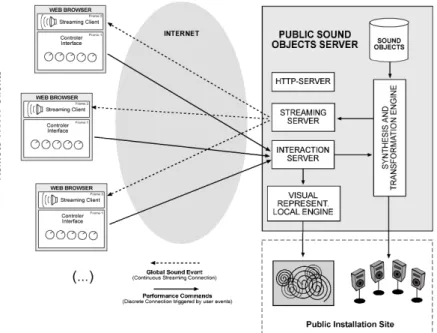
2003 (source: Federal Communications Commission, www.fcc.gov) ... 40 Figure 3 - DynaBook by Alan Kay, 1972 ... 44 Figure 4 - Public Sound Objects setup (Barbosa, 2006) ... 49 Figure 5 - One of the first wireless telephones, built in 1920 (Spooner, 1922)
... 51 Figure 6 - Mobile Subscribers Penetration in Europe (based on active mobile
subscribers) - 2009 ... 52 Figure 7 - Motorola DynaTAC was the first commercial mobile phone using
cellular networks available on the market in 1984. ... 52 Figure 8 - Regency TR-1, the first commercial transistor radio, available in
1954. ... 53 Figure 9 - TPS-L2 was the first Walkman available on the market, in 1979,
produced by Sony. ... 54 Figure 10 - The sonification production cycle (source: (Hermann et al.,
2011a)) ... 63 Figure 11 – The Konigsberg Bridges Problem ((Kraitchik, 1953) quoted in
(Weisstein, n.d.)). ... 77 Figure 12 - The Konigsberg Bridges Solution ((Kraitchik, 1953) quoted in
(Weisstein, n.d.)). ... 77 Figure 13 – Example of two network topologies. “a, The exponential network
is homogeneous: most nodes have approximately the same number of links. b, The scale-free network is inhomogeneous: the majority of the nodes have one or two links but a few nodes have a large number of links, guaranteeing that the system is fully connected”
((Albert, Jeong, & Barabási, 2000)). ... 79 Figure 14 - Random Network ... 81 Figure 15 - The Small World Effect (middle) and Random Network (right)
Figure 16 - World Map of Social Networks - June 2013. Facebook has now 1.155 billion monthly active users. Africa and Lat. America are the largest continents with 346 million users, Asia 339 million, Europe 272 million, US & Canada 198 million users (Cosenza, 2013). ... 86 Figure 17 - Number of patents granted in the USA containing the word “social
network” in the name. ... 87 Figure 18 – A timeline of the foundation of selected online social networks
from 1997 to 2011 ((Heidemann, Klier, & Probst, 2012)) ... 89 Figure 19 - Google search trends for words Web 2.0 (red) and Social Media
(blue). ... 93 Figure 20 - CenceMe Web Portal ... 99 Figure 21 - Soundwalks map view ... 101 Figure 22 - Widenoise Sound Map ... 102 Figure 23 NoiseSPY Noise Mapping. Coloured trace represent the loudness in dBA (Kanjo, 2009). ... 103 Figure 24 - The Quiet Walk GUI. ... 104 Figure 25 - SurroundSense, ambience fingerprinting system (Azizyan,
Constandache, & Roy Choudhury, 2009). ... 105 Figure 26 - SoundSense activity log visualization on two different days (H. Lu,
Pan, Lane, Choudhury, & Campbell, 2009). ... 106 Figure 27 GUI of VibN in Live (left) and Historical (right) views (Miluzzo et al.,
2011). ... 107 Figure 28 - Darwin system outline and applications (Miluzzo et al., 2010) .. 108 Figure 29 - Zagora GUI - Context-Aware Music Player Mobile Application. 108 Figure 30 - NoiseTube Mobile GUI. ... 109 Figure 31 - Smule's Ocarina World Listener view ... 110 Figure 32 - Scribe4Me GUI - Example of an audio-to-text transcription. ... 111 Figure 33 - GUI for “practice mode” (desktop version). The crow and the
crosshairs are visible, along with the score, time left and other settings. ... 117 Figure 34 - Evolution of the score along four consecutive times played (x-axis:
Figure 35 – GUI for mobile version. Left – practice mode; right – Game Mode ... 119 Figure 36 - Comparison of the score’s average (y-axis) on different setups
(x-axis): A – binaural/trackpad; B – stereo/trackpad; C – stereo/iPod. ... 120 Figure 37. Experiment room plan. Left: table, canvas and spotlight. Right:
microphone array arranged according the speakers’ distribution (red cross in the center), speakers (blue) and signal distribution (red ellipses, one for each channel/microphone). ... 126 Figure 38. Experimental setup. ... 127 Figure 39 Subjects preferences regarding the auditory and overall
experiences, with binaural and surround systems (number of
responses). ... 129 Figure 40 - Reasons why subjects chose binaural/surround as the most global real experience (normalized values, just for visual comparison). 130 Figure 41 - Evaluation of the exercise regarding its ability to promote
environmental sound awareness. ... 131 Figure 42 – Definition stage of (Basili et al., 1986) framework for
experimentation in software engineering. ... 140 Figure 43 – Network of the subjects of the experience. ... 144 Figure 44 - The three main elements of Hurly-Burly System: mobile
application, webserver, and web application. ... 152 Figure 45 - Sound classification flow. ... 162 Figure 48 - Hurly-Burly's GUI explained. ... 165 Figure 49 - Hurly-Burly: GUI for the web application. ... 171 Figure 50 - SPL compensation curve for the application ... 172 Figure 51 - SPL (A-Fast) difference between the application measurements
and a SPL professional meter. Graphs 1 to 5 (left to right, top to bottom) represent the following test signals: 1) pink noise, 2) 100Hz, 3) 1000Hz, 4) pub/bar vivid ambience, and 5) lawn mower. Graph 6 represents an overlap of graphs 4 to 6 (blue: pink noise; green: pub/bar; red: mower). The horizontal axis corresponds to the dB SPL range of the test (40 to 90 dB); vertical axis corresponds to the variance (or error) of the application measurement (dB). ... 173
Figure 52 – Results for the performance of the sound classification algorithm. ... 175 Figure 53 - Gender distribution of the sample ... 184 Figure 54 - Gender distribution in each group (normalized graph) ... 184 Figure 55 - Age distribution of the subjects from different groups ... 185 Figure 56 – Subjects nationality distribution (per group - number of answers /
normalized graph) ... 186 Figure 57 - Social Media Landscape among subjects (number of answers) 186 Figure 58 - Characterization of the sample according to the usage frequency
of OSN (number of answers) ... 187 Figure 59 - Main goals of using SM (number of answers) ... 187 Figure 60 - Main goals of using SM (per groups / number of answers /
normalized graph) ... 188 Figure 61 - Social motivations to use OSN ... 188 Figure 62 – User’s sharing preferences in SM (number of answers) ... 189 Figure 63 - Kind of devices used to access SM ... 189 Figure 64 - Usage of sound in mobile devices (ranking) ... 190 Figure 65 - Device distribution (during the experience) ... 191 Figure 66 - Proximity between user and device during the experiment ... 191 Figure 67 – Characterization of the device’s connection to the Internet during
the experiment ... 192 Figure 68 - Understanding of the application goals (1 – very, 4 – nothing /
number of answers) ... 193 Figure 69 - Evolution of the application easiness (1- easy, 4 hard / number of
answers) ... 193 Figure 70 - Evaluation of the application performance (number of answers)
... 194 Figure 71 - Evaluation of the application performance (distribution according
the devices types / normalized graph) ... 194 Figure 72 - First reason to shut down the application (number of answers) 195
Figure 73 - Evaluation of the visual output regarding users' sonic activity (number of answers) ... 195 Figure 74 - Users' knowledge of the term soundscape ... 196 Figure 75 – How subjects evaluate soundscapes as a social enhancer
(number of respondents). ... 197 Figure 76 - Subjects privacy concerns regarding the sharing of audio clips
(number of respondents) ... 197 Figure 77 - Correlation between users appreciation of soundscapes as a SN
enhancer and their willingness to share audio clips ... 198 Figure 78 - Users opinion about HB-like systems being used as environmental tools ... 198 Figure 79 - Distribution of users expectation (number of answers / normalized
graph) ... 199 Figure 80 - Subjects evaluation on the matching between their activity and the
soundscape history plot ... 199 Figure 81 - Soundscape history plot - PhD Students Room (3 weeks) ... 201 Figure 82 - Soundscape History Plot - PhD students’ room (late meeting) .. 202 Figure 83 - Soundscape History Plot - UCP member ... 203 Figure 84 - Soundscape History Plot - Macau member ... 204 Figure 85 - Distribution of the “user-device closeness” per device type
(normalized graph, see percentages above) ... 207 Figure 86 - Distribution of the "soundscape potential for SN" according to the
application performance (normalized graph) ... 208 Figure 87 - Distribution of people's opinion on "soudscapes potential for SN"
List of Tables
Table 1 - Reasons why subjects chose binaural/surround as the most global real experience (number of answers). ... 130 Table 2 – Test Group 1, USJ Students ... 145 Table 3 – Test Group 2 – UCP Staff. ... 146 Table 4 – Test Group 3 – Hurly Burly team. ... 146 Table 5 – Tables layout for Hurly-Burly database. ... 169
Acronyms
ACM – Association for Computing Machinery CASA – Computational Auditory Scene Analysis CACA – Context-Aware Computing Applications CCS – Computing Conference System
CITAR – Research Center for Science and Technology of the Arts CMC – Computer Mediated Communication
CSCW – Computer Supported Cooperative Work DBMS – Database Management System
FtF – Face-to-Face
GeoSNs - Geo-Social Networks GUI – Graphic User Interface HB – Hurly-Burly
HCI – Human-Computer Interaction
ICT – Information and Communication Technologies MIR – Music Information Retrieval
MMOG – Massive Multiplayer Online Games MOSN – Mobile Online Social Networks OSN – Online Social Networks
PARC – Palo Alto Research Center Incorporated SNS – Social Networking Sites/Services
SM – Social Media
UCP – Universidade Católica Portuguesa UDID – Unique Device Identifier
USJ – University of Saint Joseph UGC – User Generated Content WWW – World Wide Web
“Nothing essential happens in the absence of noise.”
Jacques Attali
CHAPTER 1 - Introduction
Humans are naturally inclined to exist in society, to work and live to-gether. Famous philosophers and poets have expressed this idea and made it part of the common sense lexicon. While Aristotle said that the “man is a polit-ical animal” (Arist. Pol. I.2, 1253ª2-5, trans. Barker) - willing to live in the pol-ys, to find structures and hierarchies, to organize in groups and groups of groups -, John Donne, with a more spiritual oriented discourse, conveyed in his poem “No Man Is An Island”, the importance of every subject for the socie-ty.
The topic of this dissertation – Sound Based Social Networks – has much to do with this tendency for humans to live in society but also with the way they actually do it, focusing on their communicational abilities, which un-derlay and catalyze the social dynamics.
In its most basic scenario, the minimum requirement for an act of communication is comprised of a message being transmitted from an emitter to a receiver through a medium. From this basic act many paradigms can be drawn, depending on the perspective one chooses to. McLuhan has coined the phrase “medium is the message” (McLuhan & Lapham, 1994), asserting that the influence of the medium is such that it represents, itself, a more rele-vant (and potentially unnoticeable) message than the content it carries. If this assertion may seem too radical, one has at least to admit that the medium strongly affects and shapes the way we perceive messages. It is true that one does not get equally thrilled by watching the same movie on either IMAX or on an iPod, or by receiving sad news via SMS or in person. The idiosyncrasies of the mediums, the way they appeal to our senses and the technological appa-ratus implied, impact on diverse layers of the message being transmitted, thus the way we perceive it.
Another key element in the communicational chain is language, which in a broad sense can be defined as the “system of communication used by a particular country or community”1: a set of practices, codes and syntaxes made common within emitter and receiver, enabling the good understating of the idea being conveyed. Language, for its complex nature, can assume a vast panoply of manifestations, ranging from sign language to oral language, passing through artistic language, which in turn can be divided into several artistic practices like cinema, music, painting or sculpture, each one claiming its own semiotics. Like no other animal on earth, humans have raised the bar of language to a great level - a technology with many layers and purposes that keeps evolving day-by-day. As (Postman, 1993) said, language is a “kind of technique, a machine” running invisible and inconspicuous in background, being not “merely a vehicle of thought but also the driver”.
To conclude with this brief wrap-up on communication, we go back to the beginning – the medium - to introduce Sound, the central point in this text. Sound is typically defined as a physical phenomenon based on the vibration of molecules within a fixed range of frequencies. These vibrations propagate, meaning that they travel in space through different materials, in different phys-ical states. Although air is the most common of the conductors, sound also propagates in solid and liquid materials - like steel and water - showing subtle but relevant peculiarities in each one. The ability of travelling is the key ele-ment here since it makes sound suitable for the carrying of messages. Oral language and musical language, for example, exist primarily in the sound do-main. One may object that music lives in a score or in peoples mind (remem-ber that Beethoven wrote the 9th in deafness), or that oral messages can be transposed to a written form, both cases with total absence of molecular vibra-tion. However, these examples represent ways for codifying and store latent sonic messages, which ultimately can be considered the point of arrival and departure.
1 "language". Oxford Dictionaries. Oxford University Press.
The range of frequency that defines sound is not arbitrary and coin-cides with the audible frequency range of human ears, usually fixed between 20Hz and 20kHz. Therefore, it is acceptable and advantageous for the sake of this study, to assume that sound is more a definition of a stimulus for human perception rather then an exotic physical phenomenon. This way, we are de-fining sound from an anthropocentric perspective, taking into account its im-portance for human life.
Striping it down to its inner core, the present dissertation binds together two key concepts - Socialization and Acoustic Communication - in order to propose an innovative framework for social networking based on the commu-nicational properties of sound, both as a medium and as a message.
1.1 - Related Areas and Scope of this Dissertation
This dissertation was written under the broad umbrella of Computer Music – more generally addressed within the framework of Sound and Music Computing (Serra, Leman, & Widmer, 2007) - a cross-disciplinary field that merges two large areas per se: sound and technology. Narrowing the subject down to Sound Based Social Networks, we encounter a sociological dimen-sion related with social networks and furthermore with social media.
Therefore, the core of this dissertation comprises three major scientific disciplines within the broader topic of Computer Music:
• Sound and Music Technology • Social Networks and Social Media
• Mobile Sound and Context-Aware Computing
1.1.1 - Sound and Music Technology
While the term Sound, as we have seen before, can be defined out of its physical properties (as also from an anthropocentric perspective), Music
tends to be a more blurred area and open to some haggling when one tries to crystalize it. That is particularly true after the New Music era (roughly speak-ing, the music of the second half of the XX sec.), where contribution from Luigi Russolo, Milton Babbitt, Pierre Schaeffer, Stockhausen, Xenákis, Boulez, Cage, Varèse, among others, helped to dissipate any univocal definition of Music (for a better understanding of the history of contemporary music see (Taruskin, 2009) and (Chadabe, 1996) for electronic sound). From all the ac-tors who played an active role in contemporary music history, perhaps the most disruptive and prominent name was John Cage2, which beyond great unsettling pieces like the 44’ 33’’ or William’s Mix, had accompanied is oeuvre with a consistent theoretical corpus, showing a particular interest in silence (or the absence of it) as musical material (see (Cage, 2011)). Moreover, the term “organized sound” is attributed to Edgar Varèse as a definition of Music as, a fairly broad definition that appears to include (by excess) all the music being done nowadays.
Both, Cage and Varèse’s approaches are relevant for this study as they near together the two concepts – sound and music – pointing the focus into sound. Cage asserts that there is no such thing as silence and that be-came the philosophy beneath his piece 4’ 33’’, where silence does not occur even when all the instruments of the orchestra are muted. The “music” in this case comprises the sound inherent to the audience and the musicians (breathing, movements) and other environmental sounds. This powerful idea - that sound is a constant presence - underlies our research project and sets the fundamental pillars for using sound as a valid element in the social net-work paradigm. In turn, Varèse’s definition of music as organized sound opens the door to other musical paradigms, away from the traditional trinity: harmony, timbre and rhythm. Two examples would be music concrete, intro-duced by Pierre Schaeffer, which bases its musical raw material in sound
2
Interesting to note that in a recent article published online by the NPR - 33 Musicians on What John Cage Communicates - Yoko Ono refers that “History of Western music can be divided into B.C. (Before Cage) and A.C. (After Cage)”. http://www.npr.org/2012/08/30/160327305/33-musicians-on-what-john-cage-communicates.
jects without representative musical characteristics (i.e. note/frequency) and soundscape composition, which represents a compositional approach base on environmental sounds, where the “essence is the artistic, sonic
transmis-sion of meanings about place, time, environment and listening perception”.
(Westerkamp, 2002)
Regarding the sound/music research field in Computer Music, the core of this dissertation is biased towards the sound rather than music, specifically to the sonic events that occur in a particular place and time. This approach is tied to the definition of Soundscape, which paves the theoretical ground for this research and is described later in sub-chapter 2.3 - Mapping the Sound-scape (pp. 23). The role for SoundSound-scapes in this setting is to form part of a context-aware system, able to provide useful cues about the activity of a place in a given time. Information collected this way by a user of such system can be seen as a meta-information element of his/her life experiences.
Nevertheless, a more musical approach is also discussed with regards to Algorithmic Music Composition and Sonification processes, later on sub-chapter 3.3.1 - Sonification (pp. 60). This is important as our framework for a Sound Based Social Network includes an audio feedback module, which takes this compositional method as core.
1.1.2 - Social Networks and Social Media
The sociological aspect of the research is related with social networks, in particular with social media. By studying and extracting the fundamental aspects of what a social network is, as well as the basis of social media, we propose to add a new layer of information to those usually exchanged within user in the cloud (interests, media content, emotional status, location, age, etc.), in order to catalyze further relevant social interactions. The sociological dimension in this research does not occupy the central position; rather it is considered an application target for the research being done in the sound domain. Nevertheless, a good understanding of its principles is essential and
is discussed further ahead in Chapter 4 - Being Social in the Information Era (pp. 69).
1.1.3 - Mobile Sound, Context A, Ubi Comp, Mobile Comp.
Mobile Computing is a field of Human-Computer Interaction character-ized by providing computing processes in portable devices (Imielinski, 1996). Such technology became possible thanks to developments in hardware, which allowed more processing power in smaller devices; in parallel with the production of improved long lasting batteries and wireless network capabili-ties. The expansion of this area demanded new software and interaction par-adigms and opened the doors to new opportunities in HCI. Smartphones are a good example of such evolution, with an incredible market penetration over the last decade. A comparative study revealed that in the United States of America, from 2007 to 2012, smartphone penetration increased from approx-imately 9 million users to 110 million Americans3.
Figure 1 - U.S. Smartphone Owners from 2007 to 2012 (source_ ComScore)
3
According to a study conducted by ComScore in 2012
http://www.comscoredatamine.com/2012/07/getting-smart-u-s-smartphone-population-reaches-110-million-consumers/ [accessed June 14, 2013].
The possibilities opened by Mobile Computing commonly overlap and merge with Ubiquitous Computing technologies, which are characterized by computational processing integrated (in the most invisible way possible) in everyday objects, with human-computer interaction distant from inline com-mands or menu driven GUI (Weiser, 1993). Smartphones are one example where this overlap may occur, though not necessarily, since most of its com-putational tasks are menu driven, accessed according to more traditional desktop paradigm. Some ubiquitous computing behavior on a smartphone would be, for example, an application running on background that sends a message to the user every time he/she passes by a determined location. Such operations, also baptized calm computing (Weiser & Brown, 1996a), everyware computing (Greenfield, 2006), pervasive computing, sentient com-puting (Addlesee et al., 2001) or disappearing/invisible comcom-puting (Norman, 1999) are important for our study as they commonly represent the base for Context-Aware Computing Applications (CACA), which characterize the mo-dus operandi of our system, described in detail in Chapter 8 -Hurly-Burly: Pro-totype System for Experimental Research (pp.151)
Context-Aware Computing Applications, close related with Context Sensing (Ferscha, Vogl, & Beer, 2002) and Context Enabled Applications (Salber, Dey, & Abowd, 1999), represent an area of HCI characterized by sys-tems that “examine and react to an individual’s changing context” (Bill Schilit, Adams, & Want, 1994). The same authors also underline that “This form of computing is broader than mobile computing because it concerns mobile peo-ple, not just mobile computers”(Bill Schilit et al., 1994). The distinction makes clear that CACA focuses on the user experience design rather then the mere hardware portability, although only a tenuous line keeps both apart. In the same manner as Ubiquitous Computing, also CACA can be part of non mobile devices - like public displays for example - however, CACA tends to integrate mobile computing systems, as they allow computational processing in differ-ent contexts, making them suitable for this HCI paradigm.
The last topic being introduced in this brief overview of technological areas adjacent to our research is Mobile Sound, which is in fact a designation not commonly found in literature. An example of such a paradigm would be Scribe4Me, a mobile sound translator for the deaf which analyses samples of environmental audio and sends a text description for the user (Matthews, Carter, Pai, Fong, & Mankoff, 2006). Although not common in literature, Mo-bile Sound can be used to address moMo-bile electronic devices able to produce, record and/or process sound (Behrendt, 2010). As expected, most of the au-dio tasks happening in mobile computing devices are music related: play, rec-ord, analyze and retrieve, store, mix, etc. In fact, Mobile Music is a much more common name in modern literature and relates to many different projects, ranging from music production applications like ZooZbeat (Weinberg, Godfrey, & Beck, 2010), musical instruments like the Ocarina (Wang, 2009) or intelli-gent music players like Zagora (Camurri et al., 2010).
Before we move on, it is relevant to stress the distinction made so far between Mobile Computing (which focus on the portability aspect), Ubiquitous Computing (computing integrated into everyday objects), Context Aware Computing Applications (focused on the software ability to interpret and re-spond to the context), and Mobile Sound (sound related tasks happening on a mobile computing device). These topics will be discussed in more depth on Chapter 3 -Mobile Technology, Soundscapes and Context (pp. 39).
1.2 - Motivations - research question - objectives – statement
In the media domain, sound tends to be regarded as the poor relative, the least considered on the media production pipeline. As sound designers we have learned this lesson the hard way. For example, during the production process of a movie, sound is usually left for the last stage of production. Alt-hough not a problem per se, the issues tend to arise when there is also no in-volvement of the sound crew during the concept and pre-production stages. By the end of the production pipeline, sound designers are mostly called upon to solve problems, rather than to give creative input, and to include sound
metaphors into the narrative. Although this scenario has gradually changed towards a more participative role of the sound designer in the whole produc-tion process, many people still think that sound is not as fundamental as other elements for the quality of the message being transmitted, such as photog-raphy, acting, costume design, etc. Those who think this way are usually un-aware of how a movie is made and what is involved in the sound track making of a movie. Moreover, entering in the psychoacoustics domain, there are also quite relevant aspects of how sound can affect us and influence the way we perceive everyday events, which are beyond the knowledge of non-experts.
The underlying aims of this research can be regarded as a quest to re-veal sound’s importance in everyday life, a study to bring people and sound together. Such general aim is also present in other projects running parallel to this research. For example, in Murky Shooting (Cordeiro, 2011) we have pro-duced a sound-based game where the player has to hit the target relying on audible cues only, shifting the paradigm from visual-centered towards audio-centered games.
Despite this primary goal, all our research grounds in scientific premis-es and attempt to answer more specific problems. In the prpremis-esent rpremis-esearch, the main goal is put as: define and access the potential of environmental sound as a catalyzer of interpersonal relationships. With the research question un-derlying this aim being: Can environmental sound play a role in social media as a catalyst for interpersonal interaction?
The objective of the research is then to ascertain the correlation be-tween environmental sound (specifically in soundscapes) and social interrela-tions. The unusual and unpredictable nature of the topic brings this project in-to the realm of explorain-tory scientific research.
After a systematic analysis of the problem, several sub-questions have arisen and are listed below, according to the scientific areas of our theoretical framework.
1) Soundscapes and Acoustic communication
• Is there a match between environmental sound and people’s activity? • How can we keep track of our personal soundscape?
• How much is the average person aware of its sound environment? • Do people valorize the potential of sound for HCI?
• What is environmental sound ontological potential?
• (How) Can environmental sound be used as a meaningful feature for social networking?
2) Social Networks and Social Media
• What lies in the base of a social network?
• What are the main characteristics of a social network operating in the cyberspace (online social network)?
• How do people integrate sound in their social media interactions?
3) Mobile Computing
• Is it possible do design and implement audio monitoring tools in eve-ryday mobile computing devices?
• What are the intrinsic limitations of this computing paradigm?
4) Auditory Display (sonification)
• Does it make sense to apply sonification to sound-based datasets? • What mapping/approach to follow?
5) Data visualization
• What approach to follow, regarding data visualization of sound events?
The list above was the starting point to trace the methodological plan for our research, which is summarized in sub-chapter 1.3 - Methodology Overview (pp. 11).
1.3 - Methodology Overview
In this sub-chapter we present an overview of our research design, list-ing and describlist-ing the most relevant steps that led to the conclusion of this project.
1) Formulation of the research problem
Regarding the motivations described in sub-chapter 1.2 - Motivations - research question - objectives – statement (pp. 8), we have chosen the topic Sound Based Social Networks. This topic was first hypothesized during a workshop on Design for Mobile Devices, promoted by Future Places Festival in the year 2010, in a workgroup composed by Ana Parada, João Cordeiro and Katerina Markova. Throughout the first year of research the topic experi-enced its maturation process, being iteratively discussed with colleagues, ad-visor and finally submitted as central topic to the scientific council.
2) Extensive literature review
The first two years were dedicated to literature review and state-of-the-art research, which encompassed the main areas of Social Networks and So-cial Media, Acoustic Communication a Soundscapes, Mobile Computing and Context-Aware Applications.
3) Preliminary Research Experiments
In order to ground our main research in scientific evidences, we have developed three preliminary experiments that assessed the potential of sound in several domains and showed how often people overlook the sonic phe-nomenon. Moreover, these experiments provided us with some technological knowledge in Sonic Interaction Design, Mobile Software Development and Mobile Sound.
4) Objectives formulation
After a good understanding of the theoretical background, we outlined the conceptual framework and defined the research methodology for data col-lection according to the main goal and sub-objectives.
5) Experimental research project (proof-of-concept, sample and data col-lection)
The chosen approach was based on empirical research and consisted in the development of a proof-of-concept mobile application to assess the va-lidity of the initial hypothesis – that environmental sound is able to catalyze
social relations. The application was then distributed over a group of
individu-als who formed the research sample, representative of a larger population of social media users. The research data was collected from the application rec-ords (history of environmental sound descriptions of all the users, along the timespan of the experience) combined with individual closed-end surveys and focus group interviews.
6) Processing and analyses
The data collected by the methods described above – a mix of qualita-tive and quantitaqualita-tive data – was analyzed using a computer: edited (detect and errors removed), tabled (distributed in tables) and statistically analyzed (correlations, averages, etc.).
7) Discussion of the results
The current thesis reports the process and represents the outcome of the whole research, including a critical analysis of the major findings.
1.4 - Main challenges
It is common to say that the best way to deal with problems is to regard them as opportunities and that might well be the case in our project. Along the research process we faced challenges that iteratively made us evaluate and
rethink the research design process. While most of the challenges were ex-pected (thus more easily overcome), others appeared suddenly and demand-ed an extra amount of attention. In either case, we can divide the problems into two categories: 1) those related with technological issues and 2) the ones regarding research method issues.
On the technological side we had to face the overwhelming evolution of mobile technology, which makes every move quickly outdated. Besides that, mobile computing has always struggled against energy issues. Adapting a monitoring tool to fit in a personal mobile device dramatically decreases the battery charge cycle. These and other limitation are discussed ahead.
Considering the research methodology, we had to deal with privacy is-sues regarding the use of our proof-of-concept application: the users had to expose themselves in a way they weren’t familiar with, by sharing their envi-ronmental sound information. An extra effort was put into explaining to the participants what the study was about and how the collected information would be managed. The way younger generations which grown immersed in digital technology – usually named digital natives after (Prensky, 2001) – re-lated with privacy is more open than their previous counterparts, mostly due to the possibilities brought by new technology (mobile in particular), which is in-creasingly being tailored to social media, allowing the broadcasting of private information in large scale. However, they understand now that sharing every-thing is not a risk-free activity. An additional issue, this time related with the theoretical background, was the sparse systematical literature on the topic
sound based social networks, which does not represent a research field per se. To finish, we would also point out that the effort to bring sound into the
spotlight is, somehow, an unnatural procedure on an image-centered society and evoked some perplexity on the participants, which afterwards gained a new understating and further acceptance of the medium.
Nevertheless, all the mentioned difficulties hold a latent potential, as they deal with present technologies and regard the current (and fashionable),
social media phenomena. The limitations might actually become opportunities for this study to prove its scientific validity and set the basis for future projects.
1.5 - Applications of this study
The study of sound in the establishment of social links it is not a new endeavor. Telephones and radio broadcasting have been doing that for more than a century. However, what we propose is a different approach to sound communicational properties, regarding the causal listening rather than
seman-tic listening (Chion, 1994) as discussed in Chapter 2 -Sound as a Medium,
Sound as a Message (pp. 17). Such proposal unveils some innovative appli-cations for the use of sound in everyday ICT. Being proved that environmental sound can convey useful information about context and peoples activity (with low demanding computational processing or expertise from the user’s side), there are plenty of everyday situations that could benefit from the application of our research outcomes. Next we provide a list of some hypothetic applica-tions4.
• The Intercom System Baby Monitor – Such devices are a paradigmatic technology, since they already make use of environmental sound in order to establish an elementary social bond between parents and children ba-bies. Typically, these devices are not computer based and do not interpret the sound events they capture (that analysis is left to the caretaker). A computational analysis of the sound could be used to detect different events (someone entering the room, the wakening, slight movements) and send alert messages accordingly (sms, tv pop-up messages, alert sounds).
• The Hub Monitor – A similar system to the Intercom System Baby Monitor could be used in office buildings, to assess the usage of communal social areas like the hub or canteen. Using a system that interprets the sound
4 From this list we exclude our proof-of-concept application explained in detail in Chapter 8 -Hurly-Burly: Prototype System for Experimental Research (pp.136).
source instead of broadcasting the actual sound can have advantages in protecting users privacy, yet giving valuable information on the place’s oc-cupancy.
• The Club Monitor – Entering the MIR world, nightclub costumers could benefit from a real-time feed of music metadata (title of the song, artist, genre) playing at the moment in each club of the city. This information could be effortlessly collected and broadcasted collaboratively by the cos-tumers of each place, using their smartphones. If gathered from different clubs in the area, this could work as a recommendation service based on the music being played.
1.6 - Structure of the thesis
In this sub-chapter we present the structure of the thesis, along with a brief description of each chapter, providing a map for the reader.
The thesis is divided in two major conceptual sections: contextualiza-tion and experimental process.
1) Contextualization
In this section we present the results of systematic literature review on the thesis topic, divided in three chapters:
• Chapter 2 - Sound as a Medium, Sound as a Message covers the literature review and contextualization of the research in its relation with sound.
• Chapter 3 - Mobile Technology, Soundscapes and Context intro-duces the topic of mobile devices as casual sensors for monitoring environment and human activity.
• Chapter 4 - Being Social in the Information Era covers the system-atic study of social media applications.
• Chapter 5 - State-Of-The-Art On Sound-Based Social Interaction Systems presents a survey on the state-of-the-art technologies re-garded as a references to our study.
2) Experimental Process
In this section the detailed description of the experimental process and development of the proof-of-concept/research tool is presented, along with an analysis and discussion on the collected data and further findings.
• Chapter 6 - Preliminary Research On Soundscapes And Sonic In-teraction is a chapter dedicated to present two research projects developed in parallel, by the author, during the course of this doc-toral study. The projects are not directly related with the main topic of the dissertation but provided important insights on important are-as such are-as Mobile Computing and Soundscapes;
• Chapter 7 - Research Methodology describes the methodology fol-lowed in the course of this interdisciplinary research. Several ap-proaches, from divers scientific fields, contributed with methods and techniques for our study.
• Chapter 8 - Hurly-Burly: Prototype System for Experimental Re-search is dedicated to present all the details regarding the concep-tualization, development and implementation of the proposed re-search tool / proof-of-concept.
• Chapter 9 - System Evaluation and Result Analysis is dedicated to evaluate the results of the questionnaires made to the subjects of the experience.
• Chapter 10 - Conclusions. Chapter dedicated to present the main contributions of this research project and future work to be done in this field.
CHAPTER 2 - Sound as a Medium, Sound as a
Message
The current chapter is dedicated to expatiate on the general topic of sound and soundscapes in particular, which have been widely discussed in literature, tackled from different perspectives and aimed at different goals. Our approach in this chapter aims to provide a good overall understanding of the-se scientific areas, favoring the aspects that related, more or less directly, to our research agenda. Thus, the title of the chapter encloses an abstraction regarding the role of sound in our study and should be understood in the fol-lowing way: sound is usually used as medium to convey semantic messages (speech, alarms, music, etc.) but sonic events that were not originally con-ceived as messages (the sound of a car, the sound of wind, etc.) hold a com-municative potential which we propose to explore.
2.1 - Sound: physics and meanings
Foremost, sound is regarded as a physical phenomenon, which is characterized by the vibration of molecules in a given medium in a way that is perceived by the human auditory system. Some of the early systematizations on the sound phenomenon were related to the musical practice and date from the 6th century BC, when Greek philosopher Pythagoras undertook a study on musical intervals and their mathematical relations. Aristotle also dedicated thoughts on the topic in his writings compiled under the name Poetics (Aristo-tle, 1987), where he talks about the sound differences between consonants in speech, grouping them according to their sonic characteristics, and in the work De Audibilibus, now usually ascribed to Strato (Aristotle, 1881), in which a formulation of a wave theory is mooted. Later, during the 1st century BC, sound was also debated from the architectural perspective, on the work of Vi-truvius – On Architecture (ViVi-truvius, 1931) – were concerns about room acoustics are expressed and the wave theory is suggested (Kilgour, 1963).
However, it was only in the 19th century that major systematizations in the field happened, mostly by the hand of English scientist and Nobel Prize in Physics Lord Rayleigh with his two volumes book The Theory of Sound (Ray-leigh, 1877, 1878) and with German scientist Hermann von Helmholtz (Helm-holtz, 1913) on the field of psychoacoustics.
This superficial historical review shows that the field of sound is two-fold: on one side lie the sound sources, on the other how it is perceived; or as (Olson, 1967) put it, two major scientific fields emerge in sound, the physical acoustics and physiological acoustics. The first one deals with the physical properties of the vibration while the second deals with the physiological opera-tion of the auditory system, responsible for transducing physical movement into electrical stimuli for the brain. Nevertheless, the aural experience would not be complete without the understanding of how stimuli are perceived and organized by the brain. This complex phenomenon is mainly studied under psychoacoustics, yet extending to other scientific areas such as anthropology, musicology, psychology and cognition (Erlmann, 2004). Today it is clear for the scientific community that the meaning we attribute to sound events differ from listener to listener, as a consequence of the cognitive dimension implicit on the act of listing. For example, a musical piece will resonate differently on distinctive listeners according to their musical background and affective rela-tion with that particular piece or musical genre, in the same way that the sound of a forest will give much more information to someone used to living in the countryside than to someone from the city, generally speaking (McAdams & Bigand, 1993).
2.2 - Sound awareness
Sound is therefore, a complex phenomenon and it represents a daunt-ing task when one tries to cover it in all its dimensions. But despite this com-plexity, the auditory experience happens effortlessly and most of the time un-noticed. Perhaps because of this, sound and our auditory system tend to be less considerate when compared to image and vision. While sounds can be
considered indexical from a semiotic perspective, as their meanings are quickly understood by most humans because they are largely given by their obvious physical origin (Saldanha, 2009), the average person, normally oper-ating on a casual listening mode (Chion, 1994), has an overall low awareness of his or her sonic milieu. It often takes a disruptive sound to perceive and be-come conscious of changes in a soundscape. These disruptive sounds fre-quently owe their conspicuousness to the lack of reference to any visual cues which can be true both with sounds operating clearly out of context and/or be-cause a sound source is out of one’s sight. Other forms of disruptive sounds include those that listeners dislike but are forced to live with, while not being completely unaware of its source (ex. a neighbor’s dog barking outside your window at 6 o’clock in the morning). This lack of awareness towards sound is also noticeable when people are confronted with the production process of a sound for a movie. From our experience delivering sound design courses we conclude that people in general do not recognize neither the techniques in-volved in the production pipeline nor the extension of the impact that sound has in the dramatic load of a movie. Besides, when someone rarely mentions the extraordinary quality of a movie soundtrack is usually referring to the mu-sic of the film and not to the whole sound track, which is comprised of a much richer soundscape, with subtle nuances arising from the fine mixing of human voice, music, sound effects and ambient sounds.
Sound as a sensorial stimulus has peculiarities that make it unique and highly apposite for accomplishing daily life tasks. To begin with, audition is the vigilant sense, it never shuts off even when asleep. It was due to this feature that humans (and of course other animals) were able to survive in the wild, among all sorts of predators who would attack at night or outside of the view-ing angle. Sound is three-dimensional, our auditory system is accurate enough to identify the source locus wherever it presents itself to the listener, with a moderate increase in precision when the listener is faced directly to-ward the source. The process is not analogous to localizing a visual source on the fovea of the retina (Middlebrooks & Green, 1991).
“Hearing, together with its active complement, listening, is a means by which we sense the events of life, aurally visualize spatial geometry, propagate cultural symbols, stimulate emo-tions, communicate aural information, experience the movement of time, build social relationships, and retain a memory of expe-riences.” (Blesser & Salter, 2007)
These aspects in the nature of sound had impact not only in the way humans survived in the wild but also on how recent technologies involved. Two brief examples of this fact would be the redefinition of radiobroadcast af-ter the arriving of television and the new trends in sonic inaf-teraction design.
For more than three decades, radiobroadcasting was the preeminent medium in households in western civilization. Families would gather around the radio device to listen to the several radio programs whether they were in-formative, entertainment or educational. Radio, by its technical characteristics – one antenna emitting spherically-shaped electromagnetic waves into the air (hence, the name radio/radius) - helped creating a sense of community, as those near the antenna would receive the signal while those further away would not. This resembles the church bell effect, which used to delimit the parish territory in countryside villages and even in more urban territories, cre-ating what Schafer called and Acoustic Space that potentially embraces an Acoustic Community (Schafer, 1994) (this topic is of most importance to our thesis, hence we will come back to it later in sub-chapter 2.4.1 - The acoustic community (pp. 31)). Most would agree that the magic of radio was the magi-cal world of the ear stated by McLuhan when referring to the early oral tradi-tion of the tale-tellers (McLuhan, 1962). Mainly, because radio is a medium that demands an active roll from the listener, who has to paint the narrative with his or her own mental images. With the advent of television in the mid-fifties, radio would rapidly lose its place in the limelight, as the spectators where starving for a more “multi-modal” experience in the media. Meanwhile, radio would not disappear for good, as it still represents a ubiquitous presence nowadays. What happened was that radio had to find in the unique