arXiv:1412.6663v3 [hep-ex] 23 Apr 2015
EUROPEAN ORGANISATION FOR NUCLEAR RESEARCH (CERN)
CERN-PH-EP-2014-274
Submitted to: JHEP
Search for charged Higgs bosons decaying via
H
±→ τ
±ν
in
fully hadronic final states using
pp
collision data at
√
s
= 8
TeV
with the ATLAS detector
The ATLAS Collaboration
Abstract
The results of a search for charged Higgs bosons decaying to aτ lepton and a neutrino,H±
→ τ±
ν, are presented. The analysis is based on 19.5 fb−1 of proton–proton collision data at √s = 8
TeV collected by the ATLAS experiment at the Large Hadron Collider. Charged Higgs bosons are searched for in events consistent with top-quark pair production or in associated production with a top quark, depending on the considered H±
mass. The final state is characterised by the presence of a hadronicτ decay, missing transverse momentum,b-tagged jets, a hadronically decayingW boson, and the absence of any isolated electrons or muons with high transverse momenta. The data are consistent with the expected background from Standard Model processes. A statistical analysis leads to 95% confidence-level upper limits on the product of branching ratiosB(t → bH±) × B(H±→ τ±ν), between 0.23% and 1.3% for charged Higgs boson masses in the range 80–160 GeV. It also leads to 95% confidence-level upper limits on the production cross section times branching ratio, σ(pp →
tH±
+X)×B(H±
→ τ±
ν), between 0.76 pb and 4.5 fb, for charged Higgs boson masses ranging from 180 GeV to 1000 GeV. In the context of different scenarios of the Minimal Supersymmetric Standard Model, these results exclude nearly all values of tan β above one for charged Higgs boson masses between 80 GeV and 160 GeV, and exclude a region of parameter space with high tan β for H±
Prepared for submission to JHEP
Search for charged Higgs bosons decaying via
H
±→ τ
±ν
in fully hadronic final states using pp
collision data at
√
s
= 8
TeV with the ATLAS
detector
The ATLAS Collaboration
Abstract: The results of a search for charged Higgs bosons decaying to a τ lepton
and a neutrino, H±
→ τ±
ν, are presented. The analysis is based on 19.5 fb−1
of proton–
proton collision data at √s = 8 TeV collected by the ATLAS experiment at the Large
Hadron Collider. Charged Higgs bosons are searched for in events consistent with top-quark pair production or in associated production with a top top-quark, depending on the
considered H±
mass. The final state is characterised by the presence of a hadronic τ decay, missing transverse momentum, b-tagged jets, a hadronically decaying W boson, and the absence of any isolated electrons or muons with high transverse momenta. The data are consistent with the expected background from Standard Model processes. A statistical analysis leads to 95% confidence-level upper limits on the product of branching
ratios B(t → bH±
) × B(H±
→ τ±
ν), between 0.23% and 1.3% for charged Higgs boson masses in the range 80–160 GeV. It also leads to 95% confidence-level upper limits on
the production cross section times branching ratio, σ(pp → tH±
+ X) × B(H±
→ τ±
ν), between 0.76 pb and 4.5 fb, for charged Higgs boson masses ranging from 180 GeV to 1000 GeV. In the context of different scenarios of the Minimal Supersymmetric Standard Model, these results exclude nearly all values of tan β above one for charged Higgs boson masses between 80 GeV and 160 GeV, and exclude a region of parameter space with high tan β for H±
Contents
1 Introduction 1
2 Data and simulated events 3
3 Physics object selection 5
4 Event selection and background modelling 6
4.1 Event selection 6
4.2 Data-driven estimation of the backgrounds with a true τhad 7
4.3 Data-driven estimation of the multi-jet backgrounds 9
4.4 Backgrounds with electrons or muons misidentified as τhad-vis 11
4.5 τhad-vis+ETmiss triggers 11
4.6 Event yields after the event selection 12
5 Systematic uncertainties 12
5.1 τhad-vis+ETmiss triggers 12
5.2 Data-driven background estimation 13
5.3 Detector simulation 15
5.4 Generation of t¯t and signal events 16
6 Statistical analysis 16
7 Results 18
8 Conclusions 22
9 Acknowledgements 22
1 Introduction
Charged Higgs bosons (H+, H−
) are predicted by several non-minimal Higgs scenarios, such as two-Higgs-doublet Models (2HDM) [1] or models containing Higgs triplets [2–6]. As the Standard Model (SM) does not contain any elementary charged scalar particle, the
observation of a charged Higgs boson1 would clearly indicate new phenomena beyond the
SM. For instance, supersymmetric models predict the existence of charged Higgs bosons. In a type-II 2HDM, such as the Higgs sector of the Minimal Supersymmetric Standard Model
(MSSM) [7–11], the main H+production mode at the Large Hadron Collider (LHC) would
be through top-quark decays t → bH+, for charged Higgs boson masses (m
H+) smaller than 1
In the following, charged Higgs bosons are denoted by H+
the top-quark mass (mtop). At the LHC, top quarks are produced predominantly through
t¯t production. In this paper, the contribution to t → bH+ which may arise from single
top-quark production is neglected, since the signal production cross section through this
channel is very small with respect to t¯t production. A diagram illustrating the
leading-order production mechanism is shown on the left-hand side of figure1. For charged Higgs
boson masses larger than mtop, the main H+ source at the LHC is through associated
production with a top quark. An additional b-quark can also appear in the final state. The leading-order production mechanisms in two different approximations are illustrated
in the centre and right-hand side diagrams of figure 1: in the four-flavour scheme (4FS)
b-quarks are dynamically produced, whereas in the five-flavour scheme (5FS) the b-quark is also considered as an active flavour inside the proton. Their cross sections are matched according to ref. [12], and an evaluation of the two schemes can be found in ref. [13].
In the MSSM, the Higgs sector can be completely determined at tree level by one
of the Higgs boson masses, here taken to be mH+, and tan β, the ratio of the vacuum
expectation values of the two Higgs doublets. For mH+ < mtop, the decay via H+→ τ+ν is dominant for tan β > 2 and remains sizeable for 1 < tan β < 2. For higher mH+, the decay via H+→ τ+ν is still significant, especially for large values of tan β [14]. The combined
LEP lower limit for the charged Higgs boson mass is about 90 GeV [15]. The Tevatron
experiments placed upper limits on B(t → bH+) in the 15–20% range for mH+ < mtop [16,
17]. In a previous search based on data taken at √s = 7 TeV with the ATLAS and CMS
detectors, the limits on B(t → bH+) were lowered to the range 0.8–4% [18,19]. For all of
these results, B(H+→ τ+ν) = 100% was assumed.
This paper describes a search for charged Higgs bosons with masses in the ranges 80–
160 GeV and 180–1000 GeV. The region 160 GeV < mH+ < 180 GeV is not considered in
this paper, since there is currently no reliable theoretical treatment for the interference between the different H+ production modes in this transition region [20]. The final state studied is characterised by the presence of a hadronic τ decay (τhad), missing transverse
momentum (Emiss
T ), b-quark-initiated jets, a hadronically decaying W boson, and the
ab-sence of any isolated electrons or muons with high transverse momenta. In addition to the large branching ratio for a τ to decay hadronically, this final state contains only
neutri-nos associated with the H+ production and decay, resulting in good discriminating power
between SM and signal processes. Charged Higgs bosons are searched for in a
model-independent way, hence results are given in terms of B(t → bH+) × B(H+ → τ+ν)
(low-mass search, mH+ < mtop) and σ(pp → ¯tH++ X) × B(H+→ τ+ν) (high-mass search,
mH+ > mtop). These limits are then also interpreted in different MSSM scenarios. The results are based on 19.5 fb−1
of data from pp collisions at √s = 8 TeV, collected in 2012 with the ATLAS detector at the LHC. The final state analysed for the low-mass search is t¯t → b¯bW−
H+→ b¯b(q¯q′
)(τhad+ ν). The final state is similar or identical for the high-mass search, depending on whether the additional b-quark-initiated jet is seen in the detector,
gb → ¯tH+→ (W−¯b)H+
→ (q¯q′¯b)(τ+
hadν) in the 5FS case and gg → ¯tbH+→ (W
−¯b)bH+
→ (q ¯q′¯b)b(τ+
hadν) in the 4FS case.
in this analysis are described. In section 3, the reconstruction of physics objects in ATLAS is discussed. The event selection and background modelling are presented in section 4. Systematic uncertainties are discussed in section 5, and the limit-setting procedure is de-scribed in section 6. Exclusion limits in terms of B(t → bH+) × B(H+→ τ+ν) (low-mass)
and σ(pp → ¯tH++ X) × B(H+→ τ+ν) (high-mass) as well as model-dependent exclusion
contours are presented in section 7.
(a) low-mass H+
production (b) 5FS high-mass H+
production (c) 4FS high-mass H+
production
Figure 1. Leading-order Feynman diagrams for the dominant production modes of charged Higgs bosons at masses (a) below and (b, c) above the top-quark mass.
2 Data and simulated events
The ATLAS detector [21] consists of an inner tracking detector with coverage in
pseudora-pidity2 up to |η| = 2.5, surrounded by a thin 2 T superconducting solenoid, a calorimeter
system extending up to |η| = 4.9 and a muon spectrometer extending up to |η| = 2.7 that measures the deflection of muon tracks in the field of three superconducting toroid mag-nets. A three-level trigger system is used. The first-level trigger (L1) is implemented in hardware, using a subset of detector information to reduce the event rate to no more than 75 kHz. This is followed by two software-based trigger levels (L2 and EF), which together further reduce the event rate to less than 1 kHz.
Only data taken with all ATLAS subsystems operational are used. Stringent detector and data quality requirements are applied, resulting in an integrated luminosity of 19.5 fb−1
for the 2012 data-taking period. The integrated luminosity has an uncertainty of 2.8%,
measured following the methodology described in ref. [22]. Events are required to have a
primary vertex with at least five associated tracks, each with a transverse momentum pT
greater than 400 MeV. The primary vertex is defined as the reconstructed vertex with the largest sum of squared track transverse momenta.
The background processes to this search include SM pair production of top quarks,
as well as the production of single top-quark, W +jets, Z/γ∗
+jets, diboson and multi-jet events. These backgrounds are categorised based on the type of reconstructed objects
2
ATLAS uses a right-handed coordinate system with its origin at the nominal interaction point (IP) in the centre of the detector and the z-axis along the beam pipe. The x-axis points from the IP to the centre of the LHC ring, and the y-axis points upwards. Cylindrical coordinates (r, φ) are used in the transverse plane, φ being the azimuthal angle around the z-axis. The pseudorapidity is defined in terms of the polar angle θ as η = − ln tan(θ/2).
identified as the visible decay products3of the hadronically decaying τ candidate (τhad-vis).
The dominant backgrounds in this analysis, those containing a true τhad, where the τhad-vis
is correctly identified, or a jet misidentified as a τhad-vis candidate, are estimated in a
data-driven way (sections4.2and4.3), while simulation samples are used to estimate the minor background arising from events with a lepton misidentified as a τhad-vis (1–2% of the total
background). Simulation samples are also used to develop and validate the analysis.
The modelling of SM t¯t and single top-quark events is performed with MC@NLO [23,
24], except for t-channel single top-quark production, for which AcerMC [25] is used. The top-quark mass is set to 172.5 GeV and the set of parton distribution functions used is
CT10 [26]. For events generated with MC@NLO, the parton shower, hadronisation and
underlying event are added using HERWIG [27] and JIMMY [28]. PYTHIA6 [29] is used
instead for events generated with AcerMC. Inclusive cross sections are taken from the approximate next-to-next-to-leading-order (NNLO) predictions for t¯t production [30], for
single top-quark production in the t-channel and s-channel [31, 32], as well as for W t
production [33]. Overlaps between SM W t and t¯t final states are removed [24]. Single vector
boson (W and Z/γ∗
) production is simulated with up to five accompanying partons, using
ALPGEN [34] interfaced to HERWIG and JIMMY, and using the CTEQ6L1 [35] parton
distribution functions. The additional partons produced in the matrix-element part of the event generation can be light partons or heavy quarks. In the latter case, ALPGEN is also used to generate dedicated samples with matrix elements for the production of massive
b¯b or c¯c pairs. Diboson events (W W , W Z and ZZ) are generated using HERWIG. The
cross sections are normalised to NNLO predictions for W -boson and Z/γ∗
production [36,
37] and to next-to-leading-order (NLO) predictions for diboson production [38]. The SM
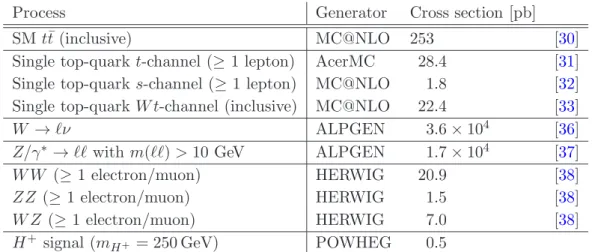
background samples are summarised in table 1.
Signal samples are produced with PYTHIA 6 for 80 GeV ≤ mH+ ≤ 160 GeV in mH+
intervals of 10 GeV separately for t¯t → b¯bH+W−
and t¯t → b¯bH−
W+, where the charged
Higgs bosons decay via H+→ τ+ν. The process t¯t → b¯bH+H−
gives a very small contribu-tion to the signal region, which is negligible after the event seleccontribu-tion described in seccontribu-tion4.1. The cross section for these processes depends only on the total t¯t production cross section
and the branching ratio B(t → bH+). For 180 GeV ≤ mH+ ≤ 1000 GeV, the simulation
of the signal for top-quark associated H+ production is performed with POWHEG [39]
interfaced to PYTHIA 8 [40]. For 180 GeV ≤ mH+ ≤ 200 GeV, samples are produced in
mH+ steps of 10 GeV, then in intervals of 25 GeV up to mH+ = 300 GeV and in intervals
of 50 GeV for mH+ ≤ 600 GeV. Additionally, signal mass points at mH+ = 750 GeV and
mH+ = 1000 GeV are produced. The production cross section for the high-mass charged
Higgs boson is computed using the 4FS and 5FS, including theoretical uncertainties, and
combined according to ref. [12]. The samples are generated at NLO using the 5FS and the
narrow-width approximation for the H+. Possible effects from the interference between
the production of a charged Higgs boson through t¯t and top-quark associated production
are not taken into account.
The event generators are tuned to describe the ATLAS data. In samples where
3
Process Generator Cross section [pb]
SM t¯t (inclusive) MC@NLO 253 [30]
Single top-quark t-channel (≥ 1 lepton) AcerMC 28.4 [31]
Single top-quark s-channel (≥ 1 lepton) MC@NLO 1.8 [32]
Single top-quark W t-channel (inclusive) MC@NLO 22.4 [33]
W → ℓν ALPGEN 3.6 × 10⁴ [36]
Z/γ∗
→ ℓℓ with m(ℓℓ) > 10 GeV ALPGEN 1.7 × 10⁴ [37]
W W (≥ 1 electron/muon) HERWIG 20.9 [38]
ZZ (≥ 1 electron/muon) HERWIG 1.5 [38]
W Z (≥ 1 electron/muon) HERWIG 7.0 [38]
H+ signal (mH+ = 250 GeV) POWHEG 0.5
Table 1. Cross sections for the simulated processes and reference generators used to model them. For the high-mass H+
signal selection, the value shown is the cross section times B(H+
→ τ+ν)
for the MSSM mmax
h scenario [41, 42], corresponding to mH+ = 250 GeV and tan β = 50. This
cross section includes both H+
and H−
production. The low-mass signal, which is not included in the table, assumes one H+
produced per t¯t decay, so it is a fraction of the t¯t cross section. The previously published upper limit on B(t → bH+) for m
H+ = 130 GeV is 0.9% [18].
PYTHIA 6 is interfaced to AcerMC, the AUET2B [43] tune is used. The Perugia 2011 C
tune [44] is used when PYTHIA 6 is interfaced to POWHEG. For the samples generated
with HERWIG, the AUET2 [45] tune is used. In all samples with τ leptons, except for
those simulated with PYTHIA 84, TAUOLA [46] is used for the τ decays. PHOTOS [47]
is used for photon radiation from charged leptons in all samples where applicable.
To take into account the presence of multiple proton–proton interactions occurring in the same and neighbouring bunch crossings (referred to as pile-up), simulated minimum-bias events are added to the hard process in each generated event. Prior to the analysis, simulated events are reweighted in order to match the distribution of the average number of pile-up interactions in the data. All generated events are propagated through a detailed
GEANT4 simulation [48,49] of the ATLAS detector and are reconstructed with the same
algorithms as the data.
3 Physics object selection
Jets are reconstructed from energy deposits in the calorimeters, using the anti-kt
algo-rithm [50,51] with a radius parameter of R = 0.4. Jets are required to have pT> 25 GeV
and |η| < 2.5. To reduce the contribution of jets initiated by pile-up, jets with pT< 50 GeV
and |η| < 2.4 must pass the requirement that at least half of the pTof the tracks associated
with the jet is contributed by tracks matched to the primary vertex [52]. An algorithm
identifies jets containing b-quarks by combining impact parameter information with the explicit determination of a secondary vertex [53], and these are referred to as b-tagged jets.
4
So-called “sophisticated tau-decays” have been available in PYTHIA since version 8.150 such that the usage of TAUOLA is not necessary.
A working point corresponding to a 70% efficiency for identifying b-quark-initiated jets is used.
Candidates for identification as τhad-vis arise from jets reconstructed from energy
de-posits in calorimeters, again using the anti-ktalgorithm with a radius parameter of R = 0.4,
which have pT > 10 GeV and one or three charged-particle tracks within a cone of size of
∆R < 0.2, where ∆R = p(∆η)2+ (∆φ)2 around the τ
had-vis axis [54]. These candidates
are further required to have a visible transverse momentum (pτT) of at least 20 GeV and
to be within |η| < 2.3. The output of boosted decision tree algorithms [55, 56] is used to distinguish τhad-vis from jets not initiated by τ leptons, separately for τhad decays with
one or three charged-particle tracks. In this analysis, a point with 40% (35%) efficiency for identification of 1(3)-prong τhad-vis is used, and this requirement is referred to as the
τhad-visidentification. Dedicated algorithms are used to reject electrons and muons that are
incorrectly identified as τhad-vis [54]. After these algorithms are applied, the backgrounds
arising from muons and electrons misidentified as τhad-vis are very small, although there is
still a sizeable background from jets misidentified as τhad-vis.
The EmissT is defined as the magnitude of the negative vectorial sum of transverse
momenta of muons and energy deposits in the calorimeter. It is computed using fully calibrated and reconstructed physics objects [57].
The final states considered in this search contain no charged leptons, hence events containing isolated electron or muon candidates with high transverse momenta are re-jected. Electron candidates are reconstructed from energy deposits in the calorimeter that are matched to tracks in the inner detector, taking losses due to bremsstrahlung into
ac-count. They are required to have a transverse energy (ET) greater than 25 GeV and to
be within |η| < 2.47 (the transition region between the barrel and end-cap calorimeters, 1.37 < |η| < 1.52, is excluded) [58, 59]. Muon candidates must pass tracking
require-ments in both the inner detector and the muon spectrometer, have pT > 25 GeV and
|η| < 2.5 [60]. Additionally, electron candidates are required to pass pile-up-corrected 90% efficient calorimeter- and track-based isolation, with ∆R cone sizes of 0.2 and 0.3, respec-tively, while muon candidates are required to pass a relative track-based isolation of < 0.05 with a ∆R cone < 0.4 [61].
4 Event selection and background modelling
4.1 Event selection
The analysis uses events passing a τhad-vis+ETmiss trigger. The τhad-vis trigger is defined by
calorimeter energy in a narrow core region and an isolation region at L1, a basic combination of tracking and calorimeter information at L2 and more sophisticated algorithms imported from the offline reconstruction at the EF. The ETmiss trigger uses calorimeter information at all levels with a more refined algorithm at the EF. The EF threshold on the transverse
momentum of the τhad-vis trigger object is 27 GeV or 29 GeV, and for the EmissT trigger
the EF threshold is 40 GeV or 50 GeV. The multiple trigger thresholds are the result of slight changes of the trigger definition during the 2012 data-taking period, for which 50%
of events had EF thresholds at 27 GeV and 50 GeV, 43% at 29 GeV and 50 GeV, and 7% at 29 GeV and 40 GeV, for the τhad-vis and ETmiss triggers, respectively.
Further event filtering is performed by discarding events in which any jet with pT >
25 GeV fails the quality cuts discussed in ref. [62]. This ensures that no jet is consistent with having originated from instrumental effects or non-collision backgrounds. The following requirements are then applied:
• at least four (three) selected jets for the low-mass (high-mass) signal selection; • at least one of these selected jets being b-tagged at the 70%-efficient working point; • exactly one selected τhad-vis with pτT > 40 GeV matched to a τhad-vis trigger object
(trigger-matched);
• no selected electron or muon in the event;
• ETmiss> 65 (80) GeV for the low-mass (high-mass) signal selection;
• ETmiss/
q
P pPV trk
T > 6.5 (6.0) GeV1/2 for the low-mass (high-mass) signal selection,
whereP pPV trk
T is the sum of transverse momenta of all tracks originating from the
primary vertex. This is to reject events in which a large reconstructed ETmiss is due to the limited resolution of the energy measurement.
For the selected events, the transverse mass (mT) of the τhad-vis and ETmiss is defined
as:
mT =
q 2pτ
TETmiss(1 − cos ∆φτ,miss), (4.1)
where ∆φτ,miss is the azimuthal angle between the τhad-visand the direction of the missing
transverse momentum. This discriminating variable takes values lower than the W boson
mass for W → τν background events and less than the H+ mass for signal events, in the
absence of detector resolution effects.
A minimal requirement is placed on mT at 20 (40) GeV in the low-mass (high-mass)
H+ search. This requirement is motivated in section 4.2. After the full event selection,
the signal has an acceptance of 0.30–0.60% for the low-mass range, and 1.7–5.8% for the
high-mass range, where in both cases the acceptance increases with increasing mH+. The
acceptances are evaluated with respect to signal samples where both the τ lepton and the associated top quark decay inclusively.
4.2 Data-driven estimation of the backgrounds with a true τhad
An embedding method [63] is used to estimate the backgrounds that contain a real τhad
from a vector boson decay. The method is based on a control data sample of µ+jets events satisfying criteria similar to those of the signal selection except for the τhad-visrequirements
and replacing the detector signature of the muon by a simulated hadronic τ decay. The method is applied to a control region of µ+jets events, rather than e+jets, due to the clean signature and the relative ease with which the measured muon can be removed. These new hybrid events are then used for the background prediction. An advantage of this approach,
compared to simulation, is that with the exception of the τhad, the estimate is extracted
from data; this includes the contributions from the underlying event and pile-up, jets, and all sources of Emiss
T except for the neutrino from the τhad decay. Furthermore, since
the normalisation of the background estimate is evaluated from the data, assuming lepton universality of the W boson decay, the method does not rely on theoretical cross sections and their uncertainties. This embedding method has been used in previous charged Higgs boson searches [64] as well as in SM H → ττ [65,66] analyses.
To select the µ+jets sample from the data, the following requirements are made:
• a single-muon trigger with a pT threshold of 24 GeV or 36 GeV (single-muon
trig-gers with two different pT thresholds are used, since the lower-threshold trigger also
requires the muon to be isolated);
• exactly one isolated muon with pT> 25 GeV and no isolated electron with
ET> 25 GeV;
• at least four (three) jets with pT > 25 GeV for the low-mass (high-mass) charged
Higgs boson search, at least one of which is b-tagged;
• ETmiss> 25 (40) GeV for the low-mass (high-mass) charged Higgs boson search.
This selection is looser than the selection defined in section4.1in order not to bias the
sample. However, the ETmiss cut in the µ+jets sample selection removes events with very
low mT. Thus, a cut on mT > 20 (40) GeV is introduced in the search for low-mass
(high-mass) charged Higgs bosons to remove this bias. With this selection, there is a possible small contamination from signal events with a leptonically decaying τ lepton. This small
contamination, which is estimated using simulation, has a much softer mT distribution
than the signal with τhad, and is observed to have a negligible impact on the evaluation
of signal strength or exclusion limits. Contamination from leptonically decaying τ leptons from W decays is accounted for in the overall normalisation (cτ →µ in eq. (4.3)).
To replace a muon in the selected data, the track that is associated with the muon is removed. The energy deposited in the calorimeters is removed by simulating a W → µν event with the same kinematics as in the selected data event and identifying the correspond-ing cells. Thus, the removal of energy deposits not associated with the selected muon is minimised. The momentum of the muon in selected events is extracted and rescaled to account for the higher τ lepton mass,
~ pτ = q E2 µ− m2τ p~pµ· ~pµ ~ pµ, (4.2)
where ~pτ is the rescaled momentum, Eµ is the reconstructed energy of the muon, mτ is
the τ mass, and ~pµ is the reconstructed muon momentum. The τ lepton with rescaled
momentum is further processed by TAUOLA to produce the hadronic τ decay and account for the τ polarisation as well as for final-state radiation. The τ lepton decay products are propagated through the full detector simulation and reconstruction. Events referred to
as containing a true τhad are those with a genuine τhad as expected from the embedding
method.
The shape of the mT distributions for backgrounds with a true τhad is taken from the
distribution obtained with the embedded events, after applying the corresponding signal selection. The normalisation is then derived from the number of embedded events:
Nτ = Nembedded· (1 − cτ →µ)
ǫτ +ETmiss−trigger
ǫµ−ID,trigger × B(τ → hadrons + ν), (4.3)
where Nτ is the estimated number of events with a true τhad, Nembedded is the number of
embedded events in the signal region, cτ →µ is the fraction of events in which the selected
muon is a decay product of a τ lepton (taken from simulation, about 4%), ǫτ +Emiss
T −trigger
is the τhad-vis+ETmiss trigger efficiency (as a function of pτT and ETmiss, derived from data,
see section 4.5), ǫµ−ID,trigger is the muon trigger and identification efficiency (as a function
of pT and η, derived from data) and B(τ → hadrons + ν) is the branching ratio of the τ
lepton decays to hadrons.
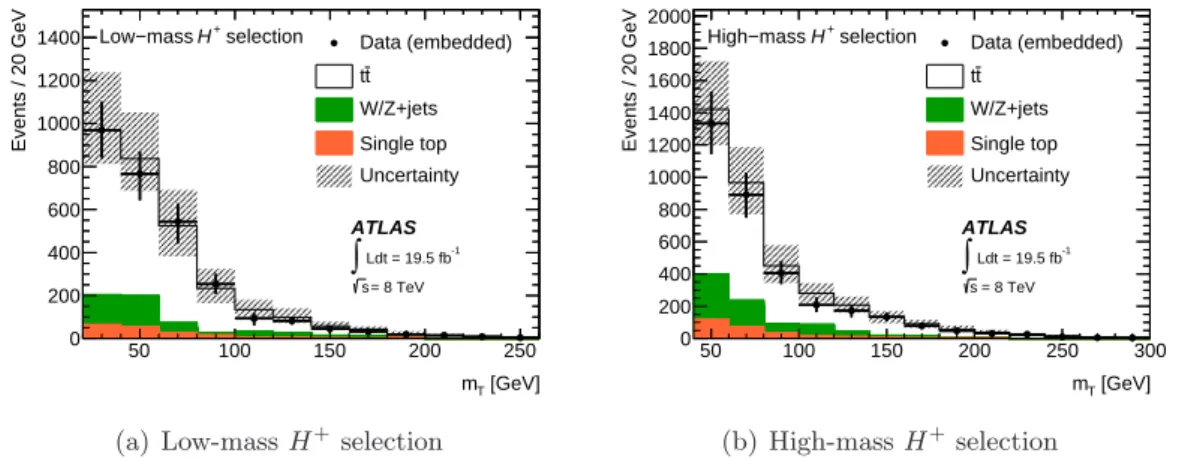
The mT distributions for selected events with a true τhad, as obtained with the
em-bedding method, are shown in figure 2 and compared to simulation. Embedded data and
simulation agree well and are within uncertainties. The combined systematic and statistical uncertainties on the embedded prediction and simulation are compared directly in figure2, where the reduction provided by the use of the embedding method is shown.
[GeV] T m 50 100 150 200 250 Events / 20 GeV 0 200 400 600 800 1000 1200 1400 Data (embedded) Single top W/Z+jets t t Uncertainty selection + H Low−mass ATLAS -1 Ldt = 19.5 fb ∫ = 8 TeV s (a) Low-mass H+ selection [GeV] T m 50 100 150 200 250 300 Events / 20 GeV 0 200 400 600 800 1000 1200 1400 1600 1800 2000 Data (embedded) Single top W/Z+jets t t Uncertainty selection + H High−mass ATLAS -1 Ldt = 19.5 fb ∫ = 8 TeV s (b) High-mass H+ selection
Figure 2. Comparison of the mTdistributions for events with a true τhadfor the (a) low-mass and
(b) high-mass charged Higgs boson search, as predicted by the embedding method and simulation. Combined statistical and systematic uncertainties (as described in section 5) for the embedded sample are shown as error bars, and all systematic uncertainties applicable to simulation are shown as hatched bands.
4.3 Data-driven estimation of the multi-jet backgrounds
For the data-driven estimation of the backgrounds with a jet misidentified as a τhad-vis
(multi-jet background), two data samples are defined, differing only in τhad-visidentification
required to pass the tight τhad-vis identification selection described in the object selection,
in addition to the trigger matching required in the event selection of section4.1. The loose sample, which contains a larger fraction of events with a misidentified τhad-vis, is obtained
by removing the τhad-vis identification requirement that was applied in the tight sample.
By construction, the tight data sample is a subset of the loose data sample.
The loose sample consists of Nrand Nmevents with, respectively, a real or misidentified
τhad-vis. It is also composed of NL events with a τhad-vis passing a loose but not tight
selection, and NTevents in which the τhad-visfulfils the tight selection. Using the efficiencies
pr and pm, respectively, for a real or misidentified loose τhad-vis satisfying the tight criteria,
the following relation can be established: NT NL ! = pr pm (1 − pr) (1 − pm) ! × Nr Nm ! . (4.4)
In turn, inverting the 2 × 2 matrix above, the number of events in which the misiden-tified τhad-vis passes the tight selection can be written as:
NmT= pmNm= pmpr
pr− pm
NL+pm(pr− 1)
pr− pm
NT. (4.5)
The final values of prand pmare parameterised in terms of the number of charged-particle
tracks in the core cone (∆R ≤ 0.2) and the number of charged-particle tracks in the hollow isolation cone (0.2 < ∆R < 0.4) around the τhad-vis axis [54], as well as the pT and |η| of
the τhad-vis. Correlations between the variables used for parameterisation are found to have a negligible effect on the results of the method.
The probability pr is determined using true τhad-vis in simulated t¯t events in the
sig-nal region. The probability pm is measured in a W +jets control region in data. Events
in this control region are triggered by a combined trigger requiring an electron with ET > 18 GeV or a muon with pT > 15 GeV in addition to a τhad-vis. In both cases, the
τhad-vis trigger object has a pT threshold of 20 GeV. The control region must have exactly
one trigger-matched reconstructed electron or muon, in addition to a trigger-matched, re-constructed, loose τhad-vis. The control region is also required to have zero b-tagged jets
and mT(e/µ, ETmiss) > 50 GeV (using eq.( 4.1), with the τhad-vis replaced by the electron
or muon). The contamination from correctly reconstructed τhad-vis (7%) and electrons or
muons mis-reconstructed as τhad-vis (5%) is subtracted using simulation. Signal processes
contribute negligibly to this region (< 0.1%).
Having computed the identification and misidentification efficiencies pr and pm, every
event in the loose sample is given a weight w as follows, in order to estimate the background with a misidentified τhad-vis in the tight sample:
• for an event with a loose but not tight τhad-vis, wL= pmpr
pr− pm
; • for an event with a tight τhad-vis, wT =
pm(pr− 1)
pr− pm
.
Events with jets misidentified as τhad-visare a major background in the high-mTregion
event per 20 GeV bin. This limitation is circumvented by fitting the mT distribution using
a power-log function in the mass range 200–800 GeV. The power-log function is defined by the following formula:
f (x) = xa+b ln(x), (4.6)
where a and b are fitted constants. The resulting mT distribution after considering each
systematic uncertainty is fitted separately. An additional systematic uncertainty is added for the choice of fit function, by symmetrising the difference between the baseline fit and an alternative fit using an exponential function. The exponential is chosen to probe the effect on the expected yield in the poor statistics tail region, since it also describes the
multi-jet background well in the region with many events. Figure3shows the fits obtained
in the nominal case, for the systematic uncertainty due to the chosen fit function, and for all other systematic uncertainties related to this background estimation (see section5.2).
[GeV]
T
m
0 100 200 300 400 500 600 700 800
Weighted events / 20 GeV
-4 10 -3 10 -2 10 -1 10 1 10 2 10 3 10 4 10 Multi-jet measurement Baseline fit Fit sys. Non−fit multi-jet sys. -1 Ldt = 19.5 fb ∫ = 8 TeV s selection + Low−mass H ATLAS (a) Low-mass H+ selection [GeV] T m 0 100 200 300 400 500 600 700 800
Weighted events / 20 GeV
-4 10 -3 10 -2 10 -1 10 1 10 2 10 3 10 4 10 Multi-jet measurement Baseline fit Fit sys. Non−fit multi-jet sys. -1 Ldt = 19.5 fb ∫ = 8 TeV s selection + High−mass H ATLAS (b) High-mass H+ selection
Figure 3. The multi-jet background predictions from data-driven methods for the (a) low-mass and (b) high-mass H+
event selections, with the results of fits using the power-log function, are shown in the solid line. The dotted lines show the systematic uncertainty from the choice of the fit function. The dashed lines show the total combined fits from the sources of systematic uncertainty listed in table4.
4.4 Backgrounds with electrons or muons misidentified as τhad-vis
Backgrounds that arise from events where an electron or muon is misidentified as τhad-visare
heavily suppressed by dedicated veto algorithms, so that these events only contribute at the level of 1–2% to the total background. These backgrounds are estimated from simulated
events, and they include contributions from t¯t, single top-quark, diboson, W +jets and
Z+jets processes. Leptons from in-flight decays in multi-jet events are accounted for in the multi-jet background estimate.
4.5 τhad-vis+ETmiss triggers
The analysis presented in this paper relies on τhad-vis+ETmiss triggers. To correct for any
difference between the trigger efficiencies observed in simulation and those observed in data, pτ
by statistical uncertainties. To increase the sample size, the τhad-vis and ETmiss trigger
efficiencies are determined separately and residual effects due to correlations are taken into account as systematic uncertainties. To measure the efficiencies, a tag-and-probe method is used in a control region enriched with t¯t events with a µ+τhadselection using a muon trigger
with a pT threshold of 24 GeV or 36 GeV. The trigger efficiencies are fitted separately for
events with a τhad-vis that has one or three charged-particle tracks. The pτT (ETmiss) trigger
efficiencies are fitted in the range of 20–100 (20–500) GeV. The ratios of the fitted functions for data and simulation are then applied to the simulated samples as continuous correction factors.
Since no trigger information is available in the embedded sample, trigger efficiencies are applied to that sample. The efficiencies for the τhad-vis trigger derived as described above
need to be corrected for misidentified τhad-vis. The fraction of events with a misidentified
τhad-vis is substantial in the µ + τhad sample used for the tag-and-probe method, leading to
a lower efficiency than in a sample with only events that have a true τhad-vis. Since only
events with a true τhad-vis are present in the embedded sample, the efficiencies determined
from data are corrected by the ratio of the simulated efficiency for true τhad-vis to the
simulated efficiency for the µ + τhad sample.
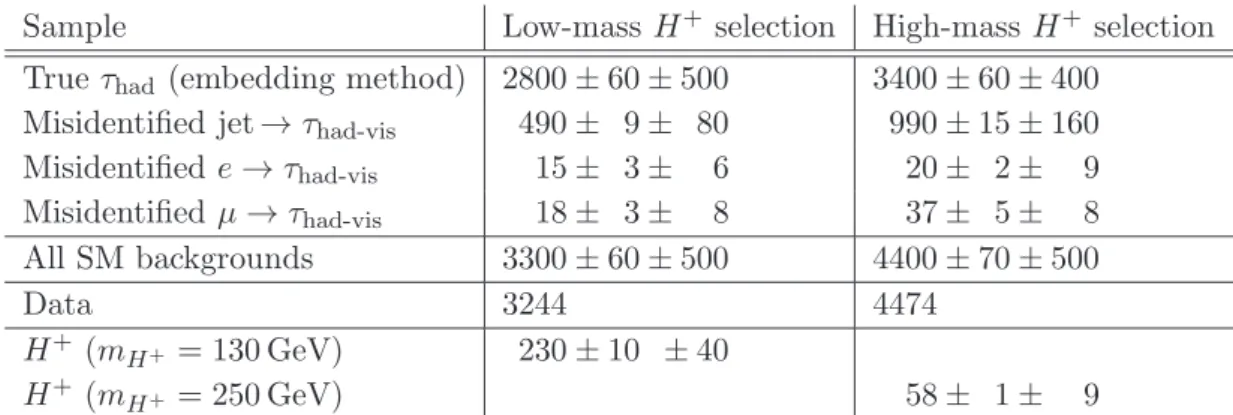
4.6 Event yields after the event selection
The expected numbers of background events and the results from data, together with an
expectation from signal contributions in the low-mass and high-mass H+ selections, are
shown in table2. For the low-mass H+ search, the signal contribution is shown for a cross
section corresponding to B(t → bH+) × B(H+ → τν) = 0.9%, and for the high-mass H+
search a possible signal contribution in the mmaxh scenario of the MSSM with tan β = 50 is shown.
The number of events with a true τhad is derived from the number of embedded
events and does not depend on the theoretical cross section of the t¯t → b¯bW+W−
process. However, this analysis does rely on the theoretical inclusive t¯t production cross section σt¯t= 253+13−15pb [30] for the estimation of the small background with electrons or muons
misidentified as τhad-vis.
5 Systematic uncertainties
5.1 τhad-vis+ETmiss triggers
Systematic uncertainties on the measurement of the τhad-vis+ETmiss trigger efficiencies arise
from multiple sources: the selection of the muon in the µ+τhad sample, the number of
misidentified τhad-vis, the choice of fitting function, slightly varying trigger requirements
during the data-taking period, a residual correlation between the τhad-visand ETmiss triggers,
and the effect of the τhad-vis energy correction on the trigger efficiency. The dominant
systematic uncertainty, which arises from misidentified τhad-vis in the t¯t → µτhad + X
control region, is evaluated by measuring the trigger correction factors after varying the expected misidentified τhad-vis yield by its uncertainty. These uncertainties are relevant
Sample Low-mass H+ selection High-mass H+ selection
True τhad (embedding method) 2800 ± 60 ± 500 3400 ± 60 ± 400
Misidentified jet → τhad-vis 490 ± 9 ± 80 990 ± 15 ± 160
Misidentified e → τhad-vis 15 ± 3 ± 6 20 ± 2 ± 9 Misidentified µ → τhad-vis 18 ± 3 ± 8 37 ± 5 ± 8 All SM backgrounds 3300 ± 60 ± 500 4400 ± 70 ± 500 Data 3244 4474 H+ (mH+ = 130 GeV) 230 ± 10 ± 40 H+ (mH+ = 250 GeV) 58 ± 1 ± 9
Table 2. Expected event yields after all selection criteria and comparison with 19.5 fb−1 of
data. The values shown for the signal correspond to the previously published upper limit on B(t → bH+
) × B(H+
→ τν) = 0.9% [18] for the low-mass signal point and tan β = 50 in the MSSM mmax
h scenario for the high-mass signal point. The predicted yield for the low-mass signal selection
assumes a t¯t cross section of 253 pb. Both the statistical and systematic uncertainties (section 5) are shown, in this order.
Source of uncertainty Low-mass H+ selection High-mass H+ selection
Muon selection < 1% < 1%
Misidentified τhad-vis 5.6% 5.7%
Fitting function 2.1% 1.8%
Trigger definition < 1% < 1%
Residual correlations 1.4% 3.2%
τhad-vis energy scale < 1% < 1%
Table 3. Effect of systematic uncertainties on the combined trigger efficiencies for a low-mass (mH+ = 130 GeV) and high-mass (mH+ = 250 GeV) signal sample.
for background events with leptons misidentified as τhad-vis as well as true τhad and signal
events. The effects on a low-mass and a high-mass signal sample are summarised in table3
and the effect on background events with true τhad is shown in table 4. The trigger
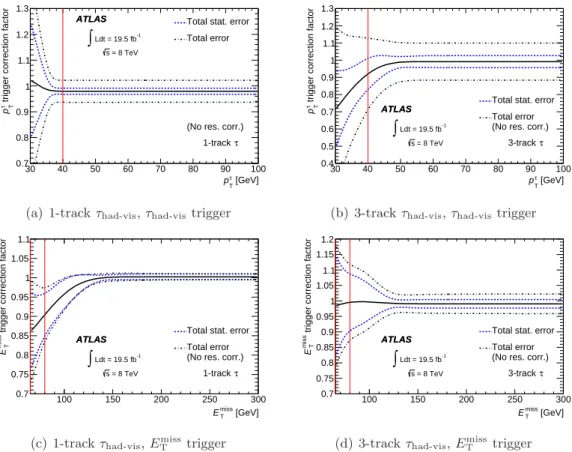
correction factors used to account for differences between the efficiencies in simulation and data are shown in figure4.
5.2 Data-driven background estimation
The systematic uncertainties arising from the data-driven methods used to estimate the
various backgrounds are summarised in table4.
The systematic uncertainties affecting the estimation of the backgrounds with true τhad, discussed in section 4.2, consist of the potential bias introduced by the embedding
method itself (embedding parameters, evaluated by varying the amount of energy that is subtracted when removing calorimeter deposits of the muon in the original event),
[GeV]
τ
T
p
30 40 50 60 70 80 90 100
trigger correction factor
τ T p 0.7 0.8 0.9 1 1.1 1.2 1.3 τ 1-track Total stat. error Total error
(No res. corr.)
ATLAS ATLAS -1 Ldt = 19.5 fb ∫ = 8 TeV s
(a) 1-track τhad-vis, τhad-vistrigger
[GeV]
τ
T
p
30 40 50 60 70 80 90 100
trigger correction factor
τ T p 0.4 0.5 0.6 0.7 0.8 0.9 1 1.1 1.2 1.3 τ 3-track Total stat. error Total error (No res. corr.)
ATLAS ATLAS -1 Ldt = 19.5 fb ∫ = 8 TeV s
(b) 3-track τhad-vis, τhad-vistrigger
[GeV]
miss T
E
100 150 200 250 300
trigger correction factor
miss T E 0.7 0.75 0.8 0.85 0.9 0.95 1 1.05 1.1 τ 1-track Total stat. error Total error (No res. corr.)
ATLAS ATLAS -1 Ldt = 19.5 fb ∫ = 8 TeV s (c) 1-track τhad-vis, E miss T trigger [GeV] miss T E 100 150 200 250 300
trigger correction factor
miss T E 0.7 0.75 0.8 0.85 0.9 0.95 1 1.05 1.1 1.15 1.2 τ 3-track Total stat. error Total error (No res. corr.)
ATLAS ATLAS -1 Ldt = 19.5 fb ∫ = 8 TeV s (d) 3-track τhad-vis, E miss T trigger
Figure 4. Inclusive τhad-visand ETmisstrigger correction factors obtained from the ratio of functions
fitted to data and simulation for τhad-vis with (a, c) one and (b, d) three charged tracks are shown
at the top and bottom, respectively. The vertical line on the τhad-vis trigger correction factor
plots indicates the lowest pτ
T threshold used in the analysis. The vertical line on the E miss T trigger
correction factor plots shows the lower boundary used in the high-mass charged Higgs boson search. The total statistical uncertainty is indicated with the dotted line and the systematic uncertainty is added in quadrature to the statistical error (dashed-dotted line). For τhad-vistrigger efficiencies,
the total systematic uncertainty is shown, while for the Emiss
T trigger efficiency, the systematic
uncertainty related to residual correlations between τhad-vis and ETmiss is not included, since the
effect is evaluated separately for several signal mass ranges and background samples.
tainties from the trigger efficiency measurement as discussed in section 5.1, uncertainties due to a possible contamination from multi-jet events (evaluated by varying the muon iso-lation requirements), uncertainties associated with the simulated τhad (τhad-visenergy scale
and identification efficiency) and uncertainties on the normalisation. The latter are dom-inated by the statistical uncertainty of the selected control sample and the τhad-vis+ETmiss
trigger efficiency uncertainties.
For the estimation of backgrounds with jets misidentified as τhad-vis, discussed in
sec-tion4.3, the dominant systematic uncertainties on the misidentification probability are the statistical uncertainty due to the control sample size and uncertainties due to the difference in the jet composition (gluon- or quark-initiated) between the control and signal regions. The uncertainty arising from differences in jet composition is evaluated from the difference
Source of uncertainty Low-mass H+ selection High-mass H+ selection True τhad Embedding parameters 3.0% 1.8% Muon isolation 0.3% 2.3% Parameters in normalisation 2.0% 2.0% τhad-vis identification 2.2% 2.0%
τhad-vis energy scale 4.0% 3.6%
τhad-vis+ ETmiss trigger 8.3% 8.3%
Jet → τhad-vis Statistical uncertainty on pm 2.0% 3.4% Statistical uncertainty on pr 0.5% 0.5% Jet composition 1.1% 1.9% τhad-vis identification 0.8% 0.6% e/µ contamination 0.5% 0.7%
Table 4. Dominant systematic uncertainties on the data-driven background estimates. The shift in event yield is given relative to the total background.
in shape and normalisation that arises when pm is measured in a control region that is
enriched in events with gluon-initiated jets. This control region differs from the signal region only by inverting the b-tag and ETmiss requirements. Other uncertainties are due to the statistical uncertainty on pr, the effect of the uncertainty in the simulated true τhad-vis
identification efficiency on the measurement of pr and pm, and the effect of the simulated
electron veto efficiency for true electrons on the measurement of pm.
5.3 Detector simulation
Systematic uncertainties originating from the simulation of pile-up and object reconstruc-tion are considered for signal events and background events with leptons misidentified as
τhad-vis. This background is roughly 1% of the final background in both the low-mass and
high-mass searches, so the systematic uncertainties have little effect on the final results. Uncertainties related to the τhad-vis energy scale and identification efficiency are also
taken into account. The uncertainty on the identification is in the range 2−3% for τhad-vis
with one charged track and 3−5% for τhad-vis with three charged tracks. It has been
measured in data using a tag-and-probe method [54]. The τhad-vis energy scale is measured
with a precision of 2−4% [67]. It is determined by fitting the reconstructed visible mass of Z → ττ events in data. Uncertainties related to jet or b-tagged jet energy scale, energy resolution, flavour identification and calibration, and the effects of pile-up interactions are also taken into account [68, 69], as well as uncertainties related to the reconstruction of ETmiss [70].
The impact of most sources of systematic uncertainty is assessed by re-applying the selection cuts for each analysis after varying a particular parameter by its ±1 standard deviation uncertainty. The dominant instrumental systematic uncertainties include the jet
energy scale, the τhad-vis energy scale, and τhad-vis identification. All instrumental
system-atic uncertainties are taken into account for the reconstruction of ETmiss.
These uncertainties affect all simulated samples, i.e. the signal and the background contribution with leptons misidentified as τhad-vis. Since the τhad in the embedded samples
are simulated, all τhad-related uncertainties are relevant for the background with true τhad
as well.
5.4 Generation of t¯t and signal events
In order to estimate the systematic uncertainties arising from the t¯t and low-mass signal
generation, as well as from the parton shower model, the acceptance is computed for t¯t
events produced with MC@NLO interfaced to HERWIG/JIMMY and POWHEG inter-faced to PYTHIA 8. Also, an uncertainty on the theoretical cross section, including both the factorisation/renormalisation scale and parton distribution function uncertainties, is taken into account for t¯t backgrounds with a lepton misidentified as a τhad-vis and low-mass
signal samples. The estimate of the small background with electrons or muons misiden-tified as τhad-vis relies additionally on the theoretical inclusive t¯t production cross section
σt¯t= 253+13−15pb [30].
The generator modelling uncertainties for the high-mass signal samples are estimated
from a comparison between events produced with MC@NLO interfaced to HERWIG++ [71]
and POWHEG interfaced to PYTHIA 8.
The systematic uncertainties originating from initial- and final-state parton radiation, which modify the jet production rate, are computed for t¯t backgrounds and applied to
low-mass signal events by using t¯t samples generated with AcerMC interfaced to PYTHIA 6,
where initial- and final-state radiation parameters are set to a range of values not excluded by the experimental data [72]. The largest relative differences with respect to the reference sample, after full event selections, are used as systematic uncertainties. For high-mass signal samples, this uncertainty is evaluated by varying factorisation/renormalisation scale parameters in the production of signal samples (QCD scale). The uncertainty due to the choice of parton distribution function has a negligible impact for both background and signal, and is not included. An additional uncertainty, arising from the difference
in acceptance between 4FS and 5FS H+ production is evaluated using dedicated signal
samples that are generated at leading order with MadGraph [73] interfaced with PYTHIA 8,
although the nominal signal samples are generated at NLO. The systematic uncertainties arising from the modelling of the t¯t and signal event generation and the parton shower, as well as from the initial- and final-state radiation, are summarised in table5.
All of these uncertainties, except for H+production, affect only signal and background
events where leptons are misidentified as τhad-vis.
6 Statistical analysis
In order to test the compatibility of the data with background-only and signal+background hypotheses, a profile log-likelihood ratio [74] is used with mT as the discriminating
distribu-Source of uncertainty Normalisation uncertainty Low-mass H+ Generator model (b¯bW− H+) 9% Generator model (b¯bW+W− ) 9% t¯t cross section 6%
Jet production rate (SM and H+) (QCD scale) 11%
High-mass H+
Generator model (H+) 2−9%
Generator model (SM) 8%
t¯t cross section 6%
Jet production rate (H+) (QCD scale) 1−2%
Jet production rate (SM) (QCD scale) 11%
H+ production (4FS vs 5FS) 3−5%
Table 5. Systematic uncertainties arising from t¯t and signal generator modelling, and from the jet production rate. The uncertainties are shown for the t¯t background and the charged Higgs boson signal, for the low-mass and high-mass charged Higgs boson selections separately. The systematic uncertainty of the H+ yield due to QCD scale and 4FS vs 5FS production was evaluated at masses
of 200, 400, and 600 GeV. For all other systematic variations of the H+
yield, all mass points were considered.
tions. Systematic uncertainties in shape and normalisation, discussed in section 5, are
incorporated via nuisance parameters fully correlated amongst the different backgrounds, and the one-sided profile likelihood ratio, ˜qµ, is used as a test statistic. The parameter of
interest, the signal-strength µ, is either B(t → bH+) × B(H+→ τ+ν) (low-mass search) or
σ(pp → ¯tH++ X) × B(H+→ τ+ν) (high-mass search). Expected limits are derived using
the asymptotic approximation [75].
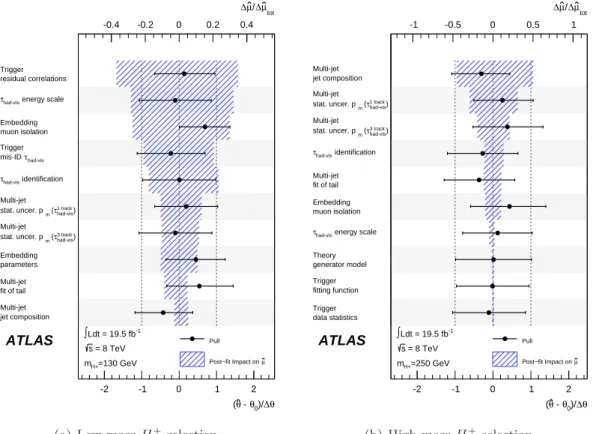
The nuisance parameters are simultaneously fitted by means of a negative log-likelihood minimisation in both low-mass and high-mass regions in order to ensure that they are well
estimated. This is shown in figure 5 for the nuisance parameters that have the largest
impact on the fitted µ, denoted ˆµ. The black dots indicate how a given nuisance parameter deviates from expectation, while the black error bars indicate how its post-fit uncertainty compares with its nominal uncertainty. In both the low-mass and high-mass searches, the black dots and error bars indicate respectively that none of the nuisance parameters deviate by more than one standard deviation and that their uncertainties are not underestimated. The blue hatched box shows the deviations of the fitted signal-strength parameter after changing a specific nuisance parameter upwards or downwards by its post-fit uncertainty.
The results in figure5 indicate the relative impact of the systematic uncertainties in the statistical analysis of the low-mass and high-mass searches. For the low-mass search, the most important systematic uncertainties are those related to the measurement of the trigger efficiency and to the simulation of the detector response to τhad-vis. Since the
with expectations. For the high-mass search, the most important systematic uncertainties are due to jets misidentified as τhad-vis, including both the yield and mT distribution of
such events, and the next dominant effect is from the true τhad-vis background.
-2 -1 0 1 2 jet composition Multi-jet fit of tail Multi-jet parameters Embedding ) had-vis 3 track τ ( m stat. uncer. p Multi-jet ) had-vis 1 track τ ( m stat. uncer. p Multi-jet identification had-vis τ had-vis τ mis-ID Trigger muon isolation Embedding energy scale had-vis τ residual correlations Trigger tot µ ∆ / µ ∆ -0.4 -0.2 0 0.2 0.4 θ ∆ )/ 0 θ - θ ( -2 -1 0 1 2 Pull µ Post−fit Impact on ATLAS = 8 TeV s -1 Ldt = 19.5 fb ∫ =130 GeV H+ m (a) Low-mass H+ selection -2 -1.5 -1 -0.5 0 0.5 1 1.5 data statistics Trigger fitting function Trigger generator model Theory energy scale had-vis τ muon isolation Embedding fit of tail Multi-jet identification had-vis τ ) had-vis 3 track τ ( m stat. uncer. p Multi-jet ) had-vis 1 track τ ( m stat. uncer. p Multi-jet jet composition Multi-jet tot µ ∆ / µ ∆ -1 -0.5 0 0.5 1 θ ∆ )/ 0 θ - θ ( -2 -1 0 1 2 Pull µ Post−fit Impact on ATLAS = 8 TeV s -1 Ldt = 19.5 fb ∫ =250 GeV H+ m (b) High-mass H+ selection
Figure 5. Impact of systematic uncertainties on the final observed limits for (a) mH+ = 130 GeV
and (b) mH+ = 250 GeV. The systematic uncertainties are ordered (top to bottom) by decreasing
impact on the fitted signal strength parameter. The dots, which refer to the bottom horizontal axis, show how each fitted nuisance parameter, ˆθ, deviates from its nominal value, θ0, in terms of
standard deviations with respect to its nominal uncertainty, ∆θ. The solid lines indicate the post-fit uncertainties of each nuisance parameter, also relative to their nominal values. The hatched band, referring to the top horizontal axis, shows the deviations of the fitted signal-strength parameter after changing a specific nuisance parameter upwards or downwards by its post-fit uncertainty (∆ˆµ) as a fraction of the total uncertainty of the fitted signal-strength parameter (∆ˆµtot).
7 Results
In figure6, the mT distribution after the final fit is shown. No significant deviation of the
data from the SM prediction is observed. For the low-mass charged Higgs boson search,
exclusion limits are set on the branching ratio B(t → bH+) × B(H+ → τ+ν). For the
high-mass H+ search, exclusion limits are set on σ(pp → ¯tH++ X) × B(H+ → τ+ν), and
are to be understood as applying to the total production cross section times branching
ratio of H+ and H−
combined. Using the binned log-likelihood described in section6, all exclusion limits are set by rejecting the signal hypothesis at the 95% confidence level (CL)
using the CLs procedure [76]. These limits are based on the asymptotic distribution of the
test statistic [75]. The exclusion limits are shown in figure 7(a) for the low-mass search
and in figure7(b) for the high-mass search. Expected and observed limits agree well and
are within the uncertainties over the whole investigated mass range. The limits are in the range between 1.3% and 0.23% for the low-mass search. For the high-mass search, they
range from 0.76 pb to 4.5 fb in the mass range 180 GeV ≤ mH+ ≤ 1000 GeV.
[GeV] T m Events / 20 GeV -2 10 -1 10 1 10 2 10 3 10 4 10 5 10 Data 2012 τ True τ → Jet τ → µ e/ = 130 GeV + H m ATLAS -1 Ldt = 19.5 fb
∫
= 8 TeV s selection + Low-mass H ) = 0.9 % ν τ → + B(H × ) + bH → B(t post-fit [GeV] T m 100 200 300 400 500 600 700 800 Data / SM0.50 1 1.52 (a) Low-mass H+ selection [GeV] T m Events / 20 GeV -2 10 -1 10 1 10 2 10 3 10 4 10 5 10 Data 2012 τ True τ → Jet τ → µ e/ = 250 GeV (x5) + H m ATLAS -1 Ldt = 19.5 fb∫
= 8 TeV s selection + High−mass H max h ) = 50 MSSM m β tan( post-fit [GeV] T m 200 400 600 800 1000 1200 Data / SM0.50 1 1.52 (b) High-mass H+ selectionFigure 6. Distributions of mTafter all selection criteria. The hatched area shows the total post-fit
uncertainty for the SM backgrounds. For the (a) low-mass selection, bins are 20 GeV wide up to mT= 320 GeV, then 320–540 GeV and > 540 GeV. For the (b) high-mass selection, bins are 20 GeV
wide up to mT= 400 GeV, then 400–460 GeV and > 460 GeV. All bins are normalised to a 20 GeV
bin width. For the low-mass search (a), a possible signal contribution with mH+ = 130 GeV, and
B(t → bH+
) × B(H+
→ τ+ν) = 0.9% is overlaid on top of the SM contributions. For the high-mass
search (b), a possible signal contribution with mH+ = 250 GeV and tan β = 50 in the mmaxh scenario
of the MSSM, where the corresponding cross section [77] is scaled up by a factor of five, is overlaid on the SM contributions.
The limits on B(t → bH+) × B(H+→ τ+ν) for the low-mass search and on σ(pp →
¯
tH++ X) × B(H+ → τ+ν) for the high-mass search are also interpreted in the context
of different scenarios of the MSSM [42]. In the mmax
h scenario, the mass of the light
CP-even Higgs boson h (mh) is maximised. Interpreting the Higgs boson discovered at the
LHC as the h, only a small region of the mH+ − tan β parameter space in this scenario
is compatible with the observation. The mmod+h and mmod−h scenarios are modifications of
the mmaxh scenario. The discovered Higgs boson is interpreted as the h as well but the
requirement that mh be maximal is dropped. This is done by reducing the amount of
mixing in the top squark sector compared to the mmaxh scenario, leading to a larger region
in the parameter space being compatible with the observation. The mmod+h and mmod−h
scenarios only differ in the sign of a parameter.
Interpretations of the 95% CL limits in the mmax
shown in figure 8. In the low-mass range, almost all values for tan β > 1 are excluded
in the different scenarios, except for a small region 140 GeV ≤ mH+ ≤ 160 GeV. Values of
tan β larger than 45 − 50 are excluded in a mass range of 200 GeV ≤ mH+≤ 250 GeV. The
exclusions in several additional scenarios, not shown here, were also considered. In the light top squark, light stau and tauphobic scenarios, no significant exclusion is achieved in the high-mass search. In the low-mass search, the excluded regions in these scenarios are sim-ilar to those shown in figure8. The limits for the low-mass H+search are also interpreted
in the low-MH scenario, where mH+ ≈ 130 GeV. Instead of excluding areas in the mH+–
tan β plane, limits are interpreted in the tan β–µ plane, for 300 GeV < µ < 3500 GeV and 1.5 < tan β < 9.5, where µ is the higgsino mass parameter. This model is excluded every-where every-where it is tested and every-where it is well-defined. For the interpretation of the low-mass search, the following relative theoretical uncertainties on B(t → bH+) × B(H+→ τ+ν) are
considered [78–80]: 5% for one-loop electroweak corrections missing from the calculations,
2% for missing two-loop QCD corrections and about 1% (depending on tan β) for ∆b
-induced uncertainties, where ∆b is a correction factor to the running b-quark mass [81].
These uncertainties are added linearly, as recommended by the LHC Higgs cross section working group [79]. For the interpretation of the high-mass search, separate uncertainties are included for the 4FS and 5FS calculations [82]. For the 5FS calculation, the following theoretical uncertainties are taken into account: scale uncertainties of approximately 10–
20% that vary with mH+, the combined uncertainty on the parton distribution function,
mass of the b-quark, and strong coupling of approximately 10–15%. For the 4FS calcula-tion, only a scale uncertainty of approximately 30% is taken into account. Owing to the complication arising from the overlap and interference with off-shell t¯t production in the
mass range of mH+ = 180–200 GeV, the MSSM interpretation is shown only for mH+ ≥
200 GeV. [GeV] + H m 80 90 100 110 120 130 140 150 160 ν +τ → + H B × + bH → t B -3 10 -2 10 -1 10 1 Observed CLs Expected σ 1 ± σ 2 ± ATLAS Data 2012 = 8 TeV s -1 Ldt = 19.5 fb
∫
(a) Low-mass H+ selection [GeV] + H m 200 300 400 500 600 700 800 900 1000 ) [pb] ν +τ → + B(H × + H σ -3 10 -2 10 -1 10 1 10 Observed CLs Expected σ 1 ± σ 2 ± ATLAS Data 2012 = 8 TeV s -1 Ldt = 19.5 fb∫
(b) High-mass H+ selectionFigure 7. Observed and expected 95% CL exclusion limits on the production and decay of (a) low-mass and (b) high-mass charged Higgs bosons. For the low-mass search, the limit is computed for B(t → bH+
) × B(H+
→ τ+ν) for charged Higgs boson production from top-quark decays as a
function of mH+. For the high-mass search, the limit is computed for σ(pp → ¯tH++ X) × B(H+→
τ+
ν), and is to be understood as applying to the total production cross section times branching ratio of H+and H− combined.
[GeV] + H m 80 90 100 110 120 130 140 150 160 β tan 0 10 20 30 40 50 60 [GeV] + H m 80 90 100 110 120 130 140 150 160 β tan 0 10 20 30 40 50 60 [GeV] + H m 80 90 100 110 120 130 140 150 160 β tan 0 10 20 30 40 50 60
Median expected exclusion Observed exclusion 95% CL theory σ Observed +1 theory σ Observed -1 -1 Ldt = 19.5 fb
∫
=8 TeV s Data 2012 scenario max h m MSSM ATLAS (a) mmax h scenario, low-mass H + selection [GeV] + H m 200 220 240 260 280 300 β tan 30 35 40 45 50 55 60 [GeV] + H m 200 220 240 260 280 300 β tan 30 35 40 45 50 55 60Median expected exclusion Observed exclusion 95% CL theory σ Observed +1 theory σ Observed -1 -1 Ldt = 19.5 fb
∫
=8 TeV s ATLAS Data 2012 scenario max h m MSSM (b) mmax h scenario, high-mass H + selection [GeV] + H m 80 90 100 110 120 130 140 150 160 β tan 0 10 20 30 40 50 60 [GeV] + H m 80 90 100 110 120 130 140 150 160 β tan 0 10 20 30 40 50 60 [GeV] + H m 80 90 100 110 120 130 140 150 160 β tan 0 10 20 30 40 50 60Median expected exclusion Observed exclusion 95% CL theory σ Observed +1 theory σ Observed -1 -1 Ldt = 19.5 fb
∫
=8 TeV s Data 2012 scenario mod+ h m MSSM ATLAS (c) mmod+ h scenario, low-mass H + selection [GeV] + H m 200 220 240 260 280 300 β tan 30 35 40 45 50 55 60 [GeV] + H m 200 220 240 260 280 300 β tan 30 35 40 45 50 55 60Median expected exclusion Observed exclusion 95% CL theory σ Observed +1 theory σ Observed -1 -1 Ldt = 19.5 fb
∫
=8 TeV s ATLAS Data 2012 scenario mod+ h m MSSM (d) mmod+ h scenario, high-mass H + selection [GeV] + H m 80 90 100 110 120 130 140 150 160 β tan 0 10 20 30 40 50 60 [GeV] + H m 80 90 100 110 120 130 140 150 160 β tan 0 10 20 30 40 50 60 [GeV] + H m 80 90 100 110 120 130 140 150 160 β tan 0 10 20 30 40 50 60Median expected exclusion Observed exclusion 95% CL theory σ Observed +1 theory σ Observed -1 -1 Ldt = 19.5 fb
∫
=8 TeV s Data 2012 scenario mod-h m MSSM ATLAS (e) mmod− h scenario, low-mass H + selection [GeV] + H m 200 220 240 260 280 300 β tan 30 35 40 45 50 55 60 [GeV] + H m 200 220 240 260 280 300 β tan 30 35 40 45 50 55 60Median expected exclusion Observed exclusion 95% CL theory σ Observed +1 theory σ Observed -1 -1 Ldt = 19.5 fb
∫
=8 TeV s ATLAS Data 2012 scenario mod-h m MSSM (f) mmod− h scenario, high-mass H + selectionFigure 8. The 95% CL exclusion limits on tan β as a function of mH+. Results are shown in the
context of different benchmark scenarios of the MSSM for the regions in which reliable theoretical predictions exist. Results are shown for (low-mass, high-mass) H+ search in the (a, b) mmax
h , (c,
d) mmod+h and (e, f) m mod−
8 Conclusions
Charged Higgs bosons decaying via H+→ τ+ν are searched for in t¯t events, in the decay
mode t → bH+(low-mass search), and for H+ production in association with a top quark,
pp → tH++ X (high-mass search). The analysis makes use of a total of 19.5 fb−1
of pp
collision data at √s = 8 TeV, recorded in 2012 with the ATLAS detector at the LHC.
The final state considered in this search is characterised by the presence of a hadronic τ decay, missing transverse momentum, b-tagged jets, a hadronically decaying W boson, as well as the absence of any electrons or muons. Data-driven methods are employed to estimate the dominant background contributions. The data are found to be in agreement with the SM predictions. Upper limits at the 95% confidence level are set on the branching
ratio B(t → bH+) × B(H+ → τ+ν) between 0.23% and 1.3% for a mass range of m
H+ =
80–160 GeV, a major improvement over the previous published limits of 0.8–3.4% for the
mass range of mH+ = 90–160 GeV [18,19]. For the mass range of mH+ = 180–1000 GeV,
the first upper limits from ATLAS are set for the production cross section times branching
ratio, σ(pp → ¯tH++ X) × B(H+ → τ+ν), between 0.76 pb and 4.5 fb. Interpreted in the
context of the mmax
h , mmod+h and mmod−h scenarios of the MSSM, the entire parameter space
with tan β > 1 is excluded for the low-mass range 90 GeV ≤ mH+ ≤ 140 GeV, and almost
all of the parameter space with tan β > 1 is excluded for 140 GeV ≤ mH+ ≤ 160 GeV. For
the high-mass range 200 GeV ≤ mH+ ≤ 250 GeV, a region of parameter space with high
tan β is excluded.
9 Acknowledgements
We thank CERN for the very successful operation of the LHC, as well as the support staff from our institutions without whom ATLAS could not be operated efficiently.
We acknowledge the support of ANPCyT, Argentina; YerPhI, Armenia; ARC, Aus-tralia; BMWFW and FWF, Austria; ANAS, Azerbaijan; SSTC, Belarus; CNPq and FAPESP, Brazil; NSERC, NRC and CFI, Canada; CERN; CONICYT, Chile; CAS, MOST and NSFC, China; COLCIENCIAS, Colombia; MSMT CR, MPO CR and VSC CR, Czech Republic; DNRF, DNSRC and Lundbeck Foundation, Denmark; EPLANET, ERC and NSRF, European Union; IN2P3-CNRS, CEA-DSM/IRFU, France; GNSF, Georgia; BMBF, DFG, HGF, MPG and AvH Foundation, Germany; GSRT and NSRF, Greece; ISF, MINERVA, GIF, I-CORE and Benoziyo Center, Israel; INFN, Italy; MEXT and JSPS, Japan; CNRST, Morocco; FOM and NWO, Netherlands; BRF and RCN, Nor-way; MNiSW and NCN, Poland; GRICES and FCT, Portugal; MNE/IFA, Romania; MES of Russia and ROSATOM, Russian Federation; JINR; MSTD, Serbia; MSSR, Slovakia;
ARRS and MIZˇS, Slovenia; DST/NRF, South Africa; MINECO, Spain; SRC and
Wal-lenberg Foundation, Sweden; SER, SNSF and Cantons of Bern and Geneva, Switzerland; NSC, Taiwan; TAEK, Turkey; STFC, the Royal Society and Leverhulme Trust, United Kingdom; DOE and NSF, United States of America.
The crucial computing support from all WLCG partners is acknowledged gratefully, in particular from CERN and the ATLAS Tier-1 facilities at TRIUMF (Canada), NDGF
(Denmark, Norway, Sweden), CC-IN2P3 (France), KIT/GridKA (Germany), INFN-CNAF (Italy), NL-T1 (Netherlands), PIC (Spain), ASGC (Taiwan), RAL (UK) and BNL (USA) and in the Tier-2 facilities worldwide.
References
[1] T.D. Lee, A Theory of Spontaneous T Violation, Phys. Rev. D 8 (1973) 1226.
[2] T. P. Cheng and L. F. Li, Neutrino masses, mixings, and oscillations in SU(2)×U(1) models of electroweak interactions, Phys. Rev. D 22 (1980) 2860.
[3] J. Schechter and J. W. F. Valle, Neutrino masses in SU(2)×U(1) theories, Phys. Rev. D 22 (1980) 2227.
[4] G. Lazarides, Q. Shafi and C. Wetterich, Proton lifetime and fermion masses in an SO(10) model, Nucl. Phys. B 181 (1981) 287.
[5] R. N. Mohapatra and G. Senjanovic, Neutrino masses and mixings in gauge models with spontaneous parity violation, Phys. Rev. D 23 (1981) 165.
[6] M. Magg and C. Wetterich, Neutrino mass problem and gauge hierarchy, Phys. Lett. B 94 (1980) 61.
[7] P. Fayet, Supersymmetry and Weak, Electromagnetic and Strong Interactions, Phys. Lett. B 64(1976) 159.
[8] P. Fayet, Spontaneously Broken Supersymmetric Theories of Weak, Electromagnetic and Strong Interactions, Phys. Lett. B 69 (1977) 489.
[9] G. R. Farrar and P. Fayet, Phenomenology of the Production, Decay, and Detection of New Hadronic States Associated with Supersymmetry, Phys. Lett. B 76 (1978) 575.
[10] P. Fayet, Relations Between the Masses of the Superpartners of Leptons and Quarks, the Goldstino Couplings and the Neutral Currents, Phys. Lett. B 84 (1979) 416.
[11] S. Dimopoulos and H. Georgi, Softly Broken Supersymmetry and SU(5), Nucl. Phys. B 193 (1981) 150.
[12] R. Harlander, M. Kramer, and M. Schumacher, Bottom-quark associated Higgs-boson production: reconciling the four- and five-flavour scheme approach, [arXiv:1112.3478], (2011).
[13] ATLAS Collaboration, Measurement of differential production cross-sections for a Z boson in association with b-jets in 7 TeV proton–proton collisions with the ATLAS detector, JHEP 10(2014) 141, [arXiv:1407.3643].
[14] LHC Higgs Cross Section Working Group, Handbook of LHC Higgs Cross Sections: 1. Inclusive Observables, CERN-2011-002 (2011) [arXiv:1101.0593].
[15] LEP Higgs Working Group for Higgs boson searches, ALEPH Collaboration, DELPHI Collaboration, L3 Collaboration, and OPAL Collaboration, Search for charged Higgs bosons: Preliminary combined results using LEP data collected at energies up to 209GeV,
[Xiv:hep-ex/0107031], (2001).
[16] CDF Collaboration, T. Aaltonen et al., Search for charged Higgs bosons in decays of top quarks in p-pbar collisions at√s = 1.96 TeV, Phys. Rev. Lett. 103 (2009) 101803, [arXiv:0907.1269].