EUROPEAN ORGANIZATION FOR NUCLEAR RESEARCH (CERN)
CERN-EP-2017-088 2017/10/23
CMS-SUS-16-037
Search for supersymmetry in pp collisions at
√
s
=
13 TeV
in the single-lepton final state using the sum of masses of
large-radius jets
The CMS Collaboration
∗Abstract
Results are reported from a search for supersymmetric particles in proton-proton col-lisions in the final state with a single lepton; multiple jets, including at least one b-tagged jet; and large missing transverse momentum. The search uses a sample of proton-proton collision data at√s = 13 TeV recorded by the CMS experiment at the LHC, corresponding to an integrated luminosity of 35.9 fb−1. The observed event yields in the signal regions are consistent with those expected from standard model backgrounds. The results are interpreted in the context of simplified models of su-persymmetry involving gluino pair production, with gluino decay into either on- or off-mass-shell top squarks. Assuming that the top squarks decay into a top quark plus a stable, weakly interacting neutralino, scenarios with gluino masses up to about 1.9 TeV are excluded at 95% confidence level for neutralino masses up to about 1 TeV.
Published in Physical Review Letters as doi:10.1103/PhysRevLett.119.151802.
c
2017 CERN for the benefit of the CMS Collaboration. CC-BY-3.0 license
∗See Appendix A for the list of collaboration members
1
A central goal of the physics program of the CMS experiment at the CERN LHC [1] is the search for new particles and phenomena beyond the standard model (SM), in particular, for super-symmetry (SUSY) [2–9]. During 2016, CMS recorded a data sample of proton-proton collisions at a center-of-mass energy of 13 TeV, corresponding to an integrated luminosity of 35.9 fb−1, significantly extending the sensitivity to the production of new heavy particles. The search described here focuses on a generically important experimental signature that is also strongly motivated by SUSY phenomenology. This signature includes a single lepton (an electron or a muon); several jets, arising from the hadronization of energetic quarks and gluons; at least one b-tagged jet, indicative of processes involving third generation quarks; and, finally,~pTmiss, the missing momentum in the direction transverse to the beam. A large value of pmissT ≡ |~pTmiss|
can arise from the production of high momentum, weakly interacting particles that escape de-tection. Searches for SUSY in the single-lepton final state have been performed by both ATLAS and CMS at√s=7 and 8 TeV [10–13] and at√s=13 TeV [14–17]. The present analysis, which introduces extended binning and other improvements, is based largely on methodologies de-scribed in detail in Ref. [16], which include the use of large-radius jets and related kinematic variables.
In models based on SUSY, new particles are introduced such that all fermionic (bosonic) de-grees of freedom in the SM are paired with corresponding bosonic (fermionic) dede-grees of free-dom in the extended theory. The discovery of a Higgs boson with low mass [18–23] provides a key motivation for SUSY. Stabilizing the Higgs boson mass at a low value, without invoking extreme fine tuning of parameters, is a major theoretical challenge, referred to as the gauge hierarchy problem [24–29]. This stabilization can be achieved in so-called natural SUSY mod-els [30–34], in which several of the SUSY partners are constrained to be light [33]: the top squarks,etL andetR, which have the same electroweak couplings as the left- (L) and right- (R) handed top quarks, respectively; the bottom squark with L-handed couplings (ebL); the gluino
(eg); and the higgsinos ( eH). This search targets gluino pair production, which has a relatively large cross section for a given mass, with gluino decayeg → tteχ
0
1. This process can arise from
e
g→et1t, where the lighter top squark mass eigenstateet1is produced either on or off mass shell. The symbol χe
0
1 denotes the lightest neutralino, an electrically neutral mass eigenstate that is
in general a mixture of the higgsinos and electroweak gauginos. In R-parity conserving SUSY models [35, 36] in which theχe
0
1is the lightest supersymmetric particle (LSP), theχe
0
1is stable and
can, in principle, account for some or all of the astrophysical dark matter [37–39]. The scenario with off-mass-shell top squarks is denoted as T1tttt [40] in simplified model scenarios [41–43]. In natural SUSY models, the top squark is typically lighter than the gluino, so we also search for scenarios with on-shell top squarks, denoted as T5tttt.
Simulated event samples for SM background processes are used to determine correction fac-tors, typically near unity, that are used in conjunction with observed event yields in control regions to determine the SM background contribution in the signal regions. The production of tt+jets, W+jets, Z+jets, and quantum chromodynamics (QCD) multijet events is simulated with the Monte Carlo (MC) generator MADGRAPH5 [email protected] [44], with parton distribution
functions taken from NNPDF 3.0 [45]. Details on the simulated SM background samples, in-cluding other processes with smaller contributions (single top quark, tt+bosons, diboson, and tttt production) are given in Ref. [16]. The detector simulation is performed with GEANT4 [46]. Simulated event samples for SUSY signal models, used to determine the selection efficiency for signal events, are generated with MADGRAPH5 [email protected] with up to two additional par-tons at leading order accuracy and are normalized to cross sections based on Ref. [47]. Because of the large number of mass hypotheses examined in this analysis, the detector simulation in this case is performed with the CMS fast simulation package [48].
Two T1tttt benchmark models are used to illustrate typical signal behavior. The T1tttt(1800,100) model, which we refer to as a noncompressed-spectrum model (NC), has m(eg) = 1800 GeV, m(χe01) = 100 GeV, and a cross section of 2.8 fb, and corresponds to a scenario with a large gluino-neutralino mass splitting. The T1tttt(1400,1000) model, with m(eg) =1400 GeV, m(χe01) = 1000 GeV, and a cross section of 25 fb, corresponds to a scenario with a small gluino-neutralino mass splitting and is referred to as a compressed-spectrum model (C).
The data were recorded with the CMS detector [49], which is constructed around a supercon-ducting solenoid of 6 m diameter, providing a magnetic field of 3.8 T. Within the solenoid volume are the charged particle tracking systems, composed of silicon-pixel and silicon-strip detectors, and the calorimeter systems, consisting of a lead tungstate crystal electromagnetic calorimeter (ECAL) and a brass and scintillator hadron calorimeter. Muons are identified and measured by gas-ionization detectors embedded in the magnetic flux-return yoke outside the solenoid. Events were selected using several triggers [50] that require either large pmissT or a sin-gle lepton (an electron or a muon), with and without significant hadronic activity. The trigger efficiency is measured in data for our analysis requirements to be nearly 100%.
Event reconstruction proceeds from particles identified by the particle-flow (PF) algorithm [51], which uses information from the tracker, calorimeters, and muon systems to identify PF candi-dates as electrons, muons, charged or neutral hadrons, or photons. Electrons are reconstructed by associating a charged-particle track with ECAL superclusters [52]. The resulting candi-date electrons are required to have transverse momentum pT > 20 GeV and pseudorapidity
|η| < 2.5, and to satisfy identification criteria designed to reject light-parton jets and photon conversions. Muons are reconstructed by associating tracks in the muon system with those found in the silicon tracker [53]. Muon candidates are required to satisfy pT > 20 GeV and
|η| <2.4. To select leptons from W boson decays, leptons are required to be isolated from other PF candidates. Isolation is quantified using an optimized version [16] of the mini-isolation variable originally suggested in Ref. [54], in which the transverse energy of the particles within a cone around the lepton momentum vector is computed using a cone size that decreases as 1/p`T, where p`Tis the transverse momentum of the lepton.
To suppress dilepton backgrounds, we veto events that contain a broader category of candi-dates for the second lepton, referred to as veto tracks. These include two categories of charged-particle tracks: isolated leptons satisfying looser identification criteria than lepton candidates, including a relaxed momentum requirement, pT > 10 GeV, and isolated charged-hadron PF
candidates, which must satisfy pT > 15 GeV and |η| < 2.5. In either case, the charge of the veto track must be opposite to that of the lepton candidate in the event. To maintain a high selection efficiency for signal events, lepton veto tracks must satisfy a requirement on the quantity [55, 56] MT2(~p`,~pTv,~pTmiss) < 80 GeV and hadronic veto tracks must satisfy
MT2(~p`,~pTv,~pTmiss) <60 GeV, where v refers to the veto track.
Charged and neutral PF candidates are clustered into jets using the anti-kTalgorithm [57] with
radius parameter R = 0.4, as implemented in the FASTJET package [58]. Jets are required to
satisfy pT > 30 GeV and|η| ≤ 2.4. Additional details and references are given in Ref. [16] on the pT- and η-dependent jet energy calibration [59], the jet identification requirements, and the
subtraction of the energy contribution to the jet pT from multiple proton-proton interactions
from the same or neighboring beam crossings (pileup) [60]. A subset of the jets are tagged as originating from b quarks using the combined secondary vertex algorithm [61, 62].
We further cluster the jets with R=0.4 (small-R jets), including those associated with isolated leptons, into R=1.4 (large-R) jets using the anti-kTalgorithm. The masses, m(Ji), of the
3
spread. The variable MJis defined as the sum of all large-R jet masses: MJ=∑Ji=large-R jetsm(Ji). For tt events with a small contribution from initial-state radiation (ISR), the MJ distribution
has an approximate cutoff at 2mt. In contrast, the MJ distribution for signal events extends to
larger values because of the presence of multiple top quarks in the decay chain. The presence of a significant amount of ISR generates a high-MJtail in the tt background, producing the main
source of background in the analysis.
The missing transverse momentum,~pTmiss, is defined as the negative vector sum of the trans-verse momenta of all PF candidates. To separate backgrounds characterized by the presence of a single W boson decaying leptonically, but without any other source of pmissT , we use the transverse mass mT =
√
2p`TpmissT [1−cos(∆φ`,~pmiss
T )], where ∆φ`,~pTmiss is the difference between the azimuthal angles of p`Tand~pTmiss. The quantity HTis defined as the scalar sum of the
trans-verse momenta of all the small-R jets passing the selection, while ST = HT+p`T.
We select events with exactly one isolated charged lepton (an electron or a muon), no veto tracks, ST > 500 GeV, pmissT > 200 GeV, and at least six small-R jets, at least one of which is b
tagged. After this set of requirements, referred to as the baseline selection, about 80% of the SM background arises from tt production. The contributions from events with a single top quark or a W boson in association with jets are each about 6–8%; much of the remainder arises from events with a tt pair produced in association with a vector boson. After applying the baseline selection, the background from QCD multijet events is negligible.
The analysis is performed using four regions in the MJ-mT plane: three control regions (CR)
and one signal region (SR):
• R1 (CR): mT ≤140 GeV, 250≤MJ ≤400 GeV,
• R2 (CR): mT ≤140 GeV, MJ >400 GeV,
• R3 (CR): mT >140 GeV, 250≤ MJ ≤400 GeV,
• R4 (SR): mT >140 GeV, MJ >400 GeV.
All four regions are divided in bins of pmissT , forming three largely independent MJ-mTplanes:
• three pmissT bins: 200< pmissT ≤350 GeV, 350< pmissT ≤500 GeV, pmissT >500 GeV
Regions R2 and R4, which have high MJ, are further divided into bins according to the number
of small-R jets (Njets) and the number of b-tagged jets (Nb) as follows:
• two Njets bins: 6≤ Njets ≤8, Njets ≥9,
• three Nbbins: Nb=1, Nb=2, Nb≥3,
giving a total of 18 bins each. Backgrounds with a single W boson decaying leptonically are strongly suppressed by the requirement mT > 140 GeV, so the background in R3 and R4 is
dominated by dilepton tt events. Approximately half of the dilepton background events in R4 contain a missed electron or muon, and the other half contain a hadronically decaying τ lepton. Given that the main background processes have two or fewer b quarks, the total SM contribution to the Nb ≥ 3 bins is very small and is driven by the b tag misidentification rate.
Signal events in the T1tttt and T5tttt models populate primarily the bins with Nb≥2.
The method for predicting the background yields takes advantage of the near absence of corre-lation between the MJand mTvariables in R1–R4, which is a consequence of the high jet
multi-plicity, pmissT , and STrequirements applied in the baseline selection [16]. To satisfy these
require-ments, background events must typically contain additional jets from ISR. Even though the background at low mTarises largely from single-lepton tt events, while the background at high
mT is dominated by dilepton tt events, the shapes of the MJ distributions at low and high mT
become very similar in the presence of multiple ISR jets. We therefore measure this shape at low mT(R1, R2) and extrapolate it to high mTto obtain the background prediction in R4. The fitted
mean background yields in R1–R4 are thus related by the constraint µbkgR4 =κ µbkgR3 µbkgR2 /µbkgR1 . Here, κ is a near-unity correction factor obtained from MC simulation of the total background that accounts for a residual mT-MJcorrelation:
κ= µ MC bkg R4 /µ MC bkg R2 µMC bkgR3 /µMC bkgR1 . (1)
This constraint is imposed by relating the expected yields in R1–R4 to three parameters: an overall background normalization λ and two ratios R(mT) and R(MJ), where the expected
background yields are given by µbkgR1 = λ, µbkgR2 = λ R(MJ), µbkgR3 = λ R(mT), and µbkgR4 =
κ λ R(MJ)R(mT). These quantities are defined such that there is one value of R(MJ)and κ for
each bin of pmissT , Njets, and Nb. Because regions R1 and R3 are integrated in Njets and Nb, the
fit parameters λ and R(mT)are defined such that there is only one value of these quantities for
each bin in pmissT .
We perform two types of maximum likelihood fits, which are described in detail in Ref. [16]. The predictive fit uses the observed yields in R1–R3, assuming no signal contribution, to prop-agate the uncertainties to λ, R(MJ), and R(mT). The global fit uses the observed yields in all
four regions R1–R4 and allows a signal contribution with a single normalization parameter. The global fit accounts for signal contamination in R1–R3, which is typically less than 10%, and is used to compute signal limits and significances. The results from the predictive fit simplify theoretical reinterpretation in terms of other models by only requiring comparison of observed and predicted yields in R4 rather than all four regions. In both cases, the likelihood function is written as a product of Poisson distributions for the relevant contributions in bins of pmiss
T ,
Njets, and Nbwithin R2 and R4, taking into account the correlated yields between the unbinned
regions R1 and R3.
Systematic uncertainties in the background prediction are incorporated in the uncertainty in the double ratio correction factor κ. Discrepancies between the value of κ predicted by simulation and the true value of κ in the data can in principle arise from mismodeling of the background composition or its properties, including detector effects.
To assess the potential impact of such effects on κ, two control samples in data are used: a 5-jet control sample and a dilepton control sample. The 5-jet control sample is completely dominated by background processes and has an SM composition very similar to that of the analysis regions. In particular, this sample probes the rate at which pmissT is mismeasured in single-lepton events, which could increase the tail of the mTdistribution. Such events account
for about 7% of the background in the signal region at high pmissT . This small event category can have a κ value that departs significantly from unity, and it is important to validate the modeling of such effects. Using the analogous R1–R4 regions in the Njets =5 control sample, κ values are
measured in data and are found to be consistent with those obtained from simulation. Because of this consistency, the statistical uncertainty obtained from the comparison in the Njets = 5
control sample is assigned as an uncertainty in κ for each pmissT bin. These uncertainties are taken to be fully correlated over the Njetsand Nbbins.
The dilepton control sample is used to test the degree of similarity between the MJ shapes
of single-lepton and dilepton tt events in the presence of ISR. This sample includes not only events with two identified isolated leptons, but also events with one lepton and an oppositely
5
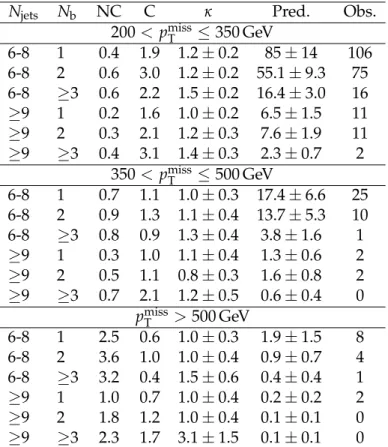
Table 1: Observed event yields and mean background yields from the predictive fit in the 18 bins of the signal region R4. Each bin is specified by the values of pmissT , Njets, and Nb.
The uncertainties in κ include both a statistical component from the size of the MC samples and a systematic component assessed from the data control samples. The uncertainty in the predicted event yield includes both of these and the statistical uncertainties associated with the data control regions. Yields for the two T1tttt benchmark models NC and C are also given.
Njets Nb NC C κ Pred. Obs.
200< pmissT ≤350 GeV 6-8 1 0.4 1.9 1.2±0.2 85±14 106 6-8 2 0.6 3.0 1.2±0.2 55.1±9.3 75 6-8 ≥3 0.6 2.2 1.5±0.2 16.4±3.0 16 ≥9 1 0.2 1.6 1.0±0.2 6.5±1.5 11 ≥9 2 0.3 2.1 1.2±0.3 7.6±1.9 11 ≥9 ≥3 0.4 3.1 1.4±0.3 2.3±0.7 2 350< pmissT ≤500 GeV 6-8 1 0.7 1.1 1.0±0.3 17.4±6.6 25 6-8 2 0.9 1.3 1.1±0.4 13.7±5.3 10 6-8 ≥3 0.8 0.9 1.3±0.4 3.8±1.6 1 ≥9 1 0.3 1.0 1.1±0.4 1.3±0.6 2 ≥9 2 0.5 1.1 0.8±0.3 1.6±0.8 2 ≥9 ≥3 0.7 2.1 1.2±0.5 0.6±0.4 0 pmissT >500 GeV 6-8 1 2.5 0.6 1.0±0.3 1.9±1.5 8 6-8 2 3.6 1.0 1.0±0.4 0.9±0.7 4 6-8 ≥3 3.2 0.4 1.5±0.6 0.4±0.4 1 ≥9 1 1.0 0.7 1.0±0.4 0.2±0.2 2 ≥9 2 1.8 1.2 1.0±0.4 0.1±0.1 0 ≥9 ≥3 2.3 1.7 3.1±1.5 0.1±0.1 0
charged veto track. The usual R3 and R4 regions are replaced by dilepton events, and the quantity κ is measured in bins of Njets. As in the 5-jets control sample, the values of κ measured
in data are found to be consistent with those observed in simulation, and uncertainties are assigned in a similar way. The uncertainties are treated as independent across Njets bins but
fully correlated across Nband pmissT bins. The uncertainties from the dilepton and 5-jet control
samples are treated as uncorrelated. Studies of a broad range of potential mismodeling effects in simulation show that all such effects would be evident in these control samples.
Systematic uncertainties in the expected signal yields account for uncertainties in the trigger, lepton identification, jet identification, and b tagging efficiencies in simulated data; uncertain-ties in the distributions of pmissT , number of pileup vertices, and ISR jet multiplicity; and uncer-tainties in the jet energy corrections, QCD scales, and integrated luminosity [63]. The combined effect of all signal-related uncertainties is typically about 25%.
Table 1 lists the observed event yields in region R4 in data, together with the mean background yields from the predictive fit and the expected signal yields from two benchmark model points. The uncertainties in the predicted background yields include the statistical uncertainties on the event yields in R1–R4 in data, the statistical uncertainties in the κ values arising from the finite size of simulated event samples, and the systematic uncertainties in κ as assessed from the data control samples. The observed yields are consistent with the background predictions in all of the 18 signal bins within 2 standard deviations (s.d.), with most of the 18 bins consistent within
Table 2: Observed event yields and mean background yields from the predictive fit in four ag-gregate search bins. In all four cases, the predicted yields refer to the signal region R4 with the standard mT >140 GeV and MJ >400 GeV requirements applied in addition to the baseline
se-lection. Unlike the finely binned approach, where all 18 background predictions are computed simultaneously, the four aggregate bin predictions are computed separately. The aggregate bins overlap, causing their background predictions to be highly correlated. Yields for the two T1tttt benchmark models NC and C are also given.
pmissT [GeV] Njets Nb NC C κ Pred. Obs.
>200 ≥9 ≥3 3.4 6.9 1.4±0.3 3.1±0.8 2
>350 ≥9 ≥2 5.3 6.2 1.0±0.4 2.7±1.2 2
>500 ≥6 ≥3 5.4 2.1 1.7±0.6 0.5±0.4 1
>500 ≥9 ≥1 5.1 3.6 1.2±0.4 0.4±0.4 2
1 s.d. The R4 bins with pmiss
T > 500 GeV show an underprediction of the background with
respect to the observed yields. However, accounting for the correlations arising from the use of a single, integrated yield in R3 across bins in Njets and Nb, the significance of the discrepancy
in these six bins in R4 is only 1.9 s.d., mostly due to the bins with Nb=1.
To simplify the reinterpretation of the results in terms of other theoretical models, we provide predicted mean background yields for four aggregated search bins, shown in Table 2. The aggregate bins are defined such that at least one bin will provide sensitivity to most of the models for which the finely binned analysis has sensitivity. Since the aggregate bins overlap, they are intended to be used one at a time, unlike the 18 nonoverlapping signal bins, which are considered simultaneously in the fit. Each prediction includes all sources of uncertainty. The choice of the best aggregate bin will depend on the model under study. For the T1tttt benchmark models considered in this letter, using the aggregate bins results in expected upper limits on the cross sections that are 20–50% higher than those resulting from the full analysis. Figure 1 compares the shapes of the MJ distributions observed in data in the single-lepton
sample for mT ≤ 140 GeV and mT > 140 GeV in two regions of pmissT . The shapes of the two
MJ distributions for each pmissT region are very similar, as expected in the absence of signal.
A further correction is applied via the κ factors listed in Table 1 in MJ ranges larger than the
binning shown in the figure. The lower-pmissT region shows the background behavior with higher statistics, while the higher-pmissT region has higher sensitivity to the signal.
Figure 2 shows an interpretation of the results as exclusion limits at 95% confidence level (CL) for T1tttt and T5tttt. The limits are obtained using the CLs method with a profile-likelihood
ratio as the test statistic, using asymptotic approximations for the distribution of the test statis-tic [64–66]. The color map shows the cross section upper limits as a function of m(eg)and m(χe01) for T1tttt, assuming a 100% branching fraction for the decayeg→tteχ
0
1. The T1tttt model points
below the dark solid curve, which extend up to gluino masses of about 1.9 TeV for neutralino masses up to 1 TeV, have a theoretical cross section above the observed cross section upper limit and are thus excluded by this analysis. The dotted black lines around the observed mass limits show the impact of the theoretical uncertainties in the overall signal cross sections arising from uncertainties in the parton distribution functions and the renormalization and factorization scales.
Model points below the light solid curve are excluded at 95% CL for the T5tttt model, where it is assumed that the top squark mass is 175 GeV above the neutralino mass, a limiting case in terms of sensitivity to the decay kinematics. The T5tttt simulation does not explicitly include direct top squark pair production. Studies presented in Ref. [16] demonstrate that the effect of this
7 [GeV] J M 200 400 600 800 1000 Events / 50 GeV 0 20 40 60 80 100 > 140 GeV T Data, m 140 GeV ≤ T Data, m (1800,100) 1 0 χ∼ t t → g ~ , g ~ g ~ (1400,1000) 1 0 χ∼ t t → g ~ , g ~ g ~ 350 GeV ≤ miss T 200 < p 2 ≥ b , N 6 ≥ jets N CMS 35.9 fb-1 (13 TeV) [GeV] J M 200 400 600 800 1000 Events / 50 GeV 0 5 10 15 20 > 140 GeV T Data, m 140 GeV ≤ T Data, m (1800,100) 1 0 χ∼ t t → g ~ , g ~ g ~ (1400,1000) 1 0 χ∼ t t → g ~ , g ~ g ~ > 350 GeV miss T p 2 ≥ b , N 6 ≥ jets N CMS 35.9 fb-1 (13 TeV)
Figure 1: Distributions of MJ observed in data for 200 < pmissT ≤ 350 GeV (left) and pmissT >
350 GeV (right) with the baseline selection and either mT ≤140 GeV or mT > 140 GeV. In each
plot, the data at low mT have been normalized to the yield observed at high mT. The vertical
dashed lines at MJ = 250 GeV and 400 GeV show the boundaries separating the control and
signal regions. The data are integrated over Njets ≥ 6 and Nb ≥ 2. Two SUSY benchmark
models, whose contributions are small in the lower pmissT region, are shown in the solid and dashed red histograms. Overflow events are included in the uppermost bins.
contribution is very small for most of the space of T5tttt model points considered here. For most of the excluded region, the boundaries for T1tttt and T5tttt are very similar, indicating only a weak overall sensitivity to the value of the top squark mass. At low values of m(χe01)in T5tttt, the sensitivity is reduced because the neutralino carries very little momentum; however, some sensitivity is still provided by dilepton events that escape the lepton veto [16]. For both the T1tttt and T5tttt models, expected limits are computed using the background-only hypothesis, with nuisance parameters assuming their best fit values from the observed data. All limits are computed using results from the global fit.
In summary, we have performed a search for an excess event yield above that expected for standard model (SM) processes using a data sample of proton-proton collision events with an integrated luminosity of 35.9 fb−1at√s=13 TeV. The signature is characterized by large miss-ing transverse momentum, a smiss-ingle isolated lepton, multiple jets, and at least one b-tagged jet. No significant excesses above the SM backgrounds are observed. The results are interpreted in the framework of simplified models that describe natural supersymmetry (SUSY) scenarios. For gluino pair production followed by the three-body decayeg→ ttχe
0
1(T1tttt model), gluinos
with masses below 1.9 TeV are excluded at 95% confidence level for neutralino masses up to about 1 TeV. For the two-body gluino decayeg →et1t withet1 → tχe
0
1(T5tttt model), the results
are generally similar, except at low neutralino masses, where the excluded gluino mass is some-what lower. These results extend previous gluino mass limits by about 300 GeV and are among the most stringent constraints on these simplified models of SUSY to date.
) [TeV]
g
~
m(
0.6
0.8
1
1.2
1.4
1.6
1.8
2
) [TeV]
1 0χ∼
m(
0
0.2
0.4
0.6
0.8
1
1.2
1.4
1.6
1.8
2
CMS
(13 TeV)
-135.9 fb
) [fb]
1 0χ∼
tt
→
g~
,
g~
g~(
σ
Upper limit (95% CL) on
1 10 2 10 experiment s.d. ± ) 1 0 χ∼ t t → g ~ , g ~ g ~ Expected ( theory s.d. ± ) 1 0 χ∼ t t → g ~ , g ~ g ~ Observed ( GeV) 175 = ) 1 0 χ∼ m( -) 1 t ~ , m( 1 0 χ∼ t → 1 t ~ , t 1 t ~ → g ~ , g ~ g ~ Expected ( GeV) 175 = ) 1 0 χ∼ m( -) 1 t ~ , m( 1 0 χ∼ t → 1 t ~ , t 1 t ~ → g ~ , g ~ g ~ Observed (Figure 2: Observed and expected excluded gluino and neutralino masses at 95% CL for the T1tttt and T5tttt models. The black (red) lines show the observed (expected) exclusion and the range associated with the theoretical (experimental) uncertainties for the T1tttt model. The solid (dashed) blue line shows the observed (expected) exclusion for the T5tttt model. The uncertainties for the T5tttt exclusion limits are not shown and are similar to those for the T1tttt model. The color map shows the observed cross section upper limits for the T1tttt model.
Acknowledgments
We congratulate our colleagues in the CERN accelerator departments for the excellent perfor-mance of the LHC and thank the technical and administrative staffs at CERN and at other CMS institutes for their contributions to the success of the CMS effort. In addition, we grate-fully acknowledge the computing centers and personnel of the Worldwide LHC Computing Grid for delivering so effectively the computing infrastructure essential to our analyses. Fi-nally, we acknowledge the enduring support for the construction and operation of the LHC and the CMS detector provided by the following funding agencies: BMWFW and FWF (Aus-tria); FNRS and FWO (Belgium); CNPq, CAPES, FAPERJ, and FAPESP (Brazil); MES (Bulgaria); CERN; CAS, MoST, and NSFC (China); COLCIENCIAS (Colombia); MSES and CSF (Croatia); RPF (Cyprus); SENESCYT (Ecuador); MoER, ERC IUT, and ERDF (Estonia); Academy of Fin-land, MEC, and HIP (Finland); CEA and CNRS/IN2P3 (France); BMBF, DFG, and HGF (Ger-many); GSRT (Greece); OTKA and NIH (Hungary); DAE and DST (India); IPM (Iran); SFI (Ireland); INFN (Italy); MSIP and NRF (Republic of Korea); LAS (Lithuania); MOE and UM (Malaysia); BUAP, CINVESTAV, CONACYT, LNS, SEP, and UASLP-FAI (Mexico); MBIE (New Zealand); PAEC (Pakistan); MSHE and NSC (Poland); FCT (Portugal); JINR (Dubna); MON, RosAtom, RAS, RFBR and RAEP (Russia); MESTD (Serbia); SEIDI and CPAN (Spain); Swiss Funding Agencies (Switzerland); MST (Taipei); ThEPCenter, IPST, STAR, and NSTDA (Thai-land); TUBITAK and TAEK (Turkey); NASU and SFFR (Ukraine); STFC (United Kingdom); DOE and NSF (USA).
References 9
References
[1] L. Evans and P. Bryant, “LHC machine”, JINST 3 doi:10.1088/1748-0221/3/08/S08001.
[2] P. Ramond, “Dual theory for free fermions”, Phys. Rev. D 3 (1971) 2415, doi:10.1103/PhysRevD.3.2415.
[3] Y. A. Gol’fand and E. P. Likhtman, “Extension of the algebra of Poincar´e group generators and violation of P invariance”, JETP Lett. 13 (1971) 323.
[4] A. Neveu and J. H. Schwarz, “Factorizable dual model of pions”, Nucl. Phys. B 31 (1971) 86, doi:10.1016/0550-3213(71)90448-2.
[5] D. V. Volkov and V. P. Akulov, “Possible universal neutrino interaction”, JETP Lett. 16 (1972) 438.
[6] J. Wess and B. Zumino, “A lagrangian model invariant under supergauge
transformations”, Phys. Lett. B 49 (1974) 52, doi:10.1016/0370-2693(74)90578-4. [7] J. Wess and B. Zumino, “Supergauge transformations in four dimensions”, Nucl. Phys. B
70(1974) 39, doi:10.1016/0550-3213(74)90355-1.
[8] P. Fayet, “Supergauge invariant extension of the Higgs mechanism and a model for the electron and its neutrino”, Nucl. Phys. B 90 (1975) 104,
doi:10.1016/0550-3213(75)90636-7.
[9] H. P. Nilles, “Supersymmetry, supergravity and particle physics”, Phys. Rep. 110 (1984) 1, doi:10.1016/0370-1573(84)90008-5.
[10] ATLAS Collaboration, “Search for supersymmetry in final states with jets, missing transverse momentum and one isolated lepton in√s=7 TeV pp collisions using 1 fb−1
of ATLAS data”, Phys. Rev. D 85 (2012) 012006, doi:10.1103/PhysRevD.85.012006, arXiv:1109.6606. [Erratum: doi:10.1103/PhysRevD.87.099903].
[11] ATLAS Collaboration, “Search for squarks and gluinos in events with isolated leptons, jets and missing transverse momentum at√s=8 TeV with the ATLAS detector”, JHEP
04(2015) 116, doi:10.1007/JHEP04(2015)116, arXiv:1501.03555.
[12] CMS Collaboration, “Search for supersymmetry in pp collisions at√s=7 TeV in events with a single lepton, jets, and missing transverse momentum”, JHEP 08 (2011) 156, doi:10.1007/JHEP08(2011)156, arXiv:1107.1870.
[13] CMS Collaboration, “Search for supersymmetry in pp collisions at√s = 8 TeV in events with a single lepton, large jet multiplicity, and multiple b jets”, Phys. Lett. B 733 (2014) 328, doi:10.1016/j.physletb.2014.04.023, arXiv:1311.4937.
[14] ATLAS Collaboration, “Search for pair production of gluinos decaying via stop and sbottom in events with b-jets and large missing transverse momentum in pp collisions at√
s =13 TeV with the ATLAS detector”, Phys. Rev. D 94 (2016), no. 3, 032003, doi:10.1103/PhysRevD.94.032003, arXiv:1605.09318.
[15] ATLAS Collaboration, “Search for gluinos in events with an isolated lepton, jets and missing transverse momentum at√s = 13 TeV with the ATLAS detector”, Eur. Phys. J. C
[16] CMS Collaboration, “Search for supersymmetry in pp collisions at√s=13 TeV in the single-lepton final state using the sum of masses of large-radius jets”, JHEP 08 (2016) 122, doi:10.1007/JHEP08(2016)122, arXiv:1605.04608.
[17] CMS Collaboration, “Search for supersymmetry in events with one lepton and multiple jets in proton-proton collisions at√s=13 TeV”, Phys. Rev. D 95 (2017) 012011,
doi:10.1103/PhysRevD.95.012011, arXiv:1609.09386.
[18] ATLAS Collaboration, “Observation of a new particle in the search for the Standard Model Higgs boson with the ATLAS detector at the LHC”, Phys. Lett. B 716 (2012) 1, doi:10.1016/j.physletb.2012.08.020, arXiv:1207.7214.
[19] CMS Collaboration, “Observation of a new boson at a mass of 125 GeV with the CMS experiment at the LHC”, Phys. Lett. B 716 (2012) 30,
doi:10.1016/j.physletb.2012.08.021, arXiv:1207.7235.
[20] CMS Collaboration, “Observation of a new boson with mass near 125 GeV in pp collisions at√s = 7 and 8 TeV”, JHEP 06 (2013) 081,
doi:10.1007/JHEP06(2013)081, arXiv:1303.4571.
[21] CMS Collaboration, “Precise determination of the mass of the Higgs boson and tests of compatibility of its couplings with the standard model predictions using proton
collisions at 7 and 8 TeV”, Eur. Phys. J. C 75 (2015) 212,
doi:10.1140/epjc/s10052-015-3351-7, arXiv:1412.8662.
[22] ATLAS Collaboration, “Measurement of the Higgs boson mass from the H→γγand H→ZZ∗→4`channels with the ATLAS detector using 25 fb−1of pp collision data”, Phys. Rev. D 90 (2014) 052004, doi:10.1103/PhysRevD.90.052004,
arXiv:1406.3827.
[23] ATLAS and CMS Collaborations, “Combined measurement of the Higgs boson mass in pp collisions at√s =7 and 8 TeV with the ATLAS and CMS experiments”, Phys. Rev. Lett. 114 (2015) 191803, doi:10.1103/PhysRevLett.114.191803,
arXiv:1503.07589.
[24] G. ’t Hooft, “Naturalness, chiral symmetry, and spontaneous chiral symmetry breaking”, NATO Sci. Ser. B 59 (1980) 135, doi:10.1007/978-1-4684-7571-5_9.
[25] E. Witten, “Dynamical breaking of supersymmetry”, Nucl. Phys. B 188 (1981) 513, doi:10.1016/0550-3213(81)90006-7.
[26] M. Dine, W. Fischler, and M. Srednicki, “Supersymmetric technicolor”, Nucl. Phys. B 189 (1981) 575, doi:10.1016/0550-3213(81)90582-4.
[27] S. Dimopoulos and S. Raby, “Supercolor”, Nucl. Phys. B 192 (1981) 353, doi:10.1016/0550-3213(81)90430-2.
[28] S. Dimopoulos and H. Georgi, “Softly broken supersymmetry and SU(5)”, Nucl. Phys. B
193(1981) 150, doi:10.1016/0550-3213(81)90522-8.
[29] R. K. Kaul and P. Majumdar, “Cancellation of quadratically divergent mass corrections in globally supersymmetric spontaneously broken gauge theories”, Nucl. Phys. B 199 (1982) 36, doi:10.1016/0550-3213(82)90565-X.
References 11
[30] R. Barbieri and G. F. Giudice, “Upper bounds on supersymmetric particle masses”, Nucl. Phys. B 306 (1988) 63, doi:10.1016/0550-3213(88)90171-X.
[31] S. Dimopoulos and G. F. Giudice, “Naturalness constraints in supersymmetric theories with nonuniversal soft terms”, Phys. Lett. B 357 (1995) 573,
doi:10.1016/0370-2693(95)00961-J, arXiv:hep-ph/9507282.
[32] R. Barbieri and D. Pappadopulo, “S-particles at their naturalness limits”, JHEP 10 (2009) 061, doi:10.1088/1126-6708/2009/10/061, arXiv:0906.4546.
[33] M. Papucci, J. T. Ruderman, and A. Weiler, “Natural SUSY endures”, JHEP 09 (2012) 035, doi:10.1007/JHEP09(2012)035, arXiv:1110.6926.
[34] J. L. Feng, “Naturalness and the status of supersymmetry”, Ann. Rev. Nucl. Part. Sci. 63 (2013) 351, doi:10.1146/annurev-nucl-102010-130447, arXiv:1302.6587. [35] G. R. Farrar and P. Fayet, “Phenomenology of the production, decay, and detection of
new hadronic states associated with supersymmetry”, Phys. Lett. B 76 (1978) 575, doi:10.1016/0370-2693(78)90858-4.
[36] S. P. Martin, “A supersymmetry primer”, Adv. Ser. Direct. High Energy Phys. 18 (1998) 1, doi:10.1142/9789812839657_0001, arXiv:hep-ph/9709356.
[37] F. Zwicky, “Die rotverschiebung von extragalaktischen nebeln”, Helv. Phys. Acta 6 (1933) 110.
[38] V. C. Rubin and W. K. Ford Jr, “Rotation of the Andromeda nebula from a spectroscopic survey of emission regions”, Astrophys. J. 159 (1970) 379, doi:10.1086/150317. [39] Particle Data Group, C. Patrignani et al., “Review of particle physics”, Chin. Phys. C 40
(2016) 100001, doi:10.1088/1674-1137/40/10/100001.
[40] CMS Collaboration, “Interpretation of searches for supersymmetry with simplified models”, Phys. Rev. D 88 (2013) 052017, doi:10.1103/PhysRevD.88.052017, arXiv:1301.2175.
[41] J. Alwall, P. C. Schuster, and N. Toro, “Simplified models for a first characterization of new physics at the LHC”, Phys. Rev. D 79 (2009) 075020,
doi:10.1103/PhysRevD.79.075020, arXiv:0810.3921.
[42] J. Alwall, M.-P. Le, M. Lisanti, and J. G. Wacker, “Model-independent jets plus missing energy searches”, Phys. Rev. D 79 (2009) 015005,
doi:10.1103/PhysRevD.79.015005, arXiv:0809.3264.
[43] D. Alves et al., “Simplified models for LHC new physics searches”, J. Phys. G 39 (2012) 105005, doi:10.1088/0954-3899/39/10/105005, arXiv:1105.2838.
[44] J. Alwall et al., “The automated computation of tree-level and next-to-leading order differential cross sections, and their matching to parton shower simulations”, JHEP 07 (2014) 079, doi:10.1007/JHEP07(2014)079, arXiv:1405.0301.
[45] NNPDF Collaboration, “Parton distributions for the LHC Run II”, JHEP 04 (2015) 040, doi:10.1007/JHEP04(2015)040, arXiv:1410.8849.
[46] GEANT4 Collaboration, “GEANT4 — a simulation toolkit”, Nucl. Instrum. Meth. A 506 (2003) 250, doi:10.1016/S0168-9002(03)01368-8.
[47] C. Borschensky et al., “Squark and gluino production cross sections in pp collisions at√s = 13, 14, 33 and 100 TeV”, Eur. Phys. J. C 74 (2014) 3174,
doi:10.1140/epjc/s10052-014-3174-y, arXiv:1407.5066.
[48] CMS Collaboration, “The fast simulation of the CMS detector at LHC”, J. Phys. Conf. Ser.
331(2011) 032049, doi:10.1088/1742-6596/331/3/032049.
[49] CMS Collaboration, “The CMS experiment at the CERN LHC”, JINST 3 (2008) S08004, doi:10.1088/1748-0221/3/08/S08004.
[50] CMS Collaboration, “The CMS trigger system”, JINST 12 (2017), no. 01, P01020, doi:10.1088/1748-0221/12/01/P01020, arXiv:1609.02366.
[51] CMS Collaboration, “Particle-flow reconstruction and global event description with the CMS detector”, (2017). arXiv:1706.04965. Submitted to JINST.
[52] CMS Collaboration, “Performance of electron reconstruction and selection with the CMS detector in proton-proton collisions at√s=8 TeV”, JINST 10 (2015) P06005,
doi:10.1088/1748-0221/10/06/P06005, arXiv:1502.02701.
[53] CMS Collaboration, “Performance of CMS muon reconstruction in pp collision events at√ s =7 TeV”, JINST 7 (2012) P10002, doi:10.1088/1748-0221/7/10/P10002, arXiv:1206.4071.
[54] K. Rehermann and B. Tweedie, “Efficient identification of boosted semileptonic top quarks at the LHC”, JHEP 03 (2011) 059, doi:10.1007/JHEP03(2011)059, arXiv:1007.2221.
[55] C. G. Lester and D. J. Summers, “Measuring masses of semi-invisibly decaying particle pairs produced at hadron colliders”, Phys. Lett. B 463 (1999) 5,
doi:10.1016/S0370-2693(99)00945-4.
[56] A. Barr, C. Lester, and P. Stephens, “A variable for measuring masses at hadron colliders when missing energy is expected; mT2: the truth behind the glamour”, J. Phys. G 29
(2003) 2343, doi:10.1088/0954-3899/29/10/304, arXiv:hep-ph/0304226. [57] M. Cacciari, G. P. Salam, and G. Soyez, “The anti-ktjet clustering algorithm”, JHEP 04
(2008) 063, doi:10.1088/1126-6708/2008/04/063, arXiv:0802.1189.
[58] M. Cacciari, G. P. Salam, and G. Soyez, “FastJet user manual”, Eur. Phys. J. C 72 (2012) 1896, doi:10.1140/epjc/s10052-012-1896-2, arXiv:1111.6097.
[59] CMS Collaboration, “Determination of jet energy calibration and transverse momentum resolution in CMS”, JINST 6 (2011) P11002,
doi:10.1088/1748-0221/6/11/P11002, arXiv:1107.4277.
[60] M. Cacciari and G. P. Salam, “Pileup subtraction using jet areas”, Phys. Lett. B 659 (2008) 119, doi:10.1016/j.physletb.2007.09.077, arXiv:0707.1378.
[61] CMS Collaboration, “Identification of b-quark jets with the CMS experiment”, JINST 8 (2013) P04013, doi:10.1088/1748-0221/8/04/P04013, arXiv:1211.4462. [62] CMS Collaboration, “Identification of b quark jets at the CMS Experiment in the LHC
References 13
[63] CMS Collaboration, “CMS luminosity measurements for the 2016 data taking period”, CMS Physics Analysis Summary CMS-PAS-LUM-17-001, CERN, 2017.
[64] A. L. Read, “Presentation of search results: the CLstechnique”, in Durham IPPP
Workshop: Advanced Statistical Techniques in Particle Physics, p. 2693. Durham, UK, March, 2002. [J. Phys. G 28 (2002) 2693]. doi:10.1088/0954-3899/28/10/313.
[65] ATLAS and CMS Collaborations, LHC Higgs Combination Group, “Procedure for the LHC Higgs boson search combination in Summer 2011”, Technical Report
CMS-NOTE-2011-005, ATL-PHYS-PUB-2011-11, CERN, 2011.
[66] G. Cowan, K. Cranmer, E. Gross, and O. Vitells, “Asymptotic formulae for likelihood-based tests of new physics”, Eur. Phys. J. C 71 (2011) 1554,
doi:10.1140/epjc/s10052-011-1554-0, arXiv:1007.1727. [Erratum: doi:10.1140/epjc/s10052-013-2501-z].
15
A
The CMS Collaboration
Yerevan Physics Institute, Yerevan, Armenia
A.M. Sirunyan, A. Tumasyan
Institut f ¨ur Hochenergiephysik, Wien, Austria
W. Adam, F. Ambrogi, E. Asilar, T. Bergauer, J. Brandstetter, E. Brondolin, M. Dragicevic, J. Er ¨o, M. Flechl, M. Friedl, R. Fr ¨uhwirth1, V.M. Ghete, J. Grossmann, J. Hrubec, M. Jeitler1, A. K ¨onig, N. Krammer, I. Kr¨atschmer, D. Liko, T. Madlener, I. Mikulec, E. Pree, D. Rabady, N. Rad, H. Rohringer, J. Schieck1, R. Sch ¨ofbeck, M. Spanring, D. Spitzbart, J. Strauss, W. Waltenberger, J. Wittmann, C.-E. Wulz1, M. Zarucki
Institute for Nuclear Problems, Minsk, Belarus
V. Chekhovsky, V. Mossolov, J. Suarez Gonzalez
Universiteit Antwerpen, Antwerpen, Belgium
E.A. De Wolf, D. Di Croce, X. Janssen, J. Lauwers, M. Van De Klundert, H. Van Haevermaet, P. Van Mechelen, N. Van Remortel
Vrije Universiteit Brussel, Brussel, Belgium
S. Abu Zeid, F. Blekman, J. D’Hondt, I. De Bruyn, J. De Clercq, K. Deroover, G. Flouris, D. Lontkovskyi, S. Lowette, S. Moortgat, L. Moreels, A. Olbrechts, Q. Python, K. Skovpen, S. Tavernier, W. Van Doninck, P. Van Mulders, I. Van Parijs
Universit´e Libre de Bruxelles, Bruxelles, Belgium
H. Brun, B. Clerbaux, G. De Lentdecker, H. Delannoy, G. Fasanella, L. Favart, R. Goldouzian, A. Grebenyuk, G. Karapostoli, T. Lenzi, J. Luetic, T. Maerschalk, A. Marinov, A. Randle-conde, T. Seva, C. Vander Velde, P. Vanlaer, D. Vannerom, R. Yonamine, F. Zenoni, F. Zhang2
Ghent University, Ghent, Belgium
A. Cimmino, T. Cornelis, D. Dobur, A. Fagot, M. Gul, I. Khvastunov, D. Poyraz, C. Roskas, S. Salva, M. Tytgat, W. Verbeke, N. Zaganidis
Universit´e Catholique de Louvain, Louvain-la-Neuve, Belgium
H. Bakhshiansohi, O. Bondu, S. Brochet, G. Bruno, A. Caudron, S. De Visscher, C. Delaere, M. Delcourt, B. Francois, A. Giammanco, A. Jafari, M. Komm, G. Krintiras, V. Lemaitre, A. Magitteri, A. Mertens, M. Musich, K. Piotrzkowski, L. Quertenmont, M. Vidal Marono, S. Wertz
Universit´e de Mons, Mons, Belgium
N. Beliy
Centro Brasileiro de Pesquisas Fisicas, Rio de Janeiro, Brazil
W.L. Ald´a J ´unior, F.L. Alves, G.A. Alves, L. Brito, M. Correa Martins Junior, C. Hensel, A. Moraes, M.E. Pol, P. Rebello Teles
Universidade do Estado do Rio de Janeiro, Rio de Janeiro, Brazil
E. Belchior Batista Das Chagas, W. Carvalho, J. Chinellato3, A. Cust ´odio, E.M. Da Costa,
G.G. Da Silveira4, D. De Jesus Damiao, S. Fonseca De Souza, L.M. Huertas Guativa, H. Malbouisson, M. Melo De Almeida, C. Mora Herrera, L. Mundim, H. Nogima, A. Santoro, A. Sznajder, E.J. Tonelli Manganote3, F. Torres Da Silva De Araujo, A. Vilela Pereira
Universidade Estadual Paulistaa, Universidade Federal do ABCb, S˜ao Paulo, Brazil
S. Ahujaa, C.A. Bernardesa, T.R. Fernandez Perez Tomeia, E.M. Gregoresb, P.G. Mercadanteb, C.S. Moona, S.F. Novaesa, Sandra S. Padulaa, D. Romero Abadb, J.C. Ruiz Vargasa
Institute for Nuclear Research and Nuclear Energy of Bulgaria Academy of Sciences
A. Aleksandrov, R. Hadjiiska, P. Iaydjiev, M. Misheva, M. Rodozov, M. Shopova, S. Stoykova, G. Sultanov
University of Sofia, Sofia, Bulgaria
A. Dimitrov, I. Glushkov, L. Litov, B. Pavlov, P. Petkov
Beihang University, Beijing, China
W. Fang5, X. Gao5
Institute of High Energy Physics, Beijing, China
M. Ahmad, J.G. Bian, G.M. Chen, H.S. Chen, M. Chen, Y. Chen, C.H. Jiang, D. Leggat, Z. Liu, F. Romeo, S.M. Shaheen, A. Spiezia, J. Tao, C. Wang, Z. Wang, E. Yazgan, H. Zhang, J. Zhao
State Key Laboratory of Nuclear Physics and Technology, Peking University, Beijing, China
Y. Ban, G. Chen, Q. Li, S. Liu, Y. Mao, S.J. Qian, D. Wang, Z. Xu
Universidad de Los Andes, Bogota, Colombia
C. Avila, A. Cabrera, L.F. Chaparro Sierra, C. Florez, C.F. Gonz´alez Hern´andez, J.D. Ruiz Alvarez
University of Split, Faculty of Electrical Engineering, Mechanical Engineering and Naval Architecture, Split, Croatia
B. Courbon, N. Godinovic, D. Lelas, I. Puljak, P.M. Ribeiro Cipriano, T. Sculac
University of Split, Faculty of Science, Split, Croatia
Z. Antunovic, M. Kovac
Institute Rudjer Boskovic, Zagreb, Croatia
V. Brigljevic, D. Ferencek, K. Kadija, B. Mesic, T. Susa
University of Cyprus, Nicosia, Cyprus
M.W. Ather, A. Attikis, G. Mavromanolakis, J. Mousa, C. Nicolaou, F. Ptochos, P.A. Razis, H. Rykaczewski
Charles University, Prague, Czech Republic
M. Finger6, M. Finger Jr.6
Universidad San Francisco de Quito, Quito, Ecuador
E. Carrera Jarrin
Academy of Scientific Research and Technology of the Arab Republic of Egypt, Egyptian Network of High Energy Physics, Cairo, Egypt
Y. Assran7,8, S. Elgammal8, A. Mahrous9
National Institute of Chemical Physics and Biophysics, Tallinn, Estonia
R.K. Dewanjee, M. Kadastik, L. Perrini, M. Raidal, A. Tiko, C. Veelken
Department of Physics, University of Helsinki, Helsinki, Finland
P. Eerola, J. Pekkanen, M. Voutilainen
Helsinki Institute of Physics, Helsinki, Finland
J. H¨ark ¨onen, T. J¨arvinen, V. Karim¨aki, R. Kinnunen, T. Lamp´en, K. Lassila-Perini, S. Lehti, T. Lind´en, P. Luukka, E. Tuominen, J. Tuominiemi, E. Tuovinen
Lappeenranta University of Technology, Lappeenranta, Finland
17
IRFU, CEA, Universit´e Paris-Saclay, Gif-sur-Yvette, France
M. Besancon, F. Couderc, M. Dejardin, D. Denegri, J.L. Faure, F. Ferri, S. Ganjour, S. Ghosh, A. Givernaud, P. Gras, G. Hamel de Monchenault, P. Jarry, I. Kucher, E. Locci, M. Machet, J. Malcles, G. Negro, J. Rander, A. Rosowsky, M. ¨O. Sahin, M. Titov
Laboratoire Leprince-Ringuet, Ecole polytechnique, CNRS/IN2P3, Universit´e Paris-Saclay, Palaiseau, France
A. Abdulsalam, I. Antropov, S. Baffioni, F. Beaudette, P. Busson, L. Cadamuro, C. Charlot, R. Granier de Cassagnac, M. Jo, S. Lisniak, A. Lobanov, J. Martin Blanco, M. Nguyen, C. Ochando, G. Ortona, P. Paganini, P. Pigard, S. Regnard, R. Salerno, J.B. Sauvan, Y. Sirois, A.G. Stahl Leiton, T. Strebler, Y. Yilmaz, A. Zabi
Universit´e de Strasbourg, CNRS, IPHC UMR 7178, F-67000 Strasbourg, France
J.-L. Agram10, J. Andrea, D. Bloch, J.-M. Brom, M. Buttignol, E.C. Chabert, N. Chanon, C. Collard, E. Conte10, X. Coubez, J.-C. Fontaine10, D. Gel´e, U. Goerlach, M. Jansov´a, A.-C. Le Bihan, N. Tonon, P. Van Hove
Centre de Calcul de l’Institut National de Physique Nucleaire et de Physique des Particules, CNRS/IN2P3, Villeurbanne, France
S. Gadrat
Universit´e de Lyon, Universit´e Claude Bernard Lyon 1, CNRS-IN2P3, Institut de Physique Nucl´eaire de Lyon, Villeurbanne, France
S. Beauceron, C. Bernet, G. Boudoul, R. Chierici, D. Contardo, P. Depasse, H. El Mamouni, J. Fay, L. Finco, S. Gascon, M. Gouzevitch, G. Grenier, B. Ille, F. Lagarde, I.B. Laktineh, M. Lethuillier, L. Mirabito, A.L. Pequegnot, S. Perries, A. Popov11, V. Sordini, M. Vander Donckt, S. Viret
Georgian Technical University, Tbilisi, Georgia
A. Khvedelidze6
Tbilisi State University, Tbilisi, Georgia
Z. Tsamalaidze6
RWTH Aachen University, I. Physikalisches Institut, Aachen, Germany
C. Autermann, S. Beranek, L. Feld, M.K. Kiesel, K. Klein, M. Lipinski, M. Preuten, C. Schomakers, J. Schulz, T. Verlage
RWTH Aachen University, III. Physikalisches Institut A, Aachen, Germany
A. Albert, M. Brodski, E. Dietz-Laursonn, D. Duchardt, M. Endres, M. Erdmann, S. Erdweg, T. Esch, R. Fischer, A. G ¨uth, M. Hamer, T. Hebbeker, C. Heidemann, K. Hoepfner, S. Knutzen, M. Merschmeyer, A. Meyer, P. Millet, S. Mukherjee, M. Olschewski, K. Padeken, T. Pook, M. Radziej, H. Reithler, M. Rieger, F. Scheuch, D. Teyssier, S. Th ¨uer
RWTH Aachen University, III. Physikalisches Institut B, Aachen, Germany
G. Fl ¨ugge, B. Kargoll, T. Kress, A. K ¨unsken, J. Lingemann, T. M ¨uller, A. Nehrkorn, A. Nowack, C. Pistone, O. Pooth, A. Stahl12
Deutsches Elektronen-Synchrotron, Hamburg, Germany
M. Aldaya Martin, T. Arndt, C. Asawatangtrakuldee, K. Beernaert, O. Behnke, U. Behrens, A.A. Bin Anuar, K. Borras13, V. Botta, A. Campbell, P. Connor, C. Contreras-Campana,
F. Costanza, C. Diez Pardos, G. Eckerlin, D. Eckstein, T. Eichhorn, E. Eren, E. Gallo14, J. Garay Garcia, A. Geiser, A. Gizhko, J.M. Grados Luyando, A. Grohsjean, P. Gunnellini, A. Harb, J. Hauk, M. Hempel15, H. Jung, A. Kalogeropoulos, M. Kasemann, J. Keaveney, C. Kleinwort,
I. Korol, D. Kr ¨ucker, W. Lange, A. Lelek, T. Lenz, J. Leonard, K. Lipka, W. Lohmann15, R. Mankel, I.-A. Melzer-Pellmann, A.B. Meyer, G. Mittag, J. Mnich, A. Mussgiller, E. Ntomari, D. Pitzl, R. Placakyte, A. Raspereza, B. Roland, M. Savitskyi, P. Saxena, R. Shevchenko, S. Spannagel, N. Stefaniuk, G.P. Van Onsem, R. Walsh, Y. Wen, K. Wichmann, C. Wissing, O. Zenaiev
University of Hamburg, Hamburg, Germany
S. Bein, V. Blobel, M. Centis Vignali, A.R. Draeger, T. Dreyer, E. Garutti, D. Gonzalez, J. Haller, A. Hinzmann, M. Hoffmann, A. Junkes, A. Karavdina, R. Klanner, R. Kogler, N. Kovalchuk, S. Kurz, T. Lapsien, I. Marchesini, D. Marconi, M. Meyer, M. Niedziela, D. Nowatschin, F. Pantaleo12, T. Peiffer, A. Perieanu, C. Scharf, P. Schleper, A. Schmidt, S. Schumann, J. Schwandt, J. Sonneveld, H. Stadie, G. Steinbr ¨uck, F.M. Stober, M. St ¨over, H. Tholen, D. Troendle, E. Usai, L. Vanelderen, A. Vanhoefer, B. Vormwald
Institut f ¨ur Experimentelle Kernphysik, Karlsruhe, Germany
M. Akbiyik, C. Barth, S. Baur, E. Butz, R. Caspart, T. Chwalek, F. Colombo, W. De Boer, A. Dierlamm, B. Freund, R. Friese, M. Giffels, A. Gilbert, D. Haitz, F. Hartmann12, S.M. Heindl, U. Husemann, F. Kassel12, S. Kudella, H. Mildner, M.U. Mozer, Th. M ¨uller, M. Plagge, G. Quast, K. Rabbertz, M. Schr ¨oder, I. Shvetsov, G. Sieber, H.J. Simonis, R. Ulrich, S. Wayand, M. Weber, T. Weiler, S. Williamson, C. W ¨ohrmann, R. Wolf
Institute of Nuclear and Particle Physics (INPP), NCSR Demokritos, Aghia Paraskevi, Greece
G. Anagnostou, G. Daskalakis, T. Geralis, V.A. Giakoumopoulou, A. Kyriakis, D. Loukas, I. Topsis-Giotis
National and Kapodistrian University of Athens, Athens, Greece
S. Kesisoglou, A. Panagiotou, N. Saoulidou
University of Io´annina, Io´annina, Greece
I. Evangelou, C. Foudas, P. Kokkas, N. Manthos, I. Papadopoulos, E. Paradas, J. Strologas, F.A. Triantis
MTA-ELTE Lend ¨ulet CMS Particle and Nuclear Physics Group, E ¨otv ¨os Lor´and University, Budapest, Hungary
M. Csanad, N. Filipovic, G. Pasztor
Wigner Research Centre for Physics, Budapest, Hungary
G. Bencze, C. Hajdu, D. Horvath16, ´A. Hunyadi, F. Sikler, V. Veszpremi, G. Vesztergombi17, A.J. Zsigmond
Institute of Nuclear Research ATOMKI, Debrecen, Hungary
N. Beni, S. Czellar, J. Karancsi18, A. Makovec, J. Molnar, Z. Szillasi
Institute of Physics, University of Debrecen, Debrecen, Hungary
M. Bart ´ok17, P. Raics, Z.L. Trocsanyi, B. Ujvari
Indian Institute of Science (IISc), Bangalore, India
S. Choudhury, J.R. Komaragiri
National Institute of Science Education and Research, Bhubaneswar, India
19
Panjab University, Chandigarh, India
S. Bansal, S.B. Beri, V. Bhatnagar, U. Bhawandeep, R. Chawla, N. Dhingra, A.K. Kalsi, A. Kaur, M. Kaur, R. Kumar, P. Kumari, A. Mehta, J.B. Singh, G. Walia
University of Delhi, Delhi, India
Ashok Kumar, Aashaq Shah, A. Bhardwaj, S. Chauhan, B.C. Choudhary, R.B. Garg, S. Keshri, A. Kumar, S. Malhotra, M. Naimuddin, K. Ranjan, R. Sharma, V. Sharma
Saha Institute of Nuclear Physics, HBNI, Kolkata, India
R. Bhardwaj, R. Bhattacharya, S. Bhattacharya, S. Dey, S. Dutt, S. Dutta, S. Ghosh, N. Majumdar, A. Modak, K. Mondal, S. Mukhopadhyay, S. Nandan, A. Purohit, A. Roy, D. Roy, S. Roy Chowdhury, S. Sarkar, M. Sharan, S. Thakur
Indian Institute of Technology Madras, Madras, India
P.K. Behera
Bhabha Atomic Research Centre, Mumbai, India
R. Chudasama, D. Dutta, V. Jha, V. Kumar, A.K. Mohanty12, P.K. Netrakanti, L.M. Pant, P. Shukla, A. Topkar
Tata Institute of Fundamental Research-A, Mumbai, India
T. Aziz, S. Dugad, B. Mahakud, S. Mitra, G.B. Mohanty, B. Parida, N. Sur, B. Sutar
Tata Institute of Fundamental Research-B, Mumbai, India
S. Banerjee, S. Bhattacharya, S. Chatterjee, P. Das, M. Guchait, Sa. Jain, S. Kumar, M. Maity21, G. Majumder, K. Mazumdar, T. Sarkar21, N. Wickramage22
Indian Institute of Science Education and Research (IISER), Pune, India
S. Chauhan, S. Dube, V. Hegde, A. Kapoor, K. Kothekar, S. Pandey, A. Rane, S. Sharma
Institute for Research in Fundamental Sciences (IPM), Tehran, Iran
S. Chenarani23, E. Eskandari Tadavani, S.M. Etesami23, M. Khakzad, M. Mohammadi Najafabadi, M. Naseri, S. Paktinat Mehdiabadi24, F. Rezaei Hosseinabadi, B. Safarzadeh25, M. Zeinali
University College Dublin, Dublin, Ireland
M. Felcini, M. Grunewald
INFN Sezione di Baria, Universit`a di Barib, Politecnico di Baric, Bari, Italy
M. Abbresciaa,b, C. Calabriaa,b, C. Caputoa,b, A. Colaleoa, D. Creanzaa,c, L. Cristellaa,b, N. De Filippisa,c, M. De Palmaa,b, F. Erricoa,b, L. Fiorea, G. Iasellia,c, S. Lezkia,b, G. Maggia,c, M. Maggia, G. Minielloa,b, S. Mya,b, S. Nuzzoa,b, A. Pompilia,b, G. Pugliesea,c, R. Radognaa,b,
A. Ranieria, G. Selvaggia,b, A. Sharmaa, L. Silvestrisa,12, R. Vendittia, P. Verwilligena
INFN Sezione di Bolognaa, Universit`a di Bolognab, Bologna, Italy
G. Abbiendia, C. Battilana, D. Bonacorsia,b, S. Braibant-Giacomellia,b, L. Brigliadoria,b, R. Campaninia,b, P. Capiluppia,b, A. Castroa,b, F.R. Cavalloa, S.S. Chhibraa,b, G. Codispotia,b, M. Cuffiania,b, G.M. Dallavallea, F. Fabbria, A. Fanfania,b, D. Fasanellaa,b, P. Giacomellia, L. Guiduccia,b, S. Marcellinia, G. Masettia, F.L. Navarriaa,b, A. Perrottaa, A.M. Rossia,b, T. Rovellia,b, G.P. Sirolia,b, N. Tosia,b,12
INFN Sezione di Cataniaa, Universit`a di Cataniab, Catania, Italy
INFN Sezione di Firenzea, Universit`a di Firenzeb, Firenze, Italy
G. Barbaglia, K. Chatterjeea,b, V. Ciullia,b, C. Civininia, R. D’Alessandroa,b, E. Focardia,b, P. Lenzia,b, M. Meschinia, S. Paolettia, L. Russoa,26, G. Sguazzonia, D. Stroma, L. Viliania,b,12
INFN Laboratori Nazionali di Frascati, Frascati, Italy
L. Benussi, S. Bianco, F. Fabbri, D. Piccolo, F. Primavera12
INFN Sezione di Genovaa, Universit`a di Genovab, Genova, Italy
V. Calvellia,b, F. Ferroa, E. Robuttia, S. Tosia,b
INFN Sezione di Milano-Bicoccaa, Universit`a di Milano-Bicoccab, Milano, Italy
L. Brianzaa,b, F. Brivioa,b, V. Cirioloa,b, M.E. Dinardoa,b, S. Fiorendia,b, S. Gennaia, A. Ghezzia,b,
P. Govonia,b, M. Malbertia,b, S. Malvezzia, R.A. Manzonia,b, D. Menascea, L. Moronia, M. Paganonia,b, K. Pauwelsa,b, D. Pedrinia, S. Pigazzinia,b,27, S. Ragazzia,b, T. Tabarelli de Fatisa,b
INFN Sezione di Napolia, Universit`a di Napoli ’Federico II’b, Napoli, Italy, Universit`a della Basilicatac, Potenza, Italy, Universit`a G. Marconid, Roma, Italy
S. Buontempoa, N. Cavalloa,c, S. Di Guidaa,d,12, M. Espositoa,b, F. Fabozzia,c, F. Fiengaa,b, A.O.M. Iorioa,b, W.A. Khana, G. Lanzaa, L. Listaa, S. Meolaa,d,12, P. Paoluccia,12, C. Sciaccaa,b,
F. Thyssena
INFN Sezione di Padova a, Universit`a di Padova b, Padova, Italy, Universit`a di Trento c, Trento, Italy
P. Azzia,12, N. Bacchettaa, L. Benatoa,b, D. Biselloa,b, A. Bolettia,b, R. Carlina,b, A. Car-valho Antunes De Oliveiraa,b, P. Checchiaa, P. De Castro Manzanoa, T. Dorigoa, U. Dossellia, F. Gasparinia,b, U. Gasparinia,b, A. Gozzelinoa, S. Lacapraraa, M. Margonia,b,
A.T. Meneguzzoa,b, N. Pozzobona,b, P. Ronchesea,b, R. Rossina,b, F. Simonettoa,b, E. Torassaa,
M. Zanettia,b, P. Zottoa,b, G. Zumerlea,b
INFN Sezione di Paviaa, Universit`a di Paviab, Pavia, Italy
A. Braghieria, F. Fallavollitaa,b, A. Magnania,b, P. Montagnaa,b, S.P. Rattia,b, V. Rea, M. Ressegotti, C. Riccardia,b, P. Salvinia, I. Vaia,b, P. Vituloa,b
INFN Sezione di Perugiaa, Universit`a di Perugiab, Perugia, Italy
L. Alunni Solestizia,b, M. Biasinia,b, G.M. Bileia, C. Cecchi, D. Ciangottinia,b, L. Fan `oa,b, P. Laricciaa,b, R. Leonardia,b, E. Manoni, G. Mantovania,b, V. Mariania,b, M. Menichellia, A. Rossi, A. Sahaa, A. Santocchiaa,b, D. Spigaa
INFN Sezione di Pisaa, Universit`a di Pisab, Scuola Normale Superiore di Pisac, Pisa, Italy
K. Androsova, P. Azzurria,12, G. Bagliesia, J. Bernardinia, T. Boccalia, L. Borrello, R. Castaldia, M.A. Cioccia,b, R. Dell’Orsoa, G. Fedia, L. Gianninia,c, A. Giassia, M.T. Grippoa,26, F. Ligabuea,c, T. Lomtadzea, E. Mancaa,c, G. Mandorlia,c, L. Martinia,b, A. Messineoa,b, F. Pallaa, A. Rizzia,b,
A. Savoy-Navarroa,28, P. Spagnoloa, R. Tenchinia, G. Tonellia,b, A. Venturia, P.G. Verdinia
INFN Sezione di Romaa, Sapienza Universit`a di Romab, Rome, Italy
L. Baronea,b, F. Cavallaria, M. Cipriania,b, D. Del Rea,b,12, M. Diemoza, S. Gellia,b, E. Longoa,b, F. Margarolia,b, B. Marzocchia,b, P. Meridiania, G. Organtinia,b, R. Paramattia,b, F. Preiatoa,b, S. Rahatloua,b, C. Rovellia, F. Santanastasioa,b
INFN Sezione di Torino a, Universit`a di Torino b, Torino, Italy, Universit`a del Piemonte Orientalec, Novara, Italy
N. Amapanea,b, R. Arcidiaconoa,c,12, S. Argiroa,b, M. Arneodoa,c, N. Bartosika, R. Bellana,b, C. Biinoa, N. Cartigliaa, F. Cennaa,b, M. Costaa,b, R. Covarellia,b, A. Deganoa,b, N. Demariaa,
21
B. Kiania,b, C. Mariottia, S. Masellia, E. Migliorea,b, V. Monacoa,b, E. Monteila,b, M. Montenoa, M.M. Obertinoa,b, L. Pachera,b, N. Pastronea, M. Pelliccionia, G.L. Pinna Angionia,b, F. Raveraa,b, A. Romeroa,b, M. Ruspaa,c, R. Sacchia,b, K. Shchelinaa,b, V. Solaa, A. Solanoa,b, A. Staianoa, P. Traczyka,b
INFN Sezione di Triestea, Universit`a di Triesteb, Trieste, Italy
S. Belfortea, M. Casarsaa, F. Cossuttia, G. Della Riccaa,b, A. Zanettia
Kyungpook National University, Daegu, Korea
D.H. Kim, G.N. Kim, M.S. Kim, J. Lee, S. Lee, S.W. Lee, Y.D. Oh, S. Sekmen, D.C. Son, Y.C. Yang
Chonbuk National University, Jeonju, Korea
A. Lee
Chonnam National University, Institute for Universe and Elementary Particles, Kwangju, Korea
H. Kim, D.H. Moon, G. Oh
Hanyang University, Seoul, Korea
J.A. Brochero Cifuentes, J. Goh, T.J. Kim
Korea University, Seoul, Korea
S. Cho, S. Choi, Y. Go, D. Gyun, S. Ha, B. Hong, Y. Jo, Y. Kim, K. Lee, K.S. Lee, S. Lee, J. Lim, S.K. Park, Y. Roh
Seoul National University, Seoul, Korea
J. Almond, J. Kim, J.S. Kim, H. Lee, K. Lee, K. Nam, S.B. Oh, B.C. Radburn-Smith, S.h. Seo, U.K. Yang, H.D. Yoo, G.B. Yu
University of Seoul, Seoul, Korea
M. Choi, H. Kim, J.H. Kim, J.S.H. Lee, I.C. Park, G. Ryu
Sungkyunkwan University, Suwon, Korea
Y. Choi, C. Hwang, J. Lee, I. Yu
Vilnius University, Vilnius, Lithuania
V. Dudenas, A. Juodagalvis, J. Vaitkus
National Centre for Particle Physics, Universiti Malaya, Kuala Lumpur, Malaysia
I. Ahmed, Z.A. Ibrahim, M.A.B. Md Ali29, F. Mohamad Idris30, W.A.T. Wan Abdullah, M.N. Yusli, Z. Zolkapli
Centro de Investigacion y de Estudios Avanzados del IPN, Mexico City, Mexico
H. Castilla-Valdez, E. De La Cruz-Burelo, I. Heredia-De La Cruz31, R. Lopez-Fernandez, J. Mejia Guisao, A. Sanchez-Hernandez
Universidad Iberoamericana, Mexico City, Mexico
S. Carrillo Moreno, C. Oropeza Barrera, F. Vazquez Valencia
Benemerita Universidad Autonoma de Puebla, Puebla, Mexico
I. Pedraza, H.A. Salazar Ibarguen, C. Uribe Estrada
Universidad Aut ´onoma de San Luis Potos´ı, San Luis Potos´ı, Mexico
A. Morelos Pineda
University of Auckland, Auckland, New Zealand
University of Canterbury, Christchurch, New Zealand
P.H. Butler
National Centre for Physics, Quaid-I-Azam University, Islamabad, Pakistan
A. Ahmad, M. Ahmad, Q. Hassan, H.R. Hoorani, A. Saddique, M.A. Shah, M. Shoaib, M. Waqas
National Centre for Nuclear Research, Swierk, Poland
H. Bialkowska, M. Bluj, B. Boimska, T. Frueboes, M. G ´orski, M. Kazana, K. Nawrocki, K. Romanowska-Rybinska, M. Szleper, P. Zalewski
Institute of Experimental Physics, Faculty of Physics, University of Warsaw, Warsaw, Poland
K. Bunkowski, A. Byszuk32, K. Doroba, A. Kalinowski, M. Konecki, J. Krolikowski, M. Misiura,
M. Olszewski, A. Pyskir, M. Walczak
Laborat ´orio de Instrumenta¸c˜ao e F´ısica Experimental de Part´ıculas, Lisboa, Portugal
P. Bargassa, C. Beir˜ao Da Cruz E Silva, B. Calpas, A. Di Francesco, P. Faccioli, M. Gallinaro, J. Hollar, N. Leonardo, L. Lloret Iglesias, M.V. Nemallapudi, J. Seixas, O. Toldaiev, D. Vadruccio, J. Varela
Joint Institute for Nuclear Research, Dubna, Russia
S. Afanasiev, P. Bunin, M. Gavrilenko, I. Golutvin, I. Gorbunov, A. Kamenev, V. Karjavin, A. Lanev, A. Malakhov, V. Matveev33,34, V. Palichik, V. Perelygin, S. Shmatov, S. Shulha, N. Skatchkov, V. Smirnov, N. Voytishin, A. Zarubin
Petersburg Nuclear Physics Institute, Gatchina (St. Petersburg), Russia
Y. Ivanov, V. Kim35, E. Kuznetsova36, P. Levchenko, V. Murzin, V. Oreshkin, I. Smirnov,
V. Sulimov, L. Uvarov, S. Vavilov, A. Vorobyev
Institute for Nuclear Research, Moscow, Russia
Yu. Andreev, A. Dermenev, S. Gninenko, N. Golubev, A. Karneyeu, M. Kirsanov, N. Krasnikov, A. Pashenkov, D. Tlisov, A. Toropin
Institute for Theoretical and Experimental Physics, Moscow, Russia
V. Epshteyn, V. Gavrilov, N. Lychkovskaya, V. Popov, I. Pozdnyakov, G. Safronov, A. Spiridonov, A. Stepennov, M. Toms, E. Vlasov, A. Zhokin
Moscow Institute of Physics and Technology, Moscow, Russia
T. Aushev, A. Bylinkin34
National Research Nuclear University ’Moscow Engineering Physics Institute’ (MEPhI), Moscow, Russia
R. Chistov37, M. Danilov37, P. Parygin, D. Philippov, S. Polikarpov, E. Tarkovskii
P.N. Lebedev Physical Institute, Moscow, Russia
V. Andreev, M. Azarkin34, I. Dremin34, M. Kirakosyan34, A. Terkulov
Skobeltsyn Institute of Nuclear Physics, Lomonosov Moscow State University, Moscow, Russia
A. Baskakov, A. Belyaev, E. Boos, M. Dubinin38, L. Dudko, A. Ershov, A. Gribushin,
V. Klyukhin, O. Kodolova, I. Lokhtin, I. Miagkov, S. Obraztsov, S. Petrushanko, V. Savrin, A. Snigirev
Novosibirsk State University (NSU), Novosibirsk, Russia
23
State Research Center of Russian Federation, Institute for High Energy Physics, Protvino, Russia
I. Azhgirey, I. Bayshev, S. Bitioukov, D. Elumakhov, V. Kachanov, A. Kalinin, D. Konstantinov, V. Krychkine, V. Petrov, R. Ryutin, A. Sobol, S. Troshin, N. Tyurin, A. Uzunian, A. Volkov
University of Belgrade, Faculty of Physics and Vinca Institute of Nuclear Sciences, Belgrade, Serbia
P. Adzic40, P. Cirkovic, D. Devetak, M. Dordevic, J. Milosevic, V. Rekovic
Centro de Investigaciones Energ´eticas Medioambientales y Tecnol ´ogicas (CIEMAT), Madrid, Spain
J. Alcaraz Maestre, M. Barrio Luna, M. Cerrada, N. Colino, B. De La Cruz, A. Delgado Peris, A. Escalante Del Valle, C. Fernandez Bedoya, J.P. Fern´andez Ramos, J. Flix, M.C. Fouz, P. Garcia-Abia, O. Gonzalez Lopez, S. Goy Lopez, J.M. Hernandez, M.I. Josa, A. P´erez-Calero Yzquierdo, J. Puerta Pelayo, A. Quintario Olmeda, I. Redondo, L. Romero, M.S. Soares, A. ´Alvarez Fern´andez
Universidad Aut ´onoma de Madrid, Madrid, Spain
J.F. de Troc ´oniz, M. Missiroli, D. Moran
Universidad de Oviedo, Oviedo, Spain
J. Cuevas, C. Erice, J. Fernandez Menendez, I. Gonzalez Caballero, J.R. Gonz´alez Fern´andez, E. Palencia Cortezon, S. Sanchez Cruz, I. Su´arez Andr´es, P. Vischia, J.M. Vizan Garcia
Instituto de F´ısica de Cantabria (IFCA), CSIC-Universidad de Cantabria, Santander, Spain
I.J. Cabrillo, A. Calderon, B. Chazin Quero, E. Curras, M. Fernandez, J. Garcia-Ferrero, G. Gomez, A. Lopez Virto, J. Marco, C. Martinez Rivero, P. Martinez Ruiz del Arbol, F. Matorras, J. Piedra Gomez, T. Rodrigo, A. Ruiz-Jimeno, L. Scodellaro, N. Trevisani, I. Vila, R. Vilar Cortabitarte
CERN, European Organization for Nuclear Research, Geneva, Switzerland
D. Abbaneo, E. Auffray, P. Baillon, A.H. Ball, D. Barney, M. Bianco, P. Bloch, A. Bocci, C. Botta, T. Camporesi, R. Castello, M. Cepeda, G. Cerminara, E. Chapon, Y. Chen, D. d’Enterria, A. Dabrowski, V. Daponte, A. David, M. De Gruttola, A. De Roeck, E. Di Marco41, M. Dobson, B. Dorney, T. du Pree, M. D ¨unser, N. Dupont, A. Elliott-Peisert, P. Everaerts, G. Franzoni, J. Fulcher, W. Funk, D. Gigi, K. Gill, F. Glege, D. Gulhan, S. Gundacker, M. Guthoff, P. Harris, J. Hegeman, V. Innocente, P. Janot, O. Karacheban15, J. Kieseler, H. Kirschenmann, V. Kn ¨unz, A. Kornmayer12, M.J. Kortelainen, C. Lange, P. Lecoq, C. Lourenc¸o, M.T. Lucchini, L. Malgeri, M. Mannelli, A. Martelli, F. Meijers, J.A. Merlin, S. Mersi, E. Meschi, P. Milenovic42, F. Moortgat, M. Mulders, H. Neugebauer, S. Orfanelli, L. Orsini, L. Pape, E. Perez, M. Peruzzi, A. Petrilli, G. Petrucciani, A. Pfeiffer, M. Pierini, A. Racz, T. Reis, G. Rolandi43, M. Rovere, H. Sakulin, C. Sch¨afer, C. Schwick, M. Seidel, M. Selvaggi, A. Sharma, P. Silva, P. Sphicas44, J. Steggemann, M. Stoye, M. Tosi, D. Treille, A. Triossi, A. Tsirou, V. Veckalns45, G.I. Veres17, M. Verweij,
N. Wardle, W.D. Zeuner
Paul Scherrer Institut, Villigen, Switzerland
W. Bertl†, K. Deiters, W. Erdmann, R. Horisberger, Q. Ingram, H.C. Kaestli, D. Kotlinski, U. Langenegger, T. Rohe, S.A. Wiederkehr
Institute for Particle Physics, ETH Zurich, Zurich, Switzerland
F. Bachmair, L. B¨ani, P. Berger, L. Bianchini, B. Casal, G. Dissertori, M. Dittmar, M. Doneg`a, C. Grab, C. Heidegger, D. Hits, J. Hoss, G. Kasieczka, T. Klijnsma, W. Lustermann, B. Mangano, M. Marionneau, M.T. Meinhard, D. Meister, F. Micheli, P. Musella, F. Nessi-Tedaldi, F. Pandolfi,