Consumer Engagement on Facebook Brand Page: the multiplier
effect of comments
Ana Teresa Martins Machado
Escola Superior de Comunicação Social [email protected]
Abstract: Driving consumer engagement in Facebook brand pages has been a key concern among brand managers. This research aims to demonstrate whereas comments on posts can have positive or negative impact on consumer engagement Key-Words: Consumer Engagement. Facebook Page. Comments.
Introduction
Emerging Consumer Engagement (CE) research in the social media context of Brand Facebook Page (BFP) has shown that consumers who become more psychologically engaged with these BFP tend to be more committed and loyal to the brand, tend to visit the physical retail store more, generate more positive word-of-mouth), and are more emotionally attached to the brand than non-brand fans Thus identifying what drives CE has become a crucial factor
for brand managers (e.g. Barger and Peltier, 2016; Cvijikj and Michahelles,2013; de Vries
and Carlson, 2014).
The recent academic research on CE although extensive highlights some weaknesses. One of them originates in the paraphernalia of definitions of the concept itself, compromising a proper measurement of the construct itself, suggesting that the field of study lacks an integrating concept and a sustainable empirical basis; The other concerns the pressing need to rigorously assess the main predictors of engagement (Calder, et al, 2016, Leckie, et al, 2016).
This study will focus on online word of mouth (WOM) as a driver of CE of FBP. Brand fans can comment either positively, neutral, or negatively on brand posts and we postulate that the valence of comments have an impact on the CE with FBP (de Vries and Carlson, 2014).
The paper is structured as follows: the next section provides a literature review and the theoretical hypothesis followed by a brief overview of the research approach adopted. Next, we provide the key results attained, followed by a discussion of the scholarly and managerial implications that arise from this study. Limitations and further reserach are presented at the final.
Today both customer and company participate actively in a “conversation” about the brand (Deighton and Kornfeld, 2009; Hennig-Thurau et al., 2010). Customers can increasingly integrate and act as co-creators and multipliers of brand messages which enables enormous viral effects and creates opportunities for word-of-mouth marketing (Kozinets et al., 2010; Libai et al., 2010). Customers are now empowered to get in contact with each other, as well as engage and participate actively in brand communication.
Over the past few years, brands have embraced one social networking site, i.e. Facebook, as a key marketing channel to drive engagement and brand awareness (Malhotra et al., 2013; Rohm et al., 2013).
Facebook brand pages have become a major channel through which consumers are able to interact with brands in a direct way by liking, sharing and/or commenting on brands’ posts and messages. In fact, these liking, sharing and commenting functions of Facebook enable anyone to respond to a brand post easily. Thus, one brand post can receive thousands of comments from Facebook users
In practice, users become fans of a Facebook fan page by pressing the “like-button,” which indicates to their social network that they like this brand; this preference is then added to their profiles. The new content of this fan page is automatically posted to their personal Facebook news feed, and they can post comments on the fan page, get in contact with the company, forward offers from this page as well as interact with other fans.
Thus, one brand post can receive thousands of comments from Facebook users interacting with the brand and other commenters, providing a platform for dialogue on social media from which it is easy to solicit information, gain feedback and better understand the consumer (Malhotra et al.,2013).
Word-of-Mouth (WoM) literature shows that online conversations that express positive feelings about the product / brand can improve attitudes and perceptions or even sales. By making a parallel with the positive comments regarding a post of the brand on Facebook, these might have complementary value to the company's brand post (de Vries et al., 2012) and thus increase the number of reactions to it.
Yet, brand fans can also comment negatively on a brand post and research on negative WoM communication shows that it reduces brand attitudes, cognitive evaluations about the brand, and purchase intentions. For the same reason as before it might be very likely that negative comments to a brand post also decrease the propensity to interact with it (de Vries et al.,
2012), although it can raise controversial dialogue between users. This results in the following hypothesis:
H1. The share of positive comments on a brand post is positively related to number of a)
Likes; b) Shares; c) Comments
H2. The share of negative comments on a brand post is negatively related to number of a)
Likes; b) Shares;
H3: The share of negative comments is positively related to number of Comments
Methodology
We conducted a netnographic analysis (Kozinets, 2002) to understand the effect of comments on CFP. For this, we analyzed all user-generated posts during two years on active fan pages of two well - known shoes brands (i.e. Cubanas: 259.142 fans; Paez: 401.715 fans). Overall, we categorized 1200 different posts from the two fan pages: Cubanas: 720 posts; Paez: 480 posts.
Brand post engagement was measured by the number of likes, the number of shares and the number of comments on a brand post.
Regarding the valence of the comments, we count the number of positive, neutral, and negative comments on a brand post. Subsequently, we compute the shares of positive, neutral, and negative comments to the total number of comments per brand post. The share of neutral comments is used as a base category in the analyses.
Results
By analysing the frequency the comments valence we conclude positive comments represents 88% of the total of dialogues where negative comments are marginal (1%);
By analysing the results for the three dependent variables, they indicate that fans engage by liking far more frequently (96%) compared to sharing (3%) and commenting (1%).
Dependent variables used in this study, i.e. number of likes, shares and comments, represent count variables with a Poisson distribution. In addition, since the distribution variance and mean were different for all of the dependent variables, we used a Negative Binomial
estimation method which overcomes the problem of over dispersed count data (Fortin and
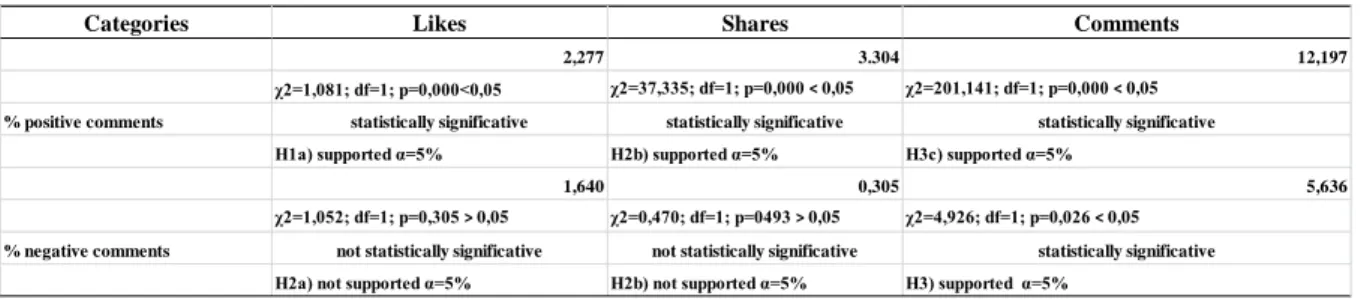
Empirical results obtained from the estimation of the proposed model for engagement over proposed drivers are reported. All results are presented in Table 1.
Table 2 – Estimation Results
Categories Likes Shares Comments
2,277 3.304 12,197
χ2=1,081; df=1; p=0,000˂0,05 χ2=37,335; df=1; p=0,000 ˂ 0,05 χ2=201,141; df=1; p=0,000 ˂ 0,05
% positive comments statistically significative statistically significative statistically significative
H1a) supported α=5% H2b) supported α=5% H3c) supported α=5%
1,640 0,305 5,636
χ2=1,052; df=1; p=0,305 ˃ 0,05 χ2=0,470; df=1; p=0493 ˃ 0,05 χ2=4,926; df=1; p=0,026 ˂ 0,05
% negative comments not statistically significative not statistically significative statistically significative
H2a) not supported α=5% H2b) not supported α=5% H3) supported α=5%
The model for the number of likes is significant as a whole (χ2=3.074, p=0,000˂0,05). The share of positive comments is significant and positively related to the number of likes (Exp(β)=2,277, p=0,000˂0,05), in support of hypothesis H1a). The share of negative comments is not significantly related to the number of likes and we cannot confirm hypothesis H2a).
The model for the number of shares is significant as a whole (χ2=508,681, = 0,000˂0,05). Again the share of positive comments is significant and positively related to the number of shares (Exp(β)=3,304, p=0,000˂0,05), in support of hypothesis H1b). The share of negative comments is not significantly related to the number of shares and we cannot confirm hypothesis H2b).
The model for the number of comments is significant as a whole (χ2=1065,375 = 0,000˂0,05). As before the share of positive comments is significant and positively related to the number of comments (Exp(β)=12,197, p=0,000˂0,05), in support of hypothesis H1c). Contrary to former results, the share of negative comments is significantly related to the number of comments and thus we can confirm hypothesis H3).
By analysing the incidence rate ratio (Exp(β) all of them are greater than one what means that the effect is bigger with comments than with no comments at all, except for the share variable. According to its magnitude the biggest effect on the number of comments is for the positive comments followed by the negative comments.
Discussion and Implications
Our results reveal that brands’ fans are influenced by each other: the share of positive comments to a brand post is associated with an increasing number of likes, shares and comments as well the
share of negative comments results in more comments This offers initial evidence for the multiplier and contagion effect of the comments, which emerges as a possible way to spread eWOM about the brands throughout the fans’ community in a simple yet effective manner.
For managers this is an important finding because it indicates that negative comments are not necessarily bad. Brand fans may feel to be part of the community because they engage in a vivid discussion with both positive and negative arguments.
Limitations and Further Research
This research is subject to some limitations which may provide fruitful avenues for future
research. We have chosen to use eleven brands from six product categories. In addition, we
have included a limited number of branded posts for a period of two years.Future studies may want to use a more comprehensive dataset.
Additionally, we have gathered data from the brand fan pages of one social networking site. It would be interesting to replicate this research for other social networking sites, to see whether the results still hold. Specifically, investigating social networking sites from other countries sheds light on possible cultural differences on social contagion i.e., brand fans influencing each other.
References
BARGER, Vitor, Peltier, James. Social media and consumer engagement: a review and research agenda. Journal of Research in Interactive Marketing, vol. 10, n. 4, 2016, p. 268-287.
CALDER, Bobby, Isaac, Mathew, Malthouse , Edward. How to capture consumer experiences: A context- specific approach to measuring engagement. Journal of Advertising Research, vol. 56, n.1, 2016, p. 1–14.
CHAN, Kimmy Wa; LI, Stella Yiyan. Understanding consumer-to-consumer interactions in virtual communities: The salience of reciprocity. Journal of Business Research, Vol. 63, n. 9, 2010, p. 1033-1040.
CHEUNG, Ronnie.The influence of electronic word-of-mouth on information adoption in online customer communities. Global Economic Review, Vol. 43, n. 1, 2014, p. 42-57.
CVIJIKJ, Irena Pletikosa, Michahelles, Florian. Online engagement factors on Facebook brand pages.
Social Network Analysis and Mining, Vol.3, n. 4, 2013, p. 843-861.
DE VRIES, Lisette, Gensler, Sonja, Leeflang, Peter. Popularity of brand posts on brand fan pages: An investigation of the effects of social media marketing. Journal of interactive marketing, Vol. 26, n. 2, 2012, p. 83-91.
FORTIN, David R.; Dholakia, Ruby Roy. Interactivity and vividness effects on social presence and involvement with a web-based advertisement. Journal of business research, Vol.58, n.3, 2005,p. 387-396.
DE VRIES, Natalie Jane, and Carlson, Jamie. Examining the drivers and brand performance implications of customer engagement with brands in the social media environment. Journal of Brand
Management, Vol 21, n. 6, 2014, p. 495-515.
DEIGHTON, John; KORNFELD, Leora. Interactivity's unanticipated consequences for marketers and marketing. Journal of Interactive Marketing, Vol 23, n.1, 2009, p. 4-10.
HENNIG-THURAU, Thorsten, Malthouse, Edward, Friege, Christian, Gensler, Sonja, Lobschat, Lara, Rangaswamy, Arvind, Skiera, Bernd. The impact of new media on customer relationships.
Journal of service research, Vol 13, n.3, 2010, p. 311 - 330.
KOZINETS, V. Robert. (2011). What is Netnography?. Thousand Oaks: Sage
KOZINETS, V. Robert, de Valck, Kristine, Wojnicki , C. Andrea, Wilner, J.S. Sarah. Networked narratives: Understanding word-of-mouth marketing in online communities. Journal of marketing, Vol. 74, n. 2, 2010, p. 71-89.
LECKIE, Civilai, Nyadzayo, Munyaradzi, Johnson ,Lester. Antecedents of consumer brand engagement and brand loyalty. Journal of Marketing Management, Vol. 32, n.5-6, 2016, p. 558-578.
LIBAI, Barak, Bolton, Ruth, Bügel, Marnix S., de Ruyte, Ko, Götz, Oliver, Risselada, Hans and Stephen, Andrew. Customer-to-customer interactions: broadening the scope of word of mouth research. Journal of service research, Vol. 13, n. 3, 2010, p. 267-282.
MALHOTRA, Arvind; Malhotra, Claudia Kubowicz; SEE, Alan. How to create brand engagement on Facebook. MIT Sloan Management Review,Vol. 54, n.2, 2013, p. 18.
ROHM, Andrew; Kaltcheva, Velitchka D.; Milne, George R.. A mixed-method approach to examining brand-consumer interactions driven by social media. Journal of Research in Interactive