Work environment and accreditation: analysis by mixed
explanatory sequential method
aAmbiente de trabalho e acreditação: análise pelo método misto explanatório sequencial
Ambiente de trabajo y acreditación: análisis por el método mixto explanatório secuencial
João Lucas Campos de Oliveira1 Verusca Soares de Souza2 Ana Carolina Simões Pereira2 Maria do Carmo Fernandez Lourenço Haddad3 Sonia Silva Marcon2 Laura Misue Matsuda2
1. Universidade Federal de Mato Grosso. Cuiabá, MT, Brasil.
2. Universidade Estadual de Maringá. Maringá, PR, Brasil.
3. Universidade Estadual de Londrina. Londrina, PR, Brasil.
Corresponding author: João Lucas Campos de Oliveira.
E-mail: [email protected]
Submitted on 12/02/2017. Accepted on 08/03/2018.
DOI: 10.1590/2177-9465-EAN-2017-0379
A
bstrActObjective: To analyze the - possible - interference of Accreditation in the work environment of the nursing team. Method: Mixed
explanatory sequential method study. The first (preponderant) quantitative phase of the research was the application of the Brazilian version of Nursing Work Index Revised (B-NWI-R) to a representative sample (n = 226) of nursing workers from three hospitals, one of them being certificate of excellence by national Accreditation and two unsealed hospitals. After descriptive analysis of the data, it was possible to connect the information, which culminated in the data collection, through interviews (n = 39), of the second (qualitative) stage of the mixed research. The final analysis included the application of inferential statistics and qualitative analysis by the Collective Subject Discourse (DSC), connected in the B-NWI-R dimensions. Results: There was no statistically
significant association in the comparisons. However, the results presented better in the certified hospital, ratifying the DSC of
this institution. Conclusion: Accreditation did not significantly interfere with nursing staff perception of the work environment.
Keywords: Hospital Accreditation; Working Environment; Nursing, Team; Quality Management; Intensive Care Units.
r
esumoObjetivo: Analisar as - possíveis - interferências da Acreditação no ambiente de trabalho da equipe de enfermagem. Método: Estudo de método misto explanatório sequencial. A primeira fase (preponderante) quantitativa da pesquisa ocorreu pela aplicação
da versão brasileira do Nursing Work Index - Revised (B-NWI-R) a uma amostra representativa (n = 226) de trabalhadores de
enfermagem de três hospitais, sendo um deles certificado em nível de excelência pela Acreditação nacional e dois hospitais não selados. Após análise descritiva dos dados, viabilizou-se a conexão das informações, que culminou na coleta de dados, por entrevistas (n = 39), da segunda etapa (qualitativa) da pesquisa mista. A análise final compreendeu a aplicação de estatística inferencial e a análise qualitativa pelo Discurso do Sujeito Coletivo (DSC), conectada nas dimensões do B-NWI-R. Resultados: Não houve associação estatística significativa nas comparações. Porém, os resultados se apresentaram melhores no hospital certificado, ratificando o DSC desta instituição. Conclusão: A Acreditação não interferiu significativamente na percepção da
equipe de enfermagem sobre o ambiente de trabalho.
Palavras-chave: Acreditação Hospitalar; Ambiente de Trabalho; Equipe de Enfermagem; Gestão da Qualidade; Unidades de Terapia
Intensiva.
r
esumenObjetivo: Analizar las - posibles - interferencias de la Acreditación en el ambiente de trabajo del equipo de enfermeira. Método: Estudio de método mixto explanatório secuencial. La primera fase (preponderante) cuantitativa de la investigación se dio por la aplicación de la versión brasileña del Nursing Work Index - Revised (B-NWI-R) a una muestra representante (n = 226) de
trabajadores de enfermería de tres hospitales, siendo uno de ellos certificado por la institución Acreditación nacional a nivel de excelencia y dos hospitales no sellados. Después del análisis descriptivo de los datos, se viabilizó la conexión de las informaciones, que culminó en la recolección de datos, por entrevistas (n = 39), de la segunda etapa (cualitativa) de la investigación mixta. El análisis final comprendió aplicación de estadística inferencial y análisis cualitativo por el Discurso del Sujeto Colectivo (DSC), conectada en las dimensiones del B-NWI-R. Resultados: No hubo asociación estadística significativa en las comparaciones. Sin embargo, los resultados se presentaron mejores en el hospital certificado, ratificando el DSC de esta institución. Conclusión: La Acreditación no interfirió significativamente en la percepción del equipo de enfermería sobre el ambiente de trabajo.
Palabras clave: Acreditación de Hospitales; Ambiente de Trabajo; Grupo de Enfermería; Gestión de la Calidad; Unidades de Cuidados
Intensivos.
INTRODUCTION
The work process in nursing, specially in hospitals, involve
daily complex decisions and attitutes that are about the
viabili-zation of care. Thus, it's evident the relevance of improvement
of favorable envirornments to the execution of work actions in
the nursing team, as well as the Professional perception about their own work, once such fact tends to reverberate in the
produced care.1-4
There are findings that, the better the work environment for professional nursing practice at the technical level, the lower are the burnout rates, the intention to leave the job, and; the higher
the level of job satisfaction.1 In addition, the work environment,
evaluated positively by nursing workers, is related to: the approval of quality of care by professionals; the favorable trend in qualified
and safe care measured by concrete measures such as
indica-tors; and positive perception about patient safety attitudes.3,5,6
The interaction quality and safety in the care with the
nursing staff's work envirornment have been highlighted around the world, due to relevance already acepted by the Institute Of Medicine (IOM)7 that the labor environment influences
the quality of care produced. This assumption reinforces the
recent finding that there is a direct association between "poor"
environments - or unfavorable to professional nursing practice - and the increased risk of death among hospitalized patients in
the United States of America.8
Quality of care as a direct or indirect product of the work envi
-rornment in health and nursing, remits to the need to improve pro -fessional practice scenery based on management strategies.7-9
In this scope, Acreditation emerges as a management system that, in theory, is a systematic, strategic and directive means for systemic improvements in the quality of the health work product, which, within the overall understanding of Accreditation, also
has repercussions on the environment of work of the member organizations.10,11
Accreditation has well defined methods, which are disseminated to all organizational spheres, which are periodically
evaluated in order to generate the mechanism of continuous and
successful improvement, resulting in quality certification.10,11
Despite the possible competitive advantage derived from
Accreditation certification, this system influences health work - more dynamic than the qualifying seal -, to the example
of changes in the work process that are linked to the basic
principles of strategic management for quality, such as the use
of management improvement tools.12
It should be highlighted that research focused on the relationship between Accreditation and work environment
perceived/evaluated by nursing is not unprecedented in Brazil.13
However, there is only an investigation of the scope of this study,
which was carried out only in public hospitals in the state of
São Paulo, and therefore it is counterproductive to attribute full
knowledge of the relationship between Accreditation and work environment.
To explore the best or greatest knowledge about - possible -
interference of Accreditation in the work envirornment is relevant, specially in the brazilian context, where the system of manage
-ment of quality, still in phase of expansion in the country had it's
implantation in less than two decades.11 Therefore, studies with
the enphasis in the impact knowledge or system influence of tariff management, in the different spheres of health work, can contribute to adjust it to its real purposes, strictly aligned with health quality, which undoubtedly includes the work environment
perceived by nursing.
Once the inclination to investigate the problem is justified, it is questioned whether: is there interference of Accreditation in
the perception of the nursing team about the work environment?
Therefore, in order to answer this question, this study's aim was
to analyze the - possible - interference of Accreditation in the work environment of the nursing team.
METHOD
Cross-sectional study based on the mixed method of
sequential explanatory drawing. In this methodological design,
mixing or combining data is enabled by the connection
procedure, in which the data analysis is the first phase of the study - which has a higher weight and it's of quantitative approach (QUAN) - connects itself the data collection of qualitative step (Qual), which is the secondary phase on attribution of weight
of this nature in a mix method study.14 A typical exemple of this
modality of investigation is the employment of interviews to
deepen findings of a survey research.15
The research happened on all Intensive Care Units (ICU) of three hospitals located in the countryside of Paraná, Brazil. The selection of fields answered to the following procedure: firstly, search on National Organization Accreditation (ONA)'s online page, selecting a certified hospital (AH) in greater level (Accreditated with Excelence) by ONA's methodology. After AH's selection, that it was private, a new search was made in the National Register of Health Establishments of two more hospitals, one of them private not certified (HB) and the third one, public, equally not endowed with Accreditation certification (HC). Selection criteria for the places were: to be a general hospital located in Paraná state; to have beds for intensive care and, in the AH case, to have Accreditation certification for a longer time, disposed in ONA's eletronic site. Already in the cases of the places for comparison, were selected institutions not certified by the Accreditation; with the same size of AH; distant in radius of maximum 150 kilometers; holders of ICU beds; and each one with a different characteristic of care, that is, a private hospital and
another public. The latter procedure was employed to increase the variability of comparisons.
ICUs were delimited as sites of investigation in the three hospitals due to the lower chance of differences in the type of service provided and, therefore, reduction in the interference
between the institutions was established to reduce the possibility of a wide cultural contrast in the work process of the nursing teams.
In the first phase of the study (QUAN), nursing professionals that worked in ICUs from the three services participated. To define the sample, at each site, a representative sample of finite populations was calculated, that is, on the total (AH = 107; HB = 80; e HC = 117) of workers in the units, whose amount was requested to the nursing services of each organization. Stratified samples from each hospital were estimated based on 95% coverage and 5% error estimate.
In the stratified sampling, the segregation of professionals by hierarchical level (nurses and mid-level workers) was considered; and also in the stratification of ICUs in units for adult care (general or specialized - ICU-A) and child care sectors (pediatric and neonatal-ICU-I).
Once the stratified samples were dimensioned, the data collection of the first phase (QUAN) of the study took place between December 2016 and March 2017. In the collection, the nursing professionals of all ICUs and all shifts of the three hospitals. After the approach, it was verified if each participant
met the criterion of inclusion of working in the sector for at least six months.
Respecting the eligibility, the worker was invited to participate in the study, at which point he explained about the purpose of the research and his form of driving. In case of acceptance,
the participant signed the Term of Free and Informed Consent
(TCLE), which was also signed in two ways of equal content by
the researcher.
The collection of the first stage (QUAN) was carried out by
the application of a form for sociodemographic and labor char-acterization of the participants. To evaluate the perception about
the work environment, the Brazilian version of the Nursing Work Index - Revised (B-NWI-R) was used, which was validated in the
national context between nurses and nursing technicians.16,1 First
step collection coleta happened until each stratified sample filling. B-NWI-R is a measure scale in Likert format. In its
employment, 15 items are staggered in four points of choice of agreement and are distributed in four subscales: Autonomy (five items); Relationship between doctors and nurses (three items); Control over the environment (seven items); and Organizational Support, with 10 items derived from the mentioned subscales.16
The autonomy subscale represents the freedom/power that the professional has to solve problems related to nursing care in
his work environment, and control refers to how the professional
controls the practices of nursing interest in the work. The subscale relationship between doctors and nurses refers to mutual
professional respect between the working classes in question,
aiming at better communication at work and the achievement
of the common goal, ie, patient care. In turn, the organizational
support subscale focuses on situations in which the organization
(mainly represented by managers) supports nursing workers, so
that they develop their professional practice.16
After the first phase of the survey (QUAN) was collected, a descriptive statistical analysis of the data was performed, using measures of central tendency, dispersion and proportion. This
procedure enabled the connection provided in the mixed study of sequential explanatory design.14
Regarding the appreciation of the work environment
measured by the B-NWI-R, the lower the scores on the items and subscales of the instrument, the better the perception about the work environment, which is more favorable to professional
nursing practice.16 Therefore, the median (2,5) was the evaluative
cut-off point.
With the points of interest raised in the data connection,
it was decided to sequence the data collection of the second
phase (Qual), using all B-NWI-R domains/subscales, since
there was similarity in the analysis between the sites surveyed.
In this way, the "Qual" step was used to provide a more in-depth
understanding of the statistical data of these domains in all
hospitals, followed by a joint assessment of the "QUAN" and "Qual".
The sequenced data collection (Qual) was carried out in June 2017, with the participation of professionals from the same sec
-tors and hospitals investigated, as long as they had participated in the first phase (QUAN). These participants were approached for convenience and, after acceptance, also formalized via the ICF, the qualitative data were collected through a focused interview, directly respecting the nuances evaluated by the B-NWI-R. The number of interviews was defined by the successive repetition of the participants' statements, in each hospital, separately.
The final analysis of the data was mediated by the interpretive junction of the inferential statistics and the qualitative analysis,
and this product was sequenced from the primary descriptive
understanding. For the quantitative analyzes, the tabulated data were treated in the software Statistical Package for Social Sciences, version 21 (SPSS-21). Before the analytical procedure itself, the data were normality by means of the
Kolmogorov-Smirnov test.
Considering the refuted normality, the data were submitted
to non-parametric inferential analyzes between two pairs of
hospitals/populations, considering the factor "Accreditation" (AH x HB; HA x HC) and also in the total analysis of the three groups.
The Mann-Whitney test was used in the comparison of two
groups and Kruskal-Wallis in the analysis of the three groups. In all inferential analyzes, statistical significance was considered at 5%, when p-value ≤ 0.05. In addition, the reliability of the B-NWI-R and its subscales was measured by Cronbach's Alpha, delimiting it when the value was ≥ 0.7.17 In case of valuation lower than the
established point, there would be no data recollection; However,
in the general analyzes of each hospital and the sample as a
whole, reliability was confirmed.
statements, and to describe the work environment perceived
by nursing professionals as if each research site represented a
"collective singularity".18
In this mixed study, the B-NWI-R domains were seized in the DSC for the three services. Thus, in the description of DSC, the general averages of each hospital compared to B-NWI-R were restated, which is in line with the "technique" known as a joint display in mixed studies, which means the joint illustrative
presentation of quantitative and qualitative results.19
All ethical requirements involving human research have been
respected. Therefore, the research project was submitted and
approved by an institutional ethics committee and is accredited
nationally by the CAAE protocol: 58571216.4.0000.0104.
RESULTS
The first phase (QUAN) of the study involved the partici
-pation of 226 (100%) full-time nursing workers in the ICUs of
the three hospitals. The distribution of participants among the
research sites was: AH (n = 82; 36.2%); HB (n = 59, 26.2%); and HC (n = 85, 37.6%). Of the total, there were 56 (24.8%) nurses and 170 (75.2%) mid-level professionals. Of these, five were
nursing assistants.
The highest proportion (n = 124, 55.2%) of the participants were married, followed by unmarried (n = 67, 29.7%), divorced (n = 28, 12.5%) and widowed 2.6%). One participant did not declare
marital status. Also, from the total, those who had children (n = 147; 65.3%) prevailed over those who did not (n = 78; 34.7%),
and again one did not state whether they had children.
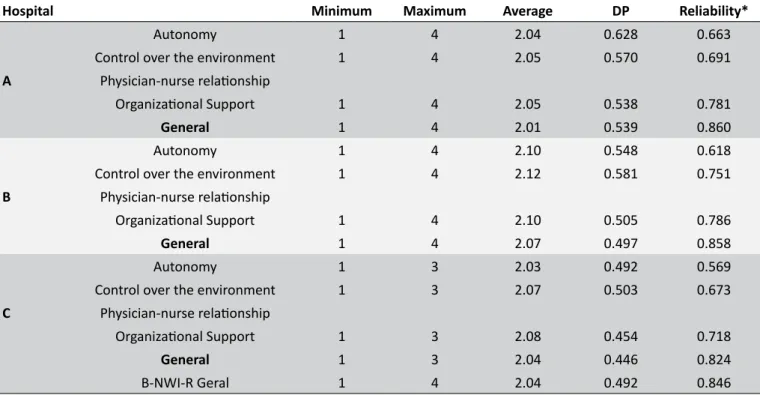
The mean age of the participants in each hospital was: HA = 36 (± 8.6); HB = 30 (± 8.4) e; HC = 39 (± 8). The mean values of time in the ICU, in years, were: 6.3 (± 4.7); 3.4 (± 3.7) e; 7.4 (± 5.4). On the appreciation of the work environment perceived by the nursing team, Table 1 illustrates the descriptive findings, in addition to the result of the reliability test of the B-NWI-R scale and its subscales, relating them according to each hospital.
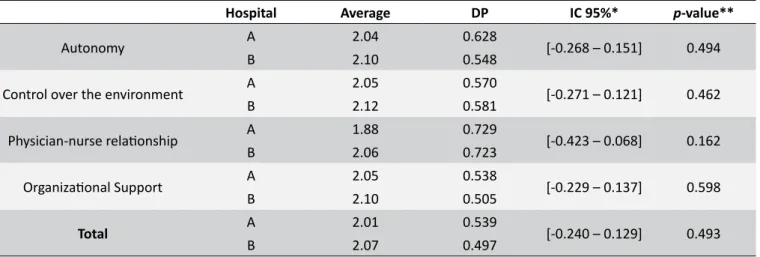
Table 2 shows the comparison of the working environment domains compared between the Accredited hospital (AH) and the non-certified private hospital (HB).
Table 3 shows the comparison similar to the previous one; however, the "Accreditation" factor is contrasted with the
perception about the working environment of the professionals
crowded in the non-certified public hospital.
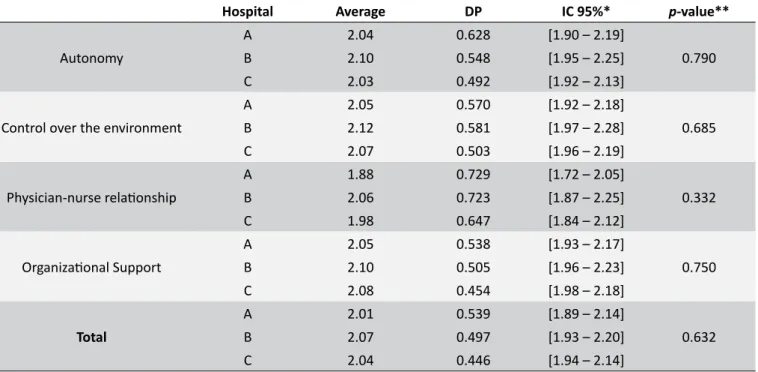
Table 4 presents data from the comparative analysis of the
three groups. That is, accredited hospital (AH), private non-certified (HB) and public without certification (HC).
The qualitative step of the sequential explanatory study
had 39 interviews (AH = 14, HB = 10; HC = 15) performed with professionals who participated in the first phase (QUAN). Chart 1 summarizes the DSC listed in each hospital, respecting the B-NWI-R domain approach in first-stage sequencing (QUAN)
of the mixed study.
Table 1.
Descriptive data on the perception of the work environment by the nursing team and reliability test of the
Brazilian version of the Nursing Work Index Revised (B-NWI-R) scale, by hospital (n = 226). Paraná, Brazil, 2017.
Hospital
Minimum
Maximum
Average
DP
Reliability*
A
Autonomy
1
4
2.04
0.628
0.663
Control over the environment
1
4
2.05
0.570
0.691
Physician-nurse relationship
Organizational Support
1
4
2.05
0.538
0.781
General
1
4
2.01
0.539
0.860
B
Autonomy
1
4
2.10
0.548
0.618
Control over the environment
1
4
2.12
0.581
0.751
Physician-nurse relationship
Organizational Support
1
4
2.10
0.505
0.786
General
1
4
2.07
0.497
0.858
C
Autonomy
1
3
2.03
0.492
0.569
Control over the environment
1
3
2.07
0.503
0.673
Physician-nurse relationship
Organizational Support
1
3
2.08
0.454
0.718
General
1
3
2.04
0.446
0.824
B-NWI-R Geral
1
4
2.04
0.492
0.846
Table 2.
Comparison of perceived work environment domains among nursing professionals from a hospital accredited
by Accreditation (AH) and non-certified private hospital (HB). (n = 141). Paraná, Brasil, 2017.
Hospital
Average
DP
IC 95%*
p
-value**
Autonomy
A
2.04
0.628
[-0.268 – 0.151]
0.494
B
2.10
0.548
Control over the environment
A
2.05
0.570
[-0.271 – 0.121]
0.462
B
2.12
0.581
Physician-nurse relationship
A
1.88
0.729
[-0.423 – 0.068]
0.162
B
2.06
0.723
Organizational Support
A
2.05
0.538
[-0.229 – 0.137]
0.598
B
2.10
0.505
Total
A
2.01
0.539
[-0.240 – 0.129]
0.493
B
2.07
0.497
* Confidence interval between differences; ** Mann-Whitney non-parametric test.
Table 3.
Comparison of perceived work environment domains among nursing professionals from a hospital accredited
by Accreditation (AH) and non-certified public hospital (HC). (n = 167). Paraná, Brazil, 2017.
Hospital
Average
DP
IC 95%*
p
-value**
Autonomy
A
2.04
0.628
[-0.160 – 0.194]
0.852
C
2.03
0.492
Control over the environment
A
2.05
0.570
[-0.193 – 0.140]
0.752
C
2.07
0.503
Physician-nurse relationship
A
1.88
0.729
[-0.307 – 0.115]
0.372
C
1.98
0.647
Organizational Support
A
2.05
0.538
[-0.183 – 0.131]
0.745
C
2.08
0.454
Total
A
2.01
0.539
[-0.184 – 0.130]
0.736
C
2.04
0.446
* Confidence interval between differences; ** Mann-Whitney non-parametric test.
DISCUSSION
Nursing professionals young adults sample ratified, by the majority of subscales by hospitals and in general, the reliability of the use of B-NWI-R. Another aspect that can leverage the reliable
position of responses is the high performance time in all hospitals.
In other words, the workers who know the labor dynamics of their service, in fact, condensed reliable perception, measurable, via an applied instrument, that is, the B-NWI-R measured what was
proposed.
The small amount of nursing assistants among the
participants is a positive result because, according to current regulations for the operation of the ICU, it is possible to note
the mention of the nursing technician when referring to nursing professionals.20 There is a possibility that nursing assistants
have been trained throughout the professional career; however,
the permanence of this category, in critical areas such as ICU,
is questionable.
Concerning the perception about the work environment,
the professionals working in the three services did not have
contrasting differences measured by scores. This is reinforced by the critical observation of DSCs, which, in general, presented similar "content". Likewise, in all descriptive quantitative analyzes,
we can see the tendency of professionals to assign a positive
evaluation to the work environment. In this respect, the accredited
hospital obtained a better score and the private hospital not
certified, the worst.
It should be noted that in the three groups of workers the
autonomy dimension evaluated by the B-NWI-R did not reach the reliability attributed to the scale responses. Possibly, this
occurred because nurses and mid-level professionals may have
Table 4.
Comparison of the domains of the work environment perceived by the three groups of nursing professionals.
(n = 226). Paraná, Brazil, 2017.
Hospital
Average
DP
IC 95%*
p
-value**
Autonomy
A
2.04
0.628
[1.90 – 2.19]
0.790
B
2.10
0.548
[1.95 – 2.25]
C
2.03
0.492
[1.92 – 2.13]
Control over the environment
A
2.05
0.570
[1.92 – 2.18]
0.685
B
2.12
0.581
[1.97 – 2.28]
C
2.07
0.503
[1.96 – 2.19]
Physician-nurse relationship
A
1.88
0.729
[1.72 – 2.05]
0.332
B
2.06
0.723
[1.87 – 2.25]
C
1.98
0.647
[1.84 – 2.12]
Organizational Support
A
2.05
0.538
[1.93 – 2.17]
0.750
B
2.10
0.505
[1.96 – 2.23]
C
2.08
0.454
[1.98 – 2.18]
Total
A
2.01
0.539
[1.89 – 2.14]
0.632
B
2.07
0.497
[1.93 – 2.20]
C
2.04
0.446
[1.94 – 2.14]
* Confidence interval between differences; ** Non-parametric Kruskal-Wallis test.
the professional definition of each working class is different - and thus demands an unequal distribution of power, which may be influenced by the hierarchical division of Brazilian nursing.
The averages of the autonomy domain attributed to the
employees of the hospital certified by Acreditação and the non-certified public hospital were similar to that of another
study developed with nurses working in the emergency unit of
a public university hospital in the south of Brazil, determined in 2,05, and a study conducted with 162 nurses from the city of São Paulo, identified in 2,3.21,9 The same average values were
worse than a survey with a sample of 114 nursing professionals
from the interior of São Paulo, who obtained an average value of 1,936, and in a study of 202 professionals from the Magnet®
organizations in the United States, who obtained an average value of 1.35 for autonomy in the work environment.22 All the
studies cited used B-NWI-R as a means of measuring the
phenomenon.
Among the nurses, it is highlighted that the leadership, whose competence is required and expected for this category, tends to be defining the work environment that the team inserts.23
In addition to this, governance - management practice involving the nurse's leadership exercise - has already been scored as
positive when establishing professional environments favorable
to professional performance, as governance falls under rational
strategies of relational and instrumental management that are inevitably immersed in the work environment.24 Although this
relationship with the literature is important, it is worth mentioning
that the study was developed with the participation of the entire
nursing team in the ICUs of the three hospitals, and not only with nurses, as seen in another recent study.25
The previous interpretation reinforces the worst perceived
autonomy among the professionals of the non-certified private hospital, as well as the general measurement of the work environment by the subjects of this place. To a certain extent, this finding refers to a favorable interpretation of Accreditation
about the work environment of the nursing team when compared
to private hospitals, since the positive difference between the certified hospital was greater in the comparison of data between institutions of this same type of care, than when comparing the private organization accredited to the public not certified.
Another aspect that reaffirms the positive perspective of Acreditation as a mediator of the environment conducive
to nursing practice is the fact mentioned in the literature,
which points out nurses as a driver of improvements in the
work process in certified hospitals, since their performance, based on articulated care knowledge with the management,
is a protagonist in the challenging and continuous work of Accreditation.26 In contrast, the preponderant data of this mixed
research, which are numerical, associated to the literature, to the
example of a study developed in the interior of the state of São
Paulo, also using the B-NWI-R, accuse that Accreditation does
not interfere in the practice environment of nursing.13
Chart 1.
Discourses of the Collective Subject (DSC) and general averages related to the work environment and its
domains, perceived by nursing professionals, by hospital. Paraná, Brazil, 2017.
AH (2,01)
HB (2,07)
HC (2,04)
The nurse is in direct supervision of
the team; then, with regard to patient
care, together with the doctor, are
the highest authorities here. The
nursing technician cannot exchange
dressing for central venous catheter.
The nurse has autonomy. So much
do we need to talk to her.
[superviser
nurse]
to then move forward. There is
control, even in caring. But you have
to impose yourself and show that you
have knowledge. I make decisions for
the knowledge I have. There are things
that are discussed and others that are
decided, and we know it later. Also,
physicians that are here have a little
more open minded. With the callers
the dialogue is open, it is possible to
have direct contact. In four years of
work, I never have a problem. It could
improve, but we get along with the
doctors. With the management we are
free to speak, to expose. The manager
is always available. Every time I needed
it, I was very well received. I think the
relationship with management is good.
For example, the head of the doctors,
she is sensational. As I said, we suffer a
lot from management, there is a lot of
pressure.
At least in the morning, we can solve
everything calmly; but in the afternoon
it is not the same way. I think it does
not have autonomy, I think nursing is
a doctor's doormat. But I've worked
in other hospitals that have a doctor
who chooses which patient is going to
stay with the nursing technician. Not
here. On the contrary, they [doctors]
give full support to the people. I quietly
discuss with the doctor about the
medication that I think could help the
patient. I think the nurse has a good
control, that part is quieter. The nurses
question the doctors about the bladder
catheters and, in many cases, they are
withdrawn by the nurse's decision.
With the doctors here our relationship
is quiet. I've never had any problems,
always have a good conversation, a
good understanding. With the boss,
we have a good relationship. It is more
open to negotiation. You have respect.
But sometimes we feel very charged,
something that does not happen in
other shifts. I get along very well with
the management. However, it could be
more flexible, really demanding what is
needed.
We have a bit of autonomy, even as
nursing technician. Nurses listen a
lot, maybe for experience. However,
there are still many things that it is the
doctor who solves. I think nursing has
control. We have here in the hospital
the Systematization of Nursing Care.
This gave autonomy for the nurse to
prescribe and also for the technician
to perform. Often it depends a lot on
the nurse, right? Because he makes a
point of his autonomy in the sector. The
nurse may make the decision to pass
a catheter, for example, and usually in
other institutions, the nurse will only do
this if the doctor prescribes. There's a
doctor who does not like you to speak,
give an opinion. But in general, they
are all very accessible. I realize a great
relationship with the doctors. First,
because we have been living together
for a long time. Of course, there are
doctors and doctors, but what stands
out is this good relationship. We are
wide open. When we come with a
proposal, it is very accessible. The
manager is an excellent professional,
always interacting, making meetings,
etc. If she can help, she helps.
over the nurse's practice in AH. It is believed that this reality reinforces studying mixed method as innovator, and, mainly, embracing interpretation of scientific results.
It is prudent to reinforce that no inferential statistical analysis
has resulted in significance, either in the comparisons made between pairs of professional groups, as well as in the joint
assessment of the working environment of the three groups of workers. This data is in line with the results of a research that
pointed out that it did not identify significant differences in the appreciation of the nursing work environment of public hospitals, even one of them having the certification seal.13 Another study
developed in the south of Brazil, with nurses in management and care positions, also did not point out statistical differences
in the perception of working environment in the comparison
between groups,25 fact that, despite going beyond Accreditation
as a measurement factor, it makes an interesting comparison of the findings.
Summing up the literature prior to the global findings of this research - that is, considering its qualitative dimension as contri
-bution to the measurements used -, it is inferred that, in the bulge of the investigated institutions, the Acreditation did not interfere
in the work environment perceived by the nursing team.
It is agreed with prior research that the appreciation of the work environment is most likely to be interfered with in addition to the Accreditation quality seal.13 In this perspective, it is valid to say
that, although the work environment is a possible measurement factor, to the viability example by B-NWI-R, this is a subjective
aspect that may have deep dimensions to be considered in
professional perception, such as satisfaction with work, life experiences, and even interpersonal relationships in the work environment. Despite this, the sequenced qualitative dimension
Refuting the subjective interpretation of the work
environ-ment, Acreditação is a management system that relies on systemic organizational evaluation, based on standards listed in the logic of its integral care, that is, "all or nothing".11 In this
perspective, this study suggests to the Accreditation manage
-ment entities, as well as to the accredited accrediting institutions,
that include in a more forceful way the appreciation of labor
relations in the health environment, because there is evidence that the work environment is related intimately with the qualified
and safe care.7,5,8
In health work relationships, overcoming "mere" tasks and providing assistance may not be sufficient for good working
relationships that culminate in ethical and teamwork.27 In this
sense, the findings related to work relationships between
physicians and nursing professionals were another positive facet that surrounded the work environment perceived by the teams
of the three hospitals, with quantitative emphasis (in descriptive terms) discrete for the organization certified by Accreditation.
The relationship between the nursing and medical teams
certainly intervenes in the environment of professional practice, especially in the ICU, where the doctors are, together with the nursing team, in daily shifts. In addition, organizational support, which also unfolds in working relationships between management and subordinates, was also more positive among
the group of professionals of this hospital.
In Accreditation at the level of excellence, as in the case of AH, it is required its proof of managerial maturity, mediated by
rational strategies strictly aligned with the continuously evaluated
results. Therefore, in the cyclical and systematic management,
towards quality in the various organizational spheres.11,10 Cyclical management procedure referred to can be facilitated in terms of the positive organizational support to the
practice of the workers in the care environment; that is, in the support of managers to those responsible for direct care, whose fact was observed in particular in the DSC of AH and HC.
It is considered that the favorable organizational support, perceived by the professionals in the accredited hospital, is a factor that, indirectly, can be translated as managerial commitment to the subordinates. This, despite reaffirming
Accreditation as a management system based on strategic
ability, includes not only the rational use of management tools for the improvement of care, but also the development of relational
skills for managerial action.10
As limitations of this research, it is pointed out the impos
-sibility of generalizing its results and the non inclusion of differ
-ent levels of Accreditation certification in the comparisons. In spite of this, the study is innovative, both because it deals with
the still vague knowledge about Accreditation interferences in
health work, but also - and perhaps mainly - when approaching the theme in a global perspective, by the use of mixed methods.
CONCLUSION
Groups of nursing workers in the hospitals surveyed favorably perceive their professional practice environments. Even with more positive evaluations, in the quantitative dimension of the study, there was no significant statistical difference in the positioning of the Accreditation factor on the work environment, either in the comparisons between pairs, as well as in the evaluation of the three condensed groups. In addition, the qualitative sequencing of the mixed explanatory study ratified
equity among the three sites in the perception about the nursing work environment.
It is concluded that the Accreditation did not significantly
interfere in the nursing workers’ perception about your work
environment. Despite this, the results obtained through the mixed
approach - whose main purpose is to achieve higher levels of
evidence - suggest that the practice environment in the certified service, although not significantly different, was better.
FINANCING
Doctorate scholarship granted by the Coordination of
Improvement of Higher Level Personnel (CAPES) to the research's first author, in the period May-July 2017.
REFERENCES
1. Marcelino CF, Alves DFS, Gasparino RC, Guirardello EB. Validation of the nursing index-revised among nursing aides and technicians. Acta Paul Enferm [Internet]. 2014 Aug; [cited 2017 Apr 23]; 27(4):305-10. Available from: http://www.scielo.br/pdf/ape/v27n4/en_1982-0194-ape-027-004-0305.pdf. DOI: 10.1590/1982-0194201400052 2. Oliveira EM, Barbosa RL, Andolhe R, Eiras FR, Padilha KG. Nursing
practice environment and work satisfaction in critical units. Rev Bras Enferm [Internet]. 2017 Jan/Feb; [cited 2017 Apr 23]; 70(1):73-80. Available from: http://www.scielo.br/pdf/reben/v70n1/en_0034-7167-reben-70-01-0079.pdf. DOI: 10.1590/0034-7167-2016-0211 3. Rochefort CM, Clarke SP. Nurses' work environments, care rationing, job
outcomes, and quality of care on neonatal units. J Adv Nurs [Internet]. 2010 Oct; [cited 2017 Apr 22]; 66(10):2213-24. Available from: http:// onlinelibrary.wiley.com/doi/10.1111/j.1365-2648.2010.05376.x/pdf. DOI: 10.1111/j.1365-2648.2010.05376.x
4. Ma C, Olds DM, Dunton NE. Nurse work environment and quality of care by unit types: A cross-sectional study. Int J Nurs Stud [Internet]. 2015 Oct; [cited 2018 Feb 10]; 52(10):1565-72. Available from: https://www.ncbi.nlm.nih.gov/pubmed/26166148. DOI: 10.1016/j. ijnurstu.2015.05.011
5. Alves DFSA, Guirardello EB. Nursing work environment, patient safety and quality of care in pediatric hospital. Rev Gaúcha Enferm [Internet]. 2016 Jun; [cited 2017 Apr 20]; 37(2):e58817. Available from: http://www.scielo.br/pdf/rgenf/v37n2/en_0102-6933-rgenf-1983-144720160258817.pdf. DOI: 10.1590/1983-1447.2016.02.58817
7. Institute of Medicina (US). Keeping Patients Safe: Transforming the Work Environment of Nurses. Washington (DC): National Academies Press; 2004.
8. Olds DM, Aiken LH, Cimiotti JP, Lake ET. Association of nurse work environment and safety climate on patient mortality: A cross-sectional study. Int J Nurs Stud [Internet]. 2017 Sep; [cited 2017 Apr 20]; 74:155-61. Available from: http://www.journalofnursingstudies.com/article/ S0020-7489(17)30129-3/pdf. DOI: 10.1016/j.ijnurstu.2017.06.004 9. Maurício LFS, Okuno MFP, Campanharo CRV, Lopes MCBT, Belasco
AGS, Batista REA. Professional nursing practice in critical units: assessment of work environment characteristics. Rev Latino Am Enferm. [Internet]. 2017; [cited 2017 Apr 21]; 25:e2854. Available from: http://www.scielo.br/pdf/rlae/v25/0104-1169-rlae-25-e2854.pdf. DOI: 10.1590/1518-8345.1424.2854
10. Oliveira JLC, Matsuda LM. Benefits and difficulties in the implementation of hospital accreditation: The voice of quality managers. Esc Anna Nery [Internet]. 2016 Jan/Mar; [cited 2017 Apr 20]; 20(1):63-9. Available from: http://www.scielo.br/pdf/ean/v20n1/en_1414-8145-ean-20-01-0063.pdf. DOI: 10.5935/1414-8145.20160009
11. Organização Nacional de Acreditação (BR). Manual das organizações prestadoras de serviços de saúde. Brasília (DF): Organização Nacional de Acreditação; 2014.
12. Oliveira JLC, Matsuda LM. Disqualification of certification by hospital accreditation: perceptions of professional staff. Texto Contexto Enferm [Internet]. 2016 Apr; [cited 2017 Apr 20]; 25(1):e4430014. Available from: http://www.scielo.br/pdf/tce/v25n1/0104-0707-tce-25-01-4430014.pdf. DOI: 10.1590/0104-07072016004430014
13. Oliveira PB, Spiri WC, Acqua MQD, Mondini CCSD. Comparasion between the accredited and non-accredited public hospital working environments. Acta Paul Enferm [Internet] 2016 Jan/Fev; [cited 2017 Apr 21]; 29(1):53-9. Available from: http://www.scielo.br/pdf/ape/ v29n1/en_1982-0194-ape-29-01-0053.pdf. DOI: 10.1590/1982- 0194201600008
14. Fetters MD, Curry LA, Creswell JW. Achieving Integration in Mixed Methods Designs-Principles and Practices. Health Serv Res [Internet]. 2013 Oct; [cited 2017 Apr 21]; 48(6 Pt 2):2134-56. Available from: https://www.ncbi.nlm.nih.gov/pubmed/24279835. DOI: 10.1111/1475-6773.12117
15. Paranhos R, Figueiredo Filho DB, Rocha EC, Silva Júnior JA, Freitas D. Uma introdução aos métodos mistos. Sociologias (Porto Alegre) [Internet]. 2016 May/Aug; [cited 2017 Apr 20]; 18(42):384-411. Available from: http://www.scielo.br/pdf/soc/v18n42/1517-4522-soc-18-42-00384. pdf. DOI: 10.1590/15174522-018004221
16. Gasparino RC, Guirardello EB. Translation and cross-cultural adaptation of the "nursing work index" - revised" into Brazilian portuguese. Acta Paul Enferm [Internet]. 2009; [cited 2017 Apr 20]; 22(3):281-7. Available from: http://www.scielo.br/pdf/ape/v22n3/en_a07v22n3.pdf. DOI: 10.1590/ S0103-21002009000300007
17. Tavakol M, Dennick R. Making sense of Cronbach's alpha. Int J Med Educ [Internet]. 2011; [cited 2017 Apr 21]; 2:53-5. Available from: https:// www.ncbi.nlm.nih.gov/pmc/articles/PMC4205511/pdf/ijme-2-53.pdf. DOI: 10.5116/ijme.4dfb.8dfd
18. Lefevre F, Lefevre AMC, Marques MCC. Discourse of the collective subject, complexity and self-organization. Ciênc Saúde Coletiva. [Internet]. 2009 Jul/ Aug; [cited 2017 Apr 20]; 14(4):1193-204. Available from: http://www.sci -elo.br/scielo.php?script=sci_arttext&pid=S1413-81232009000400025. DOI: 10.1590/S1413-81232009000400025
19. Guetterman TC, Fetters MD, Creswell JW. Integrating quantitative and qualitative results in health science mixed methods research through joint displays. Ann Fam Med [Internet]. 2015 Nov; [cited 2017 Apr 20]; 13(6):554-61. Available from: http://www.annfammed.org/ content/13/6/554.long. DOI: 10.1370/afm.1865
20. Ministério da Saúde (BR). Agência Nacional de Vigilância Sanitária. Resolução - RDC Nº 26 de 11 de maio de 2012. Altera a Resolução RDC n.º 07, de 24 de fevereiro de 2010, que dispõe sobre os requisitos mínimos para funcionamento de unidades de terapia intensiva e dá outras providências. Brasília (DF): Ministério da Saúde; 2012. [Internet] [cited 2017 Apr 24] Available from: http://bvsms.saude.gov.br/bvs/ saudelegis/anvisa/2012/rdc0026_11_05_2012.html
21. Santos JLG, Menegon FHA, De Pin SB, Erdmann AL, Oliveira RJT, Costa IAP. The nurse's work environment in a hospital emergency service. Rev Rene [Internet]. 2017 Mar/Abr; [cited 2017 Apr 20]; 18(2):195-203. Available from: http://www.periodicos.ufc.br/rene/article/view/19246. DOI: 10.15253/2175-6783.2017000200008
22. Clavelle JT, O'Grady TP, Drenkard K. Structural empowerment and the nursing practice environment in Magnet® organizations. J Nurs Adm [Internet]. 2013 Nov; [cited 2018 Feb 10]; 43(11):566-73. Available from: https://www.ncbi.nlm.nih.gov/pubmed/24153197. DOI: 10.1097/01. NNA.0000434512.81997.3f
23. Balsanelli AP, Cunha ICKO. The work environment and leadership in nursing: an integrative review. Rev Esc Enferm USP [Internet]. 2014 Aug [cited 2017 Apr 20]; 48(5):934-40. Available from: http://www.scielo.br/ pdf/reeusp/v48n5/0080-6234-reeusp-48-05-938.pdf. DOI: 10.1590/ S0080-623420140000500022
24. Santos JLG, Erdmann AL. Governance of professional nursing practice in a hospital setting: a mixed methods study. Rev Lat Am Enferm [Internet]. 2015 Nov/Dec; [cited 2017 Apr 20]; 23(6):1024-32. Available from: http:// www.scielo.br/pdf/rlae/v23n6/0104-1169-rlae-23-06-01024.pdf. DOI: 10.1590/S0080-623420140000500022
25. Santos JLG, Erdmann AL, Peiter CC, Alves MP, Lima SBS, Backes VMS. Comparison between the working environment of nurse managers and nursing assistants in the hospital context. Rev Esc Enferm USP [Internet]. 2017 Mar; [cited 2018 Mar 8]; 51:e03300. Available from: http://www.scielo.br/pdf/reeusp/v51/1980-220X-reeusp-S1980-220X2017017103300.pdf. DOI: 10.1590/S1980-220X2017017103300 26. Oliveira JLC, Hayakawa LY, Versa GLGS, Padilha EF, Marcon SS,
Matsuda LM. Nurses' performance in the accreditation process: perceptions of the multiprofissional team from the hospital. Rev Baiana Enferm [Internet]. 2017; [cited 2017 Apr 20]; 31(2):e17394. Available from: https://portalseer.ufba.br/index.php/enfermagem/article/ viewFile/17394/14631. DOI: 10.18471/rbe.v31i2.17394
27. Silveira RS, Martins CR, Lunardi VL, Vargas MAO, Lunardi Filho DW, Avila LI. The moral dimension of care in intensive therapy. Ciênc Cuid Saude. [Internet]. 2014 Apr/Jun; [cited 2017 Apr 21]; 13(2):327-34. Available from: http://periodicos.uem.br/ojs/index.php/CiencCuidSaude/ article/view/19235/pdf_170. DOI: 10.4025/cienccuidsaude.v13i2.19235
a Article extracted from the doctoral dissertation defended by the first author under the supervision of Dr.ª Laura Misue Matsuda. "Influence of hospital accreditation