Mar-Apr 2010; 18(2):175-81 www.eerp.usp.br/rlae
Corresponding Author: Danielle Fabiana Cucolo
Santa Casa de Misericórdia de São José do Rio Preto Rua Fritz Jacob, 1236
Boa Vista
CEP: 15025-500 São José do Rio Preto, SP, Brasil E-mail: [email protected]
Restructuring the Nursing Staff and its Influence on Care Hours
Danielle Fabiana Cucolo
1Márcia Galan Perroca
2This descriptive study aimed to calculate and compare the nursing staff at the
medical-surgical clinical units of a philanthropic hospital in current and projected situations, and
to investigate how much time the nursing team delivers patient care in the current and
projected situations. Gaidzinski’s method was used to calculate the nursing staff, and the
equation proposed by the Hospital Quality Commitment (HQC) to estimate care hours.
The findings showed an increase of 33% in the staff, with a 68.4% increase in the number
of nurses and 15.6% in the number of technicians / nursing auxiliaries. According to the
projected situation, the care hours varied from 5.7 to 7.2. The number of nursing and the
mean care time provided to the patients were inadequate according to the clientele’s care
needs. This could impair the quality of care.
Descriptors: Nursing Staff; Personnel Management; Workload.
Reestruturação do quadro de pessoal de enfermagem e seu impacto sobre as horas de assistência
Este estudo descritivo objetivou dimensionar e comparar o quadro de pessoal de
enfermagem das unidades de clínica médico-cirúrgica de um hospital ilantrópico, nas
situações atuais e projetadas, e investigar o tempo de assistência dispensado aos pacientes
pela equipe de enfermagem nas duas situações. Utilizou-se, para o dimensionamento,
o método proposto por Gaidzinski, e, para o cálculo das horas de assistência, a equação
proposta pelo Compromisso com a Qualidade Hospitalar (CQH). Os achados evidenciaram
necessidade de acréscimo de 33% no quadro de pessoal, com aumento de 68,4% de
enfermeiros e de 15,6% no número de técnicos/auxiliares de enfermagem. Na situação
projetada, as horas de assistência variaram de 5,7 a 7,2. O quantitativo de enfermagem
e o tempo médio dispensado aos pacientes revelaram-se inadequados às necessidades
de atendimento da clientela, podendo comprometer a qualidade da assistência.
Descritores: Recursos Humanos de Enfermagem; Administração de Recursos Humanos;
Carga de Trabalho.
Reestructuración del cuadro de personal de enfermería y su impacto sobre las horas de asistencia
Este estudio descriptivo tuvo por objetivo dimensionar y comparar el cuadro de personal
de enfermería de las unidades de clínica médico-quirúrgica de un hospital ilantrópico,
en las situaciones actuales y proyectadas, e investigar el tiempo de asistencia utilizado
en los pacientes por el equipo de enfermería en las dos situaciones. Para dimensionar se
utilizó el método propuesto por Gaidzinski, y, para el cálculo de las horas de asistencia, la
ecuación propuesta por el Compromiso con la Calidad Hospitalaria (CCH). Lo encontrado
colocó en evidencia la necesidad de aumentar en 33% el cuadro de personal, con
aumento de 68,4% de enfermeros y de 15,6% en el número de técnicos/auxiliares de
enfermería. En la situación proyectada, las horas de asistencia variaron de 5,7 a 7,2. El
cuantitativo de enfermería y el tiempo promedio utilizado con los pacientes se revelaron
inadecuados para atender las necesidades de la clientela, lo que puede comprometer la
calidad de la asistencia.
Descriptores: Personal de Enfermería; Administración de Personal; Carga de Trabajo.
Introduction
Continuous quality improvement has permeated
work processes in health services. Quality can be
deined as a set of attributes that include the level of professional excellence, eficient resource use, patient
safety and user satisfaction(1). To measure performance and signal activity irregularities, instruments known
as indicators are used. These can be deined as a
quantitative measure used to reassess, replan and
reorganize activities at a service, offering support for
decision making in care management(2).
Another aspect that needs to be taken into account
in health service assessment is related to personnel
management. In the quality context, the human
dimension is considered as the core of management
discussions, as professional satisfaction is of fundamental
importance to achieve organizational targets(3).
Quantitative and qualitative nursing staff
assessment can be considered an essential management
indicator, as it directly interferes in care humanization,
health care eficacy and costs. The number of nursing
staff makes it possible to determine the time this team
spends (care hours) to see to patients’ needs, relecting
Insuficient nursing staff has negatively inluenced
patient care quality, resulting in greater risk of adverse
events (AE), such as medication errors, health
care-related infection, non-programmed removal of probes,
drains and catheters, among others(5-6). It also affects patient morbidity and mortality rates and hospitalization
time, with ethical-legal implications and high hospital
costs(7-8). Work overload can lead to exhaustion and professional dissatisfaction, which increase absenteeism
and turnover rates(7-8), jeopardizing the institution’s goals and image.
As nurses need to continuously identify the quality
of their team’s professional practice and use the results
found as a management tool for pertinent interventions
in work processes(3), the following study objectives were outlined.
Objectives
To calculate and compare the nursing staff at the
medical-surgical clinical units of a philanthropic hospital
in current and projected situations.
To investigate how much time the nursing team
delivers patient care in the current and projected
situations.
Method
This descriptive research was carried out at four
medical-surgical clinical units of a philanthropic health
institution in the interior of São Paulo State, with a total
capacity of 196 beds. The study units represent 60% of
installed beds.
Initially, the proposal to restructure the nursing staff
was presented to the study institution’s administration
and nursing management. Next, the project was
submitted to the Institutional Review Board, and data
collection started after a favorable opinion.
For nursing staff calculations, Gaidzinski’s equation(4) was used, with three variables: workload, working time
and technical safety index (TSI).
Σ Pk . (nj + sn) . hj
100 tk . p
Qk = Σ k ( 1 + e ) . ( 1 + v ) . ( 1 + f ) . ( 1 + ak )
d - e D - v D - f D - ak
The nursing team’s workload was measured by using
a validated patient classiication instrument(9), consisting of 13 care areas. Through this instrument, patients can
be classiied in one out of four care categories: minimal
(13-26 points), intermediary (27-39 points),
semi-intensive (40-52 points) and semi-intensive (53-65 points).
Standard deviation was added to patients’ mean score(4).
Nine clinical nurses who worked at the units (ive nurses
in the morning shift and four in the afternoon shift)
applied the instrument in June 2007.
The determination of the number of daily nursing
care hours per care type and the distribution of the team
per professional category were supported by Brazilian
Nursing Council guidelines No 293/04, which ixes and
establishes parameters for Nursing Staff Calculation(10). The proportion of the team per predominant workload
and 85% of daily work time (6 hours) were considered
as productive time (11).
With regard to absences, data were collected
retrospectively between January and December 2006,
using documents from the Personnel Department
(unforeseen absence records) and the monthly scale
from the Nursing Department (foreseen absences).
Employees admitted until the ifth day and who
worked until the 25th day of the month were included,
considering a six-hour period for absences or days not
worked(12).
To calculate the percentage of foreseen absences,
the following were considered: weekly leave, holidays
not on Sundays and annual vacation. The sum of
unauthorized absences, leaves and suspensions
represented the percentage of unforeseen absences.
From that point, the TSI was determined, which
represents the percentage of professionals to be added
to the total number in each category, so as to cover for
days of foreseen and unforeseen absences(11).
Nursing team care hours were obtained by
applying the equation proposed by the Hospital Quality
Commitment Program (HQC)(13) for minimal and intermediary care.This equation was chosen due to the
high number and diversity of hospitals that participate in
this program, which periodically monitor this indicator,
so as to allow for greater comparability among indings.
Where:
k= professional category j = dependence level
Qk = total number of staff members in professional category k Pk = percentage participation/ professional category k
n = average daily number of patients sn = standard deviation of mean distribution
h = average hours of patient care
t = work journey
p = proportion of productive time e = days of leave per week d = weekdays
v = average vacation per year D = days per year
f = number of holidays per year ak = annual average of unforeseen absences/professional category k
Where
Nurse Hours = number of hours delivered per nurse number of patients-day during period
Nurse Tech. and/or Aux. Hours = number of hours delivered per Nurse Tech. and/or Aux.
number of patients-day during period
Rev. Latino-Am. Enfermagem 2010 Mar-Apr; 18(2):175-81.
To calculate the number of nursing hours per
professional category, the number of care hours in
a given period was considered, discounting hours not
worked, such as: vacation, weekly paid leave, covering
for another unit, hour discount, medical leave, late
arrival, suspension, unauthorized absence and others.
The actual work journey was considered as 5.75 hours
(day) and 11 hours (night), discounting resting time in
accordance with job legislation. Only the hours of clinical
nurses were calculated. To project nursing care hours for
the new staff, the number of staff members was divided
by 12 months, resulting in the number of professionals
on vacation/month.
Results
At the four medical-surgical clinical units under
analysis, 2291 patients/day were classiied. The
distribution per care category revealed more patients
classiied as minimal (47.1 to 79.6%) and intermediary
care (17.7 to 38.6%), with less patients in the
semi-intensive care category (1.9 to 12.3%). Patients were
found who demanded intensive care at units IV (0.2%)
and VI (2%) (Table 1).
Table 1 – Numerical, percentage and average distributions
of patients hospitalized at medical-surgical clinical units,
according to nursing care categories between May and
June. São José do Rio Preto, 2007
Care categories Unit I (n=20)
Unit II
(n=30)
Unit IV
(n=24)
Unit VI
(n=41)
Minimal
N (%) 336 (79.6) 409 (79.4) 360 (72.2) 403 (47.1)
Average 11.2 13.6 12 13.4
Intermediary
N (%) 78 (18.5) 91 (17.7) 96 (19.2) 330 (38.6)
Average 2.6 3 3.3 11
Semi-intensive
N (%) 8 (1.9) 15 (2.9) 42 (8.4) 105 (12.3)
Average 0.3 0.5 1.4 3.5
Intensive
N (%) - - 1 (0.2) 17 (2)
Average - - 0 0.6
Total
N (%) 422 (100) 515 (100) 499 (100) 855 (100)
Average 14.1 17.1 16.7 28.5
SD 2 4.3 2.5 4.2
CV (%) 14 25 15 15
The analysis of monthly schedules and Personnel
Department documents related to nursing staff absences
led to the results below.
Foreseen absences due to weekly leave
E% = ( 1 ) . 100 = 17% 7 – 1
Foreseen absences due to holiday
F% = ( 11 ) . 100 = 3.1% 365 – 11
Foreseen absences due to vacation
V% = ( 30 ) . 100 = 8.9% = 9% 365 – 30
Unforeseen absences
For the nurse category, this type of absence ranged
from 0.6% (unit IV) to 11.5% (unite I); for technicians
and auxiliaries, from 2.8% (unit IV) to 6.7% (unit II).
TSI calculations for each hospitalization unit evidenced
additions from 32 to 47% for nurses and from 35 to
40% for nurse technicians and auxiliaries (Table 2).
Table 2 – General percentage of unforeseen absences
and staff added to cover for foreseen and unforeseen
absences of nursing team members at medical-surgical
clinical units, per professional category. São José do Rio
Preto, 2006
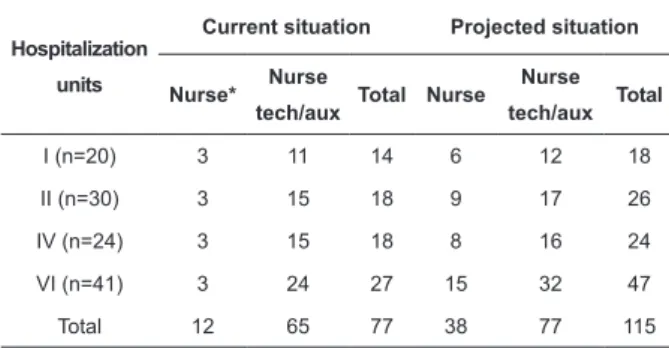
The current nursing staff at the units under analysis
consists of 77 professionals, including 12 nurses. Using
the staff calculation method, the projected staff would
comprise 115 nursing collaborators, with 38 nurses and
77 nurse technicians/auxiliaries (Table 3). In the current
situation, care hours range from 4.2 to 4.9h. In the
projected situation, a variation between 5.7 and 7.2h
was evidenced (Table 4).
Professional category
Hospitalization unit
I II IV VI
Nurse
Unforeseen absences (%) 11.5 11.3 6.9 0.6
Addition – TSI (%) 47 46 41 32
Nurse technician/auxiliary
Unforeseen absences (%) 4.1 6.7 2.8 4.2
Table 3 – Comparison between current and projected
nursing staff according to hospitalization unit under
study and professional category. São José do Rio Preto,
2007
*Nurses work at more than one unit during night shifts
Table 4 – Comparison between number of care hours
and projected nursing staff according to hospitalization
unit under study and professional category. São José do
Rio Preto, 2007
Hospitalization
units
Current situation Projected situation
Nurse* Nurse
tech/aux Total Nurse
Nurse
tech/aux Total
I (n=20) 3 11 14 6 12 18
II (n=30) 3 15 18 9 17 26
IV (n=24) 3 15 18 8 16 24
VI (n=41) 3 24 27 15 32 47
Total 12 65 77 38 77 115
Hospitalization
units
Hours
Current situation Projected situation
Nurse* Nurse
tech/aux Total Nurse Nurse
tech/aux Total
I (n=20) 1 3.6 4.6 2 3.7 5.7
II (n=30) 0.8 4.1 4.9 2.2 4.2 6.4
IV (n=24) 0.8 4 4.8 2.3 4.3 6.6
VI (n=41) 0.5 3.7 4.2 2.2 5.0 7.2
*Nurses work at more than one unit during night shifts
Discussion
In this study, the identiication of the care clientele’s proile showed that patients it into the four care
categories, showing their diversity and care complexity
for the nursing team. Among the classiied patients,
the demand for minimal care predominated (65.8%),
while some clients needed semi-intensive (7.4%) and
intensive care (0.8%). Another study(12) carried out at hospitalization units also showed a higher percentage
of patients in the minimal care category (68.7%),
with lower percentages for semi-intensive (6.6%) and
intensive care (1.5%).
Semi-intensive and intensive care patients’ stay at
the medical-surgical clinical units under analysis aroused
relections as to why those patients are allocated at
these units, as they demand permanent attention from
the nursing team, as well as more complex interventions
and a higher workload. Causes can mainly be related
with the insuficient number of beds at intensive care
units (ICU) to respond to demands, or even to the
inadequate assessment of care complexity.
In this research, percentages to cover for absences
(TSI) ranged from 32 to 47% for the nursing category
and from 35 to 40% for the nursing technician/auxiliary
category. These levels are close to what was found at
a university hospital(14), i.e. from 39 to 43% (nurses) and from 38 to 46% (technicians and auxiliaries); but
lower than levels in another research also carried out at
a teaching hospital(12), with 55 to 78% and 59 to 79.3%, respectively. It is important for each institution to
express its reality with regard to coverage for absences.
And, in case the decision is to use the TSI recommended
by the Brazilian Nursing Council (8.33% to cover for
vacations and 6.67% to cover for the absenteeism rate)
(10), the percentage of absences related to authorized leaves and holidays needs to be added with a view to
additional staff(12).
To reach the goal of 115 nursing collaborators at
the units under analysis, 33% needs to be added to total
staff. Research has shown different results, sometimes
indicating the need to increase staff numbers by 17%(15), sometimes maintaining the number of professionals(14). Findings in the present research evidenced greater
demands for nurses, representing a 68.4% increase in
comparison with the current team. Percentages found in
literature for this category were 62%(15) and 50%(14). For technicians and auxiliaries at the research institution,
a 15.6% increase was projected in relation to current
staff, as opposed to other studies that showed the need
to reduce this category by 8.7%(15) and 27%(14).
These percentages evidence the reality at the
study institution which, like other health institutions
in Brazil, still maintains a reduced number of nurses
for inancial reasons, jeopardizing the maintenance
of quality care and service supervision. This situation
also entails risks for patient safety, as exclusive nursing
activities are delegated to technical staff, with
ethical-legal implications for nursing professionals and for the
institution.
Average nursing time available per patient-day
ranged from 4.2 to 4.9h. Other studies at
medical-surgical clinical units presented 4.2h(16), between 6 and 6.5h(17) and between 6.2 and 7h(5). By adapting staff numbers, projected hours would vary between 5.7 and
7.2h, close to literature indings. As semi-intensive care
patients were found at all units (1.9 to 12.3%), projected
hours are also in line with the Brazilian Nursing Council’s
guidelines(10).
In the current situation, average nursing care hours
Rev. Latino-Am. Enfermagem 2010 Mar-Apr; 18(2):175-81.
increased, however, according to staff projections, hours
per patient-day would increase to between 2 and 2.3.
Unit VI showed the largest percentage of patients in
the semi-intensive (12.3%) and intensive care category
(2%), accompanied by the lowest average nursing care
hours (0.5). After redimensioning the team, the hours
needed to deliver care to this unit’s clients could be
projected, with a 41.7% increase in the current average
nursing hours; nurses’ hours increased by 77.3% and
nursing technicians and auxiliaries’ hours by 26%. A
great decrease in patient care hours jeopardizes the
quality of the care process due to the impossibility of
attending to care areas that need interventions, with a
consequent activity overload for the nursing team.
Some authors(7-8) demonstrated that nurses with a work overload have a greater chance of developing
the Burnout syndrome (state of physical, emotional
and mental exhaustion) and of becoming dissatisied.
They emphasized that hospitals with adequate nursing
staff numbers and concerned with nursing training and
retention achieve better results for clients and health
services. A strong association between the nurse/
patient proportion and morbidity and mortality risks,
followed by complications among surgical patients, was
documented in an American study carried out at 168
general hospitals. In that study, it was evidenced that,
for each patient added to the nurse’s mean workload,
the risk of probable death increases by 7%(7).
A correlation between the proportion of nurses/
patient and the occurrence of adverse events has also
been demonstrated in literature: 44.9% of adverse
events were found at an ICU when the proportion of
nurses was 1:2 patients; 23.8% at semi-intensive units
at a proportion of 1:3 and 33.2% at hospitalization
units at a proportion of 1:4 patients. The most frequent
events were: non-programmed removal or obstruction
of probes (57.6%), patient falls (16.6%) and medication
errors (14.8%)(6).
Another study carried out at medical-surgical
clinical units of a private institution in São Paulo(5) found AE percentages ranging from 6.4 to 7.1%, even when
patient staff numbers seemed to be adequate to respond
to patients’ needs. It should be highlighted, however, that
higher percentages of non-conformity situations were
evidenced in cases of underdimensioned nursing staff.
The beneits of staff recalculating are not limited to the
patient sphere alone, which is the main object of the care
process. They also include the professional, by recovering
the humanistic values of nursing care, and the institutional dimension. Hospitals aiming for service excellence have
better credibility and a better image in the community and
are more competitive in the health area.
It should be highlighted, however, that increasing
the nursing staff alone will not guarantee improved
quality and care productivity. This should be preceded by a systematic review of the work process, eliminating
activities that add little value to the patient, are
unnecessary or even redundant and demand time from
the team. Thus, nurses should strongly commit to
analyzing of the worklow and practices and redesigning
this process when necessary.
Literature(18) appoints nursing as hospitals’ main cost center, representing 33% of total costs and
approximately 44% of direct patient costs; and also that
about 80% of direct nursing costs are related to staff payments. Thus, the institution can see the hiring of
additional staff as a great strain on its global budget. If
nurse management presents solid arguments to the high
administration, addressing the fact that a staff increase leads to a rise in operating costs but not necessarily
to decreased proitability, can favor the availability of
the resources needed to put in practice restructuring proposals.
Conclusion
Based on these study results, it can be concluded
that the nursing staff working at the units under analysis and the time this team spends remain below the clients’
care needs. Knowing and assessing the reality can
help the units’ nurse managers to elaborate proposals, make decisions and negotiate on staff and work process
re-adaptation. The balance between use of human
resources and care quality remains a big challenge for
nurse managers.
References
1. Organização Mundial da Saúde (OMS). Avaliação dos programas de saúde: normas fundamentais para sua aplicação no processo de gestão para o desenvolvimento nacional na saúde. Genebra; 1981.
2. Bittar OJN. Indicadores de qualidade e quantidade em saúde. Rev Adm Saúde 2004; 6(22):15-8.
3. Kurcgant P, Tronchin DMR, Melleiro MM. A construção de indicadores de qualidade para a avaliação de recursos humanos nos serviços de enfermagem: pressupostos teóricos. Acta Paul Enferm 2006; 19(1):88-91.
P, coordenadora. Gerenciamento em enfermagem. São Paulo (SP): Guanabara Koogan; 2005. p.125-37.
5. Krokoscz DVC. Efeitos da alocação de pessoal e da carga de trabalho de enfermagem nos resultados da assistência em unidades de internação médico-cirúrgicas.[dissertação]. São Paulo (SP): Escola de Enfermagem/USP; 2007.
6. Nascimento CCP, Toffoletto MC, Gonçalves LA, Freitas WG, Padilha KG. Indicadores de resultados da assistência: análise dos eventos adversos durante a internação hospitalar. Rev Latino-am Enfermagem 2008; 16(4):746-51.
7. Aiken LH, Clarke SP, Sloane DM, Sochalski J, Silber JH. Hospital nurse staffing and patient mortality, nurse burnout, and job dissatisfaction. J Am Med Assoc 2002; 288:1987-93. 8. Rafferty AM, Ckarke SP, Coles J, Ball J, James P, Martin M, Aiken LH. Outcomes of variation in hospital nurse staffing in english hospitals: cross-sectional analysis of survey data and discharge records. Int J Nurs Stud 2007; 44:175-82.
9. Perroca MG. Instrumento de classificação de pacientes de Perroca: validação clínica.[tese]. São Paulo (SP): Escola de Enfermagem/USP; 2000.
10. Conselho Federal de Enfermagem. Resolução nº 293/04, fixa e estabelece parâmetros para o dimensionamento do quadro de profissionais de enfermagem nas unidades assistenciais das instituições de saúde e assemelhados. [citado 2008 nov. 10]. Disponível em: URL: http://www.portalcofen.com.br/2007/ materias.asp?ArticleID=7121§ionID=34
11. Gaidzinski RR. Dimensionamento de pessoal de enfermagem em instituições hospitalares.[tese livre-docência]. São Paulo
(SP): Escola de Enfermagem/USP; 1998.
12. Laus AM. Dimensionamento de pessoal de enfermagem para unidades de internação médicas cirúrgicas no Hospital das Clínicas da Faculdade de Medicina de Ribeirão Preto – USP.[tese]. Ribeirão Preto (SP): Escola de Enfermagem/USP; 2003. 13. Programa de Qualidade Hospitalar. Manual de indicadores de enfermagem NAGEH [monografia online]. São Paulo (SP): APM/CREMESP; 2006. Disponível em: URL: http://www.cqh.org. br/files/Manual%20de%20Indicadores%20NAGEH%20-%20V. FINAL.pdf
14. Nicola AL. Dimensionamento de pessoal de enfermagem no hospital universitário do oeste do Paraná.[tese]. Ribeirão Preto (SP): Escola de Enfermagem/USP; 2004.
15. Antunes AV, Costa MN. Dimensionamento de pessoal de enfermagem em um hospital universitário. Rev Latino-am Enfermagem 2003; 11(6):832-9.
16. Chenso MZB, Haddad MCL, Secco IAO, Dorigão AM, Nishiyama MN. Cálculo de pessoal de enfermagem em hospital universitário do Paraná: uma proposta de adequação. Semina Ciênc Biol Saúde 2004; 25:81-92.
17. Rogenski KE. Tempo de assistência de enfermagem: identificação e análise em instituição hospitalar de ensino. [dissertação]. São Paulo (SP): Escola de Enfermagem/USP; 2006.
18. Kane NM, Siegrist RB. Understanding rising hospital inpatient costs: key components of costs and the impact of poor quality. [citado 2009 Fev 17]. Disponível em: URL: http://www.bcbs. com/blueresources/cost/4_Inpatient_Qual_Assess.pdf.