Nursing leadership and its relationship with the hospital work environment
Liderança do enfermeiro e sua relação com o ambiente de trabalho hospitalar Liderazgo del enfermero y su relación con el ambiente de trabajo hospitalarioAlexandre Pazetto Balsanelli1
Daiane Rossi David1
Thais Guglielminetti Ferrari1
Corresponding author Alexandre Pazetto Balsanelli
http://orcid.org/0000-0003-3757-1061 E-mail: [email protected]
DOI
http://dx.doi.org/10.1590/1982-0194201800027
1Escola Paulista de Enfermagem, Universidade Federal de São Paulo, São Paulo, SP, Brazil.
Confl icts of interest: *scientifi c initiation research presented in 2016 to the Universidade Federal de São Paulo. Balsanelli AP is an associated editor of Acta Paulista de Enfermagem and did not participate in the manuscript’s evaluation process.
Abstract
Objective: To analyze the nursing work environment considering: autonomy, control, relationships between physicians and nurses, and organizational support; to examine the ideal leadership style in the perception of nurses, and the real leadership style according to evaluation from one of their subordinates; and to correlate the variables work environment and real leadership.
Methods: A correlational study was carried out in the healthcare units of a general hospital in the city of São Paulo, Brazil. The convenience sample was made up of 62 pairs (nurses and nursing technicians/aides). Nurses responded to three instruments, as follows: 1) characterization; 2) Brazilian Nursing Work Index-Revised (B-NWI-R), which measured autonomy, control, relationships between physicians and nurses, and organizational support; and 3) grid and leadership in nursing, which measured the ideal behavior according to fi ve styles (1.1; 1.9; 5.5; 9.1; and 9.9). Nursing technicians/aides responded to two instruments: 1) characterization and 2) grid and leadership in nursing, which measured the real behavior considering nurses as direct leaders. Data analysis was carried out with the use of variance analysis (ANOVA, p ≤0.05).
Results: The mean of the B-NWI-R was 2.2. Style 1.1 was considered as ideal by nurses (58.1%), followed by style 9.1 (35.5%). Styles 9.1 and 1.1 were the most pointed out by nursing technicians/aides. No relationship between the work environment and nurses’ real leadership (p=0.39) was found. Conclusion: The work environment proved to be favorable to nursing practice. Nurses’ ideal leadership style did not present a correspondence with the real leadership style evaluated by nursing technicians/aides, and the work environment was not associated with nursing leadership.
Resumo
Objetivo: Analisar o ambiente de trabalho do enfermeiro considerando: autonomia, controle, relações entre médicos e enfermeiros e suporte organizacional; verifi car o estilo de liderança ideal, na percepção do enfermeiro, e o real de acordo com a avaliação de um dos seus liderados; correlacionar as variáveis ambiente de trabalho e liderança real.
Métodos: Estudo correlacional realizado nas unidades assistenciais dum hospital geral de São Paulo, SP, Brasil. A amostra de conveniência constituiu-se de 62 duplas (enfermeiros e técnicos/auxiliares de enfermagem). Os enfermeiros responderam três instrumentos: 1-) caracterização; 2-) Brasilian Nursing Work Index Revised (B-NWI-R) que mensura: autonomia, controle, relações entre médicos e enfermeiros e suporte organizacional; e 3-) Grid & Liderança em Enfermagem: comportamento ideal que mensura cinco estilos: 1.1, 1.9, 5.5, 9.1 e 9.9. Os técnicos/auxiliares em enfermagem responderam: 1-) caracterização e 2-) Grid & Liderança em Enfermagem: comportamento real considerando o enfermeiro como líder imediato. Os dados foram analisados com análise de variância (ANOVA- p ≤0,05).
Resultados: A média do B-NWI-R foi de 2,2. O estilo 1.1 foi o considerado ideal pelos enfermeiros (58,1%), seguido de 35,5% do 9.1. Esses foram os mais apontados pelos técnicos, porém, nesta sequência 9.1 e 1.1. Não houve relação do ambiente de trabalho com liderança real do enfermeiro (p=0,39). Conclusão: O ambiente de trabalho mostrou-se favorável à prática de enfermagem. O estilo de liderança ideal dos enfermeiros não apresentou correspondência com o real avaliado pelos técnicos ou auxiliares de enfermagem e o ambiente de trabalho não se relacionou com a liderança dos enfermeiros.
Resumen
Objetivo: Analizar el ambiente de trabajo del enfermero considerando: autonomía, control, relaciones entre médicos y enfermeros y soporte organizacional; verifi car el estilo de liderazgo ideal en la visión del enfermero, y el real según la evaluación de uno de sus liderados; correlacionar las variables ambientales de trabajo y liderazgo real.
Métodos: Estudio correlacional realizado en unidades de atención de hospital general de São Paulo, SP, Brasil. La muestra se constituyó con 62 duplas (enfermeros y técnicos/auxiliares de enfermería). Los enfermeros respondieron tres instrumentos: 1-) caracterización; 2-) Brasilian Nursing Work Index Revised (B-NWI-R), que mide: autonomía, control, relaciones entre médicos y enfermeros y soporte organizacional; y 3-) Grid & Liderazgo en Enfermería: comportamiento ideal que mide cinco estilos: 1.1, 1.9, 5.5, 9.1 y 9,9. Los técnicos y auxiliares respondieron: 1-) caracterización; y 2-) Grid & Liderazgo en enfermería: comportamiento ideal considerando al enfermero como líder inmediato. Datos analizados con análisis de varianza (ANOVA- p≤0,05).
Resultados: La media del B-NWI-R fue 2,2. El estilo 1.1 fue considerado el ideal por los enfermeros (58,1%), seguido del 9.1 (35,5%). Fueron también los más señalados por los técnicos, aunque en la secuencia inversa. No hubo relación del ambiente de trabajo con el liderazgo real del enfermero (p=0,39).
Conclusión: El ambiente de trabajo se mostró favorable a la práctica de enfermería. El estilo de liderazgo ideal para enfermero no mostró correspondencia con el real evaluado en técnicos/auxiliares de enfermería. El ámbito de trabajo no se relacionó con el liderazgo de los enfermeros.
Keywords
Leadership; Health facility environment; Hospital units; Nursing staff
Descritores
Liderança; Ambiente de instituições de saúde; Unidades hospitalares; Recursos humanos de enfermagem
Descriptores
Liderazgo; Ambiente de instituciones de salud; Unidades hospitalarias; Personal de enfermería
Submitted
February 8, 2018
Accepted
May 3, 2018
How to cite:
Introduction
Leadership is a skill extremely necessary and re-quired from nurses to influence their teams to pro-vide nursing care that meets the expectations of pa-tients and families.(1) Healthcare institutions search
for professionals who are able to provide appro-priate care in order to achieve effective outcomes. Undergraduate programs, graduate programs, and continuing education programs in healthcare insti-tutions approach this theme in order to improve its daily practice.(2)
Studying factors related to the development of this skill is necessary to contribute to its de-velopment and learning process. Therefore, nursing leadership has been related to the fol-lowing factors: satisfaction of patients with the care provided by the nursing team;(3) patient
safety;(4) job satisfaction;(5) and satisfaction with
the work environment.(6)
When considering the work environment based on the following components, leadership may promote positive or negative results, de-pending on how it is exercised and practiced: 1) autonomy and control: capacity of nurses to resolve problems related to patient care; 2) rela-tionship between physicians and nurses: to es-tablish effective communication to achieve com-mon objectives; and 3) organizational support: to contribute to actions related to the professional practice of nurses.(6) In 1993, Trevisan(7) showed
that the hospital environment exerted influence on nursing leadership. However, one integrative review carried out from 2006 to 2013 did not find other studies showing the same influence.(8)
In order to fill this gap, Balsanelli and Cunha(9)
carried out a study in four intensive care units (ICUs), being two from private hospitals and two from public teaching hospitals. The results showed that the work environment was not related to nursing leadership (p=0.852). However, for fur-ther studies, the inclusion of ofur-ther hospital health-care units in addition to ICUs is suggested, with the possibility of examining whether this result is applied to these settings, considering differences among them.(9)
The guiding question of the present study was: “Is work environment related to nursing leadership in the healthcare units of a hospital”? In this respect, the present study aimed at con-tributing to broadening the theme of leadership in the nursing context, considering its relevance and importance for nursing practice. In addition, it sought to identify whether previous results(9)
may be found in other hospital units that clear-ly present differences among them due to some factors, especially the characteristic of the pop-ulation assisted, thus providing elements for the development of leaders.
Therefore, the objectives of the present study were: 1) to analyze the nursing work environment in the healthcare units of a hospital, considering autonomy, control, relationships between physi-cians and nurses, and organizational support; 2) to examine the ideal leadership style according to the perception of nurses, and the real leadership style according to evaluation from one of their subordi-nates; and 3) to correlate the variables work envi-ronment and real leadership.
Methods
This was a correlational study carried out in a large-sized general teaching hospital in the southern area of the city of São Paulo, Brazil. This teaching hospi-tal is categorized as an extremely important teach-ing settteach-ing. It currently has 800 beds and provides care in several specialty areas.
The convenience sample was made up of nurses, nursing technicians, and nursing aides assigned to the following intensive care units: burn; pulmon-ology; cardipulmon-ology; neurpulmon-ology; health plan; general; nephrology; emergency support; pediatrics; and neonatology. In addition, the following medical and surgical clinic units were included in the study: geriatrics; pulmonology; cardiology; nephrology; obstetrics; pediatrics; infectious disease; urology; orthopedics; and emergency.
subordinates would be more harmonious after this period of time, and not having plans for vacation leave, maternity/paternity leave, marriage leave, or bereavement leave.
Considering the data collection procedure, re-searchers initially approached nurses. Then, nursing technicians/aides, who were randomly chosen by the researchers, were invited to participate in the study. The participants were grouped in pairs, con-sidering the perception of nurses on the ideal be-havior for leadership and what nursing technicians/ aides evaluated as real in the perspective of nurses’ performance as their direct leaders. All participants signed an informed consent form.
Nurses were unaware of which collaborators of their teams were invited to participate in the sam-ple. However, nursing technicians/aides were aware of which leader they should evaluate, because the name of the nurse was written in the data collection instrument. Anonymity was ensured to prevent any influence that could interfere with the responses of the study participants.
Each nurse received the following three data collection instruments in an envelope: 1) character-ization: with information about age, gender, length of time since graduation, length of time working at the institution and in the unit, having a graduate degree, and contact with the theme of leadership; 2) Nursing Work Index-Revised version validated into Portuguese (B-NWI-R);(10) and 3) grid and
leader-ship in nursing: ideal behavior.(7)
The nursing technicians/aides chosen also re-ceived an envelope containing the following in-struments: 1) the same characterization instrument described above; 2) grid and leadership in nursing: real behavior,(10) considering the nurse in question.
A later date was scheduled for the delivery of the envelopes in person to the researchers, which should be sealed.
A total of 120 nurses and 120 nursing tech-nicians/aides were approached, but only 62 pairs were formed. Considering that the hospital had 200 nurses employed at the time of data collec-tion, the sample represented 31% of these profes-sionals. Regarding nursing technicians/aides, they had to form pairs with nurses. As a result, the
sam-ple’s percentage considering this category was not calculated.
The characteristics of the instruments used are described in the following paragraphs.
1) Nursing Work Index-Revised version validat-ed into Portuguese (B-NWI-R):(10) the B-NWI-R
originates from the Nursing Work Index (NWI), which was developed in 1989 to measure satisfac-tion, perception of quality, and characteristics of the work environment that favor nursing practice. It consists of 65 items. The Nursing Work Index-Revised (NWI-R)(11) was developed with the
pur-pose of summarizing it.
The NWI-R comprises 57 items, with 15 items distributed in a conceptual form into three dimen-sions as follows: autonomy; control on environ-ment; and relationships between physicians and nurses. Among these 15 items, ten were grouped in order to bring up the fourth dimension: organiza-tional support.(11)
Conceptually, the definitions of the dimensions are:(11)
• autonomy (five items) and control (seven items) represent the freedom of nurses to resolve prob-lems that affect the quality of nursing care;
• relationships between physicians and nurses (three items) involve professional respect for the establishment of an effective communica-tion in order to achieve a common objective regarding patient care;
• organizational support (ten items originated from the three dimensions previously men-tioned) is related to situations in which the or-ganization provides support, so nurses are able to develop their professional practice.
It is a Likert-type ranging from one to four points, and the lower the score, the greater the presence of attributes favorable to nurses’ professional practice. The scores for subscales are obtained through the mean of scores of the participants’ responses, and they may range from one to four points.(11)
The NWI-R was translated and adapted into the Brazilian culture(12) and the dimensions
2) Grid and leadership in nursing: ideal and real behavior.(7) This instrument evaluates nurses’
ideal leadership behavior and the real leadership behavior in the perception of the members of the team. The first instrument is filled by the leader and the second by a subordinate. These instru-ments were used in the present study because they match the Brazilian reality and went through face and content validation.
They consist of 25 propositions with four pos-sibilities of responses graduated in scores, as fol-lows: totally desirable (four points); desirable (three points); undesirable (two points); and totally unde-sirable (one point).(7)
Each statement of the instrument refers to a leadership style. The style with the highest score is related to how nurses exercise their leadership in their conception of an ideal behavior, and in the perception of a collaborator on what is real.(7)
The leadership styles measured are:(7)
1.1: nurses are only worried about keeping their jobs, and their interest for the service and team members is irrelevant;
1.9: nurses are friends of the team members and do anything to be appreciated;
5.5: nurses avoid taking a position and do not allow disputes. Hospital standards and regulations provide a guideline for their supervision;
9.1: nurses expect the team members to do what they think should be done;
9.9: nurses consult with the team members, so work is based on common objectives and joint res-olution of problems. All members understand their role and responsibility.
The data were collected from February to May 2016.
The present study was registered in Plataforma Brasil and approved by the research ethics commit-tee of the Federal University of São Paulo under no. 1.321.023.
Characterization data were analyzed with the use of descriptive statistics. Analysis of variance (ANOVA) was adopted to identify whether there is a correlation between the work environment and real leadership. The significance level adopted was p≤0.05.
Results
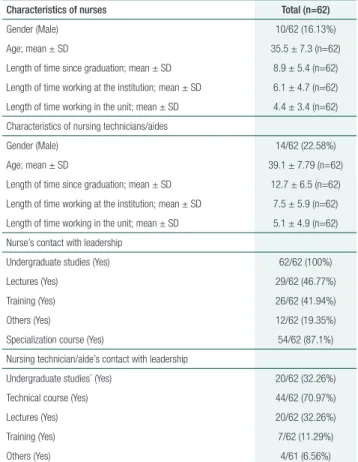
The sample was made up of 62 pairs (nurses and nursing technicians/aides). The categorization vari-ables are described in table 1.
Table 1. Characteristics of nurses and nursing technicians/ aides included in the sample (n=62 nurses and n=62 nursing technicians/aides)
Characteristics of nurses Total (n=62)
Gender (Male) 10/62 (16.13%)
Age; mean ± SD 35.5 ± 7.3 (n=62)
Length of time since graduation; mean ± SD 8.9 ± 5.4 (n=62)
Length of time working at the institution; mean ± SD 6.1 ± 4.7 (n=62)
Length of time working in the unit; mean ± SD 4.4 ± 3.4 (n=62)
Characteristics of nursing technicians/aides
Gender (Male) 14/62 (22.58%)
Age; mean ± SD 39.1 ± 7.79 (n=62)
Length of time since graduation; mean ± SD 12.7 ± 6.5 (n=62)
Length of time working at the institution; mean ± SD 7.5 ± 5.9 (n=62)
Length of time working in the unit; mean ± SD 5.1 ± 4.9 (n=62)
Nurse’s contact with leadership
Undergraduate studies (Yes) 62/62 (100%)
Lectures (Yes) 29/62 (46.77%)
Training (Yes) 26/62 (41.94%)
Others (Yes) 12/62 (19.35%)
Specialization course (Yes) 54/62 (87.1%)
Nursing technician/aide’s contact with leadership
Undergraduate studies* (Yes) 20/62 (32.26%)
Technical course (Yes) 44/62 (70.97%)
Lectures (Yes) 20/62 (32.26%)
Training (Yes) 7/62 (11.29%)
Others (Yes) 4/61 (6.56%)
*Nursing technicians/aides included in the sample who had already graduated in nursing or were attending courses
Table 2. Descriptive statistics of the B-NWI-R (n=62 nurses)
NWI Minimum Maximum Mean Standard
deviation Median First quartile
Third quartile
Total 1.3 3.5 2.2 0.5 2.2 1.9 2.6
Autonomy 1.0 3.6 2.1 0.6 2.0 1.6 2.6
Control 1.1 3.4 2.5 0.5 2.4 2.0 2.9
Relationships 1.0 3.7 1.9 0.7 1.7 1.3 2.3
Support 1.4 3.5 2.2 0.5 2.2 1.9 2.5
The mean of the overall dimension was 2.2. The dimension “relationships between physicians and nurses” was the dimension that presented the best mean, with 1.9 points. Cronbach’s alpha was 0.8. Table 3 presents the distribution of nurses’ ideal lead-ership behavior and the real leadlead-ership behavior ac-cording to evaluation from nursing technicians/aides.
fact that the work environment was measured based only on the B-NWI-R dimensions (autonomy; control; relationships between physicians and nurs-es; and organizational support).
However, the inclusion of several healthcare units of the hospital enabled the correlation be-tween the work environment in fields with different characteristics and nursing leadership.
Nurses and nursing technicians/aides presented differences in age, length of time from graduation, and length of profession time. These aspects were also found in other studies.(13) This result may be
explained by the fact of the study setting being a teaching hospital, where nursing students remain to pursue their careers. Newly graduated professionals need to face this challenge that is, to lead a more experienced average-level work group. They will be able to exercise this leadership by acquiring the necessary knowledge to manage nursing care and interact with their collaborators in order to provide safe care with quality.
When analyzing the work environment, the B-NWI-R presented an overall score of 2.2, with Cronbach’s alpha of 0.8. Similar results(14-16)
in-cluding primary healthcare units(17) were found.
Considering that the overall mean of the scale rang-es from one to four, and the lower its value, the more favorable the environment for nursing practice, an average setting is found. The dimensions that re-ceived higher scores must be evaluated with crite-ria for the establishment of action plans. Control is highlighted as an item to be revisited by the man-agement of the hospital where data collection was carried out. This is represented by the freedom of nurses to make decisions and resolve problems re-garding care. The care model, in this perspective, can be examined to identify possible existing gaps
Table 3. Distribution of the ideal leadership style according to nurses and the real leadership style according to evaluation from nursing technicians/aides (n=62 nurses and n=62 nursing technicians/aides)
Leadership styles Ideal
n(%)
Real n(%)
1.1 36(58.1) 25(40.4)
1.9 2(3.2) 8(12.9)
5.5 1(1.6) 0(0)
9.1 22(35.5) 26(41.9)
9.9 1(1.6) 3(4.8)
Total 62(100) 62(100)
Profile 1.1 was considered as ideal by nurses (58.1%), followed by profile 9.1 (35.5%). These two were also the most pointed out profiles by nursing technicians/aides, with profile 9.1 (41.9%), followed by profile 1.1 (40.4%), and profile 1.9, in-dicated by eight nursing technicians/aides (12.9%). Means of the B-NWI-R were compared ac-cording to the real leadership behavior evaluated by nursing technicians/aides. This datum is presented in table 4.
No statistical significance was found for the to-tal score and the B-NWI-R dimensions when com-pared with leadership styles.
Discussion
Considering the multidimensionality of this con-struct, the limitation of the present study is in the
Table 4. Relationship between means of the B-NWI-R dimensions and the real leadership behavior evaluated by nursing technicians/ aides (n=62 nurses and n=62 nursing technicians/aides)
Real leadership behavior
B-NWI-R 1.1 (n=25) 1.9 (n=8) 9.1 (n=26) 9.9 (n=3) Total (N=62) p-value¹
Total 2.2 ± 0.4 2.2 ± 0.6 2.2 ± 0.6 2.71 ± 0.4 2.23 ± 0.5 0.392
Autonomy 2.1 ± 0.5 2.2 ± 0.7 2.1 ± 0.7 2.8 ± 0.3 2.1 ± 0.6 0.28
Control 2.5 ± 0.5 2.4 ± 0.7 2.4 ± 0.5 2.8 ± 0.6 2.5 ± 0.5 0.748
Relationships 1.7 ± 0.5 1.8 ± 0.5 1.9 ± 0.8 2.4 ± 0.5 1.9 ± 0.7 0.267
Support 2.2 ± 0.42 2.2 ± 0.5 2.2 ± 0.6 2.6 ± 0.5 2.2 ± 0.5 0.541
and favor nursing practice. However, further re-search must be conducted to clarify this issue.
In the present study, the relationship between physicians and nurses had the lowest scores. This re-sult may be also found in other studies,(10,15,17) which
shows that the multidisciplinary team have a favorable relationship with each other, which leads to more ef-fective communication and care focused on patients. Teaching hospitals have learning as a driving force in their essence, contributing to an organizational envi-ronment appropriate for interdisciplinary studies.
The ideal leadership for nurses showed a preva-lence of style 1.1, followed by style 9.1. This finding was corroborated by nursing technicians/aides, but in reverted order. This leadership style considered as ideal by nurses is worrying, because the leaders perform the minimum, both for collaborators under their manage-ment and the institution.(7) This datum differs from
another study(18) in which the ideal profile was 9.9. The
adoption of strategies to improve this line of thought is of utmost importance for the development of this skill within this group of collaborators.
No correlation between nursing leadership and the B-NWI-R was found both in overall score and in dimensions of the scale. This result was also found in another study;(9) however, with a difference to be
high-lighted: In this study, the sum of real leadership styles more favorable to the management of people (9.1 and 9.9) was identified with a frequency very close to styles 1.1 and 1.9. Balsanelli and Cunha(18) found a
preva-lence of style 9.9. Still, no correlation between the di-mensions of the work environment measured by the B-NWI-R and nursing leadership was found.
The data found in the present study and in the study of Balsanelli and Cunha(9) suggest that the
work environment does not interfere with nursing leadership. However, considering the multidimen-sionality of this construct, other dimensions asso-ciated with work environment should be used in further studies.
The theme of leadership must be continuous-ly researched. The search for evidence in this area of knowledge is of utmost importance for nursing. Methodological designs that involve this object of study must progress, so innovative proposals can be provided to team managers. The present study was
developed filling an existing gap that is, the same result was seen in a previous study(9) and was
repli-cated in other units of the hospital. Further studies must be carried out to strengthen this knowledge, considering that the literature presents the influence of leadership on work environment.(19-21) However,
the inverse relation is a research field to be explored.
Conclusion
The results of the present study showed that the work environment achieved a mean of 2.2 accord-ing to the B-NWI-R, and that style 1.1 had the highest score as ideal in the perception of nurs-es, whereas style 9.1 had the highest score as real according to evaluation from nursing technicians/ aides. No correlation between the work environ-ment and nurses’ real leadership was found. For the development of leaders, it is of utmost impor-tance that managers know which variables are di-rectly related to leadership. In this regard, research results are necessary to offer possibilities and sci-entifically proven models, so it will be possible to promote management based on results.
Acknowledgements
To the São Paulo Research Foundation(FAPESP).
Collaborations
Balsanelli AP, David DR, and Ferrari TG declare that they contributed to the project’s conception, data analysis and writing of the article, critical re-view of its intellectual content, and approval of the final version to be published.
References
2. Lee BS, Eo YS, Lee MA. Leadership experience of clinical nurses: applying focus group interviews. J Korean Acad Nurs. 2015t;45(5):671–83.
3. Wong CA, Cummings GG, Ducharme L. The relationship between nursing leadership and patient outcomes: a systematic review update. J Nurs Manag. 2013;21(5):709–24.
4. Wong CA, Giallonardo LM. Authentic leadership and nurse-assessed adverse patient outcomes. J Nurs Manag. 2013;21(5):740–52.
5. Bormann L, Abrahamson K. Do staff nurse perceptions of nurse leadership behaviors influence staff nurse job satisfaction? The case of a hospital applying for Magnet® designation. J Nurs Adm. 2014;44(4):219–25.
6. Read EA, Laschinger HK. The influence of authentic leadership and empowerment on nurses’ relational social capital, mental health and job satisfaction over the first year of practice. J Adv Nurs. 2015;71(7):1611–23.
7. Trevisan MA. Liderança do enfermeiro: o ideal e o real no contexto hospitalar. São Paulo (SP): Savier; 1993.
8. Balsanelli AP, Cunha IC. The work environment and leadership in nursing: an integrative review. Rev Esc Enf USP. 2014;48(5):934-40.
9. Balsanelli AP, Cunha IC. Nursing leadership in intensive care units and its relationship to the work environment. Rev Lat Am Enfermagem. 2015; 23(1):106-13.
10. Gasparino RC, Guirardello EB, Aiken LH. Validation of the Brazilian version of the Nursing Work Index-Revised (B-NWI-R). J Clin Nurs. 2011;20(23-24):3494–501.
11. Aiken LH, Patrician PA. Measuring organizational traits of hospitals: the Revised Nursing Work Index. Nurs Res. 2000;49(3):146–53.
12. Gasparino RC, Guirardello EB. Tradução e adaptação para a cultura brasileira do “Nursing Work Index - Revised”. Acta Paul Enferm. 2009; 22(3):281-7.
13. Cardoso ML, Ramos LH, D’Innocenzo M. Coaching leadership: leaders’ and followers’ perception assessment questionnaires in nursing. einstein (São Paulo). 2014;12(1):66-74.
14. Alves DF, Guirardello EB. Ambiente de trabalho da enfermagem, segurança do paciente e qualidade do cuidado em hospital pediátrico. Rev Gaúcha Enferm. 2016;37(2):1-7.
15. Panunto MR, Guirardello EB. Professional nursing practice: environment and emotional exhaustion among intensive care nurses. Rev Lat Am Enfermagem. 2013;21(3):765-72.
16. Marcelino CF, Alves DF, Gasparino RC, Guirardello EB. Validação do Nursing Work Index-Revised entre auxiliares e técnicos de enfermagem. Acta Paul Enferm. 2014; 27(4):305-10.
17. Lorenz VR, Guirardello, EB. The environment of professional practice and Burnout in nurses in primary healthcare. Rev Lat Am Enfermagem. 2014;22(6):926-33
18. Balsanelli AP, Cunha IC. Ideal and real leadership of nurses in intensive care units at private and public hospitals. Cogitare Enferm. 2016; 21(1): 1-7.
19. Nayback-Beebe AM, Forsythe T, Funari T, Mayfield M, Thoms W Jr, Smith KK, et al. Using evidence-based leadership initiatives to create a healthy nursing work environment. Dimens Crit Care Nurs. 2013;32(4):166–73.
20. Bamford M, Wong CA, Laschinger H. The influence of authentic leadership and areas of worklife on work engagement of registered nurses. J Nurs Manag. 2013;21(3):529–40.