Todo o conteúdo deste periódico, exceto onde está identificado, está licenciado sob uma Licença Creative Commons.
All the contents of this journal, except where otherwise noted, is licensed under a Creative Commons Attribution License.
Possible involvement of proteasome activity in
ethylene-induced germination of dormant sunflower embryos
Fabian Borghetti 1, Fabio Nakamura Noda 1 and Cezar Martins de Sá 2 *
1Laboratório de Termobiologia L.G. Labouriau2; Laboratório de Microbiologia; Instituto de Ciências Biológicas, CP 04457,
Universidade de Brasilia, CEP 70910-900, Brasília, DF, Brasil; *Corresponding author: [email protected]
Received: 22/02/2002, Accepted: 02/08/2002
Freshly harvested sunflower seeds (Helianthus annuus L., Asteraceae) present physiological dormancy localized at the embrionary axis which prevents germination at low temperatures. However, dormant embryos reach about 100 % germination when incubated with the phytohormone ethylene during imbibition. To examine whether proteinase activities are implicated in the breaking of dormancy by ethylene, dormant embryos were treated with the proteinase inhibitors leupeptin, E64 and the proteasome specific inhibitor clasto-lactacystin ß-lactone (lactacystin). A few embryos (< 10 %) germinated at 10 oC in absence of ethylene but ethylene-treated embryos reached high germinability (~90 %) in the
presence of leupeptin, E64, water and DMSO. On the other hand, incubation in lactacystin strongly reduced (< 20 %) the ethylene-induced germination in a dose-dependent manner. Lactacystin did not affect the germinability at 25 oC
(temperature in which the embryos are no longer dormant) but increased the average germination time. The results suggest that proteasome activity may be involved in the removal of dormancy by ethylene and in the progression of the germination of sunflower embryos.
Keywords: Helianthus annuus, dormancy, ethylene, lactacystin, proteasome.
Possível envolvimento de atividade do proteassoma na germinação induzida por etileno em embriões dormentes
de girassol: Sementes recém-colhidas de girassol (Helianthus annuus L., Asteraceae) apresentam dormência fisiológica
localizada no eixo embrionário, bloqueando a germinação em baixas temperaturas. Contudo, os embriões dormentes apresentam germinabilidade próxima a 100 % quando incubados na presença de etileno durante a embebição. Para verificar se determinadas proteinases estão envolvidas na quebra da dormência pelo etileno, embriões dormentes de girassol foram tratados com os inibidores de proteinases leupeptina e E64 e o inibidor específico do proteasoma lactacistina (clasto-lactacystin ß-lactone). Observou-se que embriões incubados a 10 oC na ausência de etileno
apresentaram germinabilidade menor que 10 % em todos os inibidores testados. Embriões incubados a 10 oC na presença
de etileno apresentaram alta germinabilidade (~90 %) nos tratamentos com leupeptina, E64, água e DMSO, contudo, no tratamento com lactacistina a germinabilidade foi reduzida significativamente (< 20 %) numa relação concentração-dependente. Incubação dos embriões a 25 oC, temperatura na qual a germinação ocorre sem necessidade de etileno, a
lactacistina não afetou a germinabilidade (> 90 %), mas aumentou significativamente o tempo médio de germinação. Os resultados sugerem que a atividade do proteasoma pode estar envolvida tanto na quebra da dormência por etileno como na progressão da germinação de embriões de girassol.
Palavras-chave: Helianthus annuus, dormência, etileno, lactacistina, proteasoma.
INTRODUCTION
Seed dormancy can be regarded as the failure of an intact viable seed to complete germination under favorable conditions (De Castro and Hilhorst, 2000). In some species the seeds are prevented from completing germination because the embryo is constrained by the
surrounding structures (coat-imposed dormancy). In other species the embryos themselves present some metabolic constraint (physiological dormancy) (Bewley, 1997).
126 F. BORGHETTI et al.
abscisic acid (ABA) has been shown to be involved in the establishment of primary dormancy during seed development (Bewley, 1997), and the expression of several genes is affected by the ABA concentration in the embryonic tissues (Morris et al., 1991; Nicolás et al., 1997). The continuous expression of these genes during imbibition indicates that their respective gene products are required for the maintenance of dormancy (Li and Foley, 1997; Nicolás et al., 1997; Garello et al., 2000) and further suggests that the silencing of these genes and/ or the removal of their products is part of the breaking of dormancy in seeds (Nicolás et al., 1997; Garello et al., 2000).
Phytohormones such as gibberellins (GA) and the gas ethylene were found to break seed dormancy in several species(Kepczynski and Kepczynska, 1997). Both agents affect gene expression (Kieber, 1997) and in particular were shown to induce proteinase synthesis during seed imbibition and germination (Cervantes et al, 1994; Asano et al., 1999; Domínguez and Cejudo, 1999).
The phytohormone ethylene regulates a multitude of plant processes, ranging from seed germination to organ senescence (Johnson and Ecker, 1998). Indeed, several components involved in its action at molecular level have been identified (Johnson and Ecker, 1998). This gas was shown to regulate the germination of non-dormant and dormant seeds of several species (Corbineau and Côme, 1995; Kepczynski and Kepczynska, 1997). Although the molecular mechanism of ethylene action in the removal of seed dormancy is not understood (Cervantes et al., 1994; Corbineau and Côme, 1995), studies have shown that this gas regulates the expression of cysteine-proteinase genes during the germination of Cicer arietinum (Cervantes et al., 1994) and Pisum sativum
seeds (Cercós et al., 1999). These results suggest that proteinase activity may be part of the action of this phytohormone in promoting germination (Asano et al., 1999).
Several proteolytic pathways are involved in the intracellular degradation of proteins in plants (Vierstra, 1993). Among these the cysteine-proteinases were shown to participate in the initial steps of seed germination (Callis, 1995; Asano et al., 1999) in most cases involved in the processing of seed reserves (Callis, 1995; Asano et al., 1999). The multicatalytic proteinase complex, also known as proteasome, has been isolated from several
plant species (Skoda and Malek, 1992; Murray et al., 1997; Yanagawa et al., 1999). Its subunit composition, substrate specificity, and inhibitor sensitivities are similar to those of the mammalian counterparts (Skoda and Malek, 1992; Dick et al., 1997; Yanagawa et al., 1999). The 20 S proteasome acts as a “barrel-shaped” proteolytic core for a larger 26 S complex, which catalyzes ATP-dependent degradation of proteins that are targeted via the attachment of multiple ubiquitin molecules (Hilt and Wolf, 1996). Interestingly, recent results have revealed for Spinacea oleracea that thesynthesis and differential expression of the 20 S and 26 S proteasomes take place during seed imbibition and germination (Ito et al., 1997; Miyawaki et al., 1997) and seedling growth (Ito et al., 1997). These reports indicate that proteasome may be involved in the initial events of plant development.
The purpose of the present study was to assess the role of cysteine-proteinases and proteasome in the removal of dormancy by ethylene in sunflower embryos. Sunflower provides an excellent system to study dormancy since freshly harvested seeds are dormant (Corbineau et al, 1990). The dormancy is physiological and localized within the embryo (Le Page-Degivry and Garello, 1992). Incubation in ethylene promotes a high germinability (Corbineau et al, 1990), thus suppressing the necessity of six-month storage to remove dormancy. We report here the first evidence that proteasome activity could be required for ethylene-induced germination of dormant sunflower embryos.
MATERIAL AND METHODS
prerequisite desirable for germination experiments (Labouriau, 1983). Samples of both lots were after-ripened at 10-12 ºC for six months to obtain non-dormant embryos.
Ethylene effects on embryo dormancy: Dormant embryos of sunflower were incubated in 50 µL.L-1 ethylene. This
concentration is usually enough to break seed dormancy (Corbineau and Côme, 1995) and preliminary experiments corroborated this (data not shown). The treatments were conducted at 10 ºC and 25 oC and a
photoperiod of 10 h (4 W.m-2 white light).
Imbibition of dormant embryos in proteinase inhibitor solutions: The following protease inhibitors were employed:
a) N-Acetyl-L-leucyl-L-leucyl-L-argininal hemisulfate (leupeptin) is a competitive and reversible inhibitor of cistein- and serine-proteases. A 23 mmol.L-1 leupeptin
stock solution was stored at -20 ºC. In this study a 5
µmol.L-1 concentration was used.
b) N-(trans-Epoxysuccinyl)-L-leucine 4-guanidino-butylamide (E64) is a competitive and irreversible inhibitor of cistein-proteases. A 10 mmol.L-1 stock
solution was stored at -20 ºC and 10 and 50 µmol.L-1
concentrations were used in the present study.
c) Clastro-Lactacystin β-lactone (lactacystin) (Boston Biochem). This metabolite inhibits irreversibly the activity of the 20 S (Dick et al., 1997) and the 26 S proteasomes (Fenteany and Schreiber, 1998). This results in the inhibition of protein degradation mediated by the ubiquitin-proteasome system in cells (Dick et al., 1997). A 5 mmol.L-1 stock solution prepared in 100 % dimethyl
sulphoxide (DMSO) was stored at -20 ºC. Concentrations used in the present study were 40 and 80 µmol.L-1.
In all assays the embryos were individually disposed in small plastic flasks and 100 µL of the inhibitor-containing solution was added. Water and DMSO (1.6 %) were the controls. The effects of proteinase inhibitor solutions on embryo germination were tested at 10 ºC and 25 oC in the presence and absence of 50 µL.L-1
ethylene. For incubation in ethylene the plastic flasks were placed in tightly closed 250 mL containers and known volumes of the gas (from a stock concentration of 1,000 µL.L-1) were introduced through the rubber tap
using a graduated syringe. A similar volume of air was
removed from the container before introducing the gas ethylene to avoid pressure effects on the embryos. The embryo was considered germinated whenever the embrionary axis achieved 3 mm or more in length followed by the geotropic bend.
Statistical analysis: At least five replicates of 10 embryos of each seed lot were used in every treatment. After seven days of incubation in the solutions the germinability (percentage of germinated embryos) (Labouriau, 1983) and its 95 % confidence interval (Zar, 1999) were calculated. A single-factor analysis of variance (ANOVA) was conducted for testing the differences among the germinabilities and the Tukey test was used for multiple comparisons among treatments (Zar, 1999). The average germination time and its standard deviation were computed according to Labouriau (1983), and the homogeneity of the average germination times was verified using the Kruskal-Wallis test. Comparisons among average germination times were conducted using the modified Student’s t-test (Sokal and Rohlf, 1995). The significance level was 0.05.
RESULTS AND DISCUSSION
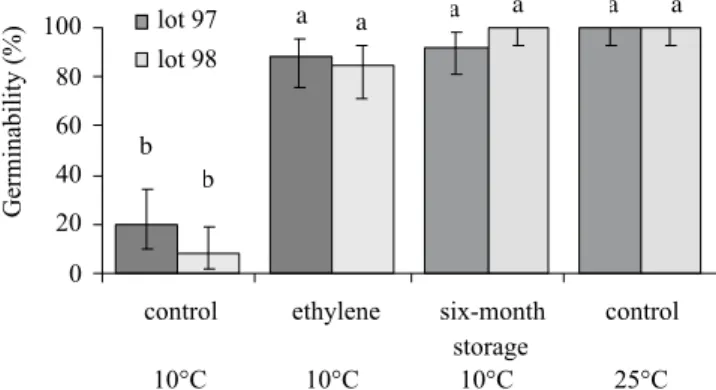
Ethylene breaks embryo dormancy in sunflower: Freshly harvested sunflower seeds are dormant at low temperatures (figure 1). Both after-ripening (six-month storage) and ethylene treatments (Corbineau et al., 1990) break the seed dormancy. These findings were corroborated in the present study for both seed lots (figure 1). Indeed, these results also showed that after-ripening can be substituted for ethylene treatment to remove embryo dormancy. The gas concentration employed in the experiments was enough to promote the germination of dormant sunflower embryos at 10 oC. Previous studies
have shown that isolated sunflower embryos are more responsive to ethylene treatments than intact seeds (Corbineau et al., 1990), probably due to the absence of a barrier to gas diffusion imposed by the seed coat (Bewley and Black, 1994). These results are consistent with previous publications (Corbineau et al., 1990) and indicated that ethylene is an efficient dormancy-breaking agent for sunflower embryos at low temperatures.
The embryos are no longer dormant at 25 oC and
128 F. BORGHETTI et al. 0 20 40 60 80 100 control 10°C ethylene 10°C six-month storage 10°C control 25°C G erm ina bi li ty (%) lot 97 lot 98 b b
a a a a a a
seeds present a high germinability at temperatures close to 25 oC (Corbineau et al., 1990). After dry-storage, the
seeds achieve a high germinability in a wider temperature range (5-40 oC) (Corbineau et al., 1990). The results show
that the primary dormancy in sunflower seeds is relative, that is, it manifests at low incubation temperatures (10 oC) but not at higher temperatures (close to 25 oC).
block the ethylene-induced germination, but lactacystin impaired it in a dose-dependent manner (figure 2). Overall, the germinability in DMSO, water, leupeptin and E64 was around 90 %, but it reached at most 20 % in presence of 80 µmol.L-1 lactacystin (figure 2). The
non-germinated embryos were still viable after seven days of incubation in lactacystin (data not shown).
Sunflower embryos are no longer dormant at 25 oC
and a high germinability (> 90 %) was recorded for embryos incubated in absence of ethylene (figure 1). Although lactacystin did not reduce the number of germinated embryos, it significantly increased the average germination time (figure 3). The average time for germination in lactacystin (t = 40.92 h ± 17.72) was statistically higher than in water (t = 28.8 h ± 15.07) (Student test, tcal = 4.23 >> t0.01 = 2.62). Also, this result showed that lactacystin is not lethal to the embryos, since the germinability was similar to that observed in water.
Figure 1. Effect of ethylene and six-month storage on the germination of dormant Helianthus annuus embryos at 10 oC and germination of dormant embryos at 25 oC (photoperiod of 10 h, 4 W.m-2 white light). Embryos were imbibed in water in the absence (control) or presence of ethylene (50 µL.L-1) at the indicated temperature. Bars represent 95 % confidence interval of the average germinability (Zar, 1999). Germinabilities followed by the same letter are not statistically different based on the Tukey’s multiple comparison test (p < 0.05).
The average germination times in the presence of ethylene are similar among different treatments: Except in the absence of ethylene, embryos of both lots exhibited similar germination kinetics (table 1). Indeed, embryos from lot 98 showed similar average germination times, irrespective the inhibitor employed (table 1). The similarity in the germination kinetics in water, DMSO and proteinase solutions indicates the absence of osmotic effects of the chemicals on germination, and shows in particular that lactacystin effects on germination at 10 oC
were in the germinability (see below) but not in the average germination time (table 1).
Lactacystin arrests the ethylene-induced germination of sunflower embryos at 10 oC: Less than 10 % of the
embryos germinated at 10 oC in absence of ethylene,
irrespective of the proteinase inhibitor tested (data not shown). At this temperature leupeptin and E64 did not
Table 1. Average germination time (t, in hours) and its
standard deviation (St, in hours) for germination of sunflower (Helianthus annuus) embryos at 10o C.
Treatment Treatment t St
(h) (h)
Air 148.8 10.73 b
Lot 97 a Ethylene 90.54 33.89 a
(50 µL.L-1)
After-ripening 97.04 24.52 a
Air 144 0
-Lot 98 b Ethylene 74.29 33.86 a
(50 µL.L-1)
After-ripening 91.2 22.19 b
Water 72.0 25.25 a
DMSO 54.55 11.21 a
(1.6%)
Lactacystin 72.0 25.25 a
(40 µM)
Lot 98 c Ethylene Lactacystin 75.43 25.66 a (50 µL.L-1) (80 µM)
E64 57.60 14.36 a
(10 µM)
E64 66.95 22.02 a
(50 µM)
Leupeptin 66.0 21.85 a
(5 µM)
0
20
40
60
80
100
0
24
48
72
96
Lactacystin
Water
Proteasome seems to be involved in the removal of dormancy by ethylene in sunflower embryos: Previous reports showed that proteinase inhibitors such as pepstatin A, PMSF, iodoacetic acid and EDTA were unable to block the germination of Cicer arietinum (Cervantes et al., 1994). Also, leupeptin and E64 were unable to prevent pollen germination and tube growth in Actinidia deliciosa
(Speranza et al., 2001). On the other hand, lactacystin was shown to impair physiological processes involving proteasome activity, such as metamorphosis in
Trypanosoma cruzi (González et al., 1996), tracheary
differentiation in Zinnia elegans (Woffenden et al., 1998) and pollen germination and growth in Actnidia deliciosa
(Speranza et al., 2001). These results show that proteasome activity is part of important events in plants such as cell differentiation and pollen tube formation. In particular, our results suggest that proteasome activity is also required for both the breaking of dormancy by ethylene and the progression of seed germination in sunflower embryos.
Most proteins eliminated by proteasome are modified by ubiquitin (Hilt and Wolf, 1996). Indeed, protein ubiquitination was observed during embryogenesis and seed germination for Lupinus albus (Ferreira et al., 1995) and Pisum sativum (Agustini et al., 1996). In particular, poly-ubiquitin mRNA and ubiquitinated proteins were shown to accumulate during embryogenesis in sunflower embryos (Almoguerra et al., 1995), and this pattern coincides with the establishment of dormancy toward maturation in this species (Le Page-Degivry and Garello, 1992).
The primary dormancy in sunflower seeds was shown to be induced by ABA(Bianco et al., 1994; Garello et al., 2000). On the other hand, ethylene is the main phytohormone involved in dormancy breaking for this species (Corbineau et al., 1990). Interestingly, recent results have shown that ABA and ethylene interact in their action, that is, they share several components of the ethylene signaling cascade in regulating aspects of plant development such as seed germination and root growth (Beaudoin et al., 2000; Ghassemian et al., 2000). However, no protein(s) involved in controlling dormancy has been identified so far (Koornneff et al., 2002).
The effects of lactacystin reported here implicate proteasome as part of the ethylene signal transduction pathway that leads to the removal of dormancy in embryos of sunflower. In addition, the reduction in the germination rate at 25 oC might indicate that the constitutive synthesis
of 20 S and 26 S proteasomes is also involved in the progression of embryo germination (Ito et al., 1997; Miyawaki et al., 1997).
Acknowledgements: The authors thank Dr. Adonai J.
Calbo (EMBRAPA/CNPH) for the supply of ethylene and to Dr. Marcelo F. de Oliveira (EMBRAPA/CNPSO) for providing the seeds. This work was supported by the Conselho Nacional de Desenvolvimento e Pesquisa (MCT-CNPq/Brazil).
0 20 40 60 80 100
40µΜ 80µΜ 5 µΜ 10µΜ 50µΜ 1.6%
b
c
a a a a a
Lactacystin Leupeptin E64 Water DMSO
Figure 2. Effects of proteinase inhibitors (µmol.L-1) on the ethylene-induced germination of dormant embryos of
Helianthus annuus (lot 98) at 10 oC (photoperiod of 10 h, 4 W.m-2 white light). The embryos were imbibed with 100 µL of the inhibitor-containing solution in the presence of ethylene (50µL.L-1). Water and DMSO (1.6 %) were the controls. Bars represent 95 % confidence interval of the average germinability (Zar, 1999). Germinabilities followed by the same letter are not statistically different based on the Tukey’s multiple comparison test (p < 0.05) (Zar, 1999).
Figure 3. Effects of lactacystin (80 µmol.L-1) on the germination of dormant Helianthus annuus embryos (lot 98) at 25 oC (photoperiod of 10 h, 4 W.m-2 white light). The average germination time is statistically higher in water than in lactacystin (Student’s t-test, p < 0.01). Bars represent 95 % confidence interval of the germinability (Zar, 1999).
G
e
rm
ina
bi
li
ty (%)
Hours
G
e
rm
ina
bi
li
130 F. BORGHETTI et al.
REFERENCES
Agustini V, McIntosh T, Malek L (1996) Ubiquitin and ATP levels in garden pea. Physiol. Plant. 97:463-468. Almoguerra C, Coca MA, Jordano J (1995) Diffferential accumulation of sunflower tetraubiquitin mRNAs during zygotic embryogenesis and developmental regulation of their heat-shock response. Plant Physiol. 107:765-773.
Asano M, Suzuki S, Kawai M, Miwa T, Shibai H (1999) Characterization of novel cysteine proteinases from germinating cotyledons of soybean (Glycine max L. Merrill). J. Biochem. 126:296-301.
Beaudoin N, Serizet C, Gosti F, Giraudat J (2000) Interactions between abscisic acid and ethylene signaling cascades. Plant Cell 12:1103-1115. Bewley JD (1997) Seed germination and dormancy. Plant
Cell 9:1055-1066.
Bewley JD, Black M (1994) Seeds: Physiology of Development and Germination, 2th edn. Plenum Press,
New York.
Bianco J, Garello G, Le Page-Degivry MT (1994) Release of Dormancy in Sunflower Embryos by Dry Storage: Involvement of Gibberellins and Abscisic Acid. Seed Sci. Res. 4:57-62.
Callis J (1995) Regulation of protein degradation. Plant Cell 7:845-857.
Cercós M, Santamaría S, Carbonell J (1999) Cloning and characterization of TPE4A, a thiol-protease gene involved during ovary senescence and seed germination in pea. Plant Physiol. 119:1341-1348. Cervantes E, Rodriguez A, Nicolás G (1994) Ethylene
regulates the expression of a cysteine proteinase gene during germination of chickpea (Cicer arietinum L.). Plant Mol. Biol. 25:207-215.
Corbineau F, Côme D (1995) Control of Seed Germination and Dormancy by the Gaseous Environment. In: Kigel J, Galili G (eds), Seed Development and Germination, pp. 397-424.Marcel Dekker, Inc., New York-Basel-Hong Kong.
Corbineau F, Bagniol S, Côme D (1990) Sunflower (Helianthus annuus L.) Seed dormancy and its regulation by ethylene. Isr. J. Bot. 39:313-325. De Castro RD, Hilhorst HWM (2000) Dormancy,
germination and the cell cycle in developing and imbibing tomato seeds. Rev. Bras. Fisiol. Veg. 12:105-136. Dick LR, Cruikshank A, Destree T, Grenier L,
McCormack TA, Melandri FD, Nunes SL, Palombella
VJ, Parent LA, Plamondon L, Stein RL (1997) Mechanistic studies on the inactivation of the proteasome by lactacystin in cultured cells. J. Biol. Chem. 272:182-188.
Domínguez F, Cejudo FJ (1999) Patterns of starchty endosperm acidification and protease gene expression in wheat grains following germination. Plant Physiol. 119:81-87.
Fenteany G, Schreiber SL (1998) Lactacyctin, proteasome, and the cell fate.J. Biol. Chem. 273:8545-8548.
Ferreira RMB, Ramos PCR, Franco E, Ricardo CPP, Teixeira ARN (1995) Changes in ubiquitin and ubiquitin-protein conjugates during seed formation and germination. J. Exp. Bot. 46:211-219.
Garello G, Barthe P, Bonelli M, Bianco-Trinchant J, Bianco J, Le Page-Degivry MT (2000) Abscisic acid-regulated responses of dormant and non-dormant embryos of
Helianthus annuus: Role of ABA-inducible proteins. Plant Physiol. Biochem. 38:473-482.
Ghassemian M, Nambara E, Cutler S, Kawaide H, Kamiya Y, McCourt P (2000) Regulation of abscisic acid signaling by the ethylene response pathway in
Arabidopsis. Plant Cell 12:1117-1126.
González J, Ramalho-Pinto EJ, Frevert U, Ghiso J, Tomlinson S, Scharfstein J, Corey EJ, Nussenzweig V (1996) Proteasome Activity is Required for the Stage-specific Tranformation of a Protozoan Parasite. J. Exp. Med. 184:1909-1918.
Hilt W, Wolf DH (1996) Proteasomes: destruction as a programme. Trends Biol. Sci. 21:96-102.
Ito N, Tomizawa K, Matsui M, Kendrick R, Sato T, Nakagawa H (1997) Characterization of 26S proteasome α- and β-type and ATPase subunits from spinach and their expression during early stages of seedling development. Plant Mol. Biol. 34:307-316. Johnson PR, Ecker JR (1998) The ethylene gas signal
transduction pathway: a molecular perspective. Annu. Rev. Genet. 32:227-254.
Kepczynski J, Kepczynska E (1997) Ethylene in seed dormancy and germination. Physiol. Plant. 101:720-726.
Kieber JJ (1997) The ethylene response pathway in
Arabidopsis. Annu Rev. Plant Physiol. Plant Mol. Biol. 48:277-296.
Labouriau LG (1983) A germinação das sementes. Monografias Científicas, Organização dos Estados Americanos, Washington.
Le Page-Degivry M-T, Garello G (1992) In situ abscisic acid synthesis. Plant Physiol. 98:1386-1390.
Li B, Foley ME (1997) Genetic and molecular control of seed dormancy. Trends Plant Sci. 2:384-389. Miyawaki M, Aito M, Ito N, Yanagawa Y, Kendrick R,
Tanaka K, Sato T, Nakagawa H (1997) Changes in proteasome levels in spinach (Spinacea oleracea) seeds during imbibition and germination. Biosci. Biotech. Biochem. 61:998-1001.
Morris CF, Anderberg RJ, Goldmark PJ, Walker-Simmons MK (1991) Molecular cloning and expression of abscisic acid-responsive genes in embryos of dormant wheat seeds. Plant Physiol. 95:814-821.
Murray PF, Giordano CV, Passeron S, Barneix AJ (1997) Purification and characterization of 20 S proteasome from wheat leaves. Plant Sci. 125:127-136.
Nicolás C, Rodríguez D, Poulsen F, Eriksen EK, Nicolás G (1997) The expression of an abscisic acid-responsive glycine-rich protein coincides with the level of seed dormancy in Fagus sylvatica. Plant Cell Physiol. 38:1303-1310.
Skoda B, Malek L (1992) Dry pea seed proteasome. Plant Physiol. 99:1515-1519
Sokal RR, Rohlf IJ (1995) Biometry. W.H. Freeman Co., New York.
Speranza A, Scoccianti V, Crinelli R, Calzoni GL & Magnani M (2001) Inhibition of proteasome activity strongly affects kiwifruit pollen germination. Involvement of the ubiquitin/proteasome pathway as a major regulator. Plant Physiol. 126:1150-1161. Vierstra RD (1993) Protein Degradation in Plants. Ann.
Rev. Plant Physiol. Plant Mol. Biol. 44:385-410. Woffenden BJ, Freeman TB, Beers EP (1998) Proteasome
inhibitors prevent tracheary element differentiation in
Zinnia mesophyll cell cultures. Plant Physiol. 118:419-430.
Yanagawa Y, Ohhashi A, Murakami Y, Saeki Y, Yokosawa H, Tanaka K, Hashimoto J, Sato T, Nakagawa H (1999) Purification and characterization of the 26S proteasome from cultured rice (Oryza sativa) cells. Plant Sci. 149:13-41.