http://psp.sagepub.com
DOI: 10.1177/0146167203029006002
2003; 29; 691
Pers Soc Psychol Bull
Max Weisbuch, Diane M. Mackie and Teresa Garcia-Marques
Prior Source Exposure and Persuasion: Further Evidence for Misattributional Processes
http://psp.sagepub.com/cgi/content/abstract/29/6/691
The online version of this article can be found at:
Published by:
http://www.sagepublications.com
On behalf of:
Society for Personality and Social Psychology, Inc.
can be found at:
Personality and Social Psychology Bulletin
Additional services and information for
http://psp.sagepub.com/cgi/alerts Email Alerts: http://psp.sagepub.com/subscriptions Subscriptions: http://www.sagepub.com/journalsReprints.nav Reprints: http://www.sagepub.com/journalsPermissions.nav Permissions: http://psp.sagepub.com/cgi/content/refs/29/6/691
SAGE Journals Online and HighWire Press platforms): (this article cites 26 articles hosted on the
10.1177/0146167203252808 ARTICLE PERSONALITY AND SOCIAL PSYCHOLOGY BULLETIN
Weisbuch et al. / IMPACT OF PRIOR SOURCE EXPOSURE
Prior Source Exposure and Persuasion:
Further Evidence for Misattributional Processes
Max Weisbuch Diane M. Mackie
University of California, Santa Barbara
Teresa Garcia-Marques
Instituto Superior de Psicologia Aplicada, Lisbon, Portugal
To assess the persuasive impact of prior source exposure, two studies paired persuasive messages with a source to whom partic-ipants had previously been exposed subliminally, explicitly, or not at all. In Experiment 2, participants’ attention also was drawn to information that potentially undermined the implica-tions of any reaction to re-exposure. Compared to no exposure, prior subliminal exposure increased the source’s persuasiveness, an effect not mediated by source liking. Explicit exposure increased source persuasiveness to the extent that the source was liked more and only absent a recall cue. Results favored misattributional accounts of prior exposure effects.
Keywords: persuasion; attitude change; mere exposure; perceptual flu-ency; attribution; subliminal
A
spokesperson appears on public television to solicit a donation. A student questions the basis of a class grade. A local citizen wants your vote for city council. Does having seen the source of such appeals before make a difference to their persuasiveness? Advertisers apparently think so, as indicated by the roughly 20% of television commer-cials that feature well-known spokespeople (Agrawal & Kamakura, 1995). Of course, being well-known may entail much more than previous exposure. Despite impressive amounts of research on source effects (Petty, Wegener, & Fabrigar, 1997), including the impact of celebrity status (Roskos-Ewoldson & Fazio, 1992), there have been few investigations of the impact of prior expo-sure to a persuasive source. Does such prior expoexpo-sure make a persuasive appeal more or less effective? Under what circumstances, and why? To help address these questions, the two experiments reported here extended models of prior exposure effects developed in other domains to the persuasion context.Prior exposure effects are well established in a num-ber of other research areas. More than 200 experiments demonstrate that prior exposure results in increased attraction or liking for a re-exposed person or object (Bornstein, 1989; Kunst-Wilson & Zajonc, 1980; Seamon, Brody, & Kauff, 1983; Zajonc, 1980, 2000), the so-called mere exposure (ME) effect (Zajonc, 1968). In ME studies, participants are re-exposed to a target lus and asked to either choose between that target stimu-lus and a similar but novel stimustimu-lus or evaluate the target stimulus typically as good/bad, attractive/unattractive, likable/unlikable, for example. Such context-restricted procedures routinely result in greater preference for and more positive responses to the re-exposed object, although ME effects have been demonstrated in natural settings as well (Zajonc & Rajecki, 1969).
Affective primacy (AP) accounts (Monahan, Murphy, & Zajonc, 1999; Murphy, Monahan, & Zajonc, 1995; Zajonc, 1980, 1998, 2000) regard ME effects as arising because repeated exposure causes an automatic positive evaluation of the re-exposed stimulus together with a global positive affective state (Monahan et al., 1999). Evi-dence that ME effects occur across cultures and species has been interpreted as especially supportive of the AP position that such positive evaluations are primary to
Authors’ Note:This research was supported by a National Science Foundation Graduate Research Fellowship to Max Weisbuch and by National Science Foundation Grant No. BCS-9975204 to Diane M. Mackie and Teresa Garcia-Marques. We are grateful that Lisa Silver and Michael Raimundo were able to provide assistance with data collec-tion. Correspondence regarding this article should be sent to Max Weisbuch, Psychology Department, University of California, Santa Barbara, CA 93106; e-mail: [email protected].
PSPB, Vol. 29 No. 6, June 2003 691-700 DOI: 10.1177/0146167203252808
and independent of cognition (Zajonc, 1980, 1998, 2000). In fact, Zajonc (1998) suggested that “a cognitive explanation (for) the exposure effect (is an argument) which, given the current state of evidence, should be laid to rest” (p. 617). Thus, the AP approach holds that increases in liking for and a concomitant global affective reaction to a stimulus are automatic responses to re-exposure.
Misattribution (MA) models of prior exposure effects (Bornstein & D’Agostino, 1994; Jacoby, Kelley, & Dywan, 1989; Klinger & Greenwald, 1994), on the other hand, argue that re-exposure triggers an initial response that reflects a match between a currently processed stimulus representation and a previously encoded representation (Carlston & Smith, 1996; Jacoby & Kelley, 1987; Klinger & Greenwald, 1994; Seamon et al., 1983). Although posi-tive in tone (Bornstein, 1989; Jacoby & Dallas, 1981; Reber, Winkielman, & Schwarz, 1998; Seamon, McKenna, & Binder, 1998), this initial reaction is rela-tively ambiguous and can thus be attributed (or misattributed) to many salient or feasible causes (Jacoby, Allan, Collins, & Larwill, 1988; Jacoby & Kelley, 1987; Jacoby, Kelley, & Dywan, 1989; Mandler, Nakamura, & Van Zandt, 1987; Reber et al., 1998). When the re-exposed object is the focus of attention (as typically occurs in the ME paradigm), the object itself is the best (and correct) explanation for the positive response, pro-ducing higher attractiveness or liking ratings. However, when re-exposure occurs and other objects also are pres-ent (perhaps the most naturalistically frequpres-ent situa-tion), the positive response may be misattributed to other probable causes, with no increase in attractiveness of the re-exposed object itself.
In these situations, repeated exposure has been found to cause favorable evaluations of a variety of prop-erties (e.g., Jacoby, Kelley, Brown, & Jasechko, 1989; Mandler et al., 1987; Reber et al., 1998; Seamon et al., 1995, 1998; Witherspoon & Allan, 1985) and is some-times unaccompanied by global liking or preference for the re-exposed stimulus itself (Bornstein et al., 1987; Jacoby et al., 1988). For example, Jacoby et al. (1988) conducted an auditory re-exposure experiment with a salient distracting variable—noise. In this experiment, participants completed a number of trials in which they first listened to a sentence through headphones and sub-sequently heard either the same sentence or a different sentence accompanied by annoying noise. Self-reported noise volume ratings were made after each trial. Partici-pants rated annoying noise as being “less loud” when they were simultaneously re-exposed to target sentences compared to when they were hearing the sentences for the first time. Thus, the reaction to re-exposure was sub-jectively explained by a probable salient cause unrelated to positive evaluation.
The AP and MA models, then, offer different predic-tions regarding the nature and specificity of the response to re-exposure. They differ, for example, in whether such an initial reaction results inevitably in global liking judgments (the AP position) or whether such a reaction can be more generally misattributed to other judgment dimensions, without increases in liking or attractiveness (the MA position). These models also differ in their predictions regarding the effects of implicit (unknown) versus explicit (known) initial expo-sure to a stimulus. AP proponents have argued that although implicit exposure may be more purely “affec-tive” and thus produce more positive evaluations of the re-exposed object (Monahan et al., 1999), such ME effects are not contingent on the initial exposure being implicit (Murphy et al., 1995; Zajonc, 1998). Thus, increased liking for the re-exposed object is expected regardless of whether initial exposure is implicit or explicit, although it may be even greater when exposure is implicit. Quite different expectations derive from the MA perspective. When the initial exposure is explicit, an attributional (Jacoby & Kelley, 1987) or attentional (Posner, 1978) specification can occur, making object-specific evaluative attributions more likely. That is, evalu-ation of the re-exposed object may be more positive with explicit exposure (at least in the absence of a “naive the-ory” about the relationship between prior exposure and favorable attributions) (Bornstein & D’Agostino, 1994). In contrast, when the initial exposure is implicit, the re-exposed stimulus is not necessarily a clear attributional target for the positive reaction, particularly when there are multiple categories of stimuli present at re-exposure. Thus, increased liking for the seen-again object is less likely when exposure is implicit.
What do such models predict about source exposure effects in persuasion? From an AP perspective, both implicit and explicit prior exposure to a source should lead to increases in attraction for that source relative to a novel source, with the increase potentially greater for implicit exposure. Greater source attractiveness may then produce greater acceptance of the source’s mes-sage (Cialdini, 1993; Hass, 1981; Perloff, 1993; Petty & Wegener, 1998). Although such effects are especially strong when peripheral processing occurs (e.g., Petty, Cacioppo, & Schumann, 1983), the relationship between source attractiveness and persuasiveness also has been demonstrated in central processing contexts, such as courtroom settings and federal elections (for a review, see Petty et al., 1997; see also Cialdini, 1993; Kulka & Kessler, 1978). From an AP perspective, the causal direction of these effects is clear: Re-exposure causes an automatic affective reaction to the source (indicated by increased attraction) that mediates the increased persuasiveness of the re-exposed source.
From the MA perspective, the positive reaction to re-exposure might be attributed to either the source or other salient aspects of the re-exposure setting, such as the persuasive appeal. When the seen-again source is known (prior exposure was explicit), the source is a likely attributional target for the positive reaction (Jacoby & Kelley, 1987; Posner, 1978), resulting in increased source liking, which may then translate into message acceptance as just described. In this case, increases in the persuasive appeal of a known source would be due to, and mediated by, source liking and attractiveness. When the seen-again source is not known (prior exposure was implicit), however, the source is not necessarily a clear target for the positive reaction. Instead, the positive reaction may well be misattributed to other available targets of evaluation, in this case per-haps, greater liking for or agreement with the position advocated in the persuasive appeal. In this case, any greater persuasiveness of a previously exposed source would occur without a commensurate increase in source liking, a crucial difference between the AP and ME models.
To assess the impact of source re-exposure on mes-sage persuasiveness and the role of affective primacy and misattributional processes in such impact, we presented participants with an essay comprised of weak or strong arguments in favor of an initially neutral issue. The essay was accompanied by a small photo of its author. Some participants had never seen the author before. Others had been exposed either explicitly or implicitly (sublimi-nally) to her face earlier in the experiment. We assessed source liking and message agreement as a function of these three exposure conditions. We expected that com-pared to the no exposure condition, both implicitly and explicitly exposed sources would be more persuasive. The AP position suggested more positive evaluations of the source in both prior exposure situations, increased persuasion in both conditions (potentially higher in the implicit condition), and mediation of any persuasion by perceived source attractiveness in both cases. The MA position predicted greater source liking only in the explicit condition, greater persuasion in both condi-tions, and mediation of persuasion by attraction only in the explicit condition. We included a manipulation of argument strength to assess any effects of source expo-sure on message processing.
EXPERIMENT 1
Participants and Design
The study included 111 female University of Califor-nia, Santa Barbara (UCSB), undergraduate students (age 18-21) who participated in this experiment in exchange for partial course credit. They were randomly assigned to the cells of a 3 (explicit exposure, implicit
exposure, or no exposure)× 2 (strong or weak persua-sive arguments) between-subjects factorial design.
Method PROCEDURE
After completing several unrelated questionnaires as part of a separate experiment, participants were instructed to follow instructions as they appeared on a computer monitor. Presentation of all instructions and stimuli and collection of all responses were controlled by SuperlabTMsoftware.
Participants were told that their first task involved answering questions about individuals whom they would see only briefly. Participants in all conditions then saw a sequence of 19 1.5-in. square monotone photographs of eight women’s faces, presented 1-in. above the center of the monitor (approximately equal to average eye level), horizontally centered. One face appeared 4 times; the other faces appeared between 1 and 3 times. Each expo-sure was 1 sec, with the next face following immediately in a randomly predetermined order (provided that the same face could not be presented twice in a row).
Manipulation of source exposure. In the no exposure
con-dition, the target face (i.e., the source of the persuasive message) was not presented. The implicit condition was identical to the unexposed condition, except that four subliminal 23-msec exposures of the target face were randomly inserted into the sequence (because all photos were presented in the same space and there were no pauses between faces, presentation in the implicit condi-tion was both backward and forward masked). The explicit condition was identical to the unexposed condi-tion except that the face presented 4 times was the target face.1 To bolster the cover story, all participants then answered several irrelevant questions about the group of persons they had just seen. Participants then viewed instructions for the second task. They were again to answer questions about a person, but this time they would receive more information: both her photograph and an essay she had written. Participants were asked to read the essay carefully.
Manipulation of argument strength. A 200-word essay was
then presented on the computer screen accompanied by a square 1.5-in.× 1.5-in. monotone photograph of the target face in the upper left hand corner. The essay advo-cated the position that taxes should be raised to help repair freeways (pretesting had indicated that the sub-ject population was neutral on the issue, M = 4.68, Mdn = 5 on a 9-point scale, and regarded it as of moderate importance and relevance, Ms = 4.53 and 4.40, respec-tively, on 9-point scales). This claim was supported by four arguments. In the strong argument condition, four arguments (e.g., “a tax rate hike to repair our freeways at
this time would save the taxpayers from an even larger tax rate hike which would be necessary in approximately 7 years, according to the state government”) shown in pre-testing to be strong and valid were combined. The weak argument condition message combined four argu-ments (e.g., “considering that our freeways are some-what unsightly and boring, this tax rate increase could repair some of our highways unattractiveness”) shown to be weak and invalid in pre-testing. Pilot testing with 33 undergraduate participants confirmed that ratings of argument strength (using a 9-point scale ranging from
weak to strong) were significantly higher for the strong
essay (M = 5.78) than the weak essay (M = 2.87), t(32) = 4.62, p < .001.
Dependent variables. Participants then responded to
three key items. Using a 7-point scale with the endpoints labeled disagree and agree, they rated their agreement with the advocated position (“Taxes should be raised to help repair freeways”). They also reported the perceived attractiveness of the source and the validity/correctness of the arguments in the essay using 7-point scales with endpoints labeled not at all and very. Participants also rated the pleasantness of the source and difficulty of the presented message; neither produced significant effects or interactions and they will not be discussed further. Finally, participants were probed for suspicion, thanked, and debriefed.
Results and Discussion
Data from 6 participants were lost due to software fail-ure. Thus, the final sample size was 105 participants.
AGREEMENT
We submitted participants’ reported agreement with the essay to a 3 (no, implicit, or explicit exposure)× 2 (weak or strong argument message) analysis of variance (ANOVA). As expected, the strong essay elicited more agreement than the weak one, F(1, 99) = 43.59, p < .001. More important, there was a main effect of exposure,
F(2, 99) = 8.61, p < .05, unimpeded by an interaction with
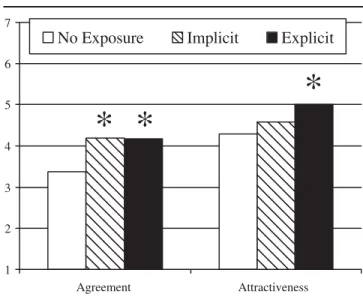
argument quality (p > .5). Because we had a priori hypotheses concerning source exposure compared to no exposure, separate planned contrasts were con-ducted comparing responses in each of the exposure conditions to those in the no exposure condition. Compared to the no exposure condition (M = 3.37), par-ticipants agreed with the essay more both when they had been explicitly exposed to the source (M = 4.18), F(1, 99) = 4.89, p < .05, and when they had been implicitly exposed to the source (M = 4.19), F(1, 99) = 5.83, p < .05 (see Figure 1). Thus, both implicit and explicit prior exposure to the source increased agreement. The lack of an interaction between exposure and argument quality is inconsistent with the position that prior exposure
influenced the amount of elaboration under these circumstances.
PERCEIVED ATTRACTIVENESS OF THE SOURCE
An identical 3× 2 ANOVA on attractiveness ratings revealed a marginal main effect of exposure, F(1, 99) = 2.52, p < .09, with no other significant main effects or interactions. Planned contrasts revealed that the source was rated as more attractive (M = 5.00) when participants had been explicitly exposed to her than when they had never seen her before (M = 4.29), F(1, 99) = 5.0, p < .05. In contrast, the source was not seen as more attractive when exposure was implicit (M = 4.58) than when there was no exposure, F(1, 99) < 1, ns (see Figure 1). The higher attractiveness ratings conferred on the explicitly exposed source relative to the implicitly exposed source suggest that the explicitly exposed source was the clear object for attribution of positivity, whereas the implicitly exposed source was not, a finding consistent with the MA position.
MEDIATION OF MESSAGE AGREEMENT BY SOURCE ATTRACTIVENESS
To provide evidence for the process underlying agree-ment with the explicitly exposed source, we assessed the extent to which re-exposure to the source increased agreement with the advocated position as a consequence of source attractiveness. To provide support for this mediational claim, we coded explicitly exposed source participants as “1” and unexposed source participants as “0,” reflecting our exposure manipulation, and entered this exposure variable into two regression equations, one predicting attractiveness and one predicting agreement. 1 2 3 4 5 6 7 Agreement Attractiveness
No Exposure
Implicit
Explicit
* *
*
Figure 1 Agreement with and attractiveness of the source as a func-tion of source exposure, Experiment 1.
NOTE: Asterisks indicate a significant difference (p < .05) from the un-exposed source condition.
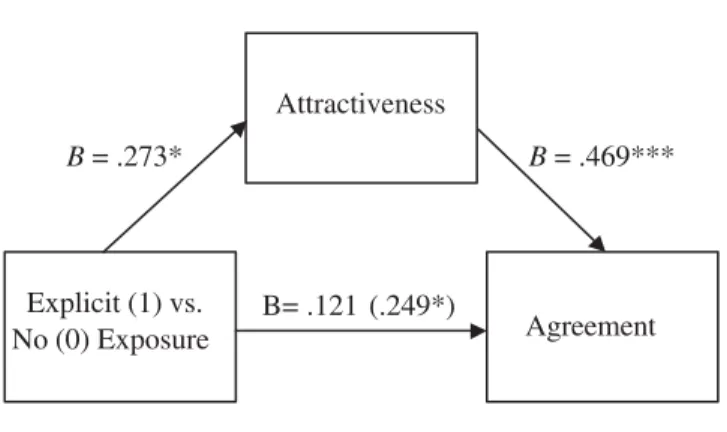
Consistent with already described analyses, the exposure variable significantly predicted both source attractive-ness and message agreement, as indicated by the positive and significant Beta weights (B = .27 and .25, respec-tively, both p < .05; see Figure 2). When rated attractive-ness was simultaneously entered with the exposure vari-able, rated source attractiveness positively and significantly predicted agreement with the essay (B = .47,
p < .001). More important, the persuasive effect of
previ-ous explicit exposure to the source dropped dramati-cally when rated attractiveness was simultaneously entered, as indicated by the large decrease in Beta (from .25 to .12). A Sobel test revealed that this decrease was significant, Z = 2.09, p < .05. Thus, the greater persuasive-ness invoked by explicit prior source exposure com-pared to when the source was novel depended on the greater attractiveness that prior explicit exposure generated.
Because implicit source exposure did not predict attractiveness ratings, mediation tests such as those performed in the explicit source exposure condition were not appropriate (see Baron & Kenny, 1986). The greater persuasiveness obtained in the implicit exposure condition could not have been mediated by greater attractiveness.
PERCEIVED ARGUMENT VALIDITY AND CORRECTNESS
To check that our messages were perceived as intended, we asked participants to indicate how valid and correct the arguments were. The same 3× 2 ANOVA conducted on these scores revealed an expected main effect for argument quality, indicating that strong mes-sages (M = 9.88) were perceived as more valid than weak messages (M = 5.09), F(1, 99) = 128.19, p < .001. There was also a main effect of exposure, F(2, 99) = 5.42, p < .01, and a significant interaction between the two factors,
F(2, 99) = 6.0, p < .001. Of importance, there were
signifi-cant differences (all p < .01) between strong and weak messages within each level of source exposure (a result that is inconsistent the idea that prior exposure influ-enced the amount of elaboration). However, simple effects tests revealed that this difference was smallest in the explicit source condition where participants rated weak arguments as more valid (M = 6.94) than they did in the novel (4.05) and implicit source (4.37) conditions,
F(1, 99) = 16.08, p < .001. No such differences occurred
on strong arguments or when comparing implicit expo-sure to no expoexpo-sure. Because explicit expoexpo-sure did pre-dict validity (B = .23, p < .05) we checked to see if validity also mediated the explicit exposure-persuasion effect. When validity was simultaneously entered with explicit exposure, validity predicted persuasion (B = .69, p < .001) and reduced the influence of explicit exposure (from B = .25 to B = .08). A Sobel test indicated that this
reduction was marginally significant, Z = 1.95, p < .06. Of importance, further analyses showed that the relation-ship between explicit source exposure and agreement continued to be mediated by source attractiveness, even when accounting for this “biased processing” effect. When argument validity was included with exposure and attractiveness to predict persuasion, attractiveness con-tinued to strongly predict persuasion (p < .001), as did validity (p < .001), indicating that the two mediational effects were relatively independent. Thus, independent of the fact that argument validity marginally mediated the impact of explicit exposure on persuasion, explicit exposure clearly facilitated source attractiveness ratings, which, in turn, influenced the persuasiveness of the mes-sage. Because implicit exposure did not influence per-ceived argument validity, the effect of implicit exposure on persuasiveness was not mediated by this variable.
The findings from Experiment 1 indicate that both implicit and explicit prior exposure can be valuable per-suasive tools for a message source, even on a topic that is moderately relevant and important to message recipi-ents and even when participants were asked to read the message carefully. Our participants certainly appeared to process the persuasive appeal quite carefully, as indi-cated by their clear differentiation of the persuasive impact of strong and weak arguments, regardless of exposure condition. Nevertheless, prior exposure to the source had clear persuasive impact. Even in this moti-vated processing setting, simply presenting the source’s face ahead of time—even when completely masked and outside of awareness—increased that source’s persua-sive effectiveness.
Our results also show that gains in the source’s persua-sive ability occurred through different processes depending on the nature of the initial exposure. When
Weisbuch et al. / IMPACT OF PRIOR SOURCE EXPOSURE 695
Explicit (1) vs. No (0) Exposure Attractiveness Agreement B = .469*** B = .273* B= .121 (.249*)
Figure 2 Mediation of the relation between explicit source exposure and persuasion.
NOTE: B indicates the beta weight associated with the effect. The par-enthetical number indicates beta before including rated attractive-ness. Asterisks indicate a significant difference from 0.
initial exposure was explicit, the source was rated as more attractive, which consequently led to increased agreement (as did the increased validity of weak arguments). When exposure was implicit, however, re-exposure led to agreement with a message persuasively argued by that source in the absence of greater source attractiveness or perceived argument validity. This pat-tern of results is more consistent with MA than AP mod-els of the effects of re-exposure. In particular, it appears that re-exposure to a face that participants had unknow-ingly seen before resulted in a reaction that was not directly attributed to the source but rather to an argu-ment made by that source. In fact, a similar result has appeared previously in the literature. When Bornstein, Leone, and Galley (1987) asked participants to resolve a trivial disagreement between two confederates, partici-pants were more likely to resolve the issue in favor of a confederate whose face had been subliminally pre-sented earlier in the experiment, but they did not report liking the previously presented confederate more.
EXPERIMENT 2
We have suggested that the pattern of our results is more consistent with an MA model of re-exposure effects in that such a model allows for the attribution of the posi-tive reaction triggered by stimulus re-exposure to other plausible stimuli in the re-exposure context. One impor-tant caveat of such re-exposure/attribution effects is that neither the process of exposure attribution nor the effects that it has on later judgments need be open to conscious awareness (Petty & Wegener, 1998; Strack, Schwarz, Bless, Kuebler, & Wanke, 1993) or understand-ing (Bargh, 1994; Bargh & Chartrand, 2000). In fact, par-ticipants typically experience mere exposure reactions to explicitly exposed objects (see Bornstein, 1989; Murphy et al., 1995) even though the mere exposure paradigm is relatively straightforward. Nevertheless, the attributional potential inherent in MA models suggests that the process involved with re-exposure effects is more open to conscious disruption than would be suggested by the AP model, which argues that preference for the exposed object automatically results from re-exposure.
To provide further evidence in support of the attributional position, we focused in a second experi-ment on conditions that typically undermine or inter-fere with misattribution of the positive reaction. If a plau-sible cause of the positive reaction evoked by re-exposure is available and accessible, the informational value of that positive reaction can be undermined and typical re-exposure effects can be eliminated. Jacoby, Kelley, Brown, et al. (1989, Experiment 2) provided evi-dence for this limiting condition by showing that making explicit (at re-exposure) the fact that names have been
seen previously undermined the typical false fame effect (also see Bornstein & D’Agostino, 1994). Rather than misattributing the exposure-based reaction to the fame of a name, participants were presumably able to attribute their reaction to the exposure itself. As Bornstein and D’Agostino (1994) note, such findings are difficult to explain with an AP model of re-exposure effects (which posits an automatic affective preference for the re-exposed object) but are consistent with MA reasoning. Of course, when participants do not know they have been previously exposed, attribution of any positive reac-tion to prior exposure is unlikely. When prior exposure is implicit, participants should have no reason to see an exposure manipulation as having an effect on them and thus no reason for attributing their positive reaction to it.
In a second experiment, we adapted Bornstein and D’Agostino’s (1994) technique and asked participants to accurately recall whether they had seen the source dur-ing the exposure phase. We expected such a manipula-tion to eliminate exposure effects when prior exposure was explicit but not when it was implicit, lending further support to the MA position. We predicted that when prior exposure became obvious to participants (when exposure was explicit), the previously exposed source would no longer be rated as more attractive than other sources and thus would be no more persuasive than a control source. However, when prior exposure could not be made obvious (when exposure was implicit), the source’s message would be more persuasive than a mes-sage authored by an explicitly exposed or novel source.
We also wanted to resolve some methodological ambi-guity in the first experiment about why there was more agreement with the implicitly exposed source. We sug-gested that in the implicit source condition, the positive reaction triggered by re-exposure is misattributed to a salient plausible cause in the re-exposure context—in this case the position advocated in the message. How-ever, because the first question participants responded to focused on their agreement, it is possible that ques-tion placement is what drove their apparent attribuques-tion (for a similar argument, see Mandler et al., 1987). To assess this possibility, in Experiment 2, we asked partici-pants to report their agreement last, after items concern-ing source attractiveness and argument validity. If attri-bution occurred to a plausible cause online, then the implicitly exposed source should continue to be more persuasive. If, on the other hand, attributions are made to the first evaluative question after re-exposure, then implicitly exposed sources should be rated as more attractive. In sum, we expected source gains in persua-sion due to implicit exposure (but not explicit exposure) to be immune to interventions occurring after the exper-imental manipulations.
Method
PARTICIPANTS
The study included 43 female UCSB students who participated in this experiment in exchange for partial credit in an introductory class.
PROCEDURE
General instructions and the manipulation of expo-sure were identical to Experiment 1. Participants saw only weak arguments presented in favor of road taxes.2 As soon as participants had finished reading the article they used the “0” (no) or “1” (yes) keys to answer the question, “Please try to be accurate in answering the fol-lowing question to the best of your abilities: Was there a photo of the author of the essay in the ‘rapid succession of faces’ that you saw just before you read the essay?” We then assessed source attractiveness, argument validity, and last, message agreement using the items described in Experiment 1.
Results and Discussion RECALL CUE RESPONSES
Participants in the explicit prior exposure condition were significantly more likely (M = .94, p < .05) to cor-rectly respond that they had seen the source than those in the unexposed (M = .59) and implicit exposure (M = .71) conditions, which did not differ from one another (p > .19). Thus, all but one of the participants in the explicit exposure condition were correctly aware of hav-ing seen the source before (i.e., there had been an impact of prior exposure and participants knew there had been prior exposure).3
AGREEMENT RATINGS
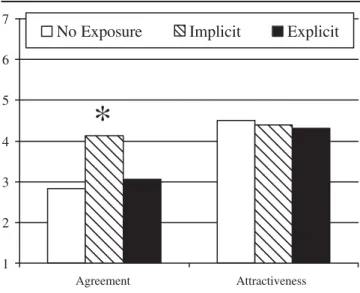
A priori–based planned contrasts revealed that the implicitly exposed source continued to exert an influ-ence on participants’ agreement (M = 4.13) compared to both the unexposed source (2.83), F(1, 41) = 5.102, p < .05, and the explicitly exposed source (3.06), F(1, 41) = 4.02, p < .06, where these latter two sources did not differ from one another, F < 1, ns (see Figure 3). Consistent with these contrasts, an ANOVA revealed a main effect of exposure that bordered on significant, F(2, 40) = 3.104, p = .056. Thus, it appears that source gains in persuasive ability produced by implicit exposure continued, despite the recall cue. However, persuasive gains due to explicit exposure were eliminated when people could correct for their prior exposure.
ATTRACTIVENESS RATINGS
A priori–based planned contrasts revealed that there was no effect of explicit source exposure on attractive-ness ratings, F < 1, ns (see Figure 3). In fact, the highest mean for this question came from the unexposed
condi-tion. The recall item apparently undermined source gains in attractiveness due to the explicit exposure manipulation in Experiment 1. Presumably, this was why the explicitly exposed source was no longer more per-suasive than the unexposed source. That is, had the explicitly exposed source been seen as more attractive, she also should have been more persuasive (attractive-ness ratings continued to be correlated with agreement ratings, r = .44, p < .05). Instead, the recall item allowed participants to attribute the positivity arising from explicit exposure to the manipulation itself, and there was no reason to account for the positivity by rating the source as more attractive. As a result, the explicitly exposed source no longer enjoyed gains in per-suasiveness.
There was no effect of explicit source exposure on perceived argument validity, as there had been in Exper-iment 1.
The results of Experiment 2 provide further evidence in favor of an attributional model of prior exposure and suggest that the effect of implicit (subliminal) source exposure on agreement ratings is relatively robust to conditions that typically undermine misattribution. As predicted by the MA model, when a subtle cue is pro-vided that discredits the explicit exposure-related response, the effects (such as those noted in Experiment 1) caused by being exposed to a previously seen source are eliminated. Thus, the explicitly exposed source was no longer rated as more attractive, and the source was not more persuasive. However, because the subliminal exposure manipulation was not accessible to partici-pants, the implicitly exposed source continued to be more persuasive than the other sources.
Weisbuch et al. / IMPACT OF PRIOR SOURCE EXPOSURE 697
1 2 3 4 5 6 7 Agreement Attractiveness
No Exposure
Implicit
Explicit
*
Figure 3 Agreement with and perceived attractiveness of the source as a function of source exposure, Experiment 2.
NOTE: Asterisks indicate a significant difference (p < .05) from the un-exposed source condition.
Furthermore, it appears that attribution of the positivity associated with re-exposure to the implicit source occurred online. That is, more positive judg-ments were not made to the first question asked but rather were made to agreement with the source’s appeal. Implicitly exposed sources were immune to interven-tions occurring after the manipulainterven-tions.
GENERAL DISCUSSION
Across two studies, people were persuaded to a greater extent by a source to whom they had been (previ-ously) subliminally exposed than by a novel source. Because that prior exposure was unavailable to aware-ness (as pilot testing showed), this persuasive advantage remained even when participants were queried about the possible effect of prior exposure to the source. Par-ticipants also were more persuaded by a source that they had knowingly seen than by a novel source. However, this latter effect had several contingencies. First, it only occurred to the extent that the previously seen source was rated higher on attractiveness than the novel source (Experiment 1). Second, the persuasive effect was elimi-nated when participants’ attention was drawn to the fact that they may have seen the source earlier (Experiment 2). Despite the very small differences in exposure time in the different conditions, explicit, implicit, and no prior exposure to the source had quite distinct persuasive outcomes.
Although these effects should of course be replicated in other experimental designs and contexts with other sources and persuasive issues, the pattern of results across the two studies was more consistent with MA than AP explanations of repeated exposure. The results were not consistent with the idea that increased attraction for a exposed object is an automatic consequence of re-exposure, as had been suggested by Zajonc and his col-leagues (Murphy et al., 1995; Zajonc, 1980, 2000). When prior exposure was implicit, arguably the condition in which AP effects should be strongest, participants showed increased acceptance of a persuasive message without finding the re-exposed object (the message source) more attractive (or the arguments more valid). These findings are consistent with the idea that the ME effect may well be a specific instance of an attribution to re-exposure, as others have argued (Bornstein & D’Agostino, 1994; Jacoby, Kelley, & Dywan, 1989; Klinger & Greenwald, 1994).
For experimental social psychologists, one advantage of using subliminal manipulations is that an experi-menter can be sure that participants are not explicitly aware of the influence of the independent variable on later thought, feeling, and behavior (Bargh, 1992). Nev-ertheless, there are probably a great many stimuli to which we are exposed on a daily basis that are
function-ally subliminal—for one reason or another we are unaware of exposure and unaware of the influence of exposure. Jacoby and Kelley (1990) suggest that when we are unaware of an influence, or have forgotten that the influence took place, we easily misattribute the exter-nally caused impact of that influence to an internal state or drive. Similarly, Bargh (1994) notes that “the unawareness of an influence on thought . . . precludes the possibility of controlling that influence . . . and makes likely that one would attribute the cause (of one’s psycho-logical state) to more salient possible causes” (p. 13).
These statements certainly appear true of the tech-nique of implicitly exposing message recipients to the sources of those messages. Implicit prior exposure to a source—where the participants were unaware of that influence—led participants to misattribute their reac-tion to internal agreement with the source’s message, at least under conditions that made the message the focus of their attention at the time of re-exposure. Similarly, implicit prior exposure to the source made that source’s resultant persuasive advantage invulnerable to correc-tion or control, at least with the technique we used. All other things being equal, then, employing a seen-before source whom message recipients (voters, consumers) are not likely to recall previously encountering seems even more persuasively fruitful than employing a source whom consumers know that they have seen before. Although a recognizably familiar source also can reliably aid persuasion, that influence is likely to occur via source attraction (and perhaps perceived argument validity) and appears more vulnerable to disruption than the influence of an implicitly familiar source. At the same time, it is important to note that the implicit source’s per-suasive edge occurred when attention was focused on the persuasive appeal modally and spatially associated with source re-exposure (for a similar discussion, see Kelley & Jacoby, 1998). Otherwise, the initial response to re-exposure may be attributed to the source itself, and then the influence of that source would be subject to the same contingencies as the explicitly exposed source.
These findings can be integrated into the larger litera-ture on source effects and attitude change. The current findings are in harmony with such source effects in at least one respect—as in previous research, a manipula-tion that increased the source’s perceived attractiveness led to an increase in that source’s persuasive power (explicit condition, Experiment 1). However, these find-ings also suggest the benefit of adding the source charac-teristic of familiarity to the list of features typically associ-ated with source effects (credibility, expertise, and attractiveness; e.g., see Petty & Wegener, 1998) because little is currently known about this obviously impactful source quality. In addition, several studies have shown that the impact of repetition can be mimicked by
alter-ing various perceptual features of the target stimulus. For instance, Reber et al. (1998) altered the figure-ground contrast of the target, with greater contrast resulting in higher ratings. It is therefore possible that source effects accruing from repetition (such as those reported here) may be explained by a broader model that considers the ease with which the source’s face is perceptually processed (e.g., perceptual fluency; see Jacoby, Kelley, & Dywan, 1989, for a review). It there-fore seems instructive to consider perceptual features associated with any source that may make that source easy or hard to process perceptually with multiple consequences.
Processing ease also may be related to the availability of a particular feature for explanatory attribution, a pos-sibility about which we also currently know little. In our results, whether subjects were or were not aware of prior exposure had decidedly different persuasion outcomes. Other quantitative changes in source characteristics might have similar effects. For instance, individuals exposed to a subtly attractive source may be more inclined to accept the source’s persuasive appeal than if the source is highly and obviously attractive (e.g., because of suspicion of being influenced; Petty, Wegener, & White, 1998; because of being distracted by her appearance—this may account for why source attrac-tiveness effects are less amenable to systematic process-ing situations; Pallak, 1983).
Future research should be directed to several issues left unresolved by our current findings. Our results show that the implicitly exposed source had an impact on atti-tude change, independent of the argument quality and even when the attitude issue was moderately important. Although it was clear that this effect was not mediated by source attractiveness (as in the explicit exposure condi-tion), it was not clear what processes might mediate it (argument validity did not seem to). If future research were able to find a processing base for such agreement, individual difference factors such as need for cognition (Cacioppo & Petty, 1982) and situational factors such as the relevance of the advocacy would have a clear impact. In addition, future research might well focus on the nature of the re-exposed stimulus (what would happen if the stimulus was negative rather than neutral or positive) (Klinger & Greenwald, 1994), the nature of the initial response (situations in which reactions of positive affect versus perceptual fluency make a difference), and the attributional plausibility of factors present at re-exposure (could a positive reaction to re-re-exposure be plausibly attributed to agreement with an extremely counterattitudinal appeal?).
Our findings suggest that repeatedly exposing influ-ence recipients to a source can enhance persuasion via a number of mechanisms. We believe that such findings
are not only practically important but also have theoreti-cal parallels to recent work showing a variety of similarly persuasion-enhancing mediators of repeated exposure to message content (Arkes, Boehm, & Xu, 1991; Begg & Armour, 1991; Garcia-Marques & Mackie, 2000; Howard, 1997; Sawyer, 1981). Our research thus extends and complements growing evidence of the considerable and varied ways in which familiarity, broadly defined, can influence persuasion.
NOTES
1. To ensure the effectiveness of the exposure sequence, 39 pilot participants were randomly assigned to one of the three exposure sequences and then asked how many times (0-5) they had seen the tar-get face. As expected, participants in the explicit condition claimed, on average, to have seen the target face 3.6 times, compared to only 0.4 times for the unexposed condition and 0.4 times for the implicit condi-tion. A priori–based contrasts comparing the explicit condition with the unexposed and implicit conditions were significant (p < .001), whereas these latter two conditions did not differ from each other (p > .65).
2. Although the interaction of exposure and argument strength on persuasion was not significant in Experiment 1 (p > .5), the main effect of explicit exposure on agreement was stronger with the weak argu-ments message than with the strong arguargu-ments message. Given that we were attempting to eliminate the main effect of exposure, we felt that it would be more conservative to use the weak argument message.
3. We had, of course, expected responses in the implicit and no exposure conditions to be closer to zero. Given that the false alarm rate was so high in the no exposure condition, we assume that our very ask-ing of the question led some participants to “guess” that they had seen the source before. If this is considered the baseline, then it is reassuring that the response rate in the implicit exposure condition did not differ from it. Recall also that the pre-test reported in Note 1 convinced us that accurate recognition in the implicit exposure condition was virtu-ally nil. However, we performed the reported agreement and attrac-tion analyses with recogniattrac-tion as a covariate and found all reported effects unchanged.
REFERENCES
Agrawal, J., & Kamakura, W. A. (1995). The economic worth of celebrity endorsers: An event study analysis. Journal of Marketing, 59, 56-62. Arkes, H. R., Boehm, L. E., & Xu, G. (1991). Determinants of judged
validity. Journal of Experimental Social Psychology, 27, 576-605. Bargh, J. A. (1992). Does subliminality matter to social psychology?
Awareness of the stimulus versus awareness of the influence. In R. Bornstein & T. Pittman (Eds.), Perception without awareness (pp. 236-255). New York: Guilford.
Bargh, J. A. (1994). The four horsemen of automaticity: Awareness, intention, efficiency, and control in social cognition. In R. S. Wyer & T. K. Srull (Eds.), Handbook of social cognition (pp. 1-40). Hillsdale, NJ: Lawrence Erlbaum.
Bargh, J. A., & Chartrand, T. L. (2000). The mind in the middle: A prac-tical guide to priming and automaticity research. In H. T. Reis & C. M. Judd (Eds.), Handbook of research methods in social and personal-ity psychology (pp. 253-285). New York: Cambridge Universpersonal-ity Press. Baron, R. M., & Kenny, D. A. (1986). The moderator-mediator vari-able distinction in social psychological research: Conceptual, stra-tegic and statistical considerations. Journal of Personality and Social Psychology, 51, 1173-1182.
Begg, I., & Armour, V. (1991). Repetition and the ring of truth: Biasing comments. Canadian Journal of Behavioural Science, 23, 195-213. Bornstein, R. F. (1989). Exposure and affect: Overview and
meta-analysis of research, 1968-1987. Psychological Bulletin, 106, 265-289. Bornstein, R. F., & D’Agostino, P. R. (1994). The attribution and dis-counting of perceptual fluency: Preliminary tests of a perceptual
fluency/attributional model of the mere exposure effect. Social Cognition, 12, 103-128.
Bornstein, R. F., Leone, D. R., & Galley, D. J. (1987). The generalizability of subliminal mere exposure effects: Influence of stimuli perceived without awareness on social behavior. Journal of Personality and Social Psychology, 53, 1070-1079.
Cacioppo, J. T., & Petty, R. E. (1982). The need for cognition. Journal of Personality and Social Psychology, 42, 116-131.
Carlston, D. E., & Smith, E. R. (1996). Principles of mental represen-tation. In E. T. Higgins & A. W. Kruglanski (Eds.), Social psychology: Handbook of basic principles (pp. 184-210). New York: Guilford. Cialdini, R. B. (1993). Influence: Science and practice. New York:
HarperCollins.
Garcia-Marques, T., & Mackie, D. M. (2000). The positive feeling of exposure: Mood as an information processing mechanism. In H. Bless & J. Forgas (Eds.), The message within: The role of subjective expe-rience in social cognition and behavior (pp. 240-261). Philadelphia: Psychology Press.
Hass, R. G. (1981). Effects of source characteristics on cognitive responses and persuasion. In R. E. Petty, T. M. Ostrom, & T. C. Brock (Eds.), Cognitive responses in persuasion (pp. 141-172). Hillsdale, NJ: Lawrence Erlbaum.
Howard, D. J. (1997). Familiar phrases as peripheral persuasion cues. Journal of Experimental Social Psychology, 33, 231-243.
Jacoby, L. L., Allan, L. G., Collins, J. C., & Larwill, L. K. (1988). Mem-ory influences subjective experience: Noise judgments. Journal of Experimental Psychology: Learning, Memory, and Cognition, 14, 240-247.
Jacoby, L. L., & Dallas, M. (1981). On the relationship between auto-biographical memory and perceptual learning. Journal of Experi-mental Psychology: General, 110, 306-340.
Jacoby, L. L., & Kelley, C. M. (1987). Unconscious influences of mem-ory for a prior event. Personality and Social Psychology Bulletin, 13, 314-336.
Jacoby, L. L., & Kelley, C. M. (1990). An episodic view of motivation: Unconscious influences of memory. In E. T. Higgins & R. M. Sorrentino (Eds.), Handbook of motivation and cognition (Vol. 2, pp. 451-480). New York: Guilford.
Jacoby, L. L., Kelley, C., Brown, J., & Jasechko, J. (1989). Becoming famous overnight: Limits on the ability to avoid unconscious influ-ences of the past. Journal of Personality and Social Psychology, 56, 326-338. Jacoby, L. L., Kelley, C. M., & Dywan, J. (1989). Memory attributions.
In H. L. Roediger & F. I. M. Craik (Eds.), Varieties of memory and con-sciousness (pp. 391-422). Hillsdale, NJ: Lawrence Erlbaum. Kelley, C. M., & Jacoby, L. L. (1998). Subjective reports and process
dissociation: Fluency, knowing, and feeling. Acta Psychologica, 98, 127-140.
Klinger, M. R., & Greenwald, A. G. (1994). Preferences need no infer-ences? The cognitive basis of unconscious mere exposure effects. In P. M. Niedenthal & S. Kitayama (Eds.), The heart’s eye: Emotional influences and perception and attention (pp. 67-85). San Diego, CA: Academic Press.
Kulka, R. A., & Kessler, J. R. (1978). Is justice really blind? The effect of litigant physical attractiveness on judicial judgment. Journal of Applied Social Psychology, 4, 336-381.
Kunst-Wilson, W. R., & Zajonc, R. B. (1980). Affective discrimination of stimuli that cannot be recognized. Science, 207, 557-558. Mandler, G., Nakamura, Y., & Van Zandt, B. J. (1987). Nonspecific
effects of exposure to stimuli that cannot be recognized. Journal of Experimental Psychology: Learning, Memory, & Cognition, 13, 646-648. Monahan, J. L., Murphy, S. T., & Zajonc, R. B. (1999). Subliminal
mere exposure: Specific, general, diffuse effects. Psychological Sci-ence, 11, 462-466.
Murphy, S. T., Monahan, J. L., & Zajonc, R. B. (1995). Additivity of nonconscious affect: Combined effects of priming and exposure. Journal of Personality and Social Psychology, 69, 589-602.
Pallak, S. R. (1983). Salience of a communicator’s physical attractive-ness and persuasion: A heuristic versus systematic processing interpretation. Social Cognition, 2, 158-170.
Perloff, R. M. (1993). The dynamics of persuasion. Hillsdale, NJ: Law-rence Erlbaum.
Petty, R. E., Cacioppo, J. T., & Schumann, D. W. (1983). Central and peripheral routes to advertising effectiveness: The moderating role of involvement. Journal of Consumer Research, 10, 135-146. Petty, R. E., & Wegener, D. T. (1998). Attitude change: Multiple roles
for persuasion variables. In D. Gilbert, S. Fiske, & G. Lindzey (Eds.), Handbook of social psychology (4th ed., Vol. 1, pp. 323-390). New York: McGraw-Hill.
Petty, R. E., Wegener, D. T., & Fabrigar, L. R. (1997). Attitudes and atti-tude change. Annual Review of Psychology, 48, 609-647.
Petty, R. E., Wegener, D. T., & White, P. H. (1998). Flexible correction processes in social judgment: Implications for persuasion. Social Cognition, 16, 93-113.
Posner, M. I. (1978). Chronometric explorations of the mind. Hillsdale, NJ: Lawrence Erlbaum.
Reber, R., Winkielman, P., & Schwarz, N. (1998). Effects of perceptual fluency on affective judgments. Psychological Science, 9, 45-48. Roskos-Ewoldsen, D. R., & Fazio, R. H. (1992). The accessibility of
source likeability as a determinant of persuasion. Personality and Social Psychology Bulletin, 18, 19-25.
Sawyer, A. G. (1981). Repetition, cognitive responses, and persuasion. In R. E. Petty, T. M. Ostrom, & T. C. Brock (Eds.), Cognitive responses in persuasion (pp. 237-261). Hillsdale, NJ: Lawrence Erlbaum. Seamon, J. G., Brody, N., & Kauff, D. M. (1983). Affective
discrimina-tion of stimuli that are not recognized: Effects of shadowing, masking and cerebral laterality. Journal of Experimental Psychology: Learning, Memory, & Cognition, 9, 544-555.
Seamon, J. G., McKenna, P. A., & Binder, N. (1998). The mere expo-sure effect is differentially sensitive to different judgment tasks. Consciousness and Cognition, 7, 85-102.
Seamon, J. G., Williams, P. C., Crowley, M. J., Kim, I., Langer, S. A., Orne, P. J., & Wishengrad, D. L. (1995). The mere exposure effect is based on implicit memory: Effects of stimulus type, encoding conditions, and number of exposures on recognition and affect judgments. Journal of Experimental Psychology: Learning, Memory, and Cognition, 21, 711-721.
Strack, F., Schwarz, N., Bless, H., Kuebler, A., & Wanke, M. (1993). Awareness of the influence as a determinant of assimilation versus contrast. European Journal of Social Psychology, 23, 53-62.
Witherspoon, D., & Allan, L. G. (1985). The effects of a prior presen-tation on temporal judgments in a perceptual identification task. Memory and Cognition, 13, 101-111.
Zajonc, R. B. (1968). Attitudinal effects of mere exposure effects. Jour-nal of PersoJour-nality and Social Psychology Monographs, 9, 1-27. Zajonc, R. B. (1980). Feeling and thinking: Preferences need no
inferences. American Psychologist, 35, 151-175.
Zajonc, R. B. (1998). Emotions. In D. T. Gilbert & S. T. Fiske (Eds.), Handbook of social psychology (4th ed., Vol. 1, pp. 591-632). New York: McGraw-Hill.
Zajonc, R. B. (2000). Feeling and thinking: Closing the debate over the independence of affect. In J. P. Forgas (Ed.), Feeling and think-ing: The role of affect in social cognition (pp. 31-58). London: Cam-bridge University Press.
Zajonc, R. B., & Rajecki, D. W. (1969). Exposure and affect: A field experiment. Psychonomic Science, 17, 216-217.
Received October 15, 2002