ORIGINAL PAPER
Amber, beads and social interaction in the Late Prehistory
of the Iberian Peninsula: an update
Carlos P. Odriozola1&Ana C. Sousa2&Rui Mataloto3&Rui Boaventura2&
Marco Andrade2&Rodrigo Villalobos García4&José Ángel Garrido-Cordero1&
Eugenio Rodríguez1&José María Martínez-Blanes5&Miguel Ángel Avilés5&
Joan Daura2&Montserrat Sanz6&José Antonio Riquelme7
Received: 24 March 2017 / Accepted: 4 October 2017 # Springer-Verlag GmbH Germany 2017
Abstract The identification of archaeological amber has been used in Iberian prehistory to evidence long-distance exchanges and engage Iberia in networks that connect west-ern Europe with central and northwest-ern Europe, the emer-gence of social complexity, and the consolidation of trade networks. However, until now, no comprehensive analyti-cal study of the Iberian amber has been produced to support any of the interpretive models currently in use. This paper approaches the analysis of Iberian Peninsula amber arte-facts by considering their provenance (based on FTIR char-acterization), chronology, and spatial relationship with oth-er exotica. Our work increases the numboth-er of analyzed ar-tefacts to 156 (24%), out of the c. 647 currently known for the Iberian Peninsula. Based on these new data and a review
of Murillo-Barroso and Martinón-Torres (2012), this over-view outlines amber consumption patterns from the 6th to 2nd millennia BCE and demonstrates long-distance amber exchange connecting Iberia with the Mediterranean region from the Neolithic period onwards.
Keywords Amber . FTIR . Iberia . Provenance . Prehistory
Introduction
The identification of archaeological amber has been used in Iberian prehistory to evidence long-distance exchanges and engage Iberia in networks that connect western Europe with central and northern Europe. However, assuming a Baltic origin for these ambers is not usually supported by analyt-ical data and numerous deposits are found in Spain, Italy, France, Germany, Austria, Switzerland, Hungary and Romania (Poinar 1992; Kosmowska-Ceranowicz 1999; Rice2006; Angelini and Bellintani2016).
With the exception of Siret’s pioneering attempt in 1913 (Siret 1913), it was not until the start of the twenty-first century, paralleling scientific developments in instrumentation and methods, that systematic prove-nance analyses of Iberian amber were performed. Beginning in the 1960s, pioneering analytical studies by Beck (Beck et al. 1964, 1965; Beck 1965) paralleled the first inventories of amber artefacts in Portugal (Ferreira
1966) and the increasing attention paid to amber finds in archaeological reports. Since then, analytical studies have relied strongly on infrared spectroscopy (FTIR), nuclear magnetic resonance and gas chromatography as ways to determine the botanical and geographical origin of amber (Stout et al. 2000). FTIR became the standard technique in archaeology and was the first technique capable of * Carlos P. Odriozola
1 Dpto. de Prehistoria y Arqueología, Universidad de Sevilla, C. María
Padilla S/N, 41004 Sevilla, Spain
2
UNIARQ, Centro de Arqueologia da Universidade de Lisboa, Lisbon, Portugal
3
Cámara Municipal de Redondo, UNIARQ, Centro de Arqueologia da Universidade de Lisboa, Lisbon, Portugal
4 Dpto. de Prehistoria, Arqueología, Antropología Social y Ciencias y
Técnicas Historiográficas, Universidad de Valladolid, Lisbon, Portugal
5
Consejo Superior de Investigaciones Científicas, Instituto de Ciencia de Materiales de Sevilla, Seville, Spain
6
Departamento de Paleontología, Facultad de Ciencias Geológicas, Centro UCM-ISCIII de Investigación sobre la Evolución y Comportamiento Humanos, Universidad Complutense de Madrid, Madrid, Spain
7 Departamento de Geografía y Ciencias Del Territorio, Universidad de
Córdoba, Córdoba, Spain
determining the Baltic origin of amber through the pres-ence of a distinct feature in its infrared spectrum: the ‘Baltic shoulder’ (Beck et al. 1964, 1965, Beck 1965,
1982). However, the limits of this method appeared to b e r e a c h e d w h e n i t p r o v e d l e s s s u c c e s s f u l i n distinguishing between non-Baltic ambers due to a mis-classification of copal as simetite. Once that had been solved, the characteristic FTIR simetite spectrum was clearly determined (Beck and Hartnett1993). In addition, the discovery of geological sources of amber within the Iberian Peninsula in the 1990s (Rovira i Port 1994; Domínguez-Bella et al. 2001; Álvarez Fernández et al.
2005; Delclòs et al. 2007; Peñalver et al. 2007; Cerdeño et al. 2012) has challenged the capabilities of this tech-nique, broadened the range of possibilities and reinforced the dangers of assuming amber provenance without supporting analytical evidence. A further limitation stems from the relative scarcity of analytical studies and abso-lute dating (see Tables1 and3).
Between the 6th and 2nd millennia BCE, the Iberian Peninsula underwent a process of increasing social complex-ity (Chapman2008) evidenced by the appearance of proto-urban settlements—enclosures, agricultural and livestock in-tensification—consolidation of the secondary products revo-lution, the development of certain crafts—in copper metallur-gy, ivory…, and the appearance of profound social inequal-ities. In this context, personal adornments, understood as sociotechnical artefacts (sensu Binford1962), are a perfect archaeological indicator of social complexity as they are as-sumed to mark personal/individual status. Even though the amount of labour involved in the manufacture of these items was not necessarily very great (Villalobos García and Odriozola2016), the use of exotic or rare materials (Alday Ruiz 1987; Pascual Benito 1999; Bueno Ramírez et al.
2005; Costa et al. 2011; Marqués Merelo and Aguado Mancha2012in the manufacture of personal adornments sug-gests a clear interest in gathering restricted and/or exclusive items to be used as status markers during social action. In addition to amber, some materials, such as alpine jade in the 6th to 4th millennia BCE (Pétrequin et al.2012), variscite in the 4th to 2nd millennia BCE (Odriozola et al. 2016b; Villalobos García and Odriozola2016) and ivory during the 3rd and 2nd millennia BCE (Schuhmacher2012), were ex-changed, traded or trafficked across Europe within interwoven networked social relationships.
This paper approaches the analysis of Iberian Peninsula amber artefacts by considering their provenance, chronolo-gy, and, most importantly, their spatial relationship with other exotica. It signifies a great advance in this field, as it increases the number of analyzed artefacts to 156. This oc-casion has been used to furnish additional and revised in-formation to the inventory of Murillo-Barroso and Martinón-Torres (2012).
Case studies
Anta da CapelaThe first amber artefacts studied and reported here were recovered during archaeological excavation in Anta da Capela, Avis (CNS 3201), by Silva and Vasconcellos in 1893. There is no agreement between the excavators when referring to the finds inside this megalith, as each one pub-l i s h e d a d i ff e r e n t i n v e n t o r y ( s e e d e S i pub-l v a 1 8 9 5; Vasconcellos1910).
Anta da Capela is a medium size megalithic passage grave, poorly preserved. Most of the orthostats from the chamber were broken or displaced (some of them even before the ex-cavation in the nineteenth century), and currently only two of them remain in their original position. The monument itself still preserves the passage and the mound, a feature which is still visible in the landscape.
The finds deposited in the National Archaeological Museum (Lisbon) are apparently incomplete, as not all the published artefacts were finally deposited in the mu-seum. However, the finds are represented by a typical Late Neolithic/Early Copper Age assemblage, consisting of small hemispherical bowls, amphibolite axes and adzes, prismatic bladelet cores and bladelets of hyaline quartz, retouched flint blades, two flint microliths (trape-zoids), 38 flint and hyaline quartz arrowheads of different typologies (with triangular, concave or convex base), an engraved schist plaque, and three sandstone plaques, one of which preserves red pigmentation on its surfaces. The amber nodule (MNA 2006.74.68) studied here (Fig. 1) appeared together with an assemblage of c. 500 beads worked in slate, talc, muscovite, variscite (MNA 2003.74.67), ceramic and ivory (Schuhmacher et al.
2009: 990–991); and a set of bone Bhair-pins^ with
de-tachable head (plain and grooved) and perforated canines of Canis.
Human remains recorded in the publications are repre-sented by numerous elements, accounting for c. 1000 teeth and a bone Bdisc^ from a trepanned cranium. However, only a few teeth and a small assemblage of fragmented long bones and maxillae are preserved in the museum, from which a sample of human humerus (MNA 2003.74.96) was submitted for C14-AMS dating (CNA-3543.1.1: 4532 ± 30 BP). The homogeneity of the votive assemblage, and its features, situates the use episodes of this monument between 3200 and 2800 BCE; the absence of elements no more recent than the second quarter of the 3rd millennium BCE indicate that the Bexotic^ materials at this monument (such as amber, ivory and even the variscite) are attributable to an occupation centred in the transition from the 4th to the 3rd millennium BCE (and the first centuries of the latter).
Table 1 A summary of Iberian archaeological sites from the 6th to the 2nd millennia BCE with published provenance analyses, a re-evaluation of provenance made by the authors, and reassessed chronological adscription of the finds. If absolute dates are not available, the chronological adscription has been based on associated archaeological materials and stratigraphy
No. Site # # Context FTIR This paper Reference
Neolithic (5th to 4th millennia BCE) 1 Sepulcro tumular
de Cal Rajolí
1 Barrow (Rovira i Port1994: 71–73) 2 Domen
de Alberite
3 1 Megalith Simetite/doubtfula (Domínguez-Bella et al.2001: 627)
3 Dolmen de Mamoa V de Chã de Arcas
1 1 Megalith Simetite (Vilaça et al.2002: 62)
4 Chousa Nova 15 2 Barrow Simetite/doubtful1 (Dominguez Bella and Bóveda2011)
5 El Juncal 1 Megalith (Gutiérrez López2007: 298) 6 Orca de Seixas 1 (lost) Megalith (Vilaça et al.2002: 72) 7 Anta dos
Pombais
4 Megalith (Oliveira1992: 58; Vilaça et al.2002: 74) 9 Necrópolis
de Campo de Hockey
3 Cist Non-Baltic Spectrum not available
(Vijande Vila et al.2015: 156–158)
10 Cueva de los Cuarenta
1 Cave (Vera Rodríguez2014: 107, 118)
11 Dolmen de la Rosa
Fragments (lost)
Megalith Pers. Com. (J.M. Gutiérrez) 12 Anta da Capela 1 1 Megalith Simetite
13 La Velilla 1 Megalith (Álvarez Fernández et al.2005: 167)
Σ > 33 5
Copper Age (3rd millennium BCE)
14 La Encantadab 0 Tholos (Molina Fajardo and Cámara Serrano2009: 312;
Costa et al.2011: 261 Table4) 15 Errekatxuetako
Atxa
1 Megalith (López Quintana2015)
16 Anta Grande do Zambujeiro
168 5 Megalith Simetite (Vilaça et al.2002: 75–76) this paper
17 Las Arnillasc fragments Megalith (Delibes de Castro et al.1986: 33) 18 Trikualtzi I 1 1 Megalith Cretaceous (Álvarez Fernández et al.2005: 166) 19 Larrate 1 1 Megalith Succinite (Álvarez Fernández et al.2005: 166–167) 20 Gorostiarán E 1 (lost) Megalith (Álvarez Fernández et al.2005: 167) 21 Sepulcro tumular
de Fossa del Gegant
1 Megalith (Rovira i Port1994: 69, 71)
22 Los Millares VII/7
4 Tholos (Almagro and Arribas1963: 129) 23 Los Millares 12 5 and a
fragment
Megalith (Almagro and Arribas1963: 129) 24 Los Millares
III/63
3 2 Megalith Yellow
mica
(Almagro and Arribas1963: 118) 25 Los Millares
XIII/74
1 Megalith (Almagro and Arribas1963: 87) 26 Los Millares IV/8 fragment Megalith (Leisner and Leisner1943: 11, tafel 24;
Almagro and Arribas1963: 119) 27 Montelirio tholos >251 131d Tholos Simetite Simetite (Fernández Flores and Aycart Luengo2013:
249; Murillo-Barroso2016), this paper 28 PP4 Montelirio
10.042–10.049
>3 1 Tholos Simetite/doubtfule (Murillo-Barroso and Martinón-Torres2012: 194–195; Murillo-Barroso and García Sanjuán2013; Murillo-Barroso
2016: 325) 29 Bela Vista 1 (lostf) Tholos (Vilaça et al.2002: 74)
30 Sepulcro de la Perag
1 Megalith (Rovira i Port1994: 72)
31 Sepulcro tumular de Cabana del Moro de Colomerah 5 fragments
Barrow (Rovira i Port1994: 70)
32 Sepulcro tumular I de El Boscg
19 Barrow (Rovira i Port1994: 70–71)
Table 1 (continued)
No. Site # # Context FTIR This paper Reference
Sepulcro tumular del Colletg
Some fragments
34 Cova del Frare 1 Cave (Rovira i Port1994: 72–73) 35 Anta do Vale
das Antas
0i Megalith (Vilaça et al.2002: 74) 36 Anta Grande
da Comenda da Igreja
5 2 Megalith Simetite (Ferreira1966; Vilaça et al.2002: 75), this paper
37 Monumento 3 de Alcalarj
5 5 Tholos Simetite (Ferreira1966; Vilaça et al.2002: 75), this paper
38 Monumento 4 de Alcalar
2 2 Tholos Simetite (Ferreira1966; Vilaça et al.2002:75), this paper
39 Caño Ronco fragments (lost)
Megalith (Cabrero García1985: 3) 40 Los Delgados I 1 (lost) 1 Megalith Not-defined Simetite (Cabrero García1988: 46) 41 Quinta do Anjo 1k Artificial
Cave
Quartz (Berdichewsky Scher1964: 51–53)
42 Valle de las Higuera 1
? 1 Artificial Cave
Non-Baltic Simetite (Bueno Ramírez et al.2005: 74) 43 Valle de las
Higueras 3
? 1 Artificial Cave
Non-Baltic Simetite (Bueno Ramírez et al.2005: 76) 44 Cova de la
Pastoral
3 Cave Cretaceous Spectrum not available (García-Puchol et al.2012: 284, 286) 45 Blanquizares de Lebor 1 Cave (Arribas1953: 89) 46 Paraje de Montebajo E3 2 Artificial Cave
(Lazarich González et al.2009: 77–80) 47 Cova de Llidoner ? Cave (García-Puchol et al.2012: 286) 48 Barranco da Nora Velha 1m 9 Tholos (Viana1959: 27) 49 Dolmen de la Pastora 1 Tholos (Almagro1962: 20) 50 Llano de la Sabina 97 1 megalith (Lorrio2008: 187, 288) 51 Llano de la Sabina 99n 1 Megalith (Lorrio2008: 187, 288) 52 Llano de la Teja 18o
1 Megalith (Leisner and Leisner1943: 146, Tafel 46)
Σ > 508 153
Bronze Age (2nd millennium BCE)
53 Cova del Gegant 6 1 Cave Simetite (Daura et al.2017: 150), this study 54 Cova de la
Roca del Frare
1 Cave (Rovira i Port1994: 73)
55 Cova de les Pixarelles
2 Cave (Rovira i Port1994: 72)
56 Sepulcro tumular de Can Cuca
1 Barrow (Rovira i Port1994: 71)
57 Sepulcro tumular de Bullons
1 and fragments
Barrow (Rovira i Port1994:71) 58 Cova dels
Muricecs
135 4 Cave Succinite (Murillo-Barroso and Martinón-Torres2012:194) 59 Los Lagos I Fragments Tholos Cretaceous (Álvarez Fernández et al.2005: 167)
60 Sepulcro tumular de Pedra Cabana
2
fragments
Barrow (Rovira i Port1994: 70)
61 Monte da Pena 2 2 Site Quartz (Thomas2014: 201–202; Fig. 85)
62 Pragança 2 2 Site Succinite (Vasconcellos1895; Gonçalves1997: 38–39) 63 Cueva de
las Ventanas
1 1 Cave Succinite (Riquelme Cantal et al.2001: 331) 64 La Almoloya
(AY-38 tomb)
>1 Site (Lull et al.2015: 92)
Σ 156 10
Long term use
Anta Grande da Comenda da Igreja
Anta Grande da Comenda da Igreja, Montemor-o-Novo (CNS 616), is a megalithic monumental passage grave, with collective burials, in use from the late 4th millennium BCE to the first half of the 3rd millennium BCE (OxTL-169f: 3235 ± 310; (Whittle and Arnaud1975: 7)). Its architecture
consists of a polygonal chamber (4.5 m in diameter and 6 m in height) formed by eight orthostats and a long passage c. 10 m long in two sections: the first section consists of small orthostats and may have functioned as an atrium; the second section is formed by larger orthostats than those in the pre-vious section. The mound is preserved up to c. 3.5 m in height.
Table 1 (continued)
No. Site # # Context FTIR This paper Reference
Atalaião / Atalaia dos
Sapateirosp
(Vilaça et al.2002: 74)
66 Alcarapinhaq 0 Site (Ferreira1966)
67 Cova de Can Mauri
1 Cave (Rovira i Port1994: 70)
68 Cova del Garrofet ? Cave (Rovira i Port1994: 73) Σ(total) > 697 168 24%
a
According to Angelini and Bellintani (2016) the spectrum of this sample totally differs from that of simetite reference spectrum. They state that, the characterization as simetite has to be considered at least doubtful due to the presence of two strong bands at c. 1000 cm−1that are lacking in the simetite reference spectra
b
No mention of amber beads at La Encantada 3 is made prior to Molina Fajardo and Cámara Serrano (2009) in either (Leisner and Leisner1943,b; Almagro and Arribas1963; Lorrio2008). Unless Molina Fajardo and Cámara Serrano have seen the bead, which they do not explicitly state, it must be considered a mistake
c
This is a 4th millennium BCE megalith that was in use during the 3rd and 2nd millennia BCE. It was referenced as La Lora in Álvarez Fernández et al. (2005)
dDuring the writing of this paper, a recent book has been published analyzing 32 beads from Montelirio tholos (Murillo-Barroso2016)
eAccording to Angelini and Bellintani (2016) the spectrum of this sample differs from that of simetite reference spectrum. They state that, the
characterization as simetite is not totally certain due to the presence of absorption peaks at about 1000 and 888 cm−1
f
There is a bead that resembles amber in its color and texture that is not amber deposited in the Museu Geológico (Lisbon)
gDated to Middle Bronze Age, c. 1800–1500 BCE, by Rovira i Port (
1994: 78), Murillo Barroso and Martinon Torres (2012: 203, Table1) includes it under Chalcolithic/Bronze Age (third to second millennia BC)
h
Dated to Middle Bronze Age, c. 1800–1500 BCE, by Rovira i Port (1994: 78), Murillo Barroso and Martinon Torres (2012: 203, Table1) includes Cabana del Moro de Colomera under Bronze Age (Second millennium BC)
i
Silva records a‘callaite’ bead found in the chamber (Horta Pereira1970). This bead still remains deposited in the Mação museum, where Sara Cura, curator of the museum, assures that the bead is referred to by Vilaca (2002) as amber mistakenly
jThe sites referred to as Alcalá 3 and 4 in Murillo-Barroso and Martinon-Torres (2012), Lorrio (2008) and Leisner and Leisner1943are Alcalar 3 and 4.
Alcalá is the nineteenth century spelling of Alcalar
kNeither Leisner (1965) nor Zbyszewski and Veiga Ferreira (1958) nor Soares (2003) refer to amber beads for any of the artificial caves of Quinta do
Anjo. However Berdichewski (1964) claims that Belchior da Cruz (1906) records in its inventory several amber beads in cave 4. However, this is a mistake that has been reproduced since Berdichewski’s work as no amber bead is recorded in Belchior da Cruz (1906) and no amber bead is deposited in the Museu Geológico (Lisbon). There is, however, a yellowish translucent bead in the loose material assemblage that to an inexperienced eye could resemble amber and that is recorded by Soares (2003) as quartz
lPossesses 12 radiocarbon dates in the 4th to 3rd millennia BCE (McClure et al.2010) without association with individuals or beads m
There is no published record for the amber finds at Barranco de Nora Velha. Consequently, the date of this amber is uncertain, however the material recorded and the monument’s architecture advise to ascribe this amber to the 3rd millennium BCE with due care (Martins2014: 37–38; Sousa2016)
nThe amber piece registered in the Museo Nacional de Arqueología (Madrid) as pertaining to Llano de la Sabina 99 is not cited in the Leisners’ review
(Leisner and Leisner1943)
o
We think that the Llano de la Sabina 99 amber bead deposited in the MAN must correspond to this megalith, the only one mentioned in the referred work (Leisner and Leisner1943) and not included in other works
p
We have revised the material from Atalaia dos Sapateiros deposited in the Museu de Vila Viçosa and we could not find any amber bead. What we found are the so-called carnelian beads, typical of Late/Final Bronze Age
q
Ferreira (1966) did not find amber beads from Alcaparica deposited in the Museu de Vila Viçosa, neither did the Leisners, and nor did we. What we found are the so-called carnelian beads, typical of Late / Final Bronze Age. These items could be what Viana (cited by Ferreira1966) might have identified as amber
First excavated in the late nineteenth century by Vasconcellos (Machado 1964; Carreira 1995), it has been the object of several excavations in the course of the twentieth century, performed by Heleno in the 1930s (Rocha2005) and Varela Gomes in the 1980s.
The recovered pottery assemblage is typical of the Iberian 3rd millennium BCE, with small carinated bowls, cups and plates. The excavations also recovered polished stone tools (axes and adzes), some bladelet cores in flint and hyaline quartz, several flint blades, microliths (mainly trap-ezoids), a set of c. 200 arrowheads shaped from different raw materials and in very diversified typologies (including types typical of the Portuguese Estremadura, like the mitriform andBEiffel Tower^ types), flint halberds and dag-gers, several dozen engraved schist plaques, sandstone plaques, engraved schist crosses, boneBhair-pins^, and a set of beads of different shapes made from various raw materials, including a zoomorphic schist pendant, a blue glass bead (possibly Bronze Age), green beads (talc, mus-covite and variscite), lignite beads, fluorite beads (one of them with reticulated decoration) and several amber beads of different typologies (MNA 985.52.1, 2000.21.5 and 2011.54.102) (Fig.2).
Montelirio tholos
Montelirio tholos was discovered in 1998 (Fernández Flores and Aycart Luengo2013; Fernández Flores et al.
2016). Itis located in the necropolis of Valencina de la Concepción settlement, one of the largest (c. 450 ha) and most remarkable sites in Copper Age Iberia (for a detailled review of the site see García Sanjuán 2013; or García Sanjuán et al.2017).
Architecturally, Montelirio is a tholos with a double chamber oriented on an east–west axis with a total exten-sion of 43.75 m. The corridors’ sides as well as the
chambers and the main corridor’s roofing were made of slate slabs, while the roofing of the two chambers was built with sun-dried mud (Fernández Flores and Aycart Luengo
2013; Fernández Flores and García Sanjuán2016). Anthropological studies have revealed a total minimum number of 25 individuals buried in this tholos, 20 in the large chamber, two in the small one and three in the corri-dor. The individuals buried in the chambers were found to be associated with an extraordinary set of sumptuous grave goods, the most notable of which is an unspecified number of shrouds, cloaks or clothes similar to that of the warrior princes in the Italian Orientalizing period (Negroni Catacchio2007,2011), made of hundreds of thousands of perforated beads and decorated with amber beads (Díaz-Guardamino et al.2016; Murillo-Barroso2016). Other re-markable objects include rock crystal arrowheads, blades and a prismatic core, flint arrow heads with long lateral appendices, four fragments of gold blades, ivory objects… (for a detailled review of the monument and its findings the reader is referred to Fernández Flores et al.2016).
In terms of chronology, 22 C14-AMS dates are available (Fernández Flores and Aycart Luengo2013; Bayliss et al.
2016). All the calibrated dates lie roughly within the first half of the third millennium BCE. These dates aim to cover from the base level of the large burial chamber to the last individual buried in this chamber, and the burial layer in the smaller chamber. These dates were the subject of debate (Mederos Martín2013) and recently of pioneering and im-pressive Bayesian modelling (Bayliss et al. 2016: 493) which shows that the monument was most likely built and used during 2900–2800 cal BCE.
However, these are not the only amber finds in the ne-cropolis of Valencina de la Concepción; Tholos 10.042– 10.049 from the PP4-Montelirio (Mora Molina et al.
2013) yielded a pommel made of simetite and a bead (Murillo-Barroso and Martinón-Torres 2012; Murillo-Fig. 1 Studied beads from Anta
Barroso and García Sanjuán2013; Murillo-Barroso2016: 194–195) and La Pastora tholos an amber bead (Almagro
1962: 20) that is deposited in the Museo Arqueológico Nacional in Madrid (although the Museum did not grant permission to analyze the bead when it was applied for).
Monte da Pena/Povoado da Pena/Tholos do Barro
Monte da Pena hill at Torres Vedras is the location of a corbelled vault tholos-type funerary monument known as Tholos do Barro (CNS 662). Its discovery and first excavation by Bovier-Lapierre, Jalhay and Pereira took place in 1908 (Pereira 1909). It was not, however, until 1965 that the floor-plan of this monument was first drawn by the Leisners (Leisner1965). Despite the designation of the tholos as a National Monument, the surroundings of it were being used as stone quarry, which moved Trindade to collect the archae-ological material found in 1965 and 1972 (Madeira et al.
1972).
Architecturally, Tholos do Barro consists of a 6 m–diame-ter corbelled vault chamber and a wall-type corridor (Sousa
2016). Its position on the top of a hill is unusual for megalithic monuments. This kind of location has, however, been record-ed for other monuments, like Tholos do Monge (Boaventura
2009).
Fieldwork at this monument is deficiently recorded. However, it is most likely that the interior of the monument was completely excavated in 1908 (Pereira 1909) and the subsequent material recoveries were made in the surround-ings. This may explain the duality of its naming as Tholos
do Barro and Monte da Pena (surroundings of the tholos). Little is known about the surroundings of the tholos. Madeira et al. (1972) points out that this area may have been used as a funerary space, while Schubart referred to it as a settlement (Schubart1967).
The beads analyzed here (Figs.3and4) were recovered by Trindade and deposited in the Museu Municipal Leonel Trindade and labelled as Monte da Pena. It is most likely that these beads were recovered in the area around the monument, and therefore refer to the Bronze Age necropolis.
Anta Grande de Zambujeiro
Architecturally, Anta Grande do Zambujeiro (CNS 62) is a monumental megalith with a long corridor (8.8 m × 2.8 m), and a seven-orthostat polygonal chamber (5.7 m × 5.5 m) with slab roofing. At the end of the corridor, just before the chamber, a pillar supports the roofing (Soares and SIlva
2010: 97–99). The entrance to the monument was preceded
by an atrium and an enormous granite stele / standing stone. The mound possesses a perimeter ring c. 50 m in diameter and 9 m high.
The first excavation was performed in Anta Grande do Zambujeiro by Henrique Leonor Pina in 1964–1968 but un-fortunately it remains unpublished and no contextual informa-tion is available for the finds. Further excavainforma-tions have recent-ly been made in the tumulus (Santos 2009: 74; Soares and SIlva2010).
Inside the chamber, the presence of microliths, variscite beads (Odriozola et al. 2012) and polished stone tools Fig. 2 Studied beads from Anta
seems to date the first burials in the late 4th millennium BCE (Santos2009: 62). These older levels were sealed by a fallen chamber slab overlain by a long 3rd millennium BCE occupational sequence. The most significant burial goods on top of this fallen slab are small decorated pottery vessels (Santos and Rocha2015), arrowheads, engraved schist plaques, a gold foil and the amber beads (Fig.5).
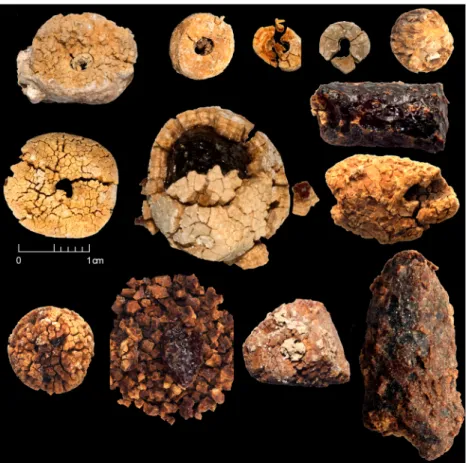
The amber beads studied here (Fig.3) are in an advanced state of oxidation and their surfaces have started to flake (Fig.6). Despite their state of preservation, the beads form one of the largest amber assemblages for the Iberian Copper
Age with 168 beads/fragments1 with a total weight of c. 500 g and some of the largest beads known in the Iberian Peninsula; up to 8 cm in diameter, 5.6 cm in height and 54 g in weight (Table2). In spite of the difference in number with amber beads from Montelirio tholos, the total weight of both assemblages is very similar. Therefore, they must both be given the same consideration in terms of social significance.
Chronologically, a radiocarbon date obtained from char-coal recovered in the tumulus excavations has given a cali-brated date for the megalith that roughly spans the second half of the 3rd millennium BCE (Soares and SIlva2010: 101). However, no further information about the beads’ archaeolog-ical context or stratigraphic associations are known other than the data given above. However, the dramatic increase in num-ber of amnum-ber artefacts during the Copper Age compared with the Neolithic (Murillo-Barroso and Martinón-Torres 2012: 201–205 Table1), and the notable number and total weight of the Anta Grande do Zambujeiro amber bead assemblage, only paralleled by the Montelirio tholos assemblage (2900– 2800 cal BCE), makes it plausible that the amber beads from Anta Grande do Zambujeiro belong to a very similar time. Whatever the case, the similarity between the Montelirio and
1It is impossible to calculate a minimum number of beads. The collection is
heavily degraded and the museum has individualized 168 records that account for beads and fragments.
Fig. 3 Selection of studied beads from Montelirio
Anta Grande do Zambujeiro amber assemblage in terms of number, weight and association with other grave goods, such as gold foils, would point to the coevality of the two assemblages.
Monuments 3 and 4 at Alcalar
The megalithic cluster of Alcalar, Portimão (CNS 11310, 4298, 3512, 7234, 7241, 7245, 11303, 7249, 7277, 7232, Fig. 5 Studied beads from Anta
Grande de Zambujeiro
Fig. 6 Surface detail of the Anta Grande de Zambujeiro beads, showing the high level of degradation
7238, 6807, 7215, 33793, 33792) is mainly characterized by a central group formed by 15 monuments, with Alcalar 1 cor-responding to a dolmen-type tomb, and the remaining monu-ments to corbel vault tombs (tholos-type) with different typol-ogies (Gonçalves,1989; Leisner and Leisner, 1943, 1959; Sousa, 2016; Veiga, 1886, 1889). Other peripheral groups are associated with this central core, such as Monte Velho (three tholoi), Monte Canelas (four hypogea) and Poio (one possible tholos and a natural cave). All these extensive funer-ary areas are directly associated with an important Chalcolithic settlement, the ditched enclosure of Alcalar (Morán2014).
The monuments were excavated in the late nineteenth cen-tury and during the first half of the twentieth cencen-tury by Nunes da Glória (Alcalar 1 and 10; Veiga1886), Estácio da Veiga (Alcalar 2 to 7; Veiga1889), Pereira Jardim (Alcalar 8 and 9; Rocha1904), Santos Rocha (Monte Velho 1 to 3; Rocha1911) and Formosinho (Alcalar 11 to 13; Viana et al.1953). Since the 1980s, archaeological work in the area of Alcalar has
included the re-excavation and restoration of monuments 7 and 9, as well as excavations in the settlement area of Alcalar and in the hypogea of Monte Canelas (Morán and Parreira2004,2007).
In general terms, the first moment of use of this area as a funerary space could be established in the last quarter of the 4th millennium BCE, corresponding to the construction and first use of the dolmen of Alcalar 1 and the hypogeum of Monte Canelas 1. It could then be extended throughout the 3rd millennium BCE, with the construction and first use of the corbel vault monuments (possibly still during the first half of the 3rd millennium) and their subsequent reuse (now in the second half).
The amber artefacts studied here (Fig.7) were collected in monuments 3 and 4 at Alcalar, two tholos-type monuments with different architectural features.
Alcalar 3 (Veiga1889: 131–250) corresponds to a
monu-ment included in a mound of about 20 m in diameter. The passage, divided into three sections (with atrium and Table 2 Weight of the studied beads
Site # Weight (g)
Anta da Capella MNA 2003.74.68 1 1.33
Anta da Capella Σ 1 1.33
Anta Grande da Comenda da Igreja MNA 985.52.1 1 + 2 fragments 0.32*
Anta Grande da Comenda da Igreja MNA 2000.21.5 1 1.56
Anta Grande da Comenda da Igreja MNA 2011.54.102 1 0.63*
Anta Grande da Comenda da Igreja Σ > 4 2.51
Alcalar 3 MNA 983.1007.74 1 1.66 Alcalar 3 MNA 983.1007.75 1 4.77 Alcalar 3 MNA 983.1007.76 1 3.83 Alcalar 3 MNA 983.1007.77 1 2.37* Alcalar 3 MNA 983.1007.103 1 0.48 Alcalar 4 MNA 983.1008.113 1 0.82* Alcalar Σ 6 13.93 Motelirio Tholos > 251 > 500 PP4 Monteliro 10.042–10.049 > 2 – Dolmen de La Pastora 1 – Valencina de la Concepción Σ > 254 > 500
Anta Granda de Zambujeiro ME 13682 1 54.00
Anta Granda de Zambujeiro ME 13690 1 36.65
Anta Granda de Zambujeiro ME 13687 1 24.10
Anta Granda de Zambujeiro ME 13696 1 14.66
Anta Granda de Zambujeiro ME 13685 1 7.80
Anta Granda de Zambujeiro > 163 > 362.80
Anta Granda de Zambujeiro Σ > 168 > 500
Pragança MNA 986.162.2261 1 3.00
Pragança MNA 986.164.6 1 4.32
Pragança Σ 2 7.32
antechamber), is about 6.10 m long, orientated towards the SE and formed by narrow vertical slabs. The chamber, about 2.80 m in diameter, is also formed by vertical slabs on which the base of the dome would be supported. It has a niche on the NE side of the Chamber, about 0.75 m above its base.
The artefact assemblage, distributed in the chamber and the passage, includes stone axes (sparse and fragmented), frag-ments of flint blades, flint cores, concave-base arrowheads, a grindstone and itsBpestle^, and limestone Bmortars^ (one of them with traces of red pigment inside). The adornment ele-ments include a boneBhair pin^ rod and various green stone and slate beads. Several potsherds (including a plate with Balmond-shaped^ rim and red slip on its surfaces) and an ivory Bplaque^ were also collected.
Particularly interesting is the artefact set collected in the lateral niche of the chamber, associated with a set of human bones indicating a secondary deposition of a possibly male individual. This set includes seven large flint blades (two of them corresponding to crested elements) and several copper
artefacts (two knives, five daggers with lateral notches for attachment to the handle, three axes, an awl, two chisels, two Bplaques^ of indeterminate use and a Bband^ about 70 cm in length with terminal spurs for fixation).
Alcalar 4 (Veiga1889: 183–226) corresponds to a
monu-ment included in a mound of about 20 m in diameter. The passage, which is about 8 m in length and oriented towards the SE, has an atrium (marked by two large limestone blocks) and an antechamber, of orthostatic-type, formed by thick slabs (dolmen type). The chamber, about 2.90 m in diameter, is formed by an integral dome (masonry of slate and sandstone slabs built right from the bottom of the chamber), presenting two niches on the NE and NW sides, about 1 m above its base. It provided few votive artefacts, very fragmented and mixed—possibly motivated by violations in Roman times. The recovered assemblage includes straight and concave-base arrowheads, a fragment of an engraved schist plaque, ceramic loom weights, abundant potsherds (over 100 frag-ments), and green stone and slate beads. Artefacts in ivory Fig. 7 Studied amber items from
(twoBplaques^ and a possible unworked piece), gold (two decorated Bfoils^) and copper (Palmela point) were also recovered.
Although the earliest uses of these monuments could be attributable, with the necessary precautions, to the first half of the 3rd millennium BCE, it is to its second half that the main funerary uses should be reported, as evidenced by the abundant presence of artefacts in copper (mainly in Alcalar 3) and gold. Possibly, the artefacts in ivory and amber are also assignable to this chronological stage.
Only two of the amber artefacts collected in these monu-ments correspond to beads, namely MNA 983.1007.77 (Alcalar 3) and MNA 983.1008.113 (Alcalar 4). The remain-ing elements, all from Alcalar 3, refer to a small nodule (MNA 983.1007.103) and three Bmushroom-shaped^ artefacts (MNA 983.1007.74 to 76). The latter may correspond to dag-ger hilts, similar (although smaller in size) to the amber knob collected in Valencina de la Concepción, in the funerary struc-ture 10.042–10.049 of PP4-Montelirio (Murillo-Barroso and García Sanjuán2013).
The presence of these elements in Alcalar 3 is suggestive because, as mentioned above, a considerable set of copper daggers was collected. However, these possible dagger knobs from Alcalar 3 are not apparently associated with the deposi-tion of the daggers (identified in the lateral niche of the cham-ber). However, they could have been displaced from their original position by post-depositional actions. The presence of ivoryBplaques^ may also contribute to this hypothesis, as they could correspond to elements also used in the enamelling of daggers.
Cova del Gegant
Cova del Gegant (Sitges, Barcelona) is a cave located in the Garraf Massif (NE Iberian Peninsula), on the Cape of Punta de les Coves. Cova del Gegant is formed by a subterranean net-work of galleries, which includes Cova del Gegant and the adjacent Cova Llarga, to which it is connected by a very nar-row passage (GL-T). Cova del Gegant is the most important and consists of a main chamber (GP1 + GP2) with a length of 22 m and two side galleries (GL) almost in parallel, one closer to the sea (GL1) and the other more inland (GL2).
The stratigraphic sequence comprises various layers grouped in 8 episodes, from the Upper Pleistocene (Episodes 0–3), c. 49–60 ka, to the Holocene (Episodes 4–7) (Daura et al.2010). As regards the Holocene layer, Episode 4 is the oldest (Bronze Age), represented by Levels VI and Ic2 (GP, GL2 sector) and Layer XXV (GP2 sector). Two addition-al pit-storage structures (Silo-1 and Silo 2) have been docu-mented in the same formation episode. Episode 5 corresponds to an erosive transgression that emptied part of the deposit and accumulated beach sand, corresponding to Level VII, X and XIf (Iron Age– Middle Ages). Episode 6 is the most recent
sediment with Layers Ia-f (Roman - Middle Ages–Modern) consistent with the same chronological horizon as Episode 5. Episode 7 corresponds to current sea erosion.
The archaeological layer ascribed to the Bronze Age main-ly corresponds to a collective burial radiocarbon dated to the Middle Bronze Age, 1600–1400 cal BCE. The artefacts re-covered comprise Late Bell Beaker pottery (NR = 71) featur-ing a decorative style akin to the Northeastern Group, gener-ally ascribed to the Early Bronze Age. Human remains com-prise 1728 bones ascribed to a MNI of 19, of which three of them have been directly dated. Ornaments are scarce and con-sist of four shell-beads, three lignite-jet beads, two amber beads (Fig.8), one coral fragment and one Cypraea fragment. Additionally, two gold artefacts known as tutuli have been recovered from the same archaeological horizon; these are very rare ornaments in the SW of Europe (Daura et al.2017).
Los Millares
Los Millares was first excavated by Siret and Flores (Almagro and Arribas1963) and remained partially unpublished (Siret
1893) until the Leisners (Leisner and Leisner1943) undertook a complete revision of the materials deposited in the Museo Arqueológico Nacional (Madrid). It was not, however, until Almagro and Arribas’ excavations (Almagro and Arribas
1963) that the site was scientifically excavated and published. Lately, in the last decades of the twentieth century, several excavations were performed in the settlement and the necrop-olis (Arribas Palau et al.1979,1981,1983).
The 84 tombs in Los Millares necropolis (Afonso Marrero et al.2011) display, according to Chapman (1990), some dif-ferentiation in terms of presence/absence of symbolic items and exotica made from rare raw materials such as amber. This results in clusters of tombs that can be related to social differences between clans or family groups. This appreciation raised some criticism and Chapman (2003,
2008) has lately revised his conclusion, minimizing social differences in the Copper Age and placing the emphasis on this in the Bronze Age. However, other authors claim that marked social hierarchization existed during the Copper Age based on the spatial organization of Los Millares necropolis and its grave goods (Afonso Marrero et al.2011).
There are, however, undeniable problems when dealing with Los Millares grave goods, stemming from the fact that the archaeological record was generated primarily in the late nineteenth century. The most serious problem is uncertainty about the association between grave goods and the tomb from which the item was recovered. To date, only 31 of the tombs excavated by Siret and Flores have been identified definitively (Chapman1990; Afonso Marrero et al.2011).
Chronologically, Los Millares covers a time span ranging from the last quarter of the 4th millennium to the early 2nd millennium BCE. That covers the whole Copper Age period.
A total of 16 amber beads and fragments were recorded in five tombs: VII/7, IV/8, 12, III/63 and 74 (Arabic numerals correspond to the Siret-Leisner seriation and the Roman nu-merals to that of Almagro and Arribas). Architecturally, the tombs consist of a corridor made of slabs and divided into two sections by a door, and a chamber with a central pillar that would support the dome. The only corbelled chamber is in tomb VII/7, which lacks the central pillar. Unfortunately, Leisner and Siret’s works do not record the location of the finds in each tomb.
Tomb 12 yielded five amber beads of different typologies and sizes, and a fragment (Leisner and Leisner1943: 25, tafel 11). The most remarkable is a large barrel bead (1976/1/ MILL/12/2), 4.7 cm long and decorated with parallel, incised lines along the perforation that are now inappreciable because of the degradation of the piece (4.5 × 2.10 cm). The Leisners (Leisner and Leisner1943) also describe a bead fragment, two cylindrical amber beads (one with red pigment), a discoidal bead, and aBtear-shaped^ amber pendant with V-shaped per-foration (Leisner and Leisner1943: 25, tafel 11).
A non-perforated amber flat-sphere (1976/1/MILL/63/1) was also found during Siret’s works in Tomb III/63 (Leisner and Leisner1943: 11, tafel 24; Almagro and Arribas1963: 118). Similar examples of non-perforated amber objects have been found in Los Delgados I tomb. Nowadays, both pieces are exhibited in Museo Arqueológico Nacional in Madrid.
An amber bead was found in each of Tombs IV/8 (Almagro and Arribas 1963: 119–122) and 74 (Leisner and Leisner 1943: 24).
Tomb VII/7 is the only tholos of the megalithic tombs at Los Millares that has yielded amber (Almagro and Arribas
1963: 72–74). According to the Leisners’ publication, this tomb may have housed at least 50 individuals, and at least 3 amber beads (Leisner and Leisner 1943: 27; tafel 12). However, when Almagro and Arribas studied the Siret collec-tion in the 1950s, the oxidacollec-tion process had already reduced the beads to fragments (Almagro and Arribas1963: 129). We do not know if these fragments are still conserved in the Museo Arqueológico Nacional in Madrid or not as the Museum has denied access to this material. In addition to this, beads from Los Millares studied here (CE00845 and CE00846) (Fig.9) are described as amber in the CERES cat-alogue, and were recovered by Almagro and Arribas in tomb VII/7, but no amber beads were said to be found during their excavations (Almagro and Arribas1963). Instead, they refer to quartz beads.
Cueva de las Ventanas
Cueva de las Ventanas (Piñar, Granada, Spain) is a natural karst cave located in Sierra Harana, with a long-term use-his-tory from the Upper Paleolithic to the Modern Era. The first archaeological citations to Cueva de las Ventanas are given by H. Obermaier, who visited the cave in 1916 and recorded Neolithic burials and materials already violated by locals. Latterly, J.-Ch. Spahni explored the cave in 1954 in the quest for Paleolithic remains, without any success. During rescue archaeological work under the supervision of Riquelme (Riquelme Cantal et al. 2001: 328), the bead studied here (Fig.10) was found in association with two‘Argaric’ inhuma-tions in the 17-A sector of the cave.
These‘Argaric’ Bronze Age burials were found sealed un-der a stone slab. The burial consisted of an adult found in fetal position on the left side, with only a piece of flint and some goat bones as grave goods. This inhumation was prepared in the place once occupied by a young adult burial, which dis-turbed most of his bones in the process. The conserved grave goods for this young adult individual were a small polished pebble, a deer calcaneus and an amber bead (Riquelme Cantal et al.2001: 330–332). This is the only amber find definitely
associated with an individual in the Province of Granada for the whole Bronze Age.
Pragança
Pragança (Cadaval) was discovered in the nineteenth century (Vasconcellos1895) and excavated by Vasconcellos in 1893 and latterly by Gonçalves in 1988 and 1990 (Gonçalves
1997).
This often-used site was occupied in the Neolithic while materials from the Final Bronze Age, Iron Age and Roman times have also been found. The Copper Age occupation is Fig. 8 Studied amber items from Cova del Gegant
well documented by radiocarbon dates in the first half of the 3rd millennium BCE (Gonçalves1997). However, the Bronze Age occupation must have been the most important as regards the abundance of metallic finds (Gonçalves1997).
Many of the finds deposited in the Museu Nacional de Arqueologia are isolated finds from nineteenth century local collectors or Vasconcellos’ excavations and no clear record of the amber bead (Fig.11) studied here is given. Despite the Copper Age radiocarbon dates for this site, it is likely that this amber bead is from the Bronze Age due to 1) its typology, similar to that of Cabecinho de Capitoa (Sousa 2008), Moreirinhos and Senhora da Guia (Vilaça et al. 2002);
and 2) the probable association with a Bronze Age metallic personal ornament assemblage (necklace, earring, button…).
Materials and methods
Since infrared spectroscopy is capable of satisfactorily distinguishing between Sicilian, Baltic, and Iberian Cretaceous ambers, copal… and can be performed either non-destructively, by means of attenuated total reflectance in-frared spectroscopy (ATR-FTIR), or on a very small sample of no more than 1 mg, it has become the standard technique Fig. 9 Studied beads from Los
Millares
Fig. 10 Studied beads from Cueva de las Ventanas
applied in archaeological research to determine the origin of amber artefacts. We have therefore followed this well-grounded methodology to perform the study of 156 of the > 697 amber beads found at ten Iberian 6th-to-2nd millennia BCE sites (Table1), in order to investigate their origins and the internal homogeneity of the amber bead assemblages.
This analytical study was conducted at the Institute for Material Science in Seville (CSIC–University of Seville) lab-oratories. All sampled beads were tested by Fourier Transform Infrared spectroscopy (FTIR).
Approximately 1 mg of sample was ground by hand using an agate mortar and mixed with a small amount of KBr, before pressing (8 T) the mixture to produce discs 1 mm thick. The specimens were analyzed using a JASCO FT/IR-6200 spectrometer. The data were collected as infra-red transmission spectra after scanning each specimen 32 times in the range 4000–400 cm−1, with a resolution of 4 cm−1.
A sample of human bone in direct connection with the bead assemblage from Anta Capela was submitted for AMS-radiocarbon dating, as will be discussed below. Radiocarbon measurements were performed using a 1 MV accelerator mass spectrometer (AMS) at the facilities of the University of Seville (Centro Nacional de Aceleradores). The chemical preparation of the samples followed standard procedures (Santos Arevalo et al.2009). Collagen extrac-tion from bone tissue followed ultrafiltraextrac-tion protocols to remove low molecular weight contaminants (Higham et al.
2006).
The Anta de Capela date and other available dates for amber-associated contexts are assessed in terms of the devel-opment of amber body ornamentation in Iberia.
Results and discussions
FTIR-based provenance analysisMontelirio tholos
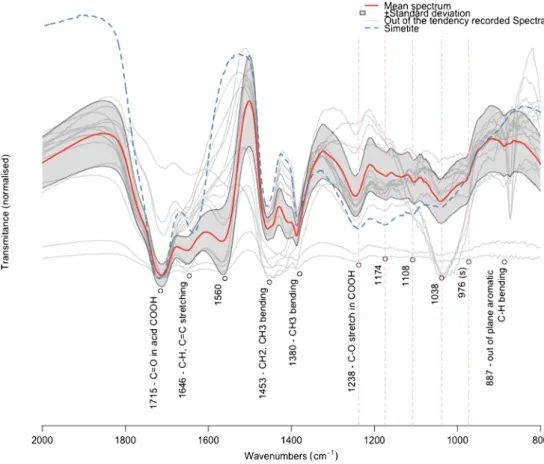
The whole Montelirio tholos bead assemblage yielded similar spectra, probably indicating that all the beads were shaped from the same type of resin. There are, however, exceptions. In Fig.12, it is possible to observe how some samples fall outside the general trend depicted by the mean spectrum and its standard deviation− 15 out of 131 samples.
None of the spectra show the so-called Baltic shoulder—an intense absorption peak in the 1160–1150 cm−1range, preced-ed by a characteristic band between 1250 and 1180 cm−1, typical of ambers from the Baltic (Beck et al.1965). Instead, in the C-O stretching region (1300–1000 cm−1), a distinctive COOH C-O stretch vibration at 1238 cm−1together with a set of absorption bands at c. 1174, 1108, 1038 and 976 cm−1were recorded. Based on the registered FTIR spectra, an Iberian origin for this bead assemblage must be discarded because feature bands recorded for 1. North Iberian ambers—c. 1020 and 960 cm−1(Peñalver et al.2007: 847–848), 2. Puerto del
Boyar (Cádiz)—c. 1600, 1450, 1075, and 875 cm−1 (Domínguez-Bella et al.2001: 627), and 3. Guadalajara am-ber—c. 1238 and 1174 cm−1 (Cerdeño et al. 2012: 380– 383)—are missing in the Montelirio tholos samples. Therefore, an Iberian origin for the Montelirio tholos bead assemblage can be rejected.
Archaeological ambers from Iberia have revealed patterns similar to those of simetite, with feature bands at c. 1241 and 1181 cm−1as well as an absence of an absorption at 890 cm−1. Fig. 11 Studied beads from
These include the amber from the Neolithic megalithic tombs of Alberite (Domínguez-Bella et al.2001: 627), Mamoa V (Vilaça et al.2002: 62), Chousa Nova (Dominguez Bella and Bóveda2011: 374), and structure 10.042–10.0492at the PP4 Montelirio (Murillo-Barroso and Martinón-Torres2012: 194–195). A Sicilian origin was proposed for the amber beads found in Alberite and structure 10.042–10.049, while Dominguez Bella and Bóveda (2011), Vilaça et al. (2002) and Dominguez Bella (2010) acknowledged the resemblance to simetite for Chousa Nova, Mamoa V and Valle de las Higueras 1 and 3, while highlighting that a local origin from botanical sources similar to the Sicilian simetite should not be rejected. Angelini and Bellintani (2016: 10), whilst admitting its plausibility, have recently questioned the Sicilian origin of the structure 10.042–10.049 amber pommel due to the pres-ence of absorption peaks at about 1000 and 888 cm−1.
Although, the Montelirio tholos mean spectra seem to match the simetite pattern, it does shows a feature band at c. 1560 cm−1 (Fig.13) that is absent from simetite consensus spectrum or any of the reference patterns collected to date (Beck and Hartnett1993). This band has been recorded in combination with an intense peak at about 1246–1256 cm−1 in archaeological samples from Trinitapoli, Puglia, southern
Italy (Angelini and Bellintani2005), in Valle de las Higueras 1 and 3, Huecas, Toledo (Dominguez Bella2010) and in highly oxidized samples from Montelirio tholos (Murillo-Barroso
2016: 326–327).
According to Maish et al. (2012), a band at c. 1574 cm−1 may appear in poorly preserved Baltic ambers due to salts of succinic acid. This band has proved to be intense in samples taken from the amber surface, while it is weaker for samples taken from the amber core. This band is believed to be due to alkaline conditions during burial, or harsh cleaning with alka-line chemicals (Pastorelli2009; Maish et al.2012). However, carboxylic acid salts are known to show asymmetric COO− stretching vibrations in the region c. 1560–1600 cm−1 (Shevchenko1963). This may be the case for the Montelirio tholos beads studied here, and the analyzed samples from Trinitapoli and the beads from Valle de las Higueras 1 and 3 were strongly weathered (Angelini and Bellintani 2005; Dominguez Bella2010).
The asymmetric COO−stretching vibrations recorded for the Tholos de Montelirio sample at c. 1560 cm−1 (Fig.12) could be related to the presence of succinate salt as a by-product of degradation processes caused by an alkaline burial environment (soil pH in the burial chamber is c. 8.4–8.3: (Borja Barrera et al.2010: 18). Consequently, we believe that observed spectral differences at c. 1560 cm−1within the 131 spectra from Montelirio tholos are due to the deterioration of
2In the same site of Valencina de la Concepción, just 200 m from the
Montelirio tholos.
Fig. 12 Montelirio tholos bead assemblage FTIR spectra, mean spectra and standard deviation
the sample by the alkaline environment, whether the sample was taken from bead’s superficial crust or core. This band at c. 1560 cm−1is also present in the amber bead from Cova del Gegant (see below), where pH is c. 8.4–8.3.
Taking into account that oxidation and deterioration of am-ber is a surface phenomenon (Shashoua et al.2006) that is manifested as a crust that may lead to the surface flaking off, sampling of core or surface crust may be responsible for the shape and intensity of this band (Fig.12). Determining wheth-er the sample is taken from the crust or core is extremely difficult in the case of the Montelirio beads as for almost all of them the surface has completely flaked off, and is undistinguishable from the amber core (Fig.14).
Bands recorded at c. 1646 and 887 cm−1, which are attrib-uted to C = H stretching, C-C stretching, and = CH2 out-of-plane bending vibrations in exocyclic methylene groups, have been recorded for those spectra that fall outside the tendency marked by the mean ± sd (Fig.12).These bands are dependent on the maturity and degree of oxidation of the resin (Langenheim1969; Shashoua et al.2006; Pastorelli 2009: 18, Table 2.2; Havelcová et al.2016).
Therefore, the differences observed in Fig.12are most likely due to sampling performance. We believe that samples that were taken from the core area of the amber, and therefore less oxidized, present less intense bands at c. 1650 and 887 cm−1and a more intense band at c. 1735 cm−1. The C-H bending mode vibration at c. 887 cm−1, although typically
absent on referenced simetite spectra, has occasionally been reported (Beck and Hartnett1993).
The spectroscopic comparison between the simetite consen-sus spectrum and the 131 recorded spectra for the Montelirio tholos beads indicates that first, the bands in the origin finger-print region (1240–970 cm−1) match both the consensus spectra for simetite and the described bands of published reference simetites (Beck and Hartnett1993; Beck1995; Angelini and Bellintani 2005; Murillo-Barroso and Martinón-Torres2012; van der Werf et al. 2016). Second, a feature band3 at c. 1560 cm−1that is absent from simetite consensus spectrum is attributed to succinate salt, a by-product of deterioration pro-cesses caused by the alkaline burial environment. Third, the relative intensities of the recorded bands at c. 1715, 1646 and 887 cm−1 are believed to be dependent on the degree of preservation/oxidation and the sampling area.
In addition, although the data might appear somewhat het-erogeneous, this is not the case after a close examination. Only 15 out of 131 samples fall outside the tendency marked by the standard deviation for the Montelirio tholos mean spectrum. Observed differences are most likely to be due to the pellet preparation process, particularly to particle size (manual grinding) and particle dispersion (mg of sample) or state of preservation.
3Usually recorded as a proper band as seen in the mean spectrum (Fig.13), or
as a shoulder as seen in Fig.12.
Fig. 13 Montelirio tholos bead assemblage general trend FTIR spectra, mean spectra and standard deviation compared to simetite reference spectrum together with band assignments
Bearing in mind the above and considering that the Montelirio tholos spectra match consensus spectra and refer-ence patterns collected to date for simetite in the most diagnos-tically useful region (Beck1971; Beck and Hartnett1993; van der Werf et al.2016), while the bands recorded here that are absent from the consensus spectra may be attributed to preser-vation issues, the most likely origin of this amber is Sicily.
Anta Grande do Zambujeiro, Anta da Capela, Anta Grande da Comenda da Igreja, Alcalar Monuments 3 and 4, and Cova del Gegant
The samples from Anta Grande do Zambujeiro, Anta da Capela, Anta Grande da Comenda da Igreja and Alcalar Monuments 3 and 4 yielded very similar spectra (Fig.15). As regards the origin of the raw material, all spectra show a
distinctive COOH C-O stretch vibration at 1238 cm−1together with a set of absorption bands at c. 1174, 1108, 1038 and 976 cm−1typical of simetite. The band at c. 1560 cm−1 ob-served in the Montelirio assemblage appears in the Anta Grande do Zambujeiro and Anta Granda da Comenda da Igreja spectra in the form of a weak shoulder (Fig.15), and in Cova del Gegant as an intense band. As mentioned above, we believe that the development of this band at c. 1560 cm−1is due to the presence of succinate salt as by-product of degradation processes caused by an alkaline burial environment. Therefore, the higher the pH is, the more intense the band will be.
Like the Montelirio assemblage, spectra from Anta Grande do Zambujeiro, Anta da Capela, Anta Grande da Comenda da Igreja, Alcalar Monuments 3 and 4, and Cova del Gegant match consensus spectra and reference patterns collected to date for simetite in the most diagnostically useful region (Beck Fig. 14 Montelirio tholos beads showing oxidation and degradation phenomena. Photographs were taking without removing the beads from the museums packs
Fig. 15 Anta Grande do Zambujeiro, Anta da Capela, Anta Grande da Comenda da Igreja, Alcalar Monuments 3 and 4, and Cova del Gegant bead assemblage FTIR spectra
1971; Beck and Hartnett 1993; van der Werf et al.2016). Thus, the most likely origin of this amber is Sicily.
However, of the six beads from Cova del Gegant, only two have yielded a recognizable amber spectrum, while the re-maining four samples have yielded spectra where phosphate bands were clearly recognizable together with other resinite bands. This very particular case will be fully developed in a forthcoming paper.
Cueva de las Ventanas
Cueva de las Ventanas FTIR spectrum (Fig.16) shows the typical Baltic shoulder, an intense absorption band in the
1160–1150 cm−1region, preceded by a characteristic band between 1250 and 1180 cm−1(Beck et al.1965). The Baltic origin of the amber used to manufacture this bead seems there-fore unquestionable.
Monte da Pena/Povoado da Pena/Tholos do Barro and Quinta do Anjo
For the Monte da Pena samples, the diamond crystal ATR modular complement of the spectrometer was used directly over the bead. Recorded spectra from Monte da Pena are very different from the other analyzed beads (Fig.17). First: There is no signal between 2000 and 1200 cm−1. Second: In the Fig. 16 Cueva de las Ventanas
bead FTIR spectrum compared to the succinite reference spectrum, together with band assignments
Fig. 17 Monte da Pena/Povoado da Pena/Tholos do Barro beads FTIR spectra compared to quartz and Paraloid B72 reference spectra
diagnostic region, no recognizable amber pattern is seen. Instead, a set of bands at c. 1162, 1130 and 795 cm−1 are assigned to Si-O stretching modes, and a band at c. 690 cm−1 is assigned to Si-O-Si/O-Si-O bending mode. These sets of bands are compatible with quartz. The yellow coloration of the bead may come from the presence of evenly distributed structural iron oxide and/or hydrous oxide.
The remaining unassigned bands in the FTIR spectra could, therefore, be related to (1) the structural Fe, or (2) to the use of Paraloid or another conservation agent applied to the beads (Fig.17).
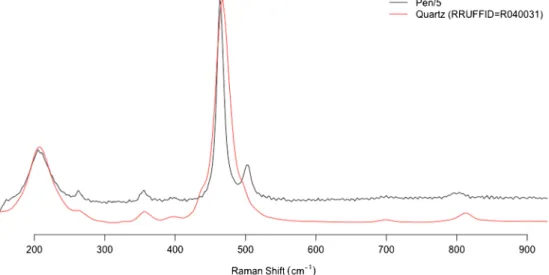
In addition to FTIR measurements, we have performed dispersive confocalμ-Raman spectrometry.4The recorded spectrum fully matches that of quartz as shown in Fig.18. Therefore, both samples from Monte da Pena must be classi-fied as macro crystalline ferruginous quartz instead of amber. The Quinta do Anjo bead is indeed another quartz artefact according to its chemical composition5(Table3). It is trans-parent and clear with a slightly smoky yellow hue.
Los Millares
The two beads recorded as amber in the Museo de Almería’s database yielded the typical mica SWIR spectrum6 and
chemical composition (Fig. 19, Table 3). Therefore, these beads have been characterized as yellow micas very similar in appearance and chemical composition to those found in the Bronze Age cist at Pessegueiro (Sinnes, Portugal) (Odriozola et al.2016a).
The misclassification of yellowish micas and quartz as am-ber is not uncommon. It is, indeed, a commonly made mistake when dealing with personal adornments. Both materials, micas and quartz, in their macro crystalline varieties were frequently used in funerary contexts during Late Prehistory.
AMS-radiocarbon dating
The AMS-radiocarbon date obtained for the sample of human humerus, MNA 2003.74.96 (Table4), shows a calibrated date that roughly spans the second half of the 4th millennium BCE. This date is very consistent in terms of the material culture finds (see above), which locate this monument in the transition from the 4th to 3rd millennium BCE.
Figures20and21show the calibrated dates for Table4and a non-parametric phase model used here to estimate activity phases through a full Bayesian Gaussian mixture model7of the radiocarbon dates (Parnell et al.2011). Four phases can be clearly observed: a first phase, represented by Alberite and Campo de Hockey and spanning from 4246 to 3915 BCE, a second phase, represented by Anta Capela and Cueva de los Cuarenta and spanning from 3765 to 3221 BCE (approximate-ly the third quarter of the 4th millennium BCE), a third phase, represented by Valencina de la Concepción, Anta Grande do Zambujeiro, Valle de las Higueras and Errekatxuetako Atx, from 2891 to 1986 BCE (third millennium BCE), and a fourth phase, represented by Cueva de las Ventanas and Cova del Gegant, from to 1894 to 1340 BCE (second quarter of second millennium BCE).
4Data was acquired using a HORIBA Jobin Yvon LabRAM HR system. The
laser diode, when operated at a wavelength of 532.06 nm, produces up to 15 mW of power in the source. Filters to reduce the laser’s power were not used. The acquisition time was 32 s per acquisition, up to a maximum of 20. The spectral measurement range chosen was between 100 and 1800 cm−1 using a 100× lens with a CCD multi-channel detector. The selected measure-ment is accurate to 1 cm−1. The measurement area selected was 1000μm in diameter.
Fig. 18 Monte da Pena/Povoado da Pena/Tholos do Barro beads Raman spectra compared to quartz
5Measured with an Oxford Instrument XMET-7500 EDX elemental analyser.
Chemical composition was dominated by Si, Al and K, together with other minor elements as Fe, Rb…
6Measured with a Panalytical ASD Terraspec HALO spectrometer. The
de-vice identified the beads against its own database as muscovite and
Iberian ambers from the 6th to 2nd millennia BCE
While any overarching perspective must remain preliminary, it is worth highlighting some apparent trends that may serve as pointers for future research. In this section, we attempt to integrate our new data for the Iberian Peninsula with the reviewed information from Murillo-Barroso and Martinón-Torres (2012: 201–205 Table1).In the Iberian Peninsula, consumption patterns may follow a first pioneering stage, when first non-formal contacts are established with the procurement area or chain of nodes that connect the source area with the Iberian Peninsula; a second stage, when contacts increase in number and start to become regular; a third stage when contacts probably formed an insti-tutionalized relationship (sensu Renfrew2001), and a fourth stage when the whole community would have gained access to this material due to the strong links developed under the institutionalization of trade. This phase opens a pathway to the decline in its use as it no longer satisfies the social need of differentiation in increasingly complex societies.
Even though an amber trade route8cannot be established for the Iberian Paleolithic—all analyzed samples are identified as local Cretaceous ambers (Álvarez Fernández et al.2005), a Mediterranean route may be proposed for the Neolithic Iberian ambers because all the finds, except for the three beads from Campo de Hockey,9originated in Sicily (Table1). At the 5th–4th millennia BCE transition, when the amber trade is first documented in the Iberian Peninsula, the first alpine jade axe reaches the Iberian Peninsula (Cassen et al. 2012; Fábregas Valcarce et al.2012) and the first exploitation of variscite deposits in the Iberian Peninsula starts (Odriozola et al.2016b). Although Orca de Seixas10dates (Almagro-Gorbea1972) should be taken with extreme caution. Both, Orca de Seixas Chousa Nova dates (Dominguez Bella and Bóveda2011) are in good agreement with the dates obtained for the amber beads’ contexts; c. last quarter of 5th and first
quarter of 4th millennia BCE. We can therefore establish a chronological range for this first pioneering stage covering the last quarter of the 5th–first quarter of the 4th millennia BCE (Fig.20, phase 1).
The start of the Copper Age (last quarter of the 4th millen-nium–beginning of the 3rd millennium BCE) is a turning point in terms of the economy and demography. It is the time when the first stable settlements are founded, e.g. Perdigões, Porto Torrão, La Pijotilla, Valencina de la Concepción, Camino de las Yeseras… (Hurtado1999; Blasco et al.2007; Valera2012,2013; Valera et al.2014), agricultural and live-stock intensification occurs (Delibes de Castro 2011), and copper metallurgy spreads (Rovira Llorens et al.2003). It is also the time when wealth, and therefore social inequalities, are recorded in burials, e.g. Millares’ necropolis (Almagro and Arribas1963), Fuente-Olmedo (Martin Valls and Delibes de Castro 1989), Valle de las Higueras (Bueno Ramírez et al.
2005), Valencina de la Concepción (García Sanjuán and Murillo-Barroso2013), etc. All this affected the role and so-cial use of personal adornments made from exotica. Just be-fore the beginning of the 3rd millennium BCE, the number of ivory and variscite objects records exponential growth (Schuhmacher2012; Odriozola et al.2016b) that is paralleled by the number of amber finds, which grows spectacularly during 3rd millennium BCE (see Table1).
During the first half of the 3rd millennium BCE, the amber route that had connected Sicily with the Iberian Peninsula since the 5th millennium BCE must have intensified its activity, as the number of finds increases dramatically from the former phase to this stage. The intensification of the activity associated with this Mediterranean amber route is also supported by the presence of an outstanding amount of Asian ivory associated with amber contexts in the PP4 Montelirio structure 10.042– 10.049 (García Sanjuán et al.2013) and in the IES ivory work-shop at Valencina (Nocete et al. 2013). However, the Mediterranean route cannot have been the only route by which ‘elites’ were procuring exotic goods by this time. In the first half of the 3rd millennium BCE in Portugal, most of the ivory finds correspond to African elephants (Schuhmacher et al. 2009; Nocete et al.2013), which could mean that a diversified exotica supply system was functioning in Iberia, even though all the analyzed amber has been characterized as Sicilian amber. For example, Anta Capela has yielded African elephant ivory beads (Schuhmacher et al.2009).
8For a detailed discussion of whether trade routes existed or not, the reader is
recommended to consult (Renfrew1993; Hughes-Brock2011).
9
Campo de Hockey necropolis beads spectra remain unpublished and a Sicilian origin has not been rejected. They are said to be non-Baltic ambers (Vijande Vila et al.2015).
10Radiocarbon dates from Orca de Seixas are subject to debate because the
recovered finds consist mainly of bell beakers (Boaventura2009). They are not associated to the amber beads, and therefore, must be taken with extreme caution. .
Table 3 Chemical composition of analyzed quartz beads expressed as atomic percentage
Al Si P S Cl K Ca Ti Cr Fe Rb Sr Sn
Quinta do Anjo 4.75 89.50 2.59 1.05 – – 1.96 – 0.03 0.12 – – –
CE00845 41.02 39.48 – 0.66 3.88 13.11 0.33 0.08 0.04 0.78 0.58 0.01 0.05
Murillo-Barroso (2016: 330) suggests, at this point, that amber trade during this period of time was carried out through indirect trade with Sardinia and Tunisia, based on the obsidian trade (Tykot et al.2013), ostrich eggshell, and especially on African ivory recorded at Valencina de la Concepción (Schuhmacher et al.2009; Nocete et al.2013). However, the only obsidian items from the Central Mediterranean (Monte Arci source) are dated in the 5th to 4th millennium BCE in
northeastern Iberia (five blade blanks, plus a core: (Terradas et al.2014), and no amber items are documented in Sardinia until the second half of the 2nd millennium BCE (Bellintani
2010; Angelini and Bellintani 2016). Nevertheless, we do agree that amber exchange networks must have reached the southern Iberian coast through North Africa, whereas north-eastern Iberia participated in exchange networks that connect-ed Southern France -from the Alps- with coastal Catalonia Fig. 19 Los Millares beads’
SWIR spectra
Table 4 Radiocarbon dates from individuals and/or contexts directly associated with amber finds in the Iberian south-west
Site Individual Layer Lab. code BP SD Material Bibliografía
10.042–10.049 Main chamber. CNA-1291 4161 34 bone (García Sanjuán2013)
Anta da Capela 2003.74.76 CNA-3543 4532 30 humerus
C. de los 40 Assemblage 1 CNA_2421 4575 35 bone (Vera Rodríguez2014)
Alberite* Ochre level Beta-80,602 5320 70 charcoal (Sttip and Tamers1996)
Alberite* Ochre level Beta-80,600 5110 140 charcoal (Sttip and Tamers1996)
Alberite* Ochre level Beta-80,598 5020 70 charcoal (Sttip and Tamers1996)
C. de Hockey E11 C14 CNA-664 5650 40 shell (Vijande Vila et al.2015)
Valle de las Higueras 1 Beta-14,275 3890 40 bone (Bueno Ramírez et al.2005)
Valle de las Higueras 3 Beta-157,729 3830 40 bone (Bueno Ramírez et al.2005)
Errekatxuetako Atxa* Chamber (Almek) Smt8 Beta-259,129 3750 40 bone (López Quintana2015)
Anta G. do Zambujeiro* Beta-243,693 3910 40 charcoal (Soares and SIlva2010)
Cueva de las Ventanas Young adult UGRA-541 3380 90 bone
Cova del Gegant Young adult (Ind #5,67) XXV OxA-29,612 3225 27 Teeth (Daura et al.2017) Cova del Gegant Adult (Ind. #17) XXV Beta-312,860 3270 30 Teeth (Daura et al.2017) Cova del Gegant Adult (Ind. # 18,19) Ib2d/Ia Beta-312,861 3200 30 Teeth (Daura et al.2017) *These dates do not belong to individuals, they rather belong to clear depositional contexts where beads were found, with exception to Anta Grande do Zambujeiro which has been discussed above