
Diogo Wahnon Silva Teixeira de Brito
No37739A Framework for Developing Motion-Based
Games
Dissertação para obtenção do Grau de Mestre em Engenharia Informática
Orientadora : Teresa Romão, Prof. Auxiliar, Universidade Nova de Lisboa
Júri:
Presidente: Prof. Doutor João Manuel Santos Lourenço
Arguente: Prof. Doutor Carlos Alberto Pacheco dos Anjos Duarte
iii
A Framework for Developing Motion-Based Games
Copyright cDiogo Wahnon Silva Teixeira de Brito, Faculdade de Ciências e Tecnolo-gia, Universidade Nova de Lisboa
Acknowledgements
First of all, I want to express my gratitude to all of those who have helped me achieve my masters degree. To Faculdade de Ciências e Tecnologias, for allowing me to study in this area. To my supervisor Professor Teresa Romão for all the care, ideas and con-structive criticism during the work in my thesis. To Pedro Centieiro, who was also preciously helpful, providing a lot of support and assistance during the development of this work. To Ahmad Akl, for the availability and help during this work. Moreover, I’d like to thank André Gil and Bliss Applications, for all the flexibility that was given me for completing my degree. Also, for all the technical support that I had from my dear colleagues.
Those who helped me during the tests in this work. Fábio Bernardo, for his in-describable help. Sara, for helping me out throughout this work and Sérgio, for his three-dimensional viewing capabilities. My friends, for walking with me along this path, while writing this thesis.
Abstract
Nowadays, whenever one intents to develop an application that allows interaction through the use of more or less complex gestures, it is necessary to go through a long process. In this process, the gesture recognition system may not obtain high accuracy results, particularly among different users.
Since the total number of applications for mobile systems, like Android and iOS, is close to a million and a half and is still increasing, it appears essential the development of a platform that abstracts developers from all the low-level gesture gathering and that streamlines the process of developing applications that make use of this kind of interaction, in a standardize way. In this case such was developed for the iOS system.
At the present time, given the existing environment issues, it is ideal to attract the attention, motivate and influence the greatest number of people into having more pro-environmental behaviors. Thus, as a proof of concept for the developed framework, an educational game was created, using persuasive technology, to influence players’s behaviors and attitudes in a pro-environmental way.
Therefore, having this idea as a basis, it was also developed a game that is presented in a public ambient display and can be played by any participant close to the display who has a device with iOS mobile system.
Keywords: gesture recognition, accelerometer, public ambient displays,
Resumo
Actualmente, sempre que se pretende desenvolver uma aplicação que permita inte-racção através do uso de gestos mais ou menos complexos, é necessário passar por um longo processo. Neste, pode acabar por não se obter um reconhecimento de gestos com bons índices de precisão, particularmente entre utilizadores distintos.
Uma vez que o número total de aplicações para sistemas móveis como Android e iOS está perto do milhão e meio e continua a aumentar, revela-se fundamental o de-senvolvimento de uma plataforma que abstraia os programadores de todo o funcio-namento de baixo nível de captação de gestos e que agilize o processo de desenvolvi-mento de aplicações que recorram a este tipo de interacção, de uma forma uniformi-zada. Neste caso tal foi desenvolvida para o sistema iOS.
Hoje em dia, dados os problemas actualmente existentes a nível ambiental, é ideal chamar a atenção, adquirir o interesse e influenciar o maior número de pessoas a ter comportamentos mais pró-ambientais. Assim, e como prova de conceito da plataforma desenvolvida, um jogo educacional, que faz uso da tecnologia persuasiva, foi criado, de modo a influenciar as atitudes e comportamentos dos seus jogadores de uma forma pró-ambiental.
Assim, com esta ideia como base, foi também desenvolvido um jogo que é apresen-tado num expositor público e que pode jogado por qualquer participante perto da zona do expositor que tenha um dispositivo com o tipo de sistema móvel iOS.
Palavras-chave: reconhecimento gestos, acelerómetro, expositores públicos,
Contents
1 Introduction 1
1.1 Motivation . . . 1
1.2 Description and Context . . . 4
1.3 Contributions . . . 5
1.4 Document Organization . . . 5
2 Related Work 7 2.1 Pervasive Computing. . . 8
2.1.1 Context awareness . . . 9
2.2 Gesture-controlled user interfaces. . . 10
2.3 Gestures for mobile interaction . . . 13
2.4 Gesture Recognition . . . 15
2.4.1 Dynamic Time Warping . . . 16
2.4.2 Hidden Markov Models . . . 21
2.4.3 Affinity Propagation . . . 21
2.4.4 Compressive sensing . . . 24
2.4.5 Random Projection . . . 27
2.5 Environmental Awareness . . . 28
2.6 Interaction with Public Ambient Displays . . . 29
2.6.1 Technology as human social relationship capacitor . . . 30
2.7 Persuasive Technology in Gaming context . . . 31
xiv CONTENTS
3 Gesture Recognition System 35
3.1 Context . . . 35
3.2 Procedure . . . 37
3.3 Training phase . . . 38
3.4 Recognition phase. . . 40
3.5 Architecture and Challenges . . . 45
3.6 Developer Environment . . . 47
3.7 Gestures Dictionary . . . 49
3.8 Implementation . . . 49
3.9 Implementation Results . . . 51
3.9.1 Methodology . . . 51
3.9.2 Results . . . 53
4 Proof of Concept 57 4.1 Proposed Solution. . . 57
4.2 Architecture . . . 59
4.3 Gameplay . . . 61
4.4 Usability Testing. . . 63
4.4.1 Methodology . . . 63
4.4.2 Discussion and Results. . . 65
5 Conclusion and Future Work 71 5.1 Future Work . . . 72
List of Figures
1.1 iPhone with coordinate system. . . 3
2.1 Commands matching consists in finding the best association between the commands exposed by the application (APP-CMDS) and the com-mands previously defined by the user (USER-CMDS). Using command synonyms (AUGM-APP-CMDS) helps this process. Taken from [Vat12]. 14 2.2 Two time sequences C and Q which are similar, but out of phase. Taken
from [KR05]. . . 17 2.3 Alignment of the two sequences by finding the optimal warping path,
that is shown in the solid squares. Taken from [KR05]. . . 18 2.4 The efficiency of FastDTW and DTW on small time series. Taken from
[SC07]. . . 20 2.5 Captology: How computing and persuasion overlap. Taken from [Cer11]. 31
3.1 Moving average result. Taken from [Smi03].. . . 38 3.2 Overall diagram block for gesture recognition. Original in [AFV11]. . . . 41 3.3 Overall gesture recognizing system architecture. Original in [AFV11].. . 46 3.4 The multiple existing screens in the developer environment. . . 48 3.5 Framework gestures dictionary. . . 50 3.6 Average gesture recognition accuracy for the number of stored gestures. 53 3.7 Average recognition time for gesture in each iteration. . . 54 3.8 Average gesture recognition time and average gesture traces length.. . . 54 3.9 Average gesture recognition time for the number of stored gestures. . . . 55
xvi LIST OF FIGURES
4.2 Device screen during the game. . . 60
4.3 Participants playing the game. . . 64
4.4 Academic Degree. . . 65
4.5 Participants’ use of new technologies. . . 65
4.6 Participants agreements toward being aware of environmental issues. . 68
4.7 Rate of agreement towards the game experience, conditioned by if the user won the game or not. . . 68
4.8 Rate of agreement towards game usability, conditioned by if the user won the game or not. . . 69
List of Tables
2.1 Matrix of distances betweenCandQ . . . 19 2.2 Matrix of the optimal warping path. . . 19 2.3 Average error of three algorithms at the selected radius value (errors of
the 3 groups of data are averaged). Taken from [SC07]. . . 20
3.1 Framework’s implementation classes. . . 52 3.2 Comparison of Performance of the implemented system, the original
1
Introduction
This document exposes the research and work that was made in similar and relevant areas in terms of gesture recognition, environmental issues and the use of persuasive computing. In this thesis a framework for recognizing motion based gestures was built, as was a proof of concept for the framework. Both are also addressed in this document. This thesis was conducted in the scope of the DEAP project (Developing Environ-mental Awareness with Persuasive Systems), which includes members of New Univer-sity of Lisbon and the UniverUniver-sity of Évora. DEAP project is funded by FCT (Fundação para a Ciência e Tecnologia).
1.1
Motivation
In the past years people’s use of mobile devices has spread all around the world. The main contribution for such event is that the size of its components became smaller, their connectivity capacities have been improved, their computing performance is higher and their price is affordable by a large part of the western world.
1. INTRODUCTION 1.1. Motivation
increase the level of context-awareness of the device. A simple example in the smart-phones environment is the switching from portrait to landscape mode depending on the rotation of the device, which is discoverable by its acceleration.
Having this background, companies that engineer and manufacture this kind of equipments developed their respective operative systems (OSs) in order to allow de-velopers world-wide to build customized applications. The two most known operative systems for mobile devices that were designed with this in mind were iOS and Android, by Apple Inc. and Google, respectively.
Besides, smartphones computation power and storage capacity has been quickly growing bigger thus allowing software developers to build better and more capable applications.
After developing an application for any of these operative systems, it is possible to promote, distribute or sell it, by using their software’s applications market, AppleR
App Store for iOS and Google Play for Android. In the first, there is over than 900.000 applications [Cos13], while in the latter there is over a million of applications [Row13], which shows that there is in fact a large number of deployed applications for such devices.
Therefore, it is easily visible that mobile devices, particularly smartphones, have been widely used in the recent years, with millions of application downloads, showing that it is possible for enthusiastic developers to have a new idea and build a custom application that can be freely distributed in its respective store. Furthermore, it is sim-ple for developers to access the data captured by multisim-ple sensors that these devices contain, such as accelerometer, gyroscope or wireless.
Moreover, the framework was developed for smartphones because this kind of vices don’t require an external setup for gesture recognition, as do other existing de-vices, such as Nintendo’s Wii or Microsoft’s Kinect. In this thesis the system that was chosen to target the framework was iOS. Such choice was made, not particularly for any technological matter but because this work is done in the scope of the DEAP project and applications in the same scope were built for iOS. Thus, future applications also funded by DEAP will probably be built for the iOS, increasing the probability of the framework to be used and helpful in such cases.
1. INTRODUCTION 1.1. Motivation
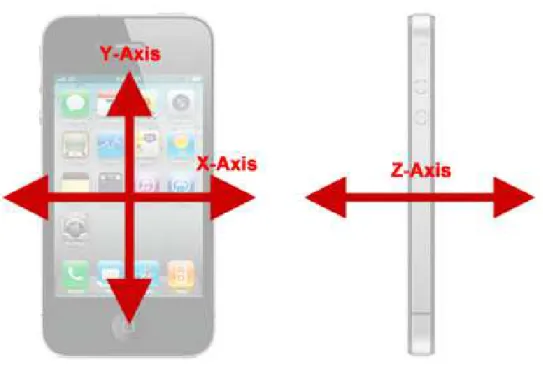
Figure 1.1: iPhone with coordinate system.
it is used for switching the device’s display from portrait to landscape mode.
However, when it comes to developing applications that make a more complex use of this data, like gesture recognition, the task is far more complex. If a developer intends to build an application that makes use of gestures, he must be responsible for all the related work regarding its recognition. This, even tough it may seem a trivial question can imply multiple days of work.
1. INTRODUCTION 1.2. Description and Context
has the role of making use of persuasive systems to alert users of the environmental is-sues that exist nowadays. Moreover, regarding the environmental scope of this work, humans are putting a huge effort upon Earth’s natural resources, by the means of var-ious sectors such like energy, agriculture, fishery and transportation. These actions are making climate changes that can already be measured like the world’s temperature in-crease and the loss of the ozone layer. Therefore, if no action is taken in order to change this situation, irreversible damages can be caused to the environment within decades.
One way of struggling against this demand is by making world citizens aware of the problems and the primitive causes that contribute to the excessive consumption and waste of natural resources. Hence, it is possible to use persuasive technology in order to change users’ behaviors towards the environment. Therefore, in this work, as a proof of concept for the framework, was developed a motion-based game that makes use of persuasive technology in order to warn and change participants behaviors towards what most contributes to world energy and resources consumption, leading to pollution and climate change.
1.2
Description and Context
Each and everyday more applications are published into the AppleR App Store, being
developed by different thousand of companies. Recently, the 50 billionth application download was made from AppleR App Store [Pre13], which reveals the extreme
de-mand for such kind of applications.
Nonetheless, it is not straightforward for a software developer to build a game or any other application that makes use of motion based gestures for the iOS system. It is a sluggish process which can take much time from the developer and other players enrolled in the creation of the application. Furthermore, in such cases, the result may not turn out as expected, having a low recognition accuracy or a high delay in the recognition process.
To elaborate the framework sketch, some related works in the gesture recognition area have been essential. It was possible to evaluate which are the existing technological possibilities to approach the issue of recognizing a movement and how some of them may be combined in order to obtain the best recognition accuracy levels.
Moreover, regarding both the fact that the framework must be tested and that this thesis is done under the DEAP project, a proof of concept is also required.
1. INTRODUCTION 1.3. Contributions
important to increase the awareness of people to these kind of situations, which can be achieved by showing them which actions are correct or not. Such can be reinforced by teaching the users in a amusing and funny way, as it is a game. Furthermore, if this game is played in a multiplayer environment based on scores, the user will be even more focused in practicing what the game states is correct, given the fact that results can be compared between players and friends.
1.3
Contributions
The main contributions of this thesis are:
• A framework for motion-based games built for the iOS system, that enables and facilitates the development of applications that make use of gestures;
• A game that informs users about the environmental issues that exist nowadays and stimulates them into having more pro-environmental behaviors;
• Insights regarding the use and development of gesture-based games and the in-teraction with public ambient displays and mobile devices;
1.4
Document Organization
The remainder of this document is organized in the following maner:
• Chapter2addresses the relevant work that was made in similar areas as this the-sis, such as gesture recognition and persuasive technology in a gaming context.
• Chapter3describes the gesture recognition system, from the original system the-ory, to the final architecture implementation.
• Chapter4covers the proof of concept for the framework, as well as the user tests that were conducted to evaluate the framework and the game.
2
Related Work
In order to fully comprehend the content presented in this document, some relevant related areas must be studied. This chapter, besides providing a summary of the state of the art in these areas, intends to make a brief description of them.
In Section2.1the concepts of pervasive computing and context awareness are cov-ered. It is explained how the development of wireless technologies and new types of embedded devices can contribute to people daily tasks. It is also explained how con-text can be important to these kind of applications, how it can be retrieved by them and how it can affect them.
In the next section,2.2, gesture-controlled user interfaces, it is shown how computer interaction was enriched due to technological developments in the last decades. New forms of interaction and some practical examples are given.
Section2.3, addresses some studies that were made in the gestures for mobile inter-action and how these can be useful and a natural communication channel.
Following, in Section2.4, the work related to the core of this thesis, different kind of possible ways of recognizing gestures are approached. A focus is made on the movement-based category, once it doesn’t require an external setup and can be used in an ubiquitous environment, such as the smartphones environment.
2. RELATEDWORK 2.1. Pervasive Computing
reducing computational costs is presented.
As the movements recognized by the proposed framework must be submitted to a proof of concept, a multiplayer game which promotes interaction between mobile devices and public ambient displays was developed. Since this work was developed in the scope of project DEAP, the game focus some pro-environmental ideas. In this way, the following sections cover related topics in the areas of environmental aware-ness, interaction with public ambient displays and persuasive technology in a gaming context.
Section 2.5, environmental awareness, addresses the effort that is being put upon Earth’s natural resources and biodiversity. Some of the key areas that most contribute to this are presented and have been taken into account when designing the proof of concept.
Interaction with public ambient displays, Section2.6, presents multiple studies that use this kind of technology and how it can help new users to interact with the system.
Following, section 2.7, persuasive technology in gaming context, explains the ba-sis of these technologies and how they can be employed in order to change users’ be-haviors. Moreover, some related works in the area, specially some pro-environmental awareness ones, are presented.
By addressing these multiple subjects the reader will know how the use of gestures in a pervasive computing can be useful; which kind of recognition technologies and other works in the gesture recognition area exist.
Finally, it is be explained how one can combine gesture recognition and user per-suasion in order to achieve environmental awareness and pro-environmental user be-haviors.
2.1
Pervasive Computing
2. RELATEDWORK 2.1. Pervasive Computing
in the middle and high class society.
This kind of computing can be of much help and comfort to a person daily life once it has numerous uses, such as home temperature management, where a certain temperature is kept independently of the user actions or a refrigerator that is capable of knowing the validity of its contained food.
The development of wireless networks, together with the common use of new types of embedded and mobile devices are leading to the already current, but specially future, scenario in which cheap interconnected computing devices are capable of supporting users in a multiple set of tasks.
As said in [Sat01], a pervasive computing environment is one where there exists a truly integration between the users and the existing computing and communication capabilities, thus becoming a technology that is invisible to the user.
Applications in this kind of environment, for having the need of acting in highly dynamic environments and placing fewer demands on user’s, have the need of being sensitive to the environment that surrounds them.
That made, unlike what happens with usual desktop applications, a need for context-awareness appears [HIR02]. Besides, it is also valuable to know what context, in a per-vasive environment, really means once it is a term employed with a wide variety of meanings.
Moreover, pervasive computing sustains why this work is targeted to a smartphones environment, once it is easy for users to access it with no external setups or complica-tions. Besides, the use of gestures is a natural interface for humans.
2.1.1 Context awareness
Context is a concept that has been studied for the past four decades by various areas of computer science and with multiple definitions, such as "that which surrounds, and gives meaning to something else" [SBG99].
Regarding the mobile and ubiquitous context, it is demanding the ability of discov-ering and reacting to changes in a given environment, providing the user with services that directly depend upon its surrounding environment.
2. RELATEDWORK 2.2. Gesture-controlled user interfaces
components, that integrate any smartphone nowadays, can be, for instance, accelerom-eters or gyroscopes for motion sensing or GPS for location sensing. Then, with data from this sensors and with multiple techniques according to the type of data, context-aware behaviors can be taken.
According to [HIR02], there are some observations about the nature of contextual information in pervasive computing systems, namely: Contextual information can be static or dynamic, being the majority of information mainly dynamic. Also, given its dynamics, this information has a temporal validity. It is imperfect and it can be incor-rect, inconsistent or incomplete. As the contextual information is derived from sensors, it has many alternative representations and, for the same reason, there is usually a significant gap between the data granularity at the sensor level and the one that the application is really interested in working with. Note that this point is particularly es-sential in this thesis, once one of its goals is to develop a framework that shall fill this gap between the low-level accelerometer data and the high-level gesture recognition.
Finally, it is also fundamental that programmers are abstracted from gathering this kind of information and so, infrastructures are needed to gather and manage this type of information to applications, in order to facilitate their development.
2.2
Gesture-controlled user interfaces
During the past decades, computer interaction has been mainly done through the use of traditional keyboard and mouse [BP09]. This way of interaction, even tough it is still widely used nowadays and, in some contexts without any other better options, can lack of usability in some other contexts. For instance, the mobile interaction is a good example where it is not suitable to work in this traditional way thus requiring other ways of interaction.
2. RELATEDWORK 2.2. Gesture-controlled user interfaces
This way, it is possible for humans to communicate with machines without requir-ing the use of mechanical devices like joysticks, keyboards or mouse. Objectively, hu-mans can thus communicate with intelligent environments, like smart homes, by em-ploying natural body movements or gestures.
This work, however, will be focused on a gesture control system in which a mobile hand-held device is used. By doing so, users do not need to be in a controlled environ-ment that makes, for instance, the use of camera-based recognition but instead, to hold the device in their hands while describing a gesture.
Moreover, one must bare in mind that movements may vary from person to person, having different meanings depending on the user’s culture. A good example is the way most western countries use head gesture for "yes" or "no". While, in these countries, people nod their head vertically for "yes" and horizontally for "no" this result is the exact opposite on cultures like Bulgarian and Serbo-Croatian, where the vertical nod means "no" and the horizontal is for "yes".
In terms of gesture-controlled interfaces there are multiple areas where these can be applied, such as entertainment, artificial intelligence, simulation, education and health. In entertainment, there are examples being widely used nowadays like Nintendo Wii and Microsoft Kinect.
Nintendo Wii, released in November 2006, is a home video game console that, after one year, had already sold over 20 millions units world-wide [Lee08]. Its main feature is the use of the Wiimote, a remote control that combines a 3-axis accelerometer, a high-speed IR-camera, a vibration motor, a speaker, Bluetooth and buttons. It allows users to easily interact with gestures and pointing, being connected by the wireless Bluetooth. This remote, in 2008, had a suggested retail price of US$40, which is really cost-effective for all it contains and is capable of [Lee08].
Microsoft Kinect is a motion sensing input device that allows users to interact solely with gestures and spoken commands, without making use of keyboard, mice or other device [Hsu11].
Even though it was primarily built for the Xbox 360 home video game console and Windows PCs, it is capable of being used in multiple other applications. Only in 2011, 18 million Kinects’ were sold, demonstrating how widely it has been used [Eis12]. This may also result from its relatively cheap price of US$149, which, compared to interac-tive whiteboards can be in the range of US$800 to US$2500 [Eis12].
Albeit both these products have an high gesture recognition accuracy and success, they require an extra setup. Thus, unlike smartphones which users carry every day, are not fit for more general contexts.
2. RELATEDWORK 2.2. Gesture-controlled user interfaces
example of this is presented in [CCH11]. It is a Kinect-based system for physical reha-bilitation targeted to young adults with motor disabilities. It is used in a public setting and shows that the participants increased their motivation in physical rehabilitation. Based in the ability of Kinect to detect user’s movements and positions, it uses this in-formation to detect if a participant is performing the exercises correctly and works in two phases. In a first phase, the participants must execute the movement correctly and, when such is done, the system learns and saves that movement. In a second phase, the participants perform the movement that the system previously stored.
Besides, it includes an interactive interface with audio and video feedback which enhances the participant’s interest and motivation, contributing to a better experience and thus a better physical rehabilitation. The participant’s status are kept in the system which allow therapists to review them easily and can be useful for a more complete recovery. In addition, using this type of environment, participants don’t need to be bothered with any attached user sensors that can be obtrusive in their rehabilitation.
Other examples are studied like the use of Kinect in Education Technology [Hsu11]. In this work, it is shown that the use of Kinect and this kind of interactive environ-ments has a great potential of boosting students creativity and enhancing classroom interactions. This study shows that Kinect is quite versatile as a teaching tool in a class-room: teachers can interact with the contents via body movements, gestures or voice communication; Kinect works with multiple-users and so students in the room can in-teract with the system; a classroom in this context can provide a whole-class support, allowing group interaction or teacher-student one-to-one interaction. Lastly, as it col-lects in-depth, 3D, information, it can support different kinds of teaching activities, like dance and martial arts.
2. RELATEDWORK 2.2. Gesture-controlled user interfaces
capacity. Regarding the gesture approach, it promotes the user’s preferred gestures, contributing to the system usability.
This can bring two important advantages to what happens today: users will already know how to interact with the system, because they have their own commands, and the accuracy of gesture recognition algorithms will considerably improve as the sys-tem can use user-specific training gestures for comparison, thus being user-dependent. The interconnection between the mobile phone and the remote display is possible with current mobile phones given their multiple connectivity options such as Bluetooth or WLAN. A scenario where such approach would be interesting, for instance, railway stations in different countries. A user who travels a lot through different stations and has the need of verifying in the system the next departing trains. However, an interac-tion is needed with the display and so the user can upload its known gestures, stored in his wireless capable mobile phone, and afterward interact with the system, that was unknown to him, with his own gestures.
The system is tested with the Microsoft Kinect. Similarly to what is done in this thesis application, the comparison between different gestures is makes use of DTW.
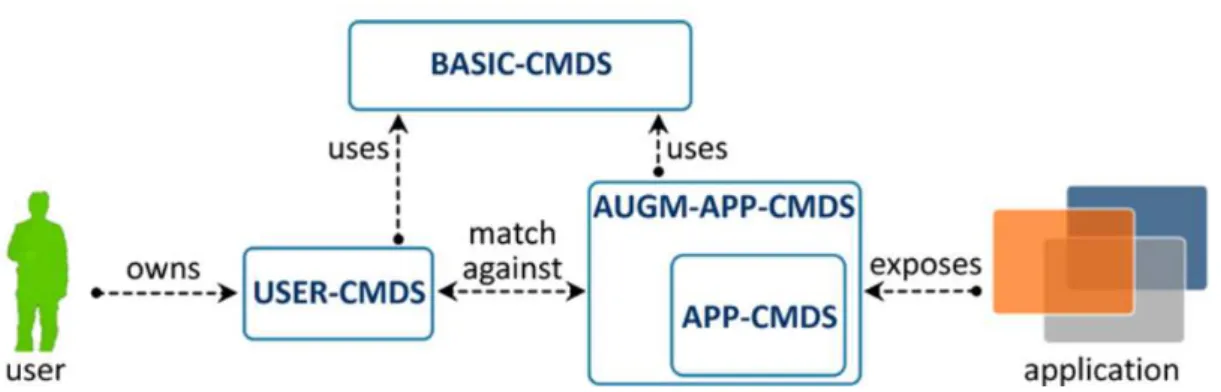
Regarding the translation between a gesture and a system function, its sketch can be seen in Fig. 2.1. Considering the commands, these are mainly divided in three sets: BASIC-CMDS, APP-CMDS and USER-CMDS. Regarding BASIC-CMDS, these are the most frequently used by any application likestart,nextorclose. This is not an initially
extensive set but one who contains basic commands that can be extended by any ap-plication. APP-CMDS is the set of commands of each application and USER-CMDS is the user specific set of commands. This last is initially a subset of BASIC-CMDS and is then extended by the user, as he interacts with different applications that use a larger set of gestures. Furthermore, to enable the user to reuse some gestures, thus not having the need of creating new ones depending on specific applications, a fourth set, AUGM-APP-CMDS acts as a synonym of gestures for AUGM-APP-CMDS.
When the user uploads its gesture set to the application a matching algorithm that makes use of this infrastructure is used. In this phase the association between the USER-CMDS and AUGM-APP-CMDS is done and a possibility of results exist: per-fect matching, perper-fect synonym-aided matching, partial sufficient matching and partial insufficient matching.
2. RELATEDWORK 2.3. Gestures for mobile interaction
Figure 2.1: Commands matching consists in finding the best association between the commands exposed by the application (APP-CMDS) and the commands previously defined by the user (USER-CMDS). Using command synonyms (AUGM-APP-CMDS) helps this process. Taken from [Vat12].
2.3
Gestures for mobile interaction
Motion gestures in a mobile interaction environment have been studied on different manners in the past, but primarily evolving guessability studies, as in [RLL11] or [LWS+12].
Such studies are useful since smartphones combine several tasks into one compo-nent limiting their input and output, having small screens and embedded thumb-sized screen keyboards. Thus, using gestures to interact with smartphones may be seen as a more natural communication channel [Accelerometer-based gesture control for a de-sign environment], providing additional input capabilities in a more intuitive way, that can be learned by observing others [LWS+12].
In terms of use in mobile interaction, studies in the area conclude that users are quite receptive towards using motion gestures to perform tasks. As shown in [RLL11] 82% of the participants said that they would use motion gestures at least occasionally, as only 4% would never use them at all.
In order to create the proposed framework, a dictionary of gestures based on previ-ous studies was used. These was based on works like [AV10], [AFV11] and [KKM+05]. The main reason why a dictionary of known gestures was used is to be able to focus on gestures that users have shown some preference in the past and also to get the best recognition accuracy results out of these, instead of going through an infinite possibility of other gestures that may not reveal useful at all for the general users.
2. RELATEDWORK 2.4. Gesture Recognition
repeatability, it is also an objective of our work to let programmers add new gestures to be recognized.
2.4
Gesture Recognition
One of the most critical factors in the gesture based interaction is its recognition. In order to provide a good user experience and interaction, specially in a game based environment, it is important that the recognition is done almost instantaneously, un-perceived by the user. Besides, it must have a high accuracy.
Regarding gesture recognition, previous works can be classified in two major cate-gories: camera-based and movement-based.
In this document some examples were already presented for both cases. Two par-ticularly interesting examples exist in both areas. For camera-based there is Microsoft Kinect and for movement-based the Wii Remote.
While camera-based can only be used where a fixed camera is set and established in a controlled environment the same is not true for dynamic environments, as uncon-trolled public zones, for instance. In this way, movement-based recognition can be used as a better approach.
Regarding gesture recognition technology, several options can be used to capture the human gestures namely infrared beams, data glove, video recognition, accelerome-ters and gyroscopes. Moreover, it is also possible to combine multiple technologies as it has happened in the past [BP09].
In this work, the main goal is the accelerometer-based recognition, once a sensor for reading such values is widely available in the smartphones universe. Regarding this kind of recognition, several approaches have been tried in the past and, in recent cases, providing levels of accuracy near 100%. Albeit the goal of the developed frame-work in this frame-work is not to reach an accuracy superior to the already existent (although our results reveal similar accuracy rates), it provides an implementation that promotes the abstraction to general application developers of programming such kind of gesture recognition.
2. RELATEDWORK 2.4. Gesture Recognition
recognition.
These methods alone do not suffice in order to achieve an accuracy of 100%. As the accuracy is quite relevant in the gesture recognition, a more complex system, as pro-posed in [AFV11], is used in this thesis. A general overview of the system architecture is shown in Fig. 3.3. It requires the use of multiple algorithms, such as Dynamic Time Warping, Affinity Propagation, Random Projection and Compressive Sensing. A brief explanation of these are presented further in this section.
Akl’s system, compared to others like uWave and Continuous or Discrete HMMs systems, achieves a superior performance, never going lower than 90% average recog-nition accuracy, in an interval of 8-18 gestures. These results take into consideration both user-dependent and independent gestures, as well as mixed-user ones. In terms of definitions, user-dependent recognition refers to when a system is trained with data from a subject and it is also used by this one. User-independent occurs when the recog-nition is made independently of the user while mixed-user recogrecog-nition exists when multiple subjects train and use the recognition system.
It is noteworthy the fact that the work developed by Akl et al. [AFV11], given its context, is targeted to a user-independent gesture recognition where it is much harder to obtain high accuracy values. In this matter, while uWave is targeted to user-dependent gesture recognition achieving an accuracy of 75.4%, the latter system has higher values, comprehended in 94.60-96.84%.
2.4.1 Dynamic Time Warping
Dynamic Time Warping (DTW) [SC07] [KR05] is an algorithm that is able to find the optimal alignment between two time series and has been widely used in areas such as science, medicine, industry and finance, in subjects like data mining and gesture recognition. In terms of complexity, it has a quadratic time and space complexity, which limits its use to small time series data sets.
DTW uses a technique of stretching or shrinking a signal along its time axis in order to find a region of similarities between both signals thus finding the minimum-distance warp path, by using a dynamic programming approach. Thus, it serves as a good way to compute the degree of similarity between any two time series or sequences.
This is quite useful, particularly when compared to the Euclidean Distance, which is also a widely use technique to represent the degree of similarity between two sequences
2. RELATEDWORK 2.4. Gesture Recognition
Figure 2.2: Two time sequences C and Q which are similar, but out of phase. Taken from [KR05].
as following:
dEuclid(C, Q) = v u u t
n X
i=1
(ci−qi)2 (2.1)
However, the latter has the limitation that both sequences must be of the same length, which makes it inapplicable in all the cases where two signals don’t share the same length.
Assume that we have two sequences
C ={c1, . . . , cn} Q={q1, . . . , qm}
(2.2)
and we wish to align both sequences using DTW(C, Q). In order to accomplish such
thing, we build an×mmatrixMwhere the(ith, jth)element ofMcontains the distance d(ci, qj) between the two pointsci andqi andd(ci, qj) = (ci−qj)2. Each element(i, j)
corresponds to the alignment between the pointsci andqj
A warping pathW is a contiguous set of matrix elements that defines a mapping betweenCandQ. Thekthelement ofW is defined aswk = (i, j)k. So,W is defined as
W ={w1, w2, . . . , wk, . . . , wK} (2.3)
where
max(m, n)≤K < m+n−1 (2.4)
The warping path is usually subject to multiple constraints [KR05]:
• Boundary conditions: w1 = (1,1)andwK = (m, n) and this needs the warping
path to start and finish in diagonally opposite corner cells of the matrix;
• Continuity: Givenwk= (a, b)thenwk·1 = (a′, b′)in whicha−a′ ≤1andb−b′ ≤
2. RELATEDWORK 2.4. Gesture Recognition
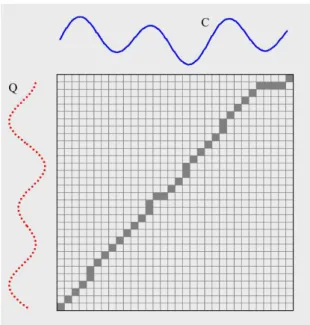
Figure 2.3: Alignment of the two sequences by finding the optimal warping path, that is shown in the solid squares. Taken from [KR05].
including diagonally adjacent cells.
• Monotonicity: Given wk = (a, b) then wk·1 = (a′, b′) in which a−a′ ≥ 0 and b−b′≥0. This compels that the points inW are monotonically spaced in time.
Even though there are exponentially many warping paths that satisfy the above conditions, we are only interested in those that minimize the following warping cost:
DTW(C, Q) =min
v u u t(XK
k=1
wk) (2.5)
By employing dynamic programming it is possible to find this path, by evaluating the following recurrence which defines the cumulative distanceγ(i, j)as the distance
d(i, j) found in the current cell and the minimum of the cumulative distances of the adjacent elements:
γ(i, j) =d(ci, qj) +min{γ(i−1, j−1), γ(i−1, j), γ(i, j−1)} (2.6)
The resulting matrix of the Eq. 2.6 can be seen in Fig. 2.3, in which the optimal path, that satisfies the aforementioned warping path constraints, is shown in the solid squares.
2. RELATEDWORK 2.4. Gesture Recognition
4 9 4 1 0 3 4 1 0 1 3 4 1 0 1 2 1 0 1 4 2 1 0 1 4 1 0 1 4 9 1 0 1 4 9 1 2 3 4
Table 2.1: Matrix of distances between
C andQ.
4 19 6 1 0 3 10 2 0 1
3 6 1 0 1
2 2 0 1 5
2 1 0 1 5
1 0 1 5 14 1 0 1 5 11
1 2 3 4
Table 2.2: Matrix of the optimal warping path
2.4.1.1 Dynamic Time Warping Example
Suppose we intent to compare two signals and evaluate the difference that exists be-tween them, by calculating their cost of similarity. Using two simple example signals,
C andQ, where one is the simple compression of the other, let
C ={1,1,2,2,3,3,4}
Q={1,2,3,4} (2.7)
be the data in these two sequences. Here, Q is a smaller, compressed version of C. To solve this problem we start by building a7×4matrix, sincen = 7andm = 4.
Moreover, on each side of the matrix we put the two signals that will help us calculate each position of the matrix. To fill each(ith, jth) position of the matrix, we make the
following calculationd(ci, qj) = (ci−qj)2. Such can be seen in Table2.1. After the matrix
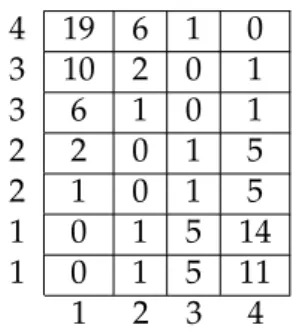
of distances is completed, it is possible to calculate the matrix with the optimal warping path, that can be seen in Table 2.2. To populate this matrix, as formulated in Eq. 2.6, each(ith, jth)position of the matrix is equal to the value of the same position in Table
2.1plus the minimum value among the adjacent cells –(i−1, j−1),(i−1, j),(i, j−1). Moreover, the similarity cost between the two signals is equal to the value in the top right corner in the Table2.2. Due to the similarity among these two signals, the cost between them is0.
2.4.1.2 Fast Dynamic Time Warping
2. RELATEDWORK 2.4. Gesture Recognition
radius
0 1 10 20 30
FastDTW 19.2% 8.6% 1.5% 0.8% 0.6%
Abstraction 983.3% 547.9% 6.5% 2.8% 1.8%
Band 2749.2% 2385.7% 794.1% 136.8% 9.3%
Table 2.3: Average error of three algorithms at the selected radius value (errors of the 3 groups of data are averaged). Taken from [SC07].
it decreases as the radius parameter increases for all algorithms. Moreover, FastDTW converges to a error of 0% much faster than others. Therefore, in terms of accuracy, FastDTW is better than the compared optimizations, as seen in Fig.2.3.
e
Regarding efficiency, as seen in Fig.2.4, FastDTW shows faster results than DTW for small time series, being the radius an influential factor in the execution time. For larger time series, FastDTW runs much more quickly. The main limitation of the FastDTW algorithm is that, in some cases, it is not able to find the optimal solution, as it is an approximate algorithm, which can be an issue if the problem requires optimal warp paths [SC07].
2. RELATEDWORK 2.4. Gesture Recognition
DTW has been commonly used in recent works regarding accelerometer-based ges-ture recognition like [AV10], [AFV11] or uWave [LZWV09].
2.4.2 Hidden Markov Models
A Hidden Markov Model is a stochastic state machine that consists in a Markov chain with a finite number of states where each state is associated with a set of random func-tions. It has been widely applied in areas of time series recognition, like speech or gesture, that have temporal and spatial variability [KKM+05].
In this kind of model, some of the variables influenced by the states are directly observable but the states themselves are hidden. A probability distribution (typically Gaussian) is associated with every state, influencing the possible output tokens. In practical uses, HMM’s takes time series of observation as input and returns the proba-bility that the input data is generated by that model [ZCWY09].
In terms of computation complexity, it is directly proportional to the dimension and number of the feature vectors, which can be an issue if a big dictionary of gestures is used [AV10].
HMM has also been used in the past regarding gesture recognition, like in [ZBA09] or [Pyl05].
[Pyl05] is an accelerometer based gesture recognition using continuous HMMs. In their work, they found beneficial to normalize data in order to compensate the offset that is introduced by the tilt of the device. This tilt mainly occurs due to the orientation of the device given the shape of the human hand and arm. In terms of results, recogni-tion accuracy was above 90% for samples with a sampling rate from 15 to 30 Hz, except for gestures that had duration inferior to a second; in this case, for some rates, gestures would even be unrecognizable. According to Timo [Pyl05], these results are valid with a set of at least 10 gestures, as in the tests.
2.4.3 Affinity Propagation
Clustering data based on a measure of similarity is a critical step in engineering sys-tems. An usual approach is to use the data to learn a set of centers such that the sum of squared errors between data points and their nearest centers is small. When such centers are selected from actual data points, they are denominated exemplars. A recent technique for data clustering is Affinity Propagation (AP) algorithm [FD07].
2. RELATEDWORK 2.4. Gesture Recognition
used to denominate the selected center of a cluster from the existing data points. For example, and as it is used in this thesis, the similarity function can be the negative Euclidean distance between data points; such is applied so that a maximum similarity corresponds to the closest data points.
Furthermore, Akl et al. choose AP as clustering technique, because it operates on a matrix of similarities between data points instead of operating on feature vectors or raw data [AFV11]. As the similarity costs are computed between gesture traces, clustering is based on their temporal characteristics. In their work, AP is used in a configuration that doesn’t require the need for forcing all traces to be of the same length as it is done in other works.
Ultimately, when compared to other clustering techniques like the K-means, AP shows better results, mainly due to the initialization independent property [FD07].
2.4.3.1 Input and Tuning
AP takes as input a collection of real-valued similarities between data points, where the similaritys(i, k) indicates how well suited data pointkis to be the exemplar for data pointi.
Also, instead of requiring that the number of clusters is specified, AP takes as input a set of real numberss(k, k)for each data pointk, known as preference(p). The data points for whose preference (p) is larger are more likely to be chosen as exemplars.
However, if all data points are initialized with the same preference constant, then all of them will have the same probability of becoming an exemplar.
In a similar way, using the same preference value(p)for all data points also directly influences the number of clusters that is given as output. By increasing the preference value used as input, the total number of clusters is also increased. However, if this value is decreased, the same happens to the number of clusters.
If this shared value is the median of the input similarities, the result will be a moder-ate number of clusters, and if such value is their minimum, it will result in the smallest number of clusters.
2.4.3.2 Message exchange
2. RELATEDWORK 2.4. Gesture Recognition
• the "responsibility"r(i, k), sent from data pointito candidate exemplark, reflects the accumulated evidence for how well-suited pointkis to serve as exemplar of point i, taking into account other potential exemplars k′ for data point i. The responsibilities are calculated as following:
r(i, k)←(i, k)− max
k′s.t.k′6=k{a(i, k
′) +s(i, k′)} (2.8)
wherei6= k,s(i, k)is the similarity between data pointiandkanda(i, k)is the
availability message defined in the next item;
• the "availability" messagea(i, k), sent from candidate exemplar pointk to data point i, reflects the accumulated evidence for how appropriate it would be for point i to choose point k as its exemplar, taking into account the support from other data points thatkshould be an exemplar. The availabilities are calculated as following:
a(i, k) = min
0, r(k, k) +
X
i′s.t.i′∈{/ i,k}
max{0, r(i′, k)}
(2.9)
• both self-responsibilityr(k, k)and the self-availabilitya(k, k)reflect accumulated evidence that point k is an exemplar. However, self-responsibility is based on the input preference and by the maximum availability received from surround-ing data points whilst the self-availability bases the exemplar suitability on the positive responsibilities sent to candidate exemplarkfrom other points. Such is expressed as:
r(k, k) =s(k, k)− max k′s.t.k′6=i
a(k, k′) +s(k, k′) (2.10)
a(k, k) = X i′s.t.i′6=k
max{0, r(i′, k)} (2.11)
2.4.3.3 Algorithm Stabilization
In AP, for each point i, its exemplar, and the cluster exemplar itself in casek = i, is found the in following manner:
2. RELATEDWORK 2.4. Gesture Recognition
Although the exemplar choosing and clustering procedure may be terminated at any iteration, it is important that such, and message-passing, is only terminated after the algorithm stabilization. Multiple options arise to pick such point that can be after a fixed number of iterations, after changes in the messages fall bellow a threshold or after the local decisions stay constant for a certain number of iterations.
2.4.4 Compressive sensing
Compressive sensing (CS) theory asserts that it is possible to recover certain signals from far fewer measurements than the traditional sampling methods [CW08]. For fur-ther example assume that a signal can be expressed as ad×1vectorx = ΨswhereΨ
is ad×dmatrix andsis ad×1sparse vector that has onlyls ≪ dnonzero elements.
The location of each nonzero element insis unknown. This method is based on two principles: sparsity and incoherence:
• sparsity, which is relative to the signals of interest, expresses the idea that in-formation rate of a continuous time signal may be much smaller than its band-width suggests. Also, it takes advantage on the fact that many natural signals are sparse or compressible, in the sense that they have concise representations when expressed in the properΨ;
• incoherence, which is relative to the sensing modality, extends the duality be-tween time and frequency and denotes that objects with a sparse representation in Ψmust be spread out in the domain in which they were acquired. Also, that the sampling waveforms have an extremely dense representation inΨ.
x is compressed using a k×d sensing matrix Φ, which yields the vector y with dimensionkas following:
y= Φx= ΦΨs (2.13)
Also, it is possible to perfectly recoversifkmeets the following inequality:
k≥clslog(d/ls) (2.14)
in whichcis a constant andlsis the sparsity level. [CW08]
Afterward, it is possible to reconstruct the signal by solving the followingℓ1norm minimization problem:
min
2. RELATEDWORK 2.4. Gesture Recognition
2.4.4.1 Restricted Isometry Property
As referred in [BDDW08], in the discrete compressive sensing problem, we are inter-ested in economically recording information about a vector (signal)x ∈ Rd, whered is generally a large value. We allocate a budget of k non-adaptive questions to ask aboutxand each of these take the form of a linear function applied tox. Therefore, the information we extract fromxis given as following:
y= Φx (2.16)
whereΦis ak×dmatrix andy ∈ Rk. The matrixΦmaps RdintoRk, wherekis usually much smaller thand.
To extract the informationycontains aboutx, we use a decoder∆that maps from
Rk back again into Rd. The role of ∆is to provide an approximation x¯ := ∆(y) =
∆(Φx)tox. The mapping∆is typically non-linear.
The central question of CS is: "What are the good encoder-decoder pairs(Φ,∆)?"
To measure the performance of an encoder-decoder pair (Φ,∆), we introduce a normk · kX in which we measure the error. Then,
E(x,Φ,∆)X :=kx−∆(Φx)kX (2.17)
consists in the encoder-decoder error onx. More generally, ifKis any closed and bounded set contained inRd, then this encoder-decoder error onKis given by
E(K,Φ,∆)X := sup
x∈K
E(x,Φ,∆)X· (2.18)
Thus, the error on set K is determined by the largest error itself contains. Re-garding the question of what constitute good encoder-decoder pairs, we introduce Ak,d :={(Φ,∆) : Φisk×d}
The best possible performance of an encoder-decoder onKis given by
Ek,d(K)X := inf
(Φ,∆)∈Ak,dE(x,Φ,∆)X· (2.19) This is the so-called "minimax" way of measuring optimality that is prevalent in approximation theory, information-based complexity and statistics [BDDW08].
The decoder∆is important in practical applications of compressive sensing.
2. RELATEDWORK 2.4. Gesture Recognition
linear program
∆(y) := arg min x: Φx=y k
xkℓd
1· (2.20)
Candès and Tao [CT05] introduced the isometry condition on matricesΦ and es-tablished its important role in compressive sensing. Given a matrixΦand any set T of column indices, we denote byΦT thek×#(T)matrix composed by these columns. Similarly, for a vectorx ∈ Rd, we denote byxT the vector obtained by retaining only the entries inxcorresponding to the column indicesT. We say that the matrixΦ sat-isfies theRestricted Isometry Property(RIP) of orderm if there exists aδm ∈ (0,1)such
that
(1−δm)kxTk2ℓd
2 ≤ kΦTxTk
2 ℓk
2 ≤(1 +δm)kxTk
2
ℓ2d (2.21)
holds for all setsTwith #(T) ≤m. The condition (2.21) is equivalent to requiring that Grammian matrixΦTTΦThas all of its eigenvalues in[1−δk,1 +δk], beingΦTTthe transpose ofΦT
The "good" matrices for compressive sensing should satisfy2.21for the largest pos-siblem. In [CT05] Candès and Tao, show that wheneverΦsatisfies the RIP of order3m withδ3m<1, then
kx−∆(Φx)kℓd
2 ≤
C2σm(x)ℓd
1
p
(m) (2.22)
whereσm(x)ℓd
1 denotes theℓ1error of the bestm-term approximation and where the constantC2 depends only onδ3m.
The proof of2.22particular formulation is available in [CDD07] while the original proof is accessible in [CRT06a].
The question before us now is: "How can we construct matricesΦthat satisfy the RIP for the largest possible range ofm?"
Beforehand, it is important to note that verifying the RIP may be a difficult task. First, it requires bounded condition number for all sub-matrices built by selectingm:=
#(T)and second, the spectral norm of a matrix is not generally easy to compute. Nevertheless, the most outstanding example that answers this question is thek×d random matricesΦwhose entriesφi,jare independent realizations of Gaussian random
variables [BDDW08]
φi,j ∼ N(0, 1
2. RELATEDWORK 2.4. Gesture Recognition
Likewise, one can also use matrices where the entries are independent realizations of±1Bernoulli random variables, such as
φi,j := (
+1/√n with probability 1 2, −1/√n with probability 1
2,
(2.24)
or related distributions, such as
φi,j := + q 3
n with probability 16,
0 with probability 23,
−q3n with probability 1 6,
(2.25)
2.4.5 Random Projection
Random projections (RP) has emerged as a powerful technique employed for dimen-sionality reduction [BM01] [LG03]. This kind of technique helps searching and explor-ing vast amounts of data while beexplor-ing computationally and time-efficient. Moreover, it helps reducing the computational cost of large amounts of data, by reducing their dimensionality and allowing to compute a smaller set.
An ideal dimensionality technique has the capability of efficiently reducing a d-dimensional data into ak-dimensional subspace, wherek ≪ d, while still preserving the original data. This is done by using a k×dmatrixA whose columns have unit lengths. Using matrix notation, whereXd×nis the original set on d-dimensional obser-vations, then
XRPk×n=Rk×dXd×n (2.26)
whereXRP
k×nis the projection of the data into a lowerk-dimensional subspace. The
concept of random projection is inspired by the Johnson-Lindenstrau lemma [JL84], which states that if points in a vector space are projected into a randomly selected sub-space of high dimension, then the distances between the points are approximately pre-served, as proven in [FM88] and [DG99].
2. RELATEDWORK 2.5. Environmental Awareness
be close enough to orthogonal to provide a reasonable approximation to the original vectors.
Regarding RP,Ais the general case ofΦ, in CS (see Section2.4.4) and also RIP (see Section 2.4.4.1). Moreover, A is a sampling operator for X and is invertible if each
x ∈ Xis uniquely determined by its projected data Ax, which can be formulated as in Eq. 2.27. Actually, matrixAis a one-to-one mapping between XRP andX, which allows the identification for eachx∈XfromAx.
x1,x2∈X, Ax1 =Ax2 →x1=x2 (2.27)
Nonetheless, we want that a small change inxproduces a small change in its
pro-jected dataAx. So, a stricter condition is given, as expressed in Eq. 2.28, whereα >0 andβ < ∞and are both constants. H is an Hilbert space, andψn ∈ His a sampling
vector [LD08].
αkx1−x2k2H≤ kAx1−Ax2k2l2 =
X
n
|hx1−x2, ψni|2≤βkx1−x2k2H (2.28)
The sampling condition expressed in Eq. 2.28onAis related to the concept of RIP and is the same as RIP ifXhas sparse columns and the columns come from the same subspace [LD08] [CT06]. Moreover, as mentioned in Section2.4.4.1, any distribution of zero mean and unit variance satisfies the condition expressed in Eq.2.28.
2.5
Environmental Awareness
Nowadays, a huge effort demand is being put upon Earth’s natural resources and bio-diversity by different sectors. However, this demand is not predicted to decrease but instead to get only higher in the next decades. So, it is of much importance that citizens overall have a more crucial role in promoting and conserving the environment.
Also, as stated in OECD Environmental Outlook to 2030 [OEC08], "Without more ambitious policies, increasing pressures on the environment could cause irreversible damage within the next few decades".
There are key sectors that need special attention, like Energy, Transportation, Agri-culture and Capture fisheries; OECD highlights priority actions in these sectors [OEC08].
2. RELATEDWORK 2.6. Interaction with Public Ambient Displays
related carbon emissions are projected to increase by 58% to 2030.
As also stated in OECD Environmental Outlook to 2030, "Many environmental chal-lenges cannot be solved by environment ministries alone" and that most environmental problems can only be solved, among other measures, with the co-operation with busi-ness and civil society."
Regarding energy consumption, its increasing consumption is a problem that af-fects the environment worldwide [McC01]. Even though governments throughout the world are promoting the development of renewable energy sources and multiple inter-national agreements aim to restrain the emissions such as CO2, people’s personal en-ergy consumption behavior still remains relatively unchallenged [BTK06]. Moreover, in the past 30 years, the electricity usage has grown about 30% [Age05] and the potential of consumption reduction in a domestic environment exists [Dar06].
Considering these factors, it is important that every citizen is fully aware of the main causes that are endangering the environment and what they can change in their behaviors to help contributing to reduce Earth’s consumption of natural resources and pollution.
In the scope of the DEAP project it is intended to make people aware of the environ-mental situation we are currently living in and also to persuade them into having pro-environmental behaviors, particularly to make them know the particular key sectors that most represent a danger to the world’s environmental resources and biodiversity. As this thesis was developed in the scope of the DEAP project, we address this matter in the proof of concept.
2.6
Interaction with Public Ambient Displays
In the matters of interaction with public ambient displays, individuals direct interac-tion activities can be classified in two types: overt or covert [KFL08]. Overt interac-tion occurs when an individual uses designated input devices like keyboard or explicit physical movement, which may result in a learning by watching and also encourage surrounding people to interact as well. On the other side, it can cause social embarrass-ment, discouraging the interaction with the display. The latter, covert interaction, exists when there is interaction between a phone or implicit physical movement. This type of interaction allows a greater level of privacy and it may increase the user confidence levels. However, not as much information is passed to others reducing the acquisition of knowledge that can be achieved with the display interaction.
2. RELATEDWORK 2.6. Interaction with Public Ambient Displays
groups where members know each other. They also conclude that, in order to enable both covert interaction and learning, more emphasis on the information part should be given, since learning by watching among strangers is not supported in the same way as, for example, touch screen applications. Therefore, instructions on how to interact were given almost 50% of the display space in the applications. Besides, font sizes would be chosen accordingly to the detail level of information, where the most detailed would have the smallest font. In this way, those who were more interested in the information would get closer to the display. For people who were just passing in the street, the pro-cess of starting to read large and less detailed information could lead to getting close to the display and even result on their interaction as actors. Results show that a 95% success rate in the learning ability was achieved [KFL08].
Previous works in this area have been done like MAID [Sal12] or Gaea [Cen11], both further addressed in this document. Besides, works like CityWall [PK08], are also relevant in this area. CityWall is a large multi-touch display that was installed during eight days in the city center of Helsinki, Finland. In these eight days, 1199 people, in various social configurations, interacted with the system. Peltonen et al. [PK08] show how a public ambient display can become a place that triggers strangers to come in contact and interact between them.
These different approaches and related works can be useful when designing the game proposed by this thesis, in order to attract different groups of people near the display and, most of all, to motivate people to play it.
2.6.1 Technology as human social relationship capacitor
As stated in [Aga05], humans have a basic need for contact with other humans, even pointing out that the lack of this social relationship can constitute a risk factor for health that can even exceed those caused by cigarette smoking or lack of physical activity. Ste-fan Agamanolis states that new technologies truly affect human behavior in relation-ships as well, being able to act as mediator or even a catalyst.
2. RELATEDWORK 2.7. Persuasive Technology in Gaming context
2.7
Persuasive Technology in Gaming context
Persuasive technology is defined as the group of technologies that intent to apply changes on user’s attitudes and behaviors without the use of coercion, which is the use of force or threats.
B.J. Fogg coined the term Captology as a new work that describes the study and use of computers as persuasive technologies. Particularly, it explores how people attitudes and behaviors change when interacting with computers itself rather than using them as communication mediators. In terms of intent, there is an universe of three computer intent types: endogenous, when a designer or producer creates a technology with the intent to persuade others in some way; exogenous, when one provides another with a computer technology with the intent of changing its attitudes; and lastly, autogenous, when a person chooses to use a technology in order to change his own behaviors. Cap-tology focus in the first one, endogenous. In terms of persuasion scale, there can be considered two magnitudes: macro, when a product is designed with the pure intent of persuasion and micro, when a product includes persuading elements but its main objective is not persuasion [Fog98] [Fog02].
Figure 2.5: Captology: How computing and persuasion overlap. Taken from [Cer11].
2. RELATEDWORK 2.7. Persuasive Technology in Gaming context
[FDK+09], eVision [San12] [SRaD+12], MAID [Sal12] or Gaea [Cen11].
PowerHouse [BTK06] is a computer game designed to influence behaviors associ-ated with energy use and promote an energy-aware lifestyle among teenagers. With the foundation that the world’s energetic consumption in the past 30 years has increased about 50% and that the domestic electric consumption can be cut significantly, it aims to explore new design and approaches that can be used to raise awareness of energy-related issues. Moreover, Bang et al. [BTK06] state that people are increasingly play-ing computer games and that these games seem to be particular powerful to influence decision-making and user behavior. Their pre-game studies concluded that teenagers’ knowledge on how much energy is being used by different domestic activities is gen-erally quite low, with a rate of 50% correct answers. In order to appeal the participants, the game format consists in a TV reality show (docu soap) where people live together in a closed house, similar to the popular game Sims [Spo13]. This game uses persua-sion by modeling energy consumption of different activities in a home. For instance, if a player is taking a hot shower the energy meter will show this immediately and the money meter will drop.
eVision [San12] is an application with the goal of informing users about environ-mental threats in their surroundings as well as their corresponding consequences. Be-sides, it has also the objective of encouraging users to change their attitude towards the environment.
In order to accomplish this goal it uses augmented reality, detecting cars, planes and bicycles. Also, it offers digital rewards for completing pro-environmental tasks, by means of giving the user an in-app currency – green leafs – that allows the in-app buying of items to customize the game character. These are rewarded when a user finishes a virtual cleaning task, for example. Furthermore, it creates a bond between the user and the virtual character in order to make users more receptive to suggestions, by allowing the user to customize the game character.
2. RELATEDWORK 2.8. Smartphone games with interaction by the use of accelerometer based gestures
emissions.
Gaea [Cen11] is a location-based multiplayer mobile game that prompts users to recycle virtual objects within a specified spatial context. Its main goal is to persuade users to recycle their wastes in a correct manner, promoting entertainment and social engagement, combining mobile devices with a public display. To do so, players need to collect virtual garbage that is shown in maps on their mobile phones. The objects are linked to specific geographic coordinates and users need to go there, pick them up and then go back to the public display and drop the item into the right recycling garbage collector. When all the garbage has been collected a quiz starts in the public display. The questions are related to information that was presented when dropping garbage and users can answer them in their mobile phones. If they answer correctly they will earn extra points. This way, the users are motivated to pay attention to the provided information in order to win the game.
Even though the game built in this thesis is developed merely as the proof of con-cept for the framework, it was the author’s intention to transfer a pro-environmental message to the players. Hence, such was addressed in key sectors that most contribute to the worldwide environment degradation, such as energy consumption and overall resource waste.
2.8
Smartphone games with interaction by the use of
accelerom-eter based gestures
There is a wide range of games in the AppleR App Store for iOS that make use of the
accelerometer to receive actions from the user. Most of them require that the device is tilted to perform a game character trajectory change. The following list addresses a few:
• Doodle Jump is a traditional platform game in which the game character contin-uously keeps moving up and must not miss a platform or will fall. To control the character position the user must tilt the device to the desired orientation.
• Labyrinth 2 is a game in which a maze must be crossed with a sphere. During this, multiple obstacles such as walls and holes harden the level. The user is able to control the level gravity by moving the device, thus affecting the sphere position that is subject to this gravity.
2. RELATEDWORK 2.8. Smartphone games with interaction by the use of accelerometer based gestures
object he loses. In this case the user must tilt the device in order to move right and left along the path, for picking coins. Moreover, this game combines the use of screen swipes in order to make the correct turns and jumps.
![Figure 2.2: Two time sequences C and Q which are similar, but out of phase. Taken from [KR05]](https://thumb-eu.123doks.com/thumbv2/123dok_br/16534019.736467/35.892.227.578.132.215/figure-time-sequences-c-similar-phase-taken-kr.webp)
![Figure 2.4: The efficiency of FastDTW and DTW on small time series. Taken from [SC07].](https://thumb-eu.123doks.com/thumbv2/123dok_br/16534019.736467/38.892.242.739.588.960/figure-efficiency-fastdtw-dtw-small-time-series-taken.webp)
![Figure 2.5: Captology: How computing and persuasion overlap. Taken from [Cer11].](https://thumb-eu.123doks.com/thumbv2/123dok_br/16534019.736467/49.892.196.608.563.839/figure-captology-computing-persuasion-overlap-taken-cer.webp)
![Figure 3.1: Moving average result. Taken from [Smi03].](https://thumb-eu.123doks.com/thumbv2/123dok_br/16534019.736467/56.892.184.792.589.812/figure-moving-average-result-taken-from-smi.webp)
![Figure 3.2: Overall diagram block for gesture recognition. Original in [AFV11].](https://thumb-eu.123doks.com/thumbv2/123dok_br/16534019.736467/59.892.217.578.122.833/figure-overall-diagram-block-gesture-recognition-original-afv.webp)
![Figure 3.3: Overall gesture recognizing system architecture. Original in [AFV11].](https://thumb-eu.123doks.com/thumbv2/123dok_br/16534019.736467/64.892.195.785.129.446/figure-overall-gesture-recognizing-architecture-original-afv.webp)
