PALLIATIVE NURSING CARE FOR THE PEDIATRIC PATIENT: AN
INTEGRATING REVIEW
Cuidados paliativos de enfermagem ao paciente pediátrico: uma revisão integrativa
Maria Tatiane Martins Rodrigues1
Sabrina de Jesus Oliveira Neves1 Karine Gabriele de Jesus Lima1 Jaqueline Rodrigues Ferreira Santos1 Aurelina Gomes e Martins1 Mirela Lopes Figueiredo1 Patricia Fernandes do Prado1
Abstract: To identify the care of the nurse to the child with cancer in palliative care. A descriptive study
with the method of integrative literature review, carrying out an online search with data collection in the
Virtual Health Library - VHL: Latin American and Caribbean Literature in Health Sciences - Lilacs, and
International Literature in Health Sciences - Medline in the period from 2012 to 2018. Of the 20 studies
identified, 10 were included in this review according to the inclusion and exclusion criteria. The main results
point out that the nursing professional must have skills and managerial assistance to provide palliative
care in the pediatric oncology sector, seeking strategies that range from communication with the child
and family to the reduction of risks that generate infection and other damages, so the infant’s needs. It is
concluded that the palliative care provided by the nurse to the child with cancer contributes to the greater
comfort in relation to its clinical state and thus maximizes the well-being and minimizes the suffering of
the patient and relatives.
Keywords: Palliative care; Oncology; Pediatrics; Pediatric nursing.
Autor para correspondência: Karine Gabriele de Jesus Lima E-mail: [email protected]
caráter descritivo com método da revisão integrativa da literatura, efetuando uma busca online com
le-vantamento de dados na Biblioteca Virtual de Saúde – BVS: Literatura Latino-Americana e do Caribe em
Ciências da Saúde – Lilacs, e Literatura Internacional em Ciências da Saúde – Medline no período de 2012
a 2018. Dos 20 estudos identificados, 10 foram incluídos nesta revisão conforme os critérios de inclusão e
exclusão. Os principais resultados apontam que o profissional de enfermagem deve ter competências
ger-encial e assistger-encial para prestar o cuidado paliativo no setor oncológico pediátrico, buscando estratégias
que vão desde a comunicação com a criança e familiares até a diminuição de riscos que gerem infecção e
outros danos, atendendo assim a necessidade do infante. Conclui-se que os cuidados paliativos prestados
pelo enfermeiro à criança com câncer contribui para o maior conforto em relação ao seu estado clínico e
assim maximiza o bem-estar e minimiza o sofrimento do paciente e familiares.
REVISTA UNIMONTES CIENTÍFICA
INTRODUCTION
The process of illness in human life
generates negative experiences by which only fits
one search: the cure. In relation to the pediatric
oncology, this suffering generates a complicated
experience for the child and therefore, brings stress
and anxiety during hospitalization
1.From a clinical point of view, the cancer in
children is observed by its histological type and its
frequency affecting then, the sustentation tissues
and cells of the hematopoietic system causing the
tumors grow aggressive and successively on the
patient’s body
2.Based on this understanding, it becomes
essential to adopt a practice whose assistance is
focused on quality of life, decrease of suffering,
pain control, stress reduction, and the anguish that
the reality of the disease cause in pediatric patients.
Therefore, the palliative cares are essential to the
pursuit of this practice, because the professional
acquires a look centered on the clinical and cautious
conditions of the patient in the humanized care
3.The pediatric palliative care is defined as
a program of care for the child with limited life
due to a currently incurable disease that seeks to
control the symptoms of pathology and integrate
the spiritual support and psychological support for
families before the moment of decision-making and
should be initiated after diagnosis of the disease
and its treatment
4.Within the multiprofessional team, the
nursing work has-become comprehensive in
palliative care, because these professionals perform
care with a humanistic vision, thus creating a bond
with the small patient so that he or she can develop
interventions, and many times their effectiveness is
highly accepted in the cancer treatment
1.The nurse in addition to experiencing the
reality of the oncologic patient during his or her
moment of pediatric hospitalization, he or she
is responsible for giving comfort and rescue the
esteem of the small infant, as well as include the
family in the whole process of care, minimizing
traumatic effects and proportionate humanization
of care
5.The objective of this study was to
describe
the nursing palliative care in oncology pediatric
patients.
METHODOLOGY
The study is descriptive using the method
of integrative review of literature, resource that
guides a methodology enabling the synthesis of the
state of knowledge of a particular subject matter
and identifying gaps which exist for suggestions of
new studies and perspectives of the topic studied.
Therefore, it is composed by the following steps:
elaboration of the guiding question; sampling in the
literature; critical analysis of the studies included;
discussion of results and presentation of the review
of knowledge
6.
To guide this review, first, the following
question was elaborated : What are the nursing
palliative cares provided to pediatric oncology
patients?
For the identification of publications that
have structured the integrative review of this study,
an online search was performed with survey data in
the Virtual Health Library - VHL: Latin American
and Caribbean Literature in Health Sciences - Lilacs,
and International Literature in Health Sciences –
20 articles related to the theme were
found, being selected 10 publications that met the
inclusion criteria for this study: studies published
in the modality of scientific article, available in
its entirety, published in Portuguese in the period
from 2012 to 2018.This study showed the need for
approval by the Committee for Ethics in Research,
considering that manipulates data of free access,
ethical confidentiality .
LITERATURE REVIEW
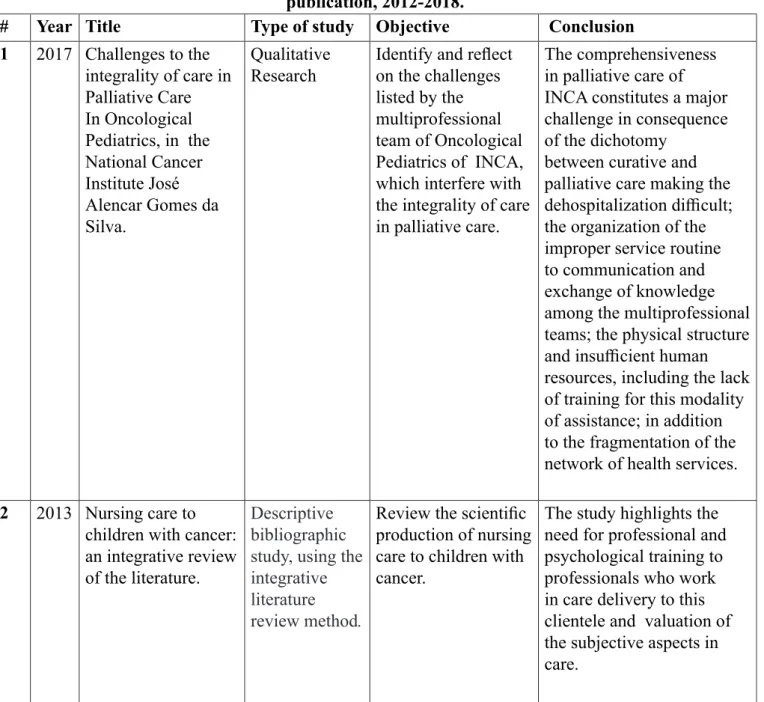
TABLE 1 presents the selected articles,
according to the authors, title, type of study,
objectives and conclusion.
Table 1 - Characteristics of the articles selected according to authors, title, type of study and year of
publication, 2012-2018.
#
Year Title
Type of study Objective
Conclusion
1
2017 Challenges to the
integrality of care in
Palliative Care
In Oncological
Pediatrics, in the
National Cancer
Institute José
Alencar Gomes da
Silva.
Qualitative
Research
Identify and reflect
on the challenges
listed by the
multiprofessional
team of Oncological
Pediatrics of INCA,
which interfere with
the integrality of care
in palliative care.
The comprehensiveness
in palliative care of
INCA constitutes a major
challenge in consequence
of the dichotomy
between curative and
palliative care making the
dehospitalization difficult;
the organization of the
improper service routine
to communication and
exchange of knowledge
among the multiprofessional
teams; the physical structure
and insufficient human
resources, including the lack
of training for this modality
of assistance; in addition
to the fragmentation of the
network of health services.
2
2013 Nursing care to
children with cancer:
an integrative review
of the literature.
Descriptive
bibliographic
study, using the
integrative
literature
review method.
Review the scientific
production of nursing
care to children with
cancer.
The study highlights the
need for professional and
psychological training to
professionals who work
in care delivery to this
clientele and valuation of
the subjective aspects in
care.
REVISTA UNIMONTES CIENTÍFICA
Of the total (100%), eight were field
research, being (70%) with a qualitative approach,
two (20%) were integrative review of literature and
one (10%) was narrative review of the literature.
3
2015 Palliative care in
pediatric oncology:
Perceptions,
knowledge and
practices in the
perspective of the
multiprofessional
team.
Qualitative,
exploratory
and descriptive
research.
Know the
perceptions,
knowledge and
practices of the
multiprofessional
team in attention to
children in palliative
care in pediatric
oncology.
The themes revealed that the
team suffers, also, with the
child’s death and, in a way
similar to the family, moves
toward the construction
of coping mechanisms
for the elaboration of the
mourning. Paradoxically,
the team shares knowledge
to delineate the foundations
of natural therapeutic
project to be implemented
and enters the family in this
process so that they can
assume the role of care for
the child.
4
2013 Unveiling the
humanized care:
perceptions of
Nurses in pediatric
oncology.
Exploratory-descriptive
study, with
qualitative
approach.
Unveiling the
elements of the
humanized care
present in the
encounter among
nurse, family and
child with cancer
identifying the
perception of
nurses regarding
the humanization
of assistance and
verifying in what
situations the nurse
realizes that the
humanization is
anchored to care.
The data allowed reflexions
about possibilities for
construction of interpersonal
humanistic process into
the environment of care in
pediatric oncology and of
advances and limitations
regarding the applicability
of this framework in
practice.
5
2012 The nurse and care
for the child with
cancer without
Possibility of cure.
Qualitative
Research
Analyze
comprehensively the
nurse’s care to the
hospitalized child
carrier of oncological
disease
out of the current
possibility of cure.
From these actions the
caring for the family present
there is guided, with the
aim of supporting them,
providing attitudes of love,
affection and respect.
30%), 2013 (3 or 30%), 2015 (2 or 20%), 2012 (or
10%) and 2018 (one or 10%).
The child cancer needs treatments that
cor-respond to long periods of time that creates anguish
and fear to small patients and, especially the
suf-fering of professionals in relation to exhaustion of
healing, because in addition to being able to act
before the child’s pain, is faced with the pain of
the family. However, the nursing staff has an
es-sential role in this process, considering that these
are professionals who promote a humanized care
that contributes to minimizing the factors resulting
from the pathology
7.The palliative care in pediatric oncology
patients is performed with the aim of identifying
complications during the treatment of the pathology,
as well as to provide relief to the symptoms,
such as difficulty feeding and handling, pain and
respiratory discomfort. Therefore, the nurse obtains
a humanistic vision to minimize the suffering of
these patients, helping them in the process of dying
with dignity and providing maximum comfort to
the patient
8.
Based on this assumption, the nurse then,
has a prominent role in the multiprofessional team,
because he or she acts in the development of tasks
and actions for palliative care, since their
manage-rial competence of care until the direct care to the
patient, always seeking to meet the needs of the
pediatric patient. To do so, it is essential the
per-formance of the multiprofessional team during the
pediatric oncology treatment in a way that enables
discovering a care focused on healing the small
in-fant
9.
From this perspective, it stands out as a tool
of palliative care, the affective communication,
effective method for discovering the humanized
care and integral, because it provides the possibility
therapeutic measure in the context of health and
disease
10.Viero et al.,
11report that it is not always
easy to work in “Pediatrics”, whereas, oncology
nurses can present difficulties in day-to-day due
to the coexistence of suffering, pain and death of
the sick child in addition to affecting his or her
psychological and with it they find ways to get out
of this reality, using means of vacation, a medical
certificate to be able to heal from the suffering of
others.
Therefore, the nurse, trained in taking care
of the oncologic child using or not palliative care,
assigns various skills to cope with the child’s
ill-ness and in the case of hospitalization, namely: use
communication to improve the relationship, reduce
the fear and anxiety, give support to families,
en-courage the expression of feelings, help in
adapta-tion in that environment considered disturbing in
the child’s perception, reduce damages, such as risk
of infection, assessing the nutritional status among
other actions
11.FINAL CONSIDERATIONS
The palliative care provided by nurses to
children with cancer involves since managerial
assistencial strategies with a single focus to reach an
admission that in addition to performing procedures
to meet the needs of the patient in terminal stage,
may bring a greater comfort in relation to their
clinical condition and thus maximize the welfare
and minimize the suffering of the patient.
At the end of this study, it is suggested that
further research should be developed addressing the
issue, both as regards the performance of the nurse,
as compared to other health care professionals who
REVISTA UNIMONTES CIENTÍFICA