EXPLORING
THE PARALLELOGRAM OF RESPONSIBILITIES
Iris Kania
Dissertation submitted as partial requirement for the conferral of Master in International Management
Supervisor:
Ana Margarida Madureira Simaens, Professora Auxiliar, Departamento de Marketing, Operações e Gestão Geral (IBS)
E XP L OR ING T HE P AR AL L E L OG R AM OF R E S P ON S IB IL IT IE S Ir is Kan ia
ABSTRACT
Businesses are facing the challenges of a shortage of highly skilled workforce and shifting demands for corporate social responsibility for employees. Research has shown that a lack of fulfilling employees’ needs leads to a gap in employee engagement, which eventually causes employee turnover costs. To avoid these costs and maintain a competitive workforce, businesses must find a different way to approach the needs of employees and the rising demand for CSR. This study aims to find a new approach for addressing the satisfaction of employees’ needs through CSR strategies. Thus, his research will try to find an answer to the question: Is it possible to find a positive reciprocity between a strategic CSR approach addressing employees and the satisfaction of the employees’ needs in order to increase employee engagement? Based on the literature review on Maslow’s Hierarchy of Needs and Carroll’s Pyramid of CSR and the factor employee engagement, two case studies were conducted with a qualitative research method of semi-structured interviews and analysed based on determined factors. The analysis of the interviews indicated the existence of a positive as well as negative reciprocity within the Parallelogram of Responsibilities, which was derived as a new model approach derived from the findings of the literature research. The results indicate that a high satisfaction of needs lead to a high demand of CSR responsibilities. On this basis it is concluded that businesses, who want to attract and maintain a highly skilled workforce, need an implemented CSR strategy regarding employees.
Keywords: Double Pyramid, Parallelogram of Responsibilities, dynamics of CSR and employee motivation, interferences of Maslow and Carroll
JEL Classifications:
M1 Business Administration
M14 Corporate Culture • Diversity • Social Responsibility M5 Personnel Economics
RESUMO
As empresas enfrentam atualmente desafios resultantes de um número cada vez menor de mão-de-obra altamente qualificada e a necessidade de responsabilidade social corporativa das gerações futuras. Uma pesquisa mostrou que a insatisfação dos funcionários leva à falta de envolvimento dos mesmos, o que geralmente gera custos associados à alta rotatividade. Para evitar estes custos e manter uma mão-de-obra competitiva, as empresas devem encontrar uma forma diferente de encarar as necessidades dos seus colaboradores e a procura crescente por RSC (Responsabilidade Social Corporativa). O presente estudo visa encontrar uma nova forma de satisfazer as necessidades desses colaboradores através de estratégias de RSC. Portanto, este estudo tentará encontrar a resposta para a pergunta: É possível obter uma reciprocidade positiva entre estratégias de RSC direcionada aos colaboradores e satisfazer suas necessidades visando obter maior envolvimento? Baseado nos estudos da Hierarquia das Necessidades de Maslow, a Pirâmide da RSC de Carroll e os fatores de envolvimento dos funcionários, dois estudos de caso foram conduzidos com um método de pesquisa qualitativa de entrevistas semi-estruturadas e analisadas com base em fatores determinados. A análise das entrevistas indicou a existência de uma reciprocidade tanto positiva quanto negativa no Paralelogramo de Responsabilidades, que foi derivado como uma nova abordagem modelo, vinda das descobertas feitas na literatura. O resultado indica que aumentar a satisfação das necessidades leva a uma maior procura por RSC. Com base nisso, conclui-se que as empresas que desejam atrair e manter uma força de trabalho altamente qualificada, necessitam de uma estratégia de RSC direcionada ao seus colaboradores.
Keywords: Pirâmide Dupla, Paralelogramo de Responsabilidades, dinâmica da RSE e motivação dos funcionários, interferências de Maslow e Carroll
JEL Classifications:
M1 Business Administration
M14 Corporate Culture • Diversity • Social Responsibility M5 Personnel Economics
ACKNOWLEDGEMENTS
The following thesis was carried out as a completion of the authors’ Master of Science degree in International Management, as part of the MIM Programme, at ISCTE-IUL University, in Lisbon, Portugal in Autumn 2019.
The authors desire to express appreciation to all of those who have contributed to the process of this thesis, from advisors, participants, and peers who have devoted their time with both intellectual help and personal support. A special thank you would like to be recognized to the following members:
Firstly, I would like to express sincere gratitude to my advisor, Mrs. Ana Simaens, for the continuous support and motivation through the duration of this study. Her mentorship and guidance, especially supporting me facing logical challenges and having an unmatched patience, has helped me manoeuvring through the research and the final writing process of this thesis.
Additionally, I would like to extend a thank you to my participants who provided me with insightful and imperative information as they willingly volunteered their time to answer my questions through the interview process; this study could not have been completed without you.
Furthermore, I would like to express a sincere Thank You to our dean Mr. Antonio Robalo for the effort of making the MIM Programme an interesting and variegated experience. The past two years have been an intense and instructive experience. Finally, I would like to thank my friends and family, who have provided an abundance of support through this year. To my father, who supported and eventually beard the consequences of my personal decision for higher education. To my best friends Anna, Eva, and Susanne for never ending brainstorming sessions and giving me a home. Lastly, I want to express my gratitude to Nadine and Sarah, for their implicitness of action. This could have never been done without your support.
With sincere gratitude,
I
TABLE OF CONTENTS
ABSTRACT ... II RESUMO ... III ACKNOWLEDGEMENTS ... IV TABLE OF CONTENTS... I TABLE OF FIGURES ... III TABLE OF TABLES ... IV1. INTRODUCTION ...1
1.1. Employee Engagement in Times of Competition for Highly Skilled Workforce ...1
1.2. Research Problem & Question ...1
1.3. Research Method ...2
1.4. Thesis Structure ...2
2. LITERATURE REVIEW ...4
2.1. The Employee Engagement Gap ...4
2.2. Maslow’s Hierarchy of Needs ...6
2.2.1. The Pyramid of Needs ...7
2.2.2. Self-actualisation ... 12
2.2.3. Criticism on Maslow’s Model ... 14
2.2.4. Maslow and Employee Engagement ... 17
2.3. The Concept of Corporate Social Responsibility ... 26
2.3.1. History & Definitions ... 26
2.3.2. The Stakeholder Concept ... 29
2.3.3. Carroll’s Pyramid of Corporate Social Responsibility ... 32
2.3.4. CSR and Employee Engagement ... 36
3. THE PARALLELOGRAM OF RESPONSIBILITIES ... 40
3.1. The Double Pyramid ... 40
3.2. Research Gap & Justification ... 41
3.3. Research Assumptions ... 42
3.4. Parallelogram of Responsibilities ... 46
3.5. Research Questions & Factors ... 49
4. METHODOLOGY ... 51
4.1. Research Method ... 51
4.2. Choice of Cases ... 52
4.3. Interview Questions and Factors ... 53
5. ANALYSIS ... 55
5.2. Case I – FinTech ... 55
5.2.1. Introduction... 55
5.2.2. Interferences of the Fulfilment of both Pyramids within the Parallelogram ... 56
5.2.3. Effects of the Parallelogram on Employee Engagement ... 61
II
5.2.5. Role of Strategic Implementation ... 62
5.3. Case II - OnTech ... 63
5.3.1. Introduction... 63
5.3.2. Interferences of the Fulfilment of both Pyramids within the Parallelogram ... 64
5.3.3. Effects of the Parallelogram on Employee Engagement ... 66
5.3.4. Role of Leader ... 67
5.3.5. Role of Strategic Implementation ... 68
5.4. Cross Analysis ... 69
5.4.1. Interferences of the Fulfilment of both Pyramids within the Parallelogram ... 69
5.4.2. Effects of the Parallelogram on Employee Engagement ... 72
5.4.3. Role of Leader ... 73
5.4.4. Role of Strategic Implementation ... 74
6. DISCUSSION ... 75 7. CONCLUSION ... 78 7.1. Main Findings ... 78 7.2. Contributions ... 78 7.3. Limitations... 79 7.4. Further Research ... 79 BIBLIOGRAPHY ... 81 APPENDICES... 84
Appendix I: 15 characteristics of self-actualised people (Maslow, 1970, p. 152-174) ... 84
Appendix II: Interview Questions with References and Factors... 86
Appendix III: Interview Results Employees sorted by Factors ... 89
III
TABLE OF FIGURES
Figure 1: Engagement Profiles: 2016 vs. 2017 (Aon plc., 2018: 7) ...5
Figure 2: Maslow’s Hierarchy of Needs (illustration according to McLeod, 2018) ...7
Figure 3: Maslow’s Extended Hierarchy of Needs (illustration according to McLeod, 2018) 12 Figure 4: Hierarchy of Human Motives (illustration according to Kenrick et al., 2010) ... 17
Figure 5: Performance Pyramid (illustration according to Stum, 2001: p.6) ... 19
Figure 6: Current-Desired Comparison of Employment-Experiences (Aon plc, 2016, p. 12) . 21 Figure 7: Pay-for-Performance Perception (Aon plc., 2016: 51) ... 23
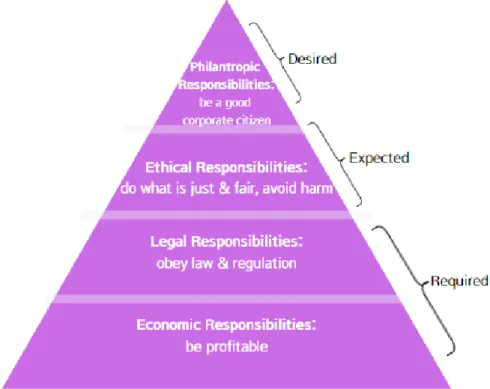
Figure 8: The Pyramid of CSR (illustration according to Carroll, 2016) ... 32
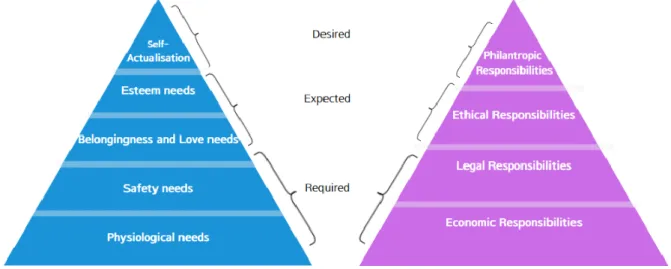
Figure 9: Double Pyramid (own Illustration) ... 40
Figure 10: The Parallelogram of Responsibility (own Illustration) ... 47
Figure 11: Reciprocity within the Parallelogram (own Illustration) ... 48
IV
TABLE OF TABLES
Table 1: List of Research Questions with References and Factors (own Illustration) ... 50 Table 2: Interviewees with Role, Title, Seniority and Code (own Illustration) ... 53 Table 3: Interview Questions Employees with References and Factors (own Illustration) ... 54
1
1. INTRODUCTION
1.1. Employee Engagement in Times of Competition for Highly Skilled Workforce
The “war for talent” is a vital challenge for corporations nowadays in order to pursue successful and sustainable business in the future. Factors like demographic change and globalised employment markets intensify the competition of companies to attract and retain the best workforce (DDI, 2015). Especially highly skilled specialisations like for instance in the IT sector have a high leverage for demanding a better work-environment. In addition to the competition of skilled workforce, several studies about employee engagement show that a lot of business potential is not unfold through low or disengaged employees: 85 percent of employees worldwide are not engaged or are actively disengaged in their job (Gallup 2017) whilst the higher engaged the employees the higher the performance of an organisation (DDI, 2015). Not only are organisations confronted with the challenges of attracting the best workforce, they also must find solutions for improving the overall employee engagement in order to increase the business performance. To replace the current strong generation, which will be retired by 2030, with a specialised and qualified workforce of the younger generations it becomes necessary understanding why and how the demands of the employees will change and how they can be met most efficiently to maintain an engaged and hence competitive workforce. At the same time the needs of society regarding Corporate Social Responsibility (CSR) activities are on the rise: 79 percent of Millennials expect business to improve their CSR efforts (Cone, 2017b) while being a good employer is the number one priority for positive CSR activities for both the Gen-Z and the Millennial generation (Cone 2017a). Another study found that American consumers prioritise companies with the reputation that they are responsible (86 percent) and caring (85 percent) (Porter Novelli, 2018). So how can organisations react to those trends?
1.2. Research Problem & Question
The future challenges businesses will face through a shortage of highly skilled workforce will lead to the problem on how to acquire, retain and thus engage employees? The trends for CSR activities addressing the employees’ welfare require business organisations to implement new CSR strategies. Bringing the two challenges of a high competition in highly skilled labour markets and a raising demand for CSR regarding employees together, forms a new opportunity: When the lack of employee engagement can be connected to a lack of CSR activities arising
2 the question if an implemented CSR strategy reinforces and increases the level employee engagement?
One attempt of investigation how CSR activities can increase employee engagement will be conducted with this thesis through two similar models which will be connected: Maslow’s Hierarchy of Needs (Maslow, A., 1954) and the responsibility of businesses based on Carroll’s Pyramid of Responsibilities (Carroll, A., 2016). Both models are well-known in their fields and similar in their display as pyramids and have several similarities which indicated a potential connection. This connection led to the idea of the “Parallelogram of Responsibilities”, which is supposed to give insights on how to use CSR strategy in order to increase employee engagement.
1.3. Research Method
In order to answer the research questions a proper research method must be determined. The analysis will be executed with the qualitative research method of semi-structured interviews, conducted in two companies and hence analysing two case studies. The responses of the interviews will be transcribed and coded according to relevant criteria in a factor analysis. The results will be displayed, ordered by the cases and research questions, followed by a cross analysis. The overall results will then be discussed with the findings from the literature research.
1.4. Thesis Structure
Starting with the literature research, the reasons for the employee engagement gap will be examined based on recent studies related to this field. After a detailed evaluation of the motivational theory of Maslow, these findings will be projected to Maslow’s pyramid of needs. Within this projection several recent studies will explain how Maslow’s theory is connected to employee’s current needs and what is necessary to fill these gaps in order to increase employee engagement. During the second part of the literature review the concept of Corporate Social Responsibility will be explained with a focus on a stakeholder management approach. Resulting the concept of Carroll’s Pyramid of CSR and its effects especially on employees will be presented and eventually mapped with how CSR activities can affect employee engagement. Deriving from the key findings of both models in the context of employee engagement the model of the “double pyramid” will be explained. The idea will be presented, if a reciprocity can be found based on similar effects between both pyramids and will be explored how using this reciprocity might be an opportunity to increase overall employee engagement and therefore business performance. Following with identifying the research gap and formulating the accurate
3 research questions under the idea of the “Parallelogram of Responsibilities” the interdependencies will be analysed through the presented research methods. During the analysis, the results of the factor analysis will be presented in order of the main and sub research questions, analysing each case individually and finally analysing the overall findings in a cross analysis. Eventually the results of the analysis will be discussed with the findings from the literature research and lead to the final answer of the research questions. At last the whole work will be summarised in the conclusion where the main findings will be stated and a statement of contribution to research will be given. Eventually the limitations of this thesis will be reflected and a potential for further research is given.
4
2. LITERATURE REVIEW
After giving a first introduction into the issue of employee engagement and the structure of this thesis, the following chapter of literature review will give elaborate information about the current state of research, sorted into the three different parts of employee engagement, Maslow’s hierarchy of needs and Carroll’s pyramid of CSR. After the theory is presented, the research gap will be detected for further assumptions of relevant research in the next chapter.
2.1. The Employee Engagement Gap
One of the main challenges modern businesses have to face today is the attraction and retention of a skilled and engaged workforce. Employees are the key driver of success and the organisations’ performance: “...the quality of an organization’s talent, its passion and commitment, is nearly impossible to replicate. Engagement is the fuel that drives the value of intangible assets.” (DDI Inc., 2015), employees and their talent are therefore a competitive advantage for a successful company. Employee engagement is a very important factor in modern management and leadership: a satisfied and motivated workforce will be highly productive and therefore improve the organisational performance (Kaur, 2013). As already mentioned in the introduction, the workforce market is highly competitive because companies understand the impact a productive workforce has. Through the factor of demographic change the competition of companies retaining the most productive workforce increases (DDI Inc., 2015). One way to have a competitive workforce is to attract and hire talent, another way to increase performance is through employee engagement.
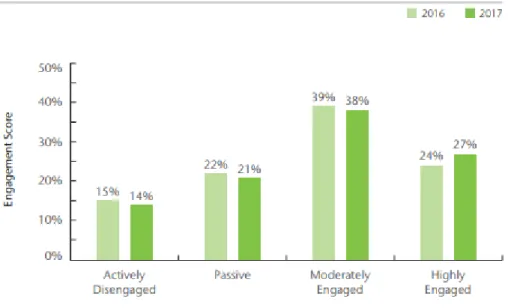
As Mirvis states that employee engagement is not only a competitive advantage in recruiting and retention and a more effective human resource management (Mirvis, 2012) but also refers to the Tower Perrin Global Workforce Study 2007-2008, which demonstrates that there is a strong relationship between employee engagement and a company’s stock price, income growth, and overall financial performance (Tower Perrin Global Workforce Study 2007-2008 cited in Mirvis, 2012). Several studies about employee engagement show that there is a lot of room for improvement when it comes to engaging employees and therefore increasing their performance: Aon’s research in 2018 “Trends in Global Employee Engagement” with more than 8 million employee responses in 2016 and 2017 in more than 1,000 companies around the globe, proves that in 2017 only 27 percent of employees are highly engaged, whilst on the opposite 38 percent are moderately engaged, 21 percent are passive and 14 percent of employees are actively disengaged (see Figure 1). In turn, across 155 countries the collected
5 data from Gallup indicates that only 15 percent of employees are engaged, while 67 percent are not engaged and 18 percent are actively disengaged (Gallup Inc., 2017). Those actively disengaged employees are a high risk for every business. Not only are these employees less productive than engaged employees, additionally they are more likely to leave the company for a better job. Aon plc. introduces their findings from their “Workforce Mindset Report” in 2016 with the fact and resulting question that “of the 52 percent who would leave their current company for another job, 44 percent are actively looking. Consider the impact that kind of turnover could have on productivity and company culture - as well as the cost to replace lost talent.” (Aon plc., 2016: 1).
Summarising all results, companies have to face the huge challenge of increasing their employee engagement in order to stay competitive and avoid opportunity cost though lost talent. At the same time this factor is a great opportunity for employers. If they are able to evaluate strategies of how to unfold the potential of a higher employee engagement, they will increase their business performance with the same workforce, that is currently disengaged or passive.
Figure 1: Engagement Profiles: 2016 vs. 2017 (Aon plc., 2018: 7)
In order to find potential strategies how to increase employee engagement it might be interesting having a closer look into the definition of engagement. DDI Inc. (2015) defines engagement as: “the extent to which people enjoy and believe in what they do and feel valued for doing it.” (DDI Inc. 2015:2). Gallup Inc. (2017: 22) describe engaged employees as “highly involved in and enthusiastic about their work and workplace. They are psychological “owners,” drive performance and innovation, and move the organization forward.”. Forbes.com defines: “Employee engagement is the emotional commitment the employee has to the organization and
6 its goals.”1, which indicates that engagement includes motivation, satisfaction and commitment
and goes one step further to claim that the employee becomes fully engaged with his work and workplace. Gallup’s research shows that, across industries and countries, teams with highly engaged members are, on average, 17 percent more productive than those with lower average engagement. (Gallup 2018b: 7)
In order to find factors on how to improve the work and workplace for employees, so they have the space and motivation to become actively engaged, the current situation has to be analysed. What factors are missing, and which needs have to be met, so that employees become more engaged. The following chapter will examine this question first on the basis of Maslow’s motivational theory and second under the perspective of corporate social responsibility.
2.2. Maslow’s Hierarchy of Needs
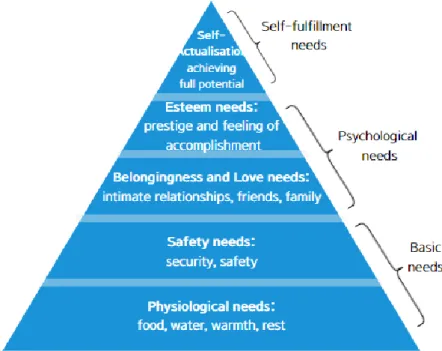
Originally published in 1943 in his paper “A Theory of Human Motivation”, the psychologist Abraham Harold Maslow first presented his motivational theory of the “Hierarchy of Needs”. This hierarchy of needs was later visualised through the well-known pyramid (as is displayed in Figure 2) and, until today, has had a considerable impact on management and educational theory (Frame, 1996). “Indeed, the powerful visual image of the pyramid of needs has been one of the most cognitively contagious ideas in the behavioural sciences.” (Kenrick et al., 2010: 292).
Though various factors of Maslow’s theory are criticised and are endeavoured to be falsified as well as verified, his idea was ground breaking in reference to time and perspective: As one of the first psychologists Maslow focused his research on the human potential rather than on psychopathology (like e.g. Freud) and presented a positive theory of human motivation, which he revised through the years of his research (Maslow, 1943). It should be emphasised that the hierarchy of needs was and is a theoretical concept and not a definite, rigorous nor universal law on human motivation (Maslow, 1943). Motivational theory is until today an ongoing, complex field of research.
1
7 Figure 2: Maslow’s Hierarchy of Needs (illustration according to McLeod, 2018)
In the following chapter, Maslow’s pyramid of needs and its evolution, as well as common criticism and its validity, will be presented and discussed. Through various literature the model will be evaluated and referred to its contemporary relevance. Eventually, the theory will be mapped with research about the needs of employees in their context of employee engagement.
2.2.1. The Pyramid of Needs
Originally divided in five stages, Maslow’s hierarchy of needs was introduced as a motivational theory which implies that human beings will naturally try to aspire fulfilling certain groups of needs in a hierarchical order. Displayed in the form of a pyramid, which underlines their character of prepotence, meaning that a lower group of needs has to be satisfied to some degree before the individual will start to aspire to meet the next level of needs (Maslow, 1943; Frame, 1996; McLeod, 2018).
Since the word and concept of ‘need(s)’ are crucial for further discussion, its relevance and meaning will be briefly explained. While Maslow used drive and need seemingly as synonyms (referring himself to the limitation of lack of redefinition (Maslow, 1943)), this context will follow the drive theory approach: drive is defined as “an activity of the total organism resulting from a persistent disequilibrium” (Seward and Seward, 1937: 349 cited in Taormina and Gao, 2013: 156), which results from an insufficiency of a certain thing. Meaning that first a disequilibrium appears, something is ‘lacking’, the need to find an equilibrium arises and leads to the drive to take the action to restore the equilibrium which eventually leads to the satisfaction
8 of the need (Taormina and Gao, 2013). “This means that it is not the feeling of need that should be correlated; rather, it is the satisfaction of the needs that should be correlated”. (Taormina and Gao, 2013: 157). What Maslow calls the “degree of relative satisfaction” is thus important, that though the word “need” will occur as the motivator, but eventually the satisfaction of the need is the important outcome; ”Every drive is related to the state of satisfaction or dissatisfaction of other drives” (Maslow, 1943: 370). Hence, the fulfilment of needs has three major steps: from acknowledging the disequilibrium (current state), resulting in the need of changing the disequilibrium towards the fulfilment or equilibrium which then should create the drive to take action which finally leads to the fulfilment in form of the re-gained equilibrium.
The first and basic level of needs are physiological needs, like oxygen, food (or more specific macro- and micronutrients), water, constant temperature and sleep. Needs which are biological requirements to sustain basic body functions and therefore survival. The absence of things that meet the physical needs will eventually lead to physical death of the organism (Taormina and Gao, 2013). Therefore, Maslow considered all other needs as secondary and physiological needs as the most prepotent of all needs (Maslow, 1943; McLeod, 2018). If all needs of an individual are deprived, the search for satisfaction would always start on the physical level (Maslow, 1943; Jerome, 2013). In most modern, peaceful societies deprivation of physiological needs no longer exists and thus is no longer a motivator itself. Though it is an interesting factor for understanding motivations through generations: when dominated by a certain group of needs, the perception of future of a deprived organism changes (Maslow, 1943). This means, that while generations of war were satisfied with a life without hunger and in safety, later generations create a different vision, because they never felt the lack or deprivation of the basic needs and strive for the satisfaction of higher groups of needs. “Each succeeding generation was expecting more from business and life” (Carroll, 2015: 88).
"It is quite true that man lives by bread alone — when there is no bread. But what happens to man’s desires when there is plenty of bread and when his belly is chronically filled? At once other (and “higher”) needs emerge and these, rather than physiological hungers, dominate the organism. And when these in turn are satisfied, again new (and still “higher”) needs emerge and so on. This is what we mean by saying that the basic human needs are organized into a hierarchy of relative prepotency" (Maslow, 1943: 375)
When the physiological needs are mostly satisfied, safety needs emerge. The individual starts seeking for a secure and stable external environment, in which it will not experience harm from the outside and is able to live with freedom from fear (McLeod, 2018). Safety needs include
9 the need for shelter and physical integrity. While children express a direct need for physical safety due to insecurity (Maslow, 1943; Jerome, 2013), adults show a more complex set of needs regarding safety and can be defined as the lack of protection from environmental/ personal/physical/financial/legal effects or everything that “make the world look unreliable, or unsafe, or unpredictable” (Maslow, 1943: 376). The degree of satisfaction on this level depends on the structural environment: in times of economic wealth the lack of a job could already cause the need for safety, while in times of war the lack of shelter will trigger the need (Taormina and Gao, 2013; Jerome, 2013). The level of need for safety, or in other words the avoidance of uncertainty, can furthermore be culturally different, as the Hofstede-Index indicates: “Countries exhibiting strong uncertainty avoidance index (UAI) maintain rigid codes of belief and behaviour, and are intolerant of unorthodox behaviour and ideas. Weak UAI societies maintain a more relaxed attitude in which practice counts more than principles.” (Hofstede Insights, 2019) While for instance Portugal scores in the UAI 99, which indicates that the need for safety regarding rules and security is a more important element for individual motivation than in Germany with an index of 65, which is still high but already tolerates more uncertainty2. The third level of needs are the needs for belongingness and love. After fairly gratifying the internal physical needs and the external needs for safety, the individual starts looking for social integration and feels the needs to love and be loved and be part of a friendly and supportive social environment (Maslow 1943; McLeod, 2018). The need for social affiliation is referred to as a psychological need, and therefore not absolutely necessary for survival. Nevertheless “human beings are exquisitely sensitive to cues of social rejection, and they respond to such cues using some of the same neural circuits used to register physical pain” (Eisenberger, Liebermann, & Williams, 2003; MacDonald & Leary, 2005 cited in Kenrick et al., 2010: 296). Hence, the consequent deprivation of the need for safety and the need for belonging can have the same psychopathological consequence for the individual. Since social exclusion is considered “the most common and important cause of anxiety” (Baumeister and Leary, 1995: 506 cited in Taormina and Gao, 2013: 158). The lack of social integration will result in the natural need for attachments with other individuals or groups (Taormina and Gao, 2013). Maslow grouped all kinds of relationships (e.g. family or romantic) into this group of needs but excluded the need of sex, which he considered a physical need (Taormina and Gao, 2013).
10 Once striving in a loving social environment, the individual will feel the need to achieve a stable and positive esteem. The esteem level is classified by Maslow into two related sets: the self-esteem (self-esteem for oneself) which can be aspired through self-worth, mastery and achievements, and the esteem from others which results from reputation, status and respect within peer-groups (Kenrick et al., 2010; McLeod, 2018). The fulfilling sense of esteem requires the respect of others, which will be received by engaging in socially desirable behaviour, while engaging in a socially undesirable behaviour will result in less esteem from others (Taormina and Gao, 2013). As the need for belonging, the need for esteem is a psychological need, which cannot be fulfilled by the individual alone but needs some form of interaction and reaction by the surrounding society and peer-groups. When the needs for self-esteem are satisfied, the individual will show self-confidence and self-worth; is the evolution of self-esteem deprived, the individual will struggle with feeling worthy and feel inferior or helpless (Jerome, 2013).
Finally, after achieving to meet all different levels of needs to some degree, the individual has the possibility to reach the final level of needs: The need for self-actualisation. In this stage the individual pursues personal growth, self-fulfilment and peak experiences. In Maslow’s words, self-actualisation is described as “the desire to become more and more what one is, to become everything one is capable of becoming” (Maslow, 1943: 163). The final step of evolution, as the hierarchy of needs implies, is the self-actualising personality, consecutively referred to as S.A.P (Frame, 1996). It is still not clear how people become self-actualised. During the four a foregoing level of needs, it is usually clear, what the individual is missing (food/love/prestige etc.). This clarity finds its end on the level of self-actualisation because on this level the needs become so fluent and individualised, that only the individual itself can figure out how to fulfil this special need (Jerome, 2013).
While the first four needs are considered deficiency needs, the last stage of self-actualisation is considered a growth need. Deficiency needs are motivating the individual when they are not met. Due to the lack of, and therefore the need for food, sleep, belonging or esteem the individual will motivate its actions towards achieving these states. The longer these deficiency needs are denied, the higher the motivation and drive of an individual to fulfil this need. When a deficiency need has become somewhat satisfied, the drive will lead naturally towards the next level of needs (McLeod, 2018). Whilst deficiency needs disappear as long as they are met and become salient since they result from a lack of something, growth needs work in a different way: Once being able to work on the need for self-fulfilment, the individual will continue to have the desire for growth and the urge may even become stronger due to internal motivation
11 so that the individual is able to reach the last stage of needs: self-actualisation (McLeod, 2018). Deficiency needs are negative motives engaging in negative freedom (freedom from) whereas the S.A.P. is engaging in positive freedom (freedom to). “In this sense the motivation of S.A.P.s is just the opposite of the motivation of average personalities” (Frame, 1996: 18). Hence, the growth need of self-actualisation is not a need, since the individual is not lacking anything. The growth need is a desire for growth and the motivation continually increases the more this desire for growth is met.
Though in a hierarchical order, the levels of needs and the hierarchy is not absolute. An individual is already able to aspire the next level of needs although still working on a lower level. There is no strict line between every set of needs as there is no absolute 100 percent fulfilment of a group of needs. Maslow stated that it is a “false impression that a need must be satisfied 100 percent before the next need emerges” (Maslow, 1987: 69 cited in McLeod, 2018: 2). It is important to notice that Maslow himself emphasised that the hierarchy and its prepotency is not nearly as rigid as might be understood today. The individual peculiarity of the different needs diverges from individual to individual. This results from multi-motivated behaviour where several or all needs motivate the individuals’ behaviour simultaneously (Maslow, 1987: 71 cited in McLeod, 2018). Another important fact is that the hierarchy of needs and the individual’s urge to meet these needs is not rigidly linear. Due to external circumstances an individual might “fall down” the hierarchy temporarily and needs to work on deficiency needs again, which were already fulfilled in the past. On the long term though the individual will always “strive up” the hierarchy in order to be able to reach the last stage of self-actualisation (McLeod, 2018).
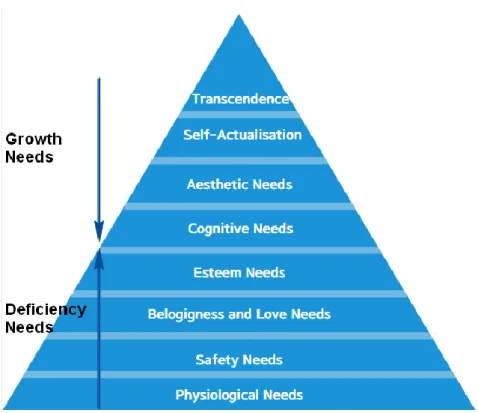
During the years of his work, Maslow expanded his pyramid regarding the differentiation of growth needs to an eight-stage model as depicted in Figure 3 (McLeod, 2018). He implemented four growth needs: cognitive needs where the individual seeks for knowledge through internal curiosity and looks for meaning in himself and life in general (McLeod, 2018). Following by aesthetic needs which motivates the individual to find appreciation in beauty and the already mentioned need for self-actualisation in order to realise personal potential and finally transcendence needs, which imply that an individual becomes motivated beyond its personal self through spirituality or service to others (McLeod, 2018). The expanded model is less known in the business environment than the five-stage model, hence in the following discussion it will always be referred to the five-stage model, implying the four growth needs summarised in the needs for self-actualisation.
12 Figure 3: Maslow’s Extended Hierarchy of Needs (illustration according to McLeod, 2018)
2.2.2. Self-actualisation
Since Maslow was interested in how individuals work in a positive way and how people reach their personal potential, his focus was set on the highest level, the level of self-actualisation. While the element “self” means an individual’s conscious and unconscious core identity, the “term “actualisation” refers to the process of converting something into what it really and essentially is” (Taormina and Gao, 2013: 160). So that the linguistic meaning of the term self-actualisation is: "the desire to become more and more what one idiosyncratically is, to become everything that one is capable of becoming." (Maslow, 1970: 46).
Every individual human being is different and aspires different goals, the level of self-actualisation is a personal and individual process. What works for one person will not necessarily work for another person, therefore the process of self-growth is an individual process. “The term self-actualisation [...] can have as many meanings as there are selves” (Frame, 1996: 15). This process is never static, since it is an intrinsic motivation of the S.A.P. The process of self-growth towards self-actualisation is a continuous and life-long process of becoming one self’s highest self and can never be completed (McLeod, 2018).
“It refers to the person’s desire for self-fulfilment, namely, to the tendency for him to become actualized in what he is potentially. The specific form that these needs
13 will take will of course vary greatly from person to person. In one individual it may take the form of the desire to be an ideal mother, in another it may be expressed athletically, and in still another it may be expressed in painting pictures or in inventions” (Maslow, 1943: 382–383). Though the process of self-actualisation is an individual and unique process, Maslow identified 15 characteristics of self-actualised people by studying 18 people he considered already being self-self-actualised (Maslow, 1970; McLeod, 2018)3:
1. Efficient perception of reality; 2. Acceptance of self, others and nature; 3. Spontaneous in thought and action; 4. Problem-centred; 5. Need for privacy; 6. Autonomy; Independence of environment; 7. Capable of deep appreciation of basic life-experience; 8. Peak experiences; 9. Gemeinschaftsgefühl4; 10. Deep interpersonal relationships with a few people; 11. Democratic attitudes; 12. Strong moral and ethical standards; 13. Philosophical, unhostile sense of humour; 14. Highly creative; 15. Resistant to enculturation
Maslow also identified certain patterns of behaviour that lead to the stage of self-actualisation (McLeod, 2018):
(a) Experiencing life like a child, with full absorption and concentration; (b) Trying new things instead of sticking to safe paths; (c) Listening to your own feelings in evaluating experiences instead of the voice of tradition, authority or the majority; (d) Avoiding pretence ('game playing') and being honest; (e) Being prepared to be unpopular if your views do not coincide with those of the majority; (f) Taking responsibility and working hard; (g) Trying to identify your defences and having the courage to give them up.
Since self-actualisation is not an absolute process, there might be individuals do not inherit all characteristics but are still self-fulfilled, as well as individuals showing some of the characteristics but are not yet self-fulfilled. Self-actualisation is not being perfect, it is an individual continuous process (McLeod, 2018). The interesting dynamic is, that what motivates an S.A.P., demotivates and even frightens a person on a lower level of needs (e.g. uncertainty) (Frame, 1996). Until today it is still not certain, how the S.A.P. evolve. There seems to be a “quantum leap” (Frame, 1996) between the stage of esteem and the stage of
self-3 A more detailed description of the 15 characteristics of self-actualised people can be found in Appendix I
14 actualisation: it is estimated that only 1-2 percent of a society achieve the final step to become an S.A.P. (Frame, 1996). Additionally, in our culture of consumerism, lower needs are triggered and eventually rewarded through the aspiration for rapid, basic need gratification on a purely materialistic level (Frame, 1996). As given through the prepotency of needs the reason for this “quantum leap” has to be found in the underlying level of needs, the needs for esteem. One trait of an S.A.P. is that they choose a task for themselves beyond their personal benefit. They “have some mission in life [...] not necessarily a task that they would prefer or choose for themselves; it may be a task that they feel is their responsibility…” (Maslow, 1950/1973: 186-187 cited in Frame, 1996: 20). This underlines the different behaviour from S.A.P.’s towards freedom: “where freedom is not an escape from discipline but an internalising of it.” (Frame, 1996: 20). With this self-chosen assignment, the S.A.P. finds its meaning of life through a positive and responsible approach to freedom and independence. Hence, the evolution of becoming an S.A.P. is a logical evolvement through the hierarchy: the experience of development of consciousness is already implied in the first stage of needs and becomes clearer and stronger through the hierarchy - “the need to be rational” (Frame, 1996: 22). Referring this and the other traits of the S.A.P. character to the corporate context of workforce means that S.A.P.s are supposed to be the most profitable employees: “This is because self-actualised employees are likely to work at their maximum creative potentials. Therefore, it is important to make employees meet this stage by helping meet their needs.” (Kaur, 2013: 1063)
2.2.3. Criticism on Maslow’s Model
The major criticism of Maslow’s motivational theory regards his methodology. Maslow conducted his approach with a qualitative biographical analysis of 18 individuals, who he personally identified as self-actualised. The election of these 18 individuals was biased by Maslow’s subjective election as well as the methodology of biographical analysis is a very subjective scientific method and hence lacks validity. His sample focused on privileged, western, white males, which raises the question of transferability to other ethnic groups, females or individuals from lower social classes (McLeod, 2018). Due to the subjective and individual perception of motivational factors the validity of any data obtained is reduced in order to verify or falsify Maslow’s theory (Jerome, 2013). Nevertheless, Jerome (2013) states that Maslow’s theory, though not being fully scientific and difficult in application, has a high relevance in modern business organisations regarding organisational culture, human resource management and employee’s performance.
15 Another criticism is the rigid hierarchy itself. An individual might live in poverty but is still capable of love or even self-fulfilment. The most famous example might be Vincent van Gogh, who pursued self-actualisation through his painting though not being able to feed and sustain himself. “Consequently, the hierarchy is not a matter of valuing what is “important” but, rather, whether one is physiologically “deprived” of something, which, when sufficiently lacking, gives rise to the need” (Taormina and Gao, 2013: 157). Projecting this to van Gogh leads to the assumption, that he personally did not feel deprived in his primary needs, but in his individual self-actualising need for painting. Taormina and Gao (2013) were able to evaluate in their research that the “satisfaction of the lower-level need immediately below any given need in the hierarchy predicted satisfaction of the next higher-level need, yielding strong evidence for the hierarchical nature of Maslow’s theory of need satisfaction” (Taormina and Gao, 2013: 169). Thus, the hierarchy is relevant but not as rigid as it is perceived and taught. If a lower group of needs is somewhat satisfied, the higher needs emerge and the more the lower needs are satisfied, the higher the satisfaction on the next level of needs. Following this approach, the underlying reason for the “quantum leap” between the level of esteem and the level of self-actualisation has to be found on the level of self-esteem. Maslow himself tried to give a better understanding of the not absolute prepotency:
“For instance, if I may assign arbitrary figures for the sake of illustration, it is as if the average citizen is satisfied perhaps 85 percent in his physiological needs, 70 percent in his safety needs, 50 percent in his love needs, 40 percent in his self-esteem needs, and 10 percent in his self-actualization needs.” (Maslow, 1970: 54) A further common point of criticism regarding the applicability of Maslow’s theory is its focus on western, privileged, white males. Which means that Maslow’s theory is not applicable for women, less wealthy individuals or other ethnic groups (e.g. Eastern cultures). McLeod (2018) refers to a study conducted from 2005 to 2010 by Tay and Diener (2011) where 60,865 participants from 123 countries were analysed with a close approach to Maslow’s theory. The results show that these human needs are independent from cultural differences. Supporting the cultural generalisability, Taormina and Gao (2013) were able to find supporting data for Maslow’s hierarchy of needs in an Eastern culture, by evaluating questionnaires from 386 adults who were all ethnic Chinese. Similarly, Taormina and Gao (2013) could not find a relevant difference between male and female participants, which leads to the conclusion, that Maslow’s model is applicable to all genders and cultures.
Especially the need for self-actualisation is criticised, as it is first not a need by definition but rather a desire and secondly highly divers to see it as a common human need. Kenrick et al.
16 (2010) evaluated the pyramid of needs in a biological framework of life-history theory and renovated the pyramid regarding three criteria: (a) ultimate evolutionary function, (b) developmental sequencing, and (c) cognitive priority. Within their functional analysis it is evaluated “that self-actualisation is not a functionally distinct need at all” and therefore has to be removed from the pyramid. “By removing self-actualization from the pyramid, we simply recognize that its privileged position cannot be compelled nor justified by the functional logic of human evolutionary biology” (Kenrick et al., 2010: 298). Replacing self-actualisation with the three reproduction needs “mate acquisition”; “mate retention” and “parenting”, they point out “that no human need can be meaningfully separated from biology” (Kenrick et al., 2010: 297). Furthermore, in their analysis they conclude that “human displays of creative and intellectual capacities are directly linked to reproductive success” (Kenrick et al., 2010: 298). The importance of the reproduction process as self-actualisation is also evaluated by the research of Taormina and Gao (2013) who found out that the demographic of “number of children” is a positive predictor in the regression of self-actualisation satisfaction. Secondly in their analysis of the pyramid, Kenrick et al. (2010) changed the display of the hierarchy itself as is presented in Figure 4. “Rather than depicting the goals as stacked on top of one another, we instead depict them as overlapping” (Kenrick et al., 2010: 293). This adaptation reflects their analysis of life-history theory and the reference that humans are an iteroparous species, who mate repeatedly during a life span and therefore continue to require basic need fulfilment (Kenrick et al., 2010). Hence, the overlapping triangles visualise that developmental needs are added to existing needs, rather than replace them (Kenrick et al., 2010), which at the same time supports the idea of relative prepotency of Maslow’s original theory, that basic needs will not just disappear after they are met. They must be continually considered and continually gratified, so that the lower and the higher needs are satisfied in a continuously balanced way.
Following the findings of Maslow’s theory and the criticism as well as measures of verification of this particular model, which were evaluated through this chapter the following key points can be concluded: The hierarchy of needs is a valid concept in the evolutionary, commune, individual, cultural, and gender perspective, while the prepotency of the different level of needs is given in a relative way: the more the underlying group of needs is met, the more the next group of needs can be fulfilled and the more a group of needs is fulfilled the less it motivates. While model and the occurrence of prepotency should be projected and considered in the
17 individual’s context and if issues occur in the development within the hierarchy, the problem has to be found in the underlying group of needs.
Figure 4: Hierarchy of Human Motives (illustration according to Kenrick et al., 2010)
As the last stage of S.A.P. is a highly individual process and differs not only by its definition as a need (as it actually is a desire) but also in the expression of the individual itself.
2.2.4. Maslow and Employee Engagement
As already shortly referred to in chapter 2.1. employee engagement is a very important factor in modern management and leadership: a satisfied and motivated workforce will be highly productive and therefore improve the organisational performance (Kaur, 2013). Greenberg & Baron (2003, cited in Jerome, 2013) suggest that managers can lead their employees in their growth up the hierarchy of needs to become eventually self-actualised, implying that both the organisation and the employee decide on the performance of the organisation utilising a set of values through corporate culture. This indicates on the reverse side, that if the employee’s needs are not reflected in the organisation’s values, performance will be not as high as its potential to be: “When employees discover that their organization cares so much about their developmental status, employees will offer their best to the service of the organization” (Jerome, 2013: 42). Thus, in order to attract and maintain a skilled, motivated, committed and eventually engaged, efficient workforce, which is one key driver for the organisation’s success, the values of the organisation need to reflect the values of the employee and the other way round: the values of the employee need to reflect the company's values. Since Maslow’s hierarchy of needs is a
18 motivational model of individuals, it must be applicable in some adapted form to the business context. Employees are at the same time individuals and need to be considered as such. The resulting question is, how can the motivation theory from Maslow help organisations and employees to find the maximum fit in order to increase the company's performance and therefore its success?
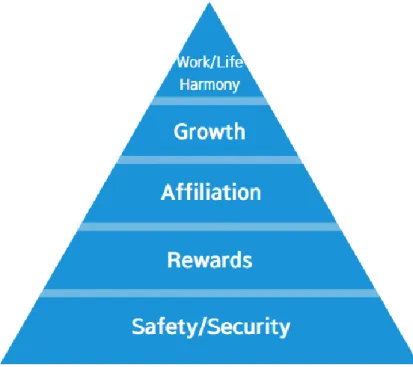
When starting their exploratory research on workforce commitment in 1997, D. Stum and his team from Aon Consulting plc. found strong parallels to Maslow’s hierarchical, motivational concept. The study focused on exploring how organisations can increase employee commitment, expressing these results in the workforce commitment index through the elements productivity, pride and retention. The results indicated that it would be possible to display a pyramid of commitment needs, the Performance Pyramid (see Figure 5). While Maslow’s theory focuses on the individual and its relation to itself and its total environment, the performance pyramid looks at the employee’s relation to its employer and workplace, thus of the individual in its business context. The hierarchy of the performance pyramid is quite similar to Maslow: Safety-; Rewards-; Affiliation-; Growth and eventually Work/Life-Harmony-Needs.
The employees’ needs for safety, similar to Maslow’s pyramid, demand an environment that is safe from fear and intimidation. Especially in the modern, fast changing work-environment the need for a stable and secure position within the corporation is essential. The study identified that in organisations, which recently downsized, merged or have been acquired show a depression in the work commitment index (Stum, 2001). This gives the important recommendation of taking special actions in regard to the employee’s needs for security, specifically in peculiar times of organisational instability and change. Carrying the employee’s need for safety further, includes actions from the organisation’s side referring to financial security like profit sharing or financial outplacement service (Kaur, 2013), health security through health insurance and health benefit programs (staff meals/ gym memberships) or general physical protection especially in the field of construction but also through healthy office equipment (Jerome, 2013).
19 Figure 5: Performance Pyramid (illustration according to Stum, 2001: p.6)
Within the next level of employee commitment, the needs for rewards, Stum (2001) refer to the problem that compensation and benefits have a major impact as a differentiator during the hiring process but become entitlement rather than motivators very quickly once an employee is hired. Nevertheless, rewards are crucial for the development of higher needs. These needs for rewards can be fulfilled through the recognition of employee’s accomplishments as an individual or as teams (Kaur, 2013) with general positive interaction and integration of organisational culture and human resource management as well as through a promotion system that is based on achievements rather than seniority (Jerome, 2013).
Following with the third set of employee’s needs, the need for affiliation, where the most crucial part is to have a feeling of being involved in the bigger picture. “Being part of something larger than oneself has been understood as part of human psychology for decades and translates into being more than just a “worker” when on the job.” (Stum, 2001: 7). Putting this need into an operational strategy means for an organisation to define and live a strong vision and mission which is executed in an open, transparent way through strong leaders who involve employees through candid communication (Stum, 2001). This can be operationalised through socialising opportunities in form of events (Kaur, 2013), or in an environment of team spirit and feeling of acceptance (Jerome, 2013).
Successively to the affiliation needs are the needs for growth within the corporate environment. “Employees want opportunities to change, learn and have new experiences on the job” (Stum, 2001: 7), which exposes employers to the challenge of providing continuous organisational
20 growth and improvement of work processes in efficiency, effectiveness, quality and productivity and moreover the opportunity for personal growth for the individual employee as well as for teams (Stum, 2001). This can be accomplished through pre- and on-job training and coaching or through business development and customer focus (Jerome, 2013). Congruent to Maslow’s last set of needs, the needs self-actualisation, employees want to fulfil their needs not only as part of the workforce but also reach their potential as a private individual within the needs for work/life harmony (Stum, 2001). As an essential driver for personal support is the need for “being seen as a person, not just a worker” (Stum, 2001: 8).
Similar to the results of the analysis regarding Maslow’s pyramid, Aon’s study showed that following a period of economic stability, the needs of employees grow through the pyramid in the sense that basic needs usually are met, and higher needs evolve (Stum, 2001). One particular interesting result of the workforce commitment study is, that the relative prepotency of the hierarchy of needs was validated: only employees, whose expectations on lower levels were met, developed higher needs such as needs for growth and work/life balance. This result permits the proposition to employers and leaders to manage the pyramid from “bottom up”. This applies especially to companies which are going through forms of change like mergers, acquisitions or downsizing: even when the workforce was considered to work within a higher set of needs, in turbulent phases the lower needs have to become a higher priority again (Stum, 2001). “Building a new employee/employer social contract that enables organisations to improve employee commitment and retention is a challenge of blending some well-established truths with innovative approaches that fit new circumstances” (Stum, 2001, p.9).
Aon Consulting’s survey was pursued until today within the framework of the “Trends in Global Employee Engagement” survey, which they execute on a yearly basis. In the Aon Hewitt’s Workforce Mindset™ Study, conducted in November 2015, 2,009 U.S.-based employees working in companies with at least 1,000 people completing the online survey, Aon plc. evaluates the trends of employee experience within their workplace through the criteria: workplace characteristics, total reward, performance and pay. As evaluated before, a competitive workforce is essential for the overall performance of a company and therefore is one of the main stakeholders which must be given high priority in strategic management decisions (the stockholder concept will be explained in chapter 2.3.2.). In order to avoid the risk and costs of employee turnover, employers must be aware of the needs and desires of employees. Or to follow Maslow’s approach of positive development: In order to have the most engaged and efficient workforce companies are ought to meet the needs and desires of employees. The trend analysis of Aon plc. is therefore a valuable indicator for future
21 management and leadership strategies with the goal of fulfilling the needs of their employees. In order to develop these management strategies, the current needs of the workforce first have to be identified, both needs that are already met and needs that are still desired by employees. In Aon’s study this comparison of current and desired experiences was surveyed through 26 different criteria displayed in Figure 6 (Aon plc., 2016: 12).
Figure 6: Current-Desired Comparison of Employment-Experiences (Aon plc, 2016, p. 12)
Reflecting the results of employee’s current vs. desired experiences in nine criteria, out of 26 criteria overall, the current state is higher than the desired state, which means those needs of employees are fulfilled. Looking into these already met needs shows that they mainly focus on the direct success of the company (e.g. competitive/sales-/growth-focused/goals-oriented/ financially stable) and thus the economic sustainability of the organisation which for the employee means that the workplace is safe and probably will be safe in the future. Meaning that the needs for safety are perceived as met by employees. The following six criteria in which the current state is more or less meeting the desired state are already more complex. While the need for “Being the best”, “Accountable” and “Teamwork focused” can be organised in the set of affiliation and rewards or directly into Maslow’s belonging and esteem needs, “Ethical” and “Efficient” are still a bit lower in the set of needs. An unethical or inefficient company might not be competitive in the future and therefore affect the need for safety. The next eleven criteria are more desired by employees than they are currently met. “Employee engagement focused” is essential for the needs of affiliation/ belonging as are “Trustworthy”, “Fair”, “Honest”,
22 “Respectful” and “Loyal”, which are all positive attributes of how to live and work together in a team and therefore affects the needs for belonging and eventually for self-esteem especially the esteem from others, in this case the work environment. “Employee recognition oriented” can be sorted into the needs for self-esteem or rewards, because a not recognised individual does not feel needed and taken seriously as the person itself or its work. “Personal growth-oriented” and “Balanced (home/work)” are clearly desires for the fulfilment of higher sets of needs, for Maslow’s self-actualisation or can be sorted in Aon’s pyramid directly into the needs of “growth” and “work/life harmony”. Accordingly, these findings give a first indicator that in general the individual’s hierarchy of needs is mostly fulfilled in the lower needs like physical and safety needs, marginally met in the middle levels like belonging and esteem needs and are lacking in the higher level of needs like esteem and self-actualisation. Hence, in order to maintain a competitive, engaged workforce and avoid costs of employee-turnover, these needs have to be met through active management decisions and strategies.
So far, the very important factor of payment has been neglected in the research of how Maslow’s hierarchy of needs are reflected in the work environment and how it can affect employee engagement. As mentioned before compensation and benefits are a differentiator during the hiring process, but become less motivating after hiring (Stum, 2001). The following question is, how payment motivates an already hired employee to become more engaged. Aon plc. found out that “Employees who know what they need to do to make more money are 8X more likely to be engaged. Employees who see a clear link between performance and pay are nearly 4X more likely to be engaged.” (Aon plc., 2016: 50). This indicates that the understanding about the payment structure is crucial for the employee engagement and therefore performance which eventually leads to the factor of transparent communication from managers. Furthermore, Aon plc. discovered, that the engagement of employees also effects on how appropriate they perceive their pay. 65 percent of engaged employees see the correlation between pay and performance and 61 percent want to improve their performance based on their pay adjustment, while only 20 percent of not engaged employees see the correlation of pay and performance and only 18 percent want to improve performance (see Figure 7).
23 Figure 7: Pay-for-Performance Perception (Aon plc., 2016: 51)
According to these findings an increase in payment is much more efficient if given to an already engaged employee who understands the correlation between both payment and performance, since an unengaged employee is less likely to see the adjustment as appropriate or to increase performance after the adjustment. The key driver for this engagement is the understanding about the link between payment and performance and the understanding about the process in how to increase payment through performance. Furthermore, the survey detected that “Significantly, only 54 percent of middle managers [...] say they see how their performance impacts their pay. If they question the link, employee conversations about the performance-pay connection may sound inauthentic, undermine managers’ credibility, and leave employees dissatisfied.” (Aon plc., 2016: 44). This indicates that the issue of not transparent communication which leads to the gap of understanding the correlation between performance and pay, already starts at the level of middle managers, which made 41 percent of all respondents of the survey (individual contributors 53 percent, senior manager 6 percent) (Aon plc., 2016: 63). In conclusion about the motivation of payment can be said that the engagement of employees is a crucial factor for the efficiency of payment adjustments so that the focus of this thesis will continue on the factors of employee engagement and motivation, not focusing with more detail on the factor payment. Nevertheless, adequate payment is a top priority in order to motivate employees.
The factor that employees do not get enough information through corporate or middle management communication, is as severe as that 34 percent of employees feel a lack of information about the performance management process (Aon plc., 2016: 40). The survey found out that employees desire more frequent feedback conversations so that they understand how to increase their performance. Their suggestions for improvement of transparent communication are that managers should have a better understanding of their work and the performance evaluation processes should be simpler and more individualised (Aon plc., 2016: 45). This indicates a lack on the levels of motivation of self-esteem, cognitive understanding, as well as affiliation. The need for more affiliation expresses itself in the most frequent
24 suggestions to the question on how to make the corporate communication more effective, which are 1. strengthen the connections between the employer, employees, and customers; 2. connect the individual with the team with the company; 3. holistic, transparent communication (Aon plc., 2016: 33). All those answers indicate that the respondent employees expressing their needs on the higher level of needs, affiliation, self-esteem and even self-actualisation with the demand for more individualised processes. Employees desire to be reviewed in their individual performance and to be recognised as an individual person and its talents and as part of the holistic picture of the company. Aon’s research (2016: 38) suggests: “Employers have an opportunity to define and reinforce mission, vision, and values during the goal-setting process, and ensure the “how” is measured during the performance management process and throughout the year.” In conclusion, the needs of employees are to be found in the higher level of needs and with an individual and frequent approach of performance evaluation in order to find efficient ways to increase their level of engagement and therefore their individual performance.
Concluding the analysis on how Maslow’s hierarchy affects employee engagement it can be said, that the pyramid can be transferred to the business environment while the pyramid can be adapted to relevant factors of the business environment (e.g. Stum, 2001). While the prepotency of needs is also given for the needs of an employee in its business environment a higher satisfaction of needs results in higher employee engagement and therefore in higher performance. While pay is a priority factor for employee engagement, payment adjustments are more efficient for already engaged employees who are more likely to understand the correlation between payment and performance and also more likely to share mission and vision of the business. Overall, employees desire a stronger connection internally and externally, a holistic and transparent communication and information, and a more individualised performance management process.
The previous chapter had a close look at Maslow’s well-known motivational concept of the hierarchy of needs and how it can be transferred to the engagement of employees. After analysing various sources, it can be stated that Maslow’s approach is a valid concept for the motivation of an individual as well as the employee and can also be projected to the needs of a community. The pyramid of needs is also generalisable in the factors of gender and culture. Additionally, the prepotency of the level of needs could be validated in different analyses and seems to work in a relative way in both private life and business environment where the satisfaction of a lower level of needs results in the capacity to fulfil the next level of needs. This
25 effect causes that the more a set of needs is satisfied, the less it motivates and the individual starts focusing its motivation on the next set of needs. Further, it causes that a satisfaction of needs and the evaluation of deficiencies through the pyramid has to be executed “bottom up”, starting with the lowest level and working its way through the pyramid until the top. Through this process it also helps to understand that a problem in the development up the pyramid is always caused by a lack of satisfaction of the underlying set of needs, which is especially important for businesses which go through a phase of merger/acquisition/downsizing and observe a decrease of the employee’s motivation and engagement. These businesses have to consider the basic needs again, although they might have been fulfilled in the past. The higher the development of the individual, the higher the consideration of the individual’s context becomes necessary, especially in the highest level of self-fulfilment where generalisation is not possible. Especially in the business environment, the levels of needs can be adapted to the specific demands of environment and still meet the validated points of prepotency and individuality. The higher the satisfaction of needs, the higher the engagement of employees and therefore the higher the performance of the business. When it comes to employee engagement, a very important factor is that payment adjustments are much more efficient for already engaged employees, who also are more likely to share the mission and vision of the company. In order to help employees to become more engaged, they desire a more individualised performance process and a more connected work-environment, where they know what they are doing, what and how the company is doing and where they feel a holistic and transparent form of communication. Following this conclusion, there has to be a correlation between the individuals’ growth within the pyramid and the mission and vision of the company which forms the businesses strategies in order to fulfil the needs of employees.
“More than ever before, I want a more human work experience.” (Aon plc., 2016, p.12)