“Made in China 2025”: China’s
development strategy through
technological innovation
Lan Yu
Orientadora: Profª
. Catedrática Doutora Carla Margarida Barroso Guapo
da Costa
Dissertação para obtenção de grau de Mestre em Relações Internacionais
Lisboa
2019
“Made in China 2025”: China’s development strategy
through technological innovation
Lan Yu
Orientadora: Profª
. Doutora Carla Margarida Barroso Guapo da Costa
Dissertação para obtenção de grau de Mestre em Relações Internacionais
Júri: Presidente:
- Prof. Doutor Nuno Gonçalo de Carvalho Canas Mendes Vogais:
- Profª. Doutora Carla Margarida Barroso Guapo da Costa - Profª. Doutora Irene de Assunção Raposo Rodrigues
Lisboa
2019
i
ACKNOWLEDGMENT
First of all, I would like to express my sincere gratitude to my advisor, Professor Carla Guapo da Costa, for her motivation, immense knowledge and wise suggestions that always direct me in the right academic course; and for her critical attitude in the course of International Political Economy that enlightens me with the ideas of the present thesis.
Besides my advisor, I would like to thank Professor Andrea Valente and Professor Nuno Canas Mendes for their insightful comments for my project in the workshop.
My sincere thanks also go to Professor Sandra Balão and Professor Álvaro Nóbrega for their academic passion and preciseness that deeply inspire me.
I thank my classmates for the thought-provoking discussions in class and the sharing of life experiences; also, I thank Ms. Inês Calixto and the library workers for their kindness and help. I want to express my special gratitude to my friends Ricardo Carvalho and Carlos Cabral for their timely help when I was facing difficulties in the thesis; to my friend Liujuan Li, for the days we were studying and having fun together in the arduous academic life.
Then, my wholehearted appreciation extends to my family for their deep love, and to my boyfriend for his firm support.
ii
ABSTRACT
The present thesis concentrates on China’s industrial plan, “Made in China 2025” (MIC2025). The plan has a dual instrumental function, namely, upgrading China’s industrial system and contributing to achieving China’s dream of great rejuvenation. China has developed from a low-income economy into a middle-income one owing to its pragmatic reforms since the end of the 1970s. However, due to the environmental problems and social disparity caused by the traditional development model, China has the risk of failing during its transformation into a high-income country and dropping in the middle-income trap (MIT). On the other hand, along with economic growth, China has shifted its low-key foreign policy to a proactive one and launched proposals for Asian security and world order. In this sense, China may encounter competition with the existing hegemony, the U.S., and drop into the Thucydides Trap (TT). With the hypotheses of falling into two traps, this research has used the mixed methods of quantitative and qualitative approaches.
In the quantitative approach, we have established two links by connecting the dual function of MIC2025 with two traps by using independent, dependent, mediating, and moderating variables for the hypotheses. In the first link, we have found that, although China has established a specific technological base, China still stands far away from the technological frontier. Thus, it is not easy for China to escape the MIT. In the second link, we have found that China’s position in the world order does not threaten America’s dominant position. However, China’s proposals for Asian security and the world may bring itself into a competition with the U.S. and fall into the TT.
In the qualitative approach, we have done two semi-structured interviews, according to which China can escape the traps. However, the possibility of falling into two traps cannot be overlooked.
Keywords: China; “Made in China 2025”; technological innovation; development strategy; middle-income trap; Thucydides Trap.
iii
RESUMO
A presente tese concentra-se num plano industrial da China, “Made in China 2025” (MIC2025). O plano tem uma função instrumental dupla, ou seja, atualizar o sistema industrial por inovação tecnológica e contribuir para alcançar o sonho da China de um grande rejuvenescimento. Assim, a dissertação é analisar se a China pode reformar a ordem mundial por inovação tecnológica. Atualmente, a China entrou num período crítico de transição da economia de renda média para a de renda alta. Considerando que a China está a enfrentar problemas ambientais cada vez mais graves e problemas sociais a nível da disparidade, a China corre o risco de não se conseguir transformar, sendo apanhada na middle-income trap (MIT).
Por outro lado, como no rápido crescimento económico, a China gradualmente mudou o seu perfil “low-key” iniciado no período Deng Xiaoping para uma postura mais proativa na política global, uma diplomacia de país principal, que é entendida como diplomacia dos grandes poderes. A diplomacia serve para ajudar a China a realizar o sonho de modernização e construir uma comunidade com um futuro compartilhado para a humanidade. Sob uma política externa proativa, a ascensão da China provavelmente cairá na Thucydides Trap (TT), ou seja, encontrará concorrência com a hegemonia existente, os EUA, o que irá trazer o mundo à instabilidade. Combinando as funções do MIC2025 e os riscos da China cair em duas armadilhas, propusemos duas hipóteses: o MIC2025 pode ajudar a China a escapar da MIT e manter um desenvolvimento sustentável; e a China, com a força aumentada pelo plano industrial, escapará da TT e contribuirá para melhorar a ordem mundial multilateral.
Considerando vários fatores que afetarão a eficácia das funções do MIC2025, elaborámos adicionalmente três proposições para as respectivas hipóteses.
Especificamente, para a primeira hipótese, as proposições são: o MIC2025 tem a função instrumental de promover o desenvolvimento por inovação tecnológica; A China possui condições pré-existentes para executar o MIC2025; O domínio das economias avançadas em inovação deixará espaço limitado para a China executar o plano.
Para a segunda hipótese, as proposições são: o MIC2025 tem a função instrumental de aumentar a força da China; As propostas da China para o mundo não levarão a China à TT, mas
iv
contribuirão para melhorar a ordem mundial multilateral; A China tem condições limitadas para reformar a ordem mundial, que é estabelecida e mantida pelos EUA e seus aliados.
Com várias hipóteses e proposições, projetámos a pesquisa de uma perspectiva pragmática, o que nos pode permitir fazer escolhas livremente e tirar proveito de diferentes abordagens para alcançar o objetivo.
Sob esta perspectiva, usámos métodos mistos sequenciais explicativos, que envolvem uma recolha de dados quantitativos primeiro e depois explicam os resultados quantitativos com os dados qualitativos.
Na parte quantitativa, primeiramente construímos relações entre as teorias de inovação tecnológica, desenvolvimento e poder, que mais tarde serão usadas como orientação para recolher e analisar os dados quantitativos.
Em seguida, recolhemos os dados quantitativos com a organização das hipóteses e as suas proposições usando variáveis. As variáveis foram escolhidas com base no motivo pragmático, o que nos pode fornecer uma estrutura precisa para direcionar o processo de recolha de dados. Selecionámos quatro tipos de variáveis para construir a estrutura, ou seja, variáveis independentes, dependentes, mediadoras e moderadoras.
As variáveis independentes são variáveis preditoras que podem causar os resultados, que são variáveis dependentes. As duas variáveis constituem uma estrutura de causa e efeito. Na estrutura, as mediadoras afetarão as dependentes em conjunto com as independentes; enquanto que as moderadoras, com a natureza de variáveis independentes, afetarão a direção e a força da relação entre as independentes e dependentes.
Com base nas características das variáveis e nas hipóteses, elaborámos duas ligações causais. Especificamente, na Ligação 1, a primeira proposição da função instrumental do MIC2025 em desenvolvimento serve como a variável independente (VI), que causará ou influenciará o resultado de escapar da MIT, que é considerada a variável dependente (VD). Além disso, a segunda proposição das condições preexistentes da China para executar o MIC2025 é a variável mediadora (VM1), afetando positivamente a ligação de causalidade; a terceira proposição de domínio da inovação das economias avançadas é a variável moderadora (VM2), influenciando negativamente a direção da ligação.
v
Na Ligação 2, a primeira proposição da função instrumental do plano no poder como VI gerará o efeito de VD de ajudar a China a escapar da TT. Além disso, a segunda proposição das propostas da China para o mundo, servindo como VM1, exercerá um efeito positivo sobre a ligação. Por outro lado, a terceira proposição da ordem mundial liberal como VM2 terá um impacto adverso.
Com relação às abordagens de pesquisa, para a Ligação 1, foram utilizadas principalmente as abordagens de análise de conteúdo de materiais em primeira mão e análise secundária de estatísticas oficiais. Na abordagem da análise de conteúdo, os documentos e textos foram recolhidos de livros editados pelo governo chinês, o site do governo chinês e os sites da imprensa principal chinesa (People’s Daily, Xinhua, China Daily), enquanto na abordagem da análise secundária das estatísticas oficiais, as estatísticas foram recolhidas no site dos departamentos do governo chinês e da imprensa principal chinesa.
Para a Ligação 2, apesar das duas abordagens usadas na primeira, também usámos os estudos comparativos entre a atual China e o Japão na década de 1980 para analisar a posição da China na ordem mundial.
Após a recolha dos dados, examinamos as relações teóricas que estabelecemos e obtivemos resultados quantitativos.
Na primeira ligação, descobrimos que o MIC2025 oferece uma trajetória orientada à inovação para o futuro desenvolvimento da China. A China construiu uma base tecnológica específica por meio de políticas contínuas de ciência e tecnologia, inovação indígena, investmento interno e investimento externo, que podem ajudar a China a executar o MIC2025. No entanto, a China ainda se mantém distante da fronteira tecnológica, dominada pelas economias ocidentais. Além disso, a proteção de propriedade intelectual (PI) da China ainda é fraca; As empresas privadas da China, que são mais eficientes em comparação com as estatais, foram reprimidas. Por fim, o risco de queda na MIT aumentou, não apenas devido aos problemas existentes em proteção ambiental e disparidade social, mas também ao surgimento do desemprego tecnológico e à intensificação da lacuna de desenvolvimento causada pelo MIC2025. Nesse sentido, é difícil para a China escapar da MIT e manter o desenvolvimento sustentável.
Na segunda ligação, descobrimos que o MIC2025 serve como um passo estratégico para realizar o sonho da China de grande rejuvenescimento. Com o crescente poder económico, militar e
vi
científico, a China propôs as suas soluções para a Ásia e o desenvolvimento mundial. Para a Ásia, trata-se do novo conceito de segurança asiática da China, que enfatiza a participação de todos os países asiáticos na manutenção da segurança. No entanto, isso dificilmente pode ser alcançado, pois nesta região, os EUA mantiveram preeminência militar e desenvolveram aliados estratégicos com vários países asiáticos. Para o mundo, a noção da China de uma comunidade de um futuro compartilhado para a humanidade é representada economicamente pela Belt and Road Initiative (BRI). Embora as rotas da BRI se espalhem amplamente, a China considera principalmente os países e regiões vizinhos com os quais pretende cooperar. Assim, a BRI demonstra as características do regionalismo e do bilateralismo. Em relação à posição da China na ordem mundial, comparamos o Japão e a China com os aspectos da sua posição na ordem e a sua relação com os EUA. Descobrimos que, na ordem mundial, a posição da China não representa ameaças à posição de liderança da América. Além disso, os dois países desenvolveram relações económicas interconectadas. Os dois elementos podem ajudar a China a escapar dos conflitos com os EUA. No entanto, a China tende a mudar seu status quo e torna-se desafiadora da ordem. Nestorna-se torna-sentido, a China e os EUA podem cair na TT sobre questões de segurança na Ásia.
Com os resultados quantitativos, escolhemos dois entrevistados (um funcionário da Embaixada da China em Portugal e uma repórter da China Daily) familiarizados com as questões tecnológicas da China e interessados na ascensão da China usando entrevistas semiestruturadas. Para os dados qualitativos, usámos análise crítica do discurso. Descobrimos que os entrevistados mantêm uma atitude realista de que a China atualizará o sistema industrial e obterá mais poder económico; enquanto para o futuro da ascensão da China, os entrevistados têm uma perspectiva liberal de que a China pode realizar uma ascensão pacífica devido à interdependência económica no mundo. Em suma, os dois pensam que a China pode escapar da MIT e da TT.
Por fim, concluímos que o MIC2025 é crucial para a China alcançar os países desenvolvidos. A China não pode utilizar o plano para alcançar o desenvolvimento sustentável sem considerar a proteção ambiental, a justiça social, a proteção de PI e a motivação dos empreendedores. Por outro lado, no processo de alcançar o mesmo, a China pode escapar intencionalmente da TT e concentrar-se no desenvolvimento económico. No entanto, na Ásia, tendo em com consideração a segurança nacional, a China não pode evitar conflitos com os EUA para defender seus interesses nacionais.
vii
Palavras-chave: China;“Made in China 2025”; inovação tecnológica; estratégia de desenvolvimento; middle-income trap; Thucydides Trap.
viii
ABBREVIATIONS
3GPP the 3rd Generation Partnership Project
ADB Asian Development Bank
AI artificial intelligence
BAT Baidu, Alibaba, and Tencent
BRI Belt and Road Initiative
BRICS Brazil, Russia, India China, and South Africa
CAE Chinese Academy of Engineering
CPO Patent Office of China
CSC China State Council
FER foreign exchange reserve
FDI foreign direct investment
FSA firm-specific asset
GATT General Agreement on Tariffs and Trade
GDP gross domestic product
GVC global value chain
HSR high-speed railway
ix
IP intellectual property
IR international relations
ISDP Institute for Security & Development Policy
LIC low-income country
LDCs less developed countries
MIC2025 Made in China 2025
MIT middle-income trap
MNCs multinational companies
MOFCOM (China’s) Ministry of Commerce
NBSC National Bureau of Statistics of China
NCCPC National Congress of the Communist Party of China
NEA new energy automobile
NMSAC (China’s) National Manufacturing Strategy Advisory Committee
OECD Organization for Economic Cooperation and Development
OFDI outward foreign direct investment
R&D research and development
SEZs Special Economic Zones
x
S&T science and technology
TRIPs Trade-related Aspects of Intellectual Property Rights
TT Thucydides Trap
UNDP United Nations Development Program
UNESCO United Nations Educational, Scientific and Cultural Organization
WHO World Health Organization
WIPO World Intellectual Property Organization
WTO World Trade Organization
WWII the Second World War
xi CONTENTS ACKNOWLEDGMENT ...I ABSTRACT ... II RESUMO ...III ABBREVIATIONS ... VIII INTRODUCTION... 1
RESEARCHRELEVANCE,RESEARCHQUESTION,ANDOBJECTIVES ... 1
HYPOTHESES,RESEARCHDESIGN,ANDDATACOLLECTION ... 4
PART ONE THEORETICAL BACKGROUND ... 10
INTRODUCTION... 10
1. TECHNOLOGICAL INNOVATION ... 10
1.2. DETERMINANTSOFTECHNOLOGICALINNOVATION ... 11
1.3. DYNAMICSOFTECHNOLOGICALINNOVATION ... 12
1.4. ACTORSOFTECHNOLOGICALINNOVATION ... 14
2. TECHNOLOGICAL INNOVATION AND DEVELOPMENT ... 15
2.1. NATUREOFDEVELOPMENT ... 15
2.2. TECHNOLOGICALINNOVATIONANDDEVELOPMENT ... 17
2.2.1. IN ECONOMIC GROWTH ... 17
2.2.2. IN ECONOMIC STRUCTURE ... 19
2.2.3. IN SUSTAINABLE DEVELOPMENT ... 20
xii
3. TECHNOLOGICAL INNOVATION AND POWER ... 23
3.1. NATUREOFPOWER ... 23
3.2. TECHNOLOGICALINNOVATIONANDPOWER ... 24
3.2.1. IN MILITARY CAPACITY ... 25
3.2.2. IN SCIENCE DIPLOMACY ... 25
3.3. TECHNOLOGICALINNOVATIONANDWORLDORDER ... 26
3.3.1. NATURE OF WORLD ORDER ... 27
3.3.2. DIVISION OF POWER IN THE WORLD ORDER ... 28
PART 2 MIC2025: CHINA’S DEVELOPMENT STRATEGY THROUGH TECHNOLOGICAL INNOVATION ... 31
1. THE DUAL INSTRUMENTAL FUNCTION OF MIC2025... 31
2. PROSPECTIVE CHINESE DEVELOPMENT: MIT OR SUSTAINABLE DEVELOPMENT? ... 36
2.1. RISKOFFALLINGINTOTHEMIT ... 36
2.2. PRE-EXISTINGCONDITIONSFORACCOMPLISHINGMIC2025... 42
2.2.1. CHINA’S S&T POLICIES ... 42
2.2.2. CHINA’S TECHNOLOGICAL BASE ... 44
2.2.3. CHINA’S FOREIGN INVESTMENT AND REVERSE KNOWLEDGE SPILLOVERS ... 50
2.3. THELIMITATIONSOFACCOMPLISHINGMIC2025 ... 53
3. THE FUTURE OF CHINA’S RISE: TT OR CONTRIBUTING TO A MULTILATERAL WORLD ORDER? ... 57
xiii
3.2. CHINA’SRISEFORTHEWORLDORDER:ANALYSISOFCHINA’S
PROPOSALSFORTHEORDER ... 59
3.3. CHINA’SRISEINTHEWORLDORDER:ACOMPARATIVESTUDYOF JAPANANDCHINA ... 61
3.3.1. POSITIONS IN THE WORLD ORDER ... 62
3.3.2. RELATIONS WITH THE U.S. ... 63
4. ANALYSIS WITH THE DATA FROM SEMI-STRUCTURED INTERVIEWS .... 67
JUSTIFICATIONOFSEMI-STRUCTUREDINTERVIEWS ... 67
QUESTIONDESIGN ... 68
INTERVIEWFORMS ... 69
DATAANALYSIS ... 69
SYNTHESISOFTHEINTERVIEWS ... 71
CONCLUSION ... 73
BIBLIOGRAPHY ... 76
APPENDIX A ... 92
xiv
CONTENTS OF FIGURES
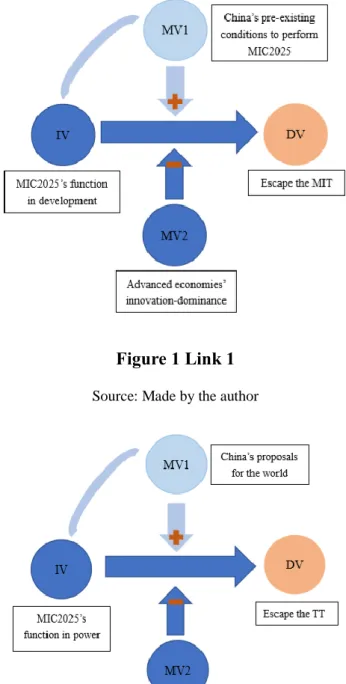
Figure 1 Link 1 ... 7
Figure 2 Link 2 ... 7
Figure 3 Ten critical sectors of MIC2025 ... 34
Figure 4 Technology roadmap for the wireless communication industry... 35
Figure 5 Trend of the growth rate of China’s GDP in 1978 – 2018 ... 37
Figure 6 Share of investment in energy industries in total investment ... 38
Figure 7 Species of air pollutant in China ... 39
Figure 8 Air quality of 338 Chinese cities in 2018 ... 39
Figure 9 Share of the GDP of each area in national GDP in the first three quarters of 2018 .. 40
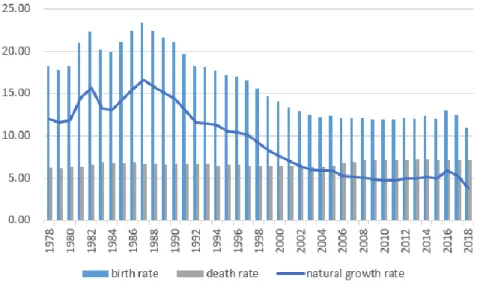
Figure 10 China’s demographic situation in 1978 – 2018 (‰) ... 41
Figure 11 Proportion of China’s different age groups in 1990 – 2018 ... 41
Figure 12 Origins of China’s FDI from 1990 to 2015 ... 47
Figure 13 Distribution of foreign investment in China from 1997 to 2017 ... 48
Figure 14 The flow of China’s OFDI in 1992 – 2012 ... 51
Figure 15 Distribution of China’s OFDI in Europe in 2017 ... 52
Figure 16 Distribution of China’s OFDI in the North America in 2017... 52
Figure 17 Distribution of China’s OFDI in the U.S. in 2017 ... 53
Figure 18 Share of public ownership in traditional industries in 2014 ... 54
Figure 19 Share of public ownership in surplus productivity in 2014 ... 54
xv
Figure 21 Top 15 military spenders in 2018 ... 58 Figure 22 World trade average annual growth rate from 2007 to 2014 ... 65
xvi
CONTENTS OF TABLES
Table 1 Re-industrialization plans of traditional industrial countries ... 32
Table 2 Four stages of China’s S&T policies’ evolution ... 43
Table 3 Legislation on foreign investment in China ... 46
Table 4 The first group of financial institutions founded in Shenzhen ... 47
Table 5 Milestones in the progress of China’s IP system ... 50
Table 6 Comparison of return on equity ratio between the SOEs and the private enterprises . 55 Table 7 World top 10 companies in semiconductor, industrial robots, and precision instruments ... 56
1
INTRODUCTION
China, known as the biggest developing country, has developed from a low-income economy into a middle-income one, due to its pragmatic reforms since the end of the 1970s (Cai, 2012). At present, China has entered a critical period of turning from a middle-income economy into a high-income one (Aoki, 2011; Cai, 2012). However, China has been facing increasingly severe environmental problems and social problems regarding disparity in income distribution. Thus, China is at risk of failing and being trapped in the middle-income trap (MIT) (Cai, 2012; Gill et al., 2007).
On the other hand, along with rapid economic growth, China has gradually changed its “low-key” profile, which started in the Deng Xiaoping period (Yan & Gong, 2018), into a more proactive posture in global politics (Zhang, 2010). Under the leadership of Xi Jinping in 2012, China put forward a “major country” diplomacy (Daguo waijiao) (People.cn, 2017) that is defined as “Great power diplomacy” by various scholars worldwide (Dotson, 2019; Miller, 2013; Takahashi, 2017; Zhang, Ye, Wang, Galli & Budeanu, 2018). This diplomacy is meant to help China fulfill China Dream of modernization and build up a community with a shared future for humankind (Ibid.). Under the proactive foreign policy, China’s further rise will probably make it fall into the Thucydides Trap (TT), namely facing competition with the existing hegemony, the U.S., in a process of growing instability in world economics and politics (Allison, 2015; Lee, 2019).
Under this background, in 2015, the Chinese government launched an industrial plan called “Made in China 2025” (MIC2025) (China State Council - CSC, 2015). The plan aims at upgrading China’s industrial system and building up industries in ten vital sectors, with a strategic aim of becoming less dependent on some key sectors and further fulfilling China Dream of modernization (Ibid.). Thus, this research is developed under the topic of “‘Made in China 2025’: China’s development strategy through technological innovation.”
RESEARCH RELEVANCE, RESEARCH QUESTION, AND OBJECTIVES
The research evolves under the discipline of the political economy of international relations (IR). Specifically, in IR, the state is the main actor. From a realist perspective (Carr, 1946/1981; Knorr, 1975; Morgenthau, 1985; Waltz, 1959), the political order is characterized by anarchy.
2
In the anarchy, without an organized power, there exists no automatic harmony (Waltz, 1959). Thereby, the states are likely to face a security dilemma, which forces them to obtain more power to achieve their goals, of which the most important one is security (Carr, 1946/1981; Morgenthau, 1985; Waltz, 1959).
Under the discipline of political economy, the states usually take measures of “reducing the home state’s dependence on others” (Gill & Law, 1988, p. 27) to increase the security. In other words, complete self-sufficiency is ideal for a state’s economic security (Gill & Law, 1988). In practical terms, the state will make industrial policies to build up its strategic industries, which concern “national security and self-sufficiency in vital sectors” (Ibid., p. 28).
MIC2025 is China’s strategic industrial policy. Since 2015, it has triggered quite different reactions inside and outside of China.
Chinese scholars generally hold a positive attitude towards the plan and consider it imperative for China’s sustainable development. It is destined to contribute directly to the implementation of the manufacturing transformation and upgrade (Xiang, 2015) to further equip China with core technologies (Zhang, 2016) in the areas of digitalization, networking, and intelligence. Finally, it will hasten the fulfillment of China’s dream “of moving into the high-income club” (Wei, Xie & Zhang, 2017, p. 68) through technological innovation (Liu, Liu & Zhang, 2018). Thus, for them, MIC2025 acts as the new engine of China’s development, while coupled with challenges in the areas of manufacturing capabilities, research and development, and human capital (Li, 2017).
In contrast, non-Chinese scholars have quite different attitudes: a few scholars (Jung, 2016) maintain a reserved attitude toward the plan, while the rest is dominated by vigilance (Heilmann, 2016). These phenomena are mainly caused by the hypothesis that China’s transformation into a manufacturing superpower will result in steep challenges for the existing manufacturing powers (Institute for Security & Development Policy - ISDP, 2018) due to “perceived intellectual property (IP) abuses, and discrimination against foreign companies” (ISDP, 2018, p. 1). Particularly the United States, as the leading technological power, will encounter threats from the rise of China (Deutch, 2018) and “an unwelcome but unavoidable contest” (Lewis, 2018, p. 7) with China for the leading role in the international order (Lewis, 2018). This unavoidable contest is called TT, a term that Graham Allision (2015) coined to indicate the instability in U.S.-China relations led by the structural change that China’s rising caused.
3
Besides these two kinds of views, Malkin (2018) has an entirely different perspective. Malkin states that China’s approach to innovation can be regarded as “a global trade governance issue” to test the “balance between binding rules and policy space since the establishment of the WTO (World Trade Organization)” through integrating China into a “rules-based global trading order” (p. 21).
After reviewing the literature, one can find that both of these perspectives have concentrated on just one of the possible effects - national or international - of the plan, and lack comprehensive consideration.
Besides, we have also found that the existing theories of technological innovation and development have been born in a capitalist background and have not provided the experiences of a non-capitalist developing country. Therefore, we will conduct original work and focus on the case of China. We will accurately testify if the mechanism of technological innovation can still be useful for China in the aspect of promoting its development and accelerating its rise in international politics.
Therefore, our research will contribute comprehensive and original perspectives to the analysis of the plan dealing with prospective Chinese development and China’s rise in the world order. The research will start with the question:
➢ Is MIC2025 an instrument for China’s development strategy to enhance its position in the world order?
To answer the research question, we propose the general objective:
➢ To analyze if China can reform the actual world order through technological innovation And five specific ones:
⚫ To explore the strategic importance of MIC2025
⚫ To examine China’s pre-existing conditions for performing MIC2025 ⚫ To inspect China’s limitations for performing MIC2025
⚫ To analyze China’s position in the current world order ⚫ To evaluate China’s proposals for the world order
4
HYPOTHESES, RESEARCH DESIGN, AND DATA COLLECTION
Concerning the research question, there are two directions to elaborate on our hypotheses. The first one is the instrumental function of MIC2025 in promoting China’s development, and the other is in helping China rise in the world order.
Combining the first direction and China’s risk of falling into the MIT, the first hypothesis is proposed as follows:
H1: MIC2025 can help China escape the MIT and maintain sustainable development.
It needs to be noted that various factors and constraints will affect the effectiveness of the plan in exerting its instrumental function of development. Naturally, regarding this hypothesis, we have further elaborated three propositions:
P1: MIC2025 has the instrumental function of promoting development by technological innovation.
P2: China has pre-existing conditions to perform MIC2025.
P3: Advanced economies’ dominance in innovation will leave limited space for China to carry out the plan.
Combining the second direction and China’s risk of falling into the TT, the second hypothesis is brought forth:
H2: China, with the strength enhanced by the industrial plan, will escape the TT and contribute to the reinforcement of a multilateral world order.
With similar logic, there are factors and constraints that will affect the plan’s effectiveness in exerting its instrumental function of power. Thus, for the second hypothesis, we have also elaborated three propositions:
P1: MIC2025 has the instrumental function of increasing China’s strength.
P2: China’s proposals for the world will not lead China to the TT, but instead will lead the country to enhance multilateral world order.
5
P3: China has limited conditions to reform the world order, which is established and maintained by the U.S. and its allies.
To start our research design, we should first choose an appropriate philosophical view that is composed of “a set of beliefs that guide action” (Guba, 1990, cit., Creswell, 2014, p. 6) and can direct us to the research purpose.
Having considered the hypotheses and related propositions, we chose the pragmatism, a world view that “is not committed to any one system of philosophy and reality” (Creswell, 2014, p. 11) and will permit us to freely make choices (Creswell, 2014) and take advantages of different approaches to realize the aim.
From a pragmatic perspective, the investigation will be concentrated on the problem and the results in the mixed context concerning political, economic, social, and other factors (Ibid.). Naturally, under the background of complex international relations, to achieve our research purpose, we decided to design our research by using the mixed methods constituted of the combination of quantitative and qualitative approach, which provide us with “a more complete understanding of a research problem than either approach alone” (Ibid., p. 4), and give us access to both quantitative and qualitative data (Creswell, 2014).
In our research, therefore, the explanatory sequential mixed methods design has been used, in which it involves the collection of quantitative data first and then explains the quantitative results “in more detail” (Creswell, 2014, p. 224) with the qualitative data.
First of all, we have constructed relations among the theories of technological innovation, development, and power, which will later be used as the direction for us to collect and analyze the quantitative data.
Then, we start collecting the quantitative data with the organization of the hypotheses and their propositions by using variables, the common elements in quantitative approach, which refers to “a characteristic or attribute of an individual or an organization that can be measured or observed and that varies among the people or organization being studied” (Creswell, 2014, p. 52).
The variables have been chosen in our study based on the pragmatic motive, considering its attribute of dividing elements of “a given situation” (Ibid.) into “at least two mutually exclusive
6
categories” (Ibid.), providing us with the precise structure to direct the process of data collections.
In constructing the structure, we principally selected four types of variables: independent variables, dependent variables, mediating variables, and moderating variables.
The independent variables, also named “treatment, manipulated, antecedent or predictor variables” (Ibid.) can “cause, influence, or affect” (Ibid.) the outcomes, which are defined as dependent variables (Creswell, 2014).
With independent variables and dependent variables, a cause-and-effect structure is set up (Ibid.), in which there exist other variables that exert impacts on the causal link (Ibid.), like mediating variables and moderating variables.
The mediating variables, according to Creswell (2014), are in the middle of the causal link and “mediate the effects of the independent variable on the dependent variable” (p. 52). The moderating variables are different, as they belong to “independent variables that affect the direction and the strength of the relationship between independent and dependent variables” (Thompson, 2006, cit., Creswell, 2014, p. 53). In other words, the dependent variables will depend on the “joint impact” (Creswell, 2014, p. 53) determined by both the independent and mediating variables (Creswell, 2014).
Based on the characteristics of the variables and the hypotheses, thus, we have elaborated two causal links.
7
Figure 1 Link 1
Source: Made by the author
Figure 2 Link 2
Source: Made by the author
Specifically, in Link 1 (see Figure 1), the first proposition of instrumental function of MIC2025 in development serves as the independent variable (IV) that will cause or influence the outcome of escaping the MIT, which is regarded as the dependent variable (DV). Moreover, the second proposition of China’s pre-existing conditions to perform MIC2025 is the mediating variable (MV1) positively affecting the causal link; the third proposition of innovation dominance of
8
advanced economies is the moderating variable (MV2) negatively influencing the direction of the causal link.
In Link 2 (see Figure 2), the first proposition of the instrumental function of the plan in power as IV will generate the effect of DV of helping China escape the TT. Also, the second proposition of China’s proposals for the world, serving as MV1, will exert a positive effect over the causal link. Conversely, the third proposition of the actual liberal world order, as MV2, will have adverse effects on the link.
With relation to the research approaches, for the first causal link, we mainly used the approaches of content analysis of first-hand materials and secondary analysis of official statistics (Bryman, 2012). In the approach of content analysis, the documents and texts were collected from books edited by the Chinese government, the websites of the Chinese government, and the websites of the principal Chinese media (China Daily, People’s Daily, Xinhua). In the approach of secondary analysis of official statistics, the statistics were collected from the websites of Chinese government departments and the principal Chinese media.
For the second causal link, despite the two approaches used in the first link, we also used one of the comparative studies between the current China and Japan in the 1980s to analyze China’s position in the world order.
After collecting the data, we examined the theoretical relations that we have established and obtained a quantitative result, which can inform “the types of participants to be purposefully selected” (Creswell, 2014, p. 224) for our following qualitative study.
The qualitative study was conducted with the instrument of semi-structured interviews; the questions served as “an interview guide” (Bryman, 2012, p. 471), leaving for the interviewee “a great of leeway in how to reply” (Ibid.).
The interview was designed with a list of interviewees, including a Chinese official (from China’s Embassy in Portugal), a Chinese reporter (from China Daily), Chinese company representatives (from Huawei and ZTE), and foreign representatives (from American and Japanese Embassy in Portugal).
After having contacted the planned interviewees, both the Chinese company representatives and foreign representatives did not accept the invitation.
9
Thereby, our interviewees are made up of one Chinese official and one Chinese reporter. Both the interviewees are familiar with Chinese technological issues and interested in China’s rise in global politics. The interview with the Chinese official was a face-to-face one, while the one with the reporter was finished by telephone due to the distance.
In the final phase, we have used critical discourse analysis, which is an inductive approach (Bryman, 2012) to analyze the qualitative data collected from the interviews responding to the quantitative results.
10
PART ONE THEORETICAL BACKGROUND
INTRODUCTION
Within the research question, we are generally considering two main perspectives: one discusses how technological innovation promotes development, and the other discusses how technological innovation affects the formation of political power and further the world order. Thus, the core theories in our research are technological innovation, development, and power. Naturally, the structure will be built up in the aspect of exploring relations among these theories. However, there is no direct literature that analyzes the relations. Through a thorough consultation and organization of relevant literature, we have constructed connections among them.
First of all, technological innovation is a complex economic phenomenon because of its nature of creative destruction and knowledge, various determinants and dynamics, and different actors of entrepreneurs and state, and by combining the nature of development, technological innovation can serve as an effective instrument in promoting development nationally or internationally; furthermore, it can also be transformed into the various forms of political power and then used by the countries to enhance their positions, which deeply affects the formation of world order.
Therefore, our theoretical background will be built up in three sections of technological innovation, technological innovation and development, and technological innovation and power. 1. TECHNOLOGICAL INNOVATION
1.1.NATURE OF TECHNOLOGICAL INNOVATION
In the literature, there is no specific definition of technological innovation as a whole, but there is distinct research on the meaning of technology and innovation.
First of all, technology is a form of knowledge (Dosi, 1984; Hall, 1994; Smith, 1996). According to Smith (1996), knowledge, in essence, is a special commodity with the apparent characteristics of public goods. With the nature of public goods, technological knowledge is independent in the context of transmission costs that can be neglected (Smith, 1996). This
11
feature is applied for the technological knowledge, whether in the practical form “related to concreate problems and devices” (Dosi, 1984, pp. 13-14) or in the theoretical form reflected in “know-how, methods, procedures, experience of successes and failure and also, of course, physical devices and equipment” (Ibid.).
The increasing of the stock of technological knowledge, naturally, generates the “effects of expanding the knowledge base” (Hall, 1994, p. 18), presented in the concrete form of technical change (Hall, 1994), which always leads to the economic situation of “higher productivity, the production of new goods or the improvement of existing ones” (Ibid., p. 18).
However, in technological innovation, the knowledge change is not gentle but violent, which is principally influenced by the nature of innovation of “creative destruction” (Elster, 1983; McCraw, 2007; Schumpeter, 1985).
Concerning the exploration of the nature of innovation, the most outstanding scholar is Schumpeter (Elster, 1983; McCraw, 2007). According to Schumpeter (1934), innovation is regarded as the new combinations of production means via creative destruction, serving as the engine of capitalist development (Ibid.) To achieve innovations, there are generally five channels, namely,
the introduction of a new good; the introduction of a new method of production; the opening of a new market; the conquest of a new source of supply of raw materials or half-manufactured goods; the carrying out of a new organization of any industry. (Schumpeter, 1934, cit., Elster, 1983, p. 116)
The process of innovation, therefore, determines the fact that the technological innovation is an original process of generating new technologies by means of creative destruction of the existing ones (Elster, 1983), and it is quite different from the technological imitation, which highly depends on the technology transfer and the host country’s absorptive capacity (Madsen, Islam & Ang, 2010). Moreover, technological imitation usually happens in backward countries lacking the technological base to make innovation (Ibid.).
12
Based on the nature of technological innovation, it can be a complex phenomenon. The process is affected by various determinants, generally of two categories: endogenous and exogenous. From the endogenous perspective, technological innovation is viewed as a learning process (Rosenberg, 1985). The viewpoint can be traced back to the classical period, in which Adam Smith (1976) found out that technical progress was mainly made by three types of learning processes: learning by using by specific workers, learning by doing through specialization in machine production, and formal or scientific learning (von Tunzelmann, 1995).
The aspect of the learning process cannot wholly explain the complexity of technological innovation. Based on the study of various scholars (Dosi, 1984; Hall, 1994; Mowery & Rosenberg, 1985), we have found that the exogenous determinants have two types, the technical-push with the focus on the function of science, and the demand-pull concentrated on the force of the market.
The technical-push treats science as an independent area to drive technology forward (Dosi, 1984; Hall, 1994). The view was added by von Tunzelmann (1995), with reference to Kuznets (1973, 1974), that “the emergence of modern science as the basis of advancing technology – a breakthrough in the evolution of science (…) produced a potential for technology far greater than existed previously” (p. 74).
However, Hall (1994) thought that technical-push is a typical linear model of science-technology-production without consideration of external marketing factors. Thus, the demand-pull emerged as a remedied theory.
Mowery and Rosenberg (1985) held that the market is “the causal prime mover” (p. 204) for technical progress. Specifically, the productive units recognize the market needs and make efforts to improve their technological activities to fulfill those needs (Mowery & Rosenberg, 1985).
With technological advancement and the emergence of sophisticated technologies, both the endogenous and the exogenous determinants encounter limitations. Thus, research and development (R&D), driven by the combined effects of the learning process and market motivations, has gained fame and popularity in academia (Belcher, Hassard & Procter, 1996). 1.3.DYNAMICS OF TECHNOLOGICAL INNOVATION
13
As with various other determinants, technological innovation evolves along with its logic and dynamics, which have been identified and studied in the literature (Dosi, 1984; Hall, 1994; Rosenberg, 1985).
First of all, technical change does not happen at random but in “a deep structure” (Hall, 1994, p. 28) determined by the existing technologies. This structure was defined as a technical paradigm by Dosi (1984) and Hall (1994).
The notion of the paradigm was first used in the history of science (Kuhn, 1970, cit., Hall, 1994), “thought of as a way of looking at the world (or part of it) which enables problems to be defined and research to be given pattern and structure” (p. 28).
Then, Dosi (1984) found a similar logic of paradigm in technical change, in which the techno-economic problems are resolved based on selected principles of the existing science and “specific rules aimed at acquiring new knowledge” (Hall, 1994, p. 29).
Within the technical paradigm, there always exists a momentum or direction (Dosi, 1984); that is to say, “once a path has been selected and established, it shows a momentum of its own” (Ibid., p. 17).
This momentum has been further named by Dosi (1984) as a technological trajectory; that is, “a normal problem-solving activity determined by a paradigm” (p. 17), can promote technological innovation by its driving force. But Hall (1994) pointed out that the trajectory can also turn into technological imperative, especially when it encounters “bottlenecks in connected processes and obvious weak spots in products” (Rosenberg, 1969, cit., Hall, 1994, p. 29). In this condition, according to Dosi (1984), it is not easy to switch to an alternative one, and the only way to change paradigm is to “start (almost) from the beginning in the problem-solving activity” (p. 18).
Therefore, both the perspective of paradigm and trajectory concern the inner logic of technical progress. Besides the inner logic, technical diffusion is another dynamic and plays a role in promoting technical progress (Landau & Rosenberg, 1992; Rosenberg, 1985). The technical diffusion is motivated by the nature of goods of technology to realize its commercialization, or its economic values (Ibid.).
14
According to Rosenberg (1985), new technologies are invented in creating the first data of technological feasibility. Also, the diffusion of new technologies is a process of identifying their economic impact. Freeman (2004) adds that the diffusion process will lead to further innovation yet in “heavily skewed distributions of research, inventive and innovative activities” (pp. 550-551) and form clusters.
Landau and Rosenberg (1992) point out that the context of economic globalization has not only diversified the process of technological diffusion but also enhanced the role of the diffusion, especially in the form of technology transfer.
Technology transfer can help innovating countries “gain the competitive advantage” (Landau & Rosenberg, 1992, p. 4) and also permit recipient countries to have the late-comer advantage of “the ability to industrialize through borrowing rather than independent invention” (Rosenberg, 1985, p. 247).
1.4.ACTORS OF TECHNOLOGICAL INNOVATION
In the literature, there are generally two types of actors that dominate the process of technological innovation, the entrepreneurs and the state.
The entrepreneurs are considered as the main protagonists in the process of innovation (McCraw, 2007). Defined as the “new men” by Schumpeter (1983), the entrepreneurs, motivated by profit, act as the “pivot on which everything turns” (cit., McCraw, 2007, p. 7) in the enterprises in whatever form or with whatever nature.
According to McCraw (2007), innovation serves as the motivation to gain higher profit for the entrepreneurs. Thus, there are two choices: that of the innovators who, to preserve high profit as long as possible, will utilize various mechanisms of protection, development, or publicity, specifically “through patents, further innovation, secret processes, and advertising” (p. 255); the non-innovators, on the other hand, will quickly react and try to imitate the innovation (McCraw, 2007).
However, Nelson and Wright (1992) thought that the Schumpeterian innovation mechanism centered on the competition was partial and limited without the consideration of the public side of technology. Thus, he pointed out, the process of innovation could be implemented by the mechanisms through which “new technical information is shared” (p. 58) and which “can be
15
used to pursue it cooperatively” (Ibid.) by various social institutions. Moreover, Nelson and Wright (1992) have emphasized the scientific contribution made by universities.
Compared with other social institutions, the firm, according to Hall (1994), can play a more active role in the realization of innovation, because as the “decision-making unit engaged in production” (p. 167), it can introduce new technologies into production in which “much new technology is developed in the pursuit of product and process innovation” (Ibid.). Moreover, it is usually “the quantity and timing of R&D undertaken within a firm” (Ibid.) that determine the speed of generating new technologies (Hall, 1994).
However, no matter how effective the mechanisms made by entrepreneurs or firms may be, they are still mainly affected by the national innovation policies (Fransman, 1994; Freeman, 2004; Malerba, 1992).
According to Malerba (1992), regarding the function of technological innovation, the public policy contributes as a principal force to “the organization of innovative activities and the commercialization of new technologies” (p. 264) through “mission-oriented programs” (p. 265), which can accumulate the forces from various institutions of “firms, research organizations, and universities” (p. 267) to focus on specific and essential technology.
Also, it is essential to note that public policies are different in different countries (Fransman, 1994; Malerba, 1992). Different from the bottom-up policies of European countries (Malerba, 1992), which emphasize “the establishment of technical standards, formation of human capital, the provision of technical information, and the diffusion of new technologies” (Malerba, 1992, p. 275), Japanese policies exert a stronger influence in the form of top-down or upstream (Fransman, 1994), reflected in the dominant occupation in R&D investment with a rate of nearly 90 percent by the government (Fransman, 1994).
2. TECHNOLOGICAL INNOVATION AND DEVELOPMENT
Technological innovation has always served as a driving force for development, which has been thoroughly discussed in the literature (Dosi, 1984; Folgieri, 2016; Lundvall, 2016; Schumpeter, 1985; von Tunzelmann, 1995). However, before exploring the connections between them, it is vital to know the nature of development.
16
Development is also a complicated issue in international politics. In the area of social science, there has been a variety of understandings about it with different emphases in its evolution for many years (Fuentes, 1993; Gilpin, 1987; Gustance & Hillier, 1998; Herath, 2009; Hosseini, 2003; Lin & Rosenblatt, 2012; Thomas, 2006; United Nations Development Program - UNDP, 2015).
The conventional development theory is born in Europe (Herath, 2009; Hosseini, 2003). It mainly concentrates on economic growth measured by the “positive change in real GDP (gross domestic product)” (Hosseini, 2010, p. 93), and on economic progress to accomplish “the growth of capitalism” (Herath, 2009, p. 1450), by resolving the problems of “urbanization, poverty and unemployment” (Ibid.).
However, in the “twentieth-century divergence” (Lin & Rosenblatt, 2012, p. 172) caused by industrialization, there emerged a division of developed and under-developed countries, with a more obvious gap after WWII (Herath, 2009; Hosseini, 2003; Lin & Rosenblatt, 2012). Under this background, in what concerns the “Third World development” (Herath, 2009, p. 1452), a modernization paradigm has been proposed, which is constituted by “a process of emulation of the patterns of development previously experienced by the now so-called developed nations” (Blomstrom & Hettne, 1984, cit., Herath, 2009, p. 1452).
For the less developed countries (LDCs), however, the development issue is much more complicated than the one of growth, since it relies on the particular circumstances in society, politics, and economy (Hosseini, 2003). Thus, the economic development with the aim of “narrowing of the gap in per capita income between the rich and poor countries” (Lewis, 1944, cit., Hosseini, 2003, p. 93) is quite not sufficient for the LDCs (Hosseini, 2003).
As an alternative, the development economics born for the LDCs is much more practical, and are designed to deal with “the root causes of poverty and backwardness” (Ibid., p. 92) and finally contributes to the transformation of “poor/non-industrialized economies to developed/industrialized ones” (Hosseini, 2003, p. 93).
It is worth noting that in the process of transformation, the LDCs are likely to drop in the MIT (Gill et al., 2007). The MIT hypothesis was launched by the World Bank to indicate the risk that will be encountered by East Asian middle-income countries in transforming into high-income countries (Ibid.), as they are “squeezed between the low-wage poor-country competitors
17
that dominate in mature industries and the rich-country innovators that dominate in industries undergoing rapid technological change” (Garrett, 2004, cit., Gill et al., 2007, p. 5).
The countries to be caught in the trap are probably caused by their lack in “institutions, capital markets, track record, or critical mass of highly skilled workers” (Flaaen, Ghani & Mishra, 2013, p. 1), or by the challenges of “distribution and social cohesion issues” (Ibid.). Besides these causes, the governments of these countries rarely shift from the “past successful policies” (Ibid.) or “exit prematurely from the industries that could have served as the basis for their specialization process” (Ibid.).
Besides the conventional development theories focusing on economic progress, the literature evolves with the notion of human development and sustainable development (Hossieni, 2010). Human development is people-centered, a perspective that is enlightened by the UNDP in the Human Development Report (1997). In this Report, UNDP uses variables such as “life expectancy, educational attainment and real GDP per capita” (Herath, 2009, p. 1458) to build Human Development Index and Human Poverty Index to measure the development (Herath, 2009).
The sustainable development approach relates to development that integrates social, environmental, and economic factors (Thomas, 2006), relying on “using resources today without affecting the options for future generations” (WCED, 1987, cit., Fuentes, 1993, p. 576), aiming to achieve a balance between three objectives, namely, “maintenance of economic growth, protection of the environment and prudent use of natural resources, and social progress that recognizes the needs of everyone” (Custance & Hillier, 1998, p. 281).
2.2.TECHNOLOGICAL INNOVATION AND DEVELOPMENT
In promoting development, technological innovation is an effective instrument in the aspect of economic growth, economic structure, and sustainable development, which has been found and continuously deepened by many scholars (Alemu, 2013; Dosi, 1984; Folgieri, 2016; Fuentes, 1993; Gustance & Hillier, 1998; Hall, 1994; Lundvall, 2016; Murphy, Shleifer & Vishny, 1989; Schumpeter, 1985; Thomas, 2006; UNDP, 2015; von Tunzelmann, 1995).
18
Among the elements that promote economic growth, technological innovation can serve as the principal driving force (Folgieri, 2016; Murphy, Shleifer & Vishny, 1989; Schumpeter, 1985; von Tunzelmann, 1995).
For Schumpeter, economic growth is the result of new combinations within the process of creative destruction (Elster, 1983). Thus, various methods of productivity are only differentiated by how the combinations are constituted and by the relations between the combining objects (Ibid.).
The driving dynamism of Schumpeterian innovation is not in linear but in circular flux, aiming to achieve the state of equilibrium: “it is a spontaneous and discontinuous change in the flow channels and in the disturbance of the equilibrium, which always change and move into the previously existing equilibrium state1” (Schumpeter, 1985, p. 47).
Schumpeterian innovation theory, developed for a capitalist society that has an established industrial base, is not appropriate for non-industrialized societies. Accordingly, for the relatively backward societies with small domestic markets, Rosenstein-Rodan (1943) proposed the concept of the big push (cit., Murphy, Shleifer & Vishny, 1989).
The big push occurs “if various sectors of the economy adopted increasing returns technologies simultaneously, they could each create income that becomes a source of demand for goods in other sectors, and so enlarge their markets and make industrialization profitable” (Rosenstein-Rodan, 1943, cit., Murphy, Shleifer & Vishny, 1989, p. 1004).
For Murphy, Shleifer, and Vishny (1989), the process of simultaneous industrialization is mainly driven by promoting domestic demand while ignoring the function of exporting growth. The technological innovation contributes to economic growth mainly by increasing the productivity, which will necessarily generate new technologies and upgrade the existing machines, with a direct function of “facilitating and abridging labor” (von Tunzelmann, 1995, p. 39).
1Translated by the author from the original version of “é uma mudança espontânea e descontínua nos canais do
19
However, in the meantime, it shall cause the anxieties of technological unemployment (Folgieri, 2016; von Tunzelmann, 1995) by reducing the necessary working hours occupied by human workers (Folgieri, 2016).
This anxiety is, nevertheless, temporary and should be analyzed in a farsighted way. Concerning David Ricardo (1817) and Marx (1887, 1965), von Tunzelmann (1995) explained that in the process of mechanization, generally, labor will be relocated by the ‘invisible hand’ and in the end, receive higher wages.
2.2.2. IN ECONOMIC STRUCTURE
Besides economic growth, technological progress proceeds toward the structural equilibrium and sustained growth through adjusting the demand and supply side (Dosi, 1984; Hall, 1994), mainly reflected in the development of external and knowledge economy (Alemu, 2013; Hall, 1994; Lundvall, 2016).
For a nation, the external economy is primarily determined by the comparative advantage (Freeman, 2004; Gereffi, 1999). Technological innovation is precisely the factor that can determine “how comparative advantage changes” (Hall, 1994, p. 392).
Specifically, technical progress will expand production possibilities and increase the production possibility frontier or technology frontier (Hall, 1994), which enables a nation to gain competitiveness in the global trade through “reaching a higher terms of trade line than before” (Hall, 1994, p. 392) or upgrading the position in the global commodity chain (Gereffi, 1999). Naturally, for the firms, the main actors of the trading economy will also gain the capacity to have new products or improve the existing ones so that they can maintain profits and competitiveness in the trade (Alemu, 2013).
Different from the viewpoint of comparative advantage, Freeman (2004) holds that a nation can enhance international competitiveness by a national innovation system. Specifically, a nation can make long-term investments in technological infrastructure (R&D) or promote technical innovation to minimize the technological gap, increase technical output, and finally enhance its competitiveness (Ibid.).
Moreover, he points out that once the country gains technological leadership, it will obtain “absolute rather than comparative advantage” (p. 541).
20
However, the positive effect of technical innovation for the external economy does not always work out efficiently, as the comparative advantage is not static but “dynamic and ever-changing” (Landau & Rosenberg, 1992, p. 114), and growth itself is “a highly path-dependent experience” (Ibid.).
Besides the external economy, technological innovation also acts as an essential role in building up a knowledge-based economy, which is a form of modern economy involving the processes of “creation, acquisition, dissemination, and utilization of knowledge” (Kumar & van Welsum, 2013, p. 5).
The knowledge economy, defined by Powell and Snellman (2004) as “production and services based on knowledge-intensive activities” (p. 199), is driven by the development of “research and development, education, and learning on the job” (Kumar & van Welsum, 2013, p. 5). For Jensen, Johnson, Lorenz, and Lundvall (2016), this economy is centered on science, technology, innovation, and the learning process.
With reference to Chen and Dahlman (2005), Kumar and van Welsum (2013) point out that there are four pillars to measure the knowledge economy: “Economic Incentive and Institutional Regime (policies and institutions for the protection of IP, the rule of law, the ease of starting a business), Education (human capital), Innovation (universities, firms, and research institutes, similar to organizational capital), and ICT (physical capital)” (p. 6).
However, for the knowledge production-centered ideas, Powell and Snellman (2004) argue that knowledge dissemination and impact should be given more attention and, thus, point out that intellectual capabilities are much more critical than physical inputs for the establishment of a knowledge economy, and patents can be “an appropriate measure of stocks of knowledge” (p. 215).
Moreover, there is a growing literature that focus on the issue of promoting the developing economy (Lu, Zhang & Wang, 2010; Xu, Liu & Chen, 2002; Asian Development Bank-ADB, 2007) through establishing the knowledge value chain, including “knowledge input, knowledge activities, knowledge output and knowledge innovation of service enterprise” (Lu, Zhang & Wang, 2010, p. 3033), improving the knowledge management, and finally, enhancing the competitive advantage in knowledge.
21
A sustainable economy is characterized by the careful consideration of social, environmental, and economic factors and can realize the purposes of environmental protection and social progress in the process of economic growth (Fuentes, 1993; Gustance & Hillier, 1998; Thomas, 2006; UNDP, 2015).
Technological innovation can maintain sustainable development, as it can “further accelerate production and spur economic growth” (Santana, Rebelattto, Périco, Moralles & Filho, 2015, p. 425).
Moreover, technological innovation can contribute to reducing negative impacts of industrial progress on society and nature through its constantly generating “new production alternatives” (Ibid.); ensure “a qualitative leap in environmental efficiency” (Fokkema et al., 2005, cit., Santana et al., 2015, p. 429); promote “economic vitality, environmental sustainability and social progress” (Santana et al., 2015, p. 429) to enhance the pillars of sustainability (Santana et al., 2015).
Fuentes (1993) and Kim (2011) contribute a viewpoint of green technology to promoting an environmental-friendly economy, which refers to “product, service, or process that delivers value using limited or zero non-renewable resources and/or creates significantly less waste than conventional offerings” (Pernick, 2007, cit., Kim, 2011, p. 15).
2.3.TECHNOLOGICAL INNOVATION IN THE INTERNATIONAL CONTEXT
In the international context, marked by globalization of an “economic, political, and social integration of states and societies, both horizontally and vertically, in tighter webs of interdependence” (de Soysa, 2003, p. 7), the most apparent way of technology transfer is a foreign direct investment (FDI) (Girma, Gorg & Pisu, 2008; Haggard & Cheng, 1992; Kostevc, Redek & Rojec, 2011; Ray, 1977). In this context, IP has played the role of legal protection (Lamberton, 1994; Teece, 1992).
The FDI emerges as an instrument for multinational companies (MNCs) to maximize their profits (Ray, 1977). The MNCs, constituted by domestic oligopolies, view FDI as an alternative to “capture monopoly profits abroad” and to “maintain market positions abroad as alternative suppliers in the local market itself and other foreign countries become more competitive” (Ibid., p. 284).
22
Also, they usually have relatively superior ‘firm-specific assets’ (FSA) concerning production techniques, know-how, or management strategy (Caves, 1996, cit., Girma, Gorg & Pisu, 2008). The FSA has some of the characteristics of public good and can enable the firm to locate profitably abroad (Ibid.).
Considering the nature of public good, the FSA is difficult to protect by MNCs (Ibid.) in recipient areas with a technology gap (Girma, Gorg & Pisu, 2008). Local firms will use it once it is out on the external market (Caves, 1996, cit., Girma, Gorg & Pisu, 2008). Thus, the positive spillovers generate and help the recipients improve productivity (Girma, Gorg & Pisu, 2008). Besides spillovers, the recipient areas can be included automatically in the global value chain (GVC) by absorbing FDI, owing to “differentiated manufacturing processes integrated globally by the multinational corporation” (Frobel, 1981, cit., Haggard & Cheng, 1992, p. 91).
To attract FDI, the receiving areas need to provide a good investment environment, not only in specific FDI policies but also in an adequate “regulatory-administrative and economic policy framework” (Kostevc, Redek & Rojec, 2011, p. 173).
However, the positive spillovers can be mitigated by the increased competition generated by foreign companies, which may actually result in adverse effects on domestic firms’ productivity “if multinationals ‘steal business’ from domestic firms and force them up their average cost curve” (Aitken & Harrison, 1999, cit., Girma, Gorg & Pisu, 2008, p. 324).
In this condition, legal protection is necessary, which is always in the form of IP, indicating a “wide range of rights that are conferred by the legal system about discrete items of information that have resulted from some form of human intellectual activity” (Ricketson, 1992, cit., Lamberton, 1994, p. 301). These activities include inventions, scientific discoveries, literary and artistic works, trading marks, and industrial designs (Lamberton, 1994).
According to Teece (1992), IP can help innovators maintain the ‘first-mover’ advantages, and guarantee them with new products and know-how winning in the market.
However, IP protection is not easy. Unlike machines with clear rights of ownership, the know-how and skills, are intangible and quickly encounter being codified by others to save the high innovation costs (Teece, 1992; Lamberton, 1994), unless they fall into some of the categories of IP, “patents, copyrights, trade secrets, trademarks” (Teece, 1992, p. 177), in which the