v.13, n.3, e5546, 2018
Recife, PE, UFRPE. www.agraria.pro.br DOI:10.5039/agraria.v13i3a5546
Protocolo 5546 - 18/01/2017 • Aprovado em 19/06/2018
Litterfall, litter stock and water holding capacity
in post-mining forest restoration ecosystems, Eastern Amazon
Walmer Bruno Rocha Martins1, Raquel Lobo do Vale2, Gracialda Costa Ferreira1,Vanda Maria Sales de Andrade1, Luiz Fernandes Silva Dionísio1, Richard Pinheiro Rodrigues1,
Francisco de Assis Oliveira1, Giuliana Mara Patrício de Souza3
FOREST SCIENCES (CIÊNCIAS FLORESTAIS)
1 Universidade Federal Rural da Amazônia, Instituto de Ciências Agrárias, Belém, PA, Brasil. E-mail: [email protected] (ORCID: 0000-0001-8795-1703);
[email protected] (ORCID: 0000-0002-4018-9624) [email protected] (ORCID: 0000-0002-2104-2854) [email protected] (ORCID: 0000-0002-4324-2742) [email protected] (ORCID: 0000-0002-4837-6192) [email protected] (ORCID: 0000-0002-4720-3492)
2 Universidade de Lisboa, Centro de Estudos Florestais, Instituto Superior de Agronomia, Lisboa, Portugal. [email protected] (ORCID: 0000-0003-4566-5420) 3 Mineração Paragominas, Paragominas, PA, Brasil. E-mail: [email protected] (ORCID: 0000-0002-5265-2516)
ABSTRACT: The objective of this study was to evaluate the litterfall deposition, the decomposition rate (KL) and the water holding capacity (WHC) of litter stored in the soil in two areas degraded by mining submitted to different methods of forest restoration: induction of natural regeneration (NR) and planting seedlings of native forest species (PS) with a forest fragment (FF) used as reference. The litterfall deposition was collected monthly over 12 months in collectors of 0.25 m2. The KL was estimated by the
relation between annual litter production and litter stock in the soil surface. WHC was determined in the rainy and dry period. The litterfall deposition was lower in PS with values of 6.61 ± 0.20, 10.75 ± 0.52 and 11.83 ± 0.72 Mg ha-1 yr-1 for PS, NR and FF
respectively. The KL and WHC were significantly lower in PS when compared to NR and FF, and WHC decreased significantly from the rainy season to the dry season. The induction of natural regeneration was the more effective restoration method for degraded areas regarding litterfall deposition, decomposition and water retention capacity, surpassing planting native tree species and approaching a native forest fragment.
Key words: bauxite mining; environmental recuperation; forest restoration indicators; natural regeneration; planting native seedlings
Fluxo, estoque e capacidade de retenção hídrica de serapilheira
em ecossistemas de restauração florestal pós mineração, Amazônia Oriental
RESUMO: O objetivo deste estudo foi avaliar a deposição da serapilheira, a taxa de decomposição (KL) e a capacidade de retenção hídrica (CRH) da serapilheira estocada no solo em duas áreas degradadas por mineração submetidas a diferentes métodos de restauração florestal: indução de regeneração natural (RN) e plantio de mudas de espécies florestais nativas (PM) e um fragmento de floresta (FF) usado como referência. A deposição de serapilheira foi coletada mensalmente ao longo de 12 meses em coletores de 0,25 m2. O KL foi estimado pela relação entre a produção anual de serapilheira e o estoque de
serapilheira na superfície do solo. A CRH foi determinada no período chuvoso e seco. A deposição de serapilheira foi menor no PM, com valores de 6,61 ± 0,20, 10,75 ± 0,52 e 11,83 ± 0,72 Mg ha-1 ano-1 para o PM, RN e FF respectivamente. O K
L e CRH
foram significativamente menores no PM quando em comparação com RN e FF, sendo que, a CRH diminuiu significativamente da estação chuvosa para à estação seca. A indução da regeneração natural foi o método mais eficaz de restauração de áreas degradadas quanto à deposição, decomposição e capacidade de retenção de água da serapilheira, superando o plantio de espécies arbóreas nativas e se aproximando de um fragmento de floresta nativa.
Palavras-chave: mineração de bauxita; recuperação ambiental; indicadores de restauração florestal; regeneração natural;
Introduction
Since the initial decade of the 2000s, an expansion in the mineral exploration sector has occurred in the state of Pará, Brazil, and especially for bauxite, where around 32.2 x 10⁶
Mg were extracted in 2014, representing 91% of national bauxite production (DNPM, 2015). When compared to other activities carried out in the Amazon (such as conventional logging, large-scale agriculture, hydroelectric projects and extensive cattle raising), the forest areas impacted by bauxite exploitation is relatively small (Parrotta & Knowles, 2001). Nevertheless, this activity causes serious impacts on the environment, mainly from the removal of vegetation and topsoil which modify the landscape and compromise biodiversity and ecological functioning in the area directly affected, as well as in the surrounding areas (Barros et al., 2012).
Planting native tree seedlings has been the most used forest restoration method (Fonseca et al., 2017), including in areas degraded by mining (Parrotta & Knowles, 1999), and has proven to be successful (Lamb et al., 2005). However, in the Brazilian Amazon it can be extremely costly and result in low-diversity stands (Campos-Filho et al., 2013). It is recognized (Chazdon & Guariguata, 2016) that natural regeneration has the potential to play a major role in large-scale reforestation of tropical forests. In areas degraded by mining, the induction of natural regeneration through the transfer of topsoil (upper soil layer) is having increasing use due to its simplicity, low-cost and effectiveness.
To assess the success of forest restoration, measures of vegetation structure, species diversity and ecosystem processes are considered essential components for long-term persistence of an ecosystem and they need to be monitored to evaluate the success of the restoration method used and eventually adapt the method to accelerate the process of revegetation. However, effective monitoring means knowing what achieve with the restoration. To reach this goal, a forest ecosystem must be used as a reference and compared with the areas under the restoration process (Daronco et al., 2013). The indicators used to describe the state in which an ecosystem is are diverse and can be divided into qualitative and quantitative (Suganuma & Durigan, 2015). In general, indicators should be easy to measure and to interpret, and should clearly demonstrate the ecosystem’s state.
Among ecosystem processes are litter dynamics, namely litter production, decomposition and renewal (Souza et al., 2016). Litterfall dynamics are a good tool for future adoption of management practices, particularly in areas suffering anthropogenic disturbance, and supports the selection of best methods to use in forest restoration (Godinho et al., 2013).
Litter, which is found on the top of forest soils, is an indicator of productivity and nutrient cycling (Londe et al., 2016). Litter serves as an entry and exit system of nutrients, thus contributing to soil fertility maintenance through the decomposition process, especially in Amazon forest soils
which are considered to be nutrient poor (Quesada et al., 2011). In addition, litter retains water and helps to negate erosion while facilitating the breaking of dormancy and germination of several native species (Mateus et al., 2013), thus contributing to natural regeneration. Water storage capacity increases with litter depth, i.e. being highest close to the soil, constituting a transitional layer where decomposition is intense, thereby generating smaller particles with higher specific surface, and therefore adsorbing more water (Melos et al., 2010).
The amount of litterfall produced is conditioned by factors such as temperature, latitude, rainfall, forest age, edaphic characteristics, and floristic composition, among others, varying over time. In an extensive literature review, Zhang et al. (2014) concluded that precipitation and solar radiation are the main climatic variables responsible for litterfall seasonality.
In this context, this research attempts to clarify the following question: what is the best method for restoring degraded areas regarding litter dynamics - Planting native seedlings or inducing natural regeneration? Thus, the aim of this work was to compare litter production, decomposition and water holding capacity between two sites subjected to different restoration methods: planting seedlings of native tree species (PS) and induction of natural regeneration (NR), where a forest fragment (FF) was used as reference.
Material And Methods
Study area
The study was conducted at the Mineração Paragominas SA company from the Hydro group, located in Platô Miltônia 3 (03°15′38′′S, 47°43′28′′W), around 70 km from the municipal headquarters of Paragominas, northeastern Pará state, at an altitude of 150 m. The company has been operating since 2007, where it currently mines approximately 15 x 106 Mg
of ore per year, thus producing 10 x 106 Mg of bauxite.The
climate in the region is “Aw” according to the Köppen-Geiger classification, characterized as hot and humid with well-defined rainy and dry seasons (from December to May, and from June to November, respectively). Mean air temperature is 26.8 °C, and annual rainfall is approximately 1500 mm (Alvares et al., 2014).
For subsoil bauxite exploitation, the topsoil is usually removed at a depth of 20 cm after suppression of the forest vegetation, and stored stacks. After bauxite extraction, the company performs topographical reconditioning for forest restoration and spreads the topsoil. Two methods are used: planting native tree species and inducing natural regeneration.
Study ecosystems
a) Planting native tree seedlings (PS)
The planting was carried out in an area of 20 hectares with subsoiling and application of reactive natural phosphate (33% P2O5 total and 10% P2O5 soluble in citric acid 2%) at
the bottom of the pit. In addition, 800 kg ha-1 of dolomitic
limestone was applied in the total area with 200 g NPK fertilizer (06 30 06) plus micronutrients (0.5% B, 0.5% Cu, 0.5% Zn) and 2.5 kg of organic compound per pit consisting of vegetable soil, charred acai lumps, charred rice straw, tanned and crushed chicken manure, and tanned and shredded sheep manure in the proportion of 20% for each component. Seedling planting was performed in May 2009 in pits of 0.30 m x 0.30 m x 0.30 m, spaced about 3 m x 3 m with the initial use of 105 species of different ecological groups. All the seedlings were produced in a nursery located in the mining area. Individuals with a total height above 30 cm were selected for the planting, and species that presented fast growth rate were planted with lower height.
The planting site is currently seven years old, it contains 106 species belonging to 23 families, has a mean canopy height of approximately 5.0 m, a density of 1,063 individuals per hectare, and basal area of 2.86 m²ha-1. The ten species
with the highest Importance Value Index - IVI (%), calculated by the sum of the relative values of frequency, dominance and density were: Chloroleucon acacioides (12.02), Libidibia
ferrea (11.07), Inga alba (11.00), Mimosa schomburgkii
(10.99), Ceiba pentandra (10.99), Genipa americana (10.05),
Inga fagifolia (9.92), Croton matourensis (8.69), Swietenia macrophylla (7.88) and Byrsonima crassifolia (7.29).
b) Induction of natural regeneration (NR)
The procedures performed in the natural regeneration induction area consisted only of land reconditioning and topsoil spreading in the total area, with subsequent isolation of the site. The site has an area of 20 hectares, is seven years old, has 26 species belonging to 12 families, has a mean canopy height of 3.5 m, a density of 5,307 individuals per hectare and basal area of 4.57 m²ha-1. The predominant
species with higher IVI (%) were: Croton matourensis (55.94),
Vismia guianensis (43.98), Cecropia sp. (42.24), Byrsonima crispa (16.32), Solanum sp. (15.83), Casearia grandiflora
(10.20), Cheiloclinium sp. (9.95), Guatteria poeppigiana (9.57), Croton ascendens (9.30) and Casearia arborea (8.03). Thus, altitude, topographic, climatic and soil conditions were initially the same for the two restoration methods.
c) Forest fragment (FF)
A fragment of approximately 20 hectares of a forest area classified as altered mainland forest was selected. The last record of conventional logging was in 2003, currently presenting eleven years after exploitation. This site has 51 species distributed in 27 families, has a mean canopy height of 7.5 m, a density of 5,540 individuals per hectare, basal area of 22.52 m²ha-1. The species with higher IVI (%) are
as follows: Croton matourensis (24.35), Tapirira guianensis (23.39), Inga alba (22.61), Chrysophyllum prieurii (21.25),
Inga thibaudiana (16.87), Guatteria poeppigiana (16.51), Cordia scabrifolia (15.07), Vismia guianensis (12.78), Eschweilera coriacea (12.78) and Myrcia fallax (9.93).
Litterfall production and litter decomposition and renewal To study the litterfall production, 30 units of 0.25 m² screen litter traps were installed in each site, randomly distributed but at least 30 m away from each other, with 90 collectors in total. A buffer zone of 50 m was excluded in the three sites. Litter was collected monthly from September 2014 to August 2015 and stored in plastic bags. At the lab the litter was sorted in five fractions: leaves, twigs (Ø ≤ 2 cm), branches (Ø> 2 cm), reproductive material (fruits, seeds, flowers) and miscellaneous (all the material that did not fit in the other fractions). Once sorted, the material was oven dried at 70°C for 72 hours and the dry weight obtained.
For the decomposition rate (KL), a sampler of 0.25 m² (0.5 m x 0.5 m) was used to collect the litter biomass standing on the soil. The samples were alternately collected at the end of September and December 2014 and in March and June 2015, adjacent to the litter traps, totaling 15 samples per site and sampling dates. The decomposition rate was estimated by the ratio between annual litterfall and standing litter biomass (Eq. 1), as proposed by Olson (1963). After estimating KL, the average renewal time of accumulated litter was determined according to Eq. A2:
L L K X = R L 1 t K = where:
KL - coefficient of decomposition, year; tR - average renewal time of litter, year; L - annual litterfall, Mg ha-1 yr-1;
X - standing litter biomass, Mg ha-1 .
Litter water holding capacity (WHC)
The standing litter biomass was collected by the same procedure (0.25 m² samples), in the rainy period (March) and in the dry period (August). The analysis of water holding capacity (WHC) was calculated according to Blow (1955), where the samples were totally submerged in water for about 90 minutes, then deposited on trays with an angle of 30° for 30 minutes to remove water excess. Next, the litter was weighed to obtain the moist mass and dry mass after being dried at 70 °C for 72 hours. The value of WHC was determined by the equation:
(1) (2) MM DM WHC 100 DM − = ⋅ where:
WHC - water holding capacity, %; MM - moist mass, g;
DM - dry mass, g.
Data analysis
The annual production, decomposition rate and renewal of litter were assessed by one-way ANOVA. Repeated measures one-way ANOVA was adopted for the litterfall production analysis in a completely randomized design, as the three sites (PS, NR and FF) were compared over one year (12 months), with 30 replicates. For analysis of the litter’s water holding capacity, we used a completely randomized design with a two-way ANOVA (three treatments x two periods) with 15 replicates. When statistically significant differences were found, differences between group means were identified by post-hoc SNK test (Student-Newman-Keuls). Data were checked for normality and homogeneity of variances to meet the assumptions of parametric analyses and transformed with square root when necessary. For ANOVA-RM, the sphericity assumption was also checked. All statistical relationships were considered significant at p<0.05. Statistical analyses were carried out with STATISTICA 8.0.
Results and Discussion
Litterfall production and turnover
Litterfall production was significantly influenced by the adopted restoration method (p<0.001), where considerably lower litterfall was observed in PS compared to NR and FF (Figure 2A). Total litterfall was 6.61±0.20, 10.75±0.52 and 11.83±0.72 Mg ha-1yr-1 for PS, NR and FF, respectively.
The litterfall production in the NR and FF sites was similar to those reported for primary and secondary forests in the Amazon, which ranged from 8.04 to 12.70 Mg ha-1yr-1
(Martius et al., 2004; Barlow et al., 2007; Almeida et al., 2015; Pereira et al., 2017). Despite being lower than the NR or FF, the annual PS output was similar to the results found in tropical forests. When compared to other forests, these values were higher than found by Zhang et al. (2014) in Boreal and Temperate forests, with litterfall of 3.3 Mg ha-1yr-1
and between 4.7 and 6.0 Mg ha-1yr-1, respectively.
Figure 1. (A) Total litterfall (Mg ha-1yr-1), (B) decomposition rate (year), (C) litter renewal (year) and (D) litter water holding
capacity (WHC%) in two restored sites: planting seedlings (PS) and induction of natural regeneration (NR), and a forest fragment (FF) adjacent to the two sites in the northeast of the Brazilian Amazon. Bars with its standard error (SE) followed by the same letter do not differ statistically by SNK test (p ≥ 0.05).
The differences in litterfall production between restoration methods corroborate the results from Machado et al. (2015), which reported higher values in more ancient forests than in early stages of succession. The higher litterfall production observed in the NR compared to PS is possibly related to the predominance of rapid growth pioneer species such as C. matourensis, V. guianensis, T. guianensis or I. alba. These species develop rapidly in disturbed areas, and according to Guariguata & Ostertag (2001) they invest more energy in leaf production than in wood.
Pioneer species improve the physical soil characteristics such as unpacking and infiltration, as well as provide more favorable conditions for establishing late succession species by their increased production and renewal of plant material, and therefore have an important ecological function (Rocha et al., 2016). Also, the higher litterfall production in NR and FF compared with PS can be explained by the high tree density (5,540 stems per hectare, 5,303 stems per hectare and 1,063 stems per hectare, for FF, NR and PS, respectively). The density of vegetation influences litterfall, since these factors are linked to forest structure (Almeida et al., 2015).
The decomposition rates (KL) and renewal times (t) were also significantly different among the sites (p<0.05 and p<0.01, respectively). KL was higher in FF, followed by NR and PS (Figure 1B). Due to the higher observed KL, the renewal times in the FF and NR sites were significantly lower than in PS site (Figure 1C).
The decomposition rate in tropical forests is typically larger than one and hardly exceeding four years, indicating
that the litter is in a state of dynamic equilibrium and renews itself rapidly (Olson, 1963); moreover, litter renewal in tropical forests occurs in less than one year on average, which is in agreement with the results of our study. However, the decomposition rate and consequently the renewal time can vary due to various biotic and abiotic factors such as temperature, rainfall, edaphic conditions, phytophysiognomy, groups of microorganisms and meso and macrofauna (Hattenschwiler et al., 2005). The decomposition rates, renewal times and WHC in FF and NR sites were similar, but higher than the PS.
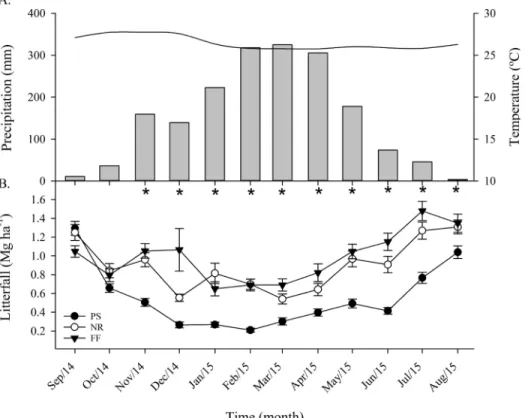
Most of the litter fell during the dry season (from November to June), particularly in the PS site where 71% of total litterfall occurred (Figure 2A). This proportion was similar and lower than PS at the NR and FF sites, being 61% and 58%, respectively. Overall, the months in which the larger amounts of litterfall occurred were August, September and July with 3.77, 3.59 and 3.52 Mg ha-1 respectively,
corresponding to periods when low rainfall was recorded in the study area (Figure 2B).
Several studies have shown that litter deposition is seasonal, with higher production in the dry season in the Amazon region (Barlow et al., 2007; Pereira et al., 2017), as well as in many forest ecosystems throughout the world (Zhang et al., 2014), and which is in accordance with this study. The variation of litter deposition in function of temperature and rainfall is associated to a strategy by plants to control water loss by transpiration in the warmer periods with leaf abscission, branches and other plant components
Figure 2. (A) Meteorological variables, precipitation (mm) and mean air temperature (ºC), at the study area. (B) Litter
temporal dynamics (Mg ha-1) in planting seedlings (PS), induction of natural regeneration (NR) and forest fragment (FF) sites.
(Machado et al., 2015; Pereira et al., 2017). Kim et al. (2012) also mentioned that greater litter production in warmer periods in the Amazon is associated with leaf renewal by trees for better utilizing photosynthetically active radiation, even with low water available in the soil.
Litter partition
Litter partition varied significantly among the sites (Figure 3). The leaves were the most representative litter fraction, and significantly different in the three sites (p<0.001) with 70, 85 and 77% in PS, NR, and FF respectively (Figure 3). Twigs (Ø ≤ 2 cm) were the main contributors to the non-foliar litter fraction, representing 17, 10 and 15% in PS, NR and FF sites, respectively, with the twigs fraction in NR being significantly lower than in the others sites (p<0.001). The reproductive material fraction represented 7, 3 and 1% of total litterfall, decreasing significantly from PS to FF and NR, respectively (p<0.001). No significant effect of the restoration method was found for the miscellaneous fraction (p>0.05), being around 5%, and the branches (Ø> 2 cm) had only a residual contribution to the total litterfall, being less than 0.5% in all sites.
The higher contribution of foliar litter composition has been reported by other authors in tropical forests (Martius et al., 2004; Almeida et al., 2015). The non-foliar litter fractions are indirect indicators of the forest maturity (Londe et al., 2016). The PS restoration method appears to provide faster canopy development regarding twigs and reproductive material litter fractions. The significantly lower proportion of twigs found in the NR site reflects the abundance of young plants or small trees which tend to lose smaller twigs (Londe et al., 2016).
A higher proportion of reproductive material has also been observed in the PS restoration method, indicating a significantly higher reproductive investment of trees at this
site even when compared to FF (7, 3 and 1% in PS, FF and NR, respectively). The species that outcrop and give fruit at specific times will attract pollinating insects and seed dispersers included in the miscellaneous litter fraction. Species that constantly bloom and bear fruit attract wildlife, and their presence is essential for dispersing propagules of various species and life forms, increasing the complexity of the ecosystem.
Litter water holding capacity (WHC)
Litter WHC was significantly affected by the restoration method used (p<0.001, Figure 1D) and season (p<0.001, Figure 4). Litter WHC was significantly lower in the PS site compared to NR and FF sites and decreased significantly from the rainy to the dry season. WHC was 194, 275 and 261% in the rainy period, and 157, 171 and 145% in the dry period for PS, NR and FF sites, respectively.
The highest litter WHC in FF and NR, particularly in the rainy period, is directly associated to the granulometry of its fractions and especially to its decomposition stage, because small particles of litter present a larger contact surface, and therefore adsorb more water (Melos et al., 2010). Moreover, the presence of water becomes fundamental for the development and multiplication of microorganisms, favoring the process of litter decomposition (Kozovits et al., 2007; Holanda et al., 2015), and therefore water retention. In areas under forest restoration, higher water retention capacity in rainy periods is a desirable feature because it prevents or hinders erosion (considered common), thus ensuring soil stability. This is especially important in restoration of areas degraded by mining, as the erosion and runoff can result in siltation and deterioration of water quality of groundwater or nearby rivers and lakes (Parrotta & Knowles, 2001).
The high WHC of FF and NR sites in relation to PS may also be related to characteristics which are inherent to the species found in both environments, such as leaf and
Figure 3. Litter partition (%). Bars of the same color with
the same letters do not differ statistically (p ≥ 0.05) In two sites under restoration process: planting seedlings (PS) and induction of natural regeneration (NR), and a forest fragment (FF) adjacent to the two sites in the northeast of the Brazilian Amazon.
Figure 4. Litter water holding capacity (WHC, %) in three
sites and two collection periods. Means followed by their standard error (SE) with the same capital letter between sites in the same period and lower at different times did not differ statistically by SNK test (p ≥ 0.05). PS: planting seedlings; NR: natural regeneration; FF: forest fragment.
flower features which enable them to retain water more easily. Three out of the ten species with higher IVI were common in FF and NR. These species may provide a more favorable microclimate of humidity and temperature in the soil’s litter layer, leading to development of microorganisms and decomposer insects. According to Guimarães & Secco (2010), C. matourensis (a species with higher IVI in NR and FF) presents a coating of lepidotos trichomes on the leaves and branches, and a pilous coating on the flowers. These characteristics are differentiated and can be favorable to water absorption. Finally, the denser ecosystems with lower light intensity reaching the ground will provide slower water evaporation, including the water contained in the litter, contributing to higher decomposition rates.
Due to its lower litterfall production, the results showed that the PS restoration method is more susceptible to erosive processes, especially with heavy rain. In addition, as it is a plantation of various species, some individuals end up dying, leaving gaps which cause further environmental change.
The distance between PS site and the remaining forest fragments (less than 500 m), could hinder inserting external propagules, compromising the natural regeneration. In fact, the close proximity to source populations (i.e. forest areas) in the surrounding landscape is of utmost importance for forest recovery (Chazdon & Guariguata, 2016; Kaiser-Bunbury et al., 2017). In addition to propagule availability, they provide habitat to insects and fauna, which play important roles in seed dispersal and pollination (Chazdon & Guariguata, 2016). Parrotta & Knowles (2001) reported abundant colonization of tree species up to 640 m away from an old-growth forest, a greater distance than in our study.
The NR restoration method proved to be more efficient in water retention as well as in re-establishing the nutrient cycling process, which is key to the sustainability of such restoration efforts. Therefore, regardless of the method to be used for restoration of degraded areas, the first step after the topographical reconformation is to cover the soil; thus the species should present fast growth, which will consequently result in larger litter stocks.
Nevertheless, NR can be considered a less effective restoration method concerning species diversity in the early stages of succession. Although the tree density and basal area observed at this site were higher than PS, the floristic diversity was much lower, both in number of species and families represented. A study at a relatively close location (Parrotta & Knowles, 1999), which included native species plantation and natural regeneration methods to restore mining areas, indicated floristic and structural differences among the methods after 13 years, but the authors concluded that both methods presented a high probability of long-term restoration success. Yet, due to the dominance of a broader range of tree species of different successional stages (as is also the case in our study), the native species planting appeared to be at a lesser risk of halted succession.
The beneficial effects of natural regeneration compared to native species planting take time to emerge (Chazdon &
Guariguata, 2016). It is expected that species diversity found in the early stages of succession will progressively increase over time (Rocha et al., 2016). Furthermore, the low diversity may be overcome in a shorter period by enrichment planting with the desired species. It has also been suggested (Chazdon & Guariguata, 2016) that naturally regenerating forests are unlikely to fully recover the original set of species even under the most favorable conditions for several reasons, making enrichment planting necessary. Overall, the induction of natural regeneration should be considered a viable option in tropical forests, being considered more suitable and less expensive (Chazdon & Uriarte, 2016; Rocha et al., 2016).
Conclusions
The induction of natural regeneration was the more effective restoration method for degraded areas regarding litterfall deposition, decomposition and water retention capacity, surpassing the planting of native tree species and approaching a native forest fragment. The low floristic diversity in early stages of succession in NR can be considered the main disadvantage of NR for forest restoration. However, the predominance of few species during establishment is ecologically considered a normal process. Furthermore, enrichment plantings are a good alternative to increase the diversity of species.
Acknowledgements
To the Mineração Paragominas SA (MPSA) company for all logistical support during the activities, and to the Coordenação
de Aperfeiçoamento de Pessoal de Nível Superior (CAPES) for
granting a postgraduate scholarship (master’s level) to the first author. The second author was funded by a postdoctoral fellowship from the Portuguese Fundação para a Ciência e a
Tecnologia (FCT; SFRH/BPD/86938/2012). Centro de Estudos
Florestais (CEF) is a research unit funded by FCT (UID/ AGR/00239/2013).13. This is the BRC 00004 product of the Brazil-Norega Biodiversity Research Consortium (BRC)
Literature Cited
Almeida, E.J.; Luizão, F.; Rodrigues, D.J. Litterfall production in intact and selectively logged forests in southern of Amazonia as a function of basal area of vegetation and plant density. Acta Amazonica, v.45, n.2, p.157-166, 2015. https://doi. org/10.1590/1809-4392201402543.
Alvares, C.A.; Stape, J.L.; Sentelhas, P.C.; Gonçalves, J.L.M. Sparovek G. Köppen’s climate classification map for Brazil. Meteorologische Zeitschrift, v.22, n.6, p.711-728. 2013. https:// doi.org/10.1127/0941-2948/2013/0507.
Barlow, J.; Gardner, T.A.; Ferreira, L.V.; Peres, C.A. Litter fall and decomposition in primary, secondary and plantation forests in the Brazilian Amazon. Forest Ecology and Management, v.247, n.1-3, p.91-97, 2007. https://doi.org/10.1016/j.foreco.2007.04.017.
Barros, D.A.; Guimarães, J.C.C.; Pereira, J.A.A.; Borges, L.A.C.; Silva, R.A.; Pereira, A.A.S. Characterization of the bauxite mining of the Poços de Caldas alkaline massif and its socio-environmental impacts. Revista Escola de Minas, v.65, n.1, p.127-133, 2012. https://doi.org/10.1590/S0370-44672012000100018.
Blow, F.E. Quantity and hydrologic characteristics of litter under upland oak forests in eastern Tennessee. Journal of Forestry, v.53, n.3, p.190-195, 1955. https://doi.org/10.1093/jof/53.3.190. Campos-Filho, E.M.; Costa, J.N.M.N.; Sousa, O.; Junqueira, R.G.P.;
Costa, J.N.M.N.; Sousa, O.L.; Junqueira, R.G.P. Mechanized direct-seeding of native forests in Xingu, central Brazil. Journal of Sustainable Forestry, v.32, n.7, p.702-727, 2013. https://doi. org/10.1080/10549811.2013.817341.
Chazdon, R.L.; Guariguata, M.R. Natural regeneration as a tool for large-scale forest restoration in the tropics: prospects and challenges. Biotropica, v.48, n.6, p.716-730, 2016. https://doi. org/10.1111/btp.12381.
Chazdon, R.L.; Uriarte, M. Natural regeneration in the context of large-scale forest and landscape restoration in the tropics. Biotropica, v. 48, n. 6, p. 709-715, 2016. https://doi.org/10.1111/btp.12409. Daronco, C.; Melo, A.C.G.; Durigan, G. Ecossistema em restauração
versus ecossistema de referência: estudo de caso da comunidade vegetal de mata ciliar em região de Cerrado, Assis, SP, Brasil. Hoehnea, v.40, n.3, p.485-498, 2013. https://doi.org/10.1590/ S2236-89062013000300008.
Departamento Nacional de Produção Mineral - DNPM. Sumário mineral. Brasília: DNPM, 2015. 135p. http://www.dnpm.gov.br/ dnpm/sumarios/sumario-mineral-2015. 31 Jan. 2018.
Fonseca, D.A.; Backes, A.R.; Rosenfield, M.F.; Overbeck, G.E.; Müller, S.C. Evaluation of the natural regeneration in a restoration planting area and in a reference riparian forest. Ciência Florestal, v.27, n.2 p.521-534. https://doi.org/10.5902/1980509827733. Godinho, T.O.; Caldeira, M.V.W.; Caliman, J.P.; Prezotti, L.C.;
Watzlawick, L.F.; Azevedo, H.C.A.; Rocha, J.H.T. Biomassa, macronutrientes e carbono orgânico na serapilheira depositada em trecho de floresta Estacional Semidecidual Submontana, ES. Scientia Forestalis, v.41, n.97, p.131-144, 2013. http://www. ipef.br/publicacoes/scientia/nr97/cap14.pdf. 29 Dez. 2017. Guariguata, M.R.; Ostertag, R. Neotropical secondary forest
succession: Changes in structural and functional characteristics. Forest Ecology and Management, v.148, n.1, p.185-206, 2001. https://doi.org/10.1016/S0378-1127(00)00535-1.
Guimarães, L.A.C.; Secco, R.S. As espécies de Croton L. sect. Cyclostigma Griseb. e Croton L. sect. Luntia (Raf.) G.L. Webster subsect. Matourenses G.L. Webster (Euphorbiaceae s.s.) ocorrentes na Amazônia brasileira. Acta Amazonica, v.40, n.3, p.471-487, 2010. https://doi.org/10.1590/S0044-59672010000300006.
Hattenschwiler, S.; Tiunov, A.V.; Scheu, S. Biodiversity and litter deomposition in terrestrial ecosystems. Annual Review of Ecollogy Evolution, and Systematics, v.36, p.191-218, 2005. https://doi.org/10.1146/annurev.ecolsys.36.112904.151932. Holanda, A.C.; Feliciano, A.L.P.; Marangon, L.C.; Freire, F.J.; Holanda,
E.M. Decomposição da serapilheira foliar e respiração edáfica em um remanescente de Caatinga na Paraíba. Revista Árvore, v. 39, n. 2, p. 245-254, 2015. https://doi.org/10.1590/0100-67622015000200004.
Kaiser-Bunbury, C.N.; Mougal, J.; Whittington, A.E.; Valentin, T.; Gabriel, R.; Olesen, J.M.; Bluthgen, N. Ecosystem restoration strengthens pollination network resilience and function. Nature, v.542, n.7640, p.223-227, 2017. https://doi.org/10.1038/nature21071.
Kim, Y.; Knox, R.G.; Longo, M.; Medvigy, D.; Hutyra, L.R.; Pyle, E.H.; Wofsy, S.C.; Bras, R.L.; Moorcroft, P.R. Seasonal carbon dynamics and water fluxes in an Amazon rainforest. Global Change Biology, v.18, n.4, p.1322-1334, 2012. https://doi. org/10.1111/j.1365-2486.2011.02629.x.
Kozovits, A.R.; Bustamante, M.M.C.; Garofalo, C.R.; Bucci, S.; Franco, A.C.; Goldstein, G.; Meinzer, F.C. Nutrient resorption and patterns of litter production and decomposition in a Neotropical Savanna. Functional Ecology, v.21, n.6, p.1034-1043, 2007. https://doi.org/10.1111/j.1365-2435.2007.01325.x.
Lamb, D.; Erskine, P.P.D.; Parrotta, J.A. Restoration of degraded tropical forest landscapes. Science, v.310, n.5754, p.1628-1632, 2005. https://doi.org/10.1126/science.1111773.
Londe, V.; Sousa, H,C.; Kozovits, A.R. Litterfall as an indicator of productivity and recovery of ecological functions in a rehabilitated riparian forest at Das Velhas river, southeast Brazil. Tropical Ecology, v.57, n.2, p.355-360, 2016. http://www. tropecol.com/pdf/open/PDF_57_2/20%20Londe%20et%20al. pdf. 13 Nov. 2017.
Machado, D.L.; Pereira, M.G.; Correia, M.E.F.; Diniz, A.R.; Santos, L.L.; Menezes, C. Ciclagem de nutrientes em diferentes estágios sucessionais da Mata Atlântica na Bacia do Rio Paraíba do Sul. Bioscience Journal, v.31, n.4, p.1222–1237, 2015. https://doi. org/10.14393/BJ-v31n1a2015-23092.
Martius, C.; Höfer, H.; Garcia, M.V.B.; Römbke, J.; Hanagarth, W. Litterfall, litter stocks and decomposition rates in ranforest and agroforestry sites in central Amazonia. Nutrient Cycling in Agroecosystems, v.68, n.2, p.137-154, 2004. https://doi. org/10.1023/B:FRES.0000017468.76807.50.
Mateus, F.A.; Couto Miranda, C.; Valcarcel, R.; Figueiredo, P.H.A. Estoque e capacidade de retenção hídrica da serrapilheira acumulada na restauração florestal de áreas perturbadas na Mata Atlântica. Floresta e Ambiente, v.20, n.3, p.336-343, 2013. https://doi.org/10.4322/floram.2013.024.
Melos, A.R.; Sato, A.M.; Netto, A.L.C. Produção, estoque e retenção hídrica da serrapilheira em encosta sob plantio de híbridos de Eucalyptus urophylla e Eucalyptus grandis: Médio Vale do Rio Paraíba do Sul. Anuário do Instituto de Geociências, v.33, n.2, p.66-73, 2010. http://www.ppegeo.igc.usp.br/index.php/ anigeo/article/view/5802. 21 Dez. 2017.
Olson, J.S. Energy storage and the balance of producers and decomposers in ecological systems. Ecology, v.44, n.2, p.322-331, 1963. https://doi.org/10.2307/1932179.
Parrotta, J.A.; Knowles, O.H. Restoration of Tropical Moist Forests on bauxite-mined lands in the Brazilian Amazon. Restoration Ecology, v.7, n.2, p.103-116, 1999. https://doi.org/10.1046/ j.1526-100X.1999.72001.x.
Parrotta, J.A.; Knowles, O.H. Restoring tropical forests on lands mined for bauxite: examples from the brazilian Amazon. Ecological Engineering, v.17, n.2, p.219-239, 2001. https://doi. org/10.1016/S0925-8574(00)00141-5.
Pereira, D.N.; Martins, W.B.R.; Andrade, V.M.S.; Oliveira, F.A. Influência da remoção de serapilheira no teor de fósforo e potássio na Amazônia Oriental. Revista Brasileira de Ciências Agrárias, v.12, n.3, p.380-385, 2017. https://doi.org/10.5039/ agraria.v12i3a5458.
Quesada, C.A.; Lloyd, J.; Anderson, L.O.; Fyllas, N.M.; Schwarz, M.; Czimczik, C.I. Soils of Amazonia with particular reference to the RAINFOR sites. Biogeosciences, v.8, n.6, p.1415, 2011. https:// doi.org/10.5194/bg-8-1415-2011.
Rocha, G.P.E.; Vieira, D.L.M.; Simon, M.F. Fast natural regeneration in abandoned pastures in southern Amazonia. Forest Ecology and Management, v.370, p.93-101, 2016. https://doi.org/10.1016/j. foreco.2016.03.057.
Souza, M.C.R.; Pinã-Rodrigues, F.C.M.; Casagrande, J.C.; Silva, S.F.; Scoriza, R.N.; Funcionalidade ecológica de sistemas agroflorestais biodiversos: uso da serapilheira como indicador da recuperação de áreas de preservação permanente. Floresta, v.46, n.1, p.75-82, 2016. https://doi.org/10.5380/ rf.v46i1.34991.
Suganuma, M.S.; Durigan, G. Indicators of restoration success in riparian tropical forests using multiple reference ecosystems. Restoration Ecology, v.23, n.3, p.238-251, 2015. https://doi. org/10.1111/rec.12168/suppinfo.
Zhang, H.; Yuan, W.; Dong, W.; Liu, S. Seasonal patterns of litterfall in forest ecosystem worldwide. Ecological Complexity, v.20, p.240-247, 2014. https://doi.org/10.1016/j.ecocom.2014.01.003.