Molecular phylogenetic reconstruction and
localization of the (TTAGG)n telomeric
repeats in the chromosomes of Acromyrmex
striatus (Roger, 1863) suggests a lower ancestral
karyotype for leafcutter ants (Hymenoptera)
Tássia Tatiane Pontes Pereira1,2, Ana Caroline Coelho Corrêa dos Reis1, Danon Clemes Cardoso1,2, Maykon Passos Cristiano1
1 Departamento de Biodiversidade, Evolução e Meio Ambiente, Universidade Federal de Ouro Preto, Ouro Preto, MG, Brazil 2 Programa de Pós-graduação em Genética, Universidade Federal do Paraná, Curitiba, PR, Brazil
Corresponding authors:Danon Clemes Cardoso ([email protected]; [email protected]); Maykon Passos Cristiano ([email protected]; [email protected])
Academic editor:V. Gokhman | Received 22 October 2017 | Accepted 27 November 2017 | Published 9 January 2018
http://zoobank.org/7DEA8B94-51CE-40A8-9693-0DC9DD108205
Citation: Pereira TTP, Reis ACCC, Cardoso DC, Cristiano MP (2018) Molecular phylogenetic reconstruction and localization of the (TTAGG)n telomeric repeats in the chromosomes of Acromyrmex striatus (Roger, 1863) suggests a lower ancestral karyotype for leafcutter ants (Hymenoptera). Comparative Cytogenetics 12(1): 13–26. https://doi.org/10.3897/ CompCytogen.v12i1.21799
Abstract
Chromosome counts and karyotype characterization have proved to be important features of a genome. Chromosome changes during the diversification of ants might play an important role, given the diversity and success of Formicidae. Comparative karyotype analyses on ants have enriched and helped ant system-atics. Among leafcutter ants, two major chromosome counts have been described, one frequent in Atta
Fabricius, 1804 (2n = 22 in all Atta spp. whose karyotype is known) and the other frequent in Acromyrmex
Mayr, 1865 (2n = 38 in the majority of species whose karyotype is known). The main exception is Acro-myrmex striatus (Roger, 1863), which harbors a diploid chromosome set of 22. Here we describe the use of fluorescence in situ hybridization (FISH) with telomeric probes with (TTAGG)6 repeats to describe the telomere composition of A. striatus and to recover potential interstitial non-telomeric signals that may reflect fusion events during the evolution of leafcutter lineage from 38 to 22 chromosomes. Further, we reconstruct the ancestral chromosome numbers of the leafcutter clade based on a recently proposed molecular phylogenetic hypothesis and phylogenomic tree. Distinct signals have been observed in both extremities on the telomere chromosomes of A. striatus. Non-telomeric signals have not been retrieved http://compcytogen.pensoft.net
Copyright Tássia T.P. Pereira et al. This is an open access article distributed under the terms of the Creative Commons Attribution License (CC BY 4.0), which permits unrestricted use, distribution, and reproduction in any medium, provided the original author and source are credited.
in our analysis. It could be supposed that the low-numbered karyotype indeed represents the ancestral chromosome number of leafcutters. The phylogenetic reconstruction also recovered a low chromosome number from the diverse approaches implemented, suggesting that n = 11 is the most likely ancestral karyotype of the leafcutter ants and is a plesiomorphic feature shared between A. striatus and Atta spp.
Keywords
fluorescence in situ hybridization (FISH), telomere, phylogenetic reconstruction, chromosome evolution, Formicidae
Introduction
The nuclear genome of any eukaryote is confined within the chromosomes, which vary in number, size, and shape. In turn, macromolecular structures, such as centromeres and telomeres, can be cytologically distinguished on each chromosome (Lysak and Schubert 2013). These latter terminal structures on the chromosomes are composed of tandem repeats that usually prevent the loss of DNA during replication, thereby promoting their stability. The telomere sequences are conserved across the species of a particular group. Among insects, the most common telomeric sequence reported is (TTAGG)n, but that is not a general consensus (Frydrychová et al. 2004). Among ants, it has been confirmed by fluorescence in situ hybridization (FISH) and by the Southern blotting technique as being the most frequent repeat in Dolichoderinae, Formicinae, and Myrmicinae subfamilies (Lorite et al. 2002).
Several studies have correlated the presence of non-telomeric signals or interstitial telomeric signals as evidence that the chromosomes have undergone structural and/or numerical rearrangements. For instance, after a Robertsonian chromosome fusion, the telomeric sequences might remain in interstitial sites of this new fused chromosome and can be detected today. Interstitial telomeric signals have been detected on the chro-mosomes of different animal groups, such as mammals (Ventura et al. 2006), fishes (Bitencourt et al. 2014), and insects (Šíchová et al. 2016). Among ants, the localiza-tion of (TTAGG)n telomeric repeats on the chromosomes was carried out only with the well-known bulldog ants from the genus Myrmecia Fabricius, 1804 (Meyne et al. 1995), and on the chromosome set (2n = 18) of the ant species Tapinoma nigerrimum
(Nylander, 1856) (Lorite et al. 2002). In both studies, positive hybridization signals were observed on the telomeres of the chromosomes. Lorite et al. (2002) suggested that the telomeric repeat (TTAGG)n is conserved among the ant lineages. It has been recently suggested that this telomere repeat was likely lost in the ancestor of Apocrita and is putatively regained in Formicidae and Apidae, since only they comprise species in which this motif was detected (Menezes et al. 2017).
avail-able, so far, for 21 species comprising Atta (five spp.) and Acromyrmex (16 spp. includ-ing subspecies and/or varieties). All Atta species (five cytogenetically studied out of 17 valid species) display karyotype uniformity with a diploid set of 22 chromosomes and karyotypic formula of 2n = 18M + 4A, except Atta robusta Borgmeier, 1939, whose karyotypic formula is 2n = 18M + 2SM + 2ST (Barros et al. 2015). Yet, Acromyrmex
(14 species and subspecies cytogenetically studied out of 62) display a slightly higher uniformity in the chromosome counts, with a diploid set of 38 chromosomes, but a very large variability in its chromosome morphology, bearing distinct karyotypic structures (Barros et al. 2016), suggesting a structural dynamic nature of the genome of Acromyrmex lineages. Two chromosome counts diverge from the 2n = 38 common chromosome number, the first from Ac. ameliae de Souza, Soares & Della Lucia, 2007 (2n = 36) (Barros 2010), and the second much more pronounced from Ac. striatus
(Roger, 1863) (2n = 22) (Cristiano et al. 2010), the same chromosome number as
Atta spp. (Cristiano et al. 2013). It has been proved by molecular phylogenetic analy-sis that A. striatus is a sister group of the remaining leafcutter ants (Cristiano et al. 2013), which was later confirmed by phylogenomic analysis (Branstetter et al. 2017). Although A. striatus and Atta spp. shared some morphological characteristics and the same number of chromosomes, they differ in some karyotype features (Cristiano et al. 2013, Barros et al. 2015).
Given the phylogenetic position of A. striatus and chromosome evolution based on a phylogenetic approach, it has been supposed that n = 11 is the ancestral chromosome number of leafcutter ants (Cristiano et al. 2013). Here, we investigate the position of telomeric signals by means of FISH with telomeric probes (TTAGG)n in order to detect telomeric and/or non-telomeric hybridization signals on the chromosomes of A. striatus, in order to dismiss the alternative hypothesis that A. striatus karyotype arose by chromosome fusion due to the uniform chromosome number in the genus. We tested the hypothesis that no interstitial markers would be observed given that the haploid chromosome number of 11 chromosomes of A. striatus is the ancestral karyotype of
the leafcutter ants. Further, we tested once more the ancestral chromosome number of all leafcutter ants by using the renewed phylogenetic approach to ancestral reconstruc-tion CHROMEVOL 2.0 (Glick and Mayrose 2014) to estimate the potential ancestral chromosome number of leafcutter ants based on a phylogenetic tree with a more com-prehensive phylogenetic and cytogenetic matrix.
Material and methods
Sampling, chromosome preparations and fluorescence in situ hybridization
al. (2011) until obtaining a brood. Metaphase chromosomes were obtained from 20 individuals according to the protocol established by Imai et al. (1988), with modifica-tions described in Cardoso et al. (2012), using the ganglia of prepupae. Metaphase spreads were conventionally stained with Giemsa and with Fluoroshield with DAPI (Sigma-Aldrich, St. Louis, Missouri, USA) for chromosome counting and karyomor-phometry as described by Cristiano et al. (2017).
Telomeric FISH was carried out according to the procedure described by Cioffi et al. (2011) on seven slides where the best metaphase spreads and an average number of ten metaphases were analyzed. The telomeric probe (TTAGG)6 was directly labeled with Cy3 on the 5’ end. Briefly, metaphase spreads were denatured for 5 min in 70%/2xSSC formamide at 75 °C. Probes were hybridized with chromosomes in 20 µl of hybridiza-tion mix containing the following: 200 ng of labeled probe, 50% formamide, 2xSSC, and 10% dextran and sulfate 20xSSC. This hybridization mix was heated for 10 min at 85 °C; slides were kept in a moist chamber at 37 °C overnight. Then, slides were washed in 4xSSC/Tween and dehydrated in a series of alcohol solutions. Slides were mounted in antifade solution with DAPI (DAPI Fluoroshield, Sigma-Aldrich). The DAPI-stained slides were then analyzed under an Olympus BX53 epifluorescence microscope coupled to an MX10 digital camera using cellSens imaging software.
Phylogenetic analysis and ancestral state inference
The ant DNA sequences were obtained from GenBank, representing the matrix data from Cristiano et al. (2013) and Cardoso et al. (2014a, b), with some sequences origi-nally obtained from Schultz and Brady (2008). Four genomic fragments were included:
wingless, long-wavelength rhodopsin, elongation factor 1-alphaparalog F1 and paralog F2. The sequences were aligned visually in MEGA v7 (Kumar et al. 2016). Ambiguously aligned sites were excluded (i.e., the long-wavelength intronic region) and the alignment
In order to estimate the ancestral haploid chromosome number of the leafcutter ants and all remaining internal nodes, we carried out three independent analyses using CHROMEVOL 2.0 (Glick and Mayrose 2014). We used this integrative cytogenetic and molecular phylogeny approach by using two probabilistic methods, maximum likelihood (ML) and Bayesian inference (BI), to infer the chromosome evolution model and haploid ancestral states (haploid chromosome number at internal nodes), relying on a phylogenetic hypothesis estimated using the matrix and models described above. The new data matrix included about 50% (20 spp.) more species whose chro-mosome counts are available.
CHROMEVOL 2.0, under ML and BI inference, evaluates ten chromosome evolution models and different transitions between chromosome numbers. Basically, models evaluate dysploidy (decrease or increase by a single chromosome number in the haploid set of chromosomes, constant or linear, the latter being dependent on the current chromosome number), polyploidy (duplication of whole chromosome complement), and demi-polyploidy (the process that allows karyotypes with multiples of a haploid karyotype). The latter mechanism allows the transition from a haploid karyotype (n) to 1.5n, which could be possible in ants if related species hybridize due to the haplodiploid genetic system. Yet, polyploidy could be more unlikely. Al-though it is widespread and common in plants, polyploidization occurs very rarely in animals due to various incompatibility problems, so models with this parameter were not evaluated. All parameters were adjusted for the data, as described by Mayrose et al. (2010) and Glick and Mayrose (2014), and as performed by Cristiano et al. (2013) and Cardoso et al. (2014). The model that, to date, fits best, and the null hypothesis of no duplication, were analyzed with 10,000 simulations under the AIC. Further, to check for possible inconsistencies in the ancestral reconstruction due to the topologies recovered in our phylogenetic analysis, an additional run was performed by using the phylogenomic tree of Branstetter et al. (2017). Then, the same chromosome number matrix was implemented by adding the information from the new taxa when available, to meet the taxa comprising the phylogenomic tree.
Results
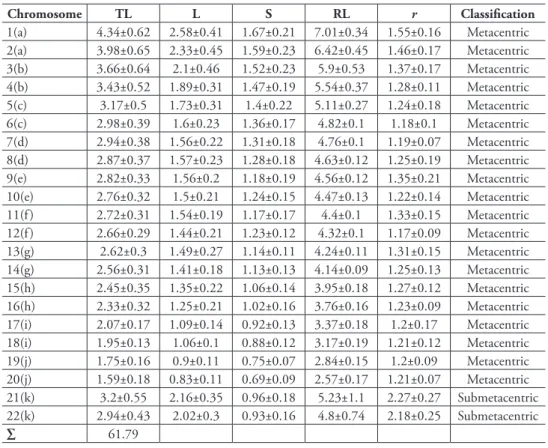
Table 1. Karyomorphometric analyses of the chromosomes of Acromyrmex striatus from ten well-spread metaphases.
Chromosome TL L S RL r Classification
1(a) 4.34±0.62 2.58±0.41 1.67±0.21 7.01±0.34 1.55±0.16 Metacentric 2(a) 3.98±0.65 2.33±0.45 1.59±0.23 6.42±0.45 1.46±0.17 Metacentric 3(b) 3.66±0.64 2.1±0.46 1.52±0.23 5.9±0.53 1.37±0.17 Metacentric 4(b) 3.43±0.52 1.89±0.31 1.47±0.19 5.54±0.37 1.28±0.11 Metacentric 5(c) 3.17±0.5 1.73±0.31 1.4±0.22 5.11±0.27 1.24±0.18 Metacentric 6(c) 2.98±0.39 1.6±0.23 1.36±0.17 4.82±0.1 1.18±0.1 Metacentric 7(d) 2.94±0.38 1.56±0.22 1.31±0.18 4.76±0.1 1.19±0.07 Metacentric 8(d) 2.87±0.37 1.57±0.23 1.28±0.18 4.63±0.12 1.25±0.19 Metacentric 9(e) 2.82±0.33 1.56±0.2 1.18±0.19 4.56±0.12 1.35±0.21 Metacentric 10(e) 2.76±0.32 1.5±0.21 1.24±0.15 4.47±0.13 1.22±0.14 Metacentric 11(f) 2.72±0.31 1.54±0.19 1.17±0.17 4.4±0.1 1.33±0.15 Metacentric 12(f) 2.66±0.29 1.44±0.21 1.23±0.12 4.32±0.1 1.17±0.09 Metacentric 13(g) 2.62±0.3 1.49±0.27 1.14±0.11 4.24±0.11 1.31±0.15 Metacentric 14(g) 2.56±0.31 1.41±0.18 1.13±0.13 4.14±0.09 1.25±0.13 Metacentric 15(h) 2.45±0.35 1.35±0.22 1.06±0.14 3.95±0.18 1.27±0.12 Metacentric 16(h) 2.33±0.32 1.25±0.21 1.02±0.16 3.76±0.16 1.23±0.09 Metacentric 17(i) 2.07±0.17 1.09±0.14 0.92±0.13 3.37±0.18 1.2±0.17 Metacentric 18(i) 1.95±0.13 1.06±0.1 0.88±0.12 3.17±0.19 1.21±0.12 Metacentric 19(j) 1.75±0.16 0.9±0.11 0.75±0.07 2.84±0.15 1.2±0.09 Metacentric 20(j) 1.59±0.18 0.83±0.11 0.69±0.09 2.57±0.17 1.21±0.07 Metacentric 21(k) 3.2±0.55 2.16±0.35 0.96±0.18 5.23±1.1 2.27±0.27 Submetacentric 22(k) 2.94±0.43 2.02±0.3 0.93±0.16 4.8±0.74 2.18±0.25 Submetacentric
∑ 61.79
TL: total length; L: long arm length; S: short arm length; RL: relative length; r: arm ratio (= L/S).
Table 2. Models of molecular evolution by genes and codons implemented in the Bayesian analyses to infer the molecular phylogeny of fungus-growing ants. This tree was the topology inputted in CHROM-EVOL 2.0 to estimate the ancestral chromosome numbers.
Gene (number of base pairs) Position Model
wingless (411bp) 1st – first position K81+G
2nd – second position TIM+I+G 3rd – third position GTR+G
elongation factor-1 alpha F1 (402 bp) 1st – first position TIM+I+G
2nd – second position GTR+G 3rd – third position GTR+G
elongation factor-1 alpha F2 (519 bp) 1st – first position TIM+I+G
2nd – second position GTR+G 3rd – third position HKY+G
long-wavelength rhodopsin (464 bp) 1st – first position SYM+I+G
Figure 1. Metaphase and karyotype of A. striatus and metaphase spreads after FISH with the telomeric probe (TTAGG)6. a Metaphase and karyotype stained with Giemsa b–h Best metaphase spreads stained with DAPI (uniform blue) and the telomeric probes with Cy3-dUTP in red.
An alignment of 1796 base pairs was obtained for the four concatenated nuclear genes comprising 49 sequences of fungus-growing ants, whose species from the gen-era Apterostigma Mayr, 1865, Mycocepurus Forel, 1893 and Mycetarotes Emery, 1913
were placed as outgroups. Nine different substitution models were estimated by PAR-TITIONFINDER2 for each gene codon position (see Table 2 for details on the parti-tion scheme) and were employed in the Bayesian analysis. As expected, all species of the
Acromyrmex and Atta genera formed a well-supported clade that fell as a sister group of
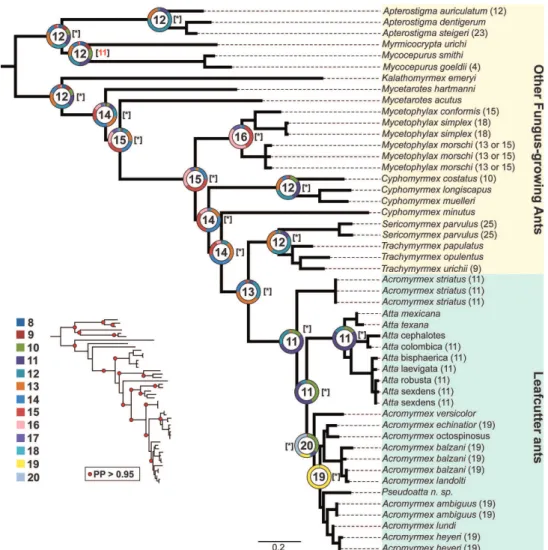
A. striatus. The results obtained in the analysis of chromosome evolution suggested that
Figure 2. Ancestral haploid chromosome state reconstruction inferred under Bayesian Inference and Maximum Likelihood methods. The ancestral chromosome number with the highest probability is given inside the circle and pie charts at the main nodes. The colors on the pie charts represent the proportional probability of each given chromosome number according to the legend. The known karyotypes of species are given at the tip. The haploid ancestral chromosome numbers with the best likelihood are given in brackets. * represent the same estimated haploid number in BI.
Discussion
All individuals of A. striatus from the population evaluated here had chromosome
1988, Cardoso et al. 2014b). No variation in the karyotypic formula was observed and the diploid set was 2K = 20M + 2SM, therefore, the fundamental number that cor-responded to the number of chromosome arms in the diploid karyotype was FN = 44. The (TTAGG)6 probe hybridized to both ends of chromosomes of A. striatus. This reveals the composition of the telomeric portions on chromosomes of the leafcutter ant A. striatus. The presence of the repeat (TTAGG)6 at the telomeres has already been reported in Apidae and Formicidae (Frydrychová et al. 2004) including ants Tapinoma nigerrimum and Myrmecia spp. (Lorite et al. 2002, Meyne et al. 1995). However, the
TTAGG telomere motif was not detected in many other Hymenoptera, suggesting that it may have been lost and only regained in Apidae and Formicidae (Menezes et al. 2017). Nevertheless, the authors do not discard multiple losses along hymenop-teran evolutionary history. Within Formicidae, the TTAGG motif was confirmed by Southern blot hybridization against digested genomic DNA in ant species from the Dolichoderinae, Formicinae, and Myrmicinae subfamilies (Lorite et al. 2002), sug-gesting that the telomeres of ants may be mainly comprised of (TTAGG)n. However, positive signals using the common vertebrate repeat (TTAGGG)n were also detected by Meyne et al. (1995) on the chromosomes of Myrmecia spp. under low stringency (reduced percentage of formamide, less than 50%). Thus, the authors did not reject that both repeats might occur on ant chromosomes (Meyne et al. 1995). In fact, Lorite et al. (2002) emphasize that the main telomere sequence in ants is (TTAGG)n instead of (TTAGGG)n, and that the latter should be present in very low copy number con-sidering the Southern blot hybridization results. Here, we reported for the first time telomeric sequences by FISH in a neotropical leafcutter ant, adding to cytogenetic knowledge on this important insect group, and helping us to identify trends in ant chromosome evolution.
In several species, the presence of interstitial telomeric signals on chromosomes has been observed (Meyne et al. 1990). These have been correlated with chromo-some rearrangements and then used as markers of karyotype evolution and, con-sequently, may be used to evaluate the phylogenetic relationship of species, and even populations (Meyne et al. 1995, Quing et al. 2013). No interstitial telomere sequences were detected on the chromosomes of A. striatus. Thus, it could be sup-posed that the chromosome number observed in this species may represent the an-cestral chromosome number of leafcutter ants. We do not ignore the fact that, due to the limitation of the FISH technique’s resolution, small interstitial telomeric sig-nals originated by chromosomal fusions were not detected. However, the results of the cyto-phylogenetic approach to estimate the ancestral chromosome number have recovered the haploid number of 11 chromosomes in ML and BI (see Figures 2 and Suppl. material 1: Figure S1), in accordance with the previous estimate by Cristiano et al. (2013). This new estimate is based on 20 cytogenetic data values of fungus-growing ants instead of 12. Here, more cytogenetic and molecular data were added. However, a more detailed chromosome evolution hypothesis for fungus-growing ants, instead of just estimating the ancestral karyotype, will be possible when more simultaneous cytogenetic and molecular data are available. Chromosome evolu-tion hypotheses based on cytogenetics coupled with molecular phylogenetic data were already drawn on the fungus-growing ant lineage from the genus Mycetophylax
Emery, 1913, where fusion events were evidenced as having taken place during its karyotype evolution (Cardoso et al. 2014).
Likewise, the ancestral haploid chromosome number of 11 was recovered based on the phylogenomic tree of fungus-growing ants from Branstetter et al. (2017). On this tree, several non-fungus-growing outgroups were included, as well as oth-er fungus-growing ants, but comprising the species included in the matrix of four nuclear genes used in the molecular phylogeny presented here. Together, telomeric FISH analysis of the karyotype of A. striatus and chromosomal reconstruction under
two phylogenetic hypotheses based on independent data reinforce a low chromo-some number as the putative ancestral karyotype for leafcutter ants. In fact, known karyotypes of Trachymyrmex Forel, 1893, the sister group to leafcutter ants, show as few as nine and 10 chromosomes in the haploid chromosome set (Murakami et al. 1998, Barros et al 2013).
Overall, in light of the results reported here, it is important to note that the evolu-tion of the remaining Acromyrmex species, in contrast to the Atta spp. and A. striatus
Acknowledgements
The present study was supported by a research grant to MPC (PPM-00126-15) from the Fundação de Amparo a Pesquisa do Estado de Minas Gerais—FAPEMIG. ACRC was awarded a grant by FAPEMIG in the undergraduate program of initiation in science and TTPP by Coordenação de Pessoal de Nível Superior (CAPES). We thank Natália Travenzo-li, Denilce Menezes Lopes, Jorge Dergam, and many others that made this study possible.
References
Barros LAC (2010) Citogenética de espécies de Attini (Formicidae: Myrmicinae) [Dissertation]. Pro-grama de Pós-graduação em Genética e Melhoramento. Viçosa: Universidade Federal de Viçosa. Barros LAC, de Aguiar H, Mariano CDF, Andrade-Souza V, Costa MA, Delabie JHC, Pompo-lo SD (2016) Cytogenetic data on six leafcutter ants of the genus Acromyrmex Mayr, 1865 (Hymenoptera, Formicidae, Myrmicinae): insights into chromosome evolution and taxo-nomic implications. Comparative Cytogenetics 10(2): 229–243. https://doi.org/10.3897/ CompCytogen.v10i2.7612
Barros LAC, de Aguiar H, Mariano CDF, Delabie JHC, Pompolo SD (2013) Cytogenetic char-acterization of the ant Trachymyrmex fuscus Emery, 1934 (Formicidae: Myrmicinae: Attini) with the description of a chromosomal polymorphism. Annales de la Societe Entomologique de France 49(4): 367–373. http://dx.doi.org/10.1080/00379271.2013.856201
Barros LAC, de Aguiar H, Teixeira GA, Mariano CDF, Teixeira MD, Delabie JHC, Pompolo SD (2015) Cytogenetic data on the threatened leafcutter ant Atta robusta Borgmeier, 1939 (Formicidae: Myrmicinae: Attini). Comptes Rendus Biologies 338(10): 660–665. https:// doi.org/10.1016/j.crvi.2015.07.006
Bitencourt JA, Sampaio I, Ramos RTC, Affonso P (2014) Chromosomal fusion in Brazilian populations of Trinectes inscriptus Gosse, 1851 (Pleuronectiformes; Achiridae) as revealed by internal telomere sequences (ITS). Journal of Experimental Marine Biology and Ecol-ogy 452: 101–104. https://doi.org/10.1016/j.jembe.2013.12.012
Bolton B (2017) AntWeb: Ants of All AntWeb. https://www.antweb.org [Accessed 30 Sep-tember 2017]
Branstetter MG, Jesovnik A, Sosa-Calvo J, Lloyd MW, Faircloth BC, Brady SG, Schultz TR (2017) Dry habitats were crucibles of domestication in the evolution of agriculture in ants. Proceedings of the Royal Society B-Biological Sciences 284(1852): 10. https://doi. org/10.1098/rspb.2017.0095
Cardoso DC, Cristiano MP, Barros LAC, Lopes DM, Pompolo SD (2012) First cytogenetic characterization of a species of the arboreal ant genus Azteca Forel, 1978 (Dolichoderinae, Formicidae). Comparative Cytogenetics 6(2): 107–114. http://doi.org/10.3897/Comp-Cytogen.v6i2.2397
reflected in molecular data. Molecular Phylogenetics and Evolution 70: 378–382. https:// doi.org/10.1016/j.ympev.2013.10.012
Cardoso DC, Cristiano MP, Tavares MG (2011) Methodological remarks on rearing basal Atti-ni ants in the laboratory for biological and evolutionary studies: overview of the genus My-cetophylax. Insectes Sociaux 58(3): 427–430. https://doi.org/10.1007/s00040-011-0160-3 Cardoso DC, Pompolo SD, Cristiano MP, Tavares MG (2014b) The role of fusion in ant chromo-some evolution: insights from cytogenetic analysis using a molecular phylogenetic approach in the genus Mycetophylax. PloS ONE 9(1): e87473. https://doi.org/10.1371/journal.pone.0087473 Cioffi MB, Kejnovsky E, Bertollo LAC (2011) The chromosomal distribution of microsatellite
repeats in the genome of the wolf fish Hoplias malabaricus, focusing on the sex chromosomes. Cytogenetic and Genome Research 132(4): 289–296. https://doi.org/10.1159/000322058 Cristiano MP, Cardoso DC, Fernandes-Salomao TM (2013) Cytogenetic and molecular analyses
reveal a divergence between Acromyrmex striatus (Roger, 1863) and other congeneric species: taxonomic implications. PloS ONE 8(3): 9. https://doi.org/10.1371/journal.pone.0059784 Cristiano MP, Pereira TTP, Simões LP, Sandoval-Gómez VE, Cardoso DC. (2017) Reassessing
the chromosome number and morphology of the turtle ant Cephalotes pusillus (Klug, 1824) using karyomorphometrical analysis and observations of new nesting behavior. Insects 8: 114. https:// doi.org/10.3390/insects8040114
Frydrychová R, Grossmann P, Trubac P, Vitkova M, Marec FE (2004) Phylogenetic distri-bution of TTAGG telomeric repeats in insects. Genome 47(1): 163–178. https://doi. org/10.1139/g03-100
Glick L, Mayrose I (2014) ChromEvol: Assessing the pattern of chromosome number evolu-tion and the inference of polyploidy along a phylogeny. Molecular Biology and Evoluevolu-tion 31(7): 1914–1922. https://doi.org/10.1093/molbev/msu122
Gokhman VE, Anokhin BA, Kuznetsova VG (2014) Distribution of 18S rDNA sites and ab-sence of the canonical TTAGG insect telomeric repeat in parasitoid Hymenoptera. Ge-netica 142(4): 317–322. https://doi.org/10.1007/s10709-014-9776-3
Imai HT, Taylor RW, Crosland MW, Crozier RH (1988) Modes of spontaneous chromosomal mutation and karyotype evolution in ants with reference to the minimum interaction hy-pothesis Japanese journal of genetics 63(2):159–185. http://doi.org/10.1266/jjg.63.159 Kumar S, Stecher G, Tamura K (2016) MEGA7: Molecular Evolutionary Genetics
Analy-sis version 7.0 for bigger datasets. Molecular Biology and Evolution 33(7): 1870–1874. https://doi.org/10.1093/molbev/msw054
Lanfear R, Calcott B, Kainer D, Mayer C, Stamatakis A (2014) Selecting optimal partition-ing schemes for phylogenomic datasets. BMC Evolutionary Biology 14: 14. https://doi. org/10.1186/1471-2148-14-82
Lanfear R, Frandsen PB, Wright AM, Senfeld T, Calcott B (2017) PartitionFinder 2: New methods for selecting partitioned models of evolution for molecular and morphological phylogenetic analyses. Molecular Biology and Evolution 34(3): 772–773. https://doi. org/10.1093/molbev/msw260
Lysak MA, Schubert I (2013) Mechanisms of chromosome rearrangements. In: Greilhuber J, Dolezel J, Wendel JF (Eds) Plant genome diversity volume 2: Physical structure, be-haviour and evolution of plant genomes. Springer, Vienna. 2(1)137–147. https://doi. org/10.1007/978-3-7091-1160-4_9
Mayrose I, Barker MS, Otto SP (2010) Probabilistic models of chromosome number evo-lution and the inference of polyploidy. Systematic Biology 59(2): 132–144. https://doi. org/10.1093/sysbio/syp083
Menezes RST, Silva TM, Carvalho AF, Andrade-Souza V, Silva JG, Costa MA (2013) Numeri-cal and structural chromosome variation in the swarm-founding wasp Metapolybia deco-rata Gribodo 1896 (Hymenoptera, Vespidae). Genetica 141(7/9): 273–280. https://doi. org/10.1007/s10709-013-9726-5
Menezes RST, Bardella VB, Cabral-de-Mello DC, Lucena DAA, Almeida EAB (2017) Are the TTAGG and TTAGGG telomeric repeats phylogenetically conserved in aculeate Hyme-noptera? The Science of Nature 104: 85. https://doi.org/10.1007/s00114-017-1507-z Meyne J, Baker RJ, Hobart HH, Hsu TC, Ryder OA, Ward OG, Wiley JE, Wursterhill DH,
Yates TL, Moyzis RK (1990) Distribution of nontelomeric sites of the (TTAGGG)n telomeric sequence in vertebrate chromosomes. Chromosoma 99(1): 3–10. https://doi. org/10.1007/BF01737283
Meyne J, Hirai H, Imai HT (1995) FISH analysis of the telomere sequences of bulldog ants (Myrmecia, Formicidae). Chromosoma 104: 14–18.
Murakami T, Fujiwara A, Yoshida MC (1998) Cytogenetics of ten ant species of the tribe Attini (Hymenoptera, Formicidae) in Barro Colorado Island, Panama: 135–139. Chromosome Science 2: 135–139.
Qing LY, Xia Y, Zheng YC, Zeng XM (2013) FISH of 5S rDNA and telomeric (TTAGGG)n repeats in normal and translocated populations of the frog Quasipaa boulengeri (Anura, Ranidae). Chi-nese Science Bulletin 58(18): 2168–2173. https://doi.org/10.1007/s11434-013-5690-9 Rambaut A, Drummond AJ (2007) Tracer v1.4. http://tree.bio.ed.ac.uk/software/tracer
[Accessed 25 November 2017]
Rambaut AJ (2009) Figtree v1.3.1. http://tree.bio.ed.ac.uk/software/figtree/ [Accessed 25 No-vember 2017]
Ronquist F, Huelsenbeck JP (2003) MrBayes 3: Bayesian phylogenetic inference under mixed models. Bioinformatics 19(12): 1572–1574. https://doi.org/10.1093/bioinformatics/btg180 Schultz TR, Brady SG (2008) Major evolutionary transitions in ant agriculture.
Proceed-ings of the National Academy of Sciences of the USA 105(14): 5435–5440. https://doi. org/10.1073/pnas.0711024105
Šíchová J, Ohno M, Dinca V, Watanabe M, Sahara K, Marec F (2016) Fissions, fusions, and translocations shaped the karyotype and multiple sex chromosome constitution of the northeast-Asian wood white butterfly, Leptidea amurensis. Biological Journal of the Lin-nean Society 118(3): 457–471. https://doi.org/10.1111/bij.12756
Supplementary material 1
Figure S1. Phylogenomic tree used to estimate the ancestral chromosome number.
Authors: Tássia Tatiane Pontes Pereira, Ana Caroline Coelho Corrêa dos Reis, Danon Clemes Cardoso, Maykon Passos Cristiano
Data type: species data
Explanation note: Numbers at nodes represent the first and second most likely haploid chromosome number followed by posterior support values under Bayesian optimi-zation and the ancestral haploid chromosome number with best likelihood under maximum likelihood optimization, as follows: [first haploid state (P.P.%)// second haploid state (P.P.%)// ML haploid state].
Copyright notice: This dataset is made available under the Open Database License
(http://opendatacommons.org/licenses/odbl/1.0/). The Open Database License
(ODbL) is a license agreement intended to allow users to freely share, modify, and use this Dataset while maintaining this same freedom for others, provided that the original source and author(s) are credited.