Vol.52, n. 3: pp. 689-699, May-June 2009
ISSN 1516-8913 Printed in Brazil BRAZILIAN ARCHIVES OF
BIOLOGY AND TECHNOLOGY
A N I N T E R N A T I O N A L J O U R N A L
Thermal and Spectroscopic Analyses on the Molecular
Interaction Between Eucalyptus Kraft Pulp Components
and Offset Printing Inks
Ericka Figueiredo Alves
1*, Rubens Chaves de Oliveira
2, Luis Henrique Mendes da Silva
3and Jorge Luiz Colodette
41Department of Paper and Bioprocess Engineerin; SUNY-College of Environmental Science and Forestry
; 413;
Walters Hal; 1 Forestry Drive, 13210; Syracuse – NY - USA.2,4Laboratórios de Celulose e Papel;Departamento de
Engenharia Florestal; Universidade Federal de Viçosa, 36570-000; Viçosa - MG - Brasil. 3Departamento de
Química; Universidade Federal de Viçosa; 36570-000; Viçosa - MG - Brasil
ABSTRACT
Thermal and infrared spectroscopic analyzes were carried out in order to study the kind of interaction between the anatomical components of the bleached eucalyptus kraft pulp with offset inks. A Bauer-McNett fiber classifier was used in order to obtain the anatomical components of the pulp, separately. The determinations of the enthalpy of the processes occurring in the samples of inks and pulp, as well as the enthalpy of these components interactions were obtained by Differential Scanning Calorimetry. In the interaction between pulp and offset ink, the reduced enthalpy values of the endothermic peak were interpreted as due to the released energy for adhesion of the ink pigment to the
substratum. The low enthalpy value, 58 to 121 cal.g-,1 indicated that the settling of the ink occurs by physical
interactions. The pulp fraction enriched with vessel elements caused a higher energy release during the adherence of the pigment into the pulp.
Key words: differential scanning calorimetry, thermogravimetry, kraft pulping, cellulose, interaction, and
eucalyptus sp.
*
Author for correspondence: [email protected]
INTRODUCTION
The pulps proceeding from the tropical forest species (Ramos, 2000) may cause problems in the papermaking process, because of the structure of their chemical and anatomical components, a well-known fact in the graphic and papermaking medium. Some problems such as the vessel picking might occur during the printing process. The vessel picking is related to a phenomenon in
which some vessel elements found on the surface
of the paper rather tend to be removed throughthe
process of adhesion with the printing ink, thus
creating some defective points on the printed
surface (Ohsawa, 1988).
The vesselelements are shown under shapes forms
that vary according the species and the widest and shortest shapes are the ones causing problems during the offset printing process of both coated
surface are visibly noticed for presenting a higher shine, when exposed towards the light. In certain printed materials, one may observe that the
printing faultsare much more pronounced in some
colors than in other ones (Colley et al., 1986). Some authors have mentioned that these faults may could be due to the differentiated interaction of the pulp components, fibers, and vessel
elements with the printinginks.
One follow-up accomplished in the industry is to measure the dimensions of the vessel elements (length-L and width-D) and the percent rate of
fibers and vessel elements. The companies’
genetic improvement program has been searching for a high width/length relationship and low fiber/vessel rate, in order to minimize the printing problems of the eucalyptus papers. Another
method used in reducing the picking is the
increased refine degree of the pulp for papermaking (Heintze and Shallhorn, 1995). In the graphic industry, the printing techniques require a careful control on the interaction of the
ink components with the printing system and the
paper. In the development of the printing inks It is necessary to take several factors into account such as the adhesion work among their components and the plate, blanket, dampening water and the paper. There is a scarce knowledge on those interactions, although several observations have shown their
importance. One way to obtaining better quality in the printed paper is getting better adhesion between the ink and paper, by determining the thermodynamic parameters involved in the process. Thus, the reactions or the phase changing process with enthalpies depending on the temperature might be followed by DSC.
In this study, thermal and spectroscopy analyses were carried out in order to determine the
interaction betweenthe anatomical components of
the bleached eucalyptus kraft pulp of with the
offset printing inks.
MATERIAL AND METHODS
The industrial Kraft pulp of Eucalyptus spp was
bleachedby ECF technology, proceeding from the
industrial unit Suzano Papel e Celulose - Mucuri-BA.
The offset inks were supplied by the company Lorigraf JF Tintas Especiais Ltda located in Juiz de Fora county, MG. For this experiment, the manufacturer prepared three europa-blue colored inks with similar chemical composition (Table 1) and three ranges: low Tack- 120 to 160 g.m.;
medium Tack - 161 to 200 g.m. and high Tack -
201 to 250 g.m.
Table 1 - Composition of the used offset inks.
Composite Type
Resins phenolic, alkydic and hydrocarbonic
Vegetal oil soybean, linseed,and alky-refined
Mineral oil deodorized aliphatic
Pigment organic
Others modifiers, waxes, antioxidants, drier agents
Pulp classification in Bauer-McNett
In order to separate the anatomical elements found
in the bleached pulp, the fiber classifier
Bauer-McNett provided with a system of sieves with 20, 48, 100 and 200 mesh that was able to separate fiber samples into fractions or groups was used. A pulp sample equivalent to 10g o.d. (over dry) was weighed and quantitatively transferred at 4% consistence to a laboratory hydrapulper. After desagregation at 30,000 rpm, the water-suspended
pulp was introduced into the highest tank of the
classifier, from which it fed by gravity the four inferior classification tanks for a 15 min period. After classification, the fractions retained in those
four qualifying sieves of the tanks were discharged
into centrifuge until reachinga consistence around
40%, in order to determine the fiber/vessel rate.
The fiber/vessel rate of the pulp
After classification of the pulp in Bauer-McNett,
an amount of 10g o. d. pulp from each fraction
second one into 0.0025%. The dilutions were accomplished by agitation. An amount of 250 mL from each fractional sample were collected under
constant homogenization, and the paper sheet was
formed in a Tappi former. The hand sheet was
dried at 105 ± 3 oC for 20 minutes. After drying,
four distinct areas of the sheet were sampled with transparent adhesive tape and allocated on
microscope glass platein order to be quantified in
computerized microscopy system. Eight glass plates from each fractional sample were
quantified, by counting of 1,500 fibers by plate
and the respective amount of the vessel elements
present in this quantification.
In order to standardizing the nomenclature of the
fractions of the classified pulps used in the
subsequent stages, these fractions were named in relation to the analysis of the fiber/vessel rate, therefore being classified into low, medium and high pulps for the fiber/vessel rate.
Chemical and physical characteristics of the pulp
The characterization of the pulp was carried out in
triplicate, by evaluating the fibers count/grams
(million), average length of the fibrous material (mm), average diameter of the fibrous material (mm), coarseness (mg/100g), fines (%) of the pulp. The pulp suspensions were prepared in
distilled water, at 0.001% consistency and
dispersant (2.0% pulp base) was added to them. The analysis was accomplished by using the image analyzer (GALAI CIS-100) with its respective software Wshape. For calculation of the percent fine occurrences, the dimensions equal or lower than 0.07 mm were considered. The air resistance
(s/100cm3 air) was carried out according to the
norm TAPPI T536 om-96, whereas the
carbohydrate analyses followed the norm TAPPI T249 cm-00 modified.
Analyses by Differential Scanning Calorimetry (DSC) and Thermogravimetry (TGA)
In these analyses, a hand sheet made in a laboratorial former according to Tappi T205 sp-95 was used.
For the determination of the thermodynamic parameters, three types of pulp samples (low, medium and high fiber/vessel rate) were taken, by using a perforator with a diameter around 6.4 mm, resulting into 4.5 ± 0.2 mg weight for each sample. For inks with low, medium, and high tack, 9 ± 0.2
mg were used. Finally, for determining the thermodynamic parameters of the interaction between pulp and ink, an amount of 5.3 ± 0.2 mg of each ink were manually added to each pulp sample. The samples were transferred to a stainless steel crucibles that it was sealed at 2-tons pressure for 1 minute. The DSC curves were obtained in a Differential Scanning Calorimeter SHIMADZU DSC-50, under nitrogen atmosphere at a constant flow rate of 50 ml/min. The variation of the temperature from 25 ºC up to 500 ºC was performed, by adopting three heating rates of 10, 15, and 20 °C/min for the inks as well as 15, 20 and 25 °C/min either for pulps and the interaction between pulps and inks. The kinetic parameters (activation energy and reaction order) were calculated, by using Ozawa’s kinetic model available in the program contained in the proper device. For obtaining the enthalpy of the endothermic and exothermic peaks, the heating rate of 15 °C/min was used for the inks, pulps and the interaction between pulps and inks. The
equipment was previously calibrated for
temperature using a standard melting point of indium (156.4 °C), 99.99% pure, and the energy calibration was done by using of the enthalpy of
melting point ( H = 28,5 J g-1) of this same metal.
The TGA curves were obtained through the device SHIMADZU model TGA-50, under nitrogen
atmosphere at a constant flow rate of 30 ml/min A
sample of 6 ± 2 mg inks withlow, medium and high tack, as well as 4 ± 2 mg of the pulps with low, medium, and high fiber/vessel rate were taken. The scanning was performed at heating rate of 15 °C/min at the temperature range from 25 ºC to 500 ºC.
Analyses by infrared spectroscopy (FT-IR)
The FT-IR spectra were obtained in a
spectrophotometer Perkin Elmer FT-IR 1000 by the diffuse reflectance method for investigating a representative sample of the offset inks. The offset ink samples were placed in a crucible, sent to a muffle furnace in at heating rate of 15 °C/min at the temperature range from 25 to 500 ºC. Then, at 200, 400 and 500 °C the muffle furnace was opened and samples were taken.
The FT-IR spectrum of the inks at room
temperature, 200, 400 and 500 °C were measured
by preparing a thin ink layer under a cesium Iodide cell (CsI). All spectra were measured at 4000-500
RESULTS AND DISCUSSION
The Differential Scanning Calorimetry analysis
(DSC)
Results of the offset ink samples
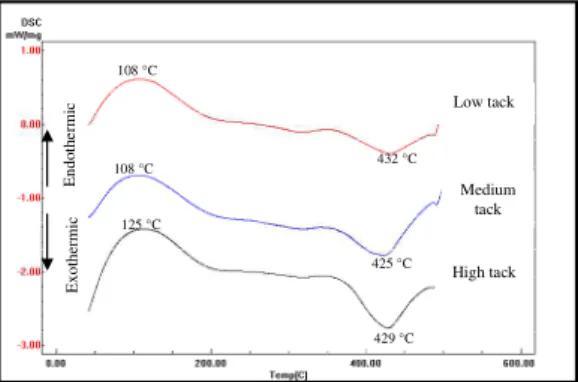
The thermograms obtained from DSC of the offset ink samples at the heating rate of 15 °C/min, from 25 to 500 ºC are presented in Figure 1. The peak areas under the obtained curves are the enthalpy
(cal.g-1) involved into thermodynamic processes
that occur at each temperature range. The thermograms of the ink samples showed an endothermic phenomenon (ascendant peak) with the maximum peak temperature ranging from 108 to 116 °C, following an exothermic phenomenon (descending peak) from 425 to 432 °C.
To assign a molecular interpretation to each peak of DSC, it was necessary to accomplish the infrared spectrum analyses of a sample that would
be representative for offset ink and its respective
pigment isolated at room temperatures, 200, 400
and 500 °C. Figure 2 shows a typical spectrum of
the ink at different temperatures. The ink spectrum at room temperature (Fig. 2) showed the presence of bands corresponding to the oils that constituted one of their main components. This spectrum presented the same characteristic bands found by Blayo et al. (2001), who studied the oils from linseed, soybean, and rape.
Figure 2 showed that the offset blue ink probably
contained the copper pigments so-called
phthalocyanine with typical absorption bands in the infrared at 2936, 2870, 1607, 1505, 1460, 1419, 1375, 1334, 1288, 1166, 1120, 1091, 998,
900, 786, 778, 726, 571 and 506 cm-1 (Havlínová
et al., 2002; Newman, 1979). Newman (1979) reported that the phthalocyanines showed very
distinct spectrum (particularly near 1700 cm-1) in
the medium infrared region, as containing well defined narrow bands due to the stretching system of the aromatic ring carbon-carbon bonds, as well as hydrogen-carbon bonds of the rings at the plane and outside the plane.
E
x
o
th
er
m
ic
E
n
d
o
th
e
rm
ic
108 °C
108 °C
125 °C
432 °C
425 °C
429 °C
Low tack
Medium tack
High tack
Figure 1 - DSC curvesof the offset inks.
Room temperature
200°C
400°C
500°C
4000 3500 3000 2500 2000 1500 1000 500 0
20 40 60 80 100 120
T
ra
n
sm
it
ta
n
ce
Wave length (cm-1)
The infrared spectra of the offset ink showed that no alteration occurred at the temperature range corresponding to the interval from 25 to 200 ºC, relative to the structural relationship of its components, indicating no chemical reactions to occur there. Thus, it could be concluded that the endothermic peak observed in the DSC analyses of the inks was due to evaporation of the solvent. The enthalpy values found in the endothermic peaks for both low-tack and medium-tack inks were
53.05 ± 2.0 cal.g-1, respectively, therefore
indicating a similar solvent content in both inks. On the contrary, the high-tack ink that probably contained a higher solvent content, showed a
higher enthalpy value (88.86 ± 2.0 cal.g-1).
As observed in the infrared spectroscopy analyses (Fig. 2), from 400 °C some modifications began in the profile of the ink spectrum, whereas at 500 °C, a great degradation of some parts of the ink components occurred due to the disappearance of the bands corresponding to the oils and resins. Therefore, it could be inferred that the exothermic peak observed in the ink DSC analyses (Fig. 1) was due to the total degradation of their component parts, such as the oils and resins, and partially of the pigment. For the values of the exothermic peak enthalpy, as there occurred an increased ink tack (Table 2), the enthalpy values also increased, therefore, suggesting a gradual increase in the content of the solid components such as resins and pigments.
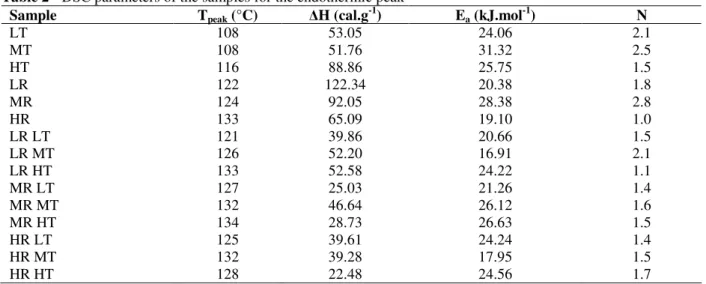
Table 2 - DSC parameters of the samples for the endothermic peak
Sample Tpeak (°C) H (cal.g
-1
) Ea (kJ.mol
-1
) N
LT 108 53.05 24.06 2.1
MT 108 51.76 31.32 2.5
HT 116 88.86 25.75 1.5
LR 122 122.34 20.38 1.8
MR 124 92.05 28.38 2.8
HR 133 65.09 19.10 1.0
LR LT 121 39.86 20.66 1.5
LR MT 126 52.20 16.91 2.1
LR HT 133 52.58 24.22 1.1
MR LT 127 25.03 21.26 1.4
MR MT 132 46.64 26.12 1.6
MR HT 134 28.73 26.63 1.5
HR LT 125 39.61 24.24 1.4
HR MT 132 39.28 17.95 1.5
HR HT 128 22.48 24.56 1.7
T = peak temperature; ∆H = enthalpy; Ea = activation energy; N = reaction order.
Where: LT = low tack ink; MT = medium tack ink; HT = high tack ink; LR = low fiber/vessel rate pulp; MR = average fiber/vessel rate pulp; and HR = high fiber/vessel rate pulp.
Results of the pulp samples
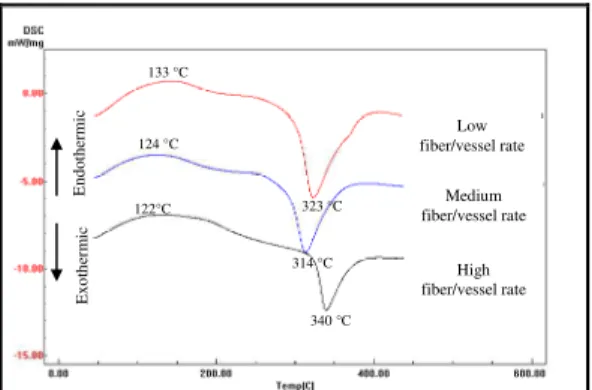
Figure 3 shows the thermograms obtained from
DSC of the pulp samples at the heating rate of 15
°C/min, from 25 up to 500 ºC. The presence of two different phenomena for those three pulp samples under study was observed. The endothermic
phenomenon occurred at the maximum
temperature range from 122 to 133 °C, and the exothermic from 314 to 340 °C. Liu et al. (2004) evaluated the pyrolysis of wood derivatives by
thermogravimetry associated with mass
spectrometry. The first detected peak appeared at the temperature range from 80 to 220 ºC, with
maximum peak at 125 °C that was due to the
133 °C
124 °C
122°C 323 °C
314 °C
340 °C
Low fiber/vessel rate
Medium fiber/vessel rate
High fiber/vessel rate
E
x
o
th
er
m
ic
E
n
d
o
th
er
m
ic
Figure 3 - DSC curves of the pulp samples.
An endothermic phenomenon was observed in the pulp samples at the temperature range of 25 to 200 °C. The enthalpy values for the endothermic phenomenon of the samples with low, medium,
and high fiber/vessel rate were: 122.34, 92.05 and
65.09 cal.g-1, respectively. It is known that this
endothermic phenomenon is due to water desorption (Liu et al., 2004). Despite all samples
tested with the same moisture content (6%) a
higher energy was needed for desorption of water molecules on the pulp with low fiber/vessel rate. In order to explain this difference in the consumption of energy, the pulp samples under the form of handsheets were submitted to the air-resistance test, as described in the item ‘materials and methods’. This test constitutes a measure
related to the porosity of the paper. The following
values were found for the pulp with low and high
fiber/vessel rate: 4.05s and 0.97 s/100cm3 air,
respectively. Based on this result, one could infer that as higher was the resistance to the passage of air, the higher would be the necessary energy to occur the evaporation of the water molecules kept in the pulp structure during the heating process,
when analyzing DSC. This behavior is probably
explained due to the highest contents of fines
found inthe pulp with low fiber/vessel rate, which
supply a higher superficial area for the adsorption of the water molecules.
In addition, an exothermic phenomenon was found
in pulp samples which was due to
depolymerization of glucose units (Liu et al., 2004) The enthalpy values found in the exothermic phenomenon for the samples of low, medium, and high fiber/vessel rate were: -125.2; -118; and –
108.6 cal.g-1, respectively. Although the pulp
samples with low and high rate have basically presented the same polymerization degree, which
was shown by the proximity of the values for their viscosities (15.2 and 16.0 cP, respectively), it was observed that the energy released during the depolymerization of the cellulose chains were different among the pulps.
The results from the technological characterization of the pulps showed that the samples with high fiber/vessel rate presented higher values for the
average length of the fibrous material (0.84 mm),
coarseness (4.8 mg/100m) and fine contents (4.98%), when compared to the pulp with low fiber/vessel rate that presented average length of the fibrous material (0.49 mm), coarseness (2.2 mg/100m) and fine contents (13.44%). This caused the formation of more porous handsheets
and the pulp with high fiber/vessel rate probably
leading to a higher accessibility for breaking of the
glycosidic bonds of the chains, therefore
generating a lower release of energy (exothermal reaction) during the chemical linkage breaking process.
Results from the pulp and ink interaction According to Hartus (1999), the interactions between inks and fibers in the DSC analysis can be detected by changes in the consumption of energy and/or in peak temperature corresponding to a determined thermal transition. One could observe in the interaction between pulps and inks (Fig. 4) that both the endothermic and exothermic phenomena were presented (Fig. 3). For the
endothermic phenomenon, the maximum
temperature range from 120 to 134 °C was observed.
pulp and ink for all samples were always lower, compared with the values found in the pulp samples.
Aiming at the investigation of the causes of the
decreased enthalpy, the thermogravimetric
analysis was carried out in order to evaluate the
amount of matter that participates into each
endothermic and exothermic transition.
121 °C
120 °C
133°C
318 °C 314 °C
340 °C
Low fiber/vessel rate pulp with ink
Low tack
Medium tack
High tack
E
x
o
th
er
m
ic
E
n
d
o
th
er
m
ic
127 °C
132 °C
134°C
319 °C
313 °C
314 °C
Medium fiber/vessel rate pulp with ink
Low tack
Medium tack
High tack
E
x
o
th
er
m
ic
E
n
d
o
th
er
m
ic
a b
127 °C
132 °C
134°C
316 °C
323 °C
314 °C
High fiber/vessel rate pulp with ink
Low tack
Medium tack
High tack
E
x
o
th
er
m
ic
E
n
d
o
th
er
m
ic
c
Figure 4 - Thermograms of the interaction between pulp and offset ink obtained from DSC. a) Low fiber/vessel rate pulp and inks; b) Mediumfiber/vessel rate pulp and inks; and c) High fiber/vesselrate pulp and inks.
Thermogravimetry analyses (TGA)
According to Hartus (1999), the interactions among ink and the fiber components in TGA will
occur with changes in weight loss at determined
temperature range, changes in the weight loss rate taxes, or changes in temperature corresponding to the highest rate of mass loss.
In the thermograms obtained from the interaction between pulp samples and inks, an initial weight loss was observed at the range from 25 to 200 °C, which corresponded to the sum of the water evaporation molecules of the pulp samples and the
ink solvent molecules, as well as a higher weight loss as those found in the analyses accomplished in DSC at the range from 300 to 500 ºC, which
corresponded to degradation of eitherthe cellulose
chains andink components.
Low fiber/vessel rate plus ink
0 1 2
Low tack Medium tack High tack
W
e
ig
h
t
lo
s
s
,
m
g
Weight loss foreseen (mg) Weight loss obtained (mg)
Medium fiber/vessel rate plus ink
0 1 2
Low tack Medium tack High tack
W
e
ig
h
t
lo
s
s
,
m
g
Weight loss foreseen (mg) Weight loss obtained (mg)
a b
High fiber/vessel rate plus ink
0 1 2
Low tack Medium tack High tack
W
e
ig
h
t
lo
s
s
,
mg
Weight loss foreseen (mg) Weight loss obtained (mg)
c
Figure 5 - Results of the weight loss obtained from TGA of the interaction between pulp and offset ink. a) Low fiber/vesselrate pulp and inks; b) Medium fiber/vessel rate pulp and inks; and c) High fiber/vessel rate pulp and inks.
It was observed that the amount of both water and solvent molecules evaporated in the interaction were superior to the foreseen amount, for all samples under study. Based on these results, one could infer that the decreased enthalpy values of the endothermic peak in the DSC analysis were not due to a decreased matter in the pulp and/or ink samples. Thus, this decreased energy could only be attributed to the released energy (exothermal process) during absorption of the ink pigment to the surface of the pulp.
Interaction between fibers and vessel
elements with offset printing inks
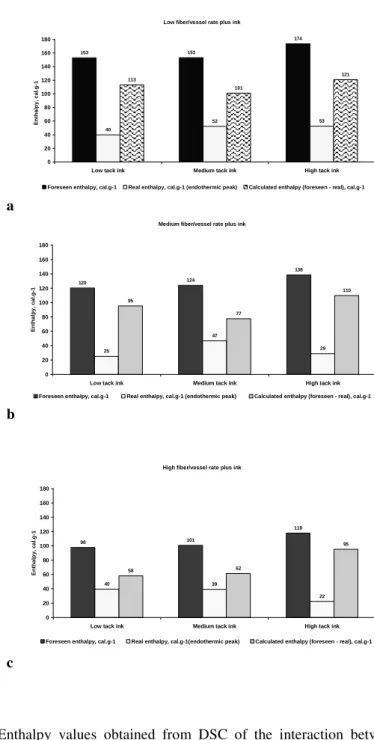
The enthalpy values (cal.g-1) foreseen for the
endothermic phenomenon in the interaction of pulps and inks corresponded to the sum of water molecule evaporations in the pulp substratum plus the ink solvent molecules. The real values obtained by Differential Scanning Calorimetry (DSC) for this phenomenon and the difference found between the foreseen enthalpy and the real
enthalpy for all samples are represented in Figure 6.
The enthalpy values obtained by adhesion of the ink pigments on the pulps ranged from 58.1 to
121.0 cal.g-1 (Table 3). According to the enthalpy
values, it could be inferred that this adhesion did
not occur by covalent bonds, where the energy
from 4000 to 5000 cal.g-1 was needed, but it
probably occurred through physical adsorption
(hydrogen bonds, van der Waals forces,
electrostatic attraction) and penetration of the ink pigment molecules through the capillaries of the fibers.
Johansson et al. (1989) studied the way the alkyd resins were kept on the surface of cellulose. They concluded that chemical interactions could occur
between the carboxylic acid groups in the alkyd
resins and the reactive sites of the cellulose surface. The resin adhered to the surface of the
fibers by an exothermal phenomenon (∆H: -9.4
kJ.mol-1) determined by intermolecular
In Table 3, one could observe that as smaller the fiber/vessel rate pulp the higher would be the
content of vessel elements in the fraction, as well
as there would be a tendency for increasing the
energy released for adhesion of the pigment into
substratum for all ink samples. Thus, those enthalpy differences between the fractions with higher contents of vessel elements and higher fiber contents could be due to both chemical and physical nature of the samples.
Low fiber/vessel rate plus ink
153 153
174
40
52 53
113
101
121
0 20 40 60 80 100 120 140 160 180
Low tack ink Medium tack ink High tack ink
E
n
th
a
lp
y
,
c
a
l.
g
-1
Foreseen enthalpy, cal.g-1 Real enthalpy, cal.g-1 (endothermic peak) Calculated enthalpy (foreseen - real), cal.g-1
a
Medium fiber/vessel rate plus ink
120 124
138
25
47
29 95
77
110
0 20 40 60 80 100 120 140 160 180
Low tack ink Medium tack ink High tack ink
E
n
th
a
lp
y
,
c
a
l.
g
-1
Foreseen enthalpy, cal.g-1 Real enthalpy, cal.g-1 (endothermic peak) Calculated enthalpy (foreseen - real), cal.g-1
b
High fiber/vessel rate plus ink
98 101
118
40 39
22
58 62
95
0 20 40 60 80 100 120 140 160 180
Low tack ink Medium tack ink High tack ink
E
n
th
a
lp
y
,
c
a
l.
g
-1
Foreseen enthalpy, cal.g-1 Real enthalpy, cal.g-1(endothermic peak) Calculated enthalpy (foreseen - real), cal.g-1 c
c
Table 3 - Enthalpy values obtained from DSC in the interaction of the ink samples with the samples of low, medium and high fiber/vessel rate
Enthalpy, cal.g-1
Fiber/vessel rate Low tack ink Medium tack ink High tack ink
Low 113.1 101.7 121.0
Medium 95.2 77.4 109.7
High 58.1 61.5 95.2
The carbohydrate analyses in the low fiber/vessel rate sample showed higher content of xylan (14.4%) and lower glucans (77.6%), whereas in the sample with high fiber/vessel rate showed
lower xylan contents (13.8%) and higher glucans
(81.4%). It is well-known that xylans are the main hemicelluloses in hardwood (Medeiros, 2007). For
each 10 xylose units, these hardwoodspresented 7
units of acetyl groups as well as from 1 to 2 units of 4-0-metylglucuronic acid (Sjöström, 1993). Cellulose that is the main carbohydrate found in the wood, presents the alcoholic and hemiacetalic groups and carboxylic groups as functional ones. It is known that reactivity of the hemicelluloses is higher than the cellulose due to both chemical and
physical differences of these components.
Concerning the chemical characteristic, the hemicelluloses present a higher number of functional groups, such as acetyl, carboxyl, and methoxyl, as well as their monomers are less stable for presenting five-carbon rings, besides having a lower molecular weight, which leads to a lower stability of the molecule. Concerning the physical characteristic, they are shown under ramified chains and consequently amorphous, therefore leading to a higher accessibility within their chain.
Thus, it could be inferred that the highest content
of hemicelluloses in the sample enriched with vessel elements might have increased the reactivity of the substratum, since they presented higher number of possible reaction sites, besides leading a higher accessibility to these reactive
groups due to the presence of the ramified chains.
On the contrary, the fiber-enriched sample (higher fiber/vessel rate) presented higher glucan contents that showed more crystalline chains as well as a lower amount of reactive sites for adhesion of the
ink pigment. The vessel elements also presenteda
highly different anatomical characteristic
compared to the fibers since, their diameters were
much larger than those fibers (Burger and
Richter, 1991) The most common shape to the
eucalyptus wood is popularly called as barrel wooden shape that is shorter and broader cells The studies concerning the separation of the non-fibrous components in oak wood accomplished by Klungness and Sanyer (1981) showed that the specific surface of the vessel elements was almost 50% higher than that of the fibers, and the specific volume twice as higher. Thus, the low fiber/vessel rate fraction that was that most enriched with vessel elements, probably released a higher energy amount in the adhesion of the pigment on the pulp
because it has a broaderspecific surface compared
to the fibers. Thus, besides the vessel elements to possess a chemical structure with higher amount of reactive sites, the vessel elements should also have
a higher specific area for a possibleinteraction.
The energy liberated from the adhesion of the pigment into substratum (pulp) was higher for all pulps samples under study, when using the high tack ink (Table 3). This phenomenon could be explained by the amount of the pigment used in formulating this ink type. With the results for loss
of the ink weightobtained by TGA, a higher mass
was observed in the exothermic peak, which corresponded to degradation of both resins and pigments for the high tack ink. This occurrence led to the conviction that a higher pigment quantity was used in the formulation of the high tack ink, therefore, increasing the number of particles by area that adhered to the substratum, thus releasing higher energy.
CONCLUSION
Molecular interactions among the components of pulp and offset printing inks were determined by thermal analyzes of DSC and TGA. These analyses showed an evaporation of the solvent to
occur at 25 to 200o C, whereas the degradation of
some ink component parts began above 300o C.
300o C. However, thermogravimetric analyzes of the pulp showed its thermal stability to occur only
until 200o C, which led to suggest this temperature
as the maximum assurance level for the printing with those offset inks.
The adsorption of the pigment to the pulp occured exothermically at enthalpy values related to physical interactions, such as hydrogen bonds, van der Waals forces and electrostatic attractions, in which higher interaction was also observed among the ink pigments with vessel elements
RESUMO
O conhecimento técnico-científico das interações que ocorrem no processo de impressão offset é escasso, embora várias observações mostrem sua importância. O objetivo deste trabalho foi estudar por análises térmicas e espectroscópicas, na região 1do infravermelho, o tipo de interação dos componentes anatômicos da polpa branqueada kraft de eucalipto com tintas de impressão offset. Foi utilizado um classificador de fibras Bauer-McNett com o intuito de se obter os componentes
anatômicos da polpa separadamente. As
determinações da entalpia dos processos que ocorrem com as amostras de tintas, polpa e
também a entalpia de interação destes
componentes foram obtidas por Calorimetria Diferencial de Varredura. Na interação entre polpa e tinta offset, a redução dos valores de entalpia do pico endotérmico foi interpretada como sendo devida à liberação de energia para a adesão do pigmento da tinta ao substrato. Os baixos valores
de entalpia (58 a 121 cal.g-1) indicam que o
assentamento da tinta ocorre por meio de interações físicas A fração de polpa enriquecida com elementos de vasos acarreta uma maior liberação de energia, durante a aderência do pigmento na polpa.
REFERENCES
Blayo, A.; Gandini, A.; Le Nest, J. F. (2001), Chemical and rheological characterization of some vegetable oils derivatives commonly used in printing inks.
Industrial Crops and Products,14, 155-167.
Burger, L. M.; Richter, H. G. (1991) Anatomia da madeira. São Paulo. Editora Nobel. 154p.
Colley, J.; Crossi, P.; Tabart, J. (1986) Overcoming the vessel picking tendency of coated papers. Appita, Carlton, 39, n. 1, p. 26-30.
Devallencourt, C.; Saiter, J. M.; Capitaine, D. (1996), Characterization of reclycled celluloses: thermogravimetry/Fourier transform infra-red coupling and thermogravimetry investigations.
Polymer Degradation and Stability, 52, 327-334.
Hartus, T. (1999), Thermal analysis of ink-substrate interactions and drying in ink jet printing. Graphic
Arts in Finland, Finland, 28, n. 1, 3 -10.
Hartus, T.; Oittinen, P. (1996), Characterization of the drying properties of heatset inks by thermal methods.
Graphic Arts in Finland, Finland, 25, n. 1, 9-15.
Havlínová, B.; Babiaková, D.; Brezová, V.; Durovic, M.; Novotná, M.; Belányi, F. (2002), The stability of offset inks on paper upon ageing. Dyes and Pigments,
54, 173-188.
Heintze, H. U.; Shallhorn, P. M. Hardwood vessel picking and the manufacturing process. (1995) Pulp
and Paper Canada, Ontario, 96 (11), p. T365-T367.
Johansson, K.; Ström, G.; Stenius, P. (1989), Sorption of alkyd resins on cellulose. Paper presented at 10 th
Cellulose and Wood-Chemistry and Technology, Wiley, New York.
Klungness, J. H.; Sanyer, N. (1981), Hardwood pulp utilization. Separation of nonfibrous oak components.
Tappi Journal, Atlanta, 64 (2) 109-113.
Liu, Q.; Lv, C.; Yang, Y.; He, F.; Ling, L. (2004), Study on the pyrolysis of wood-derived rayon fiber by thermogravimetry–mass spectrometry. Journal of
Molecular Structure, 733, 193-202.
Medeiros, Roseli Garcia et al. Application of xylanases from Amazon Forest fungal species in bleaching of eucalyptus kraft pulps. Braz. arch. biol. technol., Mar 2007, 50 (2), p.231-238.
Newman, R. (1979), Some applications of infrared spectroscopy in the examination of painting materials. Journal of the American Institute for
Conservation, 19 (1), 42-62.
Ohsawa, J. (1988), Vessel picking in printing papers. Paper presented at Tropical Wood Pulp Symposium, Singapore.
Ramos, L. P. et al. Comparison of the susceptibility of two hardwood species, Mimosa scabrella Benth and
Eucalyptus viminalis labill, to steam explosion and
enzymatic hydrolysis.Braz. arch. biol. technol., 2000, vol.43 (.2), p.195-206.
Sjöström, E. (1993) Wood Chemistry. Fundamentals and Applications, 2nd edition, Academic Press, San Diego, CA, USA, 293 p
Received: August 18, 2006; Revised: December 12, 2007; Accepted: January 07, 2009.