www.biogeosciences.net/13/5357/2016/ doi:10.5194/bg-13-5357-2016
© Author(s) 2016. CC Attribution 3.0 License.
Palaeohydrological changes over the last 50 ky in the central Gulf of
Cadiz: complex forcing mechanisms mixing multi-scale processes
Aurélie Penaud1, Frédérique Eynaud2, Antje Helga Luise Voelker3,4, and Jean-Louis Turon21University of Brest, CNRS, UMR6538 Domaines Océaniques, IUEM, 29280, Plouzané, France 2University of Bordeaux, CNRS, UMR5805 EPOC, Allée Geoffroy St Hilaire, 33615, Pessac, France 3Divisão de Geologia e Georecursos Marinhos, Instituto Português do Mar e da Atmosfera (IPMA),
Rua Alfredo Magalhães Ramalho 6, 1495-006 Lisbon, Portugal
4CCMAR, Centro de Ciencias do Mar, Universidade do Algarve, Campus de Gambelas, 8005-139 Faro, Portugal
Correspondence to:Aurélie Penaud ([email protected])
Received: 14 April 2016 – Published in Biogeosciences Discuss.: 21 April 2016
Revised: 31 August 2016 – Accepted: 12 September 2016 – Published: 27 September 2016
Abstract. New dinoflagellate cyst (dinocyst) analyses were carried out at high resolution in core MD99-2339, retrieved from a contouritic field in the central part of the Gulf of Cadiz, for the Marine Isotope Stage (MIS) 3 interval, al-lowing for discussion of palaeohydrological changes over the last 50 ky in the subtropical NE Atlantic Ocean. Some index dinocyst taxa, according to their (palaeo)ecological signifi-cance, shed light on significant sea-surface changes. Super-imposed on the general decreasing pattern of dinocyst ex-port to the seafloor over the last 50 ky, paralleling the gen-eral context of decreasing aeolian dust fertilization, a com-plex variability in dinocyst assemblages was detected at the millennial timescale. Enhanced fluvial discharges occurred during Greenland Interstadials (GIs), especially GI 1, 8 and 12, while enhanced upwelling cell dynamics were suggested during the Last Glacial Maximum and Heinrich Stadials. Fi-nally, during the early Holocene, and more specifically dur-ing the Sapropel 1 interval (around 7–9 ka BP), we evidenced a strong decrease in dinocyst fluxes, which occurred syn-chronously to a strong reduction in Mediterranean Outflow Water strength and which we attributed to an advection of warm and nutrient-poor subtropical North Atlantic Central Waters. Over the last 50 ky, our study thus allows for cap-turing and documenting the fine tuning existing between ter-restrial and marine realms in North Atlantic subtropical lati-tudes, in response to not only the regional climate pattern but also monsoonal forcing interfering during precession-driven Northern Hemisphere insolation maxima. This mechanism, well expressed during the Holocene, is superimposed on the
pervasive role of the obliquity as a first major trigger for ex-plaining migration of dinocyst productive centres in the NE Atlantic margin to the subtropical (temperate) latitudes dur-ing glacial (interglacial) periods.
1 Introduction
Marginal and semi-enclosed seas, continental shelves, and especially upwelling cells or river mouths are marine regions characterized by high primary productivity conditions. They play an important role as a carbon sink and thus signifi-cantly contribute to CO2storage. In this context, the North
Atlantic is the major contributor to atmospheric CO2
seques-tration (Sabine et al., 2004; Takahashi et al., 2009), especially in high latitudes, even if uncertainties remain in the calcu-lated amount stored by coastal regions (e.g. Flecha et al., 2012). Disregarding abiotic processes, CO2 storage
evolu-tion is itself substantially governed by continental and marine primary producers through biological carbon fixing, export and fossilization. The majority of ocean primary production comes from micro-phytoplanktonic organisms (mostly di-atoms, coccolithophores and dinoflagellates; Falkowski and Raven, 1997), mainly in coastal upwelling systems and in temperate and subpolar regions, with these micro-organisms being extremely sensitive to climate changes at seasonal and interannual timescales. In this study, we targeted a ma-jor component of the modern phytoplanktonic biomass, the dinoflagellate group. About 15 % of living dinoflagellate
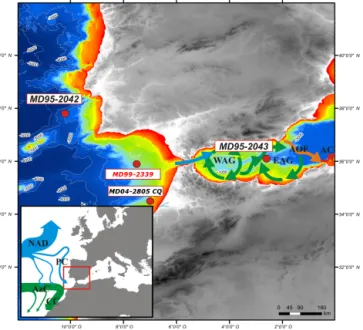
Figure 1. Area of interest with major sea-surface features. Study core MD99-2339, as well as other cores discussed in the paper, is located on the large map, which also depicts the bathymetry of the study area and the major surface currents within the Alboran Sea. WAG: Western Alboran Gyre; EAG: Eastern Alboran Gyre; AOF: Almeria–Oran Front; AC: Algerian Current. The small map on the left presents large-scale North Atlantic currents, with the North At-lantic Drift (NAD), the Portugal Current (PC) flowing southward from 45 to 30◦N, the Azores Current (AzC) derived from the south-ern branch of the Gulf Stream and flowing eastward to the Gulf of Cadiz at about 35◦N, and the Canary Current (CC) fed by both the AzC and the PC. Together, these currents form the Eastern Bound-ary Current of the North Atlantic subtropical gyre.
species form highly resistant resting cysts (dinocysts) af-ter sexual reproduction (Dodge and Harland, 1991; Head, 1996; Dale, 1996) whose modern distribution is tightly cou-pled to sea-surface physico-chemical characteristics (nutri-ent availability, temperature, sea-ice cover duration, salinity or light penetration; Rochon et al., 1999; Marret and Zon-neveld, 2003; de Vernal et al., 2001, 2005; de Vernal and Marret, 2007; Zonneveld et al., 2013). Dinocysts recorded in marine sediments thus enable qualitative as well as quan-titative discussion of past surface environments, with their preservation being furthermore high in comparison to other fossilisable planktonic groups suffering from dissolution is-sues of authigenic silica and carbonates (e.g. de Leeuw et al., 2006).
The central Gulf of Cadiz is a place of low present-day marine productivity, with a moderate ability to store CO2
and CH4 (e.g. Huertas et al., 2006, 2009; Flecha et al.,
2012). However, this might not have been the case in the past due to the potential migration of proximal productive centres (e.g. Portugal and Moroccan upwelling centres) at long-term orbital timescales (glacial–interglacial cycles) as well as at millennial sub-orbital ones (i.e. the well-known
Greenland Interstadial (GI)–Greenland Stadial (GS) cycles; Dansgaard et al., 1993; Grootes et al., 1993). In fact, it has been demonstrated that productivity changes in this re-gion involve complex hydrographical dynamics, including upwelling (Abrantes, 1991, 1992) and river inputs, and are also probably additionally forced by Mediterranean–Atlantic exchanges (Rogerson et al., 2012; Ivanovic et al., 2013). Our study aims to explore how these changes may have impacted dinoflagellates, here viewed as an index planktonic group, so as to understand complex patterns and couplings of palaeo-hydrological and palaeo-productivity changes over the last 50 ky in the subtropical NE Atlantic. Large environmental shifts which have characterized the studied period are known to be well expressed and preserved in the Gulf of Cadiz sedi-mentological archives (e.g. Sierro et al., 2005; Voelker et al., 2006, 2015; Toucanne et al., 2007; Peliz et al., 2009; Roger-son et al., 2010, 2012; Bahr et al., 2014, 2015; Hernandez-Molina et al., 2014), thus providing an ideal case study for our purposes. Different configurations of Mediterranean– Atlantic exchanges were also taken into account regarding their potential impacts on MD99-2339 dinocyst surface prox-ies. For this paper, we focus on the palaeohydrographical response of the Gulf of Cadiz during Marine Isotope Stage (MIS) 3 to extend previous studies that extensively docu-mented the last glacial–interglacial transition (e.g. Rogerson et al., 2004; Turon et al., 2003; Penaud et al., 2010). We also consider the Northern Hemisphere palaeoclimatological changes within a broader subtropical climate context, includ-ing the Mediterranean Basin (Bahr et al., 2015).
2 Surface and deep hydrography of the Gulf of Cadiz The study area is located on the eastern part of the North Atlantic’s subtropical gyre, directly adjacent to the Strait of Gibraltar (< 14 km width, < 300 m depth), the latter of which channelling water-mass exchanges between Atlantic waters at the surface and saltier/denser Mediterranean Outflow Wa-ters (MOW) at depth. This area thus couples the convergence of critical water masses regarding the Atlantic Meridional Overturning Circulation (AMOC) with a semi-permanent up-welling regime, itself connected to the larger dynamic cells off NW Africa.
More specifically, sea-surface waters from the Gulf of Cadiz are influenced by several currents, including the Por-tuguese and Moroccan coastal currents, a branch of the Azores Current (AzC; Fig. 1) flowing eastward at 35◦N
(Peliz et al., 2009), and the MOW, which feeds the Canary Current (CC; Fig. 1) to the south and also contributes to the generation of the AzC. In the open ocean only, the AzC co-incides with the Azores Front (AF), forming a strong hydro-graphical barrier at the northeastern boundary of the Atlantic subtropical gyre marked in terms of both temperature gradi-ents (about 4◦C; Gould, 1985) and the vertical structure of the water column (Fasham et al., 1985). This front is locally
Figure 2. (a) Age–depth model for core MD99-2339 (all symbols are explained in the figure), allowing for comparison of (b) the new age model (this study: planktonic δ18O monospecific record in black) with the first published one (Voelker et al., 2006: planktonic δ18O record in red).
characterized by intense upwelling cells and thus higher sea-surface productivity (Rudnick, 1996; Alves and de Verdière, 1999; Alves et al., 2002). At present, the AF does not pene-trate into the Gulf of Cadiz, where the upper 50 m sea-surface waters are generally depleted in nutrients (Navarro and Ruiz, 2006). The Gulf of Cadiz is thus today moderately responsi-ble for CO2storage (e.g. Huertas et al., 2006, 2009; Flecha
et al., 2012), and this oligotrophic regime is mainly due to surface inflow of relatively nutrient-depleted Atlantic water, while nutrient-richer conditions are found at depth as rem-nant Antarctic Intermediate Waters (Cabeçadas et al., 2002, 2003).
On the northeastern shelf of the Gulf of Cadiz, it has been demonstrated that present-day river discharges (fresh-water inputs from large rivers such as the Guadania, Tinto– Odiel and especially the Guadalquivir on the southern Iberian margin), in combination with meteorological con-ditions (incident irradiance, strong winds), strongly impact phytoplankton biomass (Huertas et al., 2006). More specifi-cally, turbidity-plume and chlorophyll-concentration dynam-ics shed light on enhanced primary productivity conditions related to fluvial discharges occurring during rainy sea-sons, and especially during negative modes of the North At-lantic Oscillation (NAO; Caballero et al., 2014). The central Gulf of Cadiz is, conversely, rather subject to fluvial
influ-ences from NW Moroccan rivers (especially from the Sebou River and additional northern African small distributaries) for which plumes spread over a large coastal area (Warrick and Fong, 2004). Additionally, the wind pattern is highly sig-nificant for sea-surface biological processes within the Gulf of Cadiz (Navarro and Ruiz, 2006): the wind-related mix-ing phenomenon cumulates with the wind-driven coastal up-welling regime, active mainly from late May/early June to late September/early October in the Portugal–Canary sys-tem (e.g. Haynes et al., 1993; Aristegui et al., 2005; Peliz et al., 2005). This seasonal upwelling functioning is itself de-pendent on seasonal migrations of the Azores High coupled to the Intertropical Convergence Zone dynamics (Hsu and Wallace, 1976). Over the last 30 ky, evidence of extremely close palaeohydrological patterns between the central Gulf of Cadiz and the NW Moroccan margin supports the idea of similar forcing acting on both of these subtropical areas of the NE Atlantic margin (Penaud et al., 2011a).
Water masses from our study area are structured as fol-lows: Surface Atlantic Waters, between the surface and 100 m water depth, overlay North Atlantic Central Waters, found between 100 and 700 m. Deep MOW are divided into two main branches centred at around 800 and 1200 m water depths, as well as at 500 m in the continental shelf (Ambar
Figure 3. Comparison, against age (new age model from this study), between the planktonic δ18O monospecific record of core MD99-2339 (red curve; Voelker et al., 2006) and the NGRIP δ18O accord-ing to the GICC05 timescale (Svensson et al., 2008). (a) Red stars show the six radiocarbon dates retained for the chronology of core MD99-2339, and dark arrows show the 13 pointers used to tune the δ18O data of core MD99-2339 to the NGRIP chronology, by con-sidering GI onsets for core MD99-2339 (numbers 1 to 12 in the figure) according to GI onset chronology established in Wolff et al., (2010). Sedimentation rates, calculated between different pointers of core MD99-2339, are also highlighted by the dark histogram. YD: Younger Dryas; BA: Bölling–Alleröd. (b) A close-up of the 25–50 ka BP interval allows for better consideration of the pointers selected (dotted vertical lines) for this new age model.
and Howe, 1979; Ambar et al., 2002). North Atlantic Deep Waters are found below 1500 m (Alvarez et al., 2005).
3 Material and methodology
3.1 Marine cores integrated within the study: chronostratigraphy
Core MD99-2339 (35.89◦N, 7.53◦W; 1170 m water depth; 18.54 m length; Fig. 1) was recovered from a contouritic field (Habgood et al., 2003) by the R/V Marion Dufresne during the 1999 International Marine Global Change Studies V
(IM-AGES V-GINNA) cruise (Labeyrie et al., 2003). It covers the last 45 ky according to its published age model (Voelker et al., 2006), which is based on 20 AMS14C dates and three δ18O control points tuned to the GISP2 chronology (Grootes and Stuiver, 1997).
In this study, the stratigraphical framework of core MD99-2339 was re-considered for its older part, where radiocarbon dates exhibited large error bars (between 200 years around 900 cm and 1400 years at 1500 cm; Voelker et al., 2006; Fig. 2) and inconsistencies with the regional North Atlantic stratotype NGRIP GICC05 timescale (Svensson et al., 2008; Austin and Hibbert, 2012; Austin et al., 2012; Rasmussen et al., 2014). This revision was furthermore motivated by the comparison of this new dinocyst MIS 3 record to that of core MD95-2043 (Alboran Sea; 36.14◦N, 2.62◦W; 1841 m wa-ter depth; 36 m length; Penaud et al., 2011b; Fig. 1). Such an approach is validated by previous works conducted on the southern Iberian margin, where the stratigraphy of palaeo-climatological reference sites was constructed using a sim-ilar tuning to Greenland ice records (e.g. Shackleton et al., 2000; Bard et al., 2004). However, this event-based stratig-raphy (i.e., Austin and Hibbert, 2012) prevents any defini-tive conclusion about latitudinal leads and lags from being established, as well as any evaluation of intra-hemispheric propagation velocities of climatic perturbations. To build the revised age–depth model (Fig. 2), we chose to keep six radiocarbon dates (Voelker et al., 2006; Figs. 2 and 3) younger than 20 ka BP (until around 600–700 cm; mean er-rors of 60 years) that we calibrated to calendar years with the CALIB 7.1 program using the Marine13 calibration data (Stuiver and Reimer, 1993; Reimer et al., 2013). Below 700 cm, we tuned the planktonic monospecific δ18O record (G. bulloides) of core MD99-2339 (13 pointers; Figs. 2 and 3) to the NGRIP ice-core GICC05 chronology, con-sidering synchronous sea-surface warmings in the Gulf of Cadiz with the onsets of GI 3 to 12, respectively (Wolff et al., 2010). As a result, Heinrich Stadial (HS; Barker et al., 2009; Sánchez-Goñi and Harrison, 2010) 5 (HS 5) is dated around 48 ka BP in our revised age model rather than 45– 46 ka BP (Voelker et al., 2006; Fig. 2). Sedimentation rates show a general decreasing trend from 60–90 cm ky−1around 40–45 ka BP to 10–40 cm ky−1across the Holocene (Fig. 3). 3.2 Dinoflagellate cyst analysis
3.2.1 Laboratory procedure and microscopic observation
A total of 161 samples were analysed for their dinocyst con-tent every 10 cm on average, representing a sample resolu-tion of around 300 years (σ = 210) for the whole of core MD99-2339, using an Olympus BX50 microscope at 400× magnification (75 slides from 0 to 740 cm/0 to 27 ka BP: Penaud et al., 2011a; 86 slides from 750 to 1844 cm/27 to 49 ka BP: this study). The preparation technique followed the
Table 1. Modern distribution versus past occurrences (MD99-2339 record) for selected major dinocyst species found in the fossil assemblage (see Fig. 5).
Dinocyst species Present-day ecology Occurrence in core MD99-2339 (Fig. 5) and palaeo-ecological in-terpretation
Lingulodinium machaerophorum (opportunistic/temperate)
Temperate to tropical euryhaline species, often found in stratified waters (fjords, bays, estuaries; e.g. Dale et al., 1999), and interpreted as a proxy for fluvial dis-charges to the ocean (Zaragosi et al., 2001; Gonzales et al., 2008; Mertens et al., 2009; Holzwarth et al., 2010; Penaud et al., 2011b). Modern centres of distribution located along the Atlantic Eastern Boundary Current with a maximum represen-tation observed at the Strait of Gibraltar outlet (Marret and Zonneveld, 2003) and close to river mouths in general (Mertens et al., 2009).
Observed all along the record with maximal percentages identified during GI 12, GI 8, GI 1 and the late Holocene. Interpreted as a strong signal for run-off and fluvial-related nutrients, as well as strong surface stratification in the Gulf of Cadiz during these in-tervals.
Operculodinium centrocarpum (opportunis-tic/temperate)
Cosmopolitan, cold to temperate (low percentages in tropics) species that has often been linked to nutrient-enriched waters and waters such as the North Atlantic Drift (Wall et al., 1977; Harland, 1983), through its distribution in the modern dinocyst database (Rochon et al., 1999), but also regarding its past temporal occurrences in North Atlantic sediments (Turon, 1984; Eynaud et al., 2004; Penaud et al., 2008).
Pattern close to that of S. mirabilis. Potential witness of increased Atlantic surface water inflow into the Gulf of Cadiz. Interestingly, the couple S. mirabilis –O. centrocarpum is succeeded by Impagi-diniumspecies twice during MIS 1 warmer intervals, with a clear bipartite structure evidenced during the BA as well as during the Holocene.
Impagidiniumspp. (I. patu-lum, I. aculeatum, I. para-doxum, I. sphaericum, I. strialatum)
(warm group)
Temperate to tropical full-oceanic species (except I. pallidum) typically character-istic of tropical/subtropical (20 to 35◦N) oligotrophic environments (Wall et al.,
1977; Turon, 1984; Marret and Zonneveld, 2003 ; Bouimetarhan et al., 2009) with-out large inter-seasonal fluctuations in SST/SSS (Vink et al., 2000). Highest abun-dances found in regions with SST above 20–25◦C (winter-summer SST; summer
SST above 15◦C) and SSS around 35–36.
Strong increases during MIS 1 and especially at the start of GI 1 and during the early Holocene. Interpreted as an imprint for the installation of warm oligotrophic conditions in the Gulf of Cadiz through warm and nutrient-poor advection of subtropical North At-lantic Central Water through the Azores Current.
Spiniferites mirabilis(warm group)
Characterizes temperate to tropical environments and extends as far south as 10◦N, with high abundances found today along the European margin in the Bay of Biscay (Rochon et al., 1999). Not observed from sites with summer SST below 12◦C and found in fully marine environments characterized by SSS above 28.5 (Marret and Zonneveld, 2003).
Significant increases during MIS 3 GI and BA, as well as highest values recorded during the Holocene.
Spiniferites delicatus/ Spiniferites bentorii (warm group)
A relatively high number of Spiniferites species, including S. delicatus and S. mem-branaceus(as well as O. israelianum), characterize the equatorial zone, also often found at the vicinity of upwelling cells (Marret and Zonneveld, 2003). S. delicatus highest relative abundances are observed at sites with SST exceeding 25◦C through-out the year, and forms a prominent part of associations in regions with SSS exceed-ing 31, as well as above 34 (Marret and Zonneveld, 2003).
Occurs especially during MIS 3, with significant drops related to all HS, alternating with L. machaerophorum higher percentages, and attesting to the warm/productive character of the subtropical study area during MIS 3 GI.
Operculodinium israelianum(warm group)
Temperate to tropical (SST above 24◦C) species characterizing fully marine sites as well as coastal waters (Wall et al., 1977; Harland, 1983), and tolerating a broad range of nutrient concentrations (Marret and Zonneveld et al., 2003). Can be related to a typical signal of high-salinity environments (Morzadec-Kerfourn et al., 1990; Marret and Zonneveld, 2003).
Typical signature found during the LGM, with, however, weak per-centages, suggesting the relatively warm/saline character of the study area during MIS 2, especially between 16 and 24 ka BP.
Nematosphaeropsis labyrinthus (cold group)
Cosmopolitan species able to tolerate a wide variety of environments (Marret and Zonneveld, 2003), including areas where up to 12 months of sea-ice cover prevail (de Vernal et al., 2001). Also considered a typical open-ocean species and predom-inantly found in cold to cool waters between 45 and 65◦N in the North Atlantic
Ocean (cf. Rochon et al., 1999), and recorded today with maximum abundances around the British Isles and in the NW Atlantic. Possibly related to nutrient-enriched waters (Devillers and de Vernal, 2000).
Typical signature, being mainly related to cold GS, such as HS1 or the YD, but also occurs during some GIs recorded between HS4 and HS 5. This species would suggest cool/eutrophic conditions.
Spiniferites
elongatus/cysts of Pen-tapharsodinium dalei(cold group)
Both taxa have their highest relative abundances in temperate to cold regions and decreasing percentages of these species along the Northern Hemisphere subtropical front, constituting a “physical” barrier for these taxa, today typically reflecting the transition from temperate to subtropical waters (Marret and Zonneveld, 2003)
Across HS4, strongest percentages of cysts of P. dalei attest to im-portant coolings.
Spiniferites lazus (cold group)
Restricted to fully marine, coastal regions of western Europe (with low occurrences) and distributed within a broad range of temperature and nutrient concentrations, in areas with SSS exceeding 30. Arctic to temperate, inner to outer neritic species (Har-land, 1983), not recorded from sites where SSS is reduced (e.g. Wall and Dale, 1973; McMinn, 1991; de Vernal et al., 1994; Nehring, 1994; Ellegaard, 2000; Persson et al., 2000).
MIS 3 to MIS 2 transition marks a strong shift from the earlier HS characterized by the association of cyst of P. dalei-B. tepikiense (HS5-HS4-HS3) to younger HS characterized by the association S. elongatus–S. lazus (HS 2 and HS1).
Bitectatodinium tepikiense (cold group)
Characterizes strong thermal, seasonal contrasts with freezing winter SST and en-hanced surface water stratification (Sánchez-Goni et al., 2000; Turon et al., 2003; Combourieu-Nebout et al., 2002; Penaud et al., 2011a, b).
Across HS5, HS 4 and then HS3, decreasing percentages of B. tepikiense, in parallel with decreasing L. machaerophorum, may confirm a decreasing stratification trend through time over each HS. Brigantedinium spp.
(heterotrophic)
Cosmopolitan species that can dominate cyst associations from coastal to oceanic sediments of the North Atlantic, the western equatorial Atlantic, and the coastal upwelling along the western African margin. Found within a broad range of temper-atures, salinities and nutrient concentrations (Marret and Zonneveld, 2003). How-ever, in this group distribution of the heterotrophic species seems largely controlled by their food requirements and some authors suggest a relationship with high sur-face productivity (e.g. Lewis et al., 1990; Dale and Fjellsafi, 1994; Marret, 1994; Biebow, 1996; Targarona et al., 1999; Zonneveld et al., 2001).
Especially found with maximal percentages during the LGM, but also during HS4. Across the LGM, Brigantedinium has been pre-viously related to the presence of a front within the Gulf of Cadiz at that time, probably similar to the modern Azores Front, which may have enhanced primary productivity through frontal upwelling cells (Rogerson et al., 2004, 2010; Penaud et al., 2011a). A strong seasonal pattern during HS4 would also be confirmed by the sig-nificant occurrence of B. tepikiense, while cysts of P. dalei attest to extremely cold SST during this interval (cf. also Patton et al., 2011). Selenopemphix nephroides/Selenopemphix quanta/Trinovantedinium applanatum (coastal heterotrophics)
Even if distributed within a broad range of temperature, salinity, or nutrient con-centration, these characterize estuarine to neritic environments (Harland, 1983) and are often found in western African upwelling and the equatorial margin (Dodge and Harland, 1991; Wall et al., 1977). Highest occurrences of S. nephroides, a temper-ate to tropical and fully marine species, characterize mesotrophic/eutrophic coastal environments (Marret and Zonneveld, 2003).
Grouped as “coastal heterotrophic species” in this study. Espe-cially found during GI–GS cycles of MIS 3, and strongly de-crease after 30 ka BP, although slightly rising again during the Late Holocene. Contrary to Brigantedinium, these species (especially S. nephroides) are absent during HS in the Gulf of Cadiz.
protocol described by de Vernal et al. (1999) and Rochon et al. (1999), slightly modified at the EPOC laboratory (Castera and Turon, http://www.epoc.u-bordeaux.fr/index.php?lang= fr&page=eq_paleo_pollens), including chemical treatments (cold HCl: 10, 25 and 50 %; cold HF: 45 and 70 %) and siev-ing through ssiev-ingle-use 10 µm nylon mesh screens. The final residue was then mounted between slide and coverslip with glycerine jelly coloured with fuchsin.
For each analysed sample, a minimum of 300 dinocyst specimens were systematically identified following the tax-onomy in Fensome and Williams (2004) and Fensome et al. (2008). High occurrences of the species Lingulodinium machaerophorum (nearly monospecific in some cases but typical for the area today) forced us to additionally count 100 dinocysts outside this species for each palynological slide in order to obtain statistically robust dinocyst results (Fatela and Taborda, 2002). Dinocysts can be expressed in percentages and also in concentrations (number of specimens per cubic centimetre of dry sediments), which are calculated through the marker grain method (Stockmarr, 1971; de Ver-nal et al., 1999; Mertens et al., 2009). This consists in adding aliquot volumes of Lycopodium spores before the palynolog-ical treatment in each sample, with these exotic spores being counted in parallel with fossil palynomorphs. One can argue that there might be a relationship between concentrations and granulometry (increasing/decreasing concentrations vs. in-creasing clays–fine silts/coarser silts–fine sands; Wall et al., 1977), especially in a contouritic environment. However, it is important to note that only fine silts have been sampled for palynological analysis. Furthermore, given that cyst concen-trations are the combined results of sedimentation rates, grain size and productivity, we also calculated flux rates (number of cysts cm−2ky−1). We do not have enough time marker points to calculate flux rates for every single short event sep-arately, but, at least on a multi-millennial timescale, dinocyst fluxes may provide a better insight into dinocyst export to the seafloor, and perhaps also indirectly into dinoflagellate productivity in surface waters.
3.2.2 Dinocyst indexes and statistical treatments of dinocyst results
Warm / cold ratio
The present-day ecology of many of the recovered species is well known from their surface sediment distribution in the North Atlantic (e.g. Turon, 1984; Rochon et al., 1999). Furthermore, latitudinal (SST changes) and inshore–offshore (eutrophic–oligotrophic conditions) gradients are mainly re-sponsible for dinocyst distribution in modern sediments (Marret and Zonneveld, 2003; Zonneveld et al., 2013). A qualitative thermic index, “warm/cold” (W/C), which has previously been used to qualitatively address SST variations (Turon and Londeix, 1988; Versteegh, 1994;
Combourieu-Nebout et al., 1999; Eynaud et al., 2016), was calculated for core MD99-2339 (cf. Table 1).
Heterotrophic / autotrophic ratio
Most dinoflagellate species are mixotrophic, and strict autotrophic dinoflagellates (phototrophic organisms) are rare. However, previous investigations have discussed het-erotrophic cysts, i.e. derived from dinoflagellates with a strict heterotrophic strategy of nutrition, as being indirectly related to food resources, and especially diatoms, as has commonly been shown in upwelling areas (Wall et al., 1977; Lewis et al., 1990; Marret, 1994; Biebow, 1996; Zonneveld et al., 1997a, 2001; Targarona et al., 1999; Bouimetarhan et al., 2009; Pe-naud et al., 2011a). This is especially true for Protoperi-diniumspecies, including Brigantedinium and Selenopem-phixspecies, thus indirectly signing periods of higher surface water productivity. In the following sections of the paper, we will refer these taxa as “heterotrophics”, with “coastal het-erotrophics” being more specifically used for Selenopemphix species (S. quanta and S. nephroides; Table 1). A ratio of het-erotrophics to autotrophics (H /A) can be also addressed that simply takes into account “strict” heterotrophic occurrences vs. the other dinocyst taxa identified in fossil assemblages. Diversity statistics
Taxonomical diversity in study samples was quantified through a variety of statistical analyses using the “Past ver-sion 1.75b” software (Hammer et al., 2001); most of these indexes are explained in Harper (1999). Here, we calculated the number of taxa per sample (S); the dominance (D), which ranges from 0 (all taxa are equally present) to 1 (one taxon dominates the community completely); and Margalef’s rich-ness index: (S−1)/ln(n), where n is the number of individuals counted in each sample.
Quantitative estimates of past sea-surface parameters We used the modern analogue technique (MAT) based on the statistical distance between fossil (palaeoceanographic record) and current (modern database) assemblages (de Ver-nal et al., 2001, 2005; Guiot and de VerVer-nal; 2007). The dinocyst transfer function used (Radi and de Vernal, 2008) is derived from a modern database comprising 67 dinocyst species and 1492 stations from the North Atlantic, Arctic and North Pacific oceans and their adjacent seas, and is run using R version 2.7.0 software (R Development Core Team, 2008; http://www.r-project.org/). The calculation of past hydrolog-ical parameters relies on a weighted average of the values obtained for a maximum of five best modern analogues for fossil assemblages, with the maximum weight being given for the closest analogue (i.e. minimal statistical distance, or “Dmin). If Dmin reaches a maximal threshold value, the R software will consider no analogue, thus leading occasion-ally to non-analogue configurations. Here, we discuss
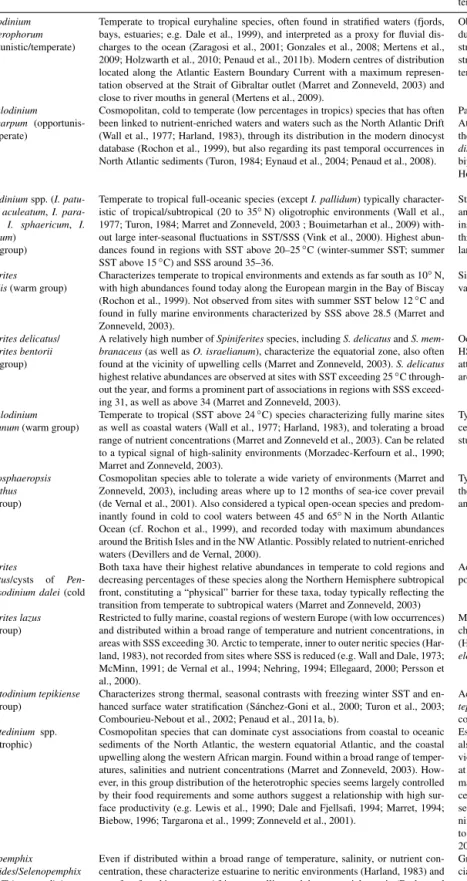
win-Figure 4. Data from core MD99-2339 compared to depth (cm). δ18O planktonic monospecific record of core MD99-2339 (a; Voelker et al., 2006) is presented in parallel with the W/C qualitative index of surface temperatures (b). Diversity indexes (species richness according to the Margalef index, c, and dominance, d) are drawn in parallel with percentages of the major species L. machaerophorum (e). Different calculations of dinocyst concentrations (f, g) are represented on a linear scale, while (h) illustrates total dinocyst and L. machaerophorum concentrations on a logarithmic scale, compared with sedimentation rates (i) and dinocyst fluxes (j). GI: Greenland Interstadial. Grey bands indicate Heinrich Stadials (HS) and the Younger Dryas (YD).
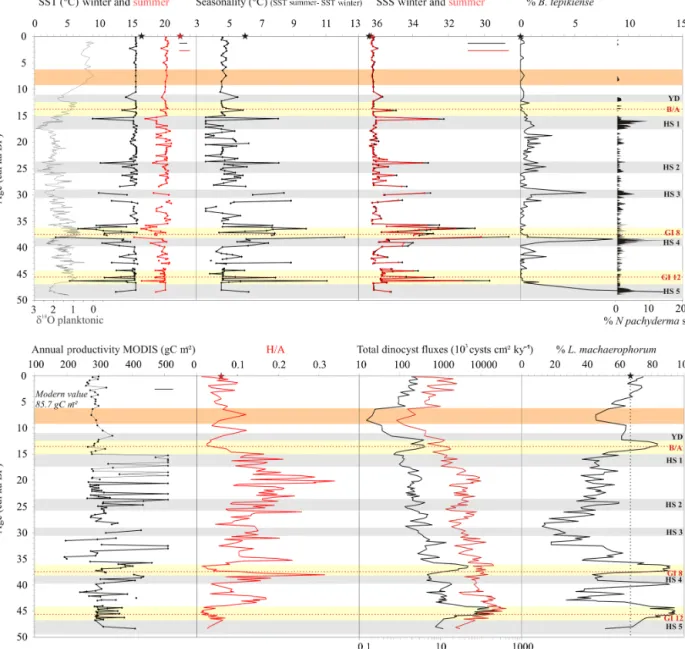
ter/summer SST with prediction errors of ±1.2◦C/±1.6◦C, respectively; winter/summer SSS, with prediction errors of ±2.1◦C/±2.3◦C, respectively; and primary productivity re-constructions with prediction error of 57 g C m−2.
4 Main dinocyst results across the last 50 ky in the Gulf of Cadiz
4.1 Dinocyst diversity, concentrations, and fluxes A total of 40 taxa were identified, with an average diversity of 20 main species. Considering the whole dinocyst assem-blage, increased total diversity (Fig. 4c) generally appears anti-correlated with decreased dominance (Fig. 4d); this in-dex is essentially explained by Lingulodinium machaeropho-rumpercentages through time (Fig. 4e) that oscillate between 30 and 90 %. L. machaerophorum is commonly considered as a typical index species for stratified waters (Table 1; Zaragosi et al., 2001; Penaud et al., 2009; Holzwarth et al., 2010), thus probably indicating enhanced fluvial inflows. Since core MD99-2339 is located in the major flow path of the lower limb of the MOW, and in a position also corresponding to the major limb of the MOW during the LGM (Rogerson et al., 2011), one can speculate whether the palaeoceano-graphical record has been disturbed by MOW plume
hydro-dynamics or advection by sedimentological processes (i.e. downslope transport). A large increase in monospecific as-semblages (when dominance is close to 1) will generally tend to reduce diversity and conversely (dominance close to 0 re-flecting an equidistribution of different species when the di-versity is maximum). Based on the obvious anti-correlation depicted in Fig. 4 (diversity vs. dominance), we argue for an autochthonous assemblage where species, and especially L. machaerophorum, reflect an in situ signal linked to changing sea-surface conditions.
Total dinocyst concentrations are generally low (less than 30 000 cysts cm−3), with the exception of two large maxima, centred on GI 8 and GI 12, showing higher values (between 100 000 and 400 000 cysts cm−3; Fig. 4f). A general trend of decreasing concentrations is then observed throughout the record with lower values observed during the early to mid-Holocene (between 1000 and 10 000 cysts cm−3)and espe-cially at the very start of the Holocene (1500 cysts cm−3; at 150–200 cm), following the cold interval of the Younger Dryas (YD; Fig. 4f). Also, minimum concentration values recorded during MIS 3 are comparable to maximum values recorded during the following MIS 2 and MIS 1. The gen-eral trend described above closely matches the one of the sedimentation rates (Fig. 4h) and thus also accounts for ex-tremely high dinocyst fluxes to the seafloor during MIS 3 (Fig. 4j), compared to the last deglaciation and the Holocene.
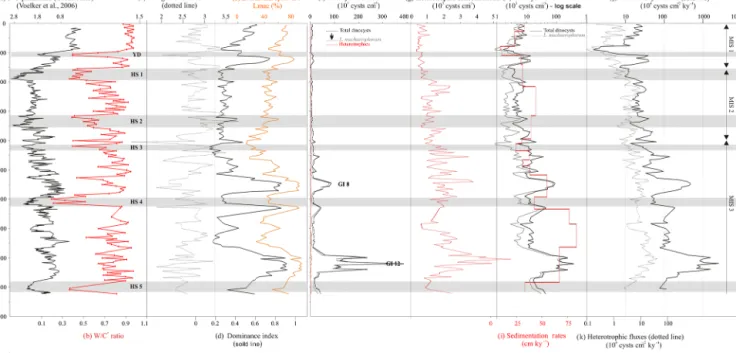
Figure 5. Data from core MD99-2339 against age (cal ka BP): major taxa occurring with values higher than 2 % in dinocyst assemblages from core MD99-2339 (0–48 ka BP; 0–1854 cm). Red, blue and green respectively indicate the “warm”, “cold”, and “heterotrophic” groups. W/C: warm to cold ratio. The trends shown in grey are calculated by excluding Lingulodinium machaerophorum from the main dinocyst sum, while coloured curves (colours explained in the figure) depict the whole assemblage considering all species. MD04-2805 CQ dinocyst data are also represented over the 28 ka BP so as to illustrate similarities between the assemblages from the central (MD99-2339, this study) and southern (MD04-2805 CQ; Penaud et al., 2011a) Gulf of Cadiz. Pink bands indicate warmer intervals (including BA, Bölling–Alleröd; LGM, Last Glacial Maximum; and GI, Greenland Interstadial) and blue bands indicate colder events (HS, Heinrich Stadials; YD, Younger Dryas).
Total dinocyst concentrations are mainly explained by L. machaerophorum alone (Fig. 4h), showing the crucial role of this species regarding dinocyst export to the seafloor from the last glacial to present in this subtropical NE Atlantic area. While heterotrophics represent a minor component of total dinocyst concentrations all along the core (Fig. 4g), it is in-teresting to note that both heterotrophic and L. machaeropho-rum concentrations/fluxes reveal the same decreasing trend along the record (Fig. 4j). Previous studies have revealed contrasted patterns between brown heterotrophic and L. machaerophorumcysts. Their apparent conflict is discussed at long timescales on the southern Iberian margin area in Ey-naud et al. (2000, 2016).
4.2 Dinocyst species reflecting qualitatively main palaeohydrological changes
Present-day ecologies of major species found in MD99-2339 assemblages are listed in Table 1 with their major past
occur-rences in the fossil record. The detailed examination of the qualitative thermic index “warm/cold” (W/C; Table 1; Fig. 5; cf. Sect. 3.2.2 of this paper), compared with the planktonic δ18O curve (G. bulloides) of core MD99-2339 (Voelker et al., 2006), shows that millennial-scale climate variability related to the GS/GI cycles is clearly captured by our fossil record thus confirming the robustness of reconstructed surface en-vironments through dinocyst assemblages in the central Gulf of Cadiz.
Specific percentages, calculated relative to the total dinocyst assemblages but also vs. a total that excludes L. machaerophorum, reveal that trends with or without L. machaerophorumare similar (Fig. 5). Peak occurrences are, however, better expressed when L. machaerophorum is omit-ted from the main palynological sum. Figure 5 further-more includes the published data from core MD04-2805 CQ (Fig. 1) over the last 28 ky (Penaud et al., 2010; dotted lines in Fig. 5). Obvious correlation between surface con-ditions recorded off the NW Moroccan coast (Marret and
Figure 6. Data from core MD99-2339 against age (cal ka BP). δ18O planktonic monospecific record and N. pachyderma (s.) percentages from core MD99-2339 (Voelker et al., 2006) in parallel with dinocyst transfer function results (n = 1492; Radi and de Vernal, 2008): winter and summer sea-surface temperature (SST) and sea-surface salinity (SSS), as well as seasonality (SST summer–SST winter) and annual pro-ductivities. Total dinocyst and heterotrophic fluxes are also depicted with the ratio H /A for “heterotrophics / autotrophics”, and percentages of two species: L. machaerophorum as a species index for higher surface stratification linked with increased palaeo-river discharges and B. tepikienseas a species index for thermal seasonal contrasts. Stars on each graph indicate present-day values for dinocyst percentages and hydrological parameters recorded in modern sediments and overlying surface waters, respectively, at the coordinates of analogue “A184” in the modern dinocyst database (34.32◦N, 7.02◦W; http://www.geotop.ca/fr/bases-de-donnees/dinokystes.html): SST winter of 16.48◦C and SST summer of 22.47◦C, SSS winter of 36.35 and SSS summer of 36.33, mean annual productivity of 85.7 g C m−2, and percentages of L. machaerophorumof 65.27 % and B. tepikiense of 0 %.
Turon, 1994; Penaud et al., 2010) and in the central part of the Gulf of Cadiz may be due to the same dynamics gov-erning palaeohydrological changes in this sector (Penaud et al., 2011a). More specifically, heterotrophics are never dominant among studied assemblages (Fig. 5). Heterotroph-ics are well known to be sensitive to oxic conditions (e.g.
Combourieu-Nebout et al., 1998; Zonneveld et al., 1997b; Kodrans-Nsiah et al., 2008), and the fact that Brigantedinium percentages increased during GS (i.e. periods with relatively well-oxygenated bottom waters related to MOW dynamics) may be an argument for a negligible effect of oxidation processes on species-selective degradation after cyst
depo-sition at our study site. Significant occurrences of some se-lected species (Table 1; Penaud et al., 2011a), and especially coastal heterotrophics (S. quanta and S. nephroides; Fig. 5), will thus indirectly reflect varying regimes of mesotrophic– oligotrophic conditions in the Gulf of Cadiz over the last 50 ky.
5 Mechanisms behind dinocyst changes at orbital and sub-orbital timescales in the Gulf of Cadiz
Portuguese–Moroccan upwelling dynamics are of particu-lar interest since planktonic populations are directly linked there to frontal areas and upwelled nutrient-enriched waters. At the Quaternary timescale, biodiversity increases have pre-viously been observed during glacial periods, as a probable consequence of an enhanced functioning of upwelling cells (Abrantes, 1988, 1991; Targarona et al., 1999; Penaud et al., 2011a) and strong biodiversity modifications have been re-lated to abrupt climate changes such as cold GS and espe-cially HS (Lebreiro et al., 1997; Eynaud et al., 2000; Voelker et al., 2006; Penaud et al., 2011a, b) with a total restructura-tion of the water column. Understanding mechanisms under-lying the complex pattern of palaeo-productivity changes at orbital as well as millennial timescales thus includes consid-ering a wide range of external and internal forcing, i.e. vary-ing conditions in terms of sea level, insolation, wind stress, water-mass exchanges at the Strait of Gibraltar, iceberg or fluvial discharges, and frontal upwelling cells, all of which are more or less interconnected at different timescales. 5.1 Glacial fertilization control on marine surface
productivity
Annual productivity quantifications calculated from dinocyst transfer function (Fig. 6), the qualitative ratio H /A, and dinocyst fluxes (total and heterotrophics) evidence higher productivities during the Late Glacial compared to the Holocene, with a sharp transition especially noted at 15 ka BP (Fig. 6). Similar decreasing palaeo-productivity at the end of the last glacial period (Voelker et al., 2009) was also previously discussed with regard to the Gulf of Cadiz in a nearby core (GeoB 9064; 35◦24.910N, 06◦50.720W; 702 m water depth) based on planktonic foraminifera-derived ductivity quantifications (Wienberg et al., 2010). Glacial pro-ductivity rise is commonly attributed to a fertilization ef-fect caused by increasing aeolian dust supply to the ocean under stronger glacial winds (Moreno et al., 2002; Bout-Roumazeilles et al., 2007; Wienberg et al., 2010), combined with higher Mediterranean continental aridity (Combourieu-Nebout et al., 2002; Sánchez-Goñi et al., 2002; Bar-Matthews et al., 2003; Fletcher and Sánchez-Goñi, 2008). Also, during MIS 2, glacial productivity reconstructed in the Gulf of Cadiz through dinocyst assemblages is the high-est (around 500 g C m−2compared to present-day values of
about 90 g C m−2; Fig. 6). It was suggested to be regionally due to upwelled nutrient-enriched waters linked to the oc-currence of a comparable hydrographic barrier to the mod-ern Azores Front (Rogerson et al., 2004, 2010; Voelker et al., 2009). This is also suggested in our record with en-hanced Brigantedinium (Fig. 7) and total heterotrophic per-centages (H /A; Fig. 6) between 26 and 15 ka BP (Penaud et al., 2011a).
5.2 Orbital control on palaeo-river discharges and nutrient availability
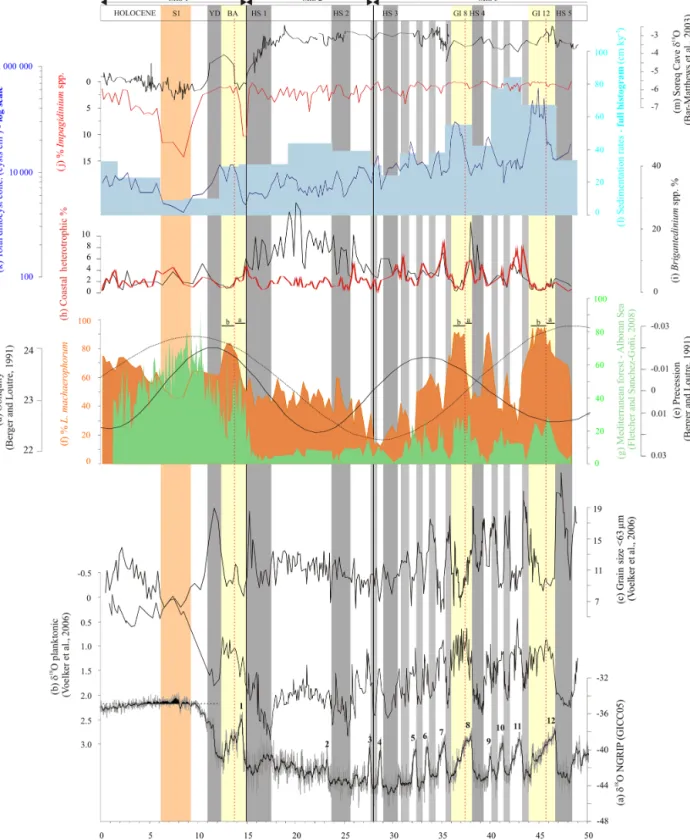
Furthermore, when considering L. machaerophorum percent-ages vs. orbital parameters, a very close relationship to the obliquity curve becomes obvious (Fig. 7). Assuming this species as a strong fluvial-sensitive cyst (Table 1), we may suggest enhanced precipitation in the southern borderlands of the Mediterranean Basin with obliquity maxima, which account for increasing northern summer insolation. Further-more, generally higher percentages of L. machaerophorum recorded between 50 and 35 ka BP coincide with extremely high total dinocyst concentrations (fluxes), while generally higher percentages of L. machaerophorum recorded from 15 ka BP onwards coincide with extremely low total dinocyst concentrations (fluxes; Fig. 7). As the Mediterranean Basin is subject to interference of northern and tropical latitudes, both obliquity and precession signals may be considered. These indeed represent major influences for the eastern African and western Indian summer monsoon systems (Tuenter et al., 2003) and can be evidenced, for instance, in Mediter-ranean palaeorecords (Lourens et al., 1996, 2001). Further-more, Tuenter et al. (2003) discussed the fact that the combi-nation “obliquity maxima–precession minima” (cf. MIS 1 in Fig. 7) would have a weaker effect on the African monsoon compared to the combination “obliquity maxima–precession maxima” (cf. MIS 3 in Fig. 7). This would be consistent, dur-ing MIS 1, with our recorded enhanced stratification related to lower productivities (Fig. 6), especially between 10 and 6 ka BP, and our recorded enhanced stratification during pe-riods of higher productivities across the last glacial (Fig. 6).
Also, interestingly, similar high Gulf of Cadiz dinocyst concentrations (fluxes) and L. machaerophorum percentages are recorded in the northern Bay of Biscay during the mid-Holocene (Naughton et al., 2007; Ganne A., personal com-munication, 2016). We can assume that high nutrient avail-ability in the Gulf of Cadiz during the last glacial may have been similarly high to modern nutrient availability in the northern latitudes of the temperate NE Atlantic (Bay of Bis-cay). This northward migration of palaeo-productive cen-tres is also similar to the migration of cold-water corals, from the Gulf of Cadiz during the last glacial period to the Irish–Norwegian margins at present (Freiwald et al., 2004; Dorschel et al., 2005; Rüggeberg et al., 2007; Eisele et al., 2008; Frank et al., 2005, 2009; de Haas et al., 2009; Wienberg et al., 2009, 2010). We then suggest maxima in
Figure 7. Greenland δ18O data (a) in parallel with data from core MD99-2339: planktonic δ18O (b) and mean grain size < 63 µm (c), over the last 50 ky. Dinocyst data (f, h, i, j) from core MD99-2339 are also depicted vs. western (pollen, Alboran Sea, g) and eastern (δ18O, Soreq Cave, m) Mediterranean records, as well as orbital parameters (d, e). Sedimentation rates (l) calculated from the new age model of core MD99-2339 echo total dinocyst concentrations (k). Greenland Interstadials (GI) 1 (Bölling–Alleröd: BA), 8 and 12 are highlighted with yellow bands and are characterized by a bipartite structure labelled “a” and “b” for the first and second phases, respectively. Grey bands indicate Heinrich Stadials (HS) and the Younger Dryas (YD). The orange vertical band indicates the time interval corresponding to Sapropel 1 (S1) formation (9.5–6.5 ka BP).
Figure 8. Comparison between dinocyst data (percentages or concentrations) as recorded from each side of the Strait of Gibraltar. Shaded blue and blue curves represent MD99-2339 data (Gulf of Cadiz, this study), while shaded red and red curves represent MD95-2043 data (Alboran Sea, Penaud et al., 2011b). Greenland Interstadials (GI) 8 and 12 are highlighted with yellow bands and are characterized by a bipartite structure labelled “a” and “b” for the first and second phases, respectively. Other GIs are highlighted with pink bands also corresponding to the numbered peaks obvious on the NGRIP curve. Grey bands indicate Heinrich Stadials (HS).
dinocyst, and perhaps phytoplanktonic organisms in general, export during glacial obliquity maxima in subtropical lati-tudes, when ice sheets were still well developed in the North-ern Hemisphere, while interglacial obliquity maxima would preferentially stimulate phytoplanktonic growth in northern latitudes of the North Atlantic. Also, climatic changes affect-ing the regional freshwater inputs may also contribute to ex-plaining those similarities between the last glacial period in the Gulf of Cadiz and the mid-Holocene in the Bay of Bis-cay (e.g. Sierro et al., 2000; Mikolajewicz, 2011; Bahr et al., 2015; Lofi et al., 2016). Marine surface productivity has been tentatively modelled for the Indian Ocean with simulations coupling a biogeochemical component for primary produc-tion, from 80 ka BP climate conditions to the pre-industrial state (Le Mézo et al., 2015). This modelling exercise
evi-denced the crucial role of obliquity, i.e. glacial–interglacial conditions responsible for changing oceanic circulation, as a main driver for phytoplanktonic productivities. This relation-ship between obliquity maxima and enhanced marine pro-ductivities has furthermore recently been evidenced in the equatorial eastern Atlantic Ocean with dinocyst data (Hardy et al., 2016).
5.3 MIS 3 and the atypical pattern of GI 8 and GI 12 5.3.1 General overview of MIS 3 pattern on either side
of the Strait of Gibraltar
MIS 3 corresponds to a general stronger velocity of denser MOW export (grain-size analysis; Fig. 7). Over this period, dinocyst signals from both sides of the Strait of Gibraltar,
i.e. signals recorded from the Gulf of Cadiz (this study) and the Alboran Sea (core MD95-2043; Penaud et al., 2011b; Fig. 1), have been compared so as to qualify Mediterranean-Atlantic surface exchanges at times when MOW experienced strongest/weakest bottom current velocities (Fig. 8).
A first look at dinocyst concentrations for selected indi-vidual species (Fig. 8d, e, f) reveals extremely close pat-terns from either side of the Strait of Gibraltar, but with a different magnitude of values, especially when consider-ing L. machaerophorum concentrations that are 10 to 100 times higher in the Gulf of Cadiz compared to the Alboran Sea (Fig. 8d). Total dinocyst concentrations are also char-acterized by similar temporal fluctuations but different re-constructed values; these marked value differences are only explained by L. machaerophorum concentrations since other “autotrophic” species show generally comparable orders of concentrations (Fig. 8g).
It is interesting to note that, even if individual species concentrations follow obviously identical oscillations, they are not as clear when considering their relative abundances (Fig. 8k, l, m). L. machaerophorum percentages generally dominate whole cyst assemblages all over MIS 3 in the Gulf of Cadiz, as is the case today (Rochon et al., 1999; Mar-ret and Zonneveld, 2003; Zonneveld et al., 2013; Table 1; Fig. 8k). In the Alboran Sea, N. labyrinthus (cool-temperate, outer-neritic) percentages mirror those of L. machaeropho-rum(temperate, inner-neritic) in the Gulf of Cadiz (Fig. 8l), with this species hardly making up 5 % of the present-day assemblage in the area. Contrary to the Gulf of Cadiz, no im-portant river discharges are noticeable today in the Alboran Sea and the continental shelf is narrower. Primary productiv-ity in the Alboran Sea mainly results today from the inflow of Atlantic waters through the Strait of Gibraltar, while marsh and riverine influence in coastal zones from the Gulf of Cadiz is particularly high (Macías et al., 2014). This could explain the predominance of L. machaerophorum in core MD99-2339, while N. labyrinthus will preferentially characterize MD95-2043. When these two species are summed, their per-centages show obvious similar patterns in terms of both val-ues and timing of the different recorded peaks (Fig. 8n). Combined N. labyrinthus–L. machaerophorum percentages are not clearly related to GS or GI climate conditions; how-ever, features can be distinguished: (i) maximal values are recorded at the end of GI 8 and 12, but very low values at the start of these specific interstadials; (ii) they never occur during HS with significant percentages; and (iii) they often characterize GS climate conditions with increasing relative abundances (Fig. 8n).
5.3.2 Greenland Stadial (GS) and especially Heinrich Stadial (HS)
During GS, and especially HS, dinocyst seasonal SST recon-structions from the Gulf of Cadiz evidence a 2 to 5◦C cool-ing, as a consequence of the southward shift of the polar front
(e.g. Eynaud et al., 2009). This is especially true for winter SST (Fig. 6), with dry and cold winter conditions also be-ing previously recorded in these latitudes (Sánchez-Goñi et al., 2002; Combourieu-Nebout et al., 2002; Moreno et al., 2002, 2005; Bout-Roumazeilles et al., 2007). B. tepikiense and the polar foraminifera N. pachyderma (s.) attest, respec-tively, to enhanced seasonality (large offset between summer and winter temperatures as confirmed by dinocyst transfer function; Fig. 6) and important coolings in the interval 25– 50 ka BP (Fig. 6). The combination “N. pachyderma (s.)–B. tepikiense”thus evidences in both the Gulf of Cadiz and the Alboran Sea the influx of subpolar water masses into these subtropical northeastern Atlantic latitudes (Bard et al., 2000; Sánchez-Goñi et al., 2000; Pailler and Bard, 2002; Turon et al., 2003; de Abreu et al., 2003; Vautravers and Shackleton, 2006; Eynaud et al., 2000, 2009; Salgueiro et al., 2010, 2014; Patton et al., 2011; Penaud et al., 2011a, b), also accounting for direct and strong surface connections responsible for sim-ilar planktonic species occurrences at both sides of the Strait (Fig. 8). During HS, this occurs in a context where bottom MOW experienced intermediate (and not the strongest) ve-locities because of the strong advection of less saline waters at the surface in the western Mediterranean Basin (Cacho et al., 2000; Sierro et al., 2005; Voelker et al., 2006; Frigola et al., 2008).
In the Gulf of Cadiz, during HS, increased annual produc-tivity reconstructions (Fig. 6) together with increased het-erotrophics (especially Brigantedinium spp.; Fig. 7) suggest primary productivity increases related to frontal system re-organizations within the Gulf of Cadiz (Rogerson et al., 2004, 2010; Voelker et al., 2009). This front was also dis-cussed over the last 28 ky by the strong decreasing gradi-ent of N. pachyderma (s.) percgradi-entages obvious during HS across a small north–south transect between southern Por-tugal and the sector Cadiz–Morocco (Penaud et al., 2011a). This configuration is similar to the one previously discussed for the LGM interval that recorded the highest productivi-ties and Brigantedinium percentages in our Gulf of Cadiz fossil record (Figs. 6 and 7). Except for HS, other GS are not systematically marked by such features. Also, it is in-teresting to note that productivity drops were noted during GS in the same core with planktonic foraminiferal Cd / Ca values, thus suggesting low nutrient availability at that time (Patton et al., 2011). Our frontal upwelling conditions ex-plaining higher productivities would thus be especially valid for HS climate extrema in the Gulf of Cadiz. In the northern North Atlantic, biomass decline has conversely been linked to abrupt climate changes (Schmittner, 2005; Mariotti et al., 2012) during AMOC disruption linked with massive iceberg calving (e.g. McManus et al., 2004; Gherardi et al., 2005).
5.3.3 The Greenland Interstadial (GI), especially GI 8 and GI 12: typical bipartite structure
In the Gulf of Cadiz, warmer surface conditions are gener-ally recorded during GIs, as suggested from the W/C ratio (Fig. 5) as well as seasonal SST reconstructions with val-ues close to modern ones (Fig. 6). Synchronous occurrences of the thermophilic species S. mirabilis on both sides of the Strait of Gibraltar (Fig. 8c) also indicate general warmer sur-face conditions at a time when bottom MOW velocity was reduced.
However, GI 12 and GI 8, immediately following HS 5 and HS 4, respectively, are characterized by very pecu-liar and unique features when compared to other GIs in the core. These two intervals show periods characterized by the longest and strongest expansions of mixed oak for-est over MIS 3 (Alboran Sea; Fletcher and Sánchez-Goñi, 2008; Fig. 7), and, from a unique hydrological point of view, they can be described according to a bipartite structure in the Gulf of Cadiz (cf. “a” and “b”; Figs. 7 and 8), also previ-ously described for the Alboran Sea (Penaud et al., 2011b; cf. Fig. 8). While the first part (“a”) is characterized by in-creasing coastal heterotrophics (Fig. 8o) and thermophilic species (Fig. 8c), paralleling higher polar air temperatures (Fig. 8j), the second part (“b”) is characterized by the highest total dinocyst concentrations (Fig. 8h) and L. machaeropho-rumpercentages (Fig. 8k) ever recorded over the last 50 ky. This second part is also characterized by a strong S. mirabilis drop (Fig. 8c), and the lowest winter SST (10◦C colder than
today; Fig. 6) and SSS (around 30 reconstructed at that time; Fig. 6). We therefore suggest a major atmospheric reorgani-zation occurring at 37 ka BP within GI 8, and at 45.5 ka BP within GI 12, also detected in NGRIP with decreasing po-lar temperatures all along these long interstadials (Fig. 8j). Within both second phases (“b”, Fig. 8), synchronous high percentages of L. machaerophorum recorded in the subtropi-cal NE Atlantic (quasi monospecific in the Gulf of Cadiz) and in the western Mediterranean Basin suggest extremely high fluvial discharges and well-stratified conditions. We there-fore suggest an extreme southward shift of the winter west-erlies belt, more pronounced during each part “b” than dur-ing each part “a”, that would also be responsible for huge advection of freshwater, especially during the winter season, and therefore reduced SST and SSS. This questions the feed-backs inherent to the atmospheric/oceanic reorganizations. Even if the precise mechanism underlying this shift is still questioned and deserved model simulations, our results ar-gue for a fast response of the ocean in this millennial/sub-millennial timescale context of rapid climate change. 5.4 Dinocyst-specific pattern across MIS 1
Interestingly, during MIS 1, decreased dinocyst fluxes and increased Impagidinium percentages (Fig. 7) seem to be re-lated to the humidity pattern as recorded in western (Fletcher
and Sánchez-Goñi, 2008; Fig. 7) and eastern (Bar-Matthews et al., 2000, 2003; Fig. 7) Mediterranean records. During the first half of the BA, Impagidinium species (especially I. ac-uleatum; Fig. 5) strongly expand (Fig. 7), arguing for the establishment of full oceanic and warm conditions, which may suggest oligotrophic conditions in this area (cf. dinocyst transfer function; Fig. 6) progressively replacing glacial eu-trophic to mesoeu-trophic ones (Behrenfeld et al., 2005; Wien-berg et al., 2010). This shift is synchronous to widespread rainfall over the entire Mediterranean Sea (Toucanne et al., 2015). Increased vegetation cover at that time (Fletcher and Sánchez-Goñi, 2008; Fig. 7) and thus decreased river runoff on land may have also induced decreased nutrient supplies to the ocean. It is interesting to note that, in North Atlantic subtropical latitudes, each onset of warm conditions during climatic optima (i.e. MIS 1, MIS 5, MIS 11, and MIS 19) was associated with the expansion of Impagidinium species (Eynaud et al., 2016). This group thus marked post-glacial conditions instead of hypsithermal ones when competition with other thermophilous taxa such as S. mirabilis is ob-served (Turon and Londeix, 1988; Londeix et al., 2007; Ey-naud et al., 2000, 2016; PeEy-naud et al., 2008). It is worth not-ing that, and similar to GI 12 and GI 8, the BA is not ho-mogeneous and is marked by a bipartite structure (cf. phases “a” and “b” in Fig. 7). The final BA (“b”) is indeed marked by a drastic drop of Impagidinium spp., a strong increase in L. machaerophorum percentages and high values of total dinocyst concentrations (Fig. 7). This may suggest slightly more productive conditions (cf. Fig. 6) that followed mean general Mediterranean aridity increases starting as soon as 14 ka BP and continuing during the following cold event of the YD (Figs. 6 and 7).
At the onset of the Holocene, during the 9.5–6.5 ka BP in-terval, the proportion of clay cohesive sediments (cf. grain-size < 63 µm; Fig. 7) observed in core MD99-2339 is the largest of the record, thus suggesting a strong reduction of MOW flow strength (Voelker et al., 2006), as also evidenced in western Mediterranean Sea contourites from the Corsica Trough (Toucanne et al., 2012). This early Holocene in-terval is coeval with enhanced summer precipitation over the northern borderlands of the eastern Mediterranean (i.e. North African summer monsoon forcing; Rossignol-Strick, 1983; Rohling and Hilgen, 1991; Bar-Matthews et al., 2000, 2003; Fig. 7) and thus increasing summer/autumn fluvial discharges mainly from the Nile (deMenocal et al., 2000; Gasse, 2000). This leads, in the eastern Mediterranean Sea, to important water column stratification, a cessation of the deep convection, an anoxic phase of bottom waters, and high surface productivity and thus to the organic-rich Sapro-pel 1 formation (e.g. Kallel et al., 1997; Mercone et al., 2000). Also, the western Mediterranean Basin was subject to enhanced rainfalls (Aritzegui et al., 2000; Zanchetta et al., 2007; Magny et al., 2013), and this has been recently connected to seasonal Mediterranean autumn/winter rainfalls sustaining high fluxes of nutrients and organic matter to the
seafloor (Toucanne et al., 2015). Conversely, in our study, the period between 9.5 and 6.5 ka BP is characterized by low quantified productivities (Fig. 6), the lowest dinocyst fluxes (Fig. 6) and by the highest percentages of Impagi-diniumspp. ever recorded over the last 50 ky (Fig. 7). Full-oceanic oligotrophic conditions have prevailed in the central Gulf of Cadiz, and this can be attributed to significantly lower amounts of Saharan dust inputs at that time (Wienberg et al., 2010) in a context where Mediterranean forest strongly expanded (Fletcher and Sánchez-Goñi, 2008; Fig. 7), pre-venting dust remobilization and run-off. Furthermore, at the time of Sapropel 1 formation (Toucanne et al., 2015), a dis-placement of the autumn/winter storm track along the north-ern Mediterranean borderlands (i.e. atmospheric configura-tion extremely close to a persistence of negative NAO con-ditions) could have been favourable to a southward winter displacement of the Azores High reinforcing the Azores Cur-rent influence towards the Gulf of Cadiz and therefore proba-bly also the advection of nutrient-poor subtropical North At-lantic Central Water during winter. This would also be con-sistent with the occurrence of thermophilous Impagidinium species, mainly encountered today in fully marine tropical environments (Bouimetarhan et al., 2009). Also, in the Gulf of Cadiz, the Levantine Intermediate Water (LIW) directly contributes to the upper MOW export during interglacials, while a downslope shift of the denser MOW plume is noted during glacials/lowstands (Voelker et al., 2006; Toucanne et al., 2012; Kaboth et al., 2016). We can then hypothesize that, during the Holocene, the cessation of LIW formation in the eastern Mediterranean Basin may have impacted the remo-bilization of sediments/nutrients through the lack of mixing at the subsurface between surface and deep currents across the Strait of Gibraltar (Gomez et al., 2000), also additionally contributing to the decreased dinocyst fluxes recorded in the central Gulf of Cadiz (Fig. 7).
6 Conclusions
Marine regions characterized by high primary productivity conditions play an important role as a carbon sink and thus significantly contribute to CO2 storage, and subtropical
lat-itudes could play a crucial role in the carbon pump at a global scale. Here, new palynological investigations carried out in the central part of the Gulf of Cadiz over MIS 3 (25–50 ka BP) allow for consideration of dinocyst popula-tion shifts over the last 50 ky in the subtropical northeast-ern Atlantic Ocean. This study provides important evidences of migrating palaeo-productivity centres from the last glacial period to the Holocene, and can therefore also be of crucial importance for our understanding of long-term and abrupt climate changes in primary productivity regimes and organic matter export to the seafloor.
We especially focus on the dinocyst species L. machaerophorum, which we interpret as a powerful
tool to discuss surface hydrological changes through time in the northeastern Atlantic, and especially water column stratification under varying regimes of palaeo-precipitations, primarily forced by obliquity maxima at orbital timescales. Dinocyst fluxes, and perhaps also dinoflagellate productive conditions, in the Gulf of Cadiz were the highest during the last glacial (especially between GI8 and GI12), and a clear imprint of millennial-scale abrupt climate changes was detected on palaeohydrological changes all over the investigated period. During the Holocene, precessional forcing is also suggested through the probable impact of Sapropel 1 formation in the eastern Mediterranean on decreasing dinocyst fluxes and perhaps also on dinoflagellate productivity in the Gulf of Cadiz.
7 Data availability
Underlying research data can be accessed as a supplement to this article in Excel format.
The Supplement related to this article is available online at doi:10.5194/bg-13-5357-2016-supplement.
Acknowledgements. Thanks to the French polar institute (IPEV, Institut Paul Emile Victor), the captain and the crew of the Marion Dufresne, and the scientific teams of the IMAGES I and V cruises. We wish to thank M. Castera, M. Georget and O. Ther for invaluable technical assistance at the laboratory. This study was supported by the French CNRS and contributes to the 2013 INSU project “ICE-BIO-RAM: Impact des Changements Environnementaux sur la BIOdiversité marine lors des Réchauffements Abrupts du cliMat” (http://www.insu.cnrs.fr/files/ao_2013_-_eynaud_validee.pdf). This work was supported by the “Laboratoire d’Excellence” LabexMER (ANR-10-LABX-19) and co-funded by a grant from the French government through the programme “Investissements d’Avenir”. Antje Voelker acknowledges her Investigador FCT (IF) development grant.
Edited by: M. Kienast
Reviewed by: F. Marret-Davies and one anonymous referee
References
Abrantes, F.: Diatom assemblages as upwelling indicators in surface sediments off Portugal, Mar. Geol., 85, 15–39, 1988.
Abrantes, F.: Increased upwelling off Portugal during the last glaciation: diatom evidence, Mar. Micropaleontol., 17, 285–310, 1991.
Abrantes, F.: Paleoproductivity oscillations during the last 130 ka along the Portuguese and NW African margins, in: Upwelling Systems: Evolution Since the Early Miocene, edited by: Sum-merhayes, C. P., Prell, W. L., and Emeis, K. C., The Geological Society, London, 499–510, 1992.
Alvarez, M., Pérez, F. F., Shoosmith, D. R., and Bryden, H. L.: The unaccounted role of Mediterranean water in the draw– down of anthropogenic carbon, J. Geophys. Res., 110, C09S03, doi:10.1029/2004JC002633, 2005.
Alves, M. and de Verdière, A. C.: Instability dynamics of a subtrop-ical jet and applications to the Azores Front current system: Eddy driven mean flow, J. Phys. Oceanogr., 29, 837–864, 1999. Alves, M., Gaillard, F., Sparrow, M., Knoll, M., and Giraud, S.:
Cir-culation patterns and transport of the Azores Front-current sys-tem, Deep-Sea Res. Pt. II, 49, 3983–4002, 2002.
Ambar, I. and Howe, M. R.: Observations of the Mediterranean out-flow – I: Mixing in the Mediterranean outout-flow, Deep-Sea Res., 26, 535–554, 1979.
Ambar, I., Serra, N., Brogueira, M.J., Cabecadas, G., Abrantes, F., Freitas, P., Goncalves, C., and Gonzalez, N.: Physical, chemical and sedimentological aspects of the Mediterranean outflow off Iberia, Deep-Sea Res. Pt. II, 49, 4163–4177, 2002.
Aristegui, J., Alvarez-Salgado, X. A., Barton, E. D., Figueiras, F. G., Hernandez-Leon, S., Roy, C., and Santos, A. M. P.: Chapter 23: oceanography and fisheries of the Canary current/Iberian re-gion of the eastern North Atlantic (18a,E), in: The sea: the global coastal ocean: interdisciplinary regional studies and syntheses, edited by: Brink, K. H. and Robinson A. R., Harvard: Harvard University Press, 877–931, 2005.
Ariztegui, D., Asioli, A., Lowe, J., and Oldfield, F.: Palaeoclimatic reconstructions and formation of sapropel S1: Inferences from Late Quaternary lacustrine and marine sequences in the Central Mediterranean region, Paleoceanogr. Palaeocl., 158, 215–240, 2000.
Austin, W. E. N. and Hibbert, F. D.: Tracing time in the ocean: A brief review of chronological constraints (60–8 kyr) on North At-lantic marine event-based stratigraphies, Quaternary Sci. Rev., 36, 28–37, 2012.
Austin, W. E. N., Hibbert, F. D., Rasmussen, S. O., Peters, C., Ab-bott, P. M., and Bryant, C. L.: The synchronization of palaeocli-matic events in the North Atlantic region during Greenland Sta-dial 3 (ca 27.5 to 23.3 kyr b2k), Quaternary Sci. Rev., 36, 154– 163, 2012.
Bahr, A., Jiménez-Espejo, F. J., Kolasinac, N., Grunert, P., Hernández-Molina, F. J., Röhl, U., Voelker, A. H. L., Escutia, C., Stow, D. A. V., Hodell, D., and Alvarez-Zarikian, C. A.: De-ciphering bottom current velocity and paleoclimate signals from contourite deposits in the Gulf of Cádiz during the last 140 kyr: an inorganic geochemical approach, Geochem. Geophy. Geosy., 15, 3145–3160, 2014.
Bahr, A., Kaboth, S., Jiménez-Espejo, F. J., Sierro, F. J., Voelker, A. H. L., Lourens, L., Röhl, U., Reichart, G. J., Escutia, C., Hernández-Molina, F. J., Pross, J., and Friedrich, O.: Persistent monsoonal forcing of Mediterranean Outflow Water dynamics during the late Pleistocene, Geology, 43, 951–954, 2015. Bard, E., Rostek, R., Turon, J. L., and Gendreau, S.: Hydrological
impact of Heinrich events in the subtropical northeast Atlantic, Science, 289, 1321–1324, 2000.
Bard, E., Rostek, F., and Ménot-Combes, G.: Radiocarbon cal-ibration beyond 20 000 14C yr B.P. by means of planktonic foraminifera of the Iberian Margin, Quaternary Res., 61, 204– 214, 2004.
Bar-Matthews, M., Ayalon, A., and Kaufman, A.: Timing and hy-drological conditions of Sapropel events in the Eastern
Mediter-ranean, as evident from speleothems, Soreq cave, Isr. Chem. Geol., 169, 145–156, 2000.
Bar-Matthews, M., Ayalon, A., Gilmour, M., Matthews, A., and Hawkesworth, C. J.: Sea-land oxygen isotopic relationships from planktonic foraminifera and speleothems in the Eastern Mediter-ranean region and their implication for paleorainfall during in-terglacial intervals, Geochim. Cosmochim. Ac., 67, 3181–3199, 2003.
Barker, S., Diz, P., Vautravers, M. J., Pike, J., Knorr, G. Hall, I. R., and Broecker, W. S.: Interhemispheric Atlantic seesaw response during the last deglaciation, Nature, 457, 1097–1102, 2009. Behrenfeld, M. J., Boss, E., Siegel, D. A., and Shea, D. M.:
Carbon-based ocean productivity and phytoplankton physi-ology from space, Global Biogeochem. Cy., 19, GB1006, doi:10.1029/2004GB002299, 2005.
Berger, A. and Loutre, M. F.: Insolation values for the climate of the last 10 million years, Quaternary Sci. Rev., 10, 297–317, 1991. Biebow, N.: Dinoflagellatenzysten als Indikatoren der spätund
post-glazialen Entwicklung des Auftriebsgeschehens vor Peru, Geo-mar Report 57, 100 pp., 1996.
Bouimetarhan, I., Marret, F., Dupont, L., and Zonneveld, K.: Di-noflagellate cyst distribution in marine surface sediments off West Africa (6–17◦N) in relation to sea-surface conditions, freshwater input and seasonal coastal upwelling, Mar. Micropa-leontol., 71, 113–130, 2009.
Bout-Roumazeilles, V., Combourieu Nebout, N., Peyron, O., Cor-tijo, E., Landais, A., and Masson-Delmotte, V.: Connection be-tween South Mediterranean climate and North African atmo-spheric circulation during the last 50 000 yr BP North Atlantic cold events, Quaternary Sci. Rev., 26, 3197–3215, 2007. Caballero, I., Morris, E. P., Prieto, L., and Navarro, G.: The
influ-ence of the Guadalquivir River on the spatio-temporal variability of suspended solids and chlorophyll in the Eastern Gulf of Cadiz, Medit. Mar. Sci., 15, 721–738, 2014.
Cabeçadas, G., Brogueira, M. J., and Goncalves, C.: The chemistry of Mediterranean outflow and its interactions with surrounding waters, Deep-Sea Res. Pt. II, 49, 4263–4270, 2002.
Cabeçadas, G., Brogueira, M. J., and Gonçalves, C.: Intermediate water masses off south-southwest Portugal: Chemical tracers, J. Mar. Res., 61, 539–552, 2003.
Cacho, I., Grimalt, J. O., Sierro, F. J., Shackleton, N. J., and Canals, M.: Evidence for enhanced Mediterranean thermohaline circula-tion during rapid climatic coolings, Earth Planet. Sc. Lett., 183, 417–429, 2000.
Combourieu-Nebout, N., Paterne, M., Turon, J. L., and Siani, G.: A high resolution record of the last deglaciation in the cen-tral Mediterranean Sea: palaeovegetation and palaeohydrological evolution, Quaternary Sci. Rev., 17, 303–317, 1998.
Combourieu-Nebout, N., Londeix, L., Baudin, F., Turon, J. L., von Grafenstein, R., and Zahn, R.: Quaternary marine and continen-tal paleoenvironments in the western Mediterranean (site 976, Alboran sea): Palynological evidence, Proceedings of the Ocean Drilling Program, Scientific Results, 161, 457–468, 1999. Combourieu-Nebout, N., Turon, J. L., Zahn, R., Capotondi, L.,
Londeix, L., and Pahnke, K.: Enhanced aridity and atmospheric high-pressure stability over the western Mediterranean during the North Atlantic cold events of the past 50 k.y., Geology 30, 863– 866, 2002.