IFAC-PapersOnLine 49-31 (2016) 114–119
ScienceDirect
Available online at www.sciencedirect.com
2405-8963 © 2016, IFAC (International Federation of Automatic Control) Hosting by Elsevier Ltd. All rights reserved. Peer review under responsibility of International Federation of Automatic Control.
10.1016/j.ifacol.2016.12.171
© 2016, IFAC (International Federation of Automatic Control) Hosting by Elsevier Ltd. All rights reserved.
A dynamic hybrid control architecture for sustainable manufacturing control
Jose-Fernando Jimenez a b. Abdelghani Bekrar a. Adriana Giret c. Paulo Leitão d e. Damien Trentesaux a.
a LAMIH, UMR CNRS 8201, University of Valenciennes and Hainaut-Cambrésis, UVHC,
Le Mont Houy, 59313 Valenciennes Cedex, France.
b Industrial Engineering Department. Pontificia Universidad Javeriana, Bogota, Colombia c Computer Science Department, Universitat Politècnica de València, Camino de Vera s/n, 46022. Valencia, Spain
d Polytechnic Institute of Bragança, Bragança, Portugal e LIACC - Artificial Intelligence and Computer Science Laboratory, Porto, Portugal
Abstract: Manufacturing systems face the challenge of accomplishing the productive effectiveness and sustainable efficiency goals at operational level. For this, manufacturing control systems must incorporate a mechanism that balances the trade-off between effectiveness and efficiency in perturbed scenarios. This paper proposes a framework of a dynamic hybrid control that manages and balances the trade-off between effectiveness and efficiency objectives. Our proposal integrates this trade-off in three different locations: the predictive-offline scheduling component, the reactive-online control component, and the switching mechanism that changes dynamic architecture. To show the contribution of our approach and the progress of our research, a case study dealing with energy-aware manufacturing control is presented.
Keywords: Intelligent Systems, manufacturing Control, Sustainability, Energy-aware scheduling, manufacturing control system.
1. INTRODUCTION
Sustainability in manufacturing has gained interest in both academic and industry fields as an opportunity to improve the effectiveness (completion of objectives) and efficiency (use of resources) in enterprises operations. Some benefits for embedding sustainability in enterprises are the mitigation of operational risk and reduction of wasting in the consumption of limited resources as energy, materials, etc. (Laszlo and Zhexembayeva 2011). From a global perspective, the concept of sustainable manufacturing suggests developing practices in manufacturing that ensure a sustainable evolvement in the social, economic and environmental dimensions (Stock and Seliger 2016). It involves the creation of manufactured products from processes that minimize negative environmental impacts, conserve energy and natural resources, are safe for employees, communities, and consumers and are economically sound (Rosen and Kishawy 2012). The design of sustainable manufacturing operations must include mechanisms that fulfil these goals simultaneously to reach the efficiency and effectiveness desired. However, in the implementation phase, the difficulty of maintaining sustainable practices lies in the fact that social and environmental goals are often conflicting with the economic ones (Montoya-Torres 2015). In this sense, the challenges of sustainable manufacturing are to include properly the social, environmental and economic goals in the decision-making of manufacturing operations, and create an appropriate method to reach a proper trade-off. Still, it is noticed that the integration of sustainable metrics in real-time scheduling clearly represents a significant challenge (Fang et al. 2011).
Since the last decade, researchers have included sustainable concepts at lower manufacturing levels (Garetti and Taisch 2012; Herrmann et al. 2014; Prabhu et al. 2015). Nevertheless, from a preliminary review, very few studies have focused on the inclusion of sustainable concepts in the manufacturing control domain. We define a sustainable manufacturing control system as the interconnection of heterogeneous hardware/software components (e.g. products, machines, sensors/actuators, optimization packages, etc.) that are synchronized and integrated into an architecture to monitor, manage and influence the behaviour of a manufacturing system in a way that pursues conjointly the achievement of social, economic and environmental goals expressed in terms of effectiveness (“doing the right things”) and efficiency (“doing things right”).
The inclusion of sustainability principles in the manufacturing control activity is highly complex. In this paper, the focus is set specifically on two issues. The first one is related to the fact that effectiveness and efficiency are naturally conflicting objectives. The second issue concerns the need to perform an online evaluation of the sustainability metrics to make short-term decisions paying attention to a longer time window. Addressing these two issues, our contribution is related to the creation of control mechanisms that perform a proper trade-off between effectiveness and efficiency metrics, both at a short-term (reactivity) and a long-short-term time window (overall optimization).
From our point of view, and among the set of possible approaches to design control architectures, the concept of
dynamic hybrid control architectures (D-HCA) seems to be an effective reference approach. The concept of hybrid control
A dynamic hybrid control architecture for sustainable manufacturing control
Jose-Fernando Jimenez a b. Abdelghani Bekrar a. Adriana Giret c. Paulo Leitão d e. Damien Trentesaux a.
a LAMIH, UMR CNRS 8201, University of Valenciennes and Hainaut-Cambrésis, UVHC,
Le Mont Houy, 59313 Valenciennes Cedex, France.
b Industrial Engineering Department. Pontificia Universidad Javeriana, Bogota, Colombia c Computer Science Department, Universitat Politècnica de València, Camino de Vera s/n, 46022. Valencia, Spain
d Polytechnic Institute of Bragança, Bragança, Portugal e LIACC - Artificial Intelligence and Computer Science Laboratory, Porto, Portugal
Abstract: Manufacturing systems face the challenge of accomplishing the productive effectiveness and sustainable efficiency goals at operational level. For this, manufacturing control systems must incorporate a mechanism that balances the trade-off between effectiveness and efficiency in perturbed scenarios. This paper proposes a framework of a dynamic hybrid control that manages and balances the trade-off between effectiveness and efficiency objectives. Our proposal integrates this trade-off in three different locations: the predictive-offline scheduling component, the reactive-online control component, and the switching mechanism that changes dynamic architecture. To show the contribution of our approach and the progress of our research, a case study dealing with energy-aware manufacturing control is presented.
Keywords: Intelligent Systems, manufacturing Control, Sustainability, Energy-aware scheduling, manufacturing control system.
1. INTRODUCTION
Sustainability in manufacturing has gained interest in both academic and industry fields as an opportunity to improve the effectiveness (completion of objectives) and efficiency (use of resources) in enterprises operations. Some benefits for embedding sustainability in enterprises are the mitigation of operational risk and reduction of wasting in the consumption of limited resources as energy, materials, etc. (Laszlo and Zhexembayeva 2011). From a global perspective, the concept of sustainable manufacturing suggests developing practices in manufacturing that ensure a sustainable evolvement in the social, economic and environmental dimensions (Stock and Seliger 2016). It involves the creation of manufactured products from processes that minimize negative environmental impacts, conserve energy and natural resources, are safe for employees, communities, and consumers and are economically sound (Rosen and Kishawy 2012). The design of sustainable manufacturing operations must include mechanisms that fulfil these goals simultaneously to reach the efficiency and effectiveness desired. However, in the implementation phase, the difficulty of maintaining sustainable practices lies in the fact that social and environmental goals are often conflicting with the economic ones (Montoya-Torres 2015). In this sense, the challenges of sustainable manufacturing are to include properly the social, environmental and economic goals in the decision-making of manufacturing operations, and create an appropriate method to reach a proper trade-off. Still, it is noticed that the integration of sustainable metrics in real-time scheduling clearly represents a significant challenge (Fang et al. 2011).
Since the last decade, researchers have included sustainable concepts at lower manufacturing levels (Garetti and Taisch 2012; Herrmann et al. 2014; Prabhu et al. 2015). Nevertheless, from a preliminary review, very few studies have focused on the inclusion of sustainable concepts in the manufacturing control domain. We define a sustainable manufacturing control system as the interconnection of heterogeneous hardware/software components (e.g. products, machines, sensors/actuators, optimization packages, etc.) that are synchronized and integrated into an architecture to monitor, manage and influence the behaviour of a manufacturing system in a way that pursues conjointly the achievement of social, economic and environmental goals expressed in terms of effectiveness (“doing the right things”) and efficiency (“doing things right”).
The inclusion of sustainability principles in the manufacturing control activity is highly complex. In this paper, the focus is set specifically on two issues. The first one is related to the fact that effectiveness and efficiency are naturally conflicting objectives. The second issue concerns the need to perform an online evaluation of the sustainability metrics to make short-term decisions paying attention to a longer time window. Addressing these two issues, our contribution is related to the creation of control mechanisms that perform a proper trade-off between effectiveness and efficiency metrics, both at a short-term (reactivity) and a long-short-term time window (overall optimization).
From our point of view, and among the set of possible approaches to design control architectures, the concept of
dynamic hybrid control architectures (D-HCA) seems to be an effective reference approach. The concept of hybrid control
A dynamic hybrid control architecture for sustainable manufacturing control
Jose-Fernando Jimenez a b. Abdelghani Bekrar a. Adriana Giret c. Paulo Leitão d e. Damien Trentesaux a.
a LAMIH, UMR CNRS 8201, University of Valenciennes and Hainaut-Cambrésis, UVHC,
Le Mont Houy, 59313 Valenciennes Cedex, France.
b Industrial Engineering Department. Pontificia Universidad Javeriana, Bogota, Colombia c Computer Science Department, Universitat Politècnica de València, Camino de Vera s/n, 46022. Valencia, Spain
d Polytechnic Institute of Bragança, Bragança, Portugal e LIACC - Artificial Intelligence and Computer Science Laboratory, Porto, Portugal
Abstract: Manufacturing systems face the challenge of accomplishing the productive effectiveness and sustainable efficiency goals at operational level. For this, manufacturing control systems must incorporate a mechanism that balances the trade-off between effectiveness and efficiency in perturbed scenarios. This paper proposes a framework of a dynamic hybrid control that manages and balances the trade-off between effectiveness and efficiency objectives. Our proposal integrates this trade-off in three different locations: the predictive-offline scheduling component, the reactive-online control component, and the switching mechanism that changes dynamic architecture. To show the contribution of our approach and the progress of our research, a case study dealing with energy-aware manufacturing control is presented.
Keywords: Intelligent Systems, manufacturing Control, Sustainability, Energy-aware scheduling, manufacturing control system.
1. INTRODUCTION
Sustainability in manufacturing has gained interest in both academic and industry fields as an opportunity to improve the effectiveness (completion of objectives) and efficiency (use of resources) in enterprises operations. Some benefits for embedding sustainability in enterprises are the mitigation of operational risk and reduction of wasting in the consumption of limited resources as energy, materials, etc. (Laszlo and Zhexembayeva 2011). From a global perspective, the concept of sustainable manufacturing suggests developing practices in manufacturing that ensure a sustainable evolvement in the social, economic and environmental dimensions (Stock and Seliger 2016). It involves the creation of manufactured products from processes that minimize negative environmental impacts, conserve energy and natural resources, are safe for employees, communities, and consumers and are economically sound (Rosen and Kishawy 2012). The design of sustainable manufacturing operations must include mechanisms that fulfil these goals simultaneously to reach the efficiency and effectiveness desired. However, in the implementation phase, the difficulty of maintaining sustainable practices lies in the fact that social and environmental goals are often conflicting with the economic ones (Montoya-Torres 2015). In this sense, the challenges of sustainable manufacturing are to include properly the social, environmental and economic goals in the decision-making of manufacturing operations, and create an appropriate method to reach a proper trade-off. Still, it is noticed that the integration of sustainable metrics in real-time scheduling clearly represents a significant challenge (Fang et al. 2011).
Since the last decade, researchers have included sustainable concepts at lower manufacturing levels (Garetti and Taisch 2012; Herrmann et al. 2014; Prabhu et al. 2015). Nevertheless, from a preliminary review, very few studies have focused on the inclusion of sustainable concepts in the manufacturing control domain. We define a sustainable manufacturing control system as the interconnection of heterogeneous hardware/software components (e.g. products, machines, sensors/actuators, optimization packages, etc.) that are synchronized and integrated into an architecture to monitor, manage and influence the behaviour of a manufacturing system in a way that pursues conjointly the achievement of social, economic and environmental goals expressed in terms of effectiveness (“doing the right things”) and efficiency (“doing things right”).
The inclusion of sustainability principles in the manufacturing control activity is highly complex. In this paper, the focus is set specifically on two issues. The first one is related to the fact that effectiveness and efficiency are naturally conflicting objectives. The second issue concerns the need to perform an online evaluation of the sustainability metrics to make short-term decisions paying attention to a longer time window. Addressing these two issues, our contribution is related to the creation of control mechanisms that perform a proper trade-off between effectiveness and efficiency metrics, both at a short-term (reactivity) and a long-short-term time window (overall optimization).
From our point of view, and among the set of possible approaches to design control architectures, the concept of
dynamic hybrid control architectures (D-HCA) seems to be an effective reference approach. The concept of hybrid control
A dynamic hybrid control architecture for sustainable manufacturing control
Jose-Fernando Jimenez a b. Abdelghani Bekrar a. Adriana Giret c. Paulo Leitão d e. Damien Trentesaux a.
a LAMIH, UMR CNRS 8201, University of Valenciennes and Hainaut-Cambrésis, UVHC,
Le Mont Houy, 59313 Valenciennes Cedex, France.
b Industrial Engineering Department. Pontificia Universidad Javeriana, Bogota, Colombia c Computer Science Department, Universitat Politècnica de València, Camino de Vera s/n, 46022. Valencia, Spain
d Polytechnic Institute of Bragança, Bragança, Portugal e LIACC - Artificial Intelligence and Computer Science Laboratory, Porto, Portugal
Abstract: Manufacturing systems face the challenge of accomplishing the productive effectiveness and sustainable efficiency goals at operational level. For this, manufacturing control systems must incorporate a mechanism that balances the trade-off between effectiveness and efficiency in perturbed scenarios. This paper proposes a framework of a dynamic hybrid control that manages and balances the trade-off between effectiveness and efficiency objectives. Our proposal integrates this trade-off in three different locations: the predictive-offline scheduling component, the reactive-online control component, and the switching mechanism that changes dynamic architecture. To show the contribution of our approach and the progress of our research, a case study dealing with energy-aware manufacturing control is presented.
Keywords: Intelligent Systems, manufacturing Control, Sustainability, Energy-aware scheduling, manufacturing control system.
1. INTRODUCTION
Sustainability in manufacturing has gained interest in both academic and industry fields as an opportunity to improve the effectiveness (completion of objectives) and efficiency (use of resources) in enterprises operations. Some benefits for embedding sustainability in enterprises are the mitigation of operational risk and reduction of wasting in the consumption of limited resources as energy, materials, etc. (Laszlo and Zhexembayeva 2011). From a global perspective, the concept of sustainable manufacturing suggests developing practices in manufacturing that ensure a sustainable evolvement in the social, economic and environmental dimensions (Stock and Seliger 2016). It involves the creation of manufactured products from processes that minimize negative environmental impacts, conserve energy and natural resources, are safe for employees, communities, and consumers and are economically sound (Rosen and Kishawy 2012). The design of sustainable manufacturing operations must include mechanisms that fulfil these goals simultaneously to reach the efficiency and effectiveness desired. However, in the implementation phase, the difficulty of maintaining sustainable practices lies in the fact that social and environmental goals are often conflicting with the economic ones (Montoya-Torres 2015). In this sense, the challenges of sustainable manufacturing are to include properly the social, environmental and economic goals in the decision-making of manufacturing operations, and create an appropriate method to reach a proper trade-off. Still, it is noticed that the integration of sustainable metrics in real-time scheduling clearly represents a significant challenge (Fang et al. 2011).
Since the last decade, researchers have included sustainable concepts at lower manufacturing levels (Garetti and Taisch 2012; Herrmann et al. 2014; Prabhu et al. 2015). Nevertheless, from a preliminary review, very few studies have focused on the inclusion of sustainable concepts in the manufacturing control domain. We define a sustainable manufacturing control system as the interconnection of heterogeneous hardware/software components (e.g. products, machines, sensors/actuators, optimization packages, etc.) that are synchronized and integrated into an architecture to monitor, manage and influence the behaviour of a manufacturing system in a way that pursues conjointly the achievement of social, economic and environmental goals expressed in terms of effectiveness (“doing the right things”) and efficiency (“doing things right”).
The inclusion of sustainability principles in the manufacturing control activity is highly complex. In this paper, the focus is set specifically on two issues. The first one is related to the fact that effectiveness and efficiency are naturally conflicting objectives. The second issue concerns the need to perform an online evaluation of the sustainability metrics to make short-term decisions paying attention to a longer time window. Addressing these two issues, our contribution is related to the creation of control mechanisms that perform a proper trade-off between effectiveness and efficiency metrics, both at a short-term (reactivity) and a long-short-term time window (overall optimization).
From our point of view, and among the set of possible approaches to design control architectures, the concept of
dynamic hybrid control architectures (D-HCA) seems to be an effective reference approach. The concept of hybrid control
A dynamic hybrid control architecture for sustainable manufacturing control
Jose-Fernando Jimenez a b. Abdelghani Bekrar a. Adriana Giret c. Paulo Leitão d e. Damien Trentesaux a.
a LAMIH, UMR CNRS 8201, University of Valenciennes and Hainaut-Cambrésis, UVHC,
Le Mont Houy, 59313 Valenciennes Cedex, France.
b Industrial Engineering Department. Pontificia Universidad Javeriana, Bogota, Colombia c Computer Science Department, Universitat Politècnica de València, Camino de Vera s/n, 46022. Valencia, Spain
d Polytechnic Institute of Bragança, Bragança, Portugal e LIACC - Artificial Intelligence and Computer Science Laboratory, Porto, Portugal
Abstract: Manufacturing systems face the challenge of accomplishing the productive effectiveness and sustainable efficiency goals at operational level. For this, manufacturing control systems must incorporate a mechanism that balances the trade-off between effectiveness and efficiency in perturbed scenarios. This paper proposes a framework of a dynamic hybrid control that manages and balances the trade-off between effectiveness and efficiency objectives. Our proposal integrates this trade-off in three different locations: the predictive-offline scheduling component, the reactive-online control component, and the switching mechanism that changes dynamic architecture. To show the contribution of our approach and the progress of our research, a case study dealing with energy-aware manufacturing control is presented.
Keywords: Intelligent Systems, manufacturing Control, Sustainability, Energy-aware scheduling, manufacturing control system.
1. INTRODUCTION
Sustainability in manufacturing has gained interest in both academic and industry fields as an opportunity to improve the effectiveness (completion of objectives) and efficiency (use of resources) in enterprises operations. Some benefits for embedding sustainability in enterprises are the mitigation of operational risk and reduction of wasting in the consumption of limited resources as energy, materials, etc. (Laszlo and Zhexembayeva 2011). From a global perspective, the concept of sustainable manufacturing suggests developing practices in manufacturing that ensure a sustainable evolvement in the social, economic and environmental dimensions (Stock and Seliger 2016). It involves the creation of manufactured products from processes that minimize negative environmental impacts, conserve energy and natural resources, are safe for employees, communities, and consumers and are economically sound (Rosen and Kishawy 2012). The design of sustainable manufacturing operations must include mechanisms that fulfil these goals simultaneously to reach the efficiency and effectiveness desired. However, in the implementation phase, the difficulty of maintaining sustainable practices lies in the fact that social and environmental goals are often conflicting with the economic ones (Montoya-Torres 2015). In this sense, the challenges of sustainable manufacturing are to include properly the social, environmental and economic goals in the decision-making of manufacturing operations, and create an appropriate method to reach a proper trade-off. Still, it is noticed that the integration of sustainable metrics in real-time scheduling clearly represents a significant challenge (Fang et al. 2011).
Since the last decade, researchers have included sustainable concepts at lower manufacturing levels (Garetti and Taisch 2012; Herrmann et al. 2014; Prabhu et al. 2015). Nevertheless, from a preliminary review, very few studies have focused on the inclusion of sustainable concepts in the manufacturing control domain. We define a sustainable manufacturing control system as the interconnection of heterogeneous hardware/software components (e.g. products, machines, sensors/actuators, optimization packages, etc.) that are synchronized and integrated into an architecture to monitor, manage and influence the behaviour of a manufacturing system in a way that pursues conjointly the achievement of social, economic and environmental goals expressed in terms of effectiveness (“doing the right things”) and efficiency (“doing things right”).
The inclusion of sustainability principles in the manufacturing control activity is highly complex. In this paper, the focus is set specifically on two issues. The first one is related to the fact that effectiveness and efficiency are naturally conflicting objectives. The second issue concerns the need to perform an online evaluation of the sustainability metrics to make short-term decisions paying attention to a longer time window. Addressing these two issues, our contribution is related to the creation of control mechanisms that perform a proper trade-off between effectiveness and efficiency metrics, both at a short-term (reactivity) and a long-short-term time window (overall optimization).
From our point of view, and among the set of possible approaches to design control architectures, the concept of
A dynamic hybrid control architecture for sustainable manufacturing control
Jose-Fernando Jimenez a b. Abdelghani Bekrar a. Adriana Giret c. Paulo Leitão d e. Damien Trentesaux a.
a LAMIH, UMR CNRS 8201, University of Valenciennes and Hainaut-Cambrésis, UVHC,
Le Mont Houy, 59313 Valenciennes Cedex, France.
b Industrial Engineering Department. Pontificia Universidad Javeriana, Bogota, Colombia c Computer Science Department, Universitat Politècnica de València, Camino de Vera s/n, 46022. Valencia, Spain
d Polytechnic Institute of Bragança, Bragança, Portugal e LIACC - Artificial Intelligence and Computer Science Laboratory, Porto, Portugal
Abstract: Manufacturing systems face the challenge of accomplishing the productive effectiveness and sustainable efficiency goals at operational level. For this, manufacturing control systems must incorporate a mechanism that balances the trade-off between effectiveness and efficiency in perturbed scenarios. This paper proposes a framework of a dynamic hybrid control that manages and balances the trade-off between effectiveness and efficiency objectives. Our proposal integrates this trade-off in three different locations: the predictive-offline scheduling component, the reactive-online control component, and the switching mechanism that changes dynamic architecture. To show the contribution of our approach and the progress of our research, a case study dealing with energy-aware manufacturing control is presented.
Keywords: Intelligent Systems, manufacturing Control, Sustainability, Energy-aware scheduling, manufacturing control system.
1. INTRODUCTION
Sustainability in manufacturing has gained interest in both academic and industry fields as an opportunity to improve the effectiveness (completion of objectives) and efficiency (use of resources) in enterprises operations. Some benefits for embedding sustainability in enterprises are the mitigation of operational risk and reduction of wasting in the consumption of limited resources as energy, materials, etc. (Laszlo and Zhexembayeva 2011). From a global perspective, the concept of sustainable manufacturing suggests developing practices in manufacturing that ensure a sustainable evolvement in the social, economic and environmental dimensions (Stock and Seliger 2016). It involves the creation of manufactured products from processes that minimize negative environmental impacts, conserve energy and natural resources, are safe for employees, communities, and consumers and are economically sound (Rosen and Kishawy 2012). The design of sustainable manufacturing operations must include mechanisms that fulfil these goals simultaneously to reach the efficiency and effectiveness desired. However, in the implementation phase, the difficulty of maintaining sustainable practices lies in the fact that social and environmental goals are often conflicting with the economic ones (Montoya-Torres 2015). In this sense, the challenges of sustainable manufacturing are to include properly the social, environmental and economic goals in the decision-making of manufacturing operations, and create an appropriate method to reach a proper trade-off. Still, it is noticed that the integration of sustainable metrics in real-time scheduling clearly represents a significant challenge (Fang et al. 2011).
Since the last decade, researchers have included sustainable concepts at lower manufacturing levels (Garetti and Taisch 2012; Herrmann et al. 2014; Prabhu et al. 2015). Nevertheless, from a preliminary review, very few studies have focused on the inclusion of sustainable concepts in the manufacturing control domain. We define a sustainable manufacturing control system as the interconnection of heterogeneous hardware/software components (e.g. products, machines, sensors/actuators, optimization packages, etc.) that are synchronized and integrated into an architecture to monitor, manage and influence the behaviour of a manufacturing system in a way that pursues conjointly the achievement of social, economic and environmental goals expressed in terms of effectiveness (“doing the right things”) and efficiency (“doing things right”).
The inclusion of sustainability principles in the manufacturing control activity is highly complex. In this paper, the focus is set specifically on two issues. The first one is related to the fact that effectiveness and efficiency are naturally conflicting objectives. The second issue concerns the need to perform an online evaluation of the sustainability metrics to make short-term decisions paying attention to a longer time window. Addressing these two issues, our contribution is related to the creation of control mechanisms that perform a proper trade-off between effectiveness and efficiency metrics, both at a short-term (reactivity) and a long-short-term time window (overall optimization).
From our point of view, and among the set of possible approaches to design control architectures, the concept of
dynamic hybrid control architectures (D-HCA) seems to be an effective reference approach. The concept of hybrid control
A dynamic hybrid control architecture for sustainable manufacturing control
Jose-Fernando Jimenez a b. Abdelghani Bekrar a. Adriana Giret c. Paulo Leitão d e. Damien Trentesaux a.
a LAMIH, UMR CNRS 8201, University of Valenciennes and Hainaut-Cambrésis, UVHC,
Le Mont Houy, 59313 Valenciennes Cedex, France.
b Industrial Engineering Department. Pontificia Universidad Javeriana, Bogota, Colombia c Computer Science Department, Universitat Politècnica de València, Camino de Vera s/n, 46022. Valencia, Spain
d Polytechnic Institute of Bragança, Bragança, Portugal e LIACC - Artificial Intelligence and Computer Science Laboratory, Porto, Portugal
Abstract: Manufacturing systems face the challenge of accomplishing the productive effectiveness and sustainable efficiency goals at operational level. For this, manufacturing control systems must incorporate a mechanism that balances the trade-off between effectiveness and efficiency in perturbed scenarios. This paper proposes a framework of a dynamic hybrid control that manages and balances the trade-off between effectiveness and efficiency objectives. Our proposal integrates this trade-off in three different locations: the predictive-offline scheduling component, the reactive-online control component, and the switching mechanism that changes dynamic architecture. To show the contribution of our approach and the progress of our research, a case study dealing with energy-aware manufacturing control is presented.
Keywords: Intelligent Systems, manufacturing Control, Sustainability, Energy-aware scheduling, manufacturing control system.
1. INTRODUCTION
Sustainability in manufacturing has gained interest in both academic and industry fields as an opportunity to improve the effectiveness (completion of objectives) and efficiency (use of resources) in enterprises operations. Some benefits for embedding sustainability in enterprises are the mitigation of operational risk and reduction of wasting in the consumption of limited resources as energy, materials, etc. (Laszlo and Zhexembayeva 2011). From a global perspective, the concept of sustainable manufacturing suggests developing practices in manufacturing that ensure a sustainable evolvement in the social, economic and environmental dimensions (Stock and Seliger 2016). It involves the creation of manufactured products from processes that minimize negative environmental impacts, conserve energy and natural resources, are safe for employees, communities, and consumers and are economically sound (Rosen and Kishawy 2012). The design of sustainable manufacturing operations must include mechanisms that fulfil these goals simultaneously to reach the efficiency and effectiveness desired. However, in the implementation phase, the difficulty of maintaining sustainable practices lies in the fact that social and environmental goals are often conflicting with the economic ones (Montoya-Torres 2015). In this sense, the challenges of sustainable manufacturing are to include properly the social, environmental and economic goals in the decision-making of manufacturing operations, and create an appropriate method to reach a proper trade-off. Still, it is noticed that the integration of sustainable metrics in real-time scheduling clearly represents a significant challenge (Fang et al. 2011).
Since the last decade, researchers have included sustainable concepts at lower manufacturing levels (Garetti and Taisch 2012; Herrmann et al. 2014; Prabhu et al. 2015). Nevertheless, from a preliminary review, very few studies have focused on the inclusion of sustainable concepts in the manufacturing control domain. We define a sustainable manufacturing control system as the interconnection of heterogeneous hardware/software components (e.g. products, machines, sensors/actuators, optimization packages, etc.) that are synchronized and integrated into an architecture to monitor, manage and influence the behaviour of a manufacturing system in a way that pursues conjointly the achievement of social, economic and environmental goals expressed in terms of effectiveness (“doing the right things”) and efficiency (“doing things right”).
The inclusion of sustainability principles in the manufacturing control activity is highly complex. In this paper, the focus is set specifically on two issues. The first one is related to the fact that effectiveness and efficiency are naturally conflicting objectives. The second issue concerns the need to perform an online evaluation of the sustainability metrics to make short-term decisions paying attention to a longer time window. Addressing these two issues, our contribution is related to the creation of control mechanisms that perform a proper trade-off between effectiveness and efficiency metrics, both at a short-term (reactivity) and a long-short-term time window (overall optimization).
From our point of view, and among the set of possible approaches to design control architectures, the concept of
dynamic hybrid control architectures (D-HCA) seems to be an effective reference approach. The concept of hybrid control
A dynamic hybrid control architecture for sustainable manufacturing control
Jose-Fernando Jimenez a b. Abdelghani Bekrar a. Adriana Giret c. Paulo Leitão d e. Damien Trentesaux a.
a LAMIH, UMR CNRS 8201, University of Valenciennes and Hainaut-Cambrésis, UVHC,
Le Mont Houy, 59313 Valenciennes Cedex, France.
b Industrial Engineering Department. Pontificia Universidad Javeriana, Bogota, Colombia c Computer Science Department, Universitat Politècnica de València, Camino de Vera s/n, 46022. Valencia, Spain
d Polytechnic Institute of Bragança, Bragança, Portugal e LIACC - Artificial Intelligence and Computer Science Laboratory, Porto, Portugal
Abstract: Manufacturing systems face the challenge of accomplishing the productive effectiveness and sustainable efficiency goals at operational level. For this, manufacturing control systems must incorporate a mechanism that balances the trade-off between effectiveness and efficiency in perturbed scenarios. This paper proposes a framework of a dynamic hybrid control that manages and balances the trade-off between effectiveness and efficiency objectives. Our proposal integrates this trade-off in three different locations: the predictive-offline scheduling component, the reactive-online control component, and the switching mechanism that changes dynamic architecture. To show the contribution of our approach and the progress of our research, a case study dealing with energy-aware manufacturing control is presented.
Keywords: Intelligent Systems, manufacturing Control, Sustainability, Energy-aware scheduling, manufacturing control system.
1. INTRODUCTION
Sustainability in manufacturing has gained interest in both academic and industry fields as an opportunity to improve the effectiveness (completion of objectives) and efficiency (use of resources) in enterprises operations. Some benefits for embedding sustainability in enterprises are the mitigation of operational risk and reduction of wasting in the consumption of limited resources as energy, materials, etc. (Laszlo and Zhexembayeva 2011). From a global perspective, the concept of sustainable manufacturing suggests developing practices in manufacturing that ensure a sustainable evolvement in the social, economic and environmental dimensions (Stock and Seliger 2016). It involves the creation of manufactured products from processes that minimize negative environmental impacts, conserve energy and natural resources, are safe for employees, communities, and consumers and are economically sound (Rosen and Kishawy 2012). The design of sustainable manufacturing operations must include mechanisms that fulfil these goals simultaneously to reach the efficiency and effectiveness desired. However, in the implementation phase, the difficulty of maintaining sustainable practices lies in the fact that social and environmental goals are often conflicting with the economic ones (Montoya-Torres 2015). In this sense, the challenges of sustainable manufacturing are to include properly the social, environmental and economic goals in the decision-making of manufacturing operations, and create an appropriate method to reach a proper trade-off. Still, it is noticed that the integration of sustainable metrics in real-time scheduling clearly represents a significant challenge (Fang et al. 2011).
Since the last decade, researchers have included sustainable concepts at lower manufacturing levels (Garetti and Taisch 2012; Herrmann et al. 2014; Prabhu et al. 2015). Nevertheless, from a preliminary review, very few studies have focused on the inclusion of sustainable concepts in the manufacturing control domain. We define a sustainable manufacturing control system as the interconnection of heterogeneous hardware/software components (e.g. products, machines, sensors/actuators, optimization packages, etc.) that are synchronized and integrated into an architecture to monitor, manage and influence the behaviour of a manufacturing system in a way that pursues conjointly the achievement of social, economic and environmental goals expressed in terms of effectiveness (“doing the right things”) and efficiency (“doing things right”).
The inclusion of sustainability principles in the manufacturing control activity is highly complex. In this paper, the focus is set specifically on two issues. The first one is related to the fact that effectiveness and efficiency are naturally conflicting objectives. The second issue concerns the need to perform an online evaluation of the sustainability metrics to make short-term decisions paying attention to a longer time window. Addressing these two issues, our contribution is related to the creation of control mechanisms that perform a proper trade-off between effectiveness and efficiency metrics, both at a short-term (reactivity) and a long-short-term time window (overall optimization).
From our point of view, and among the set of possible approaches to design control architectures, the concept of
dynamic hybrid control architectures (D-HCA) seems to be an effective reference approach. The concept of hybrid control
A dynamic hybrid control architecture for sustainable manufacturing control
Jose-Fernando Jimenez a b. Abdelghani Bekrar a. Adriana Giret c. Paulo Leitão d e. Damien Trentesaux a.
a LAMIH, UMR CNRS 8201, University of Valenciennes and Hainaut-Cambrésis, UVHC,
Le Mont Houy, 59313 Valenciennes Cedex, France.
b Industrial Engineering Department. Pontificia Universidad Javeriana, Bogota, Colombia c Computer Science Department, Universitat Politècnica de València, Camino de Vera s/n, 46022. Valencia, Spain
d Polytechnic Institute of Bragança, Bragança, Portugal e LIACC - Artificial Intelligence and Computer Science Laboratory, Porto, Portugal
Abstract: Manufacturing systems face the challenge of accomplishing the productive effectiveness and sustainable efficiency goals at operational level. For this, manufacturing control systems must incorporate a mechanism that balances the trade-off between effectiveness and efficiency in perturbed scenarios. This paper proposes a framework of a dynamic hybrid control that manages and balances the trade-off between effectiveness and efficiency objectives. Our proposal integrates this trade-off in three different locations: the predictive-offline scheduling component, the reactive-online control component, and the switching mechanism that changes dynamic architecture. To show the contribution of our approach and the progress of our research, a case study dealing with energy-aware manufacturing control is presented.
Keywords: Intelligent Systems, manufacturing Control, Sustainability, Energy-aware scheduling, manufacturing control system.
1. INTRODUCTION
Sustainability in manufacturing has gained interest in both academic and industry fields as an opportunity to improve the effectiveness (completion of objectives) and efficiency (use of resources) in enterprises operations. Some benefits for embedding sustainability in enterprises are the mitigation of operational risk and reduction of wasting in the consumption of limited resources as energy, materials, etc. (Laszlo and Zhexembayeva 2011). From a global perspective, the concept of sustainable manufacturing suggests developing practices in manufacturing that ensure a sustainable evolvement in the social, economic and environmental dimensions (Stock and Seliger 2016). It involves the creation of manufactured products from processes that minimize negative environmental impacts, conserve energy and natural resources, are safe for employees, communities, and consumers and are economically sound (Rosen and Kishawy 2012). The design of sustainable manufacturing operations must include mechanisms that fulfil these goals simultaneously to reach the efficiency and effectiveness desired. However, in the implementation phase, the difficulty of maintaining sustainable practices lies in the fact that social and environmental goals are often conflicting with the economic ones (Montoya-Torres 2015). In this sense, the challenges of sustainable manufacturing are to include properly the social, environmental and economic goals in the decision-making of manufacturing operations, and create an appropriate method to reach a proper trade-off. Still, it is noticed that the integration of sustainable metrics in real-time scheduling clearly represents a significant challenge (Fang et al. 2011).
Since the last decade, researchers have included sustainable concepts at lower manufacturing levels (Garetti and Taisch 2012; Herrmann et al. 2014; Prabhu et al. 2015). Nevertheless, from a preliminary review, very few studies have focused on the inclusion of sustainable concepts in the manufacturing control domain. We define a sustainable manufacturing control system as the interconnection of heterogeneous hardware/software components (e.g. products, machines, sensors/actuators, optimization packages, etc.) that are synchronized and integrated into an architecture to monitor, manage and influence the behaviour of a manufacturing system in a way that pursues conjointly the achievement of social, economic and environmental goals expressed in terms of effectiveness (“doing the right things”) and efficiency (“doing things right”).
The inclusion of sustainability principles in the manufacturing control activity is highly complex. In this paper, the focus is set specifically on two issues. The first one is related to the fact that effectiveness and efficiency are naturally conflicting objectives. The second issue concerns the need to perform an online evaluation of the sustainability metrics to make short-term decisions paying attention to a longer time window. Addressing these two issues, our contribution is related to the creation of control mechanisms that perform a proper trade-off between effectiveness and efficiency metrics, both at a short-term (reactivity) and a long-short-term time window (overall optimization).
From our point of view, and among the set of possible approaches to design control architectures, the concept of
dynamic hybrid control architectures (D-HCA) seems to be an effective reference approach. The concept of hybrid control
A dynamic hybrid control architecture for sustainable manufacturing control
Jose-Fernando Jimenez a b. Abdelghani Bekrar a. Adriana Giret c. Paulo Leitão d e. Damien Trentesaux a.
a LAMIH, UMR CNRS 8201, University of Valenciennes and Hainaut-Cambrésis, UVHC,
Le Mont Houy, 59313 Valenciennes Cedex, France.
b Industrial Engineering Department. Pontificia Universidad Javeriana, Bogota, Colombia c Computer Science Department, Universitat Politècnica de València, Camino de Vera s/n, 46022. Valencia, Spain
d Polytechnic Institute of Bragança, Bragança, Portugal e LIACC - Artificial Intelligence and Computer Science Laboratory, Porto, Portugal
Abstract: Manufacturing systems face the challenge of accomplishing the productive effectiveness and sustainable efficiency goals at operational level. For this, manufacturing control systems must incorporate a mechanism that balances the trade-off between effectiveness and efficiency in perturbed scenarios. This paper proposes a framework of a dynamic hybrid control that manages and balances the trade-off between effectiveness and efficiency objectives. Our proposal integrates this trade-off in three different locations: the predictive-offline scheduling component, the reactive-online control component, and the switching mechanism that changes dynamic architecture. To show the contribution of our approach and the progress of our research, a case study dealing with energy-aware manufacturing control is presented.
Keywords: Intelligent Systems, manufacturing Control, Sustainability, Energy-aware scheduling, manufacturing control system.
1. INTRODUCTION
Sustainability in manufacturing has gained interest in both academic and industry fields as an opportunity to improve the effectiveness (completion of objectives) and efficiency (use of resources) in enterprises operations. Some benefits for embedding sustainability in enterprises are the mitigation of operational risk and reduction of wasting in the consumption of limited resources as energy, materials, etc. (Laszlo and Zhexembayeva 2011). From a global perspective, the concept of sustainable manufacturing suggests developing practices in manufacturing that ensure a sustainable evolvement in the social, economic and environmental dimensions (Stock and Seliger 2016). It involves the creation of manufactured products from processes that minimize negative environmental impacts, conserve energy and natural resources, are safe for employees, communities, and consumers and are economically sound (Rosen and Kishawy 2012). The design of sustainable manufacturing operations must include mechanisms that fulfil these goals simultaneously to reach the efficiency and effectiveness desired. However, in the implementation phase, the difficulty of maintaining sustainable practices lies in the fact that social and environmental goals are often conflicting with the economic ones (Montoya-Torres 2015). In this sense, the challenges of sustainable manufacturing are to include properly the social, environmental and economic goals in the decision-making of manufacturing operations, and create an appropriate method to reach a proper trade-off. Still, it is noticed that the integration of sustainable metrics in real-time scheduling clearly represents a significant challenge (Fang et al. 2011).
Since the last decade, researchers have included sustainable concepts at lower manufacturing levels (Garetti and Taisch 2012; Herrmann et al. 2014; Prabhu et al. 2015). Nevertheless, from a preliminary review, very few studies have focused on the inclusion of sustainable concepts in the manufacturing control domain. We define a sustainable manufacturing control system as the interconnection of heterogeneous hardware/software components (e.g. products, machines, sensors/actuators, optimization packages, etc.) that are synchronized and integrated into an architecture to monitor, manage and influence the behaviour of a manufacturing system in a way that pursues conjointly the achievement of social, economic and environmental goals expressed in terms of effectiveness (“doing the right things”) and efficiency (“doing things right”).
The inclusion of sustainability principles in the manufacturing control activity is highly complex. In this paper, the focus is set specifically on two issues. The first one is related to the fact that effectiveness and efficiency are naturally conflicting objectives. The second issue concerns the need to perform an online evaluation of the sustainability metrics to make short-term decisions paying attention to a longer time window. Addressing these two issues, our contribution is related to the creation of control mechanisms that perform a proper trade-off between effectiveness and efficiency metrics, both at a short-term (reactivity) and a long-short-term time window (overall optimization).
From our point of view, and among the set of possible approaches to design control architectures, the concept of
dynamic hybrid control architectures (D-HCA) seems to be an effective reference approach. The concept of hybrid control
architecture, aiming to deal simultaneously with short-term reactivity and long term optimization is not new (Nakhaeinia et al. 2011; Arkin 1998; Murphy 2000). The integration of dynamic features addressing the evolution of the architecture itself is more recent and refers to the ability to reconfigure the architecture according to events. In the domain of embedded systems and computer sciences, this aspect is often dealt and authors often use the term “Reconfigurable control architectures” for this kind of hybrid control architectures. In the manufacturing area, the use of this term is not well standardized but a lot of works are made relatively. Let us mention for example ADACOR (Leitão and Restivo 2006), PROSA (Van Brussel et al. 1998), ORCA (Pach et al. 2014) and POLLUX (Jimenez et al. 2016) that are clear examples of HCA. In manufacturing, the main characteristics of a D-HCA are: First, a D-D-HCA is a dynamic composition of two or more automated entities that couple predictive/offline and reactive/online techniques to schedule and respond properly to unexpected events. Second, a D-HCA can switch dynamically its architecture and coupling level either for improving its performance or responding to perturbations. And third, a D-HCA permits the particularization of performance metrics in the decision-making process to trigger the switching between structures and generate balanced multi-criteria mechanisms not only for local but also for global decisions. Despite these benefits, it has been shown that very few contributions in the D-HCA domain (and more globally, in the manufacturing control domain) have been proposed to handle sustainability principles (Giret et al. 2015). Some attempts are being made at a methodological point of view (Giret and Trentesaux 2016) and most of the existing works in manufacturing control focus specifically on one of the drivers for sustainability which is energy. For instance, Mouzon et al. (2007) minimize the energy consumption and the total completion time presenting a method that couples a MILP/dispatching-rules architecture for the scheduling in a manufacturing facility. In another example, Klopper et al. (2014) integrate the energy consumption with the makespan, maximum tardiness and the average tardiness metrics in a coupled multi-objective task planner and greedy-assignment heuristic. Also, Zhang et al. (2013) integrate a makespan and energy consumption in a coupled goal programming and a genetic-algorithm method.
In such a context, the aim of this paper is to propose a sustainable D-HCA system that integrates the sustainability metrics within the manufacturing execution level. An example in the domain of energy-aware scheduling is proposed. The paper is organized as follows: our proposal is presented in section 2. Its implementation dealing with energy aware scheduling is presented in section 3. Section 4 presents the experimental results and the conclusion and future perspectives are given in section 5.
2. SUSTAINABLE POLLUX
This section presents Sustainable Pollux as a sustainable D-HCA. This proposal is an extension of a previously developed approach named Pollux where the concept of Go-Green manufacturing holons is suggested to be integrated to cope with sustainability objectives. Pollux was initially an adaptive and evolutionary D-HCA that searches dynamically for an optimal coupling between predictive (e.g. offline scheduling)
and a reactive (e.g. online scheduling) techniques in hybrid control architectures (Jimenez et al. 2016). Go-green manufacturing holons (see fig. 1) are autonomous and cooperative holons that represents physical manufacturing entities (i.e., products, machines, conveyors, AGV, etc.), whose decisions are balanced through a trade-off between efficiency-oriented and effectiveness-oriented indicators required to undertake activities in sustainable manufacturing objectives (Trentesaux and Giret 2015).
Fig. 1 Go-green manufacturing holon (Trentesaux and Giret 2015)
Sustainable Pollux is organized in two separate subsystems: a
Control system architecture (CSA), which is composed of a set of go-green manufacturing holons that represents the architecture of the control system, and a switching mechanism (SM), which function is to monitor the system performance, and, based on it, is in charge of changing the operating mode of the CSA when necessary. An operating mode is defined as a specific parameterization (definition of all parameters) of the CSA that characterizes the functioning settings of the control system. With these extensions, Sustainable Pollux implements the go-green manufacturing holons into the initial Pollux approach and extends the objectives of the switching mechanism to handle sustainability within the system monitoring and operating mode switching. More precisely, Sustainable Pollux is organized as follows:
Control system architecture (CSA): the CSA is organized using two coupled layers: a global and a local layer. The
116 Jose-Fernando Jimenez et al. / IFAC-PapersOnLine 49-31 (2016) 114–119
efficiency goals are production and inventory costs for the economic dimension, labour practices and community enrolment for the social dimension, and total energy consumption and CO2 emissions for the environmental
dimension.
Switching mechanism (SM): the SM is an entity that optimizes the CSA in real-time. It focuses on the steering and the optimization of the operating mode based on the sustainability performance metrics. At first, it defines a global performance metrics based on effectiveness and efficiency indicators. Then, given a threshold for these metrics, these are monitored as part of the control of the system performance. If these are infringed, the SM adjusts the operating mode by an improvement-search heuristic based on a trade-off between efficiency and effectiveness indicators. Finally, for the adjustments, the switching mechanism applies the new operating mode and rectifies the system performance. The SM process is a continuous and automated operation executed every time it is needed to balance the efficiency and effectiveness objectives. For example, if the throughput per timeframe is below a certain threshold, the switching mechanism will change the operating mode to favour the effectiveness indicator at the expense of the efficiency one. Likewise, if the energy consumption average is overstepped, the switching mechanism will change the operating mode favouring the efficiency regardless the effectiveness. This process can be handled using elaborated approaches such as evolutionary algorithms, swarm algorithms or neural networks, or simple ones like heuristics or iterative algorithms, depending the degree of optimality desired in SM process (Jimenez et al. 2016). In the next section, sustainable Pollux is applied to manage an energy-awareness scheduling and control of a flexible manufacturing system.
3. ENERGY-AWARE MANUFACTURING CONTROL: A CASE STUDY
For illustration purpose, this part describes the implementation of sustainable Pollux in the context of energy-aware manufacturing control. Energy is one of the most significant metric to address in sustainable manufacturing as industries consumes a significant portion in the global economy (Prabhu et al. 2015). Industries have traditionally disregarded the optimization of energy consumption as it was considered as a low-cost and unlimited resource that barely impact over manufacturing operations. However, eco-friendly concerns, inflated energy cost and market price dynamics have currently soar the interest of integrating energy-awareness in manufacturing decision-making (Giret et al. 2015). An example of this awareness and the consequence in manufacturing decision-making is the price-based demand in energy contracts. This contract, currently available in several European countries, has a short term price shifts in energy for influencing power consumption (Detzler et al. 2015). Consequently, industries optimize the consumption by adapting its operations according to these fluctuations. In this research, we focus on this area of application as currently manufacturing operations can be disrupted through the energy-price fluctuations.
3.1 System Description
The case study presented in this paper is inspired in a real full-size flexible manufacturing system (FMS) located in AIP-PRIMECA laboratory in the University of Valenciennes (France). The full description of the system is given in (Trentesaux et al. 2013), while the layout of the FMS is illustrated in fig. 2. The system consists of 6 machines connected by a conveyor system. For the case study, it is required to produce 490 jobs (70 units of each letter, as A, I, P, B, E, L, and T), which are guided by shuttles within the conveyor of the FMS. This production order of 490 jobs was
chosen due to the empirical production time without disruptions last between 5 and 7 hours.
The usual control problem to address for this FMS is to solve the dispatching order of the jobs, the machine allocation for each job and the routing path of the job in the conveyor system. In order to integrate sustainability issues in the proposed case study, an additional decision of turning the machine on/off is included to this problem since it represents a significant reduction of energy consumption in manufacturing operations (Mouzon et al. 2007). Therefore, a machine may be off, idle or working during execution. However, for easing the instantiation complexity and bounding the problem flexibility in this case study, this new decision is considered only for redundant machines (M4 and M7). Overall, the problems to solve in this case study, the operating mode in this system is the traditional dispatching, machine sequence and jobs routing of the FMS plus the machine on/off allocation.
In addition, and to be consistent with the introduced context dealing with the future of energy management in industries, it is considered an energy contract as a price-based demand.
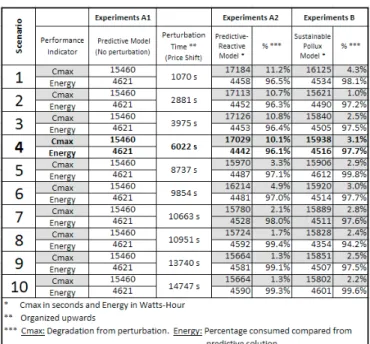
Even though a forecasted price can be estimated during the workday, it is considered a shift of the energy price as a perturbation and will be limited to 10% from the predictive price. The perturbation time is simulated stochastically by a uniform function U (0, predictive Cmax). The Cmax, also known
as makespan, is the completion time of the last job processed of the production order.
efficiency goals are production and inventory costs for the economic dimension, labour practices and community enrolment for the social dimension, and total energy consumption and CO2 emissions for the environmental
dimension.
Switching mechanism (SM): the SM is an entity that optimizes the CSA in real-time. It focuses on the steering and the optimization of the operating mode based on the sustainability performance metrics. At first, it defines a global performance metrics based on effectiveness and efficiency indicators. Then, given a threshold for these metrics, these are monitored as part of the control of the system performance. If these are infringed, the SM adjusts the operating mode by an improvement-search heuristic based on a trade-off between efficiency and effectiveness indicators. Finally, for the adjustments, the switching mechanism applies the new operating mode and rectifies the system performance. The SM process is a continuous and automated operation executed every time it is needed to balance the efficiency and effectiveness objectives. For example, if the throughput per timeframe is below a certain threshold, the switching mechanism will change the operating mode to favour the effectiveness indicator at the expense of the efficiency one. Likewise, if the energy consumption average is overstepped, the switching mechanism will change the operating mode favouring the efficiency regardless the effectiveness. This process can be handled using elaborated approaches such as evolutionary algorithms, swarm algorithms or neural networks, or simple ones like heuristics or iterative algorithms, depending the degree of optimality desired in SM process (Jimenez et al. 2016). In the next section, sustainable Pollux is applied to manage an energy-awareness scheduling and control of a flexible manufacturing system.
3. ENERGY-AWARE MANUFACTURING CONTROL: A CASE STUDY
For illustration purpose, this part describes the implementation of sustainable Pollux in the context of energy-aware manufacturing control. Energy is one of the most significant metric to address in sustainable manufacturing as industries consumes a significant portion in the global economy (Prabhu et al. 2015). Industries have traditionally disregarded the optimization of energy consumption as it was considered as a low-cost and unlimited resource that barely impact over manufacturing operations. However, eco-friendly concerns, inflated energy cost and market price dynamics have currently soar the interest of integrating energy-awareness in manufacturing decision-making (Giret et al. 2015). An example of this awareness and the consequence in manufacturing decision-making is the price-based demand in energy contracts. This contract, currently available in several European countries, has a short term price shifts in energy for influencing power consumption (Detzler et al. 2015). Consequently, industries optimize the consumption by adapting its operations according to these fluctuations. In this research, we focus on this area of application as currently manufacturing operations can be disrupted through the energy-price fluctuations.
3.1 System Description
The case study presented in this paper is inspired in a real full-size flexible manufacturing system (FMS) located in AIP-PRIMECA laboratory in the University of Valenciennes (France). The full description of the system is given in (Trentesaux et al. 2013), while the layout of the FMS is illustrated in fig. 2. The system consists of 6 machines connected by a conveyor system. For the case study, it is required to produce 490 jobs (70 units of each letter, as A, I, P, B, E, L, and T), which are guided by shuttles within the conveyor of the FMS. This production order of 490 jobs was
chosen due to the empirical production time without disruptions last between 5 and 7 hours.
The usual control problem to address for this FMS is to solve the dispatching order of the jobs, the machine allocation for each job and the routing path of the job in the conveyor system. In order to integrate sustainability issues in the proposed case study, an additional decision of turning the machine on/off is included to this problem since it represents a significant reduction of energy consumption in manufacturing operations (Mouzon et al. 2007). Therefore, a machine may be off, idle or working during execution. However, for easing the instantiation complexity and bounding the problem flexibility in this case study, this new decision is considered only for redundant machines (M4 and M7). Overall, the problems to solve in this case study, the operating mode in this system is the traditional dispatching, machine sequence and jobs routing of the FMS plus the machine on/off allocation.
In addition, and to be consistent with the introduced context dealing with the future of energy management in industries, it is considered an energy contract as a price-based demand.
Even though a forecasted price can be estimated during the workday, it is considered a shift of the energy price as a perturbation and will be limited to 10% from the predictive price. The perturbation time is simulated stochastically by a uniform function U (0, predictive Cmax). The Cmax, also known
as makespan, is the completion time of the last job processed of the production order.
Fig. 2. FMS in the University of Valenciennes
3.2 Implementation
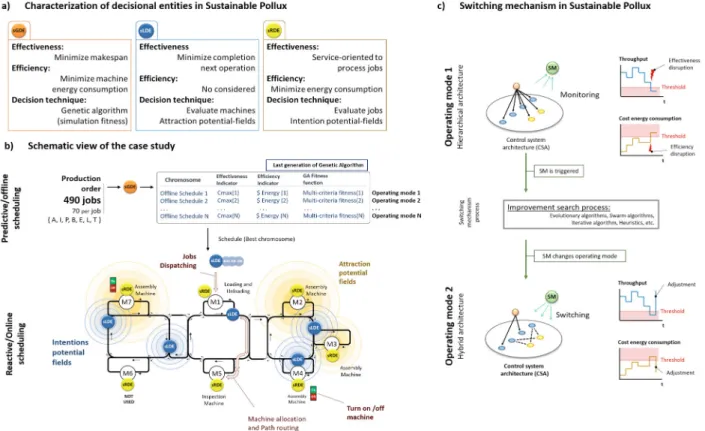
In this case study, the CSA of sustainable Pollux consists of one sGDE, 490 sLDE and 6 sRDE and it is characterized as follows: The sGDE, configured with a predictive/offline scheduling technique, solves the jobs dispatching, machine allocation, jobs routing and machine turn on/off for the production orders. It transfers these decisions to the sLDE and sRDE as instructions for execution under normal conditions. The sGDE hosts a multi-objective genetic algorithm (called MO-GA) whose fitness function is a simulation model developed in the agent-based simulation software called NETLOGO (Wilensky 1999). In this multi-objective problem, the fitness function is an aggregated weighted trade-off between the Cmax (s or seconds) and the energy consumption (W-h or watt-hour) calculated with a weighed sum method. For this, it is used a weight WCmax of 0.226 and a WEnergy of 0.774
assigned empirically in order to normalize the values from the effectiveness and efficiency objectives. The benefit of using a genetic algorithm is that it is a population-based metaheuristic that constructs several offline schedules with similar aggregated weighted trade-off value but differing in the effectiveness and efficiency objectives. Consequently, each individual from the last iteration of the GA is used to represent a possible operating mode for the production execution. Then, while the best individual is used as initial operating mode and starts the production execution, the other individuals are kept as alternative operating modes to be used in case of perturbations.
When a disruption is detected, sLDE and sRDE ignore the instruction of the sGDE and conduct their own default decision
mechanism. For that purpose, a heuristic based approach, namely potential fields (Zbib et al. 2012), has been selected. While the sLDE solves the machine allocation and path routing online through an attractive potential fields, the sRDE solves the machine turn on/off decision through an intentional potential field. The potential fields technique (Zbib et al. 2010) is a reactive technique where a decision is made accordingly to fields emitted by a corresponding entity. For the attraction potential fields, the sLDE evaluates the attraction-value acknowledged by machines (e.g. availability and proximity) in order to be directed reactively to the next machine. For the intentional potential fields, the sRDE evaluates the intentions acknowledged by jobs (e.g. frequency and duration) in order to reactively turn on/off online the corresponding machine. Fig. 3a resumes the characterization of the sGDE, sLDE and sRDE for the sustainable Pollux and fig. 3b illustrates the schematic view of the case study showing the sGDE, sLDE and sRDE decision-making techniques.
For the trade-off in the SM, fig 3c illustrates the switching mechanism in sustainable Pollux. Here, it is defined an effectiveness and efficiency thresholds as 15% of the throughput and the energy consumption (each 15 min) in the predictive-offline solution without perturbation. It is chosen the throughput since it is a classical local performance indicator during the execution. For responding to disruptions, an improvement search heuristic seeks an alternative operating mode (i.e. the set gathered from the MO-GA’s last generation) that favours the affected objective. For instance, if the cost of energy increases, the SM searches for an alternative operating mode that has a reduced value in the efficiency indicator (e.g. energy consumption) regardless the effectiveness (e.g.