Definition of Application Scenarios
G. Biegel, G. Blair, V. Cahill, A. Casimiro, K. Cheverst,
R. Cunningham, A. Fitzpatrick, A. Friday, G. Gaertner,
B. Hughes, J. Kaiser, R. Meier, N. Riejers and P. Veríssimo
DI-FCUL
TR–03–14
July 2003
Departamento de Informática
Faculdade de Ciências da Universidade de Lisboa
Campo Grande, 1700 Lisboa
Portugal
Technical reports are available at http://www.di.fc.ul.pt/tech-reports. The files are stored in PDF, with the report number as filename. Alternatively, reports are available by post from the above address.
Project IST-2000-26031
CO-operating Real-time senTient objects:
architecture and EXperimental evaluation
Definition of Application Scenarios
CORTEX Deliverable D1
Version 1.0
Revisions
Rev. Date Comment
0.1 21/10/2001 Integration of partner contributions
0.2 30/10/2001 Integration of updates from TCD and Ulm
0.3 31/10/2001 Integration of updates from Lancaster
0.4 06/11/2001 Proofreading and cross reference checking
1.0 Final version
Editor
Vinny Cahill, Trinity College Dublin
Contributors
Greg Biegel, Trinity College Dublin Gordon Blair, University of Lancaster Vinny Cahill, Trinity College Dublin Keith Cheverst, University of Lancaster Antonio Casimiro Costa, University of Lisbon Raymond Cunningham, Trinity College Dublin Aidan Fitzpatrick, Trinity College Dublin Adrian Friday, University of Lancaster Gregor Gaertner, Trinity College Dublin Barbara Hughes, Trinity College Dublin Jörg Kaiser, University of Ulm
René Meier, Trinity College Dublin Neils Riejers, Trinity College Dublin Paulo Jorge Verissimo, University of Lisbon
Address
Department of Computer Science, Trinity College Dublin,
Table of contents
CHAPTER 1 INTRODUCTION...1
CHAPTER 2 CHARACTERISTICS OF APPLICATION SCENARIOS...2
CHAPTER 3 APPLICATION SCENARIOS...4
3.1 Flare scenario ...4
3.1.1 Consistency ...4
3.1.2 Autonomy...5
3.1.3 Cooperation ...5
3.1.4 Requirements Analysis...5
3.1.4.1 Requirements from the environment...5
3.1.4.2 Requirements from the computer system...6
3.1.4.3 Techniques/mechanisms ...6
3.1.5 Feasibility...7
3.2 Air Traffic Control Scenario ...7
3.2.1 Consistency ...7
3.2.2 Autonomy and Cooperation ...8
3.2.3 Requirements Analysis...10
3.2.3.1 Requirements from the environment...10
3.2.3.2 Requirements from the computer system...10
3.2.3.3 Techniques/mechanisms ...10
3.3 Utilities Industry Scenario...10
3.3.1 Autonomy...11
3.3.2 Consistency ...11
3.3.3 Cooperation:...12
3.3.4 Requirements Analysis...12
3.3.4.1 Requirements from the environment...12
3.3.4.2 Requirements from the computer system...12
3.3.4.3 Techniques/mechanisms to be used ...13
3.3.5 Feasibility...13
3.4 Assisted Terrestrial Transportation System Scenario...14
3.4.1 Autonomy...16
3.4.2 Cooperation ...16
3.4.3 Consistency ...16
3.5 Remote Control of Real-time Operations Scenario...16
3.5.1 Autonomy...18
3.5.2 Consistency and Cooperation...18
3.6 Teleoperation Scenario...19
3.6.1 Autonomy...21
3.6.2 Consistency ...21
3.6.3 Cooperation ...21
3.6.4 Requirements Analysis...21
3.6.4.1 Requirements from the environment...21
3.6.5 Feasibility...22
3.7 Cooperating Cars and Floating Car Data ...22
3.7.1 Autonomy...24
3.7.2 Consistency ...24
3.7.3 Cooperation ...24
3.7.4 Requirements Analysis...25
3.7.4.1 Requirements from the environment...25
3.7.5 Feasibility...25
3.8 Smart (in-house) Delivery System Scenario ...25
3.8.1 Autonomy...26
3.8.2 Consistency ...26
3.8.3 Cooperation ...26
3.8.4.1 Requirements from the environment...26
3.8.5 Feasibility...27
3.9 Robots in Flare Scenario ...27
3.9.1 Autonomy...28
3.9.2 Consistency ...28
3.9.3 Cooperation ...28
3.9.4 Requirements Analysis...28
3.9.4.1 Requirements from the environment...28
3.9.5 Feasibility...29
CHAPTER 4 SUMMARY AND CONCLUSION...30
Chapter 1 Introduction
As described in [1], the purpose of this document is to identify and analyze a set of application scenarios that, on the one hand, exemplify those application areas that might benefit from the technology being developed within the CORTEX project and, on the other hand, might serve as a source of requirements on this technology. Furthermore, at least a subset of the application scenarios considered here is expected to serve as source of demonstrator applications later in the project.
We proceed as follows. Chapter 2 provides a brief overview of the most important properties that are expected to be exhibited by the applications addressed by CORTEX, as outlined in [1], and introduces the scheme that we have adopted for classifying candidate applications in this document. The classification scheme essentially considers applications under three key characteristics: 1) autonomy - the degree to which the participants in the application act solely based on the acquisition of information from the environment and on their own knowledge; 2) consistency - the degree to which participants in the application need to have a mutually consistent view of the application environment; and 3) cooperation, the degree to which the participants in the application need to cooperate in order to achieve their goals. Chapter 3 describes the analysis of a number of proposed application scenarios in detail outlining the scope of each scenario, how it has been classified with respect to the other scenarios and, of course, the specific requirements that it places on the CORTEX technology. For each scenario, the feasibility of basing a demonstrator application on that scenario is also considered. Chapter 4 summarizes the results of this survey.
Chapter 2 Characteristics of Application Scenarios
Fundamentally, CORTEX is concerned with enabling the vision of ubiquitous computing and future proactive applications, those that operate independently of direct human control, by researching the development of intelligent middleware supporting appropriate computational models for this new generation of applications. This middleware must support growth and adaptability to new technologies, and has to provide the hooks for these applications to enforce non-functional quality attributes like reliability and timeliness. In particular, the middleware is intended to cope with applications that have some or all of the following characteristics:
• Sentience – the ability to perceive the state of the surrounding environment, through the fusion and interpretation of information from possibly diverse sensors;
• Autonomy – components of these applications will be capable of acting in a decentralized fashion, based solely on the acquisition of information from the environment and on their own knowledge;
• Large scale - typical applications may be composed of billions of interacting hardware and software components;
• Time criticality - these applications will typically interact with the physical environment, and will have to cope with its pace, regardless of adverse conditions due to scale and technology shortcomings;
• Safety criticality – typical applications will interact with human users, whose well being will frequently rely on them;
• Geographical dispersion - unlike current embedded systems, typical applications will integrate components that are scattered over buildings, cities, countries, and continents;
• Mobility – furthermore, they must possess the ability to move between hosts possibly of different networks, while remaining in continuous operation
• Evolution – these applications will have to cope with changing conditions during their lifetimes. Not only must the applications be designed to evolve, but their underlying support must also be adaptable.
It is unlikely that every or indeed any one application will exhibit all of these characteristics at the same time. Indeed, it can be expected that most applications will exhibit only some of these characteristics. What seems clear is that the most challenging applications are those that mix autonomy of application participants, derived from sentience, with the need to maintain a consistency view of the application environment while possibly cooperating with other participants.
Autonomy is a central feature of the participants in the kind of proactive applications being targeted by CORTEX and, in some sense, the motivation for sentience, which provides autonomous components with the knowledge required for independent action. While there is clearly a spectrum of levels of autonomy, CORTEX is clearly targeted at applications where some degree of autonomous behavior is required.
While sentience provides participants in an application with knowledge of the environment it is clearly important that the view obtained by the participant is consistent not only with the views of other participants but also with the real world. Consistency then is another key feature of the applications addressed by CORTEX, which in some sense subsumes requirements such as timeliness.
Consistency is also the basis for cooperation between autonomous components. While not all applications will involve explicit cooperation in order to achieve application goals,
cooperation will often be required implicitly to ensure properties such as safety and at a system level to priories the use of computational resources.
With these observations in mind, the CORTEX project has used a three-way classification of candidate application scenarios to expose the key differences between the scenarios being considered as well as to ensure that the candidate scenarios cover a wide range of usage scenarios.
To be precise, the classification scheme considers applications under three characteristics: 1) autonomy, the degree to which the participants in the application act solely based on the
acquisition of information from the environment and on their own knowledge
2) consistency, the degree to which participants in the application need to have a (mutually) consistent view of the application environment; and
3) cooperation, the degree to which participants in the application need to cooperate in order to achieve their goals.
Each candidate application scenario is considered under these headings in Chapter 3 and the applications compared with respect to these headings in Chapter 4.
Chapter 3 Application Scenarios
3.1 Flare
Scenario
“Shoot 'em up” style games like Doom and Quake have become very popular in recent years. Paintball, a real world outdoor “Shoot 'em up” game using paint-filled pellets as bullets, and Lasergame, an indoor game, which uses laser beams and sensors on the players' suits, have also become very popular.
Flare is a framework for building augmented reality applications, the first application of which will be a Doom-like game combining the Doom/Quake experience with Paintball/Lasergame play to make an augmented reality game where players move around in the real world, while interacting with virtual and real players. Players will see a Doom-like game on their screen, providing a virtual representation of the real world. Their real world position will determine their location in the game. There will be both real players and virtual, computer controlled, bots in the game. Players can shoot bots and other players and pick up things like ammunition or medikits as in a normal Doom game. Players will be able to join and leave the game as they please, but the game will cease to exist when the last player leaves.
Flare will be run on wearable computers. A wireless ad hoc network will be used for communication, and Differential Global Positioning System (DGPS) and possibly other sensors to determine location. Flare will be developed in three stages. The first version will use group communication and support fault- and partition-tolerance using a single group for the entire game. Players will communicate through the group, broadcasting information like their new position, or the fact that they have fired their guns. Nodes will only update the game state as a result of receiving a message. The group communication API will support non-blocking communication even when the network is partitioned, delivering messages to the partition instead of the whole group. The receiving nodes are notified of this, and can respond to this to maintain consistency.
The second version of Flare will use multiple groups. The game area will be split into multiple zones and different groups will be used for different zones. Different groups will also be used for different interests. For instance, all bots and players in a team could use a team group to coordinate their attack. Thus, the second version will have filtering using multiple groups based on both location and interest. The third version will extend Flare with event-based communication.
Zones map nicely onto the second version of Flare where multiple groups are used for different geographical locations. These can be seen as zones, which, because of there smaller geographical size, can give higher quality of service (QoS) guarantees than would be possible if the whole game was one big zone. Basically players and bots within a zone play the game almost separately from the rest of the players, and will only require communication with the others for important events.
3.1.1 Consistency
Since this is a game application, users are bound to disconnect suddenly if they get bored with the game. The use of mobile computers and wireless networks also makes failures and network partitions likely. To allow the game to progress as much as possible in this environment, the game state will be replicated on all nodes, and the game will use producer/consumer communication instead of the client-server model that is common for these games. A client-server model would be unsuitable because nodes that lose contact with the server cannot make progress and if the server failed the whole game would stop.
Having replicated data means that we need to formulate consistency requirements. The easiest choice would be to require all nodes to have a consistent view of the game, but the game would have to block if the network is partitioned. Since we want to make progress in the presence of partitions as well, we define different levels of consistency.
We will have objects in the game, like medikits, for which we don't mind if the state becomes inconsistent when a partition occurs. This means that two players can potentially pick up the same kit. We will have objects for which we will allow one partition to do updates, and will simply copy that to the other when partitions remerge. For example, in a "capture the flag" type game, we cannot allow two players to pick up the same flag. Therefore we would allow only one partition to change the state of the flag, so they can pick it up. Deciding which partition can change the state would be done using location information, so partitions would be allowed to change the state of objects that are close to them, which will hopefully minimize the negative effects of the partition. Finally, we will have state information for which it is absolutely required that all nodes have the same value. For example, deciding who won the game. Since this will end the game, we want all players to agree on a common winner, and so no winner can be elected if the network is partitioned.
3.1.2 Autonomy
Obviously, the players in Flare are autonomous and will make decisions based both on their perceptions of the real world and the virtual world. The bots will also operate autonomously in the game under computer control although their actions are fairly limited. Although their state is fully replicated, there will be one node that is responsible for initiating the bot's actions. Deciding on which node this is will probably be done using location information to keep the physical location of the node as close to the virtual location of the bot as possible. A bot will have to autonomously decide that it wants to move to another node and initiate the appropriate protocol to do this.
3.1.3 Cooperation
Cooperation is not very important in Flare, but the game rules could be modified to include teams fighting each other. In this case, the bots and players would need to cooperate to win the game. The goals can be changed to make this more challenging. An example would be two teams that have to shoot all members on the other team. But the goal could also be to plant a bomb, to rescue hostages or to capture a flag. For these goals the level of cooperation and the complexity of the autonomous behavior would be much higher.
3.1.4 Requirements Analysis
3.1.4.1 Requirements from the environment Flare does not address:
• Large number of physical entities: flare will be played with a small number of players.
• High geographical dispersion of entities: the players will play in a limited game space that has been modeled as a virtual world.
• Human safety relies on computer-controlled entities: playing the game is unlikely to put the physical well being of the participants at risk.
Flare does address the following:
• Computer control of entities requires timely response: in order to make sure that what happens in the game is consistent with the chain of events observed in the real world, there will be timeliness requirements for message delivery.
• Subset of entities should be highly mobile: the players will move around quickly in the real world.
• State of entities changes rapidly: players shooting and dying, things being picked up and dropped.
• Feasible to demonstrate: the infrastructure necessary to implement such a system is available.
• Relevance for society/industry: the popularity of these types of games proves they are relevant to society.
3.1.4.2 Requirements from the computer system Flare does not cover:
• Support for scalability: the game will be played with a limited number of players only, scalability is not an issue.
• Support for real time computing enforcing hard QoS requirements: there are quite demanding timeliness requirements on message but failing to deliver a message in time is not catastrophic.
• Support for adaptability/evolution of the system: the system only evolves in the number of players.
• Support for heterogeneity and openness: the game is essentially closed although the use of different game devices can be envisaged.
Flare does cover:
• Support for fault-tolerance: the game should react in a consistent and well-defined way to partitions and failures while still allowing players to make as much progress as possible.
• Support for autonomy: both, the players and the bots will behave autonomously. • Support for sentience: both, in the real world through location sensors and in the
virtual world for the bots.
• Support for mobility with wireless communication: the game will be played on wearable computers with wireless 802.11 network cards.
3.1.4.3 Techniques/mechanisms Not useful in Flare:
• Real-time networks • Actuator technology Useful in Flare:
• Filtering: a version of Flare will use filtering of messages both geographically and functionally.
• Group communication: only one group will be used in the first version, but multiple groups in later versions.
• Event-based communication. • Cooperation mechanisms.
• Sensor technology: different position sensors will be used to determine the player's location.
3.1.5 Feasibility
Perhaps the main reason why Flare is an interesting application scenario is because of its feasibility. It could be implemented in a relatively short period of time, and it can be run using inexpensive hardware. Another advantage of using Flare is that because it is a game, we can chose the rules in such a way as to address the issues in which we are interested. They are not fixed by real world requirements, so we can make things as easy or as hard as we like and explore different directions.
3.2 Air Traffic Control Scenario
CORTEX aims to provide sentient objects - mobile intelligent agents, which accept input from a variety of different sensors and reacting to what they have sensed from the environment. One of the main challenges of the CORTEX project is to ensure timeliness and predictability when confronted with a dynamic environment.
In the Air Traffic Control (ATC) scenario, the sentient objects are the aircraft. The main reason that we consider ATC as a possible CORTEX application is that the central goal of CORTEX, to provide completely autonomous, decentralized cooperating agents, must be met in ATC or the results will be catastrophic. The ATC scenario requires a high degree of autonomous behavior, strong consistency and a high degree of cooperation among the sentient objects.
The ATC scenario is envisaged as providing a “free flight” system. Each aircraft will be equipped with sensing equipment to detect other aircraft in the immediate airspace. This could be thought of in terms of the WAN-of-CANs type architecture. Each aircraft has an internal CAN architecture, which is then controlled over a wider airspace. As stated above, the ATC scenario has requirements for high consistency, high autonomy and cooperation. Each of these will be further discussed in the following sections.
3.2.1 Consistency
In the ATC scenario aircraft will share airspace, and sense their immediate environment to determine the existence of other aircraft. Changes of status (e.g., changing speed, direction, altitude, etc.) of the other aircraft must be constantly monitored. The only way that an aircraft can make a judgment as to their “next move” is if each is guaranteed an up-to-date snapshot of their immediate vicinity. This snapshot must have a timeliness and correctness guarantee. Craft share a common environment; therefore it must be ensured that all craft share a common view as to the state of the environment.
This consistency requirement is paramount for the operation of a free flight scenario, and without it the results would be catastrophic. The following real-world scenarios highlight this requirement.
Monitoring airspace and “special rules airspace”
At present, there is a requirement to continually monitor the airspace that an aircraft is currently in. The current airspace is a moving target, i.e. continually updated throughout the flight and is subdivided into groups. En route, the aircraft moves between groups. An important point is that there are “special rules airspaces” which includes standard transport craft and military craft.
For free flight there would need to be continuous snapshots of the current airspace, consistently updated to all those in the proximity of the current aircraft. Proximity detection, to determine the current positioning of other craft, coupled with high-speed sensor equipment to ensure high consistency is required.
A question about the implications of the military craft in the same airspace as normal aircraft would have to be raised. Would they participate in the same form of groupings? We have assumed that free flight will exist for standard flights and special conditions will use the
existing Air Traffic Control system. If free flight means that there is no longer ground control interaction, and aircraft detection is based on sensing an object in the immediate environment, the idea of airspace as an entity is no longer required. An aircraft will monitor its position with respect to all others that it can detect.
Monitoring separation standards for differing aircraft types
We are assuming that aircraft have sensory equipment such that they can sense other aircraft within a large area, this is similar to the current use of radar controllers monitoring the current airspace of the craft, throughout the course of a flight. There are currently separation standards in place for both vertical and horizontal distance between planes. The distance must take into account the size, load and type of aircraft, for free flight; these considerations must also be taken into account. The direct implication of this is that each craft must be able to determine proximity but also aircraft type, and use all these parameters to determine a safe separation distance.
Handling “over flying”
A concept of over flying, which for current ATC means the craft are not actually in a dedicated airspace, exists. This would be directly handled by removing the reliance on defined airspaces, and passing control between the ATC handling each airspace. As stated above, we are assuming that the traditional airspace concept no longer exists, over flying is therefore not an issue.
Hard real-time timeliness requirements
There are time-critical consistency requirements for all aircraft within a defined distance of one another. They must always have a current snapshot of the other participants of their group. Each aircraft has a high level of autonomy, as realistically they can plot their own course, but essentially, as will be described, this is effectively within agreement from the other craft in their group. A group may be taken as the set of other aircraft that are currently detectable.
We are proposing a protocol whereby a plane wishing to change its course (or to do any operation that may have an impact on others) sends out a multicast message to all aircraft that it knows about. This is analogous to dynamic membership in group communications. There must be some mechanism to ensure that all the planes affected agree that the change of course can be taken. Essentially, the initiator must block awaiting a consensus on the proposed change. Only when this is achieved should the change take place.
What happens in the case of failed aircraft, i.e., an aircraft that does not receive the multicast message. Essentially, the initiator must hold off making a move until a reply has come from all the participants that are affected by the move. This could lead to deadlock where no plane can actually make progress. Absolutely hazardous, no plane could change its direction, altitude, or speed.
3.2.2 Autonomy and Cooperation
Free flight implies completely autonomous aircraft. The days of filing flight plans, negotiating with control towers for such things as route congestion avoidance have been left far behind. The aircraft now have complete control from start to finish. This obviously provides a high level of autonomy, however there are occasions when cooperative behaviour is required. For example, any changes to aircraft course must be broadcast to all those who may be affected, take-off and landing require a large amount of negotiation and cooperation and are dealt with specifically in sections following.
Handling route congestion
ATC, at present, attempts to remove route congestion. For free flight systems, this would have to mirror the Assisted Terrestrial Transportation System (ATTS) scenario (see section 3.4). Essentially if one craft can determine that the current route is overly congested, it can propagate this information to others within the group, which may mean that they leave the current group and join another. Essentially meaning that the other craft have decided to change their flight path.
Special Landing requirements
Special consideration must be taken at landing. Essentially there are defined “holding stacks” where aircrafts wishing to land must circle. Essentially an aircraft must negotiate with others if/when it is permitted to land. We consider the landing area as a priority queue, where each aircraft requesting to land broadcasts to all those in the queue, their current status. For example, the amount of fuel they have left or any on-board conditions that must be taken into account when deciding their position in the holding queue. Each aircraft could be given an initial priority, which may require rapid update if there are any changes to the state of the aircraft. The consistency of the information for all the craft in the holding queue is paramount, and their cooperation in deciding the outcome should a queue reorganization be requested is essential. Situations where there may be a race for a particular slot in the queue must be fairly arbitrated. How would fairness be guaranteed throughout the queue? This scenario highlights the requirements for cooperation amongst the participating planes.
Special considerations for take-off
The take-off scenario is similar to the above. Again, there must be some form of priority queuing mechanism to ensure fairness amongst all craft awaiting departure. The constraints on the queue may be simplified as there may not be a requirement to maintain the priority of the queue, this could be a FIFO ordered queue instead. Take-off is similar to the scenario above, where a highly cooperative group structure is required amongst the planes.
Handling international standards/boundaries
Some further thoughts would be required on areas such as: International standards, boundaries, sectors and sector controllers. For example, at present craft from some countries are prohibited from flying over others. The “flight plan” defined for the aircraft would stringently avoid these areas. If free flight is to include total dynamic route management, this implies craft are basing their decisions on such information as weather conditions, congestion etc. in an attempt to traverse the optimal path for the current destination. In addition to these factors, information on boundary control etc. would have to be taken into consideration, implying that there must be some way that the craft can sense when it is passing from a free sector to what would be a restricted sector. Similar to ATTS the first aircraft to detect this situation can propagate this information to all others, removing the requirement that each craft independently find out and react to this situation.
To summarize autonomous and cooperative behavior
The level of autonomy of the aircraft would seem to increase the further they move away from the airport. There is a large amount of negotiation that needs be performed when requesting to take off, and requesting to land, and all other craft within the vicinity of the airport, both grounded and airborne, are involved in these negotiations. En route, the aircraft within a defined proximity of each other are involved in negotiation only.
All aircraft must have a completely consistent view of all other aircraft in their vicinity. We have assumed that this view is maintained by sensing the other craft. Alternatively, an updated view is sent to a known group, the membership of which is dynamically updated, along communication channels. For an aircraft to perform any sort of maneuver, it must receive a consensus from the other members in its vicinity (or in the group). The implication of this is that there is a high level of cooperation required for an aircraft to make progress.
3.2.3 Requirements Analysis
3.2.3.1 Requirements from the environment ATC does address the following:
• A dynamic and potentially very large number of physical entities.
• Hard timeliness requirements: there are real world considerations in ATC, whereby a missed deadline has catastrophic results
• The state of the entities may change rapidly: any unforeseen event, such as engine failure, will require an immediate course of action to be taken for the new state.
•
The idea of free flight has been gaining momentum in recent times, therefore theATC scenario is gaining popularity. 3.2.3.2 Requirements from the computer system ATC would have to cover:
• Support for autonomy.
• Support for scalability: the dynamics of the environment are ever changing. Essentially there is no upper limit on the planes involved.
• Support for time dependent real time computing enforcing hard QoS requirements. • Support for adaptability/evolution of the system: the ATC would have to evolve with
changes in the aviation industry.
•
Support for fault-tolerance: at all times a fault in the system implies a huge cost and potential loss of life.3.2.3.3 Techniques/mechanisms Useful in ATC: • Real-time networks • Anonymous communication • Actuator technology • Group communication • Event-based communication
3.3 Utilities Industry Scenario
In order to provide electricity to its consumers the power distribution industry has to manage a mass of complex cabling and each regional electricity company (REC) has to deal with managing the supply of electricity to approximately 1.8 million electricity consumers. Problems with the power distribution arise quite frequently and when such problems occur and consumers are left without supply there is strong financial incentive for the REC to return supply as soon as possible. Usually when a fault occurs on the network it is necessary to re-route supply via an alternative path, this is known as ‘switching’. Field engineers are required to physically perform switching operations at ‘Switching stations’. In the current system, a control centre is responsible for coordinating the work of field engineers and for maintaining an up-to-date view of the network state. For reasons of safety, it is crucial that such a view be maintained and that no inconsistencies regarding the current network state exist. In order to maintain the consistency of network views the control centre imposes a sequential ordering on all operations affecting the network.
The current centralised approach has the inherent problem that during periods of intensive activity, e.g. during an electrical storm, the control centre can become a system bottleneck. This situation is clearly not acceptable, and a less centralised control structure needs to be put in place. Ideally, this would be achieved by distributing (i.e. replicating) the current network view amongst all concerned, rather than permitting the control centre to hoard the current view. There are obviously strong implications for maintaining consistency where multiple copies of the current network view exist. These implications are made all the more dramatic when one considers the unreliable communications infrastructure available for sending updates between the control centre and mobile field engineers.
Our approach with the MOST project was based on distributed object technology (ansaWARE) augmented by groups - we did not consider a sentient object type solution and did not focus on dependability. However, an approach based on sentient object behaviour would appear to be a possible solution for achieving decentralised control - especially given the need to maintain levels of dependability in this essentially safety critical application domain. Such as approach could utilise agents, e.g., safety agents, in order to augment the distribution of control and support cooperation.
3.3.1 Autonomy
The following list provides a sample of the type of autonomous agents that could be used in this application scenario:
• safety agent - performs autonomous network switching in order to ensure the safety of an engineer.
• task agent - manages the tasks of a human field engineer, e.g. when a given network operation should be carried out.
• scheduling agent- allocated resources required to perform a schedule of work - this is likely to be achieved in a context-aware manner - for example which engineers are geographically close to the fault area, etc.
• control agents - take the work of augmenting the role of a distributed control centre - these define zones of dependability.
• awareness agent provides a field-engineer with an awareness of activity of others.
3.3.2 Consistency
We envisage the notion of 'Zones of consistency'. Agents need to work on some level of consistent network view - within zone - where zone relates to a zone of dependability. This zone can therefore be dynamic based on parameters such as connectivity.
There is clearly a strong requirement for consistency within a zone and possibly overlap between them. Timeliness is also important with respect to maintaining consistent views. For example, consider 3 engineers, A, B, C such that at some time they all have consistent global view. Now A receives an update to the global view that is not received by B and C at the same time. The result is that partitioning takes place such that A is effectively operating within one zone of consistency while B and C operate within another.
Timeliness of propagation of state change is (context) dependent upon the criticality of the update, e.g. a change in location of a field engineer is probably less critical than notification that a given HV feed has become live.
Another dimension that pervades this environment is trust. Trust is a difficult and unresolved issue in fixed environments such as the Internet, but is even more difficult when you introduce elements of sentience, mobility, disconnection, autonomous and anonymous execution, etc. In safety critical situations it is however crucial to be able to trust available
data, advice from agents, etc. it is therefore a very interesting issue to investigate how elements of trust (e.g. of consistent views) can be provided in such sentient environments.
3.3.3 Cooperation:
The need for co-operation manifests itself in a number of ways
• Cooperation between safety agents negotiating fail-safe behaviour.
• Cooperation between agents and field engineers and control centre though control centre may not be decentralised.
• Cooperation between control agents and safety agents • Task agents cooperate with awareness agents.
3.3.4 Requirements Analysis
3.3.4.1 Requirements from the environment UIS does address:
• Large number of physical entities: e.g. switches, cables & other active network components. Teams of engineers (simulated/ emulated).
• High geographical dispersion of entities: Entities (see above) would typically be dispersed over at least a countywide area (optionally country wide).
• Human safety relies on computer-controlled entities: In a ‘real’ deployment situation, the application is highly safety critical – both in terms of Engineer safety and power supply to critical/ high priority users (e.g. hospitals, dialysis machines etc.).
• Computer control of entities requires timely response: in order to make sure that changes to the physical network state are consistent and are propagated in a timely manner to ensure that coordinated behaviour is achieved.
• Hierarchies of dependability/ zones of consistency: Power distribution networks have implicit hierarchy (high voltage, low voltage etc.) and task federation (e.g. delegation of repair tasks which occur within a specific localised region of the network).
UIS does not address the following:
• Subset of entities should be highly mobile: the network entities are stationary and field engineers change location infrequently (with respect to changes in network state).
• State of entities does not change rapidly: network state changes occur only after careful and coordinated action. However, once a change occurs state propagation must occur with strong real-time constraints (i.e. speed of light!).
• Feasible to demonstrate: the implications of real world deployment, which is not viable given the physical and financial constraints of the Utilities Industry.
3.3.4.2 Requirements from the computer system UIS does cover:
• Support for scalability: Potential number of entities that must be modelled/ simulated is large (digital representation of the established physical infrastructure is an ongoing issue due to the complexity of the system).
• Support for real time computing enforcing hard QoS requirements: there are strong real-time requirements (see above).
• Support for fault-tolerance: the system should react in a consistent and well-defined way to cope with to partitions and failures.
• Support for autonomy: network entities, safety agents etc. must be capable of autonomously behaviour.
• Support for sentience: network entities and software agents guarding personal safety must have limited sentience (e.g. detection of a cable fault, triggering action in a higher level safety agent).
UIS does not cover:
• Support for adaptability/evolution of the system: the system only evolves in terms of interaction between the various agents & entity state.
• Support for heterogeneity and openness: a real end-user system would need to address these issues (due to the federation of the power supply function within UK). However, within our prototype this is not a clear focus.
• Support for mobility with wireless communication: the simulation / emulation environment need not require mobile computation nor wireless communications (these may be simulated). Field prototypes may have such requirements.
3.3.4.3 Techniques/mechanisms to be used Useful in UIS:
• Real-time networks: Timely propagation of network state changes (or actions that affect such state) is a high priority.
• Cooperation mechanisms: Sharing of consistent views of network state is an essential part of the system.
• Group communication: Group semantics and QoS specifications on group communications are important for ensuring management of timely state sharing, network partitioning etc.
• Event-based communication.
• Filtering: filtering in terms of grouping, proximity to the distribution network or by distribution hierarchy, may be important in UIS.
Not useful in UIS:
• Actuator technology: Real network switching actions would be possible with actuators (not required for simulation or emulation however).
• Sensor technology: Power distribution sensors (cable liveness, switch state etc.) would be needed in a real deployment scenario.
• Anonymous communication. • Wireless networks.
3.3.5 Feasibility
Due to the highly safety critical nature of the Utilities Industry, full end-user participation is unlikely. However, we have experience of developing fault scenarios within this domain and believe that we have sufficient expertise in order to develop tailored fault scenarios in order to exercise the criteria outlined above. Furthermore, we envisage developing a simulation/ emulation environment in which to construct working prototypes to exercise specific fault scenarios. Such scenarios do not place strong requirements on specific hardware and software platforms.
3.4 Assisted Terrestrial Transportation System Scenario
In modern societies the role of “time” is of the utmost importance. There is continuous pressure to perform actions according to predefined schedules or within given time intervals. Typical examples are: waking up at 7h30, arriving at work before 8h30, lunch in 1 hour, go to a meeting on the other side of the town at 15h00, pick up the children at school before 18h30, etc. However, due to the inherent scale, openness and complexity of the environment in which we live, there are many non-controllable factors that introduce uncertainty on the time it takes to accomplish certain things, such as traversing a town during rush hour.
The vision of the CORTEX project is that modern technologies can be used, with the help of adequate architectures, to address issues like the one described above. The scenario described below, while putting in evidence these timeliness aspects and the uncertainty introduced by the environment, allows the establishment of requirements for the CORTEX infrastructure. This scenario is centered on an Assisted Terrestrial Transportation System (ATTS), whose objective is to help individuals to arrive at a certain destination before a given deadline, or within a certain amount of time.
Figure 3.1 ATTS scenario
Figure 3.1 highlights the essential aspects of this scenario. The goal of some car driver is to
ime it takes to
another facet, which is related with dynamic factors. The changes in the environment that occur during the course of the trip may cause significant disturbances
External zone Internal zone Long distance GSM, UMTS to remote zones Bluetooth, 802.11 to beaconing base stations
PC wired to CAN level subsystems Base station Traffic jam Accident Alternative route Objective: arrive timely to meeting PDA Assistant
reach a distant location to attend a meeting that will take place at a given hour. There is at least one highway connecting the starting point to the arrival point. It is possible that several other routes also connect the two points. The ATTS would typically be deployed on a PDA assistant, carried by the car driver or provided as an integrated car instrument.
The essential function of the ATTS is to indicate the route that minimizes the t
arrive at a certain place. However, it is obviously impossible to know a priori all the facts that might influence this calculation. Therefore, the idea is to have an ATTS that provides the probability associated to each calculation, that is, the probability of arriving within a certain amount of time to a destination taking a particular route. The probabilistic aspect is key to the problem. For example, if there are two routes that take us to some place, a faster and a slower route, one might opt for the slower one if the probability of arriving before the specified time using this route is higher than for the faster route. Note that each route is exposed to different factors, which may introduce different degrees of uncertainty. The user must specify the risk that one is willing to take.
on the time it takes to arrive at the destination. For instance, an accident in the path to the destination may introduce an extra delay, or an additional uncertainty, or both. The ATTS handles this kind of event by re-evaluating the risk incurred in taking the current affected route or possibly changing to some alternative route.
To be able to do its job, the ATTS needs a large amount of information. There are two basic classes of information: static and dynamic. Static information includes the distance to the
. The
ad along the
se, the distance is not a limiting factor for the communication. But the QoS
ation scenario. The publish/subscriber paradigm is present in the communication to
unication typically serves to obtain specific information, upon request, from particular servers. Cars act as clients and remote systems act as servers.
destination, the maximum allowed speed of the roads and the vehicle type. Dynamic information includes the weather, the traffic intensity and the condition of the car. This information can be obtained from three different sources: from the internal zone (the vehicle), from the zone surrounding the vehicle, or from distant zones. From the internal zone it is possible to obtain information related to the vehicle, like the available fuel or the fitness of the breaks. The external zone delivers information such as traffic jams, obstacles in the road, nearby gas stations or highway exits. Finally, other kinds of information like the weather forecast or changes to the scheduled meeting time can be obtained from remote zones.
The infrastructure to support all the above information flows makes use of several existing technologies, and fully exploits the WAN-of-CANs structure envisaged in CORTEX CAN level is composed by the several micro-controlled subsystems of the car, which operate under very strict timeliness and dependability requirements. The aggregate of these subsystems constitutes the internal zone, which can be accessed through a gateway device, for instance an embedded PC. The assistant PDA may connect to this PC in order to obtain information from the internal zone. Eventually, each car is equipped with similar subsystems and has a gateway device. From an external point of view, each car can be treated as an independent and autonomous object, capable of generating events or information useful in its surrounding environment, and capable to react to events disseminated by others.
The communication among all these CAN islands (cars) is accomplished by means of events disseminated to and received from external zones. Beaconing base stations spre
full length of highways have the capability of detecting the presence of cars (and the events they generate) passing through the zones that they are serving. Furthermore, these base stations may possibly be interconnected by a backbone. The event communication can be implemented using one of the existing wireless technologies for (relatively) short distances (e.g. Bluetooth or the 802.11 standard). For the backbone, a solution can be the use of fiber optical cables, or other infrastructure that is already in place (e.g., using power lines for data transmission). The combination of the cars and base stations obviously forms a WAN-of-CANs structure.
Connecting to remote zones can be accomplished by the use of technologies such as GSM or UMTS. In this ca
that can be delivered by this communication infrastructure is possibly lower that the QoS provided in external zones, and certainly much lower that the QoS required in internal zones. This has obvious impacts on the kind of information that can be exchanged over long distance links. Their purpose is fundamentally to allow sporadic access to remote data or information servers.
At least two communication paradigms can be employed in this assisted terrestrial transport
external zones. Events are published to the environment (captured by the beaconing base stations), eventually propagated to other zones, and captured by other objects (cars) that have subscribed to those events. The same paradigm is also employed in the communication in internal zones: each subsystem inside the car publishes its own events and subscribes to the events published by others.
The client/server communication paradigm is employed in the communication to remote zones. Long distance comm
3.4.1 Autonomy
Autonomy is clearly present in this scenario, with each of the vehicles moving on its own, independently of the others, in a completely autonomous manner.
this scenario. They can be derived from general safety requirements, such as avoiding accidents, or from particular proving the functionality of the ATTS. In the former case, propagate (warning) events such as those indicating the existence
portant attribute in this scenario. It is obviously convenient that every object (car) has a consistent view of the environment (what is happening in the
ctly necessary. Otherwise, the requirements for cooperation would and autonomy would possibly be reduced. The lack of a consistent
ic timing failures. Unpredictable behaviors such as
ame category.
systems and real-time architectures is of substantial importance is the area of real-time control and real-time embedded applications.
y of the approach the infrastructure,
3.4.2 Cooperation
Requirements for cooperation and coordination are minimal in requirements related with im
cooperation can be useful to
of obstacles in the road, or slow vehicles in front, or fast vehicles (e.g. ambulances) behind. In the later, the ATTS can be improved if there is some coordination among all ATTS instances when decisions have to be taken. For instance, if the traffic is slow due to an accident, the decision as to whether to take an alternative route or continue on the same route should be coordinated. Only a fraction of the vehicles should take the alternative route. Such a coordinated action would provide some kind of optimized traffic management and more accurate predictions of the ATTS.
3.4.3 Consistency
Consistency is not a particularly im highway), but it is not stri
certainly be much higher,
view is not critical. If a car misses some events and does not get to know about a traffic jam, at worse it will be delayed and will arrive late to its destination, while some other cars may take a different route to avoid the queue.
Although in this ATTS example there are a considerable number of requirements imposed on the supporting infrastructure, they do not include the aspects of predictability or guaranteed QoS. In fact, the operation of the ATTS only imposes soft timeliness constraints and remains correct despite the occurrence of sporad
those resulting from shortages of the available communication bandwidth, from variable communication delays or from sporadic losses of connectivity, do not necessarily compromise the correctness of the system. In other words, fluctuations in the QoS delivered by the supporting infrastructure can be easily tolerated if adequate measures are taken. Nevertheless, since the system is not totally best effort, there are still some problems resulting from the variable end-to-end QoS that must be addressed in CORTEX. For instance, it is necessary to prevent old information (carried by events that take too long to be received) from being used when computing some decision.
A possible classification of the ATTS scenario could be derived from the type of problem that is being addressed, which in this case is the problem of adaptive optimization of goal
achievement. To a certain extent, and using the same classification criteria, it is possible to
include the ATC scenario in the s
3.5 Remote Control of Real-time Operations Scenario
One of the areas where the use of real-time
There exist centralized and distributed control architectures. Independentl that is used, the requirements on predictability impose hard constraints on
and implicitly limit the distance between the controlling and the controlled subsystems. Therefore, real-time control is usually not considered in geographically large-scale settings. As a matter of fact, it is usually granted that long distance control can only be done on a best-effort basis.
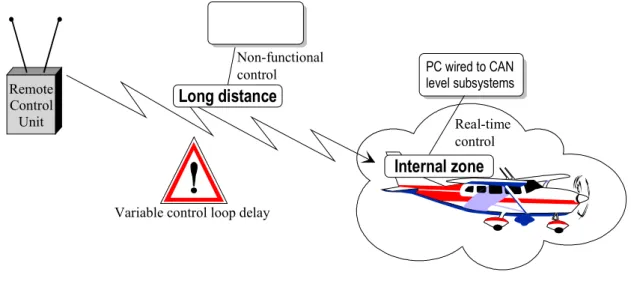
We propose a scenario that deals with a more ambitious goal, which consists in the remote control of real-time operations. While it may be unrealistic to consider real-time properties for the overall control loop, we suggest that more than best-effort control may be achievable. The scenario describes an application that introduces these increased predictability requirements.
elay associated with the long distance communication. It is necessary to handle this
unpredictability loited to allow
non-functional control to be achievable.
trol unit) wired to CAN level subsystems by means
the controlled device acts as a server. On the other hand, Figure 3.2 illustrates the proposed scenario, where the idea is to have an application that is able to remotely control a small aircraft (other real-time subsystems could be used, but this is sufficient for the sake of our purposes). There exist two levels of control. Real-time control is used inside the airplane to ensure that essential operational functions are executed in a timely manner. Non-functional control is used to remotely control the behavior of the aircraft. The former is achieved on top of some Controller Area Network (CAN), which exhibits the required synchrony properties. This real-time communication environment forms what we call an internal zone. The latter is done using an infrastructure adequate for long distance communication.
GSM, UMTS to remote systems
Figure 3.2 Remote control of real-time operations scenario
he major challenge to be addressed in this scenario derives from the variable control loop
Remote Control Unit
Variable control loop delay
Real-time control Internal zone level subsystems Long distance Non-functional
control PC wired to CAN
T d
in such a manner that some useful properties can still be exp
In terms of infrastructure requirements, this scenario suggests the need for two basic communication environments. One to support the real-time control activities performed in the internal zone, and another to support the remote non-functional control. In the former case, an obvious solution is to have a PC (the con
of some fieldbus network (e.g. CAN). For the latter, existent wireless technologies such as GSM or UMTS may be envisaged.
An interesting aspect of this application scenario is that it provides the opportunity to employ different communication paradigms. For example, remote control of the real-time operations can be performed using remote procedure calls (RPC), following a client/server model where the control unit acts as a client and
real-time control in the internal zone may be based on dissemination schemes, with messages transmitted during specific time slots. To some extent, this form of communications follows a publisher/subscriber model.
3.5.1 Autonomy
Some of the main attributes of the applications that CORTEX pretends to address are present in this scenario. For instance, the aircraft can be considered as an autonomous object. Its autonomy is granted within some bounds, since the low-level operational decisions are taken without any control of the remote control unit. The autonomy is limited by the remote control actions, or orders. Geographical dispersion derives directly from the long distance control of the real-time unit, and time-criticality emerges from the need to perform real-time actions in the internal zone. The application may also be safety-critical, if one assumes that the aircraft make take passengers on it. Finally, the problem of mobility is obviously present, and the application also has to cope with the evolution in the environment conditions that affect, among other things, the control loop delay of the non-functional control.
3.5.2 Consistency and Cooperation
In the scenario described so far the need for cooperation and coordination is clearly absent. Equally, attributes like sentience and large scale are practically not present. Because of this, we suggest an extension to the scenario in order to increase the complexity of the application and consequently the problems that must be addressed in CORTEX. The extension consists in assuming that instead of a single aircraft there exists a fleet of flying planes, of which only one (the fleet leader) is remotely controlled (see Figure 3.3).
In consequence, several important requirements are raised. Consistency is needed to ensure that every plane has the same view (in time and space) of the environment, so that they can know each other’s positions and crashes are avoided. Coordination is needed to make specific formations during the flight, or particular flight sequences. Cooperation is clearly necessary to achieve the previous goals, and also to ensure safety properties. For instance, it is needed to ensure that every plane follows its leader, and maintains a certain distance to planes flying side by side.
Figure 3.3 Extended remote control scenario
This extension also has implications from the point of view of the infrastructure. A
short-resented can be classified in the class of those that address the problem of remote control of semi-autonomous (cooperative) entities. While the problem of dealing with the variable control loop delay is perhaps where CORTEX could be focused, the
Remote Control Unit Non-functional control Real-time control Cooperation Coordination Sentience Leader Wireless (802.11)
range wireless communication infrastructure (e.g. 802.11 standard) is now needed to support the communication between the planes. The set of properties that should be enjoyed by this interaction among planes is another aspect to be dealt with in CORTEX. For example, there obviously exist some timeliness requirements that must be verified in order to achieve some degree of time coordination.
application proposed in this scenario can be considered quite complete from the point of view of the aspects that CORTEX aims to address. In fact, although none of the fundamental autonomy, cooperation and consistency attributes is exacerbated, it is possible to say that in this application they are all equally and significantly required.
3.6 Teleoperation
Scenario
Teleoperation of (semi) autonomous sentient systems become an important issue in the areas errain, mine detection and deactivation, search and tions, telemedicine and even house appliances. The of exploration of unknown dangerous t
rescue operations, remote mining applica
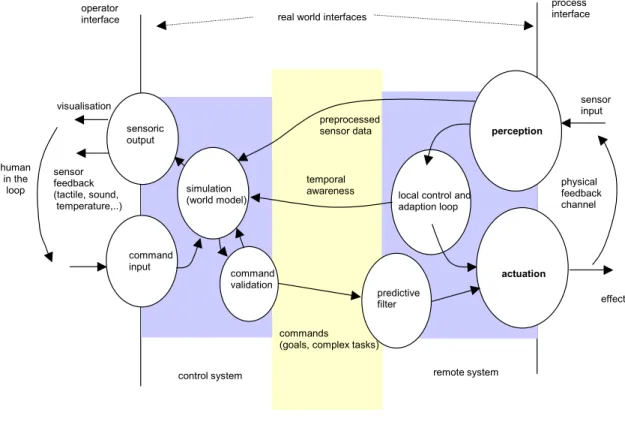
essence of theses applications is to remotely control an actuator, an electronic device or a mobile entity with a human operator in the loop. The operator will not blindly perform the control but will be assisted by the system to perform the control task (this extends the Remote Control scenario described in section 3.5 that implicitly requires visual contact with the controlled object). The problem in controlling the remote device by the operator arises from long and probably unpredictable delay and jitter of the messages between the operator and the actuator. Today, remote control relies on the availability of an infrastructure that guarantees the temporal and functional needs of the control channel within very tight bounds. This substantially raises costs, promotes proprietary special solutions and is geographically restricted to rather small areas. However, if available infrastructure such as the Internet is used to bridge large distances and standard and cheap wireless ad-hoc and multi-hop networks are part of the communication channel, it will be impossible to make strong assumptions about the predictability of the communication link. Moreover, inherent communication delay over long distances or slow media will prevent an immediate response of the remote actuator and feedback to the operator. Figure 3.4 shows the components of such a system on a technical level.
operator interface
process interface real world interfaces
perception
actuation
local control and adaption loop effect sensor input physical feedback channel command input simulation (world model) temporal awareness commands (goals, complex tasks) visualisation sensor feedback (tactile, sound, temperature,..) preprocessed sensor data sensoric output human in the loop predictive filter
wide area network
remote system control system
command validation
To contro g from a simple keyboard, graphical pads, or a mouse to data gloves and special application-specific
mote actuator needs a certain degree of autonomy, i.e. it must be able to act
te multiple smart sensor and actuator devices and a local feedback control
The grabber may be cont The screen of a control
system, as part of the operator interface shows a visualisation of the grabber and provides l the remote component, the operator needs adequate input devices rangin
components. Because the effect of the control input cannot be observed directly, visualization of the actuator, e.g. a camera image or tactile (force) feedback has to be provided. The control input may be fed to a simulated model of the actuator. This has two purposes: firstly, the control input may be validated that it does not violate any physical constraints of the actuator (e.g. validation of the movement of the joystick against the flight characteristics of an airplane). Secondly, the feedback to the human operator may be required immediately in an estimated way and later be adapted by the real feedback coming from the sensor input of the remote actuator.
Because of the delay and unreliability of the communication connection, which may be substantial, the re
in the presence of a temporary network failure or unexpected delays. In some cases, it may be desirable to transmit only goals (e.g., a robot should move to a certain place, or perform a complex tasks).
The control component and the remote component may constitute islands of tight control, which incorpora
loop. Therefore, in these systems, the message delay and jitter can be bound. For the communication network, tightness and precision may be very large. Although, even if it would be possible to derive a bound on network delay, this may be impractical to use in a worst-case scenario as the usable bandwidth would drop dramatically.
Figure 3.5 depicts an application that remotely controls a grabbing device.
Figure 3.5 Remote control of a grabber
CAN-Internet
Gateway
MC
MC
MC
Internet
rolled from different places, one at a time.
some means to provide input commands. The remote real device comprises the actuators and feedback sensors to control the local feedback loops and provide sensor feedback to the operator. The grabber itself is a distributed sensor/actuator system connecting the various smart components by a local CAN. The same may be true for the operator interface which transfers the received sensor information e.g. into force and temperature for a haptic/tactile user interface. Additionally, e.g. inclination sensors, angle detectors, optical, ultrasound or infrared range sensors e.g. at the fingertips will be used to perceive the orientation of the
grabber, the environment and the position of the object which has to be grabbed in a three-dimensional space.
There may be more than one grabber involved in a more complex task of detecting and salvaging an object e.g. in an exploration, a search and rescue, or a remote repair application.
the fine grain control of a mobile grabber, autonomy is crucial to gree of safety because of unpredictable characteristics of the WAN.
y requirements are stringent. It should be noted that in the basic ntrol, only few entities must have a consistent view. In the case
ration may take place on different levels. Because the scenario ects, coordination must be achieved in a predictable way in the
ent
Sentience is obviously one of the crucial properties of this scenario. All kinds of
s ssary autonomy of local actuator operation as
•
of small robots This would require a tight coordination of activities. In this case while controlled by multiple human operators the remote components would also directly interact to achieve the necessary level of reactivity in a safety critical situation, thus forming a complex distributed control system. Consequently, we observe a three level hierarchy of networks with decreasing demands on the predictability. Firstly the local wired CAN inside an autonomous grabbing device with the highest level of predictability (this can be refined recursively to even lower levels of the system as autonomous subparts of a grabber). Secondly, the local wireless interaction between autonomous grabbers. This interaction is also substantially controlled by the physical feedback channels (see Figure 3.4) that also raise mutual awareness between the acting components. Thirdly, the Wide Area Network (WAN) that has a low level of predictability. However, it is very important for the planning of local safety critical actions that there is a high degree of awareness about the functional and temporal status of the WAN. On the basis of this information, local actions have to be autonomously adapted. This is a major point of research in CORTEX.
3.6.1 Autonomy
In the above example of achieve an acceptable de
Information on the temporal and functional status of the WAN are needed to adapt autonomous behaviour (WAN monitoring). However the degree of autonomy may differ widely. There may be very high-level commands like: explore area (coordinate x, coordinate y) and alert the operator to a specified event. In this case the actuator, e.g., a robot, is completely autonomous.
3.6.2 Consistency
In this scenario, consistenc scenario of tight remote co
where multiple operators commonly manipulate multiple actuators, consistency is strongly required, locally between the (semi) autonomous actuators as well as between the distant human operators. Consistency constitutes a safety critical property in this scenario.
3.6.3 Cooperation
As described above, coope includes safety critical asp
functional and temporal domain. This has to be achieved over the potentially unreliable WANs and hence the scenario aims at one of the main objectives in CORTEX.
3.6.4 Requirements Analysis
3.6.4.1 Requirements from the environm •
ensors are needed to provide the nece
well as providing the necessary feedback for the human in the loop.
Scale: Moderate. In the grabber example it may be rather low. In the case of exploration of terrains it could be thought of a few hundreds
coordinating themselves. The platoon of planes is another example of a larger scale application.
•
• l Dispersion: The geographical dispersion of the application is low.
machine actuation are assumed to be distant.
• Evolution of environment: Actuation will change the situation dynamically (as EX proposal). The physical feed back loop at the remote site is
3.6.5
In general, the basic scenario appears to be feasible within the CORTEX context. The degree ntrolled entity may differ widely. There may be very high-level
g Cars and Floating Car Data
Car-to-car communication has three major goals:
. ars’ embedded sensors.
We l communication system.
Dis ed from the cars’ embedded sensors.
sors signalling Safety Critical: Potentially.
Geographica
However, human control and • Mobility: Potentially.
described in the CORT
an important property of the application scenario. However, from the point of system evolution, it is a less demanding scenario.
Feasibility
of autonomy of the co
commands like: explore area (coordinate x, coordinate y) and alert the operator on a specified event. In this case the actuator, e.g., a robot, is completely autonomous. This is also related to aspects of the intelligent in-house delivery scenario (section 3.8). Also, relations to the power-switching example (section 3.3) can be seen in which an operator may control a large number of (smart) switches.
3.7 Cooperatin
1 Dissemination of traffic information derived from the c 2. Cooperation of cars to assist the driver in critical situations. 3. Interaction between remote cars.
wil discuss these scenarios and derive the specific needs for the
semination of traffic information deriv
The car of the future will be equipped with a large number of sensors, ranging from position and speed sensors to sensors indicating road and weather conditions and sen
braking events. All these sensors will be accessible by the internal control network (CAN) of the car. To enable exploitation of the sensor information by other cars, it will be disseminated via a wireless link to a larger network, thus forming a WAN-of-CAN structure as envisaged in CORTEX. Therefore, it will be possible to derive certain traffic conditions directly from the sensor information provided by the floating cars themselves rather than by a fixed roadside infrastructure. The respective information is referred as floating car data.