Innovative Issues and Approaches in
Social Sciences
| 2
Innovative Issues and Approaches in Social Sciences
IIASS is a double blind peer review academic journal published 3 times yearly (January, May, September) covering different social sciences: political science, sociology, economy, public administration, law, management, communication science, psychology and education.
IIASS has started as a SIdip – Slovenian Association for Innovative Political Science journal and is now being published in the name of CEOs d.o.o. by Zalozba Vega (publishing house).
Typeset
This journal was typeset in 11 pt. Arial, Italic, Bold, and Bold Italic; the headlines were typeset in 14 pt. Arial, Bold
Abstracting and Indexing services
COBISS, International Political Science Abstracts, CSA Worldwide Political Science Abstracts, CSA Sociological Abstracts, PAIS International, DOAJ.
Publication Data: CEOs d.o.o.
Innovative issues and approaches in social sciences, 2015, vol. 8, no. 2
ISSN 1855-0541
| 25
GALLERY-PEDAGOGICAL ACTIVITIES AND FINE
ARTS IN THE FIRST THREE YEARS OF PRIMARY
SCHOOL
Matjaz Duh
1, Anja Pavlic
2Abstract
This article discusses the integration of pupils of the first educational period of the primary school in the gallery-pedagogical activities within the regular classes. In a qualitative study, we examined the extent to which these students are involved in the activities of the gallery, how the planning and the execution of visiting the curators-educators is going, how many works of art of the current exhibition the students see, and in which way they are presented to them. We were also interested in the reactions of the students on the works of art and their sense of self-initiative.
The study has shown the importance of museums and galleries, where students have the opportunity to experience the works of art in an authentic gallery area. This way the students experience art differently, they estimate it, and think about it. Having developed the museum pedagogy or pedagogical activities, the curators-educators can contribute a lot to accepting art among the youngest students.
Keywords: fine arts, museum pedagogy, the first three years of the primary school, gallery-pedagogical activities, education in galleries.
DOI: http://dx.doi.org/10.12959/issn.1855-0541.IIASS-2015-no2-art02
Introduction
In the first three grades of primary school students develop different abilities and skills in fine arts classes (Učni načrt – Likovna vzgoja, 2011). The modern classes of fine arts take place in two ways: (1) the development of creative art skills (productive part) and (2) the development of understanding art (receptive part) (Duh, 2013). Suitable for a simultaneous development of both types of abilities is the method of aesthetic transfer. With this method, students learn about
1
Matjaž Duh, PhD is an Associate Professor at the University of Maribor, Faculty of Education. ([email protected])
2
| 26
reproductions or the original fine works of art, and with their help and| 27
The importance of galleries for educationThe role and purpose of museums and galleries have always been known and they can be summed up shortly: collecting, editing, documenting, studying, researching, preserving and presenting its collections. Art museums and galleries offer to come into contact with the original, where one can experience the work of art which can become a source of inspirations (Sturm, 2009). If we want to get acquainted with art, we have to go to museums and galleries. Teaching art in schools should be connected with museums and galleries (Meyer-Eggenschwiler, 2011). Museums are the result of time and the expression of culture, says Prösler (1993) and with this he explains how museums around the world differ. If we do not want museums to become just a matter for experts, we have to familiarize children and adolescents with their content. The first contact is usually established through schools, where the teaching of art can develop different skills. These skills were defined in 1976 by Hilgers as: (1) the aesthetic sensibilization, (2) a sense of conditionality, (3) the ability to criticize, (4) tolerance, (5) the ability to enjoy, (6) creativity and (7) leisure (Schutz, 2002). With these skills we give students tools, which they can also use in other areas. The direct contact with art can show students that art can be connected with their own everyday life (Meyer-Eggenschwiler, 2011). The role and purpose of museums and galleries have changed in the past few decades, especially in the field of presenting their collections. There is a need for the education of the target audience because the employees of museums and galleries feel the need for more qualitative responding to the needs of the modern pluralistic and multicultural society. According to the ICOM Statutes, adopted during the 21st General Conference in Vienna, Austria, in 2007: “A museum is a non-profit making, permanent institution in the service of society and of its development, and open to the public, which acquires, conserves, researches, communicates and exhibits, for purposes of study, education and enjoyment, material evidence of people and their environment.” This statement, on the current ICOM website (2007), illustrates the growing recognition of the significance of education.There is a new profile of museum and gallery activities, called museum pedagogy. This way the practice and theory of educational work in museums and galleries are defined.
| 28
themselves as ‘centers of learning’, museums and galleries shouldtherefore provide more than displays on interesting themes; they should be able to connect these displays and themes to the life experiences of different groups of audiences”, says Illeris and continues: “To promote learning, museums and galleries have to realize the sometimes surprising fact that many actual and potential visitors prefer to learn in ways and about things that are profoundly different from the staff’s own preferences.” (Illeris, 2006: 16-17). Nowadays, we see that the impact of schools on the work in museums and galleries is much larger than the impact of museums on the work in schools. Therefore, the pedagogy in museums and galleries does not represent a specific museum pedagogy. It is mainly school pedagogy, which is in an authentic environment of museums and galleries applied to educational work in these institutions.
Many works of art and other objects are exhibited in museums and galleries. They are presented in a way that prevents observing and researching, which is typical for small children. The exhibits in these areas are usually placed and displayed at a height corresponding to adults. The successfulness of the education in museums and galleries and its measurements are also questionable. “If visitors are intended to make personal meaning from their museum experience, then how can the outcome be measured?” asks Hein and continues: “What criteria can be applied to distinguish a successful museum educational activity from one that is a failure? This issue is larger than the concern to match museum education activities to educational needs in the formal sector; it needs to be addressed in any effort to evaluate learning in the museum.” (Hein G. E., 2006: 349). Further on, the author is looking for answers to two questions: the development of special procedures to assess learning, and redefinitions of outcomes for museum visits (ibid).
A visit to the gallery within regular classes
| 29
which means they cannot grasp the view of the students. Modern| 30
The importance of practical work in the galleryWhen it comes to working with the youth, the classical guidance around an exhibition does not suffice anymore. These students have to be taught to observe the exhibits carefully and to be artistically active themselves. Only by their own artistic expression, they will truly learn about art. “Children need encouragement to develop their artistic skills. They develop their linguistic skills through speech, listening, reading and writing, and as such, they develop their aesthetic skills through drawing, scribbling and modelling, shaping space or rather through productive and receptive interaction with works of art. Dealing with art enables an aesthetic experience, which stems from the impact of a work of art when the perception of art connects with the individual’s prior experience, memories and perceptions.” (Sturm, 2009: 11). During the exhibition, the students interpret the exhibits with feelings and thought. All these interactions crumble up and because of that, they feel the need to express them. Without creation, the message, which the art berries, cannot be understood (Strnad, 2001). During an exhibition, the children process the works of art emotionally and mentally. All these feelings build up and at the end they need to be expressed. Without creating, it is not possible to understand the message carried by the work of art (Strnad, 2014). During the course of art workshops, motivation is being encouraged, students are free to express their opinions and associations, emotions are triggered and they get new information. For it to come to this, these workshops need to be planned in such a way that all these factors are being triggered (Byszewski, 2003). During art practice most of student’s capabilities are being activated, especially the sensitive thinking, visual memory and creative artistic thinking. Sensitive thinking is being developed by observing and noticing elements of art, the visual memory, and on the other hand, by gathering data. Students build on their creative artistic thinking through conscious processing of information, which the art carries. Consequentially, the students grow stronger in all areas of their personality, in cognitive, psycho-motoric and affective areas (Strnad, 2001).
| 31
The artwork that the children create allows them to compare it to thework of the artist. At the same time, they are exploring the differences of artistic expression and of solving artistic problems (Strnad, 2014). Before workshops in galleries can be set in motion, the students need to be prepared for them in school. The place where these workshops take place can be the exhibition room or a room outside the exhibition. When it comes to the exhibition space, it is necessary to take notice that the students do not damage the exhibits, which are within arm’s reach (Byszewski, 2003). Very often, the students create in galleries with the method of reproduction. It means the creation of a similar product, such as the original. Children create their own version of the exhibit based on their observing. A similar baseline can be found in the method of aesthetic transfer, which encourages students to come to their own artistic interpretation and to a new aesthetic experience through perception and reception. (Duh, Zupančič, 2013). Both methods are already successful in practice. Recreation, however, must not be the only method in the gallery (Strnad, 2001). “To experience a work of art as a game, we have to take a certain path that leads to it – through observing, thinking, researching, searching, comparing, asking, listening..” (Bračun Sova, Strnad, 2012: 28).
The selection of artworks and the encouragement of children observing works of art
| 32
retain his first impression, however, it has to gain meaning and bedeepened. The first impression can change entirely because of the gallery educator, who can direct the child to a more comprehensive observation of the artwork (Bračun Sova, Strnad, 2012).
When visiting a gallery or a museum it is wise to choose those exhibitions which attract the students. During a walk through the exhibition, the child stops there where the work of art interests him the most. When the child stopped, he found something interesting and would like to show it or ask for information about it. The teacher has to take into account the child’s need for movement. If he wants to go through the exhibition faster, it is necessary to enable it. This leads to the conclusion that this area is uninteresting. When the children lose their interest, it is sensible to take a break and lighten up the children with an activity.
While observing pictures, the teacher or the curator can warn the students on the alignment of the exhibitions, important details, and interesting events from the paintings. While talking about artwork in museums or galleries, the “ground rule question of interaction of self-perception on one hand and mediated explanation on the other” comes to mind (Barth, 2000: 7). We believe that an explanation of an artwork which was made too fast has inevitably lost its research potential, which is provided by the artwork itself. The research is reduced to activities based on mediated knowledge of the artwork and is in a great manner confined solely to researching the connections between the heard and the seen. Such guidelines and treatment of knowledge determine activities (Duh, 2013). Educators can attract students’ attention in the museum by saying something like: “I see something you do not see”. The curator then describes the artwork and the students will go about the area searching for it with interest. This role can also be given to the students themselves.
METHODOLOGY Purpose and aim
The purpose of the carried out qualitative research is the accompaniment of the process of developing artistic appreciative abilities of students in the second grade of primary school. The aim of the research is to determine the successfulness of pedagogical activities in galleries from the point of view of the appreciation.
Research methods
| 33
method of empirical research was used. The practical part is apedagogical approach for the analysis of the guidance on the exhibition 60! Panorama at the Art Gallery Maribor.
The research sample
The base population represent students of the second grade of the primary school OŠ Franca Rozmana Staneta Maribor. There were 23 students in this group.
The process of collecting the data
| 34
Research questions Is it possible to actively include students of the first three grades of primary schools in an exhibition (RQ1)?
Is it possible that students of the first three grades of primary school deepen their artistic experiences when they come in direct contact with art and the appropriate pedagogical guidance (RQ2)?
Can the activities within the museum pedagogy bring students of the first three grades of primary school to appropriate answers and conclusions (RQ3)?
Do prepared activities within the museum pedagogy encourage spontaneous learning of students and raise the level of art appreciation (RQ4)?
THE RESULTS AND INTERPRETATION
When we got to the gallery, we were welcomed by the curator. After the greeting she asked a few questions which the students answered. The questions were the following:
“What was the last exhibition you came to see here?” “What do you remember from that exhibition?”
“What did you create?”
“What did you like the most?”
The students answered the questions and said that the last exhibition they saw was called “We, You, They”. What they remembered the most from that exhibition was the art in which they could step into. It was a tent. They liked this part the most because they were allowed to individually create some art in it themselves. The curator motivated the students to think about their past experiences with the gallery. She motivated them by evoking their favorite moments experienced in the gallery. The students felt good; positive emotions and feelings were triggered. This is what encourages students to revisit galleries and their interest in art. The combination of visiting galleries and students’ own creating turned out to be the appropriate pedagogical approach. These experiences imprint strongly in students’ minds and they like them. These and similar activities are a condition for nourishing the habit of visiting galleries. This increases the possibility of the child visiting different cultural institutions on his own initiative when he grows up. Here we find a partial answer to the first research question (RQ1). During the last visit of the gallery, the students were actively involved in the exhibition and they gained many new insights.
| 35
system of the gallery pedagogical activities, only two rooms. They alsoreceived a variety of information about what they collect in the archives of UGM.
Through the conversation, the students got some basic information about the current exhibit. The curator highlighted certain facts, which she knew would attract the students’ attention. She informed them about various works of art which they collect. This way she encouraged the students to think about their experiences with various artistic elements. The focus was on a few works of art in two exhibition rooms. This turned out to be very good because students of this age are able to experience and comprehend only a certain number of works of art. If this number is exceeded, the visit to the gallery is meaningless. Students can concentrate on certain artworks better, they observe and evaluate them. The presented works of art had been properly selected according to the stage of development of the students.
| 36
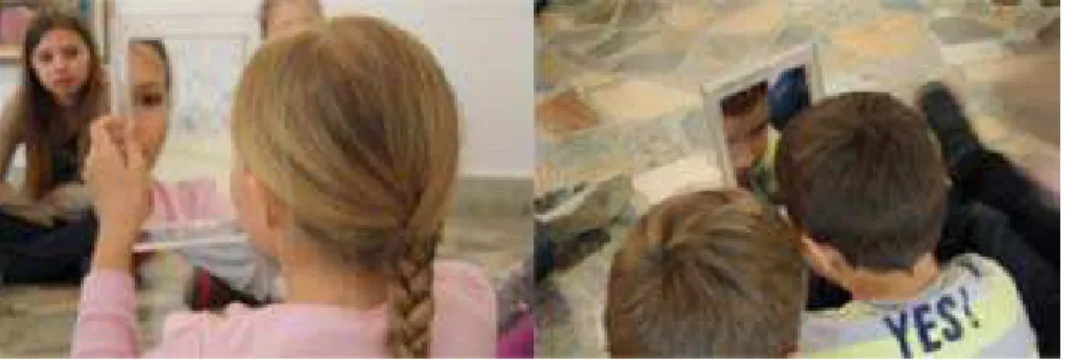
Figure 1: Students observe themselves in the mirror
The curator-educator explained that the pictures in the room represented the artists themselves. They had painted themselves by looking in the mirror. The curator made possible for the students to imagine how the artist paints himself from the memory. She did this in a way that students had to imagine a picture of themselves in their head, and the curator asked them questions like: “What color is your hair? What color are your eyes?” This way she showed them a deeper understanding of art. The students were actively involved in the exhibition (RQ1) and spontaneously deepened their artistic experience (RQ2). All the curator needed for this was different questions and a proper motivation with the mirror.
| 37
Figure 2: Matej Košir, “Alter ego (Self-portrait)” (2003-2004, glass, metal – cylinder: (17 x 18 cm; showcase: 100 x 66 x 30) Photo: Damjan Švarc)
The first impressions of students of the work of art were quite negative. The artwork has cool colors and the faces are distorted, which the students did not like. The work of art is very unusual and gives you a negative and cold feeling. The responses of the students were as follows:
“This artwork is not beautiful.” “The artwork is dark.”
“The character in the artwork has a big nose.” “The faces in the artwork are very pale.” “The artist used only cold colors.” “The artwork is unpleasant.”
“It looks as if he was asleep because it is dark. Some faces are going to fall asleep now.”
“They have closed eyes and their nose is leaned.” “It looks as if they were trapped somewhere.” “They are sad and alone.”
“They are sick or they are not feeling well.”
| 38
The curator told them that these are the images of the artist. The artist“scanned” himself and by doing so, he flattened and distorted his nose. Later he put his image into cans. The curator explained the work “to scan” to the children, so that everything made sense to them. She asked them some questions like:
“What are cans?”
“What do we put into them?” “Why do we put it there?”
This way the curator encouraged the students to think. She led them to the essence of the artistic work. Students understand a work of art if they can connect it with their experiences. That is what happened here. Together, they found out that we put things into cans so they are preserved for a longer time. That is why the artist put his image into the can, so it will last longer. What followed was a discussion about how people take care of their image to make it last longer. The students know that people use different creams and cosmetic surgeries. Here, the students got a different view on the artwork. It was not as dark and negative as it was before. The students seemed to almost like the artwork.
In this research, we wanted to find out whether the activities of the museum pedagogy can lead the students of the first three years of primary school towards appropriate answers and conclusions (RQ3). As we can see, they can. The curator led the students, with her appropriate questions, to adequate conclusions about the essence of art.
| 39
Figure 3: Iztok Maroh, “Desecrated Privacies” (2005, ceramics – burned and glazed ceramics, neon light, 280 x 100 x 140 cm) (Photo: Ivan Leskovšek)
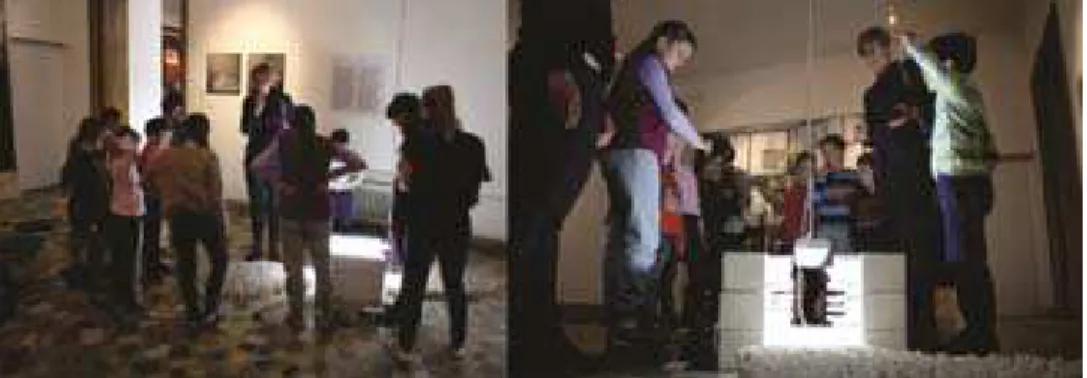
Maroh’s sculptural installation is made of 6 white ceramic box-models, 4 neon light bulbs, an electric cable, and approximately 2000 individual standing elements with figurines on top. The students liked this work of art the most because it was so different from the others, because it was shining, and because it was so unusual. At the same time, the students could not figure out what it represented, so they described what they saw. Here are some descriptions of the artwork from the students’ experience:
“The artist used clay, a light that is connected to the electricity, which brightens the space, and inside of this space the clay looks as if it is melting.”
“The artwork looks very valuable. This is probably a special coating, which makes it shine.”
“The side forms look like wings or like clouds in a city or like people, who on one side go into the cinema and on the other side they go out.”
“Each figure has something on top and that is why they are all different.”
“I see a waiter.”
| 40
“Each figure has an object. The one carrying a tray is a waiter.”The students did not say everything by themselves. The curator had to ask them various questions and sub-questions, which led to these conclusions. She let their imagination go free because each student interpreted the artwork differently. The curator linked the comments of the children and they got their explanation, which made them all happy.
Figure 4: The students are observing the artwork of Iztok Maroh
Here, we can also give a positive answer to our research question (RQ3). We found out that activities within the museum pedagogy can lead students of the first three years of primary school to adequate answers and findings. The students understand the essence of artistic work.
When they finished with this exhibit room, the students sat down on the cushions, as they did in the beginning. Once again, the curator pulled an orange out of her bag and asked the students to describe it. Here are some descriptions:
“It is round.”
“It is orange like a tangerine.”
What followed next was this question: “What is this color like?” The students answered:
“Orange is a bright color.”
“It is in the middle of all the colors.”
| 41
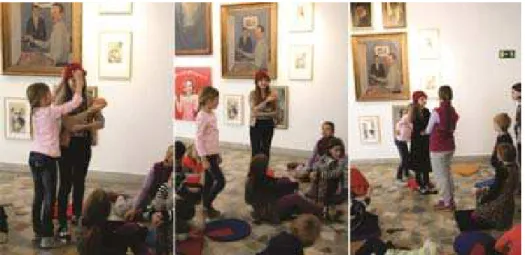
Figure 5: The preparation of the student for the illustration of Ivan Kos’s work of art
All agreed that the orange stood out on a dark background. The curator asked the students where one could go dressed like this. Here are the student’s answers:
“To see a performance.” “To a dance.”
“On a date.”
Figure 6: Ivan Kos, “The Girl with the Orange” (1927, oil on canvas, 75 x 75 cm) (Photo: Damjan Švarc)
The students were, again, very motivated. This approach to observing and learning about art impressed them. They became even more interested in Ivan Kos’s painting. The student that was dressed as the girl I the painting was very proud. She liked it and immediately she went closer to the painting. She stood beside the work of art and the other students compared the looks of the two girls. The curator explained that the artist made this artwork in 1929. She then asked the students a few questions:
“What is the room in the painting like?” “What is her facial expression like?” The students answered with the curator’s help:
“It is small.”
“It is dark and murky.” “It is dark.”
“The girl is sitting on a chair in an old room.” “The room has grey walls.”
“Her facial expression is very serious.” “The girl is very pensive.”
“The girl’s lips are pouted, like she is boastful.”
| 43
the painting. Here, we can see that a child will not always interpret adark painting as negative. It depends on how we present it.
At the end of this exhibit, we can answer our research questions, which we set before the exhibition. The students of the first three years of primary school can be actively involved in the exhibition (RQ1). They also managed to deepen their artistic experience in direct contact with art and the right guidance (RQ2). The activities within the museum pedagogy led the students to adequate answers and conclusions (RQ3). They also encouraged students’ spontaneous learning and raised their level of art appreciation (RQ4).
| 44
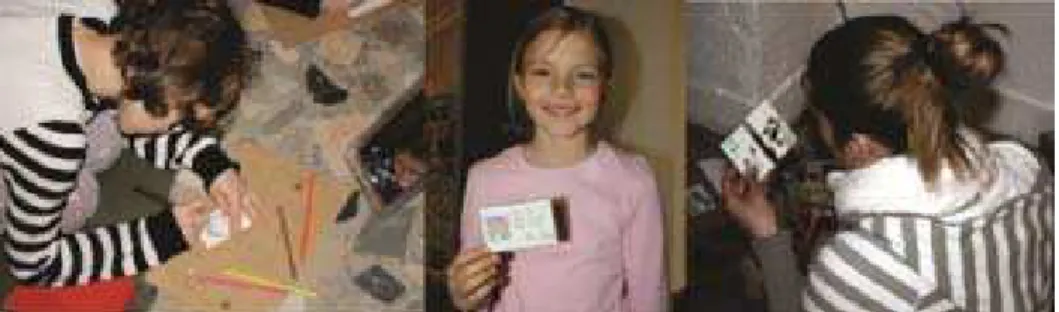
Figure 7: Creating the ID’s
Guiding the students through the exhibition rooms was interesting. They gained new artistic experience and knowledge. If every visit went as well as this one, the possibility of children growing interests in gallery and culture, as well as taking interest in visiting galleries when they grow up, would increase greatly. The students were actively participating in the tour all the time, got to know a lot of new exhibits and gained a lot of new artistic knowledge.
CONCLUSION
While researching, we discovered certain laws, which help the child’s understanding. Realizing that the curator-educator presented only a small portion of the exhibits to the children thus provoking a greater, more active response from them, which would otherwise be lost, was quite interesting. The research showed the importance of museums and galleries, where children are given the chance to experience art in an authentic environment. Children get to know the artwork differently, think about it, they even judge it. The curator-educator can contribute a great amount when it comes to accepting art in the youngest of children, especially in museum pedagogy, or rather pedagogical activity. With such guidance, students learn a great deal while experiencing the artwork fully. Practical work in the gallery is the key here, since this is where the emotions break free. Learning through art games is a spontaneous activity, where the students learn a lot. The research gave us the answers to our questions. The students actively participated in the exhibition (RQ1) and expressed their own artistic experience (RQ2). Within the pedagogical activity the students got to their answers and findings (RQ3), where the spontaneous learning raised their level of art appreciation (RQ4).
| 45
their profound knowledge. Before the exhibition they have to prepareproperly as well as set certain regulations and limits.
Students of some schools in Maribor visit the Art Gallery Maribor four times a year. With each visit a new exhibition is set up, which helps them relax and learn. In the exhibition, they follow guidelines of modern museum pedagogy. When the students come to visit, they focus solely on the artwork. They prepare certain workshops, games and interesting activities for them. The students are thoroughly motivated and participate actively.
In the study, we researched guidelines which are important for the museum pedagogy. We learned the meaning of introducing museums and galleries to children. We were present at a visit of students in the gallery and found out that modern galleries really follow the museum pedagogy guidelines. They prepare certain activities for the children during school time as well as outside of school time. We assume that only a handful of schools in Slovenia participate in these gallery programs. Due to the positive experience we got, it would seem to us that teachers should be encouraged more to visit galleries and museums.
Note:
We did not get the permission from parents of the children who participated in this research to publish photographs, which are a part of our documentation in this research. The photos published in the article were taken in the Saturday workshop of UGM with an approximate same age population of children. They were forwarded to us by the senior curator Brigita Strand. The photographs of artworks are from the archive of UGM, and they are a work of Damjan Švarc and Ivan LeskovŠek and are published with the permission of the UGM.
REFERENCES
Barth, W. (2000). Kunstbetrachtung als Wahrnehmungsubung und Kontextunterricht. Grundlagen und Unterrichtsbeispiele. Hohengehren: Schneider Verlag.
Bračun Sova, R., Strnad, B. (2012). Z igro v kiparski svet Dragice Čadež. Ljubljana: Pedagoška fakulteta.
Byszewski, Janusz. 2003. Drugačen muzej. Ljubljana: Skupnost muzejev Slovenije.
Duh, M. (2004). Vrednotenje kot didaktični problem pri likovni vzgoji. Maribor: PEF.
| 46
u različitosti izazova. Zaninović Tanay, L. (ur.), Tanay E. R. (ur.).Sretna djeca: dijete u različitosti izazova. Zagreb, Studio Tanay, pp. 33-48.
Duh, M., Korošec, A. (2014). The development of art appreciation abilities of pupils in primary school. The new educational review, Vol. 36, No. 2, pp. 42-54.
Duh, M., Zupančič, T. (2013). Likovna apreciacija in metoda estetskega transferja. Revija za elementarno izobraževanje, Vol 6, No.4, pp. 71-86. UM PeF.
Hein G. E. (2006). Museum Education. Chapter 20 (pp340 – 352). Retrieved 12 January 2014 from http://george-hein.com/downloads/MuseumEdBlackwellHein.pdf
Hooper-Greenhill, E. (1994). The Educational Role of the Museum. New York and London: Leicester Readers in Museum Studies.
ICOM (International Commission of Museums) (n.d.) ICOM definition of a museum Retrieved February 17 2014 from http://icom.museum/definition.html
Illeris, H, (2006). Museums and galleries as performative sites for lifelong learning: constructions, deconstructions and reconstructions of audience positions in museum and gallery education. Museum and society. Vol. 4 No.1 pp 15-26. Retrieved, February 27. 2014 from http://www.virtualmuseums.dk/uploads/hi/2%20Illeris.pdf
Meyer-Eggenschwiler Y. (2011). Kunst erleben durch Kunstvermittlung. Projekte und Methoden zum Thema Kunstvermittlung und Museumspädagogik. VDM Verlag Dr. Müller, Saarbrücken.
Peez. G. (2006). Evaluation ästhetischer Erfahrungs - und Bildungsprozesse. Beispiele zur Ihrer empirischen Erforschung. München, Kopaed.
Piscitelli, B., Weier, K. (2002). Learning with, through, and about art: The role of social interactions. In: Perspectives on object-centered learning in Museums. Paris, G., S. (ed). Lawrence Erlbaum, Muhwah, USA,
pp. 109-138. Retrieved, May 6. 2014 from
https://books.google.com.au/books?hl=sl&lr=&id=2XeRAgAAQBAJ&oi =fnd&pg=PA109&dq=%22Learning+With,+Through+and+About+Art:+
The+Role+of+Social+Interactions%22+B- Piscitelli&ots=18143pbDVh&sig=NzXXKcJ9GWpotbDfyNhY1x-2UhA#v=onepage&q&f=false
Prösler, M. (1993). Muzeji in razvoj – poziv k razmisleku. In: Mrvič S., Čeplak R. (ed.) Muzeoforum: zbornik muzeoloških predavanj 1991, -18. Ljubljana, Slovensko muzejsko drustvo in Zveza muzejev Slovenije.
| 47
Seumel, I. (2001). Assoziative Rezeptionsverfahren. Kunst+Unterricht253/2001, str.4-10. E. F. Verlag, GmbH.
Strnad, B. (2014). Contemporary art or just something: Young children learning through art at the Maribor Art Gallery in Slovenia. Retrieved
6. February 2014 from http://artinearlychildhood.org/journals/2014/ARTEC_2014_Research_
Journal_1_Article_1_Strnad.pdf
Strnad, Brigita. (2001). Likovna dejavnost izven šolskega programa. Likovna dejavnost v galeriji. (Neobjavljeno diplomsko delo). Univerza v Mariboru, Pedagoška fakulteta, Maribor.
Sturm L. E. (2009). Erlebnis Museum. Kunstbetrachtung und ästhetische Praxis. Westermann, Braunschweig
Tavčar, L. (1992). Metamorfoze. Ljubljana: Narodna galerija.
Tavčar, L. (2001). Otroci, mladostniki in odrasli v galeriji: priročnik za kustose pedagoge, učitelje, vzgojitelje in starše. Ljubljana: Narodna galerija.
Tavčar, L. (2009). Homo Spectator. Uvod v muzejsko pedagogiko. (digital booklet). Ljubljana, Pedagoški institut. Retrieved 06. December
2013 from http://www.sistory.si/publikacije/prenos/?urn=SISTORY:ID:911
Učni načrt. (2011). Program osnovna šola, Likovna vzgoja. Ljubljana, Ministrstvo RS za šolstvo in šport.
Umetnostna galerija Maribor: Sobotna ustvarjalnica, Figure umetnosti.
(Pridobljeno 26. 6. 2014) https://www.flickr.com/photos/umetnostnagalerijamaribor/sets/721576
43996366253/
Vogrinc, J. (2008). Kvalitativno raziskovanje na pedagoškem področju. Ljubljana: Pedagoška fakulteta.
Weier, K. (2004). Empowering Young Children in Art Museums: letting them take the lead. Contemporary Issues in early childhood. Vol.5 No.1. Retrieved March 25. 2014 from http://www.wwwords.co.uk/pdf/validate.asp?j=ciec&vol=5&issue=1&ye