ABSTRACT
BACKGROUND AND OBJECTIVES: Musculoskeletal pain
is increasingly common in the ield of workers’ health. When the work is characterized by rudimentary activities, as in the case of family farming, which requires the use of manual labor, intense and prolonged working journey, exposure to physical, chemical, biological, mechanical and ergonomic risks, the worker is prone to develop musculoskeletal diseases, and consequently pain. he objective of this study was to investigate the prevalence of musculoskeletal pain in family farmers, as well as to identify the body segments mostly afected and evaluate the tools used in the working process that may inluence the development of muscu-loskeletal diseases and pain.
METHODS: A research form that includes social-demographic data, the Nordic Musculoskeletal Questionnaire, and the visual analog pain scale were used. 150 farmers participated in the study. Statistical tests were applied to the data obtained, includ-ing the Fisher Exact. he H0 hypothesis was rejected for a signif-icance level of p≤0.05, stipulating a conidence interval of 95%.
RESULTS: he results show a high prevalence of musculoskel-etal pain in surveyed farmers, whose most afected regions were the lower back and shoulders. he pain reported by farmers is associated with the activities performed and the tools used, such as the hoe and the hand spray, used at work.
CONCLUSION: Farmers are susceptible to the development of work-related musculoskeletal disorders, and the prevalence of the referred pain is high.
Keywords: Agriculture, Musculoskeletal pain, Occupational hazards, Workload, Worker’s health.
Relationship between musculoskeletal pain complaints and family
agriculture work
Relação entre queixas de dor musculoesquelética e processo de trabalho na agricultura familiar
Marcelo Biazus1, Cleide Fátima Moretto2, Adriano Pasqualotti3
1. Universidade de Passo Fundo. Programa de Pós-Graduação em Envelhecimento Humano, Passo Fundo, RS, Brasil.
2. Universidade de Passo Fundo, Programa de Pós-Graduação em Envelhecimento Humano, Grupo Interdisciplinar de Estudos sobre Trabalho, Passo Fundo, RS, Brasil.
3. Universidade de Passo Fundo, Programa de Pós-Graduação em Envelhecimento Humano, Grupo de Pesquisa de Tecnologia de Informação em Saúde, Passo Fundo, RS, Brasil.
Submitted in May 16, 2016.
Accepted for publication in June 27, 2017.
Conlict of interests: none – Sponsoring sources: Taxa Capes/ppgeh/UPF.
Correspondence to: Universidade de Passo Fundo BR 285, Km 292. Bairro São José 99001-970 Passo Fundo, RS, Brasil. E-mail: [email protected]
© Sociedade Brasileira para o Estudo da Dor
RESUMO
JUSTIFICATIVA E OBJETIVOS: A dor musculoesquelética é cada vez mais frequente no âmbito da saúde do trabalhador. Quando o trabalho é caracterizado por atividades rudimentar-es, como no caso da agricultura familiar, que exige o emprego de força física, jornada intensa e prolongada, exposição a riscos físicos, químicos, biológicos, mecânicos e ergonômicos, o trab-alhador ica propenso a desenvolver doenças de ordem muscu-loesquelética, e, consequentemente, dor. O objetivo deste estudo foi investigar a prevalência de dor musculoesquelética em agri-cultores familiares, bem como identiicar os segmentos corporais mais acometidos e avaliar as ferramentas utilizadas no processo de trabalho que podem inluenciar o desenvolvimento de doen-ças e dores musculoesqueléticas.
MÉTODOS: Utilizou-se um formulário de pesquisa que con-templa dados sociodemográicos, o Questionário Nórdico de Sintomas Osteomusculares e a escala analógica visual para dor. Participaram do estudo 150 agricultores familiares. Aos dados obtidos foram aplicados os testes estatísticos, inclusive o Exato de Fisher. A rejeição da hipótese H0 foi realizada para um nível de signiicância de p≤0,05, estipulando um intervalo de coniança de 95%.
RESULTADOS: Os resultados apontam alta prevalência de dor musculoesquelética nos agricultores pesquisados, cujas regiões mais acometidas foram a parte inferior das costas e ombros. A referência de dor pelos agricultores está associada às atividades desempenhadas e ferramentas, como a enxada e o pulverizador manual, utilizadas no trabalho.
CONCLUSÃO: Os agricultores são suscetíveis ao desenvolvim-ento de distúrbios musculoesqueléticos relacionados ao trabalho e que a prevalência de dor referida é elevada.
Descritores: Agricultura, Carga de trabalho, Dor muscu-loesquelética, Riscos ocupacionais, Saúde do trabalhador.
INTRODUCTION
Family farming can be deined based on three essential charac-teristics, described as the management of the productive unit, workforce supplied by the family members and the ownership of the means of production1. In this group of workers prevail
rudimentary activities, such as the intense and prolonged work low, accumulation and overload of tasks, uncomfortable or ergonomically incorrect tool handling, exposure to adverse weather conditions (sun, rain, heat, cold), noise and vibrations, venomous animals, chemicals (fertilizers, pesticides), infectious
and parasitic2 , handling and transport of loads, intense or
con-tinuous physical and mental eforts, and stress arising from work and incorrect postures.
hese characteristics of the family farming process can contrib-ute to the development of musculoskeletal disorders, which risk factors are multifactorial. It can be of ergonomic nature when there is high repetitiveness of the same movement, the exces-sive efort of muscle groups, cold environment with vibration, improper furniture, which requires the adoption of incorrect postures, static postures, and others. Alternatively, of an orga-nizational nature, which includes the execution of monotonous tasks that require repetitive movements, prolonged work hours, accelerated pace and absence of rest breaks, as well as multi-activity in the case of family farming and work overload. Musculoskeletal disorders are the most frequent cause relat-ed to pain syndromes, which correspond to clinical manifes-tations characterized by the occurrence or not of concomi-tant symptoms of pain, paresthesia, feeling of heaviness and fatigue, insidious onset, usually affecting the upper limbs (UL). However, it can also affect lower limbs, as a result of the excessive use imposed on the musculoskeletal system, and the lack of time to recover3. Musculoskeletal disorders
account for a variety of inflammatory and degenerative con-ditions affecting the muscles, tendons, ligaments, joints, and synovium, such as tendinosis, bursitis, nerve compres-sions, low back pain and dorsalgia, among others4, and can
develop from the labor activity.
Worker’s health is a vast area. However, the scientiic literature is scarce concerning the agricultural worker, especially in famil-iar farming. his literature, which is already scarce, meets the potential and severe risks present in the agricultural sector, such as the use of pesticides and labor accidents, and little exploring the chronic problems such as the development of musculoskel-etal disorders and, speciically, the musculoskelmusculoskel-etal pain. Pain syndromes related to the performance of labor activities belong to the ield of physical therapy, which aims to promote the quality of life, prevent and warn about possible risks and the rehabilitation of work-related diseases. he physical force required by rural work and the excessive eforts are associated with an increased risk of development of inlammations in joints, tendons, chronic degenerative processes, intervertebral disc diseases and muscle cramps, causing the painful condi-tion5. In this sense, the rural worker’s health is an important
ield for physical therapy, and these professionals need to use appropriate handling techniques for pain management and relief, and guidelines to promote postural and ergonomic changes.
he objective of this study was to investigate the prevalence of musculoskeletal pain in family farming workers, trying to iden-tify the most afected body regions, in addition to the possible causal factors and determining sociodemographic variables.
METHODS
Transversal study with descriptive and analytical approach. For data collection, it was used a survey form including 1) the
adapted Nordic Musculoskeletal Questionnaire (NMQ); 2) the sociodemographic questionnaire and the visual analog scale (VAS). he NMQ was developed with the purpose of standard-izing the measurement of reported musculoskeletal symptoms and facilitate the comparison of results among studies5. It
in-cludes multiple or binary choices questions related to the oc-currence of symptoms in the diferent anatomical regions com-monly referred, based on the symptoms observed in the last 12 months and seven days before the interview. Respondents must report the absence from their routine activities in the last year. As for the VAS, it is a unidimensional instrument for the evaluation of pain intensity, with a line with numbered ends from zero to 10, where zero represents “no pain” and the 10 “the worse pain imaginable.” he answers between zero and 2 are considered mild pain; from 3 to 7, moderate and from 8 to 10, intense.
he sample had 150 family farming workers of both the gen-ders, with age over 18 years, living in the rural area of the city of Floriano Peixoto (RS). he selection of the subjects met the criteria of randomness, taking into account the proportion of case by city location. he total population in the study was 1.726 people, corresponding to the total rural population of the city. he sampling procedure was the simple random type. he sample includes a maximum sampling error of 3% for a conidence interval of 95%.
he application of the form was in the houses of the selected farmers. After clarifying the purpose of the study, they signed the Free and Informed Consent Form (FICT). Data collec-tion went from June to October 2015.
his study was approved by the Ethics Committee of the Uni-versity of Passo Fundo, with the Report number 1.083.663.
Statistical analysis
he data were analyzed by the IBM SPSS Statistic Package 22. he results are presented in terms of relative frequency. he Fisher Exact test was also applied. he H0 hypothesis was rejected for a signiicance level of p≤0.05, stipulating a conidence interval of 95%.
RESULTS
150 individuals working in family farming were interviewed, and the detailed results relecting the proile of these workers are shown in table 1.
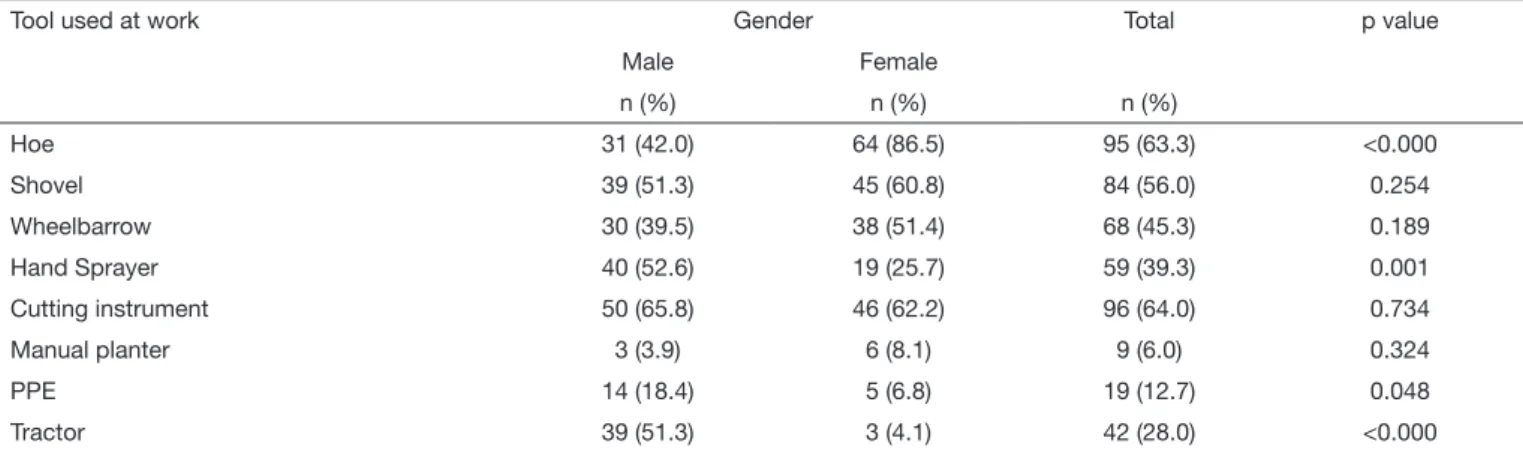
respon-mechanized equipment, as the tractor. However, personal protective equipment (PPE) was used by only 12.7% of the respondents, which leaves the worker even more exposed to accidents at work.
Table 2 also allows identifying distribution in the use of work tools by gender, where it is noticeable that the female work-ers use more the hoe; 86.5% of the respondents using this tool (p<0.000), whereas male workers use more the backpack sprayer, 52.6% (p=0.001), and the tractor, 51.3% (p<0.000). Other meaningful data relate to the use of PPE, and both genders are not supporters, however, although a smaller pro-portion of male workers demonstrate that use more (18.4%) than female (6.8%; p=0.048).
Figure 1 shows the results obtained with the application of the NMQ in the presence of pain and most involved body regions.
As for the prevalence of musculoskeletal pain, 121 respon-dents (80.7%) reported pain in last the 7 days, with intensity varying from mild to moderate, mentioned by 64.7% of the respondents, distributed as follows: 17.3% grade 3; 16.0% grade 4; 18.7% grade 5 and 12.7% grade 6. As for incapac-ity to work over the past 12 months due to musculoskeletal pain, 114 respondents (76.0%) reported this situation. In re-lation to the prevalence of pain, the most afected region was the lower back (lumbar), in 71.3% of respondents, followed by the shoulder (37.3%), wrists and hands (28.7%), knees (26.7%), neck (24.7%), hips and thighs (14.0%), elbows (14.0%), ankles and feet (8.7%) and upper back (3.3%). Ta-ble 3 shows the prevalence of pain by gender.
As shown in table 3, female workers reported more pain than male workers in the region of shoulders (48.6%; p=0.007), el-bows (20.3%; p=0.035) and wrists/hands (36.5%; p=0.047), whereas male workers had a higher prevalence of pain in the lower back (86.8%; p<0.001). It is worth mentioning that female workers also have a high value for lower back pain, 55.4% of the respondents.
he results indicate that low back pain is more associated with the use of some tools, such as the wheelbarrow (79.3%, p=0.029), manual planter (73.8%; p=0.017) and the trac-tor (90.5%, p=0.001). Pain on the shoulders is related to
Table 1. Description of the sociodemographic variables (n=150). Pas-so Fundo/RS, 2015
Variables n %
Gender
Female 74 49.3
Male 76 50.7
Marital status
Married 133 88.7
Single 16 10.7
Divorced 1 0.7
Family composition/reside with
Spouse 135 90.0
Children 71 47.3
Other relatives 20 13.3
Education
Illiterate 2 1.3
Incomplete elementary school 131 87.3
Complete elementary school 8 5.3
Incomplete high school 2 1.3
Complete high school 6 4.0
Incomplete higher education 1 0.7
Years of school
up to 4 133 88.7
More than 4 17 11.3
Table 2. Description of the use of work tools by farmers and family member, by gender, and total (n=150). Passo Fundo/RS, 2015.
Tool used at work Gender Total p value
Male Female
n (%) n (%) n (%)
Hoe 31 (42.0) 64 (86.5) 95 (63.3) <0.000
Shovel 39 (51.3) 45 (60.8) 84 (56.0) 0.254
Wheelbarrow 30 (39.5) 38 (51.4) 68 (45.3) 0.189
Hand Sprayer 40 (52.6) 19 (25.7) 59 (39.3) 0.001
Cutting instrument 50 (65.8) 46 (62.2) 96 (64.0) 0.734
Manual planter 3 (3.9) 6 (8.1) 9 (6.0) 0.324
PPE 14 (18.4) 5 (6.8) 19 (12.7) 0.048
Tractor 39 (51.3) 3 (4.1) 42 (28.0) <0.000
PPE = Personal protective equipment; Fisher’s Exact test; Signiicant value for p≤0.05.
dent has retired due to disability, lives alone or perform other activities. In addition, the study showed the concentration of the workforce on the family members, since only 0.7% of respondents hired part-time employees to help, the vast ma-jority of the workforce is the family members, spouse (82.0%) or children (40.0%).
Table 2 describes the use of work tools by family farmers, by gender.
the use of the hoe (23.6%; p=0.009); pain in the hip is re-lated to the use of the shovel (22.7%; p=0.009); pain in the wrist to the use of sprayers (20.9%, p=0.010) and the use of manual planter is related to pain in the elbow region(12.1%; p=0.017). One of the factors that may afect the prevalence of pain is the presence of rheumatic disease. However, it was not reported on the information provided by the respondents. Although it is not directly related to the objectives of this study, the data concerning the use of PPE show important evidence. As already mentioned in table 2, of the 150 re-spondents only 19 said they wore PPE, corresponding to 12.7% of the studied population, reflecting its low use. Of
them, 14 (18.4%) are male and 5 (6.8%) female (p=0.048). Due to the importance of this information, it was estab-lished a relationship between the use of PPE and the sprayer, as shown in table 4.
Table 4. Relationship between the sprayer and personal protective equipment (n=150). Passo Fundo, RS, Brazil
PPE Sprayer p value
At least once a week 84 (64.1) 47 (35.9) 0.042
Does not use 7 (36.8) 12 (63.2)
PPE = Personal protective equipment; Fisher’s Exact test; Signiicant value for p≤0.05.
Table 3. Relationship between gender and musculoskeletal pain (n=150). Passo Fundo, RS, Brazil 2015
Site of pain Gender p value
Female n (%)
Male n (%)
Neck 20 (27.0) 17 (22.4) 0,572
Upper back (dorsal) 3 (4.1) 2 (2.6) 0,679
Shoulders 36 (48.6) 20 (26.3) 0,007
Elbows 15 (20.3) 6 (7.9) 0,035
Wrists/hands 27 (36.5) 16 (21.1) 0,047
Lower back (lumbar) 41 (55.4) 66 (86.8) <;0.000
Hips/thighs 10 (13.5) 11 (14.5) 1,000
Knees 23 (31.1) 17 (22.4) 0,270
Ankles 7 (9.5) 6 (7.9) 0,779
Fisher’s Exact test; signiicant value for p≤0.05.
Figure 1. Prevalence of musculoskeletal pain reported to by farmers and most involved body regions (n=150). Passo Fundo, RS, Brazil 20157 Shoulder (37.3%)
Neck (24.7%)
Upper back (3.3%)
Wrist and hand (28.7%)
Knee (26.7%) Elbow (14.0%)
Lower back (71.3%)
Hip and thighs (14.0%)
According to table 4, the higher frequency of use of PPE is among rural workers who use sprayers, but less than once a week (n=84; p=0.042).
DISCUSSION
Family farming is essentially characterized by the manage-ment of the own production unit, family workforce, and ownership of the means of production. he results presented in this study relect the high prevalence of musculoskeletal pain among the farmers interviewed, especially on the lower back and shoulders, indicating a relationship with the instru-ments used. It was found that male workers have a higher prevalence of pain on the lower back, and the most used tools were the backpack sprayer and the tractor, while female work-ers have a higher prevalence of pain on the shouldwork-ers, using more the hoe as a tool.
hese results are in accordance with the ones of a global lit-erature review that, using keywords for musculoskeletal dis-orders and agriculture, has identiied a high prevalence of musculoskeletal disorders among farmers. he authors also identiied that the spinal region is the most involved regard-ing musculoskeletal pain, followed by the UL, and then the lower extremities. It also conirms that farmers have higher prevalence rates of musculoskeletal disorders than the non-farmer controls, suggesting that non-farmers are at particular risk of developing musculoskeletal disorders compared to other occupations8.
In a study conducted with farmers in the state of Kansas/USA, the results were similar, with a prevalence of low back pain (37.5%), followed by pain in the shoulders (25.9%), pain in the knees (23.6%) and pain in the neck (22.4%)9. Similarly,
another study identiied that low back pain has a higher prev-alence of musculoskeletal pain in farmers (33.2%), followed by neck/shoulders (30.8%) and elbow, hands, and wrists (21.6%). he signiicant statistical associations related the work of repair and maintenance of equipment and the care of animals with low back pain; milking with pain in the neck and shoulder; and material handling with pain in the elbow, wrist, and hand10. he authors of a study with workers who
grow cassava point out that the planting and extraction tasks of crop are related to discomfort and body pain complaints on the dorsal region (84%), lower back (84%), forearm (84%) and elbows (68%), identifying that the curvature of the trunk angle exceeds the recommended trunk lexion angles by the literature11.
Corroborating the results on the relationship between site of pain and the task or tool used, three studies outstand. he irst analyzed the complaints of musculoskeletal pain in farm-ers who use backpack sprayfarm-ers in cofee plantations, identify-ing that 81.81% of the respondents complained of pain in the shoulders and 54.54% pain in the lower back, results that corroborate those found in this study11. Other studies have
ergonomically analyzed farmers using the hoe and identi-ied that the lexion of the arms and neck are exacerbated, which and can be stressful, requiring physical efort and use
of greater force to keep the tool positioned above the shoul-ders12,13. herefore, these considerations support the results
for the pain in the shoulders and the use of the hoe, since the postures adopted to perform the task go beyond the physical limits. he misuse of the hoe forces farmers to adopt postures with an inclination of the trunk, which leads to the deteriora-tion of intervertebral discs of the lower back region and can justify the painful condition that the worker reports when performing the weeding task12. his fact can justify, in this
study, the high prevalence of low back pain in the subjects interviewed.
The relationship between musculoesqueléticos disorders and localized pain (neck, shoulders, back, knees, among others) with the work processes and the use of tools (weight lift, abrupt movements, exacerbated flexion of the trunk and limbs, inadequate posture, among others) are identified in some studies8,11,14,15. A study conducted with Irish farmers
concluded that 56.0% of them had some kind of muscu-loskeletal discomfort in the previous year16. On the other
hand, the present study shows even a higher prevalence, with 80.7% of the respondents with pain for at least in the last seven days, while 76.0% were prevented from working in the last year.
he scientiic literature is poor when it comes to agricultural workers, and the majority of the studies approaches potential risks for the health, such as the use of pesticides and occu-pational accidents. he present study also obtained relevant information on the use of chemicals and lack of individual protection, data that corroborate other two studies17,18. he
irst study identiies that 42% of the studied population does not use PPE, justiied by the discomfort and diiculty of lo-comotion with its use18. he second concludes that only 63%
of the interviewees use the standard PPE (cap or hat, mask, overalls, gloves, and boots), 14.8% use only gloves and mask and 22% do not use any PPE19.
CONCLUSION
he results of the study show a high prevalence of muscu-loskeletal pain and disorders in farmers. he most involved body segments are the lower back and shoulders, followed by wrists and hands, knees and neck.
REFERENCES
1. Paula MM, Kamimura QP, Silva JL. Mercados institucionais na agricultura familiar: diiculdades e desaios. Rev Política Agrícola. 2014;23(1):33-43.
2. Silva JM, Novato-Silva E, Faria HP, Pinheiro TM. Agrotóxico e trabalho: uma combinação perigosa para a saúde do trabalhador rural. Ciênc Saúde Coletiva. 2005;10(4):891-903.
3. Maeno M, Carmo JC, editor. Saúde do trabalhador no SUS: aprender com o passado, trabalhar o presente, construir o futuro. São Paulo: Hucitec; 2005.
4. Alencar MC. Distúrbios musculoesqueléticos e as atividades de trabalho em uma em-presa de reciclagem: um enfoque em aspectos físicos. Rev Ter Ocup Univ São Paulo. 2009;20(2):126-34.
5. Corrêa DC, Melo M, Dohnert MB, Pavão TS. Alterações posturais e deformidades vertebrais em trabalhadores rurais de Morrinho do Sul - RS. Rev Bras Fisioter Trab-alho. 2010;1(1):6-13.
7. Fernandes CA, Mannrich G, Merino GS, Teixeira CS, Gontijo LA, Merino EA. Queixas musculoesqueléticas e a atividade de agricultura familiar. EFDeportes.com. (Buenos Aires). 2014;19(193).
8. Osborne A, Blake C, Fullen BM, Meredith D, Phelan J, McNamara J, et al. Preva-lence of musculoskeletal disorders among farmers: a systematic review. Am J Ind Med. 2012;55(2):143-58.
9. Rosecrance J, Rodgers G, Merlino L. Low back pain and musculoskeletal symptoms among Kansas farmers. Am J Ind Med. 2006;49(7):547-56.
10. Fethke NB, Merlino LA, Gerr F, Schall MC, Branch CA. Musculoskeletal pain among Midwest farmers and associations with agricultural activities. Am J Ind Med. 2015;58(3):319-30.
11. Freitas CS. Análise ergonômica da atividade com pulverizador costal manual na cul-tura do café no município de Caratinga-MG. Rev Funcional. 2009;1(1):1-58. 12. Costa CK, Lucena NM, Tomaz AF, Másculo FS. Avaliação ergonômica do
trab-alhador rural: enfoque nos riscos laborais associados à carga física. Rev GEPROS. 2011;6(2):101-12.
13. Martins AJ, Ferreira NS. A ergonomia no trabalho rural. Rev Eletrôn Atualiza Saúde. 2015;2(2): 125-34.
14. Rocha LP, Cezar-Vaz MR, Almeida MC, Piexak DR, Bonow CA. Associação entre a carga de trabalho agrícola e as dores relacionadas. Acta Paul Enferm. 2014;27(4):333-9. 15. Fernandes HA, Minette LJ, Juvêncio JF, Silva EP, Souza AP, Diniz CS. Fatores de risco para distúrbios osteomusculares nos ombros de trabalhadores envolvidos na colheita de café. Engenharia na Agricultura, Viçosa. 2008;16(3):318-28.
16. Osborne A, Blake C, McNamara J, Meredith D, Phelan J, Cunningham C. Musculo-skeletal disorders among Irish farmers. Occup Med. 2010;60(8):598-603. 17. Soares WL, Freitas EA, Coutinho JA. Trabalho rural e saúde: intoxicações por
agrotóx-icos no município de Teresópolis – RJ. Rev Econ Sociol Rural. 2005;43(4):685-701. 18. Monquero PA, Inácio EM, Silva AC. Levantamento de agrotóxicos e utilização de
Equipamento de Proteção Individual entre agricultores da região de Araras. Arq Inst Biol. 2009;76(1):135-9.