I
ntroductIonBrazilian scientific output, as measured by number of scholarly publications indexed by the Institute for Scientific Information (ISI), has increased progressively over the past few years1. Brazil currently ranks 13th worldwide,
accoun-ting for approximately 2% of total world scientific output, exceeding the production of countries such as Switzerland (1.89%) and Sweden (1.81%) and approaching that of the Netherlands (2.55%) and Russia (2.66%)2. In 2008,
30,451 articles authored by Brazilian researchers were published in indexed journals.3 Agriculture is the foremost field of Brazilian science in terms of productivity, with 4,139 articles authored between 2003 and 2007, which
corresponds to 5% of overall worldwide output of indexed articles in the field2. Medicine is also among the most
repre-sentative areas of knowledge in Brazilian scientific output: medical research accounted for approximately 25% of Brazilian articles published in ISI-indexed journals between 1998 and 2002, followed by physics (15%) and chemistry (roughly 10%)4. Over the past few years, several studies
have analyzed the profile and scientific output of resear-chers supported by Conselho Nacional de Desenvolvimento Científico e Tecnológico (CNPq) funding in several areas of knowledge5-9. A recent article assessed the profile of
reci-pients of CNPq productivity grants for medical research7. The
objective of this study was to obtain a better understanding
*Correspondence: Rua Engenheiro Amaro Lanari 389 / 501 Belo Horizonte – MG, Brazil CEP:30310-580
Summary
objectIve. To assess the profile and scientific output of medical researchers supported by Conselho Nacional de Desenvolvimento Científico e Tecnológico (CNPq) grants.
Methods. Data were extracted from the Lattes curricula of 411 medical researchers with active grants for the 2006–2008 period. The variables of interest were gender, institutional affiliation, scientific output, and advisership of undergraduate research fellows and master’s and doctoral candidates. results. Researchers were predominantly male (68%) and recipients of category 2 grants (55.7%). Four Brazilian states (São Paulo, Rio de Janeiro, Rio Grande do Sul, and Minas Gerais) accounted for 90% of all researchers. Eight institutions accounted for roughly 80% of researchers in the sample, particularly USP (30.7%) and UNIFESP (17%). The study identified 30 areas of expertise for researchers. Median scientific output was 4.13 published articles per year (interquartile range, IQ, 2.9–5.8), or 2.23 per year (IQ, 1.4–3.2) after adjusting for articles published in Web of Science-indexed journals. The most productive areas in terms of Science-indexed articles were Neuroscience (3.16 articles/year; IQ, 1.8–4.7) and Psychiatry (2.92; IQ, 1.73–4.5).
conclusIon. Medical researchers are concentrated in the Southeast region of Brazil. The scientific output of most Brazilian researchers has increased over the past five years. An understanding of the profile of medical researchers in the country may aid development of effective strategies for qualitative improvement of scientific output.
Key words: Scientific publication indicators. Medicine. Postgraduate medical education. Health sciences.
cnpq
-
supported
MedIcal
researchers
:
a
coMparatIve
study
of
research
areas
hercílIo MartellI-junIor1, danIella reIs barbosa MartellI2, Isabel GoMes quIrIno3, MarIa chrIstIna lopes araujo olIveIra4, leonardo santos lIMa5, eduardo araujo de olIveIra6*
Study conducted at Faculdade de Medicina – Universidade Federal de Minas Gerais - UFMG; Faculdade de Odontologia – Unimontes, Belo Horizonte, MG
1. Doutor em Estomatopatologia - Professor Titular da Faculdade de Odontologia pela Universidade Estadual de Montes Claros – Unimontes, Montes Claros, MG, Brazil 2. Mestre em Ciências da Saúde - Professora da Faculdade de Odontologia pela Universidade Estadual de Montes Claros – Unimontes, Montes Claros, MG, Brazil 3. Mestre - Doutoranda em Ciências da Saúde da Universidade Federal de Minas Gerais – UFMG, Belo Horizonte, MG, Brazil
4. Doutora em Medicina - Professora Associada da Faculdade de Medicina da Universidade Federal de Minas Gerais – UFMG, Belo Horizonte, MG, Brazil 5. Mestre - Doutorando em Ciências da Saúde da Universidade Estadual de Montes Claros – Unimontes, Belo Horizonte, MG, Brazil
of the scientific output of Brazilian medical researchers by area of study or medical specialty.
M
ethodsStudy design. Cross-sectional study.
Participants. The study sample included a total of 411 recipients of CNPq research productivity grants, according to a list provided by the agency in February 2009. Resear-chers whose grants were suspended (as when undertaking postdoctoral studied overseas) were excluded from the study. Three senior researchers and an investigator who had passed away by the time of initial data collection were also excluded from the sample.
Data collection protocol. Participants were selected from the CNPq list of research productivity grant recipients (bolsistas de produtividade em pesquisa, PQ) in the field of Medicine with active grants for the 2006 to 2008 period. The sole criteria for inclusion were having received a CNPq research productivity grant and the grant being active at the time of data collection. After identification of eligible grant recipients, Lattes curricula were checked for all researchers in each of the CNPq research categories: 1 A, 1 B, 1 C, 1 D, and 2. Using data extracted from the researchers’ Lattes curricula (freely and publicly available through the CNPq Lattes Platform), a database was constructed with informa-tion on the distribuinforma-tion of productivity grants by research category (2, 1 A, 1 B, 1 C, 1 D, and senior), distribution by geographic area and institution, time elapsed since conclu-sion of doctoral studies, scientific output (scholarly articles), and contribution to human resources (service as thesis adviser for undergraduate research fellows and master’s and doctoral candidates). Analysis of scientific output was based on all articles published and theses and dissertations advised throughout each researcher’s academic career. A separate analysis was also conducted for articles published and theses advised over the five years preceding the study (2004–2008).
Variables of interest – The following variables were assessed: gender; institutional affiliation; time elapsed since conclusion of doctoral studies; awarding institution of doctoral degree; advisership of undergraduate research fellows, master’s candidates and doctoral students; and articles published in scholarly journals. Analysis of advi-sership and publications was based on absolute values for each researcher’s entire academic career, as well as figures for the past five years, as provided in the Lattes platform. Service as thesis adviser and number of published articles were also calculated by time elapsed since conclusion of doctoral studies. Information on which articles were published in indexed journals was based on a search of the Thomson Reuters (ISI) Web of Knowledge – Science (http://apps.isiknowledge.com/) and Scopus (http://www. scopus.com/home.url) databases, both accessed through the CAPES portal (http://novo.periodicos.capes.gov.br/). These databases were searched for the scientific articles listed for each researcher in the CNPq platform. Researcher names were entered as provided in their Lattes curricula; several possible spelling variations were tried as well.
Area of exper tise – This variable was based on the self-repor ted area of research provided in each researcher ’s Lattes curriculum. When this information was missing, the authors analyzed the researcher ’s scientific output over the past five years and assigned an area of exper tise based on the predominant theme of published ar ticles or theses and disser tations advised. When researchers repor ted activity in well-defined sub-areas of knowledge, such as “Pediatric Pulmonology”, they were assigned to the nearest higher-level area (“Pulmonology”) and the self-repor ted sub-area of exper tise was considered as a separate variable.
Statistical analysis – After construction of a database in the SPSS 18.0 for Windows software package, univariate descriptive statistical analyses of the collected data were performed. Continuous data were expressed as median (interquartile range). Nonparametric comparison of conti-nuous variables was performed with the Mann–Whitney U. Categorical (dichotomous or nominal) variables were compared using the chi-square test.
r
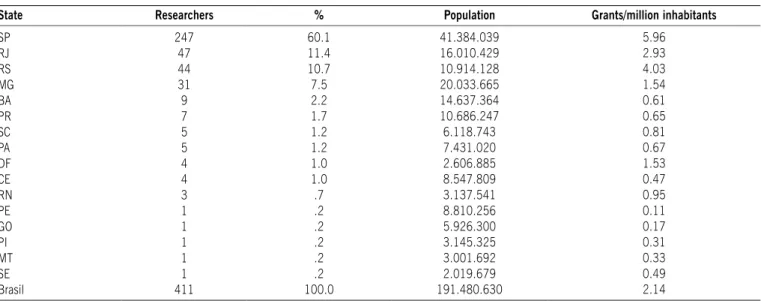
esultsDistribution of the 411 researchers by gender and grant category is summarized in Table 1. Researchers were predo-minantly male (68%) and recipients of Category 2 grants (55.7%). There was no significant difference in category distribution between genders (p=0.16). Of the investigators in the sample, 383 (93.2%) were medical graduates, 11 (2.7%) were biology majors, four (1%) had a degree in biomedical sciences, three (0.7%) had attended dentistry school, three (0.7%) were biochemistry graduates and seven (1.7%) had attended other courses. Table 2 shows the geographic origin of all researchers in the sample. Four Brazilian states (São Paulo, Rio de Janeiro, Rio Grande do Sul, and Minas Gerais) accounted for approximately 90% of researchers, with the state of São Paulo leading the list by far (60%). Analysis of the rate of RP grant recipients per population showed a national average of 2.14 medicine grant recipients per one million inhabitants. However, only three states (São Paulo, Rio Grande do Sul, and Rio de Janeiro) had a grant recipient-to-population ratio above the national average. The Southeast region of the country had a
Table 1 - Distribution of medicine grant recipients by gender and CNPq category (n = 411)
Grant category male Female Total
1A 43 (15.4) 11 (8.3) 54 (13.1)
1B 28 (10.0) 13 (9.8) 41 (10.0)
1C 34 (12.2) 11 (8.3) 45 (10.9)
1D 28 (10.0) 14 (10.6) 42 (10.20)
2 146 (52.3) 83 (62.9) 229 (55.7)
Table 2 - Distribution of medicine grant recipients by state of origin
State researchers % Population Grants/million inhabitants
SP RJ RS MG BA PR SC PA DF CE RN PE GO PI MT SE Brasil 247 47 44 31 9 7 5 5 4 4 3 1 1 1 1 1 411 60.1 11.4 10.7 7.5 2.2 1.7 1.2 1.2 1.0 1.0 .7 .2 .2 .2 .2 .2 100.0 41.384.039 16.010.429 10.914.128 20.033.665 14.637.364 10.686.247 6.118.743 7.431.020 2.606.885 8.547.809 3.137.541 8.810.256 5.926.300 3.145.325 3.001.692 2.019.679 191.480.630 5.96 2.93 4.03 1.54 0.61 0.65 0.81 0.67 1.53 0.47 0.95 0.11 0.17 0.31 0.33 0.49 2.14
Population data from IBGE/DPE/COPIS/GEADD, adapted from Santos et al8.
mean ratio of 4.01 grant recipients per million population, and the South region had an average of 2.02 recipients per million inhabitants, a rate similar to the national average. In the remaining regions of the country, however, rates were much lower: 0.43 in the Center-West region; 0.35 in the Northeast; and 0.32 in the North of Brazil. The study found that medical researchers were distributed across 40 different institutions of higher learning throughout the country. However, eight institutions accounted for approxi-mately 80% of researchers: USP (30.7%), UNIFESP (17%), UNICAMP (7.8%), UFRJ (7.1%), UFRGS (6.6%), UFMG (5.6%), UNESP (3.2%), and FIOCRUZ (2.4%). Median time since conclusion of doctoral studies was (for the 409 researchers in the sample who held a doctoral degree) was 15 years (interquartile range [IQR], 10–22 years). With regard to institution of doctoral studies, six universities accounted for 82% of researchers: USP (25%), UNIFESP (21.3%), USP-RP (8.8%), UFRS (8.1%), UFRJ (7.8%), UNICAMP (6.1%), and UFMG (5.1%).
Thir ty areas of activity for medical research were identified. However, 15 such areas, each with more than 10 researchers, account for roughly 90% of all Medicine grants: Nephrology and Urology (39 researchers; 9.5%); Neuroscience (35; 8.5%); Endocrinology (34; 8.3%); Pathology (34; 8.3%); Cardiology (33; 8%); Infectious Diseases (32; 7.8%); Hematology and Oncology (28; 6.8%); Psychiatry (23; 5.6%); Obstetrics and Gynecology (OB/GYN) (22; 5.4%); Pulmonology (21; 5.1%); Surgery (18; 4.4%); Gastroenterology (15; 3.6%); Ophthalmology (13; 3.2%); Rheumatology and Orthopedics (12; 2.9%); and Internal Medicine (12; 2.9%). Other areas, with fewer than 10 researchers each, included Immunology (9; 2.2%); Pediatrics (7; 1.7%); Medical Imaging (5; 1.2%); Genetics (4; 1.0%); Physiology (4; 1.0%); and Dermatology (3; 0.7%), in addition to other specialties with only one or
two research fellows. Comparison of distribution of grant categories by area of activity showed no statistically signi-ficant differences (p=0.61). However, the Endocrinology area had the higher percentage of researchers in the 1A and 1B grant categories (44%), whereas Infectious Diseases, Pulmonology, Surgery, Ophthalmology, Internal Medicine, and other specialty areas accounted for over 60% of rese-archers in category 2.
Publications
Throughout their academic careers, Medicine researchers supported by CNPq grants published 41,843 articles in scho-larly journals, with a median of 87 articles per investigator (IQ = 58-122). Of these, 21,481 (approximately 51%) were indexed in the Web of Science (median per researcher, 42; IQ, 29-62), whereas 28,471, or 68% of scientific output, were indexed in Scopus (median per researcher; IQ, 39-85). Taking into account the number of articles adjusted by career duration, researchers published a median of 4.13 articles per year (IQ, 2.9-5.8). The adjusted median for articles indexed in the Web of Science and in Scopus was 2.23/year (IQ, 1.4-3.2) and 2.90/year (IQ, 1.9-4.1) respectively. Analysis of adjusted scientific output showed significant differences between areas of activity in terms of the total number of published articles, (p<0.001) and in the number of articles indexed by the Web of Science (p=0.003) and Scopus (p = 0.013). Figure 1 shows a comparison of areas of activity by median number of published articles per year adjusted for time, including all published articles and those indexed in the Web of Science and Scopus databases. In terms of absolute number of articles, the most productive areas of activity were OB/GYN (median, 5.67 articles/year; IQ, 4.8-8.9), Psychiatry (5.65/year; IQ, 3.7-6.9), and Surgery (5.42/year; IQ, 2.7-8.7). However, when the sample was restricted to Scopus-indexed articles, the most productive fields were Psychiatry (4.2 articles/year; IQ, 2.3-5.9) and Neuroscience (3.87/year; IQ, 2.2-6.3). Consideration of Web of Science-indexed articles alone also showed Neuroscience (3.16 articles/year; IQ, 1.8-4.7) and Psychiatry (2.92 arti-cles/year; IQ, 1.73-4.5) as the most productive areas. When considering the percentage of Web of Science-indexed arti-cles in proportion to the total number of published artiarti-cles, Neuroscience was the most productive area of research, with a median of 67% of articles indexed (IQ, 42.2%-84.4%), whereas the least productive area in this respect was Surgery,
with a median of 36% of indexed articles (IQ, 25.9-45.6). Of the 411 researchers in the sample, 391 showed an increase in scientific output over the past five years as measured by mean number of articles published per year. This increase ranged from 1% to 387% (median, 87%). There was no significant difference in increase in scientific output between the various areas of activity (p=0.19). Four areas saw a twofold (or greater) increase in scientific output over the past five years, as measured by analysis of mean number of published articles over time: Ophthalmology, Internal Medicine, Pulmonology, and Cardiology.
d
IscussIonThe present cross-sectional study, which focused on medical researchers supported by CNPq grants, showed that Brazilian biomedical research is highly concentrated. Only four Brazilian states (three of which in the Southeast region) and eight public universities host the vast majority (80%) of medical researchers. Our findings also show a great balance between the various areas of activity (medical specialties) represented, with a slight predominance of traditional specialties such as Nephrology, Cardiology, Endo-crinology, Neuroscience, and Infectious Diseases. Each of these specialties accounts for roughly 8% a 10% of CNPq-supported researchers. The concentration of medical rese-arch activities reported herein has also been recognized by other authors in investigations of other areas of knowledge. Santos et al., for instance, in a recent study of 604 research grant recipients in the field of chemistry8 found that 63.7%
of recipients were from the Southeast region of Brazil, with 41.2% from the state of São Paulo alone. The present study found the geographic concentration of research activities to be even more pronounced, with 79% of medical researchers working out of the Southeast region of the country and 60% in the state of São Paulo. The national average number of
Neuroscience Psychiatry
OB/GYM
SurgeryHem/OncologyPathologyOphthalmologyEndocrinologyCardiologyRheumatology-OrthoInternal medicineGastroenterologyNephro/UrologyInfectious DiseasesPulmonology Others
Area de atuação
P
u
b
li
s
h
e
d
a
rt
ic
le
s
y
e
a
r
0 3 6 9 12 15
Scopus-indexed All articles
Web of Science-indexed
Figure 1 - median number of published articles per year, adjusted by length of academic career, including all published articles, Web of
medical Research Productivity grant recipients per million inhabitants was 2.1. One may infer that deviations from this mean would be indicative of a disproportionate distribution of research grants across the various regions and/or states of Brazil. Only the Southeast region had a ratio exceeding the national average, while rates in the Southern region were in line with the Brazilian average. The other three regions of Brazil had researcher-to-inhabitant ratios well below the national average. Again, these indicators were similar to those reported by Santos et. al8. In their assessment of
CNPq-funded researchers in the field of chemistry, the authors found a national average of 3.15 grant recipients per million inhabitants. Rates exceeded this national average in the South and Southeast regions of the country (3.90 and 4.76 respectively), and were well below the national average in the remaining regions: 0.26, 1.51, and 1.60 in the North, Central-West, and Northeast of Brazil respectively. Another key aspect of academic activity is the researcher’s role in training future scholars, as measured by thesis advisership of undergraduate research fellows and graduate-level grant recipients (master’s and doctoral candidates). The present study found that CNPq-supported investigators played a major role in training new researchers. The median number of grant recipients advised by each researcher (adjusted for time elapsed since conclusion of the adviser’s doctoral studies) was 0.5 and 0.3 per year for master’s and doctoral candidates respectively. These figures are quite similar to those of the most productive researchers found by Barata and Goldbaum in their analysis of CNPq-supported researchers in the field of public health5. The authors found that Brazilian
public health researchers served as thesis advisers to, on average, 0.15 doctoral candidates and 0.42 master’s student per year. However, Category 1A researchers in the field had higher advisership figures: 0.38 and 0.52 for doctoral and master’s candidates respectively. On the other hand, Cavalcante et al.6, found substantially higher averages in an
analysis of CNPq-supported researchers in various fields of dentistry: 2.2 doctoral candidates and 3.6 master’s students advised between 2003 and 2005. This increased producti-vity may reflect recent encouragement of human resources training at the graduate level by CAPES and other research funding agencies. Our analysis of scientific output shows a substantial increase in the number of scholarly articles published over the past five years, by practically all resear-chers in all areas of activity included in the sample. Similar increases in productivity have also been reported in areas such as dentistry, public health, and physical therapy5,6,8,9.
This quantitative improvement in medical research output correlates with an overall increase in scientific production in Brazil, and may reflect the various mechanisms established by Brazilian research funding agencies to serve as drivers of scholarly output. These mechanisms include improvement of the graduate education assessment system operated by the Coordenação de Aperfeiçoamento de Pessoal de Nível Superior (CAPES), which prioritizes the number and quality of published articles when assessing the quality of Brazilian graduate and postgraduate education programs10. Increases
in scientific output may also be driven by the fact that
research productivity grants foster peer competition, encou-raging the academic development of new researchers and the submission of articles to high-impact factor journals. Another key aspect that must be considered is that an increase in quantity of scientific output is not enough; improvement in quality, with greater international projection of Brazilian scientific output, must also be pursued. Our findings show that the fields of Neuroscience and Psychiatry lead the way in this search for quality, with roughly 70% of articles from researchers in both areas published in the highly selective Web of Science-indexed journals. Other indicators measured in prior studies corroborate these findings4,11-13. Nitrini
showed that the research output of Brazilian neuroscientists accounted for 2.37% of worldwide scientific production as measured by analysis of data from the 20 journals in which neuroscience research is most often published.4 Another relevant point is that several Brazilian journals in the field are indexed by Web of Science; furthermore, the Revista Brasileira de Psiquiatria is one of only seven Latin American journals with an impact factor of 1 or more (IF = 1.225)14.
c
onclusIonThe present study found that medical research is still highly concentrated in the Southeast region of Brazil, and established that the scientific output of most investigators has increased over the past five years. Neuroscience and Psychiatry had the highest high-quality scientific output of all areas of activity, with most articles indexed in the Web of Science and Scopus databases. In addition to providing a profile of medical researchers in Brazil, the findings of this study can serve as inputs for more effective development of strategies to foster scientific output and better requisition of financial resources for research funding.
Financial support: CNPq FAPEMIG
Conflicts of interest: no conflicts of interest declared concer-ning the publication of this article.
r
eferences1. Ministério da Ciência e Tecnologia. Indicadores nacionais de ciência e tecnologia (C&T): comparações internacionais - produção científica. 2009 [citado 29 abril 2010]. Disponível em: http://www.mct.gov.br/ index.php/content/view/9231.html.
2. King C. Brazilian Science on the Rise. Science Watch 2009. [cited 2010 April 19]. Available from: http://sciencewatch.com/ana/fea/ pdf/09julaugFea.pdf.
3. Ministério da Ciência e Tecnologia. MdCe. Indicadores nacionais de ciência e tecnologia (C&T): comparações internacionais - produção científica. 2009 [citado 22 Abril 2010]. Disponível em: http://www.mct.gov.br/ index.php/content/view/5710.html.
4. Nitrini R. The scientific production of Brazilian neurologists: 1995-2004. Arq Neuropsiquiatr. 2006;64:538-42.
5. Barata RB, Goldbaum M. A profile of researchers in public health with productivity grants from the Brazilian National Research Council (CNPq). Cad Saúde Publica. 2003;19:1863-76.
6. Cavalcante RA, Barbosa DR, Bonan PRF, Pires MBO, Martelli-Junior H. Perfil dos pesquisadores da área de odontologia no Conselho Nacional de Desenvolvimento Científico e Tecnológico (CNPq). Rev Bras Epidemiol. 2008;11:106-13.
8. Santos NCF, Candido LFO, Kuppens CL. Produtividade em pesquisa do CNPq: análise do perfil dos pesquisadores da química. Quimica Nova. 2010;33:489-95.
9. Santos SMC, Lima LS, Martelli DRB, Martelli Junior H. Perfil dos pesqui-sadores da Saúde Coletiva no Conselho Nacional de Desenvolvimento Científico e Tecnológico .Physis. Rev Saúde Coletiva. 2009;19:761-75. 10. Deheinzelin D, Caramelli B. [ Scientific production, post-graduate educa-tion and Revista da Associacao Medica Brasileira]. Rev Assoc Med Bras. 2007;53:471-2.
11. Gerolin J, Bressan RA, Pietrobon R, Mari JJ. Ten-year growth in the scien-tific production of Brazilian Psychiatry: the impact of the new evaluation policies. Rev Bras Psiquiatr. 2010;32:6-10.
12. Razzouk D, Zorzetto R, Dubugras MT, Gerolin J, Mari JJ. Leading countries in mental health research in Latin America and the Caribbean. Rev Bras Psiquiatr. 2007;29:118-22.
13. Rocha FF, Fuscaldi T, Castro V, Carmo W, Amaral D, Correa H. [Brazilian scientific production in the 40 psychiatric journals with high impact factor in 2006]. Rev Assoc Med Bras. 2007;53:543-6.
14. BIREME. Increased number and impact of Latin American journals in the Web of Science Newsletter - BVS 2010 [cited 2010 27 April 2010]. Available from: http://espacio.bvsalud.org/boletim. php?articleId=07093139200825.