*e-mail: [email protected]
scriptLattes: an open-source knowledge
extraction system from the Lattes platform
Jesús Pascual Mena-Chalco*, Roberto Marcondes Cesar Junior
Department of Computer Science, Institute of Mathematics and Statistics, University of São Paulo – USP, Rua do Matão, 1010, 05508-090, São Paulo, SP, Brazil
Received: July 5, 2009; Accepted: December 15, 2009
Abstract: The Lattes platform is the major scientific information system maintained by the National Council for Scientific and Technological Development (CNPq). This platform allows to manage the curricular information of researchers and institutions working in Brazil based on the so called Lattes Curriculum. However, the public information is individually available for each researcher, not providing the automatic creation of reports of several scientific productions for research groups. It is thus difficult to extract and to summarize useful knowledge for medium to large size groups of researchers. This paper describes the design, implementation and experiences with scriptLattes: an open-source system to create academic reports of groups based on curricula of the Lattes Database. The scriptLattes system is composed by the following modules: (a) data selection, (b) data preprocessing, (c) redundancy treatment, (d) collaboration graph generation among group members, (e) research map generation based on geographical information, and (f) automatic report creation of bibliographical, technical and artistic production, and academic supervisions. The system has been extensively tested for a large variety of research groups of Brazilian institutions, and the generated reports have shown an alternative to easily extract knowledge from data in the context of Lattes platform. The source code, usage instructions and examples are available at http://scriptlattes.sourceforge.net/.
Keywords: academic production report, Lattes platform, knowledge discovery.
1. Introduction
Knowledge extraction and visualization from large data-sets is an important research topic in computer science with strong potential impact in all scientific fields12. The research on this topic tipically involves the treatment of large datasets which can not be processed and understood by human experts due to its volume, diversity and complexity. Techniques from datamining, summarization, visualization, network modeling and high-performance computing are often brought together in order to solve problems of this nature. The present work is focused on the summarization and visualization of scientific reports obtained from the Brazilian Lattes platform.
The Conselho Nacional de Desenvolvimento Científico e Tecnológico (Brazilian National Council for Scientific and Technological Development - CNPq), makes efforts to inte-grate the Curricula of people associated to Brazilian scientific communities, in a curricular information system denominated LattesI. For this reason, the so-called “Lattes Curriculum” is considered a national standard of information about the scientific and academic accomplishments of students, profes-sors, researchers and professionals involved in science and technology in general.
I. The software platform, available at http://lattes.cnpq.br/, was named Lattes in honor to Cesare M. G. Lattes, a Brazilian physicist, co-discoverer of the pion or pi meson, one of the nuclear particles.
The Lattes curriculum is used for academic evaluation because it represents the history of scientific, academic and professional activities1. It is hence a rich and powerful data-base that presents inumerous potential applications (scientific, technological, economical, etc.) The Lattes curriculum, in HTML format as available in the CNPq site, displays infor-mation only in a personal way, i.e., the registered inforinfor-mation is individually associated to each person. This characteristic does not easily provide a way to figure out the bibliograph-ical, technical or artistic productions of a given group, such as a research group, professors of an academic department or members of a Brazilian institution.
There are some interesting bibliometric questions that may be answered about a group just based on the respective Lattes curricula:
• How many bibliographical, technical or artistic
productions were elaborated?
• Whatistheproile(i.e.proportionofpublication)of
the different types of bibliographical productions?
• Howistheregularityandtheevolutionofthepubli -cations along the years?
• How is the collaboration/cooperation among
researchers?
• How many thesis and dissertations have been
concluded?
• What is the geographic distribution of the
researchers?
• What is the scientiic formation inluence of the
considered researchers?
The scriptLattes, an open-source system, was designed to provide answers to the above questions through automati-cally created reports. Given a group of researchers registered in the Lattes platform, the scriptLattes download their Lattes curricula from the CNPq site, extract the information of interest, eliminate the redundant scientific productions and create reports about the production, reports of academic supervisions as well as the collaboration graph and the
research map from the members of the group. We believe
that the introduced system is a useful tool to easily extract knowledge about the Lattes curricula of a group. This knowl-edge may be used to explore, identify or validate patterns of academic activities, thus bringing bibliometric information about a group of interest 22.
This open-source system runs on a PC with GNU/Linux using Perl modules and basic structures of programming languages. The scriptLattes is a project registered in the Free Software Competence Center at University of São Paulo, being hosted at SourceForge 29. To the best of our knowledge, the system is the first to be widely used in several Brazilian academic groups, including to the University of São Paulo (USP), the State of São Paulo Research Foundation (FAPESP), and the Agency for Agro-business Technology in the State of São Paulo (APTA), for instance. The system was successfully tested with at least 300 research groups of Brazilian institu-tions.
Therefore, the present paper describes a system that allows scientific data summarization from a strucutred data-base of curricula vitae, i.e. the Lattes platform. In this context, the paper describes a new system that allows the extraction of useful summarized knowledge from large set of data, a task that would be too difficult (in many cases, impossible) to be performed manually. In order to produce such a system, different solutions and algorithms have been adopted or proposed and implemented, being described in the paper. Possible applications of the system are also discussed. The paper’s contributions show how Computer Science tools (developed data-structures, algorithms, visualization tech-niques and software system) solve an important knowledge
extraction problem from large datasets. The relevance of the paper’s contributions relies in the context of knowledge extraction and visualization systems that deal with possibly large datasets, an important Computer Science research topic10,11,12,15.
The remaining of the paper is organized as follows: Section 2 discusses some important background references followed by Section 3, which describes the modules of the proposed system. Some results illustrating the use of script-Lattes, as well as a form to explore the obtained information, are described in Section 4. Finally, the conclusions and future directions are summarized in Section 5.
2. Background
There has been intensive growing attention to the problem of extracting meaningful summarized knowledge from large volumes of data12. Papers under different perspectives (knowledge extraction, e-Science, data intensive paradigm, etc.) have appeared in most important Computer Science forums and discussed the main involved aspects, from computational tools to applications. For instance, Kouzes and collaborators15 describe some of the typical architec-ture components of a knowledge extraction systems. Some of these components inspired the tools implemented in the scriptLattes. An interest resource is the Digging into Data website11, which presents a National Science Foundation (among other funding agencies) call for applications to extract knowledge based on data-driven inquiry of large sets of books (mainly on Social Sciences and Humanities). The book10 discusses how knowledge extraction plays a central role in modern scientific fields such as environment, health and scholarly communication. Different problems, systems and computational solutions are presented by the authors in this edited book. An important field of application for such techniques is the analysis of scholar data such as publications,
supervisions,collaborationandscholarinluence10. The anal-ysis of academic data is carried out in different levels, from the case where students and researchers are exploring collab-orations and supervisors to institutional levels of academic assessment of whole departments16. Many works have been devoted to the analysis of co-authorship and collaborations from papers databases. Many of the issues in this research appear from the low degree of structure of the data as well as the ambiguities often present9,22,27. Another important issue is the analysis of the networks themselves14,17,20,28.
3. Modules of the System
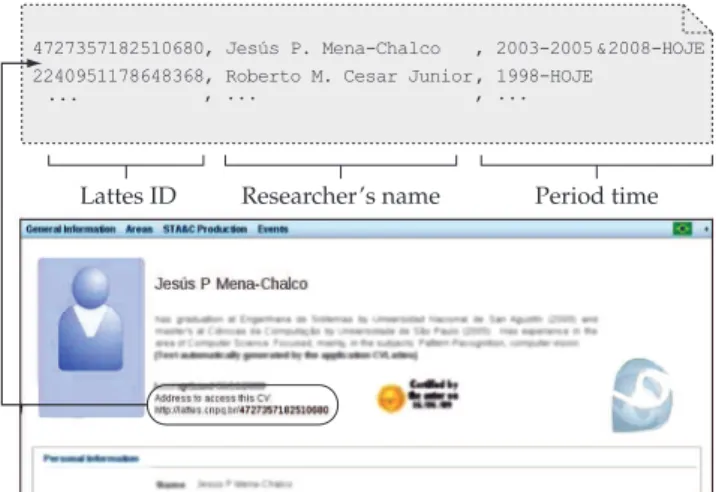
The input of the system is composed by an ASCII list of Lattes curriculum’s IDs in conjunction with the time period of each member of the group to be analyzed, i.e., the years where each member has been associated to the group (research group, institute, department, university, etc.) The ID of a Lattes curriculum is a number of 16 algarisms associ-ated to each person registered in the Lattes platform, being easily obtained from the Lattes curriculum. Therefore, the IDs are commonly used in the request of a given curriculum. See in Figure 1 an example of the input file format.
The system has been divided into six modules. Figure 2
showstheschematicdatalowdiagramofthewholesystem,
where each module is responsible to process a given type of information of the Lattes curricula. The system output is given by several reports, in HTML format, showing the summa-rized information in terms of bibliographical, technical and artistic production, as well as academic supervisions, collab-orations and research map among the members. The HTML format was chosen in all reports because of being a standard format to be visualized on the internet.
3.1. Data selection
This module allows to download the Lattes curricula, in HTML format, from the site of the Lattes platform. In order to facilitate the comparison between strings, the curricula were normalized to use the same characters codification.
The curricula are downloaded in HTML format because they are publicly available only as plain HTML. Public users of the Lattes platform do not have access either to the Lattes database or to data in XML format. As a result, special atten-tion is devoted to extract the informaatten-tion about the scientific productions, as explained in the data preprocessing module.
3.2. Data preprocessing
In this module, a HTML parser is used to extract the information about the professional address, the list of produc-tions, the list of ongoing and concluded supervisions, and the available photograph in the Lattes curriculum. The list of productions and the list of supervisions are limited by the
Figure 1. Example of input file (dotted lines). Each line corresponds to data from an author. The period time (third column value) is optional to each researcher. The figure shows where the Lattes ID may be obtained from the Lattes curriculum.
Lattes ID Researcher’s name Period time
4727357182510680, Jesús P. Mena-Chalco , 2003-2005 & 2008-HOJE
2240951178648368, Roberto M. Cesar Junior, 1998-HOJE
, ... , ...
...
Figure 2.Schematicdatalowdiagramofthesystem(dottedlines).Eachblock(solidlines)representsamodulewhileeacharrowrepresents theinformationlowbetweenmodulesorexternalplatforms(grayboxes).
Lattes platform Google maps
Data selection
Data preprocessing
Redundancy treatment
Collaboration graph generation
scriptLattes reports generation Research map geneation Lattes curricula
in HTML format Lattes
IDs
Query string
Latitude and longitude values Lattes curriculum
ID and time period of each member of the group
Lattes curricula and their corresponding
time of permanence Professional address and list of advisories’ IDs of each member
List of academic supervisions
List of filtered productions
Academic collaboration graph
Geographical map of research
Reports Lists of bibliographical,
technical and artistic productions of each member
years indicated in the time of permanence of each member of the group.
It is important to note that the types of scientific produc-tions considered by the scriptLattes are those registered in the Lattes platform. All available information from the Lattes curricula are considered as validated by the CNPq. See in Table 1 the types of productions and supervisions considered by the system.
3.3. Redundancy treatment
It is common that the productions are made in collabo-ration with one or more collaborators of the same group. Therefore, the same production (e.g. a journal paper) may appear duplicated because of being declared in each curric-ulum vitae of the corresponding co-authors. Thus, this module allows to detect and to eliminate the duplicated productions of the lists obtained after preprocessing the Lattes curricula. Furthermore, the duplicated productions are used to detect
collaboration: two researchers are defined as collaborators in the software if they have a common production detected by this module.
The productions title is considered as a standard character-istic in order to compare the scientific productions elaborated by the analyzed group. This characteristic is adopted because it is always displayed in all productions presented by the Lattes curricula in HTML format. Note that we also consid-ered other characteristics such as the authors name or DOI number. Nonetheless, these values have not yet been stand-ardized in the Lattes platform, being more difficult to parse and to compare by automatic means in the current version.
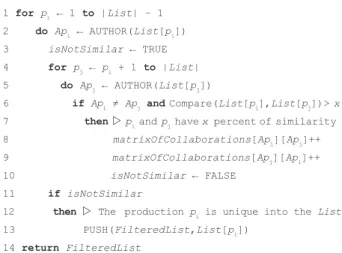
The following algorithm summarizes the process applied by this module on a list of scientific productions:
FILTER-PRODUCTIONS-LIST(List,x)
1 for pi ← 1 to |List| – 1
2 do Api ← AUTHOR(List[pi])
3 isNotSimilar ← TRUE
4 for pj ← pi + 1 to |List|
5 do Apj ← AUTHOR(List[pj])
6 if Api ≠ Apj and Compare(List[pi],List[pj])> x
7 thenpi and pj have x percent of similarity
8 matrixOfCollaborations[Api][Apj]++
9 matrixOfCollaborations[Apj][Api]++
10 isNotSimilar ← FALSE
11 if isNotSimilar
12 then The production pi is unique into the List
13 PUSH(FilteredList,List[pi])
14 return FilteredList
The Filter-Productions-List procedure requires a list of productions and a x value as parameters. The x value is the desired threshold (as a percentage value) in order to identify the similar productions. The longest common subsequence algorithm5 was used by the Compare procedure in order to calculate the percentage of similarity between the title of the scientific productions (for comparison purposes, only the size of the longest common subsequence was used as a measure of distance between productions). Thus, the publications list is filtered by removing the equal or similar publications into the List. Currently, in this module, the productions with simi-larity of 92% in their titles are identified and merged. This percentage was adopted after preliminary experiments. This value can be easily modified.
All redundant scientific productions are recorded in a bi-dimensional matrix, matrixOfCollaborations, that stores the number of bibliographical, technical and artistic collabora-tions among the members. Let n be the length of elements into List. Since we have compared the i-th production with the (n – i) remaining productions, O(n2) comparisons are required to filter the complete list.
Note that the process of this module is individually applied to each type of productions. Therefore, there may exist some publications with similar titles but belonging to different types. Those are not identified by the system as being the same.
Table 1. Information extracted from the Lattes curriculum.
Personal information
Name
Professional address
Bibliographical production
Articles in scientific journals Book published/organized Book chapter published
Articles in newspapers/magazines
Complete works published in proceedings of conferences Expanded summary published in proceedings of conferences Summary published in proceedings of conferences
Articles accepted for publication Presentations of work
Other kinds of bibliographical production
Technical production
Patented or registered software Not patented or registered software Technological products
Techniques or process Technical works
Other kinds of technical production
Artistic productions
Artistic/cultural production
Ongoing / concluded supervisions
Postdoctorate supervision Ph.D. thesis
Master’s thesis
Monograph of completion for improvement/specialization
Worksofcompletionforgraduation
3.4. Collaboration graph generation
Commonly, a scientific collaboration graph describes research activities that have been carried out by a research group19. In this module, scriptLattes uses a graph to represent the collaboration among members of a group based on scien-tific productions. Each member is represented by a node. An edge is created between a pair of nodes whenever a common production of the corresponding researchers is detected by the redundancy treatment module. In other words, if two researchers have co-authored a common production, their respective nodes in the collaboration graph are linked by an edge. The edge weights are calculated as the number of co-authored scientific productions. Therefore, a weighted graph is generated.
The process in this module is simplified by using the matrixOfCollaborations, a symmetric matrix that contains the total amount of co-authored productions between members, being computed by the redundancy treatment module. matrixOfCollaborations is taken as an adjacency matrix that represents the graph of collaborations. In the generated graph, it is possible to observe the collaboration among members and clusters of cooperation. This graph is an instrument that helps to discover the researchers with more activity of co-authoring within the group and could be used in detailed analysis of co-authoring as17,20,28.
3.5. Research map generation
It is often desired to know the geographic location of members of a particular group as well as of their alumni. In this context, scriptLattes generates a “research map” which represents the geographic location of the group members on the world. This module allows to create a research map using an external platform of geographic addresses.
The country name, city name, and the zip code number of each member, available in the Lattes curricula, is used to query the location: the longitude and latitude values are obtained if the query string is valid. Furthermore, the geographic location of each formed PhD by the group is also plotted in the map. Thus, the research map shows where the
formedstudentsareworking,givenanideaoftheinluence
maintained by the research group. It is important to note that, to accomplish the retrieval of the latitude and longitude values of the geographic position of each member, an inter-face with Google Maps is used.
3.6. Reports creation
Reports of the productions, as well as for ongoing and concluded supervisions, are created in this module. These reports are separated by type and show a quantitative infor-mation disclosed per year in inverse chronological order.
Bar charts are associated to the reports, where the bar lengths are proportional to the values of scientific produc-tions of the group. Hence, it is possible to discover if the production volume of a particular group came to baseline.
Additionally, the generated reports show web links to search engines (including Google and Scholar, among others) in order to find possible citations or similar works. Currently, reports in HTML or JSP format are generated. These formats have been chosen because of being suitable to the internet. The collaboration graph can be visualized in PNG, PostScript or using an interactive java applet18.
4. Results
Wedescribetwoexperimentsthatillustratethesoftware
potential applications.
4.1. Experiment using a single group
In this section we show an example of reports generated
bythesystem.WeusetheLattescurriculaof41professors
associated to the Department of Computer Science of the Institute of Mathematics and Statistics at the University of São Paulo (DCC-IME-USP). The time of permanence of each member was indicated as an input data, whenever the infor-mation is available.
Figure 3 shows some generated reports of the group. The complete list is available in23. See in Figure 3c the gener-ated collaboration graph. Figure 3d presents an example of the generated research map. Each member of the group is represented in green and each formed PhD in blue. The advisor-advisee relation is represented with a thin straight-line. The name of the researcher and the complete address are shown by clicking the location points.
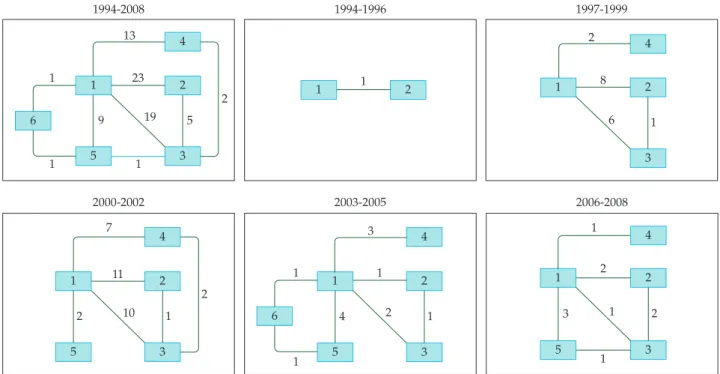
The matrix of collaborations can be used in different approaches to explore and to extract knowledge. For instance, in Figure 4 it is possible to observe the temporal collaborations of a group of professors in the last five triennia (years 1994-2008). The temporal academic collaboration graphs show how the collaborations were made during each period, i.e. the evolution of collaborations among the members through the years. Note that members 1 and 2 have been collaborating in the last five triennia in a stable way. Member 6 only had collaboration with other members in the triennium 2003-2005. On the other hand, member 5 has been
collaboratinginthegroupsincethetriennium2000-2002.With
the temporal graph of collaborations it is possible to auto-matically characterize the collaboration among members. In particular, it is possible to determine the degree of temporal collaboration of the whole group using measurements such as those described in6.
4.2. Experiment using several groups
The second experiment briely investigates the proile
(proportion of publication) of bibliographical productions from several groups with distinct characteristics.
To define the research groups, we used the Brazilian research groups databaseII maintained by the CNPq. On May of 2009, using the keyword computação as query in the
database, 56 research groups in Computer Science belonging to São Paulo State were extracted. In all groups, the lists of researchers registered on the CNPq were used to create the lists of Lattes curricula. Altogether, 56 lists were created as input to the scriptLattes. In order to consider the same time periods of the scientific productions, in the remaining of this experiment the productions of the last 10 years were consid-ered, i.e., scientific productions between 1999 and 2008.
Figure 5a shows the total amount of bibliographical productions extracted from 306 members belonging to the research groups using scriptLattes. Note that these global
amounts indicate a preference to publish as follows: complete works in conferences, summary in conferences and articles in scientific journals. See the radar chart in Figure 5b. The data visualization through radar charts helps to display both the dominant type of bibliographical production for a given group, and which groups are most similar, as described below.
The reports of bibliographical productions of each group were used to explore/classify the profiles of the research groups. The scientific productions of the last 10 years of each bibliographical type were concatenated to
a b
c d
form a vector of 90 elements. Then, the vector was normal-ized by dividing its elements by the maximum value. Thus, each element stores a relative amount of annual scientific productions of the group. Principal component analysis13 (PCA) was carried out to examine the 56 vectors of temporal scientific productions. This analysis allows to transform correlated data into a smaller number of uncor-related principal components. In particular, the first two components were used to define four classes of research
groups. The groups were clustered in classes using the centroid distance method. It was adopted the centroid distance method because it is a natural form to cluster few groups. Please refer to8 for more detailed descriptions. The first two components take into account more than 36.5% of the total variation of the analyzed vectors.
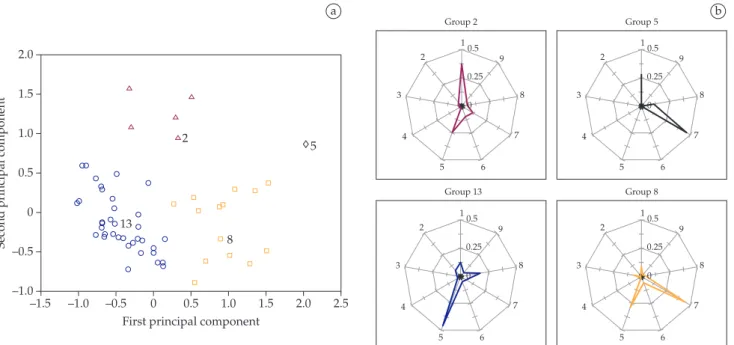
Figure 6a shows the results of clustering the 56 Computer Science research groups using the PCA data extracted by the scriptLattes reports. Each research group is represented by a
1994-2008
2000-2002 2003-2005 2006-2008
1994-1996 1997-1999
1 1
1
1 1 1
1
1
1 1
1
2 1 1 1
1
2 2
2
2
2 2
2 2 1
1
1
1 2 2
2 2
3 3
3
3 3
5 5 5
4
4
4 4
4
3 5
6 9
23 13
5 19
4
3 8
6
7
11
10 6
Figure 4. Temporal graph of collaborations based on the productions belonging to the Computer Vision Research Group24 of the Department
of Computer Science at University of São Paulo. The edge weight represents the number of co-autored productions.
0.5
0.25 1
2
3
4
5 6
7 8 9
0
a b
Type of bibliographical production Total
1. Articles in scientific journals 1816
2. Book published/organized 220
3. Book chapter published 403
4. Articles in newspapers/magazines 310
5. Complete works published in proceedings of conferences
4544
6. Expanded summary published in proceedings of conferences
586
7. Summary published in proceedings of conferences 2264
8. Presentations of work 1233
9. Other Kinds of bibliographical production 472
regular shape (e.g. circle, square, triangle or diamond) and corresponds to one of four identified classes.
In Figure 6b the production profiles from four groups are shown: 2, 5, 8 and 13. These groups were selected because they are the more representative of the identified classes. Observe that the first principal component represents vari-ation in the profile from complete works in conferences to summaries published in conferences. The second is rather
lat,probablyrepresentingthevariationintheproilefrom
complete works in conferences to articles in scientific jour-nals. This semantic interpretation is dependent upon the area of the analyzed research groups.
Similar approaches can be explored in order to analyze the overall progress of productions developed by scientific and technological Brazilian groups, i.e. to analyze the patterns of increasing or decreasing of bibliographical productions through the years. In this context, the quantitative values obtained with scriptLattes can be used to automatically esti-mate the different patterns of productivity and show if any
patternissigniicantlyinluencedbytheareaofknowledge
(e.g. Social, Applied, Medical or Biological Sciences).
5. Conclusions
In this paper we have presented an open-source system for extraction and visualization of knowledge from Lattes curricula. The designed system allows to analyze scientific productions based on curricula registered in the Lattes plat-form. It is a simple form to obtain a survey of significant performance indicators of research groups, and to analyze the progress of scientific productions and the relevant
informa-tion about their activities (e.g. see in reference30 an analysis of the performance of research groups associated to Agronomy, Genetics and Sociology).
The scriptLattes only deal with structured information from Lattes currila. A natural path to be improved in the system is the use of information from other more general or semi-structured sources. In that sense, we can explore new methods in regard to automatically extract information7,27.
An important issue regarding the generation of the collaboration graph is the treatment of the correct title disam-biguation in author citations. Alternative methods, such as in9, may be explored with the aim of use an unsupervised learning approach. Currently, the scriptLattes is being improved with the purpose of have a more general and effi-cient system. Future improvements aims at exploring the analysis about co-authoring networks2,17,20,28, measuring and extracting proximity in networks14, finding and evaluating community structure in networks21, and applying ontolo-gies4,25.Webelievethatthesenewapproacheswillallowmore contributions to the extraction and management of knowl-edge from the Lattes platform.
While there is great potential to explore the Lattes
curricula vitae there still needs to be important effort on the part of institutions which host the data to supply soft-ware interfaces, facilitating the data extraction process to the pursuit of knowledge discovery on Lattes platform. Until that time, there is an important opportunity for combine efforts to provide the bibliographical production data that can integrate the information that is already available on the internet.
Figure 6. Analysis of the scientific productions profile: a) Clustering of 56 research groups in Computer Science associated to the São Paulo State. Note that four classes were identified. Each class is represented by a different geometric form. b) Radar charts of representative groups of the identified classes. The axes, represented by a number, are related to each type of production listed in Figure 5a.
0.5 0.25 1 2 3 4 5 6 7 8 9 0.5 0.25 1 2 3 4 5 6 7 8 9 0 0.5 0.25 1 2 3 4 5 6 7 8 9 0.5 0.25 1 2 3 4 5 6 7 8 9 b a
Group 2 Group 5
Group 13 Group 8
2.0 2.0 2.5 1.5 1.5 1.0 1.0 0.5 0.5 –0.5 –0.5 –1.0 –1.0 –1.5 8 2 5 13 0 0
Second principal component
First principal component
0 0
Acknowledgements
The authors would like to thank Fabio Kon, Fabrício Martins Lopes and Yossi Zana for discussions and sugges-tions on this work and the anonymous reviewers for the critical comments and valuable suggestions. This work was supported by CAPES, CNPq and FAPESP.
References
1. Amorin CV. Curriculum vitae organization: the Lattes software platform. Pesquisa Odontológica Brasileira 2003; 17(1):18-22.
2. Balancieri R, Bovo AB, Kern VM, Pacheco RCS and Barcia RM. A análise de redes de colaboração científica sob as novas tecnologias de informação e comunicação: um estudo na Plataforma Lattes. Ciência da Informação 2005; 34(1):64-77.
3. BörnerK,ChenCMandBoyackKW.Visualizingknowledge
domains. In: Cronin, B. (Ed.). Annual Review of Information Science and Technology 2003; 37(1):179-255.
4. Castaño AC. Populando ontologias através de informações em HTML: o caso do currículo Lattes. [Master’s thesis]. São Paulo: Universidade de São Paulo; 2008.
5. Cormen TH, Leiserson CE, Rivest RL and Stein C. Introduction
to algorithms. 2 ed. Cambridge: MIT Press; 2001.
6. Costa LF, Rodrigues FA, Travieso G and Villas Boas PR. Characterization of complex networks: a survey of measurements. Advances in Physics 2007; 56(1):167-242.
7. DayMY,TsaiTH,SungCL,LeeCW,WuSH,OngCSetal.A
knowledge-based approach to citation extraction. In: Zhang D, Khoshgoftaar TM and Shyu ML. (Eds.). Proceedings of the International Conference on Information Reuse and Integration; 2005; Las Vegas Hilton. Las Vegas: IEEE Systems, Man, and Cybernetics Society; 2005. p. 50-55.
8. Duda RO, Hart PE and Stork DG. Pattern classification. 2 ed.
NewYork:JohnWiley&Sons;2000.
9. Han H, Zha H and Giles CL. Name disambiguation in author citations using a K-way spectral clustering method. In:
Proceedings of the 5 ACM/IEEE-CS Joint Conference on Digital Libraries, Tools & techniques: identifying names of people and
places; 2005; Denver. Canada: ACM; 2005. p. 334-343.
10. Hey T, Tansley S and Tolle K. (Eds.). The fourth paradigm.
Redmond,Washington:MicrosoftResearch;2009.
11. The Digging into Data Challenge. 2009. Available from: http://www.diggingintodata.org/. Access in: 20/10/2009.
12. Communications of the ACM: Surviving the data deluge 2008; 51(12). New York, NY, USA: ACM; 2008.
13. Jolliffe IT. Principal component analysis. 2 ed. New York: Springer-Verlag; 2002. (Series in statistics)
14. Koren Y, North SC and Volinsky C. Measuring and extracting proximity in networks. In: Eliassi Rad T, Ungar LH, Craven M and Gunopulos D. (Eds.). Proceedings of the Twelfth ACM SIGKDD International Conference on Knowledge Discovery and
Data Mining; 2006; Philadelphia. Philadelphia: ACM; 2006. p.
245- 255.
15. Kouzes RT, Anderson GA, Elbert ST, Gorton I and Gracio DK. The changing paradigm of dataintensive computing.
Computer 2009; 42(1):26-34.
16. Laender AHF, Lucena CJP, Maldonado JC, Souza e Silva E and Ziviani N. Assessing the research and education quality of the top Brazilian Computer Science graduate programs.
ACM SIGCSE Bulletin 2008; 40(2):135-145.
17. Liu X, Bollen J, Nelson ML and Van de Sompel H. Co-authorship networks in the digital library research community. Informations Processing and Management 2005; 41(6):1462-1480.
18. Project Zoomable Visual Transformation Machine. 2009. Available from: http://zvtm.sourceforge.net/. Access in: 20/10/2009.
19. Maia MF and Caregnato SE. Co-autoria como indicador de redes de colaboração científica. Perspectivas em Ciência da Informação 2008; 13(2):18-31.
20. Nascimento MA, Sander J and Pound J. Analysis of SIGMOD’s co-authorship graph. SIGMOD Record 2003; 32(3):8-10.
21. Newman MEJ and Girvan M. Finding and evaluating community structure in networks. Physical Review E 2004; 69(2):026113.
22. Nicholson S. The basis for bibliomining: frameworks for bringing together usage-based data mining and bibliometrics through data warehousing in digital library services.
Informations Processing and Management 2006; 42(3):785-804.
23. University of São Paulo - USP. Publications of the Department
of Computer Science. São Paulo, 2009. Available from: http://
www.vision.ime.usp.br/creativision/publications_dcc/. Access in: 20/10/2009.
24. Vision Research Group - IME - USP. Publications of the Vision Research Group. São Paulo: University of São Paulo, 2009. Available from: http://www.vision.ime.usp.br/ creativision/publications_vision/. Access in: 20/10/2009.
25. Pacheco RCS and Kern VM. Uma ontologia comum para a integração de bases de informações e conhecimento sobre ciência e tecnologia. Ciência da Informação 2001; 30(3):56-63.
26. Paulovich FV, Nonato LG, Minghim R and Levkowitz H. Least square projection: a fast high-precision multidimensional projection technique and its application to document mapping. IEEE Transactions on Visualization and Computer Graphics 2008; 14(3):564-575.
27. Peng F and McCallum A. Information extraction from research papers using conditional random fields. Informations
Processing and Management 2006; 42(4):963-979.
28. Said YH, Wegman EJ, Sharabati WK and Rigsby JT. Social
networks of author-coauthor relationships. Computational Statistics & Data Analysis 2008; 52(4):2177-2184.
29. Project scriptLattes. scriptLattes: uma ferramenta para extração e visualização de conhecimento a partir de Currículos Lattes. São Paulo: Universidade de São Paulo, 2009. Available from: http://scriptlattes.sourceforge.net. Access in: 20/10/2009.