Abstract
Objective: This article aims to review the clinical features and therapeutic characteristics that may predict treatment response in patients with social anxiety disorder (SAD). Methods: A systematic review of trials identiied through databases of ISI, Medline, PsycInfo, Cochrane, LILACS, Current Controlled Trials, and in references of previously selected articles published in English up to December 2010. In our literature search, we used the words prediction/predictors and social anxiety disorder or social phobia. Results: Early onset, greater disease severity, comorbidity with other anxiety disorders (including generalized anxiety disorder and simple phobia), and high expectations about the role of the therapist emerged as potential predictors of less effective treatment in SAD. Conclusions: Knowledge of various clinical and treatment features may help professionals to predict possible responses to therapeutic interventions in patients with SAD. However, given the diversity of measures used to assess response, further studies should be performed with standardized methods to investigate the aspects related to treatment resistance in SAD.
©2012 Elsevier Editora Ltda. All rights reserved.
A review on predictors of treatment outcome in
social anxiety disorder
Sara Costa Cabral Mululo,
1Gabriela Bezerra de Menezes,
1Paula Vigne,
1Leonardo F. Fontenelle
1,21 Programa de Pesquisa em Ansiedade e Depressão, Instituto de Psiquiatria, Universidade
Federal do Rio de Janeiro (IPUB/UFRJ), Rio de Janeiro, Brazil
2 Instituto D’Or de Pesquisa e Ensino, Rio de Janeiro & Departmento de Psiquiatria e Saúde Mental,
Instituto de Saúde da Comunidade, Universidade Federal Fluminense (MSM/UFF), Niterói, Brazil
Received on July 4, 2011; accepted on September 3, 2011
DESCRIPTORS Phobic Disorders; Predictors;
Treatment Outcome; Review;
Clinical Trials. REVIEW ARTICLE
Corresponding author: Leonardo F. Fontenelle; Rua Visconde de Pirajá 547 Sala 719; 22410-003, Ipanema, Rio de Janeiro, Brazil; Fax: (.55 21) 2239-4919; E-mail: [email protected]
1516-4446 - ©2012 Elsevier Editora Ltda. All rights reserved.
Official Journal of the Brazilian Psychiatric Association
Volume 34 • Number 1 • March/2012
Psychiatry
Uma revisão sobre fatores de predição de resposta ao tratamento no transtorno de ansiedade social
Resumo
Objetivo: Este artigo tem por objetivo descrever as principais características clínicas e terapêuticas que possam predizer resposta ao tratamento em pacientes com transtorno de ansiedade social (TAS). Métodos: Revisão sistemática de ensaios clínicos identiicados através das bases de dados ISI, Medline, PsycInfo, Cochrane, LILACS, Current Controlled Trials e em referências bibliográicas de artigos previamente selecionados publicados em inglês até dezembro de 2010. As seguintes palavras-chave foram utilizadas em nossa busca bibliográica: prediction/predictors
e social anxiety disorder ou social phobia. Resultados: Início precoce, maior gravidade da doença, comorbidade com outros transtornos de ansiedade (incluindo o transtorno de ansiedade generalizada e fobia simples) e alta expectativa sobre o papel do terapeuta emergiram como potenciais fatores de predição menor eicácia do tratamento do TAS. Conclusões: O conhecimento de uma variedade de características clínicas e de tratamento pode auxiliar os proissionais a preverem possíveis respostas às intervenções terapêuticas nos pacientes com TAS. No entanto, devido à diversidade de medidas utilizadas para avaliar a resposta, novos estudos com o objetivo de investigar aspectos relacionados à resistência ao tratamento do TAS devem ser realizados com métodos mais padronizados.
©2012 Elsevier Editora Ltda. Todos os direitos reservados. DESCRITORES:
Transtornos fóbicos; Fatores de predição; Resultado de tratamento; Revisão; Ensaios clínicos.
Introduction
Social anxiety disorder (SAD) is characterized by intense and persistent fear of being negatively evaluated by others,
which leads to signiicant avoidance or intense psychological
distress in various social situations.1 SAD has high prevalence
rates, early and insidious onset, and a chronic course.2 It is
as-sociated with low levels of quality of life; signiicant feelings
of incapacity; and notorious social, educational, and occupa-tional disability.3 Despite remaining largely underdiagnosed,4
recent studies are beginning to unveil SAD neurobiological underpinnings, thus leading to greater knowledge regarding its pathophysiology.5
Currently, the most empirically effective treatments of SAD include pharmacotherapy with selective serotonin reuptake inhibitors (SSRIs) or serotonin and norepinephrine reuptake inhibi-tors (SNRIs), and cognitive behavioral therapy (CBT), either together or separately.6,7,8 Although these strategies lead to
a therapeutic response in a large proportion of individuals, a
signiicant number of patients with SAD (up to 50%) does not respond at all or remain signiicantly symptomatic after being submitted to irst-line treatments.9,10,11
This article aims to review the clinical and therapeutic characteristics that have been reported to be associated with response to treatment prescribed to patients with SAD. Potentially, the characterization of these features may save patients’ time by avoiding ineffective treatments, which may be sometimes associated with severe side effects and/or economic burden. It could also help to identify factors that should be taken into account if one aims at elaborating more
speciic treatment for SAD individuals who do not respond to
conventional strategies.
Methods
A systematic review of clinical trials that describe the
proile of patients with SAD who respond to treatment was
performed in the following databases: ISI/Web of science, Medline, PsycInfo, Cochrane Library, LILACS, and Current Controlled Trials(articles not published yet). An additional search for articles of interest was performed in the biblio-graphic list of selected articles. The following keywords were used in the bibliographical search: prediction/predictors and social anxiety disorder or social phobia. Clinical trials originally published in English up to December 2010 were assessed.
Inclusion criteria consisted of studies composed of
sub-jects with a primary diagnosis of SAD according to the
DSM-III-R or DSM-IVand describing an assessment of treatment response predictors in this condition. We included papers that addressed the following aspects as potential response predictors: (i) clinical features (age of onset, duration of SAD, severity of symptoms, generalized subtype of SAD, family history of SAD, and psychiatric comorbidity); (ii) socio-demographic characteristics (age, gender, educational level, and marital status); and (iii) treatment features (treatment history, duration of current treatment, expectancy regarding treatment, and group cohesion [in case of group therapy]). For the sake of space, other potential predictors (e.g., per-sonality traits) were not addressed in our review.
Results
Medline search identiied 392 articles, of which 10 met the inclusion criteria. In PsycInfo, from the 58 studies identiied,
5 were included. The ISI/Web of Science database led to the
identiication of 679 articles, of which 4 were included. A
Cochrane search resulted in 158 studies, of which 11 were selected, including 10 that had already been localized on
Medline and Psyinfo, and one that appeared for the irst time.
A LILACS search led to only one article, which did not meet the inclusion criteria. Unpublished articles searched on Current Controlled Trials were not found as well. Four
of previously selected articles. These combined search strategies led to a total of 24 selected articles. Most stud-ies (n = 19) reported independent predictors of response using regression analysis, while the remaining ones12-16 used
univariate analysis.
Clinical characteristics
Studies describing the impact of different clinical character-istics (including age of onset, duration, symptom severity, subtype, and family history) on SAD treatment outcomes are listed in Table 1.
Age of onset
The impact of the age of SAD onset on treatment outcome was investigated in four studies. In one of them, no impact of age of onset on the response of 57 patients treated with group CBT was found.17 In the second trial with 204 patients
treated with sertraline or placebo, patients with late-onset
(≥ 19 years) generalized SAD tended to have a better response
to treatment with sertraline than those with early-onset gen-eralized SAD.18 Accordingly, in two additional studies; e.g.,
one including 102 patients with generalized SAD submitted
to individual or group CBT19 and the other including 80 SAD
patients treated with individual and group cognitive or in-terpersonal therapy,20 early (childhood) onset emerged as a
predictor of poor response to treatment.
Duration of illness
Duration of SAD was not associated with a worse therapeutic outcome in four studies, including trials with moclobemide,21
brofaromine and luvoxamine,22 paroxetine,23 and group CBT.17
Only one placebo-controlled trial found baseline duration of
generalized SAD to be a signiicant predictor of poor response
to treatment (in this case, sertraline).24 In this study, none
of the independent variables were signiicant as predictors of
response to placebo.
Severity
The impact of SAD severity on treatment outcome was ana-lyzed in three studies.22,23,25 Increased severity of symptoms
predicted worse response in 30 patients treated with
bro-faromine or luvoxamine (with higher Symptom Checklist-90
interpersonal sensitivity scores and heart rate predicting 92% of non-responders),22 and in 76 patients submitted
Table 1 Studies describing the impact of different clinical characteristics on treatment outcomes of social anxiety disorder
Study Design Intervention N Clinical characteristics Inluence on response
Brown et al.28 Controlled clinical trial CBTG
ESTG PHE PLO
NI Generalized subtype Negative
Slaap et al.22 Controlled clinical trial BROFARO
FLUVO
15 15
Short duration of SAD Greater Severity Generalized subtype
Family history
Neutral Negative
Neutral Negative
Turner et al.12 Controlled clinical trial Flooding
ATE PLO
NI Generalized subtype Neutral
Versiani et al.21 Naturalistic MCLO 93 Short duration of SAD
Generalized subtype
Neutral Negative
Scholing et al.25 Open trial CBTG and/or individual 73 Greater Severity Negative
Van Ameringen et al.24 Controlled clinical trial SERT
PLO
NI Short duration of SAD Positive
Stein et al.23 Controlled clinical trial PARO
PLO
491 329
Short duration of SAD Greater Severity
Neutral Neutral
Van Ameringen et al.18 Controlled clinical trial SERT
PLO
NI Early onset of SAD Negative
Lincoln et al.26 Naturalistic CBTG 287 Generalized subtype Negative
Chen et al.17 Open trial CBTG 57 Early onset of SAD
Short duration of SAD Generalized subtype
Neutral Neutral Neutral
Dalrymple et al.19 Open trial CBTG and/or individual 102 Early onset of SAD Negative
Marom et al.27 Naturalistic trial CBTG 219 Generalized subtype Negative
Borge et al.20 Controlled clinical trial COTG and individual
IT individual and group 40 40
Early onset of SAD Negative
to individual or group CBT25 (with greater impairment or
Global Clinician rating of Social Phobia severity predicting a slight proportion [4-8%] of treatment outcome). In the third study,23 the severity levels (according to the baseline scores
on the Liebowitz Social Anxiety Scale) of 829 SAD patients did not predict differences in outcome after treatment with paroxetine or placebo.
Subtype
No differences in terms of response to treatment was found between generalized and non generalized SAD patients in
three clinical trials: one article with brofaromine or luvox -amine,22 one involving group CBT,17 and one comparing
ateno-lol to exposure psychotherapy (EXP) with looding.12 However,
in other four studies using group CBT,26,27 moclobemide,21
or a set of interventions (including group CBT, educational support therapy, phenelzine, and placebo pill),28 generalized
SAD patients exhibited worse response to treatment com-pared to non-generalized patients in the post-test. In one of these studies, the generalized subtype was characterized by a trend towards worse short-term response in group CBT,
although this difference reached statistical signiicance after
one-year of follow up.26
Family history
Only one article suggested that the presence of a family history of SAD predicts worse response to treatment with
brofaromine or luvoxamine in SAD patients.22 Therefore, the
relationship between family history and response to treat-ment should be considered relatively fragile at this motreat-ment.
Comorbidities
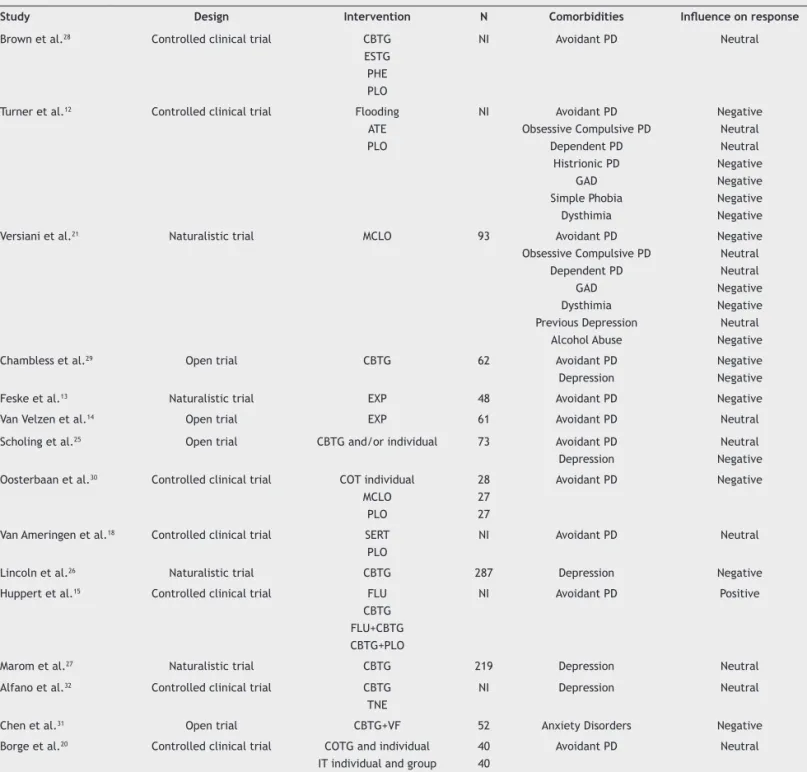
Studies describing the impact of different psychiatric comor-bidities (including personality, anxiety and mood disorders, and substance abuse) on SAD treatment outcomes are de-picted in Table 2.
Personality disorders
Eleven trials assessed the inluence of avoidant personality
disorder (PD) on treatment response of patients with SAD.
In ive of these studies, patients with SAD and avoidant PD
displayed worse outcome after treatment (including mo-clobemide,21 atenolol or EXP with looding,12 group CBT,29
EXP,13 and moclobemide or individual cognitive therapy)30
compared to patients with SAD without avoidant PD. Nonetheless, in one of these studies,30 this difference did
not remain signiicant after 15 months of treatment. In ive additional articles, the comorbidity of SAD with
avoidant PD did not predict differences in response to inter-ventions with sertraline,18 EXP,14 individual or group CBT,25
individual or group cognitive therapy, individual or group interpersonal therapy20 and a set of interventions
(includ-ing group CBT, educational support therapy, phenelzine and placebo pill).28 Finally, in contrast to the results described
above, a study with 295 generalized SAD patients re-ported that patients with avoidant personality disorder (APD) had exhibited greater changes in SAD early in treatment than those without APD.15
Two studies reported that other types of PD (e.g.,
obses-sive-compulsive and dependent) had no inluence in response
of 84 SAD patients who received either atenolol or EXP with
looding treatment,12 and 93 SAD patients who were treated
with moclobemide.21 Histrionic PD co-morbidity with SAD,
on the other hand, had a negative impact on response to
treatment with atenolol or EXP with looding.12
Anxiety disorders
A study with 52 SAD patients treated with group CBT plus video feedback of exposures revealed that co-morbidity with any anxiety disorder was associated with a worse therapeutic outcome.31 Similarly, the presence of simple phobia had a
negative impact on treatment response of 84 patients with
SAD treated with atenolol or EXP with looding.12 Finally,
generalized anxiety disorder (GAD) was associated with worse treatment response of 93 patients with SAD treated with moclobemide,21 and of 84 patients treated with atenolol
or EXP with looding.12
Mood disorders
The inluence of comorbid mood disorders on the treatment
outcome of patients with SAD was associated with mixed results. For instance, in at least three studies,25,26,29 the
presence of major depression was associated with worse
response of SAD patients treated with group and individual CBT25 or group CBT,26,29 respectively. Similarly, comorbid
dysthymia had a negative impact on response to treatment
with atenolol or EXP with looding12 and with moclobemide.21
However, in one of these articles, the negative inluence of
depression on the therapeutic outcome was not maintained in the 18-month follow up.25
In two trials27,32 no difference was found in the post-test
of SAD patients with comorbid depression treated with group CBT. However, in one of these studies,27 patients with SAD
and comorbid depression displayed an increased relapse rate after one year. On the other hand, the presence of previous episode of depression in patients treated with moclobemide did not predict any difference in treatment outcome.21
Alcohol abuse
In one of the studies described above,21 the occurrence of
alcohol abuse co-morbidity was by far the strongest predic-tor of worse therapeutic outcome in 93 SAD patients treated with moclobemide.
Sociodemographic characteristics
Studies describing the impact of different sociodemographic features (including age, gender, educational level, and mari-tal status) on SAD treatment outcomes are listed in Table3.
Age
According to several aforementioned studies, the patient’s age did not predict the therapeutic response of SAD patients to sertraline,18 moclobemide,21 paroxetine,23 brofaromine or
luvoxamine,22 group CBT,17,32 and group or individual CBT.19
Gender
paroxetine,23 moclobemide,21 brofaromine or luvoxamine.22
In one naturalistic study, no difference regarding treatment outcomes was found when CGI scores of both genders were compared at the end-point after treatment with SSRIs and/ or benzodiazepines.16 However, male gender was associated
with worse response of SAD patients to sertraline or placebo18
and to group plus video feedback CBT.31
Educational/Marital status
Educational and marital status had no impact on the response of 57 SAD patients in group CBT in one study,17 and of 102
pa-tients treated with group or individual CBT in another one.19
Treatment characteristics
Studies describing the impact of different therapeutic fea-tures on the outcome of SAD (including history, duration and expectancy of current treatment, and group cohesion [in case of group therapy]) are listed in Table 4.
Previous treatment
In three aforementioned studies, previous treatment (either pharmacotherapy or psychotherapy) had no impact on the response of SAD patients to moclobemide,21 brofaromine and
luvoxamine,22 and in group CBT.17
Table 2 Studies describing the impact of different comorbidities on treatment outcomes of social anxiety disorder
Study Design Intervention N Comorbidities Inluence on response
Brown et al.28 Controlled clinical trial CBTG
ESTG PHE PLO
NI Avoidant PD Neutral
Turner et al.12 Controlled clinical trial Flooding
ATE PLO
NI Avoidant PD
Obsessive Compulsive PD Dependent PD
Histrionic PD GAD Simple Phobia
Dysthimia
Negative Neutral Neutral Negative Negative Negative Negative
Versiani et al.21 Naturalistic trial MCLO 93 Avoidant PD
Obsessive Compulsive PD Dependent PD
GAD Dysthimia Previous Depression
Alcohol Abuse
Negative Neutral Neutral Negative Negative Neutral Negative
Chambless et al.29 Open trial CBTG 62 Avoidant PD
Depression
Negative Negative
Feske et al.13 Naturalistic trial EXP 48 Avoidant PD Negative
Van Velzen et al.14 Open trial EXP 61 Avoidant PD Neutral
Scholing et al.25 Open trial CBTG and/or individual 73 Avoidant PD
Depression
Neutral Negative Oosterbaan et al.30 Controlled clinical trial COT individual
MCLO PLO
28 27 27
Avoidant PD Negative
Van Ameringen et al.18 Controlled clinical trial SERT
PLO
NI Avoidant PD Neutral
Lincoln et al.26 Naturalistic trial CBTG 287 Depression Negative
Huppert et al.15 Controlled clinical trial FLU
CBTG FLU+CBTG CBTG+PLO
NI Avoidant PD Positive
Marom et al.27 Naturalistic trial CBTG 219 Depression Neutral
Alfano et al.32 Controlled clinical trial CBTG
TNE
NI Depression Neutral
Chen et al.31 Open trial CBTG+VF 52 Anxiety Disorders Negative
Borge et al.20 Controlled clinical trial COTG and individual
IT individual and group 40 40
Avoidant PD Neutral
ATE: Atenolol; CBTG: Cognitive Behavior Therapy Group; EXP: exposure psychotherapy; COT: Cognitive Therapy; COTG: Cognitive Therapy In Group; ESTG: Educational Supportive Therapy Group; FLU: Fluoxetine; GAD: Generalized Anxiety Disorder; IT: Interpersonal Therapy; MCLO: Moclobemida; NI: Not
Table 3 Studies describing the impact of different sociodemographic features the treatment outcomes of social anxiety disorder
Study Design Intervention N Sociodemographic
characteristics
Effect on response
Slaap et al.22 Controlled clinical Trial BROFARO
FLUVO
15 15
Age Gender
Neutral Neutral
Versiani et al.21 Naturalistic trial MCLO 93 Age
Gender
Neutral Neutral
Stein et al.23 Controlled clinical Trial PARO
PLO
491 329
Age Gender
Neutral Neutral
Van Ameringen et al.18 Controlled clinical Trial SERT
PLO
NI Age
Female Gender
Neutral Positive
Chen et al.17 Open trial CBTG 234 Age
Gender Educational Marital status
Neutral Neutral Neutral Neutral
Dalrymple et al.19 Open trial CBTG and/or individual 57 Age
Gender Educational Marital status
Neutral Neutral Neutral Neutral
Menezes et al.39 Naturalistic trial SSRI and/or BENZO 34 Gender Neutral
Alfano et al.32 Controlled clinical Trial CBTG
TNS
NI Age Neutral
Chen et al.31 Open trial CBTG+VF 80 Male Gender Negative
BENZO: Benzodiazepine; BROFARO: Brofaromine; CBTG: Cognitive Behavior Therapy Group; FLUVO: Fluvoxamine; MCLO: Moclobemide; NI: Not Informed;
PARO: Paroxetine; PLO: Placebo; SERT: Sertraline; SSRI: selective serotonin reuptake inhibitors; TNS: Treatment not Speciic; VF: Video feedback.
Table 4 Studies describing the impact of different treatment characteristics on treatment outcomes of social anxiety disorder
Study Design Intervention N Treatment characteristics Effect on Response
Slaap et al.22 Controlled clinical trial BROFARO
FLUVO
15 15
Previous treatment Neutral
Versiani et al.21 Naturalistic MCLO 93 Previous treatment Neutral
Chambless et al.29 Open trial CBTG 62 Low expectancy regarding
treatment effectiveness
Negative
Stein et al.23 Controlled clinical trial PARO
PLO
491 329
Short duration of treatment Negative
Erwin et al.33 Controlled clinical trial CBTG 234 Low expectancy regarding treatment
effectiveness
Negative
Chen et al.17 Open trial CBTG 57 Previous treatment
Short duration of treatment
Neutral Neutral
Taube-Schiff et al.35 Open trial CBTG 34 Group cohesion Positive
Delsignore et al.34 Open trial CBTG 49 Low expectancy regarding
the therapist role
Neutral
Borge et al.20 Controlled clinical trial COTG and individual
IT individual and group 40 40
Low expectancy regarding treatment effectiveness
Negative
Duration of treatment
In a study with 829 SAD patients,23 treatment with paroxetine
for 12 weeks was associated with increased response com-pared to treatment for only 8 weeks. Conversely, another study that used group CBT with a protocol of 11-20 sessions found that the number of treatment sessions did not predict response of 57 patients with SAD.17
Expectancy regarding treatment effectiveness
Low expectancy regarding treatment effectiveness and
reduced conidence concerning treatment predicted worse
response in studies that comprised 6229 and 234 patients33
with SAD assigned to group CBT, and 80 patients with SAD assigned to cognitive therapy or interpersonal therapy.20
Expectancy regarding the therapist role
In one study, the expectations of 49 SAD patients about the role of the therapist in their treatment did not have any
inluence on their response in group CBT in the short-term.34
However, in the three-month follow up, patients who attrib-uted greater responsibility for change to their therapists had worse therapeutic response.
Group cohesion in group CBT
The perception of group cohesion of individuals attending group CBT and its impact on treatment outcome were studied in 34 patients with SAD.35 In this study, increases in group
cohesion ratings over the course of treatment signiicantly
predicted therapeutic response.
Discussion
The present work aimed at reviewing the overall proile of
individuals with SAD who respond and not respond to stan-dard treatment, with the ultimate purpose of contributing to future research on the development of more effective interventions.36 We found that early onset, increased
dura-tion and severity of illness, presence of generalized subtype, positive family history of SAD, and male gender were all predictors of worse response to treatment in at least one study. Among these, early onset and severity of illness were
the most replicated indings.
In terms of co-morbidity, major depression, dysthymia,
generalized anxiety disorder, simple phobia, avoidant and histrionic PD, and alcohol abuse predicted negative responses to treatment in at least one trial. Among these conditions, anxiety disorders emerged as a predictor of poor therapeutic response in more than one study.
Finally, regarding treatment characteristics, low
expec-tancy regarding treatment eficacy, high expecexpec-tancy regard -ing the role of the therapist in treatment, and decreased group cohesion (in case of group cognitive behavioral treat-ment) were associated with worse therapeutic responses. Among the later, low expectancy regarding treatment
ef-icacy was the most replicated inding.
Importantly, we found a handful of studies suggesting the association between early onset of SAD and poor response to
treatment. While this inding provides some support to the
view that the early-onset of SAD represents a valid subtype of SAD, with greater psychiatric comorbidity, higher levels of
incapacitation, and worse prognosis,19 there is still
contro-versy on this subtype deinition, as different studies used
different age criteria for “early” or “late” onset. Previous
reviews suggested that the unwelcome inluence of both age
at onset and severity of symptoms on treatment outcome holds true for other anxiety disorders.37
Furthermore, we also found some evidence that greater severity of social anxiety symptoms predicts decreased
ef-icacy in the response of patients with SAD to different types
of treatment (both pharmacotherapy and psychotherapy).
This inding is particularly relevant when one considers that
all studies reporting them focused their analysis on patients who completed treatment (and not on an intention-to-treat sample), thus suggesting that decreased intention-to-treatment
eficacy cannot be ascribed to the tendency that patients
with more severe symptoms have to discontinue treatment more frequently.
Data supporting an effect of comorbid psychiatric disor-ders in SAD treatment response are mixed, particularly for
depression. It is dificult to explain these indings because, while major depression and dysthymia could perpetuate and
strengthen SAD patients negative beliefs about themselves, some of the SAD treatments (including SSRIs and cognitive re-structuring) may effectively treat some forms of depres-sion, particularly those that are secondary. Accordingly, it is interesting to note that many of the comorbid conditions found to predict worse response of SAD to treatment (e.g., alcohol abuse,21 speciic phobia,12 histrionic PD12) are not clearly
responsive to treatment (e.g., antidepressants) themselves.
It is worth noting that indings regarding the role of several
comorbid conditions were assessed in only one study, which restrains us to consider these results as conclusive.
Finally, we also found that low expectancy regarding treatment effectiveness,29 which might be related to
co-morbid depression,38 was associated with worse response to
treatment in different studies. Clearly, patients with SAD might believe that the treatment will not work in their case, that they will not be able to follow the therapeutic steps, or that another person will be totally responsible for his
im-provement. These cognitive distortions should be identiied
and managed early in the treatment.
Conversely, lower expectations about the role of the therapist were related to better treatment outcomes, par-ticularly in the follow-up sessions.34 Likewise, in one study,
increased feelings of group cohesion between participants and therapist in group CBT was associated with better outcomes.35 It would be interesting to test whether add-on
strategies (aimed at increasing treatment expectancy, at-tributing responsibility for change to patients, and stressing the importance of group cohesion in group CBT) increase the effectiveness of treatment provided to patients with SAD.
Indeed, our review has a number of limitations. First, several sociodemographic and clinical variables associated with worse outcomes (e.g., previous treatment, dependent and obsessive compulsive PD comorbidity) had their rela-tionship with outcome assessed by a very small number of studies. Second, as there is no current consensus on what should be the optimal criteria for treatment response in SAD, one should examine our results with caution.12,25,29 It
reappraisal of the diagnosis,40 social anxiety symptoms,
and comorbid conditions.36 Of note, none of the reviewed
studies adopted such criteria. Third, there is a clear meth-odological heterogeneity among selected studies, including study design,15,17,23 type of intervention,21,25-27,29,32 and
dura-tion of treatment (varying from ive or seven days26 to two
years).21 Accordingly, one must consider that, regardless of
treatment, longer follow-ups are usually associated with substantial reduction in anxiety symptoms, a phenomenon that can be explained by the tendency of SAD individuals to orientate their life choices so that anxiogenic situations become less prominent.41
Conclusion
The recent increase in the number of studies in the ield
of response and resistance in SAD is complicated by the
dificulty of replicating and comparing these studies. Even
when they are conducted with similar patients, treatment, and methods, a considerable variety of treatment response
and resistance deinitions is used.25 As a consequence, the
current sociodemographic and clinical proile of SAD patients
who respond to treatment remains elusive, as it does not point to a very clear direction.
To date, early onset, severity of illness, comorbid anxi-ety disorders (particularly generalized anxianxi-ety disorder and simple phobia), and low expectancy regarding treatment
eficacy emerged as potential correlates and/or predictors of low therapeutic response. Clearly, the ield of treatment response needs conceptual and methodological redeinitions
if it aims to lead to more solid results. A better knowledge
about the proile of the signiicant proportion of SAD patients
who remain resistant to treatment is important for discuss-ing the emergence of novel therapeutic alternatives, both in terms of psychotherapy and pharmacotherapy.
Disclosure
Sara C. Mululo
Employment: Instituto de Psiquiatria, Universidade Federal do Rio de Janeiro (IPUB/UFRJ)Rio de Janeiro, Brazil.
Gabriela B de Menezes
Employment: Instituto de Psiquiatria, Universidade Federal do Rio de Janeiro (IPUB/UFRJ)Rio de Janeiro, Brazil.
Paula Vigne
Employment: Instituto de Psiquiatria, Universidade Federal do Rio de Janeiro (IPUB/UFRJ)Rio de Janeiro, Brazil.
Leonardo F. Fontenelle
Employment: Instituto de Psiquiatria, Universidade Federal do Rio de Janeiro (IPUB/UFRJ); Departmento de Psiquiatria e Saúde Mental, Instituto de Saúde da Comunidade, Universidade Federal Fluminense (MSM/UFF);Instituto D’Or de Pesquisa e Ensino (IDOR), Rio de Janeiro, Brazil. Research grant: Conselho Nacional de Desenvolvimento Cientíico e Tecnológico (CNPq), Fundação Carlos Chagas Filho de Amparo à Pesquisa do Estado do Rio de Janeiro (FAPERJ), Brazil. Other research grant or medical continuous education: Instituto D’Or de Pesquisa e Ensino (IDOR), Rio de Janeiro, Brazil. Speaker’s honorária: Lundbeck.
* Modest
** Signiicant
*** Signiicant: Amounts given to the author’s institution or to a colleague for
research in which the author has participation, not directly to the author. The founding sources had no role in the study design, collection, analysis and interpretation of data, writing of the report, and decision to submit the paper for publication.
References
1. Chagas MH, Nardi AE, Manfro GG, Hetem LA, Andrada NC, Levitan MN, Salum GA, Isolan L, Ferrari MC, Crippa JA. Guidelines of the Brazilian Medical Association for the diagnosis and differential diagnosis of social anxiety disorder. Rev Bras Psiquiatr. 2010; 32(4):444-52.
2. Kessler RC, Chiu WT, Demler O, Merikangas KR, Walters EE. Prevalence, severity, and comorbidity of 12-month DSM-IV disorders in the National Comorbidity Survey. Arch Gen Psychiatr. 2005; 62:617-27.
3. American Psychiatric Association. Diagnostic and statistical manual of mental disorders. 4th ed. Washington (DC): Author; 1994.
4. Crippa JA. Does social phobia remain the ‘Ugly Duckling’ of anxiety disorders? Rev Bras Psiquiatr. 2009; 31(4):297-9. 5. Freitas-Ferrari MC, Hallak JE, Trzesniak C, Filho AS,
Machado-de-Sousa JP, Chagas MH, Nardi AE, Crippa JA. Neuroimaging in social anxiety disorder: a systematic review of the literature. Prog Neuropsychopharmacol Biol Psychiatr. 2010; 34(4):565-80. 6. Jørstad-Stein EC, Heimberg RG. Social phobia: an update on
treatment. Psychiatr Clin North Am. 2009; 32(3):641-63. 7. Rodebaugh TL, Holaway RM, Heimberg RG. The treatment of
social anxiety disorder. Clin Psychol Rev. 2004 ;24(7):883-908. 8. Mululo SC, De Menezes GB, Fontenelle L, VersianiM.Eicácia do
tratamento cognitivo e/ou comportamental para o transtorno de ansiedade social. Rev Psiquiatr RS. 2009; 31(3):1-10. 9. Blanco C, Schneier FR, Schmidt A, Blanco-Jerez C, Marshal RD,
Sanchez-Lacay A, Liebowitz MR. Pharmacological treatment of social anxiety disorder: a meta-analysis. Depress Anxiety. 2003; 18(1):29-40.
10. Van Ameringen M, Mancini C, Pipe B, Bennett M. Optimizing treatment in social phobia: a review of treatment resistance. CNS Spectr. 2004; 9(10):753-62.
11. Aarre TF. Phenelzine efficacy in refractory social anxiety disorder: a case series. Nord J Psychiatry. 2003; 57(4):313-15. 12. Turner SM, Beidel DC, Wolff PL, Spaulding S, Jacob RG. Clinical features affecting treatment outcome in social phobia. Behav Res Ther. 1996; 34(10):795-804.
13. Feske U, Perry KJ, Chambless DL, Renneberg B, Goldstein AJ. Avoidant personality disorder as a predictor for treatment outcome among generalized social phobics. Eur Neuropsychopharmacol. 2007; 17:S517-S8.
14. Van Velzen CJ, Emmelkamp PM, Scholing A. The impact of personality disorders on behavioral treatment outcome for social phobia. Behav Res Ther. 1997; 35(10):889-900.
15. Huppert JD, Strunk DR, Ledley DR, Davidson JRT, Foa EB. Generalized social anxiety disorder and avoidant personality disorder: structural analysis and treatment outcome. Depress Anxiety. 2008; 25(5):441-8.
16. De Menezes GB, Fontenelle LF, Versiani M. Gender effect on clinical features and drug treatment response in social anxiety disorder (Social Phobia). Int J Psychiatry Clin Pract. 2008; 12(2): 151-5.
17. Chen J, Nakano Y, Ietzugu T, Ogawa S, Funayama T, Watanabe N, Noda Y, Furukawa TA. Group cognitive behavior therapy for japanese patients with social anxiety disorder: preliminary outcomes and their predictors. BMC Psychiatry. 2007; 10(7):59-69.
18. Van Ameringen M, Oakman J, Mancini C, Pipe B, Chung H. Predictors of response in generalized social phobia: effect of age of onset. J Clin Psychopharmacol. 2004; 24(1):42-8. 19. Dalrymple KL, Herbert JD, Gaudiano BA. Onset of illness and
20. Borge FM, Hoffart A, Sexton H. Predictors of outcome in residential cognitive and interpersonal treatment for social phobia: do cognitive and social dysfunction moderate treatment outcome? J Behav Ther Exp Psychiatry. 2010; 41(3):212-9. 21. Versiani M, Amrein R, Montgomery SA. Social phobia: long-term
treatment outcome and prediction of response - a moclobemide study. Int Clin Psychopharmacol. 1997; 12(5):239-54.
22. Slaap BR, van Vliet IM, Westenberg HM, Den Boer JA. Responders and non-responders to drug treatment in social phobia: differences at baseline and prediction of response. J Affect Disord. 1996; 39(1):13-9.
23. Stein DJ, Stein MB, Pitts CD, Kumar R, Hunter B. Predictors of response to pharmacotherapy in social anxiety disorder: an analysis of 3 placebo-controlled paroxetine trials. J Clin Psychiatry. 2002; 63(2):152-5.
24. Van Ameringen M, Mancini C, Chung H, Batzar E, Yang R. Predictors of remission in patients treated with sertraline for moderate to severe generalized social phobia. Eur Neuropsychopharmacol. 2002; 12(3):S342.
25. Scholing A, Emmelkamp PM. Prediction of treatment outcome in social phobia: a cross-validation. Behaviour Research and Therapy. 1999; 37:659-70.
26. Lincoln TM, Riefa W, Hahlwegb K, Frankc M, von Witzlebend I, Schroederb B, Fiegenbaume W. Who Comes, Who Stays, Who Proits? Predicting refusal, dropout, success, and relapse in a short intervention for social phobia. Psychother Res. 2005; 15(3):210-25.
27. Marom S, Gilboa-Schechtman E, Aderka IM, Weizman A, Hermesh H. Impact of depression on treatment effectiveness and gains maintenance in social phobia: a naturalistic study of cognitive behavior group therapy. Depress Anxiety. 2009; 26(3):289-300. 28. Brown EJ, Heimberg RG, Juster HR. Social phobia subtype
and avoidant personality disorder: effect on severity of social phobia, impairment, and outcome of cognitive behavioral treatment. Behav Ther. 1995; 26(3):467-86.
29. Chambless DL, Tran GQ, Glass CR. Predictors of response to cognitive-behavioral group therapy for social phobia. J Anxiety Disord. 1997; 11(3):221-40.
30. Oosterbaan DB, van Balkom AJ, Spinhoven P, de Meij TG, van Dyck R. The inluence on treatment gain of comorbid avoidant personality disorder in patients with social phobia. J Nerv Ment Dis. 2002; 190(1):41-3.
31. Chen JW, Furukawa TA, Nakano Y, Ietsugu T, Ogawa S, Funayama T, Watanabe N, Noda Y, Rapee RM. Video feedback with peer ratings in naturalistic anxiety-provoking situations for social anxiety disorder: preliminary report. J Behav Ther Exp Psychiatry. 2010; 41(1):6-10.
32. Alfano CA, Pina AA, Villalta IK, Beidel DC, Ammerman RT, Crosby LE. Mediators and moderators of outcome in the behavioral treatment of childhood social phobia. J Am Acad Child Adolesc Psychiatry. 2009; 48(9):945-53.
33. Erwin BA, Heimberg RG, Schneier FR, Liebowitz MR. Anger experience and expression in social anxiety disorder: pretreatment proile and predictors of attrition and response to cognitive-behavioral treatment. Behav Ther. 2003; 34(3):331-50. 34. Delsignore A, Carraro G, Mathier F, Znoj H, Schnyder U.
Perceived responsibility for change as an outcome predictor in cognitive-behavioural group therapy. Br J Clin Psychol. 2008; 47(3):281-93.
35. Taube-Schiff M, Suvak MK, Antony MM, Bieling PJ, McCabe RE. Group cohesion in cognitive-behavioral group therapy for social phobia. Behav Res Ther. 2007; 45(4):687-98.
36. Laguna LB, Healey EC, Hope DA. Successful interdisciplinary intervention with an initially treatment-resistant social phobic. Behav Modif. 1998; 22(3):358-71.
37. Serreti A, Chiesa A, Calati R, Perna G, Bellodi L, De Ronchi D. Common genetic, clinical, demograic and psychosocial predictors of response to pharmacotherapy in mood and anxiety disorders. Int Clin Psychopharmacol. 2009; 24(1):1-18. 38. 3Carter JD, Luty SE, McKenzie JM, Mulder RT, Frampton CM,
Joyce PR. Patient predictors of response to cognitive behaviour therapy and interpersonal psychotherapy in a randomised clinical trial for depression. J Affect Disord. 2011; 128:252-61. 39. De Menezes GB, Fontenelle LF, Mululo S, Versiani M.
Treatment-resistant anxiety disorders: social phobia, generalised anxiety disorder and panic disorder. Rev Bras Psiquiatr. 2007; 29(2):S55-S60.
40. Davies RD, Dubovsky SL, Gabbert S, Chapman M. Treatment resistance in anxiety disorders. Bull Menninger Clin. 2000; 64(3):A22-A36.