*e-mail: [email protected]
Trabalho apresentado no I Simpósio Mineiro de Ciências dos Materiais, Ouro Preto, Novembro de 2001.
Preparation of Highly Dispersed Ru-Sn Bimetallic Supported Catalysts
from the Single Source Precursors Cp(PPh
3)
2Ru-SnX
3(X = Cl or Br)
Ana Cláudia Bernardes Silvaa, Ana Paula Guimarães de Sousaa, José Domingos Ardissonb,Helmuth Guido Luna Siebalda, Edmilson Mouraa, Eduardo Nicolau dos
Santosa, Nelcy Della Santina Mohallema, Rochel Montero Lagoa*
aDepartamento de Química, ICEx - UFMG, 31270-901 Belo Horizonte - MG, Brazil
bCDTN, Centro de Desenvolvimento de Tecnologia Nuclear, Belo Horizonte - MG, Brazil
Received: November 11, 2001; Revised: March 24, 2003
In this work highly dispersed Ru-Sn bimetallic catalysts have been prepared from organobimetallic Cp(PPh3)2Ru-SnX3 (X = Cl or Br) complexes. These single source precursors can be easily impregnated in high surface area supports, such as activated carbon and sol-gel SiO2, and upon controlled thermal treatment the ligands are released as volatile products resulting in the formation of the bimetallic system Ru-Sn. Catalytic reactions, such as hydrodechlorination of CCl4 and chlorobenzene and TPR (Temperature Programmed Reduction) experiments carried out with these RuSn catalysts suggested a strong interaction between Ruthenium and Tin. Mössbauer measurements showed that these materials when exposed to air are immediately oxidized to form Sn (IV). It was shown that upon controlled reduction conditions with H2 it is possible to reduce selectively Sn to different oxidation states and different phases. The Sn oxidation state showed significant effect on the catalytic hydrogenation of 1,5-cyclooctadiene. The use of these single source precursors with a controlled decomposition/reduction procedure allows the preparation of unique catalysts with an intimate interaction between the components ruthenium and tin and the possibility of varying the Sn oxidation state around the Ru metal.
Keywords: bimetallic catalyst, rutheniun, tin, hydrogenation
sults in selectivity for the carbonyl hydrogenation, what has been explained in terms of a strong interaction between the
C=O group with the tin oxide15. Therefore, two factors are
essential to produce an active and selective catalyst: (i) the proximity of Sn to the noble metal and (ii) the Sn oxidation state. The bimetallic system Ru and Sn has been pointed out recently as one of the most active and selective catalyst
for these hydrogenation17. These catalysts have been
pre-pared by the co-impregnation of two different ruthenium
and tin precursors, typically RuCl3 and SnCl4. However, the
co-impregnation method produces mostly the segregation of the metals resulting in a poor interaction of Ru and Sn.
In this work, Ru-Sn catalysts have been prepared from a single source precursor containing both metals
Cp(PPh3)2Ru-SnX3 (X = Cl or Br). The Ru-Sn chemical bond
in the precursor should result in a close proximity of the two metals throughout the catalyst preparation steps
lead-1. Introduction
Bimetallic catalysts have been used in industrial
proc-ess for many years due to their unique catalytic properties1.
However, only recently an understanding of the structure dependence on the preparation method and treatment has
been developed2-5. An important application of bimetallic
catalysts, which has been extensively investigated in the last years is the selective hydrogenation of C=O group in
α,β-unsaturated aldehydes, such as crotonaldehyde,
acrylaldehyde and citral6. These reactions should produce
the respective unsaturated alcohols which are fine chemi-cals of great importance to the cosmetic and
pharmaceuti-cal industry7,8. These catalysts are generally based on a
no-ble metal, e.g. Pt, Rh or Ru, which catalyzes the reaction, and a second metal usually Sn, Fe, Pb, Ni, Co or Ge which is mainly responsible for the selectivity in the
re-ing to a much better interaction compared to materials pre-pared by the traditional co-impregnation method.
2. Experimental
The preparation of the bimetallic complexes
Cp(PPh3)2Ru-SnX3 (X = Cl or Br) is described in detail
else-where18.
The Ru-Sn supported catalysts have been prepared by impregnation on activated carbon (100 mg, Aldrich Norit,
SBET = 950 m2/g) with a dichloromethane solution (100 mg
in 2 ml) of the complexes Cp(PPh3)2Ru-SnX3 (X = Cl or
Br). The CH2Cl2 was removed by vacuum at room
tempera-ture. The amount of the precursor was adjusted in order to produce a metallic content in the catalysts of 5 wt% ruthenium and 6 wt% of tin. The material was heated at 10 °C/min under hydrogen flow (15 ml/min) and kept at 500 °C for 60 min.
Ru-Sn/SiO2 catalysts have been prepared by mixing
TEOS (tetraethoxysilane), ethanol and water in a 1/3/10
mo-lar ratio, with HCl and HF as catalysts. Cp(PPh3)2Ru-SnCl3
(1 mol%) was added to the starting solution during prepa-ration. The solution was kept under stirring at room tem-perature for two hours for homogenization and left still for gelation. The wet gels, prepared in monolithic shape, were dried at 110 °C for 24 h.
Some of the catalyst after reduction were embedded with liquid benzene, before they were exposed to the atmosphere, in order to hinder metal oxidation by air.
Thermogravimetric analyses were carried out in a Mettler TA 4000. The samples were heated from room temperature to 750 °C at 10 °C/min under air or nitrogen flow. Scanning electron microscopy analyses were obtained in a Jeol JXA-8900RL.
Mössbauer analyses were obtained at 23 K in a
trans-mission geometry equipment with a 119Sn source in CaSnO
3.
A least squares fitting program was used to analyze the spec-tra and to calculate the chemical shifts, quadrupole split-ting and area of each component.
The TPR analyses were carried out in a Micromeritics TPR/TPD 2900 equipment. The samples were heated from
room temperature to 800 °C under 50 ml/min H2/N2
(10% v/v H2) flow. The samples were pre-treated from room
temperature to 500 °C (10 °C/min) under He flow. The hydrogendechlorination reactions have been carried in a fix bed reactor using 30 mg of Ru-Sn catalysts under
H2 flow (30 ml/min). CCl4 or chlorobenzene were introduced
in the H2 stream by a controlled temperature saturator at
0 °C, producing vapor pressures of 29 mmHg and
concen-tration of 30 µmol/l for CCl4 and 2.5 mmHg and
concentra-tion of 3 µmol/l for chlorobenzene. The diolefin
hydrogena-tion reachydrogena-tions were carried in an autoclave using 40 mg of supported Ru-Sn catalysts and 40 ml of
1,5-ciclooctadiene (COD)/benzene solution (0,4 mol/l), under hydrogen pressure (20 atm). The reaction products were analyzed by gas chromatography (Shimadzu/GC 17 A) with a FID detector and capillary column Carbowax 20M
(25 m × 0.32 mm × 0.25 µm ).
3. Results and Discussion
3.1 Thermal Decomposition of the Complexes
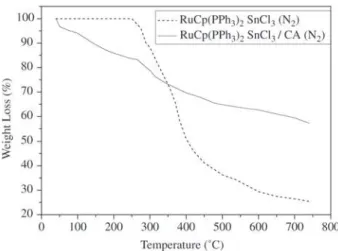
The thermogravimetric (TG) profiles of the precursor
RuCp(PPh3)2SnCl3, pure and supported on activated carbon,
in a nitrogen atmosphere, are shown in Fig. 1.
It can be observed a weight loss of ca. 74%, in the
tem-perature range 250-650 °C. This weight loss suggests the decomposition of the complex with the formation of the pure metals and elimination of the ligands as volatile prod-ucts:
volatiles RuSn
SnX PPh
RuCp( 3)2 3 → + (1)
Similar results were obtained for the RuCp(PPh3)2SnBr3
complex with a weight loss of 76% in the same temperature range.
The expected weight losses for the decomposition de-scribed in Eq. 1 are 76 and 79% for the Cl and Br deriva-tives, respectively, which are very similar to the experimen-tal value of 74 and 76%.
TG profiles were also obtained for the organometallic precursors supported on activated carbon (Fig. 1). It was observed an initial weight decrease probably related to the
presence of residual water and CH2Cl2 adsorbed on the
car-bon. From 250 up to 450 °C, the complex supported on the carbon surface seems to decompose with the expected weight loss of approximately 22%.
3.2 Activated Carbon Supported RuSn Catalysts
The activated carbon supported catalysts have been ob-tained by impregnation methods resulting in a final ruthe-nium and tin content of 5 and 6 wt%, respectively. The fol-lowing materials have been prepared: (i) Ru/AC,
impreg-nation of RuCl3 followed by reduction in H2 at 500 °C,
(ii) coimp-Ru+Sn/AC, prepared by co-impregnation of
RuCl3 and SnCl2 followed by reduction in H2 at 500 °C, and
(iii) RuSn/AC prepared by the impregnation of the
com-plex RuCp(PPh3)2SnX3 followed by reduction in H2 at
500 °C. For comparison, SnCl2 was also impregnated on
activated carbon and treated in H2 at 500 °C (Sn/AC). An
advantage the precursors RuCp(PPh3)2SnX3 should offer
over RuCl3 and SnCl3, is related to their hydrophobic
char-acter which will allow a much better interaction with the hydrophobic carbon support and consequently a better dis-persion over the carbon surface.
3.3 SiO2 sol-gel Supported RuSn Catalysts
The SiO2 sol-gelsupported catalysts have been obtained
by dispersion of the different precursors during the sol-gel preparation, to obtain ruthenium and tin content of 1 and 1.2 wt%, respectively. The following materials have been
prepared: (i) Ru/SiO2, addition of RuCl3 during the sol-gel
preparation followed by reduction in H2 at 500 °C, (ii)
coadd-Ru+Sn/SiO2, prepared by co-addition of RuCl3 and SnCl2
followed by reduction in H2 at 500 °C, and (iii) RuSn/SiO2
prepared by the addition of the complex RuCp(PPh3)2SnCl3
followed by reduction in H2 at 500 °C. For comparison,
SnCl2 was also added during sol-gel preparation and treated
in H2 at 500 °C (Sn/SiO2).
3.4 119Sn Mössbauer Spectroscopic Studies
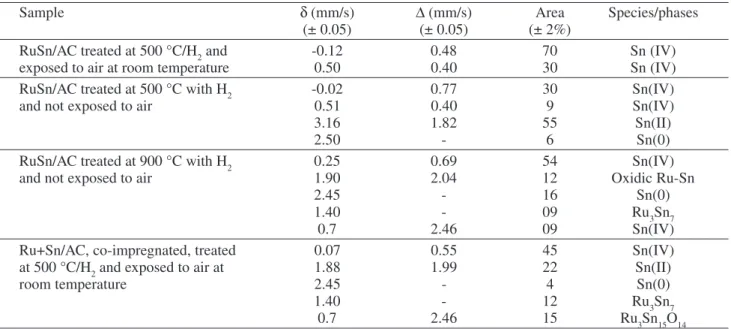
The Mössbauer data obtained for the activated carbon supported RuSn catalysts are shown in Table 1 and Fig. 2.
The RuSn/AC sample was treated with H2 at 500 °C and
after cooling to room temperature it was exposed to air. Mössbauer analysis of this sample showed that Sn is com-pletely oxidized to form Sn(IV). Similar results have been
obtained by Stievano et al.19 who carefully treated carbon
supported Ru 70% Sn 30% with H2 at 400 °C and also
ob-served the tin oxidation after exposure to air or moisture. The Mössbauer spectrum fitting suggests the presence of two different species with isomer shift (IS) of - 0.12 and 0.50 mm/s and quadrupole splitting (QS) of 0.48 and 0.4 mm/s, respectively, both related to Sn(IV). If the
sam-ple RuSn/AC treated with H2 at 500 °C is protected with
liquid benzene to hinder the oxidation by air, the spectrum can be fit with 4 Lorentzians indicating the presence of mainly Sn(II) and Sn(IV) with small amounts of Sn(0). These oxidized species are probably produced by the oxi-dation by traces of water in benzene and also to some oxy-gen diffusion through the liquid protection.
For the sample reduced at 900 °C it can be observed the presence of mainly Sn(IV) 54% and Sn(0) 16%. However, the Mössbauer spectrum seems to suggest the presence of
three new phases: oxidic Ru-Sn, Ru3Sn15O14 and Ru3Sn7.
The oxidic Ru-Sn and Ru3Sn15O14 prepared by Söhel et al20.
under similar experimental conditions (900 °C) and have
Table 1.119Sn Mössbauer parameters obtained at 23 K for the carbon supported RuSn catalysts submitted to different treatments.
Sample δ (mm/s) ∆ (mm/s) Area Species/phases
(± 0.05) (± 0.05) (± 2%)
RuSn/AC treated at 500 °C/H2 and -0.12 0.48 70 Sn (IV)
exposed to air at room temperature 0.50 0.40 30 Sn (IV)
RuSn/AC treated at 500 °C with H2 -0.02 0.77 30 Sn(IV)
and not exposed to air 0.51 0.40 9 Sn(IV)
3.16 1.82 55 Sn(II)
2.50 - 6 Sn(0)
RuSn/AC treated at 900 °C with H2 0.25 0.69 54 Sn(IV)
and not exposed to air 1.90 2.04 12 Oxidic Ru-Sn
2.45 - 16 Sn(0)
1.40 - 09 Ru3Sn7
0.7 2.46 09 Sn(IV)
Ru+Sn/AC, co-impregnated, treated 0.07 0.55 45 Sn(IV)
at 500 °C/H2 and exposed to air at 1.88 1.99 22 Sn(II)
room temperature 2.45 - 4 Sn(0)
1.40 - 12 Ru3Sn7
been described as RuSn alloys containing some oxygen into
their structure. The formation of the Ru3Sn7 alloy has been
reported previously19,21 in RuSn catalysts. These results
sug-gested that the treatment at higher temperatures (900 °C) favors the formation of alloys containing Ru and Sn.
The activated carbon catalyst obtained by
co-impregna-tion, coimp-Ru+Sn/AC, after treatment at 500 °C with H2
and exposed to air at RT, showed the presence of the fully oxidized Sn(IV) (45%) and the reduced Sn(0) (4%). The Mössbauer fitting also suggests the presence of the phases
Ru3Sn15O14 15% and Ru3Sn7 12% and a Sn(II) species. The
formation of these Sn rich phases, i.e. Ru3Sn15O14 and
Ru3Sn7, in the co-impregnated catalyst treated at
tempera-ture as low as 500 °C, might suggest that the impregnation method was not efficient in dispersing the tin throughout the carbon surface. This poor dispersion would originate Sn enriched regions which would favor the formation of the Sn rich phases observed.
It is interesting to note the different behavior of the RuSn/AC catalysts where Sn is completely oxidized whereas for the coimp-Ru+Sn/AC the Sn is only partially oxidized after reduction and exposure to air.
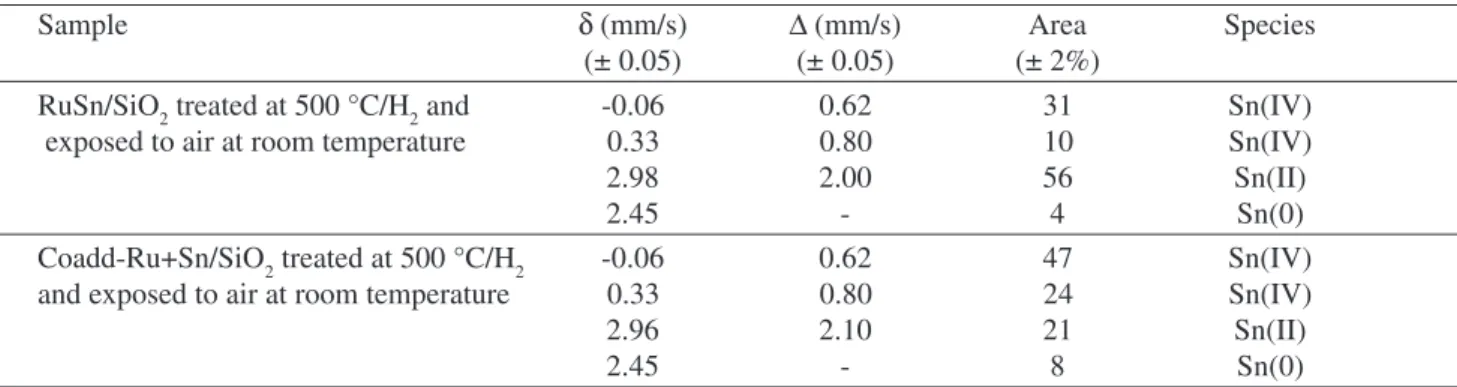
Mössbauer analyses have also been carried out for the
RuSn catalysts supported on SiO2 sol-gel matrix. The
re-sults are displayed in Table 2 and Fig. 3.
It can be observed similar spectra for both samples,
RuSn/SiO2 and coadd-Ru+Sn/SiO2, with the presence of
Sn(IV), Sn(II) and Sn(0) species. On the other hand, the
material RuSn/SiO2 showed a major contribution of Sn(II)
species whereas coadd-Ru+Sn/SiO2produced mainly
Sn(IV).
3.5 Temperature Programmed Reduction (TPR) Studies
The TPR profiles for the activated carbon supported
catalysts were obtained after reduction with H2 at 500 °C
and exposure to air at room temperature to reoxidize the metals. Figure 4 shows the TPR profiles obtained for co-imp-Ru+Sn/AC, RuSn/AC and Sn/AC.
It can be observed for Sn/AC two peaks at the tempera-ture 270 and 350-400 °C. According to the literatempera-ture the
first peak is probably related to the reduction of Sn+4 → Sn+2
which typically takes place in the temperature range
Table 2.119Sn Mössbauer parameters obtained at 23 K for the sol-gel SiO
2 supported RuSn catalysts submitted to different treatments.
Sample δ (mm/s) ∆ (mm/s) Area Species
(± 0.05) (± 0.05) (± 2%)
RuSn/SiO2 treated at 500 °C/H2 and -0.06 0.62 31 Sn(IV)
exposed to air at room temperature 0.33 0.80 10 Sn(IV)
2.98 2.00 56 Sn(II)
2.45 - 4 Sn(0)
Coadd-Ru+Sn/SiO2 treated at 500 °C/H2 -0.06 0.62 47 Sn(IV)
and exposed to air at room temperature 0.33 0.80 24 Sn(IV)
2.96 2.10 21 Sn(II)
2.45 - 8 Sn(0)
200-300 oC, whereas the second peak might be related to
the reduction Sn+2 → Sno22.
The co-imp-Ru+Sn/AC catalyst showed a broad peak centered at 160 °C related to the reduction of ruthenium
Ru+4 or Ru+3 → Ruo.23 It can also be observed peaks for the
reduction of Sn species similar to those observed for the Sn/AC sample, indicating that most of the Sn species present in the co-imp-Ru+Sn/AC catalyst are similar to those formed
in the Sn pure sampleSn/AC. On the other hand, the TPR
profile for the RuSn/AC showed significant differences. The Ru reduction peak is shifted to lower temperatures, 130 °C, whereas the reduction of Sn seems to occur in a broad peak in the temperature range 250-350 °C. Although the detailed explanation for these differences is not clear, they suggest that Ru and Sn species formed from the precursor
Cp(PPh3)2Ru-SnX3 are significantly different from those
obtained by the impregnation methods with RuCl3 and
SnCl2. These TPR differences could be produced by a
dif-ferent dispersion or by a chemical interaction of the phases present on the surface of the activated carbon.
For the reduction experiments of the sol-gel SiO2
sup-ported catalysts (Fig. 5), all the samples were pre-treated in
O2 (air) flow at 600 °C for 30 min. TPR experiments with
the sample Ru/SiO2 showed only one intense peak at ca.
110 °C, related to the reduction of Ru+4 dispersed in the
sol-gel matrix. On the other hand, it can be observed in the TPR
profile of the catalyst RuSn/SiO2 three well defined
reduc-tion peaks at 100, 150 and 210 °C and two broad peaks
Figure 3.119Sn Mössbauer spectra obtained at 23 K for the sol-gel SiO2 supported RuSn catalysts submitted to different treatments.
Figure 4. The TPR profiles for the catalysts Sn/AC, co-imp-Ru+Sn/AC and RuSn/AC.
centered at 380 and 480 °C. The peak at 100 °C is similar to
that observed in the sample Ru/SiO2. The intense peak at
150 °C, is related to a less reactive ruthenium species, which can be reduced only at higher temperatures. This species is only observed when the organometallic complex is used as precursor. As discussed above the broad peaks at 380 and 480 °C are likely related to the reduction of Sn species
dis-persed in the matrix24. However, their peak areas are too
small to account for the reduction of all tin present in the sample. Therefore, the peak at 210 °C is probably also re-lated to the reduction of tin. These two shifted peaks at 150 °C (related to the reduction of Ru species) and at 210 °C (related to the reduction of Sn species) suggest a strong in-teraction of the Ru and Sn species. The increase in the ru-thenium reduction temperature can be caused by the close proximity of the tin oxide. On the other hand, the signifi-cant decrease in the reduction temperature of the Sn
spe-cies should occur via a spillover effect,25 where the Ruo metal
activates H2 and transfer to the surrounding Sn oxides species.
3.6 Catalytic Reactions
The catalytic activity of the activated carbon supported materials were investigated for the following hydrodechlorination reactions:
CCl4 + H2→ HCCl3 + HCl
C6H5Cl + H2→ C6H6 + HCl
The activities presented by the different catalysts at 200 °C are shown in Fig. 6.
It can be observed that Ru/AC and Ru+Sn/AC show very
similar results with low CCl4 conversions of approximately
0.1 µmol/gcat.min. These results reinforces that in the
cata-lyst prepared by co-impregnation Ru+Sn/AC the Ru is not interacting significantly with the Sn species, since it showed similar performance when compared to the pure Ru/AC catalyst. On the other hand, the catalysts RuSn/AC obtained from the organometallic precursors shows a much stronger
effect of tin resulting in an activity of 0.3-0.6 µmol/gcat.min,
indicating a promoting effect of this metal. The results ob-tained for the hydrodechlorination of chlorobenzene also suggest a significant effect of tin on the catalytic activity of the catalysts RuSn/AC, but with a negative effect on the conversion.
3.7 The Effect of the Sn Oxidation State on the Catalytic Activity
To investigate the effect of the Sn oxidation state on the catalytic properties of the catalyst it was studied the hydro-genation 1,5-cyclooctadiene in the presence of the catalyst RuSn/AC submitted to two different treatments:
• after thermal treatment the catalyst was exposed to air leading to the complete oxidation of tin to Sn(IV) as shown by the Mössbauer spectrum and treated with
H2 at 200 °C in order to reduce only the ruthenium to
Ruº. This catalyst was named Ruo/Sn(IV)/AC;
• after thermal treatment, the catalyst was reduced with
H2 at 500 °C and not exposed to air. As suggested by
Mössbauer experiments, this catalyst contains mainly Sn(II) with some Sn(0) and Sn(IV). This catalyst was
named Ruo/Sn(II/IV)/AC.
The results are displayed in Fig. 7a and 7b.
The 1,5-COD hydrogenation affords mainly two prod-ucts: the selective hydrogenation compound cyclooctene (COE) and the total hydrogenation molecule cyclooctane (COA) (Scheme 1).
Very small amounts of the isomerization products 1,3-COD and 1,4-COD were also detected (yields < 1%).
Figure 6. Hydrogendechlorination of CCl4 (at 200 °C) and chlorobenzene (at 300 °C) in the presence of different RuSn
From Fig. 7a and 7b it can be observed similar
conver-sions for both catalysts Ruo/Sn(IV)/AC and Ruo/Sn(II/IV)/
AC. However, it is interesting to note that these catalysts showed significantly different product distribution during
the reaction. Ruo/Sn(IV)/AC showed much better
selectiv-ity for the production of COE, with ca. 60% yield in the
beginning of the reaction. For longer reaction times this yield will decrease due to hydrogenation of the COE to COA. On
the other hand, the catalyst Ruo/Sn(II)/AC produces mainly
the total hydrogenation compound COA.
These results show that the oxidation state of tin does not affect the catalyst activity but it has a significant effect on the product selectivity. The effects of Sn species around the Ru metal catalytic center are likely related to electronic
and steric effects7.
4. Conclusion
Supported RuSn bimetallic catalysts can be prepared by impregnation and thermal decomposition of the
organome-tallic precursors Cp(PPh3)2Ru-SnX3 (X = Cl or Br).
Cata-lysts prepared by these precursors and by the co-impregna-tion method showed significantly different properties, as
revealed by the catalytic hydrogendechlorination of CCl4
and chlorobenzene, TPR experiments and Mössbauer spectroscopy. These differences could be related to a better metal dispersion and a stronger interaction of ruthenium with tin. The interaction Ru-Sn in the prepared catalysts is favored by the chemical bond Ru-Sn existent in the organo-metallic precursor which will keep the two metals in a close proximity throughout the catalyst preparation. With these
catalysts it is also possible to have some control of the Sn oxidation state which showed a significant effect on the catalytic hydrogenation of 1,5-cyclooctadiene.
References
1. Buyanov, R.A.; Pakhomov, N.A. Kinet. Catal., v. 42, p.
64, 2001.
2. Lingaiah, N.; Sai Prasad, P.S.; Kanta Rao, P.; Smart L.E.;
Berry, F.J.Appl. Catal. A: Gen., v. 213, p. 189, 2001.
3. Gatte, R.R.; Phillips, J. J. Catal, v. 116, p. 49, 1989.
4. Niemantsverdriet, J.W.; van der Kraan, A.M., in: G.J.
Long, J.G. Stevens (Eds), Industrial Applications of the
Mössbauer Effect, PlenumPress, New York, p. 609, 1986.
5. Wang, T.; Schimdt, L.D. J. Catal., v. 71, p. 411, 1981.
6. Gallezot P.; Richard D. Catal. Rev. Sci. Eng., v. 40, p. 81,
1998.
7. Rylander, P.N. Catalytic Hydrogenation in Organic
Syn-theses, Academic Press, New York, 1986.
8. Wells, F.V.; Billot, M. Perfumery Technology, Horwood,
Chichester, 1981.
9. Coq, B.; Bittar, A.; Ditarte, R.; Figueras, F. J. Catal., v.
128, p. 275, 1991.
10. Galvagno, S.; Milone, C.; Donato, A.; Neri, G.; Pietropaolo R., in: M. Guisnet; J. Barbier; J. Barrault; C. Bouchoule; D. Duprez; G. Pérot; C. Montassier (Eds),
Studies in Surface Science and Catalysis, v. 78, Elsevier, Amsterdan, p.163, 1993.
11. Neri, G.; Mercadante, L.; Milone, C.; Pietropaolo R.,
Galvagno, S. J. Mol. Catal., v. 108, p. 41, 1996.
12. English, M.; Ranade, V.S.; Lercher, J.A. J. Mol. Catal.,
v. 121, p 69, 1997.
13. Coupé, J.N.; Jordão, E.; Fraga, M.A.; Mendes, M.J. Appl.
Catal. A: General, v. 199, p 45, 2000.
14. Marinelli, T.B.L.W.; Naburs, S.; Ponec, V. J. Catal., v.
151, p. 1, 1995.
15. Klusõn, P.; Cerneny, L., Chem. Listy, v.91, p. 100, 1997.
16. Margitfalvi, J.L.; Tompos, A.; Kolosova, I.; Valyon, J. J.
Catal., v. 174, p. 246, 1998.
17. Ponec, V., Appl. Catal., v. 149, p. 27, 1997 .
18. Moura, E.M., PhD Tesis, UFMG, 1999.
19. Stievano, L.; Calogero, S.; Wagner, F.E.; Calvagno, S.;
Milone, C. J. Phys. Chem. B, v. 103, p. 9545, 1999 .
20. Söhel, T.; Reichelt, W.; Teske, K.; F.E. Wagner, Z. Anorg.
Allg. Chem., v. 625, p. 247, 1999.
21. Neri, G.; Calogero, S.; Calvagno, S., Milone, C.; Schwank, J. J. Chem.Soc., Faraday Tras., v. 90, p. 2803, 1994.
22. Lieske, H.; Völter, J. J. Catal., v. 90, p. 96, 1984.
23. Reyes, P.; König, M.E.; Pecchi, G.; Concha, I.; Granados,
M.L.; Fierro, J.L.G. Catal. Lett., v. 46, p. 71, 1997.
24. Burch, R. J. Catal., v. 71, p. 348, 1981.
25. Grass, K.; Lintz, H.G. Stud. Surf. Sci. Catal., v. 112, p.