Article
Printed in Brazil - ©2017 Sociedade Brasileira de Química0103 - 5053 $6.00+0.00*e-mail: [email protected]
An Efficient Protocol for Facile Synthesis of New 5-Substituted-1
H
-Tetrazole
Derivatives Using Copper-Doped Silica Cuprous Sulfate (CDSCS) as Heterogeneous
Nano-Catalyst
Mohammad Navid Soltani Rad*
Medicinal Chemistry Research Laboratory, Department of Chemistry, Shiraz University of Technology, 71555-313 Shiraz, Iran
A facile and highly efficient protocol for synthesis of new 5-substituted-1H-tetrazoles derivatives using copper-doped silica cuprous sulfate (CDSCS) is described. In this method, the cycloaddition reaction of sodium azide with structurally diverse nitriles involving bioactive N-heterocyclic cores exploiting CDSCS in refluxing H2O/i-PrOH (1:1, v/v) furnishes the corresponding
5-substituted-1H-tetrazoles in good to excellent yields (up to 93%). The influence of parameters effective in progress of reaction including solvent type, temperature and catalyst was studied and discussed. In this protocol, CDSCS was proved to be an efficient heterogeneous nano-catalyst to easily achieve the new tetrazole derivatives. The advantages of CDSCS in current protocol known are its cheapness, thermal and chemical stability, ease of recyclability and reusability for several consecutive runs without significant decline in its reactivity.
Keywords: azide, CDSCS, cycloaddition, nitrile, 1H-tetrazole
Introduction
Tetrazole and its derivatives are an important class of N-heterocyclic compounds exhibiting widespread applications.1,2 Tetrazoles are extensively applied in different industries as instance: stabilizers in photography and photo imaging,3,4 explosives in rocket propellants,5-7 chelating agents in coordination chemistry,8,9 plant growth regulators, herbicides, fungicides in agriculture,3,10 and anti-wears and frictions in lubricants.11 Additionally, tetrazoles can be served as bioisosteres for the carboxylic acids.12-14 Replacing a carboxyl group with tetrazolyl moiety extensively improves the metabolic stability, bioavailability and cell permeability of a drug molecule.15,16 When increase in the lipophilicity factor (log P) for a drug molecule involving carboxylic moiety is desired, one can replace the carboxylic moiety with tetrazole as a more lipophilic bioisostere. Consequently, tetrazoles are widely applied in synthesis of many well-known drugs like losartan,17-19 candesartan,18,19 zolarsartan18,19 and valsartan.17 In addition, tetrazoles exhibit varied biological activities such as antihypertensive,17-21 antibacterial,22,23 antifungal,24,25 anticonvulsant,26 anti-inflammatory,27,28 antitubercular,29
anticancer,30 antineoplastic,31 antiallergic,32-34 and antiviral35 especially anti-HIV36 activities.
The synthesis of tetrazole and its derivatives has attracted considerable attention since the broad utilities found for tetrazoles. In this context, the different preparative methods have been emerged so far.37,38 Among them, the [3 + 2]-cycloaddition reaction of nitriles with azides is a well-known and most extensively studied and used procedure for synthesis of diverse 5-substituted-1H-tetrazoles.39,40 In this regard, several homogeneous reagents or catalysts have been developed to synthesize 5-substituted-1H-tetrazoles.41,42 Although these methods exhibit some advantages to access 1H-tetrazoles, their scale up synthesis are restricted by one or more disadvantages such as harsh reaction conditions, low yields, long reaction times, the use of strong Lewis acids, the in situ generation of HN3 as a highly dangerous volatile material with a great risk of eruption and toxicity, production of the stable metal-tetrazole complexes, the use of expensive and toxic metals or solvents, tedious work-up procedure and failure to undertake the recovery or reusability of the catalyst.
are well documented. Employing the heterogeneous catalysts often leads to the simple experimental procedures, mild reaction conditions, recovery and reusability of the catalyst, the minimization of undesirable chemical wastes, and the production of large quantities of products by using a small amount of catalyst. Thus, the exploit of heterogeneous catalysis has an exact superiority over homogeneous catalyst. In recent decade, some heterogeneous catalytic systems were developed to promote the synthesis of 5-substituted-1H-tetrazoles;43-55 nevertheless, drawbacks are usually accompanied with these heterogeneous catalysts comprising: (i) the strong acidic nature of some catalysts that largely aggravates the release of dangerous HN3; (ii) the use of weakly bonded or none-bonded metal salts supported on mineral supports which normally lead to desorption of active metal species during the reaction progress or work-up procedure; (iii) the formation of stable metal-tetrazole complexes that makes the tedious work-up procedure and (iv) the thermal or chemical instability. Thus, the employment of a heterogeneous catalyst that obviates the above drawbacks is of particular interest.
Silica-based catalysts offer several advantages like cheapness, mild reaction conditions, high yields and selectivity, non-corrosive properties, ease of handling and preparation. In addition, they could be easily removed from the reaction mixture, recovered, and reused by a simple flash filtration. Recently, we have reported the synthesis, characterization, and application of copper-doped silica cuprous sulfate (CDSCS) as a novel and efficient heterogeneous nano-catalyst for the CuI-catalyzed ‘Click’ synthesis of 1,4-disubstituted 1,2,3-triazoles56 and also 3,5-disubstituted isoxazoles.57 In light of the unique biological activities of tetrazoles and also in continuation of our ongoing research in utilizing CDSCS in organic synthesis,56-58 we herein report a practical and environmentally benign catalytic protocol for efficient synthesis of 5-substituted-1H-tetrazole derivatives using CDSCS (Scheme 1). In this synthesis, the desired nitriles 1 were primarily achieved by the reaction of diverse nucleophiles with 2-chloroacetonitrile
or 3-chloropropanenitrile in the presence of an equimolar mixture of triethylamine (TEA)-K2CO3 and catalytic amount of tetrabutylammonium iodide (TBAI) in MeCN at reflux condition. Then, to access tetrazoles 2, the cycloaddition reaction of nitriles 1 with sodium azide was carried out utilizing CDSCS in H2O/i-PrOH at reflux condition.
Results and Discussion
The first step of this synthetic approach was initiated by the preparation of the essential nitriles 1. In this context, various nucleophiles comprising azole derivatives, purine and pyrimidine nucleobases and phenols underwent the
N- or O-alkylation reaction with 2-chloroacetonitrile or 3-chloropropanenitrile through the SN2-type reaction. The reaction of the selected nucleophiles with above chloronitriles was carried out using TEA-K2CO3 (1:1) in the presence of TBAI (cat.) in refluxing MeCN (anhyd.) to gain 1. Afterward, to assess the optimized reaction condition for [3 + 2]-cycloaddition of 1 with NaN3, the influence of various parameters including temperature, solvent, and catalyst was studied. In this regard, the cycloaddition reaction of 2-(1H-benzo[d]imidazol-1-yl)acetonitrile (1a) with NaN3 was selected as a sample reaction.
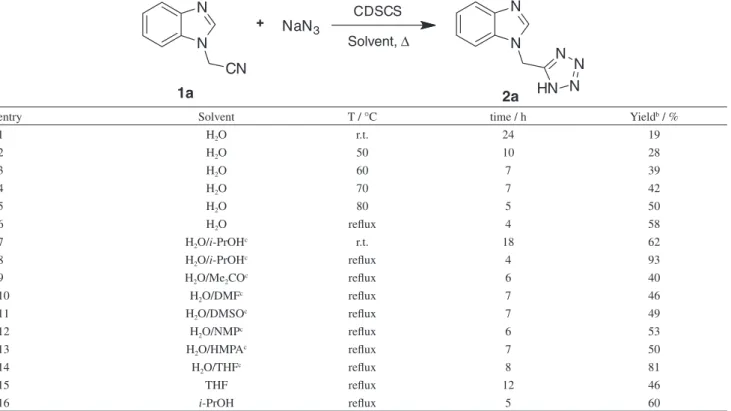
To progress the reaction efficiently, the choice of an appropriate solvent is crucial. Among tested solvents, the use of water has attracted enormous interest in organic transformations, since water is a cheap, clean, and universal solvent exhibiting extraordinary physical properties and enviro-economic benefits.59 In this regard, the model reaction was carried out in an aquatic media at room temperature. However, the corresponding tetrazole 2a was obtained only in 19% yield (Table 1, entry 1). To increase the reaction yield, the model reaction was investigated at varied temperatures (Table 1). As indicated in Table 1, the use of pure water at different temperatures failed to afford the satisfactory results even at reflux condition. This can be attributed to the lack of solubility of nitrile 1a in pure water. Consequently, the influence of several 1:1 (v/v) solutions
+ K2CO3-TEA/ TBAI (cat.) MeCN, reflux CN
Cl Nu CN
n n
n = 1, 2
H2O, i-PrOH, reflux CDSCS, NaN3
1
SiO2
CDSCS: OSO3Cu
H Nu
N H
N N N Nu
n
2
N
N N
H N O Me
O Me
, N H N
, MeO OH , Et OH , ... :
H Nu
of H2O with some water miscible organic solvents were examined (Table 1).
As indicated in Table 1, a solution of H2O/i-PrOH (1:1, v/v) was found to be the most appropriate solvent for synthesis of tetrazole derivatives in the presence of CDSCS (Table 1, entry 8). Therefore, this solvent was used for all subsequent reactions. Employing H2O/tetrahydrofuran (THF) (1:1, v/v) solution afforded the corresponding tetrazole in 81% yield after 8 h (Table 1, entry 14). Moreover, the combination of water with other miscible solvents like acetone, dimethylformamide (DMF), dimethyl sulfoxide (DMSO), N-methylpyrrolidone (NMP), and hexamethylphosphoramide (HMPA) yielded the moderate amount of product (Table 1, entries 9-13). In addition, when THF and/or i-PrOH were used separately as a solvent, 2a
was obtained in 46 and 60% yields, respectively (Table 1, entries 15, 16). Also, in an attempt to carry out the reaction in H2O/i-PrOH (1:1, v/v) solution at r.t. 2a was produced in 62% yield after 18 h (Table 1, entry 7).
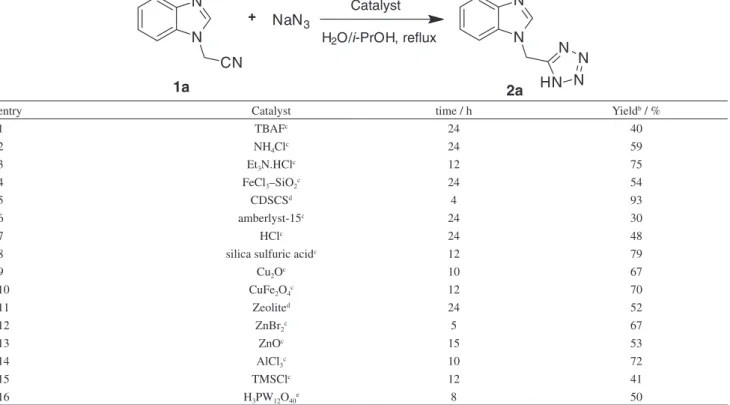
It is well understood that cycloaddition reaction between nitrile and azide is very slowly achieved in the absence of a suitable catalyst and thus it is unsuitable for large scale synthesis. In this connection, the choice of an efficient catalyst is critically essential for progress of the reaction. To investigate the catalytic potency of CDSCS, the effect of different catalysts was studied and compared with
CDSCS (Table 2). To this end, we examined the potency of several heterogeneous or homogeneous catalysts including Lewis and proton acids, solid supports, and ammonium salts which are often applied in synthesis of tetrazole derivatives. As the results in Table 2 indicate, higher yield of 2a in shorter reaction time were observed utilizing CDSCS in comparison with other tested catalysts. The use of other catalysts yielded 2a in moderate to reasonable amounts in variable times.
The optimized stoichiometric ratio of nitrile/sodium azide to access 2a using CDSCS (0.05 mol%) was determined to be 1:1.5.
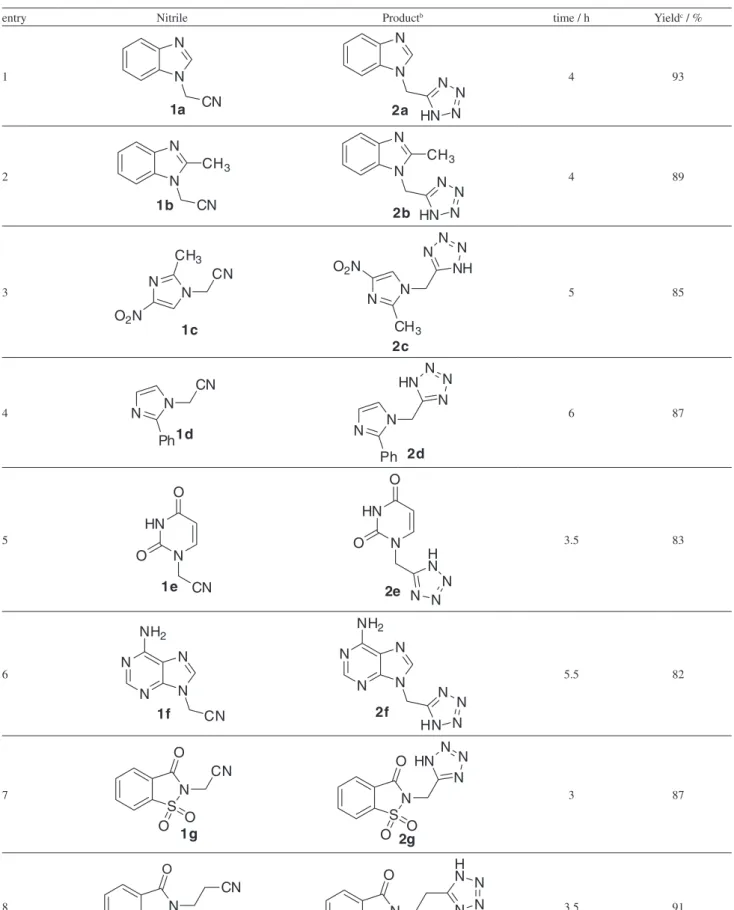
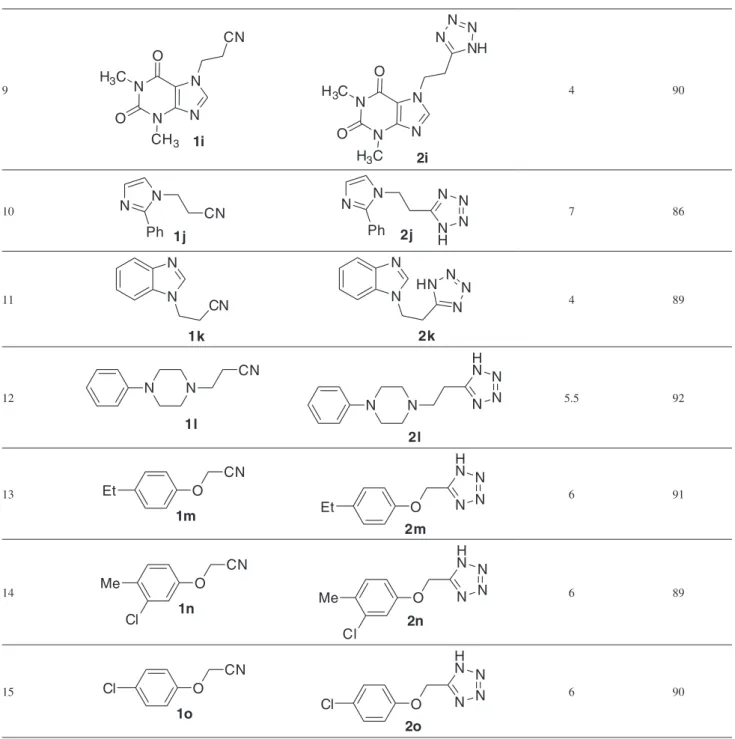
The generality and versatility of current protocol was screened by applying the optimized condition to various structurally diverse nitriles 1a-1o (Table 3). Due to Table 3, CDSCS proved to be a convenient and efficient heterogeneous nano-catalyst for cycloaddition reaction of sodium azide with different nitriles tethered to bioactive cores. As shown in Table 3, nitriles bearing azole derivatives (Table 3, entries 1-4, 10, 11), xanthine (Table 3, entry 9), purine and pyrimidine nucleobases (Table 3, entries 5 and 6) were employed to produce their corresponding 5-substituted-1H-tetrazole derivatives in good to excellent yields. Moreover, nitriles involving amine (Table 3, entry 12), cyclic amides (Table 3, entries 7 and 8), and phenols (Table 3, entries 13-15) underwent Table 1. Effect of solvent and temperature on the model reactiona
N N
CN
NaN3
CDSCS
Solvent, N
N
HN N N N
1a 2a
entry Solvent T / °C time / h Yieldb / %
1 H2O r.t. 24 19
2 H2O 50 10 28
3 H2O 60 7 39
4 H2O 70 7 42
5 H2O 80 5 50
6 H2O reflux 4 58
7 H2O/i-PrOHc r.t. 18 62
8 H2O/i-PrOHc reflux 4 93
9 H2O/Me2COc reflux 6 40
10 H2O/DMFc reflux 7 46
11 H2O/DMSOc reflux 7 49
12 H2O/NMPc reflux 6 53
13 H2O/HMPAc reflux 7 50
14 H2O/THFc reflux 8 81
15 THF reflux 12 46
16 i-PrOH reflux 5 60
aReaction conditions: nitrile (0.01 mol), NaN
cycloaddition reaction with azide to obtain the desired tetrazole derivatives. The structures of all synthesized compounds were confirmed by 1H and 13C NMR, elemental analysis, mass and infrared (IR) spectroscopy techniques.
The applicability of the present protocol in preparative scale was also examined. In this context, the cycloaddition reaction of nitrile 1a with NaN3 was performed on a 100-mmol scale. Interestingly, 2a was obtained in an excellent yield (89%) after 4 h which is comparable to smaller scale synthesis (Table 3, entry 1).
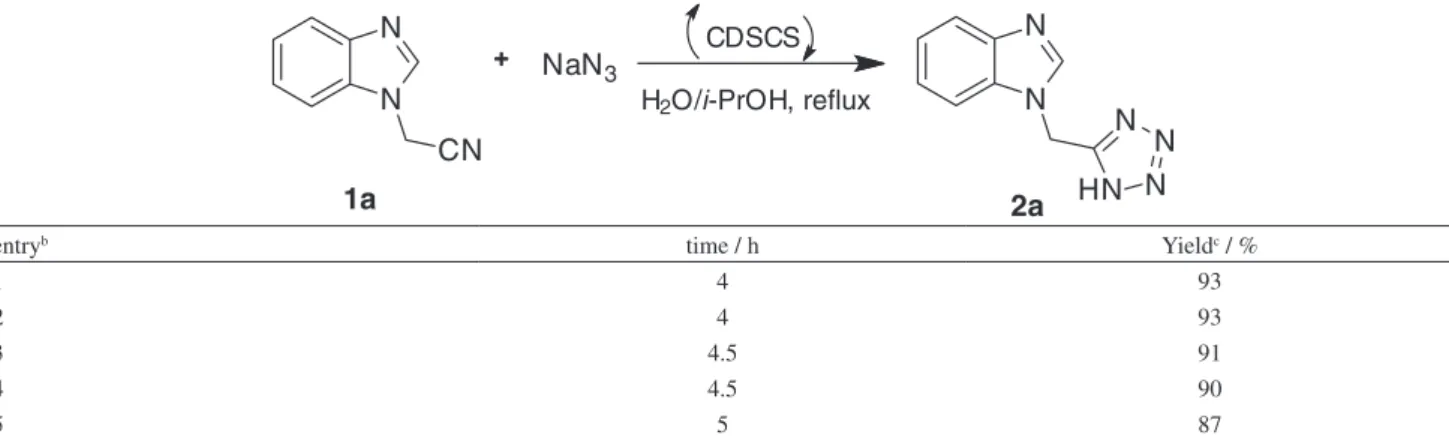
The recoverability and reusability of the catalyst is an important issue from different aspects like commercial applications and environmental concerns. In this connection, the reusability of CDSCS was investigated for sample reaction (Table 4).
The separation of the catalyst from the reaction media was conducted using a sintered glass funnel. The catalyst was then washed with ethyl acetate (2 × 15 mL) and dried in a vacuum oven at 90 ºC for 20 min. The catalyst was sequentially applied for 5 runs without the addition of the fresh catalyst to the reaction media. As shown in Table 4, the catalyst can be reused for many consecutive times without considerable decline in its catalytic activity. To determine the amount of leached Cu from CDSCS, the copper content of catalyst was determined using inductively coupled
plasma (ICP) analysis for both fresh and reused catalyst (after 5 runs). Based on the ICP results, the leached Cu was found to be 0.014%, which is negligible.
Conclusions
In conclusion, we have described a convenient protocol for facile and high yield synthesis of the new structurally diverse 5-substituted-1H-tetrazoles utilizing CDSCS as a highly efficient heterogeneous nano-catalyst. CDSCS was proved to be a useful catalyst for cycloaddition reaction of sodium azide with different nitriles involving bioactive cores in H2O/i-PrOH (1:1, v/v) at reflux condition, which affords the corresponding tetrazole derivatives in good to excellent yields. The use of ecofriendly solvent, the reusability of the catalyst, the simplicity of the process, cheapness, and applicability in preparative scale are benefits that can be mentioned for current synthetic protocol.
Experimental
General
All chemicals were purchased from either Fluka or Merck. Reactions were followed by TLC using Table 2. Comparing the influence of different catalysts with CDSCS in synthesis of 2aa
H2O/i-PrOH, reflux N
N
CN
NaN3
Catalyst
N N
HN N N N
1a 2a
entry Catalyst time / h Yieldb / %
1 TBAFc 24 40
2 NH4Clc 24 59
3 Et3N.HClc 12 75
4 FeCl3–SiO2c 24 54
5 CDSCSd 4 93
6 amberlyst-15c 24 30
7 HClc 24 48
8 silica sulfuric acidc 12 79
9 Cu2Oc 10 67
10 CuFe2O4c 12 70
11 Zeolited 24 52
12 ZnBr2c 5 67
13 ZnOc 15 53
14 AlCl3c 10 72
15 TMSClc 12 41
16 H3PW12O40e 8 50
aReaction conditions: nitrile (0.01 mol), NaN
Table 3. Synthesis of 5-substituted-1H-tetrazole derivatives using CDSCSa
entry Nitrile Productb time / h Yieldc / %
1 N
N
CN
1a
N N
HN N N N
2a
4 93
2 N
N
CN CH3
1b
N N
CH3
HN N N N
2b
4 89
3 N N
CH3 CN
O2N
1c
N N
CH3
NH N N N O2N
2c
5 85
4 N N
Ph CN
1d N N
Ph N
N N HN
2d
6 87
5
HN
N O
O
CN
1e
HN
N O
O
N NN H N
2e
3.5 83
6 N
N NH2
N N
CN
1f
N
N N
N NH2
HN N N N
2f
5.5 82
7
S N
CN O
O O
1g
S N O
N N N HN
O 2gO
3 87
8 N
CN
O
O 1h
N N N
N H N O
O 2h
9 N
N CH3 H3C
N N O
O
CN
1i
N
N H3C H3C
N N O
O
NH N N N
2i
4 90
10 N
N
Ph
CN
1j
N N
Ph N
H N N N
2j
7 86
11 N
N
CN
1k
N N
N N N HN
2k
4 89
12 N N
CN
1l
N N N N
N H N
2l
5.5 92
13 O
CN
1m
Et
O N N
N H N
2m
Et
6 91
14 O
CN
1n
Me
Cl
O N N
N H N
2n
Me
Cl
6 89
15 O
CN
1o
Cl
O N N
N H N
2o
Cl
6 90
aReaction conditions: nitrile (0.01 mol), NaN
3 (0.015 mol), CDSCS (0.05 mol%), H2O/i-PrOH (50 mL); ball products were characterized by 1H and 13C NMR, IR, CHN, and MS analysis; cisolated yield.
Table 3. Synthesis of 5-substituted-1H-tetrazole derivatives using CDSCSa (cont.)
SILG/UV 254 silica-gel plates. The fresh CDSCS was prepared according to our previous reported procedure.56,58 Column chromatography was performed on silica gel 60 (0.063-0.200 mm, 70-230 mesh; ASTM). Melting points were measured using Electrothermal IA 9000 melting point apparatus in open capillary tubes and are uncorrected. IR spectra were obtained using a Shimadzu FTIR-8300 spectrophotometer. 1H and 13C NMR spectrum was recorded on Brüker Avance-DPX-250/400 spectrometer operating
General procedure for synthesis of alkyl nitriles 1a-1o
In a double-necked round bottom flask (100 mL) equipped with a condenser, it was added a mixture, consisting of nucleophile (including: N-heterocyclic compounds or phenolic derivatives) (0.01 mol), 2-chloroacetonitrile or 3-chloropropanenitrile (0.013 mol), Et3N (0.01 mol), K2CO3 (0.01 mol), and a catalytic amount of TBAI (0.1 g) in anhydrous MeCN (40 mL). The mixture was refluxed until TLC monitoring indicates no further improvement in the reaction. The solvent was evaporated in vacuo and the remaining foam was dissolved in CHCl3 (100 mL) and subsequently washed with water (2 × 100 mL). The organic layer was dried (Na2SO4) and evaporated. The crude product was purified by column chromatography on silica gel.
General procedure for synthesis of 5-substituted-1H -tetrazole 2a-2o
In a double-necked round bottom flask (100 mL) equipped with a condenser, it was added a mixture, consisting of alkyl nitrile (0.01 mol), NaN3 (0.015 mol), and CDSCS (0.3 g, 0.05 mol%) in H2O/i-PrOH (1:1 v/v, 50 mL). The mixture was heated at reflux until TLC monitoring indicates no further improvement in the conversion (Table 3). The reaction mixture was then cooled to room temperature, vacuum-filtered using a sintered-glass funnel and the residue was washed with ethyl acetate (2 × 20 mL). The filtrate was treated with 5 N HCl to reach pH = 3 and it was allowed to stir for 30 minutes. Subsequently, the organic layer was separated, dried over anhydrous Na2SO4 and evaporated. The crude product was purified by recrystallization and/or column chromatography on silica gel eluted with proper solvents.
1-((1H-Tetrazol-5-yl)methyl)-1H-benzo[d]imidazole (2a)
Recrystallization (EtOAc) afforded a yellow solid; yield: 1.86 g (93%); mp 235-240 °C (dec.); IR (KBr)
ν / cm-1 3385, 3100, 2968, 2800, 1616, 1462, 1410; 1H NMR (250 MHz, DMSO-d
6) d8.28 (s, 1H, C(2)-H, benzimidazole), 7.64-7.61 (m, 2H, aryl), 7.22-7.13 (m, 2H, aryl), 5.55 (s, 2H, NCH2), 2.51 (s, 1H, exchangeable with D2O, NH, tetrazole); 13C NMR (250 MHz, DMSO-d6)
d 51.7, 116.6, 117.8, 122.2, 123.2, 133.6, 137.5, 145.6, 155.6; MS (EI): m/z (%) = 200 (14.5) [M+]; anal. calcd. for C9H8N6: C, 53.99; H, 4.03; N, 41.98; found: C, 54.06; H, 4.15; N, 41.92.
1-((1H-Tetrazol-5-yl)methyl)-2-methyl-1H-benzo[d]imidazole (2b)
Recrystallization (EtOAc) afforded a creamy solid; yield: 1.90 g (89%); mp > 300 °C (dec.); IR (KBr) ν / cm-1 3384, 3100, 2982, 1619, 1580, 1480; 1H NMR (250 MHz, DMSO-d6) d7.57-7.46 (m, 2H, aryl), 7.16-7.08 (m, 2H, aryl), 5.46 (s, 2H, NCH2), 4.55 (s, 1H, exchangeable with D2O, NH, tetrazole), 2.67 (s, 3H, CH3); 13C NMR (250 MHz, DMSO-d6) d17.9, 49.1, 115.5, 116.6, 121.5, 123.0, 134.7, 140.3, 151.2, 158.4; MS (EI): m/z (%) = 214 (11.4) [M+]; anal. calcd. for C
10H10N6: C, 56.07; H, 4.71; N, 39.23; found: C, 56.19; H, 4.62; N, 39.35.
5-((2-Methyl-4-nitro-1H-imidazol-1-yl)methyl)-1H-tetrazole (2c)
Column chromatography (silica gel, EtOAc–MeOH, 1:1) afforded a brown solid; yield: 1.77 g (85%); mp 208-212 °C (dec.); IR (KBr) ν / cm-1 3350, 3128, 2900, 1645, 1500, 1456, 1300; 1H NMR (250 MHz, DMSO-d
6) d8.30 (s, 1H, C(5)-H, imidazole), 5.40 (s, 2H, NCH2), 4.40 (s, 1H, exchangeable with D2O, NH, tetrazole), 2.43 (s, 3H, CH3); 13C NMR (250 MHz, DMSO-d6) d15.7, 48.2, 121.1, Table 4. The reusability of CDSCS in successive trails for synthesis of 2aa
H2O/i-PrOH, reflux N
N
CN
NaN3
N N
HN N N N
1a 2a
CDSCS
entryb time / h Yieldc / %
1 4 93
2 4 93
3 4.5 91
4 4.5 90
5 5 87
aReaction conditions: nitrile (0.01 mol), NaN
147.8, 153.0, 160.9; MS (EI): m/z (%) = 209 (8.1) [M+]; anal. calcd. for C6H7N7O2: C, 34.45; H, 3.37; N, 46.88; found: C, 34.38; H, 3.42; N, 46.94.
5-((2-Phenyl-1H-imidazol-1-yl)methyl)-1H-tetrazole (2d)
Recrystallization (EtOAc) afforded a bright brown solid; yield: 1.96 g (87%); mp 216-220 °C (dec.); IR (KBr) ν / cm-1 3280, 3150, 2937, 2850, 1653, 1476; 1H NMR (250 MHz, DMSO-d
6) d7.94-7.91 (m, 2H, aryl), 7.58-7.46 (m, 3H, aryl), 7.20 (s, 1H, C(4)-H, imidazole), 6.95 (s, 1H, C(5)-H, imidazole), 5.28 (s, 2H, NCH2), 2.50 (s, 1H, exchangeable with D2O, NH, tetrazole); 13C NMR (250 MHz, DMSO-d6) d49.0, 121.0, 125.5, 127.0, 127.4, 129.6, 131.0, 152.1, 160.1; MS (EI): m/z (%) = 226 (17.3) [M+]; anal. calcd. for C
11H10N6: C, 58.40; H, 4.46; N, 37.15; found: C, 58.31; H, 4.58; N, 37.02.
1-((1H-Tetrazol-5-yl)methyl)pyrimidine-2,4(1H,3H)-dione (2e)
Recrystallization (EtOAc) afforded a creamy solid; yield: 1.61 g (83%); mp 285-290 °C; IR (KBr) ν / cm-1 3365, 3129, 2876, 1723, 1706, 1650, 1458; 1H NMR (250 MHz, DMSO-d6) d11.37 (s, 1H, exchangeable with D2O, NH, uracil), 7.67 (d, 1H, J 7.5 Hz, C(6)-H, uracil), 5.70 (d, 1H,
J 7.5 Hz, C(5)-H, uracil), 5.07 (s, 2H, NCH2), 4.07 (s, 1H, exchangeable with D2O, NH, tetrazole); 13C NMR (250 MHz, DMSO-d6) d47.3, 103.4, 142.1, 151.5, 156.4, 161.7; MS (EI): m/z (%) = 194 (10.8) [M+]; anal. calcd. for C
6H6N6O2: C, 37.12; H, 3.11; N, 43.29; found: C, 37.24; H, 3.26; N, 43.24.
9-((1H-Tetrazol-5-yl)methyl)-9H-purin-6-amine (2f)
Recrystallization (EtOAc) afforded a creamy solid; yield: 1.78 g (82%); mp > 300 °C (dec.); IR (KBr) ν / cm-1 3328, 3100, 2853, 1676, 1520, 1471; 1H NMR (250 MHz, DMSO-d6) d8.12 (s, 1H, C(8)-H, adenine), 8.05 (s, 1H, C(2)-H, adenine), 7.17 (s, 2H, exchangeable with D2O, NH2), 5.42 (s, 2H, NCH2), 4.80 (s, 1H, exchangeable with D2O, NH, tetrazole); 13C NMR (250 MHz, DMSO-d6)
d54.3, 118.4, 139.9, 147.7, 151.5, 155.6, 162.8; MS (EI):
m/z (%) = 217 (9.5) [M+]; anal. calcd. for C
7H7N9: C, 38.71; H, 3.25; N, 58.04; found: C, 38.63; H, 3.18; N, 58.12.
2-((1H-Tetrazol-5-yl)methyl)benzo[d]isothiazol-3(2H)-one 1,1-dioxide (2g)
Recrystallization (EtOAc) afforded a pale-yellow solid; yield: 2.30 g (87%); mp 225-229 °C (dec.); IR (KBr) ν / cm-1 3324, 3050, 2976, 1715, 1600, 1460, 1321, 761; 1H NMR (250 MHz, DMSO-d
6) d7.84-7.45 (m, 4H, aryl), 4.44 (s, 2H, NCH2), 2.51 (s, 1H, exchangeable with D2O, NH, tetrazole); 13C NMR (250 MHz, DMSO-d6)
d39.5, 126.3, 126.8, 127.3, 131.6, 132.0, 139.3, 156.6,
169.1; MS (EI): m/z (%) = 265 (19.7) [M+]; anal. calcd. for C10H8N4O3S: C, 45.45; H, 3.05; N, 21.20; S, 12.13; found: C, 45.56; H, 3.11; N, 21.14; S, 12.25.
2-(2-(1H-Tetrazol-5-yl)ethyl)isoindoline-1,3-dione (2h)
Recrystallization (EtOAc) afforded a creamy solid; yield: 2.21 g (91%); mp > 300 °C (dec.); IR (KBr) ν / cm-1 3374, 3063, 2950, 1772, 1620, 1510, 1458; 1H NMR (250 MHz, DMSO-d6) d 7.28-7.09 (m, 4H, aryl), 4.34 (t, 2H, J 7.2 Hz, NCH2), 3.46 (s, 1H, exchangeable with D2O, NH, tetrazole), 3.08 (t, 2H, J 7.2 Hz, NCH2CH2); 13C NMR (250 MHz, DMSO-d
6) d27.6, 42.6, 126.3, 131.6, 134.2, 159.4, 167.0; MS (EI): m/z (%) = 243 (13.9) [M+]; anal. calcd. for C11H9N5O2: C, 54.32; H, 3.73; N, 28.79; found: C, 54.43; H, 3.82; N, 28.86.
7-(2-(1H-Tetrazol-5-yl)ethyl)-1,3-dimethyl-1H -purine-2,6(3H,7H)-dione (2i)
Column chromatography (silica gel, MeOH) afforded a brown foam; yield: 2.48 g (90%); IR (KBr) ν / cm-1 3300, 2985, 1716, 1702, 1693, 1658, 1379;1H NMR(250 MHz, DMSO-d6) d 7.86 (s, 1H, C(8)-H, theophylline), 4.55 (t, 2H, J 5.7 Hz, NCH2), 3.41 (t, 2H, J 5.7 Hz, NCH2CH2), 3.27 (s, 3H, N(1)-CH3), 3.09 (s, 3H, N(3)-CH3), 2.54 (s, 1H, exchangeable with D2O, NH, tetrazole); 13C NMR (250 MHz, DMSO-d6) d20.1, 31.0, 32.3, 34.5, 106.3, 136.8, 145.9, 147.7, 154.5, 159.8; MS (EI): m/z (%) = 276 (20.7) [M+]; anal. calcd. for C
10H12N8O2: C, 43.48; H, 4.38; N, 40.56; found: C, 43.59; H, 4.27; N, 40.61.
5-(2-(2-Phenyl-1H-imidazol-1-yl)ethyl)-1H-tetrazole (2j)
Recrystallization (EtOAc) afforded a creamy solid; yield: 2.06 g (86%); mp 250-255 °C (dec.); IR (KBr)
ν / cm-1 3300, 3050, 2960, 1650, 1485; 1H NMR (250 MHz, DMSO-d6) d7.58-7.44 (m, 5H, aryl), 7.32 (s, 1H, C(4)-H), 6.95 (s, 1H, C(5)-H), 4.29 (t, 2H, J 7.5 Hz, NCH2), 3.07 (t, 2H, J 7.5 Hz, NCH2CH2), 1.98 (s, 1H, exchangeable with D2O, NH, tetrazole); 13C NMR (250 MHz, DMSO-d6)
d 30.0, 54.5, 120.8, 125.8, 126.3, 127.0, 127.2, 130.2, 149.7, 155.1; MS (EI): m/z (%) = 240 (15.8) [M+]; anal. calcd. for C12H12N6: C, 59.99; H, 5.03; N, 34.98; found: C, 60.07; H, 5.16; N, 34.87.
1-(2-(1H-Tetrazol-5-yl)ethyl)-1H-benzo[d]imidazole (2k)
Recrystallization (EtOAc) afforded a brown solid; yield: 1.90 g (89%); mp 300-304 °C (dec.); IR (KBr) ν / cm-1 3326, 3100, 2926, 1653, 1501, 1470; 1H NMR (250 MHz, DMSO-d6) d 8.10 (s, 1H, C(2)-H, benzimidazole), 7.62-7.55 (m, 2H, aryl), 7.24-7.14 (m, 2H, aryl), 4.55 (t, 2H,
(250 MHz, DMSO-d6) d31.1, 60.5, 116.1, 117.3, 124.1, 125.2, 134.6, 138.7, 149.3, 161.7; MS (EI): m/z (%) = 214 (12.7) [M+]; anal. calcd. for C
10H10N6: C, 55.94; H, 4.63; N, 39.14; found: C, 55.83; H, 4.75; N, 39.28.
1-(2-(1H-Tetrazol-5-yl)ethyl)-4-phenylpiperazine (2l)
Column chromatography (silica gel, EtOAc-n-hexane, 1:1) afforded a bright brown solid; yield: 2.37 g (92%); mp > 300 °C (dec.); IR (KBr) ν / cm-1 3340, 3100, 2992, 1659, 1653, 1476; 1H NMR (250 MHz, DMSO-d
6)
d7.26-7.20 (m, 2H, aryl), 6.91-6.81 (m, 3H, aryl), 4.96 (s, 1H, exchangeable with D2O, NH, tetrazole), 3.83 (t, 2H, J 6.5 Hz, CH2), 3.09 (t, 2H, J 7.2 Hz, CH2), 2.72-2.65 (m, 8H, 4 CH2); 13C NMR (250 MHz, DMSO-d6) d28.2, 49.1, 52.2, 56.1, 114.3, 119.5, 130.5, 150.0, 160.2; MS (EI): m/z
(%) = 258 (19.7) [M+]; anal. calcd. for C
13H18N6: C, 60.44; H, 7.02; N, 32.53; found: C, 60.31; H, 7.08; N, 32.61.
5-((4-Ethylphenoxy)methyl)-1H-tetrazole (2m)
Recrystallization (EtOAc) afforded a creamy solid; yield: 1.85 g (91%); mp 83-85 °C; IR (KBr) ν / cm-1 3300, 3040, 2957, 1654, 1458; 1H NMR (250 MHz, DMSO-d
6)
d7.18-7.06 (m, 2H, aryl), 6.97-6.93 (m, 1H, aryl), 6.86-6.77 (m, 1H, aryl), 5.42 (s, 2H, OCH2), 4.36 (s, 1H, exchangeable with D2O, NH, tetrazole), 2.57-2.45 (m, 2H, CH2CH3), 1.14 (t, 3H, J 7.5 Hz, CH3); 13C NMR (250 MHz, DMSO-d6)
d14.6, 32.3, 72.1, 115.9, 128.4, 132.4, 155.1, 159.7; MS (EI): m/z (%) = 204 (14.5) [M+]; anal. calcd. for C
10H12N4O: C, 58.81; H, 5.92; N, 27.43; found: C, 58.89; H, 6.04; N, 27.51.
5-((3-Chloro-4-methylphenoxy)methyl)-1H-tetrazole (2n)
Recrystallization (EtOAc) afforded a white solid; yield: 1.99 g (89%); mp 145-147 °C; IR (KBr) ν / cm-1 3250, 3028, 2947, 1657, 1451, 720; 1H NMR (250 MHz, DMSO-d6) d7.04 (d, 1H, J 8.0 Hz, aryl), 6.58 (d, 1H, J 8.0 Hz, aryl), 6.49 (s, 1H, aryl), 5.61 (s, 2H, OCH2), 4.62 (s, 1H, exchangeable with D2O, NH, tetrazole), 2.47 (s, 3H, CH3); 13C NMR (250 MHz, DMSO-d6) d20.1, 70.8, 114.7, 116.4, 125.5, 129.0, 138.8, 155.9, 158.4; MS (EI):
m/z (%) = 224 (19.1) [M+]; anal. calcd. for C
9H9ClN4O: C, 48.12; H, 4.04; Cl, 15.78; N, 24.94; found: C, 48.05; H, 4.07; Cl, 15.71; N, 25.03.
5-((4-Chlorophenoxy)methyl)-1H-tetrazole (2o)
Recrystallization (EtOAc) afforded a bright brown solid; yield: 1.89 g (90%); mp 241-245 °C; IR (KBr)
ν / cm-1 3270, 3062, 2981, 1654, 1469, 715; 1H NMR (250 MHz, DMSO-d6) d 7.13 (d, 2H, J 8.8 Hz, aryl), 6.91 (d, 2H, J 8.8 Hz, aryl), 5.05 (s, 2H, OCH2), 4.39 (s, 1H, exchangeable with D2O, NH, tetrazole); 13C NMR
(250 MHz, DMSO-d6) d71.2, 116.3, 127.4, 129.7, 154.7, 159.0; MS (EI): m/z (%) = 210 (18.1) [M+]; anal. calcd. for C8H7ClN4O: C, 45.62; H, 3.35; Cl, 16.83; N, 26.60; found: C, 45.69; H, 3.43; Cl, 16.80; N, 26.67.
Supplementary Information
1H and 13C NMR spectra of synthesized tetrazoles are available free of charge at http://jbcs.sbq.org.br as PDF file.
Acknowledgments
The author is grateful to Shiraz University of Technology Research Councils for partial support of this work.
References
1. Butler, R. N. In Comprehensive Heterocyclic Chemistry II, vol. 4; Katritzky, A. R.; Rees, C. W.; Scriven, E. F. V., eds.; Pergamon: Oxford, 1996, p. 897.
2. Ostrovskii, V. A.; Koldobskii, G. I.; Trifonov, R. E. In Comprehensive Heterocyclic Chemistry III, vol. 6; Katritzky, A. R.; Ramsden, C. A.; Scriven, E. F. V.; Taylor, R. J. K., eds.; Elsevier: Oxford, 2008, p. 257.
3. Jursic, B. S.; Leblanc, B. W.; J. Heterocycl. Chem. 1998, 35, 405 and references cited therein.
4. Koldobskii, G. I.; Ostrovskii, V. A.; Popavskii, V. S.; Khim. Geterotsikl. Soedin. 1981, 10, 1299.
5. Zhao-Xu, C.; Heming, X.; Int. J. Quantum Chem. 2000, 79, 350.
6. Kharaghiosoff, K.; Klapotke, T. M.; Mayer, P.; Piotrowski, H.; Polborn, K.; Willer, R. L.; Weigand, J. J.; J. Org. Chem. 2006, 71, 1295.
7. Hammerl, A.; Hiskey, M. A.; Holl, G.; Klapoetke, T. M.; Polborn, K.; Stierstorfer, J.; Weigand, J. J.; Chem. Mater. 2005, 17, 3784.
8. Downard, A. J.; Steel, P. J.; Steenwijk, J.; Aust. J. Chem. 1995, 48, 1625.
9. Mukhopadhyay, S.; Lasri, J.; Guedes da Silva, M. F. C.; Januário Charmier, M. A.; Pombeiro, A. J. L.; Polyhedron 2008, 27, 2883. 10. McManus, J. M.; Herbst, R. M.; J. Org. Chem. 1959, 24, 1464. 11. Li, J.; Ren, T.; Liu, H.; Wang, D.; Liu, W.; Wear 2000, 246, 130. 12. Herr, R. J.; Bioorg. Med. Chem. 2002, 10, 3379.
13. Meanwell, N. A.; J. Med. Chem. 2011, 54, 2529.
14. Pegklidou, K.; Koukoulitsa, C.; Nicolaou, I.; Demopoulos, V. J.; Bioorg. Med. Chem. 2010, 18, 2107.
15. Holland, G. F.; Pereira, J. N.; J. Med. Chem. 1967, 10, 149. 16. Marvi, O.; Alizadeh, A.; Zarrabi, S.; Bull. Korean Chem. Soc.
2011, 32, 4001.
18. Alonen, A.; Finel, M.; Kostiainen, R.; Biochem. Pharmacol. 2008, 76, 763.
19. Alonen, A.; Jansson, J.; Kallonen, S.; Kiriazis, A.; Aitio, O.; Finel, M.; Kostiainen, R.; Bioorg. Chem. 2008, 36, 148. 20. Bräuner-Osborne, H.; Egebjerg, J.; Nielsen, E. O.; Madsen, U.;
Krogsgaard-Larsen, P.; J. Med. Chem. 2000, 43, 2609. 21. Lusina, M.; Cindrić, T.; Tamaić, J.; Peko, M.; Pozaić, L.;
Musulin, N.; Int. J. Pharm. 2005, 291, 127.
22. Narasaiaha, T.; Subba Raoa, D.; Rasheeda, S.; Madhavaa, G.; Srinivasulua, D.; Brahma Naidub, P.; Naga Rajua, C.; Der Pharm. Lett. 2012, 4, 854.
23. Andrus, A.; Partridge, B.; Heck, J. V.; Christensen, B. G.; Tetrahedron Lett. 1984, 25, 911.
24. Dhayanithhi, V.; Syed, S. S.; Kumaran, K.; Sankar, K. R. J.; Ragavan, R. V.; Goud, P. S. K.; Kumari, N. S.; Pati, H. N.; J. Serb. Chem. Soc. 2011, 76, 165.
25. Rajasekaran, A.; Sankaranarayanan, M.; Rajagopal, K. A.; Arch. Pharm. Res. 2006, 29, 535.
26. Upadhayaya, R. S.; Jain, S.; Sinha, N.; Kishore, N.; Chandra, R.; Arora, S. K.; Eur. J. Med. Chem. 2004, 39, 579.
27. Mohite, P. B.; Pandhare, R. B.; Khanage, S. G.; Bhaskar,V. H.; J. Pharm. Res. 2010, 3, 43.
28. Maxwell, J. R.; Wasdahl, D. A.; Wolfson, A. C.; Stenberg, V. I.; J. Med. Chem. 1984, 27, 1565.
29. Adamec, J.; Waisser, K.; Kunes, J.; Kaustova, J.; Arch. Pharm. 2005, 338, 385.
30. De Souza, A. O.; Pedrosa, M. T.; Alderete, J. B.; Cruz, A. F.; Prado, M. A.; Alves, R. B.; Silva, C. L.; Pharmazie 2005, 60, 396.
31. Akimoto, H.; Ootsu, K.; Itoh, F.; Eur. Patent EP 530,537 1993 (CA 119:226417).
32. Peet, N. P.; Baugh, L. E.; Sunder, S.; Lewis, J. E.; Matthews, E. H.; Olberding, E. L.; Shah, D. N.; J. Med. Chem. 1986, 29, 2403.
33. Ellis, G. P.; Shaw, D.; J. Med. Chem. 1972, 15, 865.
34. Nohara, A.; Kuriki, H.; Saijo, T.; Sugihara, H.; Kanno, M.; Sanno, Y.; J. Med. Chem. 1977, 20, 141.
35. Vieira, E.; Huwyler, S.; Jolidon, S.; Knoflach, F.; Mutel, V.; Wichmann, J.; Bioorg. Med. Chem. Lett. 2005, 15, 4628. 36. Gagnon, A.; Landry, S.; Coulombe, R.; Jakalian, A.; Guse, I.;
Thavonekham, B.; Bonneau, P. R.; Yoakim, C.; Simoneau, B.; Bioorg. Med. Chem. Lett. 2009, 19, 1199.
37. Katritzky, A. R.; Cai, C.; Meher, N. K.; Synthesis 2007, 1204 and all references cited therein.
38. Patil, U. B.; Kumthekar, K. R.; Nagarkar, J. M.; Tetrahedron Lett. 2012, 53, 3706.
39. Demko, Z. P.; Sharpless, K. B;. J. Org. Chem. 2001, 66, 7945. 40. Himo, F.; Demko, Z. P.; Noodleman, L.; Sharpless, K. B.; J. Am.
Chem. Soc. 2003, 125, 9983.
41. Roh, J.; Vávrová, K.; Hrabálek, A.; Eur. J. Org. Chem. 2012, 6101.
42. Voitekhovich, S. V.; Ivashkevich, O. A.; Gaponik, P. N.; Russ. J. Org. Chem. 2013, 49, 635.
43. Sreedhar, B.; Kumar, A. S.; Yada, D.; Tetrahedron Lett. 2011, 52, 3565.
44. Nasrollahzadeh, M.; Bayat, Y.; Habibi, D.; Moshaee, S.; Tetrahedron Lett. 2009, 50, 4435.
45. Du, Z.; Si, C.; Li, Y.; Wang, Y.; Lu, J.; Int. J. Mol. Sci. 2012, 13, 4696.
46. Esmaeilpour, M.; Javidi, J.; Nowroozi Dodeji, F.; Mokhtari Abarghoui, M.; J. Mol. Catal. A: Chem. 2014, 393, 18. 47. Najafi Chermahini, A.; Teimouri, A.; Momenbeik, F.; Zarei, A.;
Dalirnasab, Z.; Ghaedi, A.; Roosta, M.; J. Heterocycl. Chem. 2010, 47, 913.
48. Teimouri, A.; Najafi Chermahini, A.; Polyhedron 2011, 30, 2606.
49. Nasrollahzadeh, M.; Habibi, D.; Shahkarami, Z.; Bayat, Y.; Tetrahedron 2009, 65, 10715.
50. Sharghi, H.; Ebrahimpourmoghaddam, S.; Doroodmand, M. M.; J. Organomet. Chem. 2013, 738, 41.
51. Dehghani, F.; Sardarian, A. R.; Esmaeilpour, M.; J. Organomet. Chem. 2013, 743, 87.
52. Kantam, M. L.; Shiva Kumar, K. B.; Phani Raja, K. J.; J. Mol. Catal. A: Chem. 2006, 247, 186.
53. Lakshmi Kantam, M.; Balasubrahmanyam, V.; Shiva Kumar, K. B.; Synth. Commun. 2006, 36, 1809.
54. He, J.; Li, B.; Chen, F.; Xu, Z.; Yin, G.; J. Mol. Catal. A: Chem. 2009, 304, 135.
55. Lang, L.; Zhou, H.; Xue, M.; Wang, X.; Xu, Z.; Mater. Lett. 2013, 106, 443.
56. Soltani Rad, M. N.; Behrouz, S.; Doroodmand, M. M.; Movahediyan, A.; Tetrahedron 2012, 68, 7812.
57. Soltani Rad, M. N.; Behrouz, S.; Faghihi, M. A.; J. Iran Chem. Soc. 2014, 11, 361.
58. Soltani Rad, M. N.; Behrouz, S.; Doroodmand, M. M.; Moghtaderi, N.; Synthesis 2011, 3915.
59. Reichardt, C.; Solvents and Solvent Effects in Organic Chemistry; VCH Verlagsgesellschaft mbH: Weinheim, 1988.
Submitted: March 2, 2016