ISSN 0104-6632 Printed in Brazil
www.abeq.org.br/bjche
Vol. 33, No. 04, pp. 699 - 704, October - December, 2016 dx.doi.org/10.1590/0104-6632.20160334s20150277
Brazilian Journal
of Chemical
Engineering
SEPARATE DIGESTION OF LIQUID AND SOLID
FRACTIONS OF THERMALLY PRETREATED
SECONDARY SLUDGE. ASSESSMENT AND
GLOBAL EVALUATION
S. I. Pérez-Elvira
*, I. Sapkaite and F. Fdz-Polanco
Department of Chemical Engineering and Environmental Technology, University of Valladolid, C/ Dr. Mergelina s/n, 47011, Valladolid, Spain.
Phone: + 34 983.18.4934; Fax: + 34 983.18.4865 E-mail: [email protected]
(Submitted: April 30, 2015 ; Revised: July 8, 2015 ; Accepted: July 13, 2015)
Abstract - The fractioning into separate liquid and solid fractions obtained by centrifugation of thickened fresh and thermally pretreated (170 ºC, 50 minutes) secondary sludge showed that 30% of the particulate organic matter was released during the pretreatment, correspondingly increasing the methane production of the particulate matter by 30% (from 259 to 329 mL CH4/g VSfed). The responsible of this enhancement was
the liquid fraction, as the biodegradability of the solid fraction remained constant after the pretreatment. Mass balances showed that 34% of the VS were released to the liquid fraction, generating nearly 50% of the total methane produced, with much faster kinetics compared to the solid fraction. These results support the hypothesis of a separate liquid-solid digestion of thermally pretreated sludge, which would result in decreasing the digestion volume to half while duplicating the methane productivity per kilogram of sludge fed to digestion.
Keywords:Anaerobic digestion; BMP; Liquid/solid fractions; Secondary sludge; Thermal hydrolysis.
INTRODUCTION
Owing to environmental, economic, social and le-gal factors, there is a great interest in the reduction of sludge production volume, as well as resource recov-ery options. Anaerobic digestion is a well-proven route, combining sludge removal with energy pro-duction. However, waste activated sludge (WAS) is biological (Neyens and Baeyens, 2003) and, there-fore, anaerobic digestion is unable to remove a high fraction of the organic matter and unable to reduce significantly its final volume.
Hydrolysis being the rate limiting step for the biological degradation of WAS (Li and Noike, 1992; Shimizu et al., 1993), the introduction of a thermal hydrolysis pretreatment has proven to be a very in-teresting option (Kepp et al., 1999; Bougrier et al.,
2008; Carrère et al., 2010), currently implemented full-scale (mainly Cambi® and Biothelys®).
On the other hand, taking into account the differ-ent kinetics of hydrolytic, acidogenic and methano-genic stages, and the solubilisation reported for the organic matter after a thermal pretreatment (Carrère et al., 2008), it is reasonable to consider the possibil-ity of a separate digestion of solid and liquid frac-tions. This scenario has been proposed and studied for slurries coming from pig and dairy installation (Nozhevnikova et al., 1999; Rico et al, 2007; Sutaryo et al., 2013), but is still unexplored in the case of sludge.
different and can be considered separately in order to conceive a novel and optimized global digestion approach (higher methane productivity and smaller digestion volume).
The aim of this study is to identify the contribu-tions to the final methane potential of the liquid and solid fractions obtained by centrifugation of thick-ened and thermally pretreated waste activated sludge, by performing biochemical methane produc-tion tests (BMP) on the different fracproduc-tions, and a subsequent balance which integrates and compares the mass fractioning and methane production of the different phases in a global digestion scheme.
MATERIALS AND METHODS
Sludge Sampling, Fractioning and Pretreatment
A single sample of waste activated sludge (WAS) was taken from the municipal wastewater treatment plant of Valladolid (Spain) and thickened without polyelectrolyte to perform the research with concen-trated sludge, that is the real feeding to pre-treatment units, as justified in Pérez-Elvira et al. (2008).
A fraction of the fresh WAS was treated in a ther-mal hydrolysis batch unit, where it was heated with live steam at 170 ºC (8 bar) during 50 minutes, and then suddenly decompressed to atmospheric pressure. The effect of the pretreatment on the sludge solu-bilisation was expressed as the ratio of soluble organic matter with respect to the total (SCOD/TCOD).
Solid and liquid fractions of both fresh (“CONTROL”) and pre-treated (“TH”) sludge were separated by centrifugation at 5000 rpm for 10 minutes. Table 1 presents the results of the fraction-ing and phase characterization.
Biochemical Methane Potential Tests (BMP)
The evaluation of the anaerobic digestion of the different samples (total, solid and liquid fractions) was performed in BMP assays at 35 ºC, conducted in
triplicate in 160 mL serum bottles filled with 50 mL of a mixture of anaerobic inoculum (from the di-gester of a municipal WWTP, 15 days SRT) and the corresponding substrate (fresh WAS, hydrolyzed WAS, or solid and liquid fractions of both) at a sub-strate to inoculum ratio (SIR) of 0.5 g/g (on VS ba-sis). During the test, the bottles were incubated in a thermostated chamber in an orbital shaker. Methane production in the BMP assays was recorded by peri-odic measurements of pressure and biogas composi-tion in the headspace of the bottles. The specific methane production was expressed with respect to the volatile solids of substrate fed to each test (mL CH4/g VS). The endogenous methane production of the inoculum was subtracted from the total methane production in the BMP tests to obtain the real me-thane production of each substrate.
Analytical Methods
Total solids (TS), volatile solids (VS), total chemi-cal oxygen demand (TCOD) and soluble chemichemi-cal oxygen demand (SCOD) concentrations were deter-mined according to Standard Methods (21st edition, 2005). The soluble phase for SCOD was obtained by centrifugation at 5000 rpm for 10 minutes. The pres-sure in the headspace of the BMP bottles was meas-ured with a pressure sensor PN 5007 (IFM, Ger-many), and biogas composition was determined us-ing a gas chromatograph coupled with a thermal conductivity detector (Varian CP-3800, USA).
RESULTS AND DISCUSSION
Sludge Characterization and Thermal Hydrolysis Performance
Table 1 presents the fractioning balance obtained in the centrifugation, the characterization of the dif-ferent samples in terms of solids and COD, and the ratio SCOD/TCOD in each sample (no SCOD can be measured in solid fractions).
Table 1: Sludge fractioning and characterization of the different fractions (total, solid and liquid) before (CONTROL) and after (TH) the pretreatment, and soluble COD ratio.
TS VS TCOD SCOD SCOD/TCOD
g/kg g/kg mg/L mg/L %
CONTROL 132.1 104.6 164,000 19,120 12 CONTROL-LIQUID 15.4 10.9 24,651 19,120 78 CONTROL-SOLID 137.6 108.9 245,110 -- --
TH 78.3 59.5 100,063 36,947 37 TH-LIQUID 31.7 27.6 37.500 36,947 99
Comparing the values of TCOD and TS of “CONTROL” and “TH” samples, it can be observed that sludge is diluted by steam condensation (1.7 dilution factor). The corresponding SCOD/TCOD ratios of both samples exhibit that 30% of the par-ticulate matter was solubilized during the thermal pretreatment.
Methane Potential of Control and Hydrolyzed Fractions
Figure 1 presents the digestion curves obtained in the BMP tests. It can be observed that, in the un-treated sludge, the methane production of the solid and liquid fractions is similar, although the liquid phase presented an unexpected 5 days lag-phase, probably due to the fact that this phase is the result of the centrifugation of a thickened sludge, and therefore not representative of the real soluble easily
degradable phase. As expected, the methane produc-tion of the hydrolyzed sludge was higher compared to the untreated (329 vs. 259 mL CH4/g VSfed), repre-senting a 30% increase in the methane production with respect to the particulate phase, which is con-sistent with the 30% solubilisation of the particulate phase obtained. The fractioning of the hydrolyzed sludge showed that the contribution of the enhance-ment in methane production and kinetics after the hydrolysis is due to the liquid fraction, remaining the solid fraction difficult to degrade.
Performance of Thermal Hydrolysis in Solid and Liquid Fractions
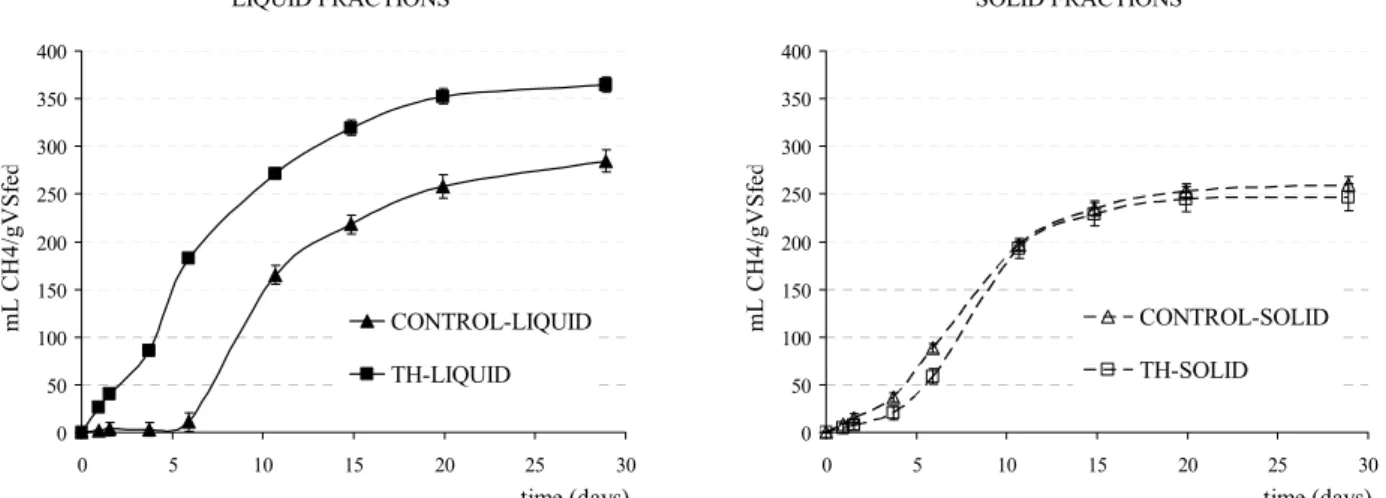
As announced in the previous discussion, it is in-teresting to compare the separate performance of liquid and solid fractions. Figure 2 compares the results obtained in the BMP for each phase.
UNTREATED SLUDGE 0 50 100 150 200 250 300 350 400
0 5 10 15 20 25 30
time (days) m L C H 4 /g V S fe d CONTROL CONTROL-LIQUID CONTROL-SOLID HYDROLYSED SLUDGE 0 50 100 150 200 250 300 350 400
0 5 10 15 20 25 30
time (days) m L C H 4/ gV S fe d TH TH-LIQUID TH-SOLID
Figure 1: Methane production curves in the BMP test performed for the different fractions of WAS (total,
liquid and solid) before (CONTROL) and after (TH).
LIQUID FRACTIONS 0 50 100 150 200 250 300 350 400
0 5 10 15 20 25 30
time (days) m L C H 4/ gV S fe d CONTROL-LIQUID TH-LIQUID SOLID FRACTIONS 0 50 100 150 200 250 300 350 400
0 5 10 15 20 25 30
time (days) m L C H 4/ gV S fe d CONTROL-SOLID TH-SOLID
Figure 2: Comparison of the methane production curves for untreated (control) and pre-treated (TH) in
The thermal hydrolysis pre-treatment increased the methane production due to the solubilisation of solids, which moved to the liquid phase, obtaining a value of 370 mL CH4/g VSfed in this liquid phase. However, the methane production of the solids re-mained similar to the original value for the solid phase, around 260 mL CH4/g VSfed.
Global Evaluation from Mass Balances
Although the previous results exhibit very useful information to understand the performance of the thermal pretreatment on the sludge. This is useless if the corresponding mass balances are not performed, as the contribution of solid and liquid fractions is key to an overall evaluation. From the experimental data obtained, mass balances were performed in order to quantify the influence of each fraction (liquid and solid) on the total methane production.
A calculation basis of 1 kg of sludge to be di-gested was considered, and the experimental data were translated into a methane production parameter, expressed as the CH4 obtained per kilogram of sludge fed to digestion.
Table 2 presents the experimental data extracted
from the previous discussion, together with the re-sults of the balances performed. Figure 3 compares the methane production per kilogram of sludge treated in the different fractions.
From this analysis, it is evident that the advanced digestion that combines thermal hydrolysis and an-aerobic digestion presents a very noticeable differ-ence with respect to the untreated sludge (control) in terms of the contribution of phases to the total me-thane production.
In the untreated sludge, the solid fraction is re-sponsible for all the methane production, because the mass balance shows that the solid fraction accounts for 96% of the total mass (representing nearly 100% of the total VS). To complete a more realistic global balance, the liquid stream separated by centrifuga-tion before the thickening of the WAS should be considered, although it is expected that this contribu-tion would still be negligible.
In the case of the thermally pretreated sludge, the solid fraction is only 26% of the total mass, although it contains 66% of the VS to be degraded. The re-maining 34% of VS released to the liquid phase are responsible for the production of 49% of the methane, with very different kinetics (higher rate, no lag-phase).
Table 2: Mass balances for VS feeding contribution and methane production for the total and the liquid/solid fractions of untreated (CONTROL) and thermally pretreated (TH) sludge.
EXPERIMENTAL DATA MASS BALANCES
Mass values Phases fractioning
Specific methane production
Contribution to VS feeding
Methane production
Contribution to methane production
(g) % mL CH4/g VSfed % mL CH4/kg of
sludge digested
%
CONTROL 1000 100% 259 27.2 CONTROL-LIQUID 43 4% 285 0.5% 0.1 0.5% CONTROL-SOLID 957 96% 260 99.5% 27.1 99.5%
TH 1758 100% 329 34.4
TH-LIQUID 1297 74% 370 34.2% 16.7 48.6% TH-SOLID 461 26% 257 65.8% 17.7 51.4%
Figure 3: Methane production calculated per kilogram of sludge digested for the liquid
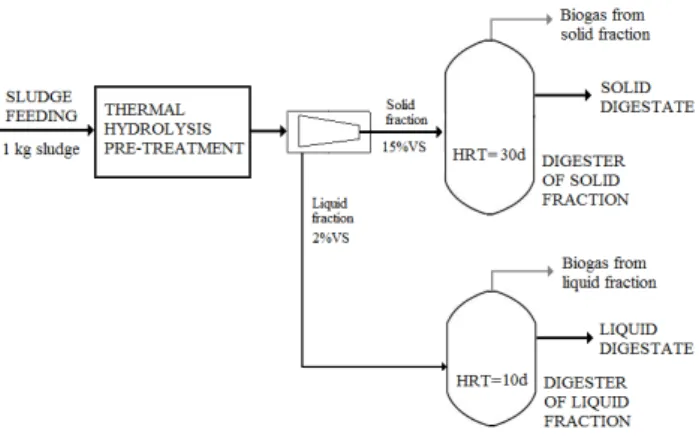
These results suggest the possibility of a new sce-nario for the anaerobic digestion of sludge, com-bining a thermal hydrolysis pre-treatment with the separate digestion of the liquid and solid fractions in digesters operated at different hydraulic retention times (HRT), thus decreasing the total digestion vol-ume. The idea from the experimental results is that the organic content of the liquid phase presents faster degradation kinetics, corresponding to the com-pounds solubilised during the hydrolysis pre-treat-ment, while the solid phase still needs high retention time, similar to a conventional solids digester. There-fore, the separate digestion proposed operates at different HRT, with different digester rheologies and control.
Proposal of a Separate Digestion Scenario
Two scenarios were compared: Scenario A corre-sponds to the conventional digestion of sludge, at 3% VS concentration and a HRT of 30 days.
Scenario B (presented in Figure 4) corresponds to the digestion scheme evaluated in this paper, consist-ing of a thermal hydrolysis pre-treatment followed by phase separation and digestion of solid and liquid phases in two different digesters, operated at different HRT.
Figure 4: Proposed scenario for the digestion of
separate solid and liquid phases resulting from a thermal hydrolysis pre-treatment.
Mass balances were performed for both scenarios according to the previously described calculation basis and methodology. However, as the HRT is a key parameter from the point of view of digester volume, the methane production obtained per kilo-gram of sludge feeding was expressed as methane productivity per day (mL CH4/kg sludge.day) di-viding by the HRT. This parameter really represents the productivity of the digester.
The results obtained are presented in Figure 5 for both scenarios A and B (separating liquid and solid digestion in this second case).
0 100 200 300 400 500 600
Scenario A Scenario B-LIQUID
Scenario B-SOLID
m
L
CH
4/
k
g
s
ludg
e.da
y
Figure 5: Methane productivity, calculated per
kilo-gram of sludge digested and day, for the conven-tional sludge digestion (Scenario A) and the pro-posed advanced separate digestion scheme (Scenario B).
These values clearly exhibit that the digestion of the liquid fraction alone after the thermal hydrolysis of the sludge accounts for more than twice compared to the conventional digestion of the sludge. Further-more, this “liquid-fraction digester”, while operated at a similar sludge concentration compared to the conventional, is four times smaller.
Regarding the solid fraction, the methane produc-tivity is slightly higher than the conventional di-gester, although this “solid-fraction digester” is again four times smaller compared to the conventional, while operated at a high concentration.
CONCLUSIONS
The study performed in this paper is based on the hypothesis that the combination of sludge pre-treat-ment (170 ºC, 50 minutes) and the subsequent sepa-rate digestion of the solid and liquid fractions can result in a global better methane productivity di-gester and smaller digestion volume.
The mass balances performed based on these ex-perimental data showed that 34% of the VS were released to the liquid fraction, generating nearly 50% of the total methane produced per kilogram of sludge digested, with much faster kinetics compared to the solid fraction.
These results support the initial hypothesis of a separate digestion of the liquid and solid fractions resulting from thermal pre-treatment of sludge. This approach would result in decreasing the digestion volume to half while duplicating the methane pro-ductivity per kilogram of sludge fed to digestion.
REFERENCES
Bougrier, C., Delgenès, J. P. and Carrére, H., Effects of thermal treatments on five different waste acti-vated sludge samples solubilisation, physical properties and anaerobic digestion. Chemical En-gineering Journal, 139, 236-244 (2008).
Carrère, H., Bougrier, C., Castets, D. and Delgenes, J. P., Impact of initial biodegradability on sludge anaerobic digestion enhancement by thermal pre-treatment. J. Environ. Sci. Health, Part – A, Toxic/ Hazard Subst. Environ. Eng., 43 (13), 1551-1555 (2008).
Carrère, H., Dumas, C., Battimelli, A., Batstone, D., Delgenes, J., Steyer, J. and Ferrer, I., Pretreatment methods to improve sludge anaerobic degradabil-ity: A review. Journal of Hazardous Materials, 183, 1-15 (2010).
Kepp, U., Machenbach, I., Weisz, N. and Solheim, O. E., Enhanced stabilisation of sewage sludge
through thermal hydrolysis – 3 years of experi-ence with full scale plants. Water Sci. Technol., 42(9), 89-96 (1999).
Li, Y. Y. and Noike, T., Upgrading of anaerobic di-gestion of waste activated sludge by thermal pre-treatment, Wat. Sci. Technol., 26(3-4), 857-866 (1992).
Neyens, E. and Baeyens, J., A review of thermal sludge pretreatment processes to improve de-waterability. Journal of Hazardous Materials, 98, 51-67 (2003).
Nozhevnikova, A. N., Kotsyurbenko, O. R. and Parshina, S. N., Anaerobic manure treatment un-der extreme temperature conditions. Wat. Sci. Tech., 40, 215-221 (1999).
Perez-Elvira, S. I., Fdz-Polanco, F., Fdz-Polanco, M., Rodríguez, P. and Rouge, P., Hydrothermal multi-variable approach. Full-scale feasibility study. Electronic Journal of Biotechnology, 11(4), 7-8 (2008).
Rico, J. L., García, H., Rico, C. and Tejero, L., Char-acterisation of solid and liquid fractions of dairy manure with regard to their component distribu-tion and methane producdistribu-tion. Bioresource Tech-nology, 98(5), 971-979 (2007).
Shimizu, T., Kudo, K. and Nasu, Y., Anaerobic waste activated sludge digestion-a bioconversion mech-anism and kinetic model. Biotechnol. Bioeng., 41, 1082-1091 (1993).