of Chemical
Engineering
www.abeq.org.br/bjchePrinted in BrazilVol. 34, No. 02, pp. 369 - 375, April - June, 2017 dx.doi.org/10.1590/0104-6632.20170342s20150533
MICROBIAL GROWTH MODELS: A GENERAL
MATHEMATICAL APPROACH TO OBTAIN
μ
max
AND
λ
PARAMETERS FROM SIGMOIDAL EMPIRICAL
PRIMARY MODELS
D. A. Longhi
1*, F. Dalcanton
2, G. M. F. de Aragão
2, B. A. M. Carcioi
2and J. B. Laurindo
21Food Engineering, Federal University of Paraná,
Jandaia do Sul, PR, Brazil. E-mail: [email protected]
2Department of Chemical and Food Engineering, Federal University of Santa Catarina,
Florianópolis, SC, Brazil.
E-mail: [email protected], [email protected], [email protected], [email protected]
(Submitted: August 24, 2015; Revised: December 1, 2015; Accepted: January 14, 2016)
Abstract – Empirical sigmoidal models have been widely applied as primary models to describe microbial
growth in foods. In predictive microbiology, the maximum speciic growth rate (µmax) and the lag phase (λ) are the parameters of some models and have been considered as biological parameters. The objective of the current study was to propose mathematical equations to obtain the parameters μmax and λ for any sigmoidal empirical growth model. In a case study, the performance was compared of two models based on empirical parameters and
two models based on biological parameters. These models were itted to experimental data for Lactobacillus plantarum in six isothermal conditions. Some advantages of the proposed approach were the practical and biological interpretation of these parameters, and the useful information of the secondary modeling describing the dependence of µmax and λ with the temperature.
Keywords: predictive microbiology; mathematical modelling; secondary models; food safety.
INTRODUCTION
In predictive microbiology, the maximum speciic growth rate (µmax) and the lag phase (λ) are parameters present in some models and are supposed to have biological meaning (Zwietering et al., 1990). A microbial growth curve is usually expressed as the natural logarithm of the microbial count (y(t) = ln(N)) against time (t). In this curve,
the parameter μmax is deined as the slope of the tangent
line at the inlection point and the parameter λ is deined as the intercept of this tangent line with the value of the initial microbial count (Pirt, 1975; Zwietering et al., 1990). Both are the main parameters of the mathematical models used to describe microbial growth over time for a single set of environmental conditions, and such models are called
primary models (Whiting and Buchanan, 1993).
The literature reports a large number of empirical sigmoidal equations that can be applied to describe microbial growth in foods (primary models). Some authors (Tsoularis and Wallace, 2002; Baty and Delignette-Muller, 2004; Peleg and Corradini, 2011; Vázquez et al., 2012; Longhi et al., 2013) have assessed general and speciic aspects of some of these models. In general, the mathematical models with biological parameters are interesting because microbiologists can validate them (Baty and Delignette-Muller, 2004).
Zwietering et al. (1990) reparametrized ive empirical sigmoidal growth models (Gompertz, Logistic, Richards, Stannard, and Schnute models), generating models with
the μmax and λ parameters. Since then, modiied Logistic
and modiied Gompertz models have been used in the reparametrized form (Gospavic et al., 2008; Pal et al., 2008; Slongo et al., 2009; Kreyenschmidt et al., 2010; Longhi et al., 2013). Vázquez et al. (2012) reparametrized two other sigmoidal models (Bertalanfy and Weibull models). However, parameter rearrangements can modify the accuracy of the estimates, making the model it difer from the original (Zwietering and den Besten, 2011). Therefore, equations transforming one parameter (empirical) to another (with biological meaning) allow comparing diferent primary models.
The objective of the current study was to propose a generalized mathematical approach to obtain the biological
parameters μmax and λ from any sigmoidal empirical
equation itted as a primary model.
THEORETICAL BACKGROUND
Sigmoidal functions frequently applied as primary models to describe microbial growth have one inlection point. The time at the inlection point (tifx) is the root in the Equation (1), and the model response at the inlection point
(yifx) is obtained by substituting tifx in the original model
equation, as shown in Equation (2).
The maximum speciic growth rate (μmax) is obtained
by substituting tifx into the irst derivative of the sigmoid
model, as shown in Equation (3).
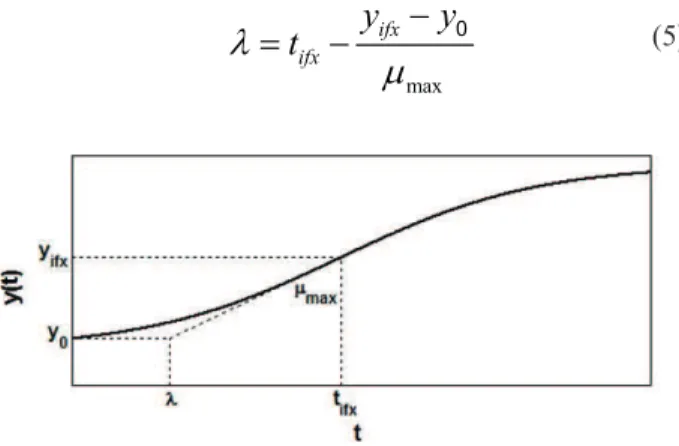
Equation (4) can be obtained from the deinitions of µmax
and λ (Pirt, 1975; Zwietering et al., 1990) (see Figure 1),
in which y0 is the natural logarithm of the initial microbial
count (y0 = ln(N0)).
Finally, λ can be isolated from Equation (4), resulting
in Equation (5).
Figure 1. Typical sigmoidal curve of the microbial growth with the graphical representation of the parameters µmax and λ, and the indication of the time at the inlection point (tifx), the model response at the inlection point (yifx), and the natural logarithm of the initial microbial count (y0).
Concisely, the present approach, based on previous studies (Zwietering et al., 1990; Vázquez et al., 2012), proposes four generalized steps (represented by Equations (1), (2), (3), and (5)) to obtain the µmax and λ parameters for
any sigmoid equation. The values of tifx and yifx (inlection
point) are dependent on the empirical parameters estimated through itting the model to the experimental data.
A sigmoidal empirical equation, in general, has one inlection point and, thus, one root can be calculated by applying Equation (1) (the time at the inlection point). If this root can be calculated for the sigmoidal equation, this approach can be applied to it.
Two empirical sigmoidal growth models were chosen for a case study: a Shifted Logistic Function (Equation (6)) and Power Type Growth (Equation (7)) (Corradini and Peleg, 2005). In Equations (6) and (7), A, b, k, n and tc are empirical parameters.
( ) d y t
dt =
2
2 0
( )
ifx ifxy t
=
y
max
( )
ifxdy t
dt
=
µ
max
ifx
ifx
y
y
t
µ
=
−
−
λ
0max
ifx ifx
y
y
t
λ
= −
µ
−
00
( )
1 exp[ (
c)] 1 exp( )
cA
A
y t
y
k t
t
kt
=
+
−
+
−
+
( )
At
nny t
y
b t
= +
0+
(1)
(2)
(3)
(4)
(5)
(6)
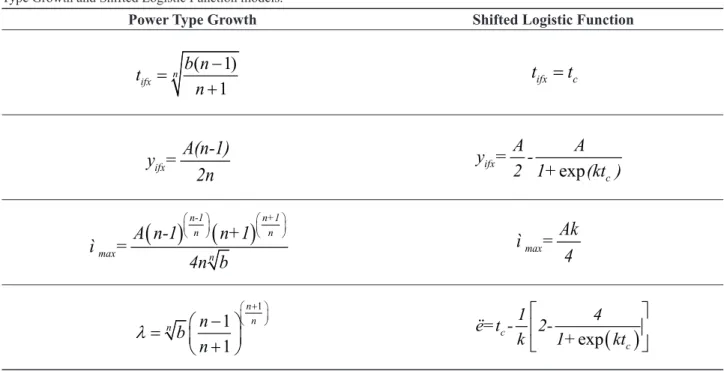
Table 1. Equations obtained in the transformation of the empirical parameters A, b, k, n, and tc to the µmax and λ parameters for the Power Type Growth and Shifted Logistic Function models.
Power Type Growth Shifted Logistic Function
( )
max(
)
0exp 1
( )
exp
exp
1
y t
y
A
t
A
µ
λ
= +
−
− +
( )
0
max
( )
4
1 exp
2
A
y t
y
μ
λ t
A
= +
+
− +
The corresponding equations for tifx, yifx, μmax and λ were obtained by applying the proposed methodology to Equations
(6) and (7) and are shown in Table 1.
The Gompertz modiied model (Equation (8)) and the Logistic modiied model (Equation (9)) are sigmoidal growth models that were reparametrized by Zwietering et al. (1990) and were used in the case study. For both Equations (8) and (9), the value of the function at t equal
to zero (y(0)) is diferent from the value of the parameter y0
(i.e., y(0) ≠ y0). This inequality creates a problem to deine
the boundary conditions of the diferential equations when one tries to use these models to assess the microbial growth under non-isothermal conditions.
(8)
(9)
( 1)
1
n ifx
b n
t
n
−
=
+
ifx
A(n-1)
y =
2n
( ) ( )
n-1 n+1n n
max n
A n-1
n+1
ì
=
4n b
1
1
1
n n
n
n
b
n
λ
+
−
=
+
ifx c
t
=
t
exp
ifx
c
A
A
y =
-2 1+
(kt )
max
Ak
ì
=
4
( )
exp
cc
1
4
ë=t -
2-k
1+
kt
The Square Root secondary model (Equation (10)) (Ratkowsky et al., 1982) has been widely used to describe the
dependence of µmax and λ with the temperature (Xanthiakos
et al., 2006; Gospavic et al., 2008; Kreyenschmidt et al., 2010; Longhi et al., 2017; Silva et al., 2017; among others).
In Equation (10), p is the temperature-dependent parameter
(µmax or 1/λ), T is the temperature, and m (empirical
parameter) and Tmin (theoretical temperature for minimal
microbial growth) are the parameters to be estimated by itting the model to the data.
(
min)
CASE STUDY
Material and methods
Shifted Logistic Function, Power Type Growth, Gompertz Modiied, and Logistic Modiied primary models were itted to the growth experimental data of
Lactobacillus plantarum in MRS (Man, Rugosa and
Sharp) culture medium at six isothermal conditions (4, 8, 12, 16, 20, and 30 °C) (data published by Longhi et al., 2013). The Shifted Logistic Function and Power Type Growth models were itted in their original forms and the
values of the empirical parameters A, b, k, n, and tc were
obtained. After that, the biological parameters μmax and λ
were obtained by the equations shown in Table 1. Then, the Square Root secondary model (Equation (10)) was itted to
the μmax and λ values, obtained from the Shifted Logistic
Function and Power Type Growth models, as dependent on
the environmental temperature. The values of μmax and λ for
the Gompertz Modiied and Logistic Modiied models, as well as the it of the Square Root secondary model, were obtained by Longhi et al. (2013).
The itting of the mathematical models to the experimental data was performed by the Curve Fitting Tool (cftool) available in the MATLAB R2011b software, version 7.13 (MathWorks, Natick, USA), using a non-linear least squares method and the trust-region relective Newton algorithm. The value of the initial try of each parameter was selected from the observation of the experimental data. The 95% conidence intervals of the model parameters were obtained in the itting procedure. The statistical indexes Root-Mean-Square Error (RMSE) and the Adjusted Coeicient of Determination (R2
adj)
(standard outputs of the Curve Fitting Tool) were used to assess the ability of the primary and secondary models to describe the experimental data.
Results and discussion
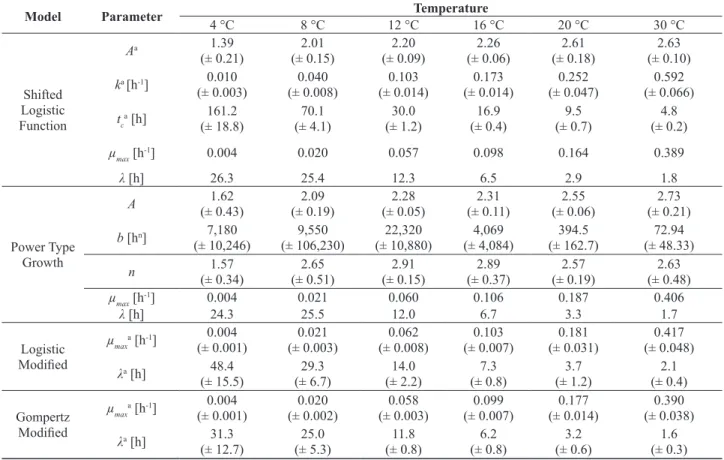
The values of the empirical parameters (A, b, k, n, and
tc) and the 95% conidence intervals, estimated by itting
the Power Type Growth and Shifted Logistic Function models to the experimental data, are shown in Table 2. In
the same table, the values of µmax and λ obtained for the
Power Type Growth and Shifted Logistic Function models with the Equations of Table 1 are shown, as well as the
values of µmax and λ from the Gompertz Modiied and
Logistic Modiied models obtained by Longhi et al. (2013). The itting of the four sigmoidal models (Shifted Logistic Functions, Power Type Growth, Gompertz modiied and Logistic Modiied) to the experimental
data of the growth of L. plantarum at 4, 8, 12, 16, 20 and
30 °C are shown in Figure 2. One important issue to be observed is the availability of experimental data in the stationary growth phase because the parameter related to
the asymptote (the A parameter in the four models) afects
the value of the other parameters.
It can be seen in Table 2 that it is diicult to interpret and compare the values of the empirical parameters. On
the other hand, the values of the µmax and λ parameters have
the same biological meaning and units (µmax [1/h] and λ
[h]) for all assessed models (Power Type Growth, Shifted Logistic Function, Logistic Modiied and Gompertz Modiied), facilitating the interpretation and comparison of these results. Furthermore, the empirical parameters of the Shifted Logistic Function and Power Type Growth models, shown in Table 2, showed larger 95% conidence intervals
in relation to µmax and λ for the Gompertz Modiied and
Logistic Modiied models, which can be considered to be another disadvantage of the models built with empirical parameters.
A high uncertainty can be observed for the λ parameter
of the sigmoidal models. In general, this uncertainty increases at lower temperatures (as can be seen by the conidence intervals in Table 2) because the distance between the inlection point and the interception with the value of the initial microbial count also increases. At
4 °C, the uncertainty in the value of the λ parameter is
greater than 32%, while for the higher temperatures, the uncertainty is lower than 23%.
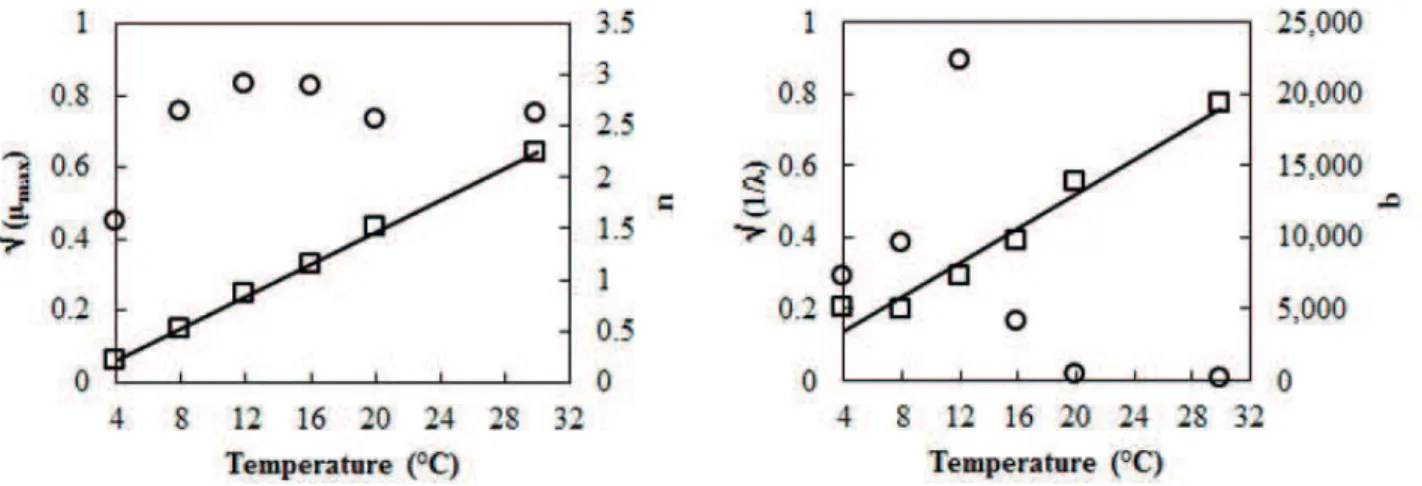
The values of the empirical b and n parameters of the
Power Type Growth model and the values of λ and µmax
transformed with Equations (1) to (5) are shown in Figure 3 as a function of the temperature. It can be seen that the values of the empirical parameters (b and n) have no clear
correlation with the temperature, mainly the b parameter,
which presented intermediate values at 4, 8, and 16 °C, a high value at 12 °C, and lower values at 20 and 30 °C. For
the n parameter, a rapid increase in their value from 4 to
8 °C can be observed, but from 8 to 30 °C it remains at a conservative value, which even the exponential or power model cannot it well to the data. Therefore, it becomes diicult to ind an appropriate secondary model for these
data. On the other hand, the µmax and λ values transformed
from the empirical parameters presented clear temperature dependences, which can be described by the Square Root secondary model, resulting in good statistical indexes, as shown in Table 3.
The values of the empirical k and tc parameters of the
Shifted Logistic Function model and the values of λ and
µmax transformed with Equations (1) to (5) are shown in
Figure 4. For the Shifted Logistic Function model, it can be seen that all parameters presented a linear dependence with the temperature, which could be described by the Square Root secondary model, resulting in good statistical indexes, as shown in Table 3. In this case, the statistical indexes of the Square Root secondary model were better
for the k and tc empirical parameters than for µmax and λ.
As µmax is a linear transformation of k (which is multiplied
Table 2. Values of the empirical parameters A, b, k, n and tc (± 95% conidence intervals) obtained by itting the Power Type Growth and Shifted Logistic Function models to L. plantarum dataa at 4, 8, 12, 16, 20, and 30 °C, values of the µ
max and λ parameters obtained from the Power Type Growth and Shifted Logistic Function empirical models, and values of the µmax and λ parameters obtained by itting the Logistic Modiieda and Gompertz Modiieda models.
Model Parameter Temperature
4 °C 8 °C 12 °C 16 °C 20 °C 30 °C
Shifted Logistic Function
Aa 1.39
(± 0.21) (± 0.15)2.01 (± 0.09)2.20 (± 0.06)2.26 (± 0.18)2.61 (± 0.10)2.63
ka [h-1] 0.010
(± 0.003) (± 0.008)0.040 (± 0.014)0.103 (± 0.014)0.173 (± 0.047)0.252 (± 0.066)0.592
tca [h] 161.2
(± 18.8) (± 4.1)70.1 (± 1.2)30.0 (± 0.4)16.9 (± 0.7)9.5 (± 0.2)4.8
µmax [h-1] 0.004 0.020 0.057 0.098 0.164 0.389
λ [h] 26.3 25.4 12.3 6.5 2.9 1.8
Power Type Growth
A (± 0.43)1.62 (± 0.19)2.09 (± 0.05)2.28 (± 0.11)2.31 (± 0.06)2.55 (± 0.21)2.73
b [hn] 7,180
(± 10,246) (± 106,230)9,550 (± 10,880)22,320 (± 4,084)4,069 (± 162.7)394.5 (± 48.33)72.94
n (± 0.34)1.57 (± 0.51)2.65 (± 0.15)2.91 (± 0.37)2.89 (± 0.19)2.57 (± 0.48)2.63
µmax [h-1] 0.004 0.021 0.060 0.106 0.187 0.406
λ [h] 24.3 25.5 12.0 6.7 3.3 1.7
Logistic Modiied
µmaxa [h-1] 0.004
(± 0.001) (± 0.003)0.021 (± 0.008)0.062 (± 0.007)0.103 (± 0.031)0.181 (± 0.048)0.417 λa [h] 48.4
(± 15.5) (± 6.7)29.3 (± 2.2)14.0 (± 0.8)7.3 (± 1.2)3.7 (± 0.4)2.1
Gompertz Modiied
µmaxa [h-1] 0.004
(± 0.001) (± 0.002)0.020 (± 0.003)0.058 (± 0.007)0.099 (± 0.014)0.177 (± 0.038)0.390 λa [h] 31.3
(± 12.7) (± 5.3)25.0 (± 0.8)11.8 (± 0.8)6.2 (± 0.6)3.2 (± 0.3)1.6
aData from Longhi et al. (2013).
Figure 2. Fitting of the four sigmoidal growth models (Shifted Logistic Functions, Power Type Growth, Gompertz modiied and
Logistic Modiied) to the experimental data of the growth of L. plantarum at 4, 8 and 12 °C (in left plot), 16, 20 and 30 °C (in right plot).
indexes. On the other hand, the λ parameter is obtained by
a non-linear equation (Table 1), with k and tc as parameters, resulting in values less correlated with the temperature.
An additional analysis was carried out by comparing the
values of µmax and λ obtained by the Gompertz Modiied,
Figure 3. Left: n parameter data (circles), the obtained √µmax parameter data (squares), and the it of the Square Root secondary model to the √µmax data (line). Right: b parameter data (circles), the obtained √(1/λ) parameter data (squares), and the it of the Square Root model to the √(1/λ) parameter data (line). All the parameter data correspond to the Power Type Growth model.
Table 3. Values of the m and Tmin parameters (± 95% conidence intervals) obtained by itting the Square Root secondary model to the data for the empirical parameters k and tc of the Shifted Logistic Functiona model, to the values of the µ
max and λ parameters obtained from the Power Type Growth and Shifted Logistic Function empirical models, and to values of the µmax and λ parameters obtained by itting the Logistic Modiieda and Gompertz Modiieda models.
Model Parameter m (°C−1 h−0.5) Tmin (°C) R2
adj RMSE (h -0.5)
Shifted Logistic Function
ka [h-1] 0.0256 (± 0.0013) 0.01 (± 0.88) 0.998 0.010
(1/tc)a [h-1] 0.0151 (± 0.0015) −0.55 (± 1.92) 0.993 0.011
µmax [h-1] 0.0218 (± 0.0007) 1.37 (± 0.47) 0.999 0.005
(1/λ) [h-1] 0.0238 (± 0.0075) -1.89 (± 5.95) 0.939 0.056
Power Type Growth µmax [h
-1] 0.0224 (± 0.0010) 1.31 (± 0.78) 0.999 0.008
(1/λ) [h-1] 0.0237 (± 0.0066) -1.85 (± 5.24) 0.952 0.049
Logistic Modiied µmax
a [h-1] 0.0226 (± 0.0009) 1.33 (± 0.68) 0.999 0.007
(1/λ) [h-1] 0.0227 (± 0.0043) -1.03 (± 3.44) 0.977 0.032
Gompertz Modiied µmax
a [h-1] 0.0219 (± 0.0010) 1.28 (± 0.76) 0.999 0.008
(1/λ) [h-1] 0.0249 (± 0.0055) -1.19 (± 4.05) 0.969 0.041 aData from Longhi et al. (2013).
Type Growth models. It can be seen in Table 2 that, for the
µmax parameter, the Logistic Modiied model presents the
higher values at most temperatures (4, 8, 12, and 30 °C), the Shifted Logistic Function model presents the lower values at all temperatures, and the Gompertz Modiied and Power Type Growth models present similar values.
For the parameter λ, the Logistic Modiied model presents
the higher values at all temperatures. In general, the values of the model parameters are associated with the format of the sigmoidal functions, in which the Logistic Modiied presents the strictest format (resulting in higher values of
µmax and λ) among the evaluated models. On the other hand,
the shift in the logistic function proposed by Corradini and Peleg (2005) leads to lower values of µmax for the Shifted Logistic Function model.
In general, in addition to the advantages presented previously, another important gain of inding biological parameters is the possibility to it the same secondary model (as the Square Root model in this case study) to the
µmax and λ parameters and to compare the parameter values
of the secondary models.
CONCLUDING REMARKS
Some advantages of analyzing biologically meaningful
µmax and λ parameters instead of empirical parameters
were observed, for instance the possibility of comparing diferent parameter of the sigmoidal models and of inding an appropriate secondary model that describes well the dependence of the parameters with the temperature.
ACKNOWLEDGEMENTS
The authors would like to thank the Graduate Program in Food Engineering of the Federal University of Santa Catarina (UFSC) and CAPES-Brazil for their inancial support.
REFERENCES
Baty, F., Delignette-Muller, M.L., Estimating the bacterial lag time: which model, which precision? Int. J. Food
Microbiol. 91, 261-277 (2004).
Corradini, M., Peleg, M., Estimating non-isothermal bacterial growth in foods from isothermal experimental data. J
Appl. Microbiol. 99, 187-200 (2005).
Gospavic, R., Kreyenschmidt, J., Bruckner, S., Popov, V. and
Haque, N., Mathematical modelling for predicting the growth of Pseudomonas spp. in poultry under variable temperature conditions. International Journal of Food
Microbiology 127: 290-297 (2008).
Kreyenschmidt, J., Hubner, A., Beierle, E., Chonsch, L.,
Scherer, A. and Petersen, B., Determination of the shelf life of sliced cooked ham based on the growth of lactic
acid bacteria in diferent steps of the chain. Journal of Applied Microbiology 108: 510-520 (2010).
Longhi, D.A., Dalcanton, F., Aragão, G.M.F., Carcioi,
B.A.M., Laurindo, J.B., Assessing the prediction ability
of diferent mathematical models for the growth of
Lactobacillus plantarum under non-isothermal conditions.
J. Theor. Biol. 335, 88-96 (2013).
Longhi, D.A., Martins, W.F., Silva, N.B., Carcioi, B.A.M.,
Aragão, G.M.F., Laurindo, J.B., Optimal experimental design for improving the estimation of growth parameters of Lactobacillus viridescens from data under non-isothermal conditions. Int. J. Food Microbiol. 240, 57-62
(2017).
Masana, M.O., Limitations and extensions of predictive
microbiology models, M. Phil (thesis), University of Reading, United Kingdom (1999).
Pal, A., Labuza, T., Diez-Gonzalez, F., Comparison of primary predictive models to study the growth of Listeria monocytogenes at low temperatures in liquid cultures and selection of fastest growing ribotypes in meat and turkey
product slurries. Food Microbiol. 25, 460-470 (2008).
Peleg, M., Corradini, M.G., Microbial growth curves: what the models tell us and what they cannot. Crit. Rev. Food
Sci. Nutr. 51, 917–945 (2011).
Pirt, S.J., Principles of Microbe and Cell Cultivation.
Blackwell, Oxford (1975).
Ratkowsky, D.A., Olley, J., McMeekin, T.A., Ball, A. Relationship Between Temperature and Growth Rate of
Bacterial Cultures. J. Bacteriol. 149(1), 1-5 (1982).
Silva, N.B., Longhi, D.A., Martins, W.F., Laurindo, J.B.,
Aragão, G.M.F., Carcioi, B.A.M., Modeling the growth
of Lactobacillus viridescens under non-isothermal conditions in vacuum-packed sliced ham. Int. J. Food
Microbiol. 240, 97-101 (2017).
Slongo, A., Amauri, R., Camargo, L., Deliza, R., Mathias, S., Aragão, G.M.F., Modeling the growth of lactic acid bacteria in sliced ham processed by high hydrostatic
pressure. Lwt-Food Sci. Technol. 42, 303-306 (2009).
Tsoularis, A., Wallace, J., Analysis of logistic growth models.
Math. Biosci. 179, 21-55 (2002).
Vázquez, J.A., Lorenzo, J.M., Fuciños, P., Franco, D.,
Evaluation of non-linear equations to model diferent animal growths with mono and bisigmoid proiles. J. Theor. Biol. 314, 95–105 (2012).
Whiting, R.C., Buchanan, R.L., A classiication of models in predictive microbiology – a reply to K. R. Davey. Food. Microbiol. 10, 175-177 (1993).
Xanthiakos, K., Simos, D., Angelidis, A., Nychas, G. and Koutsoumanis, K., Dynamic modeling of Listeria monocytogenes growth in pasteurized milk. Journal of
Applied Microbiology 100: 1289-1298 (2006).
Zwietering, M.H., den Besten, H.M.W., Modelling: One word for many activities and uses. Food Microbiol. 28, 818-822 (2011).