* Corresponding author. Mailing address: Centro de Genética, Biologia Molecular e Fitoquímica, Núcleo de Fitoquímica, Instituto Agronômico, Caixa Postal 28, CEP 13001-970, Campinas, SP, Brasil. Telefax: (+5519) 241-5188 Ramal 311. E-mail: [email protected] SOME ENZYMATIC PROPERTIES OF CHOLESTEROL OXIDASE PRODUCED BY
BREVIBACTERIUM SP
Terezinha J.G. Salva1*; Alcina M. Liserre1; Aloísia L. Moretto1; Marco A.T. Zullo2; Gisleine Ventrucci1; Tobias J.B. Menezes3
1Seção de Fermentações Industriais, Instituto de Tecnologia de Alimentos, Campinas, SP, Brasil; 2Centro
de Genética, Biologia Molecular e Fitoquímica, Instituto Agronômico, Campinas, SP, Brasil; 3Escola Superior de Agricultura Luiz de Queiroz, Universidade de São Paulo, Piracicaba, SP, Brasil
Submitted: May 03, 1999; Approved: January 11, 2000.
ABSTRACT
In this study we determined some properties of the cholesterol oxidase from a Brevibacterium strain isolated from buffalos milk and identified the cholesterol degradation products by the bacterial cell. A small fraction of the enzyme synthesized by cells cultured in liquid medium for 7days was released into the medium whereas a larger fraction remained bound to the cell membrane. The extraction of this fraction was efficiently accomplished in 1 mM phosphate buffer, pH 7.0, containing 0.7% Triton X-100. The enzyme stability under freezing and at 45oC was improved by addition of 20% glycerol. The optimum temperature and pH for the enzyme activity were 53°C and 7.5, respectively. The only steroidal product from cholesterol oxidation by the microbial cell and by the crude extract of the membrane-bound enzyme was 4-colesten-3-one. Chromatographic analysis showed that minor no steroidal compounds as well as 4-colesten-3-one found in the reaction media arose during fermentation process and were extracted together with the enzyme in the buffer solution. Cholesterol oxidation by the membrane-bound enzyme was a first order reaction type.
Key words: Cholesterol oxidase, Brevibacterium sp, cholesterol, 3β-hydroxysteroid oxidase
I NT RO DUCT I O N
Cholesterol decomposition ability is widespread among microorganisms that have been explored as free and immobilized cells (15, 29) or as enzyme source (12) in steroid biotransformations. Cholesterol may be completely oxidized by microbial cells to carbon dioxide and water by the action of a complex enzyme system in which cholesterol oxidase is the first enzyme involved. Cell-free enzymes and
microbial cells have been investigated for reduction of cholesterol level in foods (2, 3, 14, 10, 26, 28), for precursors production in manufacturing pharmaceutical steroids from cheap sterols (15) and for clinical assay of serum cholesterol (7, 25). Microbial cholesterol oxidases have received much attention in recent years, mainly due to its large use in medical practice for determination of free and bound cholesterol.
EC 1.1.3.6) is a bifunctional enzyme catalyzing the oxidation of r5-3β-hydroxysteroids to the corresponding r5-3-ketosteroid and also the isomerization of this compound to the r4 -3-ketosteroid, with reduction of oxygen to hydrogen peroxide (21, 26, 25). Although the enzyme exhibits a broad range of steroid specificities, the presence of a 3β-hydroxyl group, as in cholesterol (5-cholesten-3β-ol), 5α-cholestan-3β-ol, pregn-5-en-3β-ol-20-one, androst-5-en-3β-ol-17-one and 5α-androstan-3β-ol-7-one, is essential for activity.
In the sequence of the cholesterol oxidation by microbial cells, 4-cholesten-3-one (r4-3-ketosteroid) maybe oxidized with accumulation of the steroids 4-androstene-3,17-dione (AD) and 1,4-androstadiene-3,17-dione (ADD) (4), which are important precursors of chemically synthesized hormones, or may be transformed to no steroid intermediates (1).
Cholesterol oxidases can be intrinsic membrane-bound enzymes located on the outside of the cell, as produced by Nocardia rhodochrous (8, 7, 27), Nocardia erythropolis (19), and Mycobacterium species (22), or can be isolated from broth filtrate as in cultivation of Streptomyces violascens (23), Brevibacterium sterolicum (24), Streptoverticilium cholesterolicum (15), Rhodococcus equi no 23 (26), Mycobacterium ATCC 19652 (9) and R. erythropolis (22).
The aim of this work was to identify the cholesterol degradation products by Brevibacterium sp. cell isolated from buffalos milk and to define some properties of the cholesterol oxidase produced by the microorganism.
M ATERI ALS AND METHODS
Strain identification - bacterial strain used throughout this work was isolated from buffalos milk in a liquid medium containing cholesterol and mineral salts as described in Menezes et al. (16). Taxonomic studies were carried out by the classic methodology according to Collins (11) and Balows et al. (6), complemented by chemiotaxonomic tests. The phenotypic characterization using the API-50 CH system was conducted in accordance to the analytical profile ofbioMerieux API index (50CH, 50CHB, 50CHL) and the identification of diaminopimelic acid (LL-/meso-DAP) was done by thin-layer chromatography with ninhydrin development.
Microorganism maintenance and enzyme production - stock culture of isolated strain, identified as Brevibacterium sp., was maintained on nutrient agar slants and stock culture of Rhodococcus equi ATCC 25729 (ATCC 6939), used as type microorganism, was maintained in glucose-yeast extract medium (GY). Organisms were subcultured at monthly intervals. Before flasks inoculation, cultures were transferred from maintenance medium to agar slants consisting of 1.0% peptone (Difco, Detroit, MI, USA), 1.0% meat extract (Difco, Detroit, MI, USA), 0.5% NaCl and 2.0% agar (Difco, Detroit, MI, USA), and incubated for 24 hours at 30°C. A loopful of the 24 hours bacterial cultures was inoculated in 500 ml Erlenmeyer flasks containing 225 ml of a medium composed of: 0.1% NH4NO3, 0.025% K2HPO4, 0.025% MgS04.7H2O, 0.0001% FeS04.7H2O, 0.5% yeast extract (Difco, Detroit, MI, USA) and 0.1% cholesterol (Sigma Chemical Co., USA), pH 7.0 (medium I) (5). After sterilization, the medium was homogenized by sonication at room temperature to disperse cholesterol. Cultivation was carried out on a rotary shaker at 37°C for 7 days and at agitation speed of 150 rpm.
Enzyme isolation - the supernatant from centrifuged broth at 10,000 rpm for 10 minutes at 5°C was used as extracellular cholesterol oxidase solution. Harvested cells were washed twice with ethyl acetate and frozen at -18°C. Membrane-bound enzyme was extracted from frozen cells in 1 mM phosphate buffer, pH 7.0, containing 0.7% Triton X-100 (v/v), for 18 hours at 5°C under stirring. The extract obtained by centrifugation of the cell suspension was used as membrane-bound enzyme solution.
The quantity of 4-colesten-3-one was obtained from a standard curve prepared with solutions containing 10 to 100 µg of 4-colesten-3-one dissolved in isopropanol (ε=2.32x10⁴ M-1. cm-1).
Identification of the cholesterol oxidation products by thin-layer chromatography - in order to know the cholesterol degradation products accumulated in the culture medium due to the action of bacterial cells, 10 ml of medium I in 50 ml Erlenmeyer flasks were inoculated with a loopful of 24 hours cultures of Brevibacterium sp. or Rhodococcus equi ATCC 25729 and incubated for 7 days at 30°C and at agitation speed 150 rpm. After incubation time, cells were harvested by centrifugation and 10 ml of ethyl acetate were added to the supernatant. The organic phase was recovered in a funnel and evaporated at 60°C in a rotary evaporator until a white residue was formed. The dry residue was dissolved in 1ml of methylene chloride and analyzed by thin-layer chromatography. Blank of culture medium refers to no inoculated flask incubated and treated as the other ones.
Cholesterol degradation products resulted from the action of membrane-bound enzyme were also identified by thin-layer chromatography. The reaction medium and procedure used for cholesterol oxidation in this experiment were as those used to determine the enzyme activity but ten fold volumes of buffer, enzyme and substrate were actually employed and reaction were stopped by addition of 2 ml of methylene chloride at time intervals of 30, 60 and 90 minutes. The methylene chloride fractions were recovered and analyzed by thin layer chromatography. Reaction blank, where no cholesterol was added to the reaction mixture, was prepared for each time interval and treated in the same way.
Thin-layer chromatographies were carried out on pre-coated silica gel 60 F254 plate (0.25 mm thick, 20 cm x 20 cm) (Merck) at room temperature. Plates were activated at 110°C for 1 hour and spotted with 25 µl of samples. Benzene:ethyl acetate 9:1 (v:v) was used as solvent system and the development was carried out by spraying H2SO4: methanol 5:95 (v:v) solution followed by heating at 90°C until visualization of the spots. Twenty microlitres of 5.0 mg/ml solutions of cholesterol (5-cholesten-3-β-ol), cholestenone (4-colesten-3-one), 1,4-androstadiene-3,17-dione (ADD) and 4-androsten-1,4-androstadiene-3,17-dione (AD), from Sigma Chemical Co., USA, were spotted as standards.
Identification of the of cholesterol oxidation products by gas chromatography - a mixture of 20 ml of the membrane-bound enzyme solution (3.86 U/ml) and 80 ml of 12 mM Tris-HCl buffer, pH 7.5, was heated at 37oC. After reaching the reaction temperature, 5.0 ml of 12 mM of cholesterol in isopropanol solution were added to the mixture. Samples of 8.5 ml of the reaction medium were collected at 0, 15, 30, 45, 60, 75, 90, 105 and 120 minutes, and also at 24, 48 and 72 hours. The enzyme reaction was stopped by adding 20 ml of ethyl acetate to each sample. After saturation of the aqueous phase with NaCl, the organic phase was separated in a funnel and dried over anhydrous sodium sulfate. Ethyl acetate phase was evaporated to dryness at 60°C in a rotary evaporator. The dry residue was dissolved in ethyl acetate:methanol 9:1 (v:v). A blank, where no cholesterol was added to the reaction mixture, was prepared for each time interval and treated in the same way. Extracted compounds were quantified by gas chromatography performed with a Pye-Unicam 4600 gas chromatograph equipped with a flame ionization detector. Samples of 1 µl were injected in a poly-dimethylsiloxane column (25 m x 0.53 mm). Operating parameters were as follows: column temperature was kept at 100oC for 2 minutes and then raised, at a rate of 25oC/min, up to 250oC followed by a heating rate of 1oC/min up to 280oC, at which temperature was kept for 3 minutes; injector temperature 280oC; detector temperature 300oC; inlet pressure 14 psi and hydrogen as carrier gas. Cholesterol, cholestenone, 4-androstene-3,17-dione, 1,4-androstadiene-3,17-dione, 25-hydroxycholesterol, 5α,6α-epoxycholesterol, 3β,5α,6β-tri-hydroxycholestan, from Sigma Chemical Co. (USA), and 5α-cholestane were used as standards.
Protein concentration - protein concentration in enzyme solution, used for electrophoresis, was estimated according to the LOWRY et al. method (22), after extraction of Triton X-100 with Amberlite XAD-2 according to Cheethan (8). Bovine serum albumin (Merck) was used as standard protein.
8-25) with native buffer strip (Pharmacia LKB-Biotechnology, Uppsala-Sweden) in PhastSystem equipment (Pharmacia LKB-Biotechnology, Uppsala-Sweden). Proteins were silver stained according to File no 210 from equipment users manual.
Enzyme properties- the effect of temperature on the crude membrane-bound enzyme activity was estimated by the enzyme assay method, lightly modified, in the temperature range from 35°C to 65°C. The enzyme was added to the reaction medium after the mixture of buffer and substrate solutions had reached the reaction temperature. The same procedure was used to evaluate the effect of pH on the enzyme activity at 37°C, using 100 mM phosphate buffer for pH range from 5.0 to 7.5 and 50 mM Tris-HCl buffer for pH between 8.0 and 8.8. Thermal stability of the enzyme at 45oC was investigated in the presence of glycerol or not according to the standard method, only that before the enzyme activity measurement it was maintained at 45oC for different time intervals.
RESULTS AND DISCUSSION
The isolated microorganism was identified as a strain of Brevibacterium sp., with characteristics shown in Table 1.
When cultured in liquid medium the isolated strain produced both membrane-bound and extracellular cholesterol oxidase as observed for three Rhodococcus strains studied by Aihara et al. (1). The membrane-bound enzyme from frozen cells was easily extracted in 1 mM phosphate buffer solution containing 0.7% Triton X-100. According to Cheetham et al. (8) the enzyme can be extracted in these conditions because it is composed by a water-soluble enzymically active part and a predominant hydrophobic anchor that allows the incorporation of the enzyme into the cell membrane and detergent micelles. During extraction probably occurs the breakage of hydrophobic bonds between the enzyme and membrane lipids of the cell membrane. According to the authors, frozen cells would lead to higher yields of enzyme extraction due to the weakening of lipid-protein bonding caused by taking the membrane lipids below their thermotropic transition temperature.
We studied the effect of the ratio wet cell mass: buffer volume on the effectiveness of the enzyme solubilization in two extraction steps. In these
experiments the same buffer volume was used in the first and second extraction and the ratios tried out were 15, 20, 30 and 60 mg/ml. The amount of the enzyme extracted in the first buffer volume varied between 68.5% and 77.7% of the total extracted in both steps. The highest enzyme concentration, 1.93 U/ml, was observed in the first extraction solution from 60 mg/ml ratio, where the enzyme concentration was three times that in the supernatant of the culture broth.
The activity of the enzyme from Brevibacterium sp. was dependent of Triton X-100 concentration so that it lost completely activity at 0% detergent concentration. Similarly to the enzyme from Nocardia rhodochrous (8), the activity in buffer solution with 0.7% Triton X-100 (0.35 U/ml) was lower than in solution containing 0.15% detergent (0.51 U/ml). Studies on the enzyme from Nocardia rhodochrous activity showed that the amount of the enzyme extracted increased with detergent concentrations up to 10% (v/v) and that more enzyme was solubilized using detergent concentrations higher than 0.5% (v/v). However, as the enzyme activity was dependent of detergent concentration used, the additional activity was masked by detergent inhibition (8). This information should be considered when comparing the amount of the enzyme produced by the isolated Brevibacterium strain with others from literature, since it may show a similar behavior. The eletrophoretic analysis of the crude membrane-bound enzyme showed 10 protein components (Fig. 1), showing that the enzyme was not the unique protein extracted in the detergent solution. This profile was similar to the cholesterol oxidase of Actinomyces lavendulae extract in Tween 80, that showed 7 components (19).
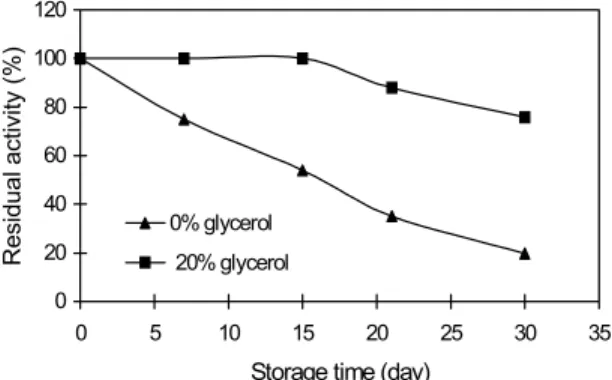
The membrane-bound enzyme in 1 mM phosphate buffer, pH 7.0, containing 0.7% Triton X-100, gradually lost its activity when stored at -18oC. Addition of 20% glycerol to the enzyme solution stabilized the enzyme activity up to 15 days of storage and diminished the loss of activity at 30 days (Fig. 2), so that, at this time the loss of activity in the presence of the compound was around 24%, whereas in the absence was around 80%.
Table 1 - Bacteriological characteristics of the isolated strain.
Morphological: Cells: isolated rods
Colonies: small, smoth and yellowish colored on nutrient agar Motility: negative
Gram-reaction: positive Spore: absent
Physiological:
Oxygen requirement: strict aerobe
Temperature relations: little growth at 5oC, good growth at 30oC
NaCl broth: growth at 4.5%, growth at 8% after 7 days, growth at 12% after 12 days Nitrate reduction: negative
Catalase: positive Oxidase: negative Urease: negative
Prodution of H2S: negative
Indol: negative TDA: negative
Arginin dehydrolase, lisine decarboxilase, ornitine decarboxilase: negative Casein, starch: not hydrolysed
Cell wall type: LL-/meso DAP Gelatin hydrolysis: negative
Acid production from carbohydrates:
Control: negative Inositol: negative Melezitose: negative Adonitol: negative
Glycerol: negative Manitol: negative D-Raffinose: negative Dulcitol: negative
Erythritol: negative Sorbitol: negative Starch: negative Galactose: negative
D-Arabinose: negative α-m-D-Manoside: negative Glycogen: negative D-Glucose: positive
L-Arabinose: negative α-m-D-Glycoside: negative Xylitol: negative D-Fructose: negative
Ribose: negative N-Acetyl-glycosamine: negative β-Gentiobiose: negative D-Manose: negative
D-Xylose: negative Amidaline: negative D-Turanose: positive L-Sorbose: negative
L-Xylose: negative Arbutine: negative D-Tugatose: negative Ramnose: negative
Gluconate: negative Esculin: negative D-Fucose: negative Salicin: negative
2-Keto-gluconate: negative Melibiose: negative L-Fucose: negative Celobiose: negative
5-Keto-gluconate: positive Sucrose: negative D-Arabitol: negative Maltose: positive
Inulin: negative Trehalose: negative L-Arabitol: negative Lactose: negative
β-Methyl-xyloside: negative
maximum activity at approximately 47oC (26) and 40oC (20), respectively. It is closer to that for the purified enzyme from Streptomyces violascens, with optimum temperature at around 50oC, with a plateau between 40oC and 60oC (23). 20% glycerol stabilized the enzyme at 45oC, so that after 30 minutes at this temperature the enzyme lost around 1% of the activity against a loss of 20% when the compound was not added (Fig. 4).
The enzyme was pH dependent as shown in Fig. 5, with maximum activity at around 7.5. Enzyme activity was at least 80% of the maximum value at pH range between 6.0 and 8.7. The optimum pH for
cholesterol oxidase from Brevibacterium sp. activity was similar to that found in literature for the same enzyme from other microorganisms. Usually the optimum pH for the enzyme activity is between 7.0 and 8.0, as can be seen for the enzymes from
Actnomyces lavendulae mycelium (19),
Corynebacterium cholesterolicum (20), Streptoverticillium cholesterolicum (13), Rhodococcus equi no 23 (26) and from Streptomyces violascens (23).
Figure 1: Electrophoresis of crude membrane-bound enzyme in gradient polyacrilamide gel 8-25%. 2 mg/ml protein in 1 mM phosphate buffer containing 0.7% Triton X-100. Silver stained proteins.
+
-0 20 40 60 80 100 120
0 5 10 15 20 25 30 35
Storage time (day)
R
e
s
id
u
a
l
a
c
ti
v
it
y
(
%
)
0% glycerol 20% glycerol
Figure 2: Stability of cholesterol oxidase at -18oC in 1 mM phosphate buffer solution containing 0.7% Triton X-100 added by 0% and 20% glycerol.
Figure 3: Effect of temperature on the cholesterol oxidase activity at pH 7.5.
0 20 40 60 80 100 120
0 5 10 15 20 25 30 35
Time (min)
R
e
la
ti
v
e
a
c
ti
v
it
y
(
%
)
20 % glycerol
0 % glycerol
Figure 4: Thermal stability of cholesterol oxidase at 45oC in 1 mM phosphate buffer solution containing 0.7% Triton X-100 added by 0% and 20% glycerol.
Figure 5: Effect of pH on the cholesterol oxidase activity at 37oC. 100 mM phosphate buffer was used for pH 5.0-7.5 and 50 mM Tris-HCI buffer was used for pH 8.0-8.8.
Figure 6: Thin-layer chromatography of medium I fermented by Brevibacterium sp. (spot 5) and Rhodococcus equi 25729 (spot 6) for 7 days at 37oC at agitation speed 150 rpm. 1-cholesterol, 2-cholestenone, 3-AD, 4-ADD, 5-no inoculated medium. Running solvent: benzene : ethyl acetate 9:1 (v/v). Development system: H2SO4 : methanol 5:95 (v/v).
Figure 7: Thin-layer chromatography of reaction media and controls at different reaction times. 1- cholesterol, 2-cholestenone, 3-AD, 4-ADD, 5-control of reaction medium at 30 min., 6-reaction medium at 30 min., 7-control of reaction medium at 60 min., 8-reaction medium at 60 min., 9-control of 8-reaction medium at 90 min., 10-reaction medium at 90 min. Running solvent: benzene : ethyl acetate 9:1 (v/v). Development system: H2SO4 : methanol 5:95 (v/v).
0 20 40 60 80 100
0 15 30 45 60 75 90 105 120
Time (min)
C
o
n
c
e
n
tr
a
ti
o
n
(
%
) cholesterol cholestenone
Figure 8: Cholesterol consumption and cholestenone production by membrane-bound cholesterol oxidase from Brevibacterium sp.
where no microorganism was inoculated, revealing that its presence was not due to the action of the microorganisms or to their enzymes on cholesterol, but probably to a metabolic compound excreted in the broth, or to a component of the medium formulation.
Cholesterol oxidation by the membrane-bound enzyme from Brevibacterium sp. resulted in 4-colesten-3-one as main product (Fig. 7, spots 6, 8 and 10) even after 90 minutes of reaction. Both reaction media (spots 6, 8 and 10) and controls, where no cholesterol was added, (spots 5, 7 and 9), showed very faint spots (not visible on the photography) on thin layer chromatography corresponding to a product with an Rf value higher than for 4-cholesten-3-one, the same spot detected on the chromatography of the fermented media (spots 6 and 7 in Fig. 6). As the compound was also detected in the controls of the reaction media, it was supposed to be extracted in the enzyme solution. Chromatography of the controls of the reaction media revealed the presence of 4-cholesten-3-one, probably adhered to the cell during fermentation course and extracted in the enzyme solution.
120 minutes (Fig. 8). An increase in the time reaction until 72 hours did not give rise to other compounds than cholestenone. These results show that, on the contrary of the extracellular enzyme from Rhodococcus equi no 23 (2), the crude extract of the membrane-bound enzyme do not have enzymes for successive degradation of cholesterol.
A C K N O W L E D G M E N T S
This work was supported by grants from RHAE/ CNPq
R E S U M O
Algumas propriedades enzimáticas da colesterol oxidase produzida por Brevibacterium sp.
Neste trabalho foram definidas algumas propriedades da enzima colesterol oxidase produzida por uma linhagem de Brevibacterium sp. isolada de leite de búfala e foram identificados os compostos resultantes da degradação do colesterol pela bactéria. Uma pequena fração da enzima sintetizada pelas células cultivadas em meio líquido por 7 dias foi liberada no meio de cultura e uma fração maior permaneceu ligada à membrana celular. A extração desta fração foi eficientemente efetuada em tampão fosfato 1mM, pH 7,0, contendo 0,7% de triton X-100. A estabilidade da enzima congelada e a 45oC foi aumentada pela adição de 20% de glicerol. A temperatura ótima para a atividade enzimática esteve ao redor de 530C e o pH ótimo esteve ao redor de 7,5. O único produto da degradação do colesterol, causada pela ação da célula bacteriana e pela colesterol oxidase ligada à membrana, acumulado no meio de cultura foi o 4-colesteno-3-ona. Análise cromatográfica revelou que uma pequena quantidade de compostos não esteroídicos, além de 4-colesteno-3-ona, formados durante a fermentação, permanecem aderidos à célula e são extraídos juntamente com a enzima na solução com detergente. A oxidação do colesterol pela enzima bruta ocorreu segundo uma equação de primeira ordem.
Palavras-chave: colesterol oxidase, Brevibacterium sp., colesterol, 3β-hidroxiesteroide oxidase
REFERENCES
1. Ahiara, H. Watanabe, K.; Nakamura, R. Characterization of production of cholesterol oxidases in three Rhodococcus strains. J. Appl. Bacteriol., 61: 269- 274, 1986.
2. Aihara, H.; Watanabe, K.; Nakamura, R. Degradation of cholesterol in hens yolk and its low density lipoprotein by extracellular enzyme of Rhodococcus equi no 23. Lebensen Wiss-w Technol., 21: 342-345, 1988.
3. Aihara, H.; Watanabe, K.; Nakamura, R. Degradation of cholesterol in egg yolk by Rhodococcus equi no 23. J. Food Sci., 53: 659-660, 1988a.
4. Ahmad, S.; Johri, B. N. Immobilization of Rhodococcus equi DSM 89-133 onto porous celite beads for cholesterol side-chain cleavage. Appl. Microbiol. Biotechnol., 37: 468-469, 1992. 5. Arima, K.; Nagasawa, M.; Bae, M.; Tamura, G. Microbial
transformation of sterols. Part I. Decomposition of cholesterol by microorganisms. Agric. Biol. Chem., 33: 1636-1643, 1969. 6. Balows, A.; Trüper, H. G. ; Dworkin, M.; Harder, W.; Schleifer, K.-H. The procakariotes - a handbook on the biology of bacteria: Ecophysiology, isolation, identification, applications. Springer-Verlag, N. Y., 1992.
7. Buckland, B. C.; Lilly M. D.; Dunnill, P. The kinetics of cholesterol oxidase synthesis by Nocardia rhodocrous. Biotechnol. Bioeng., XVIII: 601-621, 1976.
8. Cheetham, S. J.; Dunnill, P.; Lilly, D. The characterization and interconversion of three forms of cholesterol oxidase extracted from Nocardia rhodochrous. Biochem. J., 201: 515-521, 1982.
9. Chipley, J. R.; Dreyfuss, M.; Smucker, R. Cholesterol metabolism by Mycobacterium. Microbios, 12: 199-207,1975.
10. Christodoulou, S.; Hung. T. V.; Trewell, M. A.; Black, R. G. Enzymatic degradation of egg yolk cholesterol. J. Food Protection, 57: 908-912,1994.
11. Collins, M. D. The genus Brevibacterium. In: Sneath, P. H.; Mair, N. S.; Sharpe, M. E.; Holt, J. G. (eds). Bergeys Manual of Systematic Bacteriology, p. 1301-1313, 1986.
12. Constantinidis, A. Steroid transformation at high substrate concentrations using immobilized Corynebacterium simplex cells. Biotechnol. Bioeng., XXII:119-136, 1980.
13. Inouye, Y.; Taguchi, K.; Fuji, A.; Ishimaru, K.; Nakamura, S.; Nomi, R. Purification and characterization of extracellular 3?-hydroxysteroid oxidase produced by Streptoverticillium cholesterolicum. Chem. Pharm. Bull., 30: 951-958, 1982. 14. Johson, T. L.; Sonkut, G. A. Properties of cholesterol
dissimilation by Rhodococcus equi.J. Food. Protection, 53: 332-335,1990.
15. Lee, C-Y.; Liu, W-H. Production of androsta-1,4-diene-3,17-dione from cholesterol using immobilized growing cells of Mycobacterium sp. NRRL B-3683 adsorbed on solid carriers. Appl. Microbiol. Biotechnol., 36: 598-603, 1992.
16. Menezes, T. J. B. de; Salva, T. J. G.; Baranauskas, M.; Su, J.; Fluminhan, A. Isolamento e seleção de microrganismos que degradam colesterol. Ciência e Tecnologia de Alimentos, 15: 220-224, 1995.
17. Naber, E. C.; Biggert, M. D. Analysis for generation of cholesterol oxidation products in egg yolk by heat treatment. Poultry Sci., 64: 341-347, 1985.
18. Pearson, A. M. ; Wolzak, A. M.; Horenstein, N. A. Safety implications of oxidized lipids in muscle foods. Food Technol., July: 121-129, 1983.
20. Shirokane, Y.; Nakamura, K.; Mizusawa, K. Purification and some properties of an extracellular 3β-hydroxysteroid oxidase produced by Corynebacterium cholesterolicum. J. Ferment. Technol., 55: 337-346, 1977.
21. Smith, A. G.; Brooks, C. W. Application of cholesterol oxidase in the analysis of steroids. J. Chromatogr., 101: 373-378, 1974. 22. Smith, M.; Zahnley, J.; Pfeifer, D.; Goff, D. Growth and cholesterol oxidation by Mycobacterium species in Tween 80 medium. Appl. Environ. Microbiol., 59: 1425-1429, 1993. 23. Tomioka H.; Kagawa, M.; Nakamura, S. Some enzymatic properties of 3β-hydroxysteroid oxidase produced by Streptomyces violascens. J. Biochem., 79: 903-905, 1976. 24. Uwajima, T.; Yabi, H.;Terada, O. Properties of crystaline
3?-hydroxisteroid oxidase of Brevibacterium sterolicum. Agric. Biol. Chem., 38: 1149-1156, 1974.
25. Vasudevan, P. T.; Zhou, T. Enzymatic assay of cholesterol by reacion rate measurements. Biotechnol. Bioeng., 53: 391-396, 1997.
26. Watanabe, K.; Aihara, H.; Nakagawa, Y.; Nakamura, R.; Sasaki, T. Properties of the purified extracellular cholesterol oxidase from Rhodococus equi no 23. J. Agric. FoodChem., 37: 1178-1182, 1989.
27. Wilmanska, D.; Dziadek, J.; Sajduda, A.; Milczarek, K.; Jaworski, A.; Murooka, Y. Identification of cholesterol oxidase from fast-growing mycobacterial strain and Rhodococcus. J. Ferment. Bioeng., 79: 119, 1995. 28. Xiansheng, W.; Hung, T. V.; Drew, P. G.; Versteeg, K.
Enzymatic degradtion of cholesterol in milk. Austr. J. Dairy Technol., 45: 50-52,1990.