Effects of naltrexone and
cross-tolerance to morphine in a
learned helplessness paradigm
1Departamento de Farmacologia, Faculdade de Ciências Médicas and 2Centro de Engenharia Biomédica, Universidade Estadual de Campinas,
13084-100 Campinas, SP, Brasil N.A. Teixeira1,
D.G. Pereira1
and A.H. Hermini2
Abstract
Opiates have been implicated in learned helplessness (LH), a phenom-enon known to be related to opiate stress-induced analgesia (SIA). In the present study, we investigated the role of opiates in the induction of LH and SIA under different conditions. Adult female Wistar rats were trained either by receiving 60 inescapable 1-mA footshocks (IS group, N = 114) or by confinement in the shock box (control or NS group, N = 92). The pain threshold of some of the animals was immediately evaluated in a tail-flick test while the rest were used 24 h later in a shuttle box experiment to examine their escape performance. The opiate antagonist naltrexone (0 or 8 mg/kg, ip) and the previous induction of cross-tolerance to morphine by the chronic administra-tion of morphine (0 or 10 mg/kg, sc, for 13 days) were used to identify opiate involvement. Analysis of variance revealed that only animals in the IS group demonstrated antinociception and an escape deficit, both of which were resistant to the procedures applied before the training session. However, the escape deficit could be reversed if the treat-ments were given before the test session. We conclude that, under our conditions, induction of the LH deficit in escape performance is not opiate-mediated although its expression is opiate-modulated. Correspondence
N.A. Teixeira
Departamento de Farmacologia Faculdade de Ciências Médicas UNICAMP
Caixa Postal 6111 13084-100 Campinas, SP Brasil
E-mail: [email protected] Research supported by FAPESP (No. 92/3839-3). D.G. Pereira was the recipient of a FAPESP fellowship (No. 92/3816-3).
Received September 12, 1996 Accepted March 17, 1997
Key words
•Opiates
•Stress-induced analgesia
•Learned helplessness
•Depression
Introduction
Whether or not an organism can control aversive events has widespread behavioral and physiological consequences (1). Among these, exposure to unpredictable and uncon-trollable shocks may impair subsequent learn-ing responses to aversive stimuli. This effect is commonly referred to as “learned help-lessness” (LH) (2,3) and represents an ani-mal model that is useful for studying human depression (4). Uncontrollable shocks may
also reduce responsiveness to noxious or aversive events from different sources (5). The antinociception thus obtained has been termed “stress-induced analgesia” (SIA) even though it has been recognized that stress itself is not a critical variable (6).
defi-cit when administered either prior to the inescapable shock (IS) (11,12) or 24 h later, before the animals are tested for the acquisi-tion of a shock-escape response (13-15). However, reversal is only obtained with high doses of naloxone (12,14,16).
The opiate or non-opiate nature of SIA has been shown to depend on the aversive stimuli studied (7) since different stimuli, or even the same stimulus under different con-ditions, may change the nature of the SIA response (5). In contrast, the extent to which experimental parameters may influence the opiate/non-opiate nature of LH has not been as fully investigated as that of SIA. Further-more, although the reversibility of LH by opiate antagonists is a necessary condition for implicating opiate involvement, it is not sufficient (17) since opiate antagonists are not totally specific for the opiate receptor (18). Several other requirements that need to be fulfilled in order to establish opiate in-volvement have been suggested (17), the most important of these being cross-toler-ance to morphine (19).
In the present study, we investigated the involvement of opiates in the production and expression of the above phenomena using naltrexone, an opiate antagonist, and cross-tolerance to morphine. Although our IS pro-tocol differs in many aspects from those used by other authors, it induces similar LH effects (20) and long-term reinstated antino-ciception (21).
Material and Methods
Female Wistar rats (190-210 g) were used. The animals were housed individually in polypropylene cages (30 x 20 x 13 cm) with pine shavings as bedding, at a room temper-ature of 26 ± 2oC, on a 12-h light/dark cycle
(lights on at 6:00 a.m.), and with free access to water and food.
After three days of adaptation to the hous-ing conditions, the rats were randomly as-signed to one of two groups and underwent a
training session for the induction of LH (20). The first group received inescapable shocks (IS) while the other, which served as the control group, was simply confined in the shock box for the same period of time (NS). Twenty-four hours later, both groups were submitted to a test session involving an es-cape test. Another group of animals under-went the induction of LH, after which their pain threshold was determined by the tail-flick test applied immediately after the train-ing session (21).
Training and test sessions
via a small opening (6.0 x 7.5 cm) located 8 cm from the grid floor in the dividing wall (20). Thirty shocks were delivered continu-ously during each trial which lasted a maxi-mum of 30 s. In each case, the rat was required to jump into the opposite chamber in order to turn off the shock. If no response was evoked, another shock was immediately delivered (random between-trial interval of 5-25 s). The time between the onset and the end of the shocks was considered to be the response latency or trial duration.
Tail-flick test
The rats were tested for their threshold responsiveness to radiant heat pain (23). The animals were placed on a tail-flick apparatus (Albarsch) which consisted of a 13 x 25 x 33 cm metal box that supported a 25 x 33 cm aluminum plate. This plate was divided by a single groove which passed through a small hole in the center of the plate. The hole served as the focus (through a condenser lens) for a Kondon 150-W projector lamp, thereby restricting the radiant heat to a de-fined region. The animal’s tail was placed in the groove and the hole positioned 2.5 cm rostral to the tip of the tail. Deflection of the tail activated a photocell located 6.5 cm above the hole and automatically terminated the test. The light intensity was adjusted so as to obtain a baseline tail-flick response within 6-9 s. A cut-off time of 20 s was used in order to reduce the possibility of tissue damage.
Treatments
Pharmacological treatments were applied to paired IS (experimental) and NS (control) groups to form drug-treated pairs. All drugs were prepared from pure salts (Sigma) and diluted in 0.9% (w/v) saline solution. Inde-pendent subgroups of rats received similar treatments before the training or test ses-sions. Naltrexone (8 mg/kg, ip) was given 60
min (7) before the training or test sessions as appropriate. Morphine (10 mg/kg, sc) was administered once daily for 13 days in the cross-tolerance (CT) experiments. Injections were stopped 24 h before the training or test sessions as appropriate. No injection of sa-line was used to substitute for the chronic morphine or saline injections after their sus-pension, in order to avoid any conditioned behavioral effect (19). As a control for the influence of drug treatment on the behavior-al depression or antinociception induced by inescapable shocks, 0.9% (w/v) saline was administered either ip (acutely) or sc (chroni-cally) to NS and IS rats before the training or test sessions, as appropriate.
Statistical analysis
The behavioral results are reported as the mean escape latency (± SEM) for blocks of five trials during each test session or as the mean tail-flick latency (± SD) for each test session. The results obtained for the escape test were analyzed using two-way analysis of variance in order to compare the IS vs NS groups for each drug treatment. Non-para-metric Kruskal-Wallis analysis of variance followed by Dunn’s multiple comparisons test (24) was used to analyze the results obtained with the tail-flick test.
Results
learned to jump in order to escape the shocks since throughout the trials there was a signif-icantly higher mean escape latency at the beginning of the session than at the end. This relationship was observed with all treatments given before training (P≤0.001 for the acute saline (F (5,70) = 16.0), naltrexone-treated (F (5,12) = 13.1), chronic saline (F (5,70) = 15.9) and cross-tolerance to morphine (F (5,70) = 17.0) groups; Figures 1 and 2).
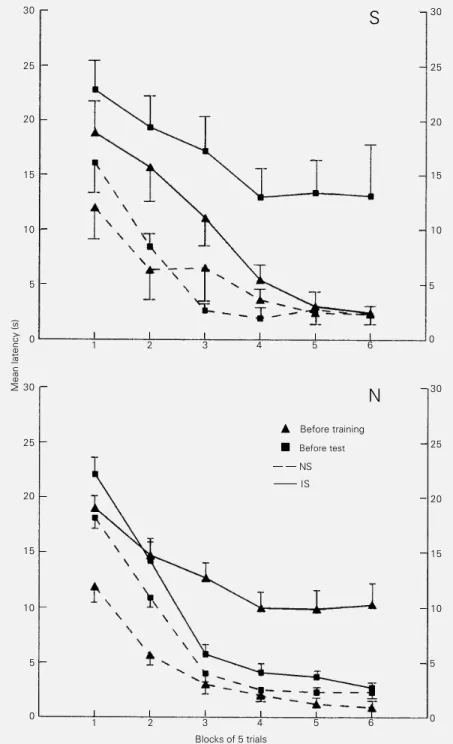
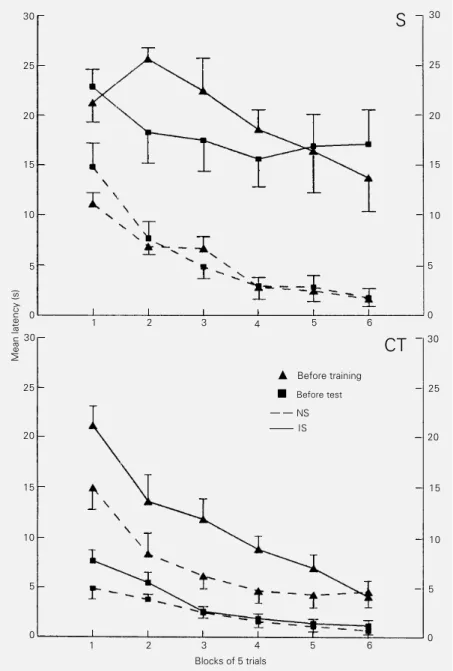
The escape deficit provoked by inescap-able shocks in the control groups (F (1,14) = 18.4 for the acute and F (1,14) = 19.2 for the chronic saline treatments) was reversed by naltrexone (Figure 1) as well as by the cross-tolerance to morphine induced before the test session (Figure 2). No statistically sig-nificant shock vs drug treatment interaction was observed. Similar to that observed for the treatments given before the training ses-sion, treating the animals before the test significantly decreased the mean latencies from the first to the last block of trials (P≤0.001 each: F (5,70) = 7.01 for acute saline-treated, F (5,70) = 6.9 for naltrexone-treated, F (5,70) = 9.4 for chronic saline-treated and F (5,90) = 16.6 for the cross-tolerance to morphine groups), indicating that the animals retained their ability to per-form the escape response.
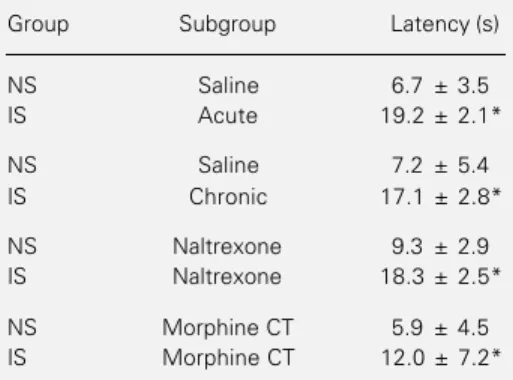
Kruskal-Wallis analysis of variance (KW = 39.8, P≤0.001) followed by Dunn’s test revealed that only the IS group showed anti-nociception soon after the shocks (P≤0.01 for the acute saline and P≤0.05 for chronic saline groups). This antinociception was not affected by the manipulation of the opiate system (P≤0.01 for naltrexone and P≤0.05 for morphine CT; Table 1).
Discussion
The LH model of depression (also known as “interference effect”) is defined on the basis of a statistically significant difference between the escape latencies of inescapably shocked animals and those of a non-shocked
Mean latency (s)
30 30
25
20
15
10
5
0
S
25
20
15
10
5
0
1 2 3 4 5 6
30 30
25
20
15
10
5
0
25
20
15
10
5
0
1 2 3 4 5 6
Blocks of 5 trials
£
Before trainingà Before test NS
IS
N
Figure 1 - Naltrexone reverses learned helplessness when administered before the test session. Data are reported as the mean escape latency (s) ± SEM for blocks of 5 trials for 6-17 rats in each group. The rats received either saline (0.9%, S) or naltrexone (8 mg/kg, N) before the training or test session and were given either inescapable (IS) or no shocks (NS) in a shuttle box.
group (control). Thus, the conclusion that an animal is (or is not) depressed under drug treatment requires that both the shocked and non-shocked groups are treated with the same drug of interest. This experimental design is routinely used in protocols involving drug administration (see for example, Ref. 25).
The present results indicate that expo-sure to inescapable shocks under the condi-tions used here produced an antinociceptive effect and substantial interference with the shuttle box escape learning 24 h later. These findings agree with those described in the pioneer work of Seligman and Maier (2) and also obtained in our laboratory using a dif-ferent protocol (20,21).
It has been postulated that the SIA ob-tained soon after a series of escapable shocks dissipates rapidly (a phenomenon known as short-term analgesia) and does not lead to the behavioral depression typical of learned helplessness. Short-term SIA is uncondition-able and cannot be induced by a brief re-exposure to inescapable shocks. Non-opiate mechanisms appear to be involved in this antinociception (7).
In contrast, opiate-mediated SIA is ob-tained after physically identical but inescap-able shocks. This antinociception is long-lasting, produces LH (8,10) and can be con-ditioned as well as reinstated after a brief re-exposure to inescapable shocks (also known as long-term reinstated analgesia). Opiates are involved in this antinociception (7). The stress protocol used in our experiments al-lowed us to observe the development of long-term, conditionable (21) hypoalgesia which was not affected by the manipulation of the opiate system before the training ses-sion. Since the classification of SIA as opi-ate- or non-opiopi-ate-dependent is based on its susceptibility to opiate blockade (7), the SIA obtained in our study can be considered to be non-opiate.
Since the opiate nature of long-lasting antinociception has been extensively stud-ied (5), it would be reasonable to suspect that
30 30
25
20
15
10
5
0
25
20
15
10
5
0
1 2 3 4 5 6
Mean latency (s)
S
30 30
25
20
15
10
5
0
25
20
15
10
5
0
1 2 3 4 5 6
CT
£
Before trainingà Before test NS
IS
Blocks of 5 trials
Figure 2 - Cross-tolerance to morphine prior to the test session reverses learned helpless-ness. Data are reported as the mean escape latency (s) ± SEM for blocks of 5 trials for 5-15 rats in each group. The rats were made cross-tolerant (CT) to morphine or received saline (0.9%, S) before the training or test session and were given either inescapable (IS) or no shocks (NS) in a shuttle box.
doses as high as 14 mg of naltrexone/kg and 3 mg of naloxone/kg. Such doses, however, do not always produce complete blockade of LH (11).
In contrast, our results demonstrate that LH was not affected by any of the manipula-tions designed to reduce the functioning of the opiate system. However, the manifesta-tion of LH induced under drug-free condi-tions could be blocked by these same ma-nipulations when they were applied immedi-ately before the test. A similar finding has been reported by others (13-15,26). The lat-ter phenomenon is mediated principally by opiate receptors in the brain since centrally, but not peripherally, administered naltrexone is able to block the manifestation of the escape impairment as well as the increase in nociceptive threshold produced by prior ex-posure to drug-free inescapable shocks (26). The intracerebroventricular administration of naltrexone before the test reduces the manifestation of both the LH escape deficit (27) and the conditioned opioid antinocicep-tion (28). Our demonstraantinocicep-tion of an opiate involvement agrees with the well established
fact that endogenous opiates participate in the manifestation of learned behavior by affecting retention and retrieval processes in a complex and profound manner (for a re-view, see 29). An effect on memory pro-cesses represents one of these pathways of interference.
Since opiate-mediated SIA is very sensi-tive to changes in the shock parameters, it would be reasonable to suspect that method-ological differences could explain the dis-crepancy between our observations and the results of others (11,12). We and others (11,12) have used the shuttle box escape latency to estimate the LH escape deficit. However, apart from the already discussed possible non-specific effect resulting from the use of high doses of antagonists by these authors (11,12), we have employed female rats which received a smaller number of shocks. The authors of the above two studies used 80 shocks which were applied either as inescapable tailshocks (11) or as footshocks (12). In this respect, it has already been shown that the number of inescapable shocks is a crucial variable in the manifestation of opiate-/non-opiate-mediated SIA. Specifical-ly, the transition from non-opiate SIA to opiate SIA occurs in the interval between 40 to 80 inescapable tailshocks (7). Sex is also recognized as being an important variable in the modulation of stress-induced opiate anti-nociception (30) and in the vulnerability of rats to the induction of depression (31), with females being more vulnerable than males.
The estrous cycle strongly influences the inhibition of pain (32), there being a strong increase in opiate antinociception during di-estrous. In addition, there are also differ-ences between sexes in the response to the persistent pain induced by the formalin test (33). Such differences can be explained by variations in the cerebral ß-endorphin con-centrations for which the levels are higher in females, particularly in the periaqueductal gray matter (34), a region known to be very important in the organization of defensive
Table 1 - Antinociception is not blocked by naltrexone.
The numbers indicate the mean tail-flick latency (± SD in s) observed soon after the training ses-sion. IS indicates rats receiving inescapable shocks and NS, non-shocked rats. Prior to train-ing, the rats received either 0.9% saline (acutely or chronically), or naltrexone (8 mg/kg) or were made cross-tolerant (CT) to morphine (10 mg/kg).
*P≤0.05 compared to the NS control group
(Dunns test). N = 8 rats per subgroup.
Group Subgroup Latency (s)
NS Saline 6.7 ± 3.5
IS Acute 19.2 ± 2.1*
NS Saline 7.2 ± 5.4
IS Chronic 17.1 ± 2.8*
NS Naltrexone 9.3 ± 2.9
IS Naltrexone 18.3 ± 2.5*
NS Morphine CT 5.9 ± 4.5
behavior, including the escape reaction and endogenous pain modulation (35). As stated above, the use of female rats in our study may have had a profound effect on the out-come of the results, particularly since our rats were possibly more resistant to the re-versal of depression and of the induced anti-nociception. In this regard, it is also possible that training may have resulted in the release of more ß-endorphin than did the test ses-sions. Our results further suggest that activa-tion by opiates is not absolutely necessary for the induction of LH in female rats. The learning of uncontrollability may activate a non-opiate system, thus leading to maniftation of the “interference effect” upon es-cape (2).
The results obtained above for non-opi-ate SIA associnon-opi-ated with non-opinon-opi-ate LH rein-force the idea that the LH and SIA produced by inescapable shocks are positively related (36). However, this relationship does not
mean that the two phenomena are necessar-ily coupled. Such a divergent association was originally suggested by MacLennan et al. (37) who observed that the selective block-ade of SIA by hypophysectomy and dexa-methasone administration did not affect the induction of the LH escape deficit.
We conclude that, under our experimen-tal conditions, the induction of the deficit in escape performance that is characteristic of the LH model of depression is not mediated, although its expression is opiate-modulated.
Acknowledgments
We are grateful to Dr. Stephen Hyslop, Department of Pharmacology, UNICAMP, for editorial assistance. We also thank Mr. Marcelo Kiyashi Nakamura for preparing the software program.
References
1. Weiss JM, Goodman PA, Losito BG,
Corrigan S, Charry JM & Bailey WH (1981). Behavioral depression produced by uncontrollable stressors: relationship to norepinephrine, dopamine and seroto-nin levels in various regions of the rat
brain. Brain Research Reviews, 3:
167-205.
2. Seligman MEP & Maier SF (1967). Failure
to escape traumatic shock. Journal of
Ex-perimental Psychology, 74: 1-9.
3. Anisman H, Zakman S, Shanks N &
Zacharko RM (1991). Multisystem regula-tion of performance deficits induced by stressors. An animal model of depression. In: Boulton A, Baker G & Martin Inverson
MT (Editors), Animal Models in Psychiatry
II. Human Press, Clifton, NJ, 1-61.
4. Willner P (1986). Validation criteria for
ani-mal models of human mental disorders: learned helplessness as a paradigm case. Progress in Neuropsychopharmacology and Biological Psychiatry, 10: 677-690.
5. Kelly D (Editor) (1986). Stress-induced
an-algesia. Annals of the New York Academy
of Sciences, 467: 1-449.
6. Amit Z & Galina ZH (1986). Stress-induced analgesia: adaptative pain suppression. Physiological Reviews, 66: 1091-1119. 7. Maier SF (1986). Stressor controllability
and stress-induced analgesia. Annals of
the New York Academy of Sciences, 467: 55-73.
8. Jackson RL, Coon DJ & Maier SF (1979). Long-term analgesic effects of
inescap-able shock and learned helplessness.
Sci-ence, 206: 91-94.
9. Maier SF & Watkins LR (1991). Condi-tioned and uncondiCondi-tioned stress induced analgesia: stimulus preexposure and
stimulus change. Animal Learning and
Be-havior, 19: 295-305.
10. Watkins LR, Cobelli PA & Mayer DJ (1982). Classical conditioning of front paw and hind paw footshock induced analge-sia (FSIA): naloxone reversibility and
de-scending pathway. Brain Research, 243:
119-132.
11. Drugan RC & Maier SF (1983). Analgesic and opioid involvement in the shock-elic-ited activity and escape deficits produced
by inescapable shock. Learning and
Moti-vation, 14: 30-47.
12. Hemingway RB & Reigle TG (1987). The involvement of endogenous opiate sys-tem in learned helplessness and
stress-induced analgesia. Psychopharmacology,
93: 353-357.
13. Whitehouse WG, Walker J, Margules DL & Bersh PJ (1983). Opiate antagonists overcome the learned effect but impair
competent escape performance.
Physiol-ogy and Behavior, 30: 731-734.
14. Hunziker MHL (1992). Opioid nature of learned helplessness and stress-induced analgesia observed without re-exposure
to shock. Behavioral Pharmacology, 3:
117-121.
15. Martin P, Soubrié P & Simon P (1986). Noradrenergic and opioid mediation of tri-cyclic-induced reversal of escape deficits caused by inescapable shock
pretreat-ment in rats. Psychopharmacology, 90:
90-94.
16. Besson A, Privat AM, Eschalier A & Fialip J (1996). Effect of morphine, naloxone and their interaction in the
learned-help-lessness paradigm in rats.
17. Sawynok J, Pinsky C & Labella FS (1979). Minireview on the specificity of naloxone as an opiate antagonist. Life Sciences, 25: 1621-1632.
18. Dingledine R, Iversen LL & Breuker R (1978). Naloxone as a GABA antagonist: evidence from iontophoretic, receptor
binding and convulsant studies. European
Journal of Pharmacology, 47: 19-27. 19. Drugan RC, Grau JW, Maier SF, Madden
J & Barchas JD (1981). Cross tolerance between morphine and the long-term an-algesic reaction to inescapable shock. Pharmacology, Biochemistry and Behav-ior, 14: 677-682.
20. Teixeira NA, Pereira DG & Hermini AH
(1995). Chronic but not acute Li+
treat-ment prevents behavioral depression in
rats. Brazilian Journal of Medical and
Bio-logical Research, 28: 1003-1007. 21. Teixeira NA, Pereira DG & Hermini AH
(1995). Lithium treatment prolongs
shock-induced hypoalgesia. Brazilian Journal of
Medical and Biological Research, 28: 791-799.
22. Hermini AH, Teixeira NA, Mendes VE & Pereira DG (1994). Development of a soft-ware to control depression experiments through the learned helplessness
model. Physics in Medicine and Biology,
39 (Part 1): 430 (Abstract).
23. DAmour FE & Smith DL (1941). A method for determining loss of pain sensation. Journal of Pharmacology and Experimen-tal Therapeutics,72: 74-79.
24. Hurwitz A (1987). Multiple comparison and nonparametric statistical tests on a
programmable calculator. Journal of
Phar-macological Methods, 17: 27-38. 25. Graeff EO, Hunziker MHL & Graeff FG
(1989). The effect of ipsapirone and Bay R
1531 on learned helplessness. Brazilian
Journal of Medical and Biological Re-search, 22: 1141-1144.
26. Whitehouse WG, Blustein JE, Walker J, Bersh PJ & Margules DL (1985). Shock controllability and opiate substrates of es-cape performance and nociception. Dif-ferential effects of peripherally and
cen-trally acting naltrexone. Behavioral
Neuro-science, 99: 717-733.
27. Blustein JE, Whitehouse WG, Calcagnetti DJ, Troisi JR, Margules DC & Bersh JP (1992). Reduction of learned helplessness by central administration of quaternary
naltrexone. Physiology and Behavior, 51:
1075-1078.
28. Calcagnetti DI, Helmstetter FJ & Fanselow MS (1987). Quaternary naltrex-one reveals the central mediation of
con-ditional opioid analgesia. Pharmacology,
Biochemistry and Behavior, 27: 529-531. 29. Izquierdo I & Netto CA (1985). Role of
ß-endorphin in behavioral regulation. Annals
of the New York Academy of Sciences, 444: 162-167.
30. Kepler KL, Standifer KM, Paul D, Kest B, Pastenak GW & Bodman RJ (1991). Gen-der effects and central opioid analgesia. Pain, 45: 87-94.
31. Kennett GA, Chaouloff F, Marcou M & Curzon A (1986). Female rats are more vulnerable than males in an animal model of depression: the possible role of
seroto-nin. Brain Research, 382: 416-421.
32. Ryan SM & Maier SF (1988). The estrous cycle and estrogen modulate
stress-in-duced analgesia. Behavioral
Neurosci-ence, 102: 371-380.
33. Aloisi AM, Albonetti ME & Carli G (1995). Effects of formalin pain on standard hole-board parameters in male and female rats. Medical Science Research, 23: 95-96. 34. Aloisi AM, Sacerdote P, Albonetti ME &
Carli G (1995). Sex-related effects on
be-haviour and ß-endorphin. Brain Research,
699: 242-249.
35. Graeff FG (1994). Neuroanatomy and neu-rotransmitter regulation of defensive be-haviors and related emotions in
mam-mals. Brazilian Journal of Medical and
Bio-logical Research, 27: 811-829.
36. Maier SF, Sherman JE, Lewis WG & Liebeskind JC (1983). The opioid, non-opioid nature of stress-induced analgesia
and learned helplessness. Journal of
Ex-perimental Psychology: Animal Behavior Processes, 9: 80-90.
37. MacLennan AJ, Drugan RC, Hyson RL & Maier SF (1982). Dissociation of long-term analgesia and the shuttle box escape
defi-cit caused by inescapable shock. Journal
of Comparative and Physiological